
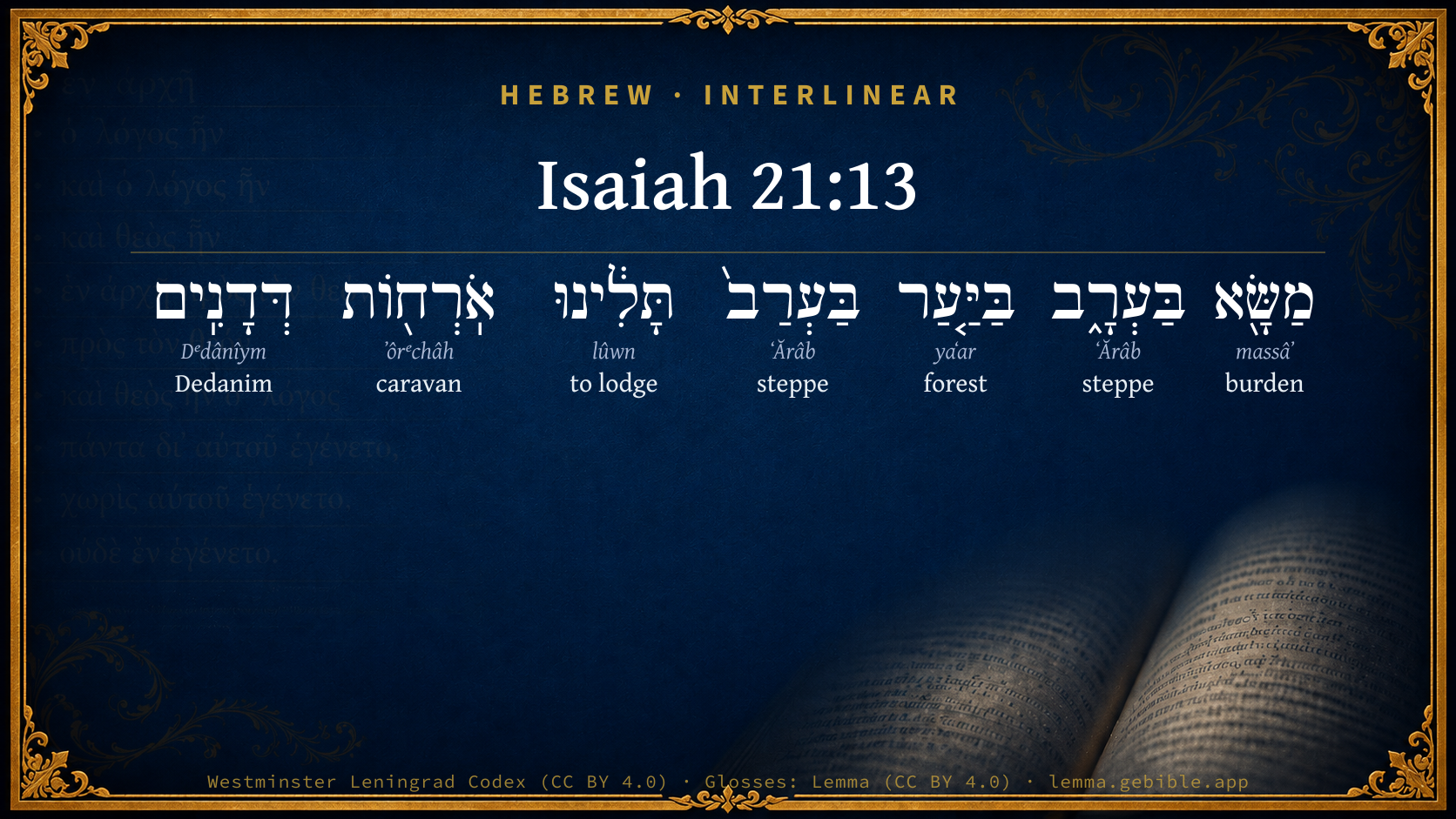
Isaiah 21:13

Hebrew (Westminster Leningrad Codex) Isaiah 21:13 appears in the Hebrew Old Testament. The text above is from the Westminster Leningrad Codex. Each word links to its Strong’s number, a concise gloss, and parsing drawn from the Open Scriptures Hebrew Bible morphology. Click any word for its full Brown-Driver-Briggs (BDB) entry.
Download image
Cite this verse

Isaiah 21:13 (World English Bible). Public Domain. Lemma interlinear Bible study tool, https://lemma.gebible.app/v/isaiah/21/13.

Show BibTeX & RIS
BibTeX
RIS
English Translation
The burden on Arabia. In the forest in Arabia shall you lodge, you caravans of Dedanites.
World English Bible · Public Domain
Highlights
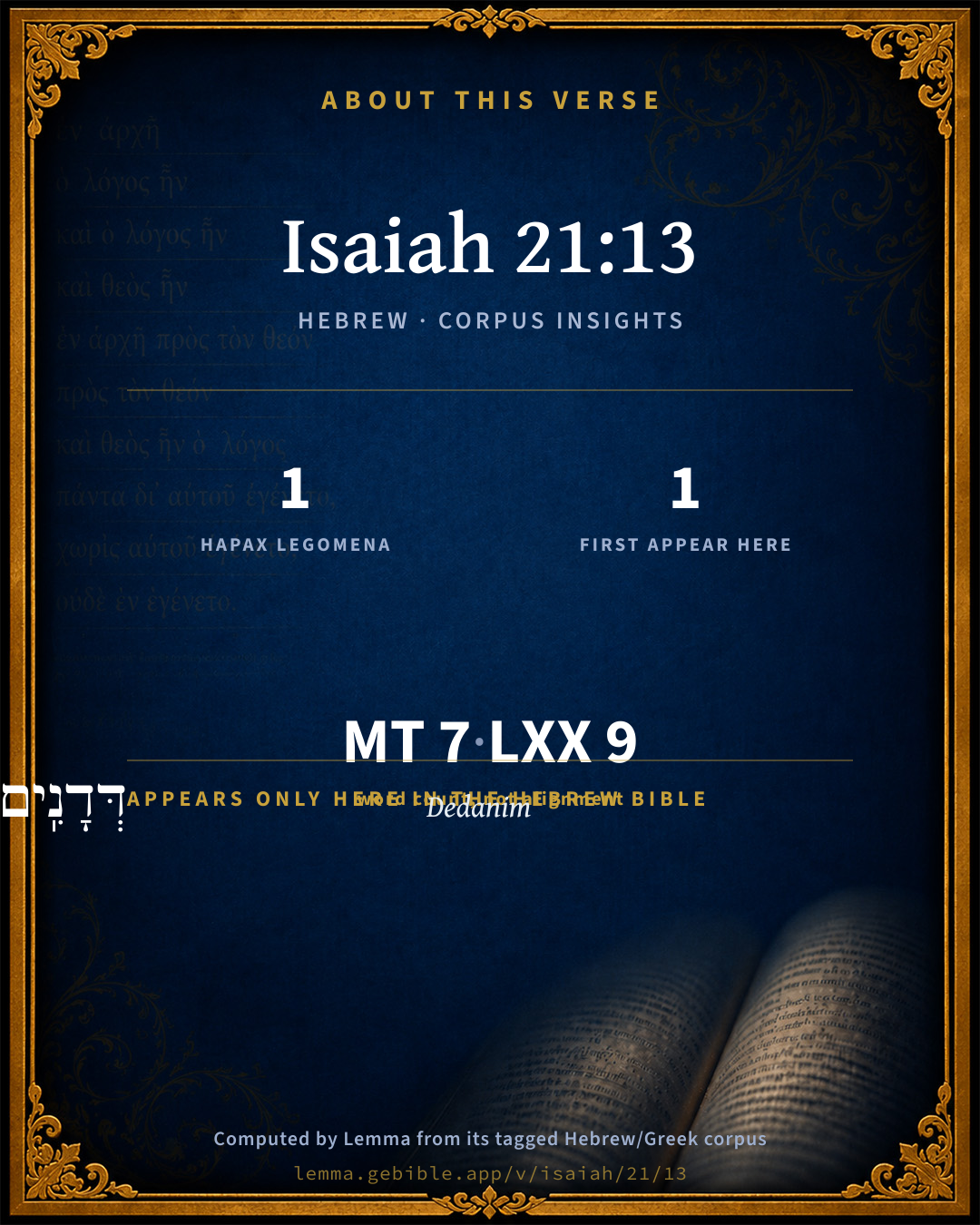
  • 1 hapax legomenon — only here in the Hebrew Bible
  • 1 first appearance in the Hebrew Bible
Full analysis ↓
Download a study sheet

One document with this verse’s original text, its word-by-word gloss line, the meaning frame, cross-references with their text, attributed commentary, and full source and license credits — printable, and it pastes into notes with its structure intact.

This verse Autodidact and up

Study sheet (.html) Plain text (.txt)

A passage Seminary Student

Up to 50 verses in one chapter. A passage sheet keeps up to 6 commentary sources and 12 cross-references per verse, in the order this page ranks them, and says so on the sheet whenever that leaves anything out. Ask for a single verse and you get the Autodidact verse sheet above.

Everything on this page stays free to read, with no account — the sheet is a download of what is already on screen, not access to it.

Want to remove ads? Support Godless Engineer
Compare translations 3

The same verse in 3 English versions, stacked beneath the original-language interlinear above. Click any original word for its lexicon entry.

Each is an independent rendering of the whole verse — the interlinear is not word-aligned to these translations.

Highlighted words mark where these versions differ — a whole-verse word diff, not a word-by-word alignment.

  • World English Bible Public Domain
    The burden on Arabia. In the forest in Arabia shall you lodge, you caravans of Dedanites.
  • King James Version Public Domain
    The burden upon Arabia. In the forest in Arabia shall ye lodge, O ye travelling companies of Dedanim.
  • unfoldingWord Literal Text CC BY-SA 4.0
    The burden against Arabia: In the thicket in Arabia you will lodge, caravans of Dedanites.

unfoldingWord Literal Text — © unfoldingWord, licensed CC BY-SA 4.0. Word-aligned USFM3 via Door43 (git.door43.org/unfoldingWord/en_ult).

Versions to compare (up to 4)

3 of 4 selected

Show all 18 translations

Every available English version of this verse, each an independent rendering of the whole verse.

  • World English Bible Public Domain
    The burden on Arabia. In the forest in Arabia shall you lodge, you caravans of Dedanites.
  • Berean Standard Bible Public Domain
    This is the burden against Arabia: In the thickets of Arabia you must lodge, O caravans of Dedanites.
  • Majority Standard Bible Public Domain
    This is the burden against Arabia: In the thickets of Arabia you must lodge, O caravans of Dedanites.
  • King James Version Public Domain
    The burden upon Arabia. In the forest in Arabia shall ye lodge, O ye travelling companies of Dedanim.
  • American Standard Version (1901) Public Domain
    The burden upon Arabia. In the forest in Arabia shall ye lodge, O ye caravans of Dedanites.
  • Revised Version (1885) Public Domain
    The burden upon Arabia. In the forest in Arabia shall ye lodge, O ye travelling companies of Dedanites.
  • Geneva Bible (1599) Public Domain
    The burden against Arabia. In the forest of Arabia shall yee tarie all night, euen in the waies of Dedanim.
  • Douay-Rheims (1899) Public Domain
    The burden in Arabia. In the forest at evening you shall sleep, in the paths of Dedanim.
  • Young's Literal Translation Public Domain
    The burden on Arabia. In a forest in Arabia ye lodge, O travellers of Dedanim.
  • Literal Standard Version CC BY-SA 4.0
    The burden on Arabia. You lodge in a forest in Arabia, || O caravans of Dedanim.
  • Unlocked Literal Bible CC BY-SA 4.0
    A declaration about Arabia. In the wilderness of Arabia you spend the night, you caravans of Dedanites.
  • unfoldingWord Literal Text CC BY-SA 4.0
    The burden against Arabia: In the thicket in Arabia you will lodge, caravans of Dedanites.
  • Darby Bible Public Domain
    The burden against Arabia. In the forest of Arabia shall ye lodge, [ye] caravans of Dedanites.
  • World Messianic Bible Public Domain
    The burden on Arabia. You will lodge in the thickets in Arabia, you caravans of Dedanites.
  • Webster's Bible Public Domain
    The burden upon Arabia. In the forest in Arabia shall ye lodge, O ye traveling companies of Dedanim.
  • Free Bible Version CC BY-SA 4.0
    A message about Arabia. Caravans from Dedan, spend the night in the bushes.
  • Bible in Basic English Public Domain
    The word about Arabia. In the thick woods of Arabia will be your night's resting-place, O travelling bands of Dedanites!
  • JPS Tanakh (1917) Public Domain
    The burden upon Arabia. In the thickets in Arabia shall ye lodge, O ye caravans of Dedanites.

Literal Standard Version (2020), Covenant Press — licensed CC BY-SA 4.0. Text via the HelloAO Bible API (eBible.org). Unlocked Literal Bible (unfoldingWord) — licensed CC BY-SA 4.0. Text via the HelloAO Bible API (eBible.org). unfoldingWord Literal Text — © unfoldingWord, licensed CC BY-SA 4.0. Word-aligned USFM3 via Door43 (git.door43.org/unfoldingWord/en_ult). Free Bible Version, Dr. Jonathan Gallagher — licensed CC BY-SA 4.0. Text via the HelloAO Bible API (eBible.org).

Word by word

More ways to search: Search by grammar → Find every occurrence → Compare this word →

Practice this passage: Drill this verse → Learn its vocabulary →

About this verse

These counts appear in no published source. They are computed here, from the morphology-tagged text and Lemma’s own curated glosses. What Lemma adds →

7
words
6
distinct lemmas
Prophets
section

Notable vocabulary

1 hapax legomenon — a word that appears only here in the entire Hebrew Bible:

  • דְּדָנִֽים Dedanim H1720

First appearance in Scripture

This word makes its first canonical appearance in the Hebrew Bible here:

  • דְּדָנִֽים Dedanim H1720

Shared distinctive vocabulary

אֹֽרְח֖וֹת caravan H736 occurs in 2 verses of the Hebrew Bible. Also found in:

Grammatical profile

  • 1 verb
  • 6 nouns

Verb forms

  • תָּלִ֔ינוּ Qal · Imperfect

Repetition

A word recurs within this verse — often emphatic in Hebrew:

  • בַּעְרָ֑ב steppe H6152 ×2

Hebrew & Septuagint length

In English translation the verse runs 16 words from the Hebrew and 15 from the Septuagint (LXX English) — closely comparable.

A rough comparison of the two English renderings, which tokenize alike — not a word-level alignment.

Word counts can differ between the Hebrew and the Greek without any difference in meaning — e.g. the Hebrew direct-object marker אֵת has no separate Greek word, and Greek often adds the article ὁ.

In the original languages it is 7 Hebrew tokens and 9 Greek tokens — but the two are counted differently (Hebrew bundles its prefixes and suffixes into one token; the Greek is in lemma form), so that isn’t a like-for-like length.

Cross-references

11

Topical passages linked to Isaiah 21:13 in the Treasury of Scripture Knowledge — connected by theme and wording, ordered by reader-vote popularity; previews shown in the World English Bible.

  • Jeremiah 25:23–24 Dedan, and Tema, and Buz, and all who have the corners [of their hair] cut off;
  • Genesis 25:3 Jokshan became the father of Sheba, and Dedan. The sons of Dedan were Asshurim, Letushim, and Leummim.
  • 1 Chronicles 1:32 The sons of Keturah, Abraham's concubine: she bore Zimran, and Jokshan, and Medan, and Midian, and Ishbak, and Shuah. The sons of Jokshan: Sheba, and Dedan.
  • Ezekiel 27:15 The men of Dedan were your traffickers; many isles were the market of your hand: they brought you in exchange horns of ivory and ebony.
  • 1 Kings 10:15 besides [that which] the traders [brought], and the traffic of the merchants, and of all the kings of the mixed people, and of the governors of the country.
  • 1 Chronicles 1:9 The sons of Cush: Seba, and Havilah, and Sabta, and Raama, and Sabteca. The sons of Raamah: Sheba, and Dedan.
  • Isaiah 13:1 The burden of Babylon, which Isaiah the son of Amoz did see.
  • Isaiah 13:20 It shall never be inhabited, neither shall it be lived in from generation to generation: neither shall the Arabian pitch tent there; neither shall shepherds make their flocks to lie down there.
  • Jeremiah 49:28–33 Of Kedar, and of the kingdoms of Hazor, which Nebuchadrezzar king of Babylon struck. Thus says Yahweh: Arise you, go up to Kedar, and destroy the children of the east.
  • Ezekiel 27:20–21 Dedan was your trafficker in precious cloths for riding.
  • Galatians 4:25 For this Hagar is Mount Sinai in Arabia, and answers to the Jerusalem that exists now, for she is in bondage with her children.

Cross-references courtesy of OpenBible.info (CC BY 4.0).

Hebrew and Greek witnesses Masoretic Hebrew ↔ Greek Septuagint

The same verse in the two great witnesses to the Old Testament, shown verse-for-verse.

These are two independent witnesses, not word-aligned to each other, and the Septuagint is shown in lemma (dictionary) form.

Hebrew Isaiah 21:13 Masoretic · Westminster Leningrad Codex

מַשָּׂ֖א בַּעְרָ֑ב בַּיַּ֤עַר בַּעְרַב֙ תָּלִ֔ינוּ אֹֽרְח֖וֹת דְּדָנִֽים

The burden on Arabia. In the forest in Arabia shall you lodge, you caravans of Dedanites.

World English Bible · Public Domain

Greek LXX Isaiah 21:13 Septuagint · lemma form

ἐν ὁ δρυμός ἑσπέρα κοιμάω ἐν ὁ ὁδός δαιδαν

You may lodge in the forest in the evening, or in the way of Daedan.

LXX2012 (modern English Septuagint) · Public Domain

On this verse, The Cambridge Bible for Schools and Colleges discusses the Septuagint’s reading. Read the note in Commentary ↓

Hebrew: Westminster Leningrad Codex (CC BY 4.0). Greek: Septuagint (public domain); English from LXX2012 (modern English Septuagint) (Public Domain). How the Septuagint differs from the Hebrew →

Targum (Aramaic paraphrase)

1

The Targum is the ancient Jewish Aramaic paraphrase of the Hebrew Scriptures — an interpretive translation, not the Hebrew text itself. Onkelos (literal) and Pseudo-Jonathan (expansive) render the Torah, and Jonathan the Prophets. Coverage is partial: where no permissively-licensed English translation exists for a verse, only the Aramaic is shown. This is verse-level text, not a word-by-word alignment to the Hebrew.

  1. Targum Jonathan Prophets (Joshua–Malachi)
    מַטַל כָּס דִלְוָט לְאַשְׁקָאָה יַת עֲרָבָאֵי בְּחוּרְשָׁא בְרַמְשָׁא יְבִיתִין שְׁיָרַת בְּנֵי דְדָן:

    The Burden Of Give The Arabians To Drink. In the forest, at even, the caravan of the sons of Dedan shall remain for the night.

    Targum Jonathan — Aramaic: “Mikraot Gedolot” (public domain). English: “Sefaria Community Translation” (CC0 1.0 (public-domain dedication)); “London "Chaldee Paraphrase," 1871” (public domain). Text via Sefaria.

Commentary

Notes on Isaiah 21:13 from classic Christian and Jewish commentators (each source and its license shown beneath its notes). The classic Christian expositions comment on the surrounding passage and are grouped to its opening verse, so a note may address several verses; the Jewish commentaries on the Tanakh (Rashi and others) are per-verse, so they appear only where the commentator wrote on this verse.

Lemma curates 59 commentaries, every one of them public domain or Creative Commons licensed, each selected and text-cleaned for this edition rather than reprinted as found. About our sources →

Matthew Henry's Commentary

Arabia was a large country, that lay eastward and southward of the land of Canaan. Much of it was possessed by the posterity of Abraham. The Dedanim, here mentioned (Isa 21:13), descended from Dedan, Abraham's son by Keturah; the inhabitants of Tema and Kedar descended from Ishmael, Gen 25:3, Gen 25:13, Gen 25:15. The Arabians generally lived in tents, and kept cattle, were a hardy people, inured to labour; probably the Jews depended upon them as a sort of a wall between them and the more warlike eastern nations; and therefore, to alarm them, they shall hear the burden of Arabia, and see it sinking under its own burden.

I. A destroying army shall be brought upon them, with a sword, with a drawn sword, with a bow ready bent, and with all the grievousness of war, Isa 21:15. It is probable that the king of Assyria, in some of the marches of his formidable and victorious army, took Arabia in his way, and, meeting with little resistance, made an easy prey of them. The consideration of the grievousness of war should make us thankful for the blessings of peace.

II. The poor country people will hereby be forced to flee for shelter wherever they can find a place; so that the travelling companies of Dedanium, which used to keep the high roads with their caravans, shall be obliged to quit them and lodge in the forest in Arabia (Isa 21:13), and shall not have the wonted convenience of their own tents, poor and weather-beaten as they are.

III. They shall stand in need of refreshment, being ready to perish for want of it, in their flight from the invading army: "O you inhabitants of the land of Tema!" (who probably were next neighbours to the companies of Dedanim) "bring you water" (so the margin reads it) "to him that is thirsty, and prevent with your bread those that flee, for they are objects of your compassion; they do not wander for wandering sake, nor are they reduced to straits by any extravagance of their own, but they flee from the sword." Tema was a country where water was sometimes a scarce commodity (as we find, Job 6:19), and we may conclude it would be in a particular manner acceptable to these poor distressed refugees. Let us learn hence. 1. To look for distress ourselves. We know not what straits we may be brought into before we die. Those that live in cities may be forced to lodge in forests; and those may know the want of necessary food who now eat bread to the full. Our mountain stands not so strong but that it may be moved, rises not so high but that it may be scaled. These Arabians would the better bear these calamities because in their way of living they had used themselves to hardships. 2. To look with compassion upon those that are in distress, and with all cheerfulness to relieve them, not knowing how soon their case may be ours: "Bring water to those that are thirsty, and not only give bread to those that need and ask it, but prevent those with it that have need; give it to them unasked." Those that do so shall find it remembered to their praise, as (according to our reading) it is here remembered to the praise of the land of Tema that they did bring water to the thirsty and relieved even those that were on the falling side.

IV. All that which is the glory of Kedar shall vanish away and fail. Did they glory in their numerous herds and flocks? They shall all be driven away by the enemy. It seems they were famous about other nations for the use of the bow in battle; but their archers, instead of foiling the enemy, shall fall themselves; and the residue of their number, when they are reduced to a small number, shall be diminished (Isa 21:17); their mighty able-bodied men, and men of spirit too, shall become very few; for they, being most forward in the defence of their country, were most exposed, and fell first, either by the enemies' sword or into the enemies' hand. Note, Neither the skill of archers (though they be ever so good marksmen) nor the courage of mighty men can protect a people from the judgments of God, when they come with commission; they rather expose the undertakers. That is poor glory which will thus quickly come to nothing.

V. All this shall be done in a little time: "Within one year according to the years of a hireling (within one year precisely reckoned) this judgment shall come upon Kedar." If this fixing of the time be of no great use to us now (because we find not either when the prophecy was delivered or when it was accomplished), yet it might be of great use to the Arabians then, to awaken them to repentance, that, like the men of Nineveh, they might prevent the judgment when they were thus told it was just at the door. Or, when it begins to be fulfilled, the business shall be done, be begun and ended in one year's time. God, when he please, can do a great work in a little time.

VI. It is all ratified by the truth of God (Isa 21:16); "Thus hath the Lord said to me; you may take my word for it that it is his word;" and we may be sure no word of his shall fall to the ground. And again (Isa 21:17): The Lord God of Israel hath spoken it, as the God of Israel, in pursuance of his gracious designs concerning them; and we may be sure the strength of Israel will not lie.

Matthew Henry's Commentary on the Whole Bible (1708–1710) — public domain (CC PDM 1.0). Text via the HelloAO Bible API.

Jamieson, Fausset & Brown

Robert Jamieson, A. R. Fausset & David Brown

PROPHECY THAT ARABIA WOULD BE OVERRUN BY A FOREIGN FOE WITHIN A YEAR. (Isa 21:13-17)

upon--that is, respecting.

forest--not a grove of trees, but a region of thick underwood, rugged and inaccessible; for Arabia has no forest of trees.

travelling companies--caravans: ye shall be driven through fear of the foe to unfrequented routes (Isa 33:8; Jdg 5:6; Jer 49:8 is parallel to this passage).

Dedanim--In North Arabia (Gen 25:3; Jer 25:23; Eze 25:13; Eze 27:20; a different "Dedan" occurs Gen 10:7).

Jamieson, Fausset & Brown — Commentary Critical and Explanatory on the Whole Bible (1871) — public domain (CC PDM 1.0). Text via the HelloAO Bible API.

The Cambridge Bible for Schools and Colleges

gen. ed. J. J. S. Perowne

13. The burden upon Arabia] The Oracle “In Arabia” (or, “In the evening”). The catchword of the heading is taken from the second word of the oracle. LXX. omits the title and in the text renders, with a different pointing, “in the evening,” which gives a good sense (Psa_30:5). The Massoretic reading may be translated “in Arabia” (Jer_25:24) or “in the desert,” although the word occurs nowhere else in this sense. Forest must here mean either “scrub” or (like the corresponding Arab. wa‘r) “rough, stony ground.”

travelling companies] caravans, as Gen_37:25.

Dedanim] Dedanites (R.V.). Dedan (Gen_10:7; Gen_25:3) was an important trading tribe of Arabia (Eze_27:20; Eze_38:13). Since it is mentioned in connexion with Edom (Jer_49:8; Eze_25:13), its possessions were probably somewhere near the north end of the Gulf of Akaba.

The oracle on Arabia, Isa_21:13-17

A vision (Isa_21:13-15) and its interpretation (Isa_21:16-17). A caravan of the merchant-tribe of Dedan is seen driven by stress of war from the regular route, and lurking in solitary places, destitute of food and water. The travellers are succoured by the hospitality of the neighbouring tribe of Tema (Isa_21:13-15). This vision symbolises a great destruction within a short time of the nomadic Arabs, purposed by Jehovah the God of Israel (16 f.). Here again positive indications of date are wanting. If the oracle belongs to the same group as the two which precede, the enemy would be the Persian conquerors of Babylonia, who are represented as attacking the Arabian caravans that traded under its auspices. A similar threat against Dedan forms part of a prophecy of Jeremiah against Edom in the time of Nebuchadnezzar (Isa_49:7 f.).

The Cambridge Bible for Schools and Colleges (gen. ed. J. J. S. Perowne; Cambridge University Press, 1878–1918) — public domain. Text from a community e-Sword module.

Trapp's Complete Commentary

John Trapp

Isa 21:13 The burden upon Arabia. In the forest in Arabia shall ye lodge, O ye travelling companies of Dedanim.

Ver. 13. The burden upon Arabia.] As a burden upon a beast. These Arabians or Hagarens had assisted, likely, Tihakah the Ethiopian against Sennacherib, and are therefore set upon by him. Sure it is they were enemies to the Church. {Psa 83:2-12}

In the forest shall ye lodge.] In the wide and wild woods, glad to lurk anywhere for safety - glad to quit your huts.

O ye travelling companies.] Ye troops of travellers.

John Trapp, A Commentary or Exposition upon All the Books of the Old and New Testament (1647–1656) — public domain. Text from a community e-Sword module.

Albert Barnes' Notes on the Bible

Analysis of Isa 21:13-17. - Vision 18. “Arabia.”

The remainder of this chapter is occupied with a single prophecy respecting Arabia. It was “probably” delivered about the time that the former was uttered - during the reign of Hezekiah, and before the invasion of Sennacherib. It had reference, I suppose, to Sennacherib; and was designed to foretell the fact that, either in his march to attack Judea, or on his return from Egypt, he would pass through Arabia, and perhaps oppress and overthrow some of their clans. At all events, it was to be fulfilled within a year after it was uttered Isa 21:16, and refers to “some” foreign invasion that was to conic upon their land. Rosenmuller supposes that it relates to the same period as the prophecy in Jer 49:28, following, and refers to the time when Nebuchadnezzar sent Nebuzaradan to overran the lands of the Ammonites, the Moabites, the Philistines, the Arabians, the Idumeans, and others who had revolted from him, and who had formed an alliance with Zedekiah.

The sentiment of the prophecy is simple - that within a year the country of Arabia would be overrun by a foreign enemy. The form and manner of the prophecy is highly poetic and beautiful. The images are drawn from customs and habits which pertain to the Arabians, and which characterize them to this day. In Isa 21:13, the prophecy opens with a declaration that the caravans that were accustomed to pass peacefully through Arabia would be arrested by the apprehension of war. They would seek a place of refuge in the forests and fastnesses of the land. Thither also the prophet sees the Arabians flocking, as if to exercise the rites of hospitality, and to minister to the needs of the oppressed and weary travelers. But the reasons why “they” are there, the prophet sees to be that “they” are oppressed and driven out of their land by a foreign invader, and “they” also seek the same places of security and of refuge Isa 21:14-15. All this would be accomplished within a year Isa 21:16; and the result would be, that the inhabitants of Arabia would be greatly diminished Isa 21:17.

Isa 21:13

The burden - (see the note at Isa 13:1).

Upon Arabia - (בערב ba‛ărâb). This is an unusual form. The title of the prophecies is usually without the ב (b) rendered ‘upon.’ Lowth supposes this whole title to be of doubtful authority, chiefly because it is missing in most MSS. of the Septuagint. The Septuagint connects it with the preceding prophecy respecting Dumab, and makes this a continuance of that. The preposition ב (b) - ‘upon,’ means here “respecting, concerning,” and is used instead of על ‛al as in Zec 9:1. Arabia is a well-known country of western Asia, lying south and southeast of Judea. It was divided into three parts, Arabia Deserta, on the east; Arabia Petrea, lying south of Judea; and Arabia Felix, lying still further south. What part of Arabia is here denoted it may not be easy to determine. It is probable that it was Arabia Petrea, because this lay between Judea and Egypt, and would be exposed to invasion by the Assyrians should they invade Egypt; and because this part of Arabia furnished, more than the others, such retreats and fastnesses as are mentioned in Isa 21:13-15.

In the forest - (ביער baya‛ar). The word (יער ya‛ar) ‘forest’ usually denotes a grove, a collection of trees. But it may mean here, any place of refuge from a pursuing foe; a region of thick underwood; an uncultivated, inaccessible place, where they would be concealed from an invading enemy. The word rendered ‘forest’ is commonly supposed to mean a forest in the sense in which that word is now used by us, meaning an extensive wood - large tract of land covered with trees. It is doubtful, however, whether the word is so used in the Bible. The Rev. Eli Smith stated to me that he had visited several of the places in Palestine to which the word (יער ya‛ar) ‘forest’ or ‘grove’ is given, and that he was satisfied that there never was a forest there in our use of the word. The same word יער ya‛ar - the י (y) not being used to begin a word in Arabic, but the ו (v) being used instead of it - occurs often in Arabic. It means, as used by the Arabs, a rough, stony, impassable place; a place where there are no roads; which is inaccessible; and which is a safe retreat for robbers - and it is not improbable that the word is so used here.

In Arabia - (בערב ba‛ărâb). The Septuagint, the Vulgate, and the Chaldee, understand this of the “evening” - ‘In the evening.’ The word ערב ‛ereb, with different points from those which the Masorites have used here, means “evening,” but there is no necessity of departing from the translation in our English version. The sense would not be materially affected whichever rendering should be preferred.

Shall ye lodge - Shall you pass the night. This is the usual signification of the word. But here it may be taken in a larger sense, as denoting that they would pitch their tents there, or that they would seek a refuge there. The sense I suppose to be this: ‘O ye traveling caravans of Dedan! Ye were accustomed to pass through Arabia, and to find a safe and hospitable entertainment there. But now, the Arabians shall be overrun by a foreign enemy; they shall be unable to show you hospitality, and to insure your safety in their tents, and for fear of the enemy still in the land you will be obliged to seek a lodging in the inaccessible thickets of the forests.’ The passage is intended to denote the “change” that had taken place, and to show the “insecurity” for caravans.

O ye traveling companies - Ye “caravans” (ארחות 'orechôt). This word usually signifies “ways, paths, cross roads.” But it is used here evidently to denote those who “traveled” in such ways or paths; that is, caravans of merchants. So it is used in Job 6:19 : ‘The caravans of Tema.’ It is well known that in the East it is usual for large companies to travel together, called “caravans.” Arabia Petrea was a great thoroughfare for such companies.

Of Dedanim - Descendants of “Dedan.” There are two men of this name mentioned in the Old Testament - the son of Raamah, the son of Cush, mentioned in Gen 10:7; and the son of Jokshan, the son of Abraham by Keturah Gen 25:3. The descendants of the latter settled in Arabia Petrea, and the descendants of the former near the Persian Gulf. It is not easy to determine which is here intended, though most probably those who dwelt near the Persian Gulf, because they are often mentioned as merchants. They dealt in ivory, ebony, etc., and traded much with Tyre Eze 27:21, and doubtless also with Egypt. They are here represented as passing through Arabia Petrea on their way to Egypt, and as compelled by the calamities in the country to find a refuge in its fastnesses and inaccessible places.

Albert Barnes' Notes on the Bible (1834–1885) — public domain. Text from a community e-Sword/MySword module.

The Biblical Illustrator

Joseph S. Exell

Isa_21:13-17

The burden upon Arabia

Arabia

The term Arabia, in the Old Testament, is not used in such a wide sense as in modern English, and denotes merely a particular, tribe, having its home in the northern part of what is now known as the Arabian peninsula, and mentioned in Eze_27:20-21, by the side of Dedan and Kedar as engaged in commerce with Tyre.

Isaiah lines a tide of invasion about to overflow the region inhabited by these tribes, and addresses the Dedanite caravans, warning them that they will have to turn aside from their customary routes and seek concealment in the forest. In verse 14, he sees in imagination the natives of Tema bringing food and water, to the fugitive traders. Tema was the name of a tribe settled in the same neighbourhood, about 250 miles S.E. of Edom, on the route between Damascus and Mecca, in a locality in which some interesting inscriptions have recently been discovered. Within a year, the prophet concludes, the glory of the wealthy pastoral (Isa_9:7) tribe of Kedar--here used so as to include by implication its less influential neighbours--will be past, and of its warriors only an insignificant remnant will survive. (Prof. S. R. Driver, D. D.)

The Bedawin

These were the carriers of the worlds commerce in the days before railways were introduced. As country after, country was feeling the consequences of the advance of Nineveh, these merchantmen would be the first to hear the news wire rearm, and in many cases to give timely assistance. But these weakly defended caravans would not stand long before the armies of Sargon. (B. Blake, B. D.)

The Biblical Illustrator, edited by Joseph S. Exell (c. 1880s–1900s) — public domain. Text from a community e-Sword module.

Joseph Benson's Commentary

Isa 21:13. The burden of Arabia — “While God revealed to his prophet the fate of foreign nations, among others he declares that of those Arabians who inhabited the western part of Arabia Deserta, or Petrea,” and bordered upon the Idumeans last mentioned. They are here termed the companies of Dedanim, being the descendants of Dedan, the son of Jokshan, the son of Abraham by Keturah; and travelling companies, because a great number of them used to travel together the same way, as now companies travelling together in those parts are called caravans. In saying, In the forest shall ye lodge, the prophet foretels that they should be driven into flight by the Assyrians, or that that populous country should be turned into a desolate wilderness.

Joseph Benson's Commentary on the Old and New Testaments (1811–1818) — public domain. Text from a community e-Sword module.

Lange's Commentary on the Holy Scriptures

C.—AGAINST ARABIA

Isa_21:13-17

13          The burden upon arabia.

In the forest10 in Arabia shall ye lodge,

O ye11 travelling companies of Dedanim.

14     The inhabitants of the land of Tema

12 Brought water to him that was thirsty,

They prevented with their bread him that fled.

15     For they fled13 from the swords,

From the drawn sword, and from the bent bow,

And from the grievousness of war.

16     For thus hath the Lord said unto me,

Within a year, according to the years of an hireling,

And all the glory of Kedar shall fail:

17     And the residue of the number of14 archers,

The mighty men of the children of Kedar,

Shall be diminished:

For the Lord God of Israel hath spoken it.

TEXTUAL AND GRAMMATICAL

Isa_21:13. בערב is ambiguous. Arabia is called עְַרַב; the pausal form is עְַרָב, which, except in pause, occurs only 2Ch_9:14. The second בערב is clearly the source of the first. In the same way “the desert of the sea,” Isa_21:1, and “the valley of vision,” Isa_22:2 (comp. Isa_21:5) have arisen. How else could we explain the prefix בְּ which in no other case stands after מַשָּׂא? It is doubtful how the second בערב was originally vocalized. The significations “in Arabia” and “in the evening,” are both suitable. The old versions give the latter. But the evening is never denoted by עְַרַב. Still it could be. The form would then come from עַָרב, “to be dark,” after the analogy of גְּבַר (once for גֶּבֶר Psa_18:26) etc.. The Prophet can have designedly employed the uncommon form instead of the usual עֶרֶב, in order to give the double sense of Arabia and evening, and perhaps to intimate that Arabia should be a land not of the rising, but of the setting sun.

Isa_21:14. הֵתָיוּ can be either perfect or imperative. But it must be taken here as perfect, as the next verb קִרְּמוּ is certainly perfect.

Isa_21:16. Mark the triple alliteration in this verse. First, we have three words beginning with א, then three beginning with שׁ, then three (or four) whose first letter is a k sound.

Isa_21:17. Mark the accumulation of substantives dependent on a noun in the construct state. No less than five words in the construct state occur together.

EXEGETICAL AND CRITICAL

1. Even the free pastoral and martial tribes of the Arabian desert must succumb to a power that crushes all before it. The Prophet vividly describes the fate of those tribes in his own peculiar way by setting before our eyes one effect of the pressure of the great worldly power. The caravans proceeding to the various chief emporiums of trade in ancient times, such as Tyre, Sidon, Babylon, were wont to cross the desert without molestation from mighty foes. But now a force assails them, against which they are unable to defend themselves, as they could against the attacks of the separate plundering tribes of Bedouins (comp. Movers,Phœn. II., p. 409). They are forced to give way, and are scattered. The fugitives seek shelter where they can find it. They are fortunate if, far from the regular route, in one of the oäses, or on a mountain slope, they can reach a wood which will conceal them from the eyes of their pursuers, and in which they can find pasture and shade for their cattle. Out of this wood they dare not venture. In order, therefore, that they may obtain subsistence, the inhabitants of the neighboring places must bring them bread and water (Isa_21:13-14). From this single circumstance it is easy to infer that the glory of the Arabians who bordered on Syria and Babylon, as whose representatives the Kedarenes are mentioned, is hastening to an end. Within the space of a year, says the Prophet, their power will be reduced to a minimum (Isa_21:16-17).

2. In the forest——of war.

Isa_21:13-15. I do not think that we should, as Wetzstein supposes, take יער in the sense of the Arabic war, i.e. a place covered with fragments of volcanic rock. For the Hebrew word never means anything else than forest. We are simply informed here that the caravans driven from their course sought shelter in some wood; and woods there actually are there, partly in the oäses, partly on the slopes of the western mountains. The forest conceals the fugitives, and at the same time furnishes shelter and pasture for the cattle. If they lodge (pass the night) in such a forest, it is a matter of course that evening has arrived. But the remark that the forest was situated in Arabia would likewise be superfluous. For if the occurrence happened in the neighborhood of Tema, that sufficiently indicates that the locality is in Arabia. But the expression בערב, as having the double meaning “in Arabia” and “in the evening,” is not superfluous. Dedan is according to Gen_10:7 (1Ch_1:9) a descendant of Cush; according to Gen_25:3 (1Ch_1:32) a grandson of Keturah also bears this name. In Jer_25:23 Dedan is named along with Tema. In Jer_49:8 they appear as belonging to Edom. And so in Eze_25:13. They are marked as a commercial people in Eze_27:15; Eze_27:20; Eze_38:13. Wetzstein (in his excursus in Delitzsch’s Commentary) finds their abode on the Red Sea, “east of the Nile, including the desert to the brook of Egypt or the borders of Edom.” He calls them Cushite tribes. However this may be, they are clearly enough denoted in the Old Testament as merchants, a people carrying on the caravan trade, especially with Tyre. If such a caravan has found in a forest shelter and pasture for the cattle, only bread and water for the men would be needed. At the dictate of hospitality the inhabitants of Tema bring these requisites to the fugitives in the forest. Wetzstein (as above) describes the situation of Tema (Jer_25:23; Job_6:19) after careful personal investigations. It lies, according to him, two days’ journey by dromedary from Dumah north-east of Tebûk, a station on the route for pilgrims from Damascus to Mecca. Dumah is marked by him as lying in the oäsis el-Gof, four days’ journey by dromedary to the southwest of Babylon. He maintains against Ritter that there are not two places called Tema. Isa_21:15 explains why the Dedanians must flee. War in every form, and with all its terrors, has assailed them.

3. For thus hath——spoken it.

Isa_21:16-17. What could be learned inferentially (Isa_21:13-15) from a single fact is now stated directly in general terms. Kedar’s might and glory must be destroyed. Kedar is, first of all, according to Gen_25:13, a son of Ishmael. But the name stands here, as very frequently in the later rabbinical usage, for the Arabs, i.e., for the inhabitants of Western Arabia, who alone were known to the Jews. In one year, exactly computed (comp. on Isa_16:14), the glory of Kedar shall have an end. As Isaiah beyond a doubt uttered this prediction, its fulfilment must have taken place while the might of Assyria flourished. We know generally that the Assyrians subdued the Arabians, for Sennacherib is called by Herodotus (II., 141) “King both of the Arabians and Assyrians,” and that while mention is made of his expedition against Egypt. This is not without significance. For when Herodotus states that Sennacherib as “King of the Arabians and Assyrians” attacked Egypt, he thereby gives us to understand that he marched against Egypt with an army composed of Arabians and Assyrians. And this fact tallies well with our remark on Isa_21:11-12, that the Assyrian in invading Egypt must have cared for the covering of his left flank and line of retreat. This object could be secured only by placing himself free from danger from the inhabitants of Arabia Petraea and Deserta. Our prophecy was therefore delivered before Sennacherib’s invasion of Egypt, which according to the Assyrian monuments, must have occurred in the year 700 B. C. (comp. Schrader,The Cuneiform Inscriptions and the Old Testament, p. 196). In accordance with what we have before observed touching the way in which prophecy advances to its complete fulfilment, it is not at all needful that the predicted catastrophe should have come upon the Arabians as a single stroke, which was not afterwards repeated. It would be sufficient to justify our regarding the prophecy as fulfilled, if in the specified time an event occurred, which was a proper beginning of the fulfilment of the prophecy, and therefore guaranteed its complete realization. We must confess that we cannot furnish direct evidence of such a particular event having taken place. The Kedarenes are here characterized as a warlike nation distinguished for the use of the bow. In this latter respect they walk in the footsteps of their ancestor, who is celebrated as an archer (Gen_21:20).

DOCTRINAL AND ETHICAL

1. On Isa_21:2 “God punishes one villain by means of another, and a man is punished by the very sin which he himself commits (Wis_11:17). Thus God punished the Babylonians by the Persians, the Persians by the Greeks, the Greeks by the Romans, the Romans by the Goths, Longobardi, and Saracens.”—Cramer. [The Persians shall pay the Babylonians in their own coin; they that by fraud and violence, cheating and plundering, unrighteous wars and deceitful treaties, have made a prey of their neighbors, shall meet with their match, and by the same methods shall themselves be made a prey of. Henry. D. M.].

2. On Isa_21:3. “The Prophets do not rejoice at the loss suffered by their enemies; but have sympathy for them as for men made in the image of God. We ought not to cast off every humane feeling towards our foes (Mat_5:34).”—Cramer.

3. On Isa_21:5. “Invadunt urbem vino somnoque sepultam.” Virgil. “We see here how people commonly feel the more secure, the more they indulge their fleshly lusts, although they are drawing nearer their punishment. So was it with the antediluvian world, so is it now also in these last times when the coming of Christ is expected, as He says, Mat_24:38.”—Renner. The Prophet Isaiah expounded, etc.—Stuttgart, 1865, p. 73.

4. On Isa_21:6 sqq. “It is a grand, infallible evidence of the prophetic Scriptures, and of their divine inspiration, that they do not speak in general uncertain terms, but describe future things so accurately, and exactly, as if we saw them before our eyes. This serves to establish the authority of the Holy Scriptures.”—Cramer.

5. On Isa_21:10. Only what the Lord said to him, and all that the Lord said to him, the Prophet declares. Therefore he is sure and certain, even when he has incredible things to announce. Therefore is he firm and courageous, though what he has to proclaim does not please the world. He conceals and keeps back nothing; neither does he add anything. He is a faithful declarer of the mind of God, and does not spare even himself. The proof, fulfilment and accomplishment he leaves to Him who spake through him.

6. On Isa_21:11. “He who sets the watch without God, watches in vain (Psa_127:1). And when God Himself is approaching, then no care of the watchmen is of any use, whether it be day or night. For when the day of the Lord begins to burn, even the stars of heaven and his Orion, do not shine brightly. For God covers the heavens, and makes the stars thereof dark, and covers the sun with a cloud (Eze_32:7). For when God the Creator of all things frowns on us, then all creatures also frown on us, and are terrible and offensive to us.”—Cramer. From this place Christian Friedr. Richter, has composed his fine morning hymn:—

Hüter, wird die Nacht der Sünden

Nicht verschwinden?

[Comp. in English Bowring’s well-known hymn:—

Watchman, tell us of the night,

What its signs of promise are.—D. M.]

7. On Isa_21:14. “We ought not to forget to be hospitable towards the needy (Heb_13:1).”—Cramer.

8. On Isa_21:16. “I regard as a true Prophet him who does not declare a matter upon mere imagination and conjecture, but measures the time so exactly that he fixes precisely when a thing shall happen.”—Cramer.

9. On Isa_22:2 sqq. To see the enemy at the gates, and at the same time to regard him merely with curiosity, and to indulge in mirth and jollity, as if all were well, and this too at a time when God’s servants warn men with tears, as Isaiah did Jerusalem (Isa_22:4), this is blind presumption which God will punish. But when the calamity has burst upon them, and all expedients by which they try to avert it are of no avail, for men to despise then the only one who can help them, and to spend the brief remaining time in sensual pleasure, this is open-eyed defiance, and will lead to judicial blindness, and that sin which will not be forgiven (Mat_12:32).

10. On Isa_22:13. This is the language of swine of the herd of Epicurus, comp. Isa_56:12; Wis_2:6 sqq.; 1Co_15:32.

11. On Isa_22:14. It is true, as Augustine says, that “no one should despair of the remission of his sin, seeing that even they who put Christ to death obtained forgiveness,” and “the blood of Jesus Christ was so shed for the forgiveness of all sins that it could wash away the sins of those by whom it was shed”—but that obstinacy, which refuses to see the needed help, excludes itself from grace and forgiveness.

12. On Isa_22:15 sqq. The mission which Isaiah here receives, reminds us strongly of that which Jeremiah had to discharge towards Jehoiakim (Jer_22:1 sqq., esp. Isa_22:19), and also of what he was obliged to say to Pashur (Isa_20:6). A Prophet of the Lord must show no respect of persons. Isaiah indeed seems to have produced the desired effect; for we find 36 and 37. Shebna as Scribe and Eliakim as steward of the house. But Jeremiah received as recompense for the fulfilment of his mission bitter hatred and cruel persecution.

13. On Isa_22:17. The Vulgate translates here: Ecce Dominus asportari te faciet, sicut asportatur gallus gallinaceus. And Jerome in his exposition says: “Hebraeus, qui nos in lectione veteris Testamenti erudivit, gallum gallinaceum transtulit. Sicut inquit gallus gallinaceus humero portatoris de allo loco transfertur ad alium, sic te Dominus de loco tuo leviter asportabit.” The cock which is never mentioned in the Old Testament, and for which we have no genuine Hebrew word, is in fact called גֶּבֶר by the Talmudists. “Conscience, wanting the word of God, is as a ball rolling on the ground, and cannot rest.”—Luther.

14. On Isa_22:19. “Service at court is not in itself to be condemned, and a good ruler and a worthy prime minister are the gift of God (Sir_4:8; Sir_4:11; Ch. 10). Let him therefore who is called to such an office abide, as the Lord has called him (1Co_7:17), and beware of excessive pomp. For God can quickly depose the proud.”—Cramer.

15. On Isa_22:21 sqq. The comparison of a magistrate in high position with a father is very appropriate. The whole extent, and the proper measure of a ruler’s power are involved in this similitude. The authority of a father and that of a ruler have a common root in love. Eliakim in having the keys of the house of David laid on his shoulder that he might open and no one shut, and shut and no one open is (Rev_3:7) viewed as a type of Christ, who is the administrator appointed by God over the house of David in the highest sense, i. e., over the kingdom of God. Christ has this power of the keys in unrestricted measure. The ministers of the Lord exercise the same only in virtue of the commission which they have from Him; and their exercise of it is only then sanctioned by the Lord, when it is in the Spirit which the Lord breathed into the disciples before He committed to them the power of the keys (Joh_20:22 sq.). [“The application of the same terms to Peter (Mat_16:19) and to Christ Himself (Rev_3:7) does not prove that they here refer to either, or that Eliakim was a type of Christ, but merely that the same words admit of different applications.” Alexander. “It is God that clothes rulers with their robes, and, therefore, we must submit ourselves to them for the Lord’s sake and with an eye to Him (1Pe_2:13). And since it is He that commits the government into their hand,—they must administer it according to His will, for His glory. And they may depend on Him to furnish them for what He calls them to; according to the promise here. I will clothe him: and then there follows, I will strengthen him.” After Henry—D. M.]

16. On Isa_22:25. “No one is so exalted or raised to such high dignity as to abide therein. But man’s prosperity, office and honor, and whatever else is esteemed great in the world are, like human life, on account of sin inconstant, vain and liable to pass away. This serves as an admonition against pride and security.” Cramer.

HOMILETICAL HINTS ON 21–22

1. On Isa_21:1-4. God’s judgments are terrible, 1) for him on whom they fall; 2) for him who has to announce them.

2. On Isa_21:6-10. The faithful watchman. 1) He stands upon his watch day and night. 2) He announces only what he has seen and what he has heard from the Lord (Isa_22:9-10). 3) But he announces this as a lion, i. e. aloud and without fear.

3. On Isa_22:11-12. The spiritual night on earth. 1) It is a. a night of tribulation, b. a night of sin. 2) It awakens a longing for its end. 3) It does not entirely cease till the Lord “vouchsafes to us a happy end, and graciously takes us from this valley of weeping to Himself in heaven.”

4. On Isa_21:14 sq. We may fitly employ this text for a charity sermon on any occasion when an appeal is made to the benevolence of the congregation (especially for exiles, as those banished from the Salzburg territory for their Evangelical faith). What we ought to consider when our contributions are asked. 1) Our own situation (we dwell in the land of Tema, a quite fertile oasis). 2) The situation of those who come to us in their distress. 3) What we have to give them.

5. On Isa_22:1-7. Warning against thoughtlessness. Pride precedes a fall. Blind presumption is often changed into its opposite.

6. On Isa_22:8-14. Blind presumption is bad, but open-eyed obstinacy is still worse. The latter is when one clearly perceives the existing distress, and the insufficiency of our own powers and of the means at our command, and yet refuses to look to Him who alone can help, or to consider the fate which awaits those who die without God, and seeks before the impending catastrophe happens to snatch as much as possible of the enjoyments of this world.

7. On Isa_22:15-19. He who will fly high is in danger of falling low. God can easily cast him down. The waxen wings of lcarus. Shebna illustrates, 1Pe_5:5.

8. On Isa_22:20-25. A mirror for those in office. Every one who has an office, ought 1) to be conscious that he has come into the office legally, and according to the will of God; 2) He ought to be a father to those over whom he is set; 3) He ought so to do everything which he does in his office, that its justice is apparent, and that no one can impugn it. 4) He ought not to be like a nail on which all the relations of his family strive to fasten their hope of success; for that is bad for himself and for those who would so abuse his influence.

Footnotes:

[10]in the evening.

[11]caravans.

[12]Or, Bring ye.

[13]Heb. from the face of.

[14]Heb. bows.

Lange's Commentary on the Holy Scriptures (Critical, Doctrinal, and Homiletical), ed. John Peter Lange, English translation edited by Philip Schaff (1864–1880) — public domain. Text from a community e-Sword module.

Tyndale Open Study Notes

Tyndale Open Resources

21:13-17 Cp. Jer 49:28-33.

21:13 Dedan was a tribe in Arabia (see Ezek 27:20; 38:13). • Caravans would hide in the deserts of Arabia from attacks by the Assyrians and Babylonians, both of whom harassed the Arabian tribes (see Isa 21:1-10; Jer 49:28-29).

Tyndale Open Study Notes — © Tyndale Open Resources, licensed CC BY-SA 4.0. Text via the HelloAO Bible API.

Geneva Bible (1599)

Geneva Bible translators

For fear, the Arabians shall flee into the woods, and he appointeth what way they shall take.

Geneva Bible (1599) marginal notes — public domain. Text via Bolls.life.

Adam Clarke's Commentary

Verse 13. The burden upon Arabia - "The oracle concerning Arabia"] This title is of doubtful authority. In the first place, because it is not in many of the MSS. of the Septuagint; it is in MSS. Pachom. and I. D. II. only, as far as I can find with certainty. Secondly, from the singularity of the phraseology; for משא massa is generally prefixed to its object without a preposition, as משא בבל massa babel; and never but in this place with the preposition ב beth. Besides, as the word בערב baarab occurs at the very beginning of the prophecy itself, the first word but one, it is much to be suspected that some one, taking it for a proper name and the object of the prophecy, might note it as such by the words משא בערב massa baarab written in the margin, which he might easily transfer to the text. The Septuagint did not take it for a proper name, but render it εν τῳ δρυμῳ ἑσπερας, "in the forest, in the evening," and so the Chaldee, which I follow; for otherwise, the forest in Arabia is so indeterminate and vague a description, that in effect it means nothing at all. This observation might have been of good use in clearing up the foregoing very obscure prophecy, if any light had arisen from joining the two together by removing the separating title; but I see no connexion between them. The Arabic Version has, "The prophecy concerning the Arabians, and the children of Chedar."

This prophecy was to have been fulfilled within a year of the time of its delivery, see Isa 21:16; and it was probably delivered about the same time with the rest in this part of the book, that is, soon before or after the 14th of Hezekiah, the year of Sennacherib's invasion. In his first march into Judea, or in his return from the Egyptian expedition, he might perhaps overrun these several clans of Arabians; their distress on some such occasion is the subject of this prophecy. - L.

Adam Clarke's Commentary on the Bible (1810–1826) — public domain. Text from a community e-Sword/MySword module.

Ellicott's Commentary for English Readers

(13) The burden upon Arabia.—Better, of the evening land. Here, again, the prophet alters the form of the word (Arab into Ereb) so as to convey a mystic meaning. The land of which he is about to speak is a land of shadow and of gloom. Evening is falling on it. It is a question whether the second Arabia is to retain its geographical form or to be translated “evening,” as before. In any case, of course, Arabia is the country spoken of. The “Dedanites” appear in Jer_49:8; Eze_25:13, and seem from Eze_27:15 to have been dwelling in the neighbourhood of the Edomites (Jer_49:8) as a commercial people trading with Tyre in ebony and ivory. The point of the oracle against them is that they shall be compelled by the presence of the Assyrian armies to leave the main lines of their traffic, probably, as before, on their way westward to Tyre, and to take bye-paths, pitching their tents not near towns and villages, but in the low brushwood of the wilderness.

A Bible Commentary for English Readers, edited by Charles John Ellicott (1878–1897) — public domain. Text from a community e-Sword module.

John Gill's Exposition

The burden upon Arabia,.... Which lay heavy upon it, as a burden upon a beast; or "concerning" it, or "against" it, as Kimchi notes; which Arabia, or what part thereof, is meant, may be gathered from the names after mentioned. The Targum is,

"the burden of the cup of cursing, to give the Arabians to drink.''

Ben Melech says, these are the Arabians that dwell in the wilderness:

in the forest in Arabia shall ye lodge; not in their tents and huts, which they had used to carry with them, and set up where they pleased; since now in their fright and flight they would leave them behind them, and so be obliged to take up their lodging in woods and forests; perhaps the desert of Arabia Petraea is meant:

O ye travelling companies of Dedanim; or Dedanites; these were Arabians that descended from Jokshan, a son of Abraham by Keturah, Gen 25:3 who were either shepherds, who went in companies together with their flocks, and moved from place to place for the sake of pasture; or rather were merchants, who went in caravans and troops with their merchandise from one country to another; see Eze 27:15 and who, because of the ravages of the enemy, would be glad of a lodging in the woods for security.

John Gill's Exposition of the Whole Bible (1746–1763) — public domain (CC PDM 1.0). Text via the HelloAO Bible API.

Haydock's Catholic Bible Commentary

Arabia. This sentence is not in the Roman (Calmet) or Alexandrian Septuagint, (Haydock) and Dedan is a city of Idumea. (Calmet) --- The Israelites are threatened. (Worthington)

George Leo Haydock (1774–1849), Haydock's Catholic Family Bible and Commentary, 1859 edition — public domain. Excludes Psalms (Douay-Rheims chapter numbering differs from Protestant) and Deuterocanonical books (Catholic canon only).

Matthew Poole's English Annotations

In the forest; not as you used to do, in the houses or tents of the Arabians; whereby he implies that that populous country should be turned into a desolate wilderness.

Travelling companies: in those parts travellers then did and still do go together in companies. See Gen 37:25,28; Job 6:19.

Dedanim; or, Dedamites; of whom see on Gen 25:3; Jer 25:23; 49:8. These were merchants, and used to trade with Tyre, Eze 27:20; 38:13, and their way lay through the same parts of Arabia.

Matthew Poole's English Annotations on the Holy Bible (1683–1685) — public domain. Text from a community e-Sword/MySword module.

Dummelow's Commentary on the Holy Bible

J. R. Dummelow

Judgment upon Arabia

This section concerns the N. Arabian tribes. For the occasion see prefatory note on Isa_21:11, Isa_21:12.

13-17. Owing to the incursions of the As Syrians the Dedanite caravans must take to flight, and other Arabian tribes shall share their fate.

13. In the forest, etc.] The trading caravans must turn from their route and hide themselves because of the invasion. Arabia] in OT. denotes the N. part of what we call Arabia.

Dedanim] a tribe dwelling near Edom (Eze_27:15).

14. The Edomites (inhabitants of.. Tema) succour the fugitives. Prevented, etc.] RV 'did meet the fugitives with their bread.'

16. According to the years, etc.] see Isa_16:14. Kedar] a general name for the tribes of N. Arabia (Psa_120:5).

17. The forecast was fulfilled in the victories over the Arabian tribes by Sargon and Sennacherib, as related in their inscriptions.

J. R. Dummelow, A Commentary on the Holy Bible (Macmillan, 1909) — public domain. Text from a community e-Sword module.

Whedon's Commentary on the Bible

Daniel D. Whedon

13-15. Burden upon Arabia — On critical grounds, both Ewald and Delitzsch make it doubtful that Arabia, as a whole, is meant, but rather think that the oracle relates to the sandy desert, the Arabah, the region over which the ancient caravan trade was carried. Their opinion is not simply plausible, it is reasonable. It is still Arabia, though a specific part. The caravans are called Dedanim, a mixture of Cushites and Ishmaelites. Their roads or camel routes to and from Tyre, and probably Gaza, are invaded by a foreign force, possibly the Assyrian, in its foraging parties, as the army passes toward Egypt or toward Tyre; and the caravans are dispersed from their accustomed track of travel far out into inhospitable deserts.

Forest — Forests, properly so-called, do not exist in Arabia. In wide and moist wadies thickets grow, and in these the caravans could conceal themselves when pursued.

Daniel D. Whedon (gen. ed.), Commentary on the Old and New Testaments (1874–1909) — public domain. Text from a community e-Sword module.

The Pulpit Commentary

Vers. 13-17. THE BURDEN OF ARABIA. Edom will have companions in misfortune among the Arab tribes upon her borders, Dedan, Tema, and Kedar. War will enter their territory, derange their commerce (ver. 13), cause flight and privation (vers. 14, 15), and within a year greatly diminish the number of their fighting men (vers. 16, 17). The date of the prophecy is uncertain, but can scarcely be earlier than B.C. 715, when Sargon made an expedition into Arabia (O. Smith, "Eponym Canon," p. 66).

The burden upon Arabia; rather, in Arabia. The phrase is varied from its usual form, probably because it is not Arabia generally, but only certain of the more northern tribes, on whom calamity is about to fall. In the forest... shall ye lodge. The word used is commonly translated "forest;" but Arabia has no forests, and the meaning hero must be "brushwood." Thorny bushes and shrubs are common in all parts of Arabia. The general meaning is that the caravans will have to leave the beaten track, and obtain such shelter and concealment as the scanty brushwood of the desert could afford. Ye traveling companies of Dedanim. The Dedanim, or Dedanites, were among the chief traders of the Arabian peninsula. They had commercial dealings with Tyre, which they supplied with ivory, ebony, and "precious clothes for chariots". (Eze_27:15, Eze_27:20) This trade they carried on by means of large caravans the "travelling companies" of the present passage. They are thought to have had their chief settlements on the shores of the Persian Gulf, where the island of Dadan may be an echo of their name.

Vers. 13-16. The tribes of Arabia.

I THE FATE OF THE DEDANITES. Their caravans must hide in the thorn-bushes away from the beaten track. These Dedanites belong to Edom. (Jer_49:8 Eze_25:13) They were merchants, and among others traded with wealthy Tyre. (Eze_27:15) And probably the meaning is that when on their way from Tyre they would be compelled to camp in the desert, because of the wide spreading war from north to south.

II THE SYMPATHY OF THE PROPHET. He calls the people of Tema to supply the thirsty and hungry fugitives with water and with bread. Tema lay on the route between Palmyra and Petra. The tribe was among the descendants of Ishmael. In these sad scenes the light of human kindness in the heart of the prophet, reflected in the picture of Temanite hospitality, shines forth. "These are the precious balsam-drops That woeful wars distil.

Hospitality is still found in generous flow among the Arabs of these regions, and reminds the wayfarer how near God is to man in the most desolate places. Wherever there is a loving human heart, there indeed is a fount and an oasis in life"s desert. And this scene reminds us how good comes out of evil, even the bitterest; the sight of the flying warriors, showing the bent bow and the wave of war, touches the spring of sympathy and mercy in yonder wild hearts.

III THE PROPHECY OF DOOM. In a year, "as the years of a hireling," i.e. swiftly, certainly, without delay, and without time of grace, Kedar"s glory shall be at an end, the powerful tribes of nomad archers will be reduced to a remnant. Those tents, "black but comely," of which the bard of the Canticles sang (1:5), those splendid flocks, and the famed rams of Nebaioth," shall disappear, or melt down to a fraction of the former numbers. So again the night sets on Edom, after a brief dawn.

IV THE WORD OF THE GOD OF ISRAEL.

1. These events were to happen by Divine appointment.

2. The God of Israel is the true God.

Let us take the saying to heart, amidst all that is most saddening in the fates of nations and institutions, "God hath done it, God hath said it." The true God who revealed himself to the fathers, and manifested himself to men in Christ, is the Being whose will is made known in the course of history. And amidst his heaviest punishments we have this consolation, that he chastises gently, and does not "give men over to death". J (Psa_118:18)

Vers. 13-17. Our ills and their remedies.

In this "burden" upon Arabia we may detect a picture or, at least, find a suggestion of

I THE ILLS TO WHICH FLESH IS HEIR.

1. Being turned out of our course. The caravans of Dedan are obliged to forsake their track and find refuge in the forests or stony retreats of the desert (ver. 13). Continually are we compelled to change our route as travelers along the road of life. We mark out our course and set out on our way, but the irresistible obstacle is confronted and we are obliged to deviate into some other track, or wait in hope until the hindrance be removed.

2. Being straitened for the necessities of life. The refugees are reduced to such straits that they are glad to receive the bread and water which "the inhabitants of the land of Tema" bring (ver. 14). Though God has made this earth to be large and bountiful enough for a vastly greater population thou even now exists upon it, yet, chiefly owing to human folly or iniquity, though sometimes to misfortune, men are reduced to such extreme hardship that the common necessaries are beyond their reach. Between this exigency and the condition of competence, how many degrees of want, and how many thousands of the children of want, are there to be found!

1. Being assailed and pursued by the enemies of our spirit. (Ver. 15.) There are adverse powers from beneath the "principalities and powers" of the kingdom of darkness; there are hostile powers that are around us

2. unprincipled and ungodly men, evil practices and harmful institutions in society; but our worst foes are those which are "of our own household," those that are within the chambers of our own souls bad habits, evil propensities, those inclinations toward folly and sin which pursue us even when the main battle has been fought and won.

3. Finding our life oppressive and burdensome to us. "According to the years of a hireling" (ver. 16). The time thus counted is reckoned with extreme carefulness; there is no danger that a single day will be left untold. The hireling is impatient for the time to be past that he may lay down the yoke and receive his wage. How many are there to whom life is so much of a burden, who are so oppressed by toil, or weighed down with care, or overwhelmed by sorrow, that they look gladly, if not eagerly, forward to its evening hour, when the night of death will release them from their struggle!

4. Being distinctly and at length fatally enfeebled. "The glory of Kedar shall fail," the bowmen and the mighty men "be diminished" (vers. 16, 17). Up to a certain point human life means, not only enjoyment, but increase; from that point it means diminution at first unconscious, but afterwards sensible and painful; at length fatal diminution in the capacity for enjoyment, in intellectual grasp, in physical endurance, in force of character. The glory of life goes; the faculties of soul and of body are palpably diminished; death draws near. Bat we may take into our view

II DIVINELY PROVIDED REMEDIES.

1. Pursuing the straight path to the goal which is set before us, from which no enemy need make us turn aside.

2. Trusting in the faithful Promiser.

3. Hiding in the pavilion of Divine power, and securing the mighty aid of the Divine Spirit.

4. Seeking and finding the comfort of the Holy Ghost.

5. Awaiting the immortal youth of the heavenly land. C.

The Pulpit Commentary (1880–1919), ed. H.D.M. Spence-Jones & Joseph S. Exell — public domain. Text from a community e-Sword module.

John Wesley's Explanatory Notes

Forest - Not as you used to do, in the houses or tents of the Arabians: whereby he implies, that that populous country should be a wilderness. Companies - In those parts travelers then did, and still do, go together in companies. Dedanim - These were merchants, who used to trade with Tyre, and their way lay thro' Arabia.

John Wesley, Explanatory Notes Upon the Whole Bible (1754–1765) — public domain. Text via the GEBible commentary corpus.

Keil & Delitzsch

C. F. Keil & F. Delitzsch

The heading בּערב משּׂא (the ע written according to the best codd. with a simple sheva), when pointed as we have it, signifies, according to Zac 9:1 (cf., Isa 9:7), "oracle against Arabia." But why not massâ ‛Arâb, since massâ is followed by a simple genitive in the other three headings? Or again, is this the only heading in the tetralogy that is not symbolical? We must assume that the Beth by which this is distinguished is introduced for the express purpose of rendering it symbolical, and that the prophet pointed it first of all בּערב, but had at the same time בּערב in his mind. The earlier translators (lxx, Targum, Syr., Vulg., Ar.) read the second בּערב like the first, but without any reason. The oracle commences with an evening scene, even without our altering the second בּערב. And the massa has a symbolical title founded upon this evening scene. Just as 'Edom becomes Dumah, inasmuch as a night without a morning dawn falls upon the mountain land of Seir, so will בּערב soon be בּערב, inasmuch as the sun of Arabia is setting. Evening darkness is settling upon Arabia, and the morning-land is becoming an evening-land. "In the wilderness in Arabia ye must pass the night, caravans of the Dedanians. Bring water to meet thirsty ones! The inhabitants of the land of Tema are coming with its bread before the fugitive. For they are flying before swords, before drawn swords, and before a bent bow, and before oppressive war." There is all the less ground for making any alteration in בּערב בּיער, inasmuch as the second Beth (wilderness in Arabia for of Arabia) is favoured by Isaiah's common usage (Isa 28:21; Isa 9:2; compare Sa2 1:21; Amo 3:9). ‛Arab, written with pathach, is Arabia (Eze 27:21; ‛arâb in pause, Jer 25:24); and ya‛ar here is the solitary barren desert, as distinguished from the cultivated land with its cities and villages. Wetzstein rejects the meaning nemus, sylva, with ya‛ar has been assumed to have, because it would be rather a promise than a threat to be told that they would have to flee from the steppe into the wood, since a shady tree is the most delicious dream of the Beduins, who not only find shade in the forest, but a constant supply of green pasture, and fuel for their hospitable hearths. He therefore renders it, "Ye will take refuge in the V‛ar of Arabia," i.e., the open steppe will no longer afford you any shelter, so that ye will be obliged to hide yourselves in the V‛ar. Arab. wa‛ur for example, is the name applied to the trachytic rayon of the Syro-Hauranitic volcanoes which is covered with a layer of stones. But as the V‛ar in this sense is also planted with trees, and furnishes firewood, this epithet must rest upon some peculiar distinction in the radical meaning of the word ya‛ar, which really does mean a forest in Hebrew, though not necessarily a forest of lofty trees, but also a wilderness overgrown with brushwood and thorn-bushes. The meaning of the passage before us we therefore take to be this: the trading caravans ('ârchōth, like hailı̄coth in Job 6:19) of the Dedanians, that mixed tribe of Cushites and Abrahamides dwelling in the neighbourhood of the Edomites (Gen 10:7; Gen 25:3), when on their way from east to west, possibly to Tyre (Eze 27:20), would be obliged to encamp in the wilderness, being driven out of the caravan road in consequence of the war that was spreading from north to south. The prophet, whose sympathy mingles with the revelation in this instance also, asks for water for the panting fugitives (התיוּ, as in Jer 12:9, an imperative equivalent to האתיוּ = האתיוּ; compare Kg2 2:3 : there is no necessity to read קדמוּ, as the Targum, Dderlein, and Ewald do). They are driven back with fright towards the south-east as far as Tema, on the border of Negd and the Syrian desert. The Tema referred to is not the trans-Hauranian Tm, which is three-quarters of an hour from Dumah, although there is a good deal that seems to favour this,

(Note: See Wetzstein, ut supra, p. 202; compare Job, ii. 425.)

but the Tema on the pilgrim road from Damascus to Mecca, between Tebuk and Wadi el-Kora, which is about the same distance (four days' journey) from both these places, and also from Chaibar (it is to be distinguished, however, from Tihama, the coast land of Yemen, the antithesis of which is ne'gd, the mountain district of Yemen).

(Note: See Sprenger, Post und Reise-routen des Orients, Heft i. (1864), pp. 118, 119.))

But even here in the land of Tema they do not feel themselves safe. The inhabitants of Tema are obliged to bring them water and bread ("its bread," lachmo, referring to nōdēd: the bread necessary in order to save them), into the hiding-places in which they have concealed themselves. "How humiliating," as Drechsler well observes, "to be obliged to practise their hospitality, the pride of Arabian customs, in so restricted a manner, and with such unbecoming secrecy!" But it could not possibly be done in any other way, since the weapons of the foe were driving them incessantly before them, and the war itself was rolling incessantly forward like an overwhelming colossus, as the repetition of the word "before" (mippenē) no less than four times clearly implies.

Keil & Delitzsch — Biblical Commentary on the Old Testament (1861–1891) — public domain (CC PDM 1.0). Text via the HelloAO Bible API. (Old Testament only.)

J. A. Alexander on Isaiah

Joseph Addison Alexander

“The burden of Arabia. In the forest in Arabia shall ye lodge, oh ye caravans of Dedanim.” The Prophet here passes from Edom to Arabia, or from one Arabian tribe or district to another. The answer in v. 12 is here explained. The country was to be in such a state that the caravans which usually traveled undisturbed would be obliged to leave the public road and pass the night among the bushes or thickets. Forests properly so called do not exist in the Arabian desert. The Dedanim are mentioned elsewhere in connection with Edom and Teman (Jer 49:8; Eze 25:13) to whom they were probably contiguous. Their precise situation is the less important as they are not the subjects of the prophecy, but spoken of as strangers passing through, the interruption of whose journey is mentioned as a proof of the condition of the country.

Joseph Addison Alexander, The Prophecies of Isaiah (1846–1847; New York: Scribner, 1870–1878) — public domain. Text from a community e-Sword module.

Scofield Reference Notes

C. I. Scofield

burden

(See Scofield "Isa 13:1")

The Scofield Reference Bible (1917 edition), notes by C. I. Scofield — public domain. Text from a community e-Sword module.

unfoldingWord translationNotes

Door43 World Missions Community

A declaration

"This is what Yahweh declares" or "This is the message of Yahweh"

about Arabia

Arabia refers to the population of Arabia. AT: "about the people of Arabia" (See: Metonymy)

In the wilderness of Arabia

Arabia does not have a forest. AT: "Far off from the road in Arabia" or "Out in the bushes of Arabia" (See: Assumed Knowledge and Implicit Information)

caravans

a group of people traveling together

Dedanites

This is a people group that lived in Arabia. (See: How to Translate Names)

land of Tema

This is the name of a city in Arabia. (See: How to Translate Names)

fugitives

A fugitive is a person who runs away so that his enemy will not capture him. See how you translated this in Isaiah 15:5.

with bread

Here "bread" represents food in general. (See: Synecdoche)

from the sword, from the drawn sword, from the bent bow

Here "sword" and "bow" represents the soldiers who attack the inhabitants of Tema. AT: "from their enemies who attack them with swords and bows" (See: Metonymy)

from the weight of war

The terror and suffering that is experienced during war is spoken of as if war were a heavy weight on people. AT: "from the horrors of war" (See: Metaphor)

translationWords

declare

Arabia

desert

bread

sword

bow and arrow

unfoldingWord translationNotes — © Distant Shores Media and the Door43 World Missions Community, licensed CC BY-SA 4.0. Source: git.door43.org/Door43/en_tn.

Rashi

Rabbi Shlomo Yitzchaki (Rashi)

The harsh prophecy concerning Arabia About the Arabs.

In the forest in Arabia did you lodge I saw what you did when Assyria exiled my people, and they begged their captors to lead them through your land, since you are the descendants of their uncles, perhaps you would have mercy on them, and you were going out and lodging in the forest, the road where the caravans pass.

the roads of your cousins the children of your uncle.

Rashi on the Tanakh — English translations: “The Judaica Press complete Tanach with Rashi, translated by A. J. Rosenberg” (CC BY 4.0); “Pentateuch with Rashi's commentary by M. Rosenbaum and A.M. Silbermann, 1929-1934” (public domain); “The Metsudah Tanach series, Lakewood, N.J” (CC BY 4.0); and “The Book of Joshua, Metsudah Publications, 1997” (CC BY 4.0). Text via Sefaria.

Ibn Ezra

Rabbi Abraham ibn Ezra

בערב In Arabia. Comp. Jer. 25:29. The Arabs belong to the family of Kedar; the second בערב has the same meaning.

Dodanim. Comp. Gen. 10:6. The land of the Dodanim is hot and dry, wanting water.

Ibn Ezra on the Tanakh — English translations: “Sefaria Community Translation” (CC0 1.0 (public-domain dedication)); “Yalkut, Sifsei Chachomim Chumash, Metsudah Publications, 2009” (CC BY 4.0); and “Commentary of Ibn Ezra on Isaiah - trans. by M. Friedlander, 1873” (public domain). Text via Sefaria.

Lesson kit

Teaching starters — assembled from the data on this page, not authored interpretation. Every prompt links to the verse data it draws on. Edit before teaching.

Isaiah, in the Prophets, opens this verse with 7 words (6 distinct Hebrew lemmas). Its most distinctive word is Dᵉdânîym (“Dedanim”). A historical commentator’s framing appears above. Read the whole chapter for the surrounding context.

Discussion questions

  1. The word Dᵉdânîym carries the sense “Dedanim.” How does it shape the verse?
  2. This verse holds 1 word here found nowhere else in the Hebrew Bible. What might the rare word draw attention to?
  3. The word “Dedanim” first appears here in Scripture. What is being introduced at this debut?
  4. Genesis 37:25 shares the word «caravan» with this verse. How do the two illuminate each other?
  5. “steppe” occurs 2× in this one verse. What is the effect of the repetition?
  6. These translations render this verse differently; the difference is in the English rendering, not the original. What questions does that raise?
  7. The verb «תָּלִ֔ינוּ» is Qal Imperfect. How does its form color the action?
  8. Reading how Matthew Henry's Commentary and Jamieson, Fausset & Brown read this verse, where do the two commentators agree and where do they part?

Things to notice

  • 1 word in this verse appears nowhere else in the Hebrew Bible.
  • 1 word makes its first canonical appearance in Scripture here.
  • This verse counts 7 Hebrew ↔ 9 Greek words.
  • These translations choose different wording for 13 words in this verse.
  • “steppe” occurs 2× in this single verse.

Reading settings

Reading text

Shown beneath each verse's original-language words.

Old Testament
Old Testament edition

Read the OT as the Masoretic Hebrew (MT) or the Greek Septuagint (LXX).

English shown for the Greek Septuagint (in the Hebrew ↔ Greek comparison).

Comparing translations? Open the Compare panel on any verse page to stack up to four side by side.