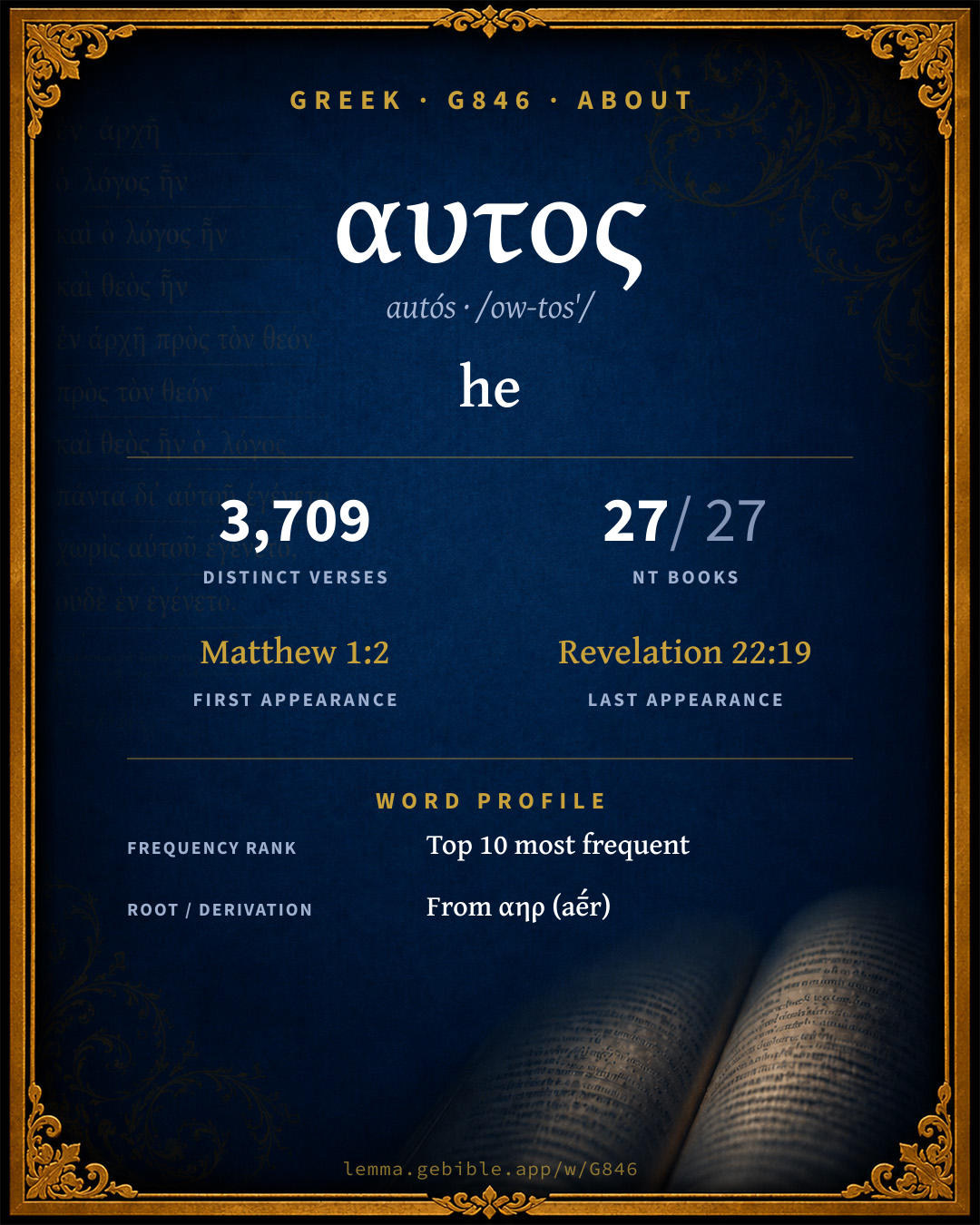
αὐτός
he
‘he’ is one of 3 main senses fuller range ↓
Full lexicon entry — Thayer's Greek Lexicon
From Thayer's Greek Lexicon
Where this word appears
See every Genitive-case word in the Greek New Testament →
Grammar key — what these labels mean
Part of speech
- Personal pronoun
- Stands in for a person already named (“I,” “you,” “he”).
Case
- Genitive
- The case of source, possession, or “of” — answers “whose / from what.”
- Accusative
- The case of the direct object and of extent.
- Dative
- The case of the indirect object, means, or location — “to / for / with / in.”
- Nominative
- The case of the subject (and the predicate nominative).
Gender
- Masculine
- Grammatically masculine.
- Feminine
- Grammatically feminine.
- Neuter
- Grammatically neuter.
Number
- Singular
- One.
- Plural
- More than one.
14 verses where G846 appears in the Dative case in the Book of 1 Corinthians. Filtered view — show all forms. Click any verse to open its interlinear word-by-word view. Verse text shown in the World English Bible for context — . Each verse’s Greek form is shown with its reference; the English is not keyword-highlighted, since the data carries no word-level English alignment. Use “Compare translations” on any verse to read it across multiple English versions. This concordance covers the Greek New Testament; Septuagint (Greek Old Testament) occurrences of this word are not indexed here.
1 Corinthians
- 1 Corinthians 1:5 αὐτῷ pron dat sg masc that in everything you were enriched in him, in all speech and all knowledge;
- 1 Corinthians 1:10 αὐτὸ αὐτῷ αὐτῇ pron acc sg neut pron dat sg masc pron dat sg fem Now I beg you, brothers, through the name of our Lord, Jesus Christ, that you all speak the same thing and that there be no divisions among you, but that you be perfected together in the same mind and in the same judgment.
- 1 Corinthians 1:24 αὐτοῖς pron dat pl masc but to those who are called, both Jews and Greeks, Christ is the power of God and the wisdom of God.
- 1 Corinthians 2:11 αὐτῷ pron dat sg masc For who among men knows the things of a man, except the spirit of the man, which is in him? Even so, no one knows the things of God, except God's Spirit.
- 1 Corinthians 2:14 αὐτῷ pron dat sg masc Now the natural man doesn't receive the things of God's Spirit, for they are foolishness to him, and he can't know them, because they are spiritually discerned.
- 1 Corinthians 7:8 αὐτοῖς pron dat pl masc But I say to the unmarried and to widows, it is good for them if they remain even as I am.
- 1 Corinthians 11:13 αὐτοῖς pron dat pl masc Judge for yourselves. Is it appropriate that a woman pray to God unveiled?
- 1 Corinthians 11:14 αὐτὴ αὐτῷ pron nom sg fem pron dat sg masc Doesn't even nature itself teach you that if a man has long hair, it is a dishonor to him?
- 1 Corinthians 11:15 αὐτῇ αὐτῇ pron dat sg fem pron dat sg fem But if a woman has long hair, it is a glory to her, for her hair is given to her for a covering.
- 1 Corinthians 12:9 αὐτῷ pron dat sg neut to another faith, by the same Spirit; and to another gifts of healings, by the same Spirit;
- 1 Corinthians 14:34 αὐταῖς pron dat pl fem let your wives keep silent in the assemblies, for it has not been permitted for them to speak; but let them be in subjection, as the law also says.
- 1 Corinthians 15:27 αὐτοῦ αὐτῷ pron gen sg masc pron dat sg masc For, "He put all things in subjection under his feet." But when he says, "All things are put in subjection," it is evident that he is excepted who subjected all things to him.
- 1 Corinthians 15:28 αὐτῷ αὐτὸς αὐτῷ pron dat sg masc pron nom sg masc pron dat sg masc When all things have been subjected to him, then the Son will also himself be subjected to him who subjected all things to him, that God may be all in all.
- 1 Corinthians 15:38 αὐτῷ pron dat sg masc But God gives it a body even as it pleased him, and to each seed a body of its own.
About this entry
At a glance — auto-summarized from this page’s data, not written by a person. Every figure links to its source below. This summary describes the numbers; it doesn’t interpret them.
αυτος (autós) is a Greek word most often rendered “he.” Scripture first uses it in Matthew 1:2. It turns up in 3,709 verses across 27 books, one of the most common footprint. Ranging over 3 senses, it is not a single-sense word. It clusters with αηρ, αετος and ανεμος under a shared root. For the data behind this summary, explore the sense tree and the renderings breakdown below.
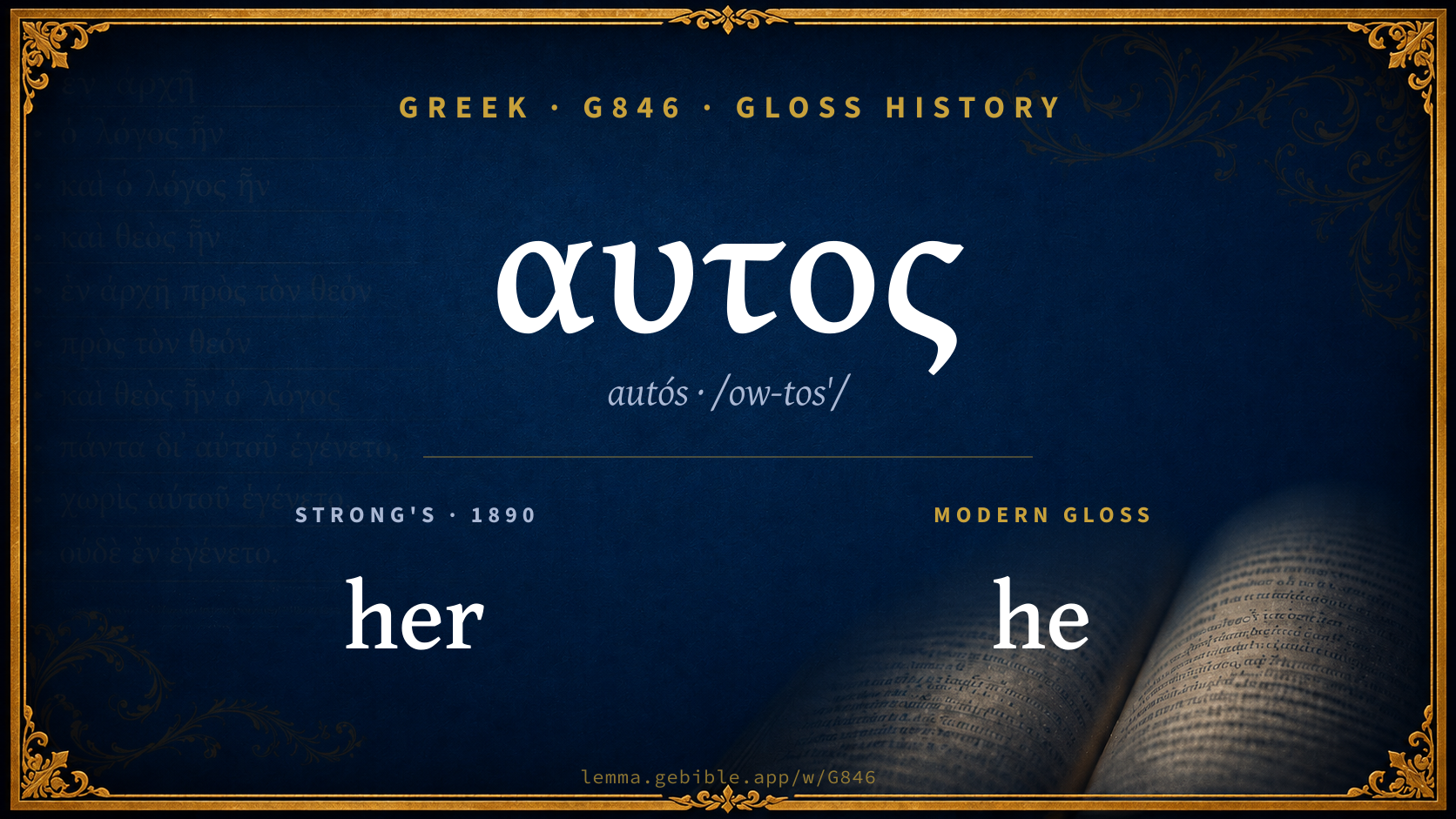
Gloss history
Strong's 1890 vs modern scholarship
About this word
Strong's G846 catalogs a Greek word from the Greek New Testament.
These counts are not copied from any lexicon or concordance. They are computed here, from the morphology-tagged Greek New Testament. What Lemma adds →
- 3,709
- distinct verses
- The word appears in 3,709 distinct verses.
- 27 / 27
- NT books
- The word appears in 27 of 27 New Testament books.
- #3
- by frequency
- Top 10 most frequent Greek words (rank 3 of 5,347 Greek words by occurrence).
View all 3,709 occurrences in the concordance →
By section of the New Testament
By traditional corpus
Conventional, traditional groupings — biblical authorship is debated, so this is a traditional corpus grouping, not an authorship claim. Some books belong to more than one corpus (Luke is in both the Gospels and the Lukan corpus, and so on), so these shares overlap and need not total 100%. Each figure is a share of the word’s 3,709 distinct verses.
- Gospels 2,275 verses · 61%
- Lukan (Luke–Acts) 1,196 verses · 32%
- Johannine 831 verses · 22%
- Pauline corpus 429 verses · 12%
- Revelation 243 verses · 7%
- General (Catholic) Epistles 160 verses · 4%
- Hebrews 98 verses · 3%
How translations render this word
Counts come from each version’s own published word-to-Strong’s tagging or interlinear alignment — an approximate guide to how each version renders this word, not a word-level alignment the data otherwise carries. Because each total is that version’s own tagged count, the per-version totals vary from one another and need not match the appearance or distinct-verse counts above. These counts may also differ from a printed concordance because Lemma counts each distinctly tagged rendering and does not collapse phrase taggings into a single head-word total. This is a fixed set of word-tagged versions (KJV, ASV, BSB, ULT) and does not change with the reading translation you choose elsewhere. Each version’s license is shown beside its name below (and on Sources).
- King James Version: Him 1,940×, Them 1,129×, His 1,081×
- American Standard Version: Him 1,799×, Them 1,045×, His 997×
- Berean Standard Bible: Him 1,170×, His 883×, Them 707×
- unfoldingWord Literal Text: Him 1,901×, Them 1,133×, His 1,045×
King James Version Public Domain
Renders G846 across 5,665 tagged occurrences — most commonly:
Plus other, less common renderings. Plus 67 renderings that appear only once — usually multi-word phrases or single function words the recovered tagging swept in, not distinct renderings. Not rendered by a distinct English word in 122 further occurrences.
American Standard Version Public Domain
Renders G846 across 5,555 tagged occurrences — most commonly:
Plus other, less common renderings. Plus 208 renderings that appear only once — usually multi-word phrases or single function words the recovered tagging swept in, not distinct renderings. Not rendered by a distinct English word in 22 further occurrences.
Berean Standard Bible Public Domain
Renders G846 across 4,053 tagged occurrences — most commonly:
Plus other, less common renderings. Plus 61 renderings that appear only once — usually multi-word phrases or single function words the recovered tagging swept in, not distinct renderings. Not rendered by a distinct English word in 1,464 further occurrences.
unfoldingWord Literal Text CC BY-SA 4.0
Renders G846 across 5,591 tagged occurrences — most commonly:
Plus other, less common renderings. Plus 26 renderings that appear only once — usually multi-word phrases or single function words the recovered tagging swept in, not distinct renderings.
Senses in Thayer's
The 3 senses Thayer's distinguishes for this word, in lexicon order (not ranked by frequency or importance). The full entry — with sub-senses — is in the Lexicon Entry tab.
- himself, herself, themselves, itself
- he, she, it
- the same
Word origin
Derived from αηρ (aḗr) (G109) — air.
From the particle αὖ au (perhaps akin to the base of G109 through the idea of a baffling wind; backward ); the reflexive pronoun self used (alone or in the compound of G1438 ) of the third person and (with the proper personal pronoun) of the other persons : - her it (-self) one the other (mine) own said ([self-] the) same ([him- my- thy-]) self [your-] selves she that their (-s) them ([-selves]) there [-at -by -in -into -of -on -with] they (these) things this (man) those together very which. Compare G848 .
— Strong’s Exhaustive Concordance (1890), public domain.
Forms in the corpus
The 29 distinct written forms G846 takes in the Greek New Testament, most frequent first — each parse links to that case’s occurrences in the concordance.
Same root — word family
Other Thayer's entries built from the same root as G846, grouped by Strong’s listed origin. These share a root / origin per the lexicon — not necessarily a shared meaning. Each links to that word’s own entry.
Derives from
Shares the same root
- αετος aetós G105 eagle
- ανεμος ánemos G417 wind
- ατμις atmís G822 vapour
- αυλη aulḗ G833 courtyard
- αυλος aulós G836 pipe
- αυριον aúrion G839 tomorrow
- αυστηρος austērós G840 harsh
- αυχμηρος auchmērós G850 squalid
Derived from this word
- αυθαδης authádēs G829 self-willed
- αυθαιρετος authaíretos G830 voluntary
- αυθεντεω authentéō G831 autocrat
- αυταρκης autárkēs G842 self-sufficient
- αυτοκατακριτος autokatákritos G843 self-condemned
- αυτοματος autómatos G844 of itself
- αυτοπτης autóptēs G845 eyewitness
- αυτου autoû G847 there
- αυτοχειρ autócheir G849 with own hands
- εαυτου heautoû G1438 himself
Compare all same-root words → Showing 4 of 20 — not the complete family. They share a root, not necessarily a meaning.
Septuagint usage
The same Greek word αυτος appears 22,367 times in the Greek Old Testament (Septuagint), across 11,866 verses in 38 books.
- 22,367
- LXX occurrences
- Tagged occurrences of this Greek word in the Septuagint.
- 11,866
- verses
- Distinct Septuagint verses containing this word.
- 38 / 39
- OT books
- The word appears in 38 of the 39 Old Testament books.
Sample Septuagint occurrences
- Genesis 1:9 αὐτός
- Exodus 1:1 αὐτός
- Leviticus 1:1 αὐτός
- Numbers 1:1 αὐτός
- Deuteronomy 1:3 αὐτός
- Joshua 1:2 αὐτός
- Judges 1:1 αὐτός
- Ruth 1:1 αὐτός
- 1 Samuel 1:1 αὐτός
- 2 Samuel 1:2 αὐτός
- 1 Kings 1:1 αὐτός
- 2 Kings 1:2 αὐτός
Septuagint occurrences (same lexeme)
Every verse where the same Strong’s number (G846) appears in the Greek Septuagint — showing the first 50 of 11,866. Verse text shown in the World English Bible for context; the Greek form is the matched word — the English is not keyword-highlighted.
- Genesis 1:9 αὐτός God said, "Let the waters under the sky be gathered together to one place, and let the dry land appear," and it was so.
- Genesis 1:11 αὐτός God said, "Let the earth put forth grass, herbs yielding seed, and fruit trees bearing fruit after their kind, with its seed in it, on the earth," and it was so.
- Genesis 1:12 αὐτός The earth brought forth grass, herbs yielding seed after their kind, and trees bearing fruit, with its seed in it, after their kind: and God saw that it was good.
- Genesis 1:17 αὐτός God set them in the expanse of sky to give light to the earth,
- Genesis 1:21 αὐτός God created the large sea creatures, and every living creature that moves, with which the waters swarmed, after their kind, and every winged bird after its kind. God saw that it was good.
- Genesis 1:22 αὐτός God blessed them, saying, "Be fruitful, and multiply, and fill the waters in the seas, and let birds multiply on the earth."
- Genesis 1:25 αὐτός God made the animals of the earth after their kind, and the cattle after their kind, and everything that creeps on the ground after its kind. God saw that it was good.
- Genesis 1:27 αὐτός God created man in his own image. In God's image he created him; male and female he created them.
- Genesis 1:28 αὐτός God blessed them. God said to them, "Be fruitful, multiply, fill the earth, and subdue it. Have dominion over the fish of the sea, over the birds of the sky, and over every living thing that moves on the earth."
- Genesis 2:1 αὐτός The heavens and the earth were finished, and all the host of them.
- Genesis 2:2 αὐτός On the seventh day God finished his work which he had made; and he rested on the seventh day from all his work which he had made.
- Genesis 2:3 αὐτός God blessed the seventh day, and made it holy, because he rested in it from all his work which he had created and made.
- Genesis 2:7 αὐτός Yahweh God formed man from the dust of the ground, and breathed into his nostrils the breath of life; and man became a living soul.
- Genesis 2:15 αὐτός Yahweh God took the man, and put him into the garden of Eden to dress it and to keep it.
- Genesis 2:17 αὐτός but of the tree of the knowledge of good and evil, you shall not eat of it: for in the day that you eat of it you will surely die."
- Genesis 2:18 αὐτός Yahweh God said, "It is not good that the man should be alone; I will make him a helper suitable for him."
- Genesis 2:19 αὐτός Out of the ground Yahweh God formed every animal of the field, and every bird of the sky, and brought them to the man to see what he would call them. Whatever the man called every living creature, that was its name.
- Genesis 2:20 αὐτός The man gave names to all cattle, and to the birds of the sky, and to every animal of the field; but for man there was not found a helper suitable for him.
- Genesis 2:21 αὐτός Yahweh God caused a deep sleep to fall on the man, and he slept; and he took one of his ribs, and closed up the flesh in its place.
- Genesis 2:22 αὐτός He made the rib, which Yahweh God had taken from the man, into a woman, and brought her to the man.
- Genesis 2:23 αὐτός The man said, "This is now bone of my bones, and flesh of my flesh. She will be called Woman, because she was taken out of Man."
- Genesis 2:24 αὐτός Therefore a man will leave his father and his mother, and will join with his wife, and they will be one flesh.
- Genesis 2:25 αὐτός They were both naked, the man and his wife, and were not ashamed.
- Genesis 3:3 αὐτός but of the fruit of the tree which is in the midst of the garden, God has said, 'You shall not eat of it, neither shall you touch it, lest you die.'"
- Genesis 3:5 αὐτός for God knows that in the day you eat it, your eyes will be opened, and you will be like God, knowing good and evil."
- Genesis 3:6 αὐτός When the woman saw that the tree was good for food, and that it was a delight to the eyes, and that the tree was to be desired to make one wise, she took of the fruit of it, and ate; and she gave some to her husband with her, and he ate.
- Genesis 3:8 αὐτός They heard the voice of Yahweh God walking in the garden in the cool of the day, and the man and his wife hid themselves from the presence of Yahweh God among the trees of the garden.
- Genesis 3:9 αὐτός Yahweh God called to the man, and said to him, "Where are you?"
- Genesis 3:10 αὐτός The man said, "I heard your voice in the garden, and I was afraid, because I was naked; and I hid myself."
- Genesis 3:11 αὐτός God said, "Who told you that you were naked? Have you eaten from the tree that I commanded you not to eat from?"
- Genesis 3:15 αὐτός I will put enmity between you and the woman, and between your offspring and her offspring. He will bruise your head, and you will bruise his heel."
- Genesis 3:16 αὐτός To the woman he said, "I will greatly multiply your pain in childbirth. In pain you will bring forth children. Your desire will be for your husband, and he will rule over you."
- Genesis 3:17 αὐτός To Adam he said, "Because you have listened to your wife's voice, and have eaten of the tree, of which I commanded you, saying, 'You shall not eat of it,' cursed is the ground for your sake. In toil you will eat of it all the days of your life.
- Genesis 3:20 αὐτός The man called his wife Eve, because she was the mother of all living.
- Genesis 3:21 αὐτός Yahweh God made coats of skins for Adam and for his wife, and clothed them.
- Genesis 3:23 αὐτός Therefore Yahweh God sent him forth from the garden of Eden, to till the ground from whence he was taken.
- Genesis 3:24 αὐτός So he drove out the man; and he placed Cherubs at the east of the garden of Eden, and the flame of a sword which turned every way, to guard the way to the tree of life.
- Genesis 4:1 αὐτός The man knew Eve his wife. She conceived, and gave birth to Cain, and said, "I have gotten a man with Yahweh's help."
- Genesis 4:2 αὐτός Again she gave birth, to Cain's brother Abel. Abel was a keeper of sheep, but Cain was a tiller of the ground.
- Genesis 4:4 αὐτός Abel also brought some of the firstborn of his flock and of the fat of it. Yahweh respected Abel and his offering,
- Genesis 4:5 αὐτός but he didn't respect Cain and his offering. Cain was very angry, and the expression on his face fell.
- Genesis 4:7 αὐτός If you do well, will it not be lifted up? If you don't do well, sin crouches at the door. Its desire is for you, but you are to rule over it."
- Genesis 4:8 αὐτός Cain said to Abel, his brother, "Let's go into the field." It happened, when they were in the field, that Cain rose up against Abel, his brother, and killed him.
- Genesis 4:11 αὐτός Now you are cursed because of the ground, which has opened its mouth to receive your brother's blood from your hand.
- Genesis 4:12 αὐτός From now on, when you till the ground, it won't yield its strength to you. You shall be a fugitive and a wanderer in the earth."
- Genesis 4:15 αὐτός Yahweh said to him, "Therefore whoever slays Cain, vengeance will be taken on him sevenfold." Yahweh appointed a sign for Cain, lest any finding him should strike him.
- Genesis 4:17 αὐτός Cain knew his wife. She conceived, and gave birth to Enoch. He built a city, and called the name of the city, after the name of his son, Enoch.
- Genesis 4:21 αὐτός His brother's name was Jubal, who was the father of all who handle the harp and pipe.
- Genesis 4:22 αὐτός Zillah also gave birth to Tubal Cain, the forger of every cutting instrument of brass and iron. Tubal Cain's sister was Naamah.
- Genesis 4:25 αὐτός Adam knew his wife again. She gave birth to a son, and named him Seth. For, she said, "God has appointed me another child instead of Abel, for Cain killed him."
These are occurrences of the same Greek lexeme (G846) in the Septuagint — not a translation of any one Hebrew word. The store carries no word-level Hebrew↔Greek alignment, so no Hebrew original is asserted here. Counts come from the recovered LXX Strong's tagging — high-frequency vocabulary is well covered, while rare or late forms may be untagged — so they reflect tagged occurrences and may slightly undercount.