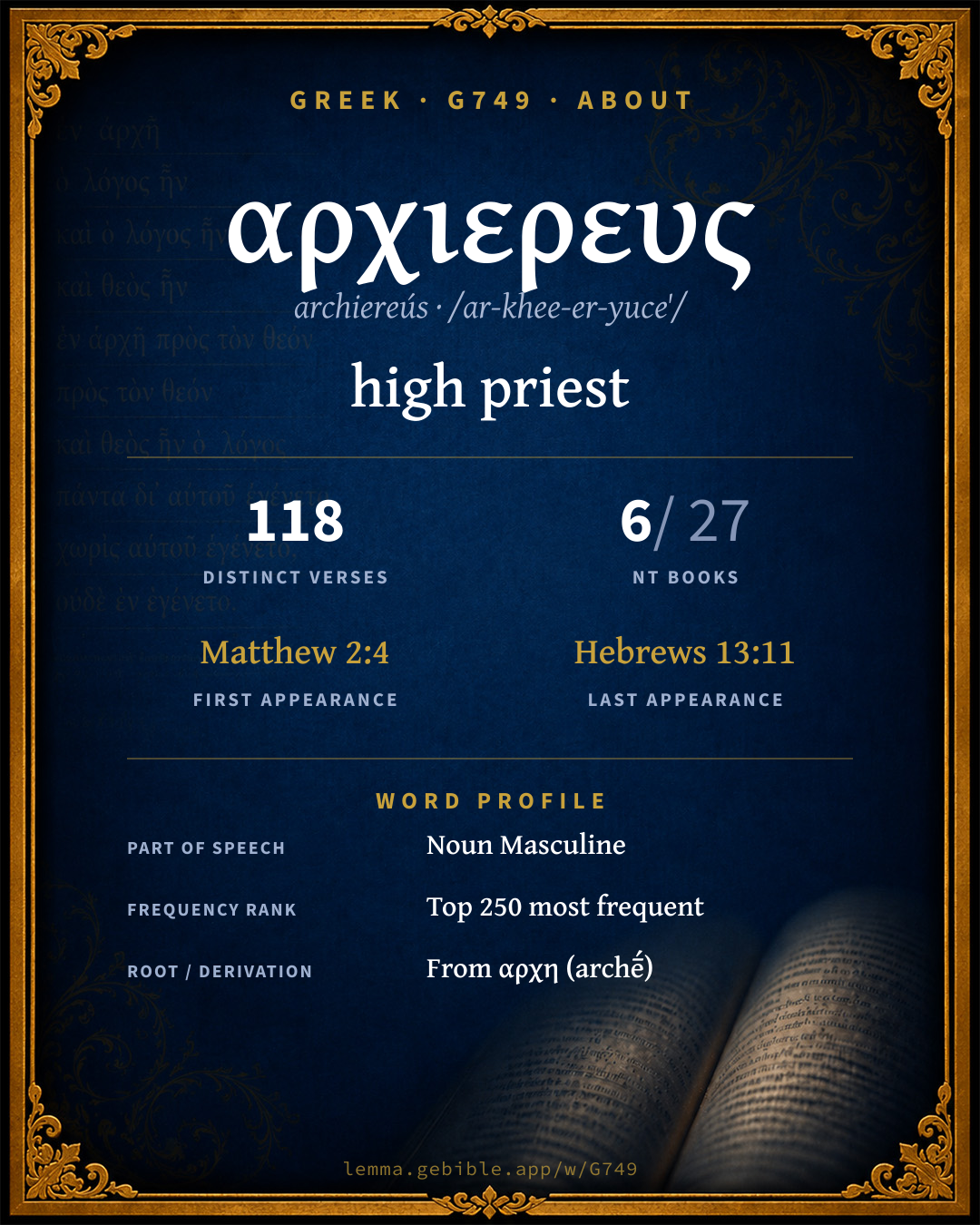
ἀρχιερεύς
high priest
Full lexicon entry — Thayer's Greek Lexicon
From Thayer's Greek Lexicon
Where this word appears
See every Nominative-case word in the Greek New Testament →
Grammar key — what these labels mean
Part of speech
- Noun
- A naming word — a person, place, thing, or idea.
Case
- Nominative
- The case of the subject (and the predicate nominative).
- Genitive
- The case of source, possession, or “of” — answers “whose / from what.”
- Accusative
- The case of the direct object and of extent.
- Dative
- The case of the indirect object, means, or location — “to / for / with / in.”
Gender
- Masculine
- Grammatically masculine.
Number
- Plural
- More than one.
- Singular
- One.
Grammatical forms
- Noun, Nominative, Plural, Masculine 39 times (32%)
- Noun, Nominative, Singular, Masculine 28 times (23%)
- Noun, Genitive, Singular, Masculine 16 times (13%)
- Noun, Accusative, Plural, Masculine 10 times (8%)
- Noun, Genitive, Plural, Masculine 10 times (8%)
- Noun, Accusative, Singular, Masculine 9 times (7%)
- Noun, Dative, Plural, Masculine 6 times (5%)
- Noun, Dative, Singular, Masculine 3 times (2%)
Parsed forms decoded from the imported morphology (Robinson–Tischendorf, public domain), counted across 121 parsed occurrences — not distinct verses.
Every verse where G749 appears — 118 distinct verses across 6 books. Click any verse to open its interlinear word-by-word view. Verse text shown in the World English Bible for context — . Each verse’s Greek form is shown with its reference; the English is not keyword-highlighted, since the data carries no word-level English alignment. Use “Compare translations” on any verse to read it across multiple English versions. This concordance covers the Greek New Testament; Septuagint (Greek Old Testament) occurrences of this word are not indexed here.
Matthew 24 verses
- Matthew 2:4 ἀρχιερεῖς n acc pl masc Gathering together all the chief priests and scribes of the people, he asked them where the Christ would be born.
- Matthew 16:21 ἀρχιερέων n gen pl masc From that time, Jesus began to show his disciples that he must go to Jerusalem and suffer many things from the elders, chief priests, and scribes, and be killed, and the third day be raised up.
- Matthew 20:18 ἀρχιερεῦσιν n dat pl masc "Behold, we are going up to Jerusalem, and the Son of Man will be delivered to the chief priests and scribes, and they will condemn him to death,
- Matthew 21:15 ἀρχιερεῖς n nom pl masc But when the chief priests and the scribes saw the wonderful things that he did, and the children who were crying in the temple and saying, "Hosanna to the son of David!" they were indignant,
- Matthew 21:23 ἀρχιερεῖς n nom pl masc When he had come into the temple, the chief priests and the elders of the people came to him as he was teaching, and said, "By what authority do you do these things? Who gave you this authority?"
- Matthew 21:45 ἀρχιερεῖς n nom pl masc When the chief priests and the Pharisees heard his parables, they perceived that he spoke about them.
- Matthew 26:3 ἀρχιερεῖς ἀρχιερέως n nom pl masc n gen sg masc Then the chief priests, the scribes, and the elders of the people were gathered together in the court of the high priest, who was called Caiaphas.
- Matthew 26:14 ἀρχιερεῖς n acc pl masc Then one of the twelve, who was called Judas Iscariot, went to the chief priests,
- Matthew 26:47 ἀρχιερέων n gen pl masc While he was still speaking, behold, Judas, one of the twelve, came, and with him a great multitude with swords and clubs, from the chief priest and elders of the people.
- Matthew 26:51 ἀρχιερέως n gen sg masc Behold, one of those who were with Jesus stretched out his hand, and drew his sword, and struck the servant of the high priest, and struck off his ear.
- Matthew 26:57 ἀρχιερέα n acc sg masc Those who had taken Jesus led him away to Caiaphas the high priest, where the scribes and the elders were gathered together.
- Matthew 26:58 ἀρχιερέως n gen sg masc But Peter followed him from a distance, to the court of the high priest, and entered in and sat with the officers, to see the end.
- Matthew 26:59 ἀρχιερεῖς n nom pl masc Now the chief priests, the elders, and the whole council sought false testimony against Jesus, that they might put him to death;
- Matthew 26:62 ἀρχιερεὺς n nom sg masc The high priest stood up, and said to him, "Have you no answer? What is this that these testify against you?"
- Matthew 26:63 ἀρχιερεὺς n nom sg masc But Jesus held his peace. The high priest answered him, "I adjure you by the living God, that you tell us whether you are the Christ, the Son of God."
- Matthew 26:65 ἀρχιερεὺς n nom sg masc Then the high priest tore his clothing, saying, "He has spoken blasphemy! Why do we need any more witnesses? Behold, now you have heard his blasphemy.
- Matthew 27:1 ἀρχιερεῖς n nom pl masc Now when morning had come, all the chief priests and the elders of the people took counsel against Jesus to put him to death:
- Matthew 27:3 ἀρχιερεῦσιν n dat pl masc Then Judas, who betrayed him, when he saw that Jesus was condemned, felt remorse, and brought back the thirty pieces of silver to the chief priests and elders,
- Matthew 27:6 ἀρχιερεῖς n nom pl masc The chief priests took the pieces of silver, and said, "It's not lawful to put them into the treasury, since it is the price of blood."
- Matthew 27:12 ἀρχιερέων n gen pl masc When he was accused by the chief priests and elders, he answered nothing.
- Matthew 27:20 ἀρχιερεῖς n nom pl masc Now the chief priests and the elders persuaded the multitudes to ask for Barabbas, and destroy Jesus.
- Matthew 27:41 ἀρχιερεῖς n nom pl masc Likewise the chief priests also mocking, with the scribes, the Pharisees, and the elders, said,
- Matthew 27:62 ἀρχιερεῖς n nom pl masc Now on the next day, which was the day after the Preparation Day, the chief priests and the Pharisees were gathered together to Pilate,
- Matthew 28:11 ἀρχιερεῦσιν n dat pl masc Now while they were going, behold, some of the guards came into the city, and told the chief priests all the things that had happened.
Mark 21 verses
- Mark 2:26 ἀρχιερέως n gen sg masc How he entered into the house of God when Abiathar was high priest, and ate the show bread, which it is not lawful to eat except for the priests, and gave also to those who were with him?"
- Mark 8:31 ἀρχιερέων n gen pl masc He began to teach them that the Son of Man must suffer many things, and be rejected by the elders, the chief priests, and the scribes, and be killed, and after three days rise again.
- Mark 10:33 ἀρχιερεῦσιν n dat pl masc "Behold, we are going up to Jerusalem. The Son of Man will be delivered to the chief priests and the scribes. They will condemn him to death, and will deliver him to the Gentiles.
- Mark 11:18 ἀρχιερεῖς n nom pl masc The chief priests and the scribes heard it, and sought how they might destroy him. For they feared him, because all the multitude was astonished at his teaching.
- Mark 11:27 ἀρχιερεῖς n nom pl masc They came again to Jerusalem, and as he was walking in the temple, the chief priests, and the scribes, and the elders came to him,
- Mark 14:1 ἀρχιερεῖς n nom pl masc It was now two days before the feast of the Passover and the unleavened bread, and the chief priests and the scribes sought how they might sieze him by deception, and kill him.
- Mark 14:10 ἀρχιερεῖς n acc pl masc Judas Iscariot, who was one of the twelve, went away to the chief priests, that he might deliver him to them.
- Mark 14:43 ἀρχιερέων n gen pl masc Immediately, while he was still speaking, Judas, one of the twelve, came--and with him a multitude with swords and clubs, from the chief priests, the scribes, and the elders.
- Mark 14:47 ἀρχιερέως n gen sg masc But a certain one of those who stood by drew his sword, and struck the servant of the high priest, and cut off his ear.
- Mark 14:53 ἀρχιερέα ἀρχιερεῖς n acc sg masc n nom pl masc They led Jesus away to the high priest. All the chief priests, the elders, and the scribes came together with him.
- Mark 14:54 ἀρχιερέως n gen sg masc Peter had followed him from a distance, until he came into the court of the high priest. He was sitting with the officers, and warming himself in the light of the fire.
- Mark 14:55 ἀρχιερεῖς n nom pl masc Now the chief priests and the whole council sought witnesses against Jesus to put him to death, and found none.
- Mark 14:60 ἀρχιερεὺς n nom sg masc The high priest stood up in the midst, and asked Jesus, "Have you no answer? What is it which these testify against you?"
- Mark 14:61 ἀρχιερεὺς n nom sg masc But he stayed quiet, and answered nothing. Again the high priest asked him, "Are you the Christ, the Son of the Blessed?"
- Mark 14:63 ἀρχιερεὺς n nom sg masc The high priest tore his clothes, and said, "What further need have we of witnesses?
- Mark 14:66 ἀρχιερέως n gen sg masc As Peter was in the courtyard below, one of the maids of the high priest came,
- Mark 15:1 ἀρχιερεῖς n nom pl masc Immediately in the morning the chief priests, with the elders and scribes, and the whole council, held a consultation, and bound Jesus, and carried him away, and delivered him up to Pilate.
- Mark 15:3 ἀρχιερεῖς n nom pl masc The chief priests accused him of many things.
- Mark 15:10 ἀρχιερεῖς n nom pl masc For he perceived that for envy the chief priests had delivered him up.
- Mark 15:11 ἀρχιερεῖς n nom pl masc But the chief priests stirred up the multitude, that he should release Barabbas to them instead.
- Mark 15:31 ἀρχιερεῖς n nom pl masc Likewise, also the chief priests mocking among themselves with the scribes said, "He saved others. He can't save himself.
Luke 14 verses
- Luke 3:2 ἀρχιερέως n gen sg masc in the high priesthood of Annas and Caiaphas, the word of God came to John, the son of Zacharias, in the wilderness.
- Luke 9:22 ἀρχιερέων n gen pl masc saying, "The Son of Man must suffer many things, and be rejected by the elders, chief priests, and scribes, and be killed, and the third day be raised up."
- Luke 19:47 ἀρχιερεῖς n nom pl masc He was teaching daily in the temple, but the chief priests and the scribes and the leading men among the people sought to destroy him.
- Luke 20:19 ἀρχιερεῖς n nom pl masc The chief priests and the scribes sought to lay hands on Him that very hour, but they feared the people--for they knew He had spoken this parable against them.
- Luke 22:2 ἀρχιερεῖς n nom pl masc The chief priests and the scribes sought how they might put him to death, for they feared the people.
- Luke 22:4 ἀρχιερεῦσιν n dat pl masc He went away, and talked with the chief priests and captains about how he might deliver him to them.
- Luke 22:50 ἀρχιερέως n gen sg masc A certain one of them struck the servant of the high priest, and cut off his right ear.
- Luke 22:52 ἀρχιερεῖς n acc pl masc Jesus said to the chief priests, captains of the temple, and elders, who had come against him, "Have you come out as against a robber, with swords and clubs?
- Luke 22:54 ἀρχιερέως n gen sg masc They seized him, and led him away, and brought him into the high priest's house. But Peter followed from a distance.
- Luke 22:66 ἀρχιερεῖς n nom pl masc As soon as it was day, the assembly of the elders of the people was gathered together, both chief priests and scribes, and they led him away into their council, saying,
- Luke 23:4 ἀρχιερεῖς n acc pl masc Pilate said to the chief priests and the multitudes, "I find no basis for a charge against this man."
- Luke 23:10 ἀρχιερεῖς n nom pl masc The chief priests and the scribes stood, vehemently accusing him.
- Luke 23:13 ἀρχιερεῖς n acc pl masc Pilate called together the chief priests and the rulers and the people,
- Luke 24:20 ἀρχιερεῖς n nom pl masc and how the chief priests and our rulers delivered him up to be condemned to death, and crucified him.
John 20 verses
- John 7:32 ἀρχιερεῖς n nom pl masc The Pharisees heard the multitude murmuring these things concerning him, and the chief priests and the Pharisees sent officers to arrest him.
- John 7:45 ἀρχιερεῖς n acc pl masc The officers therefore came to the chief priests and Pharisees, and they said to them, "Why didn't you bring him?"
- John 11:47 ἀρχιερεῖς n nom pl masc The chief priests therefore and the Pharisees gathered a council, and said, "What are we doing? For this man does many signs.
- John 11:49 ἀρχιερεὺς n nom sg masc But a certain one of them, Caiaphas, being high priest that year, said to them, "You know nothing at all,
- John 11:51 ἀρχιερεὺς n nom sg masc Now he didn't say this of himself, but being high priest that year, he prophesied that Jesus would die for the nation,
- John 11:57 ἀρχιερεῖς n nom pl masc Now the chief priests and the Pharisees had commanded that if anyone knew where he was, he should report it, that they might seize him.
- John 12:10 ἀρχιερεῖς n nom pl masc But the chief priests conspired to put Lazarus to death also,
- John 18:3 ἀρχιερέων n gen pl masc Judas then, having taken a detachment of soldiers and officers from the chief priests and the Pharisees, came there with lanterns, torches, and weapons.
- John 18:10 ἀρχιερέως n gen sg masc Simon Peter therefore, having a sword, drew it, and struck the high priest's servant, and cut off his right ear. The servant's name was Malchus.
- John 18:13 ἀρχιερεὺς n nom sg masc and led him to Annas first, for he was father-in-law to Caiaphas, who was high priest that year.
- John 18:15 ἀρχιερεῖ ἀρχιερέως n dat sg masc n gen sg masc Simon Peter followed Jesus, as did another disciple. Now that disciple was known to the high priest, and entered in with Jesus into the court of the high priest;
- John 18:16 ἀρχιερέως n gen sg masc but Peter was standing at the door outside. So the other disciple, who was known to the high priest, went out and spoke to her who kept the door, and brought in Peter.
- John 18:19 ἀρχιερεὺς n nom sg masc The high priest therefore asked Jesus about his disciples, and about his teaching.
- John 18:22 ἀρχιερεῖ n dat sg masc When he had said this, one of the officers standing by slapped Jesus with his hand, saying, "Do you answer the high priest like that?"
- John 18:24 ἀρχιερέα n acc sg masc Annas sent him bound to Caiaphas, the high priest.
- John 18:26 ἀρχιερέως n gen sg masc One of the servants of the high priest, being a relative of him whose ear Peter had cut off, said, "Didn't I see you in the garden with him?"
- John 18:35 ἀρχιερεῖς n nom pl masc Pilate answered, "I'm not a Jew, am I? Your own nation and the chief priests delivered you to me. What have you done?"
- John 19:6 ἀρχιερεῖς n nom pl masc When therefore the chief priests and the officers saw him, they shouted, saying, "Crucify! Crucify!" Pilate said to them, "Take him yourselves, and crucify him, for I find no basis for a charge against him."
- John 19:15 ἀρχιερεῖς n nom pl masc They cried out, "Away with him! Away with him! Crucify him!" Pilate said to them, "Shall I crucify your King?" The chief priests answered, "We have no king but Caesar!"
- John 19:21 ἀρχιερεῖς n nom pl masc The chief priests of the Jews therefore said to Pilate, "Don't write, 'The King of the Jews,' but, 'he said, I am King of the Jews.'"
Acts 22 verses
- Acts 4:6 ἀρχιερεὺς n nom sg masc Annas the high priest was there, with Caiaphas, John, Alexander, and as many as were relatives of the high priest.
- Acts 4:23 ἀρχιερεῖς n nom pl masc Being let go, they came to their own company, and reported all that the chief priests and the elders had said to them.
- Acts 5:17 ἀρχιερεὺς n nom sg masc But the high priest rose up, and all those who were with him (which is the sect of the Sadducees), and they were filled with jealousy,
- Acts 5:21 ἀρχιερεὺς n nom sg masc When they heard this, they entered into the temple about daybreak, and taught. But the high priest came, and those who were with him, and called the council together, and all the senate of the children of Israel, and sent to the prison to have them brought.
- Acts 5:24 ἀρχιερεῖς n nom pl masc Now when the high priest, the captain of the temple, and the chief priests heard these words, they were very perplexed about them and what might become of this.
- Acts 5:27 ἀρχιερεὺς n nom sg masc When they had brought them, they set them before the council. The high priest questioned them,
- Acts 7:1 ἀρχιερεύς n nom sg masc The high priest said, "Are these things so?"
- Acts 9:1 ἀρχιερεῖ n dat sg masc But Saul, still breathing threats and slaughter against the disciples of the Lord, went to the high priest,
- Acts 9:14 ἀρχιερέων n gen pl masc Here he has authority from the chief priests to bind all who call on your name."
- Acts 9:21 ἀρχιερεῖς n acc pl masc All who heard him were amazed, and said, "Isn't this he who in Jerusalem made havoc of those who called on this name? And he had come here intending to bring them bound before the chief priests!"
- Acts 19:14 ἀρχιερέως n gen sg masc There were seven sons of one Sceva, a Jewish chief priest, who did this.
- Acts 22:5 ἀρχιερεὺς n nom sg masc As also the high priest and all the council of the elders testify, from whom also I received letters to the brothers, and traveled to Damascus to bring them also who were there to Jerusalem in bonds to be punished.
- Acts 22:30 ἀρχιερεῖς n acc pl masc But on the next day, desiring to know the truth about why he was accused by the Jews, he freed him from the bonds, and commanded the chief priests and all the council to come together, and brought Paul down and set him before them.
- Acts 23:2 ἀρχιερεὺς n nom sg masc The high priest, Ananias, commanded those who stood by him to strike him on the mouth.
- Acts 23:4 ἀρχιερέα n acc sg masc Those who stood by said, "Do you malign God's high priest?"
- Acts 23:5 ἀρχιερεύς n nom sg masc Paul said, "I didn't know, brothers, that he was high priest. For it is written, 'You shall not speak evil of a ruler of your people.'"
- Acts 23:14 ἀρχιερεῦσιν n dat pl masc They came to the chief priests and the elders, and said, "We have bound ourselves under a great curse, to taste nothing until we have killed Paul.
- Acts 24:1 ἀρχιερεὺς n nom sg masc After five days, the high priest, Ananias, came down with certain elders and an orator, one Tertullus. They informed the governor against Paul.
- Acts 25:2 ἀρχιερεῖς n nom pl masc Then the high priest and the principal men of the Jews informed him against Paul, and they begged him,
- Acts 25:15 ἀρχιερεῖς n nom pl masc about whom, when I was at Jerusalem, the chief priests and the elders of the Jews informed me, asking for a sentence against him.
- Acts 26:10 ἀρχιερέων n gen pl masc This I also did in Jerusalem. I both shut up many of the saints in prisons, having received authority from the chief priests, and when they were put to death I gave my vote against them.
- Acts 26:12 ἀρχιερέων n gen pl masc "Whereupon as I traveled to Damascus with the authority and commission from the chief priests,
Hebrews 17 verses
- Hebrews 2:17 ἀρχιερεὺς n nom sg masc Therefore he was obligated in all things to be made like his brothers, that he might become a merciful and faithful high priest in things pertaining to God, to make atonement for the sins of the people.
- Hebrews 3:1 ἀρχιερέα n acc sg masc Therefore, holy brothers, partakers of a heavenly calling, consider the Apostle and High Priest of our confession, Jesus;
- Hebrews 4:14 ἀρχιερέα n acc sg masc Having then a great high priest, who has passed through the heavens, Jesus, the Son of God, let us hold tightly to our confession.
- Hebrews 4:15 ἀρχιερέα n acc sg masc For we don't have a high priest who can't be touched with the feeling of our infirmities, but one who has been in all points tempted like we are, yet without sin.
- Hebrews 5:1 ἀρχιερεὺς n nom sg masc For every high priest, being taken from among men, is appointed for men in things pertaining to God, that he may offer both gifts and sacrifices for sins.
- Hebrews 5:5 ἀρχιερέα n acc sg masc So also Christ didn't glorify himself to be made a high priest, but it was he who said to him, "You are my Son. Today I have become your father."
- Hebrews 5:10 ἀρχιερεὺς n nom sg masc named by God a high priest after the order of Melchizedek.
- Hebrews 6:20 ἀρχιερεὺς n nom sg masc where as a forerunner Jesus entered for us, having become a high priest forever after the order of Melchizedek.
- Hebrews 7:26 ἀρχιερεύς n nom sg masc For such a high priest was fitting for us: holy, guiltless, undefiled, separated from sinners, and made higher than the heavens;
- Hebrews 7:27 ἀρχιερεῖς n nom pl masc who doesn't need, like those high priests, to daily offer up sacrifices, first for his own sins, and then for the sins of the people. For this he did once for all, when he offered up himself.
- Hebrews 7:28 ἀρχιερεῖς n acc pl masc For the law appoints men as high priests who have weakness, but the word of the oath which came after the law appoints a Son forever who has been perfected.
- Hebrews 8:1 ἀρχιερέα n acc sg masc Now in the things which we are saying, the main point is this. We have such a high priest, who sat down on the right hand of the throne of the Majesty in the heavens,
- Hebrews 8:3 ἀρχιερεὺς n nom sg masc For every high priest is appointed to offer both gifts and sacrifices. Therefore it is necessary that this high priest also have something to offer.
- Hebrews 9:7 ἀρχιερεύς n nom sg masc but into the second the high priest alone, once in the year, not without blood, which he offers for himself, and for the errors of the people.
- Hebrews 9:11 ἀρχιερεὺς n nom sg masc But Christ having come as a high priest of the coming good things, through the greater and more perfect tabernacle, not made with hands, that is to say, not of this creation,
- Hebrews 9:25 ἀρχιερεὺς n nom sg masc nor yet that he should offer himself often, as the high priest enters into the holy place year by year with blood not his own,
- Hebrews 13:11 ἀρχιερέως n gen sg masc For the bodies of those animals, whose blood is brought into the holy place by the high priest as an offering for sin, are burned outside of the camp.
About this entry
At a glance — auto-summarized from this page’s data, not written by a person. Every figure links to its source below. This summary describes the numbers; it doesn’t interpret them.
At its core, αρχιερευς (archiereús) means “high priest.” First canonically at Matthew 2:4, it enters the text early. It appears 118 verses across 6 books of the Greek New Testament, among its common vocabulary. It shares a root with αρχη, αρχαιος and αρχηγος. Each statement above links to its evidence; the full detail follows below.
Gloss history
Strong's 1890 vs modern scholarship

About this word
Strong's G749 catalogs a Greek word from the Greek New Testament.
These counts are not copied from any lexicon or concordance. They are computed here, from the morphology-tagged Greek New Testament. What Lemma adds →
- 118
- distinct verses
- The word appears in 118 distinct verses.
- 6 / 27
- NT books
- The word appears in 6 of 27 New Testament books.
- #136
- by frequency
- Top 250 most frequent Greek words (rank 136 of 5,347 Greek words by occurrence).
View all 118 occurrences in the concordance →
By section of the New Testament
By traditional corpus
Conventional, traditional groupings — biblical authorship is debated, so this is a traditional corpus grouping, not an authorship claim. Some books belong to more than one corpus (Luke is in both the Gospels and the Lukan corpus, and so on), so these shares overlap and need not total 100%. Each figure is a share of the word’s 118 distinct verses.
- Gospels 79 verses · 67%
- Lukan (Luke–Acts) 36 verses · 31%
- Johannine 20 verses · 17%
- Hebrews 17 verses · 14%
How translations render this word
Counts come from each version’s own published word-to-Strong’s tagging or interlinear alignment — an approximate guide to how each version renders this word, not a word-level alignment the data otherwise carries. Because each total is that version’s own tagged count, the per-version totals vary from one another and need not match the appearance or distinct-verse counts above. These counts may also differ from a printed concordance because Lemma counts each distinctly tagged rendering and does not collapse phrase taggings into a single head-word total. This is a fixed set of word-tagged versions (KJV, ASV, BSB, ULT) and does not change with the reading translation you choose elsewhere. Each version’s license is shown beside its name below (and on Sources).
- King James Version: Chief priests 64×, High priest 50×, High priest's 4×
- American Standard Version: Chief priests 60×, High priest 52×, Chief priest 2×
- Berean Standard Bible: Chief priests 64×, High priest 52×, High priesthood 2×
- unfoldingWord Literal Text: Chief priests 64×, High priest 53×, A 3×
King James Version Public Domain
Renders G749 across 123 tagged occurrences — most commonly:
Plus 2 renderings that appear only once — usually multi-word phrases or single function words the recovered tagging swept in, not distinct renderings.
American Standard Version Public Domain
Renders G749 across 121 tagged occurrences — most commonly:
Plus 5 renderings that appear only once — usually multi-word phrases or single function words the recovered tagging swept in, not distinct renderings.
Berean Standard Bible Public Domain
Renders G749 across 122 tagged occurrences — most commonly:
Plus 2 renderings that appear only once — usually multi-word phrases or single function words the recovered tagging swept in, not distinct renderings.
unfoldingWord Literal Text CC BY-SA 4.0
Renders G749 across 125 tagged occurrences — most commonly:
Plus 1 rendering that appears only once — usually multi-word phrases or single function words the recovered tagging swept in, not distinct renderings.
Senses in Thayer's
The 1 sense Thayer's distinguishes for this word, in lexicon order (not ranked by frequency or importance). The full entry — with sub-senses — is in the Lexicon Entry tab.
- chief priest, high priest
Word origin
Derived from αρχη (archḗ) (G746) — beginning.
Forms in the corpus
The 8 distinct written forms G749 takes in the Greek New Testament, most frequent first — each parse links to that case’s occurrences in the concordance.
| Form | Parsing | Example | Uses |
|---|---|---|---|
| ἀρχιερεῖς archiereîs | Noun, Nominative, Plural, Masculine | Matthew 21:15 | 49 |
| ἀρχιερεὺς archiereùs | Noun, Nominative, Singular, Masculine | Matthew 26:62 | 24 |
| ἀρχιερέως archieréōs | Noun, Genitive, Singular, Masculine | Matthew 26:3 | 16 |
| ἀρχιερέων archieréōn | Noun, Genitive, Plural, Masculine | Matthew 16:21 | 10 |
| ἀρχιερέα archieréa | Noun, Accusative, Singular, Masculine | Matthew 26:57 | 9 |
| ἀρχιερεῦσιν archiereûsin | Noun, Dative, Plural, Masculine | Matthew 20:18 | 6 |
| ἀρχιερεύς archiereús | Noun, Nominative, Singular, Masculine | Acts 7:1 | 4 |
| ἀρχιερεῖ archiereî | Noun, Dative, Singular, Masculine | John 18:15 | 3 |
Same root — word family
Other Thayer's entries built from the same root as G749, grouped by Strong’s listed origin. These share a root / origin per the lexicon — not necessarily a shared meaning. Each links to that word’s own entry.
Derives from
Shares the same root
- αρχαιος archaîos G744 original
- αρχηγος archēgós G747 leader
- αρχιερατικος archieratikós G748 high priestly
- αρχιποιμην archipoímēn G750 chief shepherd
- αρχισυναγωγος archisynágōgos G752 synagogue ruler
- αρχιτεκτων architéktōn G753 architect
- αρχιτελωνης architelṓnēs G754 chief tax collector
- αρχιτρικλινος architríklinos G755 table master
Proper names from this root
People and places named from this root — a name, not an additional meaning of the word.
Compare all same-root words → Showing 4 of 11 — not the complete family. 1 of the same-root words is a proper name (a person or place). They share a root, not necessarily a meaning.
Septuagint usage
The same Greek word αρχιερευς appears 3 times in the Greek Old Testament (Septuagint), across 3 verses in 2 books.
- 3
- LXX occurrences
- Tagged occurrences of this Greek word in the Septuagint.
- 3
- verses
- Distinct Septuagint verses containing this word.
- 2 / 39
- OT books
- The word appears in 2 of the 39 Old Testament books.
Sample Septuagint occurrences
- Leviticus 4:3 ἀρχιερεύς
- Joshua 22:13 ἀρχιερεύς
Septuagint occurrences (same lexeme)
Every verse where the same Strong’s number (G749) appears in the Greek Septuagint. Verse text shown in the World English Bible for context; the Greek form is the matched word — the English is not keyword-highlighted.
- Leviticus 4:3 ἀρχιερεύς if the anointed priest sins so as to bring guilt on the people, then let him offer for his sin, which he has sinned, a young bull without blemish to Yahweh for a sin offering.
- Joshua 22:13 ἀρχιερεύς The children of Israel sent to the children of Reuben, and to the children of Gad, and to the half-tribe of Manasseh, into the land of Gilead, Phinehas the son of Eleazar the priest,
- Joshua 24:33 ἀρχιερεύς Eleazar the son of Aaron died; and they buried him in the hill of Phinehas his son, which was given him in the hill-country of Ephraim.
These are occurrences of the same Greek lexeme (G749) in the Septuagint — not a translation of any one Hebrew word. The store carries no word-level Hebrew↔Greek alignment, so no Hebrew original is asserted here. Counts come from the recovered LXX Strong's tagging — high-frequency vocabulary is well covered, while rare or late forms may be untagged — so they reflect tagged occurrences and may slightly undercount.