Hebrews 5:10

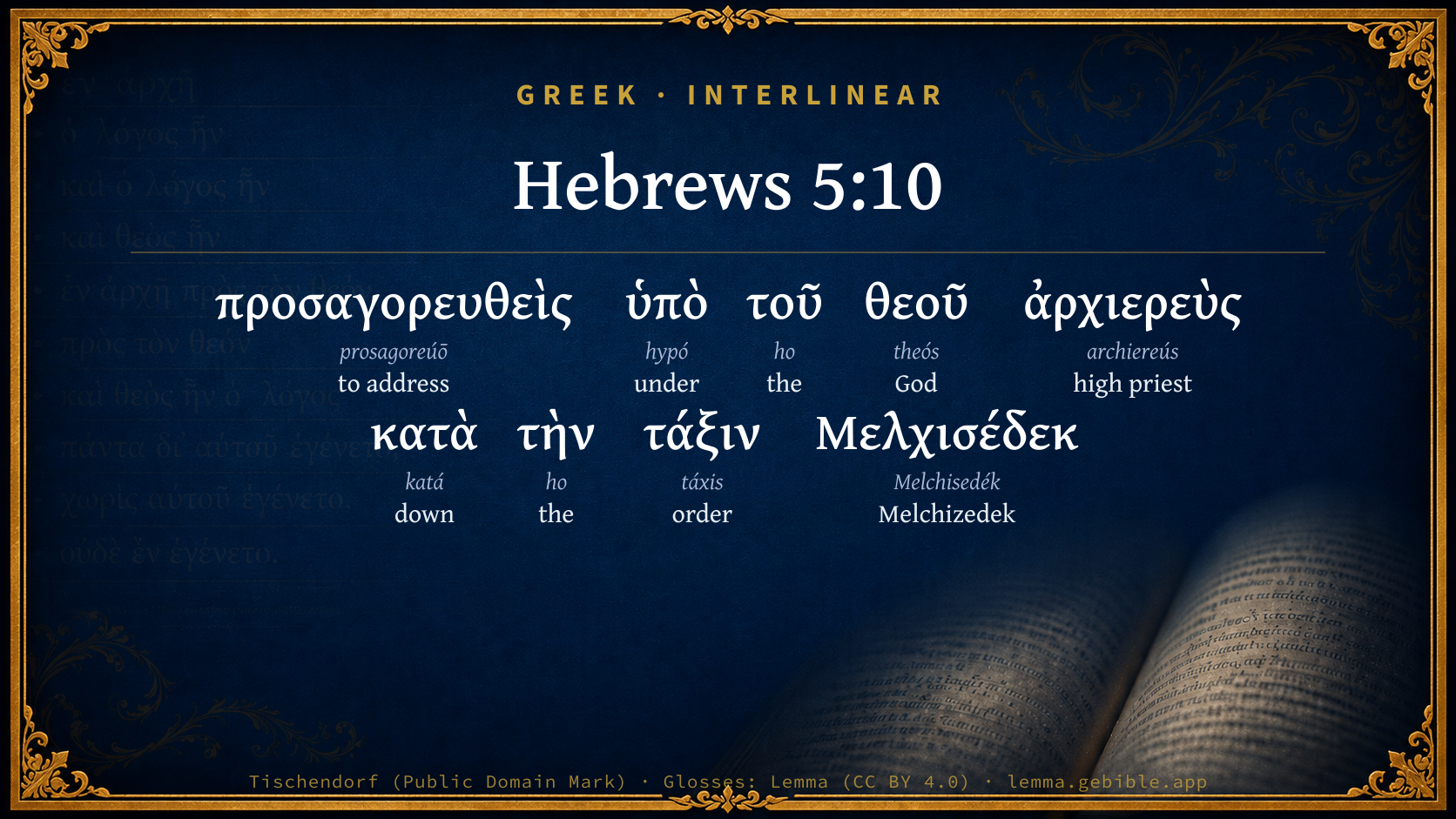
Greek (Tischendorf 8th ed.) Hebrews 5:10 appears in the Greek New Testament. The text above is from the Tischendorf 8th edition. Each word links to its Strong’s number and a concise gloss. Click any word for its full Thayer’s Greek Lexicon entry.
Download image
Cite this verse

Hebrews 5:10 (World English Bible). Public Domain. Lemma interlinear Bible study tool, https://lemma.gebible.app/v/hebrews/5/10.

Show BibTeX & RIS
BibTeX
RIS
English Translation
named by God a high priest after the order of Melchizedek.
World English Bible · Public Domain
Highlights
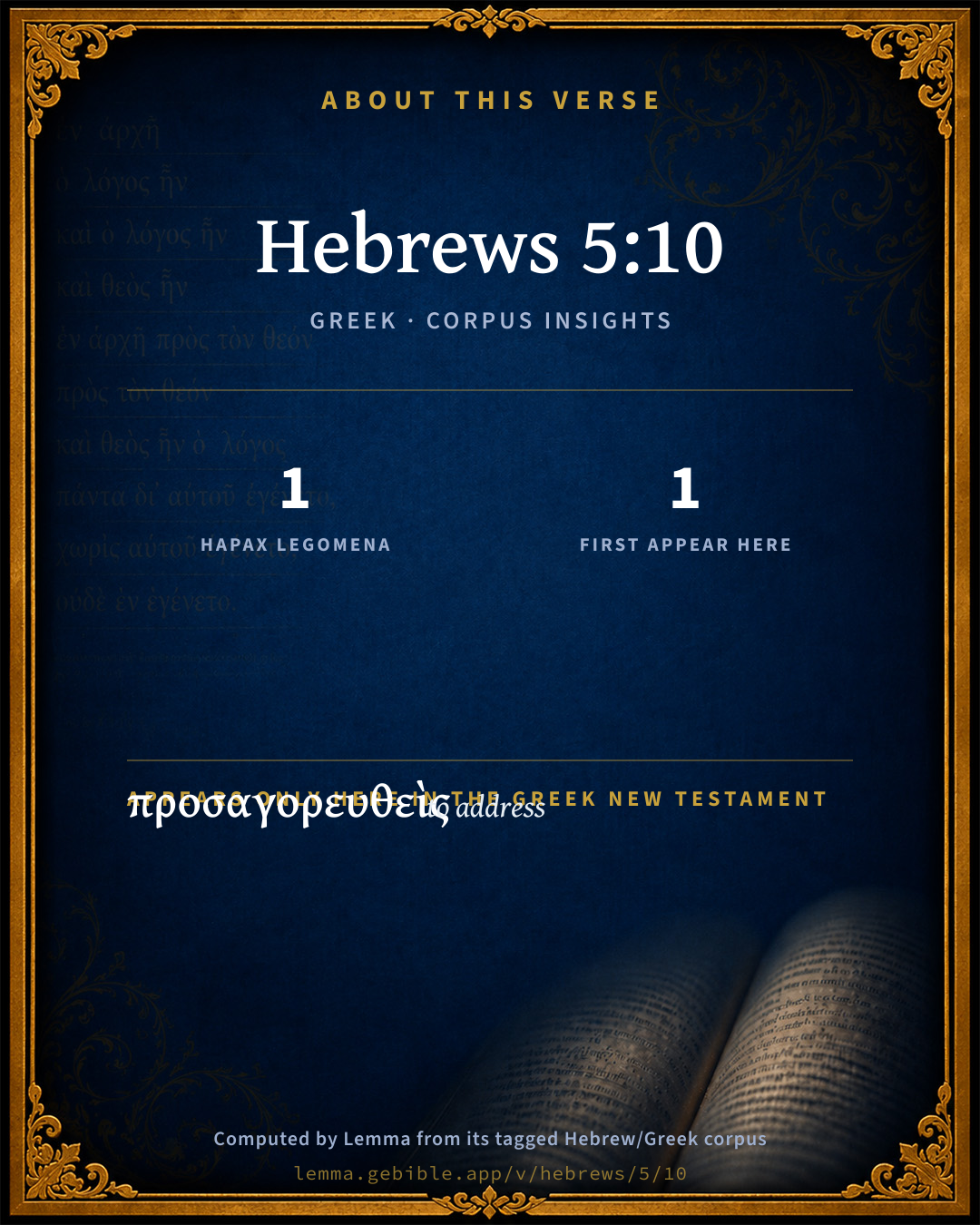
  • 1 hapax legomenon — only here in the Greek New Testament
  • 1 first appearance in the Greek New Testament
Full analysis ↓
Download a study sheet

One document with this verse’s original text, its word-by-word gloss line, the meaning frame, cross-references with their text, attributed commentary, and full source and license credits — printable, and it pastes into notes with its structure intact.

This verse Autodidact and up

Study sheet (.html) Plain text (.txt)

A passage Seminary Student

Up to 50 verses in one chapter. A passage sheet keeps up to 6 commentary sources and 12 cross-references per verse, in the order this page ranks them, and says so on the sheet whenever that leaves anything out. Ask for a single verse and you get the Autodidact verse sheet above.

Everything on this page stays free to read, with no account — the sheet is a download of what is already on screen, not access to it.

Want to remove ads? Support Godless Engineer
Compare translations 3

The same verse in 3 English versions, stacked beneath the original-language interlinear above. Click any original word for its lexicon entry.

Each is an independent rendering of the whole verse — the interlinear is not word-aligned to these translations.

Highlighted words mark where these versions differ — a whole-verse word diff, not a word-by-word alignment.

  • World English Bible Public Domain
    named by God a high priest after the order of Melchizedek.
  • King James Version Public Domain
    Called of God an high priest after the order of Melchisedec.
  • unfoldingWord Literal Text CC BY-SA 4.0
    having been designated by God high priest, according to the order of Melchizedek,

unfoldingWord Literal Text — © unfoldingWord, licensed CC BY-SA 4.0. Word-aligned USFM3 via Door43 (git.door43.org/unfoldingWord/en_ult).

Versions to compare (up to 4)

3 of 4 selected

Show all 19 translations

Every available English version of this verse, each an independent rendering of the whole verse.

  • World English Bible Public Domain
    named by God a high priest after the order of Melchizedek.
  • Berean Standard Bible Public Domain
    and was designated by God as high priest in the order of Melchizedek.
  • Majority Standard Bible Public Domain
    and was designated by God as high priest in the order of Melchizedek.
  • King James Version Public Domain
    Called of God an high priest after the order of Melchisedec.
  • American Standard Version (1901) Public Domain
    named of God a high priest after the order of Melchizedek.
  • Revised Version (1885) Public Domain
    named of God a high priest after the order of Melchizedek.
  • Geneva Bible (1599) Public Domain
    And is called of God an hie Priest after the order of Melchi-sedec.
  • Douay-Rheims (1899) Public Domain
    Called by God a high priest according to the order of Melchisedech.
  • Young's Literal Translation Public Domain
    having been addressed by God a chief priest, according to the order of Melchisedek,
  • Literal Standard Version CC BY-SA 4.0
    having been called by God a Chief Priest according to the order of Melchizedek,
  • Unlocked Literal Bible CC BY-SA 4.0
    He was designated by God as high priest after the manner of Melchizedek.
  • unfoldingWord Literal Text CC BY-SA 4.0
    having been designated by God high priest, according to the order of Melchizedek,
  • Darby Bible Public Domain
    addressed by God [as] high priest according to the order of Melchisedec.
  • World Messianic Bible Public Domain
    named by God a high priest after the order of Melchizedek.
  • Webster's Bible Public Domain
    Called by God a high priest after the order of Melchisedec.
  • Free Bible Version CC BY-SA 4.0
    having been designated by God as a high priest according to the order of Melchizedek.
  • Bible in Basic English Public Domain
    Being named by God a high priest of the order of Melchizedek.
  • Text-Critical English NT CC BY 4.0
    and was designated by God as a high priest according to the order of Melchizedek.
  • Tyndale New Testament (1534) Public Domain
    and is called of God an hye prest after the order of Melchisedech.

Literal Standard Version (2020), Covenant Press — licensed CC BY-SA 4.0. Text via the HelloAO Bible API (eBible.org). Unlocked Literal Bible (unfoldingWord) — licensed CC BY-SA 4.0. Text via the HelloAO Bible API (eBible.org). unfoldingWord Literal Text — © unfoldingWord, licensed CC BY-SA 4.0. Word-aligned USFM3 via Door43 (git.door43.org/unfoldingWord/en_ult). Free Bible Version, Dr. Jonathan Gallagher — licensed CC BY-SA 4.0. Text via the HelloAO Bible API (eBible.org).

Word by word

More ways to search: Search by grammar → Find every occurrence → Compare this word →

Practice this passage: Drill this verse → Learn its vocabulary →

About this verse

These counts appear in no published source. They are computed here, from the morphology-tagged text and Lemma’s own curated glosses. What Lemma adds →

9
words
8
distinct lemmas
General Epistles
section

Notable vocabulary

1 hapax legomenon — a word that appears only here in the entire Greek New Testament:

  • προσαγορευθεὶς to address G4316

First appearance in Scripture

This word makes its first canonical appearance in the Greek New Testament here:

  • προσαγορευθεὶς to address G4316

Shared distinctive vocabulary

Μελχισέδεκ Melchizedek G3198 occurs in 8 verses of the Greek New Testament. Also found in:

Repetition

A word recurs within this verse:

Cross-references

2

Topical passages linked to Hebrews 5:10 in the Treasury of Scripture Knowledge — connected by theme and wording, ordered by reader-vote popularity; previews shown in the World English Bible.

  • Hebrews 5:5–6 So also Christ didn't glorify himself to be made a high priest, but it was he who said to him, "You are my Son. Today I have become your father."
  • Hebrews 6:20 where as a forerunner Jesus entered for us, having become a high priest forever after the order of Melchizedek.

Cross-references courtesy of OpenBible.info (CC BY 4.0).

Commentary

Notes on Hebrews 5:10 from classic Christian and Jewish commentators (each source and its license shown beneath its notes). The classic Christian expositions comment on the surrounding passage and are grouped to its opening verse, so a note may address several verses; the Jewish commentaries on the Tanakh (Rashi and others) are per-verse, so they appear only where the commentator wrote on this verse.

Lemma curates 59 commentaries, every one of them public domain or Creative Commons licensed, each selected and text-cleaned for this edition rather than reprinted as found. About our sources →

The Biblical Illustrator

Joseph S. Exell

Heb_5:10; Heb_5:12

Of whom we have many things to say, and hard to be uttered

Difficult truth

I.

There are revealed in the Scripture SUNDRY DEEP AND MYSTERIOUS TRUTHS WHICH REQUIRE A PECULIAR DILIGENCE IN OUR ATTENDANCE UNTO THEIR DECLARATION, that we may rightly understand them, or receive them in a due manner.

1. There are some things or truths revealed in the Scripture which have a peculiar remark put upon them, as those which are deep and mysterious 1Ti_3:16; Eph_5:32; 1Co_2:6-8; Eph_3:4-5).

2. The doctrines concerning these things are not dark and obscure, but clear, evident, and perspicuous. There are two practices about these things that are equally pernicious.

(1) A pretence of things mysterious that are not clearly revealed. This the apostle calls a curious prying or intruding into things which we have not seen; they who do so are vainly purled up by their fleshly mind Col_2:18), and which he cautioneth us against (Rom_12:3).

(2) A neglect and contempt of clear open revelations, because the things revealed are mysterious.

3. The depths and mystery of the things intended, lie in themselves and their own nature. They are effects of Divine wisdom, yea the greatest which ever God will either work or declare. Hence the doctrine of them is called His wisdom (1Co_2:7), His manifold wisdom Eph_3:10), as having put the most eminent characters of infinite wisdom upon them.

4. The principal of these mysteries concern the person, offices, and grace of our Lord Jesus Christ. So as to His person, it is declared by our apostle 1Ti_3:16; as to His work and office, Philippians if. 7-10; and as to His grace, Eph_3:8-11).

5. Of all things which we are to learn in the dispensation of the Word, these are we with most diligence to attend unto (Php_3:8-10), as those wherein the glory of God and our own obedience are most concerned.

II. IT IS NECESSARY FOR THE MINISTERS OF THE GOSPEL SOMETIMES TO INSIST ON THE MOST ABSTRUSE AND DIFFICULT TRUTHS THAT ARE REVEALED FOR OUR EDIFICATION.

1. It ought to be the design of every faithful minister in the course of his ministry to withhold nothing from those committed unto his charge that belongs unto their edification, as do all things that are written in the

Scripture, but to declare unto them the whole counsel of God, so far as he himself hath attained.

2. His duty is, as much as in him lieth, to carry on his hearers unto perfection (Heb_6:1).

3. Whereas the greatest part of our congregations, it may be, frequently are such as stand in need of milk, and are not skilfull, as yet, in the word of righteousness, it is our duty also to insist on those plainer truths which are suited unto their edification.

4. Those who are called by the state of their flocks to engage sometimes in the exposition of abstruse and mysterious passages of Scripture, may do well to observe the ensuing rules, all which may be evidently gathered from the way and manner of our apostles treating concerning Melchisedec and his office.

(1) That their interpretations be openly and evidently conformable to the analogy of faith.

(2) That the exposition of them be necessary from present circumstances, which are principally two.

(a) That the things contained in them do belong unto some important truth which is plainly declared for the substance of it in other places, although from them it may receive light and illustration.

(b) When they offer themselves in the course of our work or ministry, where God gives light into the sense of the Holy Ghost in them, they are not to be waived, as we would be esteemed faithful in our work.

(3) Always to remember, that what is so abstrusely expressed, is so on purpose, for the exercise as of our faith, humility, and subjection of mind unto the authority of the Holy Ghost speaking in the Scripture; so of our diligence and dependence on Him for instruction, which calls for an especial frame of spirit in the work we undertake.

(4) That the difficulty and necessity of treating concerning such things be intimated unto them who are to be instructed, that so they may be prepared to attend with diligence, and judge with sobriety of what is delivered.

III. THERE IS A GLORIOUS LIGHT AND EVIDENCE IN ALL DIVINE TRUTHS, BUT BY REASON OF OUR DARKNESS AND WEAKNESS WE ARE NOT ALWAYS ABLE TO COMPREHEND THEM. OUR WANT OF THAT ACQUAINTANCE WITH THEM, WHICH IT IS OUR DUTY TO HAVE, AND WHICH IS NEEDFUL UNTO OUR EDIFICATION, IS FROM OURSELVES ALONE, AND FOR THE MOST PART FROM OUR SINFUL NEGLECT OF WHAT IS REQUIRED THEREUNTO.

IV. MANY WHO RECEIVE THE WORD AT FIRST WITH SOME READINESS, DO YET AFTERWARDS MAKE BUT SLOW PROGRESS EITHER IN KNOWLEDGE OR GRACE.

V. IT IS MENS SLOTHFULNESS IN HEARING THAT IS THE SOLE CAUSE OF THEIR NOT IMPROVING THE MEANS OF GRACE, OR NOT THRIVING UNDER THE DISPENSATION OF THE WORD OR, ALL OUR MISCARRIAGES, WITH RESPECT UNTO THE GOSPEL, ARE TO BE RESOLVED INTO OUR OWN SLOTH, NEGLIGENCE, AND DEPRAVED AFFECTIONS. (John Owen, D. D.)

Ye are dull of hearing

Dull of hearing

It is a metaphor taken from lazy travellers that go slowly. As men are slow in going, so are you in hearing the Word of God. And by hearing is not meant the external hearing alone, but the internal. Slow in conceiving and learning, as is expounded in the next verse. Hearing is put for learning, because knowledge is conveyed by the sense of hearing. There be many things that procure this dulness and slowness.

1. Carelessness or want of diligence (Mat_12:19).

2. A mind possessed with other things, which keep the gospel out of the doors, as these were with an high opinion of the ceremonial law and Levitical priesthood. A barrel full of corrupt water cannot receive wine.

3. Want of meditation.

4. Want of reading and conferring (Act_17:1-34.).

5. Want of prayer. We are apt scholars for the world, swift to hear news and tales, but slow and dull in hearing of the Word of God. So that we may justly suffer that check of our Saviours (Luk_24:25). (W. Jones, D. D.)

Dull of heating

The meaning is not that they were deaf either in whole or part, or that such amongst them as were learned could not read them, if written, or understand the language; but by hearing is meant understanding. There are outward ears, and outward hearing of the body: inward ears, and inward hearing of the soul: the former they had, the latter they had not, so as to be capable of such things as he had to say of this priest and priesthood. This was no obscurity in the matter, but an indisposition in the soul to receive this doctrine. Dulness was this indisposition, which in general is a defect of active power; in particular, in this place, of the intellective faculty, as not able to perceive, discern, apprehend, and judge of this higher doctrine. It is opposed to that we call acumen, the sharpness, quickness, and piercing power of the wit and intellect; yet here this dulness is restrained to a certain object, for in other things they might be apprehensive and judicious enough. By reason of this defect it is that much excellent and Divine doctrine is lost, or at least useless to the greatest part of the people, who are no whir moved with doctrine, though excellent, if above their capacity. For this cause the meanest teachers are most popular; though it is true that all wise men must have respect unto the capacity of their hearers, and condescend unto them, yet men should not be always babes and dunces in Gods school. (G. Lawson.)

Dull hearers

There is a difficulty in the things themselves (the matter of preaching), and there may be a weakness in the ministers of the gospel to speak clearly about these things; but generally the fault is in the bearers. Dull hearers make the preaching of the gospel a difficult thing: and even those that have some faith may be dull hearers, dull of understanding, and slow to believe; the understanding is weak and does not apprehend these spiritual things; the memory is weak and does not retain them. The apostle insists upon the faultiness of this infirmity of theirs. It was not a mere natural infirmity, but it was a sinful infirmity, and more in them than others, by reason of the singular advantages they had enjoyed for improving in the knowledge of Christ (Heb_5:12). (M. Henry.)

The Biblical Illustrator, edited by Joseph S. Exell (c. 1880s–1900s) — public domain. Text from a community e-Sword module.

Joseph Benson's Commentary

Heb 5:10. Called — Προσαγορευθεις, denominated by God himself, or, as some understand the expression, openly declared, namely, in the 110th Psalm, before referred to; a high-priest after the order of Melchisedec — Or, according to the constitution of Melchisedec’s priesthood, which was a figure and example of Christ’s priesthood, in the peculiar properties and circumstances of it, namely, not by a material unction, legal ceremonies, or any human ordination, but by a heavenly institution, and the immediate unction of the divine Spirit. The Holy Ghost seems to have concealed who Melchisedec was, on purpose that he might be the more eminent type of Christ. This only we know, that he was a priest, and the king of Salem, or Jerusalem.

Joseph Benson's Commentary on the Old and New Testaments (1811–1818) — public domain. Text from a community e-Sword module.

Tyndale Open Study Notes

Tyndale Open Resources

5:10 a High Priest in the order of Melchizedek: See 7:1-28.

Tyndale Open Study Notes — © Tyndale Open Resources, licensed CC BY-SA 4.0. Text via the HelloAO Bible API.

Bengel's Gnomon

Johann Albrecht Bengel

Heb 5:10. Προσαγορευθεἱς) called. His name was the Son of God; His surname, His appellation was Priest: προσηγορία, His being called a priest, not only followed the perfecting of Jesus, but also preceded His passion at the period mentioned in Psa 110:4. The same word occurs 2Ma 14:37, where it is said that Razis was called (προσαγορευόμενος) the father of the Jews.

Bengel's Gnomon of the New Testament — English translation (T&T Clark, Edinburgh, 1860) — public domain. Text from a community e-Sword module.

Meyer's Critical & Exegetical Commentary

Heinrich August Wilhelm Meyer

Heb_5:10 is not to be separated from Heb_5:9 by a colon, and to be referred back to all that precedes, from Heb_5:7 onwards (Böhme). On the contrary, the statement connects itself closely with Heb_5:9, in that it contains an elucidation of the αἴτιος σωτηρίας αἰωνίου there found. Christ became for all believers author of everlasting blessedness, in that He was saluted (or named) of God as High Priest after the manner of Melchisedec. That is to say: In order to become the mediate cause of salvation for others, Christ must be the possessor of high-priestly dignity; but this was ascribed to Him on the part of God in the utterance from the psalm, already cited in Heb_5:6. Bengel: προσηγορία, appellatio sacerdotis, non solum secuta est consummationem Jesu, sed antecessit etiam passionem, tempore Psa_110:4.

To appoint or constitute (Casaubon: constitutus; Schulz: proclaimed, publicly declared or appointed; Stengel: declared, appointed; Bloomfield: being proclaimed and constituted) προσαγορεύειν, a ἅπαξ λεγόμενον in the N. T., never means; but only to address, salute, name.

Meyer — Critical and Exegetical Commentary on the New Testament — English translation by Peter Christie, edited by Frederick Crombie (T&T Clark, 1880) — public domain. Text from a community e-Sword module.

Expositor's Greek Testament

ed. W. Robertson Nicoll

Heb 5:10 . προσαγορευθεὶς … Μελχισεδέκ “styled by God High Priest after the order of Melchizedek”. “ προσαγορεύειν expresses the formal and solemn ascription of the title to Him to whom it belongs (‘addressed as,’ ‘styled’)” (Westcott). “When the Son ascended and appeared in the sanctuary on High, God saluted Him or addressed Him as an High Priest after the order of Melchizedek, and, of course, in virtue of such an address constituted Him such an High Priest” (Davidson). Originally called to the priesthood by the words of Psa 110 , He is now by His resurrection and ascension declared to be perfectly consecrated and so installed as High Priest after the order of Melchizedek. It may be doubted, however, whether the full meaning of προσαγορεύειν “address” should here be found. The commoner meaning in writers of the time is “named” or “called”. Thus in Plutarch’s Pericles , iv. 4, Anaxagoras, ὃν Νοῦν προσηγόρευον , xxvii. 2, λευκὴν ἡμέραν ἐκείνην προσαγ ., xxiv. 6, of Aspasia, Ηρα προσαγορεύεται . and viii. 2 of Pericles himself, Ὀλύμπιον … προσαγορευθῆναι . So in Diod. Sic., i. 51, of the Egyptians, τάφους ἀϊδίους οἴκους προσαγορεύουσιν . It cannot be certainly concluded either from the tense or the context that this “naming” is to be assigned to the date of the ascension and not to the original appointment. The emphasis is on the words ὑπὸ τοῦ θεοῦ , not by man but by God has Christ been named High Priest; and on κατὰ … Μελχ . as warranting αἰωνίου .

The passage Heb 5:11 to Heb 6:20 is a digression occasioned by the writer’s reflection that his argument from the priesthood of Melchizedek may be too difficult for his hearers. In order to stimulate attention he chides and warns them, pointing out the danger of backwardness. He justifies, however, his delivery of difficult doctrine notwithstanding their sluggishness, and this on two grounds: (1) because to lay again the foundations after men have once known them is useless (Heb 6:1-8 ); and (2) because he cannot but believe that his readers are after all in scarcely so desperate a condition. They need to have their hope renewed. This hope they have every reason to cherish, seeing that their fathers have already entered into the enjoyment of it, that God who cannot lie has sworn to the fulfilment of the promises, and that Jesus has entered the heavenly world as their forerunner.

The Expositor's Greek Testament, edited by W. Robertson Nicoll (1897–1910) — public domain. Text from a community e-Sword module.

Matthew Henry's Commentary

Here the apostle returns to what he had in Heb 5:6 cited out of Psa 110:1-7, concerning the peculiar order of the priesthood of Christ, that is, the order of Melchisedec. And here,

I. He declares he had many things which he could say to them concerning this mysterious person called Melchisedec, whose priesthood was eternal, and therefore the salvation procured thereby should be eternal also. We have a more particular account of this Melchisedec in ch. 7. Some think the things which the apostle means, that were hard to be uttered, were not so much concerning Melchisedec himself as concerning Christ, of whom Melchisedec was the type. And doubtless this apostle had many things to say concerning Christ that were very mysterious, hard to be uttered; there are great mysteries in the person and offices of the Redeemer; Christianity is the great mystery of godliness.

II. He assigns the reason why he did not say all those things concerning Christ, our Melchisedec, that he had to say, and what it was that made it so difficult for him to utter them, namely, the dulness of the Hebrews to whom he wrote: You are dull of hearing. There is a difficulty in the things themselves, and there may be a weakness in the ministers of the gospel to speak clearly about these things; but generally the fault is in the hearers. Dull hearers make the preaching of the gospel a difficult thing, and even many who have some faith are but dull hearers, dull of understanding and slow to believe; the understanding is weak, and does not apprehend these spiritual things; the memory is weak, and does not retain them.

III. He insists upon the faultiness of this infirmity of theirs. It was not a mere natural infirmity, but it was a sinful infirmity, and more in them than others, by reason of the singular advantages they had enjoyed for improving in the knowledge of Christ: For when, for the time, you ought to be teachers, you have need that one teach you again which are the first principles of the oracles of God, Heb 5:12. Here observe,

1. What proficiency might have been reasonably expected from these Hebrews - that they might have been so well instructed in the doctrine of the gospel as to have been teachers of others. Hence learn, (1.) God takes notice of the time and helps we have for gaining scripture-knowledge. (2.) From those to whom much is given much is expected. (3.) Those who have a good understanding in the gospel should be teachers of other, if not in a public, yet in a private station. (4.) None should take upon them to be teachers of others, but those who have made a good improvement in spiritual knowledge themselves.

2. Observe the sad disappointment of those just expectations: You have need that one should teach you again, etc. Here note, (1.) In the oracles of God there are some first principles, plain to be understood and necessary to be learned. (2.) There are also deep and sublime mysteries, which those should search into who have learned the first principles, that so they may stand complete in the whole will of God. (3.) Some persons, instead of going forward in Christian knowledge, forget the very first principles that they had learned long ago; and indeed those that are not improving under the means of grace will be losing. (4.) It is a sin and shame for persons that are men for their age and standing in the church to be children and babes in understanding.

IV. The apostle shows how the various doctrines of the gospel must be dispensed to different persons. There are in the church babes and persons of full age (Heb 5:12-14), and there are in the gospel milk and strong meat. Observe, 1. Those that are babes, unskillful in the word of righteousness, must be fed with milk; they must be entertained with the plainest truths, and these delivered in the plainest manner; there must be line upon line, precept upon precept, here a little, and there a little, Isa 28:10. Christ despises not his babes; he has provided suitable food for them. It is good to be babes in Christ, but not always to continue in that childish state; we should endeavor to pass the infant state; we should always remain in malice children, but in understanding we should grow up to a manly maturity. 2. There is strong meat for those that are of full age, Heb 5:14. The deeper mysteries of religion belong to those that are of a higher class in the school of Christ, who have learned the first principles and well improved them; so that by reason of use they have their senses exercised to discern both good and evil, duty and sin, truth and error. Observe, (1.) There have been always in the Christian state children, young men, and fathers. (2.) Every true Christian, having received a principle of spiritual life from God, stands in need of nourishment to preserve that life. (3.) The word of God is food and nourishment to the life of grace: As new-born babes desire the sincere milk of the word that you may grow thereby. (4.) It is the wisdom of ministers rightly to divide the word of truth, and to give to every one his portion - milk to babes, and strong meat to those of full age. (5.) There are spiritual senses as well as those that are natural. There is a spiritual eye, a spiritual appetite, a spiritual taste; the soul has its sensations as well as the body; these are much depraved and lost by sin, but they are recovered by grace. (6.) It is by use and exercise that these senses are improved, made more quick and strong to taste the sweetness of what is good and true, and the bitterness of what is false and evil. Not only reason and faith, but spiritual sense, will teach men to distinguish between what is pleasing and what is provoking to God, between what is helpful and what is hurtful to our own souls.

Matthew Henry's Commentary on the Whole Bible (1708–1710) — public domain (CC PDM 1.0). Text via the HelloAO Bible API.

Jamieson, Fausset & Brown

Robert Jamieson, A. R. Fausset & David Brown

Greek, rather, "Addressed by God (by the appellation) High Priest." Being formally recognized by God as High Priest at the time of His being "made perfect" (Heb 5:9). He was High Priest already in the purpose of God before His passion; but after it, when perfected, He was formally addressed so.

Jamieson, Fausset & Brown — Commentary Critical and Explanatory on the Whole Bible (1871) — public domain (CC PDM 1.0). Text via the HelloAO Bible API.

Adam Clarke's Commentary

Verse 10. Called of God a high priest] προσαγορευθεις. Being constituted, hailed, and acknowledged to be a high priest. In Hesychius we find προσαγορευει, which he translates ασπαζεται. hence we learn that one meaning of this word is to salute; as when a man was constituted or anointed king, those who accosted him would say, Hail king! On this verse Dr. Macknight has the following note, with the insertion of which the reader will not be displeased: "As our Lord, in his conversation with the Pharisees, recorded Mt 22:43, spake of it as a thing certain of itself, and universally known and acknowledged by the Jews, that David wrote the 110th Psalm by inspiration, concerning the Christ or Messiah; the apostle was well founded in applying the whole of that Psalm to Jesus. Wherefore, having quoted the fourth verse, Thou art a priest for ever after the order of Melchisedec, as directed to Messiah, David's Lord, he justly termed that speech of the Deity a salutation of Jesus, according to the true import of the word προσαγορευθεις, which properly signifies to address one by his name, or title, or office; accordingly Hesychius explains προσαγορευομαι by ασπαζομαι. Now, that the deep meaning of this salutation may be understood, I observe, First, that, by the testimony of the inspired writers, Jesus sat down at the right hand of God when he returned to heaven, after having finished his ministry upon earth; Mr 16:19; Ac 7:56; Heb 1:3; Heb 8:1; 1Pe 3:22. Not, however, immediately, but after that he had offered the sacrifice of himself in heaven, by presenting his crucified body before the presence of God; Heb 1:3; Heb 10:10. Secondly, I observe, that God's saluting Messiah a priest after the order of Melchisedec, being mentioned in the psalm after God is said to have invited him to sit at his right hand, it is reasonable to think the salutation was given him after he had offered the sacrifice of himself; and had taken his seat at God's right hand. Considered in this order, the salutation of Jesus, as a priest after the order of Melchisedec, was a public declaration on the part of God that he accepted the sacrifice of himself, which Jesus then offered, as a sufficient atonement for the sin of the world, and approved of the whole of his ministrations on earth, and confirmed all the effects of that meritorious sacrifice, And whereas we are informed in the psalm that, after God had invited his Son, in the human nature; to sit at his right hand as Governor of the world, and foretold the blessed fruits of his government, he published the oath by which he made him a Priest for ever, before he sent him into the world to accomplish the salvation of mankind; and declared that he would never repent of that oath: The Lord hath sworn, and will not repent; Thou art a Priest for ever after the similitude of Melchisedec. It was, in effect, a solemn publication of the method in which God would pardon sinners; and a promise that the effects of his Son's government as a King, and of his ministrations as a Priest, should be eternal; see Heb 6:20. Moreover, as this solemn declaration of the dignity of the Son of God, as a King and a Priest for ever in the human nature, was made in the hearing of the angelical hosts, it was designed for this instruction, that they might understand their subordination to God's Son, and pay him that homage that is due to him as Governor of the world, and as Saviour of the human race; Phil 2:9; Phil 2:10; Heb 1:6. The above explanation of the import of God's saluting Jesus a Priest for ever, is founded on the apostle's reasonings in the seventh and following chapters, where he enters into the deep meaning of the oath by which that salutation was conferred."

Adam Clarke's Commentary on the Bible (1810–1826) — public domain. Text from a community e-Sword/MySword module.

John Calvin's Commentaries

10. Called of God, or named by God, etc. As it was necessary that he should pursue more at large the comparison between Christ and Melchisedec, on which he had briefly touched, and that the mind of the Jews should be stirred up to greater attention, he so passes to a digression that he still retails his argument.

John Calvin's Commentaries (1540-1563) — public domain. Text from the Calvin Translation Society English edition (1840s-50s) via the Christian Classics Ethereal Library (ccel.org). Calvin's coverage is partial (roughly two-thirds of the Bible); uncommented books and verses are honest gaps, never fabricated. The 19th-century editor's footnotes and remarks are omitted so the notes are faithfully Calvin's own voice.

Ellicott's Commentary for English Readers

(10) Called.—Rather, addressed. The divine words are, “Thou art a priest for ever.” In the quotation from the Psalm, “priest” is now altered into “High Priest.” The purport remains the same; or, rather, it is by this change of word that the meaning of the Psalm is fully expressed. This repetition of the words of Heb_5:6 at the close of the paragraph is singularly impressive.

At this point the course of the argument is interrupted by a long digression (Heb_5:11 to Heb_6:20), to which the writer is led by reflection on the inability of his readers to receive the teaching which befits their Christian standing. If, however, we remember the practical aim that is predominant in the Epistle, we can hardly call this a digression, so powerfully is every portion of it made subservient to one great purpose.

A Bible Commentary for English Readers, edited by Charles John Ellicott (1878–1897) — public domain. Text from a community e-Sword module.

The Cambridge Bible for Schools and Colleges

gen. ed. J. J. S. Perowne

10. called] Lit, “saluted” or “addressed by God as.” This is the only place in the N.T. where the verb occurs.

a high priest after the order of Melchisedec] We should here have expected the writer to enter at once on the explanation of this term. But he once more pauses for a solemn exhortation and warning. These pauses and landing places (as it were) in his argument, cannot be regarded as mere digressions. There is nothing that they less resemble than St Paul’s habit of “going off at a word,” nor is the writer in the least degree “hurried aside by the violence of his thoughts.” There is in him a complete absence of all the hurry and impetuosity which characterise the style of St Paul. His movements are not in the least like those of an eager athlete, but they rather resemble the stately walk of some Oriental Sheykh with all his robes folded around him. He is about to enter on an entirely original and far from obvious argument, which he felt would have great weight in checking the tendency to look back to the rites, the splendours and the memories of Judaism. He therefore stops with the calmest deliberation, and the most wonderful skill, to pave the way for his argument by a powerful mixture of reproach and warning—which assisted the object he had in view, and tended to stimulate the spiritual dulness of his readers.

The Cambridge Bible for Schools and Colleges (gen. ed. J. J. S. Perowne; Cambridge University Press, 1878–1918) — public domain. Text from a community e-Sword module.

John Gill's Exposition

Called of God an high priest, after the order of Melchisedec. , according to what is said of him, Psa 110:4 there is a resemblance between Melchizedek and Christ; many things that are said of the one, agree with the other: there is a likeness in Melchizedek to Christ; in his person, and what is said of him, that he was without father and mother; and in his office as a priest, and in the manner of his instalment into it; and in the antiquity, dignity, and perpetuity of it: and this is repeated for the further confirmation of Christ's priesthood, and is a conclusion of the truth of it from sufficient evidence: this does not so much design the constitution of Christ as priest, nor the call of him to that office, as the denomination or surnaming of him a priest of Melchizedek's order, because of the agreement between them; and contains a reason of Christ's being the author of eternal salvation, because he is a priest for ever; and prevents any objections against Christ's priesthood, and opens a way to discourse more largely concerning it.

there is a resemblance between Melchizedek and Christ; many things that are said of the one, agree with the other: there is a likeness in Melchizedek to Christ; in his person, and what is said of him, that he was without father and mother; and in his office as a priest, and in the manner of his instalment into it; and in the antiquity, dignity, and perpetuity of it: and this is repeated for the further confirmation of Christ's priesthood, and is a conclusion of the truth of it from sufficient evidence: this does not so much design the constitution of Christ as priest, nor the call of him to that office, as the denomination or surnaming of him a priest of Melchizedek's order, because of the agreement between them; and contains a reason of Christ's being the author of eternal salvation, because he is a priest for ever; and prevents any objections against Christ's priesthood, and opens a way to discourse more largely concerning it.

Hebrews 5:11

heb 5:11

heb 5:11

heb 5:11Of whom we have many things to say,.... Either of Melchizedek, or of Christ, or of his priesthood or of all of these; since the apostle does largely treat of them in the following chapters: he says many things concerning Melchizedek in the seventh chapter, and many things of Christ, and his priesthood, in those that follow; Christ is a large and inexhaustible subject in the Gospel ministry, and what a Gospel minister delights to dwell on; and it is a fund and stock from whence he is furnished with things of the greatest usefulness, and of the utmost importance:

and hard to be uttered; as were many things respecting Melchizedek, mentioned in Heb 7:3 and also concerning Christ, and his priesthood: abstruse and difficult things are to be looked into, considered, searched after, and insisted on: the whole Scripture is profitable, and the whole counsel of God is to be declared, and things hard to be explained should be attempted; this is the way to an increase of light and knowledge; though it becomes ministers to consult their own abilities, and the capacity of their hearers, that they do not go beyond them:

seeing ye are dull of hearing; this dulness of hearing is thought by some to arise from their afflictions; or from their attachment to the law of Moses; or rather from their sluggishness, indocility, and want of industry; and often times this arises from pride and prejudice, and irreverence of the word of God; and frequently from the deceitfulness of riches, and the cares of this life.

John Gill's Exposition of the Whole Bible (1746–1763) — public domain (CC PDM 1.0). Text via the HelloAO Bible API.

Trapp's Complete Commentary

John Trapp

10 Called of God an high priest after the order of Melchisedec.

Ver. 10. Called] Gr. προσαγορευθεις, spoken unto, called by name, or entitled a high priest, &c.; therefore he is truly so. For persons and things are as God calleth them.

John Trapp, A Commentary or Exposition upon All the Books of the Old and New Testament (1647–1656) — public domain. Text from a community e-Sword module.

Albert Barnes' Notes on the Bible

Called of God - Addressed by him, or greeted by him. The word used here does not mean that he was “appointed” by God, or “called” to the office, in the sense in which we often use the word, but simply that he was “addressed” as such, to wit, in Psa 110:1-7;

An high priest - In the Septuagint Psa 110:4, and in Heb 5:6, above, it is rendered “priest” - ἱερεύς hiereus - but the Hebrew word - כהן kohēn - is often used to denote the high priest, and may mean either; see Septuagint in Lev 4:3. Whether the word “priest,” or “high priest,” be used here, does not affect the argument of the apostle. “After the order of Melchizedek.” see the notes at Heb 5:6.

Albert Barnes' Notes on the Bible (1834–1885) — public domain. Text from a community e-Sword/MySword module.

Haydock's Catholic Bible Commentary

There is but one eternal Pontiff, one universal Priest given by God all others are his vicars, but not successors, whom he associates to his priesthood, to continue those same functions on earth which he himself exercises in heaven, and which had been prefigured in Melchisedech.

George Leo Haydock (1774–1849), Haydock's Catholic Family Bible and Commentary, 1859 edition — public domain. Excludes Psalms (Douay-Rheims chapter numbering differs from Protestant) and Deuterocanonical books (Catholic canon only).

Matthew Poole's English Annotations

His constitution by God the Father in his office, maketh it so effectual; he was solemnly proclaimed and declared to be what God had constituted him. God nameth or calleth things as they are, and as he hath made them; and this was done openly, and with the most illustrious solemnity, at his ascension into heaven, when God set him down on his right hand in the presence of all the surrounding angels, who did all submit to him as their Head and King, and acknowledge him as the great royal High Priest of God, as was foretold, Psa 110:1,2; which words of the psalmist the Spirit further explaineth in Heb 7:1-28, where he proves this gospel High Priest to be of a more excellent order than Aaron’s, even like that of Melchisedec, which it exceedeth, and which must last for ever.

Matthew Poole's English Annotations on the Holy Bible (1683–1685) — public domain. Text from a community e-Sword/MySword module.

Whedon's Commentary on the Bible

Daniel D. Whedon

10. Called—Addressed, saluted; namely, by Jehovah, in the inspired Messianic Psalms 110. See notes on Heb_5:6, and on Heb_6:20.

Daniel D. Whedon (gen. ed.), Commentary on the Old and New Testaments (1874–1909) — public domain. Text from a community e-Sword module.

John Wesley's Explanatory Notes

Called - The Greek word here properly signifies surnamed. His name is, "the Son of God." The Holy Ghost seems to have concealed who Melchisedec was, on purpose that he might be the more eminent type of Christ. This only we know, - that he was a priest, and king of Salem, or Jerusalem.

John Wesley, Explanatory Notes Upon the Whole Bible (1754–1765) — public domain. Text via the GEBible commentary corpus.

Burkitt's Expository Notes on the New Testament

William Burkitt

These words may be looked upon as an evidence and testimony, that the Lord Jesus Christ was, and is the author of eternal salvation to all them that obey him, because he is a Priest after the order of Melchizedek; that is, because his priesthood is eternal.

Note here, 1. That God was pleased to put a signal honour upon the person and office of Melchizedek, that in him there should be an early and excellent representation made of the person and priesthood of Jesus Christ. Melchizedek was an illustrious type of Christ ; he was the first personal type of Christ that ever was in the world; after him there were many others, and he was the only type of the person of Christ that ever was in the World. Others were types of Christ in the execution of his office, but none but Melchizedek were ever type of his person for being introduced without father, without mother, without beginning of days, nor end of life, he was made like to the Son of God, of whom it is said, Who can declare his generation? And farther, Melchizedek was a type of Christ in those two great offices of a King and a Priest, which none but he ever was.

Note, 2. That the priesthood of Christ was not after the order of Aaron, which was to expire, and not to last long, but after the order of Melchizedek, which was to continue and last forever: Thou art a Priest forever after the order of Melchizedek. The priesthood of Christ is an eternal priesthood, He never liveth to make intercession for us.

William Burkitt's Expository Notes on the New Testament (1700–1703) — public domain. Text from a community e-Sword module.

The People's New Testament

B. W. Johnson

10. Called of God an high priest. When he had suffered he was called of God an high priest, or entered upon his priesthood. Order of Melchisedec. See notes on verse 6 and chapter 7:1–10.

B. W. Johnson's The People's New Testament with Notes (1889–1891) — public domain. Electronic text from the Christian Classics Ethereal Library (CCEL) ThML edition.

Cambridge Greek Testament for Schools and Colleges

10. προσαγορευθείς, “saluted” or “addressed by God as.” This is the only place in the N. T. where the verb occurs.

κατὰ τὴν τάξιν Μελχισεδέκ. We should here have expected the writer to enter at once on the explanation of this term. But he once more pauses for a solemn exhortation and warning. These pauses, and landing-places (as it were), in his argument cannot be regarded as mere digressions. There is nothing that they less resemble than St Paul’s habit of “going off at a word,” nor is the writer in the least degree “hurried aside by the violence of his thoughts.” Commentators who indulge in such criticisms shew an entire lack of the critical sense. There is in this writer a complete absence of all the hurry and impetuosity which characterise the style of St Paul. His movements are not in the least like those of an eager athlete, but (as I have said) resemble the stately walk of some Oriental Sheykh with all his robes folded around him. He is about to enter on an entirely original and far from obvious argument, which he felt would have great weight in checking the tendency to look back to the rites, the splendours and the memories of Judaism. He therefore stops with the calmest deliberation, and the most wonderful skill, to pave the way for his argument by a powerful mixture of reproach and warning—which assisted the object he had in view, and tended to stimulate the spiritual dulness of his readers.

Cambridge Greek Testament for Schools and Colleges (Cambridge University Press, 1896; 21 vols, various authors incl. Carr, Maclear, Plummer, Farrar, Lumby, Moule, M. R. James, Simcox) — public domain. Text from a community e-Sword module.

Vincent's Word Studies in the New Testament

Marvin R. Vincent

Called of God [προσαγορευθεις] . Rend. since he was addressed or saluted by God. God recognized and saluted him as that which he had become by passing through and completing his earthly discipline.

Prosagoeuein to address N. T. o. A few times in LXX

Marvin R. Vincent, Word Studies in the New Testament (1887–1900) — public domain. Text from a community e-Sword/MySword module.

Lesson kit

Teaching starters — assembled from the data on this page, not authored interpretation. Every prompt links to the verse data it draws on. Edit before teaching.

Hebrews, in the General Epistles, opens this verse with 9 words (8 distinct Greek lemmas). Its most distinctive word is prosagoreúō (“to address”). A historical commentator’s framing appears above. Read the whole chapter for the surrounding context.

Discussion questions

  1. What does “to address” (prosagoreúō) contribute to the verse as a whole?
  2. This verse holds 1 word here found nowhere else in the Greek New Testament. What might the rare word draw attention to?
  3. The word “to address” first appears here in Scripture. What is being introduced at this debut?
  4. Hebrews 5:6 shares the word «Melchizedek» with this verse. How do the two illuminate each other?
  5. “the” occurs 2× in this one verse. What is the effect of the repetition?
  6. These translations render this verse differently; the difference is in the English rendering, not the original. What questions does that raise?
  7. Reading how The Biblical Illustrator and Joseph Benson's Commentary read this verse, where do the two commentators agree and where do they part?

Things to notice

  • 1 word in this verse appears nowhere else in the Greek New Testament.
  • 1 word makes its first canonical appearance in Scripture here.
  • These translations choose different wording for 9 words in this verse.
  • “the” occurs 2× in this single verse.
  • 8 distinct Greek lemmas span 9 words in this verse.

Reading settings

Reading text

Shown beneath each verse's original-language words.

Old Testament
Old Testament edition

Read the OT as the Masoretic Hebrew (MT) or the Greek Septuagint (LXX).

English shown for the Greek Septuagint (in the Hebrew ↔ Greek comparison).

Comparing translations? Open the Compare panel on any verse page to stack up to four side by side.