Mark 11:27

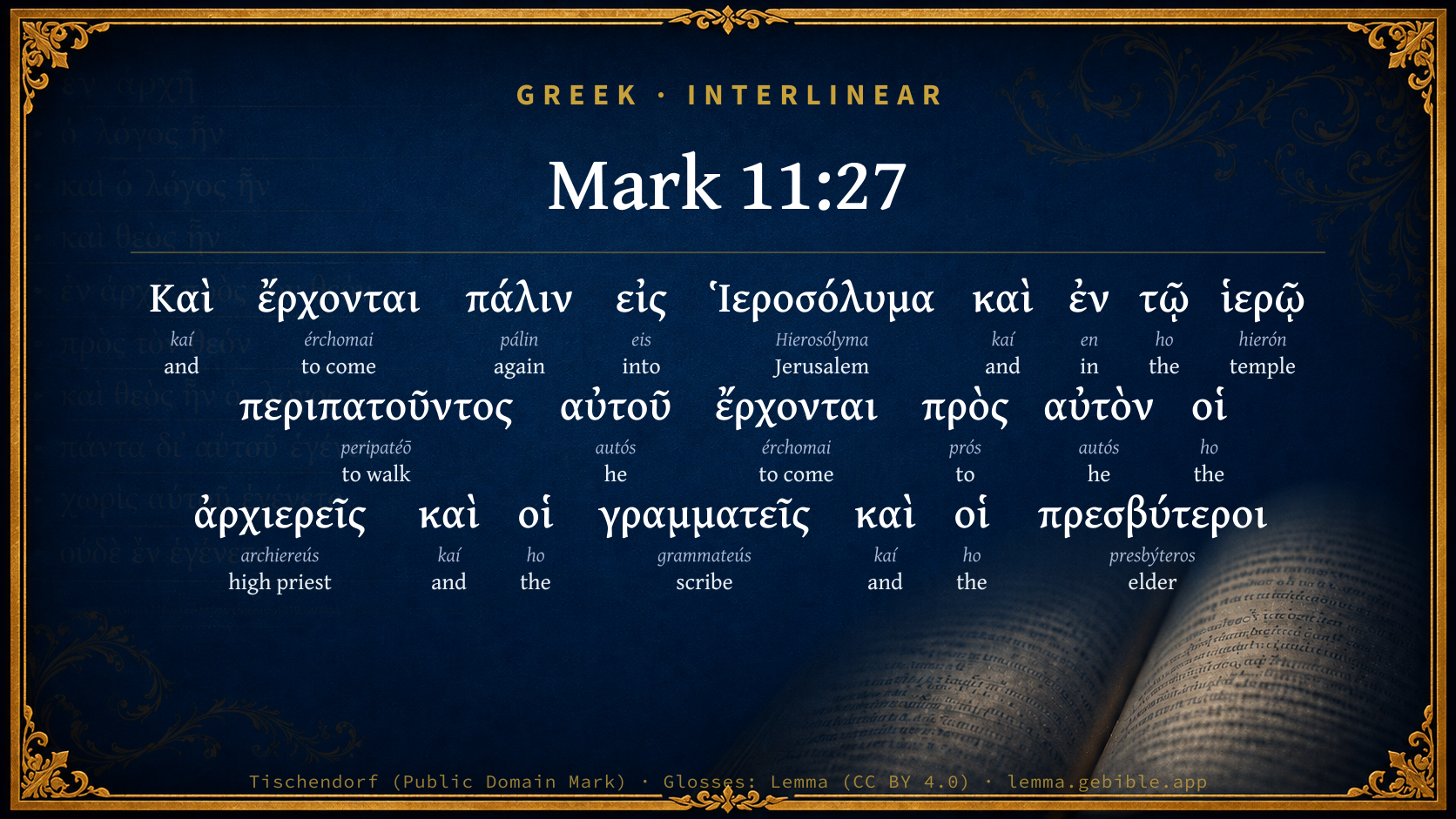
Greek (Tischendorf 8th ed.) Mark 11:27 appears in the Greek New Testament. The text above is from the Tischendorf 8th edition. Each word links to its Strong’s number and a concise gloss. Click any word for its full Thayer’s Greek Lexicon entry.
Download image
Cite this verse

Mark 11:27 (World English Bible). Public Domain. Lemma interlinear Bible study tool, https://lemma.gebible.app/v/mark/11/27.

Show BibTeX & RIS
BibTeX
RIS
English Translation
They came again to Jerusalem, and as he was walking in the temple, the chief priests, and the scribes, and the elders came to him,
World English Bible · Public Domain
Download a study sheet

One document with this verse’s original text, its word-by-word gloss line, the meaning frame, cross-references with their text, attributed commentary, and full source and license credits — printable, and it pastes into notes with its structure intact.

This verse Autodidact and up

Study sheet (.html) Plain text (.txt)

A passage Seminary Student

Up to 50 verses in one chapter. A passage sheet keeps up to 6 commentary sources and 12 cross-references per verse, in the order this page ranks them, and says so on the sheet whenever that leaves anything out. Ask for a single verse and you get the Autodidact verse sheet above.

Everything on this page stays free to read, with no account — the sheet is a download of what is already on screen, not access to it.

Want to remove ads? Support Godless Engineer
Compare translations 3

The same verse in 3 English versions, stacked beneath the original-language interlinear above. Click any original word for its lexicon entry.

Each is an independent rendering of the whole verse — the interlinear is not word-aligned to these translations.

Highlighted words mark where these versions differ — a whole-verse word diff, not a word-by-word alignment.

  • World English Bible Public Domain
    They came again to Jerusalem, and as he was walking in the temple, the chief priests, and the scribes, and the elders came to him,
  • King James Version Public Domain
    And they come again to Jerusalem: and as he was walking in the temple, there come to him the chief priests, and the scribes, and the elders,
  • unfoldingWord Literal Text CC BY-SA 4.0
    And they come to Jerusalem again, and he walking in the temple, the chief priests and the scribes and the elders come to him.

unfoldingWord Literal Text — © unfoldingWord, licensed CC BY-SA 4.0. Word-aligned USFM3 via Door43 (git.door43.org/unfoldingWord/en_ult).

Versions to compare (up to 4)

3 of 4 selected

Show all 19 translations

Every available English version of this verse, each an independent rendering of the whole verse.

  • World English Bible Public Domain
    They came again to Jerusalem, and as he was walking in the temple, the chief priests, and the scribes, and the elders came to him,
  • Berean Standard Bible Public Domain
    After their return to Jerusalem, Jesus was walking in the temple courts, and the chief priests, scribes, and elders came up to Him.
  • Majority Standard Bible Public Domain
    After their return to Jerusalem, Jesus was walking in the temple courts, and the chief priests, scribes, and elders came up to Him.
  • King James Version Public Domain
    And they come again to Jerusalem: and as he was walking in the temple, there come to him the chief priests, and the scribes, and the elders,
  • American Standard Version (1901) Public Domain
    And they come again to Jerusalem: and as he was walking in the temple, there come to him the chief priests, and the scribes, and the elders;
  • Revised Version (1885) Public Domain
    And they come again to Jerusalem: and as he was walking in the temple, there come to him the chief priests, and the scribes, and the elders;
  • Geneva Bible (1599) Public Domain
    Then they came againe to Hierusalem: and as he walked in the Temple, there came to him ye hie Priestes, and the Scribes, and the Elders,
  • Douay-Rheims (1899) Public Domain
    And they come again to Jerusalem. And when he was walking in the temple, there come to him the chief priests and the scribes and the ancients,
  • Young's Literal Translation Public Domain
    And they come again to Jerusalem, and in the temple, as he is walking, there come unto him the chief priests, and the scribes, and the elders,
  • Literal Standard Version CC BY-SA 4.0
    And they come again to Jerusalem, and in the temple, as He is walking, there come to Him the chief priests, and the scribes, and the elders,
  • Unlocked Literal Bible CC BY-SA 4.0
    They came to Jerusalem again. As Jesus was walking in the temple, the chief priests, the scribes, and the elders came to him.
  • unfoldingWord Literal Text CC BY-SA 4.0
    And they come to Jerusalem again, and he walking in the temple, the chief priests and the scribes and the elders come to him.
  • Darby Bible Public Domain
    And they come again to Jerusalem. And as he walked about in the temple, the chief priests and the scribes and the elders come to him,
  • World Messianic Bible Public Domain
    They came again to Jerusalem, and as he was walking in the temple, the chief priests, the scribes, and the elders came to him,
  • Webster's Bible Public Domain
    And they come again to Jerusalem: and as he was walking in the temple, there come to him the chief priests, and the scribes, and the elders,
  • Free Bible Version CC BY-SA 4.0
    They returned to Jerusalem, and as he was walking in the Temple, the chief priests, religious teachers, and the leaders approached him.
  • Bible in Basic English Public Domain
    And they came again to Jerusalem: and while he was walking in the Temple, there came to him the chief priests and the scribes and those in authority:
  • Text-Critical English NT CC BY 4.0
    Again they came to Jerusalem, and as Jesus was walking in the temple courts, the chief priests, the scribes, and the elders came up to him
  • Tyndale New Testament (1534) Public Domain
    And they came agayne to Hierusalem. And as he walked in the temple ther came to him the hye prestes and the Scribes and the elders

Literal Standard Version (2020), Covenant Press — licensed CC BY-SA 4.0. Text via the HelloAO Bible API (eBible.org). Unlocked Literal Bible (unfoldingWord) — licensed CC BY-SA 4.0. Text via the HelloAO Bible API (eBible.org). unfoldingWord Literal Text — © unfoldingWord, licensed CC BY-SA 4.0. Word-aligned USFM3 via Door43 (git.door43.org/unfoldingWord/en_ult). Free Bible Version, Dr. Jonathan Gallagher — licensed CC BY-SA 4.0. Text via the HelloAO Bible API (eBible.org).

Word by word

More ways to search: Search by grammar → Find every occurrence → Compare this word →

Practice this passage: Drill this verse → Learn its vocabulary →

Ἱεροσόλυμα
Hierosólyma
G2414
“Jerusalem”
Noun, Accusative, Singular, Feminine
Part of Speech
Noun
Case
Accusative
Number
Singular
Gender
Feminine
Full Thayer's Definition

Origin: of hebrew origin H3389

TDNT: 11:52,1

Jerusalem = "set ye double peace" 1. denotes either the city itself or the inhabitants 2. "the Jerusalem that now is", with its present religious institutions, i.e. the Mosaic system, so designated from its primary external location 3. "Jerusalem that is above", that is existing in heaven, according to the pattern of which the earthly Jerusalem was supposed to be built a. metaph. "the City of God founded by Christ", now wearing the form of the church, but after Christ's return to put on the form of the perfected Messianic kingdom 4. "the heavenly Jerusalem", that is the heavenly abode of God, Christ, the angels, saints of the Old and New Testament periods and those Christians that are alive at Christ's return 5. "the New Jerusalem", a splendid visible city to be let down from heaven after the renovation of the world, the future abode of the blessed
  1. Καὶ kaí G2532 “and” Conjunction
  2. ἔρχονται érchomai G2064 “to come” Verb, Present, Middle or Passive deponent, Indicative, 3rd person, Plural
  3. πάλιν pálin G3825 “again” Adverb
  4. εἰς eis G1519 “into” Preposition
  5. καὶ kaí G2532 “and” Conjunction
  6. ἐν en G1722 “in” Preposition
  7. τῷ ho G3588 “the” Article, Dative, Singular, Neuter
  8. ἱερῷ hierón G2411 “temple” Noun, Dative, Singular, Neuter
  9. περιπατοῦντος peripatéō G4043 “to walk” Verb, Present, Active, Participle, Genitive, Singular, Masculine
  10. αὐτοῦ autós G846 “he” Personal pronoun, Genitive, Singular, Masculine
  11. ἔρχονται érchomai G2064 “to come” Verb, Present, Middle or Passive deponent, Indicative, 3rd person, Plural
  12. πρὸς prós G4314 “to” Preposition
  13. αὐτὸν autós G846 “he” Personal pronoun, Accusative, Singular, Masculine
  14. οἱ ho G3588 “the” Article, Nominative, Plural, Masculine
  15. ἀρχιερεῖς archiereús G749 “high priest” Noun, Nominative, Plural, Masculine
  16. καὶ kaí G2532 “and” Conjunction
  17. οἱ ho G3588 “the” Article, Nominative, Plural, Masculine
  18. γραμματεῖς grammateús G1122 “scribe” Noun, Nominative, Plural, Masculine
  19. καὶ kaí G2532 “and” Conjunction
  20. οἱ ho G3588 “the” Article, Nominative, Plural, Masculine
  21. πρεσβύτεροι presbýteros G4245 “elder” Adjective, Nominative, Plural, Masculine, Comparative

About this verse

These counts appear in no published source. They are computed here, from the morphology-tagged text and Lemma’s own curated glosses. What Lemma adds →

22
words
14
distinct lemmas
Gospels
section

Repetition

Words recur within this verse:

  • ἔρχονται to come G2064 ×2
  • Καὶ and G2532 ×4
  • τῷ the G3588 ×4
  • αὐτοῦ he G846 ×2

Cross-references

9

Topical passages linked to Mark 11:27 in the Treasury of Scripture Knowledge — connected by theme and wording, ordered by reader-vote popularity; previews shown in the World English Bible.

  • Luke 20:1–8 It happened on one of those days, as he was teaching the people in the temple and preaching the Gospel, that the priests and scribes came to him with the elders.
  • Matthew 21:23–27 When he had come into the temple, the chief priests and the elders of the people came to him as he was teaching, and said, "By what authority do you do these things? Who gave you this authority?"
  • Psalms 2:1–5 Why do the nations rage, And the peoples plot a vain thing?
  • Acts 4:27–28 For truly, in this city against your holy servant, Jesus, whom you anointed, both Herod and Pontius Pilate, with the Gentiles and the people of Israel, were gathered together
  • Mark 14:1 It was now two days before the feast of the Passover and the unleavened bread, and the chief priests and the scribes sought how they might sieze him by deception, and kill him.
  • John 10:23 It was winter, and Jesus was walking in the temple, in Solomon's porch.
  • John 18:20 Jesus answered him, "I spoke openly to the world. I always taught in synagogues, and in the temple, where the Jews always meet. I said nothing in secret.
  • Acts 4:5–8 It happened in the morning, that their rulers, elders, and scribes were gathered together in Jerusalem.
  • Malachi 3:1 "Behold, I send my messenger, and he will prepare the way before me; and the Lord, whom you seek, will suddenly come to his temple; and the messenger of the covenant, whom you desire, behold, he comes!" says Yahweh of hosts.

Cross-references courtesy of OpenBible.info (CC BY 4.0).

Commentary

Notes on Mark 11:27 from classic Christian and Jewish commentators (each source and its license shown beneath its notes). The classic Christian expositions comment on the surrounding passage and are grouped to its opening verse, so a note may address several verses; the Jewish commentaries on the Tanakh (Rashi and others) are per-verse, so they appear only where the commentator wrote on this verse.

Lemma curates 59 commentaries, every one of them public domain or Creative Commons licensed, each selected and text-cleaned for this edition rather than reprinted as found. About our sources →

Joseph Benson's Commentary

Mar 11:27-29. There come to him the chief priests, &c. — It seems that Christ’s sermons made a great impression on those who heard him, for the number of his followers and admirers increased so as to alarm the rulers, who feared that the people, on his account, would endeavour to shake off the Roman yoke. They consulted, therefore, among themselves, how they might destroy him, and resolved to do it under pretext of law; the attachment which the multitude had to him hindering them from laying violent hands on him. In consequence of this resolution, the chief priests, scribes, and elders, that is, some of the first men of the nation, came, probably by appointment of the senate, to Jesus one day when he was in the temple, and before all the people, put two questions to him. The first was, concerning the nature of the authority by which he acted, whether it was as a prophet, a priest, or a king; no other person having a right to make any reformation in church or state. The second question was, that if he claimed the authority of any, or all of these characters, they desired to know from whom he derived it. The things done by him, to which they referred, were his entering the city with such a numerous train of attendants; his taking upon him to reform the economy of the temple; and his receiving the acclamations of the people, who gave him the title of Messiah. Jesus answered, I will also ask of you one question. — See note on Mat 21:23-27.

Joseph Benson's Commentary on the Old and New Testaments (1811–1818) — public domain. Text from a community e-Sword module.

Whedon's Commentary on the Bible

Daniel D. Whedon

§ 113. — DISCOURSE WITH CHIEF PRIESTS, ETC., IN THE TEMPLE, Mar_11:27 to Mar_12:12.

1-12. See our notes on Mat_21:33-45.

Daniel D. Whedon (gen. ed.), Commentary on the Old and New Testaments (1874–1909) — public domain. Text from a community e-Sword module.

The Preacher's Complete Homiletical Commentary

Joseph S. Exell (gen. ed.)

CRITICAL AND EXEGETICAL NOTES

Mar_11:27. The elders.—“The ancient senators or representatives of the people. With the chief priests and scribes they constituted on this occasion a formal deputation from the Sanhedrin. We find the earliest notice of the elders acting in concert as a political body in the time of the Exodus (Exo_19:7; Deu_31:9). Their authority, which extended to all matters of the common weal, they exercised under (a) the Judges (Jdg_2:17; 1Sa_4:3); under (b) the Kings (1Sa_30:26; 1Ch_21:16; 2Sa_17:4); during (c) the Captivity (Jer_29:1; Eze_8:1); after (d) the Return (Ezr_5:5; Ezr_6:7; Ezr_6:14; Ezr_10:8; Ezr_10:14); under (e) the Maccabees (1Ma_12:6; 2Ma_1:10); in (f) the time of our Lord, when they denoted a distinet body in the Sanhedrin, amongst whom they obtained their seat by election, or nomination from the executive authority.”

MAIN HOMILETICS OF THE PARAGRAPH.—Mar_11:27-33

(PARALLELS: Mat_21:23-32; Luk_20:1-8.)

Christ’s authority challenged.—I. The challenge by the chief priests and scribes and elders.—

1. The occasion. Christ’s teaching in the Temple. Observe—

(1) His constant and unwearied pains and diligence in the duties of His public ministry.

(2) Though the chief priests and scribes sought His life (Mar_11:18), yet He doth not refrain or forbear coming to Jerusalem, and into the Temple, and teaching the people there, and that daily. Hence learn that we ought not to forsake our calling, or give over the duties of it which God calls us to perform, for fear of outward dangers which may happen to us. God is able to protect us from all our enemies.

2. The persons that questioned with Christ about His calling and authority.

(1) Such as for their high place and calling in the Church should be the greatest friends and favourers of Christ and the gospel, are often the greatest enemies to both.

(2) Seeing there is such unity and consent amongst the wicked enemies of Christ, as here we see, this should teach us much more to labour for true unity and consent, whereby to join together for Christ, as these did against Him.

3. Their questioning.

(1) There is something good and commendable here. (a) That they suppose, and take it for granted, that no man ought to take upon him any public office or function in the Church without a lawful calling and authority committed to him. (b) That they themselves, being public officers and governors in the Church, do think it their duty to take care that none intrude or usurp any public office in the Church without a calling.

(2) But there is also that which is evil and wicked, (a) Their malicious purpose against Christ. (b) Their gross hypocrisy and dissimulation. (c) Their wilful ignorance and blindness, in that being formerly convinced of His lawful calling and authority by so many evident signs and testimonies of it as they had seen and heard—viz. by the testimony of the Baptist, the excellence of His doctrine, and Divine power of His miracles—yet for all this they cannot, or rather will not, see what authority He had, but do now question Him about the same.

II. The vindication of Himself by our Lord.—

1. The preface or preparation to the answer, wherein Christ tells them that He would also ask of them one question, which, if they could and would answer, then He would answer them.

(1) In that our Saviour, knowing them to come with malicious purpose, doth not directly answer their question, we may learn that it is not always necessary or fit to give a direct answer to those demands or questions put to us by others, especially by malicious enemies of the truth, who come to cavil and entrap us with captious questions, and not with a mind to learn or receive satisfaction from us.

(2) Though He does not directly answer their malicious question, yet He makes a kind of answer indirectly, by putting another question to them, and such a one as was sufficient (if they would have understood it) to resolve the matter, and to convince them: hence gather, that although it be not always necessary or fit to give a direct answer, nor yet any answer at all sometimes, to the questions of malicious cavillers, yet it is also fit sometimes to make some kind of answer to such captious questions, viz. so far forth as is necessary for the clearing of the truth and for the convincing of such cavillers (Pro_26:5; 1Pe_3:15).

2. The answer itself.

(1) In that Christ alleges the authority of John’s ministry, to justify His own calling and authority, hence gather, that one main end of the calling and ministry of the Baptist was to declare and manifest the calling and authority of Christ Himself, by giving testimony to Him that He was the true Messiah promised and sent from God to be the Saviour of the world.

(2) In that Christ here implies that John’s ministry and doctrine concerning Him was from God, and therefore to be believed and embraced, which otherwise it should not have been: hence gather, that no doctrine or ministry is to be received and embraced in the Church but that which is from God, that is, of Divine authority, and not from men only.

(3) In that Christ’s asking here whether John’s baptism or ministry was from heaven or of men doth thereby imply that it was indeed from heaven, and not from men: hence gather, the dignity and excellence of the doctrine and ministry of John, that it was the doctrine of God, and was preached and taught by authority from God Himself.

(4) The dignity and excellence of the sacrament of baptism.

III. The effects or consequents which followed.—

1. Their reasoning together about the matter, and consulting about the answer they should make.

(1) Though they came very cunningly and politicly to examine and question with our Lord about His authority, to entrap Him and bring Him into trouble and danger, yet here we see they could not prevail against Him by their policy. See Pro_21:30; Isa_8:10; Psa_2:1-4; Job_5:13; Psa_7:15.

(2) See here one point of carnal wisdom in these enemies of our Lord, in that they, being now in a perplexity, do not rashly or suddenly proceed to make answer, but first reason and consult together. See Luk_16:8; Jer_4:22.

2. Now followeth the matter of their private reasoning or consultation together.

(1) They cast what inconveniences or dangers to themselves are like to follow, if they answer thus or thus; but regard not the offence of God, and dishonour like to come to Him, by their denying or concealing the truth, and that against their own knowledge.

(2) They presuppose that if they should acknowledge John’s ministry to be from heaven, then they were bound to believe his doctrine, and that Christ might justly reprove them for not doing so.

(3) They feared the people’s displeasure, and lest they should stone them for speaking against John and his ministry; but they were not moved with any fear of God to confess the truth, neither are they afraid of offending God by denying or concealing the truth.

(4) The common and meaner sort of people are often more forward to embrace the gospel, and to esteem the ministers of it, than men of great place and dignity in the Church. 3. Their answer: “We cannot tell.” This must needs be false; yea, it is a lying answer, containing an untruth uttered against their own knowledge.

(1) God often takes and confounds the crafty and subtle enemies of the truth in their own policy (1Co_3:19).

(2) It is the property and practice of wicked and profane men to lie and dissemble for their own benefit and advantage, as for their profit and gain, or to save their credit with men, or to help themselves out of trouble, or to prevent some inconvenience or danger like to come upon them.

(3) How fearful a thing it is for any to be given up to wilful blindness and infidelity!

4. Christ’s reply. Because they denied and opposed the truth against their own knowledge, He refuses to give them any further answer. Take heed of this wilful contempt and opposition of the known truth, lest for it God do justly leave us in ignorance; yea, give us up to further blindness, to be hardened in it, as He may justly do. On the contrary, labour not only to know the truth and doctrine of God out of His Word, but especially to entertain the love of it in our hearts, that we may embrace it and yield obedience to it.—G. Petter.

OUTLINES AND COMMENTS ON THE VERSES

Mar_11:27-33. Christ and the Temple authorities.—

1. Where the action is unquestionably right some will censure the agent.

2. They who require reasons should be ready to give reasons.

3. Truth should be the first question with men, not consequences.

4. Incompetency may be exposed and assumption resisted for the sake of truth.—J. H. Godwin.

The mutual bearing of Christ and His enemies.—With evil intent they open fire. A brief “yes or no” style of reply may do great injustice to righteousness. They would be greatly pleased therewith. But they were dealing with One who had the wisdom of the serpent as well as the harmlessness of the dove. And so without needlessly rousing wrath, impeding work, or compromising truth, God’s glory and the welfare of men in all ages are subserved by the replies which came promptly and steadily back to their astonished ears. He did not deem it a duty to always answer questions directly and without reserve. The gates were not to be thrown wide open at the beck of every foe. Source, motive, and result were considered, and the nature of His replies gauged accordingly. In this instance He defeated their purpose in seeking whereof they might accuse Him. But He at the same time let them know that both the fact and source of what they sought were good and true. His refusal to respond to their liking arose not from fear of frank statement or of maintaining it. Let them answer a plain question and He would. Fair play. They would thus shew themselves worthy of an explicit reply by their own readiness to do the same. But whether answered or not, they found themselves handicapped by their insincerity as well as moral and physical cowardice. Had they been true men they would not have gotten there. Their capacity to decide on His credentials, their honesty, their courage, were all at stake. It was the presentation of a dilemma, the grasping of either horn of which would defeat them. Among the evils they made a lame effort to select the least. By avoiding a blunt refusal He prevented the needlessly premature loss of temper and its consequences. Without this self-command and wisdom, by undue exasperation, a crisis might be hastened. “His hour was not yet come.” But how could they help realising that, by such a question, He knew what was in them? How could they help knowing that the knowledge implied by His questions had Divinity back of it? How could they help concluding that Divinity carried with it that authority which they were insincerely seeking to find out? It is His turn now. He questions. They soon stand self-condemned in the light of their own admissions.—Wm. M. Campbell.

Wilful blindness and its retributive judgment.—Had they been true to their office or to themselves, they needed not to have asked this question. They had possessed long since abundant means of knowing the Divine authority both of the Lord’s ministry and of John’s baptism. But their carnal passions prevented them from acknowledging the first; while their cowardly fears, the offspring of a bad conscience, brought them into a dilemma respecting the last. Do we see nothing like this among ourselves? Received truths are disputed; things certain are treated as uncertainties; old objections, often refuted, are revived; questions are raised where the clearest light and evidence have long supplied an answer adequate to the conviction of every honest mind: but men refuse to be convinced; they harden themselves in error; because of their lusts they “love to have it so”; while some even venture to hope that their supposed inability to believe, which is their condemnation, will serve as an extenuation of their general guilt at the Last Day. How awful in these respects are the warnings of the Lord! See Joh_12:35; Mat_13:12; Luk_11:35.—J. Ford.

The rejection of authority.—Those who find themselves vanquished by truth generally endeavour to reject authority. There are no persons more forward to demand of others a reason for their actions than those who think they may do everything themselves without control. Blind priests! who see not the finger of God nor His Divine authority in the visible and innumerable miracles of Christ, which plainly authorise His mission and His conduct, and evidently prove His Divinity. Ignorant scribes! who talk of nothing but the Scriptures and the law, and yet do not perceive in Christ the author and the perfection, the end and accomplishment, the spirit and the truth of the law, as all the Scriptures declare Him to be.—P. Quesnel.

Mar_11:28. The calling of ministers in the Church.—

1. Reasons why none ought to take upon him this public office or function in the Church without a lawful calling.

(1) Because without such a calling he cannot be assured that God will assist him and strengthen him to do the duties of his calling.

(2) He cannot expect or look for the blessing of God upon that which he doth in execution of his office, and so he cannot with comfort go on in it.

(3) Neither can he be assured of God’s protection in his calling, that God will maintain and keep him against all enemies and dangers.

2. There is a twofold calling of every one who takes upon him this public office in the Church.

(1) An inward calling from God and in his own conscience, whereby he must know and be assured in himself that God has endued him in some measure with such gifts and graces as are requisite to make him able and fit to execute that office and function, together with a willing and ready mind and conscience to use those gifts to the glory of God and good of the Church.

(2) An outward calling from men also, being approved and allowed of by such as are in authority in the Church, to execute the office he takes upon him.—G. Petter.

Mar_11:29-30. Christ’s appeal to the testimony of the Baptist.—As His words are generally understood, they would have amounted only to silencing His questioners, and that in a manner which would, under ordinary circumstances, be scarcely regarded as either fair or ingenuous. It would have been simply to turn the question against themselves, and so in turn to raise popular prejudice. But the Lord’s words meant quite other. He did answer their question, though He also exposed the cunning and cowardice which prompted it. To the challenge for His authority, and the dark hint about Satanic agency, He replied by an appeal to the Baptist. He had borne full witness to the mission of Christ from the Father, and “all men counted John, that he was a prophet indeed.” Were they satisfied? What was their view of the Baptism in preparation for the Coming of Christ? They would not, or could not, answer! If they said the Baptist was a prophet, this implied not only the authorisation of the mission of Jesus, but the call to believe on Him. On the other hand, they were afraid publicly to disown John! And so their cunning and cowardice stood out self-condemned, when they pleaded ignorance—a plea so grossly and manifestly dishonest, that Christ, having given what all must have felt to be a complete answer, could refuse further discussion with them on this point.—A. Edersheim, D.D.

Mar_11:32. A prophet is one who, standing in the foreground of God, announces on Divine impulse and with Divine power truths unveiled to his spiritual perception. These truths, often significant of salvation, it is his office to report for the welfare of the community. He receives them in his own higher spirit, unto which, as to, an observatory of heavenly visions, his life for a season withdraws itself, and where, shrinking from all contact with externals, it becomes “a seeing eye, a hearing ear, a perceiving sense” for the things of eternity or of the future. What the prophet thus receives in the sanctuary of his spirit or meeting-place of the two worlds that he announces through the medium of the subordinate mind and its outflowing speech: for in the prophetic ecstasy the three constituents of the spirit-nature, νοῦς and λόγος and πνεῦμα, continue in unbroken communication with each other. If he be a seer, he contemplates that which is seen, not as it is in itself, but as it comes to view in a symbol: this symbol is Divinely formed for the purpose, and often accommodated to the man’s natural bent or educational mode of thought, being chiefly framed out of materials found in his subjectivity. The prophet is not, indeed, like the subject of the mystic ecstasy, rapt or caught up to the confines of the third heaven or blissfully translated into the paradise of God; but from the reciprocal immanence of the human spirit and of the Divine there arise manifestations to his mind in a clothing or colouring borrowed from his individual nature. The supersensuous, which he is permitted to behold, passes immediately through his own νοῦς into λόγος, and thus in the form of speech travelling through his mouth out of himself enters the ears and the νοῦς of the listening congregation, and so becomes intelligible and therefore profitable to the assembled Church.—Prof. T. S. Evans.

Mar_11:33. Christ discovers not Himself to hypocrites.—That man is altogether unworthy of the truth who seeks it only to oppose it. It is to no manner of purpose to dispute and reason with those who study only how to ensnare in their discourse, and to take advantage of everything against truth. Such persons shew plainly what concern they have for truth when they make use of lies and forgeries to oppress it. Humility does not oblige any one to give an account of his conduct to all sorts of persons, nor at all times, nor in all circumstances, but only to be ready to do it whenever the glory of God and the benefit of his neighbour require it.—P. Quesnel.

The Preacher's Complete Homiletical Commentary (gen. ed. Joseph S. Exell; Funk & Wagnalls, c. 1892) — public domain (pre-1929). A full-Bible homiletical/sermon-outline anthology covering 65 of 66 books (2 John is absent from the source module). Text from a community e-Sword module.

Lange's Commentary on the Holy Scriptures

SECOND SECTION

THE DECISIVE CONFLICT OF JESUS WITH HIS ENEMIES IN JERUSALEM, AND HIS WITHDRAWAL TO THE MOUNT OF OLIVES

s Mar_11:27 to Mar_13:37

________

1. The Attack of the Sanhedrim; or the Question concerning Christ’s Authority, and His Counter-question concerning the Baptist’s. Mar_11:27-33.

(Parallels: Mat_21:23-27; Luk_20:1-8.)

27     And they come again to Jerusalem: and as he was walking in the temple, there 28 come to him the chief priests, and the scribes, and the elders, And say21 unto him, By what authority doest thou these things, and who gave thee this authority to do these things? 29And Jesus answered and said unto them, I will also ask of you one question, 30 and answer me, and I will tell you by what authority I do these things. The baptism of John, was it from heaven, or of men? answer me. 31And they reasoned with themselves, saying, If we shall say, From heaven; he will say, Why then22 did ye not believe 32 him? But if23 we shall say, Of men; they feared the people: for all men counted John, that he was a prophet indeed. 33And they answered and said unto Jesus, We cannot tell. And Jesus answering,24 saith unto them, Neither do I tell you by what authority I do these things.

EXEGETICAL AND CRITICAL

See on the parallels of Matthew and Luke.—According to Mark’s representation, this day of Christ’s conflict falls on Tuesday of the Passion Week. But the conflict is subdivided into three parts: 1. The official demand as to Jesus’ abode and supremacy in the temple, exhibited in the question of the Sanhedrim touching His authority; with its reply, as in our present section. 2. The ironical acknowledgment, on the side of the inimical party, of Christ’s Messianic dignity, exhibited in a series of tempting questions and answers; with the great counter question, of Jesus. 3. The Lord’s words to the people, and departure from the temple. Mark’s account has in our text no prominent peculiarities; he agrees rather with Luke than with Matthew. His vivid style of delineation is seen in the trait that Jesus went round about the temple, while according to Matthew, He was in the act of teaching (though these are not inconsistent with each other); as also the second clause of the Sanhedrim’s pondering—“But if we shall say.” The Evangelist’s choice of the expression λέγει αὐτοῖς, Mar_11:33, seems appropriate; while Matthew says ἔφη, and Luke εἶπεν. As the Sanhedrim refused Him a decisive declaration concerning John, who had prophetically authenticated Him as the Messiah, He also refused to them the decisive declaration they sought. This was, however, in itself decisive; but not in the form of an express statement.

Mar_11:27. Doest Thou these things?—See Matthew. This meant, doubtless, the public appearance and work of Jesus in the temple under the Messiah-name which the people gave Him; amongst the rest, certainly, as an individual act, the cleansing of the temple also. The law ordained that prophets were to be tried, Deu_13:1. The most essential requisite was agreement with the faith of the God of Israel; the accidental requirement was the performance of miracles. The latter was not valid without the former; but it was not said that the former without the latter was not valid. (Comp. Deu_18:20; Eze_13:1). The Sanhedrim could hold themselves justified only in asking for the authority of Jesus. They could not deny that He had approved Himself by miracles. They were disposed, however, to make it a reproach, that He taught other gods, and a new religion. Hence they ask Him: 1. After the divine source of His power, prophetic inspiration; 2. after His theocratic authentication. By the latter the former also was approved, and therefore Jesus appealed to John. John was the most recent monument of the truth and validity of the prophetic order in Israel. And this John had marked Him out as the Messiah. They had been compelled to allow his validity as a prophet, although they did not afterwards acknowledge him. They would entangle Jesus by making Him appeal to His divine dignity; but the word of Jesus entangled them and smote them at the same time. It was a reference to His theocratic legitimation, the bearer of which they durst not openly impeach; and at the same time a remembrancer that they themselves had, since the days of John, been falling deep into apostasy.

Mar_11:31. If we shall say.—The abrupt form is expressive, and more significant than the full unfolding of it in Matthew and Luke, “We fear,” which certainly declares the motive of their silence.

Indeed (of a truth).—According to the reading o̓́ντως ό̓τι, which Tisch. adopts from B. C. L., Meyer translates “They were inwardly sure that John was a prophet.” But A. D. and others form a counterpoise; as well as the consideration that this would attribute to the people altogether, and as a whole, the full and believing acceptance of John.

DOCTRINAL AND ETHICAL

1. See on the parallels.

2. The counter-question of Jesus arose as the simple consequence of the question addressed to Him. That question was addressed to His theocratic authority. This was already involved in the authentication by John. If they acknowledged John, they must acknowledge also his witness to Jesus as the Messiah. If they did not acknowledge him, they were in a theocratic sense rebels; and Christ could, in the consciousness of His real, human-divine authority, transcending all theocratic authorization, refuse to give them an answer.

3. From heaven or of men.—Divine mission or human enthusiasm. The antithesis is here laid down, with reference to the contrast between the divine and the human in the human sphere, and does not prejudice the union of the divine and human in the Christological sphere.

HOMILETICAL AND PRACTICAL

See Matthew.—Christ in His temple assaulted by the official rulers of the place.—Vainly would hierarchical official authority suppress the divine mission of Jesus.—The misuse of spiritual prerogatives against the rights of the Spirit of Christ a guilt which brings after it the severest punishments: 1. Misuse of dignity calls down the judgment of disgrace; 2. misuse of office calls down displacement and rejection from office.—The Spirit of Christ triumphs over the false spirituality of His enemies: 1. With His counter-question opposing their question; 2. with His counter-declarations against their declarations.—The authority of Christ to take possession of the temple of God, as opposed to the impotence of His foes: 1. The authority: a. His theocratic authority; b. His personal divine-human authority; c. the authority which rose out of His actual Passion-conflict. 2. The impotence of His foes: a. as rejecters of the God-sent Baptist, forsaken of human justice; b. as rejecters of Christ, forsaken of the Spirit; c. as enemies and murderers of Christ, forsaken of God in His government of the world.—The obedience of Christ as confronting the Jewish priesthood, an emblem of Christian faith confronting churchly office: 1. The Lord regards the office as under the condition of obedience to the revelation of God, because it issues from that Revelation 2. He regards Himself as under the obligation to obey the revelation of God, because He is the consummation of it. Or, 1. In His suffering a question; 2. in His declining to answer; 3. in His willingness to submit to officials, so long as their rejection is not complete.—The heavenly prudence of the Lord in its triumph over the human wisdom of His enemies.—How the spirit of the New Covenant confronts the false representatives of the Old Covenant in God’s temple: 1. With the clear word of knowledge; 2. with the firm word of assurance; 3. with the sharp word of judgment; 4. with the abundant word of life and of freedom.

Starke:—Nova Bibl. Tub.:—Zeal for God’s house and for its purity is sure to awaken enemies.—Conscience bears witness against the worst of men: they are their own accusers, judges, condemners.—Osiander:—They who will not suffer the Church’s amendment in rule and discipline must fall.—Canstein:—When those in the teaching and ruling office are unfaithful to their calling, and God raises up others extraordinarily, the former take all pains to deny to the latter the power that God Himself has given them.—Hedinger:—The good need prudence in their intercourse with cunning and wicked people, lest their simplicity and openness bring harm to them and their cause.—Quesnel:—Miserable case when the men of light use their knowledge of the truth to oppose that truth.—How many will not in religious matters be sincere, and reveal the truth, lest they be assaulted and tried!—Bibl. Wirt.:—The scorners of the truth, God will in the end count not worthy of the truth they scorn; but, instead of it, will send them strong delusions, that they should believe a lie, 2Th_2:11-12.

Braune:—He might have appealed to many prophets (yet not in the same sense as to John). They would then have said: But that was in a former age. He takes the latest example (of a prophetic vocation).

Footnotes:

[21]Mar_11:28.—Tischendorf reads, with B., C., L., Δ., ἔλεγον, and ἤ for καὶ (τίς) with B., L., D.

[22]Mar_11:31.—The οὖν is wanting in A., C.*, L., Versions, Lachmann, Tischendorf, Meyer.

[23]Mar_11:32.—The ἐάν is wanting in the best Codd.; omitting it, the sentence takes a very characteristic interrogatory form.

[24]Mar_11:33.—The ἀποκριθείς is wanting in B., C., [L., Tischendorf, Meyer,] and elsewhere varies in its position.

Lange's Commentary on the Holy Scriptures (Critical, Doctrinal, and Homiletical), ed. John Peter Lange, English translation edited by Philip Schaff (1864–1880) — public domain. Text from a community e-Sword module.

Godbey's Commentary on the New Testament

William B. Godbey

THE HIGH PRIESTS DEMAND HIS AUTHORITY

Mat 21:23-27; Luk 20:1-8; Mar 11:27-33. “And again they come into Jerusalem. And He, walking round in the temple, file high priests, scribes, and elders come to Him, and say to Him, By what authority do You these things? And who gave You this authority that You may do these things? And Jesus, responding, said to them, I will also ask you one question; answer Me, and I will tell you by what authority I do these things. The baptism of John, was it from heaven, or from men? Tell Me. And they reasoned among themselves, If we may say, It is from heaven, He will say, Wherefore then did you not believe on him? But if we may say, It is from men; they feared the people: for all held John, that he was truly a prophet. And responding, they say to Jesus, We do not know. And Jesus, responding, says to them, Neither do I tell you by what authority I do these things.” Those high priests considered the authority He exercised in the purification of the temple outrageous, intrusive, and usurpatory in the extreme. Consequently they look Him in the face, with the scribes and Pharisees holding up their hands, and publicly demand His authority, feeling that it was their prerogative to manage affairs in the temple. See how inconsistent their attitude, as they were really Satan’s preachers, worshipping him as God; while the Son of God, with all authority in heaven and in earth, was there, and they were too blind to see Him! How does history repeat itself! The Lord’s true people, saved, sanctified, and filled with the Spirit, alone have authority this day to preach and labor to save souls, going where He leadeth. Do we not see the authority of such called in question by the high priests and Pharisees on all sides? Jesus simply referred them to the ministry of John, under which He was baptized with water, and thus inaugurated into His official Messiahship, the Holy Spirit immediately descending and filling Him, thus qualifying Him for His work. As Jesus said to John, “Thus it becometh us to fulfill all righteousness” — i.e., to verify every injunction of the Levitical law, which required the high priests to be anointed before entering upon the duties and exercising the authority of their office — so, pursuant to the example of our Great Leader, we should all conform to the ritual law of the New Testament, and be sure that, like Jesus, we get filled with the Holy Ghost, thus silencing criticism and disarming our enemies. You see all the high priests, Pharisees, and elders here dumfounded. They were in a dilemma, and dare not take either horn. If they denied the Divine authority of John, they were afraid of a riot, as the people all regarded him as truly a prophet, there being no dissenting voice, but unanimity of opinion as to the Divine prophetical commission of John, whose ministry was a sunburst on Israel after a dark interregnum of four hundred years. Again, they were afraid to acknowledge the Divine authenticity of John’s ministry lest Jesus would say, Why did you not believe on Him? Consequently they took a neutral position. O what a succession these blind, unspiritual high priests, ruling eiders, and Pharisees have this day! Do you not know that, as a rule, their successors in the Churches are now playing neutrality in reference to God’s mighty works in the great current revival shaking all nations, and denominated the “Holiness Movement?”

William B. Godbey, Commentary on the New Testament (1896–1900) — public domain. Text from a community e-Sword module.

The Expositor's Bible

CHAPTER 11:27-33 (Mar_11:27-33)

THE BAPTISM OF JOHN, WHENCE WAS IT?

"And they come again to Jerusalem: and as He was walking in the temple, there come to Him the chief priests, and the scribes, and the elders; and they said unto Him, By what authority doest Thou these things? or who gave Thee this authority to do these things? And Jesus said unto them, I will ask of you one question, and answer Me, and I will tell you by what authority I do these things. The baptism of John, was it from heaven, or from men? answer Me. And they reasoned with themselves, saying, If we shall say, From heaven: He will say, Why then did ye not believe him? But should we say, From men--they feared the people: for all verily held John to be a prophet. And they answered Jesus and say, We know not. And Jesus saith unto them, Neither tell I you by what authority I do these things." Mar_11:27-33 (R.V.)

THE question put to Jesus by the hierarchy of Jerusalem is recorded in all the synoptic Gospels. But in some respects the story is most pointed in the narrative of St. Mark. And it is natural that he, the historian especially of the energies of Christ, should lay stress upon a challenge addressed to Him, by reason of His masterful words and deeds. At the outset, he had recorded the astonishment of the people because Jesus taught with authority, because "Verily I say" replaced the childish and servile methods by which the scribe and the Pharisee sustained their most willful innovations.

When first he relates a miracle, he tells how their wonder increased, because with authority Jesus commanded the unclean spirits and they obeyed, respecting His self-reliant word "I command thee to come out," more than the most elaborate incantations and exorcisms. St. Mark's first record of collision with the priests was when Jesus carried His claim still farther, and said "The Son of man hath authority" (it is the same word) "on earth the forgive sins." Thus we find the Gospel quite conscious of what so forcibly strikes a careful modern reader, the assured and independent tone of Jesus; His bearing, so unlike that of a disciple or a commentator; His consciousness that the Scriptures themselves are they which testify of Him, and that only He can give the life which men think they possess in these. In the very teaching of lowliness Jesus exempts Himself, and forbids others to be Master and Lord, because these titles belong to Him.

Impressive as such claims appear when we awake to them, it is even more suggestive to reflect that we can easily read the Gospels and not be struck by them. We do not start when He bids all the weary to come to Him, and offers them rest, and yet declares Himself to be meek and lowly. He is meek and lowly while He makes such claims. His bearing is that of the highest rank, joined with the most perfect graciousness; His great claims never irritate us, because they are palpably His due, and we readily concede the astonishing elevation whence He so graciously bends down so low. And this is one evidence of the truth and power of the character which the Apostles drew.

How natural is this also, that immediately after Palm Sunday, when the people have hailed their Messiah, royal and a Savior, and when He has accepted their homage, we find new indications of authority in His bearing and His actions. He promptly took them at their word. It was now that He wrought His only miracle of judgment, and although it was but the withering of a tree (since He came not to destroy men's lives but to save them), yet was there a dread symbolical sentence involved upon all barren and unfruitful men and Churches. In the very act of triumphal entry, He solemnly pronounced judgment upon the guilty city with would not accept her King.

Arrived at the temple, He surveyed its abuses and defilements, and returned on the morrow (and so not spurred by sudden impulse, but of deliberate purpose), to drive out them that sold and bought. Two years ago He had needed to scourge the intruders forth, but now they are overawed by His majesty, and obey His word. Then, too, they were rebuked for making His Father's house a house of merchandise, but now it is His own -- "My House," but degraded yet farther into a den of thieves.

But while traffic and pollution shrank away, misery and privation were attracted to Him; the blind and the lame came and were healed in the very temple; and the center and rallying-place of the priests and scribes beheld His power to save. This drove them to extremities. He was carrying the war into the heart of their territories, establishing Himself in their stronghold, and making it very plain that since the people had hailed Him King, and He had responded to their acclaims, He would not shrink from whatever His view of that great office might involve.

While they watched, full of bitterness and envy, they were again impressed, as at the beginning, by the strange, autocratic, spontaneous manner in which He worked, making Himself the source of His blessings, as no prophet had ever done since Moses expiated so dearly the offense of saying, Must we fetch you water out of the rock? Jesus acted after the fashion of Him Who openeth His hands and satisfieth the desire of every living thing. Why did He not give the glory to One above? Why did He not supplicate, nor invoke, but simply bestow? Where were the accustomed words of supplication, "Hear me, O Lord God, hear me," or, "Where is the Lord God of Israel?"

Here they discerned a flaw, a heresy; and they would force Him either to make a fatal claim, or else to moderate His pretensions at their bidding, which would promptly restore their lost influence and leadership.

Nor need we shrink from confessing that our Lord was justly open to such reproach, unless He was indeed Divine, unless He was deliberately preparing His followers for that astonishing revelation, soon to come, which threw the Church upon her knees in adoration of her God manifest in the flesh. It is hard to understand how the Socinian can defend his Master against the charge of encroaching on the rights and honors of Deity, and (to borrow a phrase from a different connection) sitting down at the right hand of the Majesty of God, whereas every priest standeth ministering. If He were a creature, He culpably failed to tell us the conditions upon which He received a delegated authority, and the omission has made His Church ever since idolatrous. It is one great and remarkable lesson suggested by this verse: if Jesus were not Divine, what was He?

Thus it came to pass, in direct consequence upon the events which opened the great week of the triumph and the cross of Jesus, that the whole rank and authority of the temple system confronted Him with a stern question. They sat in Moses' seat. They were entitled to examine the pretensions of a new and aspiring teacher. They had a perfect right to demand "Tell us by what authority thou doest these things." The works are not denied, but the source whence they flow is questioned.

After so many centuries, the question is fresh today. For still the spirit of Christ is working in His world, openly, palpably, spreading blessings far and wide. It is exalting multitudes of ignoble lives by hopes that are profound, far-reaching, and sublime. When savage realms are explored, it is Christ Who hastens thither with His gospel, before the trader in rum and gunpowder can exhibit the charms of a civilization without a creed. In the gloomiest haunts of disease and misery, madness, idiocy, orphanage, and vice, there is Christ at work, the good Samaritan, pouring oil and wine into the gaping wounds of human nature, acting quite upon His own authority, careless who looks askance, not asking political economy whether genuine charity is pauperization, nor questioning the doctrine of development, whether the progress of the race demands the pitiless rejection of the unfit, and selection only of the strongest specimens for survival. That iron creed may be natural; but if so, ours is supernatural, it is a law of spirit and life, setting us free from that base and selfish law of sin and death. The existence and energy of Christian forces in our modern world is indisputable: never was Jesus a more popular and formidable claimant of its crown; never did more Hosannas follow Him into the temple. But now as formerly His credentials are demanded: what is His authority and how has He come by it?

Now we say of modern as of ancient inquiries, that they are right; investigation is inevitable and a duty.

But see how Jesus dealt with those men of old. Let us not misunderstand Him. He did not merely set one difficulty against another, as if we should start some scientific problem, and absolve ourselves from the duty of answering any inquiry until science had disposed of this. Doubtless it is logical enough to point out that all creeds, scientific and religious alike, have their unsolved problems. But the reply of Jesus was not a dexterous evasion, it went to the root of things, and, therefore, it stands good for time and for eternity. He refused to surrender the advantage of a witness to whom He was entitled: He demanded that all the facts and not some alone should be investigated. In truth their position bound His interrogators to examine His credentials; to do so was not only their privilege but their duty. But then they must begin at the beginning. Had they performed this duty for the Baptist? Who or what was that mysterious, lonely, stern preacher of righteousness who had stirred the national heart so profoundly, and whom all men still revered? They themselves had sent to question him, and his answer was notorious: he had said that he was sent before the Christ; he was only a voice, but a voice which demanded the preparation of a way before the Lord Himself, Who was approaching, and a highway for our God. What was the verdict of these investigators upon that great movement? What would they make of the decisive testimony of the Baptist?

As the perilous significance of this consummate rejoinder bursts on their crafty intelligence, as they recoil confounded from the exposure they have brought upon themselves, St. Mark tells how the question was pressed home, "Answer Me!" But they dared not call John an impostor, and yet to confess him was to authenticate the seal upon our Lord's credentials. And Jesus is palpably within His rights in refusing to be questioned of such authorities as these. Yet immediately afterwards, with equal skill and boldness, He declared Himself, and yet defied their malice, in the story of the lord of a vineyard, who had vainly sent many servants to claim its fruit, and at the last sent his beloved son.

Now apply the same process to the modern opponents of the faith, and it will be found that multitudes of their assaults on Christianity imply the negation of what they will not and dare not deny. Some will not believe in miracles because the laws of nature work uniformly. But their uniformity is undisturbed by human operations; the will of man wields, without canceling, these mighty forces which surround us. And why may not the will of God do the same, if there be a God? Ask them whether they deny His existence, and they will probably declare themselves Agnostics, which is exactly the ancient answer, "We cannot tell." Now as long as men avow their ignorance of the existence or non-existence of a Deity, they cannot assert the impossibility of miracles, for miracles are simply actions which reveal God, as men's actions reveal their presence.

Again, a demand is made for such evidence, to establish the faith, as cannot be had for any fact beyond the range of the exact sciences. We are asked, Why should we stake eternity upon anything short of demonstration? Yet it will be found that the objector is absolutely persuaded, and acts on his persuasion of many "truths which never can be proved" -- of the fidelity of his wife and children, and above all, of the difference between right and wrong. That is a fundamental principle: deny it, and society becomes impossible. And yet skeptical theories are widely diffused which really, though unconsciously, sap the very foundations of morality, or assert that it is not from heaven but of men, a mere expediency, a prudential arrangement of society.

Such arguments may well "fear the people," for the instincts of mankind know well that all such explanations of conscience do really explain it away.

And it is quite necessary in our days, when religion is impugned, to see whether the assumptions of its assailants would not compromise time as well as eternity, and to ask, What think ye of all those fundamental principles which sustain the family, society, and the state, while they bear testimony to the Church of Christ.

William Robertson Nicoll, ed., The Expositor's Bible (London: Hodder & Stoughton, 1887–1910) — public domain. 65 of 66 books (1 Corinthians is not separately keyed, as that volume carries no machine-parseable verse references); section-level commentary keyed to the opening verse. Introductory and overview sections not keyed to a specific passage are excluded.

Tyndale Open Study Notes

Tyndale Open Resources

11:27-33 Following the cleansing of the Temple (11:15-17; Matt 21:12-22; Luke 19:45-46), Jesus’ opponents question his authority to do so (see also Matt 21:23-27; Luke 20:1-8; cp. John 2:18-22).

11:27 Upon returning again to Jerusalem (see 11:1, 11, 15), Jesus and the disciples entered the Temple. The frequent repetition of Jerusalem reminds readers of what would soon take place there (10:32-34; see 8:31; 9:31; 14:1–16:8). • In the Temple, Jesus encountered the leading priests, the teachers of religious law, and the elders. These three groups made up the seventy-one–member high council (the ruling body of the nation). From earlier encounters with them (8:31; see also 14:43, 53; 15:1), we expect them to oppose Jesus.

Tyndale Open Study Notes — © Tyndale Open Resources, licensed CC BY-SA 4.0. Text via the HelloAO Bible API.

Bengel's Gnomon

Johann Albrecht Bengel

Mar 11:27. Περιπατοῦντος, walking about) As in his own house.—ἔρχονται, come) A weighty and solemn interrogation this was, made by men of different ranks.

Bengel's Gnomon of the New Testament — English translation (T&T Clark, Edinburgh, 1860) — public domain. Text from a community e-Sword module.

Meyer's Critical & Exegetical Commentary

Heinrich August Wilhelm Meyer

Mar_11:27-33. See on Mat_21:23-27. Comp. Luk_20:1-8. Matthew abridges little, but yet remains not so directly vivid.

περιπατοῦντος] According to Matthew and Luke Jesus taught, which, however, is not excluded by Marks statement.

Mar_11:28. ταῦτα] the cleansing of the temple, comp. on Mat_21:23.

ἵνα ταῦτα ποιῇς] not a paraphrase of the infinitive, but: in order that thou mayest do these things, purpose of τὴν ἐξουσίαν τ. ἔδωκεν.

Mar_11:29. ἐπερωτήσω] not: post interrogabo (Fritzsche), but, as always in the N. T.: to inquire of, so that ἐπί expresses the direction. Comp. Plat. Soph. p. 249 E: δικαίως ἂν ἐπερωτηθεῖμεν ἅπερ αὐτοὶ τότε ἠρωτῶμεν (be inquired of, as we ourselves asked questions).

Mar_11:31. οὖν] therefore, since it comes from heaven.

Mar_11:32. ἀλλʼ εἴπωμεν· ἐξ ἀνθρώπων] Here is to be placed a note of interrogation (Complutensian, Lachmann, Tischendorf); but are we to say: of men? a question of doubtful reflection! Rinck, Lucubr. crit. p. 306, aptly remarks on what follows: Respondet Marcus suo nomine, idque elegantissime fecisse videtur, quoniam haud facile quisquam sibi ipse aperte timorem adscribere consuevit. Comp. Buttmann, neut. Gr. p. 330 [E. T. 385].

εἶχον τὸν Ἰωάννην ὄντως, ὅτι προφ. ἦν] (see the critical remarks): they really perceived (perspectum habebant, see Ast, Lex. Plat. I. p. 873) that John (in his lifetime) was a prophet. Ἰωάννην … ὅτι is to be taken according to the well-known attraction; see Winer, p. 551 [E. T. 781]; Buttmann, p. 322 [E. T. 376].

Meyer — Critical and Exegetical Commentary on the New Testament — English translation by Peter Christie, edited by Frederick Crombie (T&T Clark, 1880) — public domain. Text from a community e-Sword module.

Expositor's Greek Testament

ed. W. Robertson Nicoll

Mar 11:27-33 . By what authority? (Mat 21:23-27 , Luk 20:1-8 ).

Mar 11:27 . πάλιν , again , for the third time: on the day of arrival, on the day of the temple cleansing, and on this day, the event of which is the questioning as to authority. περιπατοῦντος αὐτοῦ , while He is walking about, genitive absolute, instead of accusative governed by πρὸς ; probably simply descriptive (Schanz) and not implying anything offensive in manner walking as if He were Lord of the place (Klosier.); nor, on the other hand, meant to convey the idea that Jesus was giving no fresh cause of offence, simply walking about (Weiss).

The Expositor's Greek Testament, edited by W. Robertson Nicoll (1897–1910) — public domain. Text from a community e-Sword module.

Geneva Bible (1599)

Geneva Bible translators

The Gospel hath been assaulted long time since, under the pretense of an ordinary successsion.

Geneva Bible (1599) marginal notes — public domain. Text via Bolls.life.

Matthew Henry's Commentary

We have here Christ examined by the great Sanhedrim concerning his authority; for they claimed a power to call prophets to an account concerning their mission. They came to him when he was walking in the temple, not for his diversion, but teaching the people, first one company and then another. The Peripatetic philosophers were so called from the custom they had of walking when they taught. The cloisters, or piazzas, in the courts of the temple, were fitted for this purpose. The great men were vexed to see him followed and heard with attention, and therefore came to him with some solemnity, and did as it were arraign him at the bar with this question, By what authority doest thou these things? Mar 11:28. Now observe,

I. How they designed hereby to run him aground, and embarrass him. If they could make it out before the people, that he had not a legal mission, that he was not duly ordained, though he was ever so well qualified, and preached ever so profitably and well, they would tell the people that they ought not to hear him. This they made the last refuge of an obstinate unbelief; because they were resolved not to receive his doctrine, they were resolved to find some flaw or other in his commission, and will conclude it invalid, if it be not produced and ratified in their court. Thus the Papists resolve their controversy with us very much into the mission of our ministers, and if they have but any pretence to overthrow that, they think they have gained their point, though we have the scripture ever so much on our side. But this is indeed a question, which all that act either as magistrates or ministers, ought to be furnished with a good answer to, and often put to themselves, By what authority do I these things? For how can men preach except they be sent? Or how can they act with comfort, or confidence, or hope of success, except they be authorized? Jer 23:32.

II. How he effectually ran them aground, and embarrassed them, with this question, "What are your thoughts concerning the baptism of John? Was it from heaven, or of men? By what authority did John preach, and baptize, and gather disciples? Answer me, Mar 11:30. Deal fairly and ingenuously, and give a categorical answer, one way or the other." By this resolve of their question into this, our Saviour intimates how near akin his doctrine and baptism were to John's; they had the same original, and the same design and tendency - to introduce the gospel kingdom. Christ might with the better grace put this question to them, because they had sent a committee of their own house to examine John, Joh 1:19. "Now," saith Christ, "what was the result of your enquiries concerning him?"

They knew what they thought of this question; they could not but think that John Baptist was a man sent of God. But the difficulty was, what they should say to it now. Men that oblige not themselves to speak as they think (which is a certain rule) cannot avoid perplexing themselves thus.

1. If they own the baptism of John to be from heaven, as really it was, they shame themselves; for Christ will presently turn it upon them, Why did ye not then believe him, and receive his baptism? They could not bear that Christ should say this, but they could bear it that their own consciences should say so, because they had an art of stifling and silencing them, and because what conscience said, though it might gall and grate them a little, would not shame them; and then they would do well enough, who looked no further than Saul's care, when he was convicted, Honour me now before this people, Sa1 15:30.

2. If they say, "It is of men, he was not sent of God, but his doctrine and baptism were inventions of his own," they expose themselves, the people will be ready to do them a mischief, or a least clamour upon them; for all men counted John that he was a prophet indeed, and therefore they could not bear that he should be reflected on. Note, There is a carnal slavish fear, which not only wicked subjects but wicked rulers likewise are liable to, which God makes use of as a means to keep the world in some order, and to suppress violence, that it shall not always grow up into a rod of wickedness. Now by this dilemma to which Christ brought them, (1.) They were confounded and baffled, and forced to make a dishonourable retreat; to pretend ignorance - We cannot tell (and that was mortification enough to those proud men), but really to discover the greatest malice and wilfulness. What Christ did by his wisdom, we must labour to do by our well doing - put to silence the ignorance of foolish men, Pe1 2:15. (2.) Christ came off with honour, and justified himself in refusing to give them an answer to their imperious demand; Neither tell I you by what authority I do these things. They did not deserve to be told; for it was plain that they contended not for truth, but victory; nor did he need to tell them, for the works which he did, told them plainly that he had authority from God to do what he did; since no man could do those miracles which he did unless God were with him. Let them wait but three or four days, and his resurrection shall tell them who gave him his authority, for by that he will be declared to be the Son of God with power, as by their rejecting of him, notwithstanding, they will be declared to be the enemies of God.

Matthew Henry's Commentary on the Whole Bible (1708–1710) — public domain (CC PDM 1.0). Text via the HelloAO Bible API.

Adam Clarke's Commentary

Verse 27. - 33. See on Mt 21:23-27.

Adam Clarke's Commentary on the Bible (1810–1826) — public domain. Text from a community e-Sword/MySword module.

Ellicott's Commentary for English Readers

(27-33) And they come again to Jerusalem.—See Notes on Mat_21:23-27. Peculiar to St. Mark is the fact that our Lord was “walking” as well as teaching in the Temple.

A Bible Commentary for English Readers, edited by Charles John Ellicott (1878–1897) — public domain. Text from a community e-Sword module.

The Cambridge Bible for Schools and Colleges

gen. ed. J. J. S. Perowne

27–33. Question respecting John the Baptist

27. as he was walking] This is in keeping with St Mark’s vivid style of delineation.

elders] “eldere men,” Wyclif. The ancient senators or representatives of the people. With the chief priests and scribes they constituted on this occasion a formal deputation from the Sanhedrim. We find the earliest notice of the elders acting in concert as a political body in the time of the Exodus (Exo_19:7; Deu_31:9). Their authority, which extended to all matters of the common weal, they exercised under (a) the Judges (Jdg_2:7; 1Sa_4:3); under (b) the Kings (1Sa_30:26; 1Ch_21:16; 2Sa_17:4); during (c) the Captivity (Jer_29:1; Eze_8:1); after (d) the Return (Ezr_5:5; Ezr_6:7; Ezr_6:14; Ezr_10:8; Ezr_10:14); under (e) the Maccabees (1Ma_12:6; 2Ma_1:10); in (f) the time of our Lord, when they denoted a distinct body in the Sanhedrim, amongst whom they obtained their seat by election, or nomination from the executive authority.

The Cambridge Bible for Schools and Colleges (gen. ed. J. J. S. Perowne; Cambridge University Press, 1878–1918) — public domain. Text from a community e-Sword module.

John Gill's Exposition

And say unto him, by what authority dost thou do these things?.... Enter into the temple, as if he was Lord of it; and correct in such a magisterial way every thing he thought an abuse in it; do the miracles he did, as healing the lame, and blind; and take upon him to instruct the people, a work he was now engaged in:

and who gave thee this authority to do these things? See Gill on Mat 21:23.

John Gill's Exposition of the Whole Bible (1746–1763) — public domain (CC PDM 1.0). Text via the HelloAO Bible API.

Trapp's Complete Commentary

John Trapp

27 And they come again to Jerusalem: and as he was walking in the temple, there come to him the chief priests, and the scribes, and the elders,

Ver. 27. {See Trapp on "Mat 21:23"}

John Trapp, A Commentary or Exposition upon All the Books of the Old and New Testament (1647–1656) — public domain. Text from a community e-Sword module.

Albert Barnes' Notes on the Bible

See the notes at Mat 20:23-27.

Albert Barnes' Notes on the Bible (1834–1885) — public domain. Text from a community e-Sword/MySword module.

Matthew Poole's English Annotations

Our Lord went every night to Bethany, (two miles, or near as much), and returned in the morning to Jerusalem. Our Saviour walked and taught in the temple. Matthew saith the priests and the scribes came to him as he was teaching; Mark saith,

as he was walking: possibly he at the same time both walked and taught, for in his whole story we shall observe that he lost no time, if he were walking by the highway, or sitting in the house, wherever he was, we still find him teaching.

See Poole on "Mat 21:23", where we had the same thing.

Matthew Poole's English Annotations on the Holy Bible (1683–1685) — public domain. Text from a community e-Sword/MySword module.

The Pulpit Commentary

Vers. 27, 28. By what authority doest then these things? We learn from ver. 18 float the chief priests and scribes had already been seeking how they might destroy him, and they wanted to establish some definite charge, whether of blasphemy or of sedition, against him. They now approach him as he walked in the temple, and demand by what authority he was doing these things, such as casting out the profaners of the temple, teaching and instructing the people, accepting their Hosannas, etc. And who gave thee this authority to do these things? According to the best reading, this sentence should run, or (h instead of kai) who gave thee, etc., instead of "and who gave thee," etc. So that the questions are directed to two things was his authority inherent? or, was it derived?

Vers. 27-33. Authority vindicated.

The conflict between the Divine Prophet and the leaders of the Jewish people was now at its height. Jesus knew that his hour was at hand, and no longer either concealed himself, or restrained his tongue from words of merited indignation, rebuke, and almost defiance. Thus the enmity of his foes was provoked, and his condemnation was assured.

I CHRIST"S AUTHORITY WAS PUBLICLY ASSERTED AND EXERCISED. In three respects this was now made most plain.

1. The teaching of Jesus at this time was characterized by the assumption of a superiority of knowledge and insight which must have been galling to the pride of his questioners, and which they may have deemed altogether arrogant.

2. His public entry into Jerusalem in a kind of kingly state must have aroused their hostility; for, without courting their favor or support, he took to himself the homage due to the King of Israel

3. His cleansing of the temple was an authoritative act, which was felt all the more acutely by his enemies as an attack upon themselves, because their own practices were rebuked and their own credit was threatened, not to say that the base gains of some of them were imperiled. In these respects Christ claimed and exercised a special and vast authority.

II CHRIST"S AUTHORITY WAS PUBLICLY QUESTIONED AND IMPUGNED, It is evident that it was a formal deputation which surrounded him in the temple, and sought to overawe and silence him by the question which they put: "By what authority doest thou these things? and who gave it thee?" There was on their part the assumption of their own judicial right to inquire, to silence, to condemn. They had acted in a very similar manner with respect to John the Baptist. To us this deputation, and its inquisitorial proceedings, are interesting, because they conclusively establish the fact that the Lord Jesus did claim to act as none other acted, and thus aroused the hostility of his unsympathizing and unspiritual foes.

III CHRIST"S AUTHORITY WAS PUBLICLY VINDICATED BY HIMSELF. The way in which he did this is remarkable.

1. Why did not Jesus directly account for his actions to the priests, scribes, and elders? Because he had done no wrong; in the acts he had publicly performed there was nothing for which they dared expressly to impugn him. Because they themselves had corruptly suffered and justified one of the evils which he had redressed. To this their conscience testified. Because, being unable to defend their own position, they could not be allowed to attack his. Because, above all, being what he was, he was not accountable, either to them or to others, for his actions.

2. Why did Jesus vindicate himself by retorting upon his assailants? By reducing them to helpless silence? Because he thus made evident the agreement between John"s ministry and his own. It was well known that John had confessed Jesus to be the One who should come, the Messiah. Jesus appealed to John"s witness, at the same time claiming to have greater witness than that of John. Because he thus exhibited the utter incompetency of his enemies to judge his claims. They were not prepared publicly either to avow or to disavow sympathy with, confidence in, the ministry of the great forerunner. How, then, could any stress be laid upon their judgment with respect to him to whom John had witnessed?

3. What was the effect of this method of dealing with his assailants? It is evident that the leaders of the Jews were discredited and put to shame. It is equally evident that the minds of the people were influenced in Christ"s favor. But, above all, the true, proper, underived, and incomparable authority of Christ shines forth in unrivalled brightness and beauty. The surf beats upon the rock, but it fails off, powerless and, defeated; whilst the rock stands out in its rugged and impressive grandeur, its stability appearing all the more manifestly immovable because of the feebleness and vanity of the repeated and furious assaults of the tempestuous sea.

Vers. 27-33. Christ"s authority challenged add defended.

This was a necessary consequence of his action in the cleansing of the temple. By so doing he claimed to be the Judge of things religious and sacred, and to direct the conscience of man.

I THE ULTIMATE QUESTION BETWEEN CHRIST AND THE RELIGIOUS SYSTEMS AND INSTITUTIONS OF MEN IS ONE OF AUTHORITY. Only direct Divine sanction, or a higher truth vindicating itself at the bar of reason and conscience, or in the field of experience, can justify the attitude of Christ and his religion towards the religions and superstitions of men. Arbitrary assumption will soon belay itself, and the spiritual nature of man must be satisfied. This question of authority is sure to be raised sooner or later by the upholders of the systems and beliefs Christianity impugns. And Christians are counselled to "give a reason of the hope that is in" them.

II TO ALL GENUINE INQUIRERS CHRISTIANITY PRESENTS A SUFFICIENCY OF EVIDENCE,

1. The life and works of Christ are his justification. They prove him "sent from God." The evidence upon which our belief in these is based is as strong, at least, as for any other historic matter.

2. The experience of the operation of Christian doctrine and practice in the ages subsequent to the Cross.

3. The immediate witness of the conscience and the heart. With the first and the third of these the temple authorities were already conversant.

III HYPOCRITICAL AND ILLEGITIMATE INQUIRIES INTO THE AUTHORITY OF CHRIST OR HIS SERVANTS MAY BE RESISTED AND EXPOSED.

1. Christ knew the motives of his inquisitors.

2. He placed them in a false position in order to expose these to themselves and others.

3. All Divine revelations have similar evidence, and stand or fall together. Had they believed John, they would have believed Jesus. As they believed neither, it must have been because they hated the truth. It was for the interests of true religion that this fact should be made evident. He proceeded to prove the traditional unrighteousness of the Jewish people and their leaders in a series of "parables" or similitudes, which were at the same time so many appeals to conscience. (It would be well for the preacher to remark upon the unbroken consecution of ch. 11 and 12 in the spoken discourse of Christ.) M.

Vers. 27-33. Critics criticized.

I THE SPIRIT OF FAULT-FINDING NEVER LACES FOOD. The action is wrong; or, if it is right, it is done from a wrong motive, or done by the wrong person. "Ill will never said well.

II IT ASKS FOR REASONS, BUT REFUSES TO GIVE THEM. It will call others to account, and refuse to give account of itself, The arbitrary temper is directly opposed to the "sweet reasonableness of Christ.

III THE UNTRUE MAN THINKS ONLY OF POLICY IN HIS ANSWERS. The true man thinks of the fact, and tries to get at it and state it. The other, of how much he can afford to tell; how much "twere well to keep back. "Truth should be the first question with men, not consequences.

IV THERE IS A USE IN SILENT C0NTEMPT. Christ, so ready to discuss with candid inquirers and give instruction, here holds his peace. Sometimes the rule is, "Answer a fool according to his folly;" sometimes, "Answer him not according to his folly." Truth and the good of souls must be our guide. "Incompetency may be exposed and assumption resisted for the sake of truth. J.

Vers. 27-33. Parallel passages: Mat_21:23-32 Luk_20:1-8. Christ"s authority questioned.

I CAUSE OF CHRIST"S AUTHORITY BEING CALLED IN QUESTION. The ostensible cause was the events of the preceding day; the real cause Satan"s opposition to the work of Christ. On the day before he had displayed his zeal for the sanctity of God"s house and the purity of its worship. He is now called to account because of the extraordinary efforts he bad made to put a stop to the public profanation of the house of God, and because of the no less extraordinary authority which he had exercised. Such appears to be the right reference of the tauta in the question, though along with the purging of the temple may be included the miracles of healing that had been performed on the blind and lame who, as St. Matthew informs us, had resorted to him in the temple. Others, with less probability, refer the word to his teaching; for "he taught dally in the temple," as we read in St. Luke. All these, together with our Lord"s triumphal entry, had sorely displeased and greatly discomfited the Jewish rulers, who now proceeded to call his authority in question. But the prime mover of this cavilling opposition was Satan. He was pursuing his usual tactics. Good is often done in an informal way, or by voluntary agencies, or by very humble instrumentalities; and Satan, when the fact of the good done is undeniable, stirs up men to impugn the authority or assail the commission of those Christian workers by whom the good is done, thus endeavoring to raise a false issue and stay its progress.

II GREED OF GAIN VERSUS GODLINESS. The Church has its counterfeits as well as the world; there is no class altogether free from false disguises. Some, perhaps many, of those unholy traffickers who were desecrating the temple so that a second cleansing of it within the short period of three years had become a necessity, fancied they were doing God service and accommodating his worshippers; while their own sordid and selfish interests their own love of gain and usurious greed were their real and actuating motives. Was it strange that our Lord was roused to indignation, and resorted to the most active measures to expel from the sacred precincts those dealers in sheep and oxen, with their droves of cattle, those dove-sellers and money-changers, who, under the pretext of supplying the requisites for sacrifices to such as came from a distance, and the temple half-shekels to foreign Jews for their larger coins or coins with heathenish images and inscriptions, had their heart set on driving a profitable trade in this matter of the sacrifices, and their eye fixed on the kollubov , or twelfth of a shekel, as the agio of exchange; while the noisy bargainings, unseemly wranglings, and general hubbub made the house of God resemble one of those caves where robbers quarrelled over their ill-got gains?

III OUR LORD"S ANSWER TO THE QUESTION ABOUT AUTHORITY. The twofold question about our Lord"s authority and its source was put by a deputation from the Sanhedrim a deputation representative of the three chief sections of that body: namely, chief priests or heads of the twenty-four classes; scribes, the theologians or authorized interpreters of Scripture; and the elders or heads of the principal families. The question of this formidable deputation called forth a counter-question on the part of our Lord; nor was there any evasion in this. By asking them whether John"s baptism was of heavenly or human origin, he effectually answered their question, and put them into a dilemma from which there was no escaping. If they admitted John"s mission to have been from God, the matter was settled at once and decisively; for John had testified most positively and repeatedly to the Divine mission and consequent Divine authority of Jesus, saying, "Behold the Lamb of God, which taketh away the sin of the world;" and declaring that he would "baptize with the Holy Ghost." The alternative of John"s mission being derived from a human source was what they dared not face, for it would bring them into collision with the crowd, and they were too cowardly for that.

IV THE UNFAIRNESS OF THE QUESTION OF THE SANHEDRIM. Had they not had evidence of Jesus" authority in his exceptionally sinless life in the midst of all the temptations of a sinful world? Had they not evidence of his Divine authority in his teaching? he taught as One having authority, and not as the scribes;" in "the gracious words that proceeded out of his mouth"? for the universal testimony was that "never man spake like this Man." Had they not proof in the miracles which he wrought not prodigally, but properly and appropriately? "But who so blind as those who will not see? And who so deaf as those who will not hear? J.J.G.

The Pulpit Commentary (1880–1919), ed. H.D.M. Spence-Jones & Joseph S. Exell — public domain. Text from a community e-Sword module.

John Wesley's Explanatory Notes

Matt. xxi, 23; Luke xx, 1.

John Wesley, Explanatory Notes Upon the Whole Bible (1754–1765) — public domain. Text via the GEBible commentary corpus.

Kretzmann's Popular Commentary

Paul E. Kretzmann

The Question concerning Christ’s Authority.

Christ’s authority challenged:

v. 27. And they come again to Jerusalem; and as He was walking in the Temple, there come to Him the chief priests and the scribes and the elders,

v. 28. and say unto Him, By what authority doest Thou these things? and who gave Thee this authority to do these things?

By this time the death of Jesus had been definitely decided upon by the Jewish authorities. Daily they had been having sessions to consider ways and means of carrying out their intention; for it was merely a question of finding a favorable opportunity, since they feared to use power on account of the attitude of the people toward Jesus. The temper of a crowd is always uncertain, and they were awaiting developments with some anxiety. In the mean time they dogged the footsteps of Jesus as He came to the Temple on this Tuesday morning. And they could not refrain from nagging. This method, they felt, would effect at least so much, that He could not be teaching the people. In full force they surround Him, the high priests and the scribes and the elders, probably just as they had come out of the council-chamber. Their aim is to disconcert Him by challenging His right, His authority for yesterday’s action. They did not attempt to hide their displeasure over His entire manner of speaking and doing things; they resented the implication that He was the Lord of the Temple.

Paul E. Kretzmann, Popular Commentary of the Bible (1921–1924) — public domain. Text from a community e-Sword module.

Burkitt's Expository Notes on the New Testament

William Burkitt

The Pharisees having often questioned our Saviour’s doctrine before, they call in question his mission and authority now, although they might easily have understood his divine mission by his daily miracles; for Almighty God never impowered any to work miracles that were not sent by him.

Our blessed Saviour understanding their design, answers them one question by asking them another: says Christ, The baptism of John, was it from heaven or of men? Was it of divine institution, or of human invention? Implying very plainly, that the calling of such as call themselves the ministers of God: ought to be from God: No man ought to take that honour upon himself, but he that is called of God, as was Aaron Heb 1:4.

The Pharisees reply, They could not tell whence John had his mission and authority; this was manifest untruth. By refusing to tell the truth, they fall into a lie against the truth; one sin ensnares and draws men into the commission of many more. Such as will not speak exact truth, according to their knowledge, fall into the sin of lying against their knowledge and their conscience.

Our Saviour answers them, Neither tell I you by what authority I do these things. He doth not say, I cannot, or I will not tell you, but I do not, I need not tell you; because the miracles which I work before you are a sufficient demonstration of my divine commission, that I am sent of God amongst you; for God never set the seal of his omnipotence to a lie, nor impowered an impostor to work real miracles.

William Burkitt's Expository Notes on the New Testament (1700–1703) — public domain. Text from a community e-Sword module.

The People's New Testament

B. W. Johnson

27–33. And they come again to Jerusalem. On Tuesday. On Sunday the Lord entered officially. On Monday he cleansed the temple, and cursed the fig tree. On Tuesday his disciples called attention to the withered fig tree, and he again entered the city. There a delegation of the rulers demanded by what authority he had driven out the money changers the day before. For notes on his answer and what follows, see Matt. 21:23–27. Compare Luke 20:1–8.

B. W. Johnson's The People's New Testament with Notes (1889–1891) — public domain. Electronic text from the Christian Classics Ethereal Library (CCEL) ThML edition.

unfoldingWord translationNotes

Door43 World Missions Community

Connecting Statement:

The next day when Jesus returns to temple, he gives the chief priests, scribes, and elders an answer to their question about his casting the money changers out of the temple area, by asking them another question, which they were not willing to answer.

They came to

"Jesus and his disciples came to"

Jesus was walking in the temple

This means that Jesus was walking around inside of the temple; he was not walking into the temple.

They said to him

The word "They" refers to the chief priests, the scribes, and the elders.

By what authority do you do these things, and who gave you the authority to do them?

Possible meanings: 1) Both of these questions have the same meaning and are asked together to strongly question Jesus' authority and so can be combined. AT: "Who gave you authority to do these things?" 2) They are two separate questions, the first asking about the nature of the authority and the second about who gave it to him. (See: Parallelism)

you do these things

The words "these things" refer to Jesus turning over the sellers' tables in the temple and speaking against what the chief priests and scribes taught. AT: "things like those you did here yesterday" (See: Assumed Knowledge and Implicit Information)

translationWords

Jerusalem

temple

chief priests

scribe

elder

authority

unfoldingWord translationNotes — © Distant Shores Media and the Door43 World Missions Community, licensed CC BY-SA 4.0. Source: git.door43.org/Door43/en_tn.

Cambridge Greek Testament for Schools and Colleges

27–33. THE SANHEDRIN’S QUESTION ABOUT THE AUTHORITY OF JESUS

Mat 21:23-27. Luk 20:1-8

27. ἔρχονται πάλιν. Apparently the same day (Tuesday), but later than πθωῒ in Mar 11:20; it is called “The Day of Questions.” We may think of the scene as the Court of the Gentiles (Mar 11:15-17) in which He was walking, and teaching as He had opportunity. For the constr. see on Mar 9:28.

οἱ ἀρχιερεῖς κ.τ.λ. See on Mar 8:31, where, as here, all three elements of the Sanhedrin are mentioned, each with a separate article. The deputation is a formal one, and representatives of each of the three bodies are present. The intrinsic probability of the question which they raise and of the questions which follow is admitted by Strauss. Hausrath (N.T. Times, p. 250) gives a vivid description of this “picture with genuine Oriental local colouring.”

Cambridge Greek Testament for Schools and Colleges (Cambridge University Press, 1896; 21 vols, various authors incl. Carr, Maclear, Plummer, Farrar, Lumby, Moule, M. R. James, Simcox) — public domain. Text from a community e-Sword module.

Alford’s Greek Testament

Henry Alford

27-33.] The authority of Jesus questioned. His reply. Mat 21:23-32.Luk 20:1-8Luk 20:1-8. Our account and that of Matt. are very close in agreement. Luke’s has (cf. ver. 6, ὁ λ. ἅπας κατ. ἡμ.) few and unimportant additions: see notes on Matt.

Henry Alford, The Greek Testament (1849–1861) — public domain. Text from a community e-Sword module.

International Critical Commentary

27-33. On Jesus’ return to the city, he comes again to the temple, where the representatives of the Sanhedrim question him as to his authority to cleanse the temple. Jesus answers them with a counter-question, whether John’s baptism was human or divine in its origin, which will test their authority to decide such questions. This puts them in a dilemma, as they had discredited John, making it necessary for them either to sacrifice consistency or to put themselves out of favor with the people, who believed in John. They are unable to answer, and so Jesus refuses to recognize their authority to sit in judgment on him, and remains silent.

27. πρεσβύτεροι—elders. The word denotes the other members of the Sanhedrim, outside of the chief priests and scribes. It is the general word for a member of that council. The whole expression means the chief priests and scribes and other members of the Sanhedrim.1

καὶ ἔλεγον αὐτῶ—and said to him.

ἔλεγον, instead of λέγουσιν, say, Tisch. Treg. WH. RV. אBCL Δ 1, 209, mss. Lat. Vet. Memph.

International Critical Commentary — older volumes (1896–1929), various authors — public domain. Text from a community e-Sword module.

Vincent's Word Studies in the New Testament

Marvin R. Vincent

Walking. An addition of Mark. ===Mr_12

CHAPTER XII

1 - 11. Compare Mt 21:33 - 46.

Marvin R. Vincent, Word Studies in the New Testament (1887–1900) — public domain. Text from a community e-Sword/MySword module.

Lesson kit

Teaching starters — assembled from the data on this page, not authored interpretation. Every prompt links to the verse data it draws on. Edit before teaching.

Mark, in the Gospels, opens this verse with 22 words (14 distinct Greek lemmas). Its most distinctive word is Hierosólyma (“Jerusalem”). A historical commentator’s framing appears above. Read the whole chapter for the surrounding context.

Discussion questions

  1. What does “Jerusalem” (Hierosólyma) contribute to the verse as a whole?
  2. Luke 20:1–8 shares this passage’s theme. How do the two illuminate each other?
  3. “to come” occurs 2× in this one verse. What is the effect of the repetition?
  4. These translations render this verse differently; the difference is in the English rendering, not the original. What questions does that raise?
  5. Reading how Joseph Benson's Commentary and Whedon's Commentary on the Bible read this verse, where do the two commentators agree and where do they part?

Things to notice

  • These translations choose different wording for 3 words in this verse.
  • “to come” occurs 2× in this single verse.
  • 14 distinct Greek lemmas span 22 words in this verse.

Reading settings

Reading text

Shown beneath each verse's original-language words.

Old Testament
Old Testament edition

Read the OT as the Masoretic Hebrew (MT) or the Greek Septuagint (LXX).

English shown for the Greek Septuagint (in the Hebrew ↔ Greek comparison).

Comparing translations? Open the Compare panel on any verse page to stack up to four side by side.