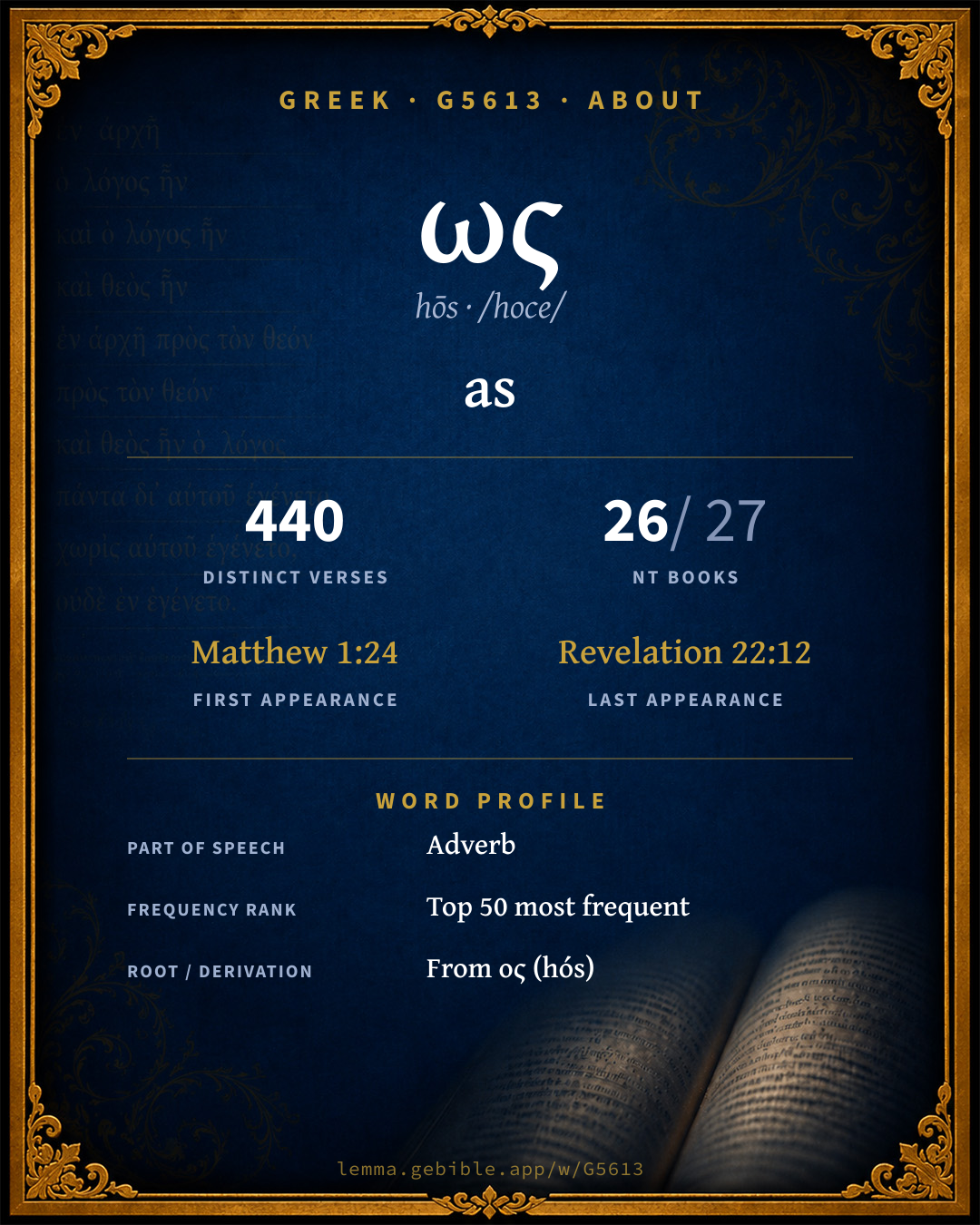
ὡς
as
Full lexicon entry — Thayer's Greek Lexicon
From Thayer's Greek Lexicon
Where this word appears
Grammar key — what these labels mean
Part of speech
- Adverb
- A word that modifies a verb, adjective, or other adverb.
Every verse where G5613 appears in the Book of Philippians — 7 distinct verses. Click any verse to open its interlinear word-by-word view. Verse text shown in the World English Bible for context — . Each verse’s Greek form is shown with its reference; the English is not keyword-highlighted, since the data carries no word-level English alignment. Use “Compare translations” on any verse to read it across multiple English versions. This concordance covers the Greek New Testament; Septuagint (Greek Old Testament) occurrences of this word are not indexed here.
Philippians
- Philippians 1:8 ὡς adv For God is my witness, how I long after all of you in the tender mercies of Christ Jesus.
- Philippians 1:20 ὡς adv according to my earnest expectation and hope, that I will in no way be disappointed, but with all boldness, as always, now also Christ will be magnified in my body, whether by life, or by death.
- Philippians 2:7 ὡς adv but emptied himself, taking the form of a servant, being made in the likeness of men.
- Philippians 2:12 ὡς adv So then, my beloved, even as you have always obeyed, not only in my presence, but now much more in my absence, work out your own salvation with fear and trembling.
- Philippians 2:15 ὡς adv that you may become blameless and harmless, children of God without blemish in the midst of a crooked and perverse generation, among whom you are seen as lights in the world,
- Philippians 2:22 ὡς adv But you know the proof of him, that, as a child serves a father, so he served with me in furtherance of the Gospel.
- Philippians 2:23 ὡς adv Therefore I hope to send him at once, as soon as I see how it will go with me.
About this entry
At a glance — auto-summarized from this page’s data, not written by a person. Every figure links to its source below. This summary describes the numbers; it doesn’t interpret them.
ως (hōs) is a Greek verb most often rendered “as.” Debuting at Matthew 1:24, it then recurs through the corpus. The Greek New Testament uses it across 440 verses — common. Related forms include ος, ο εστι and οθεν. For the data behind this summary, explore the sense tree and the renderings breakdown below.
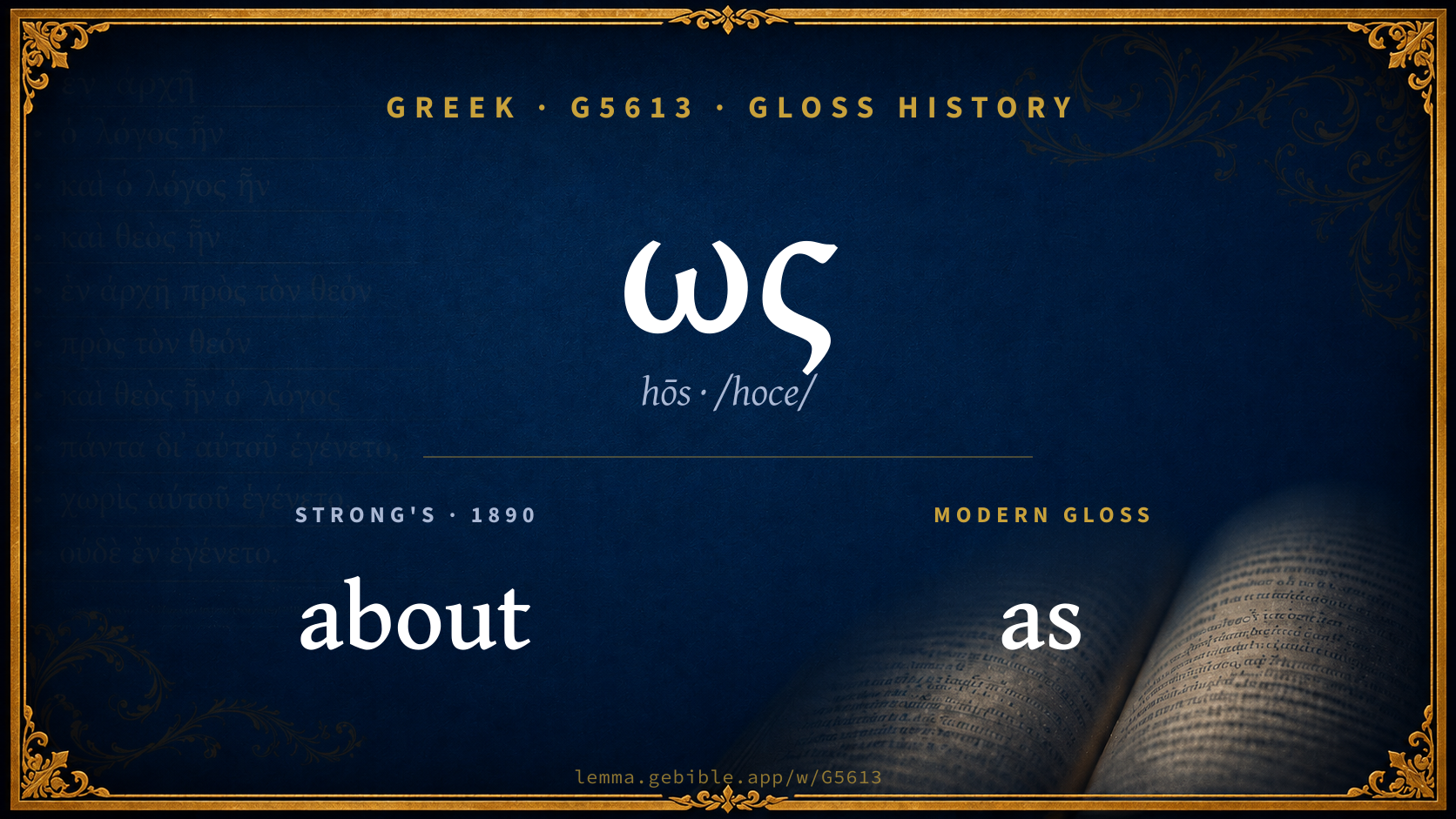
Gloss history
Strong's 1890 vs modern scholarship
About this word
Strong's G5613 catalogs a Greek word from the Greek New Testament.
These counts are not copied from any lexicon or concordance. They are computed here, from the morphology-tagged Greek New Testament. What Lemma adds →
- 440
- distinct verses
- The word appears in 440 distinct verses.
- 26 / 27
- NT books
- The word appears in 26 of 27 New Testament books.
- #39
- by frequency
- Top 50 most frequent Greek words (rank 39 of 5,347 Greek words by occurrence).
View all 440 occurrences in the concordance →
Most concentrated in
- Acts 61 verses 14%
- Revelation 56 verses 13%
- Luke 48 verses 11%
By section of the New Testament
By traditional corpus
Conventional, traditional groupings — biblical authorship is debated, so this is a traditional corpus grouping, not an authorship claim. Some books belong to more than one corpus (Luke is in both the Gospels and the Lukan corpus, and so on), so these shares overlap and need not total 100%. Each figure is a share of the word’s 440 distinct verses.
- Gospels 134 verses · 30%
- Pauline corpus 130 verses · 30%
- Lukan (Luke–Acts) 109 verses · 25%
- Johannine 91 verses · 21%
- Revelation 56 verses · 13%
- General (Catholic) Epistles 39 verses · 9%
- Hebrews 20 verses · 5%
How translations render this word
Counts come from each version’s own published word-to-Strong’s tagging or interlinear alignment — an approximate guide to how each version renders this word, not a word-level alignment the data otherwise carries. Because each total is that version’s own tagged count, the per-version totals vary from one another and need not match the appearance or distinct-verse counts above. These counts may also differ from a printed concordance because Lemma counts each distinctly tagged rendering and does not collapse phrase taggings into a single head-word total. This is a fixed set of word-tagged versions (KJV, ASV, BSB, ULT) and does not change with the reading translation you choose elsewhere. Each version’s license is shown beside its name below (and on Sources).
- King James Version: As 324×, When 41×, How 19×
- American Standard Version: As 291×, When 48×, How 19×
- Berean Standard Bible: As 161×, Like 120×, When 31×
- unfoldingWord Literal Text: As 282×, Like 77×, When 42×
King James Version Public Domain
Renders G5613 across 488 tagged occurrences — most commonly:
Plus other, less common renderings. Plus 22 renderings that appear only once — usually multi-word phrases or single function words the recovered tagging swept in, not distinct renderings. Not rendered by a distinct English word in 4 further occurrences.
American Standard Version Public Domain
Renders G5613 across 473 tagged occurrences — most commonly:
Plus other, less common renderings. Plus 37 renderings that appear only once — usually multi-word phrases or single function words the recovered tagging swept in, not distinct renderings.
Berean Standard Bible Public Domain
Renders G5613 across 438 tagged occurrences — most commonly:
Plus other, less common renderings. Plus 24 renderings that appear only once — usually multi-word phrases or single function words the recovered tagging swept in, not distinct renderings. Not rendered by a distinct English word in 52 further occurrences.
unfoldingWord Literal Text CC BY-SA 4.0
Renders G5613 across 504 tagged occurrences — most commonly:
Plus other, less common renderings. Plus 13 renderings that appear only once — usually multi-word phrases or single function words the recovered tagging swept in, not distinct renderings.
Senses in Thayer's
The 1 sense Thayer's distinguishes for this word, in lexicon order (not ranked by frequency or importance). The full entry — with sub-senses — is in the Lexicon Entry tab.
- as, like, even as, etc.
Word origin
Derived from ος (hós) (G3739) — who.
Probably adverb of compound from G3739 ; which how that is in that manner (very variously used as shown): - about after (that) (according) as (it had been it were) as soon (as) even as (like) for how (greatly) like (as unto) since so (that) that to wit unto when ([-soever]) while X with all speed.
— Strong’s Exhaustive Concordance (1890), public domain.
Forms in the corpus
The 3 distinct written forms G5613 takes in the Greek New Testament, most frequent first — each parse links to that case’s occurrences in the concordance.
| Form | Parsing | Example | Uses |
|---|---|---|---|
| ὡς hōs | Adverb | Matthew 1:24 | 485 |
| Ὡς Hōs | Adverb | John 2:23 | 14 |
| ὥς hṓs | Adverb | 2 Corinthians 3:1 | 2 |
Same root — word family
Other Thayer's entries built from the same root as G5613, grouped by Strong’s listed origin. These share a root / origin per the lexicon — not necessarily a shared meaning. Each links to that word’s own entry.
Derives from
Shares the same root
- ο εστι hó esti G3603 which is
- οθεν hóthen G3606 from which
- οποιος hopoîos G3697 what sort
- οποτε hopóte G3698 when
- οπου hópou G3699 where
- οπως hópōs G3704 how
- οσακις hosákis G3740 as often as
- οσος hósos G3745 how much
- οσπερ hósper G3746 whomever
- οστις hóstis G3748 whoever
- οτε hóte G3753 when
- ου hoû G3757 where
- ποσος pósos G4214 how much
Derived from this word
- ωσαυτως hōsaútōs G5615 likewise
- ωσει hōseí G5616 as it were
- ωσπερ hṓsper G5618 even as
- ωστε hṓste G5620 so that
Compare all same-root words → Showing 4 of 19 — not the complete family. They share a root, not necessarily a meaning.
Septuagint usage
The same Greek word ως appears 1,471 times in the Greek Old Testament (Septuagint), across 1,204 verses in 37 books.
- 1,471
- LXX occurrences
- Tagged occurrences of this Greek word in the Septuagint.
- 1,204
- verses
- Distinct Septuagint verses containing this word.
- 37 / 39
- OT books
- The word appears in 37 of the 39 Old Testament books.
Sample Septuagint occurrences
- Genesis 3:5 ὡς
- Exodus 1:19 ὡς
- Leviticus 5:10 ὡς
- Numbers 2:17 ὡς
- Deuteronomy 1:11 ὡς
- Joshua 2:5 ὡς
- Judges 2:4 ὡς
- Ruth 1:4 ὡς
- 1 Samuel 2:2 ὡς
- 2 Samuel 3:34 ὡς
- 1 Kings 1:21 ὡς
- 2 Kings 1:18 ὡς
Septuagint occurrences (same lexeme)
Every verse where the same Strong’s number (G5613) appears in the Greek Septuagint — showing the first 50 of 1,204. Verse text shown in the World English Bible for context; the Greek form is the matched word — the English is not keyword-highlighted.
- Genesis 3:5 ὡς for God knows that in the day you eat it, your eyes will be opened, and you will be like God, knowing good and evil."
- Genesis 3:22 ὡς Yahweh God said, "Behold, the man has become like one of us, knowing good and evil. Now, lest he put forth his hand, and also take of the tree of life, and eat, and live forever..."
- Genesis 6:4 ὡς The Nephilim were in the earth in those days, and also after that, when God's sons came to men's daughters. They bore children to them: the same were the mighty men who were of old, men of renown.
- Genesis 9:3 ὡς Every moving thing that lives will be food for you. As the green herb, I have given everything to you.
- Genesis 10:9 ὡς He was a mighty hunter before Yahweh. Therefore it is said, "Like Nimrod, a mighty hunter before Yahweh."
- Genesis 10:23 ως The sons of Aram: Uz, Hul, Gether, and Mash.
- Genesis 12:12 ὡς It will happen, when the Egyptians will see you, that they will say, 'This is his wife.' They will kill me, but they will save you alive.
- Genesis 13:10 ὡς Lot lifted up his eyes, and saw all the plain of the Jordan, that it was well watered every where, before Yahweh destroyed Sodom and Gomorrah, like the garden of Yahweh, like the land of Egypt, as you go to Zoar.
- Genesis 13:16 ὡς I will make your offspring as the dust of the earth, so that if a man can number the dust of the earth, then your seed may also be numbered.
- Genesis 16:6 ὡς But Abram said to Sarai, "Behold, your maid is in your hand. Do to her whatever is good in your eyes." Sarai dealt harshly with her, and she fled from her face.
- Genesis 18:23 ὡς Abraham drew near, and said, "Will you consume the righteous with the wicked?
- Genesis 18:25 ὡς Be it far from you to do things like that, to kill the righteous with the wicked, that so the righteous should be as the wicked. May that be far from you. Shouldn't the Judge of all the earth do right?"
- Genesis 18:33 ὡς Yahweh went his way, as soon as he had finished communing with Abraham, and Abraham returned to his place.
- Genesis 19:31 ὡς The firstborn said to the younger, "Our father is old, and there is not a man in the earth to come in to us after the manner of all the earth.
- Genesis 22:17 ὡς that in blessing I will bless you, and in multiplying I will multiply your seed as the stars of the heavens, and as the sand which is on the seashore. Your seed will possess the gate of his enemies.
- Genesis 26:4 ὡς I will multiply your seed as the stars of the sky, and will give to your seed all these lands. In your seed will all the nations of the earth be blessed,
- Genesis 27:4 ὡς Make me savory food, such as I love, and bring it to me, that I may eat, and that my soul may bless you before I die."
- Genesis 27:9 ὡς Go now to the flock, and get me from there two good kids of the goats. I will make them savory food for your father, such as he loves.
- Genesis 27:12 ὡς What if my father touches me? I will seem to him as a deceiver, and I would bring a curse on myself, and not a blessing."
- Genesis 27:23 ὡς He didn't recognize him, because his hands were hairy, like his brother, Esau's hands. So he blessed him.
- Genesis 27:27 ὡς He came near, and kissed him. He smelled the smell of his clothing, and blessed him, and said, "Behold, the smell of my son Is as the smell of a field which Yahweh has blessed.
- Genesis 27:30 ὡς It happened, as soon as Isaac had made an end of blessing Jacob, and Jacob had just gone out from the presence of Isaac his father, that Esau his brother came in from his hunting.
- Genesis 28:14 ὡς Your seed will be as the dust of the earth, and you will spread abroad to the west, and to the east, and to the north, and to the south. In you and in your seed will all the families of the earth be blessed.
- Genesis 28:17 ὡς He was afraid, and said, "How dreadful is this place! This is none other than God's house, and this is the gate of heaven."
- Genesis 29:10 ὡς It happened, when Jacob saw Rachel the daughter of Laban, his mother's brother, and the sheep of Laban, his mother's brother, that Jacob went near, and rolled the stone from the well's mouth, and watered the flock of Laban his mother's brother.
- Genesis 29:13 ὡς It happened, when Laban heard the news of Jacob, his sister's son, that he ran to meet Jacob, and embraced him, and kissed him, and brought him to his house. Jacob told Laban all these things.
- Genesis 29:20 ὡς Jacob served seven years for Rachel. They seemed to him but a few days, for the love he had for her.
- Genesis 30:25 ὡς It happened, when Rachel had borne Joseph, that Jacob said to Laban, "Send me away, that I may go to my own place, and to my country.
- Genesis 30:38 ὡς He set the rods which he had peeled opposite the flocks in the gutters in the watering-troughs where the flocks came to drink. They conceived when they came to drink.
- Genesis 31:2 ὡς Jacob saw the expression on Laban's face, and, behold, it was not toward him as before.
- Genesis 31:5 ὡς and said to them, "I see the expression on your father's face, that it is not toward me as before; but the God of my father has been with me.
- Genesis 31:15 ὡς Aren't we accounted by him as foreigners? For he has sold us, and has also quite devoured our money.
- Genesis 31:26 ὡς Laban said to Jacob, "What have you done, that you have deceived me, and carried away my daughters like captives of the sword?
- Genesis 32:13 ὡς He lodged there that night, and took from that which he had with him, a present for Esau, his brother:
- Genesis 33:10 ὡς Jacob said, "Please, no, if I have now found favor in your sight, then receive my present at my hand, because I have seen your face, as one sees the face of God, and you were pleased with me.
- Genesis 34:7 ὡς The sons of Jacob came in from the field when they heard it. The men were grieved, and they were very angry, because he had done folly in Israel in lying with Jacob's daughter; which thing ought not to be done.
- Genesis 34:15 ὡς Only on this condition will we consent to you. If you will be as we are, that every male of you be circumcised;
- Genesis 34:16 ὡς then will we give our daughters to you, and we will take your daughters to us, and we will dwell with you, and we will become one people.
- Genesis 36:28 ως These are the children of Dishan: Uz and Aran.
- Genesis 38:29 ὡς It happened, as he drew back his hand, that behold, his brother came out, and she said, "Why have you made a breach for yourself?" Therefore his name was called Perez.
- Genesis 39:13 ὡς It happened, when she saw that he had left his garment in her hand, and had run outside,
- Genesis 39:18 ὡς and it happened, as I lifted up my voice and cried, that he left his garment by me, and ran outside."
- Genesis 39:19 ὡς It happened, when his master heard the words of his wife, which she spoke to him, saying, "This is what your servant did to me," that his wrath was kindled.
- Genesis 40:13 ὡς Within three more days, Pharaoh will lift up your head, and restore you to your office. You will give Pharaoh's cup into his hand, the way you did when you were his cupbearer.
- Genesis 42:30 ὡς "The man, the lord of the land, spoke roughly with us, and took us for spies of the country.
- Genesis 44:10 ὡς He said, "Now also let it be according to your words: he with whom it is found will be my bondservant; and you will be blameless."
- Genesis 45:8 ὡς So now it wasn't you who sent me here, but God, and he has made me a father to Pharaoh, lord of all his house, and ruler over all the land of Egypt.
- Genesis 48:5 ὡς Now your two sons, who were born to you in the land of Egypt before I came to you into Egypt, are mine; Ephraim and Manasseh, even as Reuben and Simeon, will be mine.
- Genesis 48:20 ὡς He blessed them that day, saying, "In you will Israel bless, saying, 'God make you as Ephraim and as Manasseh'" He set Ephraim before Manasseh.
- Genesis 49:4 ὡς Boiling over as water, you shall not have the pre-eminence; Because you went up to your father's bed; Then defiled it. He went up to my couch.
These are occurrences of the same Greek lexeme (G5613) in the Septuagint — not a translation of any one Hebrew word. The store carries no word-level Hebrew↔Greek alignment, so no Hebrew original is asserted here. Counts come from the recovered LXX Strong's tagging — high-frequency vocabulary is well covered, while rare or late forms may be untagged — so they reflect tagged occurrences and may slightly undercount.