Philippians 1:8

Greek (Tischendorf 8th ed.) Philippians 1:8 appears in the Greek New Testament. The text above is from the Tischendorf 8th edition. Each word links to its Strong’s number and a concise gloss. Click any word for its full Thayer’s Greek Lexicon entry.

Download image
Cite this verse

Philippians 1:8 (World English Bible). Public Domain. Lemma interlinear Bible study tool, https://lemma.gebible.app/v/philippians/1/8.

Show BibTeX & RIS
BibTeX
RIS
English Translation
For God is my witness, how I long after all of you in the tender mercies of Christ Jesus.
World English Bible · Public Domain
Download a study sheet

One document with this verse’s original text, its word-by-word gloss line, the meaning frame, cross-references with their text, attributed commentary, and full source and license credits — printable, and it pastes into notes with its structure intact.

This verse Autodidact and up

Study sheet (.html) Plain text (.txt)

A passage Seminary Student

Up to 50 verses in one chapter. A passage sheet keeps up to 6 commentary sources and 12 cross-references per verse, in the order this page ranks them, and says so on the sheet whenever that leaves anything out. Ask for a single verse and you get the Autodidact verse sheet above.

Everything on this page stays free to read, with no account — the sheet is a download of what is already on screen, not access to it.

Want to remove ads? Support Godless Engineer
Compare translations 3

The same verse in 3 English versions, stacked beneath the original-language interlinear above. Click any original word for its lexicon entry.

Each is an independent rendering of the whole verse — the interlinear is not word-aligned to these translations.

Highlighted words mark where these versions differ — a whole-verse word diff, not a word-by-word alignment.

  • World English Bible Public Domain
    For God is my witness, how I long after all of you in the tender mercies of Christ Jesus.
  • King James Version Public Domain
    For God is my record, how greatly I long after you all in the bowels of Jesus Christ.
  • unfoldingWord Literal Text CC BY-SA 4.0
    For God my witness, how I long for all of you with the inner parts of Christ Jesus.

unfoldingWord Literal Text — © unfoldingWord, licensed CC BY-SA 4.0. Word-aligned USFM3 via Door43 (git.door43.org/unfoldingWord/en_ult).

Versions to compare (up to 4)

3 of 4 selected

Show all 19 translations

Every available English version of this verse, each an independent rendering of the whole verse.

  • World English Bible Public Domain
    For God is my witness, how I long after all of you in the tender mercies of Christ Jesus.
  • Berean Standard Bible Public Domain
    God is my witness how I long for all of you with the affection of Christ Jesus.
  • Majority Standard Bible Public Domain
    God is my witness how I long for all of you with the affection of Jesus Christ.
  • King James Version Public Domain
    For God is my record, how greatly I long after you all in the bowels of Jesus Christ.
  • American Standard Version (1901) Public Domain
    For God is my witness, how I long after you all in the tender mercies of Christ Jesus.
  • Revised Version (1885) Public Domain
    For God is my witness, how I long after you all in the tender mercies of Christ Jesus.
  • Geneva Bible (1599) Public Domain
    For God is my recorde, howe I long after you all from the very heart roote in Iesus Christ.
  • Douay-Rheims (1899) Public Domain
    For God is my witness, how I long after you all in the bowels of Jesus Christ.
  • Young's Literal Translation Public Domain
    For God is my witness, how I long for you all in the bowels of Jesus Christ,
  • Literal Standard Version CC BY-SA 4.0
    For God is my witness, how I long for you all with [the] yearnings of Jesus Christ,
  • Unlocked Literal Bible CC BY-SA 4.0
    For God is my witness, how I long for all of you with the compassion of Christ Jesus.
  • unfoldingWord Literal Text CC BY-SA 4.0
    For God my witness, how I long for all of you with the inner parts of Christ Jesus.
  • Darby Bible Public Domain
    For God is my witness how I long after you all in [the] bowels of Christ Jesus.
  • World Messianic Bible Public Domain
    For God is my witness, how I long after all of you in the tender mercies of Messiah Yeshua.
  • Webster's Bible Public Domain
    For God is my witness, how greatly I long after you all in the bowels of Jesus Christ.
  • Free Bible Version CC BY-SA 4.0
    God is my witness as to my great affection for every one of you in the caring love of Christ Jesus.
  • Bible in Basic English Public Domain
    For God is my witness, how my love goes out to you all in the loving mercies of Christ Jesus.
  • Text-Critical English NT CC BY 4.0
    For God is my witness that I long for you all with the affection of Jesus Christ.
  • Tyndale New Testament (1534) Public Domain
    For God beareth me recorde how greatly I longe after you all from the very herte rote in Iesus Christ.

Literal Standard Version (2020), Covenant Press — licensed CC BY-SA 4.0. Text via the HelloAO Bible API (eBible.org). Unlocked Literal Bible (unfoldingWord) — licensed CC BY-SA 4.0. Text via the HelloAO Bible API (eBible.org). unfoldingWord Literal Text — © unfoldingWord, licensed CC BY-SA 4.0. Word-aligned USFM3 via Door43 (git.door43.org/unfoldingWord/en_ult). Free Bible Version, Dr. Jonathan Gallagher — licensed CC BY-SA 4.0. Text via the HelloAO Bible API (eBible.org).

Word by word

More ways to search: Search by grammar → Find every occurrence → Compare this word →

Practice this passage: Drill this verse → Learn its vocabulary →

ἐπιποθῶ
epipothéō
G1971
“to long for”
Verb, Present, Active, Indicative, 1st person, Singular
Part of Speech
Verb
Tense
Present
Voice
Active
Mood
Indicative
Person
1st person
Number
Singular
Full Thayer's Definition

Origin: from G1909 and potheo (to yearn)

TDNT: None

1. to long for, desire 2. to pursue with love, to long after 3. to lust, harbour forbidden desire
  1. μάρτυς mártys G3144 “witness” Noun, Nominative, Singular, Masculine
  2. γάρ gár G1063 “for” Conjunction
  3. μου egṓ G1473 “I” Personal pronoun, 1st person, Genitive, Singular
  4. ὁ ho G3588 “the” Article, Nominative, Singular, Masculine
  5. θεός theós G2316 “God” Noun, Nominative, Singular, Masculine
  6. ὡς hōs G5613 “as” Adverb
  7. πάντας pâs G3956 “all” Adjective, Accusative, Plural, Masculine
  8. ὑμᾶς hymeîs G5210 “you” Personal pronoun, 2nd person, Accusative, Plural
  9. ἐν en G1722 “in” Preposition
  10. σπλάγχνοις splánchnon G4698 “bowels” Noun, Dative, Plural, Neuter
  11. Χριστοῦ Christós G5547 “Christ” Noun, Genitive, Singular, Masculine
  12. Ἰησοῦ Iēsoûs G2424 “Jesus” Noun, Genitive, Singular, Masculine

About this verse

These counts appear in no published source. They are computed here, from the morphology-tagged text and Lemma’s own curated glosses. What Lemma adds →

13
words
13
distinct lemmas
Pauline Epistles
section

Notable vocabulary

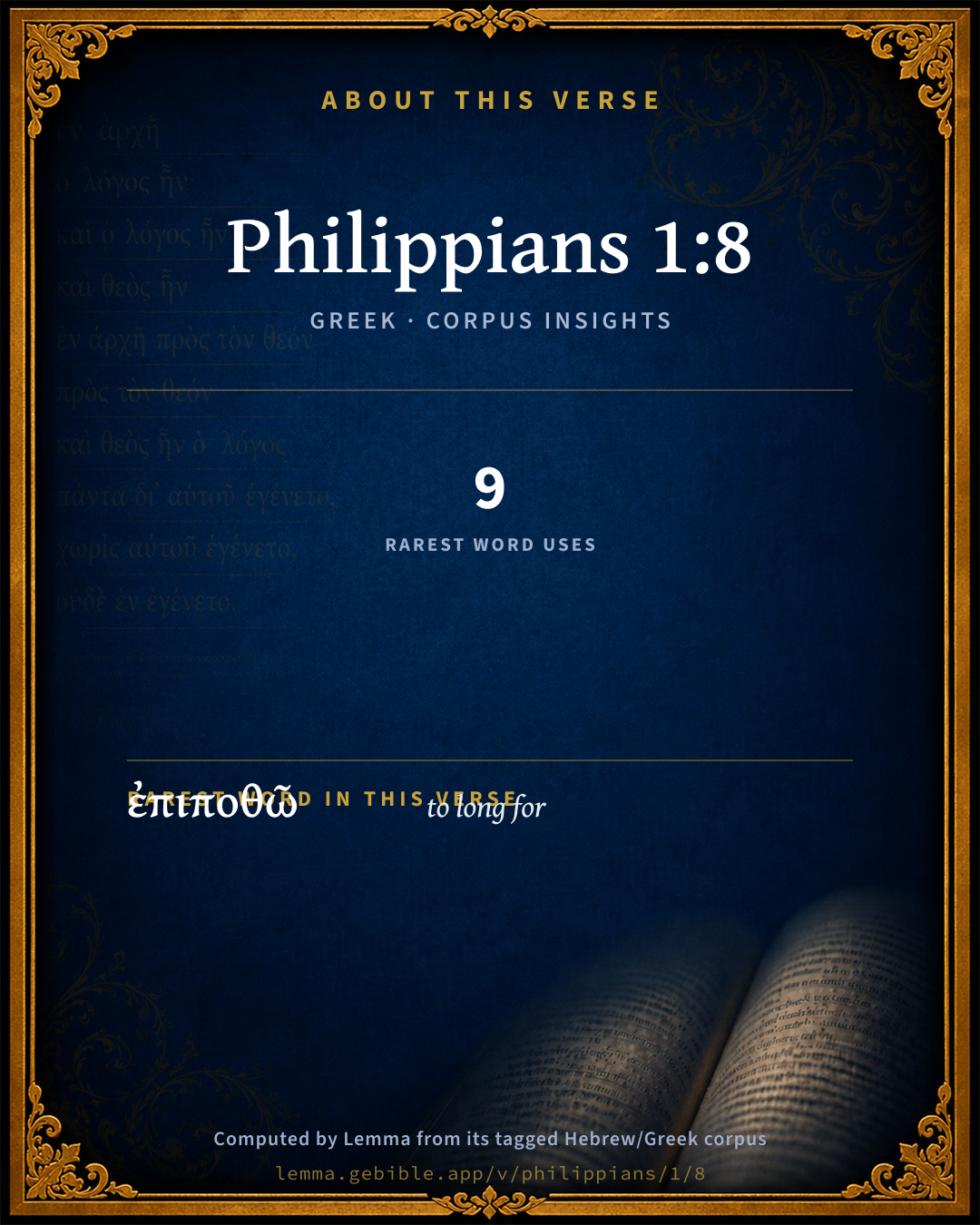
The rarest word here is ἐπιποθῶ to long for G1971 — appearing just 9 times in the whole Greek New Testament.

Shared distinctive vocabulary

ἐπιποθῶ to long for G1971 occurs in 9 verses of the Greek New Testament. Also found in:

Cross-references

22

Topical passages linked to Philippians 1:8 in the Treasury of Scripture Knowledge — connected by theme and wording, ordered by reader-vote popularity; previews shown in the World English Bible.

  • Romans 1:9 For God is my witness, whom I serve in my spirit in the Gospel of his Son, how unceasingly I make mention of you always in my prayers,
  • Philippians 4:1 Therefore, my brothers, beloved and longed for, my joy and crown, so stand firm in the Lord, my beloved.
  • 1 Thessalonians 2:8 Even so, affectionately longing for you, we were well pleased to impart to you, not the Gospel of God only, but also our own souls, because you had become very dear to us.
  • 2 Timothy 1:4 longing to see you, remembering your tears, that I may be filled with joy;
  • Romans 9:1 I tell the truth in Christ. I am not lying, my conscience testifying with me in the Holy Spirit,
  • Colossians 2:1 For I desire to have you know how greatly I struggle for you, and for those at Laodicea, and for as many as have not seen my face in the flesh;
  • Jeremiah 31:20 Is Ephraim my dear son? is he a darling child? for as often as I speak against him, I do earnestly remember him still: therefore my heart yearns for him; I will surely have mercy on him, says Yahweh.
  • Philemon 1:12 I am sending him back. Therefore receive him, that is, my own heart,
  • Isaiah 16:11 Why my heart sounds like a harp for Moab, and my inward parts for Kir Heres.
  • Isaiah 63:15 Look down from heaven, and see from the habitation of your holiness and of your glory: where are your zeal and your mighty acts? the yearning of your heart and your compassion is restrained toward me.
  • Luke 1:78 Because of the tender mercy of our God, Whereby the dawn from on high will visit us,
  • 2 Corinthians 6:12 You are not restricted by us, but you are restricted by your own affections.
  • 2 Corinthians 7:15 His affection is more abundantly toward you, while he remembers all of your obedience, how with fear and trembling you received him.
  • Galatians 1:20 Now about the things which I write to you, behold, before God, I'm not lying.
  • Galatians 4:19 My little children, of whom I am again in travail until Christ is formed in you--
  • 2 Corinthians 13:9 For we rejoice when we are weak and you are strong. And this we also pray for, even your perfecting.
  • Philippians 2:1 If there is therefore any exhortation in Christ, if any consolation of love, if any fellowship of the Spirit, if any tender mercies and compassion,
  • Philippians 2:26 since he longed for you all, and was very troubled, because you had heard that he was sick.
  • Colossians 3:12 Put on therefore, as God's chosen ones, holy and beloved, a heart of compassion, kindness, lowliness, humility, and perseverance;
  • 1 Thessalonians 2:5 For neither were we at any time found using words of flattery, as you know, nor a cloak of covetousness (God is witness),
  • Philemon 1:20 Yes, brother, let me have joy from you in the Lord. Refresh my heart in the Lord.
  • 1 John 3:17 But whoever has the world's goods, and sees his brother in need, and closes his heart of compassion against him, how does the love of God remain in him?

Cross-references courtesy of OpenBible.info (CC BY 4.0).

Commentary

Notes on Philippians 1:8 from classic Christian and Jewish commentators (each source and its license shown beneath its notes). The classic Christian expositions comment on the surrounding passage and are grouped to its opening verse, so a note may address several verses; the Jewish commentaries on the Tanakh (Rashi and others) are per-verse, so they appear only where the commentator wrote on this verse.

Lemma curates 59 commentaries, every one of them public domain or Creative Commons licensed, each selected and text-cleaned for this edition rather than reprinted as found. About our sources →

The Biblical Illustrator

Joseph S. Exell

Php_1:8

God is my witness how greatly I long after you all

Pauls tender regard for the Philippians

I.

Its witness--God.

1. This appeal should not be made frequently, or on trivial occasions; but should be reserved for seasons of peculiar solemnity, as here. Paul wanted to give them an assurance of his regard such as would be their consolation when he was gone.

2. But though the parade of this witness should be spared, the consciousness of it should pervade all our life. It is easy to deceive our fellow man. It is healthful to be constantly reminded of an onlooker who is not mocked. His company, however, is shunned by many for good reasons. No man chooses the living God as his habitual company who is not reconciled to him through Christ.

3. What a blessed state to be in; to let all our affections towards our brethren flow and reflow in the Divine presence.

II. Its source--the bowels,--the strong compassion of Christ. From that fountain his own pity flowed.

1. He was free to testify, In me dwelleth no good thing. True; no pity flowed from his cruel heart or dimmed his cruel eye when Stephen died. He was not at that time in Christ. From the memory of his former self he writes Tit_3:3.

2. Now the very love that glowed in the bosom of Jesus was communicated to His disciple. It was not a love of mere nature or an affection of party.

3. His new position gave him a new view and new affections. He had risen with Christ, and from the heavenly places the old divisions between Jew and Greek, etc., had disappeared, and one line only divided the race into two compartments, those who were in Christ Jesus and those who were not. He loved the whole, but rejoiced over the brethren with joy unspeakable.

III. Its character and strength--How greatly, etc.

1. Learn from the fact that he called God to witness it, that in order to get into communion with God it is not necessary to banish your brother out of sight. The law is that he who loveth God, love his brother also.

2. The extent and distribution of his affection--all. Probably they were not all alike attractive. The longing was one as it burned in Pauls heart; but it was many coloured as it streamed on a promiscuous congregation. Light is for all the same, but it becomes various as it falls on various surfaces.

(1) Little children. Longing after is more appropriate to infants than to others

(2) The young who are of understanding age. You have need of a compassion like Christs.

(3) The burdened with care.

(4) The aged. (W. Arnot, D. D.)

Brotherly love

I. Its sources--the tender mercies of Jesus Christ. Here the hardness of our hearts is melted. Sin has dried up the wells of sympathy, broken the family ties of mankind. Jesus collects the fragments, places them in the furnace of his love, and welds them together.

1. The restoration of the family likeness. When we see God the Father in each other, we begin to love one another. The spirit of Christ generates that love. When we meet in Christ we experience the first touch of heart. The ministry of the tender mercies of Christ quickens those who are dead in trespasses and sins.

2. On the basis of brotherly love human society is reconstructed. The branches touch each other in the vine. The whole fabric rests on the one corner stone, Christ. By the power of the Cross the clouds of selfishness are rolled back. The social instincts are sanctified to constitute universal society.

II. Its attestation--God is my witness. The evidence was an inward consciousness, and an outward life. Omniscience was the final court of appeal.

1. Love to the Church is an evidence of our conversion by the truth (1Jn_3:14).

2. Through the Church we commune with God. The heavens declare Gods glory, the earth His riches, the Bible His will, human experience in the Church His goodness. The historical side of religion administers to the spiritual. The wisdom of Paul, the zeal of Peter, the affection of John, bring God nearer to the heart. Every believer is a vessel of the Holy Ghost; and to drink of His experience is to commune with the Divine.

III. The functions of spiritual longings. Pauls supreme desire was to be near the Philippians, and to be of service to their growth. Thereby he would witness--

1. To the love of God.

2. Against the hatred of the sinful heart.

3. To the final society of the blest. (Weekly Pulpit.)

Apostolic solicitude

I. Its objects.

II. Occasion.

III. Principle.

IV. Intensity.

V. Evidence. (J. Lyth, D. D.)

Saints longing for saints

is a prophecy that all saints are destined to be brought into one assembly. God will satisfy all the desires which He creates; He will feed the soul which He has made hungry; and as He has given us the spirit of true fellowship, so will He supply the means of its full enjoyment. Out of all this comes heaven. The good longing for the good; the creature yearning for the Creator; the redeemed sighing for the Redeemer; the dew of the morning trembling with the hope of being taken up by the infinite light: what is all this but the premonition of celestial life. (J. Parker, D. D.)

The consistency of love of man with love of God

He is a jealous God to the effect of commanding, Thou shalt have no other gods before Me; but even in His own sight you may cherish to the full all your love of the brethren. The sun, at his rising, extinguishes all the stars of heaven, but not the flowers of earth; so when you get into the presence of God, none other is permitted to stand on a level with Himself, but into His presence you may boldly bring all your brethren of human kind. In His presence you may keep every affection that is inherited by nature or ingrafted by grace. (W. Arnot, D. D.)

Universality of Christian love

A lamp lighted on the top of a pillar casts light on some objects, and a shadow on others; but the sun spreads day over all. The love that is grafted into Christ is universal; like His own. There is no respect of persons with God; and none with the godly as far as they act in character. (W. Arnot, D. D.)

The bowels of Jesus Christ

The σπάγχνα are properly the nobler viscera, the heart, lungs, liver, etc., as distinguished from the ἔντερς, the lower viscera, the intestines. The σπλάγχνα alone seem to be regarded by the Greeks as the seat of affections, whether anger, love, pity, or jealousy. (Bishop Lightfoot.)

The Biblical Illustrator, edited by Joseph S. Exell (c. 1880s–1900s) — public domain. Text from a community e-Sword module.

Bengel's Gnomon

Johann Albrecht Bengel

Php 1:8. Ἐν σπλάγχνοις Ἰησοῦ Χριστοῦ, in the bowels of Jesus Christ) Not Paul, but Jesus Christ lives in Paul; wherefore Paul is not moved in the bowels of Paul, but of Jesus Christ.

Bengel's Gnomon of the New Testament — English translation (T&T Clark, Edinburgh, 1860) — public domain. Text from a community e-Sword module.

Meyer's Critical & Exegetical Commentary

Heinrich August Wilhelm Meyer

Php_1:8. A solemn confirmation of the preceding assurance, that he had his readers in his heart, etc. Comp., on the connection, Rom_1:9. Theophylact, moreover, strikingly observes: οὐχ ὡς ἀπιστούμενος μάρτυρα καλεῖ τὸν Θεόν, ἀλλὰ τὴν πολλὴν διάθεσιν οὐκ ἔχων παραστῆσαι διὰ λόγου.

ὡς ἐπιποθῶ κ.τ.λ.] how much I long after you all, etc., which would not be the case if I did not bear you in my heart (γάρ), as announced more precisely in Php_1:7. On ἐπιποθῶ, comp. Rom_1:11; Php_2:26; 1Th_3:6; 2Ti_1:4. The compound denotes the direction (Plat. Legg. ix. p. 855 F; Herod. v. 93; Diod. Sic. xvii. 101; Sir_25:20), not the strength of the ποθεῖν (comp. on 2Co_5:2), which is conveyed by ὡς; comp. Rom_1:9; 1Th_2:10.

ἐν σπλάγχνοις Χριστοῦ Ἰησοῦ] is not, with Hofmann,[53] to be connected with what follows (see on Php_1:9); it is an expression of the heartiness and truth of his longing, uttered in the strongest possible terms. ἐν, on account of the sensuous expression which follows (ΣΠΛΆΓΧΝΑ, like רַחֲמְים, as seat of the affections, especially of heartfelt love, Php_2:1; Col_3:12; Phm_1:7; Phm_1:12; Phm_1:20; also in classical authors), is to be taken locally: in the heart of Jesus Christ; that is, so that this longing of mine is not my own individual emotion, but a longing which I feel in virtue of the dwelling and working of Christ in me. Paul speaks thus from the consciousness that his inmost life is not that of his human personality, of himself, but that Christ, through the medium of the Holy Spirit, is the personal principle and agent of his thoughts, desires, and feelings. Comp. on Gal_2:20. Filled with the feeling of this holy fellowship of life, which threw his own individuality into the background, he could, seeing that his whole spiritual ζωή was thus the life of Christ in him, represent the circumstances of his ἐπιποθεῖν, as if the viscera Christi were moved in him, as if Christs heart throbbed in him for his Philippians. Bengel aptly says: In Paulo non Paulus vivit sed Jesus Christus; quare Paulus non in Pauli, sed Jesu Christi movetur visceribus. Comp. Theodoret: οὐκ ἀνθρώπινον τὸ φίλτρον, πνευματικόν. Not doing justice to the Pauline consciousness of the unio mystica which gives rise to this expression, some have rendered ἘΝ in an instrumental sense, as in Luk_1:78 (Hofmann); others have taken it of the norma: according to the pattern of Christs love to His people (Rosenmüller, Rilliet); and some have found the sense of the norma in the genitival relation: in animo penitus affecto ut animus fuit Christi (van Hengel). So also Wetstein, Heinrichs, and earlier expositors; whilst Storr refers ἘΝ ΣΠΛ. Ἰ. Χ. even to the readers (sc. ὄντας). For many other interpretations, see Hoelemann and Weiss. The merely approximate statement of the sense, given by Grotius and others: amore non illo communi, sed vere Christiano, is in substance correct, but fails to give its full development to the consciousness of the ΧΡΙΣΤῸς ἘΝ ἩΜῖΝ (Gal_2:20; Gal_4:19; Rom_8:10; 2Co_13:5; Eph_3:17); notwithstanding which Hofmann regards the identification of Pauls own heart with the heart of Christ as simply impossible; thus, however, applying to the mysticism of deep pious feeling, and the living immediate plastic form in which it finds expression, a criterion alien to its character, and drawing around it a literal boundary which it cannot bear.

[53] According to Hofmann, namely, ἐν σπλ. Χ. Ἰ. asserts with reference to the following καὶ τοῦτο προσεύχ. that Christs heart towards those who are His produces such prayer in the apostle, and manifests itself therein.

Meyer — Critical and Exegetical Commentary on the New Testament — English translation by Peter Christie, edited by Frederick Crombie (T&T Clark, 1880) — public domain. Text from a community e-Sword module.

Expositor's Greek Testament

ed. W. Robertson Nicoll

Phi 1:8 . An exact parallel is Rom 1:9-11 , μάρτυς γάρ μού ἐστιν ὁ Θεός … ὡς ἀδιαλείπτως μνείαν ὑμῶν ποιοῦμαι … ἐπιποθῶ γὰρ ἰδεῖν ὑμᾶς . Such adjuration of God he uses only in solemn personal appeals; cf. Gal 1:20 . Perhaps this goes to justify Zahn in supposing that the Philippians had imagined some lack of cordiality in Paul’s reception of their gift. Comm [59] have noted the intensity of language manifested in the compound ἐπιποθῶ . But it is needful to remember the fondness of later Greek for compounds which had lost their strong sense. Calvin, with practical insight: neque enim parum hoc valet ad fidem doctrinæ, faciendam cum persuasus est populus a doctore se amari . ἐν σπλάγχνοις . “With the heart of Jesus Christ” (with which his own has become identified). This amounts to the same thing as love. Cf. Gal 2:20 , which is the best comment. Possibly Paret ( Jahrb. f. deutsche Theol. , iii., 1, p. 25) is not too fanciful in finding here a definite recollection of Jesus’ nature, of which σπλαγχνίζεσθαι (in the Gospels) is a common expression. Every genuine pastor has some experience of this feeling.

[59]omm. Commentators.

The Expositor's Greek Testament, edited by W. Robertson Nicoll (1897–1910) — public domain. Text from a community e-Sword module.

Geneva Bible (1599)

Geneva Bible translators

He declareth his good will towards them, therewithall showing by what means chiefly they may be confirmed, to wit, by continual prayer.

Geneva Bible (1599) marginal notes — public domain. Text via Bolls.life.

Jamieson, Fausset & Brown

Robert Jamieson, A. R. Fausset & David Brown

Confirmation of Phi 1:7.

record--that is, witness.

in the bowels of Jesus Christ--"Christ Jesus" is the order in the oldest manuscripts. My yearning love (so the Greek implies) to you is not merely from natural affection, but from devotedness to Christ Jesus. "Not Paul, but Jesus Christ lives in Paul; wherefore Paul is not moved in the bowels (that is, the tender love, Jer 31:20) of Paul, but of Jesus Christ" [BENGEL]. All real spiritual love is but a portion of Christ's love which yearns in all who are united to Him [ALFORD].

Jamieson, Fausset & Brown — Commentary Critical and Explanatory on the Whole Bible (1871) — public domain (CC PDM 1.0). Text via the HelloAO Bible API.

Adam Clarke's Commentary

Verse 8. For God is my record] I call God to witness that I have the strongest affection for you, and that I love you with that same kind of tender concern with which Christ loved the world when he gave himself for it; for I am even ready to be offered on the sacrifice and service of your faith, Php 2:17.

Adam Clarke's Commentary on the Bible (1810–1826) — public domain. Text from a community e-Sword/MySword module.

John Calvin's Commentaries

8. For God is my witness. He now declares more explicitly his affection for them, and, with the view of giving proof of it, he makes use of an oath, and that on good grounds, because we know how dear in the sight of God is the edification of his Church. It was, too, more especially of advantage, that Paul’s affection should be thoroughly made known to the Philippians. For it tends in no small degree to secure credit for the doctrine, when the people are persuaded that they are beloved by the teacher. He calls God as a witness to the truth, inasmuch as he alone is the Truth, and as a witness of his affection, inasmuch as he alone is the searcher of hearts. In the word rendered long after, a particular term is made use of instead of a general, and it is a token of affection, inasmuch as we long after those things which are dear to us.

In the bowels He places the bowels of Christ in opposition to carnal affection, to intimate that his affection is holy and pious. For the man that loves according to the flesh has respect to his own advantage, and may from time to time change his mind according to the variety of circumstances and seasons. In the meantime he instructs us by what rule the affections of believers ought to be regulated, so that, renouncing their own will, they may allow Christ to sit at the helm. And, unquestionably, true love can flow from no other source than from the bowels of Christ, and this, like a goad, ought to affect us not a little — that Christ in a manner opens his bowels, that by them he may cherish mutual affection between us.

John Calvin's Commentaries (1540-1563) — public domain. Text from the Calvin Translation Society English edition (1840s-50s) via the Christian Classics Ethereal Library (ccel.org). Calvin's coverage is partial (roughly two-thirds of the Bible); uncommented books and verses are honest gaps, never fabricated. The 19th-century editor's footnotes and remarks are omitted so the notes are faithfully Calvin's own voice.

Ellicott's Commentary for English Readers

(8) God is my record.—We have a similar adjuration in Rom_1:9; 2Co_1:23; 1Th_2:5; 1Th_2:10. These instances show in what sense St. Paul interpreted such commands as the “swear not at all” of Mat_5:34.

In the bowels of Jesus Christ.—The use of the word, which we translate (not very happily or correctly) by “bowels,” is common with St. Paul. (See 2Co_6:12; 2Co_7:15; Col_3:12; Phm_1:7; Phm_1:12; Phm_1:20.) It corresponds to our use of “heart” as the seat of affection—the word “heart” itself in the New Testament being employed, in a wider sense, to signify the whole inner man. (See Eph_1:18 : “the eyes of your heart being enlightened,” and Note there.) But the phrase here is striking and even startling. “I long after you” (says St. Paul) “in the heart of Jesus Christ.” He can say (as in Gal_2:20), “I live, yet not I, but Christ liveth in me.” Hence the deep yearning of love which he feels for them he knows to be an emanation, faint indeed, but true, from the “heart of Jesus Christ” dwelling in him.

A Bible Commentary for English Readers, edited by Charles John Ellicott (1878–1897) — public domain. Text from a community e-Sword module.

The Cambridge Bible for Schools and Colleges

gen. ed. J. J. S. Perowne

8. God is my record] Better, witness; for which word “record” is a synonym in older English, e.g. in Chaucer.—For this solemn and tender appeal cp. Rom_1:9; 1Th_2:5; 1Th_2:10; and see 2Co_1:18.

long after] The Greek verb is full of a yearning, homesick tenderness. It occurs in similar connexions, Rom_1:11; 1Th_3:6; 2Ti_1:4; below, Php_2:26; and its cognates, Rom_15:23; 2Co_7:7; 2Co_7:11(?), 2Co_9:14; below, Php_4:1. St Paul employs the verb also, with beautiful significance, to denote the believer’s yearning for heavenly rest and glory, 2Co_5:2; St James, for the Spirit’s yearning jealousy for our spirits’ loyalty, Jas_4:5; St Peter, for the regenerate man’s longing for the “milk” of Divine truth, 1Pe_2:2.

in the bowels of Jesus Christ] MS. evidence favours the order Christ Jesus, see note on Php_1:1.—“In the bowels”:—better perhaps in the heart. The Greek word in the classics means, strictly, the “nobler vitals,” including the heart, as distinguished from the intestines (Æschylus, Agam., 1221). On the other hand the Septuagint in their (rare) use of the word do not observe such a distinction, and render by it the Heb. rachamîm, the bowels, regarded as the seat of tender feeling. But in any case, the question is not of anatomy, but of current usage and reference; and our word “heart” is thus the best rendering.—The phrase here carries with it no assertion of a physicospiritual theory; it only uses, as a modern naturalist might equally well do, a physical term as a symbol for non-physical emotion.—R.V. paraphrases “tender mercies.”

The phraseology (“in the heart of Christ Jesus”) is deeply significant. The Christian’s personality is never lost, but he is so united to his Lord, “one Spirit” (1Co_6:17), that the emotions of the regenerate member are, as it were, in continuity with those of the ever-blessed Head. Tyndale (1534), Cranmer (1539), and Geneva (1557) render “from the very heart root in Jesus Christ.”—The ministration of His life to the member is such that there is more than sympathy in the matter; there is communication.

The Cambridge Bible for Schools and Colleges (gen. ed. J. J. S. Perowne; Cambridge University Press, 1878–1918) — public domain. Text from a community e-Sword module.

John Gill's Exposition

For God is my record,.... Which is all one as swearing by him; it is in form of an oath, being a solemn appeal to him as the searcher of hearts, for the uprightness of his mind, the sincerity of his expressions, and the strength of his affections:

how greatly I long after you all; the common members, as well as the bishops and deacons, the weak as well as the strong believers, the poor as well as the rich; the apostle's respects were universal, and without distinction: he longed after their spiritual welfare, an increase of gifts and grace among them; he was their spiritual father, and he hankered after them; as parents after their children; he longed to see them, that he might enjoy their company and conversation, have communion with them, and impart some spiritual gift unto them: and this he did

in the bowels of Jesus Christ; not with an human and carnal affection, but with a Christian and spiritual one; with a love which came from Christ, and was in imitation of him, and on account of their being in him, loved by him, belonging to him, and being believers in him: it was in the most tender manner that he loved them, and was affected to them; the phrase denotes, that his love towards them was internal, in his heart, and was most tender and strong; and like to that tender concern Christ had for them, and which he stirred up in him.

John Gill's Exposition of the Whole Bible (1746–1763) — public domain (CC PDM 1.0). Text via the HelloAO Bible API.

Trapp's Complete Commentary

John Trapp

8 For God is my record, how greatly I long after you all in the bowels of Jesus Christ.

Ver. 8. I long after you all] Here the apostle practised his own precept of fatherly affection, φιλοστοργοι, Rom 12:10. Pray for me, mine own heart root in the Lord, quem in intimis visceribus habeo ad convivendum et commoriendum saith Bradford in a letter to his fellow martyr, Laurence Saunders.

John Trapp, A Commentary or Exposition upon All the Books of the Old and New Testament (1647–1656) — public domain. Text from a community e-Sword module.

Albert Barnes' Notes on the Bible

For God is my record - My witness; I can solemnly appeal to him.

How greatly I long after you all - To see you; and how much I desire your welfare.

In the bowels of Jesus Christ - The word “bowels,” in the Scriptures denotes the upper viscera - the region of the heart and lungs: see the notes at Isa 16:11. That region was regarded as the seat of affection, sympathy, and compassion, as the heart is with us. The allusion here is to the sympathy, tenderness, and love of the Redeemer; and probably the meaning is, that Paul regarded them with something of the affection which the Lord Jesus had for them. This was the tenderest and strongest expression which he could find to denote the ardor of his attachment.

Albert Barnes' Notes on the Bible (1834–1885) — public domain. Text from a community e-Sword/MySword module.

Matthew Poole's English Annotations

Confirming what he had before written, he appeals to God in the heavens, who searcheth the heart and trieth the reins, as in some other Epistles, Rom 1:9; 2Co 1:23, with 2Co 11:31; Gal 1:20; 1Th 2:5,10; and as Job, Job 16:19; by making a solemn protestation, or oath, to put the matter out of doubt, Heb 6:16, and giving them assurance, (as he lawfully might in this way for God’s glory, and their good, Deu 6:13), of the sincerity and intenseness of his hearty affections towards every one of them, Phi 2:26; 4:1 with 2Co 9:14.

In the bowels of Jesus Christ; not out of any carnal, selfish, or worldly respects; but a really Christian, spiritual, and tender love, seated in the inward parts of this sanctified apostle, Jer 31:33; by the same Spirit that united him unto Christ, who loves his spouse with no common love, but is the spring and procurer, and great exemplar, of that affectionate Christian love, which, like him, they are to exert from the very root of their hearts, purely, unfeignedly, and fervently, without dissimulation, Rom 12:9; 1Pe 1:22; imitating God and Christ, {Luk 1:78} as Paul here, in the highest degree of dearest affection, did love the Philippians, and elsewhere the Thessalonians, 1Th 2:7,8,11.

Matthew Poole's English Annotations on the Holy Bible (1683–1685) — public domain. Text from a community e-Sword/MySword module.

Whedon's Commentary on the Bible

Daniel D. Whedon

8. God is my record—His witness, able to testify of his yearning love, so intense that it was as if it were out of the very heart of Christ.

Daniel D. Whedon (gen. ed.), Commentary on the Old and New Testaments (1874–1909) — public domain. Text from a community e-Sword module.

The Pulpit Commentary

For God is my record rather, witness (comp. Rom_1:9) how greatly I long after you all in the bowels of Jesus Christ. The word splagcna , here rendered "bowels," means the heart, liver, etc.. he not the entrails. The expression is remarkable, and is well illustrated by Bengel"s striking words, "Paulus non in Pauli, sed Jesu Christi movetur visceribus." "Not I, but Christ liveth in me." He is so united with Christ that he feels with the heart of Christ, he loves with the love of Christ.

The Pulpit Commentary (1880–1919), ed. H.D.M. Spence-Jones & Joseph S. Exell — public domain. Text from a community e-Sword module.

John Wesley's Explanatory Notes

I long for you with the bowels of Jesus Christ - In Paul, not Paul lives, but Jesus Christ. Therefore he longs for them with the bowels, the tenderness, not of Paul, but of Jesus Christ.

John Wesley, Explanatory Notes Upon the Whole Bible (1754–1765) — public domain. Text via the GEBible commentary corpus.

Kretzmann's Popular Commentary

Paul E. Kretzmann

Paul’s eager longing for the Philippian Christians:

v. 8. For God is my record how greatly I long after you all in the bowels of Jesus Christ.

v. 9. And this I pray, that your love may abound yet more and more in knowledge and in all judgment,

v. 10. that ye may approve things that are excellent, that ye may be sincere and without offense till the day of Christ,

v. 11. being filled with the fruits of righteousness, which are by Jesus Christ, unto the glory and praise of God.

For a parallel passage see Rom 1:9-11. The apostle here confirms his declaration that he has the Philippian Christians in his heart, that he is united with them by the bonds of the strongest affection: My witness, indeed, is God, how I fervently desire you all in the mercies of Christ Jesus. He speaks with great solemnity and emphasis, asking God Himself to be the witness of the truth of his statement. His object is to have his readers gain a full and unwavering confidence in him. He has an urgent, an earnest, desire and longing for them; he fervently wishes to be with them once more. This is not merely an expression of deep attachment, of a homesick tenderness, of a natural affection which moved his entire being, but it is a feeling which flows from the mercies, the heart, of Christ Jesus. The word which Paul uses was the term for the supposed seat of mercy and loving sympathy. The love of Christ had been poured out into his heart, lived in him, actuated him. Just as fervently and truly as Christ loves those that are His own, so the apostle tried to love all Christians and especially those at Philippi.

His gratitude and loving sympathy now urges the apostle to express the feeling of his heart in a fervent prayer for the Philippians: And this I pray, that your love abound yet more and more in understanding and all intelligence. They were believers, they had given ample proof of the sound condition of their faith in good works, yet the perfection had not yet been gained that is the hope of all Christians. Therefore Paul adds intercession to prayer, pleading that through God’s gracious power their love toward Christ and the brethren should grow, be enlarged, be added to. As the beloved of the Lord they should show the growth which alone is consistent with their Christian profession; for love is the first, immediate fruit of faith. The believers should persist in love; as their, faith grows, so their love should grow. Standing still in faith and love is an impossibility to a Christian. The chief consideration that controls this growth is understanding, for love grows with the understanding of the saving truth, of the Word of our redemption. As the understanding and knowledge of God and His gracious counsel of love toward salvation grows, love must keep pace with this growth, in fact, it must be the corollary of this understanding. At the same time, this is no mere understanding of the reason and mind, but of the entire and full intelligence, of the developed discernment which is shown in sound common sense and correct judgment in spiritual matters. It is a spiritual ability to discern the good and true, that which will stand before the criterion and standard of God’s Word. It is the moral sensibility which enables the Christians to apply the proper tact to all situations and relations in the world.

The result of such understanding and sense is shown at all times: That you may test things that differ, that you may be pure and unblamable for the day of Christ, filled with the fruit of righteousness which is through Jesus Christ, to the glory and praise of God. The Christians must gain practice more and more in distinguishing that which must be judged or discriminated, that they may learn to choose, almost instinctively, between good and bad, between true and false, between what pleases and what displeases God, between what is to be recommended to Christians and what is to be shunned, between that which serves the kingdom of God and that which is inimical to its interests. This judgment of Christians should be grounded and should grow: that is the prayer of the apostle, in which all Christians will join him. The gift of trying the spirits, of distinguishing between true and false, is a very important blessing; to know in each individual instance what is right and wrong, and to fulfill the will of God in this knowledge, that is a wonderful gift of God’s grace. Only in this manner will the purpose of God be realized, namely, that the Christians will be found pure and without offense for the day of Jesus Christ. The Christian’s life should be so thoroughly above reproach and suspicion that he can let the light of full publicity fall upon him, as one that is tested by a sunbeam, and not be afraid to face his critics. The things of darkness cannot stand in the sight of the Word, which reveals all. Only the pure will stand in God’s sight. And without offense, blameless, the Christians should be; they should not stumble and fall, and they should not cause others to stumble and fall. They are always aware of the coming of the day of Jesus Christ, when everything will be revealed before the eye of the all-seeing Judge. The apostle has no reference to every-day weaknesses and foibles, but he insists that Christians should shun all the open mortal sins of the flesh. Especially such crimes as will make a Christian infamous also in the eyes of the world should not be found in a Christian community. The Christian will therefore prayerfully watch his every move and carefully weigh everything that is brought to his attention, to find which is the right course to pursue in each individual case.

It follows then, also, that Christians will always be filled with the fruit of righteousness. Love, growing in the manner indicated by the apostle, will know in every case what to do and what to leave undone, and this knowledge results in the fruit of good works. Faith and love are manifested in good works. The whole life of the believers should be filled up with good works. And yet, all the works may be entered under one single heading: fruit of faith. It is fruit of righteousness, fruit which consists in righteousness, righteousness of life, for a Christian to act and live justly toward God and his neighbor. Such fruit will result only in and through Jesus Christ. In reality, it is the power, the strength, of Jesus in the believers that works and brings forth the good deeds. And chiefly for this reason such bringing forth results to the honor and praise of God. Even in this life the Christians increase the glory and the praise of God by their life in accordance with His will.

Paul E. Kretzmann, Popular Commentary of the Bible (1921–1924) — public domain. Text from a community e-Sword module.

Burkitt's Expository Notes on the New Testament

William Burkitt

These words are expressive of that passionate degree of Christian love which St. Paul bore to the Philippians; he durst appeal to God, as to the sincerity and fervency of it: God is my record, I call him to witness, and can appeal to him as the searcher of hearts, how greatly I long after you; that is, how passionately and sincerely I love you, with the most intense and hearty affection, in the bowels of Jesus Christ.

The expression may denote the efficient cause, and the exemplary cause, of his love.

1. That the author of this his love unto them was Christ, he was the spring and procurer of it; and consequently it was no carnal or selfish love, to serve his own ends and designs upon them, but truly spiritual.

2. That Christ’s love to him was the pattern and example, according to which he loved them, with no common love, but with an entire and intense affection, from the ground of the heart and the most intimate bowels: no words can be more expressive of that fervent love and earnest longing which St. Paul had for the welfare of the Philippians; a love which very far exceeds the love of all relations. He doth not say I long after you in the bowels of a father, or in the bowels of an husband, but in the bowels of Jesus Christ; humbly comparing his love towards them to the love of Jesus Christ; not for the degrees of it, not for the fruits and advantages of it, but for the truth and sincerity of it: I greatly long after you all in the bowels of Jesus Christ.

Learn hence, That there is no stronger love, no more endeared affection, between such ministers of Christ and their beloved people, as they have been happily instrumental to convert to God when present with them, they passionately love them; when absent from them they affectionately long after them; imitating, as much as they can, their Lord Jesus Christ, both in reality and sincerity, and also in the measure and degree, of endearing affection: God is my record, how greatly I long after you all, in the bowels of Jesus Christ.

William Burkitt's Expository Notes on the New Testament (1700–1703) — public domain. Text from a community e-Sword module.

The People's New Testament

B. W. Johnson

8–11. Long after you. Love you and long for your presence. In the bowels of Jesus Christ. See Revision. With a tender love like that of Christ.

B. W. Johnson's The People's New Testament with Notes (1889–1891) — public domain. Electronic text from the Christian Classics Ethereal Library (CCEL) ThML edition.

Cambridge Greek Testament for Schools and Colleges

8. μάρτυς … ὁ θεός. Cp. Rom 1:9; 1Th 2:5; 1Th 2:10; and see 2Co 1:18; for similar solemn appeals, characteristic of an ardent heart, often tried by unkind suspicions.

ἐπιποθῶ. The word is not common in classical Greek, nor in Biblical Greek before the N.T., where it, with its cognates, is used 11 times by St Paul (Rom 1:11; Rom 15:23; 2Co 5:2; 2Co 7:7; 2Co 7:11; 2Co 9:14; Php 2:26; Php 4:1, and here; 1Th 3:6; 2Ti 1:4), once by St James (Php 4:5), and once by St Peter (1. Php 2:2). In all the Pauline places it indicates a homesick yearning; in 2Co 5:2 the “home” is the heavenly rest. Here the verb breathes the deep family affection of the Gospel.

ἐν σπλάγχνοις Χ. Ἰ. In classical Greek the σπλάγχνα are commonly (not invariably: e.g. Æsch., S. c. T. 1022) the viscera nobiliora, including the heart. The LXX. in their (rare) use of the word do not so limit it; they render by it the Heb. rach’mîm, the bowels, viewed as the seat of affection. But the question is one not of anatomy but of current reference, and our word “heart” is thus the best rendering.

“In the heart of Christ Jesus”:—the phrase is deeply significant. The Christian’s personality, never lost, is yet so united to his Lord (see 1Co 6:17) that the emotions of the regenerate member are as it were in continuity with those of the ever-blessed Head. There is more than sympathy; there is communication.

Cambridge Greek Testament for Schools and Colleges (Cambridge University Press, 1896; 21 vols, various authors incl. Carr, Maclear, Plummer, Farrar, Lumby, Moule, M. R. James, Simcox) — public domain. Text from a community e-Sword module.

Alford’s Greek Testament

Henry Alford

8.] Confirmation of ver. 7. οὐλ ὡς ἀπιστούμενος μάρτυρα καλεῖ τὸν θεόν, ἀλλὰ τὴν πολλὴν διάθεσιν οὐκ ἔχων παραστῆσαι διὰ λόγου, Thl. after Chrys. On ἐπιποθῶ, see reff. The preposition indicates the direction of the desire, not its intensification. On ἐν σπλάγχνοις χριστοῦ Ἰησοῦ, Bengel remarks, “in Paulo non Paulus vivit, sed Jesus Christus: quare Paulus non in Pauli sed in Jesu Christi movetur visceribus.” All real spiritual love is but a portion of the great love wherewith He hath loved us, which lives and yearns in all who are vitally united to Him.

Henry Alford, The Greek Testament (1849–1861) — public domain. Text from a community e-Sword module.

International Critical Commentary

8. μάρτυς γάρ μου ὁ θεός:

The reading μοι for μου, Vulg. mihi, has little support.

A strong adjuration thrown in as a spontaneous expression of feeling, like “God knows.” (Comp. Rom 1:9; 2Co 1:23; 1Th 2:5, 1Th 2:10.) Chrys. says it is an expression of his inability to express his feeling, ‘I cannot express how I long.’ Similarly, Aretius, “No necessity compels him to this appeal, yet the greatness of his love does not satisfy itself without betaking itself to God’s tribunal.”

Some of the earlier interpreters explained the words as an attestation of Paul’s love made with a view of heightening that of his readers; as a formal oath in verification of his teaching; as a protection against slanderers and against suspicion. Klöpper thinks that they were aimed at certain persons in the church who were not in full sympathy with him and did not wholly trust his assurances. All these explanations are forced. The general statement, ‘I have you in my heart,’ is carried out by the stronger expression.

ὡς ἐπιποθῶ πάντας ὑμᾶς ἐν σπλάγχνοις Χριστοῦ Ἰησοῦ:

ὡς: ‘how,’ as Rom 1:9; 1Th 2:10. Not ‘tha.’ (See Thay. Lex. sub voce, i. 6.)

ἐπιποθῶ: Mostly in Paul. The only exceptions are Jas 4:5; 1Pe 2:2. Ἐπὶ denotes the direction, not the intensity of the emotion, as Lightf. and Kl.

σπλάγχνοις: Σπλάγχνα are the nobler entrails—the heart, liver, and lungs, as distinguished from the intestines (τὰ ἔντερα), and regarded collectively as the seat of the feelings, the affections and passions, especially anxiety and anger. ‘Heart’ is used similarly by us. A like usage appears in Hebrew, though the nobler organs are not selected for the metaphorical usage. Thus מֵעִֽים, ‘bowels,’ ‘womb,’ ‘stomach,’ and קֶרֶב, ‘bowels,’ ‘belly,’ ‘womb,’ are both used for the heart as the seat of feeling. The plural of רַֽחִם, ‘the womb,’ רַֽהֲמִֽים, is rendered in the LXX by οἰκτιρμοί, Psa_25 (24):6, 40 (39):12; by ἔλεος, Isa 47:6; by σπλάγχνα, Pro 12:10. The word occurs occasionally in the singular, σπλάγχνον, in the tragedians. (See Æsch. Eum. 240; Soph. Aj. 995; Eur. Orest. 1201, Hippol. 118.) For N.T. usage, see 2:1; 2Co 6:12, 2Co 6:7:15; Col 3:12; Phm 1:7, Phm 1:12, Phm 1:20.

Χριστοῦ Ἰησοῦ: Paul’s feeling is not his mere natural affection, but an affection so informed with Christ that it is practically Christ’s own love. Christ loves them in him. Thus Beng., “In Paulo non Paulus vivit sed Jesus Christus; quare Paulus non in Pauli, sed Jesu Christi movetur visceribus.”

International Critical Commentary — older volumes (1896–1929), various authors — public domain. Text from a community e-Sword module.

Vincent's Word Studies in the New Testament

Marvin R. Vincent

In the bowels of Jesus Christ [εν σπλαγχνοις χριστου ιησου] . Rev., better, in the tender mercies. Describing his longing, not as his individual emotion, but as Christ 's longing, as if the very heart of Christ dwelt in him. "In Paul not Paul lives, but Jesus Christ" (Bengel) With tender mercies compare reins, Rev 2:23, note.

Marvin R. Vincent, Word Studies in the New Testament (1887–1900) — public domain. Text from a community e-Sword/MySword module.

Lesson kit

Teaching starters — assembled from the data on this page, not authored interpretation. Every prompt links to the verse data it draws on. Edit before teaching.

Philippians, in the Pauline Epistles, opens this verse with 13 words (13 distinct Greek lemmas). Its most distinctive word is epipothéō (“to long for”). A historical commentator’s framing appears above. Read the whole chapter for the surrounding context.

Discussion questions

  1. What does “to long for” (epipothéō) contribute to the verse as a whole?
  2. Romans 1:11 shares the word «to long for» with this verse. How do the two illuminate each other?
  3. The translations on this page render this verse differently — a whole-verse word diff, not a word-by-word alignment. What might account for the different wordings?
  4. Reading how The Biblical Illustrator and Bengel's Gnomon read this verse, where do the two commentators agree and where do they part?

Things to notice

Reading settings

Reading text

Shown beneath each verse's original-language words.

Old Testament
Old Testament edition

Read the OT as the Masoretic Hebrew (MT) or the Greek Septuagint (LXX).

English shown for the Greek Septuagint (in the Hebrew ↔ Greek comparison).

Comparing translations? Open the Compare panel on any verse page to stack up to four side by side.