
Philippians 2:15

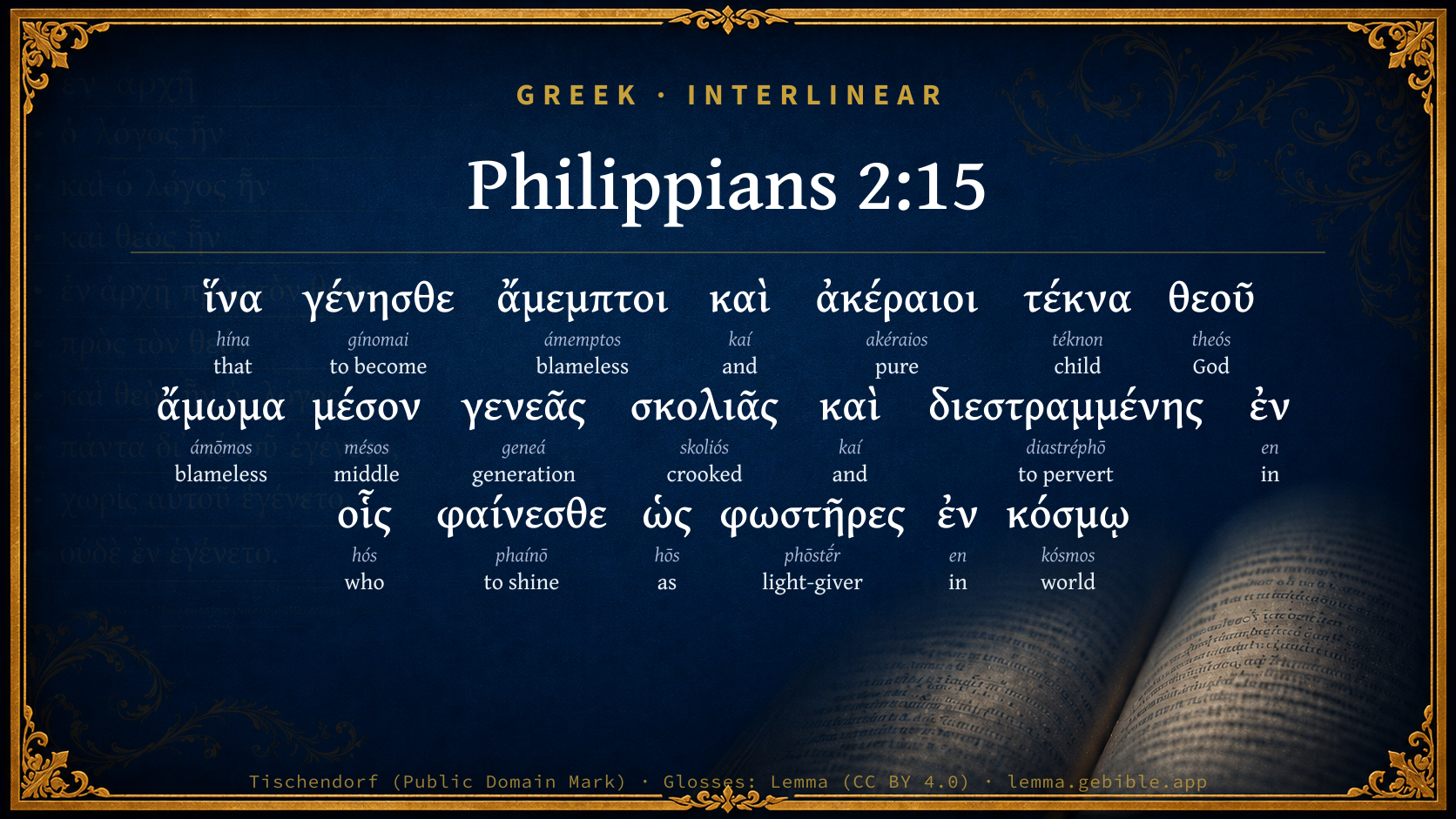
Greek (Tischendorf 8th ed.) Philippians 2:15 appears in the Greek New Testament. The text above is from the Tischendorf 8th edition. Each word links to its Strong’s number and a concise gloss. Click any word for its full Thayer’s Greek Lexicon entry.
Download image
Cite this verse

Philippians 2:15 (World English Bible). Public Domain. Lemma interlinear Bible study tool, https://lemma.gebible.app/v/philippians/2/15.

Show BibTeX & RIS
BibTeX
RIS
English Translation
that you may become blameless and harmless, children of God without blemish in the midst of a crooked and perverse generation, among whom you are seen as lights in the world,
World English Bible · Public Domain
Highlights
  • 1 first appearance in the Greek New Testament
Full analysis ↓
Download a study sheet

One document with this verse’s original text, its word-by-word gloss line, the meaning frame, cross-references with their text, attributed commentary, and full source and license credits — printable, and it pastes into notes with its structure intact.

This verse Autodidact and up

Study sheet (.html) Plain text (.txt)

A passage Seminary Student

Up to 50 verses in one chapter. A passage sheet keeps up to 6 commentary sources and 12 cross-references per verse, in the order this page ranks them, and says so on the sheet whenever that leaves anything out. Ask for a single verse and you get the Autodidact verse sheet above.

Everything on this page stays free to read, with no account — the sheet is a download of what is already on screen, not access to it.

Want to remove ads? Support Godless Engineer
Compare translations 3

The same verse in 3 English versions, stacked beneath the original-language interlinear above. Click any original word for its lexicon entry.

Each is an independent rendering of the whole verse — the interlinear is not word-aligned to these translations.

Highlighted words mark where these versions differ — a whole-verse word diff, not a word-by-word alignment.

  • World English Bible Public Domain
    that you may become blameless and harmless, children of God without blemish in the midst of a crooked and perverse generation, among whom you are seen as lights in the world,
  • King James Version Public Domain
    That ye may be blameless and harmless, the sons of God, without rebuke, in the midst of a crooked and perverse nation, among whom ye shine as lights in the world;
  • unfoldingWord Literal Text CC BY-SA 4.0
    so that you might become blameless and pure, children of God without blemish in the midst of a crooked and perverted generation, among whom you shine as lights in the world,

unfoldingWord Literal Text — © unfoldingWord, licensed CC BY-SA 4.0. Word-aligned USFM3 via Door43 (git.door43.org/unfoldingWord/en_ult).

Versions to compare (up to 4)

3 of 4 selected

Show all 19 translations

Every available English version of this verse, each an independent rendering of the whole verse.

  • World English Bible Public Domain
    that you may become blameless and harmless, children of God without blemish in the midst of a crooked and perverse generation, among whom you are seen as lights in the world,
  • Berean Standard Bible Public Domain
    so that you may be blameless and pure, children of God without fault in a crooked and perverse generation, in which you shine as lights in the world
  • Majority Standard Bible Public Domain
    so that you may be blameless and pure, children of God without fault in a crooked and perverse generation, in which you shine as lights in the world
  • King James Version Public Domain
    That ye may be blameless and harmless, the sons of God, without rebuke, in the midst of a crooked and perverse nation, among whom ye shine as lights in the world;
  • American Standard Version (1901) Public Domain
    that ye may become blameless and harmless, children of God without blemish in the midst of a crooked and perverse generation, among whom ye are seen as lights in the world,
  • Revised Version (1885) Public Domain
    that ye may be blameless and harmless, children of God without blemish in the midst of a crooked and perverse generation, among whom ye are seen as lights in the world,
  • Geneva Bible (1599) Public Domain
    That ye may be blamelesse, and pure, and the sonnes of God without rebuke in the middes of a naughtie and crooked nation, among whom yee shine as lights in the world,
  • Douay-Rheims (1899) Public Domain
    That you may be blameless, and sincere children of God, without reproof, in the midst of a crooked and perverse generation; among whom you shine as lights in the world.
  • Young's Literal Translation Public Domain
    that ye may become blameless and harmless, children of God, unblemished in the midst of a generation crooked and perverse, among whom ye do appear as luminaries in the world,
  • Literal Standard Version CC BY-SA 4.0
    that you may become blameless and pure children of God, unblemished in the midst of a crooked and perverse generation, among whom you appear as luminaries in the world,
  • Unlocked Literal Bible CC BY-SA 4.0
    Act in this way so that you may become blameless and honest, children of God without blemish. Act in this way so that you may shine as lights in the world, in the middle of a crooked and depraved generation.
  • unfoldingWord Literal Text CC BY-SA 4.0
    so that you might become blameless and pure, children of God without blemish in the midst of a crooked and perverted generation, among whom you shine as lights in the world,
  • Darby Bible Public Domain
    that ye may be harmless and simple, irreproachable children of God in the midst of a crooked and perverted generation; among whom ye appear as lights in [the] world,
  • World Messianic Bible Public Domain
    that you may become blameless and harmless, children of God without defect in the middle of a crooked and perverse generation, among whom you are seen as lights in the world,
  • Webster's Bible Public Domain
    That ye may be blameless and harmless, the sons of God, without rebuke, in the midst of a crooked and perverse nation, among whom ye shine as lights in the world;
  • Free Bible Version CC BY-SA 4.0
    so that you'll be sincere, innocent of any wrong. Be God's blameless children living in the middle of a dishonest and corrupt people. Shine among them as lights to the world,
  • Bible in Basic English Public Domain
    So that you may be holy and gentle, children of God without sin in a twisted and foolish generation, among whom you are seen as lights in the world,
  • Text-Critical English NT CC BY 4.0
    so that you may be blameless and pure, children of God without blemish in the midst of a crooked and perverse generation, among whom you shine as lights in the world
  • Tyndale New Testament (1534) Public Domain
    that ye maye be fautelesse and pure and the sonnes of God with out rebuke in the middes of a croked and a perverse nacion amonge which se that ye shyne as lightes in the worlde

Literal Standard Version (2020), Covenant Press — licensed CC BY-SA 4.0. Text via the HelloAO Bible API (eBible.org). Unlocked Literal Bible (unfoldingWord) — licensed CC BY-SA 4.0. Text via the HelloAO Bible API (eBible.org). unfoldingWord Literal Text — © unfoldingWord, licensed CC BY-SA 4.0. Word-aligned USFM3 via Door43 (git.door43.org/unfoldingWord/en_ult). Free Bible Version, Dr. Jonathan Gallagher — licensed CC BY-SA 4.0. Text via the HelloAO Bible API (eBible.org).

Word by word

More ways to search: Search by grammar → Find every occurrence → Compare this word →

Practice this passage: Drill this verse → Learn its vocabulary →

φωστῆρες
phōstḗr
G5458
“light-giver”
Noun, Nominative, Plural, Masculine
Part of Speech
Noun
Case
Nominative
Number
Plural
Gender
Masculine
Full Thayer's Definition

Origin: from G5457

TDNT: 14:10,1

1. that which gives light, an illuminator a. of the stars, sun and moon 2. light, brightness
  1. ἵνα hína G2443 “that” Conjunction
  2. γένησθε gínomai G1096 “to become” Verb, Aorist, Middle deponent, Subjunctive, 2nd person, Plural
  3. ἄμεμπτοι ámemptos G273 “blameless” Adjective, Nominative, Plural, Masculine
  4. καὶ kaí G2532 “and” Conjunction
  5. ἀκέραιοι akéraios G185 “pure” Adjective, Nominative, Plural, Masculine
  6. τέκνα téknon G5043 “child” Noun, Nominative, Plural, Neuter
  7. θεοῦ theós G2316 “God” Noun, Genitive, Singular, Masculine
  8. ἄμωμα ámōmos G299 “blameless” Adjective, Nominative, Plural, Neuter
  9. μέσον mésos G3319 “middle” Adjective, Accusative, Singular, Neuter
  10. γενεᾶς geneá G1074 “generation” Noun, Genitive, Singular, Feminine
  11. σκολιᾶς skoliós G4646 “crooked” Adjective, Genitive, Singular, Feminine
  12. καὶ kaí G2532 “and” Conjunction
  13. διεστραμμένης diastréphō G1294 “to pervert” Verb, Perfect, Passive, Participle, Genitive, Singular, Feminine
  14. ἐν en G1722 “in” Preposition
  15. οἷς hós G3739 “who” Relative pronoun, Dative, Plural, Masculine
  16. φαίνεσθε phaínō G5316 “to shine” Verb, Present, Passive, Indicative, 2nd person, Plural
  17. ὡς hōs G5613 “as” Adverb
  18. ἐν en G1722 “in” Preposition
  19. κόσμῳ kósmos G2889 “world” Noun, Dative, Singular, Masculine

About this verse

These counts appear in no published source. They are computed here, from the morphology-tagged text and Lemma’s own curated glosses. What Lemma adds →

20
words
18
distinct lemmas
Pauline Epistles
section

Notable vocabulary

The rarest word here is φωστῆρες light-giver G5458 — appearing just 2 times in the whole Greek New Testament.

First appearance in Scripture

This word makes its first canonical appearance in the Greek New Testament here:

  • φωστῆρες light-giver G5458

Shared distinctive vocabulary

φωστῆρες light-giver G5458 occurs in 2 verses of the Greek New Testament. Also found in:
Repetition

Words recur within this verse:

Cross-references

36

Topical passages linked to Philippians 2:15 in the Treasury of Scripture Knowledge — connected by theme and wording, ordered by reader-vote popularity; previews shown in the World English Bible.

  • Matthew 5:14–16 You are the light of the world. A city located on a hill can't be hidden.
  • 1 Peter 2:12 having good behavior among the nations, so in that which they speak against you as evil-doers, they may by your good works, which they see, glorify God in the day of visitation.
  • Matthew 5:45 that you may be children of your Father who is in heaven. For he makes his sun to rise on the evil and the good, and sends rain on the just and the unjust.
  • Isaiah 60:1 Arise, shine; for your light is come, and the glory of Yahweh is risen on you.
  • 1 John 3:1–3 Behold, how great a love the Father has bestowed on us, that we should be called children of God! For this cause the world doesn't know us, because it didn't know him.
  • Deuteronomy 32:5 They have dealt corruptly with him, [they are] not his children, [it is] their blemish; [They are] a perverse and crooked generation.
  • 1 Thessalonians 5:23 May the God of peace himself sanctify you completely. May your whole spirit, soul, and body be preserved blameless at the coming of our Lord Jesus Christ.
  • 1 Peter 1:14–17 as children of obedience, not conforming yourselves according to your former lusts as in your ignorance,
  • 2 Peter 3:14 Therefore, beloved, seeing that you look for these things, be diligent to be found in peace, without blemish and blameless in his sight.
  • 1 Corinthians 1:8 who will also confirm you until the end, blameless in the day of our Lord Jesus Christ.
  • Ephesians 5:7–8 Therefore don't be partakers with them.
  • Matthew 5:48 Therefore you shall be perfect, just as your Father in heaven is perfect.
  • Ephesians 5:1–2 Be therefore imitators of God, as beloved children.
  • Titus 2:10 not stealing, but showing all good fidelity; that they may adorn the doctrine of God, our Savior, in all things.
  • 1 Peter 2:9 But you are a chosen race, a royal priesthood, a holy nation, a people for God's own possession, that you may show forth the excellencies of him who called you out of darkness into his marvelous light:
  • Matthew 10:16 "Behold, I send you out as sheep in the midst of wolves. Therefore be wise as serpents, and harmless as doves.
  • Acts 2:40 With many other words he testified, and exhorted them, saying, "Save yourselves from this crooked generation!"
  • Romans 16:19 For your obedience has become known to all. I rejoice therefore over you. But I desire to have you wise in that which is good, but innocent in that which is evil.
  • 1 Timothy 3:10 Let them also first be tested; then let them serve as deacons, if they are blameless.
  • Matthew 17:17 Jesus answered, "Faithless and perverse generation! How long will I be with you? How long will I bear with you? Bring him here to me."
  • Luke 6:35 But love your enemies, and do good, and lend, expecting nothing back; and your reward will be great, and you will be children of the Most High; for he is kind toward the unthankful and evil.
  • Ephesians 5:27 that he might present the assembly to himself gloriously, not having spot or wrinkle or any such thing; but that it should be holy and without blemish.
  • Philippians 1:10 so that you may approve the things that are excellent; that you may be sincere and without offense to the day of Christ;
  • 1 Timothy 3:2 The overseer therefore must be without reproach, the husband of one wife, temperate, sensible, modest, hospitable, good at teaching;
  • Titus 2:15 Say these things and exhort and reprove with all authority. Let no man despise you.
  • Hebrews 7:26 For such a high priest was fitting for us: holy, guiltless, undefiled, separated from sinners, and made higher than the heavens;
  • Psalms 122:5 For there are set thrones for judgment, The thrones of David's house.
  • Luke 1:6 They were both righteous before God, walking blamelessly in all the commandments and ordinances of the Lord.
  • John 5:35 He was the burning and shining lamp, and you were willing to rejoice for a while in his light.
  • Acts 20:30 Men will arise from among your own selves, speaking perverse things, to draw away the disciples after them.
  • 2 Corinthians 6:17 Therefore, "'Come out from among them, And be separate,' says the Lord, 'Touch no unclean thing. I will receive you.
  • 1 Timothy 5:20 Those who sin, reprove in the sight of all, that the rest also may be in fear.
  • Titus 1:6 if anyone is blameless, the husband of one wife, having children who believe, who are not accused of loose or unruly behavior.
  • 1 Timothy 5:7 Also command these things, that they may be without reproach.
  • 1 Timothy 5:14 I desire therefore that the younger widows marry, bear children, rule the household, and give no occasion to the adversary for reviling.
  • Revelation 3:9 Behold, I give of the synagogue of Satan, of those who say they are Jews, and they are not, but lie. Behold, I will make them to come and worship before your feet, and to know that I have loved you.

Cross-references courtesy of OpenBible.info (CC BY 4.0).

Commentary

Notes on Philippians 2:15 from classic Christian and Jewish commentators (each source and its license shown beneath its notes). The classic Christian expositions comment on the surrounding passage and are grouped to its opening verse, so a note may address several verses; the Jewish commentaries on the Tanakh (Rashi and others) are per-verse, so they appear only where the commentator wrote on this verse.

Lemma curates 59 commentaries, every one of them public domain or Creative Commons licensed, each selected and text-cleaned for this edition rather than reprinted as found. About our sources →

Albert Barnes' Notes on the Bible

That ye may be blameless - That you may give no occasion for others to accuse you of having done wrong.

And harmless - Margin, “sincere.” The Greek word (ἀκέραιος akeraios) means properly that which is unmixed; and then pure, sincere. The idea here is, that they should be artless, simple, without guile. Then they would injure no one. The word occurs only in Mat 10:16; Phi 2:15, where it is rendered “harmless,” and Rom 16:19, where it is rendered “sincere”; see the Mat 10:16 note, and Rom 16:19 note.

The sons of God - The children of God; a phrase by which true Christians were denoted; see the Mat 5:45 note; Eph 5:1 note.

Without rebuke - Without blame; without giving occasion for anyone to complain of you.

In the midst of a crooked and perverse nation - Among those of perverted sentiments and habits; those who are disposed to complain and find fault; those who will take every occasion to pervert what you do and say, and who seek every opportunity to retard the cause of truth and righteousness. It is not certainly known to whom the apostle refers here, but it seems not improbable that he had particular reference to the Jews who were in Philippi. The language used here was employed by Moses Deu 32:5, as applicable to the Jewish people, and it is accurately descriptive of the character of the nation in the time of Paul. The Jews were among the most bitter foes of the gospel, and did perhaps more than any other people to embarrass the cause of truth and prevent the spread of the true religion.

Among whom ye shine - Margin, “or, shine ye.” The Greek will admit of either construction, and expositors have differed as to the correct interpretation. Rosenmuller, Doddridge and others regard it as imperative, and as designed to enforce on them the duty of letting their light shine. Erasmus says it is doubtful whether it is to be understood in the indicative or imperative. Grotius, Koppe, Bloomfield, and others regard it as in the indicative, and as teaching that they did in fact shine as lights in the world. The sense can be determined only by the connection; and in regard to it different readers will form different opinions. It seems to me that the connection seems rather to require the sense of duty or obligation to be understood. The apostle is enforcing on them the duty of being blameless and harmless; of holding forth the word of life; and it is in accordance with his design to remind them that they ought to be lights to those around them.

As lights in the world - The comparison of Christians with light, often occurs in the Scriptures; see at Mat 5:14, note, 16, note. The image here is not improbably taken from light-houses on a seacoast. The image then is, that as those light-houses are placed on a dangerous coast to apprise vessels of their peril, and to save them from shipwreck, so the light of Christian piety shines on a dark world, and in the dangers of the voyage which we are making; see the note of Burder, in Ros. Alt. u. neu. Morgenland, in loc.

Albert Barnes' Notes on the Bible (1834–1885) — public domain. Text from a community e-Sword/MySword module.

Matthew Poole's English Annotations

That ye may be blameless and harmless; that ye behave yourselves so that none can justly reproach you, Luk 1:6 and though you cannot altogether put to silence foolish men, Joh 15:25; 1Pe 2:15, yet they cannot have any just cause to stain your reputation; but you may be found sincere, simple, void of guile, Mat 10:16; Joh 1:47; Rom 16:19; 1Pe 2:1, with 1Pe 1:14.

The sons of God, without rebuke; without such spots and blemishes as are inconsistent with your adoption, or sonship, Eph 5:27. Sons of God, in regard of their relation, should be careful, as much as may be, that they do not expose themselves to the biting reproofs of those carping neighbours who are not of their Father’s family, Son 4:7; Mat 5:48; Eph 1:4; Jud 1:24.

In the midst of a crooked and perverse nation; who show by their lying in wickedness, 1Jo 5:19, and the uncured spots, yea, even plague sores, upon them who have notoriously corrupted themselves, that they are a perverse, crooked, untoward, and adulterous generation, Deu 32:5; Psa 125:5; Mat 12:39; Act 13:8,10.

Among whom ye shine as lights in the world; in conversing with such a sort of men, ye either do, or ought, unanimously to show yourselves to be light in the Lord, Mat 5:14,16; Eph 5:8,15; enlightened by the Sun of righteousness, Mal 4:2, to give a more clear light, that however the uncivil wicked would bespatter you, and cast reproach upon you in the necessary exercises of religion; yet, you not suffering as murderers, thieves, busybodies, &c., 1Pe 4:4,15,16, you will then, especially if Christ’s faithful ambassadors, show yourselves to be not such lantern or torchbearers as accompanied treacherous Judas, Joh 18:3, (however the ill men you live among may reckon you no better), but such light-bearers under Christ, (the Seventy use the word for stars, Gen 1:16; Dan 12:3; Rev 1:16,20), as irradiate the world; not a house, as a candle doth, but the world, as stars do, Rev 12:1.

Matthew Poole's English Annotations on the Holy Bible (1683–1685) — public domain. Text from a community e-Sword/MySword module.

The Biblical Illustrator

Joseph S. Exell

Php_2:15

That ye may be blameless and harmless

Gods people

I.

Their true character.

II. Position.

III. Office. (J. Lyth, D. D.)

I. The believers sphere--in a dark world, a perverse age.

II. His office--to dispense knowledge, grace, life.

III. His duty--to hold forth, etc., by precept--example. (J. Lyth, D. D.)

The Christian in the world

Why is not the Christian, as soon as converted, taken to heaven? Enoch walked three hundred years with God before he was translated; Moses for forty years led Israel ere God took him to be with Himself. Our remaining in the world gives rise to the scheme of Christian duties.

1. In speaking of duties, we must remember that there is no conflict between them. They all harmonize. They are so related that we cannot fully perform any one of them without being led on to the performance of others.

2. All our duties may be classified around three entrees.

(1) Our duties to God. These relate (a) to worship and (b) to service. They are contained in the first table of the law.

(2) Duties to our fellow beings. These are contained in the second table of the law.

(3) Duties to ourselves. These relate to securing a title to heaven and a fitness for heaven. They are practically secured when we bind the two tables of the law together.

3. Are we as Christians in the world fulfilling the plan and purpose of God? Are we blameless and harmless? Are we the sons of God? Do we shine as lights? Are we consumed with zeal for our Fathers house, and are we constantly about our Fathers business? (A. H. Moment.)

All Christians must shine

If I had been made a firefly, it would not become me to say, If God had only made me a star, to shine always, then I would shine. It is my duty, if I am a firefly, to fly and sparkle, and fly and sparkle; not to shut my wings down over my phosphorescent self, because God did not make me a sun or a star. (H. W. Beecher.)

Hiding his lamp

A labouring man, soon after confessing Christ and joining a Church in a rural district, had occasion to leave his home for a few weeks, to obtain work during harvest in an adjoining county. On returning home, he was congratulated by his fellow Christians, who expressed their hope that he had been able to stand firm to his profession of Christ, and the opposition and persecution to which they justly concluded he must have been subjected by the ungodly workmen with whom he had been compelled to labour. Oh, no, he replied, I had no persecution at all, for though I was working with them for five weeks, they never found me out. So much the worse for you, they replied, for if your light had shone before them, and you had borne a witness for Christ, they certainly would have found you out.

Christians are lights

Lights have a very cheering influence, and so have Christians. Late one night we had lost our way in a park not far from the suburbs of London, and we were walking along and wondering where we were. We said, There is a light over there, and you cannot tell what a source of comfort that candle in a cottage window proved to us. I remember riding in a third-class carriage, crowded full of people, on a dark night, when a woman at the end of the carriage struck a match and lit a candle; with what satisfaction everybodys face was lit up, as all turned to see it. A light really does give great comfort; if you think it does not sit in the dark an hour or two. A Christian ought to be a comforter; with kind words on his lips, and sympathy in his heart, he should have a cheering word for the sons of sorrow. (C. H. Spurgeon.)

The Christians carriage in the world

I. Blameless.

1. This if taken generally is impossible. Even Christ did not live without blame (Heb_12:3). The best people are subject to most blame, for wicked people will quarrel with them.

2. But the meaning is so behave yourselves that you give no occasion of offence to your own conscience, or that of others.

II. Harmless. The property of Christians is to do no harm, because our nature is changed. The gospel makes us Came. Among birds, the wicked are likened to ravenous eagles, the Christians to harmless doves; among beasts, the one are like lions, the other like lambs; among plants, briars--lilies.

III. Christians that are blameless and harmless are the sons of God.

1. The ground of this is the love of God (Joh_1:12; 1Jn_3:1).

2. Those who are His sons--

(1) He renews to do His will and commandments h Peter 1:16).

(2) He gives them the spirit of prayer (Act_9:11), by which we have constant access to Him (Eph_2:18; Eph_3:8).

(3) He affords them sweet consolation (Rom_5:1).

(4) He saves from overmuch carefulness.

3. Gods sons live without rebuke.

IV. The blameless and sons of God live in the midst of a crooked and perverse nation.

1. The nature of this crookedness.

(1) It is in the will (Jer_27:13; Mat_23:37).

(2) In the affections. Men love their bane.

(3) In the life.

(4) As regards religion.

2. The signs.

(1) Bring thyself to the rules of Gods truth; if thou do it unwillingly and shun the means of salvation, it is a sign thou art crooked.

(2) Do you tremble when the rules are applied to your lusts and corruptions.

3. The cure.

(1) Obedience to Gods ordinance.

(2) Especially when young.

(3) Keep good company.

(4) Pray with the Psalmist (Psa_119:5).

4. Why are Christians so placed?

(1) God hereby shows His power in that He can and doth preserve His children among lions.

(2) That condemnation of the wicked is hereby justified. They cannot say they were without good examples.

(3) That ungodly men may be won.

(4) That Christians may be refined.

5. Directions for Christians so placed.

(1) Remember your calling as sons of God: dont disgrace it.

(2) Observe the people with whom you converse.

(3) Beware how you give them offence.

(4) Be warned by the example of David.

(5) Look to the duties of the second table.

(6) Use a loving carriage towards all.

V. In the midst of this nation the sons of God are to shine as lights.

1. Light is--

(1) Excellent, showing the excellences of all creatures.

(2) Pure.

(3) A most comfortable thing in darkness.

(4) A quality of the surest motion.

(5) Hath a secret influence wherever it is. Herein Christians resemble light.

2. How to be a light.

(1) Communicate with the chiefest light.

(2) Use the means.

(3) Have no connection with the unfruitful works of darkness.

(4) Follow the example of those that He lights.

(5) Pray that thy light may grow more and more unto the perfect day.

(6) Enlighten thy brethren. (R. Sibbes, D. D.)

Harmless--This word probably means sincere, that is to say, pure, not mixed, not sophisticated, that is entirely of one kind, without the true and natural constitution having been altered by anything foreign. And it appears that, to set forth this simplicity and sincerity, God formerly forbade His ancient people to plant a vineyard with different kinds of plants, and to unite under the same yoke animals of different species, and to clothe themselves with a cloth of linen and woollen mixed together, to teach us by the enigma of these figures that He hates a mind and life double and variegated, in the composition of which enters vice and virtue, good and evil, piety and superstition. He wishes us to be entirely Christians, and that there should be nothing strange in the whole range of our conversation; that the outside and the inside should be of the same nature, the one exactly corresponding to the other; that the form, colour, and substance of our lives should be simple, and not mixed. And although this virtue is very extended, it may, nevertheless, be referred to four principal heads.

I. Without hypocrisy before God, acknowledging and confessing ourselves such in His presence as we are in truth, without lessening the good which there is, without also hiding interior defects with the paint and false colouring of our artifices, imitating the coarse fraud of our first father, who, having renounced the naked simplicity in which he had been formed, wished to disguise himself before that sovereign Majesty by covering himself with fig leaves.

II. not to counterfeit before men, giving up frauds, pretences, and dissimulations, crooked and equivocal ways, which the people of the world use, to make their neighbours believe of them the contrary of what they really are.

III. Gentleness and meekness of mind; it is not easily irritated, or if irritation should sometimes arise, it is soon appeased, and in reality loses the remembrance of the offences that have been committed against it.

IV. Freedom from curiosity; it only employs itself on its own business; and, entirely turned within, does not observe very carefully what passes without, from whence it is neither suspicious nor distrustful. (J. Daille.)

The sons of God--

1. There was nothing strange to the ear of a heathen in this title. The gods of the Gentiles were fabled to be the parents of earthy heroes, the fathers of races. One belief of man stands out in all ages, that man and God are related as no creature is related to either God or man.

2. Communion on some level man would have, and so the gods of the Gentiles played the part of the murderer, the adulterer, etc. Sons of God blameless and harmless was quite a new collocation of ideas. The sons of God up to that time had been too largely the tyrants, deceivers, roysterers of the world.

3. The atheism of the times was largely a reaction against these degrading conceptions. The mind of all thoughtful men was thoroughly unsettled when Christ appeared, and by living as the Son of God effected a revolution. The seed of this revolution is in Php_1:5-11. God dwelt among men at last not corrupting, thieving, or destroying, but healing, purifying, blessing. The end of God is to surround Himself with sons after this pattern.

I. Sons of God: the nature of this relationship.

1. The sons of God are clearly distinguished from the world. It is a title which man as man has no right to share.

2. But how does this square with the doctrine of universal Fatherhood taught, e.g., in Hebrews ii? Children and sons are not coordinate there. The latter is higher than the former, although the former is the base out of which the latter is evolved. In the home the natural relation is one thing, and confers certain rights and claims. The spiritual relationship is another, that is the condition of the child as a being of will, thought, and affection with regard to the parent. And so man may be a child of the Great Parent, but sensual, rebellious. To such God fulfils a Fathers duties and feels a Fathers sorrows; but sons they are not until the spirit of sonship be in them.

3. This is what regeneration means. It is the carrying up the childs relation through all the higher powers and faculties, and yielding to God the child complete (1Pe_2:1-11; 1Jn_3:1-4). It is in view of this that our Saviour delivers to Nicodemus the deepest doctrine of His kingdom. The new birth is the only way by which the unfilial child can pass into the freedom, joy, and spiritual life of the son.

II. The manifestation of sonship and its fruits.

1. Blameless and harmless (1Pe_2:18-25; 1Pe_3:8-18; 1Pe_4:12-19). Goodness is the most powerful appeal to man. Revenge may terrify, but forgiveness will awe and control. In the multitude there is a hidden sense of the beauty of goodness that only wants appealing to by some act of goodness. Bold men stood and trembled before an agonized child as they never trembled before the foe. Why? Because goodness, patience, faith, are heavenly.

2. There is nothing exclusive in this sonship--Holding forth the word of life, that men may live also. The sons are to be magnets to draw the children to the Father, that they may be received as sons. (Baldwin Brown, B. A.)

Insincere professors

As you see that in the world art counterfeits precious stones and drugs, exchanging them for others of little value, which they pass off for good by favour of some apparent resemblance which they have to the true; so also in the Church there has always been found a number of cheats, who, deceiving themselves and others, take the colour and form of the children of God, although in reality they are not so. And as there are certain means by which adulterated goods, such as the gold and stones of alchemy, are discerned from the true; so also in religion there are marks and certain proofs whereby those may be known who have only the name of the children of God from those who are so in reality. Those who sustain these trials, and in whom are really found all these marks, are they whom the apostle here very elegantly calls children of God, without rebuke; those whom the crucible cannot make to blush; those in whom neither the calumny nor the cunning of the enemy can find anything to lay hold of; such as the Scripture sets forth in a Job, who confounded all the artifices of Satan, and justified most fully by his trials the glorious testimony which God had condescended to bear to him with His own mouth. (J. Daille.)

In the midst of a crooked and perverse nation--As naturalists say that there are rivers which run through lakes without mingling their waters with them, may we flow together in this world without uniting in its ways, preserving all the colour, strength, and substance of our Divine source; may we be truly that people of God, of which Balaam formerly said, They shall dwell alone, and shall not be reckoned among the nations; always strangers in the world, although living on the earth, and breathing its air; floating in the midst of its waters without being confounded with them; walking in its fires without being burnt; constantly remaining upright, perfect, sincere, and unrebukable in the midst of all its obliquities and perversities. (J. Daille.)

Children of God without rebuke.

Moral courage

When the late Commodore Foote was in Siam he had, upon one occasion, the king on board his vessel as a guest. Like a Christian man as he was, he did not hesitate in the royal presence to ask a blessing as the guests took their places at the table. Why, that is just as the missionaries do, remarked the king, with some surprise. Yes, answered the heroic sailor, and I am a missionary too. (Homiletic Monthly.)

Shining Christians

A friend told me that he was visiting a lighthouse lately, and said to the keeper, Are you not afraid to live here? It is a dreadful place to be constantly in. No, replied the man; I am not afraid. We never think of ourselves here. Never think of yourselves! How is that? The reply was a good one. We know that we are perfectly safe, and only think of having our lamps burning brightly, and keeping the reflectors clear, that those in danger may be saved. Christians are safe in a house built on a Rock, which cannot be moved by the wildest storm, and in a spirit of holy unselfishness they should let their light gleam across the dark waves of sin, that imperilled ones may be guided into the harbour of heaven. (Homiletic Monthly.)

Shine for others

Unless we let our light shine we are hidden from recognition, and may be only stumbling blocks. A blind beggar, sitting on a sidewalk one dark night, had a bright lantern by his side. Whereat a passer-by was so puzzled that he had to turn back with, What do you keep a lantern burning for? You cant see. So that folks may not stumble over me, was the reply. We should keep our light burning for the sake of others as well as for the good of being in the light ourselves. (J. L. Nye.)

Christian influence

When Lord Peterborough lodged for a season with Fenelon, Archbishop of Cambray, he was so delighted with his piety and virtue that he exclaimed at parting, if I stayed here any longer, I should become a Christian in spite of myself.

The Biblical Illustrator, edited by Joseph S. Exell (c. 1880s–1900s) — public domain. Text from a community e-Sword module.

Tyndale Open Study Notes

Tyndale Open Resources

2:15 shining like bright lights: Believers are to draw people to God by their lives (see Matt 5:13-16). • in a world full of crooked and perverse people: See Deut 32:5; Rom 1:18-32; 3:10-23.

Tyndale Open Study Notes — © Tyndale Open Resources, licensed CC BY-SA 4.0. Text via the HelloAO Bible API.

Bengel's Gnomon

Johann Albrecht Bengel

Php 2:15. Θεοῦ, of God) who is good.—σκολιᾶς) crooked.—φαίνεσθε) ye shine, namely, by having kept this exhortation. Of life follows, as the mention of light and life is frequently joined.—ἐν κόσμῳ, in the world) among the human race, of whom many are yet to be converted, others are to be reproved.

Bengel's Gnomon of the New Testament — English translation (T&T Clark, Edinburgh, 1860) — public domain. Text from a community e-Sword module.

Meyer's Critical & Exegetical Commentary

Heinrich August Wilhelm Meyer

Php_2:15. If to their obedience of the admonitions given down to Php_2:13 there is added the manner of obedience prescribed in Php_2:14, they shall be blameless, etc. This, therefore, must be the high aim, which they are to have in view in connection with what is required in Php_2:14.

ἄμεμπτοι κ. ἀκέραιοι] blameless and sincere; the former represents moral integrity as manifesting itself to the judgment of others; the latter represents the same as respects its inner nature (comp. on Mat_10:16 and Rom_16:19).

τέκνα Θεοῦ ἀμώμ.] comprehending epexegetically the two former predicates. Children of God (in virtue of the υἱοθεσία that took place in Christ, Rom_8:15; Rom_8:23; Gal_4:5; Eph_1:5) they are (Rom_8:16; Rom_9:8). They are to become such children of God, as have nothing with which fault can be found; which in children of God presupposes the inward moral ἀκεραιότης, since they are led by the Spirit of God (Rom_8:14). This ethical view of the υἱοθεσία, prominent throughout the N. T., and already implied in the mode of contemplating Israel as the people of adoption (Rom_9:4) in the O. T. and Apocrypha, necessarily involves, in virtue of the ideal character of the relation, the moral development towards the lofty aimimplies, therefore, in the being the constant task of the becoming; and hence the sense of showing themselves is as little to be given, with Hofmann, to the γένησθε here as in Mat_10:16, Joh_15:8, et al.; comp. also on Gal_4:12. Ἀμώμητος, qui vituperari non potest, occurring elsewhere in the N. T. only at 2Pe_3:14 (not equivalent to ἄμωμος or ἄμεμπτος), but see Hom. Il. xii. 109; Herod. iii. 82; frequently in the Anthol. Its opposite is: τέκνα μώμητα, Deu_32:5; the recollection of this latter passage has suggested the subsequent words, which serve as a recommendation of the condition to be striven for by contrasting it with the state of things around.

μέσον (see the critical remarks) is adverbial, in the midst of (Hom. Il. xii. 167; Od. xiv. 300; Eur. Rhes. 531 (μέσα); LXX. Num_35:5).

σκολιᾶς κ. διεστραμμ.]crooked and perverted, a graphic figurative representation of the great moral abnormity of the generation. Comp. on σκολιός, Act_2:40; 1Pe_2:18; Pro_4:24; Wis_1:3; Plat Legg. xii. p. 945 B, Gorg. p. 525 A; and on διεστρ., Mat_17:17; Deu_32:20; Polyb. viii. 24. 3, v. 41. 1, ii. 21. 8; also διάστροφος, Soph. Aj. 442.

ἐν οἷς i.e. among the people of this γενεά; see Buttmann, Neut. Gr. p. 242 [E. T. p. 282]; Bremi, ad Isocr. I. p. 213 f.; Kühner, II. 1, p. 49 f.

φαίνεσθε] not imperative (Cyprian, Pelagius, Ambrosiaster, Theophylact, Erasmus, Vatablus, Calvin, Grotius, and others, including Storr, Flatt, Rheinwald, Baumgarten-Crusius), but the existing relation, which constitutes the essential distinctive character of the Christian state as contrasted with the non-Christian, Eph_5:8, al. The aim of the ἐν οἷς φαίνεσθε κ.τ.λ. is, by means of an appeal to the true Christian sense of honour (the consciousness of their high Christian position towards them that are without), to assist the attainment of the end in view; this is misunderstood by Bengel, when he suggests the addition of servata hac admonitione, a view in which he is followed by Hofmann. The meaning is not lucetis (so usually), but (comp. also Weiss, Schenkel, and J. B. Lightfoot): ye appear,[128] come into view, apparetis (Mat_2:7; Mat_24:27; Jam_4:14; Rev_18:23; Hom. Il. 1:477, 24:785, 788, Od. ii. 1, Il. ix. 707; Hes. Oper. 600; Plat. Rep. p. 517 B; Xen. Hell. iv. 3. 10; Polyb. ix. 15. 7; Lucian, D. D. iv. 3; also Xen. Symp. i. 9, Anab. vii. 4. 16; hence τὰ φαινόμενα, the heavenly appearances). Lucetis (Vulgate) would be φαίνετε, Joh_1:5; Joh_5:35; 1Jn_2:8; 2Pe_1:19; Rev_1:16; Rev_21:23; 1Ma_4:40; Plat. Tim. p. 39 B; Arist. Nub. 586; Hes. Oper. 528; Theoc. ii. 11.

φωστῆρες] light-givers (Rev_21:11), here a designation, not of torches (Beza, Cornelius a Lapide) or lamps (Hofmann), which would be too weak for ἐν τῷ κόσμῳ, and without support of linguistic usage; but, in accordance with the usage familiar to the apostle in the LXX, Gen_1:14; Gen_1:16, of the shining heavenly bodies; Wis_13:2; Sir_43:7; Heliod. 87; Anthol. xv. 17; Constant. Rhod. ep. in Paralip. 205.

ἐν κόσμῳ] is to be taken in reference to the physical world, and closely connected with ΦΩΣΤ. As light-bearers in the world (which shine in the world, by day the sun, by night the moon and stars), the Christians appear in the midst of a perverted generation. Comp. Mat_5:14; also classical expressions like πάτρας φέγγεα (Anthol. vi. 614, 2), etc. If φαίνεσθε be rightly interpreted, ἘΝ ΚΌΣΜῼ cannot be joined with it (de Wette, Weiss, who takes ΚΌΣΜῼ in the ethical sense), or be supplemented by ΦΑΊΝΟΝΤΑΙ (Hoelemann, Rilliet, van Hengel). It is erroneous, further, to make ἘΝ ΚΌΣΜῼ mean in heaven (Clericus, Rheinwald[129]), and also erroneous to attach a pregnant force to ἐν, making it mean within the world, in contrast to the lights of heaven shining from above; thus Hofmann, connecting it with λόγον ζωῆς ἐπέχ. and bringing out with emphasis something quite self-evident. On κόσμος without the article, see Winer, p. 117 [E. T. p. 153]. On the whole passage, comp. Test. XII. Patr. p. 577: ὑμεῖς οἱ φωστῆρες τοῦ οὐρανοῦ ὡς ὁ ἥλιος καὶ ἡ σελήνη· τι ποιήσουσι πάντα τὰ ἔθνη, ἐὰν ὑμεῖς σκοτισθήσεσθε ἐν ἀσεβείᾳ κ.τ.λ. Paul, however, has put φωστῆρες without the article, because he has conceived it qualitatively.

[128] So also Homer, Il. i. 200, which Hofmann compares and brings out for our passage the sense: stand in the light proper to them. Comp., however, Il. xix. 16, xxii. 28, and l.c.; Duncan, Lex. ed. Rost. p. 1148 f. In the former passage, i. 200, the sense is: her eyes (Athenes) appeared terrible. Comp. Nägelsbach, p. 87, ed. 3. The same sense, according to another explanation, is found in Faesi.

[129] The designation of the heavens by κόσμος, first used by Pythagoras (see Bremi, ad lsoc. Paneg. p. 90), did not enter into the Biblical usus loquendi.

Meyer — Critical and Exegetical Commentary on the New Testament — English translation by Peter Christie, edited by Frederick Crombie (T&T Clark, 1880) — public domain. Text from a community e-Sword module.

Expositor's Greek Testament

ed. W. Robertson Nicoll

Phi 2:15 . γένησθε . “That ye may become.” A high ideal before Paul’s mind to be reached by a gradual process. ἄμεμπτοι . οὐ μικρὰν γὰρ προσάγει κηλῖδα ὁ γογγυσμός (Chr [9] ). Perhaps ἄμεμ . refers to the judgment of others, while ἀκέραιοι denotes their intrinsic character (so Lft [10] ). Cf. Mat 10:16 , where Christ exhorts the disciples to be ἀκέραιοι ὡς αἱ περιστεραί . τέκνα Θεοῦ . This whole clause is a reminiscence, not a quotation, of Deu 32:5 , ἡμάρτοσαν , οὐκ αὐτῷ τέκνα , μωμητά · γενεὰ σκολιὰ καὶ διεστραμμένη . It is impossible to say whether Paul uses τ . Θ . in the strict sense common in N.T., or whether he employs the term more loosely as in Eph 5:8 . The best authorities read ἄμωμα , the more usual N.T. word. ἀμωμητά may be due to μωμητά of LXX. μέσον is certainly to be read instead of ἐν μέσῳ , with all leading authorities. It is one of those adverbial expressions which, in the later language, perhaps under the influence of Semitic usage, took the place of prepositions. Cf. Hatz., Einl , p. 214, where several exx. are quoted from Porphyrogenitus, de Caer . σκολ . κ . διεστραμ . The latter epithet is precisely = the Scotch expression “thrawn,” “having a twist” in the inner nature. ἐν οἷς . Sense-construction. φαίν . Commentators differ as to whether φ . means here “appear” or “shine”. Surely the appearing of a φωστήρ , a luminary, must be, at the same time, a shining. Both interpretations really converge in this context. [Calv. takes φαίν . as imperative, and compares Isa 60:2 . This is by no means unlikely.] Probably κόσμος (= the whole universe of things) goes closely with φωστῆρες , emphasising the contrast, while nothing is said as to their influence on others. Christ Himself is τὸ φῶς τοῦ κόσμου (Joh 8:12 ). His followers are φωστῆρες ἐν κόσμῳ . For κόσμος see Evans’ excellent note on 1Co 2:12 .

The Expositor's Greek Testament, edited by W. Robertson Nicoll (1897–1910) — public domain. Text from a community e-Sword module.

International Critical Commentary

15. ἵνα γένησθε ἄμεμπτοι καὶ ἀκέραιοι: ‘that ye may become blameless and guileless.’

For γενησθε ADFG, Vet., Lat., Vulg., read ητε.

γένησθε: ‘become,’ in the process of σωτ. κατεργ.

ἄμεμπτοι: Before both God and men.

ἀκέραιοι: lit. ‘unmixed,’ ‘unadulterated,’ describing the inward condition. (Comp. Mat 10:16; Rom 16:9.)

τέκνα θεοῦ ἄμωμα: ‘children of God without blemish.’

Both τέκνον and υἱός signify a relation based upon parentage. It is usually said that τέκνον emphasises the natural relationship, while υἱός marks the legal or ethical status (Thay. Lex. sub τέκνον, and Sanday on Rom 8:14. Comp. Westcott, Eps. of John, p. 121); but this distinction must not be too closely pressed. In LXX both τέκνα and υἱός are applied ethically to the people of Israel as God’s peculiarly beloved people; so τέκνα (Isa 30:1; Sap. 16:21); or so by implication as inhabitants of his favored seat (Joe 2:23; Zec 9:13, comp. Mat 23:37); υἱός (Isa 43:6: Deu 14:1; Sap. 9:7, 12:19, etc.). In the ethical sense, in which the distinctive character is indicated by its source, we find τέκνα ἀδικίας (Hos 10:9), σοφίας (Mat 11:19), ὑπακοῆς (1Pe 1:14), φωτὸς (Eph 5:8), ὀργῆς (Eph 2:3). Similarly υἱοὶ, according to the Hebrew use of בֵּן, בְּנֵי to mark characteristic quality as conditioned by origin. Thus υἱοὶ τῶν ἀνθρώπων, indicating changeableness, Num 23:19; indicating people accursed, 1Sa 26:19; υἱ. τοῦ αἰῶνος τούτου, φωτὸς, Lk. 26:8; ἀπειθίας, Eph 2:2; διαβόλου, Act 13:10; γεέννης, Mat 13:15. It is true that John never uses υἱός to describe the relation of Christians to God (Rev 21:7 is a quotation); but both the ethical relation and the relation of conferred privilege, as well as that of birth, attach to τέκνα. See Joh 1:12, where believers receive ἐξουσία or conferred right to become τέκνα θεοῦ, on the ground of faith. Believers are τέκνα in virtue of the gift of divine love (1Jn 3:1). The τέκνα θεοῦ are manifest as such by their righteous deeds and their brotherly love (1Jn 3:10). On the other hand, those who have the true filial disposition are described as ‘begotten’ or ‘born’ of God (γεγεννημένοι), Joh 1:13, Joh 1:3:3, Joh 1:7; 1Jn 3:9, 1Jn 3:4:7, 1Jn 3:5:1, 1Jn 3:4, 1Jn 3:18. It is also true that Paul often regards the Christian relation, from the legal point of view, as adoption. He alone uses υἱοθεσία (Rom 8:15, Rom 8:23; Gal 4:5; Eph 1:5). But in Rom 8:14, Rom 8:17, we have both υἱοὶ and τέκνα. They who are led by the Spirit are υἱοὶ; the Spirit witnesses that they are τέκνα. Both these are ethical. In vs. 21 the legal aspect appears in τὴν ἐλευθερίαν … τ. τέκ. τ. θε. (Comp. Eph 5:1; Rom 9:8.)

ἄμωμα: ‘without blemish.’

αμωμα as א ABC, 17. DFGKLP read αμωμητα.

αμωμητος never in LXX. The citn. is from Deu 32:5, and αμωμητα is probably due to μωμητα there.

For ἄμωμα comp. Eph 1:4, Eph 1:5:27; Col 1:22; ἀμώμητος, ‘that cannot be blamed,’ only in 2Pe 3:14.

μέσον γενεᾶς σκολιᾶς καὶ διεστραμμένης: ‘in the midst of a crooked and perverse generation.’ (See Deu 32:5, and comp. Mat 12:39, Mat 17:17.)

Μέσον (TR ἐν μέσῳ) is adverbial, with the force of a preposition (Win. liv.).

σκολίας: ‘indocile,’ ‘forward.’ Only here in Paul. (See Act 2:40; 1Pe 2:18; LXX; Psa_78[77]:8; 2:15, etc.)

διεστραμμένης: ‘twisted’ or ‘distorted.’ Only here in Paul. It denotes an abnormal moral condition. Σκολιὸς is the result of διαστρέφειν. Comp. στρεβλοῦν (2Pe 3:16), ‘to twist or dislocate on the rack.’

ἐν οἷς φαίνεσθε ὡς φωστῆρες ἐν κόσμῳ: ‘among whom ye are seen (appear) as luminaries in the world.’

οἷς: For the plural after γενεᾶς comp. Act 15:36; 2Pe 3:1; Gal 4:19; and see Blass, Gramm. p. 163.

φαίνεσθε: Not ‘shine’, which would be φαίνετε. (Comp. Mat 2:7, 24:27; Jas 4:14.) The word is indicative, not imperative. For the thought, comp. Mat 5:14, Mat 5:16; Eph 5:8; 1Th 5:5.

φωστῆρες: Only here and Rev 21:11. In LXX of the heavenly bodies, as Gen 1:14, Gen 1:16.

ἐν κόσμῳ: With φωστῆρες: luminaries in a dark world (Ellic., Mey., Kl., Lips.).

Lightf., De W., and Weiss connect with φαίνεσθε. Lightf.’s interpretation turns on his explanation of κόσμος, which, he says, has in the N.T. a sense so dominantly ethical that it cannot well be used here of the physical as distinguished from the moral world. An examination of the number of instances in which κόσμος occurs in a physical sense will show that this view is groundless. If taken with φαίνεσθε, ἐν κόσμῳ would be merely an unmeaning expansion of ἐν οἷς; while with φωστῆρες we have a definite image. For the omission of the article with κόσμῳ see Win. xix. 1 a.

International Critical Commentary — older volumes (1896–1929), various authors — public domain. Text from a community e-Sword module.

Geneva Bible (1599)

Geneva Bible translators

To be short, he requireth a life without fault, and pure, that being lightened with the word of God, they may shine in the darkness of this world.

Geneva Bible (1599) marginal notes — public domain. Text via Bolls.life.

Jamieson, Fausset & Brown

Robert Jamieson, A. R. Fausset & David Brown

blameless and harmless--without either the repute of mischief, or the inclination to do it [ALFORD].

sons--rather as Greek, "the children of God" (Rom 8:14-16). Imitation of our heavenly Father is the instinctive guide to our duty as His children, more than any external law (Mat 5:44-45, Mat 5:48).

without rebuke--"without (giving handle for) reproach." The whole verse tacitly refers by contrast to Deu 32:5, "Their spot . . . not . . . of His children . . . a perverse and crooked generation" (compare Pe1 2:12).

ye shine--literally, "appear" [TRENCH]. "Show yourselves" (compare Mat 5:14-16; Eph 5:8-13).

as lights in the world--The Greek expresses "as luminaries in the world," as the sun and moon, "the lights," or "great lights," in the material world or in the firmament. The Septuagint uses the very same Greek word in the passage, Gen 1:14, Gen 1:16; compare Note,, see on Rev 21:11.

Jamieson, Fausset & Brown — Commentary Critical and Explanatory on the Whole Bible (1871) — public domain (CC PDM 1.0). Text via the HelloAO Bible API.

Adam Clarke's Commentary

Verse 15. That ye may be blameless] In yourselves, and harmless to others.

The sons of God] Showing by your holy conduct that ye are partakers of the Divine nature.

Without rebuke] Persons against whom no charge of transgression can justly be laid.

A crooked and perverse] Probably referring to the Jews, who were the chief opponents and the most virulent enemies which the Christian Church had.

Among whom ye shine] Be like the sun and moon; bless even the perverse and disobedient by your light and splendour. Let your light shine before men; some will walk in that light, and by its shining God will be glorified. It is evident that the apostle, by φωστηρες εν κοσμω, lights in the world, refers to the sun and moon particularly, and perhaps to the heavenly bodies in general.

Adam Clarke's Commentary on the Bible (1810–1826) — public domain. Text from a community e-Sword/MySword module.

John Calvin's Commentaries

15 The sons of God, unreprovable. It ought to be rendered — unreprovable, because ye are the sons of God. For God’s adoption of us ought to be a motive to a blameless life, that we may in some degree resemble our Father. Now, although there never has been such perfection in the world as to have nothing worthy of reproof, those are, nevertheless, said to be unreprovable who aim at this with the whole bent of their mind, as has been observed elsewhere.

In the midst of a wicked generation. Believers, it is true, live on earth, intermingled with the wicked; they breathe the same air, they enjoy the same soil, and at that time they were even more intermingled, inasmuch as there could scarcely be found a single pious family that was not surrounded on all sides by unbelievers. So much the more does Paul stir up the Philippians to guard carefully against all corruptions. The meaning therefore is this: “You are, it is true, inclosed in the midst of the wicked; but, in the mean time, bear in mind that you are, by God’s adoption, separated from them: let there be, therefore, in your manner of life, conspicuous marks by which you may be distinguished. Nay more, this consideration ought to stir you up the more to aim at a pious and holy life, that we may not also be a part of the crooked generation, entangled by their vices and contagion.”

As to his calling them a wicked and crooked generation, this corresponds with the connection of the passage. For he teaches us that we must so much the more carefully take heed on this account — that many occasions of offense are stirred up by unbelievers, which disturb their right course; and the whole life of unbelievers is, as it were, a labyrinth of various windings, that draw us off from the right way. They are, however, notwithstanding, epithets of perpetual application, that are descriptive of unbelievers of all nations and in all ages. For if the heart of man is wicked and unsearchable, (Jeremiah 17:9,) what will be the fruits springing from such a root? Hence we are taught in these words, that in the life of man there is nothing pure, nothing right, until he has been renewed by the Spirit of God.

Among whom shine ye. The termination of the Greek word is doubtful, for it might be taken as the indicative — ye shine; but the imperative suits better with the exhortation. He would have believers be as lamps, which shine amidst the darkness of the world, as though he had said, “Believers, it is true, are children of the night, and there is in the world nothing but darkness; but God has enlightened you for this end, that the purity of your life may shine forth amidst that darkness, that his grace may appear the more illustrious.” Thus, also, it is said by the Prophet,

“The Lord will arise upon thee, and his glory will be seen upon thee.”(Isaiah 60:2.)

He adds immediately afterwards, “The Gentiles shall walk in thy light, and kings in the brightness of thy countenance.” Though Isaiah speaks there rather of doctrine, while Paul speaks here of an exemplary life, yet, even in relation to doctrine, Christ in another passage specially designates the Apostles the light of the world. (Matthew 5:14.)

John Calvin's Commentaries (1540-1563) — public domain. Text from the Calvin Translation Society English edition (1840s-50s) via the Christian Classics Ethereal Library (ccel.org). Calvin's coverage is partial (roughly two-thirds of the Bible); uncommented books and verses are honest gaps, never fabricated. The 19th-century editor's footnotes and remarks are omitted so the notes are faithfully Calvin's own voice.

Ellicott's Commentary for English Readers

(15) Blameless and harmless.—“Blameless” as to external law and judgment (as in Luk_1:6; 1Th_2:10); “harmless” in internal purity and simplicity (as in Mat_10:16, “harmless as doves;” and Rom_16:19).

The sons of God, without rebuke.—The word “without rebuke” is, according to the best MSS., the same as that which is used in Eph_1:4 (where see Note), and elsewhere, to signify “unblemished.” The whole passage seems certainly a reminiscence of Deu_32:5, as it runs in the Greek version, speaking of the Israelites as “no children of God, full of blemish, a crooked and perverse generation.” The word “crooked” is similarly applied to the unbelieving Jews by St. Peter in Act_2:40, and the epithet “faithless and perverse generation” used by our Lord in Mat_17:17; Luk_9:41.

Lights.—Properly, luminaries; so used in the Old Testament, and probably in Rev_21:11. Christians are as the lesser lights of heaven, dim in comparison with the Sun of Righteousness, perhaps shining by His reflected light, and seen only in the night of this life, till He shall rise on us again in the “day of Christ” spoken of in the next verse. The word, therefore, stands half-way between “light” itself, as in Mat_5:14, and the merely artificial “light” (or, candle) of Joh_5:35.

A Bible Commentary for English Readers, edited by Charles John Ellicott (1878–1897) — public domain. Text from a community e-Sword module.

The Cambridge Bible for Schools and Colleges

gen. ed. J. J. S. Perowne

15. be] Better, with the true reading, become, prove; a gentle intimation that a change was needed.

blameless] Secure against true charges of inconsistency of temper and conduct.

harmless] So too R.V. But this can be only a derived rendering. The literal and ordinary meaning of the Greek is “unmixed, unadulterated, pure.” The character denoted is simple as against double; single-hearted in truth and love. It occurs elsewhere, in N.T., only Mat_10:16; Rom_16:19; but often in secular writers.

the sons of God] More exactly, with R.V., children of God. The Greek word rendered “children” points more specially than the other to the nature and character of the family of God; the family-likeness. The precise phrase “children of God,” occurs elsewhere (in the Greek) Joh_1:12; Joh_11:52; Rom_8:16-17; Rom_8:21; Rom_9:8; 1Jn_3:1-2; 1Jn_3:10; 1Jn_5:2. Here the evident meaning is, “that you may prove the fact of your spiritual sonship to God by your spiritual likeness to Him, which is its one true proof.” As a rule, Scripture tends to use the words “Father,” “son,” “child,” as between God and man, to indicate not the connexion of creation but that of new-creation, as here.

without rebuke] One Greek adjective; the same word (in the best attested reading here) as that in Eph_1:4; Eph_5:27; Col_1:22; passages in this same Roman group of St Paul’s Epistles.

This word is closely connected with the preceding words; we may paraphrase, “children of God, blameless as such.”—There is an implicit reference in the phrase to Deu_32:5, where the LXX. reads, “They sinned; they were not children to Him, but blameworthy children; a generation crooked and perverse.” The “true Israelites” of Philippi were to be the antithesis of the ancient rebels.

in the midst of &c.] A continued allusion to the words (see last note) of Moses; a beautiful inversion of them. “A crooked and distorted generation” is still in view, but it is now not the Lord’s Israel, but “they which are without” (Col_4:5), whose moral contrariety was both to bring out the power and beauty of grace in the saints, and at length to yield to its blessed charm.

“In the midst of”:—not in selfish or timid isolation from the duties and difficulties of life. The Gospel has no real sanction for the monastic idea. Cp. Joh_17:15; and the tenor of the Epistles at large.

ye shine] Better, ye appear, ye are seen (R.V.). The Greek verb is used of the rising and setting of the stars, the “phœnomena” of the heavens. Perhaps this is meant to be remembered here. The saints, in the beautiful light of holiness, were to rise star-like upon the dark sky of surrounding sin. See next note.

lights] Better, light-bearers, luminaries (luminaria, Latin Versions). The word appears in both secular and Biblical Greek as a designation of the heavenly bodies; see e.g. Gen_1:14; Gen_1:16. It occurs again, in N.T., only Rev_21:11, apparently in the very rare sense of “radiance.”

Cp. Isa_60:1; Mat_5:14; Mat_5:16; Eph_5:8.

The Cambridge Bible for Schools and Colleges (gen. ed. J. J. S. Perowne; Cambridge University Press, 1878–1918) — public domain. Text from a community e-Sword module.

John Gill's Exposition

That ye may be blameless,.... This, and what follows, show the end to be answered, by observing the above exhortation. This respects not their being blameless in the sight of God, which the saints are not in themselves, being not without sin, though they are, as considered in Christ, clothed with his righteousness, and washed in his blood; but their being blameless before men: and this may be understood both actively and passively; actively, that they might be without blaming others; some are so unhappy in their disposition and conduct, as to be always finding fault with, and blaming all persons they are concerned with, and all things in them, and done by them, right or wrong, without any just reason; and this ought not to be, and may be prevented by doing all things, as before directed: or passively, that they might not be blamed by others justly; for no man can escape the blame and censure of everyone; our Lord himself did not, nor this our apostle; but doing, as before exhorted to, will, in a great measure, preclude any just reason for blame and complaint: it is added,

and harmless; that is, that they might be, and appear to be so; harmless as doves, in imitation of Christ, who was holy in his nature, and harmless in his conversation, as his followers should be; doing no injury to any man's person or property, behaving in an inoffensive manner to all men, to Jew and Gentile, and to the church of God: it follows,

the sons of God; not that they might be sons by so doing; but be "as the sons of God", as the Syriac version renders it, be like them, and behave as such; for they were the sons of God already; not by creation only, as angels, and all men are, not merely by profession of religion, but by adopting grace; they were predestinated to the adoption of children, and were taken into this relation in the covenant of grace, Christ had redeemed them from under the law, that they might receive this blessing, and it was actually bestowed upon them by him in conversion: but the sense is, that they might appear to be the children of God, by acting as becomes such; not that they might appear so to themselves, for they were openly and manifestly to themselves the children of God, by faith in Christ Jesus, and through the testimony of the Spirit, witnessing to their spirits that they were in such a relation to God; but that they might appear so to others, that they were the adopted sons of God, and also begotten again by him, and made partakers of the divine nature; by their being followers of God as dear children, and by their being obedient ones to him in all holiness and godly conversation, yielding a ready and cheerful obedience to his will, without repining at it, or disputing about it; and to be

without rebuke; not without the rebuke of their heavenly Father, for whom he loves he rebukes, and every son that he receives into his family he scourges and chastises, not in wrath and anger, or with rebukes of fury, but of love; but without the rebuke of men, both of the churches and ministers of Christ, whose business it is to reprove and rebuke, publicly and privately, as cases and their circumstances require; and of the men of the world, who when they have any occasion, make use of it to speak reproachfully, as a railing Rabshakeh did, when it is a time of rebuke and blasphemy, and to be shunned and guarded against as much possible: especially since the saints live

in the midst of a crooked and perverse nation: or age and generation, as every age is; saints are like lilies in the valleys, liable to be trampled upon by the foot of every wild beast; like roses among thorns, to be scratched and torn; and like Lots in the midst of Sodom, vexed with the filthy conversation of the wicked: the whole world lies in sin, and the saints are enclosed on every side with wicked men. Philippi, where these saints lived, was a place of wickedness, and so no doubt was the whole region of Macedonia; the inhabitants were evil for the most part; their ways were crooked, and their works perverse, being contrary to the law of God, and Gospel of Christ; and therefore the following exhortation to the saints there was very suitable,

Among whom ye shine; or "shine ye", as it may be rendered,

as lights in the world. This world is, in a moral sense, what the original chaos was in a natural sense, covered with darkness; the darkness of ignorance and unbelief, of impiety and superstition, has spread itself over the far greater part of the world; the men of it are children of the night, and of darkness; their works are works of darkness, and they are going on in darkness, not knowing where they are going. The saints are the lights of the world, they were once darkness itself, but are made light in and by the Lord; they are called into marvellous light, and are filled with light spiritual and evangelical; they are like the moon and stars, that give light to the world in the night; and as they receive their light from the sun, and communicate it to the world, so do the saints receive theirs from Christ, the sun of righteousness, and show it forth to others, both by doctrine and practice: or rather the churches of Christ are as candlesticks, in which the light of the Gospel is put, and held forth to men, as follows, see Mat 5:14.

John Gill's Exposition of the Whole Bible (1746–1763) — public domain (CC PDM 1.0). Text via the HelloAO Bible API.

Trapp's Complete Commentary

John Trapp

15 That ye may be blameless and harmless, the sons of God, without rebuke, in the midst of a crooked and perverse nation, among whom ye shine as lights in the world;

Ver. 15. Blameless and harmless] Gr. ακεραιοι, hornless, or sincere, without mixture of deceit or guile, Israelites indeed.

The sons of God] Dignity enforceth duty. Remember that thou art a king’s son, said he to Antigonus, and thou canst not do amiss.

Without rebuke] Αμωμητα, such as envy itself cannot justly tax, or fasten her fangs on. Si Luthero faverem ut viro bono, quod fatentur et hostes, &c., saith Erasmus, who yet loved him not. Luther is a good man, as his very enemies cannot but acknowledge. So Bucer, Bradford, Melancthon. Christians should excel others, standing as standard bearers, higher than others, as Saul was by the head and shoulders; being without blemish from head to foot, as Absalom; fair to the eye and good to the taste, as the tree of knowledge, Gen 3:6.

In the midst of a crooked] As Noah was righteous in his generation; as Joshua would serve Jehovah, though alone; as David therefore loved God’s testimonies, because other men kept not his law; as Elijah amidst the Baalites cries, Zelando zelavi; the worse they were, the better was he. Baruch kindled himself ( accendit seipsum, Trem.) from other men’s coldness, and quickened himself from other men’s dulness, Neh 3:20.

As lights in the world] φωτηρες, luminaries, great lights, such are the sun and moon, that give light to others. Some wicked have greater common gifts than the godly; as many metals are brighter and more orient than the heavens: yet as those metals are not fit to convey the light of the sun, nay indeed they would stop it; so neither are the wicked fit to shine the true light into us; but Christ and Christians, those lights of the world. Such as Chrysostom was, whom Theodore styleth eximium orbis terrarum luminare, a famous light of the Church; and others said, that the sunlight might better be spared than Chrysostom’s preaching.

John Trapp, A Commentary or Exposition upon All the Books of the Old and New Testament (1647–1656) — public domain. Text from a community e-Sword module.

Whedon's Commentary on the Bible

Daniel D. Whedon

15. Blameless and harmless—Better, pure in character.

Sons— Recognised by others as true children of God, without rebuke, unblamable in life.

Lights—Christians are among wicked, insincere, gainsaying men, as the sun and moon in the world, shedding light by their manner of life upon its deep darkness.

Daniel D. Whedon (gen. ed.), Commentary on the Old and New Testaments (1874–1909) — public domain. Text from a community e-Sword module.

The Pulpit Commentary

That ye may be blameless and harmless; read, with the best manuscripts, that ye may become; an exhortation to continued progress. "Harmless;" rather, pure, simple; literally, unmixed. The sons of God, without rebuke, in the midst of a crooked and perverse nation; rather, children, without the article. "The slave may murmur," says Chrysostom, "but what son will murmur, who, while working for his father, works also for himself?" Substitute "blameless" for "without rebuke," and "generation" for "nation." There is a close resemblance bore, especially in the Greek, and an evident reference to Deu_32:5. The Philippians are exhorted to exhibit in their lives a contrast to the behaviour of the rebellious Israelites. Among whom ye shine as lights in the world; not "shine," but, as R.V, are s een or appear. Lights; literally, luminaries. The word is used in Gen_1:14, 16 of the sun and moon. Comp. Ecc 43:7 and RAPC Wis 13:2, "where festhrev ouranou is exactly equivalent to fwsthrev en kosmw here, the kosmov of this place being the material world, the firmament; not the ethical world, which has been already expressed by the crooked and perverse nation" (Trench, "Synonyms of the New Testament").

Lights.

I CHRISTIANS ARE LIGHTS. Such was their appearance in St. Paul"s time. It was a dark age for the world. Old faiths were lost; horrible vices overshadowed society; gloom settled down on the most thoughtful minds. In this spiritual midnight the Christians appear like stars, each with the light of truth and goodness. A similar position always belongs of right to Christian men and women,

1. The light that comes with Christ is not confined to him. He is first of all the Light of the world. But through him his disciples, reflecting his light, become also the light of the world. (Mat_5:14)

2. This light is not diffused through the atmosphere as a vague radiance. It is focused and concentrated in Christian men and women. The truth influences the world through the persons who hold it.

3. This light is in individuals. It, is not the general illumination of the Church, but the particular light of each Christian, that enlightens the world. Every Christian is a distinct luminary.

II CHRISTIANS ARE LIGHTS BECAUSE THEY HOLD FORTH THE WORD OF LIFE. They do not shine in their own goodness, nor merely to spread abroad their own notions. They are the lamps; God"s truth is the flame. Christians, then, like the Jews of old, have the custody of "the oracles of God;" but not merely in the literal sense of possessing the Bible. Rather they declare and interpret the truth of revelation by manifesting the character and power of it in their own lives. The truth thus revealed is a word of life. It is a vital truth, the secret of the Christian life, the promise of life to the world.

III THE CHRISTIAN LIGHTS ARE SEEN BY THE WORLD. "Ye are seen as lights in the world." It is our duty to let our light shine, not to hide it under a bushel. The Church exists for the good of the world. She receives light that she may give it to the people that sit in darkness. This is the most effectual way of commending the Word of life to the world. Moreover, whether we shine well or ill, the eye of the world is upon us.

IV THE CHARACTER OF CHRISTIANS DETERMINES THEIR EFFECTIVENESS AS LIGHTS IN THE WORLD. The Church has made too much of orthodoxy to the neglect of goodness. We may have the best oil, and yet, if the lamp be out of order, the flame will flicker painfully, and if the glass be foul, the light will be dull. Christians may have the pure Word of life within them, but they will only hold it forth clearly to the world when the lamp is trim and the glass clean when their own life is healthy and no earthly-mindedness checks the outflow of the Divine radiance. Nothing is more fatal to the clear shining of the Christian light than quarrels among Christians (ver. 14). Love in the Church is an essential condition of light in the world. W.F.A.

The Pulpit Commentary (1880–1919), ed. H.D.M. Spence-Jones & Joseph S. Exell — public domain. Text from a community e-Sword module.

John Wesley's Explanatory Notes

That ye may be blameless - Before men. And simple - Before God, aiming at him alone. As the sons of God - The God of love; acting up to your high character. Unrebukable in the midst of a crooked - Guileful, serpentine, and perverse generation - Such as the bulk of mankind always were. Crooked - By a corrupt nature, and yet more perverse by custom and practice.

John Wesley, Explanatory Notes Upon the Whole Bible (1754–1765) — public domain. Text via the GEBible commentary corpus.

Scofield Reference Notes

C. I. Scofield

world

kosmos = mankind. (See Scofield "Mat 4:8").

The Scofield Reference Bible (1917 edition), notes by C. I. Scofield — public domain. Text from a community e-Sword module.

The People's New Testament

B. W. Johnson

15. The sons of God. Those of so high estate ought to be harmless, blameless, and in the midst of a crooked and perverse generation, a wicked world, they should shine as lights by their pure and holy lives.

B. W. Johnson's The People's New Testament with Notes (1889–1891) — public domain. Electronic text from the Christian Classics Ethereal Library (CCEL) ThML edition.

Cambridge Greek Testament for Schools and Colleges

15. γένησθε. So אBCD2cK2LP, all cursives, Chrys and many Greek fathers. AD2*G2, vulg, Cypr Origen and some fathers ἧτε. All editors γένησθε.

ἄμωμα. So אABC, 17 23, Clem Victorin Cyr. D2G2K2LP, most cursives, Chrys Theodoret and some other Greek fathers ἀμώμητα. LTTr Alf Ltft WH ἄμωμα. Ell Wordsw ἀμώμητα. For ἀμώμητα it may be pointed out that Deu 32:5 (LXX.), a passage certainly in St Paul’s mind here, reads οὐκ αὐτῷ τέκνα, μωμητά, γενεὰ σκολιὰ καὶ διεστραμμένη. But it is of course possible to see in ἀμώμητα a later adjustment to this.

μέσον. So אABCD2*G2, 17 31 73, Clem. D2b, cKL, most cursives, Chrys and some other Greek fathers ἐν μέσῳ. Here the less easy reading seems to have adequate support, and is therefore the more probable.

15. γένησθε. Not ἦτε. He gently suggests their need of becoming more fully what Christians should be. On the reading, see critical note.

ἄμεμπτοι. “Except concerning the law of their God” (Dan 6:5).

ἀκέραιοι. Literally, “unmingled” (κεράννυμι); pure in purpose, guileless. The rendering “harmless” seems to assume a derivation from κέρας, which cannot be sustained; as if it meant what would not push or strike. See Trench, Synonyms, s.v.

The word occurs elsewhere in N.T. only Mat 10:16; Rom 16:19. It is classical. See e.g. Euripides, Orest. 922, where a disinterested citizen is described as ἀκέραιος, ἀνεπίληπτον ἠσκηκὼς βίον.

τέκνα θεοῦ. The precise phrase recurs Joh 1:12, ἔδωκεν αὐτοῖς ἐξουσίαν τέκνα θεοῦ γενέσθαι: Joh 11:52, τὰ τέκνα τοῦ θεοῦ τὰ διεσκορπισμένα: Rom 8:16 (of the witness of the Spirit with our spirit), Rom 8:17; Rom 8:21, τὴν ἐλευθερίαν τῆς δόξης τῶν τέκνων τοῦ θεοῦ, Rom 9:8: 1Jn 3:1, ἴδετε ποταπὴν ἀγάπην κτλ., 1Jn 3:2; 1Jn 3:10, Rom 5:2. The τέκνον is emphatically the born child, shewing the family likeness; the thought in point here.

As a rule, Scripture uses the words “Father,” “son,” “child,” as between God and man, to mark the connexion not of creation but of new creation; as here.

ἄμωμα. On the reading, see critical note. The word (from μῶμος, blame, connected with μέμ-φομαι) occurs in Eph 1:4; Eph 5:27; Col 1:22 (besides a few other N.T. places)—passages in the same group of Epistles. The Philippians were to become blamelessly true to their character as God’s children.

The LXX. rendering of Deu 32:5 was here in the Apostle’s mind; ἡμάρτοσαν, οὐκ αὐτῷ τέκνα, μωμητά, γενεὰ σκολιὰ καὶ διεστραμμένη. The “true Israelites” of Philippi were to be the antithesis of the ancient rebels.

μέσον. On the reading, see critical note. The words of Moses (see last note) are still in his mind; but “the crooked and distorted generation” are now not the Lord’s Israel in rebellion, but the unsubdued outside world. “Amidst” that world, not in selfish or timorous isolation from surrounding life, the saints were to walk; in it, not of it (Joh 17:15); a visible contrast, and an attracting power. The Gospel gives no real sanction to the anchorite theory of holiness.

ἐν οἷς. The γενεά is viewed as in its individual members (οἶς).

φαίνεσθε. “Ye appear,” rather, perhaps, than “ye shine” (for which φαίνειν is the somewhat commoner word); though “there is very little difference between ‘appear’ and ‘shine’ here” (Alford).—Φαίνεσθαι is used of the rising and setting of the stars, as in the famous place, Il. VIII. 556:

ὡς δʼ ὅτʼ ἐν οὐρανῷ ἄστρα φαεινὴν ἀμφὶ σελήνην

φαίνετʼ ἀριπρεπέα.

Hence τὰ φαινόμενα, the title of one of Aratus’ astronomical poems (cent. iii. B.C.). Perhaps such a speciality of meaning is traceable here; the saints, in the beautiful light of holiness, rise star-like on the night of surrounding sin.

φωστῆρες. Luminaria, Vulg. See last note. The word occurs in the Greek of e.g. Gen 1:14; Gen 1:16, γενηθήτωσαν φωστῆρες ἐν τῷ στερεώματι τοῦ οὐρανοῦ … ἐποίησεν ὁ θεὸς τοὺς δύο φωστῆρας κτλ. In the N.T. it occurs only here and (apparently in the very rare sense of “radiance”) in Rev 21:11.

He who is “the Light of the World” (Joh 8:12), “the Sun of Righteousness” (Mal 4:2), “the Morning Star” (Rev 22:16), can make His servants reflect and in that sense repeat Himself. Cp. Isa 60:1; Mat 5:14; Eph 5:8.

Cambridge Greek Testament for Schools and Colleges (Cambridge University Press, 1896; 21 vols, various authors incl. Carr, Maclear, Plummer, Farrar, Lumby, Moule, M. R. James, Simcox) — public domain. Text from a community e-Sword module.

Alford’s Greek Testament

Henry Alford

15.] ἄμεμπτοι, without blame, ἀκέραιοι, “pure, simplices, vulg æth: sinceres (i), Clarom.: ὁ μὴ κεκραμένος κακοῖς, ἀλλʼ ἁπλοῦς καὶ ἀποίκιλος, Etym. Mag.… For the distinction between ἀκέραιος, ἁπλοῦς, and ἄκακος, see Tittm. Synon. i. p. 27.” Ellicott. On τέκνα θεοῦ, see especially Rom 8:14, Rom 8:15.

ἄμωμα, blameless: unblamed, and unblamable: Herod. uses it, ii. 177, of a law: τῷ ἐκεῖνοι ἐς αἰεὶ χρέωνται, εόντι ἀμώμῳ νόμῳ. The whole clause is a reminiscence of ref. Deut., where we have τέκνα μωμητά, γενεὰ σκολιὰ κ. διεστραμμένη.

For the figurative meaning of σκολιός, cf. reff. Acts and 1 Pet., and Plato, Legg. xii. p. 945 B, ἄν τίς τι εἴπῃ σκολιὸν αὐτῶν ἢ πραξῃ,—Gorg. p. 525 A, πάντα σκολιὰ ὑπὸ ψεύδους κ. ἀλαζονείας, κ. οὐδὸν εὐθὺ διὰ τὸ ἅνευ ἀληθείας τεθράφθαι:—and on διεστραμμένη,—διεστρέφετο ὑπὸ κόλακος, Polyb. viii. 24. 3.

ἐν οἷς, the masculine referring to those included in γενεά: so Thuc. i. 136, φεύγει—ἐς Κέρκυραν, ὢν αὐτῶν εὐεργέτης. See more examples in Kühner, ii. p. 43.

φαίνεσθε, not imperative, as most of the Fathers, Erasm., Calvin, Grot., al.,—but indicative, for this is the position of Christians in the world: see Mat 5:14; Eph 5:8. So De W., Meyer, Wiesinger, &c. &c. It has been said (Mey., Wies., al.) that we must not render φαίνεσθε ‘shine,’ which would be φαίνετε: but surely there is but very little difference between ‘appear’ and ‘shine’ here, and only St. John and St. Peter use φαίνω for ‘to shine,’ Joh 1:5; Joh 5:35; 1Jn 2:8; Rev 1:16; 2Pe 1:19,—not St. Paul, for whom in such a matter their usage is no rule. Ellic. 1) objects that this must not be alleged against the simple meaning of the word, and 2) wishes to give the middle a special use in connexion with the appearance or rising of the heavenly bodies. But we may answer 1) by such examples as δεινοὶ δέ οἱ ὄσσε φάανθεν, where Rost and Palm translate the passive ‘leuchteten:’ and 2) by urging that such a reference seems here to lay too much pregnancy of meaning on the word.

φωστῆρες, not ‘lights’ merely, but luminaries, ‘heavenly bodies:’ see ref. Gen.: and Sir. 43. 7, Wisd. 13:2.

ἐπέχοντες] probably as E. V. holding forth (hardly, as Ellic., “seeing ye hold forth,” but “in that ye hold forth:” the participle being rather explicative than causal) to them, applying to them, which is the one of the commonest meanings of ἐπέχειν,—see reff. Various senses have been given,—e.g. ‘holding fast,’ Luther, Estius, Bengel, De Wette, al.: ‘in vertice tenentes,’ Erasm.: ‘sustinentes,’ Calv.: ‘possessing,’ Meyer, who quotes for this meaning Herod. i. 104, οἱ δὲ Σκύθαι τὴν Ἀσίαν πᾶσαν ἐπέσχον, and Thuc. ii. 101, ὁ δὲ τήν τε Χαλκιδικὴν κ. Βοττικὴν κ. Μακεδονίαν ἅμα ἐπέχων ἔφθειρε,—neither of which justify it: for in both these places it is ‘to occupy,’ not ‘to possess:’ as also in Polyb. iii. 112. 8, εὐχαὶ κ. θυσίαι κ.τ.λ.… ἐπεῖχον τὴν πόλιν. And this sense would manifestly be inapplicable. His objection to the ordinary rendering, that the subjects of the sentence themselves shine by means of the λόγος τῆς ζωῆς, surely is irrelevant: for may not the stars be said ‘præbere,’ ‘prætendere,’ their light, notwithstanding that that light is in them? Chrys., Œc., Thl., interpret it, μέλλοντες ζήσεσθαι, τῶν σωζομένων ὄντες· and Chrys. continues οἱ φωστῆρές, φησι, λόγον φωτὸς ἐπέχουσιν· ὑμεῖς λόγον ζωῆς. τί ἐστι, λόγον ζωῆς· σπέρμα ζωῆς ἔχοντες, τουτέστιν, ἐνέχυρα ζωῆς ἔχοντες, αὐτὴν κατέχοντες τὴν ζωήν, τουτέστι σπέρμα ζωῆς ἐν ὑμῖν ἔχοντες:—Thdrt., ἀντὶ τοῦ τῷ λόγῳ προσέχοντες τῆς ζωῆς, ungrammatically, for this would be λόγῳ ζωῆς ἐπέχοντες,—as ὁ δὲ ἐπεῖχεν αὐτοῖς, Act 3:5: cf. also ref. 1 Tim.

εἰς καύχ. ἐμοί] for (result of your thus walking, as concerns myself) a matter of boasting for me against (temporal: reserved for) the day of Christ, that (ὅτι οὐ μάτην τὴν ὑπὲρ ὑμῶν ἀνεδεξάμην σπουδήν, Thdrt.) I did not run (the past tense is from the point of view of that day. On ἔδραμον, see reff.) for nothing, nor labour for nothing (cf. ref. Job).

17,

Henry Alford, The Greek Testament (1849–1861) — public domain. Text from a community e-Sword module.

Vincent's Word Studies in the New Testament

Marvin R. Vincent

May be - harmless [γενησθε - ακεραιοι] . May be is rather may prove or show yourselves to be. Harmless, lit., unmixed. See on Mt 10:16. Better, guileless. Blameless in the sight of others, guileless in your own hearts.

Sons of God [τεκνα] . Rev., better, children. See on Joh 1:12. Compare Deu 32:5.

Without rebuke [αμωμα] . Rev., correctly, without blemish. See on Col 1:22. The word is epexegetical of the two preceding epithets, unblemished in reputation and in reality.

Crooked and perverse [σκολιας - διεστραμμενης] . Crooked, see on untoward, Act 2:40; froward, 1Pe 2:18. Perverse, lit., warped, twisted. See on Mt 17:17; Luk 23:14.

Ye shine [φαινεσθε] . Rev., more correctly, ye are seen. Compare Mt 24:27; Rev 18:23, A. V., where the same error occurs. Shine would require the verb in the active voice, as Joh 1:5; Joh 5:35. Lights [φωστηρες] . Only here and Rev 21:11, see note. Properly, luminaries. So Rev., in margin. Generally of the heavenly bodies. See Gen 1:14, 16, Sept.

In the world. Connect with ye are seen, not with luminaries. The world, not only material, but moral. For the moral sense of kosmov world, see on Joh 1:9.

Marvin R. Vincent, Word Studies in the New Testament (1887–1900) — public domain. Text from a community e-Sword/MySword module.

Lesson kit

Teaching starters — assembled from the data on this page, not authored interpretation. Every prompt links to the verse data it draws on. Edit before teaching.

Philippians, in the Pauline Epistles, opens this verse with 20 words (18 distinct Greek lemmas). Its most distinctive word is phōstḗr (“light-giver”). A historical commentator’s framing appears above. Read the whole chapter for the surrounding context.

Discussion questions

  1. How does “light-giver” (phōstḗr) shape what this verse is saying?
  2. This is the first place “light-giver” appears in Scripture (first appears here). What does its debut here establish?
  3. How does Revelation 21:11, which shares the word «light-giver», read alongside this verse?
  4. What does the repetition of “and” (2× in this one verse) do in this verse?
  5. The translations on this page render this verse differently — a whole-verse word diff, not a word-by-word alignment. What might account for the different wordings?
  6. Compare how Albert Barnes' Notes on the Bible and Matthew Poole's English Annotations read this verse. Where do they agree or differ?

Things to notice

  • 1 word makes its first canonical appearance in Scripture here.
  • These translations choose different wording for 16 words in this verse.
  • “and” occurs 2× in this single verse.
  • 18 distinct Greek lemmas span 20 words in this verse.

Reading settings

Reading text

Shown beneath each verse's original-language words.

Old Testament
Old Testament edition

Read the OT as the Masoretic Hebrew (MT) or the Greek Septuagint (LXX).

English shown for the Greek Septuagint (in the Hebrew ↔ Greek comparison).

Comparing translations? Open the Compare panel on any verse page to stack up to four side by side.