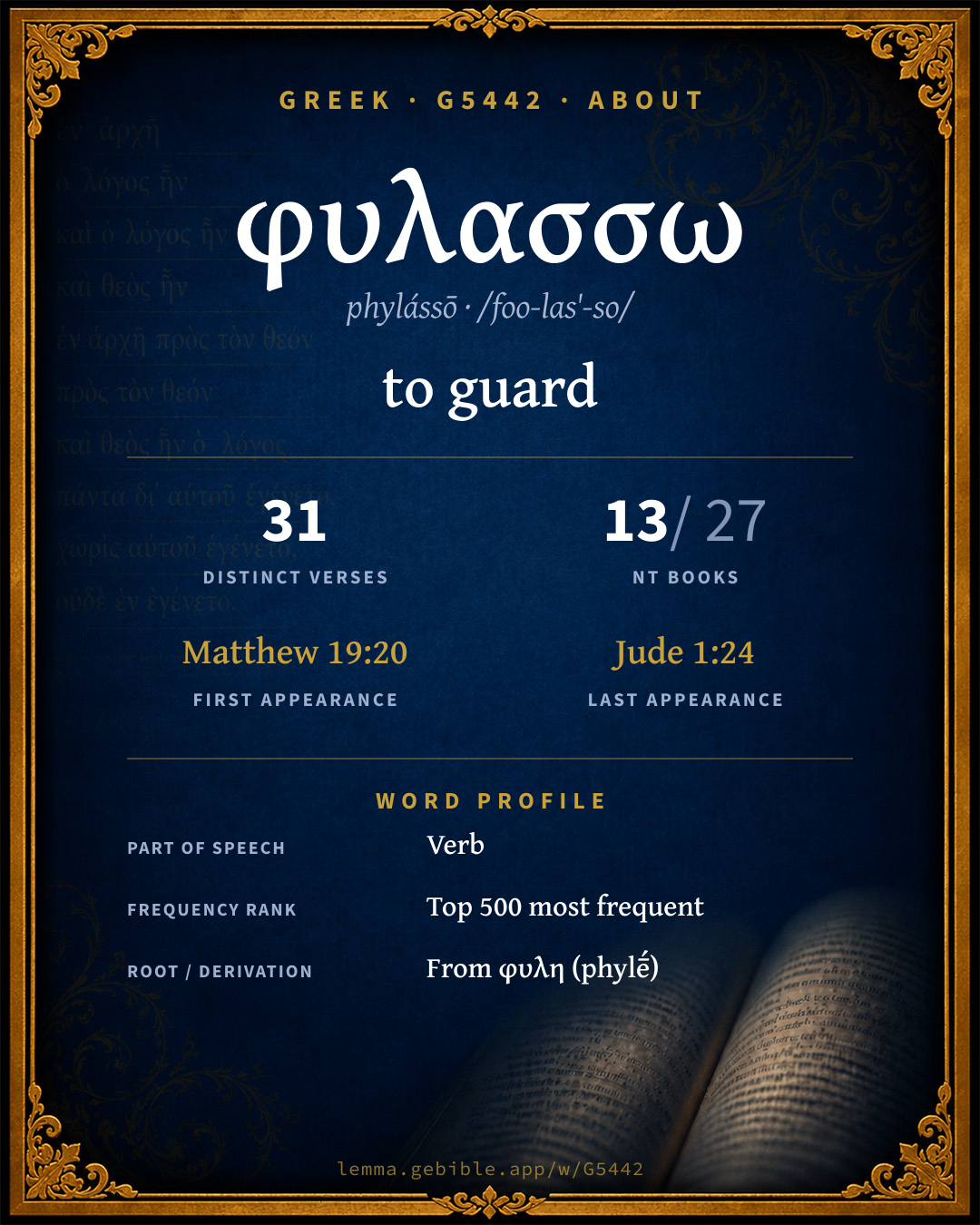
φυλάσσω
to guard
‘to guard’ is one of 5 main senses fuller range ↓
Full lexicon entry — Thayer's Greek Lexicon
From Thayer's Greek Lexicon
Where this word appears
See every Present-tense verb in the Greek New Testament →
Grammar key — what these labels mean
Part of speech
- Verb
- An action or state-of-being word.
Tense
- Aorist
- Action viewed as a simple whole, without regard to duration — often past (perfective aspect).
- Future
- Action expected in future time.
- Present
- Ongoing or general action in present time (imperfective aspect).
Voice
- Active
- The subject performs the action.
- Middle
- The subject acts on or for itself, or with special interest in the action.
- Passive
- The subject receives the action.
Mood
- Indicative
- States a fact or asks a factual question (the mood of reality).
- Imperative
- Expresses a command or request.
- Infinitive
- A verbal noun (“to write”), unmarked for person or number.
- Participle
- A verbal adjective (“writing,” “having written”).
- Subjunctive
- Expresses probability, purpose, or possibility (the mood of contingency).
Case
- Nominative
- The case of the subject (and the predicate nominative).
- Dative
- The case of the indirect object, means, or location — “to / for / with / in.”
Person
- 1st person
- The speaker (“I / we”).
- 2nd person
- The one addressed (“you”).
- 3rd person
- The one spoken about (“he / she / it / they”).
Gender
- Masculine
- Grammatically masculine.
Number
- Singular
- One.
- Plural
- More than one.
Grammatical forms 20 distinct
- Verb, Aorist, Active, Indicative, 1st person, Singular 3 times (10%)
- Verb, Aorist, Active, Imperative, 2nd person, Singular 2 times (6%)
- Verb, Aorist, Active, Infinitive 2 times (6%)
- Verb, Future, Active, Indicative, 3rd person, Singular 2 times (6%)
- Verb, Present, Active, Infinitive 2 times (6%)
- Verb, Present, Active, Participle, Nominative, Plural, Masculine 2 times (6%)
- Verb, Present, Active, Participle, Nominative, Singular, Masculine 2 times (6%)
- Verb, Present, Active, Subjunctive, 3rd person, Singular 2 times (6%)
+12 more forms (14 occurrences)
Parsed forms decoded from the imported morphology (Robinson–Tischendorf, public domain), counted across 31 parsed occurrences — not distinct verses.
Every verse where G5442 appears — 31 distinct verses across 13 books. Click any verse to open its interlinear word-by-word view. Verse text shown in the World English Bible for context — . Each verse’s Greek form is shown with its reference; the English is not keyword-highlighted, since the data carries no word-level English alignment. Use “Compare translations” on any verse to read it across multiple English versions. This concordance covers the Greek New Testament; Septuagint (Greek Old Testament) occurrences of this word are not indexed here.
Matthew 1 verse
Mark 1 verse
Luke 6 verses
- Luke 2:8 φυλάσσοντες pres act ptcp nom pl masc There were shepherds in the same country staying in the field, and keeping watch by night over their flock.
- Luke 8:29 φυλασσόμενος pres pass ptcp nom sg masc For Jesus was commanding the unclean spirit to come out of the man. For the unclean spirit had often seized the man. He was kept under guard, and bound with chains and fetters. Breaking the bands apart, he was driven by the demon into the desert.
- Luke 11:21 φυλάσσῃ pres act subj 3sg "When the strong man, fully armed, guards his own dwelling, his goods are safe.
- Luke 11:28 φυλάσσοντες pres act ptcp nom pl masc But he said, "On the contrary, blessed are those who hear the word of God, and keep it."
- Luke 12:15 φυλάσσεσθε pres mid impv 2pl He said to them, "Beware! Keep yourselves from covetousness, for a man's life doesn't consist of the abundance of the things which he possesses."
- Luke 18:21 ἐφύλαξα aor act ind 1sg He said, "I have observed all these things from my youth up."
John 3 verses
- John 12:25 φυλάξει fut act ind 3sg He who loves his life will lose it. He who hates his life in this world will keep it to eternal life.
- John 12:47 φυλάξῃ aor act subj 3sg If anyone listens to my sayings, and doesn't believe, I don't judge him. For I came not to judge the world, but to save the world.
- John 17:12 ἐφύλαξα aor act ind 1sg While I was with them in the world, I kept them in your name. Those whom you have given me I have kept. None of them is lost, except the son of destruction, that the Scripture might be fulfilled.
Acts 8 verses
- Acts 7:53 ἐφυλάξατε aor act ind 2pl You received the law as it was ordained by angels, and didn't keep it!"
- Acts 12:4 φυλάσσειν pres act inf When he had arrested him, he put him in prison, and delivered him to four squads of four soldiers each to guard him, intending to bring him out to the people after the Passover.
- Acts 16:4 φυλάσσειν pres act inf As they went on their way through the cities, they delivered the decrees to them to keep which had been ordained by the apostles and elders who were at Jerusalem.
- Acts 21:24 φυλάσσων pres act ptcp nom sg masc Take them, and purify yourself with them, and pay their expenses for them, that they may shave their heads. Then all will know that there is no truth in the things that they have been informed about you, but that you yourself also walk keeping the law.
- Acts 21:25 φυλάσσεσθαι pres mid inf But concerning the Gentiles who believe, we have written our decision that they should observe no such thing, except that they should keep themselves from food offered to idols, from blood, from strangled things, and from sexual immorality."
- Acts 22:20 φυλάσσων pres act ptcp nom sg masc When the blood of Stephen, your witness, was shed, I also was standing by, and consenting to his death, and guarding the cloaks of those who killed him.'
- Acts 23:35 φυλάσσεσθαι pres mid inf "I will hear you fully when your accusers also arrive." He commanded that he be kept in Herod's palace.
- Acts 28:16 φυλάσσοντι pres act ptcp dat sg masc When we entered into Rome, the centurion delivered the prisoners to the captain of the guard, but Paul was allowed to stay by himself with the soldier who guarded him.
Romans 1 verse
Galatians 1 verse
2 Thessalonians 1 verse
1 Timothy 2 verses
- 1 Timothy 5:21 φυλάξῃς aor act subj 2sg I charge you in the sight of God, and Christ Jesus, and the chosen angels, that you observe these things without prejudice, doing nothing by partiality.
- 1 Timothy 6:20 φύλαξον aor act impv 2sg Timothy, guard that which is committed to you, turning away from the empty chatter and oppositions of the knowledge which is falsely so called;
2 Timothy 3 verses
- 2 Timothy 1:12 φυλάξαι aor act inf For this cause I suffer also these things. Yet I am not ashamed, for I know him whom I have believed, and I am persuaded that he is able to guard that which I have committed to him against that day.
- 2 Timothy 1:14 φύλαξον aor act impv 2sg That good thing which was committed to you, guard through the Holy Spirit who dwells in us.
- 2 Timothy 4:15 φυλάσσου pres mid impv 2sg of whom you also must beware; for he greatly opposed our words.
2 Peter 2 verses
- 2 Peter 2:5 ἐφύλαξεν aor act ind 3sg and didn't spare the ancient world, but preserved Noah with seven others, a preacher of righteousness, when he brought a flood on the world of the ungodly;
- 2 Peter 3:17 φυλάσσεσθε pres mid impv 2pl You therefore, beloved, knowing these things beforehand, beware lest, being carried away with the error of the wicked, you fall from your own steadfastness.
1 John 1 verse
Jude 1 verse
About this entry
At a glance — auto-summarized from this page’s data, not written by a person. Every figure links to its source below. This summary describes the numbers; it doesn’t interpret them.
The Greek verb φυλασσω centers on the idea of “to guard.” Older and newer Bibles part ways — “keep” in the King James Version, “guard” (Berean Standard Bible) in modern versions. See the renderings breakdown. It turns up in 31 verses across 13 books, a moderately common footprint. The word gravitates to Acts (26%), then Luke and John. Thayer's distinguishes 5 senses for it. For the data behind this summary, explore the sense tree and the renderings breakdown below.
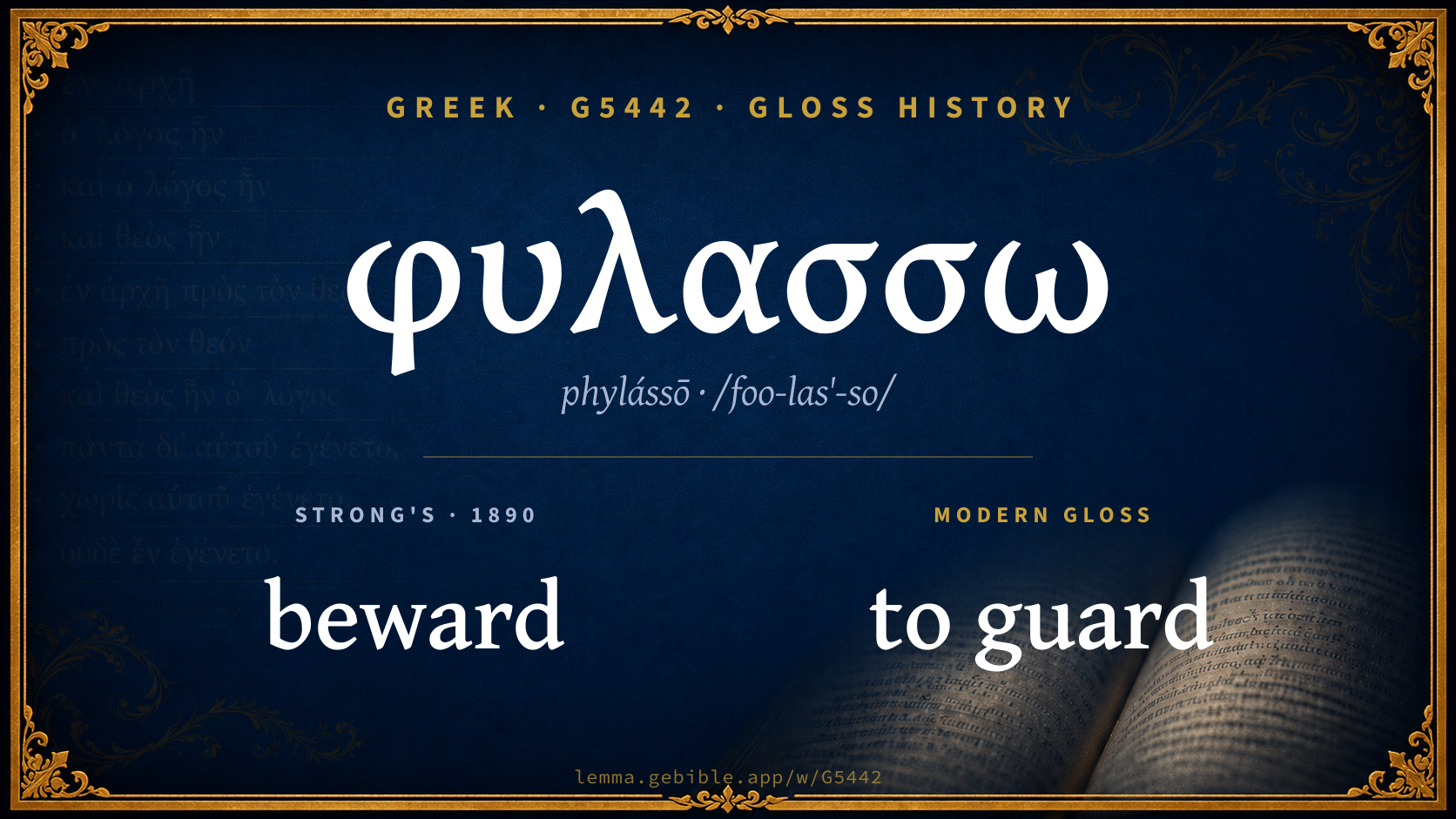
Gloss history
Strong's 1890 vs modern scholarship
About this word
Strong's G5442 catalogs a Greek word from the Greek New Testament.
These counts are not copied from any lexicon or concordance. They are computed here, from the morphology-tagged Greek New Testament. What Lemma adds →
- 31
- distinct verses
- The word appears in 31 distinct verses.
- 13 / 27
- NT books
- The word appears in 13 of 27 New Testament books.
- #448
- by frequency
- Top 500 most frequent Greek words (rank 448 of 5,347 Greek words by occurrence).
View all 31 occurrences in the concordance →
By section of the New Testament
By traditional corpus
Conventional, traditional groupings — biblical authorship is debated, so this is a traditional corpus grouping, not an authorship claim. Some books belong to more than one corpus (Luke is in both the Gospels and the Lukan corpus, and so on), so these shares overlap and need not total 100%. Each figure is a share of the word’s 31 distinct verses.
- Lukan (Luke–Acts) 14 verses · 45%
- Gospels 11 verses · 35%
- Pauline corpus 8 verses · 26%
- Johannine 4 verses · 13%
- General (Catholic) Epistles 4 verses · 13%
How translations render this word
Counts come from each version’s own published word-to-Strong’s tagging or interlinear alignment — an approximate guide to how each version renders this word, not a word-level alignment the data otherwise carries. Because each total is that version’s own tagged count, the per-version totals vary from one another and need not match the appearance or distinct-verse counts above. These counts may also differ from a printed concordance because Lemma counts each distinctly tagged rendering and does not collapse phrase taggings into a single head-word total. This is a fixed set of word-tagged versions (KJV, ASV, BSB, ULT) and does not change with the reading translation you choose elsewhere. Each version’s license is shown beside its name below (and on Sources).
- King James Version: Keep 11×, Kept 3×, Beware 2×
- American Standard Version: Guard 6×, Keep 5×, Keeping 3×
- Berean Standard Bible: Guard 5×, Keep 4×, I have kept 3×
- unfoldingWord Literal Text: Keep 6×, Guard 4×, I have kept 3×
King James Version Public Domain
Renders G5442 across 32 tagged occurrences — most commonly:
Plus 14 renderings that appear only once — usually multi-word phrases or single function words the recovered tagging swept in, not distinct renderings.
American Standard Version Public Domain
Renders G5442 across 29 tagged occurrences — most commonly:
Plus 13 renderings that appear only once — usually multi-word phrases or single function words the recovered tagging swept in, not distinct renderings.
Berean Standard Bible Public Domain
Renders G5442 across 31 tagged occurrences — most commonly:
Plus 17 renderings that appear only once — usually multi-word phrases or single function words the recovered tagging swept in, not distinct renderings.
unfoldingWord Literal Text CC BY-SA 4.0
Renders G5442 across 36 tagged occurrences — most commonly:
Plus 18 renderings that appear only once — usually multi-word phrases or single function words the recovered tagging swept in, not distinct renderings.
Senses in Thayer's
The 5 senses Thayer's distinguishes for this word, in lexicon order (not ranked by frequency or importance). The full entry — with sub-senses — is in the Lexicon Entry tab.
- to watch, keep watch
- to guard or watch, have an eye upon: lest he escape
- to guard a person (or thing) that he may remain safe
- to guard i.e. care for, take care not to violate
- to observe for one's self something to escape
Word origin
Derived from φυλη (phylḗ) (G5443) — tribe.
Forms in the corpus
The 20 distinct written forms G5442 takes in the Greek New Testament, most frequent first — each parse links to that tense’s occurrences in the concordance.
Same root — word family
Other Thayer's entries built from the same root as G5442, grouped by Strong’s listed origin. These share a root / origin per the lexicon — not necessarily a shared meaning. Each links to that word’s own entry.
Derives from
Shares the same root
Derived from this word
Compare all same-root words → Showing 4 of 6 — not the complete family. They share a root, not necessarily a meaning.
Septuagint usage
The same Greek word φυλασσω appears 415 times in the Greek Old Testament (Septuagint), across 398 verses in 31 books.
- 415
- LXX occurrences
- Tagged occurrences of this Greek word in the Septuagint.
- 398
- verses
- Distinct Septuagint verses containing this word.
- 31 / 39
- OT books
- The word appears in 31 of the 39 Old Testament books.
Sample Septuagint occurrences
- Genesis 2:15 φυλάσσω
- Exodus 12:17 φυλάσσω
- Leviticus 8:35 φυλάσσω
- Numbers 1:53 φυλάσσω
- Deuteronomy 4:2 φυλάσσω
- Joshua 1:7 φυλάσσω
- Judges 1:24 φυλάσσω
- 1 Samuel 1:12 φυλάσσω
- 2 Samuel 11:16 φυλάσσω
- 1 Kings 2:3 φυλάσσω
- 2 Kings 6:9 φυλάσσω
- 1 Chronicles 9:19 φυλάσσω
Septuagint occurrences (same lexeme)
Every verse where the same Strong’s number (G5442) appears in the Greek Septuagint — showing the first 50 of 398. Verse text shown in the World English Bible for context; the Greek form is the matched word — the English is not keyword-highlighted.
- Genesis 2:15 φυλάσσω Yahweh God took the man, and put him into the garden of Eden to dress it and to keep it.
- Genesis 3:24 φυλάσσω So he drove out the man; and he placed Cherubs at the east of the garden of Eden, and the flame of a sword which turned every way, to guard the way to the tree of life.
- Genesis 18:19 φυλάσσω For I have known him, to the end that he may command his children and his household after him, that they may keep the way of Yahweh, to do righteousness and justice; to the end that Yahweh may bring on Abraham that which he has spoken of him."
- Genesis 26:5 φυλάσσω because Abraham obeyed my voice, and kept my charge, my commandments, my statutes, and my laws."
- Genesis 30:31 φυλάσσω He said, "What shall I give you?" Jacob said, "You shall not give me anything. If you will do this thing for me, I will again feed your flock and keep it.
- Genesis 31:24 φυλάσσω God came to Laban, the Syrian, in a dream of the night, and said to him, "Take heed to yourself that you don't speak to Jacob either good or bad."
- Genesis 31:29 φυλάσσω It is in the power of my hand to hurt you, but the God of your father spoke to me last night, saying, 'Take heed to yourself that you don't speak to Jacob either good or bad.'
- Genesis 41:35 φυλάσσω Let them gather all the food of these good years that come, and lay up grain under the hand of Pharaoh for food in the cities, and let them keep it.
- Genesis 41:36 φυλάσσω The food will be for a store to the land against the seven years of famine, which will be in the land of Egypt; that the land not perish through the famine."
- Exodus 12:17 φυλάσσω You shall observe the feast of unleavened bread; for in this same day have I brought your hosts out of the land of Egypt: therefore shall you observe this day throughout your generations by an ordinance forever.
- Exodus 12:24 φυλάσσω You shall observe this thing for an ordinance to you and to your sons forever.
- Exodus 12:25 φυλάσσω It shall happen when you have come to the land which Yahweh will give you, according as he has promised, that you shall keep this service.
- Exodus 13:10 φυλάσσω You shall therefore keep this ordinance in its season from year to year.
- Exodus 15:26 φυλάσσω and he said, "If you will diligently listen to the voice of Yahweh your God, and will do that which is right in his eyes, and will pay attention to his commandments, and keep all his statutes, I will put none of the diseases on you, which I have put on the Egyptians; for I am Yahweh who heals you."
- Exodus 19:5 φυλάσσω Now therefore, if you will indeed obey my voice, and keep my covenant, then you shall be my own possession from among all peoples; for all the earth is mine;
- Exodus 20:6 φυλάσσω and showing loving kindness to thousands of those who love me and keep my commandments.
- Exodus 22:6 φυλάσσω "If fire breaks out, and catches in thorns so that the shocks of grain, or the standing grain, or the field are consumed; he who kindled the fire shall surely make restitution.
- Exodus 22:9 φυλάσσω For every matter of trespass, whether it be for ox, for donkey, for sheep, for clothing, or for any kind of lost thing, about which one says, 'This is mine,' the cause of both parties shall come before God. He whom God condemns shall pay double to his neighbor.
- Exodus 23:13 φυλάσσω "Be careful to do all things that I have said to you; and don't invoke the name of other gods, neither let them be heard out of your mouth.
- Exodus 23:15 φυλάσσω You shall observe the feast of unleavened bread. Seven days you shall eat unleavened bread, as I commanded you, at the time appointed in the month Abib (for in it you came out from Egypt), and no one shall appear before me empty.
- Exodus 23:20 φυλάσσω "Behold, I send an angel before you, to keep you by the way, and to bring you into the place which I have prepared.
- Exodus 23:22 φυλάσσω But if you indeed listen to his voice, and do all that I speak, then I will be an enemy to your enemies, and an adversary to your adversaries.
- Exodus 31:13 φυλάσσω "Speak also to the children of Israel, saying, 'Most assuredly you shall keep my Sabbaths: for it is a sign between me and you throughout your generations; that you may know that I am Yahweh who sanctifies you.
- Exodus 31:14 φυλάσσω You shall keep the Sabbath therefore; for it is holy to you. Everyone who profanes it shall surely be put to death; for whoever does any work therein, that soul shall be cut off from among his people.
- Exodus 31:16 φυλάσσω Therefore the children of Israel shall keep the Sabbath, to observe the Sabbath throughout their generations, for a perpetual covenant.
- Exodus 34:18 φυλάσσω "You shall keep the feast of unleavened bread. Seven days you shall eat unleavened bread, as I commanded you, at the time appointed in the month Abib; for in the month Abib you came out from Egypt.
- Leviticus 8:35 φυλάσσω At the door of the Tent of Meeting you shall stay day and night seven days, and keep the charge of Yahweh, that you don't die: for so I am commanded."
- Leviticus 18:4 φυλάσσω You shall do my ordinances, and you shall keep my statutes, and walk in them: I am Yahweh your God.
- Leviticus 18:5 φυλάσσω You shall therefore keep my statutes and my ordinances; which if a man does, he shall live in them: I am Yahweh.
- Leviticus 18:26 φυλάσσω You therefore shall keep my statutes and my ordinances, and shall not do any of these abominations; neither the native-born, nor the stranger who lives as a foreigner among you;
- Leviticus 18:30 φυλάσσω Therefore you shall keep my charge, that you do not practice any of these abominable customs, which were practiced before you, and that you do not defile yourselves with them: I am Yahweh your God.'"
- Leviticus 19:3 φυλάσσω "'Each one of you shall respect his mother and his father. You shall keep my Sabbaths. I am Yahweh your God.
- Leviticus 19:19 φυλάσσω "'You shall keep my statutes. "'You shall not crossbreed different kinds of animals. "'you shall not sow your field with two kinds of seed; "'neither shall there come upon on you a garment made of two kinds of material.
- Leviticus 19:30 φυλάσσω "'You shall keep my Sabbaths, and reverence my sanctuary; I am Yahweh.
- Leviticus 19:37 φυλάσσω You shall observe all my statutes, and all my ordinances, and do them. I am Yahweh.'"
- Leviticus 20:8 φυλάσσω You shall keep my statutes, and do them. I am Yahweh who sanctifies you.
- Leviticus 20:22 φυλάσσω "'You shall therefore keep all my statutes, and all my ordinances, and do them; that the land, where I am bringing you to dwell, may not vomit you out.
- Leviticus 22:9 φυλάσσω "'They shall therefore keep my charge, lest they bear sin for it, and die therein, if they profane it. I am Yahweh who sanctifies them.
- Leviticus 22:31 φυλάσσω "Therefore you shall keep my commandments, and do them. I am Yahweh.
- Leviticus 25:18 φυλάσσω "'Therefore you shall do my statutes, and keep my ordinances and do them; and you shall dwell in the land in safety.
- Leviticus 26:2 φυλάσσω "'You shall keep my Sabbaths, and have reverence for my sanctuary. I am Yahweh.
- Leviticus 26:3 φυλάσσω "'If you walk in my statutes, and keep my commandments, and do them;
- Numbers 1:53 φυλάσσω But the Levites shall encamp around the Tabernacle of the Testimony, that there may be no wrath on the congregation of the children of Israel: and the Levites shall be responsible for the Tabernacle of the Testimony."
- Numbers 3:7 φυλάσσω They shall keep his charge, and the charge of the whole congregation before the Tent of Meeting, to do the service of the tabernacle.
- Numbers 3:8 φυλάσσω They shall keep all the furnishings of the Tent of Meeting, and the obligations of the children of Israel, to do the service of the tabernacle.
- Numbers 3:10 φυλάσσω You shall appoint Aaron and his sons, and they shall keep their priesthood. The stranger who comes near shall be put to death."
- Numbers 3:28 φυλάσσω According to the number of all the males, from a month old and upward, there were eight thousand six hundred, keeping the charge of the sanctuary.
- Numbers 3:32 φυλάσσω Eleazar the son of Aaron the priest shall be prince of the princes of the Levites, with the oversight of those who keep the charge of the sanctuary.
- Numbers 3:38 φυλάσσω Those who encamp before the tabernacle eastward, in front of the Tent of Meeting toward the sunrise, shall be Moses, and Aaron and his sons, keeping the charge of the sanctuary for the charge of the children of Israel. The stranger who comes near shall be put to death.
- Numbers 6:24 φυλάσσω 'Yahweh bless you, and keep you.
These are occurrences of the same Greek lexeme (G5442) in the Septuagint — not a translation of any one Hebrew word. The store carries no word-level Hebrew↔Greek alignment, so no Hebrew original is asserted here. Counts come from the recovered LXX Strong's tagging — high-frequency vocabulary is well covered, while rare or late forms may be untagged — so they reflect tagged occurrences and may slightly undercount.