1 John 5:21

Greek (Tischendorf 8th ed.) 1 John 5:21 appears in the Greek New Testament. The text above is from the Tischendorf 8th edition. Each word links to its Strong’s number and a concise gloss. Click any word for its full Thayer’s Greek Lexicon entry.
Download image
Cite this verse

1 John 5:21 (World English Bible). Public Domain. Lemma interlinear Bible study tool, https://lemma.gebible.app/v/1-john/5/21.

Show BibTeX & RIS
BibTeX
RIS
English Translation
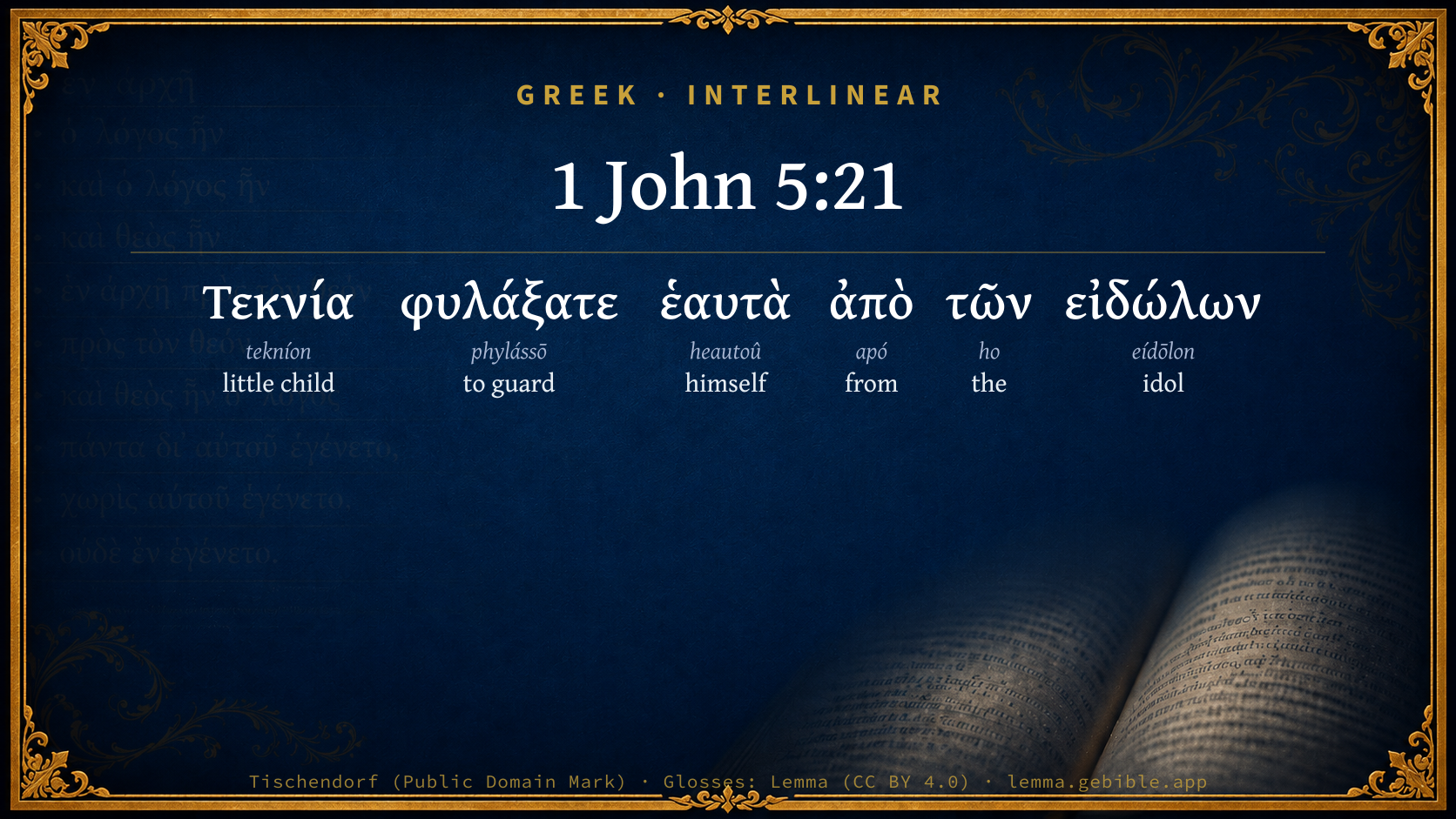
Little children, keep yourselves from idols.
World English Bible · Public Domain
Download a study sheet

One document with this verse’s original text, its word-by-word gloss line, the meaning frame, cross-references with their text, attributed commentary, and full source and license credits — printable, and it pastes into notes with its structure intact.

This verse Autodidact and up

Study sheet (.html) Plain text (.txt)

A passage Seminary Student

Up to 50 verses in one chapter. A passage sheet keeps up to 6 commentary sources and 12 cross-references per verse, in the order this page ranks them, and says so on the sheet whenever that leaves anything out. Ask for a single verse and you get the Autodidact verse sheet above.

Everything on this page stays free to read, with no account — the sheet is a download of what is already on screen, not access to it.

Want to remove ads? Support Godless Engineer
Compare translations 3

The same verse in 3 English versions, stacked beneath the original-language interlinear above. Click any original word for its lexicon entry.

Each is an independent rendering of the whole verse — the interlinear is not word-aligned to these translations.

Highlighted words mark where these versions differ — a whole-verse word diff, not a word-by-word alignment.

  • World English Bible Public Domain
    Little children, keep yourselves from idols.
  • King James Version Public Domain
    Little children, keep yourselves from idols. Amen.
  • unfoldingWord Literal Text CC BY-SA 4.0
    Little children, keep yourselves from the idols.

unfoldingWord Literal Text — © unfoldingWord, licensed CC BY-SA 4.0. Word-aligned USFM3 via Door43 (git.door43.org/unfoldingWord/en_ult).

Versions to compare (up to 4)

3 of 4 selected

Show all 19 translations

Every available English version of this verse, each an independent rendering of the whole verse.

  • World English Bible Public Domain
    Little children, keep yourselves from idols.
  • Berean Standard Bible Public Domain
    Little children, keep yourselves from idols.
  • Majority Standard Bible Public Domain
    Little children, keep yourselves from idols. Amen.
  • King James Version Public Domain
    Little children, keep yourselves from idols. Amen.
  • American Standard Version (1901) Public Domain
    `My' little children, guard yourselves from idols.
  • Revised Version (1885) Public Domain
    My little children, guard yourselves from idols.
  • Geneva Bible (1599) Public Domain
    Litle children, keepe your selues from idoles, Amen.
  • Douay-Rheims (1899) Public Domain
    Little children, keep yourselves from idols. Amen.
  • Young's Literal Translation Public Domain
    Little children, guard yourselves from the idols! Amen.
  • Literal Standard Version CC BY-SA 4.0
    Little children, guard yourselves from idols! Amen.
  • Unlocked Literal Bible CC BY-SA 4.0
    Children, keep yourselves from idols.
  • unfoldingWord Literal Text CC BY-SA 4.0
    Little children, keep yourselves from the idols.
  • Darby Bible Public Domain
    Children, keep yourselves from idols.
  • World Messianic Bible Public Domain
    Little children, keep yourselves from idols.
  • Webster's Bible Public Domain
    Little children, keep yourselves from idols. Amen.
  • Free Bible Version CC BY-SA 4.0
    Dear friends, stay away from idol worship.
  • Bible in Basic English Public Domain
    My little children, keep yourselves from false gods.
  • Text-Critical English NT CC BY 4.0
    Little children, guard yourselves from idols. Amen.
  • Tyndale New Testament (1534) Public Domain
    Babes kepe youre selves from ymages. Amen.

Literal Standard Version (2020), Covenant Press — licensed CC BY-SA 4.0. Text via the HelloAO Bible API (eBible.org). Unlocked Literal Bible (unfoldingWord) — licensed CC BY-SA 4.0. Text via the HelloAO Bible API (eBible.org). unfoldingWord Literal Text — © unfoldingWord, licensed CC BY-SA 4.0. Word-aligned USFM3 via Door43 (git.door43.org/unfoldingWord/en_ult). Free Bible Version, Dr. Jonathan Gallagher — licensed CC BY-SA 4.0. Text via the HelloAO Bible API (eBible.org).

Word by word

More ways to search: Search by grammar → Find every occurrence → Compare this word →

Practice this passage: Drill this verse → Learn its vocabulary →

About this verse

These counts appear in no published source. They are computed here, from the morphology-tagged text and Lemma’s own curated glosses. What Lemma adds →

6
words
6
distinct lemmas
General Epistles
section

Notable vocabulary

The rarest word here is Τεκνία little child G5040 — appearing just 8 times in the whole Greek New Testament.

Shared distinctive vocabulary

Τεκνία little child G5040 occurs in 8 verses of the Greek New Testament. Also found in:

Cross-references

10

Topical passages linked to 1 John 5:21 in the Treasury of Scripture Knowledge — connected by theme and wording, ordered by reader-vote popularity; previews shown in the World English Bible.

  • 1 Corinthians 10:14 Therefore, my beloved, flee from idolatry.
  • 1 Corinthians 10:7 Neither be idolaters, as some of them were. As it is written, "The people sat down to eat and drink, and rose up to play."
  • Exodus 20:3–4 You shall have no other gods before me.
  • 2 Corinthians 6:16–17 What agreement has a temple of God with idols? For you are a temple of the living God. Even as God said, "I will dwell in them, and walk in them; and I will be their God, and they will be my people."
  • Matthew 6:13 Bring us not into temptation, but deliver us from the evil one. For yours is the Kingdom, the power, and the glory forever. Amen.'
  • 1 Thessalonians 1:9 For they themselves report concerning us what kind of a reception we had from you; and how you turned to God from idols, to serve a living and true God,
  • 1 John 2:1 My little children, I write these things to you so that you may not sin. If anyone sins, we have a Counselor with the Father, Jesus Christ, the righteous.
  • Revelation 9:20 The rest of mankind, who were not killed with these plagues, didn't repent of the works of their hands, that they wouldn't worship demons, and the idols of gold, and of silver, and of brass, and of stone, and of wood; which can neither see, nor hear, nor walk.
  • Revelation 13:14–15 He deceives my own people who dwell on the earth because of the signs he was granted to do in front of the beast; saying to those who dwell on the earth, that they should make an image to the beast who had the sword wound and lived.
  • Revelation 14:11 The smoke of their torment goes up forever and ever. They have no rest day and night, those who worship the beast and his image, and whoever receives the mark of his name.

Cross-references courtesy of OpenBible.info (CC BY 4.0).

Where the printed editions differ

1 variant

Places in this verse where the major printed Greek editions disagree on the wording in a way that affects the translation — a comparison of editions, not a manuscript-by-manuscript collation. The editions are the modern critical texts (Nestlé-Aland 28/27, SBL, Westcott-Hort, Tregelles, Tyndale House) and the traditional texts behind the KJV (the Textus Receptus and the Byzantine/Majority text). It is not a claim about which reading is original.

  1. Extra text
    ἀμήν.¶

    “Amen.”

    In TRByz Not in NA28NA27TynSBLWHTreg

    ἀμήν.¶ (amēn) 'Amen.' is only in traditional manuscripts (TR+Byz)

Textual data: Translators Amalgamated Greek New Testament (STEPBible TAGNT) · CC BY 4.0.

Commentary

Notes on 1 John 5:21 from classic Christian and Jewish commentators (each source and its license shown beneath its notes). The classic Christian expositions comment on the surrounding passage and are grouped to its opening verse, so a note may address several verses; the Jewish commentaries on the Tanakh (Rashi and others) are per-verse, so they appear only where the commentator wrote on this verse.

Lemma curates 59 commentaries, every one of them public domain or Creative Commons licensed, each selected and text-cleaned for this edition rather than reprinted as found. About our sources →

The Biblical Illustrator

Joseph S. Exell

1Jn_5:21

Little children, keep yourselves from idols

The sin of idolising

I.

What is the right notion of idolatry, as it still prevails even among nominal Christians? I answer generally; whatever is so desired and loved, so trusted in or honoured, as to displace God from His preeminence is an idol. Accordingly the objects of human idolatry are exceedingly numerous; and one individual is far from being constant to the same. We see the idol of yesterday cast to the moles and bats today; and that which is deified today may probably be trampled in the mire tomorrow. This multiplicity of idols, this unsteadiness of taste and affection appeared among the heathen polytheists. It is the proper curse and punishment of forsaking the Creator that the heart roam from creature to creature with a sickly capriciousness, and never know where to settle. Consider, then, whether or not you are immoderately attached to any earthly object; to any friend or relation; to money, power, learning, reputation, pleasure, popularity.

II. The way of detecting these idolatrous propensities in ourselves.

1. What is their effect in filling your mind, and memory, and imagination? What do your thoughts chiefly run upon? To what do they naturally tend--God or Mammon? Your memory too, what scenes and discourses does it most fondly review? Those of a spiritual and devout, or those of a worldly cast? Tell me, also, which way your fancy flies when it makes excursions. To airy castles of augumented wealth and importance in this world; to higher distinctions, and finer houses, and more abundant comforts; or to scenes of heavenly holiness and bliss? Try yourselves, again, as to the influence of temporal things upon your religious exercises.

2. Is your sensibility to sin as lively as ever? If you have lost ground in this respect, and are less particular than once you were, what has so sadly altered you? Has it not been too warm an attachment to this or that person; too keen a solicitude for this or the other acquisition?

3. Are you greatly elated by gain, and greatly dejected by loss in your worldly affairs and connections? In thought survey your possessions and still more your friends. Now, which of all these is dearest to you? Have you ascertained? Then I ask whether you could bear to part with that possession by the stroke of misfortune; with that friend by the stroke of death? Ah, you exclaim, it would break my heart to be deprived of such a blessing. Would that indeed be the ease? Then tremble lest that blessing turn into a curse by proving your idol.

III. Some of Gods methods of dealing with such idolaters; for He is a jealous God. The idols He will utterly abolish. Sometimes He sweeps them away as with a whirlwind. They are smitten to the ground and disappear in a moment. Health, strength, beauty, knowledge, fame, wealth, just now they were flourishing like a flower; and like a flower they have faded away. Sometimes the cup of idolatrous happiness is not dashed from our lips, but wormwood is mingled with it. God embitters to us our darling enjoyments, so that where we looked for peace and comfort we find nothing but misery. Was it the husband you loved more than God? That husband becomes faithless and unkind. Was it the wife? She grows sickly and fretful. The child? He turns out wild; or is lost to you in some other way. Be assured that the over-eager pursuit of any worldly good is full of mischief and peril. And this dreadful consummation occurs when God leaves us to our idols; when he suffers them to take and keep possession of our souls. Ephraim is joined to idols; let him alone. Leave him to his fatal infatuation. Let him take his fill of carnal delights till the day of repentance is closed and judgment bursts upon him. Merciful God, sever us from our idols by whatever visitation thou mayest see fit; only leave us not bound up with them to perish in the day of Thy coming!

IV. The means of keeping ourselves from idols.

1. Exercise a sleepless vigilance, kept awake by a sense of your proneness to fall into this evil; and be much in prayer for Divine help, conscious that you are too weak to preserve yourselves without assistance from above. Understand, however, that what you have mainly to guard against is not any particular object, but the turning of that object into an idol.

2. Do not heedlessly form such connections and acquaintances, whether by marriage or partnership in business or domestic service, as threaten to absorb the heart and alienate the affections from God. Recollect that it is easier to abstain from making idols than afterwards to put them away.

3. Think much of the vanity of human things; what they really are and of what account. Often the dearest idol gives birth to the greatest sorrow. How common the remark upon something of which high expectations were conceived, It has turned out quite the reverse. Oh, truly, it is most unwise to set our heart upon a gourd which may wither away at any moment and leave us more painfully sensible than ever of the scorching sunbeams.

4. Never forget that it is the prime end of the gospel to unbind your heart from the creature in order to its being reunited to your Father in heaven. Are you not to be temples of the Holy Ghost; to be sanctified into an habitation of God through the Spirit? What then have you to do any more with idols? (J. N. Pearson, M. A.)

The true God and shadows

By the true God St. John means the God not only truth speaking, but true in essence, genuine, real; by shadows or idols he means the false principles which take possession of the senses--the unreal reflections of the only Real. There was in deed plenty of need for this warning in St. Johns day and in the Churches under his care. Perhaps the antithesis of Christianity and the world is not now so sharply apparent. But the contrast still exists. Although the twilight realm may be vast, yet broad and deep are the shadows which men take for realities, and live in them, and worship them, and believe in them. Can there be a more evident example of shadow worship than the devotion of the world to the material--which in reality is the immaterial? In every form of matter there is indeed the hint of God, but it is a hint only, the pledge of the reality, not the great Reality Itself. It is from heedlessness of this great truth that the First Commandment of the Decalogue, which some imagine completely needless for themselves, is perhaps really more necessary than any of the other nine. For all around us is a world worshipping sham gods of its own deification. How then does Christ teach us the eternal distinction between shadows and realities? In His temptation we have exhibited to us the whole matter in a nutshell. Temptation is the battle of alternatives, the choice between the high and the low, the real and the shadowy. Alexander, conqueror of the world, wept for worlds beyond to conquer: Caesar, with his hand grasping Satans gift of the world empire, dreamed of something more real when he told the Egyptian priest he would give up all, even Cleopatra herself, to discover the mysterious sources of the Nile. It is this reality, this wider con quest, this source of eternal life, which has been mans search in all his philosophies and religious systems. Napoleon, beset with quagmires in Egypt, bade his officers ride out in all directions, the first to find firm ground to return and lead the way for the rest. So mans heart has bidden him ride out in every direction to seek the Real, and St. John comes back from his fellowship with Jesus, and cries, This is the real God and the life which is eternal. Little children, guard yourselves from the sham gods. (H. H. Gowen.)

Idolatry

If an idol is a thing which draws the heathen away from the living God, anything which does this for us may be named an idol.

I. Self. Love of self is born in us, and if not early checked will be our master. It feeds upon falsehood, unkindness, greediness, and pride. You must gratify it at whatever cost, and then it demands more and more. Self is a dreadful idol. Beware of it.

II. Dress. You may forget the pearl in anxiety about its setting.

III. Pleasure. Do not children encourage the passion for exciting amusements till they are miserable without them, though so many innocent recreations remain to them? We have known children whose Sundays were a weariness to them, and their studies a punishment. Their pleasures were their idols. (British Weekly Pulpit.)

The Biblical Illustrator, edited by Joseph S. Exell (c. 1880s–1900s) — public domain. Text from a community e-Sword module.

The Expositor's Bible

Chapter 1 Part 1

1 John

THE SURROUNDINGS OF THE FIRST EPISTLE OF ST. JOHN.

1Jn_5:21

AFTER the example of a writer of genius, preachers and essayists for the last forty years have constantly applied-or misapplied-some lines from one of the greatest of Christian poems. Dante writes of St. John-

"As he, who looks intent,

And strives with searching ken, how he may see

The sun in his eclipse, and, through decline

Of seeing, loseth power of sight: so I Gazed on that last resplendence."

The poet meant to be understood of the Apostles spiritual splendour of soul, of the absorption of his intellect and heart in his conception of the Person of Christ and of the dogma of the Holy Trinity. By these expositors of Dante the image is transferred to the style and structure of his writings. But confusion of thought is not magnificence, and mere obscurity is never sunlike. A blurred sphere and undecided outline is not characteristic of the sun even in eclipse. Dante never intended us to understand that St. John as a writer was distinguished by a beautiful vagueness of sentiment, by bright but tremulously drawn lines of dogmatic creed. It is indeed certain that round St. John himself, at the time when he wrote, there were many minds affected by this vague mysticism. For them, beyond the scanty region of the known, there was a world of darkness whose shadows they desired to penetrate. For them this little island of life was surrounded by waters into whose depths they affected to gaze. They were drawn by a mystic attraction to things which they themselves called the "shadows," the "depths," the "silences." But for St. John these shadows were a negation of the message which he delivered that "God is light, and darkness in Him is none." These silences were the contradiction of the Word who has once for all interpreted God. These depths were "depths of Satan." For the men who were thus enamoured of indefiniteness, of shifting sentiments and flexible creeds, were Gnostic heretics. Now St. Johns style, as such, has not the artful variety, the perfect balance in the masses of composition, the finished logical cohesion of the Greek classical writers. Yet it can be loftily or pathetically impressive. It can touch the problems and processes of the moral and spiritual world with a pencil tip of deathless light, or compress them into symbols which are solemnly or awfully picturesque. Above all St. John has the faculty of enshrining dogma in forms of statement which are firm and precise-accurate enough to be envied by philosophers, subtle enough to defy the passage of heresy through their finely drawn yet powerful lines. Thus in the beginning of his Gospel all false thought upon the Person of Him who is the living theology of His Church is refuted by anticipation that which in itself or in its certain consequences unhumanises or undeifies the God Man; that which denies the singularity of the One Person who was Incarnate, or the reality and entireness of the manhood of Him who fixed His Tabernacle of humanity in us.

It is therefore a mistake to look upon the First Epistle of St. John as a creedless composite of miscellaneous sweetnesses, a disconnected rhapsody upon philanthropy. And it will be well to enter upon a serious perusal of it, with the conviction that it did not drop from the sky upon an unknown place, at an unknown time, with an unknown purpose. We can arrive at some definite conclusions as to the circumstances from which it arose, and the sphere in which it was written-at least if we are entitled to say that we have done so in the case of almost any other ancient document of the same nature.

Our simplest plan will be, in the first instance, to trace in the briefest outline the career of St. John after the Ascension of our Lord, so far as it can be followed certainly by Scripture, or with the highest probability from early Church history. We shall then be better able to estimate the degree in which the Epistle fits into the framework of local thought and circumstances in which we desire to place it.

Much of this biography can best be drawn out by tracing the contrast between St. John and St. Peter, which is conveyed with such subtle and exquisite beauty in the closing chapter of the fourth Gospel.

The contrast between the two Apostles is one of history and of character.

Historically, the work done by each of them for the Church differs in a remarkable way from the other.

We might have anticipated for one so dear to our Lord a distinguished part in spreading the Gospel among the nations of the world. The tone of thought revealed in parts of his Gospel might even have seemed to indicate a remarkable aptitude for such a task. St. Johns peculiar appreciation of the visit of the Greeks to Jesus, and his preservation of words which show such deep insight into Greek religious ideas, would apparently promise a great missionary, at least to men of lofty speculative thought. But in the Acts of the Apostles St. John is first overshadowed, then effaced, by the heroes of the missionary epic, St. Peter and St. Paul. After the close of the Gospels he is mentioned five times only. Once his name occurs in a list of the Apostles. Thrice he passes before us with Peter. Once again (the first and last time when we hear of St. John in personal relation with St. Paul) he appears in the Epistle to the Galatians with two others, James and Cephas, as reputed to be pillars of the Church. But whilst we read in the Acts of his taking a certain part in miracles, in preaching, in confirmation; while his boldness is acknowledged by adversaries of the faith; not a line of his individual teaching is recorded. He walks in silence by the side of the Apostle who was more fitted to be a missionary pioneer.

With the materials at our command, it is difficult to say how St. John was employed whilst the first great advance of the cross was in progress. We know for certain that he was at Jerusalem during the second visit of St. Paul. But there is no reason for conjecturing that he was in that city when it was visited by St. Paul on his last voyage (A.D. 60); while we shall presently have occasion to show how markedly the Church tradition connects St. John with Ephesus.

We have next to point out that this contrast in the history of the Apostles is the result of a contrast in their characters. This contrast is brought out with a marvellous prophetic symbolism in the miraculous draught of fishes after the Resurrection.

First as regards St. Peter.

"When Simon Peter heard that it was the Lord, he girt his fishers coat unto him (for he was naked), and did cast himself into the sea." His was the warm energy, the forward impulse of young life, the free bold plunge of an impetuous and chivalrous nature into the waters which are nations and peoples. In he must; on he will. The prophecy which follows the thrice renewed restitution of the fallen Apostle is as follows: "Verily, verily, I say unto thee, When thou wast young, thou girdedst thyself, and walkedst whither thou wouldest: but when thou shalt be old, thou shalt stretch forth thy hands, and another shall gird thee, and carry thee where thou wouldest not. This spake He, signifying by what death He should glorify God, and when He had spoken this, He saith unto him, Follow Me." This, we are told, is obscure; but it is obscure only as to details. To St. Peter it could have conveyed no other impression than that it foretold his martyrdom. "When thou wast young," points to the tract of years up to old age. It has been said that forty is the old age of youth, fifty the youth of old age. But our Lord does not actually define old age by any precise date. He takes what has occurred as a type of Peters youthfulness of heart and frame-"girding himself," with rapid action, as he had done shortly before; "walking," as he had walked on the white beach of the lake in the early dawn; "whither thou wouldest," as when he had cried with impetuous, half-defiant independence, "I go a-fishing," invited by the auguries of the morning, and of the water. The form of expression seems to indicate that Simon Peter was not to go far into the dark and frozen land; that he was to be growing old, rather than absolutely old. Then should he stretch forth his hands, with the dignified resignation of one who yields manfully to that from which nature would willingly escape. "This spake He," adds the evangelist, "signifying by what death He shall glorify God." What fatal temptation leads so many commentators to minimise such a prediction as this? If the prophecy were the product of a later hand, added after the martyrdom of St. Peter, it certainly would have wanted its present inimitable impress of distance and reserve.

It is in the context of this passage that we read most fully and truly the contrast of our Apostles nature with that of St. Peter. St. John, as Chrysostom has told us in deathless words, was loftier, saw more deeply, pierced right into and through spiritual truths, was more the lover of Jesus than of Christ, as Peter was more the lover of Christ than of Jesus. Below the different work of the two men, and determining it, was this essential difference of nature, which they carried with them into the region of grace. St. John was not so much the great missionary with his sacred restlessness; not so much the oratorical expositor of prophecy with his pointed proofs of correspondence between prediction and fulfilment, and his passionate declamation driving in the conviction of guilt like a sting that pricked the conscience. He was the theologian; the quiet master of the secrets of the spiritual life; the calm, strong controversialist who excludes error by constructing truth. The work of such a spirit as his was rather like the finest product of venerable and long established Churches. One gentle word of Jesus sums up the biography of long years which apparently were without the crowded vicissitudes to which other Apostles were exposed. If the old Church history is true, St. John was either not called upon to die for Jesus, or escaped from that death by a miracle. That one word of the Lord was to become a sort of motto of St. John. It occurs some twenty-six times in the brief pages of these Epistles. "If I will that he abide"-abide in the bark, in the Church, in one spot, in life, in spiritual communion with Me. It is to be remembered finally, that not only spiritual, but ecclesiastical consolidation is attributed to St. John by the voice of history. He occupied himself with the visitation of his Churches and the development of Episcopacy. So in the sunset of the Apostolic age stands before us the mitred form of John the Divine. Early Christianity had three successive capitals-Jerusalem, Antioch, Ephesus. Surely, so long as St. John lived, men looked for a Primate of Christendom not at Rome but at Ephesus.

How different were the two deaths! It was as if in His words our Lord allowed His two Apostles to look into a magic glass, wherein one saw dimly the hurrying feet, the prelude to execution which even the saint wills not; the other the calm life, the gathered disciples, the quiet sinking to rest. In the clear obscure of that prophecy we may discern the outline of Peters cross, the bowed figure of the saintly old man. Let us be thankful that John "tarried." He has left the Churches three pictures that can never fade-in the gospel the picture of Christ, in the Epistles the picture of his own soul, in the Apocalypse the picture of Heaven.

So far we have relied almost exclusively upon indications supplied by Scripture. We now turn to Church history to fill in some particulars of interest.

Ancient tradition unhesitatingly believed that the latter years of St. Johns prolonged life were spent in the city of Ephesus, or province of Asia Minor, with the Virgin Mother, the sacred legacy from the cross, under his fostering care for a longer or shorter portion of those years. Manifestly he would not have gone to Ephesus during the lifetime of St. Paul. Various circumstances point to the period of his abode there as beginning a little after the fall of Jerusalem (A.D. 67). He lived on until towards the close of the first century of the Christian era, possibly two years later (A.D. 102). With the date of the Apocalypse we are not directly concerned, though we refer it to a very late period in St. Johns career, believing that the Apostle did not return from Patmos until just after Domitians death. The date of the Gospel may be placed between A.D. 80 and 90. And the First Epistle accompanied the Gospel, as we shall see in a subsequent chapter.

The Epistle then, like the Gospel, and contemporaneously with it, saw the light in Ephesus, or in its vicinity. This is proved by three pieces of evidence of the most unquestionable solidity.

(1) The opening chapters of the Apocalypse contain an argument which cannot be explained away for the connection of St. John with Asia Minor and with Ephesus. And the argument is independent of the authorship of that wonderful book. Whoever wrote the Book of the Revelation must have felt the most absolute conviction of St. Johns abode in Ephesus and temporary exile to Patmos. To have written with a special view of acquiring a hold upon the Churches of Asia Minor, while assuming from the very first as fact what they, more than any other Churches in the world, must have known to be fiction, would have been to invite immediate and contemptuous rejection. The three earliest chapters of the Revelation are unintelligible, except as the real or assumed utterance of a Primate (in later language) of the Churches of Asia Minor. To the inhabitants of the barren and remote isle of Patmos, Rome and Ephesus almost represented the world; their rocky nest among the waters was scarcely visited except as a brief resting place for those who sailed from one of those great cities to the other, or for occasional traders from Corinth.

(2) The second evidence is the fragment of the Epistle of Irenaeus to Florinus preserved in the fifth book of the "Ecclesiastical History" of Eusebius. Irenaeus mentions no dim tradition, appeals to no past which was never present. He has but to question his own recollections of Polycarp, whom he remembered in early life. "Where he sat to talk, his way, his manner of life, his personal appearance, how he used to tell of his intimacy with John, and with the others who had seen the Lord." Irenaeus elsewhere distinctly says that "John himself issued the Gospel while living at Ephesus in Asia Minor, and that he survived in that city until Trajans time."

(3) The third great historical evidence which connects St. John with Ephesus is that of Polycrates, Bishop of Ephesus, who wrote a synodical epistle to Victor and the Roman Church on the Quartodeciman question, toward the close of the second century. Polycrates speaks of the great ashes which sleep in Asia Minor until the Advent of the Lord, when He shall raise up His saints. He proceeds to mention Philip who sleeps in Hierapolis; two of his daughters; a third who takes her rest in Ephesus, and "John moreover, who leaned upon the breast of Jesus, who was a high priest bearing the radiant plate of gold upon his forehead."

This threefold evidence would seem to tender the sojourn of St. John at Ephesus for many years one of the most solidly attested facts of earlier Church history.

It will be necessary for our purpose to sketch the general condition of Ephesus in St. Johns time.

A traveller coming from Antioch of Pisidia (as St. Paul did A.D. 54) descended from the mountain chain which separates the Meander from the Cayster. He passed down by a narrow ravine to the "Asian meadow" celebrated by Homer. There, rising from the valley, partly running up the slope of Mount Coressus, and again higher along the shoulder of Mount Prion, the traveller saw the great city of Ephesus towering upon the hills, with widely scattered suburbs. In the first century the population was immense, and included a strange mixture of races and religions. Large numbers of Jews were settled there, and seems to have possessed a full religious organisation under a High priest or Chief Rabbi. But the prevailing superstition was the worship of the Ephesian Artemis. The great temple, the priesthood whose chief seems to have enjoyed a royal or quasi-royal rank, the affluence of pilgrims at certain seasons of the year, the industries connected with objects of devotion, supported a swarm of devotees, whose fanaticism was intensified by their material interest in a vast religious establishment. Ephesus boasted of being a theocratic city, the possessor and keeper of a temple glorified by art as well as by devotion. It had a civic calendar marked by a round of splendid festivities associated with the cultus of the goddess. Yet the moral reputation of the city stood at the lowest point, even in the estimation of Greeks. The Greek character was effeminated in Ionia by Asiatic manners, and Ephesus was the most dissolute city of Ionia. Its once superb schools of art became infected by the ostentatious vulgarity of an ever-increasing parvenu opulence. The place was chiefly divided between dissipation and a degrading form of literature. Dancing and music were heard day and night; a protracted revel was visible in the streets. Lascivious romances whose infamy was proverbial were largely sold and passed from hand to hand. Yet there were not a few of a different character. In that divine climate, the very lassitude, which was the reaction from excessive amusement and perpetual sunshine, disposed many minds to seek for refuge in the shadows of a visionary world. Some who had received or inherited Christianity from Aquila and Priscilla, or from St. Paul himself, thirty or forty years before, had contaminated the purity of the faith with inferior elements derived from the contagion of local heresy, or from the infiltration of pagan thought. The Ionian intellect seems to have delighted in imaginative metaphysics; and for minds undisciplined by true logic or the training of severe science imaginative metaphysics is a dangerous form of mental recreation. The adept becomes the slave of his own formulae, and drifts into partial insanity by a process which seems to himself to be one of indisputable reasoning. Other influences outside Christianity ran in the same direction. Amulets were bought by trembling believers. Astrological calculations were received with the irresistible fascination of terror. Systems of magic, incantations, forms of exorcism, traditions of theosophy, communications with demons-all that we should now sum up under the head of spiritualism-laid their spell upon thousands. No Christian reader of the nineteenth chapter of the Acts of the Apostles will be inclined to doubt that beneath all this mass of superstition and imposture there lay some dark reality of evil power. At all events the extent of these practices, these "curious arts" in Ephesus at the time of St. Pauls visit, is clearly proved by the extent of the local literature which spiritualism put forth. The value of the books of magic which were burned by penitents of this class, is estimated by St. Luke at fifty thousand pieces of silver-probably about thirteen hundred and fifty pounds of our money!

Let us now consider what ideas or allusions in the Epistles of St. John coincide with, and fit into, this Ephesian contexture of life thought.

We shall have occasion in the third chapter to refer to forms of Christian heresy or of semi-Christian speculation indisputably pointed to by St. John, and prevalent in Asia Minor when the Apostle wrote. But besides this, several other points of contact with Ephesus can be detected in the Epistles before us.

(1) The first Epistle closes with a sharp decisive warning, expressed in a form which could only have been employed when those who were addressed habitually lived in an atmosphere saturated with idolatry, where the social temptations to come to terms with idolatrous practices were powerful and ubiquitous. This was no doubt true of many other places at the time, but it was preeminently true of Ephesus. Certain of the Gnostic Christian sects in Ionia held lax views about "eating things sacrificed unto idols," although fornication was a general accompaniment of such a compliance. Two of the angels of the Seven Churches of Asia within the Ephesian group-the angels of Pergamum and of Thyatira-receive special admonition from the Lord upon this subject. These considerations prove that the command, "Children, guard yourselves from the idols," had a very special suitability to the conditions of life in Ephesus.

(2) The population of Ephesus was of a very composite kind. Many were attracted to the capital of Ionia by its reputation as the capital of the pleasures of the world, It was also the centre of an enormous trade by land and sea. Ephesus, Alexandria, Antioch, and Corinth were the four cities where at that period all races and all religions of civilised men were most largely represented. Now the First Epistle of St. John has a peculiar breadth in its representation of the purpose of God. Christ is not merely the fulfilment of the hopes of one particular people. The Church is not merely destined to be the home of a handful of spiritual citizens. The Atonement is as wide as the race of man. "He is the propitiation for the whole world; we have seen, and bear witness that the Father sent the Son as Saviour of the world." A cosmopolitan population is addressed in a cosmopolitan epistle.

(3) We have seen that the gaiety and sunshine of Ephesus was sometimes darkened by the shadows of a world of magic; that for some natures Ionia was a land haunted by spiritual terrors. He must be a hasty student who fails to connect the extraordinary narrative in the nineteenth chapter of the Acts with the ample and awful recognition in the Epistle to the Ephesians of the mysterious conflict in the Christian life against evil intelligences, real, though unseen. The brilliant rationalist may dispose of such things by the convenient and compendious method of a sneer. "Such narratives as that" (of St. Pauls struggle with the exorcists at Ephesus) "are disagreeable little spots in everything that is done by the people. Though we cannot do a thousandth part of what St. Paul did, we have a system of physiology and of medicine very superior to his." Perhaps he had a system of spiritual diagnosis very superior to ours. In the epistle to the Angel of the Church of Thyatira, mention is made of "the woman Jezebel, which calleth herself a prophetess," who led astray the servants of Christ. St. John surely addresses himself to a community where influences precisely of this kind exist, and are recognised when he writes, - "Beloved, believe not every spirit, but try the spirits whether they are of God: because many false prophets are gone out into the world every spirit that confesseth not Jesus is not of God." The Church or Churches, which the First Epistle directly contemplates, did not consist of men just converted. Its whole language supposes Christians, some of whom had grown old and were "fathers" in the faith, while others who were younger enjoyed the privilege of having been born and brought up in a Christian atmosphere. They are reminded again and again, with a reiteration which would be unaccountable if it had no special significance, that the commandment "that which they heard," "the word," "the message," is the same which they had "from the beginning." Now this will exactly suit the circumstances of a Church like the Ephesian, to which another Apostle had originally preached the Gospel many years before. On the whole, we have in favour of assigning these Epistles to Ionian and Ephesian surroundings a considerable amount of external evidence. The general characteristics of the First Epistle consonant with the view of their origin which we have advocated are briefly these:

(1) It is addressed to readers who were encompassed by peculiar temptations to make a compromise with idolatry.

(2) It has an amplitude and generality of tone which befitted one who wrote to a Church which embraced members from many countries, and was thus in contact with men of many races and religions.

(3) It has a peculiar solemnity of reference to the invisible world of spiritual evil and to its terrible influence upon the human mind.

(4) The Epistle is pervaded by a desire to have it recognised that the creed and law of practice which it asserts is absolutely one with that which had been proclaimed by earlier heralds of the cross to the same community.

Every one of these characteristics is consistent with the destination of the Epistle for the Christians of Ephesus in the first instance. Its polemical element, which we are presently to discuss, adds to an accumulation of coincidences which no ingenuity can volatilise away. The Epistle meets Ephesian circumstances; it also strikes at Ionian heresies. Aia-so-Louk, the modern name of Ephesus, appears to be derived from two Greek words, which speak of St. John the Divine, the theologian of the Church. As the memory of the Apostle haunts the city where he so long lived, even in its fall and long decay under its Turkish conquerors, -and the fatal spread of the malaria from the marshes of the Cayster-so a memory of the place seems to rest in turn upon the Epistle, and we read it more satisfactorily while we assign to it the origin attributed to it by Christian antiquity, and keep that memory before our minds.

William Robertson Nicoll, ed., The Expositor's Bible (London: Hodder & Stoughton, 1887–1910) — public domain. 65 of 66 books (1 Corinthians is not separately keyed, as that volume carries no machine-parseable verse references); section-level commentary keyed to the opening verse. Introductory and overview sections not keyed to a specific passage are excluded.

Tyndale Open Study Notes

Tyndale Open Resources

5:21 In closing, John exhorts his flock to keep away from anything that might take God’s place in your hearts (literally keep yourselves from idols). In the context of 1 John, the primary idol would be any false teaching that takes people away from Jesus Christ, who is at once fully man and fully God.

Tyndale Open Study Notes — © Tyndale Open Resources, licensed CC BY-SA 4.0. Text via the HelloAO Bible API.

Bengel's Gnomon

Johann Albrecht Bengel

1Jn 5:21. Φυλάξατε ἑαυτοὺς, keep yourselves) in my absence, that no one deceive you. The elegance of the active verb with the reciprocal pronoun is more expressive than φυλάξασθε, be on your guard. See on Chrysostom de Sacerd. p. 423.—ἀπὸ τῶν εἰδώλων, from idols) and not only from their worship, but also from all communion and appearance of communion with them: Rev 2:14; Rev 2:20.[27]

[27] Bengel, J. A. (1866). Vol. 5: Gnomon of the New Testament (M. E. Bengel & J. C. F. Steudel, Ed.) (W. Fletcher, Trans.) (111–154). Edinburgh: T&T Clark.

Bengel's Gnomon of the New Testament — English translation (T&T Clark, Edinburgh, 1860) — public domain. Text from a community e-Sword module.

Meyer's Critical & Exegetical Commentary

Heinrich August Wilhelm Meyer

1Jn_5:21. If believers have come to the true God through Christ, they have to take care that they do not lose this eternal and highest good by giving themselves up to any vain idol. In this train of thought John closes his Epistle with the short exhortation, so impressive, however, in its brevity: τεκνία φυλάξετε ἑαυτοὺς ἀπὸ τῶν εἰδώλων. In the address τεκνία we may see the depth of the feeling with which John utters these concluding words.

εἴδωλα are properly images; this signification is retained here by many commentators (Tertullian, Oecumenius, Lyranus, Lorinus, Salmeron, Lücke, Baumgarten-Crusius, Erdmann, Düsterdieck, etc.), whilst some of them, however, extend the idea to that of false, heathen gods; others, again, refer the expression to the arbitrary self-made representations of God which the false teachers hadthus Bede, Rickli, Sander, Thiersch (Versuch zur Herstellung, p. 241), etc.

Others combine both views, and understand by εἴδωλα here all sorts of images which men arbitrarily make for themselves of God (Ebrard, Braune). If the warning is not to be regarded as a detached appendix, foreign to the contents of the Epistle, we cannot rest satisfied with the first interpretation. As the apostle, just in the antithesis to the false teachers, who belong to the κόσμος, has so decidedly referred to the ἀληθινὸς Θεός, he certainly has in view in this warning, if not altogether, yet principally, the untrue mental images of those teachers.[337] It is only if so taken that the warning to keep themselves from idols forms the appropriate conclusion of the whole Epistle.

[337] That the apostle here also means the res mundariae, inasmuch as man is attached to them (Myrberg), is so much the more improbable as the foregoing contains no reference to them.

Meyer — Critical and Exegetical Commentary on the New Testament — English translation by Peter Christie, edited by Frederick Crombie (T&T Clark, 1880) — public domain. Text from a community e-Sword module.

Expositor's Greek Testament

ed. W. Robertson Nicoll

1Jn 5:21 . Filioli, custodite vos a simulacris (Vulg.). The exhortation arises naturally. “This” this God revealed and made near and sure in Christ “is the True God and Life Eternal. Cleave to Him, and do not take to do with false Gods: guard yourselves from the idols.” St. John is thinking, not of the heathen worship of Ephesus Artemis and her Temple, but of the heretical substitutes for the Christian conception of God. τεκνία gives a tone of tenderness to the exhortation. φυλάσσειν is used of “guarding” a flock (Luk 2:8 ), a deposit or trust (1Ti 6:20 ; 2Ti 1:12 ; 2Ti 1:14 ), a prisoner (Act 12:4 ). φυλάσσειν “watch from within ”; τηρεῖν (see note on 1Jn 2:3 ), “watch from without ”. Thus, when a city is besieged, the garrison φυλάσσουσι , the besiegers τηροῦσιν . The heart is a citadel, and it must be guarded against insidious assailants from without. Not φυλάσσετε , “be on your guard,” but φυλάξατε , aor. marking a crisis. The Cerinthian heresy was a desperate assault demanding a decisive repulse.

The Expositor's Greek Testament, edited by W. Robertson Nicoll (1897–1910) — public domain. Text from a community e-Sword module.

Geneva Bible (1599)

Geneva Bible translators

He expresseth a plain precept of taking heed of idols: which he setteth against the only true God, that with this seal as it were he might seal up all the former doctrine.

Geneva Bible (1599) marginal notes — public domain. Text via Bolls.life.

Jamieson, Fausset & Brown

Robert Jamieson, A. R. Fausset & David Brown

Affectionate parting caution.

from idols--Christians were then everywhere surrounded by idolaters, with whom it was impossible to avoid intercourse. Hence the need of being on their guard against any even indirect compromise or act of communion with idolatry. Some at Pergamos, in the region whence John wrote, fell into the snare of eating things sacrificed to idols. The moment we cease to abide "in Him that is true (by abiding) in Jesus Christ," we become part of "the world that lieth in the wicked one," given up to spiritual, if not in all places literal, idolatry (Eph 5:5; Col 3:5).

Next: 2 John Introduction

Jamieson, Fausset & Brown — Commentary Critical and Explanatory on the Whole Bible (1871) — public domain (CC PDM 1.0). Text via the HelloAO Bible API.

Adam Clarke's Commentary

Verse 21. Little children] τεκνια. Beloved children; he concludes with the same affectionate feeling with which he commenced.

Keep yourselves from idols.] Avoid the idolatry of the heathens; not only have no false gods, but have the true God. Have no idols in your houses, none in your churches, none in your hearts. Have no object of idolatrous worship; no pictures, relics, consecrated tapers, wafers, crosses, c., by attending to which your minds may be divided, and prevented from worshipping the infinite Spirit in spirit and in truth.

The apostle, says Dr. Macknight cautioned his disciples against going with the heathens into the temple of their idol gods, to eat of their feasts upon the sacrifices they had offered to these gods and against being present at any act of worship which they paid them; because, by being present, they participated of that worship, as is plain from what St. Paul has written on the subject, 1Co 8:10, where see the notes.

That is a man's idol or god from which he seeks his happiness; no matter whether it be Jupiter, Juno, Apollo, Minerva, Venus, or Diana; or pleasure, wealth, fame, a fine house, superb furniture, splendid equipage, medals, curiosities, books, titles, human friendships, or any earthly or heavenly thing, God, the supreme good, only excepted. That is a man's idol which prevents him from seeking and finding his ALL in God.

Wiclif ends his epistle thus: My little sones, kepe ye you fro mawmitis, i.e. puppets, dolls, and such like; for thus Wiclif esteemed all images employed in religious worship. They are the dolls of a spurious Christianity, and the drivellings of religion in nonage and dotage. Protestants, keep yourselves from such mawmets!

Amen.] So be it! So let it be! And so it shall be, God being our helper, for ever and ever!

Subscriptions in the VERSIONS: -

The end of the Epistle of the Apostle John. - SYRIAC.

The First Epistle of John the apostle is ended. - SYR. Philoxenian.

Nothing in either the COPTIC or VULGATE.

Continual and eternal praise be to God! - ARABIC.

The end. - AETHIOPIC;

In this version the epistle is thus introduced: -

In the name of the Father, and of the Son, and of the Holy Spirit, one God, the Epistle of John, the son of Zebedee, the evangelist and apostle of our Lord Jesus Christ; may his intercession be with us for ever and ever! Amen.

In the MANUSCRIPTS: -

The First of John. - AB.

The First Epistle of John the evangelist.

The First catholic Epistle of St. John the divine, written from Ephesus.

The Epistle to the Parthians. - See several Latin MSS.

The word amen is wanting in all the best MSS. and in most of the versions.

For other matters relative to the epistle itself see the preface: and for its heavenly doctrine and unction read the text, in the original if you can; if not, in our own excellent translation.

Adam Clarke's Commentary on the Bible (1810–1826) — public domain. Text from a community e-Sword/MySword module.

John Calvin's Commentaries

21 Keep yourselves from idols Though this be a separate sentence, yet it is as it were an appendix to the preceding doctrine. For the vivifying light of the Gospel ought to scatter and dissipate, not only darkness, but also all mists, from the minds of the godly. The Apostle not only condemns idolatry, but commands us to beware of all images and idols; by which he intimates, that the worship of God cannot continue uncorrupted and pure whenever men begin to be in love with idols or images. For so innate in us is superstition, that the least occasion will infect us with its contagion. Dry wood will not so easily burn when coals are put under it, as idolatry will lay hold on and engross the minds of men, when an occasion is given to them. And who does not see that images are the sparks? What sparks do I say? nay, rather torches, which are sufficient to set the whole world on fire.

The Apostle at the same time does not only speak of statues, but also of altars, and includes all the instruments of superstitions. Moreover, the Papists are ridiculous, who pervert this passage and apply it to the statues of Jupiter and Mercury and the like, as though the Apostle did not teach generally, that there is a corruption of religion whenever a corporeal form is ascribed to God, or whenever statues and pictures form a part of his worship. Let us then remember that we ought carefully to continue in the spiritual worship of God, so as to banish far from us everything that may turn us aside to gross and carnal superstitions.

end of the first epistle of John

John Calvin's Commentaries (1540-1563) — public domain. Text from the Calvin Translation Society English edition (1840s-50s) via the Christian Classics Ethereal Library (ccel.org). Calvin's coverage is partial (roughly two-thirds of the Bible); uncommented books and verses are honest gaps, never fabricated. The 19th-century editor's footnotes and remarks are omitted so the notes are faithfully Calvin's own voice.

The Cambridge Bible for Schools and Colleges

gen. ed. J. J. S. Perowne

21. Farewell Warning

Little children] As usual (1Jn_2:1; 1Jn_2:12; 1Jn_2:28, 1Jn_3:7; 1Jn_3:18, 1Jn_4:4), this refers to all his readers.

keep yourselves] Better, as R. V., guard yourselves. It is not the verb used in 1Jn_5:18 (τηρεῖν) but that used 2Th_3:3 (φυλάσσειν); ‘shall guard you from the evil one’. Both verbs occur Joh_17:12 : comp. Joh_12:25; Joh_12:47. Here the verb is in the aorist imperative; ‘once for all be on your guard and have nothing to do with’. The use of the reflexive pronoun instead of the middle voice intensifies the command to personal care and exertion (φυλάξατε ἑαυτά). This construction is frequent in S. John: Joh_1:8; Joh_3:3; Joh_7:4; Joh_11:33; Joh_11:55; Joh_13:4; Joh_21:1; Rev_6:15; Rev_8:6; Rev_19:7.

from idols] Or perhaps, from the idols; those with which Ephesus abounded: or again, from your idols; those which have been, or may become, a snare to you. This is the last of the contrasts of which the Epistle is so full. We have had light and darkness, truth and falsehood, love and hate, God and the world, Christ and Antichrist, life and death, doing righteousness and doing sin, the children of God and the children of the devil, the spirit of truth and the spirit of error, the believer untouched by the evil one and the world lying in the evil one; and now at the close we have what in that age was the ever present and pressing contrast between the true God and the idols. There is no need to seek far-fetched figurative explanations of ‘the idols’ when the literal meaning lies close at hand, is suggested by the context, and is in harmony with the known circumstances of the time. Is it reasonable to suppose that S. John was warning his readers against “systematising inferences of scholastic theology; theories of self-vaunting orthodoxy … tyrannous shibboleths of aggressive systems”, or against superstitious honour paid to the “Madonna, or saints, or pope, or priesthood”, when every street through which his readers walked, and every heathen house they visited, swarmed with idols in the literal sense; above all when it was its magnificent temples and groves and seductive idolatrous rites which constituted some of the chief attractions at Ephesus? Act_19:27; Act_19:35; Tac. Ann. iii. 61, iv. 55. Ephesian coins with idolatrous figures on them are common. ‘Ephesian letters’ (Ἐφέσια γράμματα) were celebrated in the history of magic, and to magic the ‘curious arts’ of Act_19:19 point. Of the strictness which was necessary in order to preserve Christians from these dangers the history of the first four centuries is full. Elsewhere in N. T. the word is invariably used literally: Act_7:41; Act_15:20; Rom_2:22; 1Co_8:4; 1Co_8:7; 1Co_10:19; 1Co_12:2; 2Co_6:16; 1Th_1:9; Rev_9:20. Moreover, if we interpret this warning literally, we have another point of contact between the Epistle and the Apocalypse (Rev_9:20; Rev_21:8). Again, as we have seen, some of the Gnostic teachers maintained that idolatry was harmless, or that at any rate there was no need to suffer martyrdom in order to avoid it. This verse is a final protest against such doctrine. Lastly, this emphatic warning against the worship of creatures intensifies the whole teaching of this Epistle; the main purpose of which is to establish the truth that the Son of God has come in the flesh in the Man Jesus. Such a Being was worthy of worship. But if, as Ebionites and Cerinthians taught, Jesus was a creature, the son of Joseph and Mary, then worship of such an one would be only one more of those idolatries from which S. John in his farewell injunction bids Christians once and for ever to guard themselves.

Amen] Here, as at the end of the Gospel and the Second Epistle, ‘Amen’ is the addition of a copyist. אAB and most Versions omit it. Such conclusions, borrowed from liturgies, have been freely added throughout N. T. Perhaps that in Gal_6:18 is the only final ‘Amen’ that is genuine; but that in 2Pe_3:8 is well supported.

The Cambridge Bible for Schools and Colleges (gen. ed. J. J. S. Perowne; Cambridge University Press, 1878–1918) — public domain. Text from a community e-Sword module.

John Gill's Exposition

Little children, keep yourselves from idols, Amen. From Heathen idols and idolatry, into which the saints in those times might be liable to be drawn, by reason of their dwelling among Heathen idolaters, and being related to them, and by the too great freedom used in eating things sacrificed to idols in their temples; and from all other idols that might be introduced by some who went by the name of Christians, as the Gnostics, who worshipped the images of Simon and Helena; and the passage may be an antidote against the worshipping of images, afterwards introduced by the Papists. Moreover, errors and false doctrines, which are the figments of men's minds, and what they are fond of, may be called idols, and should be guarded against, and abstained from; as also the lusts of men's hearts, and all the evil things that are in the world, which are adored by the men of it; and even every creature that is loved too much is an idol; hence covetousness is called idolatry; nor should any creature or thing be loved more than God or Christ: the one only living and true God, Father, Son, and Spirit, he is only to be worshipped, feared, and loved.

John Gill's Exposition of the Whole Bible (1746–1763) — public domain (CC PDM 1.0). Text via the HelloAO Bible API.

Trapp's Complete Commentary

John Trapp

21 Little children, keep yourselves from idols. Amen.

Ver. 21. Keep yourselves from idols] Negatively at least (as those 7000 in Israel, that had not bowed their knees to Baal), if not positively, by open declaration of your utter dislike, as did Daniel and his associates. Irenaeus reproveth the heretics called Gnostici, for that they carried about the image of Christ in Pilate’s time, after his own proportion; using also for declaration of their affection towards it, to set garlands upon the head of it; so soon crept this cursed sin into the primitive Church. Soon after the Council of Nice, arose a sharp contention between Irene the empress and her son Constantine VI, who destroyed images; for the which she unnaturally put out his eyes. About which time, as Eutropius writeth, the sun was darkened most terribly for 17 days together; God showing by that, how much he disliked those proceedings. Letters were sent by Queen Mary and her council, to examine Mr Flower why he wore about his neck written, Deum time, idolum fuge; Fear God and flee idolatry, to stir up Bishop Bonner to proceed against all that did the like. Arguments and authorities alleged by Bishop Ridley against images in churches may be read, Acts and Mon. fol. 1928, &c. Martin was much grieved that this sentence of St John was set in our churches, in the place where the rood loft {a} formerly stood.

{a} The cross upon which Christ suffered; the cross as the symbol of the Christian faith. Now only arch. ŒD

John Trapp, A Commentary or Exposition upon All the Books of the Old and New Testament (1647–1656) — public domain. Text from a community e-Sword module.

Albert Barnes' Notes on the Bible

Little children - This is a favorite mode of address with John, (see the notes at 1Jo 2:1), and it was proper to use it in giving his parting counsel; embracing, in fact, all that he had to say - that they should keep themselves from idols, and suffer nothing to alienate their affections from the true God. His great object had been to lead them to the knowledge and love of God, and all his counsels would be practically followed, if, amidst the temptations of idolatry, and the allurements of sin, nothing were allowed to estrange their hearts from him.

Keep yourselves from idols - From worshipping them; from all that would imply communion with them or their devotees. Compare the notes at 1Co 10:14. The word rendered “idols” here (εἰδώλων eidōlōn) means, properly, an image, specter, shade - as of the dead; then any image or figure which would represent anything, particularly anything invisible; and hence anything designed to represent God, and that was set up with a view to be acknowledged as representing him, or to bring, him, or his perfections, more vividly before the mind. The word is applicable to idol-gods - pagan deities, 1Co 8:4, 1Co 8:7; 1Co 10:19; Rom 2:22; 2Co 6:16; 1Th 1:9; but it would, also, be applicable to any “image” designed to represent the true God, and through or by which the true God was to be adored. The essential things in the word seem to be:

(a)An image or representation of the Deity, and,

(b)The making of that an object of adoration instead of the true God.

Since one of these things would be likely to lead to the other, both are forbidden in the prohibitions of idolatry, Exo 20:4-5. This would forbid all attempts to represent God by paintings or statuary; all idol-worship, or worship of pagan gods; all images and pictures that would be substituted in the place of God as objects of devotion, or that might transfer the homage from God to the image; and all giving of those affections to other beings or objects which are due to God. why the apostle closed this Epistle with this injunction he has not stated, and it may not be easy to determine. It may have been for such reasons as these:

Those to whom he wrote were surrounded by idolaters, and there was danger that they might fall into the prevailing sin, or in some way so act as to be understood to lend their sanction to idolatry.

(2)In a world full of alluring objects, there was danger then, as there is at all times, that the affections should be fixed on other objects than the supreme God, and that what is due to him should be withheld.

It may be added, in the conclusion of the exposition of this Epistle, that the same caution is as needful for us as it was for those to whom John wrote. We are not in danger, indeed, of bowing down to idols, or of engaging in the grosser forms of idol-worship. But we may be in no less danger than they to whom John wrote were, of substituting other things in our affections in the place of the true God, and of devoting to them the time and the affection which are due to him. Our children it is possible to love with such an attachment as shall effectually exclude the true God from the heart. The world - “its wealth, and pleasures, and honors - we may love with a degree of attachment such as even an idolater would hardly shew to his idol-gods; and all the time which he would take in performing his devotions in an idol-temple, we may devote with equal fervor to the service of the world. There is practical idolatry all over the world; in nominally Christian lands as well as among the pagan; in families that acknowledge no God but wealth and fashion; in the hearts of multitudes of individuals who would scorn the thought of worshipping at a pagan altar; and it is even to be found in the heart of many a one who professes to be acquainted with the true God, and to be an heir of heaven. God should have the supreme place in our affections. The love of everything else should be held in strict subordination to the love of him.

He should reign in our hearts; be acknowledged in our closets, our families, and in the place of public worship; be submitted to at all times as having a right to command and control us; be obeyed in all the expressions of his will, by his word, by his providence, and by his Spirit; be so loved that we shall be willing to part without a complaint with the dearest object of affection when he takes it from us; and so that, with joy and triumph, we shall welcome his messenger, “the angel of death,” when he shall come to summon us into his presence. To all who may read these illustrations of the Epistle of the “beloved disciple,” may God grant this inestimable blessing and honor. Amen.

Albert Barnes' Notes on the Bible (1834–1885) — public domain. Text from a community e-Sword/MySword module.

Haydock's Catholic Bible Commentary

Keep yourselves from idols. An admonition to the new converted Christians, lest, conversing with heathens and idolaters, they might fall back into the sin of idolatry, which may be the sin unto death here mentioned by St. John. (Witham)

George Leo Haydock (1774–1849), Haydock's Catholic Family Bible and Commentary, 1859 edition — public domain. Excludes Psalms (Douay-Rheims chapter numbering differs from Protestant) and Deuterocanonical books (Catholic canon only).

Matthew Poole's English Annotations

i.e. From those idolatrous communions with the Gentiles in their worship and festivals in their temples, which these pseudo-christians had latitude enough for, as appears by the apostle St. Paul’s discourses, 1Co 8:1-13; 10:14 (especially if any danger did urge); wherein, instead of that communion with the Father and the Son, which {1Jo 1:3} he was inviting them to, they should have

fellowship with devils, as that other apostle tells his Corinthians, 1Co 10:20,21. And he might also have reference to the peculiar idolatries, which this sort of men are noted to have been guilty of towards their great sect master.

Matthew Poole's English Annotations on the Holy Bible (1683–1685) — public domain. Text from a community e-Sword/MySword module.

Whedon's Commentary on the Bible

Daniel D. Whedon

21. Idols—As above remarked, John’s immediate readers were probably expected to be mostly Gentiles brought by Christ to an understanding of the true One. They were surrounded on every hand with idols in Ephesus and in all Asia Minor. In Ephesus the temple of Artemis (Diana) was still standing in pride and power. Hence it became the little body of Christians, one and all, to beware of idols. It is the last tender warning of the venerable apostle to his little children at this same Ephesus, to keep themselves from Artemis and her images, and adhere to the true God in his Son Jesus Christ. John closes with as emphatic an abruptness as he commences this epistle. Note on 1Jn_1:1. But there was a special danger arising from the seductions of the errorists condemned in this epistle; who, in fact, advocated the participating in the sacrificial banquets of the pagan temples. An idol is an image, a pretence, a phantom, an unreality, in opposition to the true God, (1Jn_5:20,) who is the infinite reality.

Daniel D. Whedon (gen. ed.), Commentary on the Old and New Testaments (1874–1909) — public domain. Text from a community e-Sword module.

The Pulpit Commentary

Keep yourselves from idols; or, guard yourselves from the idols. In verse 18 we had threi; here the verb is fulaxate. The aorist, rather than the present imperative, is used to make the command more forcible, although the guarding is not momentary, but will have to continue (Compare meinate ejn ejmoi, Joh_15:4; tav ejntolav tav ejmasate. Joh_14:15) What is the meaning of "the idols" twn eijdwlwn here? In answering this question it will be well to hold fast to the common canon of exegesis, that where the literal interpretation makes good sense, the literal interpretation is probably right. Here the literal interpretation makes excellent sense. Ephesus was famous for its idols. To be "temple-keeper of the great Artemis" (Act_19:35) was its pride. The moral evils which had resulted from the abuse of the right of sanctuary had caused the Roman senate to cite the Ephesians and other states to submit their charters to the government for inspection. Ephesus had been the first to answer to the summons, and bad strenuously defended its claims. It was famous, moreover, for its charms and incantations; and folly of this kind had found its way into the Christian Church. (Act_19:13-20) As so often happens with converts from a religion full of gross superstition, a good many of the superstitious observances survived the adoption of Christianity. With facts such as these before us, we can hardly be wrong in interpreting "the idols" quite literally. The apostle"s "little children" could not live in Ephesus without coming constantly in contact with these polluting but attractive influences. They must have absolutely nothing to do with them: "Guard yourselves and abjure ajpo them." Of course, this literal interpretation places no limit on the application of the text. To a Christian anything is an idol which usurps the place of God in the heart, whether this be a person, or a system, or a project, or wealth, or what not. All such usurpations come within the sweep of the apostle"s injunction, "Guard yourselves from your idols.

Beware of the idols!

Closing warning. By how much the evidence is clear that in Christ we have the true God, and eternal life, by so much should we be sternly jealous over ourselves that we suffer naught to take the place in our regard which he alone should fill. Hence it is not unnatural that a sentence like this should come from the apostle"s pen ere he closes the letter. It is easy to detect an undertone of deep emotion, as the apostle, having discharged his responsibilities in unfolding the truth, now reminds his readers most tenderly of theirs, in cleaving to it and rejecting all besides. TopicA warning against the idolatry of cleaving to any but Christ.

I WE ARE UNIFORMLY TAUGHT IN SCRIPTURE TO CHERISH AN ABHORRENCE OF IDOLS. The second commandment forbids any worship to them. Isaiah poured scorn on idol-worship. "Idols" (ei]dwla, simulacra) images, dead representations of the Living One. Anything which fills the place in the understanding, the heart, the life, which is due to God alone, is an idol. Note: None have ever been more noted for horror of idolatry than those who have paid the most reverent worship to the Lord Jesus Christ as the Son of God. It is, in fact, in connection with the most distinct avowal of him as "the true God and eternal life," that this warning against all idolatry is found. But the verse is not general and indefinite, for observe

II THE APOSTLE HAS BEFORE HIS EYE THE VARIOUS "IDOLS" WITH WHICH HIS LEADERS WOULD BE SURROUNDED. "Guard yourselves from the idols ajpolwn." It is absolutely necessary to study with close attention the actual surroundings of John and the Churches of his care, if we would rightly apprehend and expound the caution here recorded. There appears to be no reason to doubt that the apostle wrote this Epistle at Ephesus. The worship of the great goddess Diana had its seat there. The temple of Ephesus was a wonder of the world. And, over and above the dark black mass of people who cared not either for religion or morals, Gnosticism and Dualism were prominent there. The doctrine of the Nicolaitanes was taught there, and there too a spurious and magic spiritualism had its seat (see Act_19:19, Act_19:26, Act_19:35; Rev_2:6) There was both a denial of the true and a presentation of the false claim to the regard of men.

III WITH ALL THESE FORMS OF ERROR BEFORE HIM, THE APOSTLE HAD CALLED THEM BY THE ONE NAME ANTICHRIST. With this one word he indicates the one feature they all have in common. They so mar the representation of Christ that he is no longer the Christ; and set up in his place a substitute of their own, which is no better than an antichrist. There were many of them; but their huge denials of the truth were not to be tolerated (1Jn_2:22, 23 4:1-3; 2Jn_1:7) If the Incarnation were denied, along therewith must be the denial of the Propitiation, the Redemption, the cleansing, the fellowship, the life. All goes if the Christ goes. And inasmuch as men will have a faith of some kind, so that when they have dethroned the true, they will enthrone the false, there will at once come to be some antichrist some rival to the Son of God. It may appear in the form of some worldly attachment, eliciting a false affection (chapter 2:15-18); or in the disguise of some intellectual subtlety, leading to or from a false philosophy; (1Jn_4:1-3) or in some manifest depravity of morals denying the need of an atonement or of cleansing grace, through denying the fact of sin. (1Jn_1:8, 1Jn_1:10) The "many antichrists" which John espied were but so many ei]dwla, and whoever followed them would be, in fact, an idolater.

IV FROM ALL THESE FORMS OF IDOLATRY IT IS NECESSARY FOR BELIEVERS TO GUARD THEMSELVES. The preposition ajpo is significant here. They must keep away from them. From everything that

(1) denies, or

(2) lowers, or

(3) opposes, or

(4) dishonours, or

(5) supplements the Christ.

yourselves, guard yourselves, the word is as in a watch-tower fulaxate. But what is the fortress? Can we be wrong in saying:

1. The truth is the stronghold in which they were to remain, while keeping a vigilant watch on the foe? The Lord Jesus Christ, the Son of God and Saviour of men, the Propitiation for sins, the final Judge of men, the true Object of a devout and adoring worship, the Life, the Mediator, the Model, the Leader, the Lord.

2. They were to ensure remaining in this stronghold of truth by cultivating fellowship in him who is the Truth. (1Jn_2:28; cf. also the analogous phrase in Philippians

3. Frourhsei taav uJmwn kai tamata uJmwn Communion with God will ensure a holy peace that will guard the heart from restlessness and the thinkings from error.

V THIS KEEPING OF THEMSELVES IN GUARD AGAINST THE IDOLS IS HERE THROWN ON THEIR OWN PERSONAL RESPONSIBILITY. "Guard yourselves. It is as if the apostle had said, "I have done what I can in writing down the truth and in warning you against the errors of the day. Now, where my responsibility ends, yours begins." Compare the parting words of Moses (Deu_29:9-29 Deu_31:2-13) and of Paul. (Act_20:28-31)

VI THIS REMINDER OF THEIR PERSONAL RESPONSIBILITY IS GIVEN WITH THE UTMOST TENDERNESS OF PASTORAL SOLICITUDE. The last stroke of the pen reminds the apostle of his own inability to do more than he has done. He cannot always be with the Churches. And as if the thoughts that they and he must soon part, and that he, the last surviving apostle, must leave the Churches "as sheep in the midst of wolves," as their Lord had said, were almost overwhelming, his tone at parting is that of the utmost tenderness: "Little children, hold yourselves aloof from all the idols.

VII THE PRECEPT, THOUGH IT HAS A LOCAL AND TEMPORAL REFERENCE, IS OF WORLD-WIDE AND PERMANENT SIGNIFICANCE. Forms of antichrist still abound, and there is as much need for vigilant watchfulness on the part of believers now as there was in the apostle"s time. Can we think of pantheism, agnosticism, positivism, materialism, rationalism, anti-supernaturalism, without seeing how many forms of error would supplant the Christ, and put a rival in his place? Can we think of sacerdotalism, rampant and wild, without seeing how many there are who would put a priest between the soul and the Saviour; who teach that the Church is to be our bulwark, by remaining in which we shall keep from idols; who would make an idol of the sacramental bread, as if it would nourish the spiritual life, and even of the baptismal water, as if it could initiate it? And we venture to think that these sacerdotal ei]dwla are more perilous to many than those of the unbelieving world. They are more specious, and therefore more deceptive. May the Holy Ghost grant us his enlightening unction, that we may discern and detect error with a glance of the eye! Amen.

Self-guardianship against idolatry.

children, keep yourselves from idols." The connection of this verse with the preceding seems to be in the antithesis between the" true God" and "idols." Loyalty to the "true God" demands separation from all false gods. Notice

I THE AFFECTIONATE APPELLATION BY WHICH THE APOSTLE ADDRESSES HIS READERS, "Little children." "He parts from them with his warmest and most affectionate word of address." This form of address suggests:

1. The spiritual paternity of the apostle. Probably many of those to whom he was writing were his children in the Lord, begotten by his ministry by his preaching, his prayers, and his faith. Very tender and sacred is this relationship. (cf chapter 2:1; 1Co_4:14, 1Co_4:15; Gal_4:19; Phm_1:10)

2. The spiritual affection of the apostle. This is delicately yet clearly indicated by the use of the diminutive.

3. The spiritual authority of the apostle. His relation to them, his affection for them, and his large and ripe experience, combined to invest him with sacred and commanding influence. And, as "little children," his readers needed guidance, and owed to him obedience.

II THE IMPORTANT EXHORTATION WHICH THE APOSTLE ADDRESSES TO HIS READERS. "Keep yourselves from idols." Consider:

1. The nature of the sin to be guarded against. Idolatry. Originally it seems to have comprised two things:

(1) the attempt to represent the Divine Being by visible and material forms;

(2) the offering to these forms the worship which belongs only to God. Some are in danger to-day of falling into idolatry of this kind through the use in worship of pictures and statues designed to represent the Saviour.

But the essence of idolatry is giving to another the love and reverence and devotion which are rightly due to God alone. Many make an idol of riches. Money is their god, and they devote all their powers and opportunities to the eager pursuit of it. "Covetousness is idolatry." Others worship pleasure. They live but for amusement, and endeavour to subordinate everything to their personal gratification. And others make honour, or fame, or power, their god. We may make an idol of some beloved relative or friend wife, husband, or child. Or, and this is in some respects worst of all, a man may make a god of himself may think first and chiefly of himself, study his own interests and happiness, and love himself supremely. It has been well said, "Wooden idols are easily avoided, but take heed of the idols of gold. It is no difficult matter to keep from dead idols, but take heed that thou worship not the living ones, and especially thyself; for as soon as thou arrogatest to thyself either honour, or praise, or knowledge, or power, thou settest thyself in the place of God, and he has declared that he "will not give his glory to another. And this sin offers the greatest dishonour and wrong and insult to God.

2. The damager of the sin to be guarded against. This may be seen from the following considerations.

(1) The worship of anything less than God cannot satisfy our spiritual nature. God has made us for himself, and our souls cannot rest until they rest in him.

(2) The worship of anything less than God dwarfs and degrades man"s spiritual nature. The exercise of real worship transforms the worshipper into likeness to the object worshipped; e.g., the idolatry of riches will gradually mould man into a groveling, grasping miser; of power, into a ruthless, despotic tyrant, etc.

(3) The worship of anything less than God will lead to bitter disappointment and irretrievable loss. Sooner or later, the idolater will be awakened from his delusions, and then he will find that his god is a poor sham, and that, as for himself, he has "forsaken the Fountain of living waters, and hewed him out cisterns, broken cisterns, that can hold no water." And how terrible is death to the idolater! Death may take from him the wife whom he loves more than he loves God, or the child, etc. And when he dies he must leave his idols behind him his money, etc. "We brought nothing into the world, neither can we carry anything out." "When he dieth he shall carry nothing away; his glory shall not descend after him.

And then will arise the bitter cry, "Ye have taken away my gods; and what have I more?

3. The method of guarding against this sin. The most effective preservative against idolatry is growing fidelity to God. He who assiduously cultivates reverent attachment and hearty devotion to him cannot fall into idolatry. "The Lord our God is one Lord: and thou shalt love the Lord thy God with all thy heart, and with all thy soul, and with all thy mind, and with all thy strength." "Thou shalt have no other gods before me." "Little children, keep yourselves from idols. W.J.

The Pulpit Commentary (1880–1919), ed. H.D.M. Spence-Jones & Joseph S. Exell — public domain. Text from a community e-Sword module.

John Wesley's Explanatory Notes

Keep yourselves from idols - From all worship of false gods, from all worship of images or of any creature, and from every inward idol; from loving, desiring, fearing anything more than God. Seek all help and defense from evil, all happiness in the true God alone.

John Wesley, Explanatory Notes Upon the Whole Bible (1754–1765) — public domain. Text via the GEBible commentary corpus.

MacLaren's Expositions of Holy Scripture

Alexander MacLaren

1 John

THE LAST WORDS OF THE LAST APOSTLE

1Jn 5:20-21

So the Apostle ends his letter. These words are probably not only the close of this epistle, but the last words, chronologically, of Scripture. The old man gathers together his ebbing force to sum up his life’s work in a sentence, which might be remembered though much else was forgotten. Last words stick. Perhaps, too, some thought of future generations, to whom his witness might come, passed across his mind. At all events, some thought that we are here listening to the last words of the last Apostle may well be in ours. You will observe that, in this final utterance, the Apostle drops the triumphant ‘we know,’ which we have found in previous sermons reiterated with such emphasis. He does so, not because he doubted that all his brethren would gladly attest and confirm what he was about to say, but because it was fitting that his last words should be his very own; the utterance of personal experience, and weighty with it, and with apostolic authority. So he smelts all that he had learned from Christ, and had been teaching for fifty years, into that one sentence. The feeble voice rings out clear and strong; and then softens into tremulous tones of earnest exhortation, and almost of entreaty. The dying light leaps up in one bright flash: the lamp is broken, but the flash remains. And if we will let it shine into our lives, we shall not walk in darkness, but have the light of life.

I. Here we have the sum of all that we need to know about God.

‘This is the true God.’ The first question is, What or whom does John mean by ‘this’?

Grammatically, we may refer the word to the immediately preceding name, Jesus Christ. But it is extremely improbable that the Apostle should so suddenly shift his point of view, as he would do if, having just drawn a clear distinction between ‘Him that is true,’ and the Christ who reveals Him, he immediately proceeded to apply the former designation to Jesus Christ Himself. It is far more in accordance with his teaching, and with the whole scope of the passage, if by ‘ this’ we understand the Father of whom he has just been speaking. It is no tautology that he reiterates in this connection that He is ‘ true.’ For he has separated now his own final attestation from the common consciousness of the Christian community with which he has previously been dealing. And when he says, ‘This is the true God’ he means to say, ‘ This God of whom I have been affirming that Jesus Christ is His sole Revealer, and of whom I have been declaring that through Jesus Christ we may know Him and dwell abidingly in Him,’’ this’-and none else-’ is the true God.’

Then the second question that I have to answer briefly is, what does John mean by ‘true’? I had occasion, in a previous sermon on the foregoing words, to point out that by that expression he means, whenever he uses it, some person or thing whose nature and character correspond to his or its name, and who is essentially and perfectly that which the name expresses. If we take that as the signification of the word, we just come to this, that the final assertion into which the old Apostle flings all his force, and which he wishes to stand out prominent as his last word to his brethren and to the world, is that the God revealed in Jesus Christ, and with whom a man through Jesus Christ may have fellowship of knowledge and friendship-that He and none but He answers to all that men mean when they speak of a God; that He, if I might use such an expression, fully fills the part.

Brethren, if we but think that, however it comes {no matter about that}, every man has in him a capacity of conceiving of a perfect Being, of righteousness, power, purity, and love, and that all through the ages of the world’s yearnings there has never been presented to it the realization of that dim conception, but that all idolatry, all worship, has failed in bodying out a Person who would answer to the requirements of a man’s spirit, then we come to the position in which these final words of the old fisherman go down to a deeper depth than all the world’s wisdom, and carry a message of consolation and a true gospel to be found nowhere besides.

Whatsoever embodiments men may have tried to give to their dim conception of a God, these have been always limitations, and often corruptions, of it. And to limit or to separate is, in this case, to destroy. No pantheon can ever satisfy the soul of man who yearns for One Person in whom all that he can dream of beauty, truth, and goodness shall be ensphered. A galaxy of stars, white as the whitest spot in the Milky Way, can never be a substitute for the sun. ‘This is the true God’; and all others are corruptions, or limitations, or divisions, of the indissoluble unity.

Then, are men to go for ever and ever with ‘the blank misgivings of a creature, moving about in worlds not realized’? Is it true that I can fancy some one far greater than is? Is it true that my imagination can paint a nobler form than reality acknowledges? It is so, alas! unless we take John’s swan-song and last testimony as true, and say:-This God, manifest in Jesus Christ, on whose heart I can lay my head, and into whose undying and unstained light I can gaze, and in whose righteousness I can participate, this God is the real God; no dream, no projection from my own nature, magnified and cleansed, and thrown up first from the earth that it may come down from heaven, but the reality, of whom all human imaginations are but the faint transcripts, though they be the faithful prophets.

For, consider what it is that the world owes to Jesus Christ, in its knowledge of God. Remember that to us orphaned men He has come and said, as none ever said, and showed as none ever showed: ‘Ye are not fatherless; there is a Father in the heavens.’ Consider that to the world, sunk in sense and flesh, and blotting its most radiant imaginations of the Divine by some veil and hindrance, of corporeity and materialism, He comes, and has said, ‘God is a Spirit.’ Consider that, taught of Him, this Apostle, to whom was committed the great distinction of in monosyllables preaching central truths and in words that a child can apprehend, setting forth the depths that eternity and angels cannot comprehend, has said, ‘God is Light, and in Him is no darkness at all.’ And consider that he has set the apex on the shining pyramid, and spoken the last word when he has told us, ‘God is Love.’ And put these four revelations together, the Father; Spirit; unsullied Light; absolutely Love; and then let us bow down and say, ‘Thou hast said the truth, O aged Seer. This is our God; we have waited for Him, and He will save us. This-and none beside-is the true God,’ I know not what the modern world is to do for a God if it drifts away from Jesus Christ and His revelations. I know that it is always a dangerous way of arguing to try to force people upon alternatives, one of which is so repellent as to compel them to cling to the other. But it does seem to me that the whole progress of modern thought, with the advancement of modern physical science, and other branches of knowledge which perhaps are not yet to be called science, are all steadily converging on forcing us to this choice -will you have God in Christ, or, will you wander about in a Godless world, and for your highest certitude have to say,’ Perhaps’? ‘This is the true God,’ and if we go away from Him I do not know where we are to go.

II. Here we have the sum of His gifts to us.

‘This is the true God, and eternal life.’ Now, let us distinctly and emphatically put first that what is here declared is primarily something about God, and not about His gift to men; and that the two clauses, ‘the true God,’ and ‘eternal life,’ stand in precisely the same relation to the preceding words, ‘This is.’ That is to say, the revelation which John would lay upon our hearts, that from it there may spring up in them a wondrous hope, is that, in His own essential self, the God revealed in Jesus Christ, and brought into living fellowship with us by Him, is ‘eternal life.’ By ‘eternal life’ he means something a great deal more august than endless existence. He means a life which not only is not ended by time, but which is above time, and not subject to its conditions at all. Eternity is not time spun out for ever. And so we are not lifted up into a region where there is little light, but where the very darkness is light, just as the curtain was the picture, in the old story of the painter,

That seems to part us utterly from God. He is ‘eternal life’; then, we poor creatures down here, whose being is all ‘cribbed, cabined, and confined’ by succession, and duration, and the partitions of time, what can we have in common with Him? John answers for us. For, remember that in the earlier part of this epistle he writes that ‘the life was manifested, and we shew unto you that eternal life which was with the Father, and was manifested unto us,’ and ‘we declare it unto you; that ye also may have fellowship with us; and our fellowship is with the Father and with His Son.’ So, then, strange as it is, and beyond our thoughts as it is, there may pass into creatures that very eternal life which is in God, and was manifested in Jesus. We have to think of Him because we know Him to be love, as in essence self-communicating, and whatsoever a creature can receive, a loving Father, the true God, will surely give.

But we are not left to wander about in regions of mysticism and darkness. For we know this, that however strange and difficult the thought of eternal life as possessed by a creature may be, to give it was the very purpose for which Jesus Christ came on earth. ‘I am that Bread of Life.’ ‘I am come that they might have life, and have it more abundantly.’ And we are not left to grope in doubt as to what that eternal life consists in; for He has said:’ This is life eternal, that they might know Thee, the only true God, and Jesus Christ whom Thou hast sent.’ Nor are we left in any more doubt as to that bond by which the whole fullness of this Divine gift may flow into a man’s spirit. For over and over again the Master Himself has declared, ‘He that believeth hath everlasting life.’

Thus, then, there is a life which belongs to God on His throne, a life lifted above the limitations of time, a life communicated by Jesus Christ, as the waters of some land-locked lake may flow down through a sparkling river, a life which consists in fellowship with God, a life which may be, and is, ours, on the simple condition of trusting Him who gives it, and a life which, eternal as it is, and destined to a glory all undreamed of, in that future beyond the grave, is now the possession of every man that puts forth the faith which is its condition. ‘He that believeth hath’-not shall have, in some distant future, but has to-day-’everlasting life,’ verily here and now. And so John lays this upon our hearts, as the ripe fruit of all his experience, and the meaning of all his message to the world, that God revealed in Christ ‘is the true God,’ and as Himself the possessor, is the source for us all, of life eternal.

III. Lastly, we have here the consequent sum of Christian effort.

‘Little children, keep yourselves from idols,’ seeing that ‘this is the true God,’ the only One that answers to your requirements, and will satisfy your desires. Do not go rushing to these shrines of false deities that crowd every corner of Ephesus-ay, and every corner of Manchester. For what does John mean by an idol? Does he mean that barbarous figure of Diana that stood in the great temple, hideous and monstrous? No! He means anything, or any person, that comes into the heart and takes the place which ought to be filled by God, and by Him only. What I prize most, what I trust most utterly, what I should be most forlorn if I lost; what is the working aim of my life, and the hunger of my heart-that is my idol. We all know that.

Is the exhortation not needed, my brother? In Ephesus it was hard to have nothing to do with heathenism. In that ancient world their religion, though it was a superficial thing, was intertwined with daily life in a fashion that puts us to shame. Every meal had its libation, and almost every act was knit by some ceremony or other to a god. So that Christian men and women had almost to go out of the world, in order to be free from complicity in the all-pervading idol-worship. Now, although the form has changed, and the fascinations of old idolatry belong only to a certain stage in the world’s culture and history, the temptation to idolatry remains just as subtle, just as all-pervasive, and the yielding to it just as absurd. You and I call ourselves Christians. We say we believe that there is nothing else, and nobody else, in the whole sweep of the universe that can satisfy our hearts, or be what our imagination can conceive, but God only. Having said that on the Sunday, what about Monday? They have forsaken Me, the fountain of living water, and hewed to themselves broken cisterns that can hold no water.’ ‘Little children’-for we are scarcely more mature than that-’little children, keep yourselves from idols.’

And how is it to be done? ‘Keep yourselves.’ Then you can do it, and you have to make a dead lift of effort, or be sure of this-that the subtle seduction will slide into your heart, and before you know it, you will be out of God’s sanctuary, and groveling in Diana’s temple. But it is not only our own effort that is needed, for just a sentence or two before, the Apostle had said: ‘He that is born of God ‘-that is, Christ- ‘keepeth us.’ So our keeping of ourselves is essentially our letting Him keep us. Stay inside the walls of the citadel, and you need not be afraid of the besiegers; go outside by letting your faith flag, and you will be captured or killed. Keep yourselves by clinging ‘to Him that is able to keep you from falling, and to present you faultless.’ Make experience by fellowship with Him who is the only true God, and able to satisfy your whole nature, mind, heart, will, and these false deities, the whole rabble of them, will have no power to tempt you to bow the knee.

Brethren! Here is the sum of the whole matter. There is one truth on which we can stay our hearts, one God in whom we can utterly trust, the God revealed in Jesus Christ. If we do not see Him in Christ, we shall not see Him at all, but wander about all our days in a world empty of solid reality. There is one gift which will satisfy all our needs, the gift of eternal life in Jesus Christ. There is one practical injunction which will save us from many a heartache, and which our weakness can never afford to neglect, and that is to keep ourselves from all false worship. These golden words of my text, in their simplicity, in their depth, in their certainty, in their comprehensiveness, are worthy to be the last words of Revelation; and to stand to all the world, through all ages, as the shining apex, or the solid foundation, or the central core of Christianity. ‘This’-this, and none else- ‘is the true God and eternal life. Little children, keep yourselves from idols.’

Alexander MacLaren, Expositions of Holy Scripture (1904–1910) — public domain. Text from a community e-Sword module.

The People's New Testament

B. W. Johnson

21. Keep yourselves from idols. Flee from idolatry, the besetting sin of that age. So too we need to flee from the idols of our age. Whatever takes our worship from God is an idol.

Note. —Sin in the First Epistle of John. A comparison of passages will show that an extreme and false doctrine might be reached by pressing one class to the exclusion of another class. I give a list:

I. If we say that we have no sin we deceive ourselves, 1:8. If we confess our sins, he is faithful and righteous to forgive our sins, 1:9. If we say we have not sinned we make him a liar, 1:10. If any man sin (man is not in the Greek), we have an Advocate with the Father, 2:1. I write these things that you may sin not, 2:1. If any man see his brother sinning a sin not unto death, 5:16. There is a sin not unto death, 5:17.

These passages all refer to Christians; they teach their liability to sin; show how they may obtain pardon, and show how also they should labor to save an erring brother. One the other hand there is another class which teaches that the Christian is freed from sin.

II. The blood of Jesus his Son cleanses from all sin, 1:7. Whosoever abideth in him sinneth not, 3:6. He cannot sin because he is begotten of God, 3:9. Whosoever is begotten of God sinneth not, 5:18.

If this second class of passages was alone considered they would teach apparently the absolute holiness of the saint. The two classes are to be interpreted in the light of each other. They teach that the germ of sin, dormant, perhaps, remains in us as long as we are in the flesh. “The flesh lusteth against the Spirit.” We “may be overtaken in a fault,” the dormant germ waken, and we be betrayed into sin for the moment. The sin is due to the temporary revival of the old nature. The new nature, the spiritual being born of the new birth, is not disposed to sin, and will be destroyed if the sin is wilful and continued. One born of God cannot engage in willful sin. Nor can he who abides in Christ. He who becomes a wilful sinner does not abide in Christ, nor remain a child of God.

B. W. Johnson's The People's New Testament with Notes (1889–1891) — public domain. Electronic text from the Christian Classics Ethereal Library (CCEL) ThML edition.

Cambridge Greek Testament for Schools and Colleges

21. Omit the final ἀμήν with [831][832][833] and most Versions against [834][835].

[831] 4th century. Discovered by Tischendorf in 1859 at the monastery of S. Catherine on Mount Sinai, and now at Petersburg. All three Epistles.

[832] 5th century. Brought by Cyril Lucar, Patriarch of Constantinople, from Alexandria, and afterwards presented by him to Charles I. in 1628. In the British Museum. All three Epistles.

[833] 4th century. Brought to Rome about 1460. It is entered in the earliest catalogue of the Vatican Library, 1475. All three Epistles.

[834] 9th century. All three Epistles.

[835] 9th century. All three Epistles.

In all these cases [836] is almost certainly right; in not one is it certainly wrong. The combination [837][838] proves to be always right.

[836] 4th century. Brought to Rome about 1460. It is entered in the earliest catalogue of the Vatican Library, 1475. All three Epistles.

[837] 4th century. Discovered by Tischendorf in 1859 at the monastery of S. Catherine on Mount Sinai, and now at Petersburg. All three Epistles.

[838] 4th century. Brought to Rome about 1460. It is entered in the earliest catalogue of the Vatican Library, 1475. All three Epistles.

The chapter falls into two parts. The first twelve verses form the last section of the second main division of the Epistle, GOD IS LOVE (1Jn 2:29 to 1Jn 5:12): the last nine verses form the conclusion and summary of the whole. Some editors break up the first part of the chapter into two sections, 1–5 and 6–12, but texts and versions seem to be right in giving the whole as one paragraph. The second part does contain two smaller sections, 13–17 and 18–21. We may analyse the chapter therefore as follows: Faith is the Source of Love, the Victory over the World, and the Possession of Life (1–12). Conclusion and Summary: Intercessory Love the Fruit of Faith and of the Possession of Life (13–17); The Sum of the Christian’s Knowledge (18–20); Final practical Injunction (21).

It will be observed that in the middle of the first section we have what looks at first sight a digression and yet is intimately connected with the main subject of the section. This main subject is Faith, a word which (strangely enough) occurs nowhere else in S. John’s Epistles, nor in his Gospel. And faith necessarily implies witness. Only on the strength of testimony is faith possible. Therefore in this paragraph on Faith and its effects the Apostle gives in detail the various kinds of witness on which the Christian’s faith is based (6–12). The paragraph shews plainly S. John’s view of the relation of Faith to Love. The two are inseparable. Faith that does not lead to Love, Love that is not based on Faith, must come to nothing.

21. FAREWELL WARNING

21. τεκνία. As in 1Jn 2:1; 1Jn 2:12; 1Jn 2:28; 1Jn 3:7; 1Jn 3:18; 1Jn 4:4, this address refers to all his readers, and not merely the younger among them.

φυλάξατε ἑαυτά. As R.V., guard yourselves, to distinguish between τηρεῖν (1Jn 5:18) and φυλάσσειν (2Th 3:3). Both verbs occur Joh 17:12: comp. Joh 12:25; Joh 12:47. The aorist imperative makes the command sharp and decisive: ‘once for all be on your guard and have nothing to do with’. Comp. ἐκτινάξατε τὸν χοῦν (Mar 6:11), ἐξάρατε τὸν πονηρὸν ἐξ ὑμῶν αὐτῶν (1Co 5:13). The difference between aorist and present imperative is well seen in Joh 2:16: ‘Take these things hence at once (ἄρατε) and do not go on making (μὴ ποιεῖτε)’. The use of the reflexive pronoun instead of the middle voice intensifies the command to use personal care and exertion. See on 1Jn 1:8. This construction is common in S. John (Joh 3:3; Joh 7:4; Joh 11:33; Joh 11:55; Joh 13:4; Joh 21:1; Rev 6:15; Rev 8:6; Rev 19:7). For the reflexive of the third person with a verb of the second comp. 2Jn 1:8; Joh 5:42. Winer, 178, 321. For ἑαυτὰ some authorities ([855]3[856]) have ἑαυτούς, which is the usual gender: the pronoun is rarely made to agree with a neuter form of address.

[855] 4th century. Discovered by Tischendorf in 1859 at the monastery of S. Catherine on Mount Sinai, and now at Petersburg. All three Epistles.

[856] 5th century. Brought by Cyril Lucar, Patriarch of Constantinople, from Alexandria, and afterwards presented by him to Charles I. in 1628. In the British Museum. All three Epistles.

ἀπὸ τῶν εἰδώλων. Perhaps, from the idols; those with which Ephesus abounded: or again, from your idols; those which have been, or may become, a snare to you. This is the last of the contrasts of which the Epistle is so full. We have had light and darkness, truth and falsehood, love and hate, God and the world, Christ and Antichrist, life and death, doing righteousness and doing sin, the children of God and the children of the devil, the spirit of truth and the spirit of error, the believer untouched by the evil one and the world lying in the evil one; and now at the close we have what in that age was the ever-present and pressing contrast between the true God and the idols. There is no need to seek far-fetched figurative explanations of ‘the idols’ when the literal meaning lies close at hand, is suggested by the context, and is in harmony with the known circumstances of the time. Is it reasonable to suppose that S. John was warning his readers against “systematising inferences of scholastic theology; theories of self-vaunting orthodoxy … tyrannous shibboleths of aggressive systems”, or against superstitious honour paid to the “Madonna, or saints, or pope, or priesthood”, when every street through which his readers walked, and every heathen house they visited, swarmed with idols in the literal sense; above all when it was its magnificent temples and groves and seductive idolatrous rites which constituted some of the chief attractions at Ephesus? Act 19:27; Act 19:35; Tac. Ann. III. 61, IV. 55. Ephesian coins with idolatrous figures on them are common. ‘Ephesian letters’ (Ἐφέσια γράμματα) were celebrated in the history of magic, and to magic the ‘curious arts’ of Act 19:19 point. Of the strictness which was necessary in order to preserve Christians from these dangers the history of the first four centuries is full. Elsewhere in N.T. the word is invariably used literally: Act 7:41; Act 15:20; Rom 2:22; 1Co 8:4; 1Co 8:7; 1Co 10:19; 1Co 12:2; 2Co 6:16; 1Th 1:9; Rev 9:20. Moreover, if we interpret this warning literally, we have another point of contact between the Epistle and the Apocalypse (Rev 2:14; Rev 2:20; Rev 9:20; Rev 21:8). Again, as we have seen, some of the Gnostic teachers maintained that idolatry was harmless, or that at any rate there was no need to suffer martyrdom in order to avoid it. This verse is a final protest against such doctrine. Lastly, this emphatic warning against the worship of creatures intensifies the whole teaching of this Epistle; the main purpose of which is to establish the truth that the Son of God has come in the flesh in the Man Jesus. Such a Being was worthy of worship. But if, as Ebionites and Cerinthians taught, Jesus was a creature, the son of Joseph and Mary, then worship of such an one would be only one more of those idolatries from which S. John in his farewell injunction bids Christians once and for ever to guard themselves.

Of course the figurative meaning of ‘idols’ is not excluded by maintaining the literal meaning as the primary one. Thus Cornelius à Lapide having first explained the passage of actual idolatry, quia illo aevo hoc erat maxime periculosum, adds Mysticè, simulacra phantasiae hominum sunt prava dogmata, hœreses, phantasmata vana, avaritia, cupiditates honoris, pecuniae, voluptatis. Comp. Bacon’s idola tribus, idola specus, idola fori, idola theatri (Nov. Org. 39–44).

The final ‘Amen’ ([857][858] and Vulgate) is the addition of a copyist, as at the end of the Second Epistle and the Gospel. It is omitted in [859][860][861] and most Versions. Such conclusions, borrowed from liturgies, have been freely added throughout N.T. Perhaps that in Gal 6:18 is the only final ‘Amen’ that is genuine; but that in 2Pe 3:8 is well supported.

[857] 9th century. All three Epistles.

[858] 9th century. All three Epistles.

[859] 4th century. Discovered by Tischendorf in 1859 at the monastery of S. Catherine on Mount Sinai, and now at Petersburg. All three Epistles.

[860] 5th century. Brought by Cyril Lucar, Patriarch of Constantinople, from Alexandria, and afterwards presented by him to Charles I. in 1628. In the British Museum. All three Epistles.

[861] 4th century. Brought to Rome about 1460. It is entered in the earliest catalogue of the Vatican Library, 1475. All three Epistles.

Cambridge Greek Testament for Schools and Colleges (Cambridge University Press, 1896; 21 vols, various authors incl. Carr, Maclear, Plummer, Farrar, Lumby, Moule, M. R. James, Simcox) — public domain. Text from a community e-Sword module.

Alford’s Greek Testament

Henry Alford

21.] Parting warning against idols. Little children (see reff. He parts from them with his warmest and most affectionate word of address), keep yourselves from idols (the εἴδωλον is properly a figure of an imaginary deity,—while an ὁμοίωμα is that of some real person or thing made into an object of worship. So in an old Etymologicum ineditum in Biel sub voce (Düsterdieck),—τὸ μὲν εἴδωλον οὐδεμίαν ὑπόστασιν ἔχει, τὸ δὲ ὁμοίωμα τινών ἐστιν ἴνδαλμα καὶ ἀπείκασμα. So Rom 1:23, 1Co 10:19, 1Co 12:2, and especially ref. 1 Thess., where, as here, θεὸς ζῶν καὶ ἀληθινός is opposed to εἴδωλα. And there seems no justification for the departing from the plain literal sense in this place. All around the Christian Church was heathenism: the born of God and the κείμενοι ἐν τῷ πονηρῷ were the only two classes: those who went out of one, went into the other: God’s children are thus then finally warned of the consequence of letting go the only true God, in whom they can only abide by abiding in His Son Jesus Christ, in these solemn terms,—to leave on their minds a wholesome terror of any the least deviation from the truth of God, seeing into what relapse it would plunge them. This is a more satisfactory view than that taken by Düsterdieck, that having so long and so much warned them against error in Christian doctrine, he could not part without also warning them against that of which they were indeed in less danger, relapse into heathenism:—and far better than that of Hammond, al., that the εἴδωλα were the fictions of Gnostic error).

Henry Alford, The Greek Testament (1849–1861) — public domain. Text from a community e-Sword module.

International Critical Commentary

21. τεκνία] The writer’s favourite form of address to introduce an appeal.

φυλάξατε ἑαυτά] If the use of the active with the reflexive can be regarded as “emphasizing the duty of personal effort,” it is significant. The danger is great. It needs all the effort which they can make to guard against it. With the peremptory aorist imperative, cf. ἐξάρατε (1Co 5:13), and ἐκτίάξατε (Mar 4:11).

ἀπὸ τῶν εἰδώλων] All the false images of God which men have made for themselves instead of accepting the true revelation of Him given in His Son. The expression embraces all false conceptions of God. It is not exhausted by the particular conceptions of the (Gnostic) false teachers against whose views the Epistle is directed. And it is not probable that the writer intends only actual objects of pagan worship, as Zahn suggests, finding in the verse an indication of the character of the readers to whom the Epistle is addressed (cf. also Windisch, ad loc.). If any limited reference is necessary, it must be found in the untrue mental images fashioned by the false teachers.

φυλαξασθαι H δ48 (33) | εαυτα א* B L h 23. 29. 31 cscr 58lect al. fere. 15] ταυτα H δ6 (ψ): εαυτους אc A K P al. pler. cat. Thphyl. Oec. | των] pr. παντων H δ6 (Ψ)| ειδωλων א A B 1. 13. 27. 29. 34. 65. 66**. 68 dscr am. demid. tol. sah. boh. syr. arm. aeth.] + αμην K L P al. pler. vg. fu. harl.

SEPARATE NOTE

The Text of 1Jn 5:7, 1Jn 5:8

μαρτυροῦντες] + εν τω ουρανω ο πατηρ ο λογος και το αγιον πνευμα και ουτοι τρεις εν εισι και τρεις εισιν οι μαρτυρουντες εν τη γη σ͵. It is not necessary now to prove at any great length the spuriousness of this interesting but unfortunate gloss. Its style and want of conformity to the context would be sufficient to condemn it, even if it had considerable support from trustworthy authorities for the text. Without it the passage runs clearly. The threefold witness is first given, which satisfies the requirements of the law; and after the witness which is legally valid among men, is given the “greater witness” of God, which is precisely defined in ver. 9, though the exact meaning of the words is doubtful. The “heavenly witnesses” destroy the natural sequence of the passage. And the personal use of ὁ λόγοςis wholly alien to the style of the Epistle, and also of the Gospel, where it is confined to the Prologue. In the earliest form in which the words appear in Greek, the absence of articles and copulae, where Greek would require their presence, betrays at once their derivation from Latin. It is enough to recapitulate the well-known and often stated facts that the words are not found (as part of the Johannine text) (1) in any Greek manuscript with the exception of two very late MSS, obviously modified by the text of the Latin Vulgate, and in the margin of a third, the marginal note being in a seventeenth century hand; (2) in any independent Greek writer; (3) in any Latin writer earlier than Priscillian; (4) in any ancient version except in the Latin, where it is absent from the older forms of the old Latin as found in Tertullian, Cyprian, and Augustine; from the Vulgate as issued by Jerome, according to the testimony of the Codices Amiatinus and Fuldensis; and from Alcuin’s revision (Codex Vallicellianus). And even when it first appears in the Vulgate, in the “Theodulfian” recension, the earthly witnesses are placed before the heavenly.

The history of the gloss has been well told by Wettstein, Tischendorf, and Westcott, from whose work the accounts in most commentaries are obviously derived. New light has been thrown on the subject in the interesting monograph of Künstle, Das comma Joanneum auf seine Herkunft untersucht, 1905), and some interesting suggestions as to the origin of the celebrated “Codex Britannicus,” on the authority of which Erasmus in fulfilment of his rash promise introduced the clause into the text of his Third Edition, by Dr. Rendel Harris in his History of the Leicester Codex.

The history of the gloss itself naturally begins much earlier than the history of its introduction into the actual text of the Epistle.

The passage in Tertullian (adv. Praxeam, c. 25), which has often been quoted as containing an allusion to the verse, is really proof that he knew no such reading in the Epistle: “ita connexus patris in filio et filii in paraclito tres efficit cohaerentes, alterum ex altero, qui tres unum sunt, non unus, quomodo dictum est Ego et pater unum sumus, ad substantiae unitatem, non ad numeri singularitatem.”

Unfortunately there is no direct quotation of the passage in Cyprian: though the citation and interpretation of 1Jn 5:6-8 in the pseudo-Cyprianic tract, de rebaptismate, c. 15, witnesses to the early Latin text, which has no trace of the heavenly witnesses. “Et spiritus est qui testimonium perhibet, quia spiritus est ueritas: quia tres testimonium perhibent, spiritus et aqua et sanguis, et isti tres (in)1 unum sunt.”The well-known passage in Cyprian, de Catholicae ecclesiae unitate, c. 6, shows how easily the language of 1Jn 5:8 was interpreted of the Three Persons of the Trinity: “dicit Dominus Ego et pater unum sumus et iterum de Patre et Filio et Spiritusancto scriptum est Et tres unum sunt.” In favour of this, which is the natural interpretation of Cyprian’s words, is the reference to him in Facundus, pro defensione trium capit. 1:3, who, after giving the same interpretation of the Spirit and the water and the blood, adds, “Quod tamen Ioannis apostoli testimonium b. Cyprianus, Carthaginiensis antistes et martyr, in epistola sine libro quem de unitate sanctae ecclesiae scripsit, de patre et filio et spiritu sancto dictum intelligit.”

Augustine’s interesting interpretation (Contra Maximinum, 2:22) of 1Jn 5:8, which he quotes in the form “Tres sunt testes, spiritus et aqua et sanguis et tres unum sunt,” shows that this interpretation was traditional in his time, so that he can assume that the writer of the Epistle intended the “unum” to refer to the three persons symbolized by the Spirit, water, and blood, and not to the symbols, which are different in substance. Incidentally it shows also, of course, that the heavenly witnesses formed no part of his text.

It may be worth while to quote from Berger’s Histoire de la Vulgate the evidence from the passage which he has there collected.

Leon Palimpsest (vii.):

et sps est testi1

monium quia sps est ueritas8 quoniam

tres sunt qui testimonium dant in terra

sps et aqua et sanguis7 et tres sunt

qui testimonium aicunt in caelo pa

ter et uerbum et sps scs et hi tres unum

sunt in xpo ihu9 si testimonium hominum

accip …

Compl.1 (Madrid Univ. Lib. 31) 9. “Quia tres sunt qui testimonium dant in terris, aqua sanguis et caro (mg. uel spiritus) et tria hec unum sunt et tria sunt qui testimonium dicunt in celo Pater Verbum et Spiritus et hec tria unum sunt in Christo Jhesu.”

Leg.1 (Cathedral of Leon, 6) 10. “Quia tres sunt qui testimonium dant in terra Spiritus et aqua et sanguis et tria haec unum sunt et tria sunt sunt qui testimonium dicunt in caelo Pater Verbum et Spiritus et hii tres unum sunt in Christo Ihesu.”

Group of Toletanus, viii. (Madrid B.N.). Cauensis viii.-ix. (Rom. formerly Cloister of La Cana, Salerno). Leg.2**. Gothicus Legionensis, a.d. 960 (S. Isidio. Leon). Osc. Bible of Huesca xii. (Madrid Archaeol. Mus. 485). Compl. 2, 3 x.-xii. Codices 32-34, Madrid Univ. Libr. B.N. Paris, 321. xiii. dem. Cod. Demidorianus xiii.

“Quia1 tres sunt qui testimonium dant2 in terra Spiritus Est_3 aqua et sanguis et hi4 tres unum sunt in Christo Ihesu.5 Est_6 tres sunt7 qui testimonium dicunt8 in caelo Pater uerbum Est_9 Spiritus10 et hii tres unum sunt.

Berne University Lib. A. 9, Saec. xi. (Vienne au Dauphiné): “Quoniam tres sunt qui testimonium dant1 spiritus aqua et sanguis et tres unum sunt.”2

Paris B.N. 4 and 4.2. ix. and x. (given by Chapter of Puy to Colbert in 1681) addition in nearly contemporary hand to 1Jn 5:7: “Quoniam tres sunt qui testimonium dant in caelo Pater Verbum et Spiritus et tres unum sunt: et tres sunt qui testimonium dant in terra sanguis aqua et caro. Si testimonium,” etc.

Paris B. N. 2328, viii. ix. Codex Lemouicensis: “Quia tres sunt qui testimonium dicunt in terra spiritus aqua et sanguis et hi tres unum sunt: et tres sunt qui testimonium perhibent Verbum et spiritus et tres unum sunt in Christo Ihesu.”

B.N. 315, xii.-xiii.: “Quoniam tres sunt qui testimonium dant in terra caro aqua et sanguis: et tres sunt qui testimonium dant in terra Pater Verbum et S.S. et hi tres unum sunt.”

B.N. 13174, ix. (fin.): “Quoniam tres sunt qui testimonium dant spiritus aqua et sanguis et tres unum sunt.”

A second hand, almost contemporary, adds: “Quoniam tres sunt qui testimonium dant in terra Spiritus aqua etsanguis et tres unum sunt et tres sunt qui testimonium dicunt in caelo Pater Verbum et Spiritus sanctum et hi tres unum [sunt].”

This (M. Berger adds) is substantially the text of the first hand of Bible of Theodulf.

B.N. 11532 (Lothaire II. a.d. 855-869), from Corbie: “Quoniam tres sunt qui testimonium dant1 spiritus aqua et sanguis et tres unum sunt et tres sunt qui …2 testificantur3 Pater verbum et spiritus et tres unum sunt.”

Vienna Bibl. Imp. 1190, ix. (inc.). First hand gives ver. 8 without interpolation. In a second nearly contemporary hand is added, “Quoniam tres sunt qui testimonium perhibent in terra aqua sanguis et caro et tres in nobis sunt et tres sunt qui testimonium perhibent in caelo Pater Verbum et spiritus et hi tres unum sunt.”With this may be compared the reading found in Bibl. Mazarine 7: “Quoniam tres sunt qui testimonium dant in caelo Pater Verbum et Spiritus et tres sunt qui testimonium dant in terra caro sanguis et aqua et hi tres in nobis unum sunt.”

With these must be compared the quotation in the treatise “Contra Varimadum” attributed by Chifflet in his edition of 1664 to Vigilius of Thapsus, and claimed by Künstle for the Spaniard Idacius Clarus (cf. Künstle, p. 16; Herzog-Hauck, 20. 642, s.v. Vigilius von Thapsus), which is almost identical with the reading of the second hand of the Vienna MS.

S. Gall. 907. In the hand of “Winitharius.” viii.: “Quia tres sunt qui testimonium dant spiritus et aqua et sanguis et tres unum sunt: sicut in celo tres sunt Pater Verbum et Spiritus et tres unum sunt.”

S. Gall. 83. Part of the MSS of Hartmut (841-872): “Quia tres sunt qui testimonium dant spiritus et aqua et sanguis et tres unum sunt: sicut in caelo tres sunt Pater Verbum et Spiritus et tres unum sunt.”

Genève 1. (x.-xi.), given to the Chapter of S. Peter by the Bishop Frederic (1031-1073). Representing an Italian text (Berger, 140 ff.): “Quia tres sunt qui testimonium dant spiritus et aqua et sanguis et tres unum sunt: et tres testimonium perhibent in caelo Pater Verbum et Spiritus et tres unum sunt.”

Theodulfian recension (B.N. 9380) ix.: “Quia tres sunt qui testimonium dant in terra spiritus aqua et sanguis et tres unum sunt et tres sunt qui testimonium dicunt in celo Pater et Filius et Spiritus sanctus et hi tres unum sunt.”

The earliest certain instance of the gloss being quoted as part of the actual text of the Epistle is in the Liber Apologeticus (? a.d. 380) of Priscillian (ed. Schepps. Vienna Corpus xviii., 1889): “Sicut Ioannes ait: Tria sunt quae testimonium dicunt in terra: aqua caro et sanguis; et haec tria in unum sunt. et tria sunt quae testimonium dicunt in caelo: pater, uerbum et spiritus; et haec tria unum sunt in Christo Iesu.” With this must be compared the readings of the Leon Palimpsest, Compl. 1, Leg.1, all of which agree, if Berger has rightly restored the text of the Palimpsest, in connecting the words in Christo Iesu with the heavenly witnesses, placed, of course, after the earthly witnesses. The two latter MSS give some support to the peculiarities of Priscillian’s text, the use of the neuter (tria) and the substitution of caro for spiritus.The evidence of the Expositio Fidei, published by Caspari from the Ambrosian MS (i. 101 sup.) which contained the Muratorian fragment, is also important: “Sicut euangelista testatur quia scriptum est, ‘Tres sunt qui dicunt testimonium in caelo pater uerbum et spiritus’: et haec tria unum sunt in Christo Iesu. Non tamen dixit ‘Unus est in Christo Iesu.’ ”

The close agreement of this with Priscillian’s quotation is evident. Unfortunately, the value of its evidence is difficult to determine. Caspari, its editor, regards the creed as African, of the fifth or sixth century. Dom Morin would attribute it to Isaac the Jew and the times of Damasus (372). Künstle regards it as clearly anti-Priscillianist and Spanish. If Dom Morin is right, its early date gives it a special importance. But the view that Priscillian is attacked in it is a satisfactory explanation of that part of it which is concerned with the Comma Joanneum.

It may, however, be doubted whether later authorities do not preserve an earlier form of the interpolation. The date of the so-called Speculum is uncertain. Probably it is not later than the first half of the fifth century. Künstle brings forward some indications of its connection with Spain and the orthodox opponents of Priscillian. The form in which it quotes our passage is of considerable interest. It occurs in c. 2., of which the heading is De distinctione personarum patris et filii et spiritus sancti, and runs as follows:1 “Quoniam (quia C) tres sunt qui testimonium dicunt in terra, spiritus aqua et sanguis: et hii tres unum sunt in Christo Iesu, et tres sunt qui testimonium dicunt in caelo, pater, uerbum et spiritus: et hii tres unum sunt.”The agreement of this with the group of MSS quoted above from Berger is at once evident. Their common source cannot be of recent date. And intrinsically their reading has the appearance of being, if not original, at least earlier than the Priscillian form. The words in Christo Iesu are far more natural in connection with the earthly witnesses than at the end of the second clause.2 The form of text found in the Leon palimpsest, where there is no clause “et hii tres unum sunt” after the earthly witnesses, suggests how the connection of the phrases “hi tres unum sunt in Christo Iesu,” if originally referring to the earthly witnesses, might have become attached to the second verse (heavenly witnesses) by the mechanical process of the insertion of a marginal gloss, originally containing an interpretation, after the word sanguis. The form in which Priscillian quotes the verses suited admirably his peculiar view as to the distinction of persons in the Trinity.1 If the Speculum is anti-Priscillianist, it is far more probable that the common use of the clause about the heavenly witnesses as part of the text of S. John’s Epistle is to be explained by the supposition that it had already found its way into some copies of the Epistles at an earlier date, than that Priscillian is first responsible for its insertion, while his opponents accepted his text and used it against him by means of a different interpretation, and, perhaps, a slight alteration.

This point has been well discussed by M. Babut in his Priscillien et le Priscillianisme (Bibliothèque de I’École des hautes études, Sciences historiques et philologiques, 169, Paris, 1909), Appendix, 4:3, p. 267 ff. He points out the great difficulties which met Künstle’s suggestion that the insertion of the comma into the text of the Epistle is due to Priscillian himself: (1) His opponents never accuse him of having falsified the text of a Canonical Book. (2) To quote his own interpolation in his Apology would have been an inconceivable act of audacity. (3) Such a falsification could hardly have been accepted by all Catholic theologians, and, as Künstle has shown, the reading was universally accepted in the ninth century. (4) The verse is found in several orthodox works of the fifth century. Its acceptance must therefore have been almost immediate by Priscillian’s enemies. It is far more probable that both Priscillian and his opponents found the gloss in the text of their Bibles.

The confession of faith presented by the Catholic bishops of Africa to the vandal king Hunnerich in 484 (Victor Vitensis, Historia Persecutionis, ed. Petschenig, Vienna Corpus, 7:46 ff.), is proof of the presence of the insertion in the Johannine text towards the end of the fifth century: “Et ut adhuc luce clarius unius diuinitatis esse cum patre et filio spiritum sanctum doceamus, Ioannis euangelistae testimonio comprobatur; ait namque: Tres sunt qui testimonium perhibent (dant cod) in caelo pater uerbum et spiritus sanctus et hi tres unum sunt.”

Unfortunately the whole passage is not quoted, and therefore the quotation throws little light on the history of the gloss. Künstle, again, claims a Spanish source for the whole confession. Whether he is justified in doing so or not must be left to the specialist to determine. The quotation has not the variant dicunt, supposed by Berger to be Spanish (p. 163).It is certain that the gloss was accepted by Fulgentius of Ruspe († 533). Though the treatise De fide Catholica adv. Pintam is not recognized as his work, the quotations in his Responsio contra Arianos and De Trinitate determine the matter.1 Here, also, it is only the gloss which is quoted. We do not know the relation in which it stood to the rest of the passage in his text of the Epistle. It may be worth while to add the exact text, which differs in the two quotations. The variants in brackets are from the De Trinitate.

“Tres sunt qui testimonium perhibent (dicunt) in caelo pater uerbum et spiritus: et (hi) tres unum sunt.” For perhibent, cf. Cod. Lemonicensis, Vienna B.I. 1190, Geneva. 1.

The evidence for the African use of the passage which has been supposed to be derived from Vigilius of Thapsus (490) is too uncertain to afford much help.

The quotation in the First Book de Trinitate (Migne, P. L. lxii. 243), which is not by Vigilius, has an interesting text.

“Tres sunt qui testimonium dicunt in caelo pater uerbum et Spiritus et in Christo Iesu unum sunt.”

The form of text contains Spanish affinities even if Künstle is not right in claiming a Spanish origin for the twelve books de Trinitate.

The quotation in the treatise c. Varimadum (c. 5, Migne, P. L. lxii. 359) is still more interesting:

“Tres sunt qui testimonium perhibent in terra aqua sanguis et caro et tres in nobis sunt. Et tres sunt qui testimonium perhibent in caelo pater verbum et Spiritus et ii tres unum sunt.” Cf. Vienna B.I. 1190, Bibl. Mazarine. Here, again, the connection with Spanish types of text is far more certain than any possible connection with Africa or Vigilius.

The pseudo-Hieronymian prologue to the Catholic Epistles, which is found in the Codex Fuldensis (546), though that MS does not contain ver. 7 in its text of the Epistle, affords additional evidence of the prevalence of the gloss in the sixth and probably in the fifth century.

“Non ita est ordo apud Graecos qui integre sapiunt … illo praecipue loco, ubi de unitate trinitatis in prima Iohannis epistula positum legimus, in qua ab infidelibus translatoribus multum erratum esse fidei ueritate comperimus, trium tantummodo uocabula, hoc est aquae sanguinis et spiritus in ipsa sua editione ponentes, et patris uerbique ac spiritus testimonium omittentes, in quo maxime et fides catholica roboratur et patris et filii et spiritus sancti una diuinitatis substantia comprobatur.”

Künstle would again find a Spanish origin for this prologue, attributing it to Peregrinus, the orthodox sponsor of Priscillianist writings; but on what grounds he does not say.

The evidence of Ziegler’s Freisingen fragment, now in the Staatsbibliothek at Munich, must be considered next. The passage runs as follows:

QM TR es sunt qui testificantur

IN TERRA • SPs ET AQUA ET SAnguis et tres sunt qui tes

TIFICANTUR IN CAELO PaTER Et uerbum et sps scs et hi

TRES UNUM SUNT • SI TEST …

(The legible letters are given in capitals.)

If Ziegler is right in his identification of the text of this fragment with that of Fulgentius of Ruspe, we have again important evidence of the existence of the gloss in Africa at an early date. This is, however, already attested for the sixth century, and the fragment cannot be earlier than that. If the text of the quotation which has been given above for Fulgentius is correct, there are differences between his text and that of this fragment, at any rate in this passage. And M. Berger has pointed out the similarity between the text of the Leon Palimpsest and the Freisingen fragment in these verses (Histoire, p. 9). The closeness of similarity between the two texts is seen in the note which gives a comparison of their readings where the two can be tested. It will be seen that their agreement in readings certainly attested by both is very close indeed, and it is possible that a more accurate restoration of the illegible parts would reveal even closer resemblance. 1

This agreement includes, in the small space under consideration, the readings hoc (hic) est illius Antichristi (4:3), the priority of the earthly witnesses, as we should naturally expect in such early texts, the absence of the clause affirming the unity of the earthly witnesses. They differ in their translations of μαρτυρεῖν (unless, indeed, testificari should be supplied in the doubtful places of the Leon Palimpsest), and probably, with regard to the addition in Christo Iesu after υνυμ συντ in ver. 8, which cannot be certainly claimed for the African text, unless the Speculum can be definitely connected with Africa. It would certainly be rash to assume an early African form of the text from which these words were absent as opposed to the early Spanish form which undoubtedly had them, and probably in this place. It is always possible that their absence from later texts may have affected the manuscript transmission of the text of early quotations. We are again brought to the conclusion that the relation between early African and Spanish texts needs further investigation.The gloss was certainly known as part of the text of the Epistle in Africa in the fifth century. Its acceptance as part of the text cannot be proved in any country except Spain in the fourth century. There it was undoubtedly used by Priscillian (? 380). The influence of his work and writings on the Latin text of the Bible, which passed over into orthodox circles through Peregrinus and others, is an undoubted fact. It is through the Theodulfian Recension of the Vulgate that the gloss first gained anything like wide acceptance. A large proportion of the earlier evidence for the gloss can be very plausibly traced to Spanish influences. Thus the importance of the name of Priscillian in the history of the insertion is fully established. But Künstle has not proved his point that Priscillian was the first who introduced the words into the text of S. John’s Epistle, or even that this first took place in Spain. At least it may be said that the evidence of Spanish manuscripts, of the form in which the gloss is found in Priscillian, and of its use by his opponents, suggest the probability that Priscillian was not responsible for its first introduction. But these reasons are not conclusive. In one point Priscillian has preserved the true reading against (?) all Latin authorities, reading, with regard to the earthly witnesses, in unum sunt. It is a possible explanation of the textual facts that the words in Christo Iesu were first connected with the passage by Priscillian, either as part of the text or as an explanation. In the place which he assigns to them they support his “Panchristismus” admirably. Their first connection with the earthly witnesses may be due to their removal by Peregrinus or some orthodox opponent of Priscillian to a place where they did not give such clear support to Priscillian’s views.

At present we cannot say more than that the insertion was certainly known in Africa in the fifth century. The connection between the Spanish and African texts still requires investigation. Though its acceptance as part of the text of the Epistle cannot be proved for any locality except Spain in the fourth century, it does not necessarily follow that it is of Spanish origin.

In view of the clear evidence that Priscillian in 380 knew, or made the words part of his text, it is difficult to maintain an African origin for the gloss, which did not form part of the text of Augustine, who died a.d. 430. On this point Jülicher’s interesting review of Künstle’s work (Göttingen: Anzeigen, 1905, pp. 930-935) perhaps hardly does justice to the strength of Künstle’s position, though it rightly calls attention to some inaccuracies in his quotations and defects in his methods of presenting the evidence. Ziegler’s theory of the African origin of the gloss is now faced by great, if not insuperable, difficulties. But the subject needs further investigation by competent Latin scholars.

There is no trace of the presence of the gloss in any Oriental version or in Greek writers, except under the influence of the Vulgate.

The following note in Zohrab’s edition of the Armenian Bible is of sufficient interest to deserve quotation in full. I am indebted for the translation to my friend and colleague Mr. N. McLean, Tutor and Lecturer of Christ’s College, Cambridge. The note has been somewhat curtailed by paraphrase.“Oscan here as in many other places altered the Armenian text from the Latin, adding, ‘Who witnesses that Christ is the Truth. For there are three who witness in heaven, the Father, the Word, and the Holy Spirit, and the three are one: and there are three who witness on earth, Spirit, Water, and Blood, and the three are one. If of men,’ etc. But of eighteen of our MSS, old and new, and two Catholic interpreters in addition, one only from the new, written in a.d. 1656, ten years before the edition of Oscan, thus puts the text ‘That the Spirit is truth. There are the three who testify in heaven, the Father, the Word, and the Holy Spirit, and these three are one. And there are three who testify on earth, the Spirit, the Water, and the Blood. If of men,’ etc. And although there was also another more ancient copy which contained a similar text, nevertheless it plainly appeared that the first writing had been erased, and the longer text adjusted to its space by another writer. All our MSS, whether of the whole Scriptures or of missals, as well as numerous Greek older copies, have only the text which we have been compelled to edit (i.e. the true text without the gloss).”

The close parallel to the history of the insertion of the gloss in the Greek text is of some interest.

According to Westcott, it first appears in Greek in a Greek version of the Acts of the Lateran Council in 1215. Its first appearance in a Greek MS of the N.T., the Graeco-Latin Vatican MS Ottobon. 162 (xv.), betrays the use of the Vulgate, ὅτι τρεῖς εἰσὶν οἱ μαρτυροῦντες ἀπὸ τοῦ οὐρανοῦ πατὴρ λόγος καὶ πνεῦμα καὶ οἱ τρεῖς εἰς τὸ ἕν εἰσι· καὶ τρεῖς εἰσὶν οἱ μαρτυροῦντες ἐπὶ τῆς γῆς τὸ πνεῦμα τὸ ὕδωρ καὶ τὸ αἷμα. The Codex Britannicus (Dublin, Montfort 34, saec. xvi.) is even more slavish (ἐν τῷ οὐρανῷ, οὗτοι οἱ τρεῖς, πνεῦμα ὕδωρ καὶ αἷμα). Erasmus fulfilled his promise to the letter in his third edition. He follows the MS that had been “provided” exactly, except that he inserts καί before ὕδωρ, and does not remove the clause καὶ οἱ τρεῖς εἰς τὸ ἕν εἰσιν, which rightly had a place in his earlier editions.

The history of the Montfort Codex, which Dr. Dobbin pronounced to be “a transcript with arbitrary and fanciful variations” of the Oxford MS Lincoln 39, has been further investigated by Dr. Rendel Harris in his “Leicester Codex,” 1889. Both MSS were at one time in the possession of the same owner, Chark. His reasons for suggesting that the MS was actually forged by a Franciscan of the name of Roy (or Froy), perhaps at the instignation of Henry Standish, provincial master of the order in England, will be found on pp. 46-53 of the “Leicester Codex.” They are plausible, even if they do not compel assent. He has at least proved that the MS was in the hands of Franciscans at a date very near to that of its actual production.

Before the appearance of Erasmus’s third edition in 1522 the gloss had already been printed in Greek in the Complutensian Polyglott in 1514. The text is obviously derived, if not taken immediately from the Vulgate, though the supply of the necessary articles and copulas to make the sentences Greek has partially concealed its close dependence upon the Latin.

B δ1. Codex Vaticanus. Rome. Vat. Gr. 1209 (iv.).

אԠא. δ2. Codex Sinaiticus. Petersburg (iv.).

A δ4. Codex Alexandrinus. London. Brit. Mus. Royal Libr. I. D. v.-viii. (v.).

L α5. Rome. Angel. 39 (ol. A. 2. 15) (ix.).

P P. α3. Petersburg. Bibl. Roy. 225 (ix.). Palimpsest. 1Jn 3:2-1 του.

25 25. α103. London. Brit. Mus. Harley 5537 (a.d. 1087). 2Jn 1:5 missing.

h. h. Fleury Palimpsest, ed. S. Berger, paris, 1889, and Buchanan, Old Latin Biblical Texts, Oxford (v.). 1Jn 1:8-20.

Ψ̠δ6. Athos. Lawra 172 (β52) (viii.-ix.).

13 13 ( = 33gosp.). δ48. Paris. Bibl. Nat. Gr. 14 (ix.-x.).

m m. Liber de divinis Scripturis sive Speculum, ed. Weihrich. Vienna Corpus xii., 1887. The following verses are quoted: 1Jn 1:2, 1Jn 1:3, 1Jn 1:8, 1Jn 1:9, 1Jn 1:2:9, 1Jn 1:10, 21, 23, 3:1Jn 1:7-10, 16-18, 1Jn 1:4:1, 1Jn 1:9, 15, 18, 1Jn 1:5:1, 1Jn 1:6-8, 1Jn 1:10, 20, 21; 2Jn 1:7, 2Jn 1:10, 2Jn 1:11.

1 See von Soden, Das Lat. N.T. in Afrika, p. 280.

1 The words and letters in italics are conjecturally supplied by the Editor, being illegible in the MS.

1 The words and letters in italics are conjecturally supplied by the Editor, being illegible in the MS.

1 The words and letters in italics are conjecturally supplied by the Editor, being illegible in the MS.

1 quoniam, cpl.3

2 dicunt, tol.

3 om. osc. cpl.3 321 dem.

4 om. dem.

5 om. dem.

6 om. tol. cpl.2 quia, 321**.

7 om. et tres sunt, cpl.3

8 dant, cpl.2 321, dem.

9 om. 321.*

10 + sanctus, osc. cpl.2, 3 321.

1 + in terra sec. man.

2 + et tres sunt qui testimonium dicunt in caelo Pater et Filius et Spiritus Sanctus et hii tres unum sunt sec. man.

1 + in terra sec. man.

2 de caelo p. m. sup. ras.

3 testimonium dicunt in caelo sec. man.

1 De divinis Scripturis suie Speculum, ed. Weihrich, Vienna Corpus xii.

2 There is possibly support for the addition “in Christo Iesu” to the clause about the unity of the earthly witnesses in the Latin translation of Clement of Alexandria’s Adumbrationes on the Epistle. “Quia tres sunt qui testificantur Spiritus, quod est uita, et aqua, quod est regeneratio ac fides, et sanguis, quod est cognitio, ‘et his tres unum sunt.’ In Saluatore quippe istae sunt virtutes salutiferae, et uita ipsa in ipso filio eius exsistit.” Even if this is so, we are uncertain how much to refer to Clement and how much to his abbreviator. Cf. Cassiodorus, Complexiones in Ioannis Epist. ad Parthos: “Cui rei testificantur in terra tria mysteria aqua sanguis et spiritus, quae in passione domini leguntur impleti; in caelo autem pater et filius et Spiritus sanctus; et hi tres unus est deus.”

1 M. Babut rejects Künstle’s statement that Priscillian denied the distinction as too absolute. He adds, “mais il est vrai qu˒il les distingue mal et qu˒il tend, en plusieurs textes, à les fondre en une seule. On a raison de parler de panchristisme” (p. 273).

1 See, however, Westcott, p. 194, who refers to C. Fabian. fragm.

1

LEON PALIMPSEST. ZIEGLER

1Jn 4:3-6.

in carne uenisse om. (reading qui non confitetur IHM)

hic hoc

quod quem

International Critical Commentary — older volumes (1896–1929), various authors — public domain. Text from a community e-Sword module.

Vincent's Word Studies in the New Testament

Marvin R. Vincent

Keep yourselves [φυλαξατε εαυτα] . The exact phrase is not found elsewhere in the New Testament. See 2Pe 3:17. Rev., rightly, guard. See on 1Pe 1:4.

Idols [ειδωλων] . Strictly, images. The command, however, has apparently the wider Pauline sense, to guard against everything which occupies the place due to God.

Marvin R. Vincent, Word Studies in the New Testament (1887–1900) — public domain. Text from a community e-Sword/MySword module.

Westcott on Hebrews & the Epistles of John

Brooke Foss Westcott

21. Τεκνία] Once again the anxiety of the Apostle calls up the title of affection which has not been used since iv. 4. See ii. 1 note.

φυλάξατε ἑαυτά] custodite vos V., guard yourselves. The exact phrase is not found again in the N. T. Coman adj. James i. 27; 2 Cor. xi.9; 1 Tim. v. 22. This ‘guarding’ of the Christian answers to the ‘keeping’ of Christ (0. 8). The use of the ‘active with the reflexive pronoun as distinguished from the middle (Le. xii. 15 φυλάσσεσθε ἀπὸ π. πλεονεξίας) emphasises the duty of personal effort. The use of the neuter (¢avra) in direct agreement with rexvia seems to be unique. For the use of ἑαυτά with the second person see c.i.8n. The

_ compare 1 Pet. ii. 17 for its exact force.

Elsewhere in the Epistle (except iii. 1) St John always uses the present. ἀπὸ τῶν εἰδ.] a simulacris VY. The word εἴδωλον is comparatively infrequent in the N. T., and elsewhere it is always used literally (6.9. 1 Thess. i.9). But ‘idolatry’ (Col. iii. 5) and ‘idolater’ (Eph. v. 5) have a wider

sense in St Paul; and the context

here seems to require a corresponding extension of the meaning of the term. An ‘idol’ is anything which occupies the place due to God. The use of the definite article call up all the familiar objects which fall under the title. The command to Christians is not generally to keep themselves from such things as idols (ἀπὸ ei8.) but from the well-known objects of a false devotion. Compare 2 Cor. vi. 16 μετὰ εἰδώλων with Rom. ii. 22 ὁ βδελυσσ. τὰ εἴδωλα.

This comprehensive warning is probably the latest voice of Scripture,

Brooke Foss Westcott (1825–1901), The Epistle to the Hebrews (1889) and The Epistles of St John (1883) — public domain (pre-1929). Text recovered from Internet Archive / Google Books OCR scans. Westcott’s Gospel of John commentary is not included (its OCR lost the chapter running-heads required for reliable verse-keying). Some Greek quoted in the Hebrews volume is imperfectly rendered by the OCR.

Lesson kit

Teaching starters — assembled from the data on this page, not authored interpretation. Every prompt links to the verse data it draws on. Edit before teaching.

1 John, in the General Epistles, opens this verse with 6 words (6 distinct Greek lemmas). Its most distinctive word is tekníon (“little child”). A historical commentator’s framing appears above. Read the whole chapter for the surrounding context.

Discussion questions

  1. The word tekníon carries the sense “little child.” How does it shape the verse?
  2. John 13:33 shares the word «little child» with this verse. How do the two illuminate each other?
  3. The translations on this page render this verse differently — a whole-verse word diff, not a word-by-word alignment. What might account for the different wordings?
  4. Reading how The Biblical Illustrator and The Expositor's Bible read this verse, where do the two commentators agree and where do they part?

Things to notice

Reading settings

Reading text

Shown beneath each verse's original-language words.

Old Testament
Old Testament edition

Read the OT as the Masoretic Hebrew (MT) or the Greek Septuagint (LXX).

English shown for the Greek Septuagint (in the Hebrew ↔ Greek comparison).

Comparing translations? Open the Compare panel on any verse page to stack up to four side by side.