

2 Timothy 1:12
Greek (Tischendorf 8th ed.) 2 Timothy 1:12 appears in the Greek New Testament. The text above is from the Tischendorf 8th edition. Each word links to its Strong’s number and a concise gloss. Click any word for its full Thayer’s Greek Lexicon entry.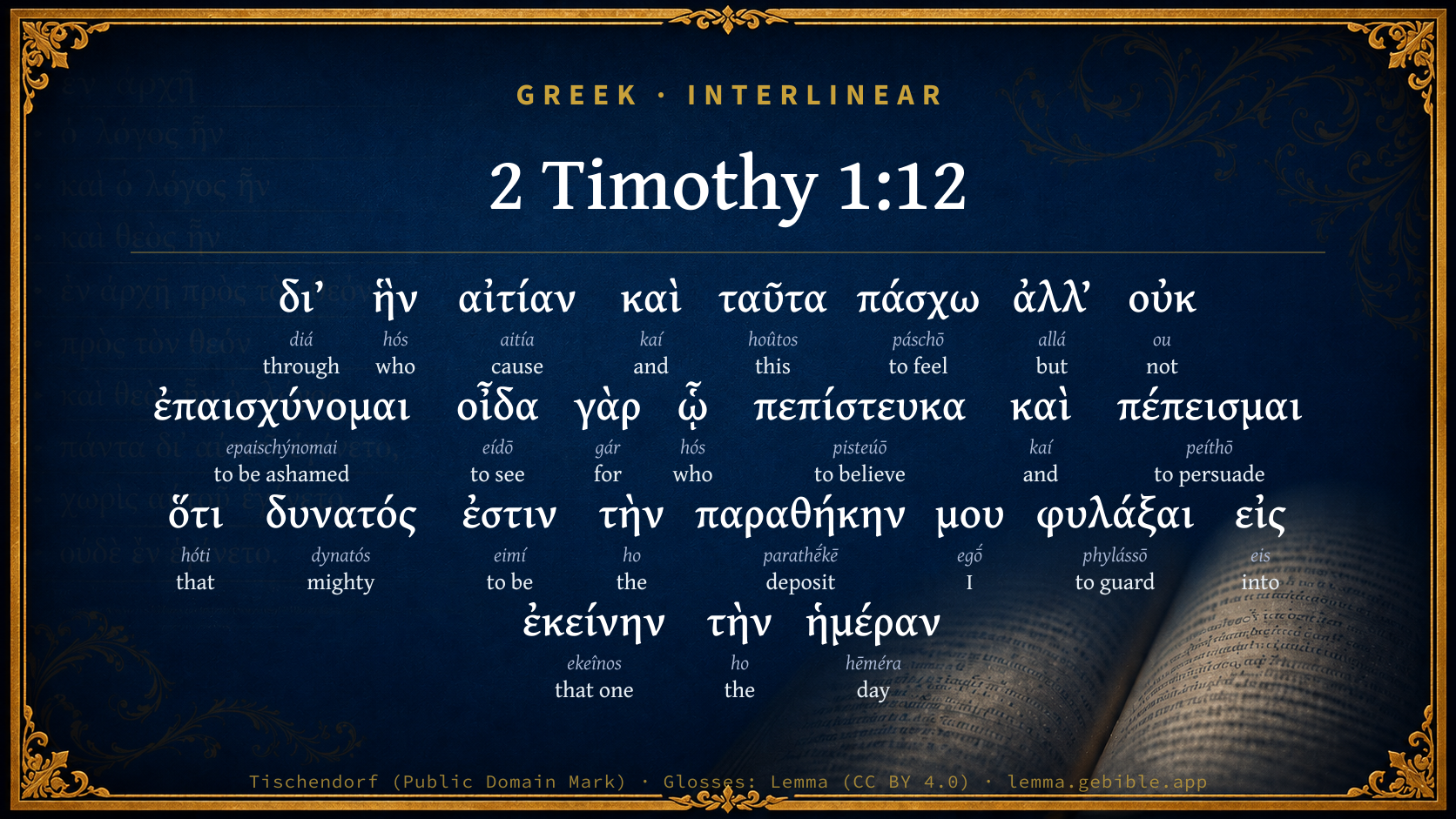
For this cause I suffer also these things. Yet I am not ashamed, for I know him whom I have believed, and I am persuaded that he is able to guard that which I have committed to him against that day.
Download a study sheet
One document with this verse’s original text, its word-by-word gloss line, the meaning frame, cross-references with their text, attributed commentary, and full source and license credits — printable, and it pastes into notes with its structure intact.
This verse Autodidact and up
A passage Seminary Student
Up to 50 verses in one chapter. A passage sheet keeps up to 6 commentary sources and 12 cross-references per verse, in the order this page ranks them, and says so on the sheet whenever that leaves anything out. Ask for a single verse and you get the Autodidact verse sheet above.
Everything on this page stays free to read, with no account — the sheet is a download of what is already on screen, not access to it.
Compare translations 3
The same verse in 3 English versions, stacked beneath the original-language interlinear above. Click any original word for its lexicon entry.
Each is an independent rendering of the whole verse — the interlinear is not word-aligned to these translations.
Highlighted words mark where these versions differ — a whole-verse word diff, not a word-by-word alignment.
-
World English Bible Public Domain
For this cause I suffer also these things. Yet I am not ashamed, for I know him whom I have believed, and I am persuaded that he is able to guard that which I have committed to him against that day.
-
King James Version Public Domain
For the which cause I also suffer these things: nevertheless I am not ashamed: for I know whom I have believed, and am persuaded that he is able to keep that which I have committed unto him against that day.
-
unfoldingWord Literal Text CC BY-SA 4.0
for which reason I also suffer these things. But I am not ashamed, for I know in whom I have believed, and I have been persuaded that he is able to guard my deposit until that day.
unfoldingWord Literal Text — © unfoldingWord, licensed CC BY-SA 4.0. Word-aligned USFM3 via Door43 (git.door43.org/unfoldingWord/en_ult).
Show all 19 translations
Every available English version of this verse, each an independent rendering of the whole verse.
-
World English Bible Public Domain
For this cause I suffer also these things. Yet I am not ashamed, for I know him whom I have believed, and I am persuaded that he is able to guard that which I have committed to him against that day.
-
Berean Standard Bible Public Domain
For this reason, even though I suffer as I do, I am not ashamed; for I know whom I have believed, and I am convinced that He is able to guard what I have entrusted to Him for that day.
-
Majority Standard Bible Public Domain
For this reason, even though I suffer as I do, I am not ashamed; for I know whom I have believed, and I am convinced that He is able to guard what I have entrusted to Him for that day.
-
King James Version Public Domain
For the which cause I also suffer these things: nevertheless I am not ashamed: for I know whom I have believed, and am persuaded that he is able to keep that which I have committed unto him against that day.
-
American Standard Version (1901) Public Domain
For which cause I suffer also these things: yet I am not ashamed; for I know him whom I have believed, and I am persuaded that he is able to guard that which I have committed unto him against that day.
-
Revised Version (1885) Public Domain
For the which cause I suffer also these things: yet I am not ashamed; for I know him whom I have believed, and I am persuaded that he is able to guard that which I have committed unto him against that day.
-
Geneva Bible (1599) Public Domain
For the which cause I also suffer these things, but I am not ashamed: for I knowe whom I haue beleeued, and I am persuaded that he is able to keepe that which I haue committed to him against that day.
-
Douay-Rheims (1899) Public Domain
For which cause I also suffer these things: but I am not ashamed. For I know whom I have believed, and I am certain that he is able to keep that which I have committed unto him, against that day.
-
Young's Literal Translation Public Domain
for which cause also these things I suffer, but I am not ashamed, for I have known in whom I have believed, and have been persuaded that he is able that which I have committed to him to guard -- to that day.
-
Literal Standard Version CC BY-SA 4.0
for which cause these things I also suffer, but I am not ashamed, for I have known in whom I have believed, and have been persuaded that He is able to guard that which I have committed to Him—to that day.
-
Unlocked Literal Bible CC BY-SA 4.0
For this cause I also suffer these things. But I am not ashamed, for I know him whom I have believed. I am persuaded that he is able to keep that which I have entrusted to him until that day.
-
unfoldingWord Literal Text CC BY-SA 4.0
for which reason I also suffer these things. But I am not ashamed, for I know in whom I have believed, and I have been persuaded that he is able to guard my deposit until that day.
-
Darby Bible Public Domain
For which cause also I suffer these things; but I am not ashamed; for I know whom I have believed, and am persuaded that he is able to keep for that day the deposit I have entrusted to him.
-
World Messianic Bible Public Domain
For this cause I also suffer these things. Yet I am not ashamed, for I know him whom I have believed, and I am persuaded that he is able to guard that which I have committed to him against that day.
-
Webster's Bible Public Domain
For which cause I also suffer these things: nevertheless I am not ashamed: for I know whom I have believed, and am persuaded that he is able to keep that which I have committed to him against that day.
-
Free Bible Version CC BY-SA 4.0
That's also the reason I'm suffering all this, but I'm not ashamed, because I know whom I've trusted. I'm confident that he can look after what I've entrusted to him until the Day he returns.
-
Bible in Basic English Public Domain
And for which I undergo these things: but I have no feeling of shame. For I have knowledge of him in whom I have faith, and I am certain that he is able to keep that which I have given into his care till that day.
-
Text-Critical English NT CC BY 4.0
That is why I am suffering these things. But I am not ashamed, for I know whom I have believed, and I am persuaded that he is able to guard what has been entrusted to me until that day.
-
Tyndale New Testament (1534) Public Domain
for the which cause I also suffre these thinges. Neverthelesse I am not a shamed For I knowe who I have beleved and am sure that he is able to kepe that which I have committed to his kepynge agaynst that daye.
Literal Standard Version (2020), Covenant Press — licensed CC BY-SA 4.0. Text via the HelloAO Bible API (eBible.org). Unlocked Literal Bible (unfoldingWord) — licensed CC BY-SA 4.0. Text via the HelloAO Bible API (eBible.org). unfoldingWord Literal Text — © unfoldingWord, licensed CC BY-SA 4.0. Word-aligned USFM3 via Door43 (git.door43.org/unfoldingWord/en_ult). Free Bible Version, Dr. Jonathan Gallagher — licensed CC BY-SA 4.0. Text via the HelloAO Bible API (eBible.org).
Word by word
More ways to search: Search by grammar → Find every occurrence → Compare this word →
Practice this passage: Drill this verse → Learn its vocabulary →
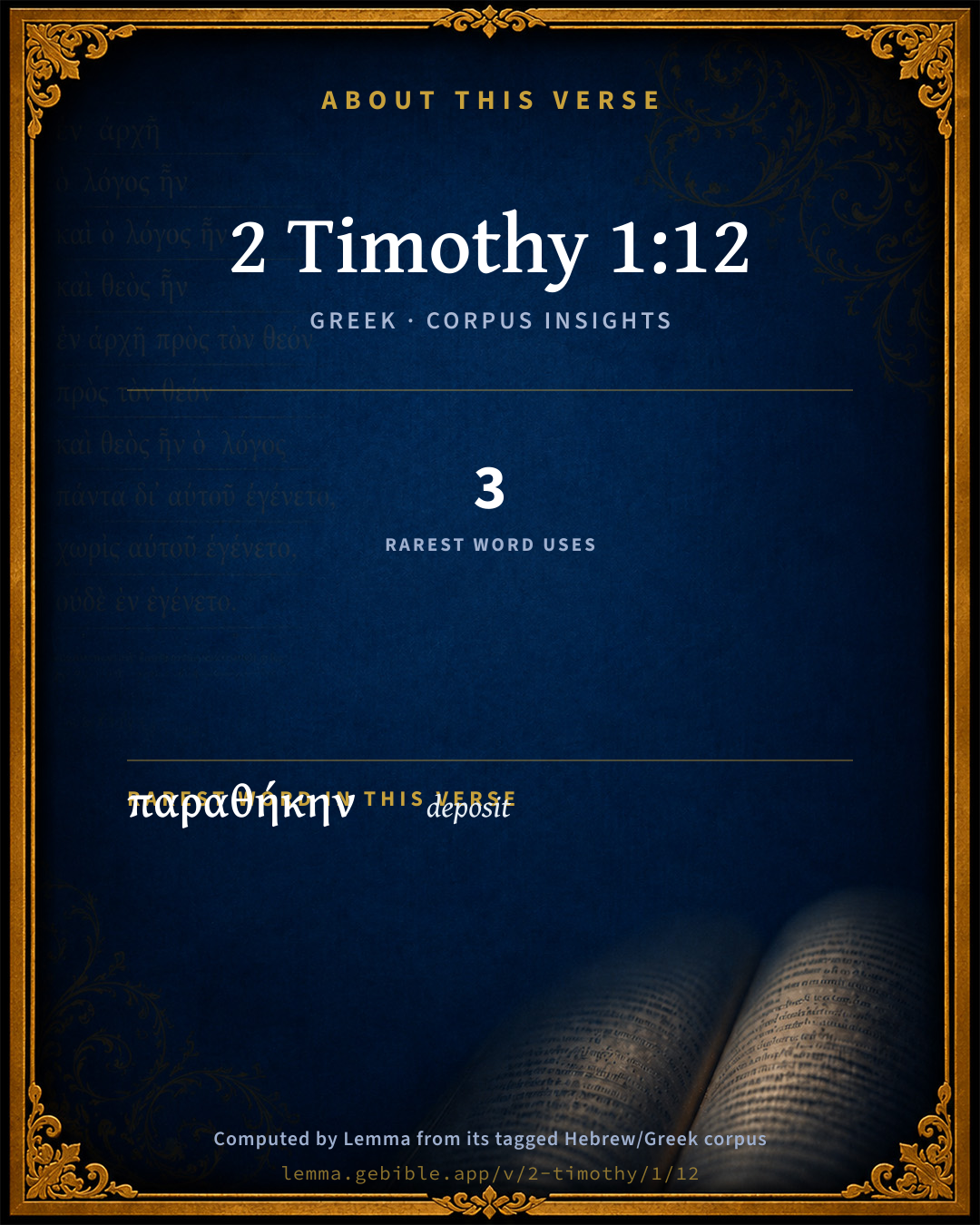
- Appears 3× in the Greek New Testament
- First appears at 1 Timothy 6:20
- Part of Speech
- Noun
- Case
- Accusative
- Number
- Singular
- Gender
- Feminine
Full Thayer's Definition
- δι’ diá G1223 “through” Preposition
- ἣν hós G3739 “who” Relative pronoun, Accusative, Singular, Feminine
- αἰτίαν aitía G156 “cause” Noun, Accusative, Singular, Feminine
- καὶ kaí G2532 “and” Conjunction
- ταῦτα hoûtos G3778 “this” Demonstrative pronoun, Accusative, Plural, Neuter
- πάσχω páschō G3958 “to feel” Verb, Present, Active, Indicative, 1st person, Singular
- ἀλλ’ allá G235 “but” Conjunction
- οὐκ ou G3756 “not” Particle, Negative
- ἐπαισχύνομαι epaischýnomai G1870 “to be ashamed” Verb, Present, Middle or Passive deponent, Indicative, 1st person, Singular
- οἶδα eídō G1492 “to see” Verb, Perfect, Active, Indicative, 1st person, Singular
- γὰρ gár G1063 “for” Conjunction
- ᾧ hós G3739 “who” Relative pronoun, Dative, Singular, Masculine
- πεπίστευκα pisteúō G4100 “to believe” Verb, Perfect, Active, Indicative, 1st person, Singular
- καὶ kaí G2532 “and” Conjunction
- πέπεισμαι peíthō G3982 “to persuade” Verb, Perfect, Passive, Indicative, 1st person, Singular
- ὅτι hóti G3754 “that” Conjunction
- δυνατός dynatós G1415 “mighty” Adjective, Nominative, Singular, Masculine
- ἐστιν eimí G1510 “to be” Verb, Present, Active, Indicative, 3rd person, Singular
- τὴν ho G3588 “the” Article, Accusative, Singular, Feminine
- παραθήκην parathḗkē G3866 “deposit” Noun, Accusative, Singular, Feminine
- μου egṓ G1473 “I” Personal pronoun, 1st person, Genitive, Singular
- φυλάξαι phylássō G5442 “to guard” Verb, Aorist, Active, Infinitive
- εἰς eis G1519 “into” Preposition
- ἐκείνην ekeînos G1565 “that one” Demonstrative pronoun, Accusative, Singular, Feminine
- τὴν ho G3588 “the” Article, Accusative, Singular, Feminine
- ἡμέραν hēméra G2250 “day” Noun, Accusative, Singular, Feminine
About this verse
These counts appear in no published source. They are computed here, from the morphology-tagged text and Lemma’s own curated glosses. What Lemma adds →
- 26
- words
- 23
- distinct lemmas
- Pauline Epistles
- section
Cross-references
54Topical passages linked to 2 Timothy 1:12 in the Treasury of Scripture Knowledge — connected by theme and wording, ordered by reader-vote popularity; previews shown in the World English Bible.
- Jude 1:24 Now to him who is able to keep them from stumbling, and to present you faultless before the presence of his glory in great joy,
- 2 Timothy 1:8 Therefore don't be ashamed of the testimony of our Lord, nor of me his prisoner; but endure hardship for the Gospel according to the power of God,
- 1 Peter 4:19 Therefore let them also who suffer according to the will of God in doing good entrust their souls to him, as to a faithful Creator.
- 2 Timothy 4:8 From now on, there is stored up for me the crown of righteousness, which the Lord, the righteous judge, will give to me on that day; and not to me only, but also to all those who have loved his appearing.
- Hebrews 7:25 Therefore he is also able to save to the uttermost those who draw near to God through him, seeing he ever lives to make intercession for them.
- 1 Timothy 6:20 Timothy, guard that which is committed to you, turning away from the empty chatter and oppositions of the knowledge which is falsely so called;
- Nahum 1:7 Yahweh is good, a stronghold in the day of trouble; and he knows those who take refuge in him.
- Matthew 24:36 But no one knows of that day and hour, not even the angels of heaven, but my Father only.
- Romans 1:16 For I am not ashamed of the Gospel of Christ, for it is the power of God for salvation for everyone who believes; for the Jew first, and also for the Greek.
- Psalms 25:2 My God, I have trusted in you, Don't let me be shamed. Don't let my enemies triumph over me.
- Psalms 9:10 Those who know your name will put their trust in you, For you, Yahweh, have not forsaken those who seek you.
- 2 Timothy 4:16–17 At my first defense, no one came to help me, but all left me. May it not be held against them.
- 1 Peter 1:5 who by the power of God are guarded through faith for a salvation ready to be revealed in the last time.
- Isaiah 12:2 Behold, God is my salvation. I will trust, and will not be afraid; for Yah, Yahweh, is my strength and song; and he has become my salvation."
- Philippians 3:21 who will change the body of our humiliation to be conformed to the body of his glory, according to the working by which he is able even to subject all things to himself.
- 2 Timothy 1:18 (the Lord grant to him to find the Lord's mercy in that day); and in how many things he served at Ephesus, you know very well.
- Psalms 31:5 Into your hand I commend my spirit. You redeem me, Yahweh, God of truth.
- Isaiah 54:4 Don't be afraid; for you shall not be ashamed: neither be confounded; for you shall not be disappointed: for you shall forget the shame of your youth; and the reproach of your widowhood shall you remember no more.
- John 10:28–30 I give eternal life to them. They will never perish, and no one will snatch them out of my hand.
- John 17:15 I pray not that you would take them from the world, but that you would keep them from the evil one.
- 1 Corinthians 3:13 each man's work will be revealed. For the Day will declare it, because it is revealed in fire; and the fire itself will test what sort of work each man's work is.
- Philippians 3:8 Yes most assuredly, and I count all things to be loss for the excellency of the knowledge of Christ Jesus, my Lord, for whom I suffered the loss of all things, and count them nothing but refuse, that I may gain Christ
- Philippians 3:10 that I may know him, and the power of his resurrection, and the fellowship of his sufferings, becoming conformed to his death;
- 2 Timothy 2:9 in which I suffer hardship to the point of chains as a criminal. But God's word isn't chained.
- Matthew 12:21 In his name, the Gentiles will hope."
- Romans 9:33 even as it is written, "Behold, I lay in Zion a stumbling stone and a rock of offense; And no one who believes in him will be disappointed."
- Psalms 56:9 Then my enemies shall turn back in the day that I call. I know this, that God is for me.
- Isaiah 50:7 For the Lord Yahweh will help me; therefore I have not been confounded: therefore have I set my face like a flint, and I know that I shall not be disappointed.
- Matthew 7:22 Many will tell me in that day, 'Lord, Lord, didn't we prophesy in your name, in your name cast out demons, and in your name do many mighty works?'
- Luke 23:46 Jesus, crying with a loud voice, said, "Father, into your hands I commit my spirit!" Having said this, he breathed his last.
- John 6:39–40 This is the will of my Father who sent me, that of all he has given to me I should lose nothing, but should raise him up at the last day.
- John 6:44 No one can come to me unless the Father who sent me draws him, and I will raise him up in the last day.
- John 17:11–12 I am no more in the world, but these are in the world, and I am coming to you. Holy Father, keep them through your name which you have given me, that they may be one, even as we are.
- Acts 7:59 They stoned Stephen as he called out, saying, "Lord Jesus, receive my Spirit!"
- Acts 9:16 For I will show him how many things he must suffer for my name's sake."
- Acts 13:46 Paul and Barnabas spoke out boldly, and said, "It was necessary that God's word should be spoken to you first. Since indeed you thrust it from you, and judge yourselves unworthy of eternal life, behold, we turn to the Gentiles.
- Acts 13:50 But the Jews stirred up the devout and prominent women and the chief men of the city, and stirred up a persecution against Paul and Barnabas, and threw them out of their borders.
- Acts 14:5–6 When some of both the Gentiles and the Jews, with their rulers, made a violent attempt to mistreat and stone them,
- Acts 21:13 Then Paul answered, "What are you doing, weeping and breaking my heart? For I am ready not only to be bound, but also to die at Jerusalem for the name of the Lord Jesus."
- Acts 21:27–31 When the seven days were almost completed, the Jews from Asia, when they saw him in the temple, stirred up all the multitude and laid hands on him,
- Acts 22:21–24 "He said to me, 'Depart, for I will send you out far from here to the Gentiles.'"
- Romans 5:4–5 and perseverance, proven character; and proven character, hope:
- Romans 15:12–13 Again, Isaiah says, "There will be the root of Jesse, He who arises to rule over the Gentiles; On him will the Gentiles hope."
- Ephesians 1:12–13 to the end that we should be to the praise of his glory, we who had before hoped in Christ:
- Philippians 1:20 according to my earnest expectation and hope, that I will in no way be disappointed, but with all boldness, as always, now also Christ will be magnified in my body, whether by life, or by death.
- 1 Thessalonians 2:16 forbidding us to speak to the Gentiles that they may be saved; to fill up their sins always. But wrath has come on them to the uttermost.
- 2 Timothy 3:10–12 But you did follow my teaching, conduct, purpose, faith, patience, love, steadfastness,
- Hebrews 2:18 For in that he himself has suffered being tempted, he is able to help those who are tempted.
- Hebrews 12:2 looking to Jesus, the author and perfecter of faith, who for the joy that was set before him endured the cross, despising shame, and has sat down at the right hand of the throne of God.
- 1 Peter 1:20–21 who was foreknown indeed before the foundation of the world, but was revealed at the end of times for your sake,
- 1 Peter 4:16 But if one of you suffers for being a Christian, let him not be ashamed; but let him glorify God in this matter.
- Luke 10:12 I tell you, it will be more tolerable in that day for Sodom than for that city.
- Ephesians 3:1–8 For this cause I, Paul, am the prisoner of Christ Jesus on behalf of you Gentiles,
- 1 Thessalonians 5:4 But you, brothers, aren't in darkness, that the day should overtake you like a thief.
Cross-references courtesy of OpenBible.info (CC BY 4.0).
Lesson kit
Teaching starters — assembled from the data on this page, not authored interpretation. Every prompt links to the verse data it draws on. Edit before teaching.
2 Timothy, in the Pauline Epistles, opens this verse with 26 words (23 distinct Greek lemmas). Its most distinctive word is parathḗkē (“deposit”). A historical commentator’s framing appears above. Read the whole chapter for the surrounding context.
Discussion questions
- The word parathḗkē carries the sense “deposit.” How does it shape the verse?
- 1 Timothy 6:20 shares the word «deposit» with this verse. How do the two illuminate each other?
- “who” occurs 2× in this one verse. What is the effect of the repetition?
- These translations render this verse differently. What is at stake in choosing one wording over another?
- Reading how The Biblical Illustrator and MacLaren's Expositions of Holy Scripture read this verse, where do the two commentators agree and where do they part?
Things to notice
- These translations choose different wording for 11 words in this verse.
- “who” occurs 2× in this single verse.
- 23 distinct Greek lemmas span 26 words in this verse.
Commentary
Notes on 2 Timothy 1:12 from classic Christian and Jewish commentators (each source and its license shown beneath its notes). The classic Christian expositions comment on the surrounding passage and are grouped to its opening verse, so a note may address several verses; the Jewish commentaries on the Tanakh (Rashi and others) are per-verse, so they appear only where the commentator wrote on this verse.
Lemma curates 59 commentaries, every one of them public domain or Creative Commons licensed, each selected and text-cleaned for this edition rather than reprinted as found. About our sources →
The Biblical Illustrator
Joseph S. Exell
The Biblical Illustrator, edited by Joseph S. Exell (c. 1880s–1900s) — public domain. Text from a community e-Sword module.
MacLaren's Expositions of Holy Scripture
Alexander MacLaren
Alexander MacLaren, Expositions of Holy Scripture (1904–1910) — public domain. Text from a community e-Sword module.
The Expositor's Bible
William Robertson Nicoll, ed., The Expositor's Bible (London: Hodder & Stoughton, 1887–1910) — public domain. 65 of 66 books (1 Corinthians is not separately keyed, as that volume carries no machine-parseable verse references); section-level commentary keyed to the opening verse. Introductory and overview sections not keyed to a specific passage are excluded.
Tyndale Open Study Notes
Tyndale Open Resources
Tyndale Open Study Notes — © Tyndale Open Resources, licensed CC BY-SA 4.0. Text via the HelloAO Bible API.
Bengel's Gnomon
Johann Albrecht Bengel
Bengel's Gnomon of the New Testament — English translation (T&T Clark, Edinburgh, 1860) — public domain. Text from a community e-Sword module.
Meyer's Critical & Exegetical Commentary
Heinrich August Wilhelm Meyer
Meyer — Critical and Exegetical Commentary on the New Testament — English translation by Peter Christie, edited by Frederick Crombie (T&T Clark, 1880) — public domain. Text from a community e-Sword module.
Expositor's Greek Testament
ed. W. Robertson Nicoll
The Expositor's Greek Testament, edited by W. Robertson Nicoll (1897–1910) — public domain. Text from a community e-Sword module.
Vincent's Word Studies in the New Testament
Marvin R. Vincent
Marvin R. Vincent, Word Studies in the New Testament (1887–1900) — public domain. Text from a community e-Sword/MySword module.
Geneva Bible (1599)
Geneva Bible translators
Geneva Bible (1599) marginal notes — public domain. Text via Bolls.life.
Jamieson, Fausset & Brown
Robert Jamieson, A. R. Fausset & David Brown
Jamieson, Fausset & Brown — Commentary Critical and Explanatory on the Whole Bible (1871) — public domain (CC PDM 1.0). Text via the HelloAO Bible API.
Adam Clarke's Commentary
Adam Clarke's Commentary on the Bible (1810–1826) — public domain. Text from a community e-Sword/MySword module.
John Calvin's Commentaries
John Calvin's Commentaries (1540-1563) — public domain. Text from the Calvin Translation Society English edition (1840s-50s) via the Christian Classics Ethereal Library (ccel.org). Calvin's coverage is partial (roughly two-thirds of the Bible); uncommented books and verses are honest gaps, never fabricated. The 19th-century editor's footnotes and remarks are omitted so the notes are faithfully Calvin's own voice.
Ellicott's Commentary for English Readers
A Bible Commentary for English Readers, edited by Charles John Ellicott (1878–1897) — public domain. Text from a community e-Sword module.
The Cambridge Bible for Schools and Colleges
gen. ed. J. J. S. Perowne
The Cambridge Bible for Schools and Colleges (gen. ed. J. J. S. Perowne; Cambridge University Press, 1878–1918) — public domain. Text from a community e-Sword module.
John Gill's Exposition
John Gill's Exposition of the Whole Bible (1746–1763) — public domain (CC PDM 1.0). Text via the HelloAO Bible API.
Trapp's Complete Commentary
John Trapp
John Trapp, A Commentary or Exposition upon All the Books of the Old and New Testament (1647–1656) — public domain. Text from a community e-Sword module.
Albert Barnes' Notes on the Bible
Albert Barnes' Notes on the Bible (1834–1885) — public domain. Text from a community e-Sword/MySword module.
Haydock's Catholic Bible Commentary
George Leo Haydock (1774–1849), Haydock's Catholic Family Bible and Commentary, 1859 edition — public domain. Excludes Psalms (Douay-Rheims chapter numbering differs from Protestant) and Deuterocanonical books (Catholic canon only).
Matthew Poole's English Annotations
Matthew Poole's English Annotations on the Holy Bible (1683–1685) — public domain. Text from a community e-Sword/MySword module.
Whedon's Commentary on the Bible
Daniel D. Whedon
Daniel D. Whedon (gen. ed.), Commentary on the Old and New Testaments (1874–1909) — public domain. Text from a community e-Sword module.
The Pulpit Commentary
The Pulpit Commentary (1880–1919), ed. H.D.M. Spence-Jones & Joseph S. Exell — public domain. Text from a community e-Sword module.
John Wesley's Explanatory Notes
John Wesley, Explanatory Notes Upon the Whole Bible (1754–1765) — public domain. Text via the GEBible commentary corpus.
Fairbairn on Ezekiel, Jonah & the Pastoral Epistles
Patrick Fairbairn
Patrick Fairbairn — An Exposition of Ezekiel (1851), Jonah (1849), and The Pastoral Epistles (1874) — public domain. Text from a community e-Sword module.
Scofield Reference Notes
C. I. Scofield
The Scofield Reference Bible (1917 edition), notes by C. I. Scofield — public domain. Text from a community e-Sword module.
Burkitt's Expository Notes on the New Testament
William Burkitt
William Burkitt's Expository Notes on the New Testament (1700–1703) — public domain. Text from a community e-Sword module.
The People's New Testament
B. W. Johnson
B. W. Johnson's The People's New Testament with Notes (1889–1891) — public domain. Electronic text from the Christian Classics Ethereal Library (CCEL) ThML edition.
unfoldingWord translationNotes
Door43 World Missions Community
unfoldingWord translationNotes — © Distant Shores Media and the Door43 World Missions Community, licensed CC BY-SA 4.0. Source: git.door43.org/Door43/en_tn.
Cambridge Greek Testament for Schools and Colleges
Cambridge Greek Testament for Schools and Colleges (Cambridge University Press, 1896; 21 vols, various authors incl. Carr, Maclear, Plummer, Farrar, Lumby, Moule, M. R. James, Simcox) — public domain. Text from a community e-Sword module.
International Critical Commentary
International Critical Commentary — older volumes (1896–1929), various authors — public domain. Text from a community e-Sword module.