2 Peter 2:5

Greek (Tischendorf 8th ed.) 2 Peter 2:5 appears in the Greek New Testament. The text above is from the Tischendorf 8th edition. Each word links to its Strong’s number and a concise gloss. Click any word for its full Thayer’s Greek Lexicon entry.
Download image
Cite this verse

2 Peter 2:5 (World English Bible). Public Domain. Lemma interlinear Bible study tool, https://lemma.gebible.app/v/2-peter/2/5.

Show BibTeX & RIS
BibTeX
RIS
English Translation
and didn't spare the ancient world, but preserved Noah with seven others, a preacher of righteousness, when he brought a flood on the world of the ungodly;
World English Bible · Public Domain
Download a study sheet

One document with this verse’s original text, its word-by-word gloss line, the meaning frame, cross-references with their text, attributed commentary, and full source and license credits — printable, and it pastes into notes with its structure intact.

This verse Autodidact and up

Study sheet (.html) Plain text (.txt)

A passage Seminary Student

Up to 50 verses in one chapter. A passage sheet keeps up to 6 commentary sources and 12 cross-references per verse, in the order this page ranks them, and says so on the sheet whenever that leaves anything out. Ask for a single verse and you get the Autodidact verse sheet above.

Everything on this page stays free to read, with no account — the sheet is a download of what is already on screen, not access to it.

Want to remove ads? Support Godless Engineer
Compare translations 3

The same verse in 3 English versions, stacked beneath the original-language interlinear above. Click any original word for its lexicon entry.

Each is an independent rendering of the whole verse — the interlinear is not word-aligned to these translations.

Highlighted words mark where these versions differ — a whole-verse word diff, not a word-by-word alignment.

  • World English Bible Public Domain
    and didn't spare the ancient world, but preserved Noah with seven others, a preacher of righteousness, when he brought a flood on the world of the ungodly;
  • King James Version Public Domain
    And spared not the old world, but saved Noah the eighth person, a preacher of righteousness, bringing in the flood upon the world of the ungodly;
  • unfoldingWord Literal Text CC BY-SA 4.0
    and he did not spare the ancient world, but protected the eighth, Noah, a preacher of righteousness, having brought a flood upon the world of the ungodly ones;

unfoldingWord Literal Text — © unfoldingWord, licensed CC BY-SA 4.0. Word-aligned USFM3 via Door43 (git.door43.org/unfoldingWord/en_ult).

Versions to compare (up to 4)

3 of 4 selected

Show all 19 translations

Every available English version of this verse, each an independent rendering of the whole verse.

  • World English Bible Public Domain
    and didn't spare the ancient world, but preserved Noah with seven others, a preacher of righteousness, when he brought a flood on the world of the ungodly;
  • Berean Standard Bible Public Domain
    if He did not spare the ancient world when He brought the flood on its ungodly people, but preserved Noah, a preacher of righteousness, among the eight;
  • Majority Standard Bible Public Domain
    if He did not spare the ancient world when He brought the flood on its ungodly people, but preserved Noah, a preacher of righteousness, among the eight;
  • King James Version Public Domain
    And spared not the old world, but saved Noah the eighth person, a preacher of righteousness, bringing in the flood upon the world of the ungodly;
  • American Standard Version (1901) Public Domain
    and spared not the ancient world, but preserved Noah with seven others, a preacher of righteousness, when he brought a flood upon the world of the ungodly;
  • Revised Version (1885) Public Domain
    and spared not the ancient world, but preserved Noah with seven others, a preacher of righteousness, when he brought a flood upon the world of the ungodly;
  • Geneva Bible (1599) Public Domain
    Neither hath spared the olde worlde, but saued Noe the eight person a preacher of righteousnesse, and brought in the flood vpon the world of the vngodly,
  • Douay-Rheims (1899) Public Domain
    And spared not the original world, but preserved Noe, the eighth person, the preacher of justice, bringing in the flood upon the world of the ungodly.
  • Young's Literal Translation Public Domain
    and the old world did not spare, but the eighth person, Noah, of righteousness a preacher, did keep, a flood on the world of the impious having brought,
  • Literal Standard Version CC BY-SA 4.0
    and did not spare the old world, but kept the eighth person, Noah, a preacher of righteousness, having brought a flood on the world of the impious,
  • Unlocked Literal Bible CC BY-SA 4.0
    Also, he did not spare the ancient world. Instead, he preserved Noah, who was a herald of righteousness, along with seven others, when he brought a flood on the world of the ungodly.
  • unfoldingWord Literal Text CC BY-SA 4.0
    and he did not spare the ancient world, but protected the eighth, Noah, a preacher of righteousness, having brought a flood upon the world of the ungodly ones;
  • Darby Bible Public Domain
    and spared not [the] old world, but preserved Noe, [the] eighth, a preacher of righteousness, having brought in [the] flood upon [the] world of [the] ungodly;
  • World Messianic Bible Public Domain
    and didn’t spare the ancient world, but preserved Noah with seven others, a proclaimer of righteousness, when he brought a flood on the world of the ungodly,
  • Webster's Bible Public Domain
    And spared not the old world, but saved Noah the eighth person, a preacher of righteousness, bringing the flood upon the world of the ungodly;
  • Free Bible Version CC BY-SA 4.0
    God didn't spare the ancient world either, but he protected Noah who told people about the God who did right. He was one of the eight who were saved when God sent a flood upon a world of evil people.
  • Bible in Basic English Public Domain
    And did not have mercy on the world which then was, but only kept safe Noah, a preacher of righteousness, with seven others, when he let loose the waters over the world of the evil-doers;
  • Text-Critical English NT CC BY 4.0
    and if he did not spare the ancient world, but preserved Noah, a preacher of righteousness, along with seven others, when he brought a flood upon the world of the ungodly;
  • Tyndale New Testament (1534) Public Domain
    Nether spared the olde worlde but saved Noe the ryghte preacher of rightewesnes and brought in the flud vpon the worlde of the vngodly

Literal Standard Version (2020), Covenant Press — licensed CC BY-SA 4.0. Text via the HelloAO Bible API (eBible.org). Unlocked Literal Bible (unfoldingWord) — licensed CC BY-SA 4.0. Text via the HelloAO Bible API (eBible.org). unfoldingWord Literal Text — © unfoldingWord, licensed CC BY-SA 4.0. Word-aligned USFM3 via Door43 (git.door43.org/unfoldingWord/en_ult). Free Bible Version, Dr. Jonathan Gallagher — licensed CC BY-SA 4.0. Text via the HelloAO Bible API (eBible.org).

Word by word

More ways to search: Search by grammar → Find every occurrence → Compare this word →

Practice this passage: Drill this verse → Learn its vocabulary →

κήρυκα
kēryx
G2783
“herald”
Noun, Accusative, Singular, Masculine
Part of Speech
Noun
Case
Accusative
Number
Singular
Gender
Masculine
Full Thayer's Definition

Origin: from G2784

TDNT: 14:23,4

1. a herald or messenger vested with public authority, who conveyed the official messages of kings, magistrates, princes, military commanders, or who gave a public summons or demand, and performed various other duties. In the NT God's ambassador, and the herald or proclaimer of the divine word.
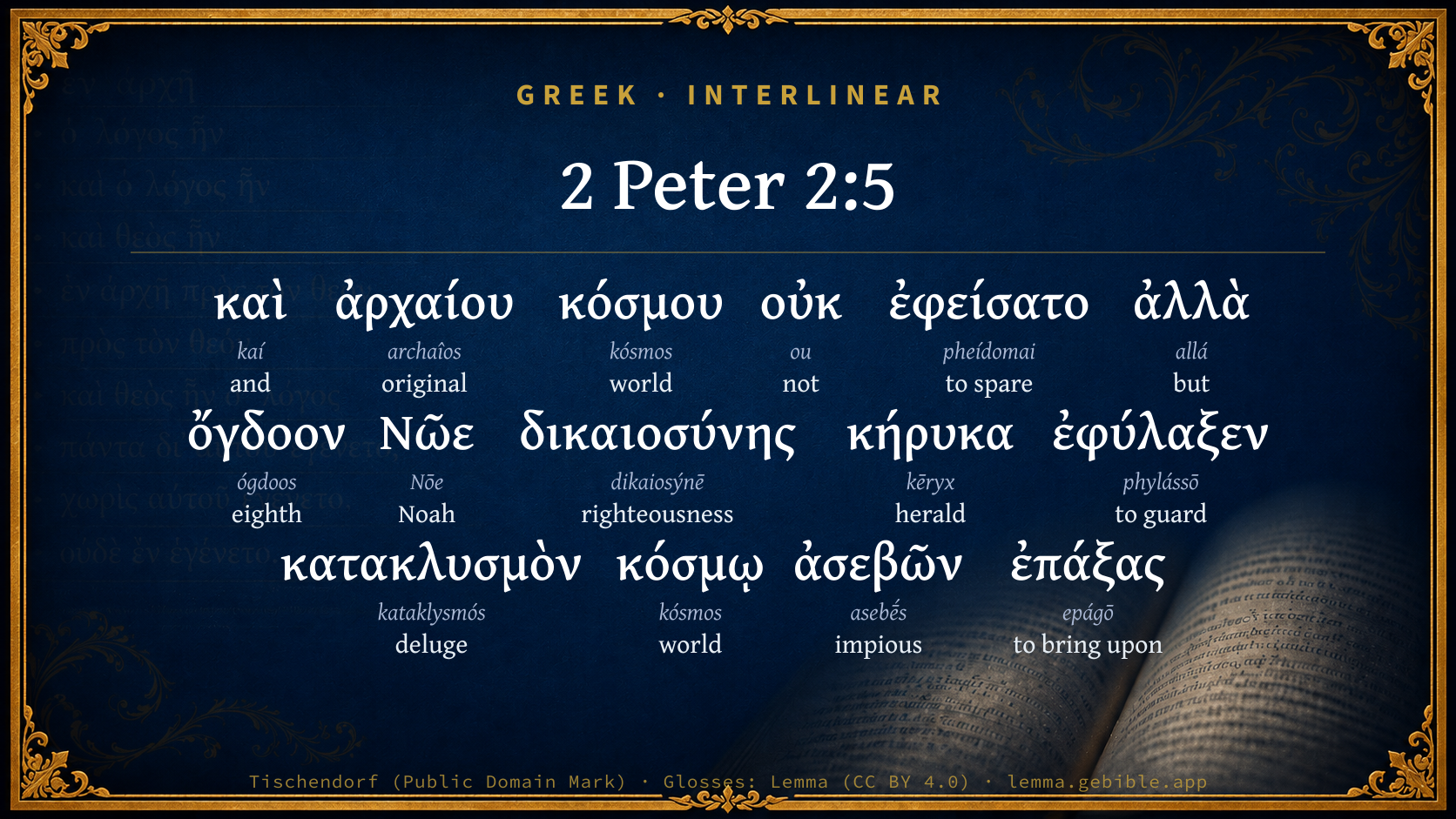
  1. καὶ kaí G2532 “and” Conjunction
  2. ἀρχαίου archaîos G744 “original” Adjective, Genitive, Singular, Masculine
  3. κόσμου kósmos G2889 “world” Noun, Genitive, Singular, Masculine
  4. οὐκ ou G3756 “not” Particle, Negative
  5. ἐφείσατο pheídomai G5339 “to spare” Verb, Aorist, Middle deponent, Indicative, 3rd person, Singular
  6. ἀλλὰ allá G235 “but” Conjunction
  7. ὄγδοον ógdoos G3590 “eighth” Adjective, Accusative, Singular, Masculine
  8. Νῶε Nōe G3575 “Noah” Noun, Proper, indeclinable
  9. δικαιοσύνης dikaiosýnē G1343 “righteousness” Noun, Genitive, Singular, Feminine
  10. ἐφύλαξεν phylássō G5442 “to guard” Verb, Aorist, Active, Indicative, 3rd person, Singular
  11. κατακλυσμὸν kataklysmós G2627 “deluge” Noun, Accusative, Singular, Masculine
  12. κόσμῳ kósmos G2889 “world” Noun, Dative, Singular, Masculine
  13. ἀσεβῶν asebḗs G765 “impious” Adjective, Genitive, Plural, Masculine
  14. ἐπάξας epágō G1863 “to bring upon” Verb, Aorist, Active, Participle, Nominative, Singular, Masculine

About this verse

These counts appear in no published source. They are computed here, from the morphology-tagged text and Lemma’s own curated glosses. What Lemma adds →

15
words
14
distinct lemmas
General Epistles
section

Notable vocabulary

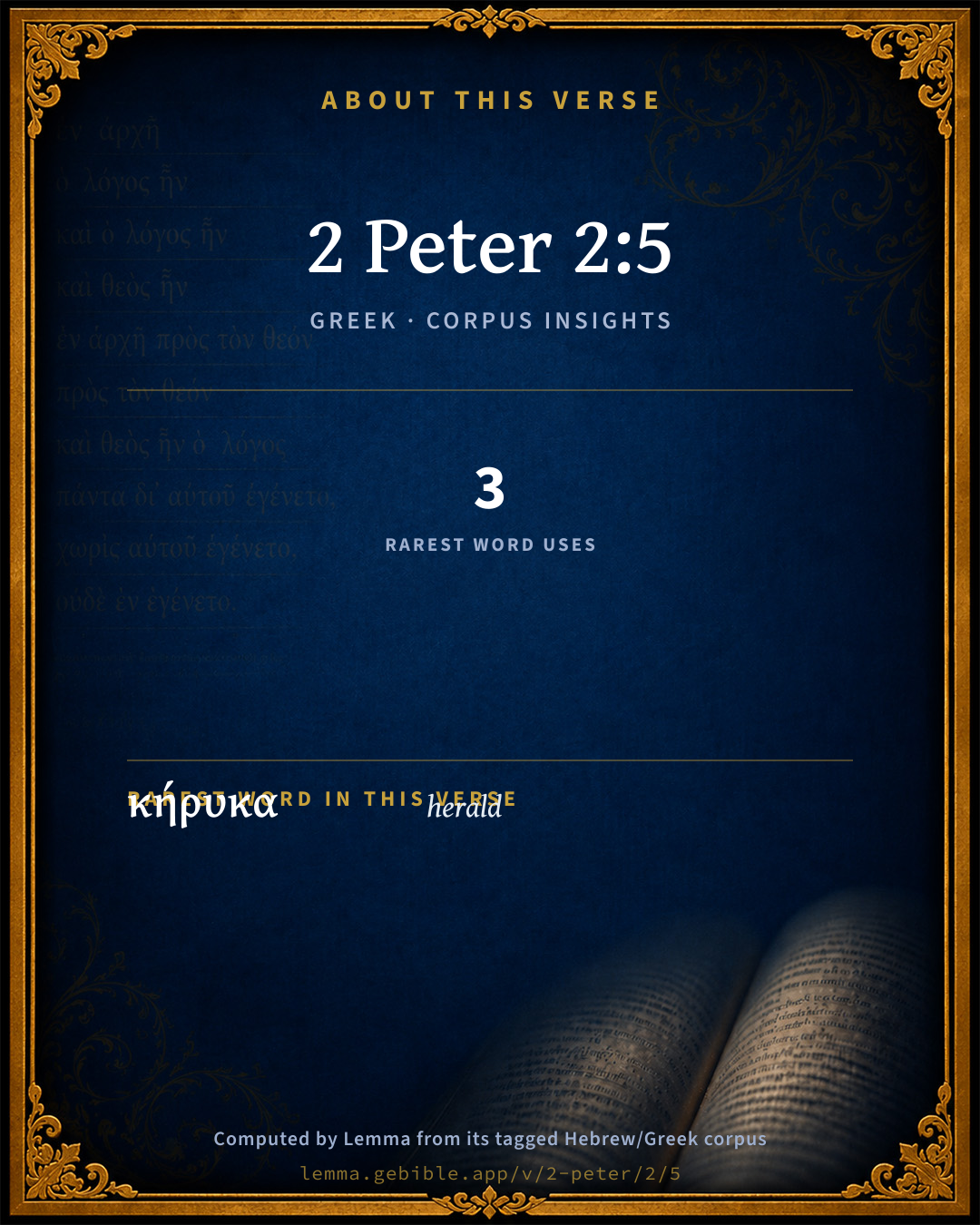
The rarest word here is κήρυκα herald G2783 — appearing just 3 times in the whole Greek New Testament.

Shared distinctive vocabulary

κήρυκα herald G2783 occurs in 3 verses of the Greek New Testament. Also found in:

Repetition

A word recurs within this verse:

  • κόσμου world G2889 ×2

Cross-references

9

Topical passages linked to 2 Peter 2:5 in the Treasury of Scripture Knowledge — connected by theme and wording, ordered by reader-vote popularity; previews shown in the World English Bible.

  • Hebrews 11:7 By faith, Noah, being warned about things not yet seen, moved with godly fear, prepared an ark for the saving of his house, through which he condemned the world, and became heir of the righteousness which is according to faith.
  • 2 Peter 3:6 by which means the world that then was, being overflowed with water, perished.
  • Luke 17:26–27 As it happened in the days of Noah, even so will it be also in the days of the Son of Man.
  • Jude 1:14–15 About these also Enoch, the seventh from Adam, prophesied, saying, "Behold, the Lord came with ten thousands of his holy ones,
  • Genesis 7:1–24 Yahweh said to Noah, "Come with all of your household into the ark, for I have seen your righteousness before me in this generation.
  • Matthew 24:37–39 "As the days of Noah were, so will be the coming of the Son of Man.
  • 1 Peter 3:19–20 in which he also went and preached to the spirits in prison,
  • Genesis 6:1–8 It happened, when men began to multiply on the surface of the ground, and daughters were born to them,
  • Job 22:15–16 Will you keep the old way Which wicked men have trodden,

Cross-references courtesy of OpenBible.info (CC BY 4.0).

Commentary

Notes on 2 Peter 2:5 from classic Christian and Jewish commentators (each source and its license shown beneath its notes). The classic Christian expositions comment on the surrounding passage and are grouped to its opening verse, so a note may address several verses; the Jewish commentaries on the Tanakh (Rashi and others) are per-verse, so they appear only where the commentator wrote on this verse.

Lemma curates 59 commentaries, every one of them public domain or Creative Commons licensed, each selected and text-cleaned for this edition rather than reprinted as found. About our sources →

Joseph Benson's Commentary

2Pe 2:5. And spared not the old — The antediluvian; world, but saved Noah — Interposed amidst the general ruin for the preservation of one good man and his family; the eighth person, a preacher, &c. — Bishop Pearson translates this clause, the eighth preacher of righteousness; supposing that Enoch, (Gen 5:24,) from whom Noah was descended, was the first preacher of righteousness, and that all the intermediate persons were likewise preachers thereof, and that Christ preached by them all. But of this there is no evidence; and it seems certain that Enoch could not be the first preacher of righteousness: Adam was, in a wonderful manner, fitted to perform that office in the first world, as Noah was in the second; and what excellent instructions both might give, is easy to be conceived! Bishop Pearson adds, that if the above-mentioned sense of the passage be not admitted, it may be understood as denoting, not the order in which Noah was ranked, but merely the number of persons that were with him, namely, Noah with seven others, or Noah one of eight. By terming Noah a preacher, κηρυκα, a crier, or herald, of righteousness, Peter intimates that all the time Noah was preparing the ark, he proclaimed to the antediluvians the destruction of the world by a flood, that from the dread of that impending judgment of God they might be brought to repentance. His preaching, however, it appears, was attended with little or no success. Bringing in the flood — In a gradual, but irresistible manner; upon the world of the ungodly — Whose numbers stood them in no stead.

Joseph Benson's Commentary on the Old and New Testaments (1811–1818) — public domain. Text from a community e-Sword module.

Tyndale Open Study Notes

Tyndale Open Resources

2:5 The second example of judgment is that God did not spare the ancient world at the time of Noah. In the flood, God destroyed all human life apart from Noah and his family (see Gen 6–8).

Tyndale Open Study Notes — © Tyndale Open Resources, licensed CC BY-SA 4.0. Text via the HelloAO Bible API.

Bengel's Gnomon

Johann Albrecht Bengel

2Pe 2:5. Ἀρχαίου, ancient) antediluvian.—ὄγδοον Νῶε, Noah the eighth person) Noah and his family were eight in number. Raphelius shows that this use of numerals prevailed among the Greeks. Compare 1Pe 3:20. To the eight souls is opposed the universe, the densely peopled world of the ungodly.—δικαιοσύνης κήρυκα, a preacher of righteousness) Not only was he himself righteous, but he had also preached righteousness to the world.—κατακλυσμὸν, the flood) Although therefore the godly are saved, the wicked cannot hope that they shall be saved with them.

Bengel's Gnomon of the New Testament — English translation (T&T Clark, Edinburgh, 1860) — public domain. Text from a community e-Sword module.

Meyer's Critical & Exegetical Commentary

Heinrich August Wilhelm Meyer

2Pe_2:5. Second example: the flood; this is peculiar to the author of this epistle; cf. the corresponding section in Jude. καὶ ἀρχαίου κόσμου οὐκ ἐφείσατο] The clausal formation is the same as that in 2Pe_2:4. Subaudienda est particula: εἰ (Gerhard). The words which follow on this tell in what the οὐκ ἐφείσατο consisted: κατακλυσμὸν κ.τ.λ.; there is no mention here of a destruction (Schott) of the world.

ἀρχ. κόσμος, i.e. mundus antediluvianus.

ἀλλʼ … ἐφύλαξε] The thought of the deliverance of the righteous is connected with that of the destruction of the ungodly; cf. 2Pe_2:7.

ὄγδοον belongs not to κήρυκα (Heinsius, Lightfoot, and Schwegler in his nachapost. Zeitalter, I. p. 515; cf., as opposed to him, Hilgenfeld, Clement. p. 185), but directly to Νῶε; Luther correctly: Noah with seven others; cf. Winer, p. 234 [E. T. 312]; Buttmann, p. 26. There is nothing to show that the number eight has a mystical meaning here (Dietlein).[67] The mention of it naturally arose from the recollection of the event; at the same time, however, it marks the small number of the saved contrasted with that of those who perished (Bengel, Schott, etc.). Besides, Noah and those with him, as also Lot afterwards, are taken by the author as types of the ΕὐΣΕΒΕῖς (2Pe_2:9), on whom the judgment of God will not come.

ΔΙΚΑΙΟΣΎΝΗς ΚΉΡΥΚΑ is added as the reason of Gods preservation (ἘΦΎΛΑΞΕ) (thus, too, Wiesinger). By ΔΙΚΑΙΟΣΎΝΗ is to be understood here, not the condition of being justified (Wiesinger), but a believing and godly bearing towards God; otherwise in Heb_11:7.

ΚΑΤΑΚΛΥΣΜΌΝ] Mat_24:38-39; Gen_5:17, LXX. Heb. מַבּוּל: the verb ΚΑΤΑΚΛΎΖΕΙΝ, chap. 2Pe_3:6.

ΚΌΣΜῼ ἈΣΕΒῶΝ] antithesis to ΔΙΚΑΙΟΣΎΝΗς ΚΉΡΥΚΑ; the world is thus named, inasmuch as it had become the dwelling-place of ungodly humanity.

ἘΠΆΞΑς] on this form of the aorist, see Buttmann, Ausf. Gr. § 114, s.v. ἄγω.

[67] Peter looked upon Noah as the bearer of the eight, and saw in the church saved from the flood a holy eight, making a final close to the old world.

REMARK.

With regard to its position, Dietlein insists that this verse is intimately connected with 2Pe_2:4, so that the judgment of imprisonment on the angels must be considered as one and the same event with the Noachic flood; that the judgment on the ἀρχαῖος κόσμος, 2Pe_2:4-5, must be distinguished from the judgment of God within the second world (2Pe_2:6); and that the latter only, not the former, must be regarded as the example, strictly so called; thus, too, Schott. But the whole structure and mode of expression of this section is opposed to any such division; for (1) The clauses are simply co-ordinate (as 2Pe_2:5 is joined to 2Pe_2:4, so is 2Pe_2:6 to 2Pe_2:5, merely by καί); (2) The ἀρχαῖος κόσμος is mentioned only here, not in 2Pe_2:4; (3) What is stated in 2Pe_2:6 is not brought prominently forward as an event taking place in the new world; (4) In the idea of the κόσμος ἀσεβῶν the angels cannot be included, since the flood came on the ungodly men only; and it is arbitrary and strange to assume that the flood buried mankind in the depths, and those spirits which in sin had taken up their abode with them (Schott). It is arbitrary to regard the judgment on Sodom as the only proper example, since no other position is given to the judgments mentioned in 2Pe_2:4-5 than to that in 2Pe_2:6. The chief reason for the division lies in 2Pe_2:9, which consists of two members, due, however, to the two foregoing examples. From the fact that only one of the members applies to 2Pe_2:4, it does not follow that there no special example can be intended, the less so that the leading idea is not the deliverance of the righteous, but the confinement of the ungodly. Equally little is proved by the repetition of the verb: οὐκ ἐφείσατο, which serves rather to mark off the ἀρχαῖος κόσμος from the ἀγγελ. ἁμαρτ., not to unite them into one idea. Even Brückner has rejected the view of Dietlein and Schott. Hofmann, too, while questioning it, approaches it very closely when he says: The judgment of the flood was also a judgment upon those spirits which had become involved in the sin and in the fate of the race of men then living.

Meyer — Critical and Exegetical Commentary on the New Testament — English translation by Peter Christie, edited by Frederick Crombie (T&T Clark, 1880) — public domain. Text from a community e-Sword module.

Expositor's Greek Testament

ed. W. Robertson Nicoll

2Pe 2:5 . ἀρχαίου κόσμου . The article is omitted, which is not a mark of illiteracy. This chapter is prophetic in form, and the omission of the article is characteristic of that style. Cf. Job 3:10 , Jdg 5:5 . (See Mayor, Ed. xxxiv. xxxv.). δικαιοσύνης κήρυκα . κηρ . in this sense is used in N.T. only here, and in 1Ti 2:7 , 2Ti 1:11 . 2Ti 1:2 Peter again borrows from Jewish tradition as to the preaching of Noah. Cf. Jos. Antiq. i. 3, 1, Clem. Rom. i. 7. κατακλυσμόν , cf. Mat 24:38-39 , Luk 7:27 , Gen 6:17 . ἐπάξας . Aorist participle implies co-incident action. “He saved N.… while he sent, etc.” ἐπάγω is used of “setting-on,” “letting loose,” e.g. “dogs”. Odyssey , xix. 445, Xen. Cyr. x. 19. ὄγδοον . “with seven others”. Classical Greek usage is to add αὐτόν . There is much difficulty as to the significance of the numeral. The reference is no doubt to the number of Noah’s family. The numeral is placed in a prominent place in the sentence to lay stress on the small number saved out of the inhabited world, as a striking example of mercy in the midst of judgment, cf. 1Pe 3:20 . Cf. P. Petr. iii. 28. ὅτι ἐδραγματοκλέπτει τρίτος ὤν ( bis ), cf. Abbott, J. G §. 562

The Expositor's Greek Testament, edited by W. Robertson Nicoll (1897–1910) — public domain. Text from a community e-Sword module.

Geneva Bible (1599)

Geneva Bible translators

Which was before the Flood: not that God made a new world, but because the world seemed new.

For he ceased not for the space of an hundred and twenty years to warn the wicked both by word and deed, what wrath of God hanged over their heads.

Geneva Bible (1599) marginal notes — public domain. Text via Bolls.life.

Jamieson, Fausset & Brown

Robert Jamieson, A. R. Fausset & David Brown

eighth--that is, Noah, and seven others. Contrasted with the densely peopled "world of the ungodly."

preacher--not only "righteous" himself (compare Pe2 2:8), but also "a preacher of righteousness": adduced by Peter against the licentiousness of the false teachers (Pe2 2:2) who have no prospect before them but destruction, even as it overtook the ungodly world in Noah's days.

Jamieson, Fausset & Brown — Commentary Critical and Explanatory on the Whole Bible (1871) — public domain (CC PDM 1.0). Text via the HelloAO Bible API.

Adam Clarke's Commentary

Verse 5. Spared not the old world] The apostle's argument is this: If God spared not the rebellious angels, nor the sinful antediluvians, nor the cities of Sodom and Gomorrha, he will not spare those wicked teachers who corrupt the pure doctrines of Christianity.

Saved Noah the eighth] Some think that the words should be translated, Noah the eighth preacher of righteousness; but it seems most evident, from 1Pet 3:20, that eight persons are here meant, which were the whole that were saved in the ark, viz. Shem, Ham, Japhet, and their three wives, six; Noah's wife seven; and Noah himself the eighth. The form of expression, ογδοον Νωε, Noah the eighth, i.e. Noah and seven more, is most common in the Greek language. So in APPIAN, Bell. Pun., p. 12, Τριτος δε ποτε εν σπηλαιῳ κρυπτομενος ελαθε, sometimes he the third (i.e. he with two others) lay hid in a cave. ANDOCIDES, Orat. iv. p. 295: Αἱρεθεις επι τουτῳ δεκατος αυτος, he himself the tenth (i.e. he and nine others) were chosen to this. See a number of other examples in Kypke.

World of the ungodly] A whole race without God-without any pure worship or rational religion.

Adam Clarke's Commentary on the Bible (1810–1826) — public domain. Text from a community e-Sword/MySword module.

John Calvin's Commentaries

5. The old world. The import of what he says is, that God, after having drowned the human race, formed again as it were a new world. This is also an argument from the greater to the less; for how can the wicked escape the deluge of divine wrath, since the whole world was once destroyed by it? For by saying that eight only were saved, he intimates that a multitude would not be a shield against God to protect the wicked; but that as many as sin shall be punished, be they few or many in number.

But it may be asked why he calls Noah the preacher of righteousness. Some understand that he was the preacher of the righteousness of God, inasmuch as Scripture commends God's righteousness, because he defends his own and restores them, when dead, to life. But I rather think that he is called the preacher of righteousness, because he labored to restore a degenerated world to a sound mind, and this not only by his teaching and godly exhortations, but also by his anxious toil in building the ark for the term of a hundred and twenty years. Now, the design of the Apostle is to set before our eyes God’s wrath against the wicked, so as to encourage us at the same time to imitate the saints.

John Calvin's Commentaries (1540-1563) — public domain. Text from the Calvin Translation Society English edition (1840s-50s) via the Christian Classics Ethereal Library (ccel.org). Calvin's coverage is partial (roughly two-thirds of the Bible); uncommented books and verses are honest gaps, never fabricated. The 19th-century editor's footnotes and remarks are omitted so the notes are faithfully Calvin's own voice.

Ellicott's Commentary for English Readers

(5) And spared not the old world.—The fact that the Flood is taken as the second instance of divine vengeance gives us no clue as to the source of the first instance. In the Book of Enoch the Flood follows closely upon the sin of the angels, as in Genesis 6 upon that of the sons of God, so that in either case the first instance would naturally suggest the second.

Noah the eighth person.—According to a common Greek idiom, this means Noah and seven others; and the point of it is that the punishment must have been signal indeed if only eight persons out of a whole world escaped. The coincidence with 1Pe_3:20 must not pass unobserved, especially as there the mention of “spirits in prison” immediately precedes, just as here, the angels in “caves of darkness.” The suggestion that eight is here a mystical number (the sabbatical seven and one over) is quite gratuitous; as also that “eighth” may mean eighth from Enos, which would be utterly pointless, there being neither mention of Enos nor the faintest allusion to him. (Comp. Clement I. vii. 6; ix. 4; and see Note on 2Pe_2:9.)

Bringing in the flood upon the world.—“In” should be omitted. The phrase is exactly parallel to “bring upon themselves swift destruction “in 2Pe_2:1. The word for “bring” is the same in both cases.

A Bible Commentary for English Readers, edited by Charles John Ellicott (1878–1897) — public domain. Text from a community e-Sword module.

The Cambridge Bible for Schools and Colleges

gen. ed. J. J. S. Perowne

5. and spared not the old world …] The à fortiori argument is continued, and enters on the series of typical examples of judgments which St Peter had heard from our Lord’s lips in Luk_17:26-29. In regard to this instance we note the parallelism with 1Pe_3:20, extending even to the stress laid on the number of those who were rescued from the destruction—“Noah, the eighth person,” is, according to a common idiom, equivalent to “Noah and seven others.” The nouns in the clause that follows are remarkable as being all without the article in the Greek.

bringing in the flood upon the world of the ungodly] The description of Noah as “a preacher of righteousness” has no verbal counterpart in the language of the Old Testament, but it is obviously implied in the substance of the narrative.

The Cambridge Bible for Schools and Colleges (gen. ed. J. J. S. Perowne; Cambridge University Press, 1878–1918) — public domain. Text from a community e-Sword module.

John Gill's Exposition

And spared not the old world,.... In distinction from the present world, that now is; which was, as it were, formed anew out of that which was destroyed by the deluge. The Vulgate Latin version renders it, "the original world"; and the Ethiopic version, "the first world"; it designs the ancient inhabitants of the world, as it was from the beginning, before the flood; who, being wicked, were not spared by God, but had just punishment inflicted on them:

but saved Noah the eighth person; not the eighth from Adam, as Enoch is said to be the seventh from him, Jde 1:14 for he was the tenth; nor is it to be read with the following clause, "the eighth preacher of righteousness"; but he was the eighth person, or one of the eight persons, saved from the flood; see Pe1 3:20 hence the Ethiopic version, rather as a paraphrase than a version, renders it, "but caused to remain seven souls with Noah; whom he saved"; Hottinger (p) and Dr. Hammond (q) observe, from the Arabic writers, that the mountain on which the ark rested, and a town near it, were called Themenim; that is, "the eight", from the number of persons then and there saved:

a preacher of righteousness; of the righteousness of God, in all his ways and works, and in case he should destroy the world by a flood, as he had threatened; and of civil and moral righteousness among men, both by words, during the building of the ark, and by works, by his own example, in his righteous life and conversation; and of the righteousness of faith, or of Christ, by which he was justified and of which he was an heir, Heb 11:7, the Jews (r) say that Noah was a prophet; and they represent him also, as a preacher, and even tell us the very words he used in his exhortations to the old world (s), saying,

"be ye turned from your evil ways and works, lest the waters of the flood come upon you, and cut off all the seed of the children of men:''

but though Noah, a preacher of righteousness, was saved, false teachers cannot expect to escape divine vengeance; who only are transformed as ministers of righteousness, but in truth are ministers of unrighteousness; opposers of the righteousness of Christ, and live unrighteous lives and conversations, and so their end will be according to their works:

bringing in the flood upon the world of the ungodly; or "the ungodly of the world", as "the ungodly of the earth" (t); see Psa 75:8 though here it indeed means a whole world of wicked men, all but a very few, which were destroyed by the flood. This expresses both the wickedness of the men of that generation, the imagination of the thoughts of whose heart were evil continually; and whose lives were filled up with uncleanness, violence, rapine, oppression, injustice, and corruption, of all sorts; and likewise the large numbers of them, there was a whole world of them; and yet this did not secure them from the wrath of God, but served to stir it up the more; wherefore false teachers and their followers must not build upon their numbers, or hope to be screened from just punishment on that account; since a world of ungodly men were, for their wickedness, at once swept away, with a flood of God's bringing upon them; causing that very useful and serviceable element of water to be the means of their destruction; for this was not a casual thing, which came of itself, or by chance, but was of God himself, who broke up the fountains of the great deep, and opened the windows of heaven, and destroyed at once all mankind, men, women, and children, and every living creature, excepting what were with Noah in the ark: and since they were persons of such a character as here described, it is not to be thought their punishment is ended here; it is the general notion of the Jews (u), that

"the generation of the flood shall have no part in the world to come, nor shall they stand in judgment.''

(p) Smegma Orientale, p. 251, 252. (q) In loc. (r) Aben Ezra in Gen. viii. 21. (s) Pirke Eliezer, c. 22. (t) Targum in Psal. xlvi. 8. (u) Misna Sanhedrin, c. 11. sect. 3. Vajikra Rabba, sect. 4. fol. 149. 1. Yalkut Simeoni, par. 2. fol. 89. 2.

John Gill's Exposition of the Whole Bible (1746–1763) — public domain (CC PDM 1.0). Text via the HelloAO Bible API.

Trapp's Complete Commentary

John Trapp

5 And spared not the old world, but saved Noah the eighth person, a preacher of righteousness, bringing in the flood upon the world of the ungodly;

Ver. 5. Bringing in the flood] And so burying them all in one universal grave of waters. In this universal deluge God swept away all: as if he had blotted that out of his title, Exo 34:6, and now took up that emperor’s motto, Fiat iustitia et pereat mundus, Let justice be done, though the whole world be undone.

John Trapp, A Commentary or Exposition upon All the Books of the Old and New Testament (1647–1656) — public domain. Text from a community e-Sword module.

Albert Barnes' Notes on the Bible

And spared not the old world - The world before the flood. The argument here is, that he cut off that wicked race, and thus showed that he would punish the guilty. By that awful act of sweeping away the inhabitants of a world, he showed that people could not sin with impunity, and that the incorrigibly wicked must perish.

But saved Noah the eighth person - This reference to Noah, like the reference to Lot in 2Pe 2:7, seems to have been thrown in in the progress of the argument as an incidental remark, to show that the righteous, however few in number, would be saved when the wicked were cut off. The phrase “Noah the eighth,” means Noah, one of eight; that is, Noah and seven others. This idiom is found, says Dr. Bloomfield, in the best writers - from Herodotus and Thucydides downward. See examples in Wetstein. The meaning in this place then is, that eight persons, and eight only of that race, were saved; thus showing, that while the wicked would be punished, however numerous they might be, the righteous, however few, would be saved.

A preacher of righteousness - In Gen 6:9, it is said of Noah that he was “a just man and perfect in his generations, and Noah walked with God;” and it may be presumed that during his long life he was faithful in reproving the wickedness of his age, and warned the world of the judgment that was preparing for it. Compare the notes at Heb 11:7.

Bringing in the flood upon the world of the ungodly - Upon all the world besides that pious family. The argument here is, that if God would cut off a wicked race in this manner, the principle is settled that the wicked will not escape.

Albert Barnes' Notes on the Bible (1834–1885) — public domain. Text from a community e-Sword/MySword module.

Matthew Poole's English Annotations

And spared not the old world: the world, for men in the world, viz. those that lived in it before the flood.

But saved Noah the eighth person; viz. together with the other seven, his wife, three sons, and their wives, 1Pe 3:20. Noah may be particularly named, because God had a special respect to him, and for his sake spared others.

A preacher: constituted to be so by Divine authority and commission.

Of righteousness: i.e. not only:

1. Of the righteousness of God, who had threatened to destroy the world for its wickedness; but:

2. Of the righteousness of Christ upon all them that should believe. It is not to be doubted but he preached the same righteousness whereof he himself was heir, and that was the righteousness of faith, Heb 11:7; and this he did not in words only, but in his actions; in that he built the ark for the saving himself and his household, which was a type of the salvation of believers by Christ. And:

3. Of the righteousness of sanctification, in his exhorting the men that then were to repentance and holiness, if possibly thereby they might prevent the approaching deluge.

Bringing in the flood upon the world of the ungodly; the whole multitude of wicked men then living in the world.

Matthew Poole's English Annotations on the Holy Bible (1683–1685) — public domain. Text from a community e-Sword/MySword module.

Whedon's Commentary on the Bible

Daniel D. Whedon

b. Second case—The antediluvians.

5. Spared not the old world—That is, though his long suffering waited a hundred and twenty years for the repentance of the wicked, and though he gave them for that period the preaching and godly example of Noah, the blow, when the day of punishment came, was unsparing and terrible.

Saved—Here comes in, by way of contrast, the idea of the preservation of the godly, which is as certainly God’s law of action as is the punishment of the wicked.

Noah, the eighth—Not the eighth preacher, as some say, but, according to a frequent idiom, Noah, and seven others.

A preacher—St. Peter alone mentions Noah’s preaching. He was a proclaimer of righteousness, heralding the coming flood, and exhorting the people to believe God, repent of their sins, obey him in holy living, and thus escape the impending wrath. Heb_11:7. But they refused, and that world of the ungodly was swept away. Such, and so terrible, is God when he arises to judgment; and such will he always be, with as little regard to numbers and as great regard to character.

Daniel D. Whedon (gen. ed.), Commentary on the Old and New Testaments (1874–1909) — public domain. Text from a community e-Sword module.

The Pulpit Commentary

And spared not the old world, but saved Noah the eighth person; rather, as in the Revised Version, the ancient world, but preserved Noah with seven others. "The eighth" is a common classical idiom (generally with the pronoun aujtov) for a with seven others." Mark the close parallelism with 1Pe_3:20, where, as here, the apostle impresses upon his readers the fewness of the saved. A preacher of righteousness. The Old Testament narrative does not directly assert this; but "a just man and perfect," who "walked with God", (Gen_6:9) must have been a preacher (literally, "herald") of righteousness to the ungodly among whom he lived. Josephus, in a well-known passage ("Ant.," 1:3, 1), says that Noah tried to persuade his neighbours to change their mind and their actions for the better. Bringing in the Flood upon the world of the ungodly. The Revised Version renders, when he brought a Flood upon the world. In the Greek there is no article throughout this verse. In verse 1 the ungodly are represented as bringing upon themselves swift destruction; here God brings the punishment upon them. The same Greek verb is used in both places. In one place St. Peter gives the human, in the other the Divine, aspect of the same events (comp. Clement I, 7 and 9).

A preacher of righteousness.

In the Book of Genesis we read that Noah was a righteous and blameless man, who found grace in the eyes of the Lord, and walked with God. Josephus, who preserves, it would seem, an old Hebrew tradition, witnesses not only to Noah"s just and pious character, but to his ministry to the sinful generation among whom his lot was cast. After describing the sinfulness of the people, Josephus proceeds, "But Noah was very uneasy at what they did; and, being displeased at their conduct, persuaded them to change their dispositions and acts for the better; but, seeing that they did not yield to him, but were slaves to their wicked pleasures, he was afraid they would kill him." The office and ministry ascribed to Noah are required in every generation, and God ever raises up faithful men whom he empowers to discharge amongst their contemporaries the duties devolving upon the preachers of righteousness.

I THE NECESSITY FOR PREACHERS OF RIGHTEOUSNESS.

1. This appears from a consideration of man"s nature. Human beings areconstituted with moral capabilities and with faculties to be employed in a moral life. Intelligence, conscience, and will are the prerogative of men among the inhabitants of this earth. And even the most degraded, those most nearly allied in habits to the brutes, are susceptible of elevation in the scale of moral life. He who examines, fairly and completely, the nature of man must admit that he is made for righteousness.

2. And the requirement of God corresponds with the nature of man. Godcalls men to righteousness, holds them responsible to himself, as the righteous Governor and Judge, for obedience or disobedience to his commands.

3. Yet it is not to be questioned that the ideal of human character andconduct has not been reached, that unrighteousness has prevailed amongst men, that in the highest sense "there is none that doeth righteousness none who has no failings to acknowledge, none who has a perfect obedience to present.

II THE IMPORT OF THE PREACHING OF RIGHTEOUSNESS.

1. The standard of righteousness has to be maintained. It would be base indeed on the part of the preacher were he to substitute an inferior standard for the Law of God, were he to accommodate his teaching to the corrupt nature and the ungodly life of the sinful. The Law, which is holy, just, and good, must he upheld in all its purity and in all its rigidity. And this may he done with the assurance that the conscience, even of the iniquitous, will in all likelihood acknowledge that the right is a higher and better standard than the agreeable or the customary, however human

2. infirmity may have practically adopted and followed the latter. Every minister of religion is bound to insist upon a scriptural rule of right, to apply the laws of morality to all parts of human nature, to all relations of human society.

3. The violators of the Law of righteousness have to be rebuked. Probablythe reference in the text is especially to this aspect of the preacher"s service. It is not enough to say, "This is what men should be and do!" It is necessary to address to the disobedient the remonstrances, the rebukes, the warnings, which are authorized by the Word of God. Expostulation, reproach, and admonition are not the most agreeable or the most easy parts of a preacher"s work; yet they are indispensable, and are often most valuable in their effects. Many faithful preachers have, like Noah, to lament that their rebukes and warnings seem to have been in vain; yet they have the satisfaction of having done their duty and delivered their soul.

1. The restoration of righteousness by means of the Divine Mediator has tohe proclaimed. There is a righteousness which is by the Law; but there is also a higher righteousness which is by faith in Christ unto those who believe, and this is exactly adapted to the needs of sinful men, who upon repentance and faith may become "just with God." It is the privilege and the delight of the Christian preacher to exhibit the beauty and appropriateness of this spiritual righteousness, and to invite men to use those means by which they may secure this for themselves.

III THE METHODS OF THE PREACHING OF RIGHTEOUSNESS.

1. The most natural and obvious method is by the utterances of the livingvoice, the organ by which, according to the constitution imposed upon man, truth is communicated and impression produced by the rousing of deep and divinely implanted emotion.

2. Yet there are other means of preaching righteousness, for which somemay be qualified who are not gifted with effective speech. The press affords in these days an outlet for much consecrated Christian energy, and most important is it, when gifted authors are found endeavouring to lower by their writings the standard of human morality, that Christian thinkers and writers should wield their pen, in all departments of literature, in the service of righteousness and of God.

3. In any case righteousness may be, and should be, preached in theimpressive and effective language of the life.

IV THE RESULTS OF THE PREACHING OF RIGHTEOUSNESS.

1. Such preaching must be witness of condemnation against those whorefuse it.

2. But to those who accept and obey the Divine message it is the means ofsalvation and of life eternal. J.R.T.

The Pulpit Commentary (1880–1919), ed. H.D.M. Spence-Jones & Joseph S. Exell — public domain. Text from a community e-Sword module.

John Wesley's Explanatory Notes

And spared not the old, the antediluvian, world, but he preserved Noah the eighth person - that is, Noah and seven others, a preacher as well as practicer, of righteousness. Bringing a flood on the world of the ungodly - Whose numbers stood them in no stead.

John Wesley, Explanatory Notes Upon the Whole Bible (1754–1765) — public domain. Text via the GEBible commentary corpus.

Scofield Reference Notes

C. I. Scofield

world

kosmos = mankind. (See Scofield "Mat 4:8").

The Scofield Reference Bible (1917 edition), notes by C. I. Scofield — public domain. Text from a community e-Sword module.

The People's New Testament

B. W. Johnson

5. And spared not the old world. The case of the antediluvians furnishes the second example of God's swift justice. But preserved Noah with seven others. God did not then forget the righteous. A preacher of righteousness. By example as well as by word. See Gen. 7:1–7, and 1 Pet. 3:20.

B. W. Johnson's The People's New Testament with Notes (1889–1891) — public domain. Electronic text from the Christian Classics Ethereal Library (CCEL) ThML edition.

Cambridge Greek Testament for Schools and Colleges

5, 6. As in the next chapter, the destructive agencies of water and fire are here placed side by side.

5. ἀρχαίου κόσμου. ὁ τότε κόσμος 2Pe 3:6. The absence of the article here is noticeable: in the next verse again it is absent (πόλεις Σοδόμων κ.τ.λ.). Sir 16:7 οὐκ ἐξιλάσατο περὶ τῶν ἀρχαίων γιγάντων.

ὄγδοον with seven others: αὐτόν is commonly added in these phrases.

Νῶε δικαιοσύνης κήρυκα. The ancient writing which lays most stress on Noah’s preaching is the Sibylline Oracles, Book 1. (a Jewish book altered by a Christian), which devotes some fifty lines to two addresses of Noah. There is also an allusion to it in 1Pe 3:20 in the word ἀπειθήσασιν.

Cambridge Greek Testament for Schools and Colleges (Cambridge University Press, 1896; 21 vols, various authors incl. Carr, Maclear, Plummer, Farrar, Lumby, Moule, M. R. James, Simcox) — public domain. Text from a community e-Sword module.

Alford’s Greek Testament

Henry Alford

5.] Second historical proof—the flood. Wanting in Jude—and spared not the ancient world, but preserved (here first comes in the idea of the preservation of the righteous, which is worked out further in the next verse) Noah the eighth person (i. e. with seven others: according to the well-known formula, generally found in Greek with αὐτός: so Thucyd. ii. 79, ἐστρατήγει δὲ Ξενοφῶν ὁ Εὐριπίδου τρίτος αὐτός, and passim. But the shorter phrase is not without classic example: e. g. Plato, Legg. iii. p. 695 c, λαβὼν τὴν ἀρχὴν ἕβδομος, and other examples in Winer, § 37. 2: and in Wetstein. The numeral adj. must be taken with Νῶε, not with κήρυκα) preacher of righteousness (the obvious construction would be, “as a preacher of righteousness:” so Huther: but we should thus be introducing an element logically extraneous to the context, which treats not of the purpose why the righteous are preserved, but simply of their preservation. And in these later Epistles, all considerations based on stricter views of the usage of the article before substantives are exceedingly unsafe. The fact, that Noah was thus a preacher of (moral) righteousness to the depravity of his age, is found alluded to in Jos. Antt. i. 3. 1,—ὁ Νώεος δέ, τοῖς πραττομένοις ὑπʼ αὐτῶν δυσχεραίνων καὶ τοῖς βουλεύμασιν ἀηδῶς ἔχων, ἔπειθεν ἐπὶ τὸ κρεῖττον αὐτοὺς τὴν διάνοιαν καὶ τὰς πράξεις μεταφέρειν: Bereschith Rabba xxx. 6, in Wetst. “κῆρυξ generationis diluvii, id est, Noachus:” al. in De Wette), bringing (= “when He brought,” or, “and brought:” contemporary with the ἐφύλαξεν above) the flood (anarthrous, as well known; in the earlier written reff. Matt., Luke, the art. is expressed) on the world (again anarthrous) of ungodly men (Dietlein, in his commentary, attaching ver. 4 to ver. 5, and believing the crime of the angels to be that in Gen 6:2 (see note on Jud 1:6), holds that only one example is furnished by them both, as declaring God’s dealings with the old world; vv. 7, 8 giving corresponding testimony with regard to the new. But his reasons, as Huther has shewn, will not hold: seeing that, 1. the sentences are strictly co-ordinate with each other, ver. 6: ver. 5: ver. 5: ver. 4, all being simply coupled by καί: 2. there is no mention of the new world at ver. 6, as there is none of the old at ver. 4:3. the angels cannot be part of the κόσμος ἀσεβῶν. And Dietlein’s idea, that if we take three examples, both members of the apodosis ver. 9, will not be represented in ver. 4, proves nothing, because that apodosis answers not to each of vv. 4, 5, 6, separately, but to vv. 4-7 generally: the idea of rescuing the righteous coming in as secondary, by the way. And the repetition of οὐκ ἐφείσατο, vv. 4, 5, by which Dietlein tries to strengthen his position, is in fact against him: marking off, as it does, expressly, ver. 5 from ver. 4, as a second example of God’s unsparing vengeance):

Henry Alford, The Greek Testament (1849–1861) — public domain. Text from a community e-Sword module.

Vincent's Word Studies in the New Testament

Marvin R. Vincent

Saved [εφυλαξεν] . Rev., preserved. See on 1Pe 1:4, and compare "the Lord shut him in" (Gen 7:16).

Noah the eighth person. So the A. V., literally. Rev. is more perspicuous however : Noah with seven others. Compare 1Pe 3:20.

A preacher [κηρυκα] . Lit., a herald. Compare the kindred verb khrussw, to preach, everywhere in New Testament. The word herald is beautifully suggestive, at many points, of the office of a gospel minister. In the Homeric age the herald partook of the character of an ambassador. He summoned the assembly and kept order in it, and had charge of arrangements at sacrifices and festivals. The office of the heralds was sacred, and their persons inviolable; hence they were employed to bear messages between enemies. The symbol of their office was the herald's staff, or caduceus, born by Mercury, the herald - God. This was originally an olive - branch with fillets, which were afterward formed into snakes, according to the legend that Mercury found two snakes fighting and separated them with his wand, from which circumstances they were used as an emblem of peace. Plato (" Laws, "12, 941) thus speaks of the fidelity entailed by the office :" If any herald or ambassador carry a false message to any other city, or bring back a false message from the city to which he is sent, or be proved to have brought back, whether from friends or enemies, in his capacity of herald or ambassador, what they have never said - let him be indicted for having offended, contrary to the law, in the sacred office and appointment of Hermes and Zeus, and let there be a penalty fixed which he shall suffer or pay if he be convicted. "In later times, their position as messengers between nations at war was emphasized. In Herodotus (i., 21), the word herald is used as synonymous with apostle." Alyattes sent a herald [κηρυκα] to Miletus in hopes of concluding a truce, etc. The herald [αποστολος] went on his way to Miletus. " A priestly house at Athens bore the name of khrukev, heralds.

Bringing in [επαξας] . The verb may be said to be used by Peter only. Besides this passage and ver. 1, it occurs only at Act 5:28, where Luke probably received the account from Peter as the principal actor : "ye intend to bring upon us [επαγαγειν] this man's blood."

Marvin R. Vincent, Word Studies in the New Testament (1887–1900) — public domain. Text from a community e-Sword/MySword module.

Lesson kit

Teaching starters — assembled from the data on this page, not authored interpretation. Every prompt links to the verse data it draws on. Edit before teaching.

2 Peter, in the General Epistles, opens this verse with 15 words (14 distinct Greek lemmas). Its most distinctive word is kēryx (“herald”). A historical commentator’s framing appears above. Read the whole chapter for the surrounding context.

Discussion questions

  1. How does “herald” (kēryx) shape what this verse is saying?
  2. How does 1 Timothy 2:7, which shares the word «herald», read alongside this verse?
  3. What does the repetition of “world” (2× in this one verse) do in this verse?
  4. The translations on this page render this verse differently — a whole-verse word diff, not a word-by-word alignment. What might account for the different wordings?
  5. Compare how Joseph Benson's Commentary and Tyndale Open Study Notes read this verse. Where do they agree or differ?

Things to notice

Reading settings

Reading text

Shown beneath each verse's original-language words.

Old Testament
Old Testament edition

Read the OT as the Masoretic Hebrew (MT) or the Greek Septuagint (LXX).

English shown for the Greek Septuagint (in the Hebrew ↔ Greek comparison).

Comparing translations? Open the Compare panel on any verse page to stack up to four side by side.