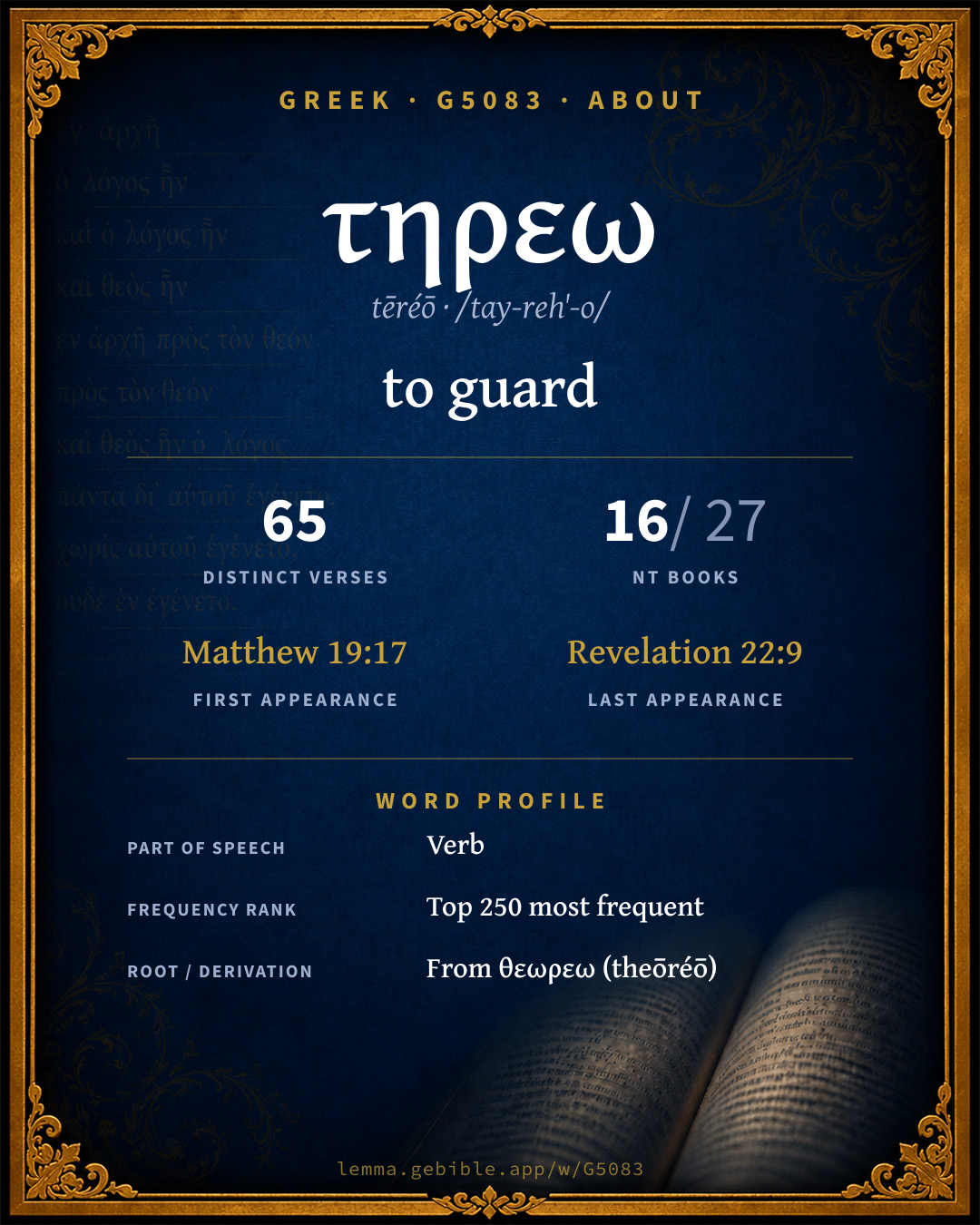
τηρέω
to guard
Full lexicon entry — Thayer's Greek Lexicon
From Thayer's Greek Lexicon
Where this word appears
See every Present-tense verb in the Greek New Testament →
Grammar key — what these labels mean
Part of speech
- Verb
- An action or state-of-being word.
Tense
- Present
- Ongoing or general action in present time (imperfective aspect).
- Aorist
- Action viewed as a simple whole, without regard to duration — often past (perfective aspect).
- Future
- Action expected in future time.
- Imperfect
- Continuous or repeated action in past time (“was writing”).
- Perfect
- A completed past action with continuing present results.
Voice
- Active
- The subject performs the action.
- Passive
- The subject receives the action.
Mood
- Infinitive
- A verbal noun (“to write”), unmarked for person or number.
- Participle
- A verbal adjective (“writing,” “having written”).
- Subjunctive
- Expresses probability, purpose, or possibility (the mood of contingency).
- Indicative
- States a fact or asks a factual question (the mood of reality).
- Imperative
- Expresses a command or request.
- Optative
- Expresses a wish or a remote possibility.
Case
- Nominative
- The case of the subject (and the predicate nominative).
- Genitive
- The case of source, possession, or “of” — answers “whose / from what.”
- Accusative
- The case of the direct object and of extent.
- Dative
- The case of the indirect object, means, or location — “to / for / with / in.”
Person
- 3rd person
- The one spoken about (“he / she / it / they”).
- 2nd person
- The one addressed (“you”).
- 1st person
- The speaker (“I / we”).
Gender
- Masculine
- Grammatically masculine.
- Feminine
- Grammatically feminine.
Number
- Singular
- One.
- Plural
- More than one.
Grammatical forms 40 distinct
- Verb, Present, Active, Infinitive 7 times (10%)
- Verb, Present, Active, Participle, Nominative, Singular, Masculine 6 times (8%)
- Verb, Aorist, Active, Subjunctive, 3rd person, Singular 4 times (6%)
- Verb, Present, Active, Participle, Nominative, Plural, Masculine 4 times (6%)
- Verb, Present, Active, Indicative, 3rd person, Singular 3 times (4%)
- Verb, Present, Passive, Infinitive 3 times (4%)
- Verb, Aorist, Active, Indicative, 2nd person, Singular 2 times (3%)
- Verb, Aorist, Active, Imperative, 2nd person, Singular 2 times (3%)
+32 more forms (40 occurrences)
Parsed forms decoded from the imported morphology (Robinson–Tischendorf, public domain), counted across 71 parsed occurrences — not distinct verses.
Every verse where G5083 appears — 65 distinct verses across 16 books. Click any verse to open its interlinear word-by-word view. Verse text shown in the World English Bible for context — . Each verse’s Greek form is shown with its reference; the English is not keyword-highlighted, since the data carries no word-level English alignment. Use “Compare translations” on any verse to read it across multiple English versions. This concordance covers the Greek New Testament; Septuagint (Greek Old Testament) occurrences of this word are not indexed here.
Matthew 6 verses
- Matthew 19:17 τήρησον aor act impv 2sg He said to him, "Why do you call me good? No one is good but one, that is, God. But if you want to enter into life, keep the commandments."
- Matthew 23:3 τηρεῖτε pres act impv 2pl All things therefore whatever they tell you to observe, observe and do, but don't do their works; for they say, and don't do.
- Matthew 27:36 ἐτήρουν impf act ind 3pl and they sat and watched him there.
- Matthew 27:54 τηροῦντες pres act ptcp nom pl masc Now the centurion, and those who were with him watching Jesus, when they saw the earthquake, and the things that were done, feared exceedingly, saying, "Truly this was the Son of God."
- Matthew 28:4 τηροῦντες pres act ptcp nom pl masc For fear of him, the guards shook, and became like dead men.
- Matthew 28:20 τηρεῖν pres act inf teaching them to observe all things that I commanded you. Behold, I am with you always, even to the end of the age." Amen.
Mark 1 verse
John 16 verses
- John 2:10 τετήρηκας perf act ind 2sg and said to him, "Everyone serves the good wine first, and when the guests have drunk freely, then that which is worse. You have kept the good wine until now!"
- John 8:51 τηρήσῃ aor act subj 3sg Most assuredly, I tell you, if a person keeps my word, he will never see death."
- John 8:52 τηρήσῃ aor act subj 3sg Then the Jews said to him, "Now we know that you have a demon. Abraham died, and the prophets; and you say, 'If a man keeps my word, he will never taste of death.'
- John 8:55 τηρῶ pres act ind 1sg You have not known him, but I know him. If I said, 'I don't know him,' I would be like you, a liar. But I know him, and keep his word.
- John 9:16 τηρεῖ pres act ind 3sg Some therefore of the Pharisees said, "This man is not from God, because he doesn't keep the Sabbath." Others said, "How can a man who is a sinner do such signs?" There was division among them.
- John 12:7 τηρήσῃ aor act subj 3sg But Jesus said, "Leave her alone. She has kept this for the day of my burial.
- John 14:15 τηρήσετε fut act ind 2pl If you love me, keep my commandments.
- John 14:21 τηρῶν pres act ptcp nom sg masc One who has my commandments, and keeps them, that person is one who loves me. One who loves me will be loved by my Father, and I will love him, and will reveal myself to him."
- John 14:23 τηρήσει fut act ind 3sg Jesus answered him, "If a man loves me, he will keep my word. My Father will love him, and we will come to him, and make our home with him.
- John 14:24 τηρεῖ pres act ind 3sg He who doesn't love me doesn't keep my words. The word which you hear isn't mine, but the Father's who sent me.
- John 15:10 τηρήσητε τετήρηκα aor act subj 2pl perf act ind 1sg If you keep my commandments, you will remain in my love; even as I have kept my Father's commandments, and remain in his love.
- John 15:20 ἐτήρησαν τηρήσουσιν aor act ind 3pl fut act ind 3pl Remember the word that I said to you: 'A servant is not greater than his lord.' If they persecuted me, they will also persecute you. If they kept my word, they will keep yours also.
- John 17:6 τετήρηκαν perf act ind 3pl I revealed your name to the people whom you have given me out of the world. They were yours, and you have given them to me. They have kept your word.
- John 17:11 τήρησον aor act impv 2sg I am no more in the world, but these are in the world, and I am coming to you. Holy Father, keep them through your name which you have given me, that they may be one, even as we are.
- John 17:12 ἐτήρουν impf act ind 1sg While I was with them in the world, I kept them in your name. Those whom you have given me I have kept. None of them is lost, except the son of destruction, that the Scripture might be fulfilled.
- John 17:15 τηρήσῃς aor act subj 2sg I pray not that you would take them from the world, but that you would keep them from the evil one.
Acts 7 verses
- Acts 12:5 ἐτηρεῖτο impf pass ind 3sg Peter therefore was kept in the prison, but constant prayer was made by the assembly to God for him.
- Acts 12:6 ἐτήρουν impf act ind 3pl The same night when Herod was about to bring him out, Peter was sleeping between two soldiers, bound with two chains. Guards in front of the door kept the prison.
- Acts 15:5 τηρεῖν pres act inf But some of the sect of the Pharisees who believed rose up, saying, "It is necessary to circumcise them, and to charge them to keep the law of Moses."
- Acts 16:23 τηρεῖν pres act inf When they had laid many stripes on them, they threw them into prison, charging the jailer to keep them safely,
- Acts 24:23 τηρεῖσθαι pres pass inf He ordered the centurion that Paul should be kept in custody, and should have some privileges, and not to forbid any of his friends to serve him or to visit him.
- Acts 25:4 τηρεῖσθαι pres pass inf However Festus answered that Paul should be kept in custody at Caesarea, and that he himself was about to depart shortly.
- Acts 25:21 τηρηθῆναι τηρεῖσθαι aor pass inf pres pass inf But when Paul had appealed to be kept for the decision of the emperor, I commanded him to be kept until I could send him to Caesar."
1 Corinthians 1 verse
2 Corinthians 1 verse
Ephesians 1 verse
1 Thessalonians 1 verse
1 Timothy 2 verses
2 Timothy 1 verse
James 2 verses
- James 1:27 τηρεῖν pres act inf Pure religion and undefiled before our God and Father is this: to visit the fatherless and widows in their affliction, and to keep oneself unstained by the world.
- James 2:10 τηρήσῃ aor act subj 3sg For whoever shall keep the whole law, and yet stumble in one point, he has become guilty of all.
1 Peter 1 verse
2 Peter 4 verses
- 2 Peter 2:4 τηρουμένους pres pass ptcp acc pl masc For if God didn't spare angels when they sinned, but cast them down to Tartarus, and committed them to pits of darkness, to be reserved to judgment;
- 2 Peter 2:9 τηρεῖν pres act inf the Lord knows how to deliver the godly out of temptation and to keep the unrighteous under punishment for the day of judgment;
- 2 Peter 2:17 τετήρηται perf pass ind 3sg These are wells without water, clouds driven by a storm; for whom the blackness of darkness has been reserved forever.
- 2 Peter 3:7 τηρούμενοι pres pass ptcp nom pl masc But the heavens that now are, and the earth, by the same word have been stored up for fire, being reserved against the day of judgment and destruction of ungodly men.
1 John 7 verses
- 1 John 2:3 τηρῶμεν pres act subj 1pl This is how we know that we know him: if we keep his commandments.
- 1 John 2:4 τηρῶν pres act ptcp nom sg masc One who says, "I know him," and doesn't keep his commandments, is a liar, and the truth isn't in him.
- 1 John 2:5 τηρῇ pres act subj 3sg But whoever keeps his word, God's love has most assuredly been perfected in him. This is how we know that we are in him:
- 1 John 3:22 τηροῦμεν pres act ind 1pl and whatever we ask, we receive from him, because we keep his commandments and do the things that are pleasing in his sight.
- 1 John 3:24 τηρῶν pres act ptcp nom sg masc He who keeps his commandments remains in him, and he in him. By this we know that he remains in us, by the Spirit which he gave us.
- 1 John 5:3 τηρῶμεν pres act subj 1pl For this is the love of God, that we keep his commandments. His commandments are not grievous.
- 1 John 5:18 τηρεῖ pres act ind 3sg We know that whoever is born of God doesn't sin, but he who was born of God keeps himself, and the evil one doesn't touch him.
Jude 4 verses
- Jude 1:1 τετηρημένοις perf pass ptcp dat pl masc Jude, a servant of Jesus Christ, and brother of James, to those who are called, sanctified by God the Father, and kept for Jesus Christ:
- Jude 1:6 τηρήσαντας τετήρηκεν aor act ptcp acc pl masc perf act ind 3sg Angels who didn't keep their first domain, but deserted their own dwelling place, he has kept in everlasting bonds under darkness for the judgment of the great day.
- Jude 1:13 τετήρηται perf pass ind 3sg wild waves of the sea, foaming out their own shame; wandering stars, for whom the blackness of darkness has been reserved forever.
- Jude 1:21 τηρήσατε aor act impv 2pl Keep yourselves in the love of God, looking for the mercy of our Lord Jesus Christ to eternal life.
Revelation 10 verses
- Revelation 1:3 τηροῦντες pres act ptcp nom pl masc Blessed is he who reads and those who hear the words of the prophecy, and keep the things that are written in it, for the time is at hand.
- Revelation 2:26 τηρῶν pres act ptcp nom sg masc He who overcomes, and he who keeps my works to the end, to him I will give authority over the nations.
- Revelation 3:3 τήρει pres act impv 2sg Remember therefore how you have received and heard. Keep it, and repent. If therefore you won't watch, I will come as a thief, and you won't know what hour I will come upon you.
- Revelation 3:8 ἐτήρησάς aor act ind 2sg "I know your works (behold, I have set before you an open door, which no one can shut), that you have a little power, and kept my word, and didn't deny my name.
- Revelation 3:10 ἐτήρησας τηρήσω aor act ind 2sg fut act ind 1sg Because you kept my command to endure, I also will keep you from the hour of testing, which is to come on the whole world, to test those who dwell on the earth.
- Revelation 12:17 τηρούντων pres act ptcp gen pl masc The dragon grew angry with the woman, and went away to make war with the rest of her seed, who keep God's commandments and hold Jesus' testimony.
- Revelation 14:12 τηροῦντες pres act ptcp nom pl masc Here is the patience of the saints, those who keep the commandments of God, and the faith of Jesus."
- Revelation 16:15 τηρῶν pres act ptcp nom sg masc "Behold, I come like a thief. Blessed is he who watches, and keeps his clothes, so that he doesn't walk naked, and they see his shame."
- Revelation 22:7 τηρῶν pres act ptcp nom sg masc "Behold, I come quickly. Blessed is he who keeps the words of the prophecy of this book."
- Revelation 22:9 τηρούντων pres act ptcp gen pl masc He said to me, "See you don't do it! I am a fellow bondservant with you and with your brothers, the prophets, and with those who keep the words of this book. Worship God."
About this entry
At a glance — auto-summarized from this page’s data, not written by a person. Every figure links to its source below. This summary describes the numbers; it doesn’t interpret them.
τηρεω (tēréō) is a Greek verb most often rendered “to guard.” It first appears in Matthew 19:17. Spanning 65 verses in 16 books, it ranks among the moderately common words of the Greek New Testament. John dominates its distribution — 16 of 65 verses. Related forms include θεωρεω, θεωρια and τηρησις. For the data behind this summary, explore the sense tree and the renderings breakdown below.
Gloss history
Strong's 1890 vs modern scholarship

About this word
Strong's G5083 catalogs a Greek word from the Greek New Testament.
These counts are not copied from any lexicon or concordance. They are computed here, from the morphology-tagged Greek New Testament. What Lemma adds →
- 65
- distinct verses
- The word appears in 65 distinct verses.
- 16 / 27
- NT books
- The word appears in 16 of 27 New Testament books.
- #236
- by frequency
- Top 250 most frequent Greek words (rank 236 of 5,347 Greek words by occurrence).
View all 65 occurrences in the concordance →
Most concentrated in
- John 16 verses 25%
- Revelation 10 verses 15%
- Acts 7 verses 11%
By section of the New Testament
By traditional corpus
Conventional, traditional groupings — biblical authorship is debated, so this is a traditional corpus grouping, not an authorship claim. Some books belong to more than one corpus (Luke is in both the Gospels and the Lukan corpus, and so on), so these shares overlap and need not total 100%. Each figure is a share of the word’s 65 distinct verses.
- Johannine 33 verses · 51%
- Gospels 23 verses · 35%
- General (Catholic) Epistles 18 verses · 28%
- Revelation 10 verses · 15%
- Lukan (Luke–Acts) 7 verses · 11%
- Pauline corpus 7 verses · 11%
How translations render this word
Counts come from each version’s own published word-to-Strong’s tagging or interlinear alignment — an approximate guide to how each version renders this word, not a word-level alignment the data otherwise carries. Because each total is that version’s own tagged count, the per-version totals vary from one another and need not match the appearance or distinct-verse counts above. These counts may also differ from a printed concordance because Lemma counts each distinctly tagged rendering and does not collapse phrase taggings into a single head-word total. This is a fixed set of word-tagged versions (KJV, ASV, BSB, ULT) and does not change with the reading translation you choose elsewhere. Each version’s license is shown beside its name below (and on Sources).
- King James Version: Keep 19×, Keepeth 6×, Observe 4×
- American Standard Version: Keep 18×, Keepeth 6×, Kept 5×
- Berean Standard Bible: Keep 9×, Keeps 7×, Obey 3×
- unfoldingWord Literal Text: Keep 17×, Keeping 7×, Keeps 4×
King James Version Public Domain
Renders G5083 across 74 tagged occurrences — most commonly:
Plus 27 renderings that appear only once — usually multi-word phrases or single function words the recovered tagging swept in, not distinct renderings. Not rendered by a distinct English word in 1 further occurrence.
American Standard Version Public Domain
Renders G5083 across 75 tagged occurrences — most commonly:
Plus 37 renderings that appear only once — usually multi-word phrases or single function words the recovered tagging swept in, not distinct renderings.
Berean Standard Bible Public Domain
Renders G5083 across 69 tagged occurrences — most commonly:
Plus 39 renderings that appear only once — usually multi-word phrases or single function words the recovered tagging swept in, not distinct renderings. Not rendered by a distinct English word in 2 further occurrences.
unfoldingWord Literal Text CC BY-SA 4.0
Renders G5083 across 80 tagged occurrences — most commonly:
Plus 32 renderings that appear only once — usually multi-word phrases or single function words the recovered tagging swept in, not distinct renderings.
Senses in Thayer's
The 1 sense Thayer's distinguishes for this word, in lexicon order (not ranked by frequency or importance). The full entry — with sub-senses — is in the Lexicon Entry tab.
- to attend to carefully, take care of
Word origin
Derived from θεωρεω (theōréō) (G2334) — to behold.
From τηρός teros (a watch ; perhaps akin to G2334 ); to guard (from loss or injury properly by keeping the eye upon; and thus differing from G5442 which is properly to prevent escaping; and from G2892 which implies a fortress or full military lines of apparatus) that is to note (a prophecy; figuratively to fulfil a command); by implication to detain (in custody; figuratively to maintain ); by extension to withhold (for personal ends; figuratively to keep unmarried ): - hold fast keep (-er) (ob- pre- re) serve watch.
— Strong’s Exhaustive Concordance (1890), public domain.
Forms in the corpus
The 40 distinct written forms G5083 takes in the Greek New Testament, most frequent first — each parse links to that tense’s occurrences in the concordance.
Same root — word family
Other Thayer's entries built from the same root as G5083, grouped by Strong’s listed origin. These share a root / origin per the lexicon — not necessarily a shared meaning. Each links to that word’s own entry.
Derives from
Shares the same root
Derived from this word
Compare all same-root words → They share a root, not necessarily a meaning.
Septuagint usage
The same Greek word τηρεω appears 27 times in the Greek Old Testament (Septuagint), across 26 verses in 8 books.
- 27
- LXX occurrences
- Tagged occurrences of this Greek word in the Septuagint.
- 26
- verses
- Distinct Septuagint verses containing this word.
- 8 / 39
- OT books
- The word appears in 8 of the 39 Old Testament books.
Sample Septuagint occurrences
- Genesis 3:15 τηρέω
- 1 Samuel 15:11 τηρέω
- Ezra 8:29 τηρέω
- Proverbs 2:11 τηρέω
- Ecclesiastes 11:4 τηρέω
- Song of Solomon 3:3 τηρέω
- Jeremiah 20:10 τηρέω
- Daniel 6:12 τηρέω
Septuagint occurrences (same lexeme)
Every verse where the same Strong’s number (G5083) appears in the Greek Septuagint. Verse text shown in the World English Bible for context; the Greek form is the matched word — the English is not keyword-highlighted.
- Genesis 3:15 τηρέω I will put enmity between you and the woman, and between your offspring and her offspring. He will bruise your head, and you will bruise his heel."
- 1 Samuel 15:11 τηρέω It repents me that I have set up Saul to be king; for he is turned back from following me, and has not performed my commandments. Samuel was angry; and he cried to Yahweh all night.
- Ezra 8:29 τηρέω Watch you, and keep them, until you weigh them before the chiefs of the priests and the Levites, and the princes of the fathers' [houses] of Israel, at Jerusalem, in the chambers of the house of Yahweh.
- Proverbs 2:11 τηρέω Discretion will watch over you. Understanding will keep you,
- Proverbs 3:1 τηρέω My son, don't forget my teaching; But let your heart keep my commandments:
- Proverbs 3:21 τηρέω My son, let them not depart from your eyes. Keep sound wisdom and discretion:
- Proverbs 4:6 τηρέω Don't forsake her, and she will preserve you. Love her, and she will keep you.
- Proverbs 4:23 τηρέω Keep your heart with all diligence, For out of it is the wellspring of life.
- Proverbs 7:5 τηρέω That they may keep you from the strange woman, From the foreigner who flatters with her words.
- Proverbs 8:34 τηρέω Blessed is the man who hears me, Watching daily at my gates, Waiting at my door posts.
- Proverbs 13:3 τηρέω He who guards his mouth guards his soul. One who opens wide his lips comes to ruin.
- Proverbs 15:32 τηρέω He who refuses correction despises his own soul, But he who listens to reproof gets understanding.
- Proverbs 16:13 τηρέω Righteous lips are the delight of kings. They value one who speaks the truth.
- Proverbs 19:16 τηρέω He who keeps the commandment keeps his soul, But he who is contemptuous in his ways shall die.
- Proverbs 23:18 τηρέω Indeed surely there is a future hope, And your hope will not be cut off.
- Proverbs 23:26 τηρέω My son, give me your heart; And let your eyes keep in my ways.
- Proverbs 25:10 τηρέω Lest one who hears it put you to shame, And your bad reputation never depart.
- Proverbs 31:2 τηρέω "Oh, my son!" Oh, son of my womb! Oh, son of my vows!
- Ecclesiastes 11:4 τηρέω He who observes the wind won't sow; And he who regards the clouds won't reap.
- Song of Solomon 3:3 τηρέω The watchmen who go about the city found me; "Have you seen him whom my soul loves?"
- Song of Solomon 7:14 τηρέω
- Song of Solomon 8:11 τηρέω Solomon had a vineyard at Baal Hamon. He leased out the vineyard to keepers. Each was to bring a thousand shekels of silver for its fruit.
- Song of Solomon 8:12 τηρέω My own vineyard is before me. The thousand are for you, Solomon; Two hundred for those who tend its fruit. Lover
- Jeremiah 20:10 τηρέω For I have heard the defaming of many, terror on every side. Denounce, and we will denounce him, [say] all my familiar friends, those who watch for my fall; peradventure he will be persuaded, and we shall prevail against him, and we shall take our revenge on him.
- Daniel 6:12 τηρέω Then they came near, and spoke before the king concerning the king's interdict: Haven't you signed an interdict, that every man who shall make petition to any god or man within thirty days, save to you, O king, shall be cast into the den of lions? The king answered, The thing is true, according to the law of the Medes and Persians, which doesn't alter.
- Daniel 9:4 τηρέω I prayed to Yahweh my God, and made confession, and said, Oh, Lord, the great and dreadful God, who keeps covenant and loving kindness with those who love him and keep his commandments,
These are occurrences of the same Greek lexeme (G5083) in the Septuagint — not a translation of any one Hebrew word. The store carries no word-level Hebrew↔Greek alignment, so no Hebrew original is asserted here. Counts come from the recovered LXX Strong's tagging — high-frequency vocabulary is well covered, while rare or late forms may be untagged — so they reflect tagged occurrences and may slightly undercount.