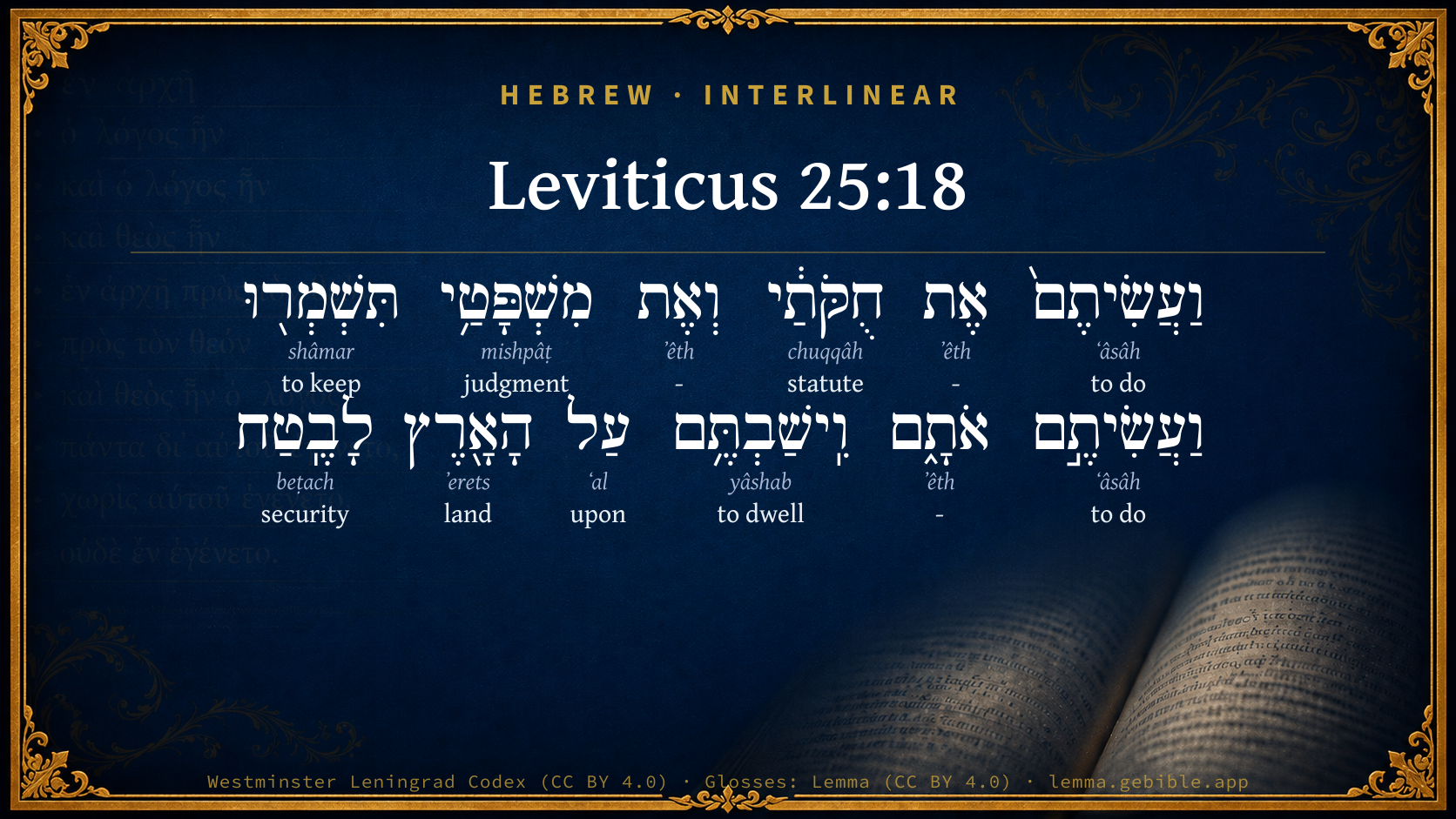
Leviticus 25:18

Hebrew (Westminster Leningrad Codex) Leviticus 25:18 appears in the Hebrew Old Testament. The text above is from the Westminster Leningrad Codex. Each word links to its Strong’s number, a concise gloss, and parsing drawn from the Open Scriptures Hebrew Bible morphology. Click any word for its full Brown-Driver-Briggs (BDB) entry.
Download image
Cite this verse

Leviticus 25:18 (World English Bible). Public Domain. Lemma interlinear Bible study tool, https://lemma.gebible.app/v/leviticus/25/18.

Show BibTeX & RIS
BibTeX
RIS
English Translation
"'Therefore you shall do my statutes, and keep my ordinances and do them; and you shall dwell in the land in safety.
World English Bible · Public Domain
Download a study sheet

One document with this verse’s original text, its word-by-word gloss line, the meaning frame, cross-references with their text, attributed commentary, and full source and license credits — printable, and it pastes into notes with its structure intact.

This verse Autodidact and up

Study sheet (.html) Plain text (.txt)

A passage Seminary Student

Up to 50 verses in one chapter. A passage sheet keeps up to 6 commentary sources and 12 cross-references per verse, in the order this page ranks them, and says so on the sheet whenever that leaves anything out. Ask for a single verse and you get the Autodidact verse sheet above.

Everything on this page stays free to read, with no account — the sheet is a download of what is already on screen, not access to it.

Want to remove ads? Support Godless Engineer
Compare translations 3

The same verse in 3 English versions, stacked beneath the original-language interlinear above. Click any original word for its lexicon entry.

Each is an independent rendering of the whole verse — the interlinear is not word-aligned to these translations.

Highlighted words mark where these versions differ — a whole-verse word diff, not a word-by-word alignment.

  • World English Bible Public Domain
    "'Therefore you shall do my statutes, and keep my ordinances and do them; and you shall dwell in the land in safety.
  • King James Version Public Domain
    Wherefore ye shall do my statutes, and keep my judgments, and do them; and ye shall dwell in the land in safety.
  • unfoldingWord Literal Text CC BY-SA 4.0
    And you shall do my statutes, and my judgments you shall keep and do them, and you shall dwell on the land in security.

unfoldingWord Literal Text — © unfoldingWord, licensed CC BY-SA 4.0. Word-aligned USFM3 via Door43 (git.door43.org/unfoldingWord/en_ult).

Versions to compare (up to 4)

3 of 4 selected

Show all 18 translations

Every available English version of this verse, each an independent rendering of the whole verse.

  • World English Bible Public Domain
    "'Therefore you shall do my statutes, and keep my ordinances and do them; and you shall dwell in the land in safety.
  • Berean Standard Bible Public Domain
    You are to keep My statutes and carefully observe My judgments, so that you may dwell securely in the land.
  • Majority Standard Bible Public Domain
    You are to keep My statutes and carefully observe My judgments, so that you may dwell securely in the land.
  • King James Version Public Domain
    Wherefore ye shall do my statutes, and keep my judgments, and do them; and ye shall dwell in the land in safety.
  • American Standard Version (1901) Public Domain
    Wherefore ye shall do my statutes, and keep mine ordinances and do them; and ye shall dwell in the land in safety.
  • Revised Version (1885) Public Domain
    Wherefore ye shall do my statutes, and keep my judgments and do them; and ye shall dwell in the land in safety.
  • Geneva Bible (1599) Public Domain
    Wherefore ye shall obey mine ordinances, and keepe my lawes, and do them, and ye shall dwell in the land in safetie.
  • Douay-Rheims (1899) Public Domain
    Do my precepts, and keep my judgments, and fulfil them: that you may dwell in the land without any fear,
  • Young's Literal Translation Public Domain
    `And ye have done My statutes, and My judgments ye keep, and have done them, and ye have dwelt on the land confidently,
  • Literal Standard Version CC BY-SA 4.0
    And you have done My statutes, and you keep My judgments, and have done them, and you have dwelt on the land confidently,
  • Unlocked Literal Bible CC BY-SA 4.0
    Therefore you must obey my decrees, keep my laws, and carry them out. Then you will live in the land in safety.
  • unfoldingWord Literal Text CC BY-SA 4.0
    And you shall do my statutes, and my judgments you shall keep and do them, and you shall dwell on the land in security.
  • Darby Bible Public Domain
    And ye shall do my statutes, and observe mine ordinances and do them: thus shall ye dwell in your land securely.
  • World Messianic Bible Public Domain
    “‘Therefore you shall do my statutes, and keep my ordinances and do them; and you shall dwell in the land in safety.
  • Webster's Bible Public Domain
    Wherefore ye shall do my statutes, and keep my judgments, and do them; and ye shall dwell in the land in safety.
  • Free Bible Version CC BY-SA 4.0
    Keep my rules and observe my regulations, so you can live in safety in the land.
  • Bible in Basic English Public Domain
    So keep my rules and my decisions and do them, and you will be safe in your land.
  • JPS Tanakh (1917) Public Domain
    Wherefore ye shall do My statutes, and keep Mine ordinances and do them; and ye shall dwell in the land in safety.

Literal Standard Version (2020), Covenant Press — licensed CC BY-SA 4.0. Text via the HelloAO Bible API (eBible.org). Unlocked Literal Bible (unfoldingWord) — licensed CC BY-SA 4.0. Text via the HelloAO Bible API (eBible.org). unfoldingWord Literal Text — © unfoldingWord, licensed CC BY-SA 4.0. Word-aligned USFM3 via Door43 (git.door43.org/unfoldingWord/en_ult). Free Bible Version, Dr. Jonathan Gallagher — licensed CC BY-SA 4.0. Text via the HelloAO Bible API (eBible.org).

Word by word

More ways to search: Search by grammar → Find every occurrence → Compare this word →

Practice this passage: Drill this verse → Learn its vocabulary →

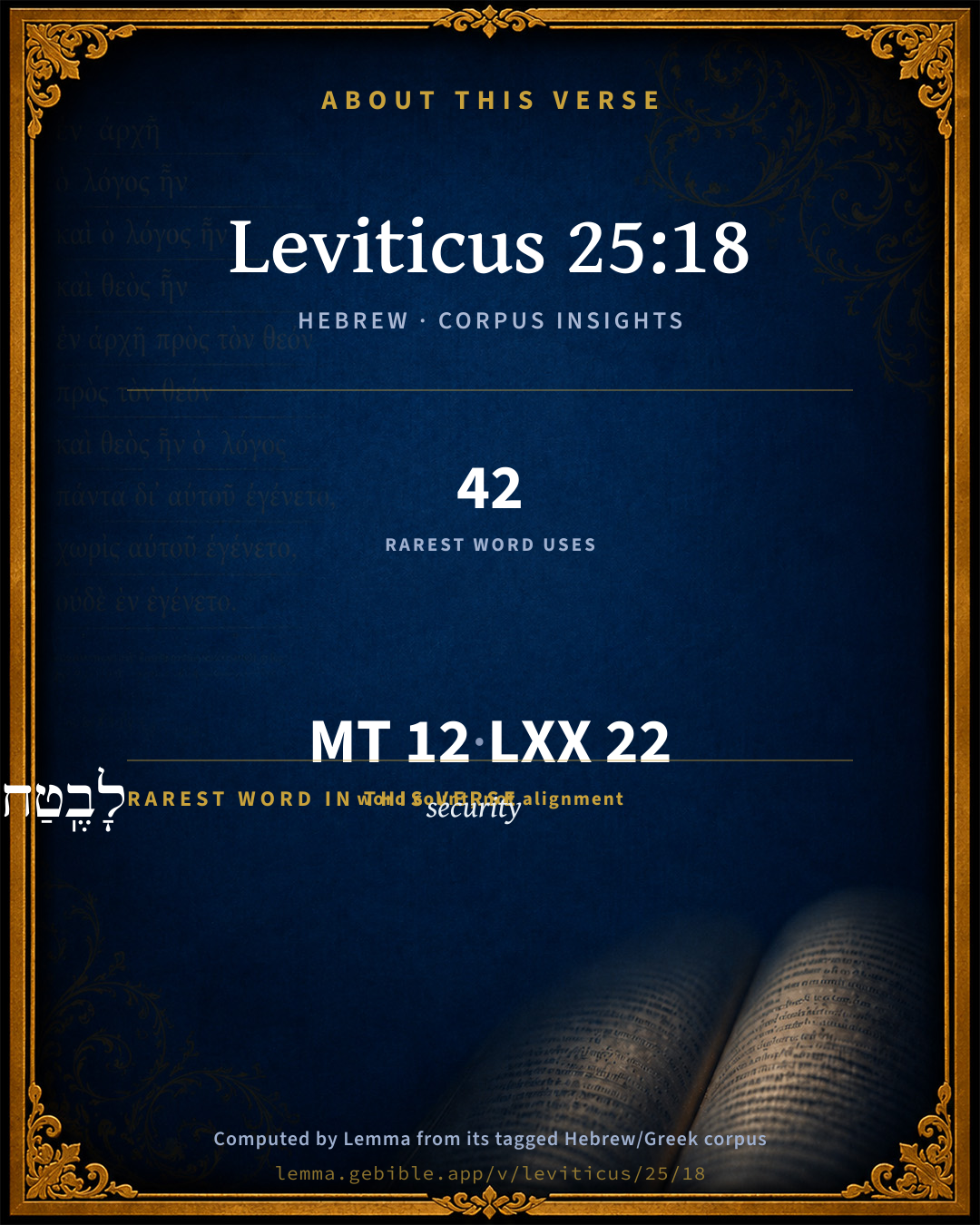
לָבֶֽטַח
beṭach
H983
“to/for · security”
Preposition + Noun, Common, Masculine, Singular, Absolute
Part of Speech
Preposition + Noun
Type
Common
Gender
Masculine
Number
Singular
State
Absolute
Full BDB Definition

Origin: from H982

TWOT: 233a

security, safety - securely
  1. וַעֲשִׂיתֶם֙ ʻâsâh H6213 “and · to do” Conjunction + Verb, Qal, Sequential Perfect, 2nd Person, Masculine, Plural
  2. אֶת ʼêth H853 “-” Particle, Direct Object
  3. חֻקֹּתַ֔י chuqqâh H2708 “statutes · my” Noun, Common, Both, Plural, Construct + Suffix, Personal, 1st Person, Common, Singular
  4. וְאֶת ʼêth H853 “and · -” Conjunction + Particle, Direct Object
  5. מִשְׁפָּטַ֥י mishpâṭ H4941 “judgments · my” Noun, Common, Masculine, Plural, Construct + Suffix, Personal, 1st Person, Common, Singular
  6. תִּשְׁמְר֖וּ shâmar H8104 “to keep” Verb, Qal, Imperfect, 2nd Person, Masculine, Plural
  7. וַעֲשִׂיתֶ֣ם ʻâsâh H6213 “and · to do” Conjunction + Verb, Qal, Sequential Perfect, 2nd Person, Masculine, Plural
  8. אֹתָ֑ם ʼêth H853 “- · them” Particle, Direct Object + Suffix, Personal, 3rd Person, Masculine, Plural
  9. וִֽישַׁבְתֶּ֥ם yâshab H3427 “and · to dwell” Conjunction + Verb, Qal, Sequential Perfect, 2nd Person, Masculine, Plural
  10. עַל ʻal H5921 “upon” Preposition
  11. הָאָ֖רֶץ ʼerets H776 “the · land” Particle, Definite Article + Noun, Common, Both, Singular, Absolute

About this verse

These counts appear in no published source. They are computed here, from the morphology-tagged text and Lemma’s own curated glosses. What Lemma adds →

12
words
9
distinct lemmas
Pentateuch
section

Shared distinctive vocabulary

לָבֶֽטַח security H983 occurs in 41 verses of the Hebrew Bible. Also found in:

Grammatical profile

  • 4 verbs
  • 4 nouns
  • 1 preposition
  • 3 particles

Verb forms

  • וַעֲשִׂיתֶם֙ Qal · Sequential Perfect
  • תִּשְׁמְר֖וּ Qal · Imperfect
  • וַעֲשִׂיתֶ֣ם Qal · Sequential Perfect
  • וִֽישַׁבְתֶּ֥ם Qal · Sequential Perfect

Repetition

A word recurs within this verse — often emphatic in Hebrew:

  • וַעֲשִׂיתֶם֙ to do H6213 ×2

Hebrew & Septuagint length

In English translation the verse runs 22 words from the Hebrew and 27 from the Septuagint (LXX English) — closely comparable.

A rough comparison of the two English renderings, which tokenize alike — not a word-level alignment.

Word counts can differ between the Hebrew and the Greek without any difference in meaning — e.g. the Hebrew direct-object marker אֵת has no separate Greek word, and Greek often adds the article ὁ.

In the original languages it is 12 Hebrew tokens and 22 Greek tokens — but the two are counted differently (Hebrew bundles its prefixes and suffixes into one token; the Greek is in lemma form), so that isn’t a like-for-like length.

Cross-references

17

Topical passages linked to Leviticus 25:18 in the Treasury of Scripture Knowledge — connected by theme and wording, ordered by reader-vote popularity; previews shown in the World English Bible.

  • Deuteronomy 12:10 But when you go over the Jordan, and dwell in the land which Yahweh your God causes you to inherit, and he gives you rest from all your enemies round about, so that you dwell in safety;
  • Proverbs 1:33 But whoever listens to me will dwell securely, And will be at ease, without fear of harm."
  • Jeremiah 23:6 In his days Judah shall be saved, and Israel shall dwell safely; and this is his name by which he shall be called: Yahweh our righteousness.
  • Leviticus 26:3–12 "'If you walk in my statutes, and keep my commandments, and do them;
  • Deuteronomy 28:1–14 It shall happen, if you shall listen diligently to the voice of Yahweh your God, to observe to do all his commandments which I command you this day, who Yahweh your God will set you on high above all the nations of the earth:
  • Psalms 4:8 In peace I will both lay myself down and sleep, For you, Yahweh alone, make me live in safety.
  • Ezekiel 33:24–26 Son of man, they who inhabit those waste places in the land of Israel speak, saying, Abraham was one, and he inherited the land: but we are many; the land is given us for inheritance.
  • Leviticus 19:37 You shall observe all my statutes, and all my ordinances, and do them. I am Yahweh.'"
  • Deuteronomy 33:12 Of Benjamin he said, The beloved of Yahweh shall dwell in safety by him; He covers him all the day long, He dwells between his shoulders.
  • Deuteronomy 33:28 Israel dwells in safety, The fountain of Jacob alone, In a land of grain and new wine; Yes, his heavens drop down dew.
  • Psalms 103:18 To those who keep his covenant, To those who remember to obey his precepts.
  • Jeremiah 7:3–7 Thus says Yahweh of Hosts, the God of Israel, Amend your ways and your doings, and I will cause you to dwell in this place.
  • Jeremiah 33:16 In those days shall Judah be saved, and Jerusalem shall dwell safely; and this is [the name] by which she shall be called: Yahweh our righteousness.
  • Ezekiel 33:29 Then shall they know that I am Yahweh, when I have made the land a desolation and an astonishment, because of all their abominations which they have committed.
  • Ezekiel 34:25–28 I will make with them a covenant of peace, and will cause evil animals to cease out of the land; and they shall dwell securely in the wilderness, and sleep in the woods.
  • Ezekiel 36:24–28 For I will take you from among the nations, and gather you out of all the countries, and will bring you into your own land.
  • Jeremiah 25:5 saying, Return you now everyone from his evil way, and from the evil of your doings, and dwell in the land that Yahweh has given to you and to your fathers, from of old and even forevermore;

Cross-references courtesy of OpenBible.info (CC BY 4.0).

Hebrew and Greek witnesses Masoretic Hebrew ↔ Greek Septuagint

The same verse in the two great witnesses to the Old Testament, shown verse-for-verse.

These are two independent witnesses, not word-aligned to each other, and the Septuagint is shown in lemma (dictionary) form.

Hebrew Leviticus 25:18 Masoretic · Westminster Leningrad Codex

וַעֲשִׂיתֶם֙ אֶת חֻקֹּתַ֔י וְאֶת מִשְׁפָּטַ֥י תִּשְׁמְר֖וּ וַעֲשִׂיתֶ֣ם אֹתָ֑ם וִֽישַׁבְתֶּ֥ם עַל הָאָ֖רֶץ לָבֶֽטַח

"'Therefore you shall do my statutes, and keep my ordinances and do them; and you shall dwell in the land in safety.

World English Bible · Public Domain

Greek LXX Leviticus 25:18 Septuagint · lemma form

καί ποιέω πᾶς ὁ δικαίωμα ἐγώ καί πᾶς ὁ κρίσις ἐγώ καί φυλάσσω καί ποιέω αὐτός καί καταοἰκέω ἐπί ὁ γῆ πείθω

And you⌃ shall keep all my ordinances, and all my judgments; and do you⌃ observe them, and you⌃ shall keep them, and dwell securely in the land.

LXX2012 (modern English Septuagint) · Public Domain

Hebrew: Westminster Leningrad Codex (CC BY 4.0). Greek: Septuagint (public domain); English from LXX2012 (modern English Septuagint) (Public Domain). How the Septuagint differs from the Hebrew →

Targum (Aramaic paraphrase)

2

The Targum is the ancient Jewish Aramaic paraphrase of the Hebrew Scriptures — an interpretive translation, not the Hebrew text itself. Onkelos (literal) and Pseudo-Jonathan (expansive) render the Torah, and Jonathan the Prophets. Coverage is partial: where no permissively-licensed English translation exists for a verse, only the Aramaic is shown. This is verse-level text, not a word-by-word alignment to the Hebrew.

  1. Targum Onkelos Torah (Genesis–Deuteronomy)
    וְתַעְבְּדוּן יָת קְיָמַי וְיָת דִינַי תִּטְּרוּן וְתַעֲבְּדוּן יָתְהוֹן וְתֵיתְבוּן עַל אַרְעָא לְרָחֲצָן

    (no public-domain English translation for this verse)

    Targum Onkelos — Aramaic: “Onkelos Genesis” (public domain); “Onkelos Exodus” (public domain); “Onkelos Leviticus” (public domain); “Onkelos Numbers” (public domain); “Onkelos Deuteronomy” (public domain). English: “Sefaria Community Translation” (CC0 1.0 (public-domain dedication)); “J.W. Etheridge. The Targums of Onkelos and Jonathan Ben Uzziel on the Pentateuch. London: Longmans, Green, 1862” (public domain). Text via Sefaria.

  2. Targum Pseudo-Jonathan Torah (Genesis–Deuteronomy)
    וְתַעַבְדוּן יַת קְיָמַי וְיַת סִדְרֵי דִינַי תִטְרוּן וְתַעְבְדוּן יַתְהוֹן וְתֵיתְבוּן עַל אַרְעָא לְרוֹחֲצָן

    And you shall perform My statutes, and observe the order of My judgments and do them, that you may dwell upon the land securely.

    Targum Pseudo-Jonathan — Aramaic: “Targum Jonathan on Genesis” (public domain); “Targum Jonathan on Exodus” (public domain); “Targum Jonathan on Leviticus” (public domain); “Targum Jonathan on Numbers” (public domain); “Targum Jonathan on Deuteronomy” (public domain). English: “The Targum of Jonathan ben Uzziel, trans. J. W. Etheridge, London, 1862” (public domain). Text via Sefaria.

Commentary

Notes on Leviticus 25:18 from classic Christian and Jewish commentators (each source and its license shown beneath its notes). The classic Christian expositions comment on the surrounding passage and are grouped to its opening verse, so a note may address several verses; the Jewish commentaries on the Tanakh (Rashi and others) are per-verse, so they appear only where the commentator wrote on this verse.

Lemma curates 59 commentaries, every one of them public domain or Creative Commons licensed, each selected and text-cleaned for this edition rather than reprinted as found. About our sources →

Trapp's Complete Commentary

John Trapp

Lev 25:18 Wherefore ye shall do my statutes, and keep my judgments, and do them; and ye shall dwell in the land in safety.

Ver. 18. Ye shall do my statutes.] Ye shall do them, and do them: that is, ye shall do them diligently, {as Psa 119:4} and then ye shall dwell in the land in safety; yea, ye shall dwell there in safety: that is, ye shall assuredly; take my word for it.

John Trapp, A Commentary or Exposition upon All the Books of the Old and New Testament (1647–1656) — public domain. Text from a community e-Sword module.

Whedon's Commentary on the Bible

Daniel D. Whedon

ADDITIONAL LEGISLATION RESPECTING THE SABBATICAL YEAR, Lev_25:18-22.

These verses should be read in connexion with vers. 1-7, since they chiefly relate to the same topic. They seem to be misplaced in their present position, amid precepts relating to the jubilee, though they are not in reality. The purport of Lev_25:18-19 is, that safety and temporal prosperity in the land of promise hinge on obedience to the declared will of Jehovah.

Daniel D. Whedon (gen. ed.), Commentary on the Old and New Testaments (1874–1909) — public domain. Text from a community e-Sword module.

Geneva Bible (1599)

Geneva Bible translators

Or, boldly without fear.

Geneva Bible (1599) marginal notes — public domain. Text via Bolls.life.

Ellicott's Commentary for English Readers

(18) Wherefore ye shall do my statutes.—Better, And ye shall do . . . that is, the above named statutes and ordinances respecting the sabbatical year and the jubile, which required great sacrifices.

Ye shall dwell in the land in safety.—As God is Israel’s strong tower and wall of defence, it is by keeping His commandments that the Israelites will enjoy the security which other nations endeavour to obtain by great labour and mighty armies.

And the land . . . her fruit.—He, moreover, who has given Israel these statutes, also controls the operations of nature. Hence, though the observance of His laws would necessitate the abstention from cultivating the soil, the Lord will cause the land to yield an abundant harvest which will richly supply all their wants, and they will safely and quietly dwell therein without being compelled to make raids upon their neighbours for food, or surrender themselves to their enemies for want of provision (1Ma_6:49; 1Ma_6:53; Josephus, Antt. xiv. 16, § 2; xv. :1, § 2).

A Bible Commentary for English Readers, edited by Charles John Ellicott (1878–1897) — public domain. Text from a community e-Sword module.

The Cambridge Bible for Schools and Colleges

gen. ed. J. J. S. Perowne

18–22. A hortatory addition, relating to the sabbatical year and interrupting the Jubile regulations. It is thus clearly out of place, and should properly follow Lev_25:7. Its tone is that of H, and is in accord with such hortatory passages as Lev_18:25 ff., Lev_20:22 f., Lev_26:3 ff. It may be conjectured that the redactor’s reason for placing it here out of its proper context was to indicate that it applies to the regulations for the Jubile as well as the sabbatical year.

The mention of the ninth year (Lev_25:22), combined with the words ‘three years’ (Lev_25:21), seems to point to the view (see introd. note to ch.) that the Jubile year was really the 50th, not the 49th, and that thus the land on such occasions was to have two years (the seventh and eighth) of rest. On the other hand, Lev_25:20 has ‘the seventh year’ (not the seventh and eighth), and Lev_25:22 ‘ye shall sow the eighth year’ (not the ninth). It is probable that the redactor, with the object mentioned above, introduced into Lev_25:22 mention of the ninth year. So Dillm. who further makes the ‘three years,’ originally meaning the sixth, seventh, and eighth (i.e. the produce of the sixth year was to last abnormally till the harvest time of that sowed in the earlier part of the eighth instead of the seventh year) to have been taken by the redactor to mean seventh, eighth, and ninth, so as to fall in with his view that the Jubile followed, instead of coinciding with, the last year of the cycle of seven sabbatical years.

The Cambridge Bible for Schools and Colleges (gen. ed. J. J. S. Perowne; Cambridge University Press, 1878–1918) — public domain. Text from a community e-Sword module.

John Gill's Exposition

Wherefore ye shall do my statutes, and keep my judgments, and do them,.... These and all others he enjoined; by which tenure, even obedience to all his commands, moral, ritual, and judicial, they were to hold the land of Canaan, and their possessions in it, which is intended in the next clause:

and ye shall dwell in the land in safety; without any fear of enemies, or of the neighbouring nations about them seizing upon them, and distressing them; and Jarchi observes, that it was for transgressing the sabbatical year that Israel was carried captive, which he thinks is intimated in Ch2 36:21; and that the seventy years' captivity in Babylon were for the seventy sabbatical years that had been neglected.

John Gill's Exposition of the Whole Bible (1746–1763) — public domain (CC PDM 1.0). Text via the HelloAO Bible API.

Albert Barnes' Notes on the Bible

In safety - i. e., secure from famine, Lev 26:5; Deu 12:10.

Albert Barnes' Notes on the Bible (1834–1885) — public domain. Text from a community e-Sword/MySword module.

The Pulpit Commentary

Vers. 18-22. only the year of jubilee, but the sabbatical year also, commenced in the autumn, when the farmers first began to sow for the coming year; so that the sowing was suspended from the autumn of the sixth year till the autumn of the seventh, and even till the autumn of the eighth whenever the jubilee year came round, in which case both sowing and reaping were omitted for two years in succession, and consequently the produce of the sixth year, which was harvested in the seventh month of that year, must have sufficed for three years, not merely till the sowing in the autumn of the eighth or fiftieth year, but till the harvest of the ninth or fifty-first year, as the Talmud and rabbins of every age have understood the law" (Keil). The question, What shall we eat? would present itself with double force when the sabbatical and the jubilee years came together. It and the answer to it therefore properly follow on the institution of the jubilee, instead of preceding it, as Ewald, Knobcl, and others demand that it should do.

The Pulpit Commentary (1880–1919), ed. H.D.M. Spence-Jones & Joseph S. Exell — public domain. Text from a community e-Sword module.

unfoldingWord translationNotes

Door43 World Missions Community

obey my decrees, keep my laws, and carry them out

All of these phrases mean basically the same thing. They emphasize that the people must obey everything Yahweh says. (See: Parallelism)

you will eat your fill

This means that they would eat enough until their stomach was full. AT: "you will eat till you are full" or "you will eat plenty" (See: Idiom)

translationWords

obey

decree

law

life

unfoldingWord translationNotes — © Distant Shores Media and the Door43 World Missions Community, licensed CC BY-SA 4.0. Source: git.door43.org/Door43/en_tn.

Rashi

Rabbi Shlomo Yitzchaki (Rashi)

וישבתם על הארץ לבטח [WHEREFORE YE SHALL DO MY ORDINANCES] AND YE SHALL ABIDE IN THE LAND IN SAFETY — It states this because as a punishment for the sin of neglecting the laws of ”Shemittah” Israel becomes exiled, as it is said (Leviticus 26:33, 34) “(And I will disperse you among the nations…] Then shall the land makeup for the Sabbatical years… even then make up for her Sabbatical years that she has not observed” (Shabbat 33a). The seventy years of the Babylonian exile were indeed a punishment corresponding to the seventy Sabbatical years which they had neglected (cf. Rashi on Leviticus 26:35).

Rashi on the Tanakh — English translations: “The Judaica Press complete Tanach with Rashi, translated by A. J. Rosenberg” (CC BY 4.0); “Pentateuch with Rashi's commentary by M. Rosenbaum and A.M. Silbermann, 1929-1934” (public domain); “The Metsudah Tanach series, Lakewood, N.J” (CC BY 4.0); and “The Book of Joshua, Metsudah Publications, 1997” (CC BY 4.0). Text via Sefaria.

Ramban (Nachmanides)

Rabbi Moshe ben Nachman (Ramban / Nachmanides)

AND YE SHALL DO MY STATUTES, AND KEEP MINE ORDINANCES. He warned [here] concerning [all] the statutes on account of the Sabbatical year and the Jubilee mentioned [above], because these [commandments] are in the category of “statutes” [for which no explicit reason is given], and [He warned concerning all] the ordinances on account of the law of the return of sales and servants in the Jubilee, and [the law of] overcharging [which are “ordinances” for which the reasons are obvious]. He said, and ye shall dwell in the Land in safety, because it is for the sin of [transgressing the laws of] the Sabbatical year and the Jubilee that Israel goes into exile. He then said again, And the Land shall yield her fruit, and ye shall eat until ye have enough, and dwell therein in safety, meaning that you will not have to go out of the Land in the Sabbatical year in order to live in another land on account of lack of food [because the Land shall yield enough fruit].

Ramban (Nachmanides) on the Tanakh — English translation: “Commentary on the Torah by Ramban (Nachmanides). Translated and annotated by Charles B. Chavel. New York, Shilo Pub. House, 1971-1976” (CC BY 4.0). Text via Sefaria.

Sforno

Rabbi Ovadia Sforno

My statutes. The matters of the Sabbatical and Jubilee years. And My laws. In the matters of selling and buying for the years of the jubilee, and the rest. There should not be any cheating in those matters.

And you will then live in the land in security. You will not be exiles from it, the opposite of (26:34): “The land will then be appeased for its Shabbosos all the days of its desolation,” and also the opposite of (Yeshayahu 57:17): “For the iniquity of his thievery I became wroth”.

Sforno on the Tanakh — English translation: “Yalkut, Sifsei Chachomim Chumash, Metsudah Publications, 2009” (CC BY 4.0). Text via Sefaria.

Lesson kit

Teaching starters — assembled from the data on this page, not authored interpretation. Every prompt links to the verse data it draws on. Edit before teaching.

Leviticus, in the Pentateuch, opens this verse with 12 words (9 distinct Hebrew lemmas). Its most distinctive word is beṭach (“security”). A historical commentator’s framing appears above. Read the whole chapter for the surrounding context.

Discussion questions

  1. What does “security” (beṭach) contribute to the verse as a whole?
  2. Genesis 34:25 shares the word «security» with this verse. How do the two illuminate each other?
  3. “to do” occurs 2× in this one verse. What is the effect of the repetition?
  4. These translations render this verse differently. What is at stake in choosing one wording over another?
  5. The verb «וַעֲשִׂיתֶם֙» is Qal Sequential Perfect. How does its form color the action?
  6. Reading how Trapp's Complete Commentary and Whedon's Commentary on the Bible read this verse, where do the two commentators agree and where do they part?

Things to notice

Reading settings

Reading text

Shown beneath each verse's original-language words.

Old Testament
Old Testament edition

Read the OT as the Masoretic Hebrew (MT) or the Greek Septuagint (LXX).

English shown for the Greek Septuagint (in the Hebrew ↔ Greek comparison).

Comparing translations? Open the Compare panel on any verse page to stack up to four side by side.