
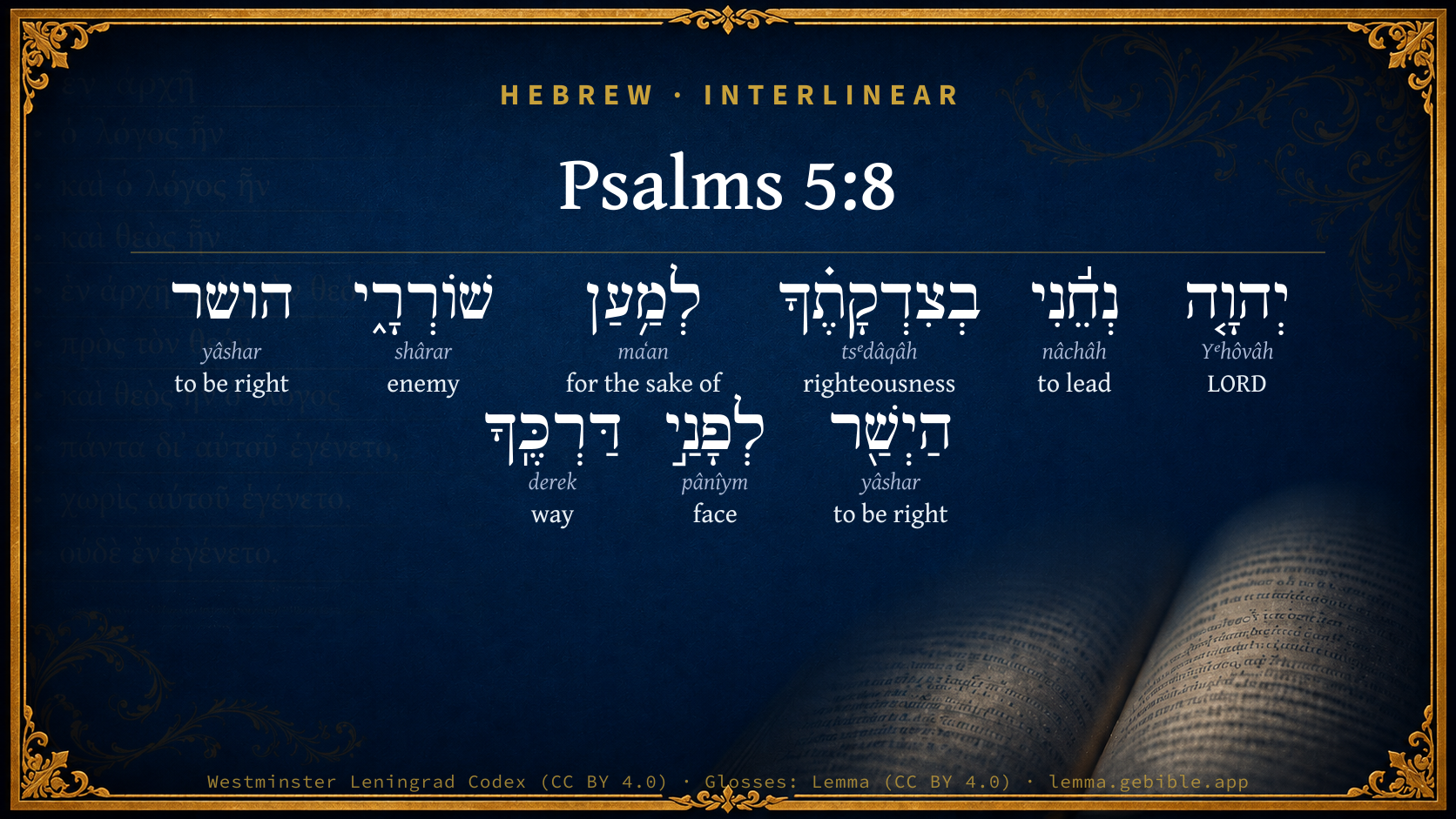
Psalms 5:8

Hebrew (Westminster Leningrad Codex) Psalms 5:8 appears in the Hebrew Old Testament. The text above is from the Westminster Leningrad Codex. Each word links to its Strong’s number, a concise gloss, and parsing drawn from the Open Scriptures Hebrew Bible morphology. Click any word for its full Brown-Driver-Briggs (BDB) entry.
Download image
Cite this verse

Psalms 5:8 (World English Bible). Public Domain. Lemma interlinear Bible study tool, https://lemma.gebible.app/v/psalms/5/8.

Show BibTeX & RIS
BibTeX
RIS
English Translation
Lead me, Yahweh, in your righteousness because of my enemies. Make your way straight before my face.
World English Bible · Public Domain
Highlights
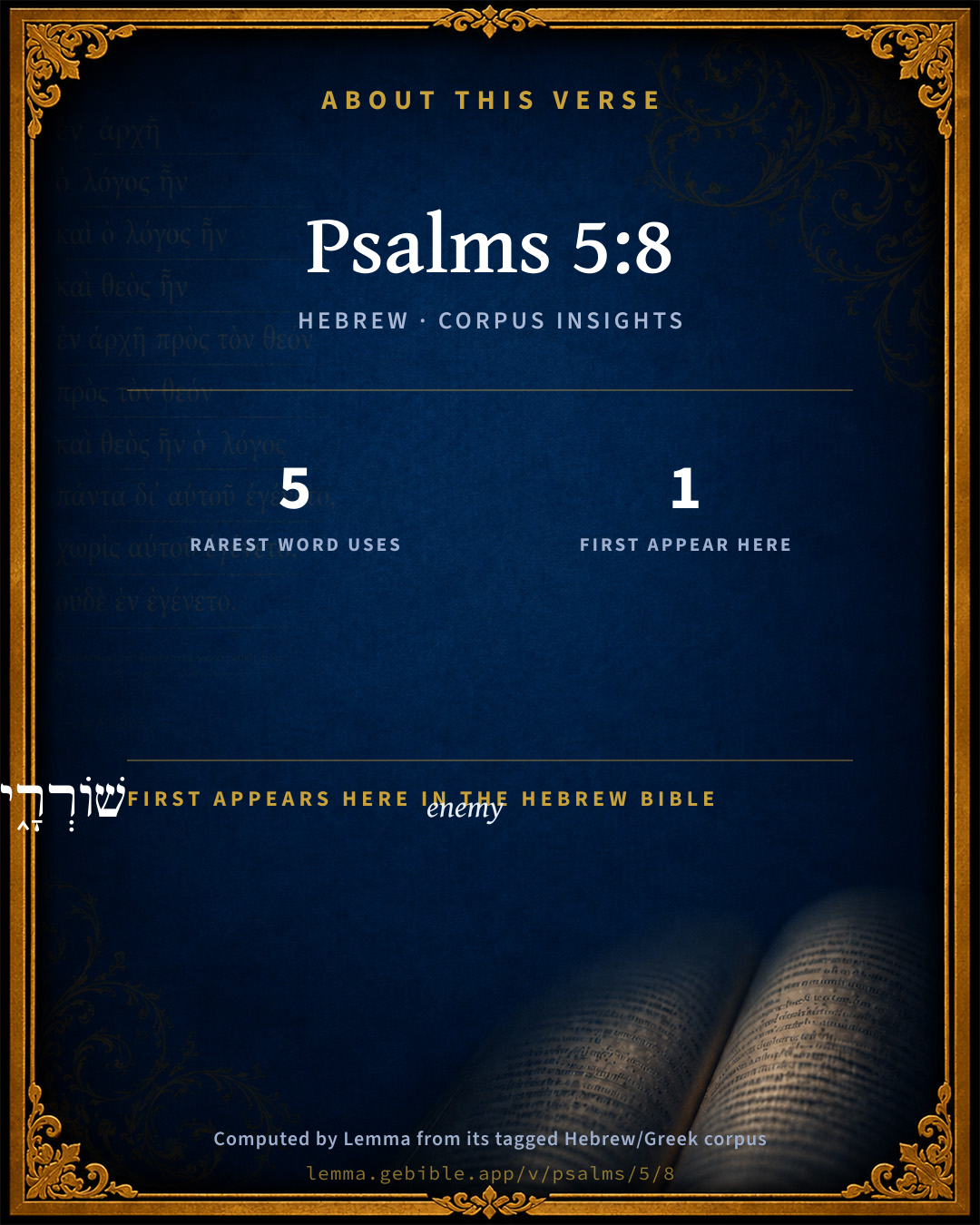
  • 1 first appearance in the Hebrew Bible
Full analysis ↓
Download a study sheet

One document with this verse’s original text, its word-by-word gloss line, the meaning frame, cross-references with their text, attributed commentary, and full source and license credits — printable, and it pastes into notes with its structure intact.

This verse Autodidact and up

Study sheet (.html) Plain text (.txt)

A passage Seminary Student

Up to 50 verses in one chapter. A passage sheet keeps up to 6 commentary sources and 12 cross-references per verse, in the order this page ranks them, and says so on the sheet whenever that leaves anything out. Ask for a single verse and you get the Autodidact verse sheet above.

Everything on this page stays free to read, with no account — the sheet is a download of what is already on screen, not access to it.

Want to remove ads? Support Godless Engineer
Compare translations 3

The same verse in 3 English versions, stacked beneath the original-language interlinear above. Click any original word for its lexicon entry.

Each is an independent rendering of the whole verse — the interlinear is not word-aligned to these translations.

Highlighted words mark where these versions differ — a whole-verse word diff, not a word-by-word alignment.

  • World English Bible Public Domain
    Lead me, Yahweh, in your righteousness because of my enemies. Make your way straight before my face.
  • King James Version Public Domain
    Lead me, O LORD, in thy righteousness because of mine enemies; make thy way straight before my face.
  • unfoldingWord Literal Text CC BY-SA 4.0
    Yahweh, guide me in your righteousness because of my watchers; straighten before my face your path.

unfoldingWord Literal Text — © unfoldingWord, licensed CC BY-SA 4.0. Word-aligned USFM3 via Door43 (git.door43.org/unfoldingWord/en_ult).

Versions to compare (up to 4)

3 of 4 selected

Show all 18 translations

Every available English version of this verse, each an independent rendering of the whole verse.

  • World English Bible Public Domain
    Lead me, Yahweh, in your righteousness because of my enemies. Make your way straight before my face.
  • Berean Standard Bible Public Domain
    Lead me, O LORD, in Your righteousness because of my enemies; make straight Your way before me.
  • Majority Standard Bible Public Domain
    Lead me, O LORD, in Your righteousness because of my enemies; make straight Your way before me.
  • King James Version Public Domain
    Lead me, O LORD, in thy righteousness because of mine enemies; make thy way straight before my face.
  • American Standard Version (1901) Public Domain
    Lead me, O Jehovah, in thy righteousness because of mine enemies; Make thy way straight before my face.
  • Revised Version (1885) Public Domain
    Lead me, O LORD, in thy righteousness because of mine enemies; make thy way plain before my face.
  • Geneva Bible (1599) Public Domain
    Leade me, O Lord, in thy righteousnes, because of mine enemies: make thy way plaine before my face.
  • Douay-Rheims (1899) Public Domain
    But as for me in the multitude of thy mercy, I will come into thy house; I will worship towards thy holy temple, in thy fear.
  • Young's Literal Translation Public Domain
    O Jehovah, lead me in Thy righteousness, Because of those observing me, Make straight before me Thy way,
  • Literal Standard Version CC BY-SA 4.0
    O YHWH, lead me in Your righteousness, || Because of those observing me, || Make Your way straight before me,
  • Unlocked Literal Bible CC BY-SA 4.0
    Oh Lord, lead me in your righteousness because of my enemies; make your path straight before me.
  • unfoldingWord Literal Text CC BY-SA 4.0
    Yahweh, guide me in your righteousness because of my watchers; straighten before my face your path.
  • Darby Bible Public Domain
    Lead me, Jehovah, in thy righteousness, because of my foes; make thy way plain before me.
  • World Messianic Bible Public Domain
    Lead me, LORD, in your righteousness because of my enemies. Make your way straight before my face.
  • Webster's Bible Public Domain
    \\5:7\\But as for me, I will come into thy house in the multitude of thy mercy: and in thy fear will I worship towards thy holy temple.
  • Free Bible Version CC BY-SA 4.0
    Lead me, Lord, you who always does what is right, save me from my enemies. Make your way clear to me.
  • Bible in Basic English Public Domain
    Be my guide, O Lord, in the ways of your righteousness, because of those who are against me; make your way straight before my face.
  • JPS Tanakh (1917) Public Domain
    (5-9) O LORD, lead me in Thy righteousness because of them that lie in wait for me; make Thy way straight before my face.

Literal Standard Version (2020), Covenant Press — licensed CC BY-SA 4.0. Text via the HelloAO Bible API (eBible.org). Unlocked Literal Bible (unfoldingWord) — licensed CC BY-SA 4.0. Text via the HelloAO Bible API (eBible.org). unfoldingWord Literal Text — © unfoldingWord, licensed CC BY-SA 4.0. Word-aligned USFM3 via Door43 (git.door43.org/unfoldingWord/en_ult). Free Bible Version, Dr. Jonathan Gallagher — licensed CC BY-SA 4.0. Text via the HelloAO Bible API (eBible.org).

Word by word

More ways to search: Search by grammar → Find every occurrence → Compare this word →

Practice this passage: Drill this verse → Learn its vocabulary →

שׁוֹרְרָ֑י
shârar
H8324
“enemies · my”
Noun, Common, Masculine, Plural, Construct + Suffix, Personal, 1st Person, Common, Singular
Part of Speech
Noun
Type
Common
Gender
Masculine
Number
Plural
State
Construct
Full BDB Definition

Origin: a primitive root

TWOT: 2469

(Qal) to be an enemy
  1. יְהוָ֤ה Yᵉhôvâh H3068 “LORD” Noun, Proper
  2. נְחֵ֬נִי nâchâh H5148 “lead · me” Verb, Qal, Imperative, 2nd Person, Masculine, Singular + Suffix, Personal, 1st Person, Common, Singular
  3. בְצִדְקָתֶ֗ךָ tsᵉdâqâh H6666 “in/at · righteousness · your” Preposition + Noun, Common, Feminine, Singular, Construct + Suffix, Personal, 2nd Person, Masculine, Singular
  4. לְמַ֥עַן maʻan H4616 “for the sake of” Preposition
  5. הושר yâshar H3474 “be right” Verb, Hiphil, Imperative, 2nd Person, Masculine, Singular
  6. הַיְשַׁ֖ר yâshar H3474 “be right” Verb, Hiphil, Imperative, 2nd Person, Masculine, Singular
  7. לְפָנַ֣י pânîym H6440 “to/for · face(s) · my” Preposition + Noun, Common, Both, Plural, Construct + Suffix, Personal, 1st Person, Common, Singular
  8. דַּרְכֶּֽךָ derek H1870 “way · your” Noun, Common, Both, Singular, Construct + Suffix, Personal, 2nd Person, Masculine, Singular

About this verse

These counts appear in no published source. They are computed here, from the morphology-tagged text and Lemma’s own curated glosses. What Lemma adds →

9
words
8
distinct lemmas
Wisdom
section

Notable vocabulary

The rarest word here is שׁוֹרְרָ֑י enemy H8324 — appearing just 5 times in the whole Hebrew Bible.

First appearance in Scripture

This word makes its first canonical appearance in the Hebrew Bible here:

  • שׁוֹרְרָ֑י enemy H8324

Shared distinctive vocabulary

שׁוֹרְרָ֑י enemy H8324 occurs in 5 verses of the Hebrew Bible. Also found in:

Grammatical profile

  • 3 verbs
  • 5 nouns
  • 1 preposition

Verb forms

  • נְחֵ֬נִי Qal · Imperative
  • הושר Hiphil · Imperative
  • הַיְשַׁ֖ר Hiphil · Imperative

Repetition

A word recurs within this verse — often emphatic in Hebrew:

  • הושר to be right H3474 ×2

Hebrew & Septuagint length

In English translation the verse runs 17 words from the Hebrew and 18 from the Septuagint (LXX English) — closely comparable.

A rough comparison of the two English renderings, which tokenize alike — not a word-level alignment.

Word counts can differ between the Hebrew and the Greek without any difference in meaning — e.g. the Hebrew direct-object marker אֵת has no separate Greek word, and Greek often adds the article ὁ.

Cross-references

13

Topical passages linked to Psalms 5:8 in the Treasury of Scripture Knowledge — connected by theme and wording, ordered by reader-vote popularity; previews shown in the World English Bible.

  • Psalms 27:11 Teach me your way, Yahweh. Lead me in a straight path, because of my enemies.
  • Psalms 25:4–5 Show me your ways, Yahweh. Teach me your paths.
  • Proverbs 3:5–6 Trust in Yahweh with all your heart, And don't lean on your own understanding.
  • Psalms 86:11 Teach me your way, Yahweh. I will walk in your truth. Make my heart undivided to fear your name.
  • Psalms 119:10 With my whole heart, I have sought you. Don't let me wander from your commandments.
  • Psalms 143:8–10 Cause me to hear your loving kindness in the morning, For I trust in you. Cause me to know the way in which I should walk, For I lift up my soul to you.
  • Proverbs 4:25 Let your eyes look straight ahead. Fix your gaze directly before you.
  • Psalms 119:64 The earth is full of your loving kindness, Yahweh. Teach me your statutes.
  • Psalms 31:1 In you, Yahweh, I take refuge. Let me never be disappointed: Deliver me in your righteousness.
  • Psalms 59:10 My God will go before me with his loving kindness. God will let me look at my enemies in triumph.
  • Matthew 3:3 For this is he who was spoken of by Isaiah the prophet, saying, "The voice of one crying in the wilderness, Make ready the way of the Lord, Make his paths straight."
  • Psalms 54:5 He will repay the evil to my enemies. Destroy them in your truth.
  • Hebrews 12:13 and make straight paths for your feet, so that which is lame may not be dislocated, but rather be healed.

Cross-references courtesy of OpenBible.info (CC BY 4.0).

Hebrew and Greek witnesses Masoretic Hebrew ↔ Greek Septuagint

The same verse in the two great witnesses to the Old Testament, shown verse-for-verse.

You’re reading Greek Psalm 5 (Hebrew Psalm 5). The Septuagint counts the superscription, so verse numbers can differ from the Hebrew — chapter-level alignment, not verse-by-verse. Numbering follows Rahlfs.

These are two independent witnesses, not word-aligned to each other, and the Septuagint is shown in lemma (dictionary) form.

Hebrew Psalms 5:8 Masoretic · Westminster Leningrad Codex

יְהוָ֤ה נְחֵ֬נִי בְצִדְקָתֶ֗ךָ לְמַ֥עַן שׁוֹרְרָ֑י הושר הַיְשַׁ֖ר לְפָנַ֣י דַּרְכֶּֽךָ

Lead me, Yahweh, in your righteousness because of my enemies. Make your way straight before my face.

World English Bible · Public Domain

Greek LXX Greek Psalm 5:8 Septuagint · lemma form

ἐγώ δέ ἐν ὁ πλῆθος ὁ ἔλεος σύ εἰςἔρχομαι εἰς ὁ οἶκος σύ προςκυνέω πρός ναός ἅγιος σύ ἐν φόβος σύ

Lead me, O Lord, in your righteousness because of my enemies; make my way plain before your face.

LXX2012 (modern English Septuagint) · Public Domain

Hebrew: Westminster Leningrad Codex (CC BY 4.0). Greek: Septuagint (public domain); English from LXX2012 (modern English Septuagint) (Public Domain). How the Septuagint differs from the Hebrew →

Commentary

Notes on Psalms 5:8 from classic Christian and Jewish commentators (each source and its license shown beneath its notes). The classic Christian expositions comment on the surrounding passage and are grouped to its opening verse, so a note may address several verses; the Jewish commentaries on the Tanakh (Rashi and others) are per-verse, so they appear only where the commentator wrote on this verse.

Lemma curates 59 commentaries, every one of them public domain or Creative Commons licensed, each selected and text-cleaned for this edition rather than reprinted as found. About our sources →

Trapp's Complete Commentary

John Trapp

Psa 5:8 Lead me, O LORD, in thy righteousness because of mine enemies; make thy way straight before my face.

Ver. 8. Lead me, O Lord, in thy righteousness] That is, in thy faithfulness, and according to thy promise in that behalf made unto me, to be my God and guide even unto death, to lead me in the way everlasting, to direct my footsteps in thy fear, &c. Deduc me ut non titubem, saith R. David, Lead me, that I stumble not; or if I do, yet that I fall not; for he that stumbleth and falleth not gets ground.

Because of mine enemies] Or, because of mine observers, who narrowly watch for my halting, that they might blaspheme thee, and thy religion through my default, 1Sa 18:9. Saul fixed his eyes upon David, but for no good to him. So 1Pe 2:12; 1Pe 3:2, wicked men spy, and pry accurately (as the word εποπτευσαντες signifieth) into the courses of God’s people, to see what evil they can find out and fasten on. We should, therefore, walk exactly, Eph 5:15, and pray earnestly, as here.

Make thy way straight before my face] Remove all rubs and remoras, and lay all plain and level, that I may walk and not be weary, run and not faint, Isa 40:31.

John Trapp, A Commentary or Exposition upon All the Books of the Old and New Testament (1647–1656) — public domain. Text from a community e-Sword module.

The Biblical Illustrator

Joseph S. Exell

Psa_5:8

Lead me, O Lord, in Thy righteousness.

A resolve and a prayer

God is addressed as a friend. Three things in Davids prayer.

1. What is the rule according to which he looks for this Divine guidance? Lead me in Thy righteousness. The righteousness here is Gods faithfulness. All Gods dealings with His people have been faithful.

2. Why he wishes this leading. It is that he may be divinely instructed in the right path. The Christian may sometimes be in a state of great perplexity as to the way he should go. He desires Divine guidance in the path of Christian experience, in the path of practice, and in the path of precept.

3. The motive he pleads to enforce it with God. The margin reads--Because of my observers. Who are our observers? The world, fellow Christians, ministers, angels, and God. (William Jay.)

Make Thy way straight before my face.--

Practical paths

Two men aspire to be inventors of first-rate rank. The one spends all his life in study and experiment, and lights upon nothing new; but the other has some surprising discovery to put before the public every year or two. How do we explain the difference? Is it luck and nothing more? The unsuccessful inventor, with perhaps equal ingenuity, is following impracticable and unremunerative paths for a lifetime. The successful inventor knows in what direction others have toiled without profit, and scarcely ever spends a week on a misleading scent. His shrewd despair of finding anything new or remunerative in certain directions shuts him up to one golden path of fruitful research. (Thomas G. Selby.)

The Biblical Illustrator, edited by Joseph S. Exell (c. 1880s–1900s) — public domain. Text from a community e-Sword module.

Joseph Benson's Commentary

Psa 5:8. Lead me, O Lord — Direct my heart, and counsels, and affairs, and all the course and actions of my life; in thy righteousness — In thy righteous laws, or, for, or, because of, or, according to, thy righteousness, a phrase and argument frequently used in the Psalms. Because of mine enemies — That I may give them no occasion of slandering me, or religion for my sake. Make the way — Wherein thou wouldst have me to walk, or the course thou wouldst have me to take; straight before my face — Plain to my view, that I may clearly discern it, and readily, evenly, and smoothly walk in it without mistake, hinderance, or stumbling, which my enemies would gladly take hold of. “Thus, a man’s enemies,” says Dr. Horne,

“while they oblige him to pray more fervently, and to watch more narrowly over his conduct, oftentimes become his best friends.”

Joseph Benson's Commentary on the Old and New Testaments (1811–1818) — public domain. Text from a community e-Sword module.

Tyndale Open Study Notes

Tyndale Open Resources

5:8 God guides those who are obedient, submissive, and patient in waiting for him to lead, provide, and protect them (27:11; 43:3; 143:10), not those who expect God simply to endorse their own decisions. • Following the right path of wisdom leads to the Lord (27:11; 61:2; 139:24).

Tyndale Open Study Notes — © Tyndale Open Resources, licensed CC BY-SA 4.0. Text via the HelloAO Bible API.

Geneva Bible (1599)

Geneva Bible translators

Because thou art just, therefore lead me out of the dangers of mine enemies.

Geneva Bible (1599) marginal notes — public domain. Text via Bolls.life.

Jamieson, Fausset & Brown

Robert Jamieson, A. R. Fausset & David Brown

enemies--literally, "watchers" (Psa 27:11), hence special need of guidance.

in thy righteousness--an attribute implying faithfulness in promises as well as threatenings.

make thy way straight--that is, make the way of providence plain.

Jamieson, Fausset & Brown — Commentary Critical and Explanatory on the Whole Bible (1871) — public domain (CC PDM 1.0). Text via the HelloAO Bible API.

Adam Clarke's Commentary

Verse 8. Lead me, O Lord, in thy righteousness] When entered into the house, and prostrated before the temple, he knew that, unless God continued to lead and direct, he was not likely to profit even by such great advantages. We need God not only to bring us to his house, but to keep our feet while we are there.

Because of mine enemies] His conduct was marked; his enemies looked upon and watched him with an evil eye. They would have been glad of his halting, that they might have brought a reproach on the good cause which he had espoused. O how cautiously should those walk who make a profession of living to God, of knowing themselves to be in his favour, and of being delivered from all sin in this life!

Make thy way straight] Show me that I must go right on; and let thy light always shine on my path, that I may see how to proceed.

Adam Clarke's Commentary on the Bible (1810–1826) — public domain. Text from a community e-Sword/MySword module.

John Calvin's Commentaries

8. O Jehovah, lead me forth, etc. Some explain these words thus: Show me what is right, and make me wholly devoted to the practice of that righteousness which adorns thy character; and do this because of my adversaries; for the saints, impelled by the wicked practice and deceitful arts of the ungodly, are in danger of turning aside from the right way. This meaning is unquestionably a pious and a useful one. But the other interpretation is more suitable, which views the words as a prayer that God would lead his servant in safety through the midst of the snares of his enemies, and open up to him a way of escape, even when, to all appearance, he was caught and surrounded on every side. The righteousness of God, therefore, in this passage, as in many others, is to be understood of his faithfulness and mercy which he shows in defending and preserving his people. Consequently, in thy righteousness means the same thing as for or according to thy righteousness. David, desiring to have God as the guide of his path, encourages himself in the hope of obtaining his request, because God is righteous; as if he had said, Lord, as thou art righteous, defend me with thine aid, that I may escape from the wicked plots of my enemies. Of the same import is the last clause of the verse, where he prays that the way of God may be made straight before his face, in other words, that he might be delivered by the power of God from the distresses with which he was so completely surrounded, that, according to the judgment of the flesh, he never expected to find a way of escape. And thus he acknowledges how impossible it was for him to avoid being entangled in the snares of his enemies, “Par ainsi il confesse n’avoir ne dexterite ne force, ne mesme aucun moyen pour eviter les embusches des ennemis.” — Fr. “Thus he confesses that he has neither skill nor power, nor any means whatever, by which to avoid the snares of his enemies.”

John Calvin's Commentaries (1540-1563) — public domain. Text from the Calvin Translation Society English edition (1840s-50s) via the Christian Classics Ethereal Library (ccel.org). Calvin's coverage is partial (roughly two-thirds of the Bible); uncommented books and verses are honest gaps, never fabricated. The 19th-century editor's footnotes and remarks are omitted so the notes are faithfully Calvin's own voice.

Ellicott's Commentary for English Readers

(8) Enemies.—Literally, those watching for, or lying in wait. Aquila and Jerome both give “those lying in ambush.” God’s guidance and protection would enable the good man to avoid their snares, and to walk straight in the way of righteousness. To walk in God’s way is to walk in safety.

A Bible Commentary for English Readers, edited by Charles John Ellicott (1878–1897) — public domain. Text from a community e-Sword module.

The Cambridge Bible for Schools and Colleges

gen. ed. J. J. S. Perowne

8. The prayer for guidance which is the main object and central thought of the Psalm.

Lead me … in thy righteousness] i.e. because Thou art righteous. A comparison of Psa_23:3; Pro_8:20; Pro_12:28; might incline us to understand the meaning to be, ‘Lead me in the path of right conduct which Thou hast marked out for me:’ but the true parallels are Psa_31:1, Psa_71:2, Psa_119:40, Psa_143:1; Psa_143:11; which shew clearly that God’s own righteousness is meant. One element of that righteousness is faithfulness to His saints in the fulfilment of covenant promises, and to this the Psalmist appeals.

because of mine enemies] A peculiar word found only in Psa_27:11, Psa_54:5, Psa_56:2, Psa_59:10. Render, as in R.V. margin, them that lie in wait for me, like fowlers (Jer_5:26, R.V.), or a leopard for its prey (Hos_13:7). He prays that he may be preserved from falling into their snares.

make thy way straight] Or, as P.B.V. and R.V., plain. The word means both level and straight. The godly man’s life is a path marked out for him by God (Psa_17:5, Psa_73:24, Psa_86:11). He prays that it may be such that he may be in no danger of stumbling or losing his way. ‘Bring us not into temptation.’

The Cambridge Bible for Schools and Colleges (gen. ed. J. J. S. Perowne; Cambridge University Press, 1878–1918) — public domain. Text from a community e-Sword module.

John Gill's Exposition

Lead me, O Lord, in thy righteousness,.... Not in mine, but thine; in the righteousness of God, which is revealed in the Gospel, from faith to faith, and is imputed by God, and received by faith; in this righteousness the psalmist desired to be led into the house of God, and appear before him; nor is there any other righteousness in which man can stand before God and worship. Or else the sense is, that God would lead him in the way of righteousness, in his righteous statutes, judgments, and ordinances; in which way the Lord does lead his people, Psa 23:3. Or that he would lead him for his righteousness' sake; because of his faithfulness to his promises, that he would direct, uphold, and never leave nor forsake him. David was very sensible that the way of man is not in himself, and that he could not direct his own steps; and therefore desired to be guided by the Lord, and to be led by the right hand of his righteousness, and to be upheld by it in his ways:

because of mine enemies; or, "those that observe me" (l) that lie in wait and watch for my halting, as Jeremiah's enemies did; and would rejoice at my fall, and insult me, and blaspheme thy name; therefore lead, guide, and uphold me;

make thy way straight before my face; thy way of providence, thy way of grace, thy way of worship and duty; let it appear plain and manifest, that I may know in which way I should walk; and let all obstructions be removed out of the way, that I may walk straight on, without any difficulty or hinderance. He seems to have respect to his enemies, who lay in his way, that God would remove them; see Psa 5:9.

(l) "observatores meos", Junius & Tremellius, Cocceius, Michaelis; so Aben Ezra, Kimchi, Ben Melech, & Ainsworth.

John Gill's Exposition of the Whole Bible (1746–1763) — public domain (CC PDM 1.0). Text via the HelloAO Bible API.

Albert Barnes' Notes on the Bible

Lead me, O Lord, in thy righteousness - That is, conduct me safely in the manifestation of the principles of justice or righteousness which belong to thy nature. David felt assured that his was a righteous cause, and that he might make his appeal to God on the ground of the justness of that cause. Such a ground of appeal is always proper when we are in danger or in trouble from the injustice of others, for we may always ask of God to interpose, and to cause that which is right to be done.

Because of mine enemies - On account of my enemies, or in respect to them; that is, that they may not triumph, but that I may be vindicated and may be delivered from them.

Make thy way straight before my face - The way in which thou wouldst have me to walk. That is, mark out or make plain before me the path for me to tread - the path in which thou wilt deliver me. He was in perplexity, and knew not which way to go, and he looks up to God for guidance and direction.

Albert Barnes' Notes on the Bible (1834–1885) — public domain. Text from a community e-Sword/MySword module.

Matthew Poole's English Annotations

Lead me; direct my heart, and counsels, and affairs, and all the course and actions of my life.

In thy righteousness; in thy righteous laws; which sometimes are called righteousness, as Psa 119:172; Mat 3:15. Or, for, or because of, or according to thy righteousness; which is a phrase and argument frequently used in this Book of Psalms.

Because of mine enemies; either,

1. That I may give them no occasion of slandering me, or religion for my sake. Or rather,

2. Because they are most malicious and mischievous, and withal cunning and treacherous, as he describes them in the next verse, (which he useth as an argument to enforce this petition,) and they lay snares for me, and if thou dost not assist me, will be too hard for me, and will triumph over me; which will reflect dishonour upon thee also.

Thy way, i.e. the way wherein thou wouldst have me to walk, or the course which thou wouldst have me to take; for God’s precepts or counsels are most commonly called his way.

Straight, or plain, or smooth, that I may clearly discern it, and readily walk in it, without mistake, or let, or stumbling, or offence. This was a needful request, because many good men are oft at a loss what their duty is in several circumstances. And God granted this request to David, as in many other things, so in this, that he should not cut off Saul when he had opportunity and instigation to do it, 1Sa 24; 1Sa 26, but that he should wait till God took him away.

Before my face; to my view and for my walk; for men walk forward, not backward.

Matthew Poole's English Annotations on the Holy Bible (1683–1685) — public domain. Text from a community e-Sword/MySword module.

Whedon's Commentary on the Bible

Daniel D. Whedon

8. In thy righteousness—It was not in human counsels and cognitions of right, but in Jehovah’s, that he was safe and might securely walk.

Mine enemies—Strictly, my observers, those who watch for me—waylayers. No human wisdom could cope with these trained and wily politicians, these ambushed “sharp shooters;” and hence it was not in cunning, but righteousness,—the righteousness of God—that he trusted. See Pro_10:9; 1Pe_3:13-16.

Thy way straight—The clearly revealed will of God is always a blessing, as it enables men to walk safely if they be obedient.

Daniel D. Whedon (gen. ed.), Commentary on the Old and New Testaments (1874–1909) — public domain. Text from a community e-Sword module.

The Pulpit Commentary

Lead me, O Lord, in thy righteousness. Here at last we find what David prayed for. Previously, we have only heard him entreat that his prayer may be heard (vers. 1, 2), declare that he will pray early (ver. 3), and before the tabernacle (ver. 7); now we learn what his prayer is. It is that God will lead him in the path of his righteousness that righteousness of which he is the pattern, and whereof he approves; and will "make his way plain for him," i.e. show it him clearly, so that he cannot mistake it. God is asked to do this, especially because of David"s enemies, or of "those that lie in wait for him" (Revised Version margin), lest, if he were to make a false step, they should triumph over him, and so he should bring discredit upon the cause of God and of his saints. Make thy way straight (plain, Revised Version) before my face. Not so much "smooth my way," or "make it level" or "easy," as put it plainly before me". (scrap. Psa_25:5; and Psa_27:11, me thy way, O Lord, and lead me in a plain path, because of mine enemies

Vers. 8-12. The righteousness of God.

This second strophe of the psalm is very much like the first in substance, the matter running parallel with vers. 3-7. The fundamental thought on which all is based is that of the righteousness of God. The whole prayer is framed on that conception.

I A PRAYER FOR RIGHTEOUS DELIVERANCE AND GUIDANCE.

1. For righteous guidance. "Lead me in thy righteousness; make thy way the right way plain to me.

2. For righteous deliverance. The unrighteous lay in wait for him threatened his safety. There was "no faithfulness in their mouth;" they used slander and treachery when they dared not use open violence. Their inward part, their souls. were full of evil designs and purposes. "Their throat is like an open sepulchre," which yawns for his destruction. Their speech, fair and smooth, to flatter and put him off his guard and lure him on. With them, mouth, heart, throat, and tongue are all instruments of evil; and their malice was such that he needed the care and guidance of the righteous power above.

II A PRAYER FOR RIGHTEOUS RETRIBUTION. (Ver. 10) Punish. "The word properly signifies such a decision and judgment as would show and manifest what sort of neighbours they are when their ungodly dispositions are disclosed and every one is made known." Show them guilty. Let them fall through or because of their own counsels. Their counsels are of such an evil nature that they must in the end ensure their destruction. By means of their transgressions thrust them away the same thought in substance as the last. But the great argument for retribution is they have rebelled against thee. The enemies of the psalmist are the enemies of God. God"s cause and that of his people are the same. Whoso toucheth you, toucheth the apple of mine eye; "Saul, Saul, why porsecutest thou me?

III PRAYER FOR THE REALIZATION OF A RIGHTEOUS JOY. (Vers. 11, 12) This joy proceeds:

1. From the sense of refuge and defence we have in God.

2. From the love we have to God, for his goodness and righteousness.

3. From the knowledge we have that God does assuredly bless the righteous. S.

The Pulpit Commentary (1880–1919), ed. H.D.M. Spence-Jones & Joseph S. Exell — public domain. Text from a community e-Sword module.

John Wesley's Explanatory Notes

Righteousness - In thy righteous laws. Because - That I may give them no occasion of slandering me, or religion for my sake. The way - The way wherein thou wouldst have to one walk. Plain - That I may clearly discern it, and readily walk in it.

John Wesley, Explanatory Notes Upon the Whole Bible (1754–1765) — public domain. Text via the GEBible commentary corpus.

J. A. Alexander on Psalms

Joseph Addison Alexander

8. For the same reason he is equally confident in the anticipation of his own deliverance. Since his enemies must perish as the enemies of God, he must escape, not on account of his own merit, nor simply as an object of God's favour, but as the champion of his cause, his earthly vicegerent, the type and representative of his Messiah. And I, as distinguished from these sinners, in the abundance of thy mercy, which excludes all reliance on his own strength or goodness, will come to thy house, the tabernacle set up on Mount Zion by David. I will worship, literally prostrate or bow myself, towards thy temple of holiness, thy holy temple, or rather palace, so called as the residence of Israel's divine King, and therefore no less applicable to the tabernacle than the temple. See 1Sa 1:9; 1Sa 3:3, Psa 27:4; Psa 28:2. Towards, not in, because the worshippers did not go into the sanctuary itself, but worshipped in the court, with their faces turned towards the place of God's manifested presence. Such usages are now superseded by the advent of the true sanctuary. See above, on Psa 3:5. In thy fear, the reverence engendered even by the view and the experience of God's mercy. There may be an allusion in this verse to David's painful sense of his exclusion from the house of God (2Sa 15:25); but it cannot be merely an anticipation of renewed access to the sanctuary, which was equally open to all others, and could not therefore be used to indicate the contrast between his condition and that of others. The verse is rather an engagement to acknowledge God's delivering mercy in the customary manner. See below, Psa 66:13. As if he had said, While my enemies perish by the hand of God, I shall be brought by his mercy to give thanks for my deliverance at his sanctuary.

Joseph Addison Alexander, The Psalms Translated and Explained (1850) — public domain. Text from a community e-Sword module.

Rashi

Rabbi Shlomo Yitzchaki (Rashi)

I...shall enter Your House to thank You for Your great loving-kindness that You have wondrously bestowed upon us, to grant us revenge upon them.

Rashi on the Tanakh — English translations: “The Judaica Press complete Tanach with Rashi, translated by A. J. Rosenberg” (CC BY 4.0); “Pentateuch with Rashi's commentary by M. Rosenbaum and A.M. Silbermann, 1929-1934” (public domain); “The Metsudah Tanach series, Lakewood, N.J” (CC BY 4.0); and “The Book of Joshua, Metsudah Publications, 1997” (CC BY 4.0). Text via Sefaria.

Radak

Rabbi David Kimhi (Radak)

But as for me, in the multitude of Thy loving – kindness – they are despised in Thine eyes, but as for me, I will take my stand in Thy sight and before Thee.

I will come into Thine House: – in the multitude of Thy loving-kindness which I hope for from Thee.

In Thy fear will I worship toward Thy holy Temple – which is before me. And the interpretation of toward (Thy) temple (is): because the worshipper of God makes the Temple and the Holy Place (the object) of his longing desire, and worships God as though before it. And the interpretation of Thine House and Thy holy Temple (is): the House which contained the Ark.

Radak on the Tanakh — English translations: “Sefaria Community Translation” (CC0 1.0 (public-domain dedication)); “Eliyahu Munk, HaChut Hameshulash” (CC BY 4.0); “Rabbi Mike Feuer, Jerusalem Anthology” (CC BY 4.0); and “R. David Kimhi on the first book of Psalms, Translated by R.G. Finch, London, 1919” (public domain). Text via Sefaria.

Ibn Ezra

Rabbi Abraham ibn Ezra

But I (וַאֲנִי - Va'ani): He returns to what he began [in verse 4]: "at daybreak You hear my voice." [The connection is that] he comes to the house of Ad-nai, but he does not have a Minchah (Gift/Grain Offering) with him to bow down with in His temple (be-heikhalo). [This contrasts with] the one bringing the first fruits of the ground (reishit pri ha-adamah), concerning whom it is written (Deuteronomy 26:10): "and you shall bow down (ve-hishtachavita) before Ad-nai your God." And behold, the meaning is: I do not have a Minchah offering, but only [the offering of] acknowledging Your abundant love (rov chasdekha) towards me.

And the meaning of in Your awe/fear (בְּיִרְאָתֶךָ - be-yir'atekha) is: I have nothing with which to bow down except with my awe/fear (yir'ati) of You. Similar [is the usage in (Exodus 20:17)]: "...and that His fear (yir'ato) may be before your faces." For others [also] fear (yir'u) HaShem.

Ibn Ezra on the Tanakh — English translations: “Sefaria Community Translation” (CC0 1.0 (public-domain dedication)); “Yalkut, Sifsei Chachomim Chumash, Metsudah Publications, 2009” (CC BY 4.0); and “Commentary of Ibn Ezra on Isaiah - trans. by M. Friedlander, 1873” (public domain). Text via Sefaria.

Lesson kit

Teaching starters — assembled from the data on this page, not authored interpretation. Every prompt links to the verse data it draws on. Edit before teaching.

Psalms, in the Wisdom, opens this verse with 9 words (8 distinct Hebrew lemmas). Its most distinctive word is shârar (“enemy”). A historical commentator’s framing appears above. Read the whole chapter for the surrounding context.

Discussion questions

  1. The word shârar carries the sense “enemy.” How does it shape the verse?
  2. This is the first place “enemy” appears in Scripture (first appears here). What does its debut here establish?
  3. How does Psalms 27:11, which shares the word «enemy», read alongside this verse?
  4. What does the repetition of “to be right” (2× in this one verse) do in this verse?
  5. These translations render this verse differently. What is at stake in choosing one wording over another?
  6. «נְחֵ֬נִי» is a Qal Imperative verb. How does that grammatical form shape the action described?
  7. Compare how Trapp's Complete Commentary and The Biblical Illustrator read this verse. Where do they agree or differ?

Things to notice

  • 1 word makes its first canonical appearance in Scripture here.
  • These translations choose different wording for 13 words in this verse.
  • “to be right” occurs 2× in this single verse.
  • 8 distinct Hebrew lemmas span 9 words in this verse.

Reading settings

Reading text

Shown beneath each verse's original-language words.

Old Testament
Old Testament edition

Read the OT as the Masoretic Hebrew (MT) or the Greek Septuagint (LXX).

English shown for the Greek Septuagint (in the Hebrew ↔ Greek comparison).

Comparing translations? Open the Compare panel on any verse page to stack up to four side by side.