
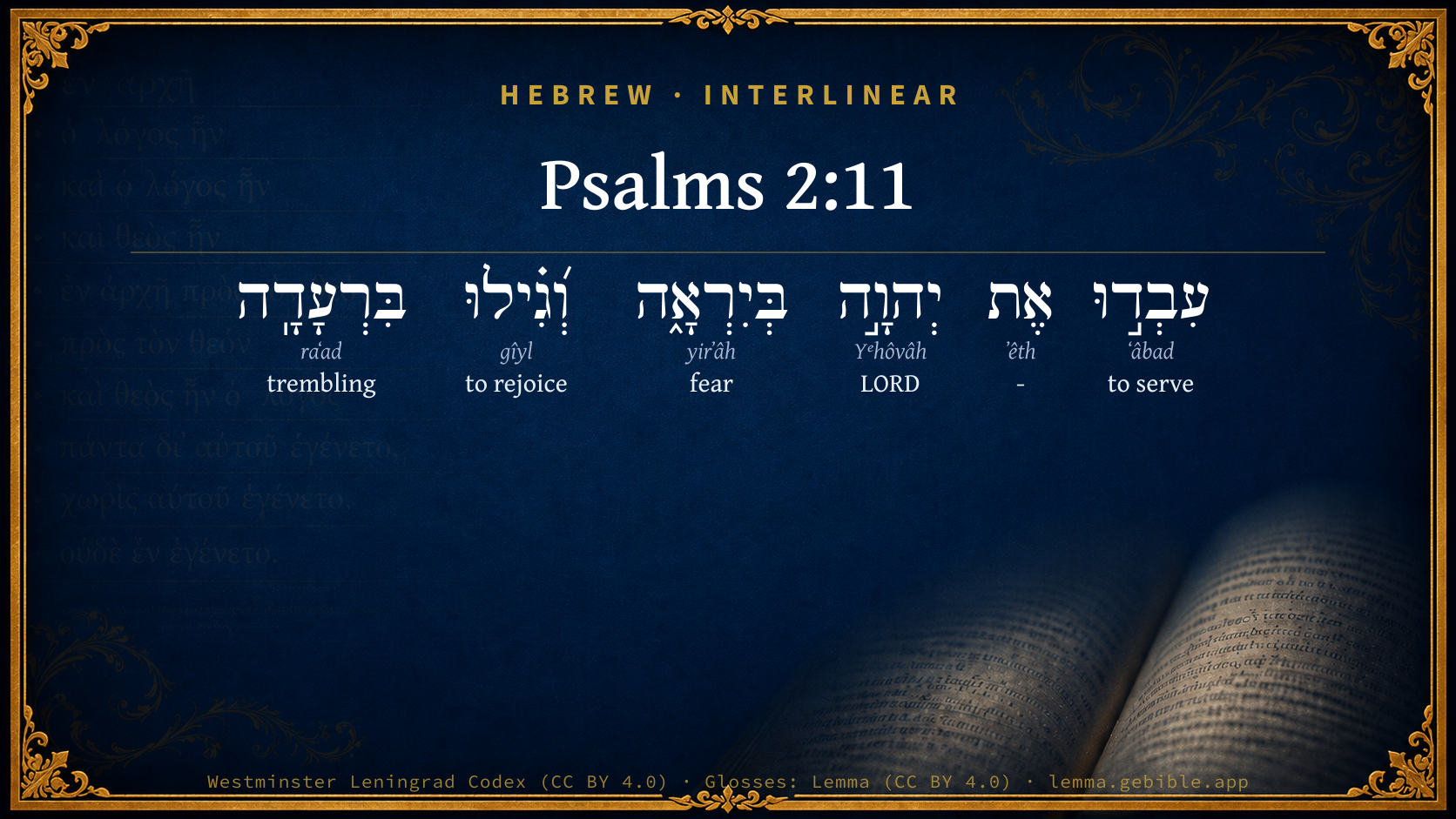
Psalms 2:11

Hebrew (Westminster Leningrad Codex) Psalms 2:11 appears in the Hebrew Old Testament. The text above is from the Westminster Leningrad Codex. Each word links to its Strong’s number, a concise gloss, and parsing drawn from the Open Scriptures Hebrew Bible morphology. Click any word for its full Brown-Driver-Briggs (BDB) entry.
Download image
Cite this verse

Psalms 2:11 (World English Bible). Public Domain. Lemma interlinear Bible study tool, https://lemma.gebible.app/v/psalms/2/11.

Show BibTeX & RIS
BibTeX
RIS
English Translation
Serve Yahweh with fear, And rejoice with trembling.
World English Bible · Public Domain
Download a study sheet

One document with this verse’s original text, its word-by-word gloss line, the meaning frame, cross-references with their text, attributed commentary, and full source and license credits — printable, and it pastes into notes with its structure intact.

This verse Autodidact and up

Study sheet (.html) Plain text (.txt)

A passage Seminary Student

Up to 50 verses in one chapter. A passage sheet keeps up to 6 commentary sources and 12 cross-references per verse, in the order this page ranks them, and says so on the sheet whenever that leaves anything out. Ask for a single verse and you get the Autodidact verse sheet above.

Everything on this page stays free to read, with no account — the sheet is a download of what is already on screen, not access to it.

Want to remove ads? Support Godless Engineer
Compare translations 3

The same verse in 3 English versions, stacked beneath the original-language interlinear above. Click any original word for its lexicon entry.

Each is an independent rendering of the whole verse — the interlinear is not word-aligned to these translations.

Highlighted words mark where these versions differ — a whole-verse word diff, not a word-by-word alignment.

  • World English Bible Public Domain
    Serve Yahweh with fear, And rejoice with trembling.
  • King James Version Public Domain
    Serve the LORD with fear, and rejoice with trembling.
  • unfoldingWord Literal Text CC BY-SA 4.0
    Serve Yahweh with fear and rejoice with trembling.

unfoldingWord Literal Text — © unfoldingWord, licensed CC BY-SA 4.0. Word-aligned USFM3 via Door43 (git.door43.org/unfoldingWord/en_ult).

Versions to compare (up to 4)

3 of 4 selected

Show all 18 translations

Every available English version of this verse, each an independent rendering of the whole verse.

  • World English Bible Public Domain
    Serve Yahweh with fear, And rejoice with trembling.
  • Berean Standard Bible Public Domain
    Serve the LORD with fear, and rejoice with trembling.
  • Majority Standard Bible Public Domain
    Serve the LORD with fear, and rejoice with trembling.
  • King James Version Public Domain
    Serve the LORD with fear, and rejoice with trembling.
  • American Standard Version (1901) Public Domain
    Serve Jehovah with fear, And rejoice with trembling.
  • Revised Version (1885) Public Domain
    Serve the LORD with fear, and rejoice with trembling.
  • Geneva Bible (1599) Public Domain
    Serue the Lord in feare, and reioyce in trembling.
  • Douay-Rheims (1899) Public Domain
    Serve ye the Lord with fear: and rejoice unto him with trembling.
  • Young's Literal Translation Public Domain
    Serve ye Jehovah with fear, And rejoice with trembling.
  • Literal Standard Version CC BY-SA 4.0
    Serve YHWH with fear, || And rejoice with trembling.
  • Unlocked Literal Bible CC BY-SA 4.0
    Worship Yahweh in fear and rejoice with trembling.
  • unfoldingWord Literal Text CC BY-SA 4.0
    Serve Yahweh with fear and rejoice with trembling.
  • Darby Bible Public Domain
    Serve Jehovah with fear, and rejoice with trembling.
  • World Messianic Bible Public Domain
    Serve the LORD with fear, and rejoice with trembling.
  • Webster's Bible Public Domain
    Serve the LORD with fear, and rejoice with trembling.
  • Free Bible Version CC BY-SA 4.0
    Serve the Lord in reverence, celebrate with trembling!
  • Bible in Basic English Public Domain
    Give worship to the Lord with fear, kissing his feet and giving him honour,
  • JPS Tanakh (1917) Public Domain
    Serve the LORD with fear, and rejoice with trembling.

Literal Standard Version (2020), Covenant Press — licensed CC BY-SA 4.0. Text via the HelloAO Bible API (eBible.org). Unlocked Literal Bible (unfoldingWord) — licensed CC BY-SA 4.0. Text via the HelloAO Bible API (eBible.org). unfoldingWord Literal Text — © unfoldingWord, licensed CC BY-SA 4.0. Word-aligned USFM3 via Door43 (git.door43.org/unfoldingWord/en_ult). Free Bible Version, Dr. Jonathan Gallagher — licensed CC BY-SA 4.0. Text via the HelloAO Bible API (eBible.org).

Word by word

More ways to search: Search by grammar → Find every occurrence → Compare this word →

Practice this passage: Drill this verse → Learn its vocabulary →

About this verse

These counts appear in no published source. They are computed here, from the morphology-tagged text and Lemma’s own curated glosses. What Lemma adds →

6
words
6
distinct lemmas
Wisdom
section

Notable vocabulary

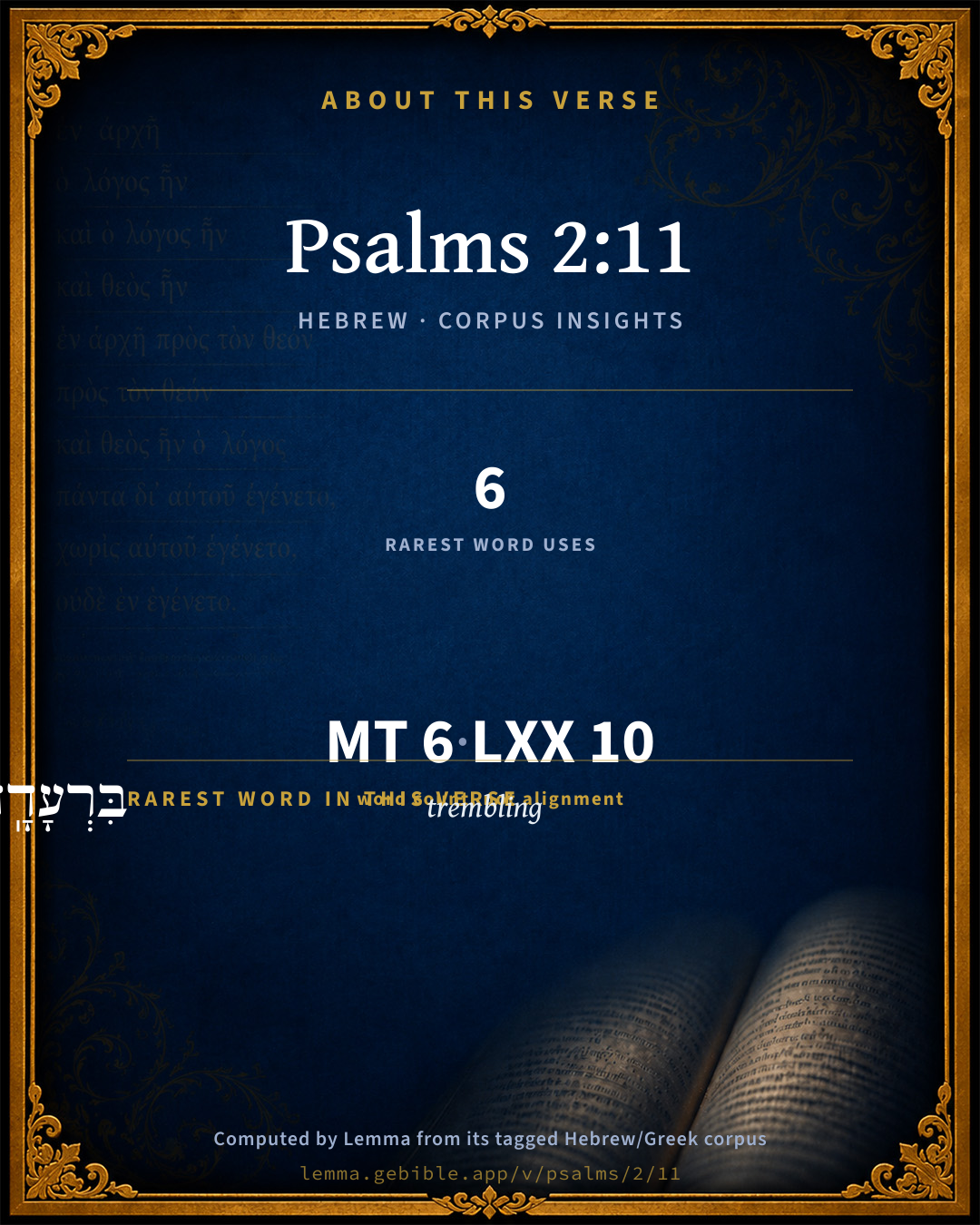
The rarest word here is בִּרְעָדָֽה trembling H7461 — appearing just 6 times in the whole Hebrew Bible.

Shared distinctive vocabulary

בִּרְעָדָֽה trembling H7461 occurs in 6 verses of the Hebrew Bible. Also found in:

Grammatical profile

  • 2 verbs
  • 3 nouns
  • 1 particle

Verb forms

  • עִבְד֣וּ Qal · Imperative
  • וְ֝גִ֗ילוּ Qal · Imperative

Hebrew & Septuagint length

In English translation the verse runs 8 words from the Hebrew and 11 from the Septuagint (LXX English) — closely comparable.

A rough comparison of the two English renderings, which tokenize alike — not a word-level alignment.

Word counts can differ between the Hebrew and the Greek without any difference in meaning — e.g. the Hebrew direct-object marker אֵת has no separate Greek word, and Greek often adds the article ὁ.

In the original languages it is 6 Hebrew tokens and 10 Greek tokens — but the two are counted differently (Hebrew bundles its prefixes and suffixes into one token; the Greek is in lemma form), so that isn’t a like-for-like length.

Cross-references

9

Topical passages linked to Psalms 2:11 in the Treasury of Scripture Knowledge — connected by theme and wording, ordered by reader-vote popularity; previews shown in the World English Bible.

  • Philippians 2:12 So then, my beloved, even as you have always obeyed, not only in my presence, but now much more in my absence, work out your own salvation with fear and trembling.
  • Hebrews 12:25 See that you don't refuse him who speaks. For if they didn't escape when they refused him who warned on the Earth, how much more will we not escape who turn away from him who warns from heaven,
  • Hebrews 12:28–29 Therefore, receiving a Kingdom that can't be shaken, let us have grace, through which we serve God acceptably, with reverence and awe,
  • Psalms 89:7 A very awesome God in the council of the holy ones, To be feared above all those who are around him?
  • Psalms 119:119–120 You put away all the wicked of the earth like dross. Therefore I love your testimonies.
  • Hebrews 4:1–2 Let us fear therefore, lest perhaps a promise being left of entering into his rest, anyone of you should seem to have come short of it.
  • Psalms 97:1 Yahweh reigns! Let the earth rejoice! Let the multitude of islands be glad!
  • Psalms 95:1–8 Oh come, let's sing to Yahweh. Let's shout aloud to the rock of our salvation!
  • Psalms 99:1 Yahweh reigns! Let the peoples tremble. He sits enthroned among the cherubim. Let the earth be moved.

Cross-references courtesy of OpenBible.info (CC BY 4.0).

Hebrew and Greek witnesses Masoretic Hebrew ↔ Greek Septuagint

The same verse in the two great witnesses to the Old Testament, shown verse-for-verse.

You’re reading Greek Psalm 2 (Hebrew Psalm 2). The Septuagint counts the superscription, so verse numbers can differ from the Hebrew — chapter-level alignment, not verse-by-verse. Numbering follows Rahlfs.

These are two independent witnesses, not word-aligned to each other, and the Septuagint is shown in lemma (dictionary) form.

Hebrew Psalms 2:11 Masoretic · Westminster Leningrad Codex

עִבְד֣וּ אֶת יְהוָ֣ה בְּיִרְאָ֑ה וְ֝גִ֗ילוּ בִּרְעָדָֽה

Serve Yahweh with fear, And rejoice with trembling.

World English Bible · Public Domain

Greek LXX Greek Psalm 2:11 Septuagint · lemma form

δουλεύω ὁ κύριος ἐν φόβος καί ἀγαλλιάομαι αὐτός ἐν τρόμος

Serve the Lord with fear, and rejoice in him with trembling.

LXX2012 (modern English Septuagint) · Public Domain

On this verse, The Cambridge Bible for Schools and Colleges discusses the Septuagint’s reading. Read the note in Commentary ↓

Hebrew: Westminster Leningrad Codex (CC BY 4.0). Greek: Septuagint (public domain); English from LXX2012 (modern English Septuagint) (Public Domain). How the Septuagint differs from the Hebrew →

Commentary

Notes on Psalms 2:11 from classic Christian and Jewish commentators (each source and its license shown beneath its notes). The classic Christian expositions comment on the surrounding passage and are grouped to its opening verse, so a note may address several verses; the Jewish commentaries on the Tanakh (Rashi and others) are per-verse, so they appear only where the commentator wrote on this verse.

Lemma curates 59 commentaries, every one of them public domain or Creative Commons licensed, each selected and text-cleaned for this edition rather than reprinted as found. About our sources →

Trapp's Complete Commentary

John Trapp

Psa 2:11 Serve the LORD with fear, and rejoice with trembling.

Ver. 11. Serve the Lord with fear] Timore non servili sed amicali, with reverence and godly fear, Heb 12:28. Say to Christ, as the people did to Joshua, Jos 1:16, and as the rulers and elders of Israel did to Jehu, 2Ki 10:5, "We are thy servants, and will do all thou shalt bid us."

And rejoice before him with trembling] A strange mixture of contrary passions (for base fear hath torment, 1Jn 4:18), but such as is usual with God’s servants, whose task it is to work out their salvation with fear and trembling, Php 2:12. Agreeable whereunto is that of Bernard, Laeti simus sed non securi; gaudentes in Domino sed caventes a recidivo. Those good women went from Christ’s sepulchre with fear and great joy. We should come to him in his ordinances similarly affected.

John Trapp, A Commentary or Exposition upon All the Books of the Old and New Testament (1647–1656) — public domain. Text from a community e-Sword module.

The Biblical Illustrator

Joseph S. Exell

Psa_2:11

Serve the Lord with fear, and rejoice with trembling.

Antagonistic forces

The scientist tells us that the laws of nature are arranged on the principle of antagonistic forces; and it is somewhat thus with the laws of the Christian life.

I. The two states of feeling referred to.

1. Fear. There are two kinds, servile and filial. The latter is indicated here. A noble sensitiveness, an anxious consciousness, a salutary apprehensiveness.

2. And rejoice with trembling, that is, with diffidence.

II. These two states of feeling are not incompatible. They are only apparently so. How often in nature contradictory materials and forces blend--hydrogen and oxygen, nitrogen and oxygen. Attraction and repulsion are really complementary, and not contradictory.

III. They are essential to the security and development of the Christian life. They not only may, but ought, to exist together.

1. We ought to fear. The brighter the star the more it trembles.

2. And we ought to rejoice. Fear without joy is torment, and joy without holy fear would be presumption. (W. L. Watkinson.)

The reverence due to Divine Providence

Fear, very necessary for us all. Yet not inordinate fear. Religion regulates it and Gods Word cautions us against superstitious terrors (Jer_10:2-3). But we are to take notice of what He does and learn His will thereby. Many fail to do this by the common events of His providence; hence special and extraordinary ones are, at times, sent to us. Men avoid the lessons of them. They say They did not do us harm. But others may come and destroy you. And is not the fact of such forbearance a reason for not despising them? But they are natural, say others, And are not life and death natural? Terror alone is of no use, but generally the first motive of reformation. But our dangers do not proceed from our sins: we are no worse than others--so speak some. Are we sure that we are not greater sinners than others? Think of our national sins. Some would fly away from Gods judgments. Fly from your iniquities, if you would be safe. Some are afraid to express their convictions lest the world despise them. But take care lest our Lords words concerning them who deny Him before men apply to you. You are not called to forsake your proper duties, nor even relaxations, but your absorption in these things. Fear not man. The good will not shun you. Let the rest do so. Examine your state of heart. All is well if that be right with God. If not, humble yourself before Hint. (T. Secker.)

Divine service

I. The universal obligation. No man liveth to himself, and no man dieth to himself. We cannot even die without affecting others, much less can we live without influencing to a greater or less degree the condition and character of those by whom we are surrounded. This is not merely a fact, it is a law. There may be individual unwillingness, as in the case of a miser; or the principle may be socially counter-wrought. All classes unite in working for the common good; knowing it or not, whether they be willing or not, all serve the state-unity which they compose. In the language of the text, the business of all created life is to serve the Lord.

II. Particular obedience.

1. To serve God consciously.

2. To serve God reverently. Think how great and how good a Master! Our particular place and work may be humble; yet the whole is sublime. Angels, free from all distraction in the sinless world, are working at the grander parts; our work and theirs are yet to be brought together. Ours, therefore, must be our very best, or better be left undone.

3. To serve God fearfully. As having failed, and yet having been forgiven. As having promised better things, and yet as knowing ourselves weak; and finally, as bearing in mind the testing time. (J. M. Stott, M. A.)

Christian reverence

In a Christians course fear and love must go together. In heaven, love will absorb fear. No one now can love God aright without fearing Him. Self-confident men, who do not know their own hearts, or the reasons they have for being dissatisfied with themselves, do not fear God, and they think this bold freedom is to love Him. Deliberate sinners fear, but cannot love Him. But devotion to Him consists in love and fear, as we may understand from our ordinary attachment to each other. No one really loves another who does not feel a certain reverence towards him. It is mutual respect which makes friendship lasting. So again in the feelings of inferiors towards superiors. Fear must go before love. Till he who has authority shows he has it and can use it, his forbearance will not be valued truly: his kindness will look like weakness. We learn to contemn what we do not fear, and we cannot love what we contemn. So in religion also, We cannot understand Christs mercies till we understand His power, His glory, His unspeakable holiness, and our demerits; that is, until we first fear Him. Not that fear comes first, and then love; for the most part they will proceed together. Fear is allayed by the love of Him, and our love sobered by our fear of Him. Thus He draws us on with encouraging voice amid the terrors of His threatenings. Are we in danger of speaking or thinking of Christ irreverently? We may not be in danger of deliberate profaneness, but we are in danger of this, namely, of allowing ourselves to appear profane, and of gradually becoming irreverent while we are pretending to be so. Careless language cannot be continued without its affecting the heart at last. Men become the cold, indifferent, profane characters they professed themselves to be. (J. H. Newman, B. D.)

Rejoice with trembling.

The mixture of joy and fear in religion

Joy and fear are two great springs of human action. The mixed condition of this world gives scope for both. Each of them possesses a proper place in religion. Under the present imperfection of human nature each of these principles may be carried to a dangerous extreme. When the whole of religion is placed in joy it is in hazard of rising into unwarrantable rapture. When it rests altogether on fear it degenerates into superstitious servility. Joy tempered with fear is the proper disposition of a good man.

I. Joy is essential to religion. Religion inspires joy. It confers the two most material requisites of joy, a favourable situation of things without and a proper disposition of mind within. It infuses those mild and gentle dispositions whose natural effect is to smooth the temper of the soul. Benevolence and candour, moderation and temperance, wherever they reign, produce cheerfulness and serenity, The consciousness of integrity gives ease and freedom to the mind. As religion inspires joy, so what it inspires it commands us to cherish. Religious obedience, destitute of joy, is not genuine in its principle. We serve with pleasure the benefactor whom we love. Exclude joy from religion and you leave no other motives to it, except compulsion and interest. As religion destitute of joy is imperfect in its principle, so in practice it must be unstable. In vain you endeavour to fix any man to the regular performance of that in which he finds no pleasure. Bind him ever so fast by interest or fear, he will contrive some method of eluding the obligation. Estimate, therefore, the genuineness of your religious principles; estimate the degree of your stability in religious practice, by the degree of your satisfaction in piety and virtue.

II. When we rejoice we should rejoice with trembling.

1. Because all the objects of religion which afford ground for joy tend to inspire, at the same time, reverence and fear.

2. As joy, tempered by fear, suits the nature of religion, so it is requisite for the proper regulation of the conduct of man. Let his joy flow from the best and purest source, yet, if it remain long unmixed, it is apt to become dangerous to virtue, It is wisely ordered in our present state that joy and fear, hope and grief should act alternately as checks and balances upon each other, in order to prevent all excess in any of them which our nature could not bear.

3. The unstable condition of all human beings, naturally inspires fear in the midst of joy. Vicissitudes of good and evil, of trials and consolations, fill up mans life. Whether we consider life or death, time or eternity, all things appear to concur in giving to man the admonition of the text, rejoice with trembling. (Hugh Blair, D. D.)

The Biblical Illustrator, edited by Joseph S. Exell (c. 1880s–1900s) — public domain. Text from a community e-Sword module.

Joseph Benson's Commentary

Psa 2:11. Serve the Lord with fear — That is, with reverence and an awful sense of his great and glorious majesty, rendering you careful and diligent to please him, and afraid to offend him. And rejoice — Do not esteem his yoke your dishonour and grievance, but know that it is a greater glory and happiness to be the subjects of this King than to be the emperors of the greatest empire; and accordingly rejoice in it, and bless God for this inestimable grace and benefit; with trembling — This is added to signify the quality of the joy to which he calls them and to distinguish it from that carnal and worldly rejoicing which is usually attended with security and presumption; and to warn them to take heed that they did not turn this grace of God into wantonness; but, on the contrary, work out their salvation with fear and trembling.

Joseph Benson's Commentary on the Old and New Testaments (1811–1818) — public domain. Text from a community e-Sword module.

Tyndale Open Study Notes

Tyndale Open Resources

2:11-12 rejoice: Rulers must welcome the Son as their true and only King. • Submit to God’s royal son (or Submit to God’s royal Son, or kiss the son): Kissing was an expression of submission (Hos 13:2). • The Lord gives joy to all who fear him (Ps 1:1-2) and trust him (18:30; 34:22; 119:1-3).

Tyndale Open Study Notes — © Tyndale Open Resources, licensed CC BY-SA 4.0. Text via the HelloAO Bible API.

Adam Clarke's Commentary

Verse 11. Serve the Lord with fear] A general direction to all men. Fear God with that reverence which is due to his supreme majesty. Serve him as subjects should their sovereign, and as servants should their master.

Rejoice with trembling.] If ye serve God aright, ye cannot but be happy; but let a continual filial fear moderate all your joys. Ye must all stand at last before the judgment-seat of God; watch, pray, believe, work, and keep humble.

Adam Clarke's Commentary on the Bible (1810–1826) — public domain. Text from a community e-Sword/MySword module.

The Cambridge Bible for Schools and Colleges

gen. ed. J. J. S. Perowne

11. Serve] The context indicates that political submission to Jehovah in the person of His representative is primarily intended. Cp. Psa_18:43; Psa_72:11. But the wider meaning must not be excluded. Serve and fear are words constantly used with a religious meaning; and political submission to Israel is only the prelude to that spiritual submission of the nations to Jehovah, which is a constant element in the Messianic expectation of the O.T. Cp. Psa_22:27-28; Psa_67:7; Psa_100:1 ff.; Psa_102:15; &c.

rejoice with trembling] There is no need to alter the reading to tremble (Psa_96:9) or to look for this meaning in the word rendered rejoice. Joyfulness tempered with reverent awe befits those who approach One so gracious yet so terrible. Cp. Psa_97:1; Psa_100:2; Hos_3:5; Hos_11:10-11; Heb_12:28. P.B.V. adds unto him with LXX and Vulg.

The Cambridge Bible for Schools and Colleges (gen. ed. J. J. S. Perowne; Cambridge University Press, 1878–1918) — public domain. Text from a community e-Sword module.

John Gill's Exposition

Serve the Lord with fear,.... Not the creature, neither more, nor besides, nor with the Creator; God and mammon cannot both be served; nor any fictitious and nominal deities, the idols of the Gentiles, who are not gods by nature; but the true Jehovah, the one and only Lord God, he only is to be worshipped and served, even Father, Son, and Spirit. Here it may be understood either of the Lord Christ, the Son of God, who is to be served by the kings and judges of the earth, he being King of kings, and Lord of lords; or rather of Jehovah the Father, since the Son seems to be distinguished from him in Psa 2:12, and the service these persons are called unto lies not in the discharge of any office in the church, as in preaching the word, which is serving God in the Gospel of his Son; and hence the ministers of the word are eminently called the servants of the most high God; for kings and judges are not required hereby to lay aside their crowns and sceptres, and leave their seats of justice, and become preachers of the Gospel; but in acting according to the will of God revealed in his word, and in the whole worship of him, both internal and external: and this is to be done "with fear", not with fear of man, nor with servile fear of God, but with a godly and filial fear, with a reverential affection for him, and in a way agreeable to his mind and will; with reverence and awe of him, without levity, carelessness, and negligence;

and rejoice with trembling; some reference may be had to the joy in public worship, as at sacrifices and festivals, and the music in divine service under the law; and the singing of psalms and hymns and spiritual songs under the Gospel; and especially to the Gospel dispensation itself, which is a time of joy and rejoicing; the Gospel is good tidings of great joy; the kingdom of God is not in things external, but in joy in the Holy Ghost; and, above all, respect is had to a rejoicing in Christ Jesus, in his person, righteousness, and salvation: and which is consistent with "trembling"; not with a fearful looking for of judgment, but with modesty and humility; in which sense this word, when joined with "fear" as here, is used Phi 2:12, and stands opposed to pride, haughtiness, and arrogance; men should so rejoice in Christ as to have no confidence in the flesh, or assume any degree of glory to themselves, or have any rejoicing in themselves, but wholly in Christ, giving all the glory of what they have to him.

John Gill's Exposition of the Whole Bible (1746–1763) — public domain (CC PDM 1.0). Text via the HelloAO Bible API.

Albert Barnes' Notes on the Bible

Serve the Lord with fear - With reverence, and with deep apprehensions of the consequences of not serving and obeying him. That is, serve him in not opposing, but in promoting his purpose of establishing a kingdom under the Messiah, with the deep apprehension that if you do not do it, he will arise and crush you in his wrath.

And rejoice - Prof. Alexander renders this “shout,” and supposes that it refers to the customary recognition of a present sovereign. The word used - גיל gı̂yl - means properly to move in a circle, to revolve; and then to dance in a circle, to exult, to rejoice. Then, according to Gesenius, it means to tremble, to fear, from the leaping or palpitation of the heart Job 37:1; Hos 10:5; Psa 29:6. Gesenius renders it here “fear with trembling.” The common translation, however, better expresses the sense. It means that they should welcome the purposes of Yahweh, and exult in his reign, but that it should be done with a suitable apprehension of his majesty and power, and with the reverence which becomes the public acknowledgment of God.

With trembling - With reverence and awe, feeling that he has almighty power, and that the consequences of being found opposed to him must be overwhelming and awful. The duty here enjoined on kings and rulers is that of welcoming the purposes of God, and of bringing their influence - derived from the station which they occupy - to bear in promoting the reign of truth upon the earth - a duty binding on kings and princes as well as on other men. The feelings with which this is to be done are those which belong to transactions in which the honor and the reign of God are concerned. They are mingled feelings, derived from the mercy of God on the one hand, and from his wrath on the other; from the hope which his promise and purpose inspires, and from the apprehension derived from his warnings and threatenings.

Albert Barnes' Notes on the Bible (1834–1885) — public domain. Text from a community e-Sword/MySword module.

Matthew Poole's English Annotations

With fear, i.e. with reverence, and an awful sense of his great and glorious majesty, as very careful and diligent to please him, and afraid to offend him.

Rejoice; do not esteem his yoke your dishonour and grievance; but know that it is a greater glory and happiness to be the subjects of this King, than to be emperors of the greatest empire; and accordingly rejoice in it, and bless God for this inestimable grace and benefit.

With trembling: this is added to express the quality of this joy to which he calls them, and to distinguish it from that carnal and worldly rejoicing which is usually attended with security, and presumption, and licentiousness, and to warn them to take heed that they do not turn this grace of God into wantonness, nor slacken their dread of God’s tremendous majesty, and of his terrible judgments, if they should hereafter revolt from him, or rebel against him; but, on the contrary, work out their salvation with fear and trembling, as it is prescribed, Phi 2:12; compare Mat 28:8.

Matthew Poole's English Annotations on the Holy Bible (1683–1685) — public domain. Text from a community e-Sword/MySword module.

The Treasury of David

Charles H. Spurgeon

Verse 11. "Serve the Lord with fear;" let reverence and humility be mingled with your service. He is a great God, and ye are but puny creatures; bend ye, therefore, in lowly worship, and let a filial fear mingle with all your obedience to the great Father of the Ages. "Rejoice with trembling," There must ever be a holy fear mixed with the Christian's joy. This is a sacred compound, yielding a sweet smell, and we must see to it that we burn no other upon the altar. Fear, without joy, is torment; and joy, without holy fear, would be presumption.

Verse 11. "Serve the Lord with fear." This fear of God qualifies our joy. If you abstract fear from joy, joy will become light and wanton; and if you abstract joy from fear, fear then will become slavish.

William Bates, D.D., 1625 - 1699.

Verse 11. "Serve the Lord with fear, and rejoice with trembling." There are two kinds of serving and rejoicing in God. First, a serving in security, and a rejoicing in the Lord without fear; these are peculiar to hypocrites, who are secure, who please themselves, and who appear to themselves to be not unuseful servants, and to have great merit on their side, concerning whom it is said (Psalm 10:5), "Thy judgments are far above out of his sight;" and also afterwards (Psalm 36:1), "There is no fear of God before his eyes." These do righteousness without judgment at all times; and permit not Christ to be the Judge to be feared by all, in whose sight no man living is justified. Secondly, a serving with fear and a rejoicing with trembling; these are peculiar to the righteous who do righteousnesses at all times, and always rightly attemper both; never being without judgments, on the one hand, by which they are terrified and brought to despair of themselves and of all their own works; nor without that righteousness on the other, on which they rest, and in which they rejoice in the mercy of God. It is the work of the whole lives of these characters to accuse themselves in all things, and in all things to justify and praise God. And thus they fulfil that word of Proverbs 28:14, "Blessed is the man that feareth alway;" and also that of Philippians 4:4, "Rejoice in the Lord alway." Thus, between the upper and nether millstone (Deuteronomy 24:6), they are broken in pieces and humbled, and the husks being thus bruised off, they come forth the all-pure wheat of Christ.

Martin Luther.

Verse 11. The fear of God promotes spiritual joy; it is the morning star which ushers in the sunlight of comfort. "Walking in the fear of God, and in the comfort of the Holy Ghost." God mingles joy with fear, that fear may not be slavish.

Thomas Watson, 1660.

Verse 11. Mingled experience. See the case of the women returning from the sepulchre. Matthew 28:8. This may be rendered a very comforting subject, if the Holy Spirit direct the mind of the preacher.

True religion, a compound of many virtues and emotions.

Charles H. Spurgeon's The Treasury of David (1869–1885) — public domain. Psalms only. Text from a community e-Sword/MySword module.

The Pulpit Commentary

Serve the Lord with fear. "If ye will not serve him (i.e. honour and obey him) from love, do it from fear;" "The fear of the Lord is the beginning of wisdom". (Psa_111:10) And rejoice. Do not be content with fear. Go on from fear to love, and so to joy. Good men "rejoice in God alway". (Php_4:4) But such rejoicing must be with trembling; or, with reverence (Prayer-book Version), since no service is acceptable to God but such as is rendered "with reverence and godly fear". (Heb_12:28)

The Pulpit Commentary (1880–1919), ed. H.D.M. Spence-Jones & Joseph S. Exell — public domain. Text from a community e-Sword module.

John Wesley's Explanatory Notes

Fear - With an awful sense of his great and glorious majesty. Rejoice - Do not esteem his yoke your dishonour and grievance; but rejoice in this inestimable grace and benefit. Trembling - This is added to warn them of taking heed that they do not turn this grace of God into wantonness.

John Wesley, Explanatory Notes Upon the Whole Bible (1754–1765) — public domain. Text via the GEBible commentary corpus.

J. A. Alexander on Psalms

Joseph Addison Alexander

11. Serve the Lord, Jehovah, in the way that he requires, by acknowledging His Anointed as your rightful sovereign. Serve the Lord uiith. fear, religious awe, not only on account of His tremendous majesty, but also in view of his vindicatory justice and destroying power. .sad shout, as a customary recognition of a present sovereign, with trembling, an external sign of fear, employed as an equivalent or parallel to fear itself. The word translated shout may also mean rejoice, as joy is often publicly expressed by acclamation. The sense will then be, and rejoice with trembling, i.e. exercise those mingled feelings which are suited to your present situation, in full view of God's wrath on one side, and his mercy on the other. This explanation agrees well with the transition, in these verses, from the tone of terrible denunciation to that of friencliy admonition and encouragement.

Joseph Addison Alexander, The Psalms Translated and Explained (1850) — public domain. Text from a community e-Sword module.

Scofield Reference Notes

C. I. Scofield

fear

(See Scofield "Psa 19:9")

The Scofield Reference Bible (1917 edition), notes by C. I. Scofield — public domain. Text from a community e-Sword module.

Rashi

Rabbi Shlomo Yitzchaki (Rashi)

and rejoice with quaking When the quaking, about which it is written (Isa. 33:14): “Trembling seized the flatterers,” comes, you will rejoice and be happy if you have served the Lord.

Rashi on the Tanakh — English translations: “The Judaica Press complete Tanach with Rashi, translated by A. J. Rosenberg” (CC BY 4.0); “Pentateuch with Rashi's commentary by M. Rosenbaum and A.M. Silbermann, 1929-1934” (public domain); “The Metsudah Tanach series, Lakewood, N.J” (CC BY 4.0); and “The Book of Joshua, Metsudah Publications, 1997” (CC BY 4.0). Text via Sefaria.

Radak

Rabbi David Kimhi (Radak)

Serve the Lord: – Take pleasure in what He takes pleasure in, and serve Him

with fear: – because ye should be in awe of Him, and know that power and might are His, and not with you who have come up with much people;

And exult: – Be not angry at (the fact of) my kingdom, but be glad and exult, because it is the good pleasure of God;

with trembling: – and tremble because of Him.

Radak on the Tanakh — English translations: “Sefaria Community Translation” (CC0 1.0 (public-domain dedication)); “Eliyahu Munk, HaChut Hameshulash” (CC BY 4.0); “Rabbi Mike Feuer, Jerusalem Anthology” (CC BY 4.0); and “R. David Kimhi on the first book of Psalms, Translated by R.G. Finch, London, 1919” (public domain). Text via Sefaria.

Ibn Ezra

Rabbi Abraham ibn Ezra

Serve (עִבְדוּ - ivdu): [This command is] the opposite of their words [in verse 3], "Let us break (nenattekah) [their cords]." And the service of HaShem [should be] out of fear (le-yir'ah) of Him, and [so as] not to transgress His command (lit. His mouth).

And rejoice (וְגִילוּ - ve-gilu): If joy (gil) comes, do not forget that you should tremble (tir'adu) out of fear of HaShem. [Explaining the combination "rejoice with trembling"].

And some say (v'yesh omrim): [That the imperative form] rejoice (gilu) is like [the future/imperfect form] "you will rejoice" (tagilu). [This follows] the pattern of [sequences where imperatives imply a consequence or condition, like (Deuteronomy 32:50)] "Ascend (aleh)... and die (u-mut) on the mountain," or [like the blessing in (Genesis 1:22)] "Be fruitful (p'ru) and multiply (u-rvu)," which is a blessing upon the fish of the sea. And the meaning [according to this second view] is: That you will rejoice (tagilu) if you have [first] trembled (ra'adtem) out of [fear of] HaShem.

Ibn Ezra on the Tanakh — English translations: “Sefaria Community Translation” (CC0 1.0 (public-domain dedication)); “Yalkut, Sifsei Chachomim Chumash, Metsudah Publications, 2009” (CC BY 4.0); and “Commentary of Ibn Ezra on Isaiah - trans. by M. Friedlander, 1873” (public domain). Text via Sefaria.

Lesson kit

Teaching starters — assembled from the data on this page, not authored interpretation. Every prompt links to the verse data it draws on. Edit before teaching.

Psalms, in the Wisdom, opens this verse with 6 words (6 distinct Hebrew lemmas). Its most distinctive word is raʻad (“trembling”). A historical commentator’s framing appears above. Read the whole chapter for the surrounding context.

Discussion questions

  1. How does “trembling” (raʻad) shape what this verse is saying?
  2. Exodus 15:15 shares the word «trembling» with this verse. How do the two illuminate each other?
  3. These translations render this verse differently. What is at stake in choosing one wording over another?
  4. The verb «עִבְד֣וּ» is Qal Imperative. How does its form color the action?
  5. Reading how Trapp's Complete Commentary and The Biblical Illustrator read this verse, where do the two commentators agree and where do they part?

Things to notice

Reading settings

Reading text

Shown beneath each verse's original-language words.

Old Testament
Old Testament edition

Read the OT as the Masoretic Hebrew (MT) or the Greek Septuagint (LXX).

English shown for the Greek Septuagint (in the Hebrew ↔ Greek comparison).

Comparing translations? Open the Compare panel on any verse page to stack up to four side by side.