
Ephesians 5:21

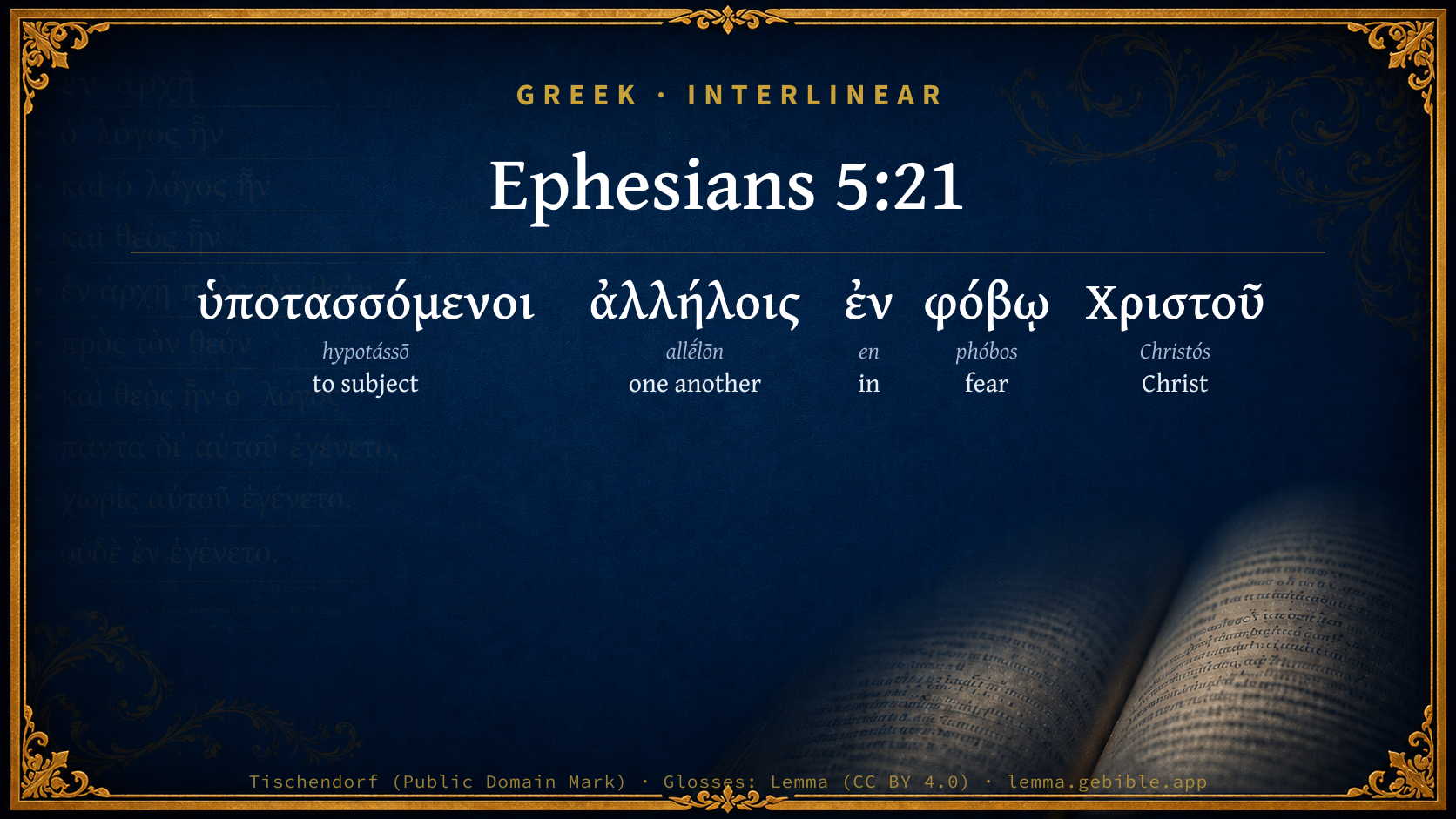
Greek (Tischendorf 8th ed.) Ephesians 5:21 appears in the Greek New Testament. The text above is from the Tischendorf 8th edition. Each word links to its Strong’s number and a concise gloss. Click any word for its full Thayer’s Greek Lexicon entry.
Download image
Cite this verse

Ephesians 5:21 (World English Bible). Public Domain. Lemma interlinear Bible study tool, https://lemma.gebible.app/v/ephesians/5/21.

Show BibTeX & RIS
BibTeX
RIS
English Translation
subjecting yourselves one to another in the fear of Christ.
World English Bible · Public Domain
Download a study sheet

One document with this verse’s original text, its word-by-word gloss line, the meaning frame, cross-references with their text, attributed commentary, and full source and license credits — printable, and it pastes into notes with its structure intact.

This verse Autodidact and up

Study sheet (.html) Plain text (.txt)

A passage Seminary Student

Up to 50 verses in one chapter. A passage sheet keeps up to 6 commentary sources and 12 cross-references per verse, in the order this page ranks them, and says so on the sheet whenever that leaves anything out. Ask for a single verse and you get the Autodidact verse sheet above.

Everything on this page stays free to read, with no account — the sheet is a download of what is already on screen, not access to it.

Want to remove ads? Support Godless Engineer
Compare translations 3

The same verse in 3 English versions, stacked beneath the original-language interlinear above. Click any original word for its lexicon entry.

Each is an independent rendering of the whole verse — the interlinear is not word-aligned to these translations.

Highlighted words mark where these versions differ — a whole-verse word diff, not a word-by-word alignment.

  • World English Bible Public Domain
    subjecting yourselves one to another in the fear of Christ.
  • King James Version Public Domain
    Submitting yourselves one to another in the fear of God.
  • unfoldingWord Literal Text CC BY-SA 4.0
    submitting yourselves to one another in reverence for Christ—

unfoldingWord Literal Text — © unfoldingWord, licensed CC BY-SA 4.0. Word-aligned USFM3 via Door43 (git.door43.org/unfoldingWord/en_ult).

Versions to compare (up to 4)

3 of 4 selected

Show all 19 translations

Every available English version of this verse, each an independent rendering of the whole verse.

  • World English Bible Public Domain
    subjecting yourselves one to another in the fear of Christ.
  • Berean Standard Bible Public Domain
    Submit to one another out of reverence for Christ.
  • Majority Standard Bible Public Domain
    Submit to one another out of reverence for Christ.
  • King James Version Public Domain
    Submitting yourselves one to another in the fear of God.
  • American Standard Version (1901) Public Domain
    subjecting yourselves one to another in the fear of Christ.
  • Revised Version (1885) Public Domain
    subjecting yourselves one to another in the fear of Christ.
  • Geneva Bible (1599) Public Domain
    Submitting your selues one to another in the feare of God.
  • Douay-Rheims (1899) Public Domain
    Being subject one to another, in the fear of Christ.
  • Young's Literal Translation Public Domain
    subjecting yourselves to one another in the fear of God.
  • Literal Standard Version CC BY-SA 4.0
    subjecting yourselves to one another in the fear of Christ.
  • Unlocked Literal Bible CC BY-SA 4.0
    submitting yourselves to one another in reverence for Christ.
  • unfoldingWord Literal Text CC BY-SA 4.0
    submitting yourselves to one another in reverence for Christ—
  • Darby Bible Public Domain
    submitting yourselves to one another in [the] fear of Christ.
  • World Messianic Bible Public Domain
    subjecting yourselves to one another in the fear of Messiah.
  • Webster's Bible Public Domain
    Submitting yourselves one to another in the fear of God.
  • Free Bible Version CC BY-SA 4.0
    Each of you should be willing to accept what others tell you to do out of reverence for Christ.
  • Bible in Basic English Public Domain
    Letting yourselves be ruled by one another in the fear of Christ.
  • Text-Critical English NT CC BY 4.0
    and submitting to one another in the fear of Christ.
  • Tyndale New Testament (1534) Public Domain
    submittinge youre selves one to another in the feare of God.

Literal Standard Version (2020), Covenant Press — licensed CC BY-SA 4.0. Text via the HelloAO Bible API (eBible.org). Unlocked Literal Bible (unfoldingWord) — licensed CC BY-SA 4.0. Text via the HelloAO Bible API (eBible.org). unfoldingWord Literal Text — © unfoldingWord, licensed CC BY-SA 4.0. Word-aligned USFM3 via Door43 (git.door43.org/unfoldingWord/en_ult). Free Bible Version, Dr. Jonathan Gallagher — licensed CC BY-SA 4.0. Text via the HelloAO Bible API (eBible.org).

Word by word

More ways to search: Search by grammar → Find every occurrence → Compare this word →

Practice this passage: Drill this verse → Learn its vocabulary →

ὑποτασσόμενοι
hypotássō
G5293
“to subject”
Verb, Present, Passive, Participle, Nominative, Plural, Masculine
Part of Speech
Verb
Tense
Present
Voice
Passive
Mood
Participle
Case
Nominative
Number
Plural
Gender
Masculine
Full Thayer's Definition

Origin: from G5259 and G5021

TDNT: 08:39,1

1. to arrange under, to subordinate 2. to subject, put in subjection 3. to subject one's self, obey 4. to submit to one's control 5. to yield to one's admonition or advice 6. to obey, be subject A Greek military term meaning "to arrange [troop divisions] in amilitary fashion under the command of a leader". In non-military use,it was "a voluntary attitude of giving in, cooperating, assumingresponsibility, and carrying a burden".
  1. ἀλλήλοις allḗlōn G240 “one another” Reciprocal pronoun, Dative, Plural, Masculine
  2. ἐν en G1722 “in” Preposition
  3. φόβῳ phóbos G5401 “fear” Noun, Dative, Singular, Masculine
  4. Χριστοῦ Christós G5547 “Christ” Noun, Genitive, Singular, Masculine

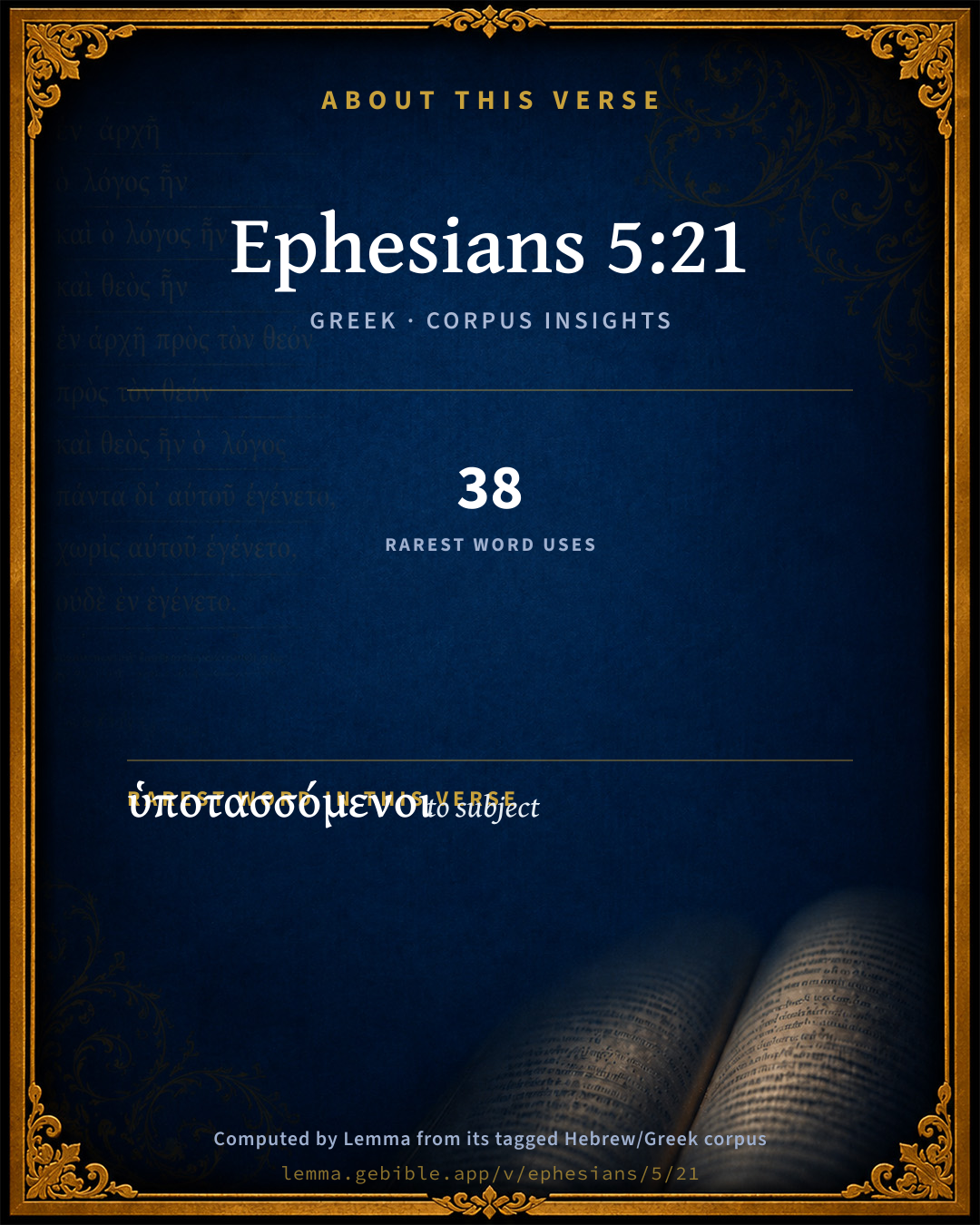
About this verse

These counts appear in no published source. They are computed here, from the morphology-tagged text and Lemma’s own curated glosses. What Lemma adds →

5
words
5
distinct lemmas
Pauline Epistles
section

Shared distinctive vocabulary

ὑποτασσόμενοι to subject G5293 occurs in 31 verses of the Greek New Testament. Also found in:
Cross-references

19

Topical passages linked to Ephesians 5:21 in the Treasury of Scripture Knowledge — connected by theme and wording, ordered by reader-vote popularity; previews shown in the World English Bible.

  • Philippians 2:3 doing nothing through rivalry or through conceit, but in humility, each counting others better than himself;
  • Ephesians 5:24 But as the assembly is subject to Christ, so let the wives also be to their own husbands in everything.
  • Ephesians 5:22 Wives, be subject to your own husbands, as to the Lord.
  • Hebrews 13:17 Obey your leaders and submit to them, for they watch on behalf of your souls, as those who will give account, that they may do this with joy, and not with groaning, for that would be unprofitable for you.
  • 1 Peter 5:5 Likewise, you younger ones, be subject to the elder. Yes, all of you gird yourselves with humility, to subject yourselves to one another; for "God resists the proud, but gives grace to the humble."
  • 1 Timothy 3:4 one who rules his own house well, having children in subjection with all reverence;
  • 1 Peter 2:17 Honor all men. Love the brotherhood. Fear God. Honor the king.
  • Galatians 5:13 For you, brothers, were called for freedom. Only don't use your freedom for gain to the flesh, but through love be servants to one another.
  • 1 Timothy 2:11 Let a woman learn in quietness with all subjection.
  • 1 Corinthians 16:16 that you also be in subjection to such, and to everyone who helps in the work and labors.
  • 2 Chronicles 19:7 Now therefore let the fear of Yahweh be on you; take heed and do it: for there is no iniquity with Yahweh our God, nor respect of persons, nor taking of bribes.
  • Nehemiah 5:15 But the former governors who were before me were chargeable to the people, and took of them bread and wine, besides forty shekels of silver; yes, even their servants bore rule over the people: but I didn't do so, because of the fear of God.
  • Proverbs 24:21 My son, fear Yahweh and the king. Don't join those who are rebellious:
  • Romans 13:1–5 Let every soul be in subjection to the higher authorities, for there is no authority except from God, and those who exist are ordained by God.
  • Genesis 16:9 The angel of Yahweh said to her, "Return to your mistress, and submit yourself under her hands."
  • 1 Chronicles 29:24 All the princes, the mighty men, and also all of the sons of king David submitted themselves to Solomon the king.
  • Nehemiah 5:9 Also I said, The thing that you do is not good: ought you not to walk in the fear of our God, because of the reproach of the nations our enemies?
  • 2 Corinthians 7:1 Having therefore these promises, beloved, let us cleanse ourselves from all defilement of flesh and spirit, perfecting holiness in the fear of God.
  • 1 Peter 2:13 Therefore subject yourselves to every ordinance of man for the Lord's sake: whether to the king, as supreme;

Cross-references courtesy of OpenBible.info (CC BY 4.0).

Where the printed editions differ

1 variant

Places in this verse where the major printed Greek editions disagree on the wording in a way that affects the translation — a comparison of editions, not a manuscript-by-manuscript collation. The editions are the modern critical texts (Nestlé-Aland 28/27, SBL, Westcott-Hort, Tregelles, Tyndale House) and the traditional texts behind the KJV (the Textus Receptus and the Byzantine/Majority text). It is not a claim about which reading is original.

  1. Different wording
    Χριστοῦ.

    “of Christ.”

    In NA28NA27TynSBLWHTregByz Not in TR

    Θεοῦ (Theou) 'of God' occurs in traditional manuscripts (TR) instead of Χριστοῦ.¶ (Christou) 'of Christ.' in older manuscripts (NA28+NA27+Tyn+SBL+WH+Treg+Byz)

Textual data: Translators Amalgamated Greek New Testament (STEPBible TAGNT) · CC BY 4.0.

Commentary

Notes on Ephesians 5:21 from classic Christian and Jewish commentators (each source and its license shown beneath its notes). The classic Christian expositions comment on the surrounding passage and are grouped to its opening verse, so a note may address several verses; the Jewish commentaries on the Tanakh (Rashi and others) are per-verse, so they appear only where the commentator wrote on this verse.

Lemma curates 59 commentaries, every one of them public domain or Creative Commons licensed, each selected and text-cleaned for this edition rather than reprinted as found. About our sources →

Matthew Henry's Commentary

Here the apostle begins his exhortation to the discharge of relative duties. As a general foundation for these duties, he lays down that rule Eph 5:21. There is a mutual submission that Christians owe one to another, condescending to bear one another's burdens: not advancing themselves above others, nor domineering over one another and giving laws to one another. Paul was an example of this truly Christian temper, for he became all things to all men. We must be of a yielding and of a submissive spirit, and ready to all the duties of the respective places and stations that God has allotted to us in the world. In the fear of God, that is, so far as is consistent with the fear of God, for his sake, and out of conscience towards him, and that hereby we may give proof that we truly fear him. Where there is this mutual condescension and submission, the duties of all relations will be the better performed. From Eph 5:22 to the end he speaks of the duties of husbands and wives; and he speaks of these in a Christian manner, setting the church as an example of the wife's subjection, and Christ as an example of love in husbands.

I. The duty prescribed to wives is submission to their husbands in the Lord (Eph 5:22), which submission includes the honouring and obeying of them, and that from a principle of love to them. They must do this in compliance with God's authority, who has commanded it, which is doing it as unto the Lord; or it may be understood by way of similitude and likeness, so that the sense may be, "as, being devoted to God, you submit yourselves unto him." From the former sense we may learn that by a conscientious discharge of the duties we owe to our fellow-creatures we obey and please God himself; and, from the latter, that God not only requires and insists on those duties which immediately respect himself, but such as respect our neighbours too. The apostle assigns the reason of this submission from wives: For the husband is the head of the wife, Eph 5:23. The metaphor is taken from the head in the natural body, which, being the seat of reason, of wisdom, and of knowledge, and the fountain of sense and motion, is more excellent than the rest of the body. God has given the man the pre-eminence and a right to direct and govern by creation, and in that original law of the relation, Thy desire shall be to thy husband, and he shall rule over thee. Whatever there is of uneasiness in this, it is an effect of sin coming into the world. Generally, too, the man has (what he ought to have) a superiority in wisdom and knowledge. He is therefore the head, even as Christ is the head of the church. There is a resemblance of Christ's authority over the church in that superiority and headship which God has appointed to the husband. The apostle adds, and he is the Saviour of the body. Christ's authority is exercised over the church for the saving of her from evil, and the supplying of her with every thing good for her. In like manner should the husband be employed for the protection and comfort of his spouse; and therefore she should the more cheerfully submit herself unto him. So it follows, Therefore as the church is subject unto Christ (Eph 5:24), with cheerfulness, with fidelity, with humility, so let the wives be to their own husbands in every thing - in every thing to which their authority justly extends itself, in every thing lawful and consistent with duty to God.

II. The duty of husbands (on the other hand), is to love their wives (Eph 5:25); for without this they would abuse their superiority and headship, and, wherever this prevails as it ought to do, it will infer the other duties of the relation, it being a special and peculiar affection that is required in her behalf. The love of Christ to the church is proposed as an example of this, which love of his is a sincere, a pure, an ardent, and constant affection, and that notwithstanding the imperfections and failures that she is guilty of. The greatness of his love to the church appeared in his giving himself unto the death for it. Observe, As the church's subjection to Christ is proposed as an exemplar to wives, so the love of Christ to his church is proposed as a pattern to husbands; and while such exemplars are offered to both, and so much is required of each, neither has reason to complain of the divine injunctions. The love which God requires from the husband in behalf of his wife will make amends for the subjection which he demands from her to her husband; and the prescribed subjection of the wife will be an abundant return for that love of the husband which God has made her due. The apostle, having mentioned Christ's love to the church, enlarges upon it, assigning the reason why he gave himself for it, namely, that he might sanctify it in this world, and glorify it in the next: That he might sanctify and cleanse it, with the washing of water by the word (Eph 5:26) - that he might endue all his members with a principle of holiness, and deliver them from the guilt, the pollution, and the dominion of sin. The instrumental means whereby this is affected are the instituted sacraments, particularly the washing of baptism and the preaching and reception of the gospel. And that he might present it to himself, etc., Eph 5:27. Dr. Lightfoot thinks the apostle alludes here to the Jews' extraordinary carefulness in their washings for purification. They were careful that there should be no wrinkle to keep the flesh from the water, and no spot nor dirt which was not thoroughly washed. Others understand him as alluding to a garment come newly out of the fuller's hand, purged from spots, stretched from wrinkles, the former newly contracted, the latter by long time and custom. That he might present it to himself - that he might perfectly unite it to himself in the great day, a glorious church, perfect in knowledge and in holiness, not having spot, nor wrinkle, nor any such thing, nothing of deformity or defilement remaining, but being entirely amiable and pleasing in his eye, holy and without blemish, free from the least remains of sin. The church in general, and particular believers, will not be without spot or wrinkle till they come to glory. From this and the former verse together we may take notice that the glorifying of the church is intended in the sanctifying of it: and that those, and those only, who are sanctified now, will be glorified hereafter. - So ought men to love their wives as their own bodies, etc., Eph 5:28. The wife being made one with her husband (not in a natural, but in a civil and in a relative sense), this is an argument why he should love her with as cordial and as ardent an affection as that which he loves himself. For no man ever yet hated his own flesh, Eph 5:29 - (no man in his right senses ever hated himself, however deformed, or whatever his imperfections might be); so far from it that he nourishes and cherishes it; he uses himself with a great deal of care and tenderness, and is industrious to supply himself with every thing convenient or good for him, with food and clothing, etc. Even as the Lord the church: that is, as the Lord nourishes and cherishes the church, which he furnishes with all things that he sees needful or good for her, with whatever conduces to her everlasting happiness and welfare. The apostle adds, For we are members of his body, of his flesh and of his bones, Eph 5:30. He assigns this as a reason why Christ nourishes and cherishes his church - because all who belong to it are members of his body, that is, of his mystical body. Or, we are members out of his body: all the grace and glory which the church has are from Christ, as Eve was taken out of the man. But, as one observes, it being the manner of the sacred writings to express a complex body by the enumeration of its several parts, as the heaven and earth for the world, evening and morning for the natural day, so here, by body, flesh, and bones, we are to understand himself, the meaning of the verse being that we are members of Christ. - For this cause (because they are one, as Christ and his church are one) shall a man leave his father and mother; the apostle refers to the words of Adam, when Eve was given to him for a meet help, Gen 2:24. We are not to understand by this that a man's obligation to other relations is cancelled upon his marriage, but only that this relation is to be preferred to all others, there being a nearer union between these two than between any others, that the man must rather leave any of those than his wife. - And they two shall be one flesh, that is, by virtue of the matrimonial bond. This is a great mystery, Eph 5:32. Those words of Adam, just mentioned by the apostle, are spoken literally of marriage; but they have also a hidden mystical sense in them, relating to the union between Christ and his church, of which the conjugal union between Adam and the mother of us all was a type: though not instituted or appointed by God to signify this, yet it was a kind of natural type, as having a resemblance to it: I speak concerning Christ and the church.

After this, the apostle concludes this part of his discourse with a brief summary of the duty of husbands and wives, Eph 5:33. "Nevertheless (though there be such a secret mystical sense, yet the plain literal sense concerns you) let every one of you in particular so love his wife even as himself, with such a sincere, peculiar, singular, and prevailing affection as that is which he bears to himself. And the wife see that she reverence her husband." Reverence consists of love and esteem, which produce a care to please, and of fear, which awakens a caution lest just offence be given. That the wife thus reverence her husband is the will of God and the law of the relation.

Matthew Henry's Commentary on the Whole Bible (1708–1710) — public domain (CC PDM 1.0). Text via the HelloAO Bible API.

The Biblical Illustrator

Joseph S. Exell

Eph_5:21

Submitting yourselves one to another in the fear of God.

Submission one to another

I. In the first place, observe the necessity of the precept. Pride is the great besetting sin of our fallen nature. In our unregenerate state it rules, reigns, and tyrannises; and in our regenerate state, it still harasses, entangles, and tempts us in all we do. Some are proud of their learning, and some of their ignorance. Some are proud of their intellect, and some of their stupidity. Behold then, the necessity of the precept. What is it leads men, beloved, to that insubordination as to ranks in society, that is so very manifest in the present day? What is it leads men to pull down their superiors? What makes men behave so unsuitably to their equals? What makes men look down so on their inferiors? It is the pride of our hearts.

II. But observe, secondly, there is not only a necessity for this precept, but there is an especial suitableness in it. These are addressed as servants of Christ. What a Master! Why, His whole life was one submission; it was subjection to the work and will of God. Observe, even in His intercession, in His exaltation at the right hand of God, it is according to the will of God. And let me remark this one thing more; not only was our Lord one exhibition of subjection to God His Father, but He was subject unto His parents. More than that, He was subject in a sense to His very disciples. Look into that twenty-second chapter of Lukes Gospel. Oh! blessed truth! may we have grace to learn it out! There was also a strife among them, which of them should be accounted the greatest. And He said unto them, The kings of the Gentiles exercise lordship over them; and they that exercise authority upon them are called benefactors. But ye shall not be so: but he that is greatest among you, let him be as the younger; and he that is chief, as he that doth serve. For whether is greater, he that sitteth at meat, or he that serveth? is not he that sitteth at meat? but I am among you as he that serveth.

III. Now see the extent of the precept. Many seem to say that it means submission to the powers that be--those in authority, them that have the rule. But that is not the meaning of this passage; and I cannot see any reason to think so for one moment. It takes it in, certainly; it necessarily includes submission to those who are above us; to him who is our superior in age, our superior in position in the Church, our superior in gifts, or our superior in grace. It takes in submission from the wife to the husband; from the children to the parent; and from the servant to the master. But it includes more; for it includes the duty of submission on every part. It is mutual; it is universal; it not only belongs to one party, but it belongs to all; so that each one of Gods children shall feel the solemn obligation there is for subjection to those around him. What! does this break in on the different ranks of men? By no means. Does this bring the world into confusion? Masters still remain masters; servants still remain servants. Still, the command--be subject to the powers that be, give honour to him to whom honour is due, is a precept for us to obey. Here, then, we have to consider the respectful and affectionate bearing ordered and enjoined by this portion of Gods Word to all, without distinction; to those our superiors, to those our equals, and to those who we think beneath us. But observe, why is it added, in the fear of God? Is not this a motive? Is not self-consideration enough to give us a motive? This man has many infirmities, manifest infirmities; but how little do I know how much grace he receives from the Lord, hour by hour. Perhaps I should take my place at his feet, instead of placing him at my feet. How little do I know how soon he may have to bear my infirmities? How soon may he have to take up my burden! My dear hearers, yet the great motive here is, submitting in the fear of God. All these things are motives; yet this motive is especially remarked--in the fear of God--as under His eye; remembering, Thou God seest me. (J.H. Evans, M.A.)

Mutual condescension

In the words observe--

1. The connection or dependence; for the construction is continued from that clause, Be filled with the Spirit, submitting yourselves one to another in the fear of God. The construction is the same. The Spirits influence is necessary for the duties of our relations, as well as the duties of worship.

2. The substance of the duty--Submitting yourselves one to another. The exhortation is to mutual submission, keeping the order set by God.

3. The manner of performance--In the fear of God; that is, so as they would approve themselves to God, who is the author of all order in every community and society of mankind; and to Him we must give an account as our proper Judge (1Pe_1:17).

That mutual condescension to one another in the duties of our places and relations doth very much become those who are filled with the Spirit.

I. I shall inquire wherein this mutual condescension doth consist? I answer--It may be considered with respect to ecclesiastical, or civil, or economical power.

1. With respect to ecclesiastical power, which must be determined by the nature of that community for which it serveth.

2. There is political or civil power, principally greatness and authority in the civil state. This is the Lords ordinance, and must be submitted to for Gods sake (1Pe_2:13-14).

3. There is economical power; that of the husband, parent, master. There are duties which belong to these relations. Well, then, this submission is by discharging the duties we owe to each relation. But why is this called submission?

(1) Because superiors have a debt of duty upon them, as well as inferiors, which in some cases is hard to perform. This submission on the superiors part lieth in the faithful and loving discharge of their duty to the meanest within their charge. The husband is to cherish the wife in all conditions, sick and well; masters to stoop to do good to the meanest of their servants, and not rule them according to passion and will; they have souls to save or lose as well as the best of the family, and therefore they are to take care of all of them, that they may serve the Lord, they and all their household; their outward condition doth no way hinder our duty to them.

(2) Because this duty calleth upon us for the meanest services for the common good; as when a magistrate defendeth the poor against the mighty, and disdaineth not to appear for his meanest subjects (Job_31:34).

(3) With all patience to bear their infirmities.

(4) As to equals, there is a submitting ourselves one to another (Rom_12:10; Php_2:3). We are better acquainted with ourselves than others, we want some perfection and accomplishment God bath given to them. We ought to speak of our own gills with modesty, of theirs with charity; to be severe at home, without a jealous inquiry.

(5) We are to speak to one another by way of instruction and reproof (Col_3:16; Lev_19:17), Now it is a submission to take it well.

II. The graces which are necessary for this, to submit ourselves one to another. It is required that we be filled with the spirit. But I answer--

1. Love, which is the cement of human society; for where love reigneth, there will be mutual service and submission (Gal_5:13).

2. Humility, which is opposite to fastidiousness, disdain, and contempt (1Pe_5:5).

3. The fear of God, that is in the text. Now this in the fear of God--

(1) Noteth the impulsive cause, that obedience to this precept floweth from this cause. It is done in conscience to His command, and then it is acceptable to God.

(2) The fear of God is the rule and measure of this submission. As it influenceth, so it limiteth it (Act_5:29).

(3) The fear of God is necessary, and a great help to this duty. (a) Partly to tame that natural fierceness that is in the heart of man, that we may not refuse the yoke; as Nabal was such a son of Belial, that a man could not speak to him (1Sa_25:17).

2. To check our pride, that we may not be ashamed to serve our neighbour in love.

3. To bridle and curb excess of power.

III. I am now to prove that this is an unquestionable duty.

1. It is required in Scripture (Gal_5:13).

2. I prove it by example. I shall first produce the example of our Lord Jesus Christ (Joh_13:3; Joh_13:5).

3. Now I shall give you the reasons of this duty.

1. To prevent contempt. Human nature is incapable of bearing it. Whatsoever rank we are in, we should not despise others, but acknowledge the gifts of God in them.

2. Because there are none living whom God alloweth only to live to themselves. We are all bound to promote the common good.

3. Submitting ourselves to one another is required for a supply of mutual necessities. We lack something that the meanest have; if they have strength for labour, others have wisdom and conduct for government. There must be a contemperation; if some are fitted to serve, those that have wealth should bless God that He hath put them into such an able condition to hire their service; if some have wisdom to contrive, others have elocution to recommend a good design; both must serve one another in love.

4. Because of equality; the equity of this mutual submission is built upon a double equality.

1. The actual equality of all men by nature.

2. The possible equality in the course of Gods providence.

1. To show how much the Christian religion befriendeth human societies; for we owe duties one to another in our several stations. It is neither injurious to princes nor subjects, but it commandeth everyone to do good according to his calling.

2. Where the fear of God is rooted in the heart of any, it will make him tender and careful of his duty to man, and from a right principle and motive, and in a right manner, and to a right end. (T. Manton, D. D.)

Submission for a common cause

When a Scottish chieftain desired to summon his clan, upon any emergency, he slew a goat, and making a cress of any light wood, seared its extremities in the fire, and extinguished them in the blood of the animal. This was called the Fiery Cross, or the Cross of Shame, because disobedience to what the symbol implied inferred infamy. It was delivered to a swift and trusty messenger, who ran full speed with it to the next hamlet, where he presented it to the principal person, with a single word, implying the place of rendezvous. He who received the symbol was bound to send it forward, with equal despatch, to the next village; and thus it passed with incredible celerity through all the district which owed allegiance to the chief. At sight of the Fiery Cross every man capable of bearing arms was obliged instantly to repair to the place of rendezvous. He who failed to appear suffered the extremities of fire and sword, as indicated by the bloody and burnt marks upon this warlike signal. (Sir Walter Scott.)

The Biblical Illustrator, edited by Joseph S. Exell (c. 1880s–1900s) — public domain. Text from a community e-Sword module.

Tyndale Open Study Notes

Tyndale Open Resources

5:21–6:9 Paul gives specific instructions on how believers are to relate to one another in a Christian home (see also Col 3:18–4:1; 1 Pet 2:18–3:7). Love and respect are to characterize all relationships in the body of Christ as an expression of believers’ commitment to the Lord himself.

5:21 And further, submit to one another: The verb form links it with the command to be filled (5:18). This general instruction (cp. Phil 2:3) applies to all three relationships that Paul discusses: wives and husbands (Eph 5:22-33), children and their parents (6:1-4), and slaves and their masters (6:5-9). For believers, submission is not expressed out of fear or desire for personal gain, but out of reverence for Christ.

Tyndale Open Study Notes — © Tyndale Open Resources, licensed CC BY-SA 4.0. Text via the HelloAO Bible API.

Bengel's Gnomon

Johann Albrecht Bengel

Eph 5:21. Ἀλλήοις, to one another) Now he proceeds to treat concerning our duty to others; and the foundation of this is the fear of Christ,[87] which derives its motives from the Christian faith; 1Pe 2:13. A rare phrase; comp. 2Co 5:11; 1Co 10:22.

[87] Namely, this reading, ἐν φόβῳ Χριστοῦ, which the older Ed. had judged not quite certain, both the margin of the 2d Ed. reckons as quite certain, and the Germ. Vers. expresses it.—E. B.

AB Vulg. read Χριστοῦ; D(Δ)f read Ἰησοῦ; Gg read Ἰησοῦ Χριστοῦ; Rec. Text, Θεοῦ, without good authority.—ED.

Bengel's Gnomon of the New Testament — English translation (T&T Clark, Edinburgh, 1860) — public domain. Text from a community e-Sword module.

Meyer's Critical & Exegetical Commentary

Heinrich August Wilhelm Meyer

Eph_5:21 f.[270] The words ὙΠΟΤΑΣΣ. ἈΛΛΉΛ. ἘΝ ΦΌΒῼ ΧΡ. still belong to Eph_5:20 (so Lachmann, Tischendorf, Bleek), parallel to the ΕὐΧΑΡΙΣΤΟῦΝΤΕς Κ.Τ.Λ., adding to this relation towards God the mutual relation towards one another. Then begins with αἱ γυναῖκες a new section, into the first precept of which we have to take over the verb from the ὙΠΟΤΑΣΣΌΜΕΝΟΙ just used, namely, ὙΠΟΤΆΣΣΕΣΘΕ (Elzevir) or ὙΠΟΤΑΣΣΈΣΘΩΣΑΝ (Lachmann). Calvin, Zanchius, Koppe, Flatt, Meier, Matthies, and others (comp. also Reiche, Comm. crit. p. 183), incorrectly hold that the participle is to be taken imperatively; in that case an ἐστέ to be supplied in thought must, as in Rom_12:9, have been suggested by the context. Olshausen quite arbitrarily proposes that we supply mentally: are all believers. If the new section was to begin with ὑποτασσ., then ὙΠΟΤΑΣΣ. ἈΛΛ. ἘΝ Φ. ΧΡ. would have to be regarded as an absolutely prefixed general attribute, to which the special one afterwards to be adduced would be subordinate (inasmuch as ye subject yourselves in the fear of Christ, the wives ought, etc.). It would not militate against this view, that in the sequel only the ὙΠΌΤΑΞΙς of the wives follows, while the ὑπακοή of the children and servants, in chap. 6, can no longer be brought into connection with our ὑποτασσόμενοι. For often with the classical writers also, after the prefixing of such absolute nominatives, which have reference to the whole collectively, the discourse passes only over to one part (not to several); see particularly Nägelsbach, z. Ilias, ed. 3, p. 385 f. But against it may be urged the consideration that αἱ γυναῖκες has no special verb; such a verb, and one correlative as to notion with ὙΠΟΤΑΣΣ., could not but be associated with it.

On the thought ὙΠΟΤΆΣΣΕΣΘΑΙ ἈΛΛΉΛΟΙς, comp. 1Pe_5:5; Clem. Cor. 1:38.

ἐν φόβῳ Χριστοῦ] is the fundamental disposition, in which the ὙΠΟΤΆΣΣΕΣΘΑΙ ἈΛΛΉΛΟΙς is to take place. And Christ is to be feared as the judge. Comp. 2Co_5:11; 1Co_10:22.

τοῖς ἰδίοις ἀνδράσιν] to their own husbands. Without being misunderstood, Paul might have written merely τοῖς ἀνδράσιν, but ἸΔΊΟΙς serves to make the obligation of the ὙΠΟΤΆΣΣΕΣΘΑΙ ΤΟῖς ἈΝΔΡΆΣΙΝ palpable in its natural necessity; for what a wife is she, who refuses obedience to her own husband! So also Stobaeus, S. 22: Θεανῶ … ἐρωτηθεῖσα, τί πρῶτον εἴη γυναικί, τὸ τῷ ἰδίῳ, ἔφη, ἀρέσκειν ἀνδρί. Throughout the N.T. ἼΔΙΟς never stands in place of the mere possessive pronoun, but has always, as also with the Greeks, an emphasis to be derived from the connection, even at Mat_12:5; Mat_15:14 (see in loc.); 1Pe_3:1; and Tit_2:5 (where the relation is as in our passage). This in opposition to Winer, p. 139 [E. T. 192], and at the same time in opposition to Harless and Olshausen, who (comp. also Dorville, ad Charit. p. 452) see in ὁ ἴδιος ἀνήρ nothing more than a designation which has become usual for the husband. From the very context, in itself ὁ ἀνήρ is husband (Hom. Od. xix. 294; Mat_1:16). That which, on the other hand, Bengel finds in ἰδίοις: etiamsi alibi meliora viderentur habere consilia, is imported.

Ὡς Τῷ ΚΥΡΊῼ] By this is not meant the husbands (Thomas Aquinas, Semler), which must have been τοῖς κυρίοις, but Christ, and ὡς expresses the mode of view in which the wives are to regard their obedience towards the husbands, namely, as rendered to the Lord; comp. Eph_6:6-7. For the husband (see what follows) stands in relation to the wife not otherwise than as Christ to the church; in the conjugal relation the husband is the one who represents Christ to the wife, in so far as he is head of the wife, as Christ is the Head of the church. To find in ὡς the mere relation, of resemblance (uxoris erga maritum officia similia quodammodo sunt officiis Christianorum erga Christum, Koppe) is erroneous on account of what follows; the passage must have run in the form ὡς ἡ ἐκκλησία τῷ κυρίῳ, which Erasmus has imported into his paraphrase: non aliter, quam ecclesia subdita est Domino Jesu. We may add that the view of Michaelisthat here and Col_3:18 the teachings as to marriage are directed against errors of the Essenes (comp. 1Ti_4:3)is the more to be regarded as a fiction, inasmuch as Paul is speaking not of the propriety of marriage, but of the duties of the married life.

[270] A more sublime, more ideal regulation of the married state is not conceivable than that which is here set forth by the apostle, vv. 2133, and yet it is one which has flowed from the living depth of the Christian consciousness, and hence is practically applicable to all concrete relations.

Meyer — Critical and Exegetical Commentary on the New Testament — English translation by Peter Christie, edited by Frederick Crombie (T&T Clark, 1880) — public domain. Text from a community e-Sword module.

Expositor's Greek Testament

ed. W. Robertson Nicoll

Eph 5:21 . ὑποτασσόμενοι ἀλλήλοις : subjecting yourselves one to another . The connection of this clause is by no means clear. It is taken by not a few (Calv., Matthies, etc.) as an independent clause, the participle being dealt with as an imperative. But there is nothing to suggest the ἐστε which would have to be supplied. To relate the clause to the paragraph which follows means that it is the introductory, general statement, of which we have a particular application in what is said of the γυναῖκες . But in that case we should expect the duty of the γυναῖκες to be conveyed by a noun distinct from ὑποτασσόμενοι , but denoting a form of behaviour that would come easily under the comprehensive duty expressed by the participle. It is best to connect the clause, therefore, with what precedes it, and to take it as a fourth coordinate clause, giving yet another way in which the condition of being “filled with the Spirit” should express itself. The former three dealt with spiritual converse, praise, and thanksgiving; this one deals with what is due from ourselves to others. It is appended to the other three as a summary statement of duty in our relations one to another, of which particular applications are to be made. Thus it leads easily on to the special obligations which are next enforced. The same comprehensive statement of Christian duty in our earthly relations as summed up in the one idea of mutual ὑπόταξις , in contrast with pagan self-seeking and self-assertion, is given in 1Pe 5:5 . ἐν φόβῳ Θεοῦ [ Χριστοῦ ]: in the fear of God [ of Christ ]. The reading of the TR, Θεοῦ , is that mostly of the cursives and a few Fathers. It must give place to Χριστοῦ , which is given by [591] [592] [593] [594] [595] , Vulg., Syr., Boh., etc., and is accepted by LTTrWHRV. Other variations occur, e.g. , Χριστοῦ Ἰησοῦ in D and Ἰησοῦ Χριστοῦ in [596] . The phrase “in the fear of Christ” occurs only this once. Reverence for the Lord Himself was the spirit in which this great duty of mutual subjection was to be fulfilled.

[591] Codex Vaticanus (sæc. iv.), published in photographic facsimile in 1889 under the care of the Abbate Cozza-Luzi.

[592] Codex Sinaiticus (sæc. iv.), now at St. Petersburg, published in facsimile type by its discoverer, Tischendorf, in 1862.

[593] Codex Alexandrinus (sæc. v.), at the British Museum, published in photographic facsimile by Sir E. M. Thompson (1879).

[594] Codex Angelicus (sæc. ix.), at Rome, collated by Tischendorf and others.

[595] Codex Porphyrianus (sæc. ix.), at St. Petersburg, collated by Tischendorf. Its text is deficient for chap. Eph 2:13-16 .

[596] Codex Boernerianus (sæc. ix.), a Græco-Latin MS., at Dresden, edited by Matthæi in 1791. Written by an Irish scribe, it once formed part of the same volume as Codex Sangallensis ( δ ) of the Gospels. The Latin text, g, is based on the O.L. translation.

The Expositor's Greek Testament, edited by W. Robertson Nicoll (1897–1910) — public domain. Text from a community e-Sword module.

Hodge's Commentary on Romans, Ephesians & First Corinthians

Charles Hodge

Eph_5:21-33

Analysis

The apostle enjoins mutual obedience as a Christian duty, Eph_5:2. Under this head he treats of the relative duties of husbands and wives, parents and children, masters and servants. The remainder of this chapter is devoted to the duties of husbands and wives. As the conjugal relation is analogous to that which Christ sustains to the church, the one serves to illustrate the others. The apostle, therefore, combines the two subjects throughout the paragraph.

Wives should be subject to their husbands as the church is to Christ.

1. The motive to this subject is a regard to the Lord, Eph_5:22.

2. The ground of it is, that the husband is the head of the wife, as Christ is the head of the church, Eph_5:23.

3. This subjection is not confined to any one sphere, but extends to all, Eph_5:24.

Husbands should love their wives.

1. The measure of this love is Christs love for the church for whose redemption he died, Eph_5:25-27.

2. The ground of love is in both cases the same the wife is flesh of her husbands flesh, and bone of his bone. So the church is flesh of Christs flesh and bone of his bone. Husband and wife are one flesh; so are Christ and the church. What is true of the one is true of the other, Eph_5:29-31.

3. The union between Christ and his church is indeed of a higher order than that between husband and wife nevertheless the analogy between the two cases is such as to render it obligatory on the husband to love his wife as being himself, and on the wife to reverence her husband, Eph_5:32-33.

Commentary

Eph_5:21

That a new paragraph begins with this verse is generally conceded. First, because the preceding exhortations are evidently brought to a close in Eph_5:20 with the words to God even the Father. And secondly, because the command to be obedient one to another, amplified through this chapter and part of the next, does not naturally cohere with what precedes. This being the case, the participle ὑποτασσόμενοι, being obedient, which this verse begins, cannot be explained by referring it to the verb, πληροῦσθε in Eph_5:18. The sense would then be, Be filled with the Spirit submitting yourselves one to another. This construction of the passage for the reasons just stated is rejected by most commentators. Others take the participle for the imperative and render the words, Be subject one to another. But this is contrary to the usage of the language. The most common explanation is to connect this verse with the following, Being subject one to another (as ye are bound to be), ye wives be subject to your husbands. From the general obligation to obedience follows the special obligation of wives, children, and servants, as explained in what follows.

This command to submit one to another is found in other passages of the New Testament, as in 1Pe_5:5, All of you be subject one to another, and be clothed with humility. Rom_12:10; Phi_2:3. The scriptural doctrine on this subject is that men are not isolated individuals, each one independent of all others. No man liveth for himself and no man dieth for himself. The essential equality of men and their mutual dependence lay the foundation for the obligation of mutual subjection. The apostle however is here speaking of the duties of Christians. It is, therefore, the Christian duty of mutual submission of which this passage treats. It not only forbids pride and all assumption of superiority, but enjoins mutual subjection, the subjection of a part to the whole, and of each one to those of his fellow believers with whom he is specially connected. Every Christian is responsible for his faith and conduct to his brethren in the Lord, because he constitutes with them one body having a common faith and a common life. The independency of one Christian of all others, or of one Christian society of all similar societies, is inconsistent with the relation in which believers stand to each other, and with the express commands of Scripture.

We are to be thus subject one to another ἐν φόβῳ Χριστοῦ.‹18› This may mean either that the fear of Christ, at whose bar we are to stand in judgment, should constrain us to this mutual subjection; or that the duty should be religiously performed. The motive should be reverence for Christ, a regard for his will and for his glory. It is in this way all social duties, even the most humiliating, are raised into the sphere of religion, and rendered consistent with the highest elevation and liberty. This idea is specially insisted upon by the apostle when he comes to speak of the duty of servants to their masters. It ought not to escape the readers notice that the relation in which this and similar passages suppose us to stand to Christ, is, such as we can sustain to no other than to a divine person. He to whom we are responsible for all our conduct, and reverence for whom is the great motive to the performance of duty, is God.

Charles Hodge — Commentary on Romans (1835), First Corinthians (1857), and Ephesians (1856) — public domain. Text from a community e-Sword module.

Geneva Bible (1599)

Geneva Bible translators

A short repetition of the end whereunto all things ought to be referred, to serve one another for God’s sake.

Geneva Bible (1599) marginal notes — public domain. Text via Bolls.life.

Jamieson, Fausset & Brown

Robert Jamieson, A. R. Fausset & David Brown

(Phi 2:3; Pe1 5:5.) Here he passes from our relations to God, to those which concern our fellow men.

in the fear of God--All the oldest manuscripts and authorities read, "in the fear of CHRIST." The believer passes from under the bondage of the law as a letter, to be "the servant of Christ" (Co1 7:22), which, through the instinct of love to Him, is really to be "the Lord's freeman"; for he is "under the law to Christ" (Co1 9:21; compare Joh 8:36). Christ, not the Father (Joh 5:22), is to be our judge. Thus reverential fear of displeasing Him is the motive for discharging our relative duties as Christians (Co1 10:22; Co2 5:11; Pe1 2:13).

Jamieson, Fausset & Brown — Commentary Critical and Explanatory on the Whole Bible (1871) — public domain (CC PDM 1.0). Text via the HelloAO Bible API.

Adam Clarke's Commentary

Verse 21. Submitting - one to another] Let no man be so tenacious of his own will or his opinion in matters indifferent, as to disturb the peace of the Church; in all such matters give way to each other, and let love rule.

In the fear of God.] Setting him always before your eyes, and considering that he has commanded you to love one another, and to bear each other's burdens; and that what you do in this or any other commanded case, you do as unto the Lord. Instead of εν φοβω θεου, in the fear of GOD, εν φοβω χριστου, in the fear of CHRIST, is the reading of ABDEFG, with all others of most value; besides the Syriac, Coptic, Sahidic, AEthiopic, Armenian, Vulgate, and Itala; Basil the Great, and Chrysostom. Neither reading makes any difference in the sense.

Adam Clarke's Commentary on the Bible (1810–1826) — public domain. Text from a community e-Sword/MySword module.

John Calvin's Commentaries

21. Submit yourselves. God has bound us so strongly to each other, that no man ought to endeavor to avoid subjection; and where love reigns, mutual services will be rendered. I do not except even kings and governors, whose very authority is held for the service of the community. It is highly proper that all should be exhorted to be subject to each other in their turn.

But as nothing is more irksome to the mind of man than this mutual subjection, he directs us to the fear of Christ, who alone can subdue our fierceness, that we may not refuse the yoke, and can humble our pride, that we may not be ashamed of serving our neighbors. It does not much affect the sense, whether we interpret the fear of Christ, passively, thus, — let us submit to our neighbors, because we fear Christ; or actively, — let us submit to them, because the minds of all godly persons ought to be influenced by such fear under the reign of Christ. Some Greek manuscripts read, “the fear of God.” The change may have been introduced by some person, who thought that the other phrase, the fear of Christ, though by far the most appropriate, sounded a little harsh.

John Calvin's Commentaries (1540-1563) — public domain. Text from the Calvin Translation Society English edition (1840s-50s) via the Christian Classics Ethereal Library (ccel.org). Calvin's coverage is partial (roughly two-thirds of the Bible); uncommented books and verses are honest gaps, never fabricated. The 19th-century editor's footnotes and remarks are omitted so the notes are faithfully Calvin's own voice.

Ellicott's Commentary for English Readers

(21) Submitting yourselves one to another in the fear of God.—In grammatical construction this clause is connected with the preceding verses; in point of idea it leads on to the next section, which treats of the three-fold submission of wives to husbands, children to parents, slaves to masters. There is, however, a certain connection of idea with the preceding section also, and especially with the encouragement of a Christian enthusiasm in the last clause. The strong and frequent emphasis laid in the New Testament on subjection, whether (as in Rom_13:1-7; 1Pe_2:13-17) to the civil powers, or (as here, in Col_3:18 to Col_4:1, and 1Pe_2:18 to 1Pe_3:7) to domestic authority, or (as in 1Th_5:12-13; 2Th_3:6; 2Th_3:14-15) to ecclesiastical authority, probably indicates some tendency, in the first exuberance of Christian liberty and enthusiasm, to disregard the wholesome restraints, laws, and conventions of outward life. Hence St. Paul’s general caution here, prefatory to the more detailed teaching of subjection which follows.

A Bible Commentary for English Readers, edited by Charles John Ellicott (1878–1897) — public domain. Text from a community e-Sword module.

The Cambridge Bible for Schools and Colleges

gen. ed. J. J. S. Perowne

21. submitting] The primary point in the spiritual ethics of the Gospel is humiliation; self is dethroned as against God, and consequently as against men. Here the special, but not exclusive, reference is to fellow-Christians. “[The precept] seems to have been suggested by the humble and loving spirit which is the moving principle of thanksgiving” (Ellicott).

Special applications of this great principle now follow, in a study of the relative duties of the Christian Home.

The Cambridge Bible for Schools and Colleges (gen. ed. J. J. S. Perowne; Cambridge University Press, 1878–1918) — public domain. Text from a community e-Sword module.

John Gill's Exposition

For the husband is the head of the wife,.... See Gill on Co1 11:3.

Even as Christ is the head of the church; all the elect; See Gill on Eph 1:22. And he is the Saviour of the body; not "of our body", as the Ethiopic version reads, of that part of man, which is called the body; though that indeed is redeemed and saved by Christ, as well as the soul; but "of his body", as the Vulgate Latin version reads; that is, of the church, which is his body; see Eph 1:23; of which he is the Saviour; he provides everything for it, preserves and protects it, and has wrought out salvation for it, which every member of it partakes of.

John Gill's Exposition of the Whole Bible (1746–1763) — public domain (CC PDM 1.0). Text via the HelloAO Bible API.

Trapp's Complete Commentary

John Trapp

21 Submitting yourselves one to another in the fear of God.

Ver. 21. Submitting yourselves] This is a general admonition to all inferiors, whose duties are afterwards described. Thus in the second table of the law, the fifth commandment for order and obedience is fitly premised to the following precepts.

In the fear of God] This frameth the heart to a ready and regular submission. Hence that saying of Luther, Primo praecepto reliquorum omnium observantia praecipitur, The first commandment includes the other nine.

John Trapp, A Commentary or Exposition upon All the Books of the Old and New Testament (1647–1656) — public domain. Text from a community e-Sword module.

Albert Barnes' Notes on the Bible

Submitting yourselves one to another - Maintaining due subordination in the various relations of life. This general principle of religion, the apostle proceeds now to illustrate in reference to wives Eph 5:22-24; to children Eph 6:1-3; and to servants, Eph 6:5-8. At the same time that he enforces this duty of submission, however, he enjoins on others to use their authority in a proper manner, and gives solemn injunctions that there should be no abuse of power. Particularly he enjoins on husbands the duty of loving their wives with all tenderness Eph 5:25-33; on fathers, the duty of treating their children so that they might easily obey them Eph 6:4; and on masters, the duly of treating their servants with kindness, remembering that they have a Master also in heaven; Eph 6:9. The general meaning here is, that Christianity does not break up the relations of life, and produce disorder, lawlessness, and insubordination; but that it will confirm every proper authority, and make every just yoke lighter. Infidelity is always disorganizing; Christianity, never.

Albert Barnes' Notes on the Bible (1834–1885) — public domain. Text from a community e-Sword/MySword module.

Matthew Poole's English Annotations

Submitting yourselves one to another, viz. to those to whom ye ought to be subject in natural, civil, or church relations.

In the fear of God; either for fear of offending God, the Author of all power, who commands this subjection; or so far as is consistent with the fear of God, and so in those things which are not forbidden of him.

Matthew Poole's English Annotations on the Holy Bible (1683–1685) — public domain. Text from a community e-Sword/MySword module.

Whedon's Commentary on the Bible

Daniel D. Whedon

21. Submitting yourselves—Dr. Eadie thinks this “introduces a new train of thought;” but, on the contrary, it is only the finishing of the thought of the paragraph. The joyous melody of the heart which it inspires is to be sustained, and discords avoided, by mutual concession, nay, mutual submission, in honour preferring one another. Hence this submitting yourselves one to another strictly co-ordinates with, and completes, the speaking to each other in, etc., of Eph_5:19. In the fear of (not by the best readings God, but) Christ. Overlying and regulating our mutual joy and submission, is our loving fear of our loving and adorable Messiah.

Daniel D. Whedon (gen. ed.), Commentary on the Old and New Testaments (1874–1909) — public domain. Text from a community e-Sword module.

The Pulpit Commentary

Subjecting yourselves one to another in the fear of Christ. The last of the participial exhortations depending on the general exhortation of ver. 15 to walk strictly, Most commentators connect it with the three immediately preceding participles (speaking, singing, giving thanks), but are unable to find a link of connection. Better connect with ver. 15. Mutual subjection is part of a wise, circumspect walk, i.e. mutual recognition of each other"s rights and of our obligations to serve them. In some sense we are all servants, i.e. we are bound to serve others; the very father is, in this sense, servant of his child. So in the Christian Church we are all in a sense servants ("By love serve one another," (Gal_5:15; Mat_20:26-28; Joh_13:15, Joh_13:16) This view is in harmony with the humble spirit of the gospel. Pride leads us to demand rigorously from others what we fancy they owe to us; humility, to give to others what Christ teaches that we owe to them. The one feeling is to be discouraged, the other exercised and strengthened. In the verses following we have this precept split up into its constituent filaments. The reading of R.V, "in the fear of Christ," has more authority than A.V, "in the fear of God." It brings to our mind the wonderful example of Christ in this clement of character. (comp. Luk_2:51; Heb_5:8) Reverential regard for him should inspire us with the same spirit. (Php_2:5-8)

The Pulpit Commentary (1880–1919), ed. H.D.M. Spence-Jones & Joseph S. Exell — public domain. Text from a community e-Sword module.

Burkitt's Expository Notes on the New Testament

William Burkitt

Our apostle having exhorted the Ephesians to such general duties as belong to all Christians, comes now to exhort them to the practice of relative duties, as they are members of societies, and particularly as they live in a family society one with another, as husbands and wives, parents and children, masters and servants; much of the life and power of religion appearing in the conscientious practice and performance of religious duties.

But first he gives them a general direction to submit themselves one to another in the fear of God, that is, by yielding and mutually condescending to each other, stooping to the meanest office of love and kindness one towards another; and this in the fear of God, that is, either in obedience to the command of God, which enjoins this submission, for then we perform our duty one towards another acceptably, and as we ought, when we eye the command of God in what we do: or else in the fear of God, that is, making the fear of God the rule and measure of our submission one to another; for we are by no means bound to submit ourselves in order to the pleasing of our neighbours, any farther than is consistent with that subjection and obedience which we owe to God.

Learn hence, That where that noble and divine principle of the fear of God prevaileth in the heart, it will make a man conscientiously careful of his duty towards man: the fear of God in him will have both the force of a motive to quicken him up unto, and also of a rule to guide and direct him in, that submission, which, in obedience to God is due and payable to his neighbours. Having laid down this general rule, now he comes to press us to the practice of particular duties, Wives, submit yourselves to your own husbands, & c.

Note here, He begins with the wife’s duty first, before the husband’s, probably because her duty of entire subjection is the most difficult duty, and that being conscientiously discharged, is a compelling motive to the husband to set about his duty in like manner.

Note, 2. The particular and special duty which the wife is exhorted to: and that is submission, Wives, submit yourselves. This supposes the wife’s due esteem of, and her affectionate love unto, her husband, as the root of this submission.

Note, 3. The universality and extensive nature of the command: it is to all wives, to pay this tribute of subjection to their own husbands; no honour, superiority, or antecedent dignity in the wife, no personal infirmity, no moral infirmity, nay, no error in religion, can give a discharge from this obligation: there is no wife, whatever her birth and breeding, whatever her parts or privileges may be, that is exempted from this tie of subjection to her husband; for the law of nature, the ordinance of God, and her own voluntary covenant and promise in marriage, to oblige and bind her to it.

Yet, note, 4. The qualification and manner of this submission: it must be as unto the Lord; that is, in obedience to the command of the Lord, who has given the husband power over the wife, and required and will reward, her obedience to him; or else, as unto the Lord, it pointeth out a similitude, and likeness, and resemblance, in the wife’s subjection to the husband, with that which they owe to Christ the Lord; that is, it must not be feigned, but sincere; it must not be constrained, but willing, from a complacency taken in the doing of this duty.

And lastly, as unto the Lord, that is, in all lawful things; the wife is by no means to obey the husband in any commands which are contrary to that submissive obedience which she owes to Christ, her supreme Lord. Now, with this limitation, the wife, in subjecting herself to her husband, is subject unto the Lord.

Note, 5. The reason given by the Holy Ghost for enforcing this duty of submissive obedience upon wives, For the husband is the head of the wife, even as Christ is the head of the church, & c. that is, the wife ought to submit herself to her husband, because,

1. He is her head; and, 2. Therein doth resemble Christ’s headship over his church.

Observe here, That this metaphor of an head, applied to the husband, denotes both the dignity and duty of the husband: it implies his eminency by reason of his sex; it implies his authority to govern and direct, as the head has power to guide and govern the whole body; and it points out his duty, as well as his dignity: as the head is the seat of wisdom and knowledge, so husbands should be endowed with greater measures of knowledge, and prudence, to enable them to guide and govern in the place God has set them.

And further, the apostle would have wives consider and observe that God will have some resemblance of Christ’s authority over the church, held forth in the husband’s authority over the wife. Is Christ an head of dominion and direction also to his church? so should the husband be to his wife. Doth Christ exercise his dominion and power over the church, not rigidly and tyrannically, but with meekness and gentleness? so should the husband rule.

In a word, is Christ the Saviour of the body meritoriously? so should the husband be ministeriously, to defend the wife from injuries, to supply her necessities, and to improve his whole power and authority over her for her good.

Note, 6. The manner of this subjection specified and declared: as the church is subject, so let the wife be subject. Is the church subject to Christ willingly, cheerfully, dutifully, delightfully? so let the wife be subject. Doth the church subject itself to Christ universally? so let the wife be subject in all things; not absolutely in all things, but in all things lawful, godly, and honest; nothing is excepted out of the wife’s subjection to her husband, but that which is contrary to her duty to him who commanded this subjection; when there appears little discretion in the husband’s command, then there will appear a great sense of duty in the wife’s obedience.

William Burkitt's Expository Notes on the New Testament (1700–1703) — public domain. Text from a community e-Sword module.

Godbey's Commentary on the New Testament

William B. Godbey

ARGUMENT 23

SPIRITUAL WEDLOCK

21-24. Here the apostle gives the beautiful and instructive similitude of the matrimonial alliance, unifying husband and wife, and thus vividly illustrating the mysterious unity of our Lord and his bride.

William B. Godbey, Commentary on the New Testament (1896–1900) — public domain. Text from a community e-Sword module.

The People's New Testament

B. W. Johnson

21. Subjecting yourselves. Filled with the Spirit, we “speak in psalms,” etc. (verse 19), “give thanks,” (verse 20), and submit ourselves to each other in the fear of God. This last duty belongs to the relations of life. One of these relations is of husbands and wives (verses 22–32); another of children and parents (6:1–4); another still of servants and masters (6:5–9).

B. W. Johnson's The People's New Testament with Notes (1889–1891) — public domain. Electronic text from the Christian Classics Ethereal Library (CCEL) ThML edition.

Cambridge Greek Testament for Schools and Colleges

21. ὑποτασσόμενοι ἀλλήλοις ἐν φόβῳ Χριστοῦ. An unexpected conclusion to the devotional outburst keeping it in strict relation to the commonplace duties of everyday life. This law of mutual subjection is paradoxical not in form only but in substance, for it covers all cases including those in authority as well as those under authority (see Hort Village Sermons in outline, p. 107). The closest parallels are Rom 12:10; Php 2:3. Origen adds Gal 5:13 with a reference to the Feet-washing in John 13. It rests on the law of Christian leadership laid down by the Lord in Mar 10:43-45; cf. Joh 10:11. The devotion of the Good Shepherd to the service of His Flock is absolute.

ἐν φόβῳ Χριστοῦ. The relationship is consecrated and safeguarded on both sides by the thought of Christ. He is the ideal Husband, Parent, and Lord as well as Judge. Cf. Eph 6:5-9. On the place of ‘fear’ in the Christian life see Hort on 1Pe 1:17.

Cambridge Greek Testament for Schools and Colleges (Cambridge University Press, 1896; 21 vols, various authors incl. Carr, Maclear, Plummer, Farrar, Lumby, Moule, M. R. James, Simcox) — public domain. Text from a community e-Sword module.

International Critical Commentary

21. ὑποτασσόμενοι ἀλλήλοις ἐν φόβῳ Χριστοῦ.

Χριστοῦ with א A B L P, Vulg., Syr. (both), Boh., etc. Θεοῦ of Rec. is in most cursives, and D has Χριστοῦ Ἰησοῦ; G, Ἰησοῦ Χριστοῦ. As φόβος Χριστοῦ is not found elsewhere, copyists naturally wrote φόβος Θεοῦ, which was familiar.

“In the fear of Christ,” i.e. with reference for Him as the guiding motive.

“Submitting yourselves.” The connexion of this with the preceding seems rather loose. Ellicott says: “the first three [clauses] name three duties, more or less specially in regard to God, the last a comprehensive moral duty in regard to man, ” suggested by the thought of the humble and loving spirit which is the principle of εὐχαριστία. This does not meet the difficulty of the connexion. Alford refers back to μὴ μεθύσκ., “not blustering, but being subject,” and Eadie is inclined to the same view; but this is forced, and requires us to interpolate something which is not indicated by anything in the text. Much the same may be said of Findlay’s view. He illustrates by reference to the confusion in the Church meetings in the Corinthian Church (1Co 14:26-34), “when he urges the Asian Christians to seek the full inspiration of the Spirit, and to give free utterance in song to the impulses of their new life, he adds this word of caution.” This supplies too much, and besides, ὑποτασσόμενοι would be an unsuitable word to express such readiness to give way in the matter of prophesying as St. Paul directs in 1 Cor. Bloomfield, taking a similar view, supposes that what is insisted on is subordination to a leading authority. This preserves the sense of ὑποτ., but not of ἀλλήλοις. Blaikie refers back to ver. 15.

In considering the connexion it must be borne in mind that ὑποτάσσεσθε in the next verse is in all probability not genuine, so that the verb has to be supplied from ὑποτασσόμενοι. There is therefore no break between vv. 21 and 22. Further, the whole following section, which is not a mere digression, depends on the thought expressed in this clause of which it is a development. To suppose a direct connexion with πληροῦσθε ἐν πν. does not yield a suitable sense. The connexion with the preceding context is, in fact, only in form, that with what follows is in substance. From 4:32 we have a series of precepts expressed in imperatives and participles depending on γίνεσθε, περιπατεῖτε; δοκιμάζοντες, ἐξαγοραζόμενοι, λαλοῦντες. Ver. 18 interrupts the series by a direct imperative, as in vv. 3 ff., 12 ff. St. Paul elsewhere (Rom 12:9) carries on in participles a series of precepts begun in a different construction, ἀποστυγοῦντες τὸ πονηρόν, κ.τ.λ. It is therefore quite natural that here, where the participles λαλοῦντες, εὐχαρ., though not put for imperatives, yet from their connexion involve a command, he should make the transition to the new section easy by continuing to use the participle. Comp. 1Pe 2:18, 1Pe 3:1. Meyer admits that it is no objection to this that in what follows we have only the ὑπόταξις of the wives, while the ὑπακοή of the children and servants in ch. 6. cannot be connected with ὑποτασς.; for in classical writers also, after the prefixing of such absolute nominatives which refer collectively to the whole, often the discourse passes over to one part only. But he thinks that in that case αἱ γυναῖκες would necessarily have a special verb correlative with ὑποτ. It is not easy to see the force of this.

International Critical Commentary — older volumes (1896–1929), various authors — public domain. Text from a community e-Sword module.

Lesson kit

Teaching starters — assembled from the data on this page, not authored interpretation. Every prompt links to the verse data it draws on. Edit before teaching.

Ephesians, in the Pauline Epistles, opens this verse with 5 words (5 distinct Greek lemmas). Its most distinctive word is hypotássō (“to subject”). A historical commentator’s framing appears above. Read the whole chapter for the surrounding context.

Discussion questions

  1. What does “to subject” (hypotássō) contribute to the verse as a whole?
  2. Luke 2:51 shares the word «to subject» with this verse. How do the two illuminate each other?
  3. These translations render this verse differently; the difference is in the English rendering, not the original. What questions does that raise?
  4. Reading how Matthew Henry's Commentary and The Biblical Illustrator read this verse, where do the two commentators agree and where do they part?

Things to notice

Reading settings

Reading text

Shown beneath each verse's original-language words.

Old Testament
Old Testament edition

Read the OT as the Masoretic Hebrew (MT) or the Greek Septuagint (LXX).

English shown for the Greek Septuagint (in the Hebrew ↔ Greek comparison).

Comparing translations? Open the Compare panel on any verse page to stack up to four side by side.