
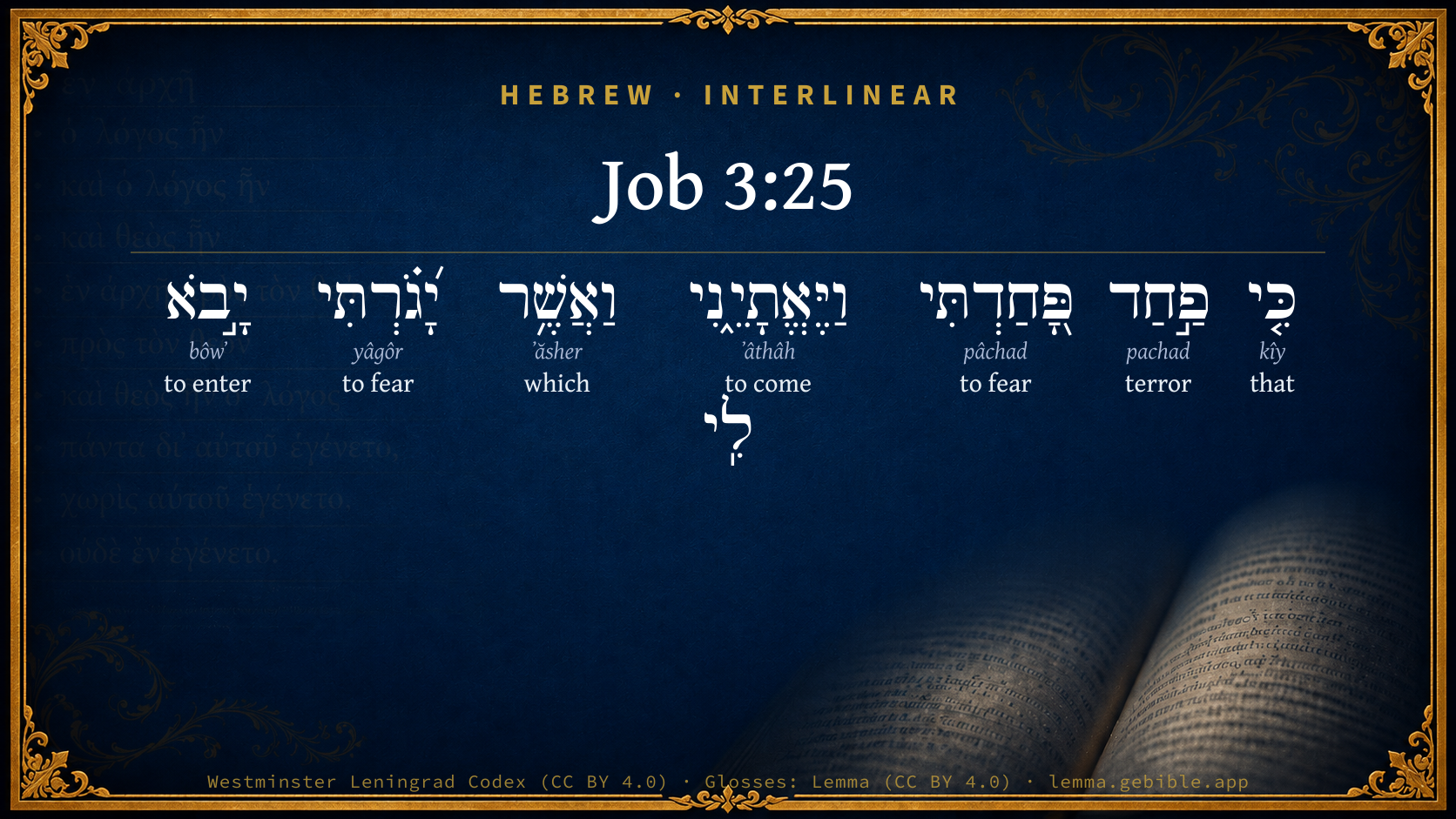
Job 3:25

Hebrew (Westminster Leningrad Codex) Job 3:25 appears in the Hebrew Old Testament. The text above is from the Westminster Leningrad Codex. Each word links to its Strong’s number, a concise gloss, and parsing drawn from the Open Scriptures Hebrew Bible morphology. Click any word for its full Brown-Driver-Briggs (BDB) entry.
Download image
Cite this verse

Job 3:25 (World English Bible). Public Domain. Lemma interlinear Bible study tool, https://lemma.gebible.app/v/job/3/25.

Show BibTeX & RIS
BibTeX
RIS
English Translation
For the thing which I fear comes on me, That which I am afraid of comes to me.
World English Bible · Public Domain
Download a study sheet

One document with this verse’s original text, its word-by-word gloss line, the meaning frame, cross-references with their text, attributed commentary, and full source and license credits — printable, and it pastes into notes with its structure intact.

This verse Autodidact and up

Study sheet (.html) Plain text (.txt)

A passage Seminary Student

Up to 50 verses in one chapter. A passage sheet keeps up to 6 commentary sources and 12 cross-references per verse, in the order this page ranks them, and says so on the sheet whenever that leaves anything out. Ask for a single verse and you get the Autodidact verse sheet above.

Everything on this page stays free to read, with no account — the sheet is a download of what is already on screen, not access to it.

Want to remove ads? Support Godless Engineer
Compare translations 3

The same verse in 3 English versions, stacked beneath the original-language interlinear above. Click any original word for its lexicon entry.

Each is an independent rendering of the whole verse — the interlinear is not word-aligned to these translations.

Highlighted words mark where these versions differ — a whole-verse word diff, not a word-by-word alignment.

  • World English Bible Public Domain
    For the thing which I fear comes on me, That which I am afraid of comes to me.
  • King James Version Public Domain
    For the thing which I greatly feared is come upon me, and that which I was afraid of is come unto me.
  • unfoldingWord Literal Text CC BY-SA 4.0
    For I feared a fear and it has arrived with me; what I dreaded has come to me.

unfoldingWord Literal Text — © unfoldingWord, licensed CC BY-SA 4.0. Word-aligned USFM3 via Door43 (git.door43.org/unfoldingWord/en_ult).

Versions to compare (up to 4)

3 of 4 selected

Show all 18 translations

Every available English version of this verse, each an independent rendering of the whole verse.

  • World English Bible Public Domain
    For the thing which I fear comes on me, That which I am afraid of comes to me.
  • Berean Standard Bible Public Domain
    For the thing I feared has overtaken me, and what I dreaded has befallen me.
  • Majority Standard Bible Public Domain
    For the thing I feared has overtaken me, and what I dreaded has befallen me.
  • King James Version Public Domain
    For the thing which I greatly feared is come upon me, and that which I was afraid of is come unto me.
  • American Standard Version (1901) Public Domain
    For the thing which I fear cometh upon me, And that which I am afraid of cometh unto me.
  • Revised Version (1885) Public Domain
    For the thing which I fear cometh upon me, and that which I am afraid of cometh unto me.
  • Geneva Bible (1599) Public Domain
    For the thing I feared, is come vpon me, and the thing that I was afraid of, is come vnto me.
  • Douay-Rheims (1899) Public Domain
    For the fear which I feared hath come upon me: and that which I was afraid of, hath befallen me.
  • Young's Literal Translation Public Domain
    For a fear I feared and it meeteth me, And what I was afraid of doth come to me.
  • Literal Standard Version CC BY-SA 4.0
    For I feared a fear and it meets me, || And what I was afraid of comes to me.
  • Unlocked Literal Bible CC BY-SA 4.0
    For the thing that I feared has come on me; what I was afraid of has come to me.
  • unfoldingWord Literal Text CC BY-SA 4.0
    For I feared a fear and it has arrived with me; what I dreaded has come to me.
  • Darby Bible Public Domain
    For I feared a fear, and it hath come upon me, and that which I dreaded hath come to me.
  • World Messianic Bible Public Domain
    For the thing which I fear comes on me, that which I am afraid of comes to me.
  • Webster's Bible Public Domain
    For the thing which I greatly feared hath come upon me, and that which I dreaded hath come to me.
  • Free Bible Version CC BY-SA 4.0
    For all that I feared has happened to me; everything that I dreaded has come upon me.
  • Bible in Basic English Public Domain
    For I have a fear and it comes on me, and my heart is greatly troubled.
  • JPS Tanakh (1917) Public Domain
    For the thing which I did fear is come upon me, and that which I was afraid of hath overtaken me.

Literal Standard Version (2020), Covenant Press — licensed CC BY-SA 4.0. Text via the HelloAO Bible API (eBible.org). Unlocked Literal Bible (unfoldingWord) — licensed CC BY-SA 4.0. Text via the HelloAO Bible API (eBible.org). unfoldingWord Literal Text — © unfoldingWord, licensed CC BY-SA 4.0. Word-aligned USFM3 via Door43 (git.door43.org/unfoldingWord/en_ult). Free Bible Version, Dr. Jonathan Gallagher — licensed CC BY-SA 4.0. Text via the HelloAO Bible API (eBible.org).

Word by word

More ways to search: Search by grammar → Find every occurrence → Compare this word →

Practice this passage: Drill this verse → Learn its vocabulary →

About this verse

These counts appear in no published source. They are computed here, from the morphology-tagged text and Lemma’s own curated glosses. What Lemma adds →

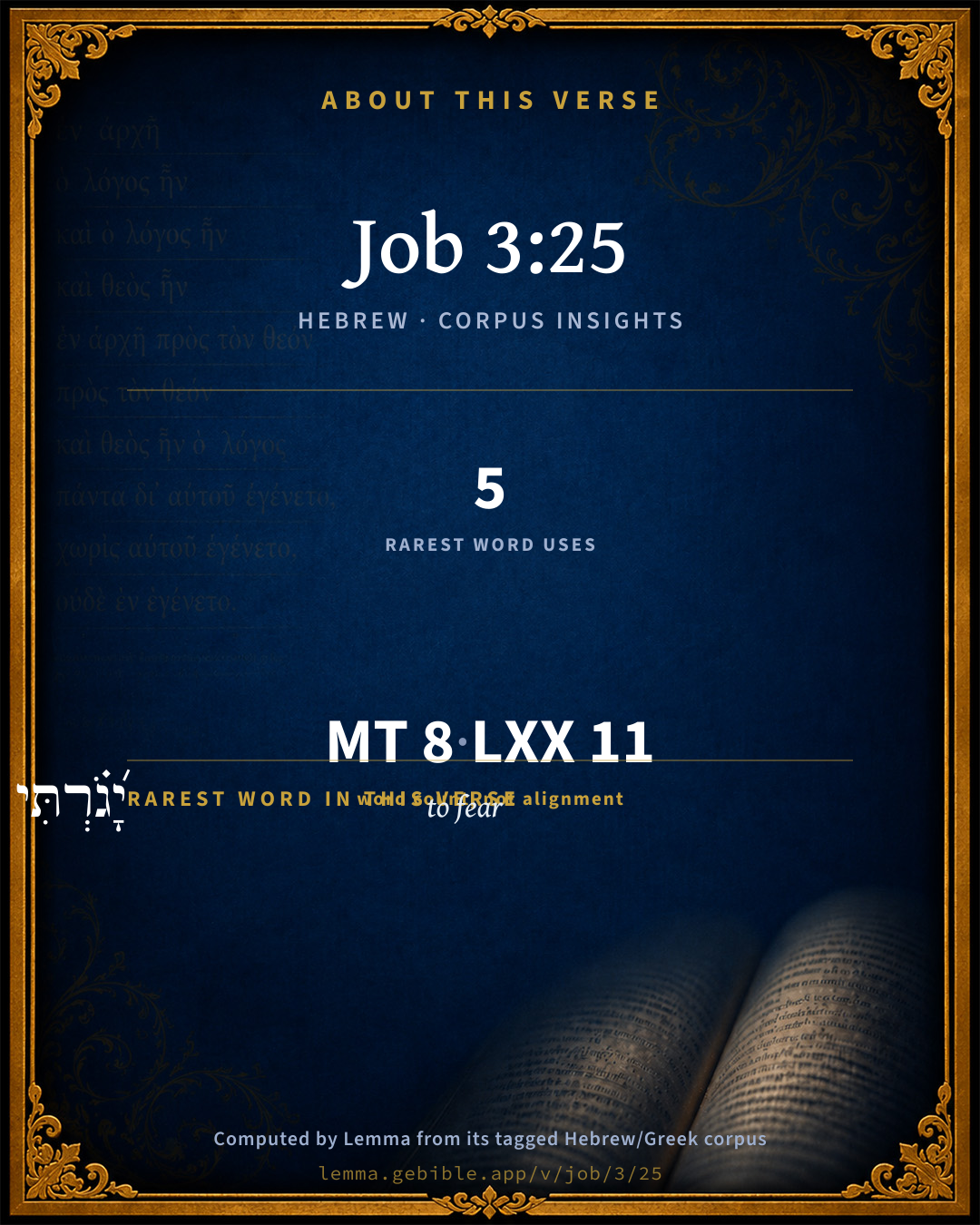
8
words
7
distinct lemmas
Wisdom
section

Notable vocabulary

The rarest word here is יָ֝גֹ֗רְתִּי to fear H3025 — appearing just 5 times in the whole Hebrew Bible.

Shared distinctive vocabulary

יָ֝גֹ֗רְתִּי to fear H3025 occurs in 5 verses of the Hebrew Bible. Also found in:

Grammatical profile

  • 4 verbs
  • 1 noun
  • 1 preposition
  • 1 conjunction
  • 1 particle

Verb forms

  • פָּ֭חַדְתִּי Qal · Perfect
  • וַיֶּאֱתָיֵ֑נִי Qal · Sequential Imperfect
  • יָ֝גֹ֗רְתִּי Qal · Perfect
  • יָ֣בֹא Qal · Imperfect

Hebrew & Septuagint length

In English translation the verse runs 18 words from the Hebrew and 20 from the Septuagint (LXX English) — closely comparable.

A rough comparison of the two English renderings, which tokenize alike — not a word-level alignment.

Word counts can differ between the Hebrew and the Greek without any difference in meaning — e.g. the Hebrew direct-object marker אֵת has no separate Greek word, and Greek often adds the article ὁ.

In the original languages it is 8 Hebrew tokens and 11 Greek tokens — but the two are counted differently (Hebrew bundles its prefixes and suffixes into one token; the Greek is in lemma form), so that isn’t a like-for-like length.

Cross-references

3

Topical passages linked to Job 3:25 in the Treasury of Scripture Knowledge — connected by theme and wording, ordered by reader-vote popularity; previews shown in the World English Bible.

  • Job 1:5 It was so, when the days of their feasting had run their course, that Job sent and sanctified them, and rose up early in the morning, and offered burnt offerings according to the number of them all. For Job said, "It may be that my sons have sinned, and renounced God in their hearts." Thus did Job continually.
  • Job 30:15 Terrors are turned on me. They chase my honor as the wind. My welfare has passed away as a cloud.
  • Job 31:23 For calamity from God is a terror to me, By reason of his majesty I can do nothing.

Cross-references courtesy of OpenBible.info (CC BY 4.0).

Hebrew and Greek witnesses Masoretic Hebrew ↔ Greek Septuagint

The same verse in the two great witnesses to the Old Testament, shown verse-for-verse.

These are two independent witnesses, not word-aligned to each other, and the Septuagint is shown in lemma (dictionary) form.

Hebrew Job 3:25 Masoretic · Westminster Leningrad Codex

כִּ֤י פַ֣חַד פָּ֭חַדְתִּי וַיֶּאֱתָיֵ֑נִי וַאֲשֶׁ֥ר יָ֝גֹ֗רְתִּי יָ֣בֹא לִֽי

For the thing which I fear comes on me, That which I am afraid of comes to me.

World English Bible · Public Domain

Greek LXX Job 3:25 Septuagint · lemma form

φόβος γάρ ὅς φροντίζω ἔρχομαι ἐγώ καί ὅς δείδω συνἀντάω ἐγώ

For the terror of which I meditated has come upon me, and that which I had feared has befallen me.

LXX2012 (modern English Septuagint) · Public Domain

Hebrew: Westminster Leningrad Codex (CC BY 4.0). Greek: Septuagint (public domain); English from LXX2012 (modern English Septuagint) (Public Domain). How the Septuagint differs from the Hebrew →

Commentary

Notes on Job 3:25 from classic Christian and Jewish commentators (each source and its license shown beneath its notes). The classic Christian expositions comment on the surrounding passage and are grouped to its opening verse, so a note may address several verses; the Jewish commentaries on the Tanakh (Rashi and others) are per-verse, so they appear only where the commentator wrote on this verse.

Lemma curates 59 commentaries, every one of them public domain or Creative Commons licensed, each selected and text-cleaned for this edition rather than reprinted as found. About our sources →

Trapp's Complete Commentary

John Trapp

Job 3:25 For the thing which I greatly feared is come upon me, and that which I was afraid of is come unto me.

Ver. 25. For the thing which I greatly feared is come upon me] Heb. I feared a fear, and it came upon me. Had Job been wicked, this had been no wonder, Pro 10:24 Job 15:21. Or had his fear been sinful, it had been less pity, Pro 29:25 Joh 11:48; for why should he, by a painful preconceit, suffer before he needed, and send for his crosses before they came? A good man should be careful (and so consequently fearful) in nothing, Php 4:6, he should hope the best, and bear bravely οτι αν Yεος διδω, saith Demosthenes, whatever God sendeth. The Epicureans held, that a good man might be cheerful under whatsoever miseries: 1. In consideration of honesty and integrity. 2. In consideration of those pleasures and comforts that formerly he had enjoyed, and now cheered up himself with, Ex praeteritarum voluptatum recordatione (Cie. de Finib. lib. 2). Of neither of these was Job to seek; but whereas it might be said unto him, Is it fit for thee, who hast hitherto been so happy, now to take on so heavily, because thus and thus afflicted? Truly, saith he, I was never so happy as you took me for; because (considering how moveable and mutable all outward things are) I always feared lest I should outlive my prosperity; that which now also is unhappily befallen me. Sulla had been happy, si eundem et vincendi et vivendi finem fecisset, saith one; that is, if he had made an end of conquering and of living together; but that he did not. In him and many others it hath appeared that mortality is but the stage of mutability. This holy Job had oft forecasted with himself: and though in his passion he here allege it as a reason why he took no comfort in his meat, &c., yet in true account it could be no grief unto him, nor offence of heart (as she once said to David, 1Sa 25:31), since it was a fear of wisdom and caution; a fear of the head, and not of the heart; a fear of diligence, and not of diffidence.

John Trapp, A Commentary or Exposition upon All the Books of the Old and New Testament (1647–1656) — public domain. Text from a community e-Sword module.

Joseph Benson's Commentary

Job 3:25. For the thing which I greatly feared is come upon me — Before this flood of misery was poured upon me, I was indeed under great and strong apprehensions, which I could not account for, of something or other that would happen to me; something extremely grievous and afflicting; something as bad, nay, worse than death itself. For I considered the variety of God’s providences, the changeableness of this vain world, the infirmities and contingencies to which human nature is liable in the present life, God’s justice, and the sinfulness of all mankind. And it is now evident that these fears of mine were not in vain, for they are justified by my present calamities. I may, therefore, say that I have never enjoyed any sound tranquillity since I was born; and, of consequence, it hath not been worth my while to live, since all my days have been evil, and full of trouble and distress, either by the fear of miseries or by the suffering of them.

Joseph Benson's Commentary on the Old and New Testaments (1811–1818) — public domain. Text from a community e-Sword module.

Geneva Bible (1599)

Geneva Bible translators

In my prosperity I looked ever for a fall, as is come now to pass.

Geneva Bible (1599) marginal notes — public domain. Text via Bolls.life.

Jamieson, Fausset & Brown

Robert Jamieson, A. R. Fausset & David Brown

the thing which I . . . feared is come upon me--In the beginning of his trials, when he heard of the loss of one blessing, he feared the loss of another; and when he heard of the loss of that, he feared the loss of a third.

that which I was afraid of is come unto me--namely, the ill opinion of his friends, as though he were a hypocrite on account of his trials.

Jamieson, Fausset & Brown — Commentary Critical and Explanatory on the Whole Bible (1871) — public domain (CC PDM 1.0). Text via the HelloAO Bible API.

Adam Clarke's Commentary

Verse 25. For the thing which I greatly reared] Literally, the fear that I feared; or, l feared a fear, as in the margin. While I was in prosperity I thought adversity might come, and I had a dread of it. I feared the loss of my family and my property; and both have occurred. I was not lifted up: I knew that what I possessed I had from Divine Providence, and that he who gave might take away. I am not stripped of my all as a punishment for my self-confidence.

Adam Clarke's Commentary on the Bible (1810–1826) — public domain. Text from a community e-Sword/MySword module.

Ellicott's Commentary for English Readers

(25) For the thing which I greatly feared . . .—Comp. Pro_28:14. It means that he had always had in remembrance the uncertainty and instability of earthly things, an yet he had been overtaken by a calamity that mocked his carefulness and exceeded his apprehensions.

A Bible Commentary for English Readers, edited by Charles John Ellicott (1878–1897) — public domain. Text from a community e-Sword module.

John Gill's Exposition

For the thing which I greatly feared is come upon me,.... Some refer this to his fears about his children, lest they should sin and offend God, and bring down his judgments on them, and now what he feared was come to pass, Job 1:5; others take in all his sorrows and troubles; which, through the changeableness of the world, and the uncertainty of all things in it, and the various providences of God, he feared would come upon him at one time or another; and this he mentions to justify his expostulation, why light and life should be continued to such a man, who, by reason of his fear and anxiety of mind, never had any pleasure in his greatest prosperity, destruction from the Almighty being a terror to him; Job 31:23; but I think it is not reasonable to suppose that a man of Job's faith in God, and trust in him, should indulge such fears to such a degree; nor indeed that he could ever entertain such a thought in him, nor even surmise that such shocking calamities and distresses should come upon him as did: but this is to be understood not of his former life, in prosperity, but of the beginning of his afflictions; when he heard of the loss of one part of his substance, he was immediately possessed with a fear of losing another; and when he heard of that, he feared the loss of a third, and even of all; then of his children, and next of his health:

and that which I was afraid of is come unto me: which designs the same, in other words, or a new affliction; and particularly the ill opinion his friends had of him; he feared that through these uncommon afflictions he should be reckoned an ungodly man, an hypocrite; and as he feared, so it was; this he perceived by the silence of his friends, they not speaking one word of comfort to him; and by their looks at him, and the whole of their behaviour to him.

John Gill's Exposition of the Whole Bible (1746–1763) — public domain (CC PDM 1.0). Text via the HelloAO Bible API.

Albert Barnes' Notes on the Bible

For the thing which I greatly feared - Margin, As in the Hebrew “I feared a fear, and it came upon me.” This verse, with the following, has received a considerable variety of exposition. Many have understood it as referring to his whole course of life, and suppose that Job meant to say that he was always apprehensive of some great calamity, such as that which had now come upon him, and that in the time of his highest prosperity be had lived in continual alarm lest his property should be taken. away, and lest he should be reduced to penury and suffering. This is the opinion of Drusius and Codurcus. In reply to this, Schultens has remarked, that such a supposition is contrary to all probability; that there was no reason to apprehend that such calamities as he now suffered, would come upon him; that they were so unusual that they could not have been anticipated; and that, thercfore, the alarm here spoken of, could not refer to the general tenor of his life.

That seems to have been happy and calm, and perhaps, if anything, too tranquil and secure. Most interpreters suppose that it refers to the state in which he was “during” his trial, and that it is designed to describe the rapid succession of his woes. Such is the interpretation of Rosenmuller, Schultens, Drs. Good, Noyes, Gill, and others. According to this, it means that his calamities came on him in quick succession. He had no time after one calamity to become composed before another came. When he heard of one misfortune, he naturally dreaded another, and they came on with overwhelming rapidity. If this be the correct interpretation, it means that the source of his lamentation is not merely the greatness of his losses and his trials considered in the “aggregate,” but the extraordinary rapidity with which they succeeded each other, thus rendering them much more difficult to be borne; see Job 1: He apprehended calamity, and it came suddenly.

When one part of his property was taken, he had deep apprehensions respecting the rest; when all his property was seized or destroyed, he had alarm about his children; when the report came that they were dead, he feared some other affliction still. The sentiment is in accordance with human nature, that when we are visited with severe calamity in one form, we naturally dread it in another. The mind becomes exquisitely sensitive. The affections cluster around the objects of attachment which are left, and they become dear to us. When one child is taken away, our affections cling more closely to the one which survives, and any little illness alarms us, and the value of one object of affection is more and more increased - like the Sybil’s leaves - as another is removed. It is an instinct of our nature, too, to apprehend calamity in quick succession when one comes “Misfortunes seldom come alone;” and when we suffer the loss of one endeared object, we instinctively feel that there may be a succession of blows that will remove all our comforts from us. Such seems to have been the apprehension of Job.

Albert Barnes' Notes on the Bible (1834–1885) — public domain. Text from a community e-Sword/MySword module.

Haydock's Catholic Bible Commentary

Fear. In prosperity he feared the assaults of pride. Now he is in danger of yielding to impatience and despair. (Calmet)

George Leo Haydock (1774–1849), Haydock's Catholic Family Bible and Commentary, 1859 edition — public domain. Excludes Psalms (Douay-Rheims chapter numbering differs from Protestant) and Deuterocanonical books (Catholic canon only).

Matthew Poole's English Annotations

This is another reason why he is weary of his life, and why he repents that ever he was born, because he never enjoyed any solid and secure comfort.

The thing which I greatly feared is come upon me. Heb. I feared a fear, (i.e. a danger or mischief in one kind or other, the act being here put for the object, as joy and love are oft put for the things rejoiced in, or loved, and here fear for the thing feared. Or, I feared with fear, i.e. I feared greatly,) and it came. Even in the time of my peace and prosperity I was full of fears, considering the variety of God’s providences, the course and changeableness of this vain world, the infirmities and contingencies of human nature and life, God’s justice, and the sinfulness of all mankind. And these fears of mine were not vain, but are justified by my present calamities. So that I have never enjoyed any sound tranquillity since I was born; and therefore it hath not been worth my while to live, since all my days have been evil, and full of vexation and torment, either by the fear of miseries, or by the sufferance of them.

Matthew Poole's English Annotations on the Holy Bible (1683–1685) — public domain. Text from a community e-Sword/MySword module.

Whedon's Commentary on the Bible

Daniel D. Whedon

25. I greatly feared — Literally, A fear I feared, and it came upon me.

The elegance of the Hebrew (פחד פחדתי) is lost in the A.V. Compare Psa_53:5, see margin. A twofold illustration of such alliteration appears to the English reader in Isa_27:7, which is well expressed in our translation. (Compare Isa_22:17-18; Mic_2:4.) These quite equal in beauty the most admired alliterations of the classic poets: for instance, πονος πονω πονον φερει. — SOPHOCLES, Ajax, 866. The form of the verb is come, ויאתיני, (Vav consecutive,) closely binds the issue with the apprehension, and perhaps justifies Hirtzel and Dillmann in their interpretation: “The trouble he thought of, and which he deprecated, immediately came upon him.” Here Job may possibly refer to his solicitude over his children in connexion with their sudden and overwhelming destruction. Some (DENDY, Philos. of Myst.) have fancifully conceived that the apprehension of misfortune may prove its cause. Thus Montaigne was all his life fearful of “the stone,” and in old age it came upon him with all its terrors. — Essays, ii, chap. 37. On the other hand, Davidson mistakingly suggests that the idea that Job “in the height of his felicity had been haunted by the presentiment of coming calamity, is opposed to the whole convictions of antiquity, and contradicted by the anguish and despair of the man under his suffering, which was to him inexplicable and unexpected.” On the convictions of antiquity, see Herodotus, 1:32; 3:40; 7:10, 46.

Daniel D. Whedon (gen. ed.), Commentary on the Old and New Testaments (1874–1909) — public domain. Text from a community e-Sword module.

The Pulpit Commentary

For the thing which I greatly feared is come upon me; literally, for I fear a fear, and it comes upon me. The meaning is not that the affliction which has come upon him is a thing which Job had feared when he was prosperous; but that now that he is in adversity, he is beset with fears, and that all his presentiments of evil are almost immediately accomplished. The second clause, And that which I was (rather, am) afraid of is come unto me, merely repeats and emphasizes the first (see the comment on ver. 11).

Vers. 25, 26. Fears confirmed by facts.

Job complained that he was not foolishly confident in his prosperity, and so courting a reverse of fortune by pride and presumption. On the contrary, he was anticipating the possibility of evil and walking in fear. His action, as it appears in the opening verses of the book, shows us a man of an anxious temperament. (Job_1:5) He thinks it hard that trouble should come to him who had feared it. This may be unreasonable in Job; but it is quite natural, and not at all inexplicable. Inconsistent as it may seem, our very anticipation of evil is unconsciously taken as a sort of insurance against it. Because we are prepared to expect it we somehow come to think that we should not receive it. Our humility, foresight, and apprehension are unconsciously treated as making up a sort of compensation which shall buy off the impending evil. When they turn out to be nothing of the kind we are sadly disappointed.

I OUR WORST FEARS MAY BE REALIZED.

1. On earth. Anxious people are not ipso facto saved from trouble. The world does contain great evils. The ills of life are not confined to the imagination of the despondent. They are seen in plain prosaic facts.

2. After death. The fear of death will not save from death, nor will the fear of hell save from hell. A person may have very dark views of his impending fate, and, if he deserves it, he may find that it is quite equal to his fears. Nothing can be more disastrous than the notion that the expectation of future punishment is only the dream of a scared conscience. "Whatsoever a man soweth, that shall he also reap" is a great fundamental law of nature.

II THE RIGHT WAY TO DISPEL FEARS IS TO REMOVE THEIR GROUNDS. To soothe fears without touching the facts which justify them is the height of folly. The facts remain, however much we may be hoodwinked into disregarding them. Salvation is not to be got by means of any manipulation of the sinner"s fears. Sin is the fundamental cause of all ruin, and the justification of men"s worst fears. The one necessity is to remove the sin; then the fears will vanish of their own accord. The sickening letters from condemned criminals, who are quite sure that they are going straight from the gallows to heaven, although they give no sign of genuine penitence for sin, reveal a very unwholesome style of religious instruction. Surely the chief business of a Christian teacher is not to lull the fears of an alarmed conscience, and induce a condition of placid resignation. Hypnotism would do this more effectively; but to be hypnotized into placidity is not to be saved. If, however, men learn to confess their sins, and to loathe themselves on account of those sins, then indeed the gospel of Christ assures perfect redemption for all who turn to him in faith. When this is the soul"s experience fear may be banished. Trouble, indeed, may come. But it is useless to anticipate it. It is better to take our Lord"s advice, and "be not anxious for the morrow. W.F.A.

The Pulpit Commentary (1880–1919), ed. H.D.M. Spence-Jones & Joseph S. Exell — public domain. Text from a community e-Sword module.

John Wesley's Explanatory Notes

Feared - Even in the time of my prosperity, I was full of fears, considering the variety of God's providences, the changeableness of this vain world, God's justice, and the sinfulness of all mankind. And these fears of mine, were not in vain, but are justified by my present calamities.

John Wesley, Explanatory Notes Upon the Whole Bible (1754–1765) — public domain. Text via the GEBible commentary corpus.

unfoldingWord translationNotes

Door43 World Missions Community

the thing that I feared has come on me; what I was afraid of has come to me

These two phrases mean the same thing. AT: "what I feared most has happened to me" or "my worst fear has come true" (See: Parallelism)

I am not at ease, I am not quiet, and I have no rest

Job expresses his anguish in three separate phrases. AT: "I am very anxious" or "I am emotionally and physically tormented" (See: Parallelism)

translationWords

fear

rest

trouble

unfoldingWord translationNotes — © Distant Shores Media and the Door43 World Missions Community, licensed CC BY-SA 4.0. Source: git.door43.org/Door43/en_tn.

Rashi

Rabbi Shlomo Yitzchaki (Rashi)

the thing I feared All my life, I stood in fear of this, as I said (1:5): “Now it would come about, when the cycle of the feasting would days be over, etc.”

What I dreaded—Behold!

Rashi on the Tanakh — English translations: “The Judaica Press complete Tanach with Rashi, translated by A. J. Rosenberg” (CC BY 4.0); “Pentateuch with Rashi's commentary by M. Rosenbaum and A.M. Silbermann, 1929-1934” (public domain); “The Metsudah Tanach series, Lakewood, N.J” (CC BY 4.0); and “The Book of Joshua, Metsudah Publications, 1997” (CC BY 4.0). Text via Sefaria.

Lesson kit

Teaching starters — assembled from the data on this page, not authored interpretation. Every prompt links to the verse data it draws on. Edit before teaching.

Job, in the Wisdom, opens this verse with 8 words (7 distinct Hebrew lemmas). Its most distinctive word is yâgôr (“to fear”). A historical commentator’s framing appears above. Read the whole chapter for the surrounding context.

Discussion questions

  1. What does “to fear” (yâgôr) contribute to the verse as a whole?
  2. How does Deuteronomy 9:19, which shares the word «to fear», read alongside this verse?
  3. These translations render this verse differently; the difference is in the English rendering, not the original. What questions does that raise?
  4. «פָּ֭חַדְתִּי» is a Qal Perfect verb. How does that grammatical form shape the action described?
  5. Compare how Trapp's Complete Commentary and Joseph Benson's Commentary read this verse. Where do they agree or differ?

Things to notice

Reading settings

Reading text

Shown beneath each verse's original-language words.

Old Testament
Old Testament edition

Read the OT as the Masoretic Hebrew (MT) or the Greek Septuagint (LXX).

English shown for the Greek Septuagint (in the Hebrew ↔ Greek comparison).

Comparing translations? Open the Compare panel on any verse page to stack up to four side by side.