
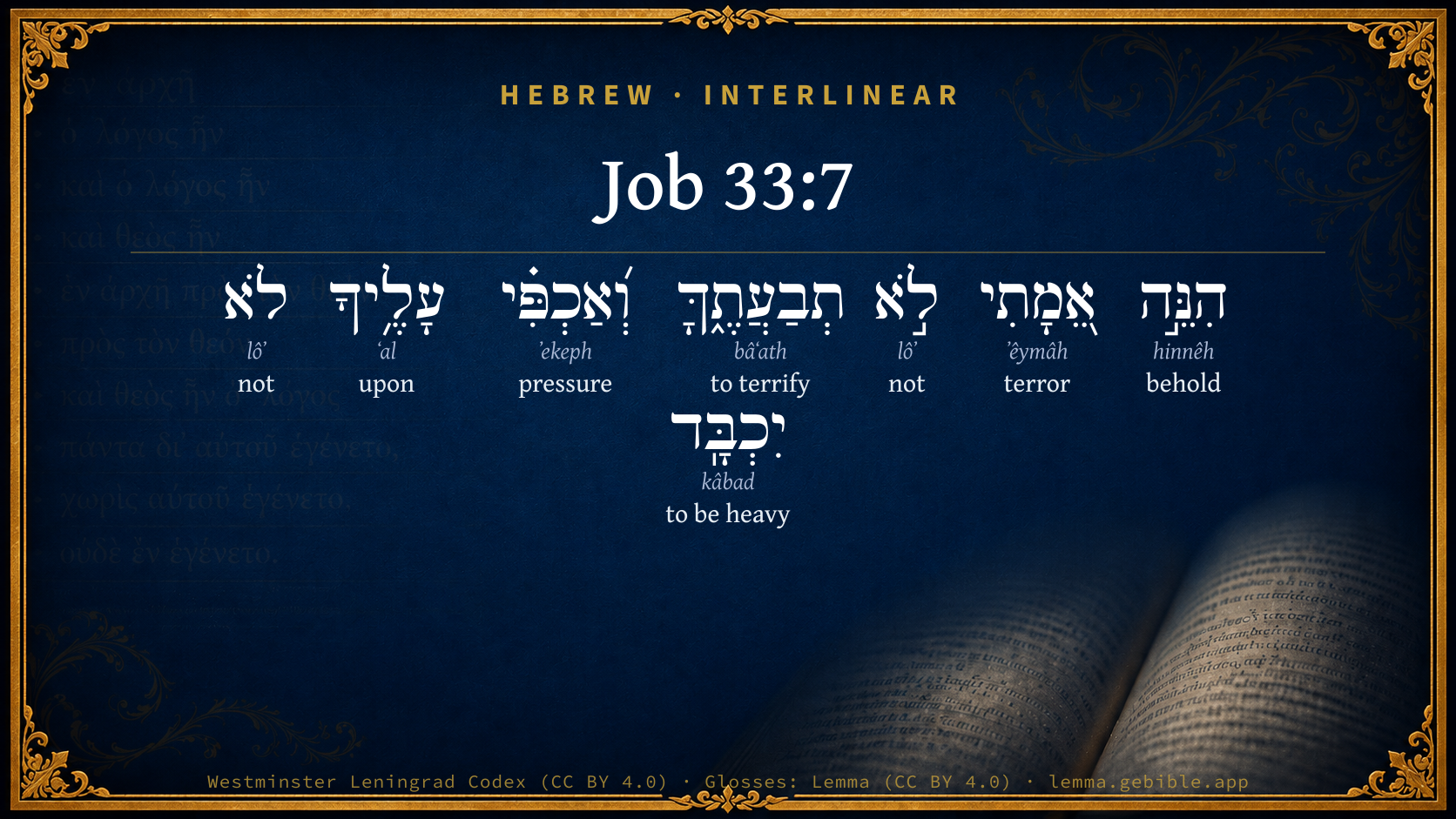
Job 33:7

Hebrew (Westminster Leningrad Codex) Job 33:7 appears in the Hebrew Old Testament. The text above is from the Westminster Leningrad Codex. Each word links to its Strong’s number, a concise gloss, and parsing drawn from the Open Scriptures Hebrew Bible morphology. Click any word for its full Brown-Driver-Briggs (BDB) entry.
Download image
Cite this verse

Job 33:7 (World English Bible). Public Domain. Lemma interlinear Bible study tool, https://lemma.gebible.app/v/job/33/7.

Show BibTeX & RIS
BibTeX
RIS
English Translation
Behold, my terror shall not make you afraid, Neither shall my pressure be heavy on you.
World English Bible · Public Domain
Highlights
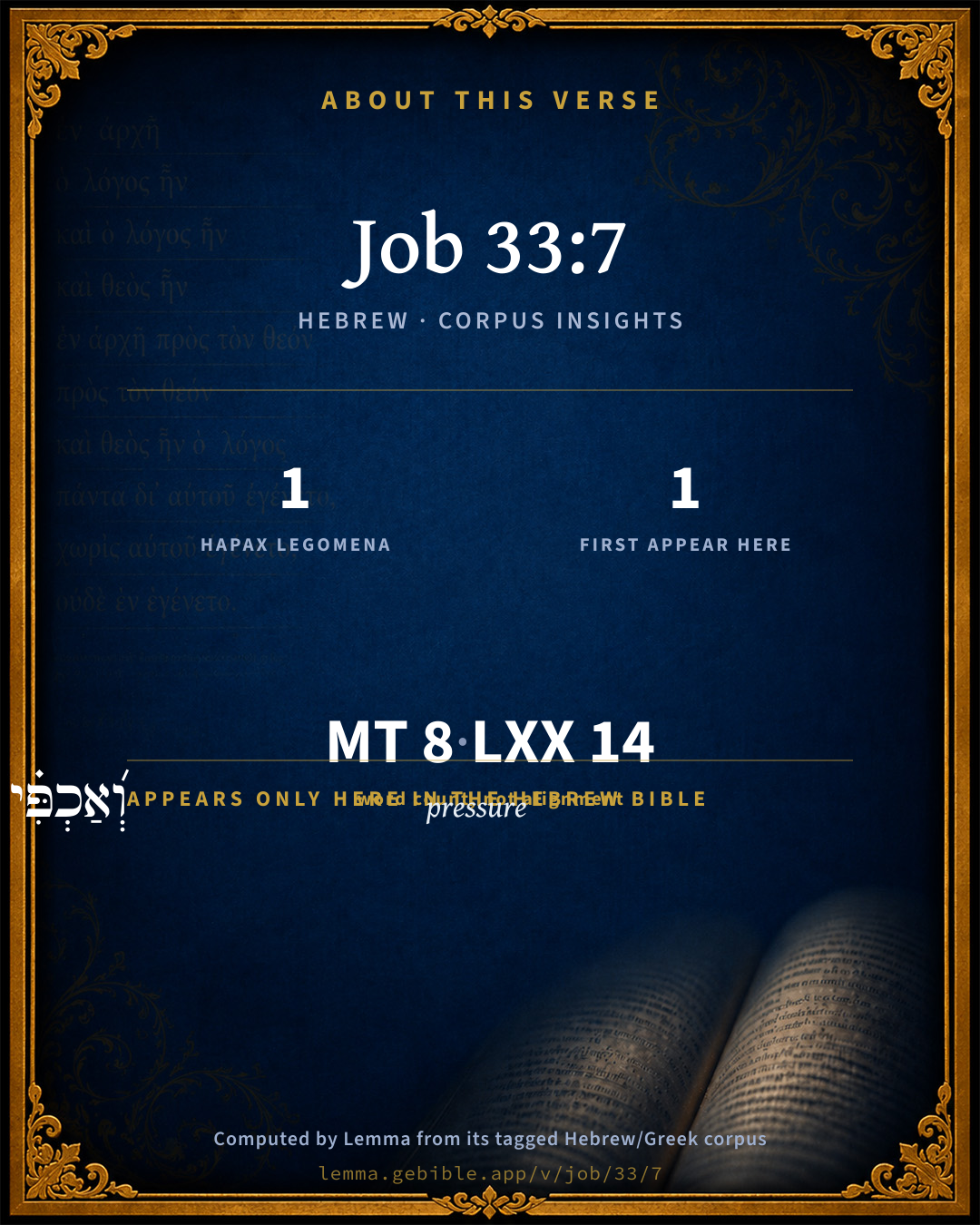
  • 1 hapax legomenon — only here in the Hebrew Bible
  • 1 first appearance in the Hebrew Bible
Full analysis ↓
Download a study sheet

One document with this verse’s original text, its word-by-word gloss line, the meaning frame, cross-references with their text, attributed commentary, and full source and license credits — printable, and it pastes into notes with its structure intact.

This verse Autodidact and up

Study sheet (.html) Plain text (.txt)

A passage Seminary Student

Up to 50 verses in one chapter. A passage sheet keeps up to 6 commentary sources and 12 cross-references per verse, in the order this page ranks them, and says so on the sheet whenever that leaves anything out. Ask for a single verse and you get the Autodidact verse sheet above.

Everything on this page stays free to read, with no account — the sheet is a download of what is already on screen, not access to it.

Want to remove ads? Support Godless Engineer
Compare translations 3

The same verse in 3 English versions, stacked beneath the original-language interlinear above. Click any original word for its lexicon entry.

Each is an independent rendering of the whole verse — the interlinear is not word-aligned to these translations.

Highlighted words mark where these versions differ — a whole-verse word diff, not a word-by-word alignment.

  • World English Bible Public Domain
    Behold, my terror shall not make you afraid, Neither shall my pressure be heavy on you.
  • King James Version Public Domain
    Behold, my terror shall not make thee afraid, neither shall my hand be heavy upon thee.
  • unfoldingWord Literal Text CC BY-SA 4.0
    behold, my fear will not terrify you, and my pressure will not be heavy on you.

unfoldingWord Literal Text — © unfoldingWord, licensed CC BY-SA 4.0. Word-aligned USFM3 via Door43 (git.door43.org/unfoldingWord/en_ult).

Versions to compare (up to 4)

3 of 4 selected

Show all 18 translations

Every available English version of this verse, each an independent rendering of the whole verse.

  • World English Bible Public Domain
    Behold, my terror shall not make you afraid, Neither shall my pressure be heavy on you.
  • Berean Standard Bible Public Domain
    Surely no fear of me should terrify you; nor will my hand be heavy upon you.
  • Majority Standard Bible Public Domain
    Surely no fear of me should terrify you; nor will my hand be heavy upon you.
  • King James Version Public Domain
    Behold, my terror shall not make thee afraid, neither shall my hand be heavy upon thee.
  • American Standard Version (1901) Public Domain
    Behold, my terror shall not make thee afraid, Neither shall my pressure be heavy upon thee.
  • Revised Version (1885) Public Domain
    Behold, my terror shall not make thee afraid, neither shall my pressure be heavy upon thee.
  • Geneva Bible (1599) Public Domain
    Beholde, my terrour shall not feare thee, neither shall mine hand be heauie vpon thee.
  • Douay-Rheims (1899) Public Domain
    But yet let not my wonder terrify thee, and let not my eloquence be burdensome to thee.
  • Young's Literal Translation Public Domain
    Lo, my terror doth not frighten thee, And my burden on thee is not heavy.
  • Literal Standard Version CC BY-SA 4.0
    Behold, my terror does not frighten you, || And my burden on you is not heavy.
  • Unlocked Literal Bible CC BY-SA 4.0
    See, terror of me will not make you afraid; neither will my pressure be heavy upon you.
  • unfoldingWord Literal Text CC BY-SA 4.0
    behold, my fear will not terrify you, and my pressure will not be heavy on you.
  • Darby Bible Public Domain
    Behold, my terror shall not make thee afraid, nor my burden be heavy upon thee.
  • World Messianic Bible Public Domain
    Behold, my terror will not make you afraid, neither will my pressure be heavy on you.
  • Webster's Bible Public Domain
    Behold, my terror shall not make thee afraid, neither shall my hand be heavy upon thee.
  • Free Bible Version CC BY-SA 4.0
    See here, you don't need to be frightened of me. I won't be too hard on you.
  • Bible in Basic English Public Domain
    Fear of me will not overcome you, and my hand will not be hard on you.
  • JPS Tanakh (1917) Public Domain
    Behold, my terror shall not make thee afraid, neither shall my pressure be heavy upon thee.

Literal Standard Version (2020), Covenant Press — licensed CC BY-SA 4.0. Text via the HelloAO Bible API (eBible.org). Unlocked Literal Bible (unfoldingWord) — licensed CC BY-SA 4.0. Text via the HelloAO Bible API (eBible.org). unfoldingWord Literal Text — © unfoldingWord, licensed CC BY-SA 4.0. Word-aligned USFM3 via Door43 (git.door43.org/unfoldingWord/en_ult). Free Bible Version, Dr. Jonathan Gallagher — licensed CC BY-SA 4.0. Text via the HelloAO Bible API (eBible.org).

Word by word

More ways to search: Search by grammar → Find every occurrence → Compare this word →

Practice this passage: Drill this verse → Learn its vocabulary →

About this verse

These counts appear in no published source. They are computed here, from the morphology-tagged text and Lemma’s own curated glosses. What Lemma adds →

8
words
7
distinct lemmas
Wisdom
section

Notable vocabulary

1 hapax legomenon — a word that appears only here in the entire Hebrew Bible:

  • וְ֝אַכְפִּ֗י pressure H405

First appearance in Scripture

This word makes its first canonical appearance in the Hebrew Bible here:

  • וְ֝אַכְפִּ֗י pressure H405

Shared distinctive vocabulary

תְבַעֲתֶ֑ךָּ to terrify H1204 occurs in 16 verses of the Hebrew Bible. Also found in:

Grammatical profile

  • 2 verbs
  • 2 nouns
  • 1 preposition
  • 3 particles

Verb forms

  • תְבַעֲתֶ֑ךָּ Piel · Imperfect
  • יִכְבָּֽד Qal · Imperfect

Repetition

A word recurs within this verse — often emphatic in Hebrew:

Hebrew & Septuagint length

In English translation the verse runs 16 words from the Hebrew and 14 from the Septuagint (LXX English) — closely comparable.

A rough comparison of the two English renderings, which tokenize alike — not a word-level alignment.

Word counts can differ between the Hebrew and the Greek without any difference in meaning — e.g. the Hebrew direct-object marker אֵת has no separate Greek word, and Greek often adds the article ὁ.

In the original languages it is 8 Hebrew tokens and 14 Greek tokens — but the two are counted differently (Hebrew bundles its prefixes and suffixes into one token; the Greek is in lemma form), so that isn’t a like-for-like length.

Cross-references

4

Topical passages linked to Job 33:7 in the Treasury of Scripture Knowledge — connected by theme and wording, ordered by reader-vote popularity; previews shown in the World English Bible.

  • Job 13:21 Withdraw your hand far from me; And don't let your terror make me afraid.
  • Job 9:34 Let him take his rod away from me, Let his terror not make me afraid:
  • Psalms 32:4 For day and night your hand was heavy on me. My strength was sapped in the heat of summer. Selah.
  • Psalms 88:16 Your fierce wrath has gone over me. Your terrors have cut me off.

Cross-references courtesy of OpenBible.info (CC BY 4.0).

Hebrew and Greek witnesses Masoretic Hebrew ↔ Greek Septuagint

The same verse in the two great witnesses to the Old Testament, shown verse-for-verse.

These are two independent witnesses, not word-aligned to each other, and the Septuagint is shown in lemma (dictionary) form.

Hebrew Job 33:7 Masoretic · Westminster Leningrad Codex

הִנֵּ֣ה אֵ֭מָתִי לֹ֣א תְבַעֲתֶ֑ךָּ וְ֝אַכְפִּ֗י עָלֶ֥יךָ לֹא יִכְבָּֽד

Behold, my terror shall not make you afraid, Neither shall my pressure be heavy on you.

World English Bible · Public Domain

Greek LXX Job 33:7 Septuagint · lemma form

οὐ ὁ φόβος ἐγώ σύ στροβέω οὐδέ ὁ χείρ ἐγώ βαρύς εἰμί ἐπί σύ

My fear shall not terrify you, neither shall my hand be heavy upon you.

LXX2012 (modern English Septuagint) · Public Domain

On this verse, Albert Barnes' Notes on the Bible discusses the Septuagint’s reading. Read the note in Commentary ↓

Hebrew: Westminster Leningrad Codex (CC BY 4.0). Greek: Septuagint (public domain); English from LXX2012 (modern English Septuagint) (Public Domain). How the Septuagint differs from the Hebrew →

Commentary

Notes on Job 33:7 from classic Christian and Jewish commentators (each source and its license shown beneath its notes). The classic Christian expositions comment on the surrounding passage and are grouped to its opening verse, so a note may address several verses; the Jewish commentaries on the Tanakh (Rashi and others) are per-verse, so they appear only where the commentator wrote on this verse.

Lemma curates 59 commentaries, every one of them public domain or Creative Commons licensed, each selected and text-cleaned for this edition rather than reprinted as found. About our sources →

Trapp's Complete Commentary

John Trapp

Job 33:7 Behold, my terror shall not make thee afraid, neither shall my hand be heavy upon thee.

Ver. 7. Behold, my terror shall not make thee afraid] This Job had earnestly desired of God, Job 9:24; Job 13:21, and Elihu, as a cunning disputant, presseth him with his own words: I will not, saith he, neither is it fit any mortal man should by his terror and power ravish another of his right religion, as some Zamzummims do the meaner sort of people by their belluine {brutal} greatness; as the pope and his janissaries {One of a former body of Turkish infantry, constituting the Sultan’s guard and the main part of the standing army. The body was first organized in the 14th century, and was composed mainly of tributary children of Christians; after a large number of them had been massacred in 1826, the organization was finally abolished.} do the heretics, as they call those of the reformed religion, that will not renounce it; not once hearing what they can say for themselves. Either you must turn or burn, say they. This is monstrous immanity. Giants are called Emim, formidable, and Nephilim, because men fall before them through fear.

Neither shall my hand be heavy upon thee] Brentius rendereth this verse thus: Ecce frons mea non terreat te, et inclinatio mea super te non gravet, Behold, my forehead cannot fright thee; neither can my bowing down upon thee surcharge thee. I shall neither brow beat thee nor quell thee with my weight, that thou shouldest refuse to reason the case with me. Periculosum est contra eum scribere, qui potest proscribere; et illi contradicere, qui potest aqua et qui interdicere. It is ill meddling with those that are armed with great power, and can as easily undo a man as bid it be done. I must needs acknowledge you the better scholar (said Phavorinus the philosopher to Adrian the emperor) qui triginta habes legiones, who hast thirty legions at command (Aelius Spart.). But here was no such disparity or cause of fear in Job, from his compeer, Elihu.

John Trapp, A Commentary or Exposition upon All the Books of the Old and New Testament (1647–1656) — public domain. Text from a community e-Sword module.

Tyndale Open Study Notes

Tyndale Open Resources

33:7 you don’t need to be afraid of me (literally my terror shall not make you afraid): God’s terrors (6:4; 7:14; 9:34; 13:21; 23:15) had been thrown in Job’s face by Eliphaz (15:21, 24; 22:10), Bildad (18:11, 14), and Zophar (20:25). • Elihu promised not to come down hard on Job, but later he broke his word (34:7-9, 33-37).

Tyndale Open Study Notes — © Tyndale Open Resources, licensed CC BY-SA 4.0. Text via the HelloAO Bible API.

Geneva Bible (1599)

Geneva Bible translators

I will not handle thee so roughly as these others have done.

Geneva Bible (1599) marginal notes — public domain. Text via Bolls.life.

Jamieson, Fausset & Brown

Robert Jamieson, A. R. Fausset & David Brown

hand--alluding to Job's words (Job 13:21).

Jamieson, Fausset & Brown — Commentary Critical and Explanatory on the Whole Bible (1871) — public domain (CC PDM 1.0). Text via the HelloAO Bible API.

Adam Clarke's Commentary

Verse 7. My terror shall not make thee afraid] This is an allusion to what Job had said, Job 9:34: "Let him take his rod away from me, and let not his fear terrify me." Being thy equal, no fear can impose upon thee so far as to overawe thee; so that thou shouldst not be able to conduct thy own defence. We are on equal terms; now prepare to defend thyself.

Adam Clarke's Commentary on the Bible (1810–1826) — public domain. Text from a community e-Sword/MySword module.

Ellicott's Commentary for English Readers

(7) Neither shall my hand be heavy upon thee—i.e., I will deal gently with thee, and not be harsh.

A Bible Commentary for English Readers, edited by Charles John Ellicott (1878–1897) — public domain. Text from a community e-Sword module.

The Cambridge Bible for Schools and Colleges

gen. ed. J. J. S. Perowne

7. Job had often complained that the terror and majesty of God overpowered him and made it impossible for him to plead his cause and shew his rectitude; comp. ch. Job_9:34, Job_13:21.

my hand be heavy] The term hand may be an uncommon form of the Heb. word having that sense, or it may perhaps mean burden, pressure; comp. ch. Job_13:21.

The Cambridge Bible for Schools and Colleges (gen. ed. J. J. S. Perowne; Cambridge University Press, 1878–1918) — public domain. Text from a community e-Sword module.

John Gill's Exposition

Behold, my terror shall not make thee afraid,.... To come near, join issue in a debate, and speak freely; this Job had wished for, and desired of God that his fear might not terrify him, and his dread not make him afraid, and then he could talk and reason freely with him, Job 9:34; now Job had nothing to fear from Elihu, he was a man and not God, with whom there was no terrible majesty, as with God; he was but a clod of clay, and had nothing in him or about him to strike terror into him; he was no great personage, as a king or prince, nor in any civil authority, nor had so much as age to command an awe, much less could inject dread and terror:

neither shall my hand be heavy upon thee; which is not to be literally understood; Job could be in no fear of that, nor Elihu guilty of such rudeness; but figuratively, that he should not seek to afflict and distress him, or add to his affliction, and make it heavier, by hard words, severe reflections, and cruel reproaches; he seems to refer to Job 13:21; the Targum is,

"my burden upon time shall not be heavy;''

he promises not to aggravate things, but make them as easy as they would admit of.

John Gill's Exposition of the Whole Bible (1746–1763) — public domain (CC PDM 1.0). Text via the HelloAO Bible API.

Albert Barnes' Notes on the Bible

Behold my terror shall not make thee afraid - Job had earnestly desired to carry his cause directly before God, but he had expressed the apprehension that he would overawe him by his majesty, so that he would not be able to manage his plea with the calmness and self-possession which were desirable. He had, therefore, expressed it as his earnest wish, that if he were so permitted, God would not take advantage of his majesty and power to confound him; see the notes at Job 13:21. Elihu now says, that the wish of Job in this could be amply gratified. Though he spake in the name of God, and it might be considered that the case was fairly carried before him, yet he was also a man. He was the fellow, the equal with Job. He was made of the same clay, and he could not overawe him as the Almighty himself might do. There would be, therefore, in his case all the advantage of carrying the cause directly up to God, and yet none of the disadvantage which Job apprehended, and which must ensue when a mere man undertook to manage his own cause with the Almighty.

Neither shall my hand be heavy upon, thee - Alluding, evidently, to what Job had said, Job 13:21, that the hand of God was heavy upon him, so that he could not conduct his cause in such a manner as to do justice to himself. He had asked, therefore (see the notes at that place), as a special favor, if he was permitted to carry his cause before God, that his hand would be so far lightened that he could be able to state his arguments with the force which they required. Elihu says now that that wish could be gratified. Though he was in the place of God, yet he was a man, and his hand would not be upon him to crush him down so that he could not do justice to himself. The noun rendered “hand” (אכף 'ekeph) does not elsewhere occur. The verb אכף 'âkaph occurs once in Pro 16:26, where it is rendered “craveth” - “He that laboreth, laboreth for himself; for his mouth craveth it of him” - where the margin is boweth unto.

The word in Arabic means to lead a beast of burden; to bend, to make to bow under a lead; and then to impel, to urge on; and hence, it means, “his mouth, that is, hunger, impels, or urges him on to labor.” In like manner the meaning of the word here (אכף 'ekeph) may be a lead or burden, meaning “my lead, i. e., my weight, dignity, authority, shall not be burdensome or oppressive to you.” But the parallel place in Job 13:21, is “hand,” and that meaning seems to be required here. Kimchi supposes it is the same as כף kaph - hand, and the Septuagint has so rendered it, ἡ χείρ μου hē cheir mou. In the view of the speech of Elihu thus far, we cannot but remark that there is much that is unique, and especially that he lays decided claim to inspiration. Though speaking for God, yet he was in human nature, and Job might speak to him as a friend, unawed and unterrifled by any dread of overwhelming majesty and power.

On what grounds Elihu based these high pretensions does not appear, and his claim to them is the more remarkable from his youth. It does not require the aid of a very lively imagination to fancy a resemblance between him and the Lord Jesus - the great mediator between God and man - and were that mode of interpretation which delights to find types and figures every where a mode that could be vindicated, there is no character in the Old Testament that would more obviously suggest that of the Redeemer than the character of Elihu. His comparative youth, his modesty, his humility, would suggest it. The fact that he comes in to utter his sentiments where age and wisdom had failed to suggest the truth, and when pretending sages were confounded and silenced, would suggest it. The fact that he claims to be in the place of God, and that a cause might be managed before him as if it were before God and yet that he was a man like others, and that no advantage would be taken to overawe by mere majesty and power, are all circumstances that would constitute a strong and vivid resemblance. But I see no evidence that this was the design of the introduction of the character of Elihu, and interesting as the comparison might be, and desirable as it may seem that the book of Job should be found to contain some reference to the great work of mediation, yet the just and stern laws of interpretation exclude such a reference in the absence of proof, and do not allow us to luxuriate in the conceptions of fancy, however pious the reflections might be, or to search for typical characters where the Spirit of inspiration has not revealed them as such, however interesting or edifying might be the contemplation.

Albert Barnes' Notes on the Bible (1834–1885) — public domain. Text from a community e-Sword/MySword module.

Haydock's Catholic Bible Commentary

Wonder (miraculum.) Hebrew, "terror," (Haydock) in allusion to Job’s words, chap. ix. 34. --- Eloquence. Hebrew, "hand." (Calmet) --- Septuagint, "the dread of me shall not cast thee down, nor my hand be heavy upon thee." Arrogant men esteem their own observations as something wonderful. (St. Gregory) (Worthington)

George Leo Haydock (1774–1849), Haydock's Catholic Family Bible and Commentary, 1859 edition — public domain. Excludes Psalms (Douay-Rheims chapter numbering differs from Protestant) and Deuterocanonical books (Catholic canon only).

Matthew Poole's English Annotations

Which was the condition of that disputation which thou didst offer to undertake with God, Job 9:34; 13:21.

Matthew Poole's English Annotations on the Holy Bible (1683–1685) — public domain. Text from a community e-Sword/MySword module.

Whedon's Commentary on the Bible

Daniel D. Whedon

7. My hand heavy — Job feared to contend with God lest his majesty should overwhelm him, Job_9:34; Job_13:21; Job_23:6. Elihu now assures Job that he can listen dispassionately, as he has nothing to fear from one, like himself, formed from the clay, though he speak as the representative of God. He cites against Job his own language. For hand, kaph, (Job_13:21,) he now uses ekeph, which may also mean “burden,” “pressure.”

Daniel D. Whedon (gen. ed.), Commentary on the Old and New Testaments (1874–1909) — public domain. Text from a community e-Sword module.

The Pulpit Commentary

My terror shall not make thee afraid. Thou canst feel no alarm at me; I cannot terrify thee, as God would. (Job_6:4 Job_7:14 Job_9:34. etc.) Neither shall my hand (literally, my pack-saddle) be heavy upon thee. Thou wilt not feel my presence a burden, or be crushed under the weight of my words.

The Pulpit Commentary (1880–1919), ed. H.D.M. Spence-Jones & Joseph S. Exell — public domain. Text from a community e-Sword module.

Rashi

Rabbi Shlomo Yitzchaki (Rashi)

and my coercion Heb. אכפי, my coercion, like (Prov. 16:26), “his mouth forces (אכף).”

Rashi on the Tanakh — English translations: “The Judaica Press complete Tanach with Rashi, translated by A. J. Rosenberg” (CC BY 4.0); “Pentateuch with Rashi's commentary by M. Rosenbaum and A.M. Silbermann, 1929-1934” (public domain); “The Metsudah Tanach series, Lakewood, N.J” (CC BY 4.0); and “The Book of Joshua, Metsudah Publications, 1997” (CC BY 4.0). Text via Sefaria.

Lesson kit

Teaching starters — assembled from the data on this page, not authored interpretation. Every prompt links to the verse data it draws on. Edit before teaching.

Job, in the Wisdom, opens this verse with 8 words (7 distinct Hebrew lemmas). Its most distinctive word is ʼekeph (“pressure”). A historical commentator’s framing appears above. Read the whole chapter for the surrounding context.

Discussion questions

  1. The word ʼekeph carries the sense “pressure.” How does it shape the verse?
  2. This verse holds 1 word here found nowhere else in the Hebrew Bible. What might the rare word draw attention to?
  3. The word “pressure” first appears here in Scripture. What is being introduced at this debut?
  4. 1 Samuel 16:14 shares the word «to terrify» with this verse. How do the two illuminate each other?
  5. “not” occurs 2× in this one verse. What is the effect of the repetition?
  6. These translations render this verse differently; the difference is in the English rendering, not the original. What questions does that raise?
  7. The verb «תְבַעֲתֶ֑ךָּ» is Piel Imperfect. How does its form color the action?
  8. Reading how Trapp's Complete Commentary and Tyndale Open Study Notes read this verse, where do the two commentators agree and where do they part?

Things to notice

  • 1 word in this verse appears nowhere else in the Hebrew Bible.
  • 1 word makes its first canonical appearance in Scripture here.
  • This verse counts 8 Hebrew ↔ 14 Greek words.
  • These translations choose different wording for 12 words in this verse.
  • “not” occurs 2× in this single verse.

Reading settings

Reading text

Shown beneath each verse's original-language words.

Old Testament
Old Testament edition

Read the OT as the Masoretic Hebrew (MT) or the Greek Septuagint (LXX).

English shown for the Greek Septuagint (in the Hebrew ↔ Greek comparison).

Comparing translations? Open the Compare panel on any verse page to stack up to four side by side.