
Job 13:11

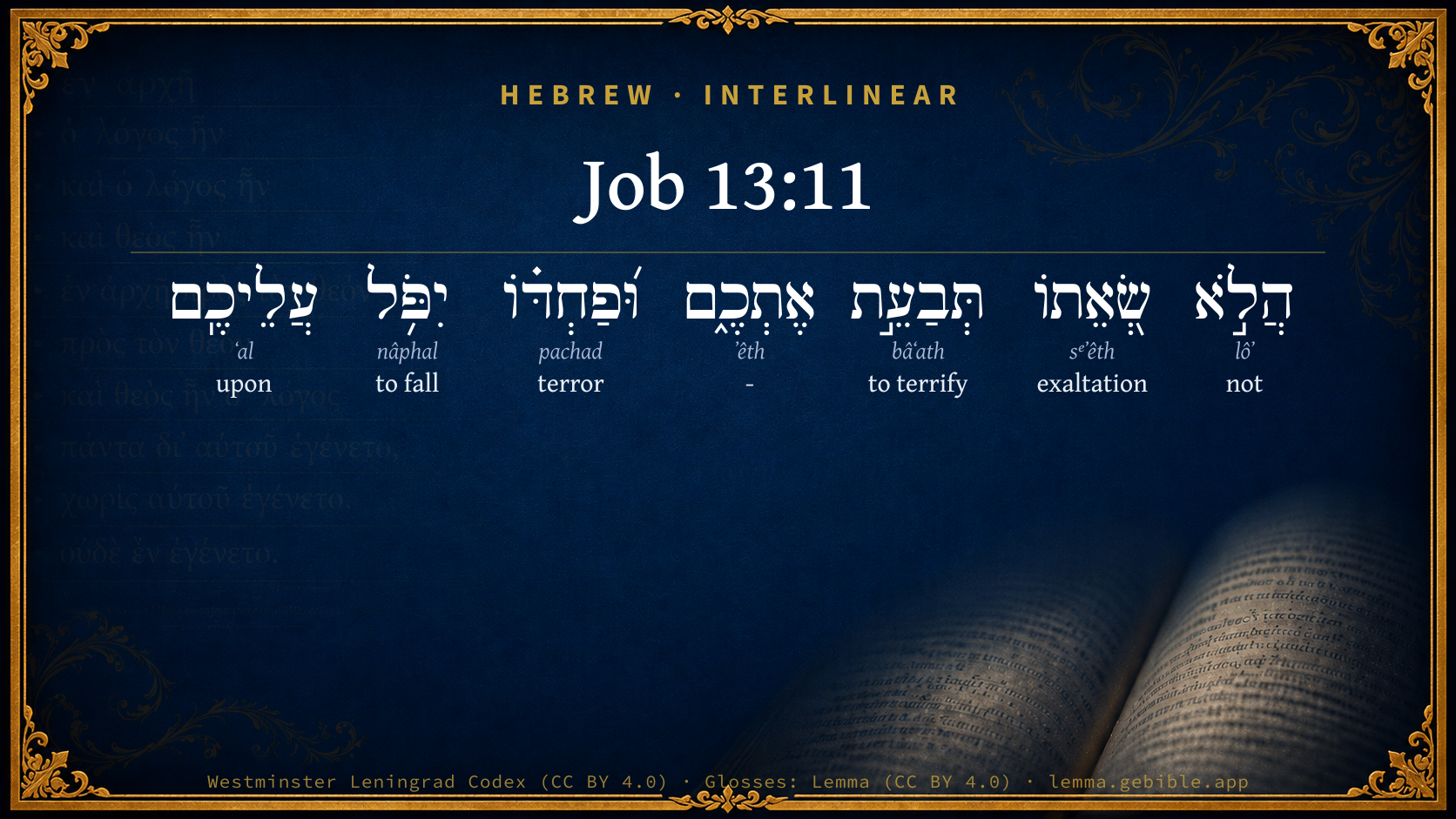
Hebrew (Westminster Leningrad Codex) Job 13:11 appears in the Hebrew Old Testament. The text above is from the Westminster Leningrad Codex. Each word links to its Strong’s number, a concise gloss, and parsing drawn from the Open Scriptures Hebrew Bible morphology. Click any word for its full Brown-Driver-Briggs (BDB) entry.
Download image
Cite this verse

Job 13:11 (World English Bible). Public Domain. Lemma interlinear Bible study tool, https://lemma.gebible.app/v/job/13/11.

Show BibTeX & RIS
BibTeX
RIS
English Translation
Shall not his majesty make you afraid, And his dread fall on you?
World English Bible · Public Domain
Download a study sheet

One document with this verse’s original text, its word-by-word gloss line, the meaning frame, cross-references with their text, attributed commentary, and full source and license credits — printable, and it pastes into notes with its structure intact.

This verse Autodidact and up

Study sheet (.html) Plain text (.txt)

A passage Seminary Student

Up to 50 verses in one chapter. A passage sheet keeps up to 6 commentary sources and 12 cross-references per verse, in the order this page ranks them, and says so on the sheet whenever that leaves anything out. Ask for a single verse and you get the Autodidact verse sheet above.

Everything on this page stays free to read, with no account — the sheet is a download of what is already on screen, not access to it.

Want to remove ads? Support Godless Engineer
Compare translations 3

The same verse in 3 English versions, stacked beneath the original-language interlinear above. Click any original word for its lexicon entry.

Each is an independent rendering of the whole verse — the interlinear is not word-aligned to these translations.

Highlighted words mark where these versions differ — a whole-verse word diff, not a word-by-word alignment.

  • World English Bible Public Domain
    Shall not his majesty make you afraid, And his dread fall on you?
  • King James Version Public Domain
    Shall not his excellency make you afraid? and his dread fall upon you?
  • unfoldingWord Literal Text CC BY-SA 4.0
    not his majesty terrify you and the dread of him fall on you?

unfoldingWord Literal Text — © unfoldingWord, licensed CC BY-SA 4.0. Word-aligned USFM3 via Door43 (git.door43.org/unfoldingWord/en_ult).

Versions to compare (up to 4)

3 of 4 selected

Show all 18 translations

Every available English version of this verse, each an independent rendering of the whole verse.

  • World English Bible Public Domain
    Shall not his majesty make you afraid, And his dread fall on you?
  • Berean Standard Bible Public Domain
    Would His majesty not terrify you? Would the dread of Him not fall upon you?
  • Majority Standard Bible Public Domain
    Would His majesty not terrify you? Would the dread of Him not fall upon you?
  • King James Version Public Domain
    Shall not his excellency make you afraid? and his dread fall upon you?
  • American Standard Version (1901) Public Domain
    Shall not his majesty make you afraid, And his dread fall upon you?
  • Revised Version (1885) Public Domain
    Shall not his excellency make you afraid, and his dread fall upon you?
  • Geneva Bible (1599) Public Domain
    Shall not his excellencie make you afraid? and his feare fall vpon you?
  • Douay-Rheims (1899) Public Domain
    As soon as he shall move himself, he shall trouble you: and his dread shall fall upon you.
  • Young's Literal Translation Public Domain
    Doth not His excellency terrify you? And His dread fall upon you?
  • Literal Standard Version CC BY-SA 4.0
    Does His excellence not terrify you? And His dread fall on you?
  • Unlocked Literal Bible CC BY-SA 4.0
    Will not his majesty terrify you, and the dread of him fall upon you?
  • unfoldingWord Literal Text CC BY-SA 4.0
    not his majesty terrify you and the dread of him fall on you?
  • Darby Bible Public Domain
    Shall not his excellency terrify you? and his dread fall upon you?
  • World Messianic Bible Public Domain
    Won’t his majesty make you afraid and his dread fall on you?
  • Webster's Bible Public Domain
    Shall not his excellence make you afraid? and his dread fall upon you?
  • Free Bible Version CC BY-SA 4.0
    Isn't his majesty terrifying to you? Aren't you so afraid of him you're paralyzed?
  • Bible in Basic English Public Domain
    Will not his glory put you in fear, so that your hearts will be overcome before him?
  • JPS Tanakh (1917) Public Domain
    Shall not His majesty terrify you, and His dread fall upon you?

Literal Standard Version (2020), Covenant Press — licensed CC BY-SA 4.0. Text via the HelloAO Bible API (eBible.org). Unlocked Literal Bible (unfoldingWord) — licensed CC BY-SA 4.0. Text via the HelloAO Bible API (eBible.org). unfoldingWord Literal Text — © unfoldingWord, licensed CC BY-SA 4.0. Word-aligned USFM3 via Door43 (git.door43.org/unfoldingWord/en_ult). Free Bible Version, Dr. Jonathan Gallagher — licensed CC BY-SA 4.0. Text via the HelloAO Bible API (eBible.org).

Word by word

More ways to search: Search by grammar → Find every occurrence → Compare this word →

Practice this passage: Drill this verse → Learn its vocabulary →

About this verse

These counts appear in no published source. They are computed here, from the morphology-tagged text and Lemma’s own curated glosses. What Lemma adds →

7
words
7
distinct lemmas
Wisdom
section

Notable vocabulary

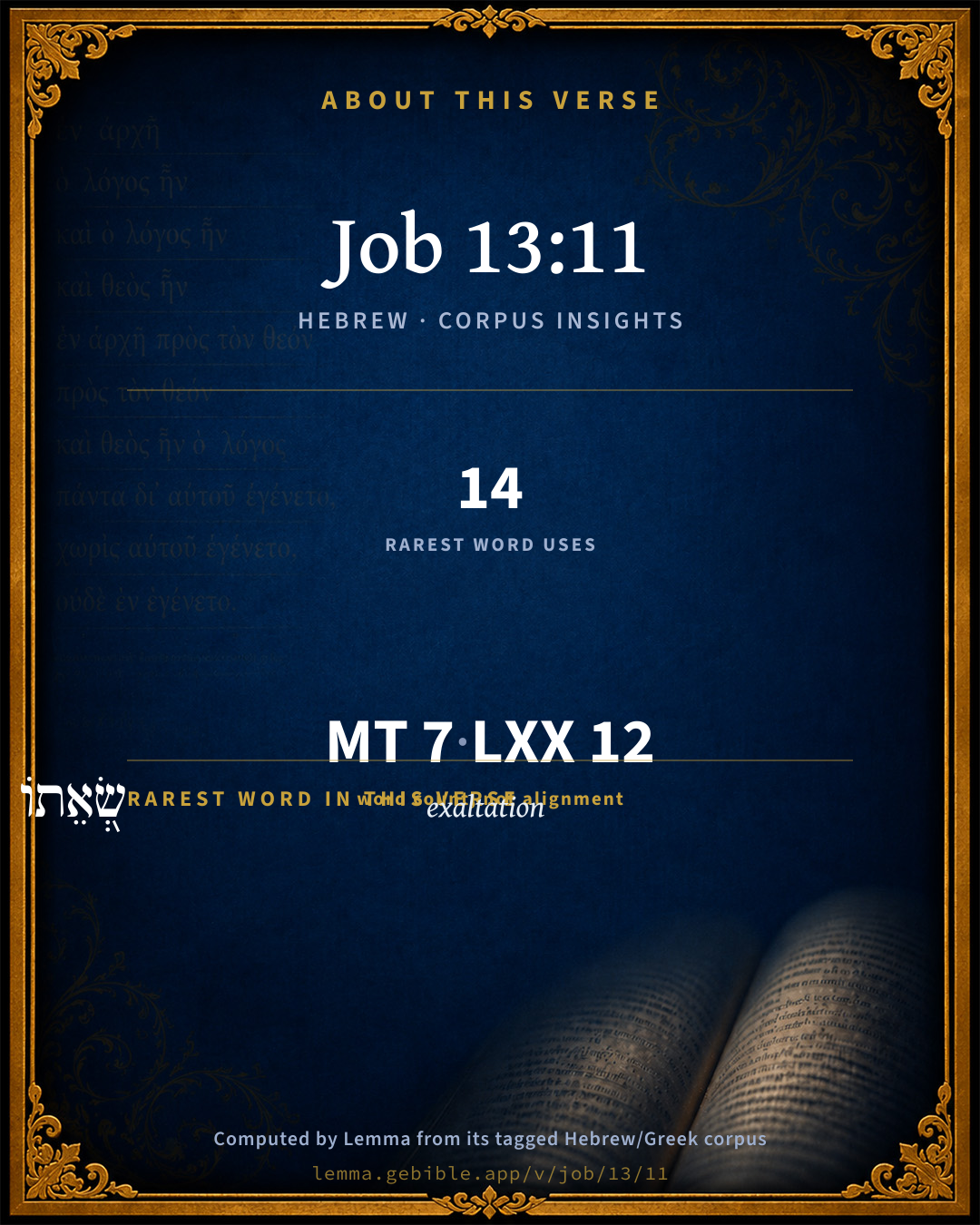
The rarest word here is שְׂ֭אֵתוֹ exaltation H7613 — appearing just 14 times in the whole Hebrew Bible.

Shared distinctive vocabulary

שְׂ֭אֵתוֹ exaltation H7613 occurs in 13 verses of the Hebrew Bible. Also found in:

Grammatical profile

  • 2 verbs
  • 2 nouns
  • 1 preposition
  • 2 particles

Verb forms

  • תְּבַעֵ֣ת Piel · Imperfect
  • יִפֹּ֥ל Qal · Imperfect

Hebrew & Septuagint length

In English translation the verse runs 13 words from the Hebrew and 14 from the Septuagint (LXX English) — closely comparable.

A rough comparison of the two English renderings, which tokenize alike — not a word-level alignment.

Word counts can differ between the Hebrew and the Greek without any difference in meaning — e.g. the Hebrew direct-object marker אֵת has no separate Greek word, and Greek often adds the article ὁ.

In the original languages it is 7 Hebrew tokens and 12 Greek tokens — but the two are counted differently (Hebrew bundles its prefixes and suffixes into one token; the Greek is in lemma form), so that isn’t a like-for-like length.

Cross-references

9

Topical passages linked to Job 13:11 in the Treasury of Scripture Knowledge — connected by theme and wording, ordered by reader-vote popularity; previews shown in the World English Bible.

  • Job 31:23 For calamity from God is a terror to me, By reason of his majesty I can do nothing.
  • Psalms 119:120 My flesh trembles for fear of you. I am afraid of your judgments.
  • Exodus 15:16 Terror and dread falls on them. By the greatness of your arm they are as still as a stone; Until your people pass over, Yahweh, Until the people pass over who you have purchased.
  • Job 13:21 Withdraw your hand far from me; And don't let your terror make me afraid.
  • Isaiah 8:13 Yahweh of hosts, him shall you sanctify; and let him be your fear, and let him be your dread.
  • Jeremiah 5:22 Don't you fear me? says Yahweh: won't you tremble at my presence, who have placed the sand for the bound of the sea, by a perpetual decree, that it can't pass it? and though the waves of it toss themselves, yet they can't prevail; though they roar, yet they can't pass over it.
  • Jeremiah 10:10 But Yahweh is the true God; he is the living God, and an everlasting King: at his wrath the earth trembles, and the nations are not able to abide his indignation.
  • Matthew 10:28 Don't be afraid of those who kill the body, but are not able to kill the soul. Rather, fear him who is able to destroy both soul and body in Gehenna.
  • Revelation 15:3–4 They sang the song of Moses, the servant of God, and the song of the Lamb, saying, "Great and marvelous are your works, Lord God, the Almighty; Righteous and true are your ways, you King of the nations.

Cross-references courtesy of OpenBible.info (CC BY 4.0).

Hebrew and Greek witnesses Masoretic Hebrew ↔ Greek Septuagint

The same verse in the two great witnesses to the Old Testament, shown verse-for-verse.

These are two independent witnesses, not word-aligned to each other, and the Septuagint is shown in lemma (dictionary) form.

Hebrew Job 13:11 Masoretic · Westminster Leningrad Codex

הֲלֹ֣א שְׂ֭אֵתוֹ תְּבַעֵ֣ת אֶתְכֶ֑ם וּ֝פַחְדּ֗וֹ יִפֹּ֥ל עֲלֵיכֶֽם

Shall not his majesty make you afraid, And his dread fall on you?

World English Bible · Public Domain

Greek LXX Job 13:11 Septuagint · lemma form

πότερον οὐ δεινός αὐτός στροβέω σύ φόβος δέ παρά αὐτός ἐπιπίπτω σύ

shall not his whirlpool sweep you round, and terror from him fall upon you?

LXX2012 (modern English Septuagint) · Public Domain

Hebrew: Westminster Leningrad Codex (CC BY 4.0). Greek: Septuagint (public domain); English from LXX2012 (modern English Septuagint) (Public Domain). How the Septuagint differs from the Hebrew →

Commentary

Notes on Job 13:11 from classic Christian and Jewish commentators (each source and its license shown beneath its notes). The classic Christian expositions comment on the surrounding passage and are grouped to its opening verse, so a note may address several verses; the Jewish commentaries on the Tanakh (Rashi and others) are per-verse, so they appear only where the commentator wrote on this verse.

Lemma curates 59 commentaries, every one of them public domain or Creative Commons licensed, each selected and text-cleaned for this edition rather than reprinted as found. About our sources →

Trapp's Complete Commentary

John Trapp

Job 13:11 Shall not his excellency make you afraid? and his dread fall upon you?

Ver. 11. Shall not his excellency make you afraid?] Heb. His highness, his majesty, his surpassing sublimity and transcendent glory; shall not this frighten you, and rein you in from wrongly dealing and warping? "Who would not fear thee, O King of nations? for to thee doth it appertain," Jer 10:7. And, "Fear ye not me? saith the Lord: will ye not tremble at my presence?" Jer 5:22. If an earthly king be so dread a sovereign; if the glory of angels hath so terrified the best saints on earth, that they could hardly outlive such an apparition; what shall we think of the great and terrible God, as he is called, Neh 1:5, the first motion of whose anger shall put men into disorder, and the brightness of his offended majesty strike your spirits with astonishment? It is reported of Augustus, the emperor, and likewise of Tamerlane, that warlike Scythian, that in their eyes sate such a rare majesty, as a man could hardly endure to behold them without closing his own; and many in talking with them, and often beholding them, have become dumb (Turk. Hist. 236, 415). Now the Lord of glory as far outshineth any mortal wight as the sun in his strength doth a clod of clay; and this made Job cry out, Job 9:34, "Let not his fear terrify me." Be not thou a terror to me, O Lord, saith holy Jeremiah, Jer 17:17; and, The Lord most high is terrible, saith David, Psa 47:2. Most high he is, and therefore terrible.

And his dread fall upon you?] Some read the whole verse thus: Shall not this acceptation of him make you afraid, seeing his dread will fall upon you? q.d. Let the sense of your sin and the fear of his wrath, ready to seize upon you, deter you from passing an unrighteous sentence, and from harbouring such low conceits of God.

John Trapp, A Commentary or Exposition upon All the Books of the Old and New Testament (1647–1656) — public domain. Text from a community e-Sword module.

Joseph Benson's Commentary

Job 13:11-12. Shall not his excellency — His infinite wisdom, which sees your secret falsehood, and his justice and power, which can and will punish you for it; make you afraid? — Of speaking rashly or falsely of his ways and counsels. Your remembrances — Hebrew, זכרניכם, zichronechem, your memorials; or, as Chappelow translates it, memorabilia vestra, your remarkable things, your discourses, and arguments, and memorable actions; are like unto ashes — Contemptible and unprofitable, Hebrew, משׁלי אפר, mishle epher, are parables or speeches of dust or ashes, mouldering, as it were, and coming to nothing. All that is most excellent and memorable in you; your wealth, and dignity, and wit, and reputation, or whatsoever it is for which you expect to be remembered, it is all but poor despicable dust and ashes; for, your bodies are like to bodies of clay — Though they be not full of sores and biles as mine is, yet they are but dust, and to dust they shall return, as well as mine. The consideration of our mortality should make us afraid of offending God.

Joseph Benson's Commentary on the Old and New Testaments (1811–1818) — public domain. Text from a community e-Sword module.

Jamieson, Fausset & Brown

Robert Jamieson, A. R. Fausset & David Brown

make you afraid?--namely, of employing sophisms in His name (Jer 10:7, Jer 10:10).

Jamieson, Fausset & Brown — Commentary Critical and Explanatory on the Whole Bible (1871) — public domain (CC PDM 1.0). Text via the HelloAO Bible API.

Adam Clarke's Commentary

Verse 11. His dread fall upon you?] The very apprehension of his wrath is sufficient to crush you to nothing.

Adam Clarke's Commentary on the Bible (1810–1826) — public domain. Text from a community e-Sword/MySword module.

The Cambridge Bible for Schools and Colleges

gen. ed. J. J. S. Perowne

11. his excellency] His majesty affright you. They shall be paralyzed when they stand before God who searches the heart.

The Cambridge Bible for Schools and Colleges (gen. ed. J. J. S. Perowne; Cambridge University Press, 1878–1918) — public domain. Text from a community e-Sword module.

John Gill's Exposition

Shall not his excellency make you afraid,.... To commit sin, any sin, and particularly that just mentioned, which they might expect to be reproved for; there is an excellency in the name of God, which is fearful and dreadful, and in the nature and perfections of God, his power, justice, and holiness, in which he is glorious and tremendous, and should deter men from sinning against him; and there is an excellency in his works of nature and providence, which are wondrous, and show him to be near at hand, and can at once, if he pleases, take vengeance for sin: or "shall not his height" (b), &c. his sublimity, his superiority to all beings; he is the most high God, higher than the highest among men, he is above all gods, all that are so called; and therefore all the inhabitants of the earth should stand in awe of him, and not sin: or "shall not his lifting up" (c)? &c. on a throne of judgment, as the Targum adds; he is the Judge of the whole earth, and will judge his people, and right their wrongs; he sits on a throne high, and lifted up, judging righteously; and will maintain the cause of the innocent, and avenge himself on those that injure them, and therefore it must be a fearful thing to fall into his hands: some render it, "shall not his burning" (d); or flaming fire, &c. as Jarchi observes, and apply it to hell fire, and the everlasting burnings of the lake which burns with fire and brimstone; and which are very terrible, and may well frighten men from sinning against God; but the first sense seems to be best:

and his dread fall upon you? the dread of men, of powerful and victorious enemies, is very terrible, as was the dread of the Israelites which fell upon the inhabitants of Canaan, Jos 2:9; but how awful must be the terror of the great and dreadful God, when that falls upon men, or his terrible wrath and vengeance are revealed from heaven, and threaten every moment to fall upon the transgressors of his law, upon those that mock him and injure his people.

(b) "celsitudo ejus", Montanus, Vatablus, Bolducius; "sublimitas ejus", Beza, Mercerus. (c) "Elevatio, erectio", Drusius. (d) So some in Jarchi & Bar Tzemach.

John Gill's Exposition of the Whole Bible (1746–1763) — public domain (CC PDM 1.0). Text via the HelloAO Bible API.

Albert Barnes' Notes on the Bible

Shall not his excellency - His exaltation שׂאת śe'êth from נשׂא nâśâ' to exalt, to lift up), or his majesty, Gen 49:3.

Make you afraid - Fill you with awe and reverence. Shall it not restrain you from fallacy, from sophisms, and from all presumptuous and unfounded reasoning? The sense here is, that a sense of the greatness and majesty of God should fill the mind with solemnity and reverence, and make us serious and sincere; should repress all declamation and mere assertion, and should lead us to adduce only those considerations which will bear the test of the final trial. The general proposition, however, is not less clear, that a sense of the majesty and glory of God should at all times fill the mind with solemn awe, and produce the deepest veneration. See Jer 5:22; Jer 10:7-10; Gen 28:17.

And his dread - The fear of him. You should so stand in awe of him as not to advance any sentiments which he will not approve, or which will not bear the test of examination. Rosenmuller, however, and after him Noyes, supposes that this is not so much a declaration of what ought to be, implying that the fear of God ought to produce veneration, as a declaration of what actually occurred - implying that they were actually influenced by this slavish fear in what they said. According to this it means that they were actuated only by a dread of what God would do to them that led them to condemn. Job without proof, and not by a regard to truth. But the common interpretation seems to me most in accordance with the meaning of the passage.

Albert Barnes' Notes on the Bible (1834–1885) — public domain. Text from a community e-Sword/MySword module.

Matthew Poole's English Annotations

His excellency; his infinite wisdom, which sees your secret falsehoods; and his justice and power, which can and will punish you for it.

Make you afraid of speaking rashly or falsely of his ways and counsels.

Matthew Poole's English Annotations on the Holy Bible (1683–1685) — public domain. Text from a community e-Sword/MySword module.

Whedon's Commentary on the Bible

Daniel D. Whedon

11. His dread fall upon you — Pineda gives, in this place, a Spanish proverb, The hill and the stones are God’s: that is, the vantage ground is his.

Daniel D. Whedon (gen. ed.), Commentary on the Old and New Testaments (1874–1909) — public domain. Text from a community e-Sword module.

The Pulpit Commentary

Shall not his excellency make you afraid! and his dread fall upon you? Will not the very excellency and perfection of God cause you all the more to fear, since they will be arrayed against you? God, who is of purer eyes than to behold iniquity, who is no respecter of persons, and hates those who are respecters of persons, will by his very purity and truth be offended at your conduct, and induced to punish it,

The Pulpit Commentary (1880–1919), ed. H.D.M. Spence-Jones & Joseph S. Exell — public domain. Text from a community e-Sword module.

unfoldingWord translationNotes

Door43 World Missions Community

Connecting Statement:

Job continues to speak to his friends.

Will not his majesty terrify you, and the dread of him fall upon you?

Job uses these questions to rebuke his friends. Possible meanings are 1) Job is saying that they should fear God. AT: "His majesty should make you afraid, and his dread should fall on you." or 2) Job is saying that they will fear God. AT: "His majesty will make you afraid, and his dread will fall on you!" (See: Rhetorical Question)

and the dread of him fall upon you

Dread falling on people represents them becoming terribly afraid. AT: "and you not be terribly afraid" or "and you not be terrified" (See: Metaphor)

Your memorable sayings are proverbs made of ashes

Ashes represent things that are worthless and do not last. AT: "Your memorable sayings are worthless like ashes" or "Your memorable sayings will be forgotten like ashes that are blown away" (See: Metaphor)

your defenses are defenses made of clay

Job speaks of what they say as if it were a wall made of clay around a city; it cannot defend the people because clay breaks easily. AT: "What you say in defense is as useless as a wall of clay" (See: Metaphor)

your defenses

Possible meanings are that this refers to 1) what they say to defend themselves or 2) what they say to defend God.

translationWords

majesty

fear

proverb

unfoldingWord translationNotes — © Distant Shores Media and the Door43 World Missions Community, licensed CC BY-SA 4.0. Source: git.door43.org/Door43/en_tn.

Rashi

Rabbi Shlomo Yitzchaki (Rashi)

Will not His majesty Heb. שאתו. [Will not] His exaltation and His awesomeness terrify you? Others define שְׂאֵתוֹ as “His burning fire.” like (II Sam. 5:21), “and David and his men burned them (וישאם),” and like (Jud. 20:38), “a great pillar of (משאת) smoke.”

Rashi on the Tanakh — English translations: “The Judaica Press complete Tanach with Rashi, translated by A. J. Rosenberg” (CC BY 4.0); “Pentateuch with Rashi's commentary by M. Rosenbaum and A.M. Silbermann, 1929-1934” (public domain); “The Metsudah Tanach series, Lakewood, N.J” (CC BY 4.0); and “The Book of Joshua, Metsudah Publications, 1997” (CC BY 4.0). Text via Sefaria.

Lesson kit

Teaching starters — assembled from the data on this page, not authored interpretation. Every prompt links to the verse data it draws on. Edit before teaching.

Job, in the Wisdom, opens this verse with 7 words (7 distinct Hebrew lemmas). Its most distinctive word is sᵉʼêth (“exaltation”). A historical commentator’s framing appears above. Read the whole chapter for the surrounding context.

Discussion questions

  1. The word sᵉʼêth carries the sense “exaltation.” How does it shape the verse?
  2. How does Genesis 4:7, which shares the word «exaltation», read alongside this verse?
  3. These translations render this verse differently; the difference is in the English rendering, not the original. What questions does that raise?
  4. «תְּבַעֵ֣ת» is a Piel Imperfect verb. How does that grammatical form shape the action described?
  5. Compare how Trapp's Complete Commentary and Joseph Benson's Commentary read this verse. Where do they agree or differ?

Things to notice

Reading settings

Reading text

Shown beneath each verse's original-language words.

Old Testament
Old Testament edition

Read the OT as the Masoretic Hebrew (MT) or the Greek Septuagint (LXX).

English shown for the Greek Septuagint (in the Hebrew ↔ Greek comparison).

Comparing translations? Open the Compare panel on any verse page to stack up to four side by side.