
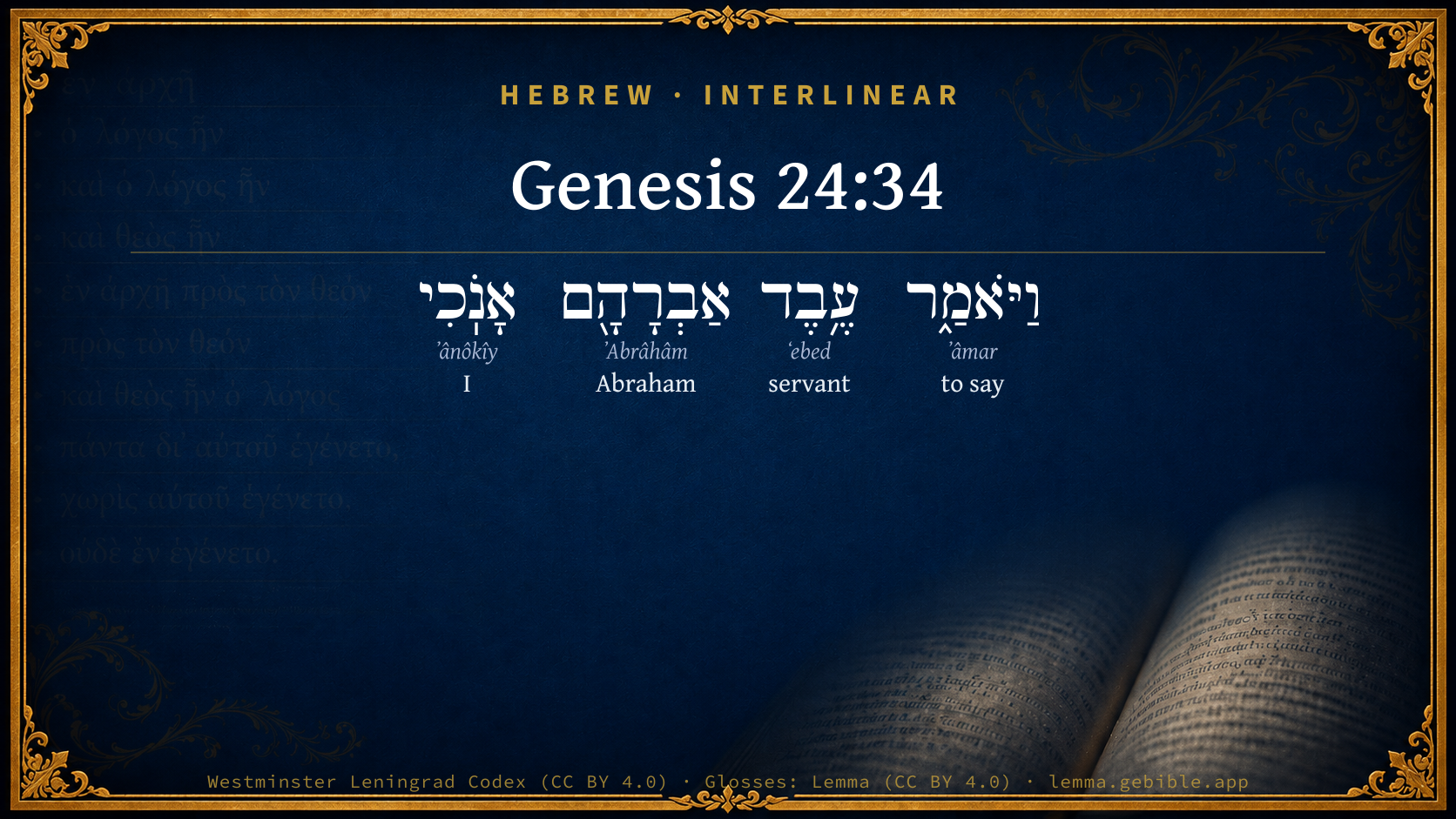
Genesis 24:34

Hebrew (Westminster Leningrad Codex) Genesis 24:34 appears in the Hebrew Old Testament. The text above is from the Westminster Leningrad Codex. Each word links to its Strong’s number, a concise gloss, and parsing drawn from the Open Scriptures Hebrew Bible morphology. Click any word for its full Brown-Driver-Briggs (BDB) entry.
Download image
Cite this verse

Genesis 24:34 (World English Bible). Public Domain. Lemma interlinear Bible study tool, https://lemma.gebible.app/v/genesis/24/34.

Show BibTeX & RIS
BibTeX
RIS
English Translation
He said, "I am Abraham's servant.
World English Bible · Public Domain
Download a study sheet

One document with this verse’s original text, its word-by-word gloss line, the meaning frame, cross-references with their text, attributed commentary, and full source and license credits — printable, and it pastes into notes with its structure intact.

This verse Autodidact and up

Study sheet (.html) Plain text (.txt)

A passage Seminary Student

Up to 50 verses in one chapter. A passage sheet keeps up to 6 commentary sources and 12 cross-references per verse, in the order this page ranks them, and says so on the sheet whenever that leaves anything out. Ask for a single verse and you get the Autodidact verse sheet above.

Everything on this page stays free to read, with no account — the sheet is a download of what is already on screen, not access to it.

Want to remove ads? Support Godless Engineer
Compare translations 3

The same verse in 3 English versions, stacked beneath the original-language interlinear above. Click any original word for its lexicon entry.

Each is an independent rendering of the whole verse — the interlinear is not word-aligned to these translations.

Highlighted words mark where these versions differ — a whole-verse word diff, not a word-by-word alignment.

  • World English Bible Public Domain
    He said, "I am Abraham's servant.
  • King James Version Public Domain
    And he said, I am Abraham's servant.
  • unfoldingWord Literal Text CC BY-SA 4.0
    Then he said, “I a servant of Abraham.

unfoldingWord Literal Text — © unfoldingWord, licensed CC BY-SA 4.0. Word-aligned USFM3 via Door43 (git.door43.org/unfoldingWord/en_ult).

Versions to compare (up to 4)

3 of 4 selected

Show all 18 translations

Every available English version of this verse, each an independent rendering of the whole verse.

  • World English Bible Public Domain
    He said, "I am Abraham's servant.
  • Berean Standard Bible Public Domain
    “I am Abraham’s servant,” he replied.
  • Majority Standard Bible Public Domain
    “I am Abraham’s servant,” he replied.
  • King James Version Public Domain
    And he said, I am Abraham's servant.
  • American Standard Version (1901) Public Domain
    And he said, I am Abraham's servant.
  • Revised Version (1885) Public Domain
    And he said, I am Abraham’s servant.
  • Geneva Bible (1599) Public Domain
    Then he said, I am Abrahams seruant,
  • Douay-Rheims (1899) Public Domain
    And he said: I am the servant of Abraham:
  • Young's Literal Translation Public Domain
    And he saith, `I `am' Abraham's servant;
  • Literal Standard Version CC BY-SA 4.0
    And he says, “I [am] Abraham’s servant;
  • Unlocked Literal Bible CC BY-SA 4.0
    He said, “I am Abraham's servant.
  • unfoldingWord Literal Text CC BY-SA 4.0
    Then he said, “I a servant of Abraham.
  • Darby Bible Public Domain
    And he said, I am Abraham's servant.
  • World Messianic Bible Public Domain
    He said, “I am Abraham’s servant.
  • Webster's Bible Public Domain
    And he said, I am Abraham's servant.
  • Free Bible Version CC BY-SA 4.0
    “I'm Abraham's servant,” the man began.
  • Bible in Basic English Public Domain
    And he said, I am Abraham's servant.
  • JPS Tanakh (1917) Public Domain
    And he said: 'I am Abraham's servant.

Literal Standard Version (2020), Covenant Press — licensed CC BY-SA 4.0. Text via the HelloAO Bible API (eBible.org). Unlocked Literal Bible (unfoldingWord) — licensed CC BY-SA 4.0. Text via the HelloAO Bible API (eBible.org). unfoldingWord Literal Text — © unfoldingWord, licensed CC BY-SA 4.0. Word-aligned USFM3 via Door43 (git.door43.org/unfoldingWord/en_ult). Free Bible Version, Dr. Jonathan Gallagher — licensed CC BY-SA 4.0. Text via the HelloAO Bible API (eBible.org).

Word by word

More ways to search: Search by grammar → Find every occurrence → Compare this word →

Practice this passage: Drill this verse → Learn its vocabulary →

About this verse

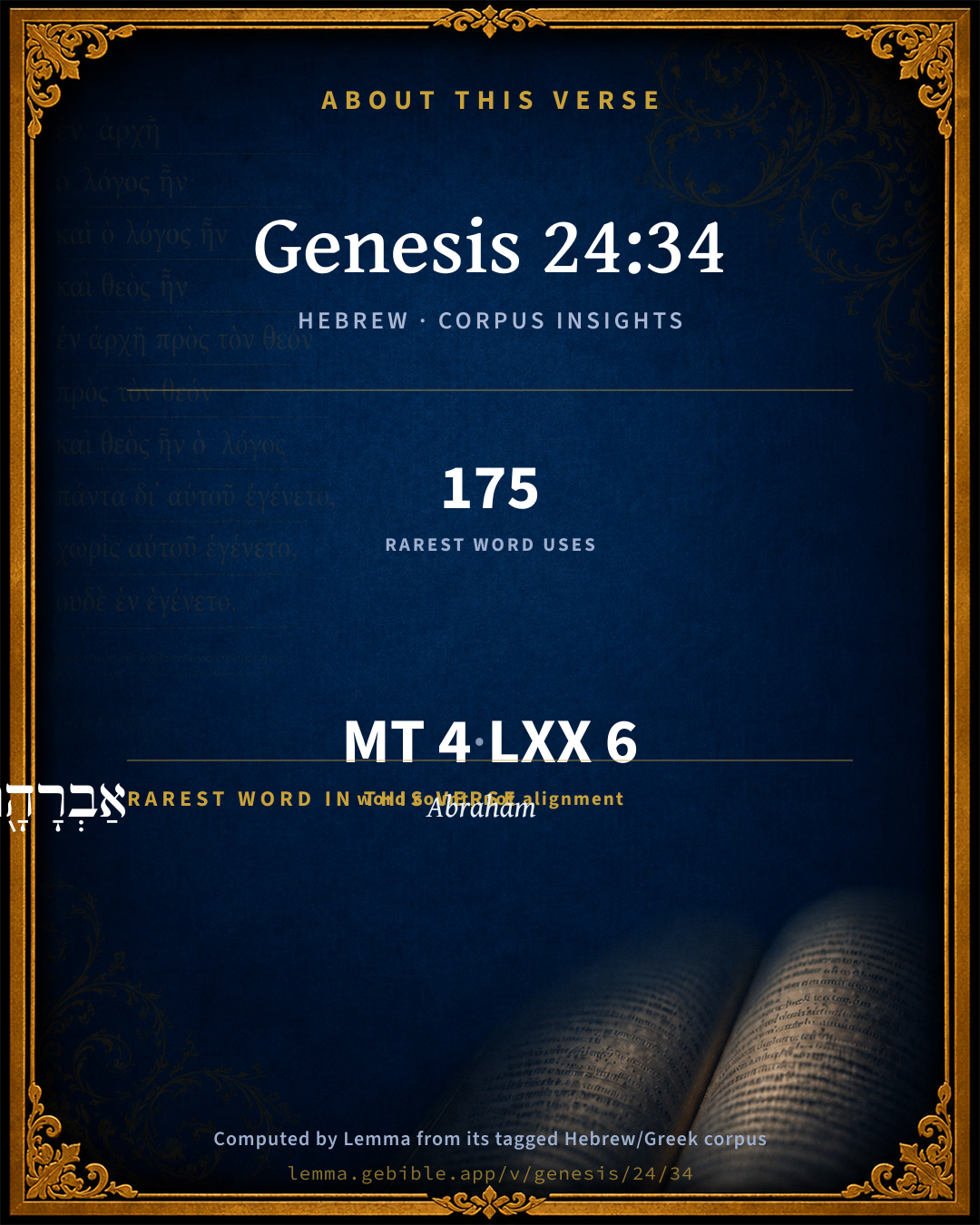
These counts appear in no published source. They are computed here, from the morphology-tagged text and Lemma’s own curated glosses. What Lemma adds →

4
words
4
distinct lemmas
Pentateuch
section

Grammatical profile

  • 1 verb
  • 2 nouns
  • 1 pronoun

Verb forms

  • וַיֹּאמַ֑ר Qal · Sequential Imperfect

Hebrew & Septuagint length

In English translation the verse runs 6 words from the Hebrew and 9 from the Septuagint (LXX English) — closely comparable.

A rough comparison of the two English renderings, which tokenize alike — not a word-level alignment.

Word counts can differ between the Hebrew and the Greek without any difference in meaning — e.g. the Hebrew direct-object marker אֵת has no separate Greek word, and Greek often adds the article ὁ.

In the original languages it is 4 Hebrew tokens and 6 Greek tokens — but the two are counted differently (Hebrew bundles its prefixes and suffixes into one token; the Greek is in lemma form), so that isn’t a like-for-like length.

Hebrew and Greek witnesses Masoretic Hebrew ↔ Greek Septuagint

The same verse in the two great witnesses to the Old Testament, shown verse-for-verse.

These are two independent witnesses, not word-aligned to each other, and the Septuagint is shown in lemma (dictionary) form.

Hebrew Genesis 24:34 Masoretic · Westminster Leningrad Codex

וַיֹּאמַ֑ר עֶ֥בֶד אַבְרָהָ֖ם אָנֹֽכִי

He said, "I am Abraham's servant.

World English Bible · Public Domain

Greek LXX Genesis 24:34 Septuagint · lemma form

καί εἶπον παῖς αβρααμ ἐγώ εἰμί

And he said, I am a servant of Abraam;

LXX2012 (modern English Septuagint) · Public Domain

Hebrew: Westminster Leningrad Codex (CC BY 4.0). Greek: Septuagint (public domain); English from LXX2012 (modern English Septuagint) (Public Domain). How the Septuagint differs from the Hebrew →

Targum (Aramaic paraphrase)

2

The Targum is the ancient Jewish Aramaic paraphrase of the Hebrew Scriptures — an interpretive translation, not the Hebrew text itself. Onkelos (literal) and Pseudo-Jonathan (expansive) render the Torah, and Jonathan the Prophets. Coverage is partial: where no permissively-licensed English translation exists for a verse, only the Aramaic is shown. This is verse-level text, not a word-by-word alignment to the Hebrew.

  1. Targum Onkelos Torah (Genesis–Deuteronomy)
    וַאֲמַר עַבְדָּא דְאַבְרָהָם אֲנָא

    (no public-domain English translation for this verse)

    Targum Onkelos — Aramaic: “Onkelos Genesis” (public domain); “Onkelos Exodus” (public domain); “Onkelos Leviticus” (public domain); “Onkelos Numbers” (public domain); “Onkelos Deuteronomy” (public domain). English: “Sefaria Community Translation” (CC0 1.0 (public-domain dedication)); “J.W. Etheridge. The Targums of Onkelos and Jonathan Ben Uzziel on the Pentateuch. London: Longmans, Green, 1862” (public domain). Text via Sefaria.

  2. Targum Pseudo-Jonathan Torah (Genesis–Deuteronomy)
    וַאֲמַר עַבְדָא דְאַבְרָהָם אֲנָא

    And he said, I am the servant of Abraham.

    Targum Pseudo-Jonathan — Aramaic: “Targum Jonathan on Genesis” (public domain); “Targum Jonathan on Exodus” (public domain); “Targum Jonathan on Leviticus” (public domain); “Targum Jonathan on Numbers” (public domain); “Targum Jonathan on Deuteronomy” (public domain). English: “The Targum of Jonathan ben Uzziel, trans. J. W. Etheridge, London, 1862” (public domain). Text via Sefaria.

Commentary

Notes on Genesis 24:34 from classic Christian and Jewish commentators (each source and its license shown beneath its notes). The classic Christian expositions comment on the surrounding passage and are grouped to its opening verse, so a note may address several verses; the Jewish commentaries on the Tanakh (Rashi and others) are per-verse, so they appear only where the commentator wrote on this verse.

Lemma curates 59 commentaries, every one of them public domain or Creative Commons licensed, each selected and text-cleaned for this edition rather than reprinted as found. About our sources →

Joseph Benson's Commentary

Gen 24:34. I am Abraham’s servant — Abraham’s name, no doubt, was well known among them, and respected; and we may suppose them not altogether ignorant of his state; for Abraham knew theirs, Gen 22:20.

Joseph Benson's Commentary on the Old and New Testaments (1811–1818) — public domain. Text from a community e-Sword module.

John Gill's Exposition

And he said, I am Abraham's servant. Not Abraham himself, this undeceived Laban, if he so thought, but a servant of his; which was enough to introduce his discourse, his master being a near relation of theirs, and well known to them by name, if not in person.

And he said, I am Abraham's servant. Not Abraham himself, this undeceived Laban, if he so thought, but a servant of his; which was enough to introduce his discourse, his master being a near relation of theirs, and well known to them by name, if not in person.

Genesis 24:35

gen 24:35

gen 24:35

gen 24:35And the Lord hath blessed my master greatly,.... With temporal blessings, after enumerated, which are of God, and are here ascribed to him, the Father, fountain, author, and giver of all such mercies:

and he is become great; in the world, and highly honoured and esteemed among men:

and he hath given him flocks and herds, and silver and gold, and menservants and maidservants, and camels and asses; though many of them were obtained in the diligent use of means, yet with the blessing of God; and others were the gifts of princes to him, as of Pharaoh king of Egypt, and Abimelech king of Gerar; yet, as it was the Lord that put it into their hearts to be so liberal to him, they are here called his gifts; see Gen 12:16.

John Gill's Exposition of the Whole Bible (1746–1763) — public domain (CC PDM 1.0). Text via the HelloAO Bible API.

The Pulpit Commentary

Vers. 34-49. Availing himself of the privilege thus accorded, the faithful ambassador recounted the story of his master"s prosperity, and of the birth of Isaac when Sarah his mother was old (literally, after her old age); of the oath which he had taken to seek a wife for his master s son among his master"s kindred, and of the singularly pro vide ntial manner in which he had been led to the discovery of the chosen bride. Then with solemn earnestness he asked for a decision. And now if ye will deal kindly and truly literally, if ye are doing, i.e. are ready or willing to extend kindness and truth (cf. ver. 27)with (or, to) my master, tell me: and if not, toll me; that I may turn (literally, and I will turn) to the right hand, or to the left in further prosecution of my mission, to seek in some other family a bride for my master"s son.

The Pulpit Commentary (1880–1919), ed. H.D.M. Spence-Jones & Joseph S. Exell — public domain. Text from a community e-Sword module.

John Wesley's Explanatory Notes

I am Abraham' servant - Abraham's name, no doubt, was well known among them, and respected; and we may suppose them not altogether ignorant of his state, for Abraham knew theirs, chap. xxii, 20.

John Wesley, Explanatory Notes Upon the Whole Bible (1754–1765) — public domain. Text via the GEBible commentary corpus.

Kretzmann's Popular Commentary

Paul E. Kretzmann

Eliezer states his errand

v. 34. And he said, I am Abraham’s servant. After thus introducing himself, Eliezer, in a carefully set speech, announces the object of his coming.

v. 35. And the Lord hath blessed my master greatly; and he is become great; and He hath given him flocks, and herds, and silver, and gold, and men-servants, and maid-servants, and camels, and asses. The apparently careless enumeration serves to enhance the impression of great wealth and power.

v. 36. And Sarah, my master’s wife, bare a son to my master when she was old, after the signs of advancing age were in evidence; and unto him hath he given all that he hath. Isaac was the heir of all this great wealth.

v. 37. And my master made me swear, saying, Thou shalt not take a wife to my son of the daughters of the Canaanites, in whose land I dwell,

v. 38. but thou shalt go unto my father’s house and to my kindred and take a wife unto my son.

v. 39. And I said unto my master, Peradventure the woman will not follow me.

v. 40. And he said unto me, The Lord before whom I walk, in the fear of whom he had arranged and led his entire life, will send His angel with thee and prosper thy way, give success to thy undertaking; and thou shalt take a wife for my son of my kindred and of my father’s house.

v. 41. Then shalt thou be clear from this my oath, when thou comest to my kindred; and if they give not thee one, thou shalt be clear from my oath.

v. 42. And I came this day unto the well and said, O Lord God of my master-Abraham, if now Thou do prosper my way which I go, if Thou wilt indeed give success to my undertaking;

v. 43. behold, I stand by the well of water, and it shall come to pass that, when the virgin cometh forth to draw water, and I say to her, Give me, I pray thee, a little water of thy pitcher to drink,

v. 44. and she say to me, Both drink thou, and I will also draw for thy camels, let the same be the woman whom the Lord hath appointed out for my master’s son. Even in this part of his speech, by referring to the virgin, in the singular, whom he was expecting to come to the well, the servant directs the attention of his hearers to Rebekah.

v. 45. And before I had done speaking in mine heart, behold, Rebekah came forth with her pitcher on her shoulder; and she went down unto the well and drew water; and I said unto her, Let me drink, I pray thee.

v. 46. And she made haste, and let down her pitcher from her shoulder, and said, Drink, and I will give thy camels drink also. So I drank, and she made the camels drink also.

v. 47. And I asked her and said, Whose daughter art thou? And she said, The daughter of Bethuel, Nahor’s son, whom Milcah bare unto him. And I put the earring (nose ring) upon her face and the bracelets upon her hands.

v. 48. And I bowed down my head, and worshiped the Lord, and blessed the Lord God of my master Abraham, which had led me in the right way to take my master’s brother’s daughter (in the wider sense, for Rebekah was Nahor’s grandchild) unto his son. The circumstantial narrative, with the full account of the prayer, was intended to show that Jehovah had really taken the matter out of Eliezer’s hands already, a fact which his hearers would surely have to acknowledge.

v. 49. And now, if ye will deal kindly and truly with my master, tell me; and if not, tell me; that I may turn to the right hand or to the left. Eliezer appeals directly to the kindness and faithfulness which Abraham should surely be entitled to from his relatives. At any rate, he expected them to give him definite information as to their stand in the matter, in order that he might know exactly what course to pursue next. Mark that in a proper and valid betrothal, as Luther here points out, the suit is directed to the parents of the young woman first, and a secret engagement has no validity before God.

Paul E. Kretzmann, Popular Commentary of the Bible (1921–1924) — public domain. Text from a community e-Sword module.

Radak

Rabbi David Kimhi (Radak)

ויאמר עבד אברהם אנכי, our sages (Baba Kama 92) consider this as an example of a popular proverb that one should mention any personal deficiency before commencing to carry out whatever mission has been assigned to him. [according to this interpretation Eliezer, instead of considering it a privilege to be the servant of a man like Avraham, considered it a stigma that he was a slave. Ed.]

Radak on the Tanakh — English translations: “Sefaria Community Translation” (CC0 1.0 (public-domain dedication)); “Eliyahu Munk, HaChut Hameshulash” (CC BY 4.0); “Rabbi Mike Feuer, Jerusalem Anthology” (CC BY 4.0); and “R. David Kimhi on the first book of Psalms, Translated by R.G. Finch, London, 1919” (public domain). Text via Sefaria.

Lesson kit

Teaching starters — assembled from the data on this page, not authored interpretation. Every prompt links to the verse data it draws on. Edit before teaching.

Genesis, in the Pentateuch, opens this verse with 4 words (4 distinct Hebrew lemmas). Its most distinctive word is ʼAbrâhâm (“Abraham”). A historical commentator’s framing appears above. Read the whole chapter for the surrounding context.

Discussion questions

  1. What does “Abraham” (ʼAbrâhâm) contribute to the verse as a whole?
  2. These translations render this verse differently; the difference is in the English rendering, not the original. What questions does that raise?
  3. «וַיֹּאמַ֑ר» is a Qal Sequential Imperfect verb. How does that grammatical form shape the action described?
  4. Compare how Joseph Benson's Commentary and John Gill's Exposition read this verse. Where do they agree or differ?

Things to notice

Reading settings

Reading text

Shown beneath each verse's original-language words.

Old Testament
Old Testament edition

Read the OT as the Masoretic Hebrew (MT) or the Greek Septuagint (LXX).

English shown for the Greek Septuagint (in the Hebrew ↔ Greek comparison).

Comparing translations? Open the Compare panel on any verse page to stack up to four side by side.