Genesis 21:25

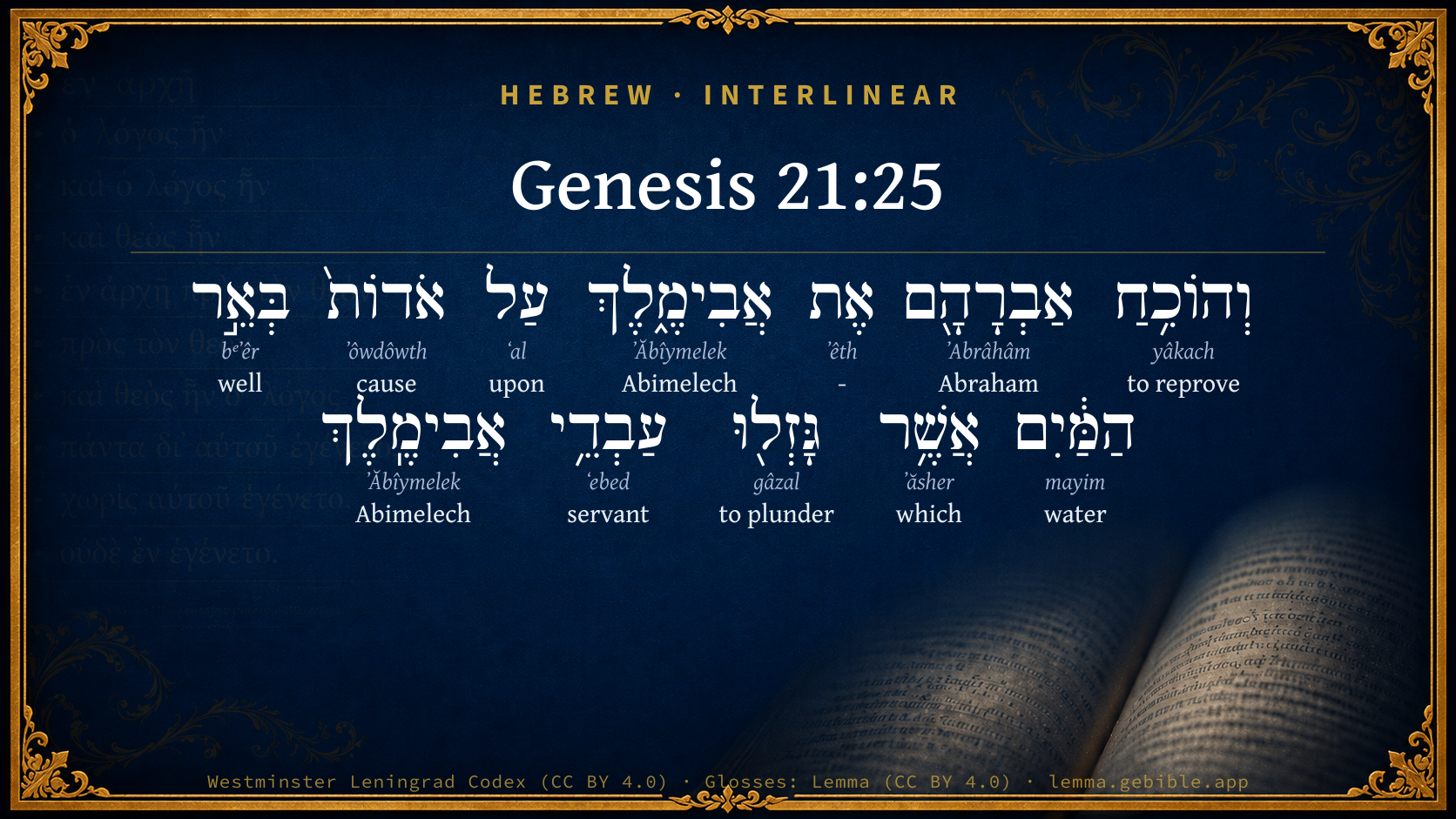
Hebrew (Westminster Leningrad Codex) Genesis 21:25 appears in the Hebrew Old Testament. The text above is from the Westminster Leningrad Codex. Each word links to its Strong’s number, a concise gloss, and parsing drawn from the Open Scriptures Hebrew Bible morphology. Click any word for its full Brown-Driver-Briggs (BDB) entry.
Download image
Cite this verse

Genesis 21:25 (World English Bible). Public Domain. Lemma interlinear Bible study tool, https://lemma.gebible.app/v/genesis/21/25.

Show BibTeX & RIS
BibTeX
RIS
English Translation
Abraham complained to Abimelech because of a water well, which Abimelech's servants had violently taken away.
World English Bible · Public Domain
Highlights
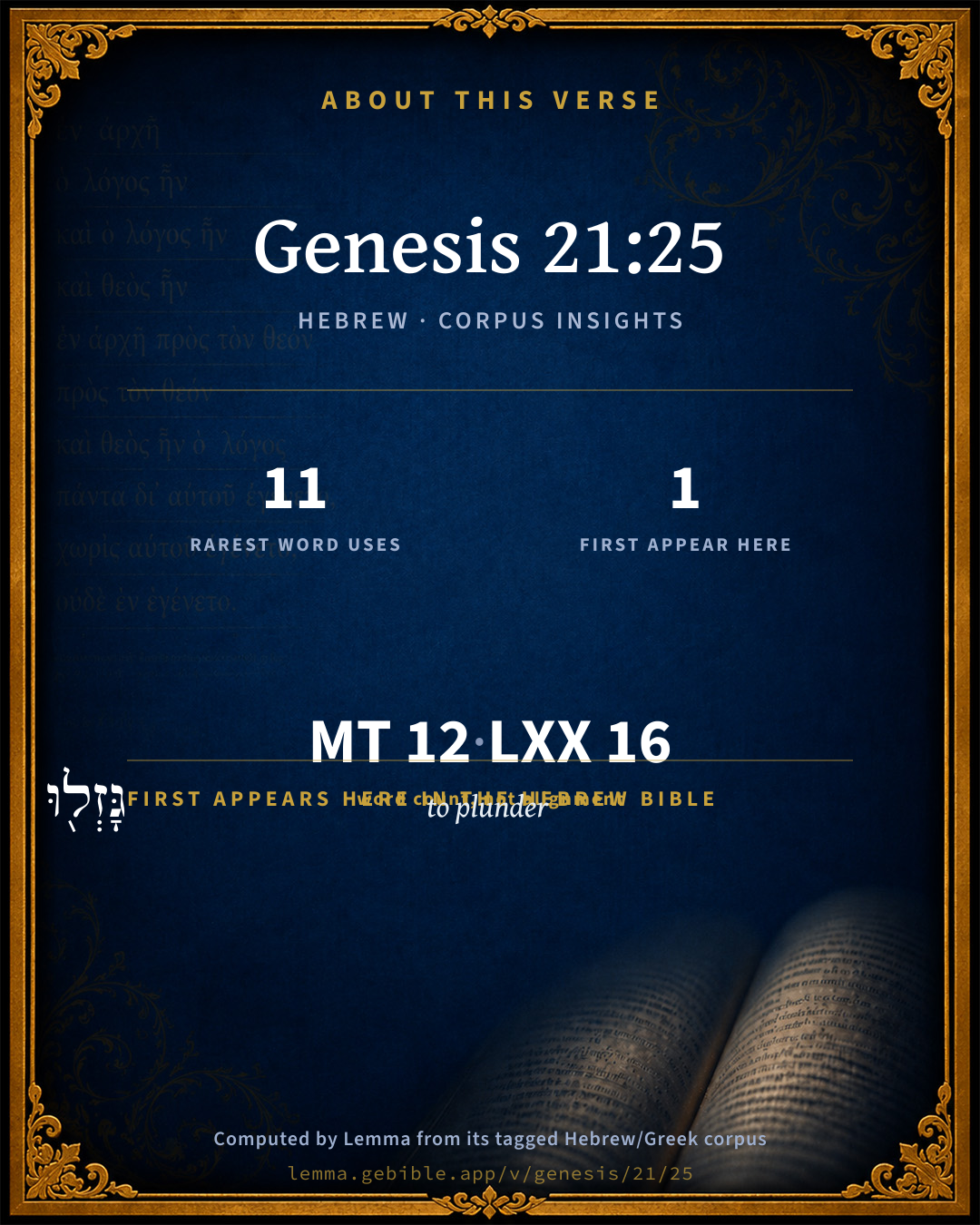
  • 1 first appearance in the Hebrew Bible
Full analysis ↓
Download a study sheet

One document with this verse’s original text, its word-by-word gloss line, the meaning frame, cross-references with their text, attributed commentary, and full source and license credits — printable, and it pastes into notes with its structure intact.

This verse Autodidact and up

Study sheet (.html) Plain text (.txt)

A passage Seminary Student

Up to 50 verses in one chapter. A passage sheet keeps up to 6 commentary sources and 12 cross-references per verse, in the order this page ranks them, and says so on the sheet whenever that leaves anything out. Ask for a single verse and you get the Autodidact verse sheet above.

Everything on this page stays free to read, with no account — the sheet is a download of what is already on screen, not access to it.

Want to remove ads? Support Godless Engineer
Compare translations 3

The same verse in 3 English versions, stacked beneath the original-language interlinear above. Click any original word for its lexicon entry.

Each is an independent rendering of the whole verse — the interlinear is not word-aligned to these translations.

Highlighted words mark where these versions differ — a whole-verse word diff, not a word-by-word alignment.

  • World English Bible Public Domain
    Abraham complained to Abimelech because of a water well, which Abimelech's servants had violently taken away.
  • King James Version Public Domain
    And Abraham reproved Abimelech because of a well of water, which Abimelech's servants had violently taken away.
  • unfoldingWord Literal Text CC BY-SA 4.0
    Then Abraham complained to Abimelech on account of the well of water that the servants of Abimelech had seized.

unfoldingWord Literal Text — © unfoldingWord, licensed CC BY-SA 4.0. Word-aligned USFM3 via Door43 (git.door43.org/unfoldingWord/en_ult).

Versions to compare (up to 4)

3 of 4 selected

Show all 18 translations

Every available English version of this verse, each an independent rendering of the whole verse.

  • World English Bible Public Domain
    Abraham complained to Abimelech because of a water well, which Abimelech's servants had violently taken away.
  • Berean Standard Bible Public Domain
    But when Abraham complained to Abimelech about a well that Abimelech’s servants had seized,
  • Majority Standard Bible Public Domain
    But when Abraham complained to Abimelech about a well that Abimelech’s servants had seized,
  • King James Version Public Domain
    And Abraham reproved Abimelech because of a well of water, which Abimelech's servants had violently taken away.
  • American Standard Version (1901) Public Domain
    And Abraham reproved Abimelech because of the well of water, which Abimelech's servants had violently taken away.
  • Revised Version (1885) Public Domain
    And Abraham reproved Abimelech because of the well of water, which Abimelech’s servants had violently taken away.
  • Geneva Bible (1599) Public Domain
    And Abraham rebuked Abimelech for a well of water, which Abimelechs seruants had violently taken away.
  • Douay-Rheims (1899) Public Domain
    And he reproved Abimelech for a well of water, which his servants had taken away by force.
  • Young's Literal Translation Public Domain
    And Abraham reasoned with Abimelech concerning the matter of a well of water which Abimelech's servants have taken violently away,
  • Literal Standard Version CC BY-SA 4.0
    And Abraham reasoned with Abimelech concerning the matter of a well of water which Abimelech’s servants have violently taken away,
  • Unlocked Literal Bible CC BY-SA 4.0
    Abraham also complained to Abimelech concerning a well of water that Abimelech's servants had seized from him.
  • unfoldingWord Literal Text CC BY-SA 4.0
    Then Abraham complained to Abimelech on account of the well of water that the servants of Abimelech had seized.
  • Darby Bible Public Domain
    And Abraham reproved Abimelech because of a well of water that Abimelech's servants had violently taken away.
  • World Messianic Bible Public Domain
    Abraham complained to Abimelech because of a water well, which Abimelech’s servants had violently taken away.
  • Webster's Bible Public Domain
    And Abraham reproved Abimelech, because of a well of water, which Abimelech's servants had violently taken away.
  • Free Bible Version CC BY-SA 4.0
    Then Abraham raised an issue with Abimelech of a well that Abimelech's servants had taken by force.
  • Bible in Basic English Public Domain
    But Abraham made a protest to Abimelech because of a water-hole which Abimelech's servants had taken by force.
  • JPS Tanakh (1917) Public Domain
    And Abraham reproved Abimelech because of the well of water, which Abimelech's servants had violently taken away.

Literal Standard Version (2020), Covenant Press — licensed CC BY-SA 4.0. Text via the HelloAO Bible API (eBible.org). Unlocked Literal Bible (unfoldingWord) — licensed CC BY-SA 4.0. Text via the HelloAO Bible API (eBible.org). unfoldingWord Literal Text — © unfoldingWord, licensed CC BY-SA 4.0. Word-aligned USFM3 via Door43 (git.door43.org/unfoldingWord/en_ult). Free Bible Version, Dr. Jonathan Gallagher — licensed CC BY-SA 4.0. Text via the HelloAO Bible API (eBible.org).

Word by word

More ways to search: Search by grammar → Find every occurrence → Compare this word →

Practice this passage: Drill this verse → Learn its vocabulary →

About this verse

These counts appear in no published source. They are computed here, from the morphology-tagged text and Lemma’s own curated glosses. What Lemma adds →

12
words
11
distinct lemmas
Pentateuch
section

Notable vocabulary

The rarest word here is אֹדוֹת֙ cause H182 — appearing just 11 times in the whole Hebrew Bible.

First appearance in Scripture

This word makes its first canonical appearance in the Hebrew Bible here:

  • גָּזְל֖וּ to plunder H1497

Shared distinctive vocabulary

אֹדוֹת֙ cause H182 occurs in 10 verses of the Hebrew Bible. Also found in:

Grammatical profile

  • 2 verbs
  • 7 nouns
  • 1 preposition
  • 2 particles

Verb forms

  • וְהוֹכִ֥חַ Hiphil · Perfect
  • גָּזְל֖וּ Qal · Perfect

Repetition

A word recurs within this verse — often emphatic in Hebrew:

  • אֲבִימֶ֑לֶךְ Abimelech H40 ×2

Hebrew & Septuagint length

In English translation the verse runs 16 words from the Hebrew and 17 from the Septuagint (LXX English) — closely comparable.

A rough comparison of the two English renderings, which tokenize alike — not a word-level alignment.

Word counts can differ between the Hebrew and the Greek without any difference in meaning — e.g. the Hebrew direct-object marker אֵת has no separate Greek word, and Greek often adds the article ὁ.

In the original languages it is 12 Hebrew tokens and 16 Greek tokens — but the two are counted differently (Hebrew bundles its prefixes and suffixes into one token; the Greek is in lemma form), so that isn’t a like-for-like length.

Cross-references

9

Topical passages linked to Genesis 21:25 in the Treasury of Scripture Knowledge — connected by theme and wording, ordered by reader-vote popularity; previews shown in the World English Bible.

  • Genesis 26:15–22 Now all the wells which his father's servants had dug in the days of Abraham his father, the Philistines had stopped, and filled with earth.
  • Genesis 13:7 There was a strife between the herdsmen of Abram's cattle and the herdsmen of Lot's cattle: and the Canaanite and the Perizzite lived then in the land.
  • Genesis 29:8 They said, "We can't, until all the flocks are gathered together, and they roll the stone from the well's mouth. Then we water the sheep."
  • Exodus 2:15–17 Now when Pharaoh heard this thing, he sought to kill Moses. But Moses fled from the face of Pharaoh, and lived in the land of Midian, and he sat down by a well.
  • Judges 1:15 She said to him, Give me a blessing; for that you have set me in the land of the South, give me also springs of water. Caleb gave her the upper springs and the lower springs.
  • Proverbs 17:10 A rebuke enters deeper into one who has understanding Than a hundred lashes into a fool.
  • Proverbs 25:9 Debate your case with your neighbor, And don't betray the confidence of another;
  • Proverbs 27:5 Better is open rebuke Than hidden love.
  • Matthew 18:15 "If your brother sins against you, go, show him his fault between you and him alone. If he listens to you, you have gained back your brother.

Cross-references courtesy of OpenBible.info (CC BY 4.0).

Hebrew and Greek witnesses Masoretic Hebrew ↔ Greek Septuagint

The same verse in the two great witnesses to the Old Testament, shown verse-for-verse.

These are two independent witnesses, not word-aligned to each other, and the Septuagint is shown in lemma (dictionary) form.

Hebrew Genesis 21:25 Masoretic · Westminster Leningrad Codex

וְהוֹכִ֥חַ אַבְרָהָ֖ם אֶת אֲבִימֶ֑לֶךְ עַל אֹדוֹת֙ בְּאֵ֣ר הַמַּ֔יִם אֲשֶׁ֥ר גָּזְל֖וּ עַבְדֵ֥י אֲבִימֶֽלֶךְ

Abraham complained to Abimelech because of a water well, which Abimelech's servants had violently taken away.

World English Bible · Public Domain

Greek LXX Genesis 21:25 Septuagint · lemma form

καί ἐλέγχω αβρααμ ὁ αβιμελεχ περί ὁ φρέαρ ὁ ὕδωρ ὅς ἀποαἱρέω ὁ παῖς ὁ αβιμελεχ

And Abraam reproved Abimelech because of the wells of water, which the servants of Abimelech took away.

LXX2012 (modern English Septuagint) · Public Domain

Hebrew: Westminster Leningrad Codex (CC BY 4.0). Greek: Septuagint (public domain); English from LXX2012 (modern English Septuagint) (Public Domain). How the Septuagint differs from the Hebrew →

Targum (Aramaic paraphrase)

2

The Targum is the ancient Jewish Aramaic paraphrase of the Hebrew Scriptures — an interpretive translation, not the Hebrew text itself. Onkelos (literal) and Pseudo-Jonathan (expansive) render the Torah, and Jonathan the Prophets. Coverage is partial: where no permissively-licensed English translation exists for a verse, only the Aramaic is shown. This is verse-level text, not a word-by-word alignment to the Hebrew.

  1. Targum Onkelos Torah (Genesis–Deuteronomy)
    וְאוֹכַח אַבְרָהָם יָת אֲבִימֶלֶךְ עַל עֵיסַק בֵּירָא דְמַיָּא דִּי אֲנִּיסוּ עַבְדֵי אֲבִימֶלֶךְ

    (no public-domain English translation for this verse)

    Targum Onkelos — Aramaic: “Onkelos Genesis” (public domain); “Onkelos Exodus” (public domain); “Onkelos Leviticus” (public domain); “Onkelos Numbers” (public domain); “Onkelos Deuteronomy” (public domain). English: “Sefaria Community Translation” (CC0 1.0 (public-domain dedication)); “J.W. Etheridge. The Targums of Onkelos and Jonathan Ben Uzziel on the Pentateuch. London: Longmans, Green, 1862” (public domain). Text via Sefaria.

  2. Targum Pseudo-Jonathan Torah (Genesis–Deuteronomy)
    וְאִתְוַוכַּח אַבְרָהָם עִם אֲבִימֶלֶךְ עַל עֵיסַק בֵּירָא דְמַיָא דְאָנְסוּ לֵיהּ עַבְדֵי אֲבִימֶלֶךְ

    And Abraham remonstrated with Abimelek concerning the well of water of which the servants of Abimelek had deprived him.

    Targum Pseudo-Jonathan — Aramaic: “Targum Jonathan on Genesis” (public domain); “Targum Jonathan on Exodus” (public domain); “Targum Jonathan on Leviticus” (public domain); “Targum Jonathan on Numbers” (public domain); “Targum Jonathan on Deuteronomy” (public domain). English: “The Targum of Jonathan ben Uzziel, trans. J. W. Etheridge, London, 1862” (public domain). Text via Sefaria.

Commentary

Notes on Genesis 21:25 from classic Christian and Jewish commentators (each source and its license shown beneath its notes). The classic Christian expositions comment on the surrounding passage and are grouped to its opening verse, so a note may address several verses; the Jewish commentaries on the Tanakh (Rashi and others) are per-verse, so they appear only where the commentator wrote on this verse.

Lemma curates 59 commentaries, every one of them public domain or Creative Commons licensed, each selected and text-cleaned for this edition rather than reprinted as found. About our sources →

The Cambridge Bible for Schools and Colleges

gen. ed. J. J. S. Perowne

25. Abraham reproved] Disputes about wells are some of the most common causes of strife among the Bedouin tribes. Abraham’s complaint is that his servants had dug wells; that Abimelech’s servants had taken violent possession of them; that there had been no redress. The occasion of the treaty favoured a settlement of the dispute.

The verbs in Gen_21:25-26 are best rendered as frequentatives = “as often as Abraham complained to Abimelech, Abimelech used to reply he was entirely ignorant.” Gesen. Hebr. Gr. § 112 rr.

The Cambridge Bible for Schools and Colleges (gen. ed. J. J. S. Perowne; Cambridge University Press, 1878–1918) — public domain. Text from a community e-Sword module.

Trapp's Complete Commentary

John Trapp

Gen 21:25 And Abraham reproved Abimelech because of a well of water, which Abimelech’s servants had violently taken away.

Ver. 25. And Abraham reproved Abimelech.] Inferiors may reprove their superiors, so they do it wisely and modestly.

John Trapp, A Commentary or Exposition upon All the Books of the Old and New Testament (1647–1656) — public domain. Text from a community e-Sword module.

Tyndale Open Study Notes

Tyndale Open Resources

21:25 The motif of the well appears again (cp. 16:14; 21:19). God provided water (a symbol of blessing) in the barren wilderness and later even brought water out of a rock for Israel (Exod 15:22-27; 17:1-7; Num 20:1-13).

Tyndale Open Study Notes — © Tyndale Open Resources, licensed CC BY-SA 4.0. Text via the HelloAO Bible API.

Jamieson, Fausset & Brown

Robert Jamieson, A. R. Fausset & David Brown

And Abraham reproved Abimelech because of a well--Wells were of great importance to a pastoral chief and on the successful operation of sinking a new one, the owner was solemnly informed in person. If, however, they were allowed to get out of repair, the restorer acquired a right to them. In unoccupied lands the possession of wells gave a right of property in the land, and dread of this had caused the offense for which Abraham reproved Abimelech. Some describe four, others five, wells in Beer-sheba.

Jamieson, Fausset & Brown — Commentary Critical and Explanatory on the Whole Bible (1871) — public domain (CC PDM 1.0). Text via the HelloAO Bible API.

Adam Clarke's Commentary

Verse 25. Abraham reproved Abimelech] Wells were of great consequence in those hot countries, and especially where the flocks were numerous, because the water was scarce, and digging to find it was accompanied with much expense of time and labour.

Adam Clarke's Commentary on the Bible (1810–1826) — public domain. Text from a community e-Sword/MySword module.

John Calvin's Commentaries

25. And Abraham reproved Abimelech. This complaint seems to be unjust; for, if he had been injured, why did he not resort to the ordinary remedy? He knew the king to be humane, to have some seed of piety, and to have treated himself courteously and honorably; why then does he doubt that he will prove the equitable defender of his right? If, indeed, he had chosen rather to smother the injury received, than to be troublesome to the king, why does he now impute the fault to him, as if he had been guilty? Possibly, however, Abraham might know that the injury had been done, through the excessive forbearance of the king. We may assuredly infer, both from his manners and his disposition, that he did not expostulate without cause; and hence the moderation of the holy man is evident; because, when deprived of the use of water, found by his own industry and labor, he does not contend, as the greatness of the injury would have justified him in doing; for this was just as if the inhabitants of the place had made an attempt upon his life. But though he patiently bore so severe an injury, yet when beyond expectation, the occasion of taking security is offered, he guards himself from fixture aggression. We also see how severely the Lord exercised Abraham, as soon as he appeared to be somewhat more at ease, and had obtained a little alleviation. Certainly, it was not a light trial, to be compelled to contend for water; and not for water which was public property but for that of a well, which he himself had digged.

John Calvin's Commentaries (1540-1563) — public domain. Text from the Calvin Translation Society English edition (1840s-50s) via the Christian Classics Ethereal Library (ccel.org). Calvin's coverage is partial (roughly two-thirds of the Bible); uncommented books and verses are honest gaps, never fabricated. The 19th-century editor's footnotes and remarks are omitted so the notes are faithfully Calvin's own voice.

John Gill's Exposition

And Abraham took sheep and oxen, and gave them unto Abimelech,.... In gratitude for former favours he had received from him, in token of the friendship that subsisted between them, and for the confirmation of it; and to show that he was fully satisfied with Abimelech's answer to his complaint, as well as willing to enter into covenant by sacrifice, when such creatures were divided, and the covenanters passed between the pieces, for so it follows:

and both of them made a covenant; or, "cut or struck a covenant" (s); cut the sacrifice in pieces and passed between them, in token of the compact and agreement they entered into with each other; signifying that whoever broke it deserved to be cut in pieces as those creatures were.

(s) "foedus percusserunt", Pagninus, Montanus, Drusius; "secuerunt", Cocceius.

John Gill's Exposition of the Whole Bible (1746–1763) — public domain (CC PDM 1.0). Text via the HelloAO Bible API.

Matthew Poole's English Annotations

That the foundation of true friendship might be firmly laid, and the peace inviolably observed, he removes an impediment to it, an occasion of quarrel and just exception on Abraham’s part.

A well of water in those hot and dry countries was of great esteem and necessity. Compare Gen 26:19-21; Jdg 1:15. Besides, a well may be put for wells, as the Greeks render it, and as may seem probable by comparing this with Gen 26:15,18; it being an ordinary thing to use the singular number for the plural, as hath been showed. See Gen 3:2; 4:20.

Matthew Poole's English Annotations on the Holy Bible (1683–1685) — public domain. Text from a community e-Sword/MySword module.

Whedon's Commentary on the Bible

Daniel D. Whedon

25. Reproved — The same word used in Gen_20:16, where it is said that Sarah was reproved by Abimelech. There was an outstanding difficulty which must be settled before Abraham will swear.

Daniel D. Whedon (gen. ed.), Commentary on the Old and New Testaments (1874–1909) — public domain. Text from a community e-Sword module.

The Pulpit Commentary

And Abraham reproved (literally, reasoned with, and proved to the satisfaction of) Abimelech (who was, until informed, entirely unacquainted with the action of his servants) because of a well of water, which Abimelech"s servants had violently taken away. The greatest possible injury of a material kind that could be done to a nomads chief was the all faction of his water supplies. Hence "the ownership of wells m Palestine was as jealously guarded as the possession of a mine in our own" (Inglis). Contests for wells are now very common all over the country, but more especially in the southern deserts" (Thomson, "Land and Book," p. 559).

The Pulpit Commentary (1880–1919), ed. H.D.M. Spence-Jones & Joseph S. Exell — public domain. Text from a community e-Sword module.

unfoldingWord translationNotes

Door43 World Missions Community

Abraham also complained to Abimelech

Possible meanings are 1) Abraham was complaining about what happened or 2) "Abraham also rebuked Abimelech"

concerning a well of water that Abimelech's servants had seized from him

"because Abimelech's servants had taken one of Abraham's wells"

seized from him

"taken from Abraham" or "had taken control of"

I have not heard of it until today

"This is the first time I have heard about it"

Abraham took sheep and oxen and gave them to Abimelech

This is a sign of friendship and that Abraham agrees to make covenant with Abimelech. (See: Symbolic Action)

translationWords

Abraham

Abimelech

cistern

servant

seize

ewe

cow

covenant

unfoldingWord translationNotes — © Distant Shores Media and the Door43 World Missions Community, licensed CC BY-SA 4.0. Source: git.door43.org/Door43/en_tn.

Rashi

Rabbi Shlomo Yitzchaki (Rashi)

והוכח AND [ABRAHAM] REPROVED — it means he argued with him about it.

Rashi on the Tanakh — English translations: “The Judaica Press complete Tanach with Rashi, translated by A. J. Rosenberg” (CC BY 4.0); “Pentateuch with Rashi's commentary by M. Rosenbaum and A.M. Silbermann, 1929-1934” (public domain); “The Metsudah Tanach series, Lakewood, N.J” (CC BY 4.0); and “The Book of Joshua, Metsudah Publications, 1997” (CC BY 4.0). Text via Sefaria.

Radak

Rabbi David Kimhi (Radak)

והוכיח אברהם, seeing that they had both agreed to a pact and had confirmed it by a mutual oath, Avraham now complained about the servants of Avimelech having stolen his wells, especially the well he had dug in Beer Sheva. Beer Sheva was on the border between the land of Canaan and the land of the Philistines, and Avimelech’s servants had argued that Avraham had dug the well on land belonging to the Philistines. In response to Avraham’s complaint both Avimelech and Avraham went from Gerar to Beer Sheva to inspect the area and find out who had been wronged. Seeing that they saw that Avraham’s shepherds were grazing their cattle in that region it was natural that they had dug for water there in order to provide water for their livestock. Even though the Torah did not spell out precisely what occurred, it is reasonable to accept the scenario which I have described.

Radak on the Tanakh — English translations: “Sefaria Community Translation” (CC0 1.0 (public-domain dedication)); “Eliyahu Munk, HaChut Hameshulash” (CC BY 4.0); “Rabbi Mike Feuer, Jerusalem Anthology” (CC BY 4.0); and “R. David Kimhi on the first book of Psalms, Translated by R.G. Finch, London, 1919” (public domain). Text via Sefaria.

Lesson kit

Teaching starters — assembled from the data on this page, not authored interpretation. Every prompt links to the verse data it draws on. Edit before teaching.

Genesis, in the Pentateuch, opens this verse with 12 words (11 distinct Hebrew lemmas). Its most distinctive word is ʼôwdôwth (“cause”). A historical commentator’s framing appears above. Read the whole chapter for the surrounding context.

Discussion questions

  1. How does “cause” (ʼôwdôwth) shape what this verse is saying?
  2. The word “to plunder” first appears here in Scripture. What is being introduced at this debut?
  3. Genesis 21:11 shares the word «cause» with this verse. How do the two illuminate each other?
  4. “Abimelech” occurs 2× in this one verse. What is the effect of the repetition?
  5. These translations render this verse differently. What is at stake in choosing one wording over another?
  6. The verb «וְהוֹכִ֥חַ» is Hiphil Perfect. How does its form color the action?
  7. Reading how The Cambridge Bible for Schools and Colleges and Trapp's Complete Commentary read this verse, where do the two commentators agree and where do they part?

Things to notice

Reading settings

Reading text

Shown beneath each verse's original-language words.

Old Testament
Old Testament edition

Read the OT as the Masoretic Hebrew (MT) or the Greek Septuagint (LXX).

English shown for the Greek Septuagint (in the Hebrew ↔ Greek comparison).

Comparing translations? Open the Compare panel on any verse page to stack up to four side by side.