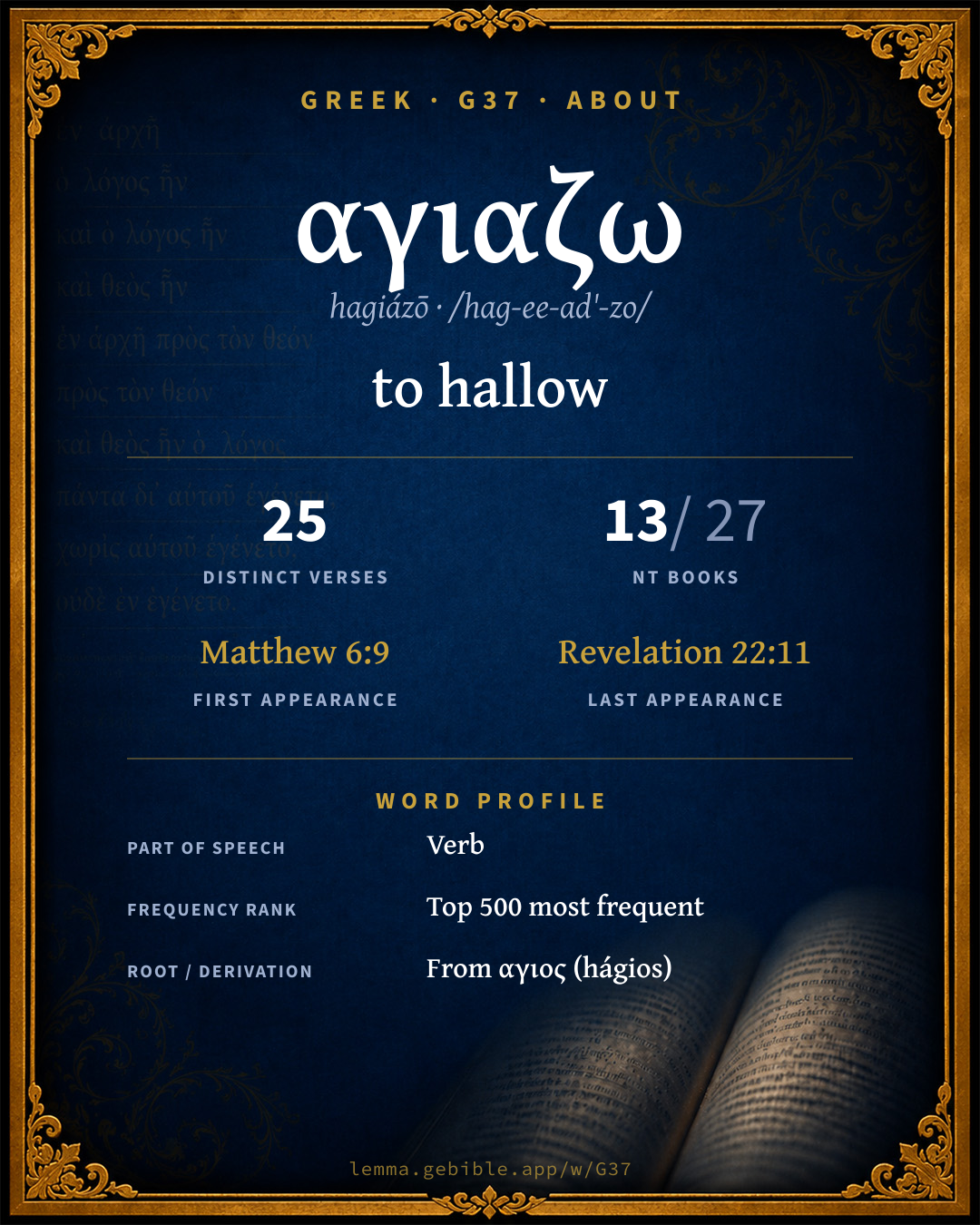
ἁγιάζω
to hallow
‘to hallow’ is one of 5 main senses fuller range ↓
Full lexicon entry — Thayer's Greek Lexicon
From Thayer's Greek Lexicon
Where this word appears
Grammar key — what these labels mean
Part of speech
- Verb
- An action or state-of-being word.
Tense
- Aorist
- Action viewed as a simple whole, without regard to duration — often past (perfective aspect).
- Perfect
- A completed past action with continuing present results.
- Present
- Ongoing or general action in present time (imperfective aspect).
Voice
- Passive
- The subject receives the action.
- Active
- The subject performs the action.
Mood
- Imperative
- Expresses a command or request.
- Participle
- A verbal adjective (“writing,” “having written”).
- Subjunctive
- Expresses probability, purpose, or possibility (the mood of contingency).
- Indicative
- States a fact or asks a factual question (the mood of reality).
- Optative
- Expresses a wish or a remote possibility.
Case
- Dative
- The case of the indirect object, means, or location — “to / for / with / in.”
- Nominative
- The case of the subject (and the predicate nominative).
- Accusative
- The case of the direct object and of extent.
Person
- 3rd person
- The one spoken about (“he / she / it / they”).
- 2nd person
- The one addressed (“you”).
- 1st person
- The speaker (“I / we”).
Gender
- Masculine
- Grammatically masculine.
- Neuter
- Grammatically neuter.
- Feminine
- Grammatically feminine.
Number
- Singular
- One.
- Plural
- More than one.
Every verse where G37 appears in the Book of Revelation — 1 distinct verse. Click any verse to open its interlinear word-by-word view. Verse text shown in the World English Bible for context — . Each verse’s Greek form is shown with its reference; the English is not keyword-highlighted, since the data carries no word-level English alignment. Use “Compare translations” on any verse to read it across multiple English versions. This concordance covers the Greek New Testament; Septuagint (Greek Old Testament) occurrences of this word are not indexed here.
Revelation
About this entry
At a glance — auto-summarized from this page’s data, not written by a person. Every figure links to its source below. This summary describes the numbers; it doesn’t interpret them.
The Greek verb αγιαζω centers on the idea of “to hallow.” Lexicons map it across 5 senses. Spanning 25 verses in 13 books, it ranks among the uncommon words of the Greek New Testament. Its earliest occurrence is Matthew 6:9. Related forms include αγιος, αγιον and αγιοτης. For the data behind this summary, explore the sense tree and the renderings breakdown below.
Gloss history
Strong's 1890 vs modern scholarship
About this word
Strong's G37 catalogs a Greek word from the Greek New Testament.
These counts are not copied from any lexicon or concordance. They are computed here, from the morphology-tagged Greek New Testament. What Lemma adds →
- 25
- distinct verses
- The word appears in 25 distinct verses.
- 13 / 27
- NT books
- The word appears in 13 of 27 New Testament books.
- #485
- by frequency
- Top 500 most frequent Greek words (rank 485 of 5,347 Greek words by occurrence).
View all 25 occurrences in the concordance →
By section of the New Testament
By traditional corpus
Conventional, traditional groupings — biblical authorship is debated, so this is a traditional corpus grouping, not an authorship claim. Some books belong to more than one corpus (Luke is in both the Gospels and the Lukan corpus, and so on), so these shares overlap and need not total 100%. Each figure is a share of the word’s 25 distinct verses.
- Pauline corpus 8 verses · 32%
- Gospels 7 verses · 28%
- Hebrews 6 verses · 24%
- Johannine 4 verses · 16%
- Lukan (Luke–Acts) 3 verses · 12%
- General (Catholic) Epistles 1 verse · 4%
- Revelation 1 verse · 4%
How translations render this word
Counts come from each version’s own published word-to-Strong’s tagging or interlinear alignment — an approximate guide to how each version renders this word, not a word-level alignment the data otherwise carries. Because each total is that version’s own tagged count, the per-version totals vary from one another and need not match the appearance or distinct-verse counts above. These counts may also differ from a printed concordance because Lemma counts each distinctly tagged rendering and does not collapse phrase taggings into a single head-word total. This is a fixed set of word-tagged versions (KJV, ASV, BSB, ULT) and does not change with the reading translation you choose elsewhere. Each version’s license is shown beside its name below (and on Sources).
- King James Version: Are sanctified 5×, Sanctify 4×, Is sanctified 3×
- American Standard Version: Sanctify 5×, Sanctified 4×, Are sanctified 3×
- Berean Standard Bible: Sanctify 7×, Sanctified 6×, Is sanctified 3×
- unfoldingWord Literal Text: Having been sanctified 3×, Is sanctified 3×, Let 3×
King James Version Public Domain
Renders G37 across 29 tagged occurrences — most commonly:
Plus 10 renderings that appear only once — usually multi-word phrases or single function words the recovered tagging swept in, not distinct renderings.
American Standard Version Public Domain
Renders G37 across 28 tagged occurrences — most commonly:
Plus 11 renderings that appear only once — usually multi-word phrases or single function words the recovered tagging swept in, not distinct renderings.
Berean Standard Bible Public Domain
Renders G37 across 28 tagged occurrences — most commonly:
Plus 6 renderings that appear only once — usually multi-word phrases or single function words the recovered tagging swept in, not distinct renderings.
unfoldingWord Literal Text CC BY-SA 4.0
Renders G37 across 33 tagged occurrences — most commonly:
Plus 10 renderings that appear only once — usually multi-word phrases or single function words the recovered tagging swept in, not distinct renderings.
Senses in Thayer's
The 5 senses Thayer's distinguishes for this word, in lexicon order (not ranked by frequency or importance). The full entry — with sub-senses — is in the Lexicon Entry tab.
- to render or acknowledge, or to be venerable or hallow
- to separate from profane things and dedicate to God
- to cleanse externally
- to purify by expiation: free from the guilt of sin
- to purify internally by renewing of the soul
Word origin
Derived from αγιος (hágios) (G40) — saint.
From G40 ; to make holy that is (ceremonially) purify or consecrate ; (mentally) to venerate : - hallow be holy sanctify.
— Strong’s Exhaustive Concordance (1890), public domain.
Forms in the corpus
The 21 distinct written forms G37 takes in the Greek New Testament, most frequent first — each parse links to that tense’s occurrences in the concordance.
Same root — word family
Other Thayer's entries built from the same root as G37, grouped by Strong’s listed origin. These share a root / origin per the lexicon — not necessarily a shared meaning. Each links to that word’s own entry.
Derives from
Shares the same root
- αγιον hágion G39 holy
- αγιοτης hagiótēs G41 holiness
- αγιωσυνη hagiōsýnē G42 holiness
- αγνος hagnós G53 sacred
Derived from this word
Compare all same-root words → Showing 4 of 7 — not the complete family. They share a root, not necessarily a meaning.
Septuagint usage
The same Greek word αγιαζω appears 166 times in the Greek Old Testament (Septuagint), across 146 verses in 24 books.
- 166
- LXX occurrences
- Tagged occurrences of this Greek word in the Septuagint.
- 146
- verses
- Distinct Septuagint verses containing this word.
- 24 / 39
- OT books
- The word appears in 24 of the 39 Old Testament books.
Sample Septuagint occurrences
- Genesis 2:3 ἁγιάζω
- Exodus 13:2 ἁγιάζω
- Leviticus 6:11 ἁγιάζω
- Numbers 3:13 ἁγιάζω
- Deuteronomy 5:12 ἁγιάζω
- Joshua 7:13 ἁγιάζω
- Judges 17:3 ἁγιάζω
- 1 Samuel 7:1 ἁγιάζω
- 2 Samuel 8:11 ἁγιάζω
- 1 Kings 8:8 ἁγιάζω
- 2 Kings 10:20 ἁγιάζω
- 1 Chronicles 18:11 ἁγιάζω
Septuagint occurrences (same lexeme)
Every verse where the same Strong’s number (G37) appears in the Greek Septuagint — showing the first 50 of 146. Verse text shown in the World English Bible for context; the Greek form is the matched word — the English is not keyword-highlighted.
- Genesis 2:3 ἁγιάζω God blessed the seventh day, and made it holy, because he rested in it from all his work which he had created and made.
- Exodus 13:2 ἁγιάζω "Sanctify to me all of the firstborn, whatever opens the womb among the children of Israel, both of man and of animal. It is mine."
- Exodus 13:12 ἁγιάζω that you shall set apart to Yahweh all that opens the womb, and every firstborn which you have that comes from an animal. The males shall be Yahweh's.
- Exodus 19:14 ἁγιάζω Moses went down from the mountain to the people, and sanctified the people; and they washed their clothes.
- Exodus 19:22 ἁγιάζω Let the priests also, who come near to Yahweh, sanctify themselves, lest Yahweh break forth on them."
- Exodus 19:23 ἁγιάζω Moses said to Yahweh, "The people can't come up to Mount Sinai, for you charged us, saying, 'Set bounds around the mountain, and sanctify it.'"
- Exodus 20:8 ἁγιάζω "Remember the Sabbath day, to keep it holy.
- Exodus 20:11 ἁγιάζω for in six days Yahweh made heaven and earth, the sea, and all that is in them, and rested the seventh day; therefore Yahweh blessed the Sabbath day, and made it holy.
- Exodus 28:38 ἁγιάζω It shall be on Aaron's forehead, and Aaron shall bear the iniquity of the holy things, which the children of Israel shall make holy in all their holy gifts; and it shall be always on his forehead, that they may be accepted before Yahweh.
- Exodus 28:41 ἁγιάζω You shall put them on Aaron your brother, and on his sons with him, and shall anoint them, and consecrate them, and sanctify them, that they may minister to me in the priest's office.
- Exodus 29:1 ἁγιάζω "This is the thing that you shall do to them to make them holy, to minister to me in the priest's office: take one young bull and two rams without blemish,
- Exodus 29:21 ἁγιάζω You shall take of the blood that is on the altar, and of the anointing oil, and sprinkle it on Aaron, and on his garments, and on his sons, and on the garments of his sons with him: and he shall be made holy, and his garments, and his sons, and his sons' garments with him.
- Exodus 29:27 ἁγιάζω You shall sanctify the breast of the wave-offering, and the thigh of the heave-offering, which is waved, and which is heaved up, of the ram of consecration, even of that which is for Aaron, and of that which is for his sons:
- Exodus 29:33 ἁγιάζω They shall eat those things with which atonement was made, to consecrate and sanctify them: but a stranger shall not eat of it, because they are holy.
- Exodus 29:36 ἁγιάζω Every day shall you offer the bull of sin-offering for atonement: and you shall cleanse the altar, when you make atonement for it; and you shall anoint it, to sanctify it.
- Exodus 29:37 ἁγιάζω Seven days you shall make atonement for the altar, and sanctify it: and the altar shall be most holy; whatever touches the altar shall be holy.
- Exodus 29:43 ἁγιάζω There I will meet with the children of Israel; and the place shall be sanctified by my glory.
- Exodus 29:44 ἁγιάζω I will sanctify the tent of meeting and the altar: Aaron also and his sons I will sanctify, to minister to me in the priest's office.
- Exodus 30:29 ἁγιάζω You shall sanctify them, that they may be most holy. Whatever touches them shall be holy.
- Exodus 30:30 ἁγιάζω You shall anoint Aaron and his sons, and sanctify them, that they may minister to me in the priest's office.
- Exodus 31:13 ἁγιάζω "Speak also to the children of Israel, saying, 'Most assuredly you shall keep my Sabbaths: for it is a sign between me and you throughout your generations; that you may know that I am Yahweh who sanctifies you.
- Exodus 40:8 ἁγιάζω You shall set up the court around it, and hang up the screen of the gate of the court.
- Exodus 40:9 ἁγιάζω You shall take the anointing oil, and anoint the tent, and all that is in it, and shall make it holy, and all its furniture: and it will be holy.
- Exodus 40:10 ἁγιάζω You shall anoint the altar of burnt offering, with all its vessels, and sanctify the altar: and the altar will be most holy.
- Exodus 40:13 ἁγιάζω You shall put on Aaron the holy garments; and you shall anoint him, and sanctify him, that he may minister to me in the priest's office.
- Leviticus 6:11 ἁγιάζω He shall take off his garments, and put on other garments, and carry the ashes outside the camp to a clean place.
- Leviticus 6:20 ἁγιάζω "This is the offering of Aaron and of his sons, which they shall offer to Yahweh in the day when he is anointed: the tenth part of an ephah of fine flour for a meal offering perpetually, half of it in the morning, and half of it in the evening.
- Leviticus 8:11 ἁγιάζω He sprinkled it on the altar seven times, and anointed the altar and all its vessels, and the basin and its base, to sanctify them.
- Leviticus 8:12 ἁγιάζω He poured some of the anointing oil on Aaron's head, and anointed him, to sanctify him.
- Leviticus 8:15 ἁγιάζω He killed it; and Moses took the blood, and put it on the horns of the altar round about with his finger, and purified the altar, and poured out the blood at the base of the altar, and sanctified it, to make atonement for it.
- Leviticus 8:30 ἁγιάζω Moses took some of the anointing oil, and some of the blood which was on the altar, and sprinkled it on Aaron, on his garments, and on his sons, and on his sons' garments with him, and sanctified Aaron, his garments, and his sons, and his sons' garments with him.
- Leviticus 10:3 ἁγιάζω Then Moses said to Aaron, "This is what Yahweh spoke of, saying, "'I will show myself holy to those who come near me, And before all the people I will be glorified.'" Aaron held his peace.
- Leviticus 11:44 ἁγιάζω For I am Yahweh your God. Sanctify yourselves therefore, and be holy; for I am holy: neither shall you defile yourselves with any kind of creeping thing that moves on the earth.
- Leviticus 16:4 ἁγιάζω He shall put on the holy linen coat, and he shall have the linen breeches on his body, and shall put on the linen sash, and he shall be dressed with the linen turban. They are the holy garments. He shall bathe his body in water, and put them on.
- Leviticus 16:19 ἁγιάζω He shall sprinkle some of the blood on it with his finger seven times, and cleanse it, and make it holy from the uncleanness of the children of Israel.
- Leviticus 20:3 ἁγιάζω I also will set my face against that person, and will cut him off from among his people because he has given of his seed to Molech, to defile my sanctuary, and to profane my holy name.
- Leviticus 20:8 ἁγιάζω You shall keep my statutes, and do them. I am Yahweh who sanctifies you.
- Leviticus 21:8 ἁγιάζω You shall sanctify him therefore; for he offers the bread of your God: he shall be holy to you: for I Yahweh, who sanctify you, am holy.
- Leviticus 21:12 ἁγιάζω neither shall he go out of the sanctuary, nor profane the sanctuary of his God; for the crown of the anointing oil of his God is upon him. I am Yahweh.
- Leviticus 21:15 ἁγιάζω He shall not profane his seed among his people: for I am Yahweh who sanctifies him.'"
- Leviticus 21:23 ἁγιάζω He shall not come near to the veil, nor come near to the altar, because he has a blemish; that he may not profane my sanctuaries, for I am Yahweh who sanctifies them.'"
- Leviticus 22:2 ἁγιάζω "Tell Aaron and his sons to separate themselves from the holy things of the children of Israel, which they make holy to me, and that they not profane my holy name. I am Yahweh.
- Leviticus 22:3 ἁγιάζω Tell them, 'If anyone of all your seed throughout your generations approaches the holy things, which the children of Israel make holy to Yahweh, having his uncleanness on him, that soul shall be cut off from before me. I am Yahweh.
- Leviticus 22:9 ἁγιάζω "'They shall therefore keep my charge, lest they bear sin for it, and die therein, if they profane it. I am Yahweh who sanctifies them.
- Leviticus 22:16 ἁγιάζω and so cause them to bear the iniquity that brings guilt, when they eat their holy things: for I am Yahweh who sanctifies them.'"
- Leviticus 22:32 ἁγιάζω You shall not profane my holy name, but I will be made holy among the children of Israel. I am Yahweh who makes you holy,
- Leviticus 25:10 ἁγιάζω You shall make the fiftieth year holy, and proclaim liberty throughout the land to all its inhabitants. It shall be a jubilee to you; and each of you shall return to his own property, and each of you shall return to his family.
- Leviticus 25:11 ἁγιάζω That fiftieth year shall be a jubilee to you. In it you shall not sow, neither reap that which grows of itself, nor gather from the undressed vines.
- Leviticus 27:14 ἁγιάζω "'When a man dedicates his house to be holy to Yahweh, then the priest shall evaluate it, whether it is good or bad: as the priest shall evaluate it, so shall it stand.
- Leviticus 27:15 ἁγιάζω If he who dedicates it will redeem his house, then he shall add the fifth part of the money of your valuation to it, and it shall be his.
These are occurrences of the same Greek lexeme (G37) in the Septuagint — not a translation of any one Hebrew word. The store carries no word-level Hebrew↔Greek alignment, so no Hebrew original is asserted here. Counts come from the recovered LXX Strong's tagging — high-frequency vocabulary is well covered, while rare or late forms may be untagged — so they reflect tagged occurrences and may slightly undercount.