1 Timothy 4:5

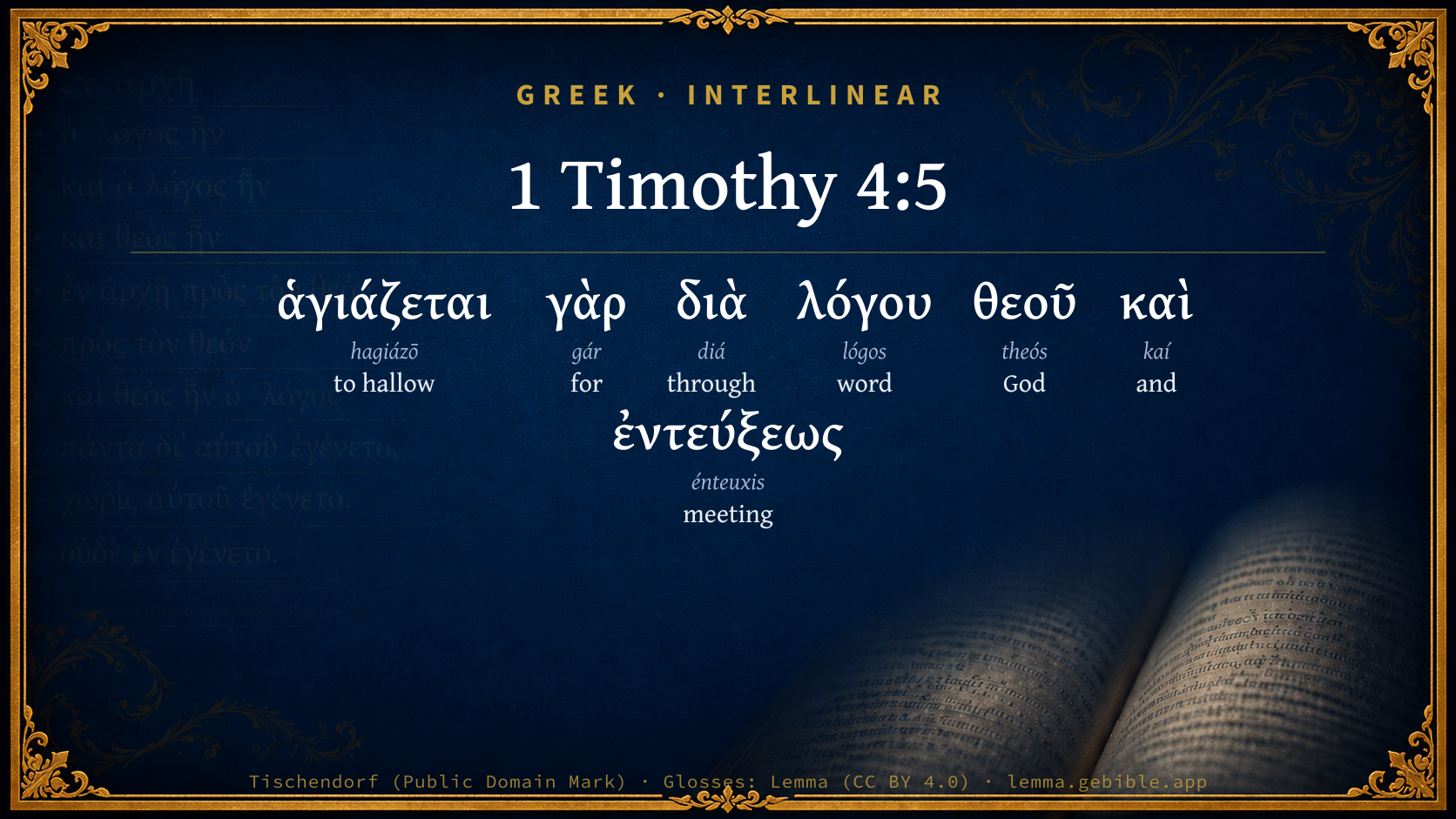
Greek (Tischendorf 8th ed.) 1 Timothy 4:5 appears in the Greek New Testament. The text above is from the Tischendorf 8th edition. Each word links to its Strong’s number and a concise gloss. Click any word for its full Thayer’s Greek Lexicon entry.
Download image
Cite this verse

1 Timothy 4:5 (World English Bible). Public Domain. Lemma interlinear Bible study tool, https://lemma.gebible.app/v/1-timothy/4/5.

Show BibTeX & RIS
BibTeX
RIS
English Translation
For it is sanctified through the word of God and prayer.
World English Bible · Public Domain
Download a study sheet

One document with this verse’s original text, its word-by-word gloss line, the meaning frame, cross-references with their text, attributed commentary, and full source and license credits — printable, and it pastes into notes with its structure intact.

This verse Autodidact and up

Study sheet (.html) Plain text (.txt)

A passage Seminary Student

Up to 50 verses in one chapter. A passage sheet keeps up to 6 commentary sources and 12 cross-references per verse, in the order this page ranks them, and says so on the sheet whenever that leaves anything out. Ask for a single verse and you get the Autodidact verse sheet above.

Everything on this page stays free to read, with no account — the sheet is a download of what is already on screen, not access to it.

Want to remove ads? Support Godless Engineer
Compare translations 3

The same verse in 3 English versions, stacked beneath the original-language interlinear above. Click any original word for its lexicon entry.

Each is an independent rendering of the whole verse — the interlinear is not word-aligned to these translations.

Highlighted words mark where these versions differ — a whole-verse word diff, not a word-by-word alignment.

  • World English Bible Public Domain
    For it is sanctified through the word of God and prayer.
  • King James Version Public Domain
    For it is sanctified by the word of God and prayer.
  • unfoldingWord Literal Text CC BY-SA 4.0
    for it is sanctified by the word of God and prayer.

unfoldingWord Literal Text — © unfoldingWord, licensed CC BY-SA 4.0. Word-aligned USFM3 via Door43 (git.door43.org/unfoldingWord/en_ult).

Versions to compare (up to 4)

3 of 4 selected

Show all 19 translations

Every available English version of this verse, each an independent rendering of the whole verse.

  • World English Bible Public Domain
    For it is sanctified through the word of God and prayer.
  • Berean Standard Bible Public Domain
    because it is sanctified by the word of God and prayer.
  • Majority Standard Bible Public Domain
    because it is sanctified by the word of God and prayer.
  • King James Version Public Domain
    For it is sanctified by the word of God and prayer.
  • American Standard Version (1901) Public Domain
    for it is sanctified through the word of God and prayer.
  • Revised Version (1885) Public Domain
    for it is sanctified through the word of God and prayer.
  • Geneva Bible (1599) Public Domain
    For it is sanctified by the worde of God, and prayer.
  • Douay-Rheims (1899) Public Domain
    For it is sanctified by the word of God and prayer.
  • Young's Literal Translation Public Domain
    for it is sanctified through the word of God and intercession.
  • Literal Standard Version CC BY-SA 4.0
    for it is sanctified through the word of God and intercession.
  • Unlocked Literal Bible CC BY-SA 4.0
    For it is sanctified by the word of God and prayer.
  • unfoldingWord Literal Text CC BY-SA 4.0
    for it is sanctified by the word of God and prayer.
  • Darby Bible Public Domain
    for it is sanctified by God's word and freely addressing [him].
  • World Messianic Bible Public Domain
    For it is sanctified through the word of God and prayer.
  • Webster's Bible Public Domain
    For it is sanctified by the word of God, and prayer.
  • Free Bible Version CC BY-SA 4.0
    since it is made sacred by the word of God and by prayer.
  • Bible in Basic English Public Domain
    For it is made holy by the word of God and by prayer.
  • Text-Critical English NT CC BY 4.0
    since it is sanctified through the word of God and prayer.
  • Tyndale New Testament (1534) Public Domain
    For it is sanctyfyed by the worde of God and prayer.

Literal Standard Version (2020), Covenant Press — licensed CC BY-SA 4.0. Text via the HelloAO Bible API (eBible.org). Unlocked Literal Bible (unfoldingWord) — licensed CC BY-SA 4.0. Text via the HelloAO Bible API (eBible.org). unfoldingWord Literal Text — © unfoldingWord, licensed CC BY-SA 4.0. Word-aligned USFM3 via Door43 (git.door43.org/unfoldingWord/en_ult). Free Bible Version, Dr. Jonathan Gallagher — licensed CC BY-SA 4.0. Text via the HelloAO Bible API (eBible.org).

Word by word

More ways to search: Search by grammar → Find every occurrence → Compare this word →

Practice this passage: Drill this verse → Learn its vocabulary →

About this verse

These counts appear in no published source. They are computed here, from the morphology-tagged text and Lemma’s own curated glosses. What Lemma adds →

7
words
7
distinct lemmas
Pauline Epistles
section

Notable vocabulary

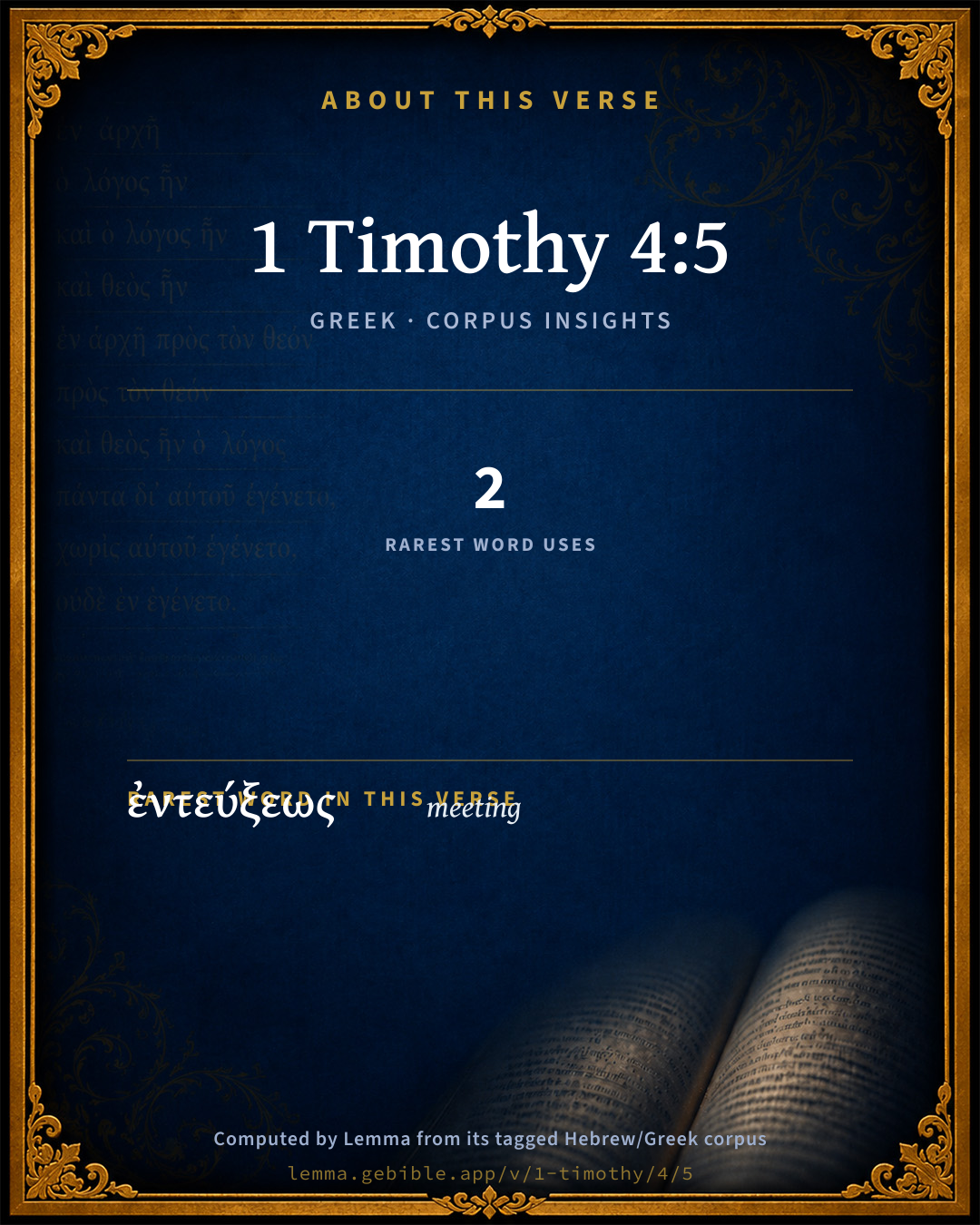
The rarest word here is ἐντεύξεως meeting G1783 — appearing just 2 times in the whole Greek New Testament.

Shared distinctive vocabulary

ἐντεύξεως meeting G1783 occurs in 2 verses of the Greek New Testament. Also found in:

Cross-references

7

Topical passages linked to 1 Timothy 4:5 in the Treasury of Scripture Knowledge — connected by theme and wording, ordered by reader-vote popularity; previews shown in the World English Bible.

  • 1 Timothy 4:3 forbidding marriage and commanding to abstain from foods which God created to be received with thanksgiving by those who believe and know the truth.
  • Luke 4:4 Jesus answered him, saying, "It is written, 'Man shall not live by bread alone, but by every word of God.'"
  • 1 Corinthians 7:14 For the unbelieving husband is sanctified in the wife, and the unbelieving wife is sanctified in the husband. Otherwise your children would be unclean, but now are they holy.
  • Luke 11:41 But give for gifts to the needy those things which are within, and behold, all things will be clean to you.
  • Titus 1:15 To the pure, all things are pure; but to those who are defiled and unbelieving, nothing is pure; but both their mind and their conscience are defiled.
  • Genesis 1:25 God made the animals of the earth after their kind, and the cattle after their kind, and everything that creeps on the ground after its kind. God saw that it was good.
  • Genesis 1:31 God saw everything that he had made, and, behold, it was very good. There was evening and there was morning, the sixth day.

Cross-references courtesy of OpenBible.info (CC BY 4.0).

Commentary

Notes on 1 Timothy 4:5 from classic Christian and Jewish commentators (each source and its license shown beneath its notes). The classic Christian expositions comment on the surrounding passage and are grouped to its opening verse, so a note may address several verses; the Jewish commentaries on the Tanakh (Rashi and others) are per-verse, so they appear only where the commentator wrote on this verse.

Lemma curates 59 commentaries, every one of them public domain or Creative Commons licensed, each selected and text-cleaned for this edition rather than reprinted as found. About our sources →

Bengel's Gnomon

Johann Albrecht Bengel

1Ti 4:5. Ἁγιάζεται, is sanctified) Lev 19:24.—διὰ λόγου Θεοῦ, by the word of God) The word of God enters into all thanksgiving, nay, also into the creation and granting of meats.—καὶ ἐντεύξεως, and intercessory [or consecratory] prayer) It is the duty of the children of God to offer intercessory [ch. 1Ti 2:1; or consecratory] prayer for the creatures which they use. It is a high dignity. Not only Christians, but also Jews and Heathens, consecrated the table with prayer.

Bengel's Gnomon of the New Testament — English translation (T&T Clark, Edinburgh, 1860) — public domain. Text from a community e-Sword module.

Meyer's Critical & Exegetical Commentary

Heinrich August Wilhelm Meyer

1Ti_4:5 serves to elucidate the thought expressed in 1Ti_4:4, that every meat taken with thanksgiving is good, and not to be rejected.

Ἁγιάζεται γὰρ διὰ λόγου Θεοῦ καὶ ἐντεύξεως] ἁγιάζειν is not declare to be clean and permissible, but make something holy. In itself the meat is not something holy, for, as a purely material thing, it can be called neither holy nor unholy (so also van Oosterzee). It is less suitable to say, with Wiesinger, that the κτίσις being burdened with a curse, is subject to ματαιότης and the δουλεία τῆς φθορᾶς; but it is made holy for those who enjoy it by the λόγος Θεοῦ. Wahl and Leo take Θεοῦ to be the objective genitive, and interpret it as oratio ad Deum facta, which makes the expression synonymous with ἔντευξις following it; but λόγος Θεοῦ never occurs in this sense. Other expositors have supposed that reference is made to some particular passage of the Scriptures, either to Gen_1:31 or Act_10:15; but de Wette rightly remarks that the words in that case go quite beyond 1Ti_4:4, and touch on the question whether certain meats are clean or unclean. For the same reason, λόγος Θεοῦ cannot mean generally the expressions of the divine doctrine, the principles of Christianity (Heydenreich). Since the expression points back to μετὰ εὐχαριστίας in 1Ti_4:4, and is closely connected with ἔντευξις, it can only mean the word of God occurring in the prayer of thanksgiving (de Wette, Wiesinger, van Oosterzee), either in this sense, that the word of thanks itself is called the Word of God, inasmuch as it is the expression of Gods indwelling Spirit, or because the prayer is supposed to consist of the words of Scripture.[156]

Regarding ἜΝΤΕΥΞΙς, see 1Ti_2:1.

[156] In the Apostolic Constitutions, vii. 49, there stands the following grace before meat: εὐλογητὸς εἶ, Κύριε, ὁ τρέφων μὲ ἐκ νεότητός μου, ὁ διδοὺς τροφὴν πάσῃ σαρκί, πλήρωσον χαρᾶς καὶ εὐφροσύνης τὰς καρδίας ἡμῶν, ἵνα πάντοτε πᾶσαν αὐτάρκειαν ἔχοντες, περισσεύωμεν εἰς πᾶν ἔργον ἀγαθὸν ἐν Χρ. Ἰησοῦ, τῷ Κυρίῳ ἡμῶν, διʼ οὗ σοὶ δόξα, τιμὴ καὶ κράτος εἰς τοὺς αἰῶνας, ἀμήν.

Meyer — Critical and Exegetical Commentary on the New Testament — English translation by Peter Christie, edited by Frederick Crombie (T&T Clark, 1880) — public domain. Text from a community e-Sword module.

Expositor's Greek Testament

ed. W. Robertson Nicoll

1Ti 4:5 . ἁγιάζεται : The use of the present tense here supports the explanation given of 1Ti 4:4 , and helps to determine the sense in which λόγος θεοῦ is used. The food lying before me at this moment, which to some is ἀπόβλητος , is sanctified here and now by the εὐχαριστία . See 1Co 10:30 .

λόγος θεοῦ and ἔντευξις (see note on 1Ti 2:1 ) are in some sense co-ordinate (almost a hendiadys), and together form elements in a εὐχαριστία . If St. Paul had meant by λόγος θεοῦ , the general teaching of Scripture, or the particular text, Gen 1:31 , he must have said ἡγίασται . At the same time, the written word was an element in the notion of the writer. λόγος θεοῦ has not here merely its general sense, a divine communication to man; it rather determines the quality of the ἔντευξις , as a scriptural prayer; a prayer in harmony with God’s revealed truth . The examples that have come down to us of grace before meat are, as Dean Bernard notes here, “packed with scriptural phrases”.

The best commentary on this verse is the action of St. Paul himself on the ship, when, having “taken bread, he gave thanks to God in the presence of all; and he brake it, and began to eat” (Act 27:35 ).

Although there is not here any direct reference to the Sacrament of the Eucharist, it is probable that thoughts about it have influenced the language; for the Eucharist is the supreme example of all benedictions and consecrations of material things. And if this be so, the passage has light thrown on it by the language of Justin Martyr and Irenæus about the Prayer of Consecration; e.g. , Justin, Apol . i. 66. “As Jesus Christ our Saviour, by the word of God ( διὰ λόγου θεοῦ ) made flesh, had both flesh and blood for our salvation, so we have been taught that the food over which thanks have been given by the word of prayer which comes from him ( τὴν διʼ εὐχῆς λόγου τοῦ παρʼ αὐτοῦ εὐχαριστηθεῖσαν τροφήν ) that food from which our blood and flesh are by assimilation nourished is both the flesh and the blood of that Jesus who was made flesh”. Similarly Irenæus ( Haer . 1Ti 4:2-3 ), “Both the mingled cup, and the bread which has been made, receives upon itself the word of God , and the Eucharist becomes the body of Christ” ( ἐπιδέχεται τὸν λόγον τοῦ θεοῦ , καὶ γίνεται ἡ εὐχαριστία σῶμα Χριστοῦ ). Perhaps by the word of prayer which comes from him Justin means a formula authorised by Christ. It must be added that the Prayer Book of Serapion, bishop of Thmuis in Egypt, circ . A.D. 380, contains an epiclesis in which we read, “O God of truth, let thy holy Word come to sojourn on this bread, that the bread may become Body of the Word, and on this cup, that the cup may become Blood of the Truth” (Bishop J. Wordsworth’s trans.).

A comparison of these passages suggests an association in the thought of the primitive Church of the Holy Spirit and the λόγος τοῦ θεοῦ .

The Expositor's Greek Testament, edited by W. Robertson Nicoll (1897–1910) — public domain. Text from a community e-Sword module.

Geneva Bible (1599)

Geneva Bible translators

We confess and acknowledge that God is the maker and giver of those creatures which we use. Secondly, that we are of the number of those, who through Christ’s benefit have recovered that right over all creatures, which Adam lost by his fall. Thirdly, by our prayers we crave of the Lord, that we may use those meats with a good conscience, which we receive at his hands. Fourthly, we make an end of our eating and drinking, with thanksgiving and prayer: and so are our meats sanctified to us.

He useth God’s benefits rightly, which acknowledge the giver of them by his word, and calleth upon him.

It is so made pure and holy in respect of us, so that we may use it with a good conscience, as received at the Lord’s hand.

Geneva Bible (1599) marginal notes — public domain. Text via Bolls.life.

Jamieson, Fausset & Brown

Robert Jamieson, A. R. Fausset & David Brown

sanctified--"hallowed"; set apart as holy for the use of believing men: separated from "the creature," which is under the bondage of vanity and corruption (Rom 8:19, &c.). Just as in the Lord's Supper, the thanksgiving prayer sanctifies the elements, separating them from their naturally alien position in relation to the spiritual world, and transferring them to their true relation to the new life. So in every use of the creature, thanksgiving prayer has the same effect, and ought always to be used (Co1 10:30-31).

by the word of God and prayer--that is, "by means of intercessory prayer" (so the Greek)--that is, consecratory prayer in behalf of "the creature" or food--that prayer mainly consisting of "the word of God." The Apostolic Constitutions [7.49], give this ancient grace, almost wholly consisting of Scripture, "Blessed art thou, O Lord, who feedest me from my youth, who givest food to all flesh: Fill our hearts with joy and gladness, that we, having all sufficiency, may abound unto every good work in Christ Jesus our Lord, through whom glory, honour, and might, be to thee for ever. Amen." In the case of inspired men, "the word of God" would refer to their inspired prayers (Kg1 17:1); but as Paul speaks in general, including uninspired men's thanksgiving for meals, the "word of God" more probably refers to the Scripture words used in thanksgiving prayers.

Jamieson, Fausset & Brown — Commentary Critical and Explanatory on the Whole Bible (1871) — public domain (CC PDM 1.0). Text via the HelloAO Bible API.

Adam Clarke's Commentary

Verse 5. For it is sanctified by the word of God] δια λογου θεου. By the command of God; probably referring to Ge 1:29: And God said, I have given you every herb-and every tree-to you it shall be for meat; and Ge 9:3: Every moving thing that liveth shall be meat for you; even as the green herb have I given you all things; i.e. I have given you every animal that is proper for food, as I have given you every herb and fruit proper for nourishment. Therefore, all this was sanctified, set apart, and appropriated to this use by this command. And when man is about to use it, he is to sanctify or set it apart to that use by prayer to God,

1. That it may "answer the end to us for which it was designed;

2. That we may use it with gratitude and moderation;

3. That all the strength derived from it may be devoted to God, in filling up the duties of those situations in which his providence has placed us.

Those who thank not God for their food, and pray not for his blessing in the use of it, are unworthy even of a morsel of bread, and of the breath they breathe. Bishop Newton's opinion of this prophecy I have reserved to the end of this chapter.

Adam Clarke's Commentary on the Bible (1810–1826) — public domain. Text from a community e-Sword/MySword module.

John Calvin's Commentaries

5 For it is sanctified by the word of God and prayer This is the confirmation of the preceding clause, if it be received with Thanksgiving. And it is an argument drawn from contrast; for “holy” and “profane” are things contrary to each other. Let us now see what is the sanctification of all good things, which belong to the sustenance of the present life. Paul testifies that it consists of “the word of God and prayer.” But it ought to be observed, that this word must be embraced by faith, in order that it may be advantageous; for, although God himself sanctifies all things by the Spirit of his mouth, yet we do not obtain that benefit but by faith. To this is added “prayer;” for, on the one hand, we ask from God our daily bread, according to the commandment of Christ, (Matthew 6:11;) and, on the other hand we offer thanksgiving to Him for His goodness.

Now Paul’s doctrine proceeds on this principle, that there is no good thing, the possession of which is lawful, unless conscience testify that it is lawfully our own. And which of us would venture to claim for himself a single grain of wheat, if he were not taught by the word of God that he is the heir of the world? Common sense, indeed, pronounces, that the wealth of the world is naturally intended for our use; but, since dominion over the world was taken from us in Adam, everything that we touch of the gifts of God is defiled by our pollution; and, on the other hand, it is unclean to us, till God graciously come to our aid, and by ingrafting us into his Son, constitutes us anew to be lords of the world, that we may lawfully use as our own all the wealth with which he supplies us.

Justly, therefore, does Paul connect lawful enjoyment with “the word”, by which alone we regain what was lost in Adam; for we must acknowledge God as our Father, that we may be his heirs, and Christ as our Head, that those things which are his may become ours. Hence it ought to be inferred that the use of all the gifts of God is unclean, unless it be accompanied by true knowledge and calling on the name of God; and that it is a beastly way of eating, when we sit down at table without any prayer; and, when we have eaten to the full, depart in utter forgetfulness of God.

And if such sanctification is demanded in regard to common food, which, together with the belly, is subject to corruption, what must we think about spiritual sacraments? If “the word,” and calling on God through faith, be not there, what remains that is not profane? Here we must attend to the distinction between the blessing of the sacramental table and the blessing of a common table; for, as to the food which we eat for the nourishment of our body, we bless it for this purpose, that we may receive it in a pure and lawful manner; but we consecrate, in a more solemn manner, the bread and wine in the Lord’s Supper, that they may be pledges to us of the body and blood of Christ.

John Calvin's Commentaries (1540-1563) — public domain. Text from the Calvin Translation Society English edition (1840s-50s) via the Christian Classics Ethereal Library (ccel.org). Calvin's coverage is partial (roughly two-thirds of the Bible); uncommented books and verses are honest gaps, never fabricated. The 19th-century editor's footnotes and remarks are omitted so the notes are faithfully Calvin's own voice.

Ellicott's Commentary for English Readers

(5) For it is sanctified by the word of God and prayer.—Not only are all created things to be considered pure, and not lightly to be put aside; but in the sight of God “every creature” is holy when received as His gift with thanksgiving and with prayer—such thanksgiving-prayer containing thoughts in exact accordance with the Spirit of God revealed in Scripture. Thus all food is sanctified, not only, or even chiefly, by the common formula of a Christian grace before meat. This too often degenerates into a mere form of words—into lip-service of the most heartless form—and is too often looked upon as a kind of religious charm. The sanctification referred to by St. Paul belongs to no one prayer or grace, but to the constant habit of referring everything to God as the giver of all—to the perpetual “office” of a devout heart which, taking everything as a gift from God, the lover and the friend of man, thanks God from the heart continually.

One, if not the oldest, form of a Christian grace before meat is the one found in the Apostolic Constitutions. It is very simple and beautiful, and perhaps not too long for daily use. It runs as follows: “Blessed be Thou, O Lord, who nourisheth men from very youth up, who givest meat to all flesh; fill our hearts with joy and gladness, so that we, always enjoying a sufficiency, may abound unto every good work in Christ Jesus our Lord, through whom be ascribed to Thee glory, honour, and power unto the ages. Amen.”

A Bible Commentary for English Readers, edited by Charles John Ellicott (1878–1897) — public domain. Text from a community e-Sword module.

The Cambridge Bible for Schools and Colleges

gen. ed. J. J. S. Perowne

5. for it is sanctified by the word of God and prayer] Rather, through. The ‘word of God’ is most commonly in N.T. ‘the gospel’ generally, Act_4:31, 1Co_14:36, Col_1:25, 1Th_2:2; 1Th_2:8-9; 1Th_2:13, Rev_20:4; sometimes more pointedly ‘the word which God speaks through His messengers or immediately in the heart of each man, Heb_4:12, 1Pe_1:23, Tit_1:3; sometimes still more specifically, the very Son of God Himself, the Word incarnate, Joh_1:1, 1Jn_1:1, Rev_19:13. But it is also the record of God’s will and truth as declared by the Old Testament lawgivers and prophets, Mar_7:13, Rom_9:6. And so with Huther, Ellicott, Conybeare, Lightfoot and Alford, we understand it here of O.T. declarations of God’s creating and sustaining goodness incorporated in the ‘invocation.’ We take it to imply that the thanksgiving was commonly made in some Scriptural words, such as those quoted from a primitive grace before meat (Apostolical Constitutions, vii. 49), which begins ‘Blessed art thou, O Lord, Who nurturest me from my youth up, Who givest food to all flesh.’ Compare the Latin Version of Psa_145:15 :

Oculi omnium in Te sperant, Domine,

Et Tu das escam illis in tempore.

The word for ‘prayer’ here is the same as that rendered ‘intercessions’ in 1Ti_2:1, where the meaning is discussed. Here perhaps it is chosen as more directly expressing the recognition of God’s particular providence; each recipient of ‘daily bread,’ after reciting the very words of God speaking to him and giving him every good gift, is to speak in his turn face to face with God and pray with thankful heart for blessings to others, ‘Our Father, give us our daily bread.’ The whole life of a Christian (and therefore everything of which he partakes) is sanctified through the word of God and prayer.

The bearing of this passage on the social and religious question of total abstinence from alcoholic drink is seen in the following note of Fairbairn; all the better because he is evidently not thinking specially of that particular form of abstinence:

‘Scripture indeed does not deny that a person may occasionally abstain from certain meats or from marriage, with advantage to his own spiritual life or the good of the kingdom of God (Mat_6:16-17; Mat_17:21; Mat_19:12; 1Co_7:32-37). But in such cases the alternative is not put as between a relatively pure and perfect state by the one course, and an impure or defective one by the other; but the one is presented merely as affording opportunities or helps for prosecuting more freely and unreservedly the work of faith than can well be done in the other. If temporary fasting should dispose and enable one to fight more successfully against the lusts of the flesh, or if by abstaining from marriage one could in particular spheres of labour, or in certain conjunctures of the Church’s history, more effectually serve the interests of the Gospel than otherwise, then the higher principles of that Gospel, the nobler ends of a Christian calling, will undoubtedly justify the restraint or the sacrifice. But to do this is only to subordinate a less to a greater good: it creates no factitious distinctions in respect to the allowable or forbidden, holy or unholy, in the ordinary relationship and circumstances of life; and calls for a rejection of the natural good in these only when it may be conducive as means to a definite spiritual end.’

The Cambridge Bible for Schools and Colleges (gen. ed. J. J. S. Perowne; Cambridge University Press, 1878–1918) — public domain. Text from a community e-Sword module.

John Gill's Exposition

For it is sanctified,.... Or set apart for use, and may be lawfully used at all times:

by the word of God; which declares that there is nothing in itself common, or unclean, or unfit for use, and that nothing that goes into a man defiles him; so that by virtue of this word of God, every creature may be made use of, that is fit for food: or else this designs the word of God, which gives a blessing to what is eaten; for it is not by bread or meat only, but through the word of God commanding a blessing on what is eaten, that man lives, Mat 4:4 and therefore this blessing upon our food should be asked for: wherefore it follows,

and prayer; this being used before eating for a blessing on the food, and after it, in a way of thanksgiving for it, sanctifies every creature of God, or gives men a free use of any, or all of them. So the Israelites, when they had eaten, and were full, were to bless the Lord, Deu 8:10. And thus our Lord Jesus Christ, at meals, used to take the food, and bless it or ask a blessing on it, Mat 14:19. And so did the Essenes among the Jews (h), and the Christians in Tertullian's (i) time; and the practice is highly necessary and commendable, nor ought it to be disused.

(h) Porphyr. de Abstinentia, l. 4. sect. 12. (i) Apolog. c. 39.

John Gill's Exposition of the Whole Bible (1746–1763) — public domain (CC PDM 1.0). Text via the HelloAO Bible API.

Trapp's Complete Commentary

John Trapp

5 For it is sanctified by the word of God and prayer.

Ver. 5. By the word] Of permission, Act 10:15, and of promise, a new right purchased by Christ, &c.

And prayer] For his leave and blessing, that "staff of bread," &c. This is to eat to the Lord Rom 14:6; to imitate Christ, Mat 26:26-30; Paul, Act 27:35; Samuel, 1Sa 9:13.

John Trapp, A Commentary or Exposition upon All the Books of the Old and New Testament (1647–1656) — public domain. Text from a community e-Sword module.

Albert Barnes' Notes on the Bible

For it is sanctified by the word of God - By the authority or permission of God. It would be profane or unholy if he had forbidden it; it is made holy or proper for our use by his permission, and no command of “man” can make it unholy or improper; compare Gen 1:29; Gen 9:3.

And prayer - If it is partaken of with prayer. By prayer we are enabled to receive it with gratitude, and everything that we eat or drink may thus be made a means of grace.

Albert Barnes' Notes on the Bible (1834–1885) — public domain. Text from a community e-Sword/MySword module.

Haydock's Catholic Bible Commentary

It is sanctified by the word of God, and prayer. That is, praying that they may not, by the abuse we make of them, be an occasion to us of sinning and offending God. (Witham) --- The use of all kinds of meat is in itself good; but if it were not, it would become sanctified by the prayer which we usually pronounce over it, and by the word of Christ, who has declared that not that which enters the mouth defiles a man. (Calmet)

George Leo Haydock (1774–1849), Haydock's Catholic Family Bible and Commentary, 1859 edition — public domain. Excludes Psalms (Douay-Rheims chapter numbering differs from Protestant) and Deuterocanonical books (Catholic canon only).

Matthew Poole's English Annotations

For it is sanctified: sanctified in this place signifies made pure, or lawful to be used.

By the word of God; by the gospel, which declares it so, Act 10:15; or by God’s ordination, which hath so determined it.

And prayer; and prayer to God for a blessing upon it.

Matthew Poole's English Annotations on the Holy Bible (1683–1685) — public domain. Text from a community e-Sword/MySword module.

Whedon's Commentary on the Bible

Daniel D. Whedon

5. Sanctified—Though it be a piece of flesh, it is not a lump of sin; it is consecrated to be aliment for the holy life of a holy man. And no man is the holier for looking pure and solemn and refusing it as a defilement.

By the word of God—As some explain, by the declaration of God, as in Gen_1:29 : “God said, Behold, I have given you every herb… and every tree… to you it shall be for meat.” Huther, Alford, and Ellicott refer the sanctification to the offering of prayer composed in spirit or in words of the word of God. Huther gives, from the Apostolic Constitutions, the beautiful Greek of the following primitive prayer at table: “Blessed art thou, O Lord, who nourishest me from my youth up, who givest food to all flesh. Fill our hearts with joy and gladness, in order that we, having all contentment, may abound unto every good work, in Christ Jesus our Lord; through whom to thee be glory, honour, and power, for ever and ever. Amen.” This formula is a holy blend of “the word of God and prayer,” whereby, offered in spirit and truth, the meat is sanctified.

Daniel D. Whedon (gen. ed.), Commentary on the Old and New Testaments (1874–1909) — public domain. Text from a community e-Sword module.

The Pulpit Commentary

Through for by, A.V It is sanctified through the Word of God. Considerable difference of opinion prevails among commentators as to the precise meaning of this verse, especially of the phrase, "the Word of God." Some refer to Gen_1:4, Gen_1:10, Gen_1:12, etc.; others toxiv, Gen_1:29 Gen_9:4, as containing the original grant of meats for the use of man; others to the scriptural phrases embodied in the words of the ejnteu the prayer of thanksgiving. Another possible reference would be to the Word of God recorded inzeti. Act_10:13, Act_10:15, Act_10:28, by which that which had previously been unclean was now made clean or holy; or, lastly, it might mean "the blessing of God" given in answer to the "prayer" on each occasion, which suits well the present tense, aJgia Prayer. (ejnteuxiv see 1Ti_2:1, note)

Creation sanctified.

it is sanctified by the Word of God and prayer." Here, then, is an exquisite harmony. We have been talking of creation, and now we come to consider the Word of God. And these creative things are to be "sanctified by the Word of God and prayer." Men can talk with God. His fellowship is a test of all our pleasures and companionships and associations the Bible be out of place here?" It is never out of place in nature"s gardens and groves. The best descriptions of nature are in the Bible. It is never out of place in pure festivities. It records the marriage supper, and the music and the dance when the prodigal came home. It is never out of place in children"s joys; for it gives the picture of a glad and happy childhood. The prophet says, "The streets of the city shall be full of girls and boys playing;" and Christ took up little children in his arms, and blessed them. It is never out of place in pure human love; for that is poetized in one entire book of the Bible. It is not out of place in the earnest pursuit of secular things; for the proverbs appeal to personal endeavor, and to the right enjoyment of riches and honor. The Bible sanctifies life from the cradle to the grave, and any social economy apart from the Word of God is only a paper defense against tyranny and wrong. "And prayer." For we may speak to God. The neutral face of nature is ghastly without him. "Speak, Lord; for thy servant heareth." Can I ask God to be there at all? Can I ask him to aid me in my work? Can I ask him to comfort me if I fail? Can I ask him to quicken my powers and enlarge my opportunities? Can I ask him to sanctify my associations? These are vital questions; for nothing is sanctified without him, and everything is "sanctified by the Word of God and prayer.

W.M.S.

The Pulpit Commentary (1880–1919), ed. H.D.M. Spence-Jones & Joseph S. Exell — public domain. Text from a community e-Sword module.

John Wesley's Explanatory Notes

It is sanctified by the word of God - Creating all, and giving it to man for food. And by prayer - The children of God are to pray for the sanctification of all the creatures which they use. And not only the Christians, but even the Jews, yea, the very heathens used to consecrate their table by prayer.

John Wesley, Explanatory Notes Upon the Whole Bible (1754–1765) — public domain. Text via the GEBible commentary corpus.

The People's New Testament

B. W. Johnson

5. It is sanctified. The food we eat is made holy when we offer thanks to God for it and pray his blessing upon it. This passage shows that the early saints were always wont to offer thanks before eating.

B. W. Johnson's The People's New Testament with Notes (1889–1891) — public domain. Electronic text from the Christian Classics Ethereal Library (CCEL) ThML edition.

Cambridge Greek Testament for Schools and Colleges

5. ἁγιάζεται γὰρ κ.τ.λ. Not only is πᾶν κτίσμα objectively good (καλόν), but it is also, despite the Fall and its consequences (Rom 8:20), good in relation to man, provided it be received μετὰ εὐχαριστίας; then ἁγιάζεται, it is sanctified‚ each time that it is used. The present tense shews that it is no single Divine act which is here in the mind of the writer, but a continued and recurring sanctification. εὐχαριστία is used in its most general sense; but the view of life here presented may be described as sacramental.

διὰ λόγου θεοῦ καὶ ἐντεύξεως. What is the meaning of λόγος θεοῦ here? The tense of ἁγιάζεται (see above) shews that it cannot be referred (a) to the Incarnate Word, as the Creative Agent (Joh 1:3), or (b) to the Divine voice of creation (Gen 1:31; cp. Act 10:15). The general sense of the clause undoubtedly is that meat becomes sanctified for man’s use by devout, thankful, and prayerful reception (see above on 1Ti 2:1 for ἔντευξις); and thus the Apostle seems to have had in his mind the pious practice of ‘grace before meat.’ Hence the point to be determined is the meaning of λόγος θεοῦ, if λόγ. θεοῦ καὶ ἔντ. is a description of such εὐχαί. Now the commonest and most general meaning of λόγος θεοῦ in the N.T. is the Divine message spoken or delivered under the guidance of the Divine Spirit (see Additional Note at end of chapter iv.), but no such general meaning will fit the context here. It is true that St Paul (Col 3:16) follows up the exhortation εὐχάριστοι γίνεσθε by adding ὁ λόγος τοῦ χριστοῦ ἐνοικείτω ἐν ὑμῖν πλουσίως … διδάσκοντες καὶ νουθετοῦντες ἑαυτοὺς ψαλμοῖς, ὕμνοις κ.τ.λ.; and it has been urged that in like manner in the present passage the εὐχαριστία, which is the condition of right use of God’s gifts, is the outcome of the indwelling λόγος θεοῦ, which is then understood (c) of the Divine utterance through the mouth of the person who offers his grace before meat. But, though λόγ. θ. καὶ ἔντ. constitute one conception, yet the connecting ͅκαί distinguishes λόγ. θ. from ἔντευξις; λόγ. θ. seems to mark some special feature which differentiates this ἔντευξις from prayer in general. And this special feature in the earliest Christian age (as is still the case) was the employment in the ‘grace’ of phrases from Holy Scripture. An interesting form from the Apostolical Constitutions (vii. 49) runs as follows: εὐλογητὸς εἶ κύριε ὁ τρέφων με ἐκ νεότητός μου, ὁ διδοὺς τροφὴν πάσῃ σαρκί· πλήρωσον χαρᾶς καὶ εὐφροσύνης τὰς καρδίας ἡμῶν, ἱνα πάντοτε πᾶσαν αὐτάρκειαν ἔχοντες, περισσεύωμεν εἰς πᾶν ἔργου ἀγαθὸν ἐν Χριστῷ Ἰησοῦ τῷ κυρίῳ ἡμῶν, διʼ οὖ σοὶ δόξα τιμὴ καὶ κράτος εἰς τοὺς αἰῶνας, ἀμήν, which is packed with Scriptural phrases[530]. The words of the Psalter (e.g. Psa 145:15-16) have often been used for this pious purpose. Hence we conclude (d) that λόγος θεοῦ in the verse before us refers to the words of the O.T. which were commonly embodied (by the Jews as well as by the early Christians) in the εὐχαὶ ἐπ ̓ ἀρίστῳ or prayers before meat: for it is sanctified through the Word of God and prayer.

[530] Cp. Tertullian (Apol. xxxix.), speaking of the ἀγάπαι, “Non prius discumbitur, quam oratio ad deum praegustetur … post aquam manualem et lumina, ut quisque de scripturis sanctis vel de proprio ingenio potest, provocatur in medium deo canere … aeque oratio convivium dirimit.” This refers to the exhortation given in connexion with the prayer before and after the common meal, and not necessarily to the prayer itself.

Cambridge Greek Testament for Schools and Colleges (Cambridge University Press, 1896; 21 vols, various authors incl. Carr, Maclear, Plummer, Farrar, Lumby, Moule, M. R. James, Simcox) — public domain. Text from a community e-Sword module.

Alford’s Greek Testament

Henry Alford

5.] Reason for the above assertion. Because (ὅτι is more the objective,—γάρ, which follows, the subjective causal particle: ὅτι introduces that which rests on a patent fact, as here on a Scripture quotation,—γάρ, that which is in the writer’s mind, and forms part of his own reasoning) every thing which God has made is good (in allusion to ref. Gen. See also Rom 14:14, Rom 14:20); and nothing (which God has made) is to be rejected (Wetst. cites Hom. Il. γ. 65, οὔτοι ἀπόβλητʼ ἑστὶ θεῶν ἐρικυδέα δῶρα—on which the Schol.,—ἀπόβλητα, ἀποβολῆς ἄξια· τὰ ὑπὸ θεῶν, φησί, δεδομένα δῶρα οὐκ ἔστι μὲν ἀρνήσασθαι) if received with thanksgiving (“properly, even without this condition, all things are pure: but he did not rise to this abstraction, because he was regarding meats not per se, but in their use, and this latter may become impure by an ungodly frame of mind.” De Wette): for (see on ὅτι and γάρ above) it (this subject is gathered out of the preceding clause by implication, and = ‘every κτίσμα which is partaken of with thanksgiving’) is hallowed (more than ‘declared pure,’ or even than ‘rendered pure:’ the latter it does not want, the former falls far short of the work of the assigned agents. The emphasis is on ἁγιάζεται, and a new particular is introduced by it—not purity merely, but holiness,—fitness for the godly usage of Christian men. To this, which is more than mere making or declaring pure, it is set apart by the εὐχαριστία; so that the minus is proved by the majus. There is certainly a slight trace of reference to the higher consecration in the Lord’s Supper. The same word εὐχαριστία is common to both. Ordinary meals are set apart for ordinary Christian use by asking a blessing on them: that meal, for move than ordinary use, by asking on it its own peculiar blessing) by means of the word of God and intercession (what ‘word of God?’ how to be understood? treating the plamer word first, the ἔντευξις is evidently intercession (see on ch. 2:1) on behalf of the κτίσμα partaken of—that it may be ‘sanctified to our use.’ This, bound on as λογου θεοῦ is to εντεύξεως by the non-repetition of the preposition, may serve to guide us to its meaning. And first, negatively. It cannot mean any thing which does not form part of the εὐχαριστία: such as God’s word in the Scripture just cited (Mack), or in any other place (Grot., al.): or God’s word in the foundation-truths of Christianity. Then, positively: it must mean in some sense the εὐχαριστία, or something in it. But not, as Wahl and Leo, the ‘word addressed to God,’ ‘oratio ad Deum facta,’ which would be an unprecedented meaning for λόγος θεοῦ: the only way open for us is, that the εὐχαριστία itself, or some part of it, is in some sense the word of God. This may be (1) by its consisting in whole or in part of Scripture words, or (2) by the effusion of a Christian man, speaking in the power of God’s Spirit, being known as λόγος θεοῦ. This latter is perhaps justified by the reff.: but still it seems to me hardly probable, and I should prefer the former. (So Ellic. also.) It would generally be the case, that any form of Christian thanksgiving before meat would contain words of Scripture, or at all events thoughts in exact accordance with them: and such utterance of God’s revealed will, bringing as it would the assembled family and their meal into harmony with Him, might well be said ἁγιάζειν the βρώματα on the table for their use. Many of the Commentators quote from the Constt. Ap. vii. 49, p. 1057, Migne, the following grace before meat, used in the primitive times: εὐλογητὸς εἶ κύριε ὁ τρέθων με ἐκ νεότητός μου, ὁ διδοὺς τροφὴν πάσῃ σαρκί· πλήρωσον χαρᾶς καὶ εὐφροσύνης τὰς καρδίας ἡμῶν, ἵνα πάντοτε πᾶσαν αὐτάρκειαν ἔχοντες, περισσεύωμεν εἰς πᾶν ἔργον ἀγαθὸν ἐν χριστῷ Ἰησοῦ τῷ κυρίῳ ἡμῶν, διʼ οὗ σοὶ δόξα τιμὴ καὶ κράτος εἰς τους αἰῶνας, ἀμήν. Here almost every clause is taken from some expression of Scripture).

Henry Alford, The Greek Testament (1849–1861) — public domain. Text from a community e-Sword module.

Vincent's Word Studies in the New Testament

Marvin R. Vincent

It is sanctified [αγιαζεται] . Not declared holy, but made holy. The declaration confirms the last clause of ver. 4. Thanksgiving to God has a sanctifying effect. The food in itself has no moral quality (Rom 14:14), but acquires a holy quality by its consecration to God; by being acknowledged as God 's gift, and partaken of as nourishing the life for God 's service. Comp. Paul 's treatment of the unbelieving husband and the believing wife, 1Co 7:14.

By the word of God [δια λογου θεου] . That is, by the word of God as used in the prayer. Scripture is not called "the Word of God." The Word of God includes much more than Scripture : but Scripture contains the Word of God, and the thanksgiving at table was in the words of Scripture. See Psa 145:15, 16. The custom of grace at meat appears 1Sa 9:13. Christ blessed the loaves and fishes (Mt 14:19; Mt 14:36) : Paul on the ship gave thanks for the meal which the seamen ate (Act 27:35). Enteuxewv prayer, see on ch. 1ti 2:1.

Marvin R. Vincent, Word Studies in the New Testament (1887–1900) — public domain. Text from a community e-Sword/MySword module.

Lesson kit

Teaching starters — assembled from the data on this page, not authored interpretation. Every prompt links to the verse data it draws on. Edit before teaching.

1 Timothy, in the Pauline Epistles, opens this verse with 7 words (7 distinct Greek lemmas). Its most distinctive word is énteuxis (“meeting”). A historical commentator’s framing appears above. Read the whole chapter for the surrounding context.

Discussion questions

  1. How does “meeting” (énteuxis) shape what this verse is saying?
  2. 1 Timothy 2:1 shares the word «meeting» with this verse. How do the two illuminate each other?
  3. These translations render this verse differently. What is at stake in choosing one wording over another?
  4. Reading how Bengel's Gnomon and Meyer's Critical & Exegetical Commentary read this verse, where do the two commentators agree and where do they part?

Things to notice

Reading settings

Reading text

Shown beneath each verse's original-language words.

Old Testament
Old Testament edition

Read the OT as the Masoretic Hebrew (MT) or the Greek Septuagint (LXX).

English shown for the Greek Septuagint (in the Hebrew ↔ Greek comparison).

Comparing translations? Open the Compare panel on any verse page to stack up to four side by side.