Hebrews 10:14

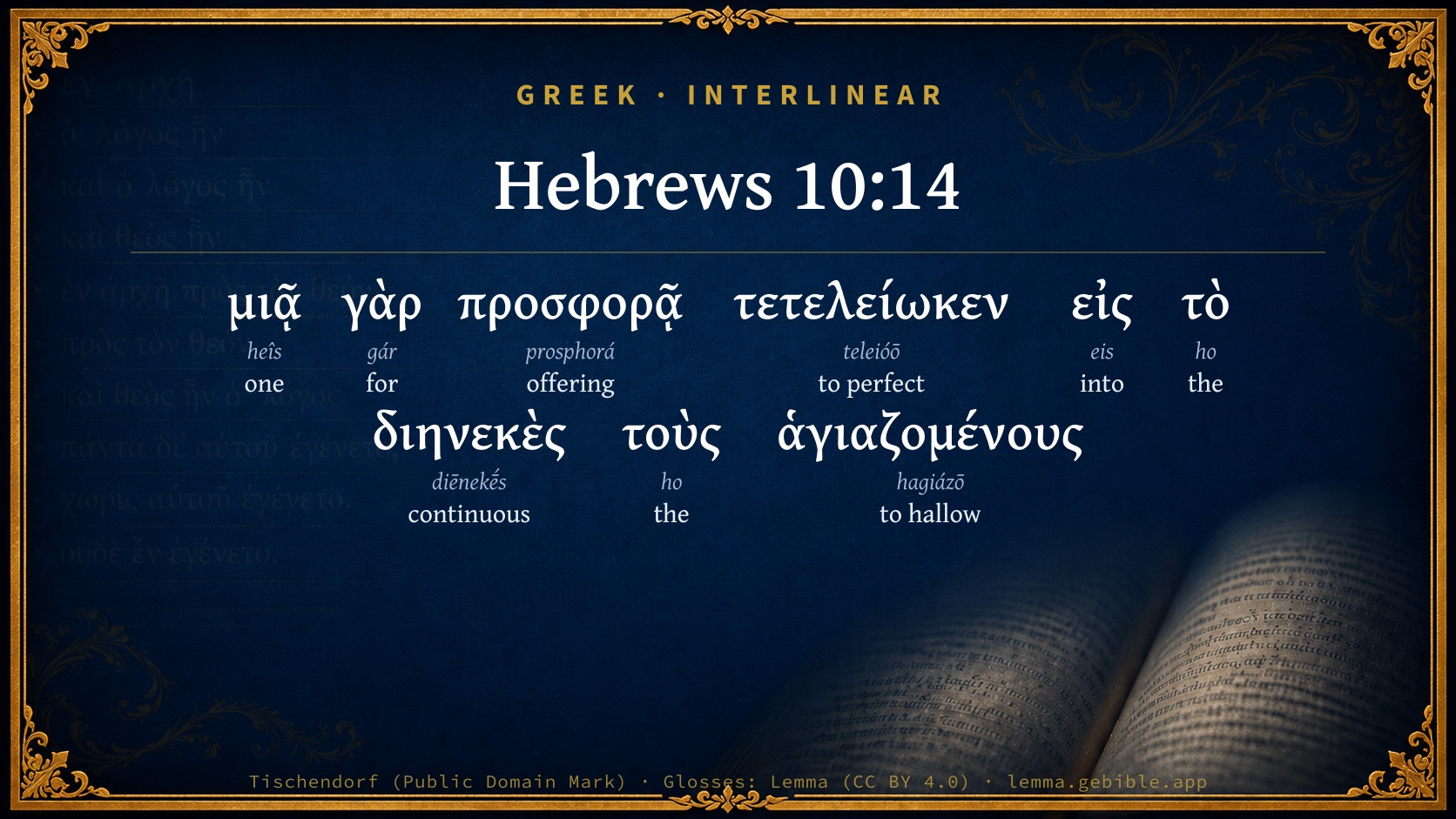
Greek (Tischendorf 8th ed.) Hebrews 10:14 appears in the Greek New Testament. The text above is from the Tischendorf 8th edition. Each word links to its Strong’s number and a concise gloss. Click any word for its full Thayer’s Greek Lexicon entry.
Download image
Cite this verse

Hebrews 10:14 (World English Bible). Public Domain. Lemma interlinear Bible study tool, https://lemma.gebible.app/v/hebrews/10/14.

Show BibTeX & RIS
BibTeX
RIS
English Translation
For by one offering he has perfected forever those who are being sanctified.
World English Bible · Public Domain
Download a study sheet

One document with this verse’s original text, its word-by-word gloss line, the meaning frame, cross-references with their text, attributed commentary, and full source and license credits — printable, and it pastes into notes with its structure intact.

This verse Autodidact and up

Study sheet (.html) Plain text (.txt)

A passage Seminary Student

Up to 50 verses in one chapter. A passage sheet keeps up to 6 commentary sources and 12 cross-references per verse, in the order this page ranks them, and says so on the sheet whenever that leaves anything out. Ask for a single verse and you get the Autodidact verse sheet above.

Everything on this page stays free to read, with no account — the sheet is a download of what is already on screen, not access to it.

Want to remove ads? Support Godless Engineer
Compare translations 3

The same verse in 3 English versions, stacked beneath the original-language interlinear above. Click any original word for its lexicon entry.

Each is an independent rendering of the whole verse — the interlinear is not word-aligned to these translations.

Highlighted words mark where these versions differ — a whole-verse word diff, not a word-by-word alignment.

  • World English Bible Public Domain
    For by one offering he has perfected forever those who are being sanctified.
  • King James Version Public Domain
    For by one offering he hath perfected for ever them that are sanctified.
  • unfoldingWord Literal Text CC BY-SA 4.0
    For by one offering he has perfected for all time the ones being sanctified.

unfoldingWord Literal Text — © unfoldingWord, licensed CC BY-SA 4.0. Word-aligned USFM3 via Door43 (git.door43.org/unfoldingWord/en_ult).

Versions to compare (up to 4)

3 of 4 selected

Show all 19 translations

Every available English version of this verse, each an independent rendering of the whole verse.

  • World English Bible Public Domain
    For by one offering he has perfected forever those who are being sanctified.
  • Berean Standard Bible Public Domain
    because by a single offering He has made perfect for all time those who are being sanctified.
  • Majority Standard Bible Public Domain
    because by a single offering He has made perfect for all time those who are being sanctified.
  • King James Version Public Domain
    For by one offering he hath perfected for ever them that are sanctified.
  • American Standard Version (1901) Public Domain
    For by one offering he hath perfected for ever them that are sanctified.
  • Revised Version (1885) Public Domain
    For by one offering he hath perfected for ever them that are sanctified.
  • Geneva Bible (1599) Public Domain
    For with one offering hath he consecrated for euer them that are sanctified.
  • Douay-Rheims (1899) Public Domain
    For by one oblation he hath perfected for ever them that are sanctified.
  • Young's Literal Translation Public Domain
    for by one offering he hath perfected to the end those sanctified;
  • Literal Standard Version CC BY-SA 4.0
    for by one offering He has perfected to the end those being sanctified;
  • Unlocked Literal Bible CC BY-SA 4.0
    For by one offering he has perfected forever those who are being sanctified.
  • unfoldingWord Literal Text CC BY-SA 4.0
    For by one offering he has perfected for all time the ones being sanctified.
  • Darby Bible Public Domain
    For by one offering he has perfected in perpetuity the sanctified.
  • World Messianic Bible Public Domain
    For by one offering he has perfected forever those who are being sanctified.
  • Webster's Bible Public Domain
    For by one offering he hath perfected for ever them that are sanctified.
  • Free Bible Version CC BY-SA 4.0
    For by a single sacrifice he has set right forever those who are being made holy.
  • Bible in Basic English Public Domain
    Because by one offering he has made complete for ever those who are made holy.
  • Text-Critical English NT CC BY 4.0
    For by one offering he has perfected for all time those who are being sanctified.
  • Tyndale New Testament (1534) Public Domain
    For with one offerynge hath he made parfecte for ever them that are sanctified.

Literal Standard Version (2020), Covenant Press — licensed CC BY-SA 4.0. Text via the HelloAO Bible API (eBible.org). Unlocked Literal Bible (unfoldingWord) — licensed CC BY-SA 4.0. Text via the HelloAO Bible API (eBible.org). unfoldingWord Literal Text — © unfoldingWord, licensed CC BY-SA 4.0. Word-aligned USFM3 via Door43 (git.door43.org/unfoldingWord/en_ult). Free Bible Version, Dr. Jonathan Gallagher — licensed CC BY-SA 4.0. Text via the HelloAO Bible API (eBible.org).

Word by word

More ways to search: Search by grammar → Find every occurrence → Compare this word →

Practice this passage: Drill this verse → Learn its vocabulary →

About this verse

These counts appear in no published source. They are computed here, from the morphology-tagged text and Lemma’s own curated glosses. What Lemma adds →

9
words
8
distinct lemmas
General Epistles
section

Notable vocabulary

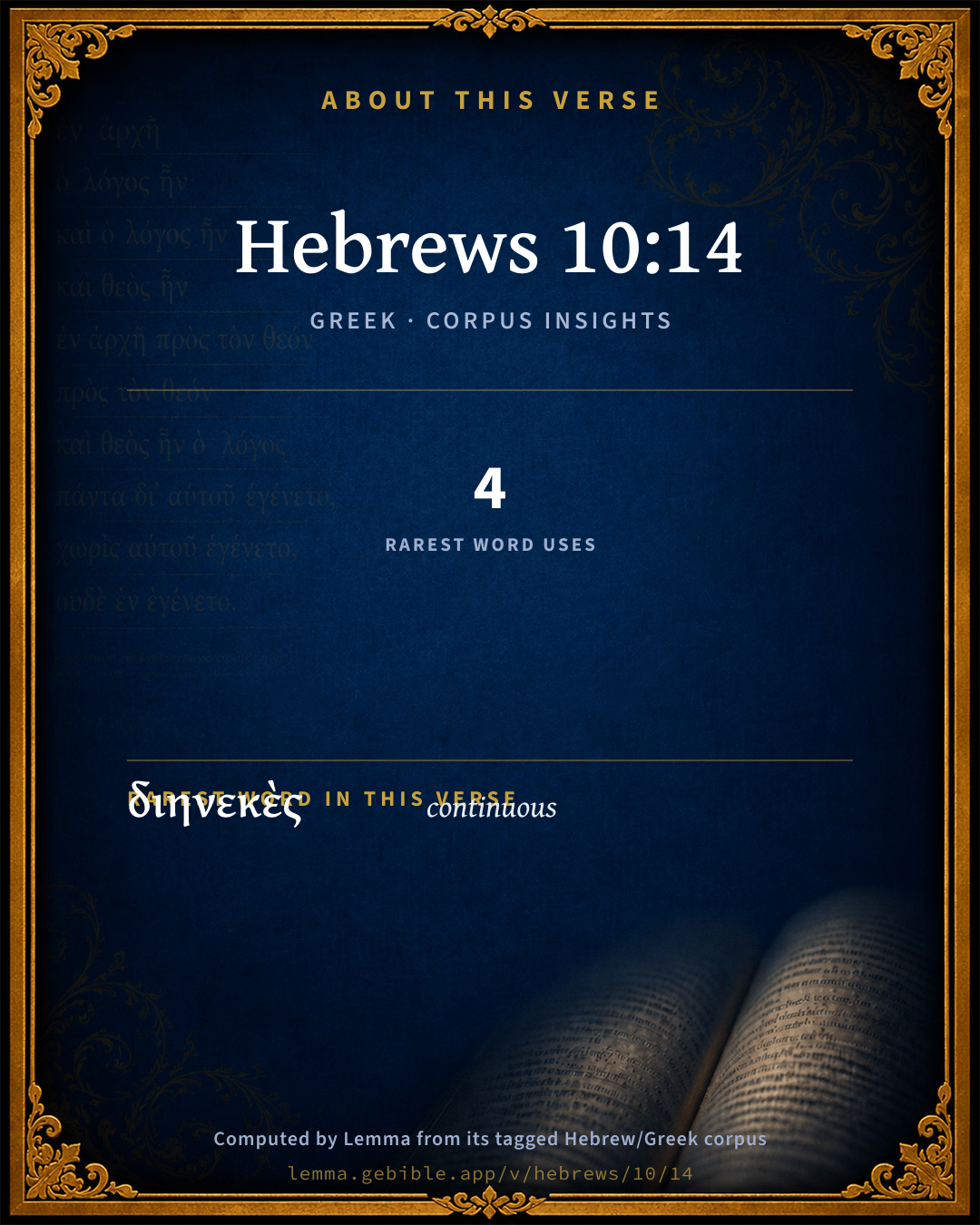
The rarest word here is διηνεκὲς continuous G1336 — appearing just 4 times in the whole Greek New Testament.

Shared distinctive vocabulary

διηνεκὲς continuous G1336 occurs in 4 verses of the Greek New Testament. Also found in:

Repetition

A word recurs within this verse:

Cross-references

14

Topical passages linked to Hebrews 10:14 in the Treasury of Scripture Knowledge — connected by theme and wording, ordered by reader-vote popularity; previews shown in the World English Bible.

  • Hebrews 9:14 how much more will the blood of Christ, who through the eternal Spirit offered himself without blemish to God, cleanse your conscience from dead works to serve the living God?
  • Hebrews 7:25 Therefore he is also able to save to the uttermost those who draw near to God through him, seeing he ever lives to make intercession for them.
  • Hebrews 10:1 For the law, having a shadow of the good to come, not the very image of the things, can never with the same sacrifices year by year, which they offer continually, make perfect those who draw near.
  • Hebrews 2:11 For both he who sanctifies and those who are sanctified are all from one, for which cause he is not ashamed to call them brothers,
  • Romans 15:16 that I should be a servant of Christ Jesus to the Gentiles, ministering as a priest the Gospel of God, that the offering up of the Gentiles might be made acceptable, sanctified by the Holy Spirit.
  • Hebrews 13:12 Therefore Jesus also, that he might sanctify the people through his own blood, suffered outside of the gate.
  • Acts 20:32 Now, brothers, I entrust you to God, and to the word of his grace, which is able to build up, and to give you the inheritance among all those who are sanctified.
  • Ephesians 5:26 that he might sanctify it, having cleansed it by the washing of water with the word,
  • Hebrews 6:13–14 For when God made a promise to Abraham, since he could swear by none greater, he swore by himself,
  • Hebrews 7:19 (for the law made nothing perfect), and a bringing in thereupon of a better hope, through which we draw near to God.
  • 1 Corinthians 1:2 to the assembly of God which is at Corinth; those who are sanctified in Christ Jesus, called to be saints, with all who call on the name of our Lord Jesus Christ in every place, both theirs and ours:
  • Hebrews 9:10 being only (with meats and drinks and various washings) fleshly ordinances, imposed until a time of reformation.
  • Jude 1:1 Jude, a servant of Jesus Christ, and brother of James, to those who are called, sanctified by God the Father, and kept for Jesus Christ:
  • Acts 26:13 at noon, O King, I saw on the way a light from the sky, brighter than the sun, shining around me and those who traveled with me.

Cross-references courtesy of OpenBible.info (CC BY 4.0).

Commentary

Notes on Hebrews 10:14 from classic Christian and Jewish commentators (each source and its license shown beneath its notes). The classic Christian expositions comment on the surrounding passage and are grouped to its opening verse, so a note may address several verses; the Jewish commentaries on the Tanakh (Rashi and others) are per-verse, so they appear only where the commentator wrote on this verse.

Lemma curates 59 commentaries, every one of them public domain or Creative Commons licensed, each selected and text-cleaned for this edition rather than reprinted as found. About our sources →

Albert Barnes' Notes on the Bible

For by one offering - By offering himself once on the cross. The Jewish priest offered his sacrifices often, and still they did not avail to put away sin; the Saviour made one sacrifice, and it was sufficient for the sins of the world.

He hath perfected forever - He hath laid the foundation of the eternal perfection. The offering is of such a character that it secures their final freedom from sin, and will make them forever holy. It cannot mean that those for whom he died are made at once perfectly holy, for that is not true; but the idea is, that the offering was complete, and did not need to be repeated; and that it was of such a nature as entirely to remove the penalty due to sin, and to lay the foundation for their final and eternal holiness. The offerings made under the Jewish Law were so defective that there was a necessity for repeating them every day; the offering made by the Saviour was so perfect that it needed not to be repeated, and that it secured the complete and final salvation of those who availed themselves of it.

Them that are sanctified - Those who are made holy by that offering. It does not mean that they are as yet “wholly” sanctified, but that they have been brought under the influence of that gospel which sanctifies and saves; see Heb 2:11; Heb 9:14. The doctrine taught in this verse is, that all those who are in any measure sanctified will be perfected forever. It is not a temporary work which has been begun in their souls, but one which is designed to be carried forward to perfection. In the atonement made by the Redeemer there is the foundation laid for their eternal perfection, and it was with reference to that, that it was offered. Respecting this work and the consequences of it, we may remark, that there is:

(1)Perfection in its nature, it being of such a character that it needs not to be repeated;

(2)There is perfection in regard to the pardon of sin - all past sins being forgiven to those who embrace it, and being forever forgiven; and

(3)There is to be absolute perfection for them forever.

They will be made perfect at some future period, and when that shall take place it will be to continue forever and ever.

(The perfection, in this place, is not to be understood of the perfection of grace or of glory. It is perfection, in regard to the matter in hand, in regard to what was the chief design of sacrifices, namely, expiation and consequent pardon and acceptance of God. And this indeed is the Τελειωσις Teleiōsis of the Epistle to the Hebrews generally, Heb 7:11; Heb 9:9; Heb 10:1. Perfect moral purity and consummate happiness will doubtless follow as consequences of the sacrifice of Christ, but the completeness of his expiation, and its power to bring pardon and peace to the guilty and trembling sinner, to justify him unto eternal life, is here, at all events, principally intended. The parties thus perfected or completely justified, are τους ἁγιαζομενους tous hagiazomenous, the “sanctified.” Ἁγιαζω Hagiazō, however, besides the general sense of “sanctify” has in this Epistle, like τελειοω teleioō, its sacrificial sense of cleansing from guilt. “Whether ceremonially, as under the Levitical dispensation; Heb 9:13; comp, Lev 16:19; or really and truly, by the offering of the body of Christ; Heb 10:10, Heb 10:14, Heb 10:29; compare Heb 10:2, and Heb 2:11; Heb 9:14.” - Parkhurst’s Greek Lexicon. The meaning, then, may be, that they who are purged or cleansed by this sacrifice, in other words, those to whom its virtue is applied, are perfectly justified.

Wherever this divine remedy is used, it will effectually save. By one offering Christ hath forever justified such as are purged or cleansed by it. This could not be said of those sanctified or purged by the legal sacrifices. Mr. Scott gives the sacrificial sense of the word, but combines with it the sense of sanctifying morally, in the following excellent paraphrase. “By his one oblation he hath provided effectually for the perfect justification unto eternal life, of all those who should ever receive his atonement, by faith springing from regeneration, and evidenced ‘by the sanctification of the Spirit unto obedience,’ and who were thus set apart and consecrated to the service of God.”)

Albert Barnes' Notes on the Bible (1834–1885) — public domain. Text from a community e-Sword/MySword module.

The Biblical Illustrator

Joseph S. Exell

Heb_10:14

Perfected for ever them that are sanctified

Perfection in faith

I.

THE CHILDREN OF GOD ARE HERE INTENDED, UNDER THE TERM SANCTIFIED; they are described as sanctified persons. There are two meanings to the term sanctified. One is, set apart. God has set apart His people from before the foundation of the world, to be His chosen and peculiar inheritance. We are sanctified by God the Father. There is a second signification, which implies not the decree of the Father, but the work of the Holy Spirit. But the word here, I think, includes both of these senses; and I must try to find a figure which will embrace them both. And what is the apostle speaking about? In the ninth chapter he is speaking about the tabernacle, and the candlestick, and the table, and the shewbread, and the sanctuary, and the golden censer, and the ark of the covenant overlaid with gold, and the pot of manna; he is talking about priests, and holy things; and he is declaring that all these things of which he speaks were sanctified things, but that though they were sanctified things, they wanted to be made perfect by the sprinkling of blood, Now I believe the sanctification of our text is to be understood in this sense.

II. IN WHAT SENSE ARE WE TO UNDERSTAND THAT CHRIST HAS PERFECTED THESE THAT ARE SANCTIFIED? When the golden vessels were brought into the temple or into the sanctuary, they were sanctified the very first moment that they were dedicated to God. No one dared to employ them for anything but holy uses. But they were not perfect. What did they need, then, to make them perfect? Why, to have blood sprinkled on them; and, as soon as the blood was sprinkled on them, those golden vessels were perfect vessels, officially perfect. God accepted them as being holy and perfect things, and they stood in His sight as instruments of an acceptable worship. Just so was it with the Levites and the priests. As soon as ever they were set apart to their office; as soon as ever they were bern, in fact, they were consecrated, they belonged to God; they were His peculiar priesthood. But they were not perfect until they had passed through divers washings, and had the blood sprinkled upon them. Then God looked upon them in their official priestly character, as being perfect persons. Here is one sense of the text. The apostle says that we who are the priests of God have a right as priests to go to Gods mercy-seat that is within the veil; but it were to our death to go there unless we were perfect. But we are perfect, for the blood of Christ has been sprinkled on us, and, therefore, our standing before God is the standing of perfection. Our standing, in our own conscience, is imperfection, just as the character of the priest might be imperfect. But that has nothing to do with it. Our standing in the sight of God is a standing of perfection; and when He sees the blood, as of old the destroying angel passed over Israel, so this day, when He sees the blood, God passes over our sins, and accepts us at the throne of His mercy, as if we were perfect. Therefore, let us come boldly; let us draw near with a true heart in frill assurance of faith, having our hearts sprinkled from an evil conscience, and our bodies washed with pure water. And now we will have one more thought, and then I shall have given you the full meaning of the text. In the seventh chapter, the nineteenth verse, there is a word that is a key to the meaning of my text, and that helped me all through it. For the law made nothing perfect, but the bringing in of a better hope did, by the which we draw nigh unto God. Then with this, compare the tenth chapter and first verse, The law having a shadow of good things to come, and not the very image of the things, can never with those sacrifices which they offered year by year, continually make the comers thereunto perfect. There is the word perfect; and we have it in the text; for then, says he, if they had been perfect, would they not have ceased to be offered. Why offer any more, if you are a perfect man? If the sacrifice made is perfect, the worshippers, once purged, should have had no more conscience of sin. Now mark. The Jewish sacrifice was never intended to make the Jews moral character any better, and it did not; it had no effect upon what we call his sanctification; all the sacrifice dealt with was his justification, and the perfection would be sought after; the perfection is not of sanctification, but of official standing, as he stood justified before God. Now that is the meaning of the word perfect here. It does not mean that the sacrifice did not make the man perfectly holy, and perfectly moral, and so forth; the sacrifice had no tendency to do that; it was quite another matter. It means that it did not perfectly make him justified in his own conscience and in the sight of God, because he had to come and offer again. But now behold the glory of Christ Jesus as revealed to us in our text. Those sacrifices could not make the comers thereunto perfect. They could not feel in their own conscience that they were perfectly justified, and they wanted fresh offerings; but I see the slaughtered Lamb on Calvary. Years ago I sought Him and I found Him. I do not want another Lamb; I do not want another sacrifice. I can still see that blood flowing, and I can feel continually that I have no more conscience of sin. (C. H. Spurgeon.)

The one perfect offering

1. The act is to perfect, which may be to a thing perfect; and seeing the end of Christs sacrifice is mans full happiness, therefore to perfect is to make us perfectly and fully happy.

2. The subject of this consecration are the sanctified.

3. The effect is glorious and most excellent, and includes regeneration, justification, reconciliation, adoption with the inferior degrees of them all, and also the resurrection and eternal glorification. And surely so rare an effect must have some excellent cause; and so it hath, and that is, that one offering of Christ. (G. Lawson.)

Perfected:

The word perfected falls with a strange sound on those who are experiencing daily their sad imperfections. But the Christian is a strange paradox. We are unknown, yet well known; chastened, yet not killed; dying, and, behold, we live; poor, yet making many rich; having nothing, yet possessing all things. Let me speak to you then of this twofold aspect of the Christian. You may be caught up into the third heaven, and yet the abundance of thin revelation will not burn up the dross that is within you, or kill the old man, the flesh which warreth against the spirit. We have died once in Christ, and in Christ are accepted and perfect; but our old nature is not dead, the flesh in us is not annihilated, there is still within us that which has no pleasure in the will and ways of God. Painful this struggle will ever be, though God is with us, and our joy is greater than our pain. We have in us the death of Adam, and we have in us the resurrection of Jesus Christ. By the one we are broken and tormented through sin, and darkness, and sluggishness, and earthliness, and gloom; by Christ we are raised, and strengthened, and comforted. We sin, we fall, we carry about with us a mind resisting Gods will, criticising it, and rebelling; and we shall experience to the very last breath we draw on earth, that there is a conflict, and that we must strive and suffer in order to be faithful unto death. (A. Saphir.)

Importance of the death of Christ:

Speculate on it how we may, the death of the Lord Jesus Christ is presented to us in the New Testament as the everlasting reason of every happy relation between sinful man and the moral government of God. (R. W. Dale, LL. D.)

By one offering:

As our burnt-offering, Christ became our righteousness in full consecration; as our peace-offering, our life; as our sin-offering, the expiation for our sins; as our guilt-offering, He made satisfaction and plenary reparation in our behalf to the God on whose inalienable rights in us, by our sins we had trespassed without measure. (S. H. Kellogg, D. D.)

The Biblical Illustrator, edited by Joseph S. Exell (c. 1880s–1900s) — public domain. Text from a community e-Sword module.

MacLaren's Expositions of Holy Scripture

Alexander MacLaren

Hebrews

PERFECTED AND BEING SANCTIFIED

Heb 10:14

IN the preceding sentence there is another ‘for ever,’ which refers to the sacrifice of Christ, and declares its perpetual efficacy. It is one, the world’s sins are many, but the single sacrifice is more than all of them. It is a past act, but its consequences are eternal, and flow down through all the ages. The text explains wherein consists the perpetual efficacy of Christ’s sacrifice, and the reason why it needs no repetition while the world lasts. It endures for ever, because it has perfected for ever them that are sanctified. Now, in looking at these words, two things are noteworthy. One is the double designation here of the persons whom Christ influences by His offering, in that they are ‘perfected,’ and in that they are ‘sanctified.’ Another is the double aspect of our Lord’s work here set forth in regard to time, in that it is, in the first part of the sentence, spoken of as a past act whose consequences endure - ‘He hath perfected’ - and in the latter part of our text, according to the accurate rendering, it is spoken of as continuous and progressive, as yet incomplete and going on to perfection- For the text ought to read - ‘He hath perfected for ever them that are being sanctified.’ So there you have these two things, the double view of what Christ does, ‘perfects’ and ‘sanctifies,’ and the double view of His ‘work, in that in one aspect it is past and complete, and in another aspect it is running on, continuous, and as yet unfinished.

I. First, then, look at the twofold aspect of the effect of Christ’s sacrifice.

By it we are ‘perfected,’ ‘sanctified.’ Now, these two words, so to speak, cover the same facts, but they look at them from two different points of view. One of them looks at the completed Christian character from the human point of view, and the other looks at it from the divine. For, what does ‘perfect’ mean in the New Testament? It means, as many a passage might be quoted to show, ‘mature,’ ‘full grown,’ in opposition to ‘babes in Christ.’ This very Epistle uses the two phrases in that antithesis, but the literal meaning of the word is that which has reached its end, that which has attained what it was meant to be; and, according to the New Testament teaching, a man is perfected when he has all his capabilities and possibilities of progress and goodness and communion with God made into realities and facts in His life, when the bud has flowered, and the flower has fruited, When capacity is developed, privileges enjoyed, duties attended to,. relationships entered into and maintained - when these things have taken place the man is perfect. It is to be observed that there is no reference in the word to any standard outside of human nature. If a man has become all that it is possible for him to be, he is, in the fullest sense, perfect. But Scripture also recognises a relative perfection, as we have already remarked, which consists in a certain maturity of Christian character, and has for its opposite the condition of ‘babes in Christ.’ So Paul exhorts ‘as many as be perfect’ to be ‘thus minded’ - namely, not to count themselves to have apprehended, but to stretch forward to the things which rare before, and to press towards the goal which still gleams far in advance. Consider, now, that other description of a Christian character as

‘sanctified.’

The same set of facts in a man’s nature is thought of in that word, only they are looked at from another point of view. I suppose I do not need to enlarge upon the fact which, however, I am afraid a great many good people do not realise as they should, that the Biblical notion of ‘saint’ and ‘sanctified’ does not begin with character, but with relation, or, if I might put it more plainly, it does not, primarily and to start with, mean righteous, but ‘belonging to God.’ The Old and the New Testament concur in this conception of ‘sanctity,’ or ‘holiness,’ which are the same thing, only one is a Latin word and the other a Teutonic one - namely, that it starts from being consecrated and given up to God, and that out of that consecration will come all manner of righteousness and virtues, beauties of character, and dispositions and deeds which all men own to be ‘lovely... and of good report.’ The saint is, first of all, a man who knows that he belongs to God, and is glad to belong to Him, and then, afterwards, he becomes righteous and pure and radiant, but it all starts with yielding myself to God.

So the same set of characteristics which in the word ‘perfected’ were considered as fulfilling the idea of manhood, as God has given it to us, are massed in this other word, and considered as being the result of our yielding ourselves to Him. That is to say, no man has reached the end which he was created and adapted to reach, unless he has surrendered himself to God. You never be ‘perfected’ until you are ‘sanctified.’

You must begin with consecration, and then holiness of character, and beauty of conduct, and purity of heart will all come after that. It is vain to put the cart before the horse, and to try to work at mending your characters, before you have set right your relationship to God. Begin with sanctifying, and you will come to perfecting. That is the New Testament teaching. And there is no way of getting to that perfection except, as we shall see, through the one offering.

II. In the next place notice here the completed work.

‘By one offering He hath "perfected"‘ us, the Christian people of this generation, the Christian people yet to be born into the world, the men that have not yet learned that they belong to Him, but who will learn it some day. Were they all ‘perfected’ eighteen centuries ago? In what sense can that perfecting be said to be a past act? Suppose you take some purifying agent, and throw it in at the headwaters of a river, and it goes down the stream, down and down and down, and by degrees purifies it all If you like to use long- winded words, you can say that ‘potentially’ the river was purified when the precipi-rating agent was flung into it, though its waves were still foul with impurity. Or you can put it into plainer English and say that the past act has its abiding consequences, for there has been thrown into the centre of human history, as it were, that which is amply adequate to the ‘perfecting’ and the ‘sanctifying’ of every soul of the race. And that is what the writer of this Epistle means when he says ‘He hath perfected,’ because that sacrifice, like the precipitating agent that I have spoken about, has been flung into the stream of the world’s history, and has power to make pure as the dew-drop, or as the water that flows from melting ice, every foul-smelling, darkly dyed drop of the filthy stream.

‘By one offering; Now the word that the writer employs there is a very unusual one in Scripture. He has just been using it in a previous verse, where he speaks about ‘the offering of the body of Jesus Christ.’ Did you ever notice that remarkable expression ‘the offering of the body,’ not as we usually read, the ‘blood.’ What does that mean? I think it means this, that the writer is contemplating not only the culminating sacrifice of Calvary, but Christ’s offering of Himself all through His earthly life; and knitting together in one the life and the death, the totality of His work, as that by which He has ‘perfected for ever all them that are being sanctified.’ And that, I think, is made quite certain, because he has just been speaking, and the words of my text refer back to the declaration in one of the psalms ‘Lo! I come to do Thy will, O God,’ as expressing the whole meaning of the sacrifice of Jesus Christ. That saying of the psalmist was fulfilled not only on the Cross but in all His daily life.

Jesus Christ, then, in His whole manifestation, in His life, but not only in His life; and in His death, but not only in His death, has offered Himself unto God, ‘the Lamb without blemish, and without spot.’ And in that offering culminating in the death upon the Cross, but not confined thereto, there does lie the power which is triumphantly more than adequate to deal with all the foulnesses and sins of the world, and to perfect for ever any man that attaches himself to it. It deals with our guilt as nothing else can. It speaks to our consciences as nothing else can. It takes away all the agony and the pain, or all the dogged deadness, of a seared conscience. It deals with character. In that great offering, considered as including Christ’s life as well as His death, and considered as including Christ’s death as well as His life, you have folded up in indissoluble unity the pattern, the motive, and the power for all righteousness of character; and he reaches the end for which God created him, who, laying his hand on the head of that offering, not only transfers his sins to it, but receives its righteousness into him. By one offering that dealt with guilt, and wiped it all out, and that deals with the tyranny of evil, and emancipates us from it, and that communicates to us a new life formed in righteousness after the image of Him that created us, we are delivered from the burden of our sins and perfected, in so far as we lay hold of the power that is meant to cleanse us.

There is no other way of being perfected. You will never reach the point which it is possible for you to attain, and you will never fulfil the purpose for which God made you, unless you have joined yourself by faith to Jesus Christ, and are receiving into your life, and developing in your character, the power which He has lodged in the heart of humanity for redemption and purifying.

III. Now one last word. We have here the continuous and progressive work of Christ, and the growing experience, of Christians.

As I have remarked, the last clause of my text would be more completely rendered if we read, ‘them that are being sanctified.’ The same idea is set forth by the apostle Paul in that solemn passage in the first Epistle to the Corinthians, where he speaks about the double effect of the gospel upon ‘them that are perishing; and on them that are being saved.’ In both cases there is a process going on. The same idea is brought out, too, in the other expression in the Acts of the Apostles, about the ‘Lord adding to the Church daily,’ not, as the Authorised Version has it, ‘such as should be saved,’ but ‘them that were being saved.’ We may speak of salvation as past, as all included in the initial act by which we are knit to Jesus Christ through faith, when as guilty sinners we come to Him and east ourselves on Him. We may speak of salvation as being future, and lying beyond this vale of tears and battlefield of sins and sorrow. But we can speak of it more accurately than in either of these aspects, as a point in the past, prolonged into a line in the present, and running on into the future. For salvation is a process which is going on day by day, if we are right, and which I am afraid is not progressive in a very great many professing Christian people. Perfected, I said, meant full-grown. I wonder about how many of us it would need to be said, ‘Ye are babes in Christ, and when for the time ye ought to be teachers ye have need that one teach you which be the first principles of the oracles of God.’ Salvation is a progressive process. That is to say, if we are truly joined to Jesus Christ, we are growingly influenced by the powers of His Cross and the gift of His Spirit.

There is no limit to that growth. It is like a spiral which goes up and up and up, and in every convolution ‘draws nearer to the centre, but never reaches it. Our hearts and spirits are wonderfully elastic. They can take in a great deal more of God than we think they can, or than they ever have taken in. We can receive just as much of that infinite Life into our finite spirits as we will. Let us each strive to get more and more of Jesus Christ in us, that we may know Him, and the ‘power of His resurrection, and the fellowship of His sufferings,’ more fully, more deeply, and may keep it more constantly. Oh, brethren! if we are not ascending the ladder that reaches to heaven, which is Christ Himself, we are descending; and if we are not growing we are dwindling; and if we cannot say that we are being sanctified, we are being made more and more common and profane.

I am not going to say one word about whether absolute perfection or absolute sanctification can be reached in this life. If you and I were many hundreds of miles farther on the road, it would be worth discussing whether we could reach the goal or not. Never mind about the possibilities of abstract and perfect sanctification, we are a good long way off that.

Look after the next step in advance, and leave the ultimate one to take care of itself. Only remember, that whilst Christ’s past work has in it perpetual and absolute power to make any man perfect, no man will be sanctified unless he is sanctified by ‘faith that is in Me,’ and by the effort to work into his life and character the gift of the Divine Spirit and of the life of Christ which he receives by faith. It is ‘them that are being sanctified’ to whom the large hopes of this great text apply, and who may be sure that one day they will be absolutely perfected.

Alexander MacLaren, Expositions of Holy Scripture (1904–1910) — public domain. Text from a community e-Sword module.

Tyndale Open Study Notes

Tyndale Open Resources

10:14 made perfect: See study notes on 7:11, 28. • those who are being made holy: What the author has in mind is complete purification from sins.

Tyndale Open Study Notes — © Tyndale Open Resources, licensed CC BY-SA 4.0. Text via the HelloAO Bible API.

Bengel's Gnomon

Johann Albrecht Bengel

Heb 10:14. Μιᾷ γὰρ προσφορᾷ, for by one offering) Or should we rather read μία γὰρ προσφορὰ, for one offering?[63] For the language is framed (moves on) in the abstract also in Heb 10:11; and with the same verb ΤΕΛΕΙΟῦΝ, to perfect, which here sustains the Apodosis, it was similarly framed, ch. Heb 7:19, Heb 9:9, Heb 10:1.—γὰρ, for) The assigning of a reason (Ætiology, Append.) is to be referred to (has reference to) Heb 10:12.—τοὺς ἁγιαζομένους, those who were sanctified) A participle of the imperfect tense. For this sanctification was accomplished in the very act of offering the sacrifice, Heb 10:10.

[63] The Germ. Vers., following the reasons assigned by the Gnomon, prefers this reading, which was considered of equal authority by the margin of both Ed.—E. B.

Bengel's Gnomon of the New Testament — English translation (T&T Clark, Edinburgh, 1860) — public domain. Text from a community e-Sword module.

Meyer's Critical & Exegetical Commentary

Heinrich August Wilhelm Meyer

Heb_10:14. Proof of the possibility of the εἰς τὸ διηνεκὲς ἐκάθισεν ἐν δεξιᾷ τοῦ θεοῦ, Heb_10:12, from the needlessness for a fresh sacrifice, since Christ has already, by the sacrifice once offered, brought in perfect sanctification for His believers.

The accentuation: μιᾷ γὰρ προσφορᾷ, merits the preference to μιὰ γὰρ προσφορά, to which Bengel is inclined, and which has been followed by Ewald, since by the former the words acquire an immediate reference to Christ.

τοὺς ἁγιαζομένους] them that are sanctified, sc. as regards the decree of God. The participle present is used substantively, as Heb_2:11, without respect to time.

Meyer — Critical and Exegetical Commentary on the New Testament — English translation by Peter Christie, edited by Frederick Crombie (T&T Clark, 1880) — public domain. Text from a community e-Sword module.

Jamieson, Fausset & Brown

Robert Jamieson, A. R. Fausset & David Brown

For--The sacrifice being "for ever" in its efficacy (Heb 10:12) needs no renewal.

them that are sanctified--rather as Greek, "them that are being sanctified." The sanctification (consecration to God) of the elect (Pe1 1:2) believers is perfect in Christ once for all (see on Heb 10:10). (Contrast the law, Heb 7:19; Heb 9:9; Heb 10:1). The development of that sanctification is progressive.

Jamieson, Fausset & Brown — Commentary Critical and Explanatory on the Whole Bible (1871) — public domain (CC PDM 1.0). Text via the HelloAO Bible API.

Adam Clarke's Commentary

Verse 14. For by one offering] His death upon the cross.

He hath perfected for ever.] He has procured remission of sins and holiness; fur it is well observed here, and in several parts of this epistle, that τελειοω, to make perfect, is the same as αφεσιν αμαρτιων ποιεω, to procure remission of sins.

Them that are sanctified.] τους αγιαζομενους. Them that have received the sprinkling of the blood of this offering. These, therefore, receiving redemption through that blood, have no need of any other offering; as this was a complete atonement, purification, and title to eternal glory.

Adam Clarke's Commentary on the Bible (1810–1826) — public domain. Text from a community e-Sword/MySword module.

Ellicott's Commentary for English Readers

(14) No repetition of His offering is needed, for by one offering He hath brought all unto “perfection,” and that “for ever.” In Heb_7:11 we have read that “perfection” did not come through the Levitical priesthood or through the law (Heb_10:19); the object of man’s hopes and of all priestly service has at last been attained, since through the “great High Priest” “we draw nigh to God” (Heb_7:19). In this is involved salvation to the uttermost (Heb_7:25). The last word of this verse has occurred before, in Heb_2:11. As was there explained, it literally means those who are being sanctified, all those who, from age to age, through faith (Heb_10:22) receive as their own that which has been procured for all men.

A Bible Commentary for English Readers, edited by Charles John Ellicott (1878–1897) — public domain. Text from a community e-Sword module.

The Cambridge Bible for Schools and Colleges

gen. ed. J. J. S. Perowne

14. he hath perfected] Heb_7:11; Heb_7:25.

them that are sanctified] “those who are in the way of sanctification” (Heb_2:11; comp. Act_2:47).

The Cambridge Bible for Schools and Colleges (gen. ed. J. J. S. Perowne; Cambridge University Press, 1878–1918) — public domain. Text from a community e-Sword module.

John Gill's Exposition

For by one offering,.... The same as before; himself, body and soul; this is a reason why he is set down, and will continue so for ever, and why he expects his enemies to be made his footstool; because by one sacrifice for sin, which he has once offered,

he hath perfected for ever them that are sanctified; that is, who are sanctified by God the Father, Jde 1:1 or, who are set apart by him in eternal election, from the rest of the world, for his own use, service, and glory, to a state of grace and holiness here, and happiness hereafter; for this is not to be understood either of their being sanctified in Christ, though the Syriac version reads, "that are sanctified" in him, or by his Spirit, though both are true of the same persons; these Christ, by his sacrifice, has perfected, and has perfectly fulfilled the law for them; he has perfectly expiated their sins; he has obtained the full pardon of all their sins, and complete redemption; he has perfectly justified them from all things, and that for ever; which shows the continued virtue of Christ's sacrifice, in all generations, to all the elect of God, and the fulness and duration of their salvation; and so Christ by his one sacrifice did what the law, and all its sacrifices, could not do, Heb 10:1.

John Gill's Exposition of the Whole Bible (1746–1763) — public domain (CC PDM 1.0). Text via the HelloAO Bible API.

Trapp's Complete Commentary

John Trapp

14 For by one offering he hath perfected for ever them that are sanctified.

Ver. 14. He hath perfected] tie would not off the cross till all was finished.

John Trapp, A Commentary or Exposition upon All the Books of the Old and New Testament (1647–1656) — public domain. Text from a community e-Sword module.

Haydock's Catholic Bible Commentary

By one oblation [5] he hath perfected or consummated for ever them that are sanctified, or justified, because this one oblation was sufficient to sanctify all men. He repeats this, to shew them the excellency of Christ’s sacrifice above those of the former law. (Witham)

===============================

[BIBLIOGRAPHY]

Una oblatione, &c. Greek: mia prosphora. See St. John Chrysostom (Greek: log. iz. p. 523. lin. 20. et seq.) Greek: ti oun emeis kath ekasten emeran ou prospheromen; prospheromen men, all anamnesin poioumenoi tou thanatou autou. kai mia estin aute, kai ou pollai....ton gar auton aei prospheromen....osper pollachou prosphomenos en soma esti. kai ou polla somata, outo kai mia thusia (et unum, sive idem sacrificium) o Archiereus emon ekeinos esti, o ten thusian kathaiousan zmas prosnegkon. ekeinen prospheromen kai non, ten tote prosenechtheisen, &c.

George Leo Haydock (1774–1849), Haydock's Catholic Family Bible and Commentary, 1859 edition — public domain. Excludes Psalms (Douay-Rheims chapter numbering differs from Protestant) and Deuterocanonical books (Catholic canon only).

Matthew Poole's English Annotations

For by one offering: for here gives the reason of the precedent effect, and it is opposed to the reason of the legal offerings’ defect; their sacrifices multiplied could not perfect sinners, but this one doth it fully.

He hath perfected for ever: Christ, God-man, the gospel High Priest, by the one offering of himself a sacrifice for sin to God his Father, and once performed by him, hath secured perfection of justification, sanctification, and blessedness, perpetually to be continued, whereby the persons interested in it are qualified and consecrated to be priests to God and his Father, (as the Aaronical priests were by the sacrifice of the ram of consecration, Exo 29:22,24), to serve in their proportion here, but especially after the completion of it by their resurrection, they shall perfectly serve him before his throne in the holy of holiest for ever, 1Pe 2:9; Rev 1:6; 5:10; 20:6.

Them that are sanctified; the renewed souls by the Holy Ghost, such whose consciences he hath sprinkled with the blood of Jesus, and by it freed them from the guilt of sin and its punishment, and whose natures he regenerates and sanctifieth, freeing them from their evil habits, and making them inherently holiness unto the Lord, Psa 110:3; 1Co 6:11.

Matthew Poole's English Annotations on the Holy Bible (1683–1685) — public domain. Text from a community e-Sword/MySword module.

Whedon's Commentary on the Bible

Daniel D. Whedon

14. Perfected for ever… sanctified—He has once, fully and forever, potentially and conditionally, perfected all; but the full reality takes effect only in those who are sanctified through faith in him.

Daniel D. Whedon (gen. ed.), Commentary on the Old and New Testaments (1874–1909) — public domain. Text from a community e-Sword module.

The Pulpit Commentary

For by one offering he hath perfected forever them that are sanctified. The tense of the participle agiazomenouv , instead of as ver. hgiasmenouv , in 10, does not involve a different sense of the verb, viz. the ordinary one associated with the word "sanctify." When it was necessary to express by the word itself the accomplishment of sanctification in the sense intended, the perfect participle was used; here the subjects of the same sanctification are denoted, the accomplishment being expressed by teteleiwke . (cf. oi agiazomenoi , Heb_2:11) The meaning of teteleiwke ("hath perfected") may be taken as ruled by tounouv : hath perfected them as agioi , done all that was required for their being such, without any need of any further offering. (cf. Heb_10:1)

The Pulpit Commentary (1880–1919), ed. H.D.M. Spence-Jones & Joseph S. Exell — public domain. Text from a community e-Sword module.

John Wesley's Explanatory Notes

He hath perfected them forever - That is, has done all that was needful in order to their full reconciliation with God.

John Wesley, Explanatory Notes Upon the Whole Bible (1754–1765) — public domain. Text via the GEBible commentary corpus.

Scofield Reference Notes

C. I. Scofield

perfected

(See Scofield "Mat 5:48").

The Scofield Reference Bible (1917 edition), notes by C. I. Scofield — public domain. Text from a community e-Sword module.

The People's New Testament

B. W. Johnson

14. For by one offering, that of the cross, he hath perfected forever. Given them perfect consciences free from a sense of the guilt of sin. Them that are sanctified. All Christ's brethren are sanctified (2:11); so are all whose sins are forgiven (verse 10, also verse 29); all saints are sanctified (1 Cor. 1:2); hence all Christians are called the “sanctified.”

B. W. Johnson's The People's New Testament with Notes (1889–1891) — public domain. Electronic text from the Christian Classics Ethereal Library (CCEL) ThML edition.

Cambridge Greek Testament for Schools and Colleges

14. τετελείωκν. Heb 7:11; Heb 7:25.

τοὺς ἁγιαζομένους. “Those who are in the way of sanctification” (Heb 2:11; comp. Act 2:47).

Cambridge Greek Testament for Schools and Colleges (Cambridge University Press, 1896; 21 vols, various authors incl. Carr, Maclear, Plummer, Farrar, Lumby, Moule, M. R. James, Simcox) — public domain. Text from a community e-Sword module.

Alford’s Greek Testament

Henry Alford

14.] And He need not renew his sacrifice: For by one offering (we might read also μία γὰρ προσφορά, nominative: and Bengel prefers this, from the fact that in ver. 11 the sacrifices are the subject, αἵτινες οὐδέποτε δύνανται κ.τ.λ. But here more probably Christ is the subject throughout, and therefore the dative is better: there being no relative to connect with θυσίαν, as there) He hath perfected for ever them who are being sanctified (“The Writer says not τοὺς τελειωμένους, but τοὺς ἁγιαζομένους. Sanctification, i. e. the imputed and implanted purification from sins (for both these are alike contained in the idea), is the way whereby the objective perfection already provided in the self-sacrifice of Christ gradually renders itself subjective in men.” Delitzsch).

Henry Alford, The Greek Testament (1849–1861) — public domain. Text from a community e-Sword module.

Vincent's Word Studies in the New Testament

Marvin R. Vincent

He hath perfected forever [τετελειωκεν εις το διηνεκες] . Note the continued emphasis upon the teleiwsivperfection. Comp. ch. Heb 7:11, 19; Heb 9:9; Heb 10:1; Heb 12:2. No more sacrifices are needed. The reign of the Great High Priest is not to be interrupted by the duty of sacrifice.

15 - 17. Repetition of the passage already cited from Jer. in ch. 8 10 - 12. The nerve of the citation is ver. 17.

Marvin R. Vincent, Word Studies in the New Testament (1887–1900) — public domain. Text from a community e-Sword/MySword module.

Westcott on Hebrews & the Epistles of John

Brooke Foss Westcott

14. μιᾷ yap προσφορᾷ] For by one offecring..., 90 that no fresh duty can interrupt the continuance of His royal Majesty.

The word προσφορά goes back to Ὁ. 10 (note). It extends more widely combines both words in Eph. v. 2 which, as was noticed, is the only passage besides this chapter (ve. 5, 8, 10, 18) in which the word is used in connexion with Christ’s work; nor indced does it occur elsewhere in the Epistles nt all oxcopt Rom. xv. 16.

Tho ‘offering’ of Christ, His perfect life crowned by a willing death, in which Ile fulfilled the destiny of man and bore the punishment of human sin, is that by and in which every human life finds its consummation.

Η is significant that Christ Ilimsolf is snid to perfect ‘by tho offcring’: it ia not said that ‘the offering’ perfects. His action is personal in tho application of His own work. The importance of this form of expression appears from tho language used of the Law: vii. 19 οὐδὲν ἐτελείωσεν ὁ νόμος. Comp. ix.9; X. 1. In the case of the Levitical institations the action of the appointed ministers fell into the background.

rever. εἷς τὸ διην.) He hath perfected Jor ever... Latt. consummavit in sempiternum. For the perfect see xi. 17

note; vii. 6 note, 28; ix. 6,8, 18; and contrast ἐτελείωσεν c. vii. 19.

notes. The virtue of Christ’s work remains ever available as long as the need of man exists.

τοὺς ἁγιαζομένουε] Vulg. sanctyficatoe; O. L. noe sanctificans: all who from time to time realise progressively in fact that which has been potentially obtained for them. Comparec. ii. 11; and contrast Ὁ. 10 ἡγιασμένοι.

The endeavour of the Old Latin to express the continuous form of the present is interesting (see for the converse i. 3).

There is a similar contrast between xifi, 23; Acts fi. 47; 1 Cor. £ 18; 2 Tit. fit. 5.

(4) 115—18. The fulfilment in Christ of the prophetic description of the New Covenant.

The Apostle goes back in conclusion to the testimony of tho prophet from which he commenced his exposition of the high-priestly and sacrificial sorvico of the new Oovenant. A characteristic of that Covenant, which has been established by Christ, was the forgivonces of sins. Under it, thorofore, offerings for sin were nocossarily dono away; and the Templo services could no longer have any value for the Christian.

is And the Holy Spirit aleo beareth witness to us; for after that He hath said,

6 This is the covenant that I will

covenant with them

After those days, saith the Lord,

Even putting my laws upon their

heart, And upon their mind will I write them; then saith He

| Γ ⸗ τοὺς ὡγιαζομένους.

17 And their sine and their iniquities will I remember no more. % Now where there is remission of these, there is no more offering for sin.

Brooke Foss Westcott (1825–1901), The Epistle to the Hebrews (1889) and The Epistles of St John (1883) — public domain (pre-1929). Text recovered from Internet Archive / Google Books OCR scans. Westcott’s Gospel of John commentary is not included (its OCR lost the chapter running-heads required for reliable verse-keying). Some Greek quoted in the Hebrews volume is imperfectly rendered by the OCR.

Lesson kit

Teaching starters — assembled from the data on this page, not authored interpretation. Every prompt links to the verse data it draws on. Edit before teaching.

Hebrews, in the General Epistles, opens this verse with 9 words (8 distinct Greek lemmas). Its most distinctive word is diēnekḗs (“continuous”). A historical commentator’s framing appears above. Read the whole chapter for the surrounding context.

Discussion questions

  1. What does “continuous” (diēnekḗs) contribute to the verse as a whole?
  2. Hebrews 7:3 shares the word «continuous» with this verse. How do the two illuminate each other?
  3. “the” occurs 2× in this one verse. What is the effect of the repetition?
  4. These translations render this verse differently. What is at stake in choosing one wording over another?
  5. Reading how Albert Barnes' Notes on the Bible and The Biblical Illustrator read this verse, where do the two commentators agree and where do they part?

Things to notice

  • These translations choose different wording for 8 words in this verse.
  • “the” occurs 2× in this single verse.
  • 8 distinct Greek lemmas span 9 words in this verse.

Reading settings

Reading text

Shown beneath each verse's original-language words.

Old Testament
Old Testament edition

Read the OT as the Masoretic Hebrew (MT) or the Greek Septuagint (LXX).

English shown for the Greek Septuagint (in the Hebrew ↔ Greek comparison).

Comparing translations? Open the Compare panel on any verse page to stack up to four side by side.