
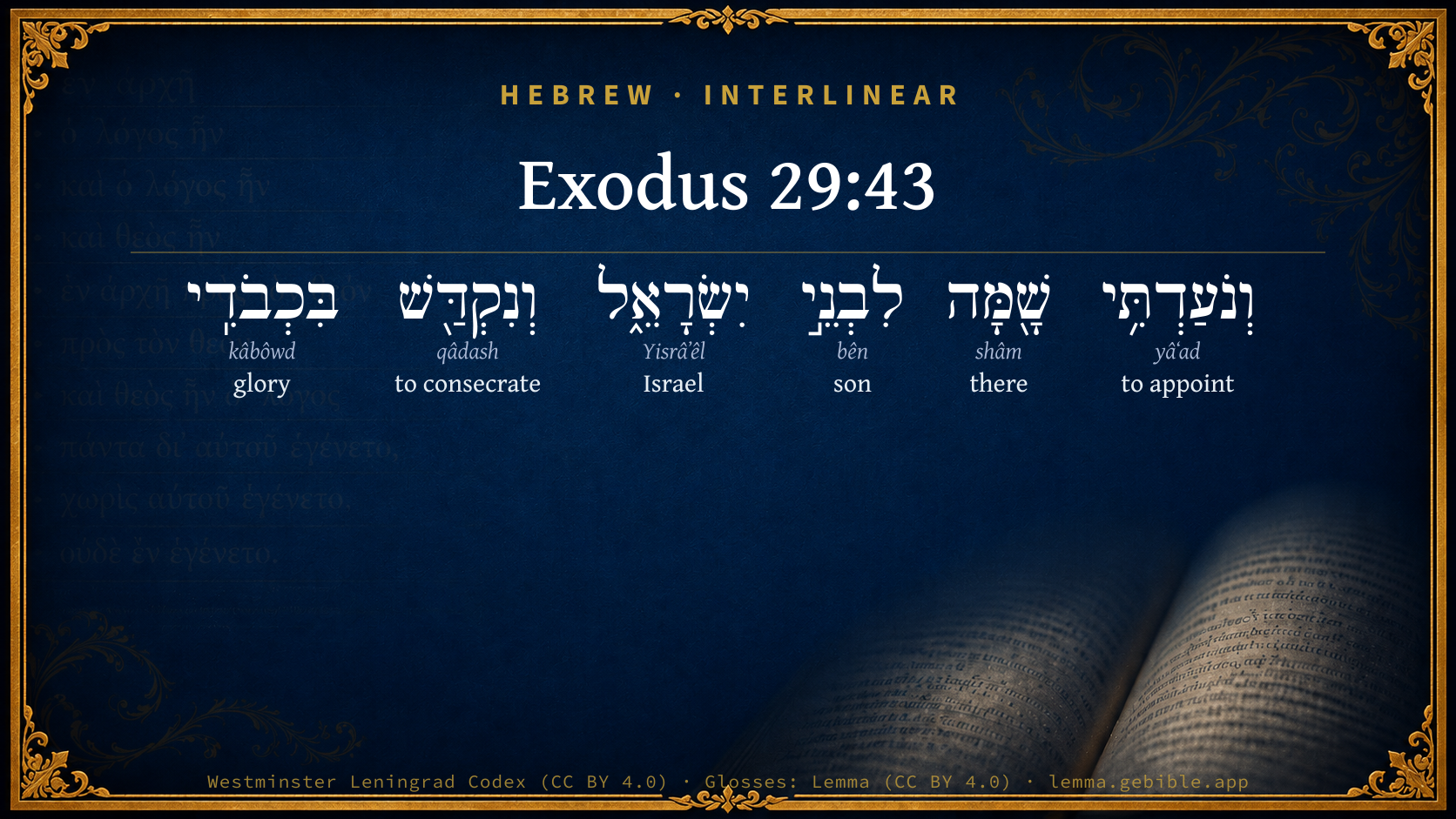
Exodus 29:43

Hebrew (Westminster Leningrad Codex) Exodus 29:43 appears in the Hebrew Old Testament. The text above is from the Westminster Leningrad Codex. Each word links to its Strong’s number, a concise gloss, and parsing drawn from the Open Scriptures Hebrew Bible morphology. Click any word for its full Brown-Driver-Briggs (BDB) entry.
Download image
Cite this verse

Exodus 29:43 (World English Bible). Public Domain. Lemma interlinear Bible study tool, https://lemma.gebible.app/v/exodus/29/43.

Show BibTeX & RIS
BibTeX
RIS
English Translation
There I will meet with the children of Israel; and the place shall be sanctified by my glory.
World English Bible · Public Domain
Download a study sheet

One document with this verse’s original text, its word-by-word gloss line, the meaning frame, cross-references with their text, attributed commentary, and full source and license credits — printable, and it pastes into notes with its structure intact.

This verse Autodidact and up

Study sheet (.html) Plain text (.txt)

A passage Seminary Student

Up to 50 verses in one chapter. A passage sheet keeps up to 6 commentary sources and 12 cross-references per verse, in the order this page ranks them, and says so on the sheet whenever that leaves anything out. Ask for a single verse and you get the Autodidact verse sheet above.

Everything on this page stays free to read, with no account — the sheet is a download of what is already on screen, not access to it.

Want to remove ads? Support Godless Engineer
Compare translations 3

The same verse in 3 English versions, stacked beneath the original-language interlinear above. Click any original word for its lexicon entry.

Each is an independent rendering of the whole verse — the interlinear is not word-aligned to these translations.

Highlighted words mark where these versions differ — a whole-verse word diff, not a word-by-word alignment.

  • World English Bible Public Domain
    There I will meet with the children of Israel; and the place shall be sanctified by my glory.
  • King James Version Public Domain
    And there I will meet with the children of Israel, and the tabernacle shall be sanctified by my glory.
  • unfoldingWord Literal Text CC BY-SA 4.0
    And I will meet with the sons of Israel there, and it will be set apart by my glory.

unfoldingWord Literal Text — © unfoldingWord, licensed CC BY-SA 4.0. Word-aligned USFM3 via Door43 (git.door43.org/unfoldingWord/en_ult).

Versions to compare (up to 4)

3 of 4 selected

Show all 18 translations

Every available English version of this verse, each an independent rendering of the whole verse.

  • World English Bible Public Domain
    There I will meet with the children of Israel; and the place shall be sanctified by my glory.
  • Berean Standard Bible Public Domain
    I will also meet with the Israelites there, and that place will be consecrated by My glory.
  • Majority Standard Bible Public Domain
    I will also meet with the Israelites there, and that place will be consecrated by My glory.
  • King James Version Public Domain
    And there I will meet with the children of Israel, and the tabernacle shall be sanctified by my glory.
  • American Standard Version (1901) Public Domain
    And there I will meet with the children of Israel; and `the Tent' shall be sanctified by my glory.
  • Revised Version (1885) Public Domain
    And there I will meet with the children of Israel; and the Tent shall be sanctified by my glory.
  • Geneva Bible (1599) Public Domain
    There I will appoynt with the children of Israel, and the place shall bee sanctified by my glorie.
  • Douay-Rheims (1899) Public Domain
    And there will I command the children of Israel, and the altar shall be sanctified by my glory.
  • Young's Literal Translation Public Domain
    and I have met there with the sons of Israel, and it hath been sanctified by My honour.
  • Literal Standard Version CC BY-SA 4.0
    and I have met with the sons of Israel there, and it has been sanctified by My glory.
  • Unlocked Literal Bible CC BY-SA 4.0
    That is where I will meet with the Israelites; the tent will be set apart for me by my glory.
  • unfoldingWord Literal Text CC BY-SA 4.0
    And I will meet with the sons of Israel there, and it will be set apart by my glory.
  • Darby Bible Public Domain
    And there will I meet with the children of Israel; and it shall be hallowed by my glory.
  • World Messianic Bible Public Domain
    There I will meet with the children of Israel; and the place shall be sanctified by my glory.
  • Webster's Bible Public Domain
    And there I will meet with the children of Israel, and the tabernacle shall be sanctified by my glory.
  • Free Bible Version CC BY-SA 4.0
    I will meet with the Israelites there, and that place will be made holy by my glory.
  • Bible in Basic English Public Domain
    There I will come face to face with the children of Israel, and the Tent will be made holy by my glory
  • JPS Tanakh (1917) Public Domain
    And there I will meet with the children of Israel; and the Tent shall be sanctified by My glory.

Literal Standard Version (2020), Covenant Press — licensed CC BY-SA 4.0. Text via the HelloAO Bible API (eBible.org). Unlocked Literal Bible (unfoldingWord) — licensed CC BY-SA 4.0. Text via the HelloAO Bible API (eBible.org). unfoldingWord Literal Text — © unfoldingWord, licensed CC BY-SA 4.0. Word-aligned USFM3 via Door43 (git.door43.org/unfoldingWord/en_ult). Free Bible Version, Dr. Jonathan Gallagher — licensed CC BY-SA 4.0. Text via the HelloAO Bible API (eBible.org).

Word by word

More ways to search: Search by grammar → Find every occurrence → Compare this word →

Practice this passage: Drill this verse → Learn its vocabulary →

וְנֹעַדְתִּ֥י
yâʻad
H3259
“and · to appoint”
Conjunction + Verb, Niphal, Sequential Perfect, 1st Person, Common, Singular
Part of Speech
Conjunction + Verb
Stem
Niphal
Form
Sequential Perfect
Person
1st Person
Gender
Common
Number
Singular
Full BDB Definition

Origin: a primitive root

TWOT: 878

to fix, appoint, assemble, meet, set, betroth - (Qal) to appoint, assign, designate - (Niphal) - to meet - to meet by appointment - to gather, assemble by appointment - (Hiphil) to cause to meet - (Hophal) to be set, be placed before, be fixed
  1. שָׁ֖מָּה shâm H8033 “there · toward” Adverb + Suffix, Demonstrative
  2. לִבְנֵ֣י bên H1121 “to/for · sons of” Preposition + Noun, Common, Masculine, Plural, Construct
  3. יִשְׂרָאֵ֑ל Yisrâʼêl H3478 “Israel” Noun, Proper
  4. וְנִקְדַּ֖שׁ qâdash H6942 “and · to consecrate” Conjunction + Verb, Niphal, Sequential Perfect, 3rd Person, Masculine, Singular
  5. בִּכְבֹדִֽי kâbôwd H3519 “in/at · glory · my” Preposition + Noun, Common, Both, Singular, Construct + Suffix, Personal, 1st Person, Common, Singular

About this verse

These counts appear in no published source. They are computed here, from the morphology-tagged text and Lemma’s own curated glosses. What Lemma adds →

6
words
6
distinct lemmas
Pentateuch
section

Shared distinctive vocabulary

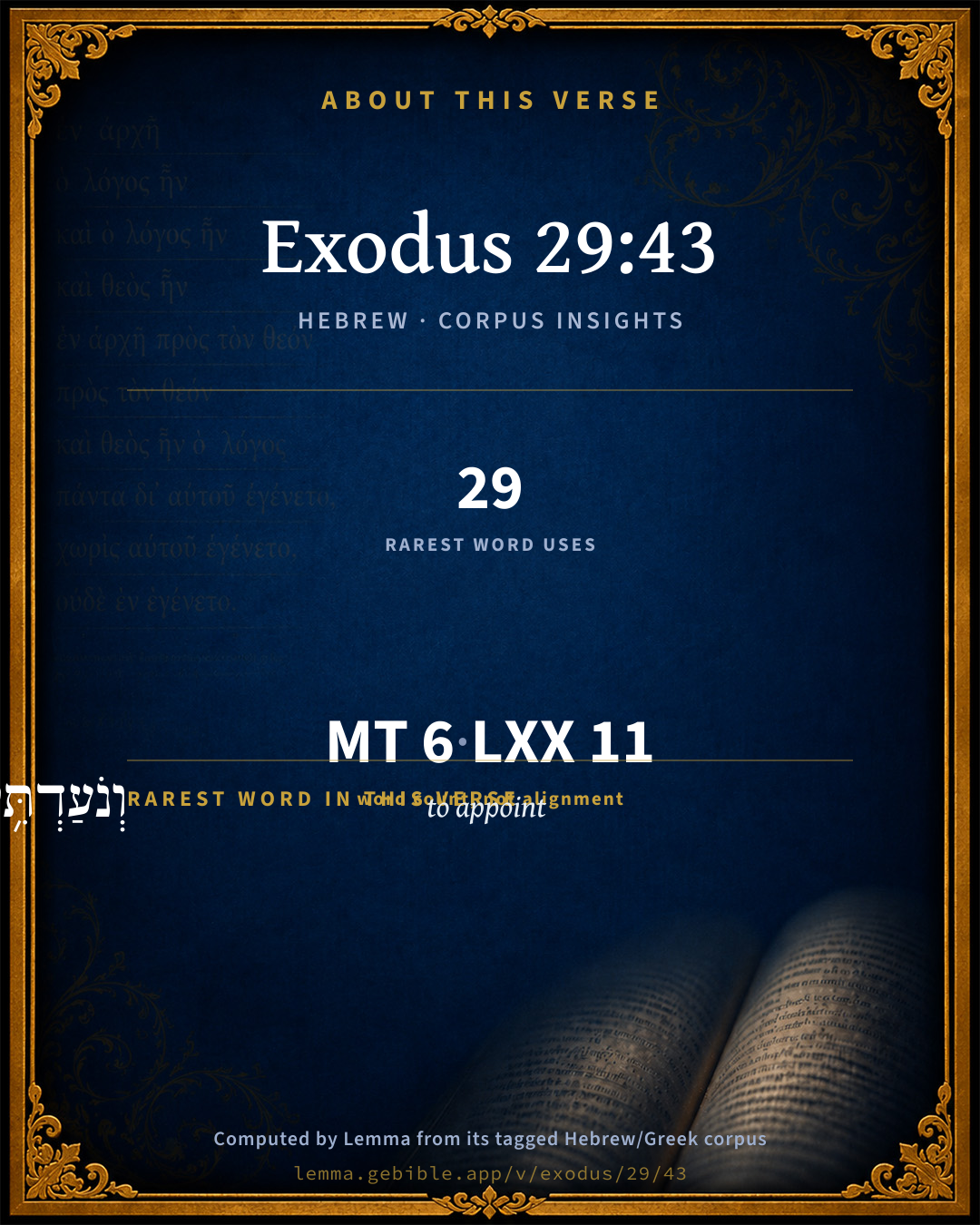
וְנֹעַדְתִּ֥י to appoint H3259 occurs in 29 verses of the Hebrew Bible. Also found in:

Grammatical profile

  • 2 verbs
  • 3 nouns
  • 1 adverb

Verb forms

  • וְנֹעַדְתִּ֥י Niphal · Sequential Perfect
  • וְנִקְדַּ֖שׁ Niphal · Sequential Perfect

Hebrew & Septuagint length

In English translation the verse runs 18 words from the Hebrew and 19 from the Septuagint (LXX English) — closely comparable.

A rough comparison of the two English renderings, which tokenize alike — not a word-level alignment.

Word counts can differ between the Hebrew and the Greek without any difference in meaning — e.g. the Hebrew direct-object marker אֵת has no separate Greek word, and Greek often adds the article ὁ.

In the original languages it is 6 Hebrew tokens and 11 Greek tokens — but the two are counted differently (Hebrew bundles its prefixes and suffixes into one token; the Greek is in lemma form), so that isn’t a like-for-like length.

Cross-references

13

Topical passages linked to Exodus 29:43 in the Treasury of Scripture Knowledge — connected by theme and wording, ordered by reader-vote popularity; previews shown in the World English Bible.

  • 1 Kings 8:11 so that the priests could not stand to minister by reason of the cloud; for the glory of Yahweh filled the house of Yahweh.
  • Exodus 40:34 Then the cloud covered the tent of meeting, and the glory of Yahweh filled the tent.
  • 2 Chronicles 5:14 so that the priests could not stand to minister by reason of the cloud: for the glory of Yahweh filled the house of God.
  • 2 Chronicles 7:1–3 Now when Solomon had made an end of praying, the fire came down from heaven, and consumed the burnt offering and the sacrifices; and the glory of Yahweh filled the house.
  • Ezekiel 43:5 The Spirit took me up, and brought me into the inner court; and, behold, the glory of Yahweh filled the house.
  • Malachi 3:1 "Behold, I send my messenger, and he will prepare the way before me; and the Lord, whom you seek, will suddenly come to his temple; and the messenger of the covenant, whom you desire, behold, he comes!" says Yahweh of hosts.
  • Isaiah 6:1–3 In the year that king Uzziah died, I saw the Lord sitting on a throne, high and lifted up; and his train filled the temple.
  • Isaiah 60:1 Arise, shine; for your light is come, and the glory of Yahweh is risen on you.
  • Haggai 2:7–9 and I will shake all nations. The precious things of all nations will come, and I will fill this house with glory, says Yahweh of Hosts.
  • 2 Corinthians 3:18 But we all, with unveiled face beholding as in a mirror the glory of the Lord, are transformed into the same image from glory to glory, even as from the Lord, the Spirit.
  • 2 Corinthians 4:6 seeing it is God who said, "Light will shine out of darkness," who has shone in our hearts, to give the light of the knowledge of the glory of God in the face of Jesus Christ.
  • 1 John 3:2 Beloved, now we are children of God, and it is not yet revealed what we will be. But we know that, when he is revealed, we will be like him; for we will see him just as he is.
  • Revelation 21:22–23 I saw no temple in it, for the Lord God, the Almighty, and the Lamb, are its temple.

Cross-references courtesy of OpenBible.info (CC BY 4.0).

Hebrew and Greek witnesses Masoretic Hebrew ↔ Greek Septuagint

The same verse in the two great witnesses to the Old Testament, shown verse-for-verse.

These are two independent witnesses, not word-aligned to each other, and the Septuagint is shown in lemma (dictionary) form.

Hebrew Exodus 29:43 Masoretic · Westminster Leningrad Codex

וְנֹעַדְתִּ֥י שָׁ֖מָּה לִבְנֵ֣י יִשְׂרָאֵ֑ל וְנִקְדַּ֖שׁ בִּכְבֹדִֽי

There I will meet with the children of Israel; and the place shall be sanctified by my glory.

World English Bible · Public Domain

Greek LXX Exodus 29:43 Septuagint · lemma form

καί τάσσω ἐκεῖ ὁ υἱός ἰσραήλ καί ἁγιάζω ἐν δόξα ἐγώ

And I will there give orders to the children of Israel, and I will be sanctified in my glory.

LXX2012 (modern English Septuagint) · Public Domain

Hebrew: Westminster Leningrad Codex (CC BY 4.0). Greek: Septuagint (public domain); English from LXX2012 (modern English Septuagint) (Public Domain). How the Septuagint differs from the Hebrew →

Targum (Aramaic paraphrase)

2

The Targum is the ancient Jewish Aramaic paraphrase of the Hebrew Scriptures — an interpretive translation, not the Hebrew text itself. Onkelos (literal) and Pseudo-Jonathan (expansive) render the Torah, and Jonathan the Prophets. Coverage is partial: where no permissively-licensed English translation exists for a verse, only the Aramaic is shown. This is verse-level text, not a word-by-word alignment to the Hebrew.

  1. Targum Onkelos Torah (Genesis–Deuteronomy)
    וֶאֱזַמֵן מֵימְרִי תַמָן לִבְנֵי יִשְׂרָאֵל וְיִתְקַדַשׁ בִּיקָרִי:

    (no public-domain English translation for this verse)

    Targum Onkelos — Aramaic: “Onkelos Genesis” (public domain); “Onkelos Exodus” (public domain); “Onkelos Leviticus” (public domain); “Onkelos Numbers” (public domain); “Onkelos Deuteronomy” (public domain). English: “Sefaria Community Translation” (CC0 1.0 (public-domain dedication)); “J.W. Etheridge. The Targums of Onkelos and Jonathan Ben Uzziel on the Pentateuch. London: Longmans, Green, 1862” (public domain). Text via Sefaria.

  2. Targum Pseudo-Jonathan Torah (Genesis–Deuteronomy)
    וְאֵיזַמֵן מֵימְרִי תַמָּן לִבְנֵי יִשְרָאֵל וְאֵקַדֵשׁ בְּרַבָּנֵיהוֹן בְּגִין יְקָרִי

    And there I will appoint My Word (to meet) with the sons of Israel, and I will be sanctified in their rulers for My glory.

    Targum Pseudo-Jonathan — Aramaic: “Targum Jonathan on Genesis” (public domain); “Targum Jonathan on Exodus” (public domain); “Targum Jonathan on Leviticus” (public domain); “Targum Jonathan on Numbers” (public domain); “Targum Jonathan on Deuteronomy” (public domain). English: “The Targum of Jonathan ben Uzziel, trans. J. W. Etheridge, London, 1862” (public domain). Text via Sefaria.

Commentary

Notes on Exodus 29:43 from classic Christian and Jewish commentators (each source and its license shown beneath its notes). The classic Christian expositions comment on the surrounding passage and are grouped to its opening verse, so a note may address several verses; the Jewish commentaries on the Tanakh (Rashi and others) are per-verse, so they appear only where the commentator wrote on this verse.

Lemma curates 59 commentaries, every one of them public domain or Creative Commons licensed, each selected and text-cleaned for this edition rather than reprinted as found. About our sources →

Trapp's Complete Commentary

John Trapp

Exo 29:43 And there I will meet with the children of Israel, and [the tabernacle] shall be sanctified by my glory.

Ver. 43. And I will dwell.] {See Trapp on "2Co 6:16"}

John Trapp, A Commentary or Exposition upon All the Books of the Old and New Testament (1647–1656) — public domain. Text from a community e-Sword module.

Joseph Benson's Commentary

Exo 29:43-44. There I will meet with the children of Israel — I will make this tabernacle the seat of my cloud of glory, which will be the symbol of my divine presence, and from thence I will give frequent discoveries of my will, and tokens of my favour toward them. The tabernacle of the congregation — אהל מועדohel mogned, the tabernacle of meeting, so called because there God and his people met together. I will sanctify Aaron and his sons — God sanctified, set them apart, and marked them out to be his priests in a solemn manner by the appearance of his glory at their first sacrifice, and by sending fire from heaven to consume their burnt-offering, Lev 9:23-24.

Joseph Benson's Commentary on the Old and New Testaments (1811–1818) — public domain. Text from a community e-Sword module.

Geneva Bible (1599)

Geneva Bible translators

Because of my glorious presence.

Geneva Bible (1599) marginal notes — public domain. Text via Bolls.life.

Adam Clarke's Commentary

Verse 43. There I will meet with the children of Israel] See Clarke on Ex 25:22.

Adam Clarke's Commentary on the Bible (1810–1826) — public domain. Text from a community e-Sword/MySword module.

Ellicott's Commentary for English Readers

(43) The tabernacle shall be sanctified by my glory.—See Exo_40:34-35; and comp. Lev_9:24; 1Ki_8:10-11; 2Ch_5:13-14; 2Ch_7:2.

A Bible Commentary for English Readers, edited by Charles John Ellicott (1878–1897) — public domain. Text from a community e-Sword module.

The Cambridge Bible for Schools and Colleges

gen. ed. J. J. S. Perowne

43. And I will meet there] There is no emph. on ‘there’ in the Heb. In its probable original context (see on vv. 38–42), at the altar.

the Tent] Heb. it, i.e., in its probable original context, the altar.

by my glory] When He enters it in His glory: see Exo_40:34 f.; and cf. on Exo_16:10. Tent, altar, and priests (v. 44) will alike be hallowed by the power of Jehovah’s sanctifying presence.

43–46. Conclusion to the whole body of directions (chs. 25–29). In the sanctuary thus erected, Jehovah will appear in His glory; and dwell permanently in the midst of His people. The purpose of its construction, as laid down in Exo_25:8, is thus accomplished.

The Cambridge Bible for Schools and Colleges (gen. ed. J. J. S. Perowne; Cambridge University Press, 1878–1918) — public domain. Text from a community e-Sword module.

John Gill's Exposition

And there will I meet with the children of Israel,.... Not only with Moses or with Aaron, and his successors, but with the people themselves, by granting them his gracious presence in public ordinances, giving them tokens of his goodwill unto them, and of his acceptance of their offerings, hearing their prayers put up by themselves, or by the priest interceding for them, and receiving their thanksgivings for mercies bestowed, and giving them instructions by the mouth of his priests:

and the tabernacle shall be sanctified by my glory; by his Shechinah, or the glory of the divine Majesty, dwelling in it; or it may be supplied, the children of Israel shall be sanctified; set apart and distinguished by his glorious presence among them; the Targum of Jonathan is,"I will be sanctified in or by their princes, because of my glory.''

John Gill's Exposition of the Whole Bible (1746–1763) — public domain (CC PDM 1.0). Text via the HelloAO Bible API.

Haydock's Catholic Bible Commentary

Glory, or presence, or by the flame which shall come down from heaven to consume the victim, Leviticus ix. 24. (Calmet)

George Leo Haydock (1774–1849), Haydock's Catholic Family Bible and Commentary, 1859 edition — public domain. Excludes Psalms (Douay-Rheims chapter numbering differs from Protestant) and Deuterocanonical books (Catholic canon only).

Matthew Poole's English Annotations

i.e. By my glorious presence and appearance, of which see Exo 40:34,35; Le 9:24.

Matthew Poole's English Annotations on the Holy Bible (1683–1685) — public domain. Text from a community e-Sword/MySword module.

Whedon's Commentary on the Bible

Daniel D. Whedon

43. There I will meet — Here is enunciated the main thought that underlies all the symbolism of the tabernacle and its holy services. It was the visible sanctuary, where Jehovah signified the conditions on which it was possible for him to dwell with man, and permit man to dwell with him. The sanctification of Israel was to be secured through these consecrated forms of mediation, and was the highest ideal revealed amid the symbols. For what is it that shall be sanctified by my glory? Not the tabernacle or tent, as both the Authorized Version and the Revised Version supply in the text, nor the altar, as others have supposed; for both these are expressly named in the next verse as a distinct conception; but the children of Israel just mentioned, here conceived as a unit, and hence the use of the verb in the singular number. Israel is to be sanctified by meeting with Jehovah, and thus entering into the divine glory by the means ordained for that very end.

Daniel D. Whedon (gen. ed.), Commentary on the Old and New Testaments (1874–1909) — public domain. Text from a community e-Sword module.

The Pulpit Commentary

Vers. 43-46. GOD"S PROMISES. The chapter terminates with a parenthetic insertion of various promises, intended to cheer the Israelites under the hard circumstances of their wanderings in the wilderness, and growing out of the mention of the tabernacle as "the tabernacle of meeting" (ver. 42). "There," says God, "He will meet, not only Moses, to speak to him, but also the children of Israel, to receive their offerings, hear their prayers, and grant their requests. There will he meet them, and there his glory shall be; and the tabernacle shall be thereby sanctified. He will sanctify both the tabernacle and the altar; he will sanctify, moreover, both Aaron and his sons; and he will dwell among the children of Israel, and be their God; and they shall know him." Very precious and gracious promises, made absolutely; though, as the result showed, (2Ch_36:14-18) contingent on their obedience; and faithfully performed, as long as even a remnant was obedient, during a space of above seven hundred years from the Exodus to the Captivity!

There will I meet the children of Israel. Lay Israelites might not enter the tabernacle, and could only "meet God" at its entrance, when they brought their sacrifices to the altar. He promises, however, to meet them on these occasions with favour and. acceptance. The tabernacle shall be sanctified by my glory. Compare Exo_40:34. The presence of the Shechinah was the true sanctification of the tabernacle all the rest was mere type and figure. God not only "put his name there," but put his presence there visibly.

Vers. 43-46. God"s promises to Israel.

Here we may note

I THE DIVINE GOODNESS AS SHOWN IN THE MAKING OF PROMISES, Man has no claim upon his Maker. Our "goodness extendeth not to him." So far forth as we "do him true and laudable service," we are "unprofitable servants we have done that which was our duty to do". (Luk_17:10) But how little of such service is rendered! How great are our shortcomings! How many our "sins, negligences, and ignorances!" How little do we deserve anything but evil at God"s hand! And yet, he not only bears with us, but makes us gracious promises. He binds himself to us beforehand by express engagements he pledges his own sacred word to bestow upon us divers blessings. Here he promised Israel five things

1. The sanctification of the tabernacle by the Shechinah;

2. The sanctification of the altar;

3. Holiness in Aaron and his sons;

4. His own permanent abiding presence with them as their God; and

5. Their own recognition of him as their Lord God

the deliverer who brought them out of Egypt the eternal JehovahEloheyhem. And to Christians he has promised far more pardon, redemption, acceptance, sanctification by the Holy Spirit, eternal life! Utterly unworthy as we are, these promises have been made to us. God"s infinite goodness has caused him to condescend to enter into covenant with his creatures; and the promises which he has made to us, "he for his part will most surely keep and perform.

II THE DIVINE FAITHFULNESS, AS SHOWN IN THE FULFILMENT OF THE PROMISES MADE.

(1) The sanctification of the tabernacle was effected by the entrance into it of the Shechinah; (Exo_40:34)

(2) That of the altar by the fire which "came out from before the Lord"; (Lev_9:24)

(3) Aaron and his sons were sanctified to the effectual performance of all their ministerial acts, and were further personally sanctified, so far as their own wills would permit;

(4) God did abide with his people Israel, notwithstanding all their shortcomings, for at least seven centuries; defended them from their enemies; taught them by his prophets; made them a praise and a wonder among the nations. And, on the whole,

(5) notwithstanding occasional defections, Israel did recognise Jehovah as their God, did maintain his worship, did observe his laws, did believe that he dwelt among them, and was "the Lord their God." Shall we think that to us he will be less faithful? Shall we doubt that he will give to us the covenanted blessings pardon, and redemption, and acceptance, and sanctification, and eternal life? Surely, "God is not a man that he should lie, or the son of man that he should repent." He is "the faithful and the true". (Rev_19:11) He never broke a promise. All to which he is pledged he will most assuredly perform, if we only are not wanting on our part.

HOMILIES BY J. ORR Vers. 43-46. Israel sanctified by God"s presence.

1. Three grades of sanctification.

1. By blood.

2. Unction of the Spirit.

3. Personal Divine indwelling.

2. God"s dwelling with Israel sanctifies

1. the tabernacle;

2. his servants;

3. the whole people. J.O.

The Pulpit Commentary (1880–1919), ed. H.D.M. Spence-Jones & Joseph S. Exell — public domain. Text from a community e-Sword module.

unfoldingWord translationNotes

Door43 World Missions Community

General Information:

Yahweh continues speaking to Moses.

the tent will be set apart for me by my glory

This can be stated in active form. AT: "My awesome presence will dedicate the tent to me" (See: Active or Passive)

translationWords

Israel

tent of meeting

set apart

glory

set apart

altar

Aaron

servant

priest

unfoldingWord translationNotes — © Distant Shores Media and the Door43 World Missions Community, licensed CC BY-SA 4.0. Source: git.door43.org/Door43/en_tn.

Rashi

Rabbi Shlomo Yitzchaki (Rashi)

ונעדתי שמה AND I WILL BE MET THERE — I will come together with them in a conversation as a king who appoints a place of meeting where he will speak with his subjects.

ונקדש AND IT — the Tabernacle — SHALL BE SANCTIFIED,

בכבדי BY MY GLORY — for my Shechina shall rest there. A Midrashic comment is: Read not here בִּכְבוֹדִי “by My Glory”, but בִּכְבוּדַי, “through My honoured ones”. Here He gave him some slight intimation of the death of Aaron’s sons on the day when it (the Tabernacle) would be erected. This is the meaning of what Moses then said, (Leviticus 10:3) “That is what the Lord said, Through those that draw near to Me will I be sanctified”. But where had he said this? Here, in the words, “and it shall be sanctified through My honoured ones” (Zevachim 115b).

Rashi on the Tanakh — English translations: “The Judaica Press complete Tanach with Rashi, translated by A. J. Rosenberg” (CC BY 4.0); “Pentateuch with Rashi's commentary by M. Rosenbaum and A.M. Silbermann, 1929-1934” (public domain); “The Metsudah Tanach series, Lakewood, N.J” (CC BY 4.0); and “The Book of Joshua, Metsudah Publications, 1997” (CC BY 4.0). Text via Sefaria.

Lesson kit

Teaching starters — assembled from the data on this page, not authored interpretation. Every prompt links to the verse data it draws on. Edit before teaching.

Exodus, in the Pentateuch, opens this verse with 6 words (6 distinct Hebrew lemmas). Its most distinctive word is yâʻad (“to appoint”). A historical commentator’s framing appears above. Read the whole chapter for the surrounding context.

Discussion questions

  1. How does “to appoint” (yâʻad) shape what this verse is saying?
  2. Exodus 21:8 shares the word «to appoint» with this verse. How do the two illuminate each other?
  3. The translations on this page render this verse differently — a whole-verse word diff, not a word-by-word alignment. What might account for the different wordings?
  4. The verb «וְנֹעַדְתִּ֥י» is Niphal Sequential Perfect. How does its form color the action?
  5. Reading how Trapp's Complete Commentary and Joseph Benson's Commentary read this verse, where do the two commentators agree and where do they part?

Things to notice

Reading settings

Reading text

Shown beneath each verse's original-language words.

Old Testament
Old Testament edition

Read the OT as the Masoretic Hebrew (MT) or the Greek Septuagint (LXX).

English shown for the Greek Septuagint (in the Hebrew ↔ Greek comparison).

Comparing translations? Open the Compare panel on any verse page to stack up to four side by side.