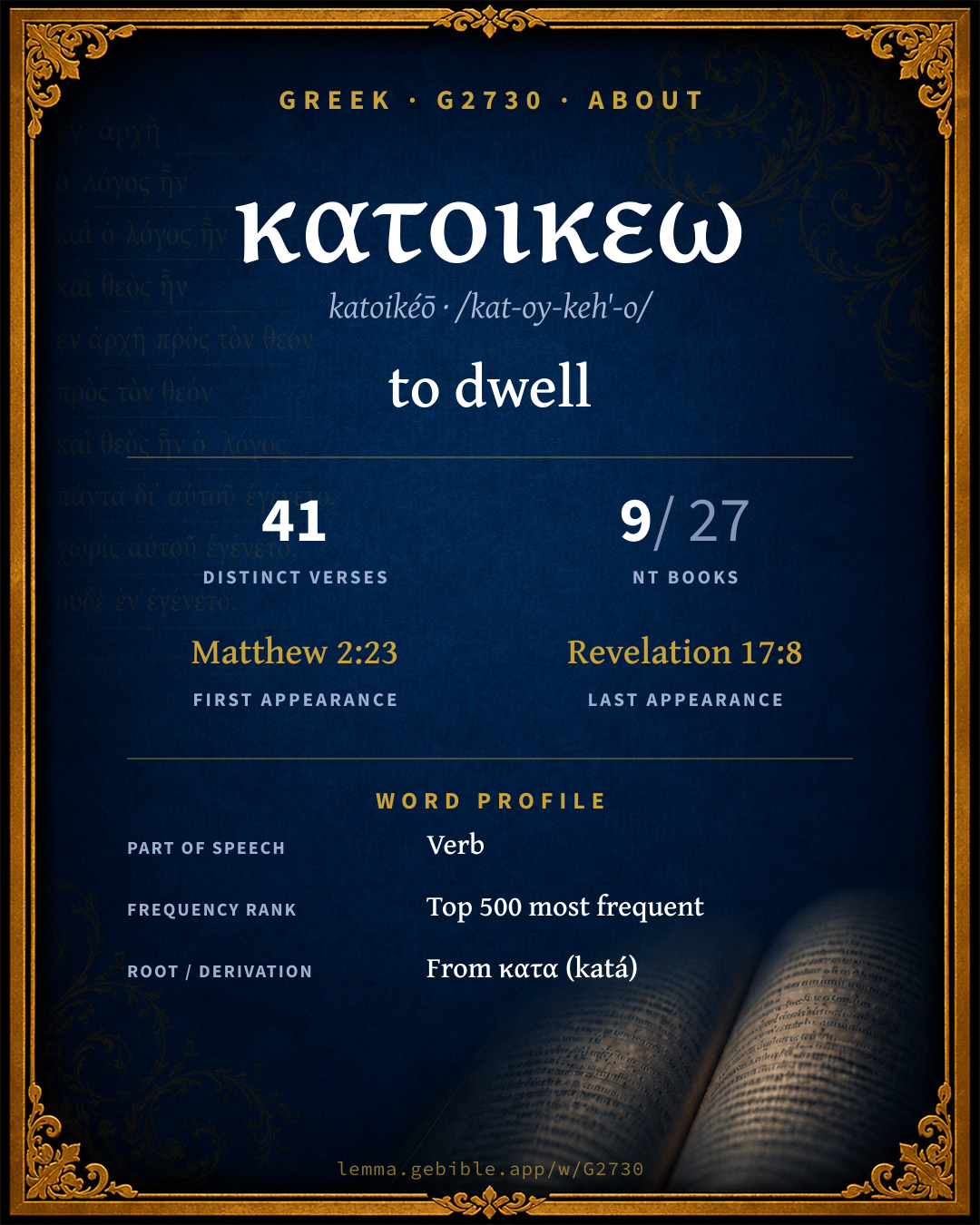
κατοικέω
to dwell
‘to dwell’ is one of 2 main senses fuller range ↓
Full lexicon entry — Thayer's Greek Lexicon
From Thayer's Greek Lexicon
Where this word appears
Grammar key — what these labels mean
Part of speech
- Verb
- An action or state-of-being word.
Tense
- Present
- Ongoing or general action in present time (imperfective aspect).
- Aorist
- Action viewed as a simple whole, without regard to duration — often past (perfective aspect).
Voice
- Active
- The subject performs the action.
Mood
- Participle
- A verbal adjective (“writing,” “having written”).
- Indicative
- States a fact or asks a factual question (the mood of reality).
- Infinitive
- A verbal noun (“to write”), unmarked for person or number.
Case
- Accusative
- The case of the direct object and of extent.
- Nominative
- The case of the subject (and the predicate nominative).
- Dative
- The case of the indirect object, means, or location — “to / for / with / in.”
- Genitive
- The case of source, possession, or “of” — answers “whose / from what.”
Person
- 3rd person
- The one spoken about (“he / she / it / they”).
- 2nd person
- The one addressed (“you”).
Gender
- Masculine
- Grammatically masculine.
Number
- Plural
- More than one.
- Singular
- One.
Every verse where G2730 appears in the Book of James — 1 distinct verse. Click any verse to open its interlinear word-by-word view. Verse text shown in the World English Bible for context — . Each verse’s Greek form is shown with its reference; the English is not keyword-highlighted, since the data carries no word-level English alignment. Use “Compare translations” on any verse to read it across multiple English versions. This concordance covers the Greek New Testament; Septuagint (Greek Old Testament) occurrences of this word are not indexed here.
James
About this entry
At a glance — auto-summarized from this page’s data, not written by a person. Every figure links to its source below. This summary describes the numbers; it doesn’t interpret them.
κατοικεω — transliterated katoikéō — is a Greek verb carrying the sense “to dwell.” Its English rendering has broadened — “dwell” classically, “living” (unfoldingWord Literal Text) in modern versions; see the renderings breakdown. The Greek New Testament uses it across 41 verses — moderately common. More than a third of its appearances fall in Acts. Its lexical range runs to 2 senses. See the sense tree, 41-verse concordance, and the renderings breakdown below.
Gloss history
Strong's 1890 vs modern scholarship
About this word
Strong's G2730 catalogs a Greek word from the Greek New Testament.
These counts are not copied from any lexicon or concordance. They are computed here, from the morphology-tagged Greek New Testament. What Lemma adds →
- 41
- distinct verses
- The word appears in 41 distinct verses.
- 9 / 27
- NT books
- The word appears in 9 of 27 New Testament books.
- #337
- by frequency
- Top 500 most frequent Greek words (rank 337 of 5,347 Greek words by occurrence).
View all 41 occurrences in the concordance →
Most concentrated in
- Acts 19 verses 46%
- Revelation 10 verses 24%
- Matthew 4 verses 10%
By section of the New Testament
By traditional corpus
Conventional, traditional groupings — biblical authorship is debated, so this is a traditional corpus grouping, not an authorship claim. Some books belong to more than one corpus (Luke is in both the Gospels and the Lukan corpus, and so on), so these shares overlap and need not total 100%. Each figure is a share of the word’s 41 distinct verses.
- Lukan (Luke–Acts) 21 verses · 51%
- Johannine 10 verses · 24%
- Revelation 10 verses · 24%
- Gospels 6 verses · 15%
- Pauline corpus 3 verses · 7%
- General (Catholic) Epistles 2 verses · 5%
- Hebrews 1 verse · 2%
How translations render this word
Counts come from each version’s own published word-to-Strong’s tagging or interlinear alignment — an approximate guide to how each version renders this word, not a word-level alignment the data otherwise carries. Because each total is that version’s own tagged count, the per-version totals vary from one another and need not match the appearance or distinct-verse counts above. These counts may also differ from a printed concordance because Lemma counts each distinctly tagged rendering and does not collapse phrase taggings into a single head-word total. This is a fixed set of word-tagged versions (KJV, ASV, BSB, ULT) and does not change with the reading translation you choose elsewhere. Each version’s license is shown beside its name below (and on Sources).
- King James Version: Dwell 14×, Dwelt 11×, Dwelleth 7×
- American Standard Version: Dwell 17×, Dwelt 10×, Dwelleth 5×
- Berean Standard Bible: Dwell 15×, Living 6×, Lived 5×
- unfoldingWord Literal Text: Living 10×, Ones living 10×, Inhabiting 4×
King James Version Public Domain
Renders G2730 across 48 tagged occurrences — most commonly:
Plus 6 renderings that appear only once — usually multi-word phrases or single function words the recovered tagging swept in, not distinct renderings.
American Standard Version Public Domain
Renders G2730 across 48 tagged occurrences — most commonly:
Plus 11 renderings that appear only once — usually multi-word phrases or single function words the recovered tagging swept in, not distinct renderings.
Berean Standard Bible Public Domain
Renders G2730 across 41 tagged occurrences — most commonly:
Plus 11 renderings that appear only once — usually multi-word phrases or single function words the recovered tagging swept in, not distinct renderings. Not rendered by a distinct English word in 2 further occurrences.
unfoldingWord Literal Text CC BY-SA 4.0
Renders G2730 across 48 tagged occurrences — most commonly:
Plus 11 renderings that appear only once — usually multi-word phrases or single function words the recovered tagging swept in, not distinct renderings.
Senses in Thayer's
The 2 senses Thayer's distinguishes for this word, in lexicon order (not ranked by frequency or importance). The full entry — with sub-senses — is in the Lexicon Entry tab.
- metaph. divine powers, influences, etc., are said to dwell in his soul, to pervade, prompt, govern it
- God is said to dwell in the temple, i.e. to be always present for worshippers
Word origin
Derived from κατα (katá) (G2596) — down.
Forms in the corpus
The 14 distinct written forms G2730 takes in the Greek New Testament, most frequent first — each parse links to that tense’s occurrences in the concordance.
Same root — word family
Other Thayer's entries built from the same root as G2730, grouped by Strong’s listed origin. These share a root / origin per the lexicon — not necessarily a shared meaning. Each links to that word’s own entry.
Derives from
Shares the same root
- καθα kathá G2505 according as
- καθαιρεω kathairéō G2507 to tear down
- καθαπτω katháptō G2510 to fasten down
- καθεδρα kathédra G2515 seat
- καθεζομαι kathézomai G2516 to sit down
- καθεξης kathexēs G2517 in order
- καθευδω katheúdō G2518 to fall asleep
- καθηγητης kathēgētḗs G2519 guide
- καθηκω kathḗkō G2520 to come down
- καθημαι káthēmai G2521 to sit down
- καθημερινος kathēmerinós G2522 daily
- καθιημι kathíēmi G2524 to send down
- καθιστημι kathístēmi G2525 to place
- καθο kathó G2526 according to what
- καθολου kathólou G2527 wholly
- καθοπλιζω kathoplízō G2528 to arm
- καθοραω kathoráō G2529 to see clearly
- καθοτι kathóti G2530 according to what
- καθως kathṓs G2531 according as
- καμμυω kammýō G2576 to close eyes
- καταβαινω katabaínō G2597 to descend
- καταβαλλω katabállō G2598 to cast down
- καταβαρεω katabaréō G2599 to weigh down
- καταβιβαζω katabibázō G2601 to bring down
+103 more words share this root (not shown).
Derived from this word
Compare all same-root words → Showing 4 of 131 — not the complete family. They share a root, not necessarily a meaning.
Septuagint usage
The same Greek word κατοικεω appears 567 times in the Greek Old Testament (Septuagint), across 509 verses in 33 books.
- 567
- LXX occurrences
- Tagged occurrences of this Greek word in the Septuagint.
- 509
- verses
- Distinct Septuagint verses containing this word.
- 33 / 39
- OT books
- The word appears in 33 of the 39 Old Testament books.
Sample Septuagint occurrences
- Genesis 9:27 καταοἰκέω
- Exodus 12:40 καταοἰκέω
- Leviticus 18:3 καταοἰκέω
- Numbers 13:19 καταοἰκέω
- Deuteronomy 1:4 καταοἰκέω
- Joshua 1:14 καταοἰκέω
- Judges 1:9 καταοἰκέω
- Ruth 1:4 καταοἰκέω
- 1 Samuel 6:21 καταοἰκέω
- 2 Samuel 2:3 καταοἰκέω
- 1 Kings 2:46 καταοἰκέω
- 2 Kings 16:6 καταοἰκέω
Septuagint occurrences (same lexeme)
Every verse where the same Strong’s number (G2730) appears in the Greek Septuagint — showing the first 50 of 509. Verse text shown in the World English Bible for context; the Greek form is the matched word — the English is not keyword-highlighted.
- Genesis 9:27 καταοἰκέω God enlarge Japheth, Let him dwell in the tents of Shem; Let Canaan be his servant."
- Genesis 11:2 καταοἰκέω It happened, as they traveled east, that they found a plain in the land of Shinar; and they lived there.
- Genesis 11:31 καταοἰκέω Terah took Abram his son, Lot the son of Haran, his son's son, and Sarai his daughter-in-law, his son Abram's wife. They went forth from Ur of the Chaldees, to go into the land of Canaan. They came to Haran, and lived there.
- Genesis 12:6 καταοἰκέω Abram passed through the land to the place of Shechem, to the oak of Moreh. The Canaanite was then in the land.
- Genesis 13:6 καταοἰκέω The land was not able to bear them, that they might live together: for their substance was great, so that they could not live together.
- Genesis 13:7 καταοἰκέω There was a strife between the herdsmen of Abram's cattle and the herdsmen of Lot's cattle: and the Canaanite and the Perizzite lived then in the land.
- Genesis 13:12 καταοἰκέω Abram lived in the land of Canaan, and Lot lived in the cities of the plain, and moved his tent as far as Sodom.
- Genesis 13:18 καταοἰκέω Abram moved his tent, and came and lived by the oaks of Mamre, which are in Hebron, and built an altar there to Yahweh.
- Genesis 14:7 καταοἰκέω They returned, and came to En-mishpat (the same is Kadesh), and struck all the country of the Amalekites, and also the Amorites, that lived in Hazazon Tamar.
- Genesis 14:12 καταοἰκέω They took Lot, Abram's brother's son, who lived in Sodom, and his goods, and departed.
- Genesis 14:13 καταοἰκέω One who had escaped came and told Abram, the Hebrew. Now he lived by the oaks of Mamre, the Amorite, brother of Eshcol, and brother of Aner; and these were allies of Abram.
- Genesis 16:12 καταοἰκέω He will be like a wild donkey among men. His hand will be against every man, and every man's hand against him. He will live opposite all of his brothers."
- Genesis 19:25 καταοἰκέω He overthrew those cities, all the plain, all the inhabitants of the cities, and that which grew on the ground.
- Genesis 19:29 καταοἰκέω It happened, when God destroyed the cities of the plain, that God remembered Abraham, and sent Lot out of the midst of the overthrow, when he overthrew the cities in which Lot lived.
- Genesis 19:30 καταοἰκέω Lot went up out of Zoar, and lived in the mountain, and his two daughters with him; for he was afraid to live in Zoar. He lived in a cave with his two daughters.
- Genesis 20:15 καταοἰκέω Abimelech said, "Behold, my land is before you. Dwell where it pleases you."
- Genesis 21:20 καταοἰκέω God was with the boy, and he grew. He lived in the wilderness, and became, as he grew up, an archer.
- Genesis 21:21 καταοἰκέω He lived in the wilderness of Paran. His mother took a wife for him out of the land of Egypt.
- Genesis 22:19 καταοἰκέω So Abraham returned to his young men, and they rose up and went together to Beersheba. Abraham lived at Beersheba.
- Genesis 24:62 καταοἰκέω Isaac came from the way of Beer Lahai Roi. For he lived in the land of the South.
- Genesis 25:11 καταοἰκέω It happened after the death of Abraham, that God blessed Isaac, his son. Isaac lived by Beer Lahai Roi.
- Genesis 25:18 καταοἰκέω They lived from Havilah to Shur that is before Egypt, as you go toward Assyria. He lived opposite all his relatives.
- Genesis 26:2 καταοἰκέω Yahweh appeared to him, and said, "Don't go down into Egypt. Dwell in the land which I will tell you of.
- Genesis 26:6 καταοἰκέω Isaac lived in Gerar.
- Genesis 26:17 καταοἰκέω Isaac departed from there, encamped in the valley of Gerar, and lived there.
- Genesis 34:10 καταοἰκέω You shall dwell with us: and the land will be before you. Live and trade in it, and get possessions in it."
- Genesis 34:15 καταοἰκέω Only on this condition will we consent to you. If you will be as we are, that every male of you be circumcised;
- Genesis 34:22 καταοἰκέω Only on this condition will the men consent to us to dwell with us, to become one people, if every male among us be circumcised, as they are circumcised.
- Genesis 34:30 καταοἰκέω Jacob said to Simeon and Levi, "You have troubled me, to make me odious to the inhabitants of the land, among the Canaanites and the Perizzites. I am few in number. They will gather themselves together against me and strike me, and I will be destroyed, I and my house."
- Genesis 35:22 καταοἰκέω It happened, while Israel lived in that land, that Reuben went and lay with Bilhah, his father's concubine, and Israel heard of it. Now the sons of Jacob were twelve.
- Genesis 36:20 καταοἰκέω These are the sons of Seir the Horite, the inhabitants of the land: Lotan, Shobal, Zibeon, Anah,
- Genesis 37:1 καταοἰκέω Jacob lived in the land of his father's travels, in the land of Canaan.
- Genesis 45:10 καταοἰκέω You shall dwell in the land of Goshen, and you will be near to me, you, your children, your children's children, your flocks, your herds, and all that you have.
- Genesis 46:34 καταοἰκέω that you shall say, 'Your servants have been keepers of cattle from our youth even until now, both we, and our fathers:' that you may dwell in the land of Goshen; for every shepherd is an abomination to the Egyptians."
- Genesis 47:4 καταοἰκέω They said to Pharaoh, "We have come to live as foreigners in the land, for there is no pasture for your servants' flocks. For the famine is severe in the land of Canaan. Now therefore, please let your servants dwell in the land of Goshen."
- Genesis 47:5 καταοἰκέω Pharaoh spoke to Joseph, saying, "Your father and your brothers have come to you.
- Genesis 47:27 καταοἰκέω Israel lived in the land of Egypt, in the land of Goshen; and they got themselves possessions therein, and were fruitful, and multiplied exceedingly.
- Genesis 49:13 καταοἰκέω "Zebulun will dwell at the haven of the sea. He will be for a haven of ships. His border will be on Sidon.
- Genesis 50:22 καταοἰκέω Joseph lived in Egypt, he, and his father's house. Joseph lived one hundred ten years.
- Exodus 12:40 καταοἰκέω Now the time that the children of Israel lived in Egypt was four hundred thirty years.
- Exodus 15:14 καταοἰκέω The peoples have heard. They tremble. Pangs have taken hold on the inhabitants of Philistia.
- Exodus 15:15 καταοἰκέω Then the chiefs of Edom were dismayed. Trembling takes hold of the mighty men of Moab. All the inhabitants of Canaan are melted away.
- Leviticus 18:3 καταοἰκέω You shall not do as they do in the land of Egypt, where you lived: and you shall not do as they do in the land of Canaan, where I am bringing you; neither shall you walk in their statutes.
- Leviticus 20:22 καταοἰκέω "'You shall therefore keep all my statutes, and all my ordinances, and do them; that the land, where I am bringing you to dwell, may not vomit you out.
- Leviticus 23:42 καταοἰκέω You shall dwell in booths seven days. All who are native-born in Israel shall dwell in booths,
- Leviticus 25:10 καταοἰκέω You shall make the fiftieth year holy, and proclaim liberty throughout the land to all its inhabitants. It shall be a jubilee to you; and each of you shall return to his own property, and each of you shall return to his family.
- Leviticus 25:18 καταοἰκέω "'Therefore you shall do my statutes, and keep my ordinances and do them; and you shall dwell in the land in safety.
- Leviticus 25:19 καταοἰκέω The land shall yield its fruit, and you shall eat your fill, and dwell therein in safety.
- Leviticus 26:5 καταοἰκέω Your threshing shall reach to the vintage, and the vintage shall reach to the sowing time; and you shall eat your bread to the full, and dwell in your land safely.
- Leviticus 26:35 καταοἰκέω As long as it lies desolate it shall have rest, even the rest which it didn't have in your sabbaths, when you lived on it.
These are occurrences of the same Greek lexeme (G2730) in the Septuagint — not a translation of any one Hebrew word. The store carries no word-level Hebrew↔Greek alignment, so no Hebrew original is asserted here. Counts come from the recovered LXX Strong's tagging — high-frequency vocabulary is well covered, while rare or late forms may be untagged — so they reflect tagged occurrences and may slightly undercount.