
Genesis 36:20

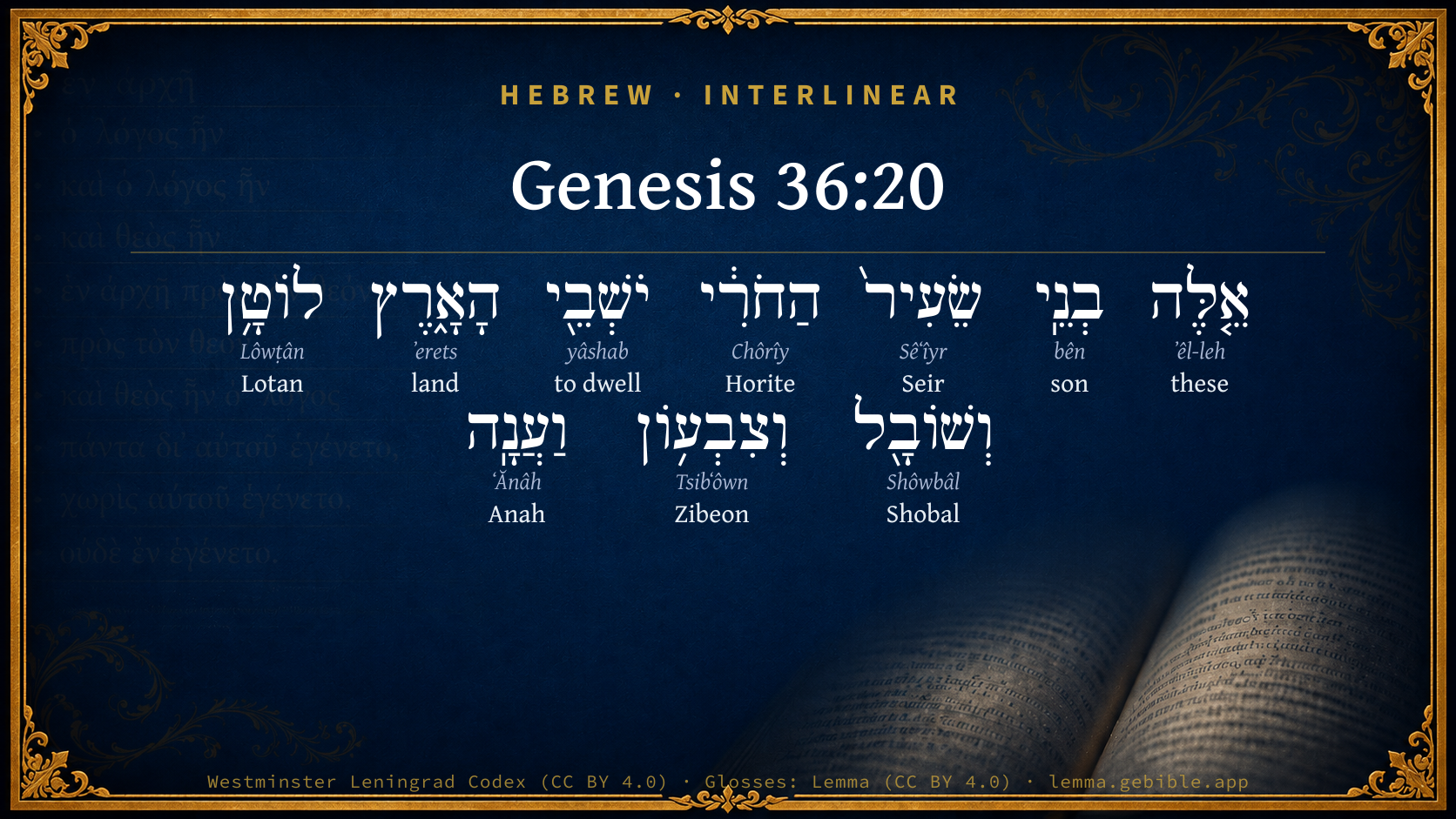
Hebrew (Westminster Leningrad Codex) Genesis 36:20 appears in the Hebrew Old Testament. The text above is from the Westminster Leningrad Codex. Each word links to its Strong’s number, a concise gloss, and parsing drawn from the Open Scriptures Hebrew Bible morphology. Click any word for its full Brown-Driver-Briggs (BDB) entry.
Download image
Cite this verse

Genesis 36:20 (World English Bible). Public Domain. Lemma interlinear Bible study tool, https://lemma.gebible.app/v/genesis/36/20.

Show BibTeX & RIS
BibTeX
RIS
English Translation
These are the sons of Seir the Horite, the inhabitants of the land: Lotan, Shobal, Zibeon, Anah,
World English Bible · Public Domain
Highlights
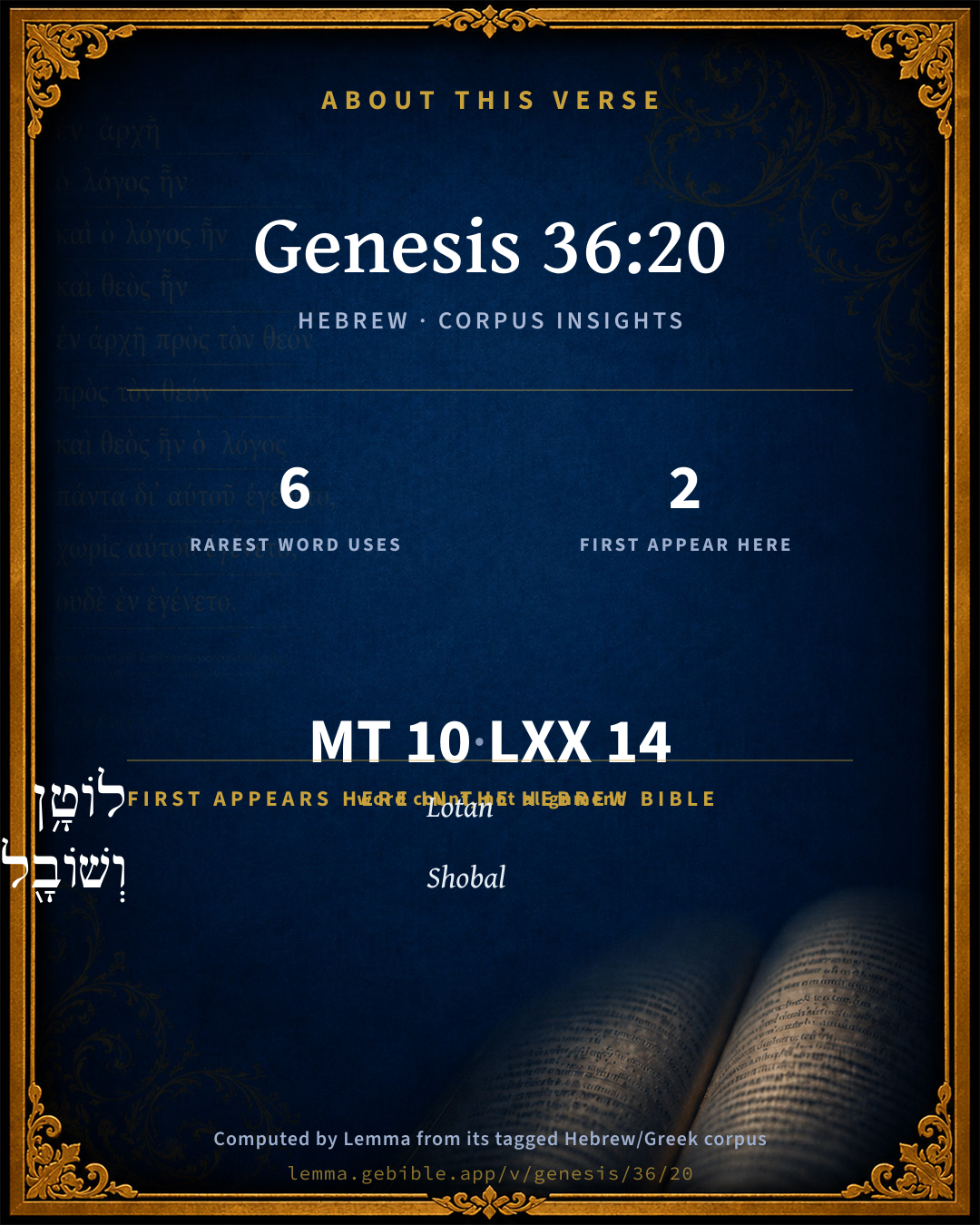
  • 2 first appearances in the Hebrew Bible
Full analysis ↓
Download a study sheet

One document with this verse’s original text, its word-by-word gloss line, the meaning frame, cross-references with their text, attributed commentary, and full source and license credits — printable, and it pastes into notes with its structure intact.

This verse Autodidact and up

Study sheet (.html) Plain text (.txt)

A passage Seminary Student

Up to 50 verses in one chapter. A passage sheet keeps up to 6 commentary sources and 12 cross-references per verse, in the order this page ranks them, and says so on the sheet whenever that leaves anything out. Ask for a single verse and you get the Autodidact verse sheet above.

Everything on this page stays free to read, with no account — the sheet is a download of what is already on screen, not access to it.

Want to remove ads? Support Godless Engineer
Compare translations 3

The same verse in 3 English versions, stacked beneath the original-language interlinear above. Click any original word for its lexicon entry.

Each is an independent rendering of the whole verse — the interlinear is not word-aligned to these translations.

Highlighted words mark where these versions differ — a whole-verse word diff, not a word-by-word alignment.

  • World English Bible Public Domain
    These are the sons of Seir the Horite, the inhabitants of the land: Lotan, Shobal, Zibeon, Anah,
  • King James Version Public Domain
    These are the sons of Seir the Horite, who inhabited the land; Lotan, and Shobal, and Zibeon, and Anah,
  • unfoldingWord Literal Text CC BY-SA 4.0
    These the sons of Seir the Horite who were inhabiting the land: Lotan and Shobal and Zibeon and Anah

unfoldingWord Literal Text — © unfoldingWord, licensed CC BY-SA 4.0. Word-aligned USFM3 via Door43 (git.door43.org/unfoldingWord/en_ult).

Versions to compare (up to 4)

3 of 4 selected

Show all 18 translations

Every available English version of this verse, each an independent rendering of the whole verse.

  • World English Bible Public Domain
    These are the sons of Seir the Horite, the inhabitants of the land: Lotan, Shobal, Zibeon, Anah,
  • Berean Standard Bible Public Domain
    These are the sons of Seir the Horite, who were living in the land: Lotan, Shobal, Zibeon, Anah,
  • Majority Standard Bible Public Domain
    These are the sons of Seir the Horite, who were living in the land: Lotan, Shobal, Zibeon, Anah,
  • King James Version Public Domain
    These are the sons of Seir the Horite, who inhabited the land; Lotan, and Shobal, and Zibeon, and Anah,
  • American Standard Version (1901) Public Domain
    These are the sons of Seir the Horite, the inhabitants of the land: Lotan and Shobal and Zibeon and Anah,
  • Revised Version (1885) Public Domain
    These are the sons of Seir the Horite, the inhabitants of the land; Lotan and Shobal and Zibeon and Anah,
  • Geneva Bible (1599) Public Domain
    These are the sonnes of Seir the Horite, which inhabited the lande before, Lotan, and Shobal, and Zibeon, and Anah.
  • Douay-Rheims (1899) Public Domain
    These are the sons of Seir the Horrite, the inhabitants of the land: Lotan, and Sobal, and Sebeon, and Ana,
  • Young's Literal Translation Public Domain
    These `are' sons of Seir the Horite, the inhabitants of the land: Lotan, and Shobal, and Zibeon, and Anah,
  • Literal Standard Version CC BY-SA 4.0
    These [are] sons of Seir the Horite, the inhabitants of the land: Lotan, and Shobal, and Zibeon, and Anah,
  • Unlocked Literal Bible CC BY-SA 4.0
    These were the sons of Seir the Horite, the inhabitants of the land: Lotan, Shobal, Zibeon, Anah,
  • unfoldingWord Literal Text CC BY-SA 4.0
    These the sons of Seir the Horite who were inhabiting the land: Lotan and Shobal and Zibeon and Anah
  • Darby Bible Public Domain
    These are the sons of Seir the Horite, the inhabitant of the land: Lotan, and Shobal, and Zibeon, and Anah,
  • World Messianic Bible Public Domain
    These are the sons of Seir the Horite, the inhabitants of the land: Lotan, Shobal, Zibeon, Anah,
  • Webster's Bible Public Domain
    These are the sons of Seir the Horite, who inhabited the land; Lotan, and Shobal, and Zibeon, and Anah.
  • Free Bible Version CC BY-SA 4.0
    These were the sons of Seir the Horite, who were living in the country: Lotan, Shobal, Zibeon, Anah,
  • Bible in Basic English Public Domain
    These are the sons of Seir the Horite who were living in that country; Lotan, Shobal, Zibeon, Anah,
  • JPS Tanakh (1917) Public Domain
    These are the sons of Seir the Horite, the inhabitants of the land: Lotan and Shobal and Zibeon and Anah,

Literal Standard Version (2020), Covenant Press — licensed CC BY-SA 4.0. Text via the HelloAO Bible API (eBible.org). Unlocked Literal Bible (unfoldingWord) — licensed CC BY-SA 4.0. Text via the HelloAO Bible API (eBible.org). unfoldingWord Literal Text — © unfoldingWord, licensed CC BY-SA 4.0. Word-aligned USFM3 via Door43 (git.door43.org/unfoldingWord/en_ult). Free Bible Version, Dr. Jonathan Gallagher — licensed CC BY-SA 4.0. Text via the HelloAO Bible API (eBible.org).

Word by word

More ways to search: Search by grammar → Find every occurrence → Compare this word →

Practice this passage: Drill this verse → Learn its vocabulary →

הַחֹרִ֔י
Chôrîy
H2752
“the · Horite”
Particle, Definite Article + Noun, Gentilic, Masculine, Singular, Absolute
Part of Speech
Particle + Noun
Type
Gentilic
Gender
Masculine
Number
Singular
State
Absolute
Full BDB Definition

Origin: from H2356

TWOT: None

Horite = "cave dweller" - the inhabitants of Mount Seir - the inhabitants of Edom (in later times)
  1. אֵ֤לֶּה ʼêl-leh H428 “these” Pronoun, Demonstrative, Common, Plural
  2. בְנֵֽי bên H1121 “sons of” Noun, Common, Masculine, Plural, Construct
  3. שֵׂעִיר֙ Sêʻîyr H8165 “Seir” Noun, Proper
  4. יֹשְׁבֵ֖י yâshab H3427 “dwelling” Verb, Qal, Participle Active, Masculine, Plural, Construct
  5. הָאָ֑רֶץ ʼerets H776 “the · land” Particle, Definite Article + Noun, Common, Both, Singular, Absolute
  6. לוֹטָ֥ן Lôwṭân H3877 “Lotan” Noun, Proper
  7. וְשׁוֹבָ֖ל Shôwbâl H7732 “and · Shobal” Conjunction + Noun, Proper
  8. וְצִבְע֥וֹן Tsibʻôwn H6649 “and · Zibeon” Conjunction + Noun, Proper
  9. וַעֲנָֽה ʻĂnâh H6034 “and · Anah” Conjunction + Noun, Proper

About this verse

These counts appear in no published source. They are computed here, from the morphology-tagged text and Lemma’s own curated glosses. What Lemma adds →

10
words
10
distinct lemmas
Pentateuch
section

Notable vocabulary

The rarest word here is הַחֹרִ֔י Horite H2752 — appearing just 6 times in the whole Hebrew Bible.

First appearance in Scripture

These words make their first canonical appearance in the Hebrew Bible here:

  • לוֹטָ֥ן Lotan H3877
  • וְשׁוֹבָ֖ל Shobal H7732

Shared distinctive vocabulary

הַחֹרִ֔י Horite H2752 occurs in 6 verses of the Hebrew Bible. Also found in:

Grammatical profile

  • 1 verb
  • 8 nouns
  • 1 pronoun

Verb forms

  • יֹשְׁבֵ֖י Qal · Participle Active

Hebrew & Septuagint length

In English translation the verse runs 17 words from the Hebrew and 17 from the Septuagint (LXX English) — the same length.

A rough comparison of the two English renderings, which tokenize alike — not a word-level alignment.

Word counts can differ between the Hebrew and the Greek without any difference in meaning — e.g. the Hebrew direct-object marker אֵת has no separate Greek word, and Greek often adds the article ὁ.

In the original languages it is 10 Hebrew tokens and 14 Greek tokens — but the two are counted differently (Hebrew bundles its prefixes and suffixes into one token; the Greek is in lemma form), so that isn’t a like-for-like length.

Cross-references

6

Topical passages linked to Genesis 36:20 in the Treasury of Scripture Knowledge — connected by theme and wording, ordered by reader-vote popularity; previews shown in the World English Bible.

  • Genesis 14:6 and the Horites in their Mount Seir, to Elparan, which is by the wilderness.
  • Deuteronomy 2:12 The Horites also lived in Seir before, but the children of Esau succeeded them; and they destroyed them from before them, and lived in their place; as Israel did to the land of his possession, which Yahweh gave to them.)
  • Deuteronomy 2:22 as he did for the children of Esau, who dwell in Seir, when he destroyed the Horites from before them; and they succeeded them, and lived in their place even to this day:
  • 1 Chronicles 1:38–42 The sons of Seir: Lotan, and Shobal, and Zibeon, and Anah, and Dishon, and Ezer, and Dishan.
  • Genesis 36:2 Esau took his wives from the daughters of Canaan: Adah the daughter of Elon, the Hittite; and Oholibamah the daughter of Anah, the daughter of Zibeon, the Hivite;
  • Genesis 36:22–30 The children of Lotan were Hori and Heman. Lotan's sister was Timna.

Cross-references courtesy of OpenBible.info (CC BY 4.0).

Hebrew and Greek witnesses Masoretic Hebrew ↔ Greek Septuagint

The same verse in the two great witnesses to the Old Testament, shown verse-for-verse.

These are two independent witnesses, not word-aligned to each other, and the Septuagint is shown in lemma (dictionary) form.

Hebrew Genesis 36:20 Masoretic · Westminster Leningrad Codex

אֵ֤לֶּה בְנֵֽי שֵׂעִיר֙ הַחֹרִ֔י יֹשְׁבֵ֖י הָאָ֑רֶץ לוֹטָ֥ן וְשׁוֹבָ֖ל וְצִבְע֥וֹן וַעֲנָֽה

These are the sons of Seir the Horite, the inhabitants of the land: Lotan, Shobal, Zibeon, Anah,

World English Bible · Public Domain

Greek LXX Genesis 36:20 Septuagint · lemma form

οὗτος δέ υἱός σηιρ ὁ χορραῖος ὁ καταοἰκέω ὁ γῆ λωταν σωβαλ σεβεγων ανα

And these are the sons of Seir, the Chorrhite, who inhabited the land; Lotan, Sobal, Sebegon, Ana,

LXX2012 (modern English Septuagint) · Public Domain

On this verse, Keil & Delitzsch discusses the Septuagint’s reading. Read the note in Commentary ↓

Hebrew: Westminster Leningrad Codex (CC BY 4.0). Greek: Septuagint (public domain); English from LXX2012 (modern English Septuagint) (Public Domain). How the Septuagint differs from the Hebrew →

Targum (Aramaic paraphrase)

2

The Targum is the ancient Jewish Aramaic paraphrase of the Hebrew Scriptures — an interpretive translation, not the Hebrew text itself. Onkelos (literal) and Pseudo-Jonathan (expansive) render the Torah, and Jonathan the Prophets. Coverage is partial: where no permissively-licensed English translation exists for a verse, only the Aramaic is shown. This is verse-level text, not a word-by-word alignment to the Hebrew.

  1. Targum Onkelos Torah (Genesis–Deuteronomy)
    אִלֵּין בְּנֵי שֵׂעִיר חוֹרָאָה יָתְבֵי דְּאַרְעָא לוֹטָן וְשׁוֹבָל וְצִבְעוֹן וַעֲנָה

    (no public-domain English translation for this verse)

    Targum Onkelos — Aramaic: “Onkelos Genesis” (public domain); “Onkelos Exodus” (public domain); “Onkelos Leviticus” (public domain); “Onkelos Numbers” (public domain); “Onkelos Deuteronomy” (public domain). English: “Sefaria Community Translation” (CC0 1.0 (public-domain dedication)); “J.W. Etheridge. The Targums of Onkelos and Jonathan Ben Uzziel on the Pentateuch. London: Longmans, Green, 1862” (public domain). Text via Sefaria.

  2. Targum Pseudo-Jonathan Torah (Genesis–Deuteronomy)
    אִלֵין בְּנוֹי דִגְבַל גְנוּסַיָא דִמְקַדְמַת דְנָא הֲווֹן יַתְבֵי אַרְעָא הַהוּא לוֹטָן וְשׁוֹבָל וְצִבְעוֹן וַעֲנָה

    These are the sons of Gebal, the generations who before that had dwelt in that land: Lotan, and Shobal, and Sebeon, and Anah,

    Targum Pseudo-Jonathan — Aramaic: “Targum Jonathan on Genesis” (public domain); “Targum Jonathan on Exodus” (public domain); “Targum Jonathan on Leviticus” (public domain); “Targum Jonathan on Numbers” (public domain); “Targum Jonathan on Deuteronomy” (public domain). English: “The Targum of Jonathan ben Uzziel, trans. J. W. Etheridge, London, 1862” (public domain). Text via Sefaria.

Commentary

Notes on Genesis 36:20 from classic Christian and Jewish commentators (each source and its license shown beneath its notes). The classic Christian expositions comment on the surrounding passage and are grouped to its opening verse, so a note may address several verses; the Jewish commentaries on the Tanakh (Rashi and others) are per-verse, so they appear only where the commentator wrote on this verse.

Lemma curates 59 commentaries, every one of them public domain or Creative Commons licensed, each selected and text-cleaned for this edition rather than reprinted as found. About our sources →

Trapp's Complete Commentary

John Trapp

Gen 36:20 These [are] the sons of Seir the Horite, who inhabited the land; Lotan, and Shobal, and Zibeon, and Anah,

Ver. 20. These are the sons of Seir.] Esau was by marriage allied to this Seir: for he married his niece Aholibamah: {Gen 36:2} yet the children of Esau chased away the Horims of Seir, and dwelt in their stead in mount Seir. {Deu 2:12} Wicked men are void of natural affection, in their pursuit of profit or preferment; Abimelech, Absalom, Athaliah, for instance; and that Amida, son of Muleasses, king of Tunis, who rose up against his father, and possessing himself of his kingdom, slew his captains, polluted his wives, took the castle of Tunis; and, after all, put out his father’s and brethren’s eyes, like as Muleasses himself, before, had dealt with his own brethren. {a}

{a} Turk. Hist., fol. 745, 747, 642.

John Trapp, A Commentary or Exposition upon All the Books of the Old and New Testament (1647–1656) — public domain. Text from a community e-Sword module.

Joseph Benson's Commentary

Gen 36:20. These are the sons of Seir — In the midst of the genealogy of the Edomites is inserted the genealogy of the Horites, that were the natives of mount Seir before the Edomites took possession of it, Deu 2:12; Deu 2:22. This comes in here, not only to give light to the story, but to be a standing reflection upon the Edomites for intermarrying with them, by which it is likely they learned their ways, and corrupted themselves.

Joseph Benson's Commentary on the Old and New Testaments (1811–1818) — public domain. Text from a community e-Sword module.

Whedon's Commentary on the Bible

Daniel D. Whedon

SONS OF SEIR THE HORITE, Gen_36:20-30.

The Horites were the original occupants of Mount Seir, (Gen_14:6,) but it appears from Deu_2:12; Deu_2:22, that they were subdued by the sons of Esau, and in all probability the remnants of their tribes intermarried with the Edomites, and became so identified with them as to be thus included in this genealogy. The seven sons of Seir the Horite are all mentioned again in Gen_36:29-30 as the dukes of the Horites, corresponding with the sons and dukes of Esau already given. On the identification of some of these names there are differences of opinion. Timna, in Gen_36:22, is generally allowed to be the same as the concubine of Eliphaz, Gen_36:12. It is natural to suppose Aholibamah the daughter of Anah (Gen_36:25) to be the same as the wife of Esau, (Gen_36:2,) but Keil very positively denies their identity. Anah (Gen_36:24) is said to be a son of Zibeon the Horite; but the Anah of Gen_36:2 is the daughter of Zibeon the Hivite. Anah is distinguished for having found the mules in the wilderness, as he fed the asses of Zibeon his father. There is no good authority for rendering the word ימם, mules; it means rather, warm springs. While he pastured the asses of Zibeon he discovered certain hot springs, probably those of Callirhoe, on the east of the Dead Sea, in the wady Zerka-Main, which are famous for their medicinal qualities and various temperature, ranging from tepid to a degree of heat that cannot be endured in bathing. Hengstenberg suggests that the discovery of these springs gave Anah the surname Beeri, (xxvi, 34,) “the fountain man,” or “well-finder,” and thus constructs an argument to prove the identity of Anah with the father of Esau’s wife. His argument, if not conclusive, should suffice to show how many possible circumstances, now unknown to us, might have occasioned the differences of names which puzzle us in old genealogical tables.

Daniel D. Whedon (gen. ed.), Commentary on the Old and New Testaments (1874–1909) — public domain. Text from a community e-Sword module.

Tyndale Open Study Notes

Tyndale Open Resources

36:20-30 Seir the Horite was an early inhabitant of the land; his descendants populated the region until Esau moved in and displaced them (Deut 2:12).

Tyndale Open Study Notes — © Tyndale Open Resources, licensed CC BY-SA 4.0. Text via the HelloAO Bible API.

Geneva Bible (1599)

Geneva Bible translators

Before that Esau did there inhabit.

Geneva Bible (1599) marginal notes — public domain. Text via Bolls.life.

Matthew Henry's Commentary

In the midst of this genealogy of the Edomites here is inserted the genealogy of the Horites, those Canaanites, or Hittites (compare Gen 26:34), that were the natives of Mount Seir. Mention is made of them, Gen 14:6, and of their interest in Mount Seir, before the Edomites took possession of it, Deu 2:12, Deu 2:22. This comes in here, not only to give light to the story, but to be a standing reflection upon the Edomites for intermarrying with them, by which, it is probable, they learned their way, and corrupted themselves. Esau having sold his birthright, and lost his blessing, and entered into alliance with the Hittites, his posterity and the sons of Seir are here reckoned together. Note, Those that treacherously desert God's church are justly numbered with those that were never in it; apostate Edomites stand on the same ground with accursed Horites. Particular notice is taken of one Anah who fed the asses of Zibeon his father (Gen 36:24), and yet is called duke Anah, Gen 36:29. Note, Those that expect to rise high should begin low. An honourable descent should not keep men from an honest employment, nor a mean employment hinder any man's preferment. This Anah was not only industrious in his business, but ingenious too, and successful; for he found mules, or (as some read it) waters, hot-baths, in the wilderness. Those that are diligent in their business sometimes find more advantages than they expected.

Matthew Henry's Commentary on the Whole Bible (1708–1710) — public domain (CC PDM 1.0). Text via the HelloAO Bible API.

Jamieson, Fausset & Brown

Robert Jamieson, A. R. Fausset & David Brown

Sons of Seir, the Horite--native dukes, who were incorporated with those of the Edomite race.

Jamieson, Fausset & Brown — Commentary Critical and Explanatory on the Whole Bible (1871) — public domain (CC PDM 1.0). Text via the HelloAO Bible API.

Adam Clarke's Commentary

Verse 20. These are the sons of Seir the Horite] These Horites were the original inhabitants of the country of Seir, called the land of the Horites, and afterwards the land of the Idumeans, when the descendants of Esau had driven them out. These people are first mentioned Ge 14:6.

Adam Clarke's Commentary on the Bible (1810–1826) — public domain. Text from a community e-Sword/MySword module.

Ellicott's Commentary for English Readers

(20) The sons of Seir the Horite.—This genealogy is given partly because it contains that of Aholibamah, but chiefly because the Horites were in time fused with the descendants of Esau, and together formed the Edomites.

A Bible Commentary for English Readers, edited by Charles John Ellicott (1878–1897) — public domain. Text from a community e-Sword module.

The Cambridge Bible for Schools and Colleges

gen. ed. J. J. S. Perowne

20. the inhabitants of the land] The aborigines: see Gen_14:6; Deu_2:12.

20–30. The Horites—the aboriginal inhabitants of the country—“the sons of Seir, the Horite,” were possibly so called from the word ḥor, “a hole”; cf. 1Sa_13:6; 1Sa_14:11. This derivation has long been maintained, and is possibly correct, the Horites being regarded as troglodytes, or cave-dwellers. In Oba_1:3 Edom is apostrophized, “O thou that dwellest in the clefts of the rock.” On the other hand another derivation has recently commended itself, Hor being identified with the Egyptian Haru which is found in Egyptian inscriptions for “Syria.” But there is good support from the rocks of Petra and the excavations at Gezer for the “cave-dweller” explanation of the word.

The Cambridge Bible for Schools and Colleges (gen. ed. J. J. S. Perowne; Cambridge University Press, 1878–1918) — public domain. Text from a community e-Sword module.

John Gill's Exposition

And these are the children of Zibeon,.... The third son of Self, and who had two sons:

both Ajah and Anah; of the latter it is observed:

this was that Anah that found the mules in the wilderness, as he fed the asses of Zibeon his father; who observed, while he was feeding his father's asses in the wilderness, that the he asses coupled with mares, or horses with the she asses, and produced another sort of creatures called mules; and by this means found out the way how such creatures might be produced, and practised it: so Aelianus says (d), that mules are not the produce of nature, but you may call it an adulterous invention of human contrivance and boldness, and a theft: this is the common interpretation, and to which our version leads: but against it it may be observed, that the word for "mules" is different from this here used, nor is this word ever used of mules, nor does it appear that there were any creatures of this sort before the days of David; nor is the word translated "found" ever used of that which before was not in being, but of what already existed; nor is there any mention of horses or mares in this account also; had it referred to a mixture of these creatures with asses, it would not have been omitted. Some think therefore the words are to be rendered, "he found waters in the wilderness"; sources and collections of waters which were not usual in a wilderness, and of great worth and use in desert lands, as Edom was, and in those hot countries, and the Vulgate Latin version renders it, "hot waters"; but then to the fixing of either of these versions, the word must be altered either in its points or letters, for which there is no authority. The Targum of Onkelos renders it mighty ones or giants, and may signify the "Emim", the "aleph" being changed for "yod", as Aben Ezra observes; and then the sense is, that these gigantic people, who were so called from the terror they taught upon their neighbours, and, who dwelt near the Horim in Seir, Deu 2:10, as they used to steal from their flocks, Anah lighted on them in the wilderness, and fell upon them, and took them; and with this agrees the Samaritan version, "he found giants, in the wilderness"; and so Abendana interprets the words: Aben Ezra observes that many interpret the word of plants or herbs; and a very learned (e) man is of opinion that the word used is the name of an useful herb or plant, first discovered by Anah. This Anah, though a keeper of his father's asses, is afterwards called Duke Anah; it being the custom of the sons of great personages to be the keepers of flocks and herds; See Gill on Gen 29:9.

(d) De Animal. l. 12. c. 16. (e) Wagenseil, in Sota, p. 217, 218.

John Gill's Exposition of the Whole Bible (1746–1763) — public domain (CC PDM 1.0). Text via the HelloAO Bible API.

Matthew Poole's English Annotations

1840

The sons of Seir are here mentioned, partly because of their alliance with Esau’s family, Gen 35:2,20,22,24,25, and partly because the government was translated from his to Esau’s family.

Who inhabited the land, and ruled there, till Esau and his posterity drove them out, Deu 2:12,22.

Matthew Poole's English Annotations on the Holy Bible (1683–1685) — public domain. Text from a community e-Sword/MySword module.

The Pulpit Commentary

Vers. 20, 21. These are the sons of Seir the Horite, who inhabited the land. The primitive inhabitants of Idumea were Horites (vide, Gen_14:6) of whom the ancestor, Seir ("Rugged"), either gave his name to, or took his name from, the district in which he lived. Though ultimately driven out by the Edomites, (Deu_2:12) they were probably only gradually dispossessed, and not until a portion of them had coalesced with their conquerors, as Esau himself had a Horite wife, Aholibamah, and his son Eliphaz a Horite concubine of the name of Thuna. They were, as the name Horite, from chor, a hole or cavern, imports a race of troglodytes or cavemen, who dwelt in the sandstone and limestone eaves with which the land of Edom abounds. The cave palaces, temples, and tombs that have been excavated in Mount Seir are still astonishing in their grandeur. Lotan, up" (Gesenius)and Shobal, (Gesenius)and Zibeon, and Anah (this Anah was the uncle of the Anah mentioned in ver. 25), and Dishan, (Gesenius, Furst)and Eser, (Gesenius) and Dishan : same as Dishon (Gesenius, Furst); "Threshing" (Murphy)these are the dukes of, the Horites, the children of Seir in the land of Edom.

The Pulpit Commentary (1880–1919), ed. H.D.M. Spence-Jones & Joseph S. Exell — public domain. Text from a community e-Sword module.

John Wesley's Explanatory Notes

These are the sons of Seir - In the midst of the genealogy of the Edomites is inserted the genealogy of the Horites, those Canaanites, or Hittites, (compare chap. xxvi, 34,) that were the natives of mount Seir. Mention is made of them, chap. xiv, 6, and of their interest in mount Seir before the Edomites took possession of it, Deut. ii, 12, 22. This comes in here, not only to give light to the story, but to be a standing reflexion upon the Edomites for intermarrying with them, by which it is likely they learned their way, and corrupted themselves. Esau having sold his birth-right, and lost his blessing and entered into alliance with the Hittites, his posterity and the sons of Seir are here reckoned together. Those that treacherously desert God's church are justly numbered with those that were never in it: apostate Edomites stand on the same ground with accursed Horites. Notice is taken of one Anah, who fed the asses of Zibeon his father, ver. 20, and yet is called duke Anah, ver. 29. Those that expect to rise high should begin low. An honourable descent should not keep men from an honest employment, nor a mean employment baulk any man's preferment.

John Wesley, Explanatory Notes Upon the Whole Bible (1754–1765) — public domain. Text via the GEBible commentary corpus.

Keil & Delitzsch

C. F. Keil & F. Delitzsch

(parallel, Ch1 1:38-42). Descendants of Seir the Horite; - the inhabitants of the land, or pre-Edomitish population of the country. - "The Horite:" ὁ Τρωγλοδύτης, the dweller in caves, which abound in the mountains of Edom (vid., Rob. Pal. ii. p. 424). The Horites, who had previously been an independent people (Gen 14:6), were partly exterminated and partly subjugated by the descendants of Esau (Deu 2:12, Deu 2:22). Seven sons of Seir are given as tribe-princes of the Horites, who are afterwards mentioned as Alluphim (Gen 36:29, Gen 36:30), also their sons, as well as two daughters, Timna (Gen 36:22) and Aholibamah (Gen 36:25), who obtained notoriety from the face that two of the headquarters of Edomitish tribe-princes bore their names (Gen 36:40 and Gen 36:41). Timna was probably the same as the concubine of Eliphaz (Gen 36:12); but Aholibamah was not the wife of Esau (cf. Gen 36:2). - There are a few instances in which the names in this list differ from those in the Chronicles. But they are differences which either consist of variation in form, or have arisen from mistakes in copying.

(Note: Knobel also undertakes to explain these names geographically, and to point them out in tribes and places of Arabia, assuming, quite arbitrarily and in opposition to the text, that the names refer to tribes, not to persons, although an incident is related of Zibeon's son, which proves at once that the list relates to persons and not to tribes; and expecting his readers to believe that not only are the descendants of these troglodytes, who were exterminated before the time of Moses, still to be found, but even their names may be traced in certain Bedouin tribes, though more than 3000 years have passed away! The utter groundlessness of such explanations, which rest upon nothing more than similarity of names, may be seen in the association of Shobal with Syria Sobal (Judith 3:1), the name used by the Crusaders for Arabia tertia, i.e., the southernmost district below the Dead Sea, which was conquered by them. For notwithstanding the resemblance of the name Shobal to Sobal, no one could seriously think of connecting Syria Sobal with the Horite prince Shobal, unless he was altogether ignorant of the apocryphal origin of the former name, which first of all arose from the Greek or Latin version of the Old Testament, and in fact from a misunderstanding of Psa 60:2, where, instead צובה ארם, Aram Zobah, we find in the lxx Συριά Σοβάλ, and in the Vulg. Syria et Sobal.)

Of Anah, the son of Zibeon, it is related (Gen 36:24), that as he fed the asses of his father in the desert, he "found היּמם" - not "he invented mules," as the Talmud, Luther, etc., render it, for mules are פּרדים, and מצא does not mean to invent; but he discovered aquae calidae (Vulg.), either the hot sulphur spring of Calirrhoe in the Wady Zerka Maein (vid., Gen 10:19), or those in the Wady el Ahsa to the S.E. of the Dead Sea, or those in the Wady Hamad between Kerek and the Dead Sea.

(Note: It is possible that there may be something significant in the fact that it was "as he was feeding his father's asses," and that the asses may have contributed to the discovery; just as the whirlpool of Karlsbad is said to have been discovered through a hound of Charles IV, which pursued a stag into a hot spring, and attracted the huntsmen to the spot by its howling.)

Keil & Delitzsch — Biblical Commentary on the Old Testament (1861–1891) — public domain (CC PDM 1.0). Text via the HelloAO Bible API. (Old Testament only.)

Scofield Reference Notes

C. I. Scofield

Horite

Lit. Rock dweller.

The Scofield Reference Bible (1917 edition), notes by C. I. Scofield — public domain. Text from a community e-Sword module.

Kretzmann's Popular Commentary

Paul E. Kretzmann

The Horites

v. 20. These are the sons of Seir, the Horite, who inhabited the land; after him the country was named, and with his descendants those of Edom mingled: Lotan, and Shobal, and Zibeon, and Anah (this name being both masculine and feminine),

v. 21. and Dishon, and Ezer, and Dishan; these are the dukes of the Horites, the children of Seir, in the land of Edom. The Horites, or descendants of Seir, the original inhabitants of the wilderness of Zin, were cave-dwellers arid shared the many caves in that country with their herds and flocks.

v. 22. And the children of Lotan were Hori and Hemam (or Homam, 1Ch 1:39); and Lotan’s sister was Timna.

v. 23. And the children of Shobal were these: Alvan (or Alian, 1Ch 1:40),and Manahath, and Ebal, Shepho (or Shephi, 1Ch 1:40),and Onam.

v. 24. And these are the children of Zibeon: both Ajah, and Anah; this was that Anah that found the mules in the wilderness, as he fed the asses of Zibeon, his father. While he had charge of his father’s asses in the wilderness, he discovered some warm springs, a number of which are found in that country to this day.

v. 25. And the children of Anah were these: Dishon, and Aholibamah, the daughter of Anah.

v. 26. And these are the children of Dishon: Hemdan (or Amram, 1Ch 1:41),and Eshban, and Ithran, and Cheran.

v. 27. The children of Ezer are these: Bilhan, and Zaavan, and Akan (or Jakan, 1Ch 1:42).

v. 28. The children of Dishan are these: Uz, and Aran.

v. 29. These are the dukes that came of the Horites: Duke Lotan, Duke Shobal, Duke Zibeon, Duke Anah,

v. 30. Duke Dishon, Duke Ezer, Duke Dishan; these are the dukes that came of Hori, among their dukes in the land of Seir. These were all descendants of Seir, the Horite, as they were divided and called after their individual princes.

Paul E. Kretzmann, Popular Commentary of the Bible (1921–1924) — public domain. Text from a community e-Sword module.

unfoldingWord translationNotes

Door43 World Missions Community

Seir

The word "Seir" is the name of a man and of a country.

the Horite

The word "Horite" refers to a people group. See how you translated it in Genesis 14:6.

the inhabitants of the land

"who lived in the land of Seir, which is also called Edom"

Lotan, Shobal, Zibeon, Anah, Dishon, Ezer, and Dishan ... Hori and Heman

These are names of men. (See: How to Translate Names)

Timna

This is the name of a woman. (See: How to Translate Names)

translationWords

Edom

unfoldingWord translationNotes — © Distant Shores Media and the Door43 World Missions Community, licensed CC BY-SA 4.0. Source: git.door43.org/Door43/en_tn.

Rashi

Rabbi Shlomo Yitzchaki (Rashi)

ישבי הארץ THE INHABITANTS OF THE LAND — i.e. who had been its inhabitants before Esau came there. Our Rabbis explained (Shabbat 85b) that they are called יושבי הארץ because they were experts in making the land habitable (by skillful cultivation) saying: this entire rood of ground is suitable for planting olives, that entire rood for vines — because they tasted the soil and so discovered what was suitable for planting in it.

Rashi on the Tanakh — English translations: “The Judaica Press complete Tanach with Rashi, translated by A. J. Rosenberg” (CC BY 4.0); “Pentateuch with Rashi's commentary by M. Rosenbaum and A.M. Silbermann, 1929-1934” (public domain); “The Metsudah Tanach series, Lakewood, N.J” (CC BY 4.0); and “The Book of Joshua, Metsudah Publications, 1997” (CC BY 4.0). Text via Sefaria.

Ramban (Nachmanides)

Rabbi Moshe ben Nachman (Ramban / Nachmanides)

THESE ARE THE SONS OF SE’IR ‘HACHORI’ (THE HORITE). Hachori was the name of a man who was the father of an ancient nation which was called by his name, just as the Amorite and the Perizzite, as it is said, When He destroyed the Horites from before them. And he was called Se’ir because of the name of the land which was Se’ir — a name derived from Esau who was a hairy man — from the day Esau came there. The name Edom likewise stemmed from Esau. However, Scripture seems to distinguish between “Se’ir” and “Edom” for it says, These are the sons of Se’ir the Horite who were the inhabitants of the land from the first, not the sons of Se’ir the Edomite who came there. With the help of G-d, I will yet explain the genealogy of the Horite in the book of Mishneh Torah. Rabbi Abraham ibn Ezra wrote: “Scripture mentions this in order to delineate the genealogy of Se’ir and Esau since Israel was to be commanded, concerning the sons of Esau, [not to abhor them or take their land].”, 23:8; 2:5. And Rashi wrote: “It would have been unnecessary to write the genealogy of the Horites had it not been that Scripture wishes to mention Timna, thereby showing the esteem in which Abraham was held.”

Ramban (Nachmanides) on the Tanakh — English translation: “Commentary on the Torah by Ramban (Nachmanides). Translated and annotated by Charles B. Chavel. New York, Shilo Pub. House, 1971-1976” (CC BY 4.0). Text via Sefaria.

Radak

Rabbi David Kimhi (Radak)

אלה בני שעיר החרי ישבי הארץ, who used to dwell in that land before the sons of Esau and their offspring came to live there. This story has as its objective that the whole earth and all that is in it belongs to the one and only G’d Who has created it, and Who therefore may allocate it to whoever He wishes. He may deprive one nation of its homeland and give it to another. In this situation G’d expelled the nation which had lived in the region known as Mont Seir and allowed Esau and his clan to displace them. According to Bereshit Rabbah, or to Shabbat 85 and quoted by Rashi, the word חרי is derived from ריח, smell, fragrance. The people described as having lived in that land were such expert farmers that they could determine merely by their sense of small which piece of land was best suited to grow different crops.

Radak on the Tanakh — English translations: “Sefaria Community Translation” (CC0 1.0 (public-domain dedication)); “Eliyahu Munk, HaChut Hameshulash” (CC BY 4.0); “Rabbi Mike Feuer, Jerusalem Anthology” (CC BY 4.0); and “R. David Kimhi on the first book of Psalms, Translated by R.G. Finch, London, 1919” (public domain). Text via Sefaria.

Lesson kit

Teaching starters — assembled from the data on this page, not authored interpretation. Every prompt links to the verse data it draws on. Edit before teaching.

Genesis, in the Pentateuch, opens this verse with 10 words (10 distinct Hebrew lemmas). Its most distinctive word is Chôrîy (“Horite”). A historical commentator’s framing appears above. Read the whole chapter for the surrounding context.

Discussion questions

  1. The word Chôrîy carries the sense “Horite.” How does it shape the verse?
  2. 2 words make their first appearance in Scripture here. What does this debut establish?
  3. How does Genesis 14:6, which shares the word «Horite», read alongside this verse?
  4. The translations on this page render this verse differently — a whole-verse word diff, not a word-by-word alignment. What might account for the different wordings?
  5. «יֹשְׁבֵ֖י» is a Qal Participle Active verb. How does that grammatical form shape the action described?
  6. Compare how Trapp's Complete Commentary and Joseph Benson's Commentary read this verse. Where do they agree or differ?

Things to notice

Reading settings

Reading text

Shown beneath each verse's original-language words.

Old Testament
Old Testament edition

Read the OT as the Masoretic Hebrew (MT) or the Greek Septuagint (LXX).

English shown for the Greek Septuagint (in the Hebrew ↔ Greek comparison).

Comparing translations? Open the Compare panel on any verse page to stack up to four side by side.