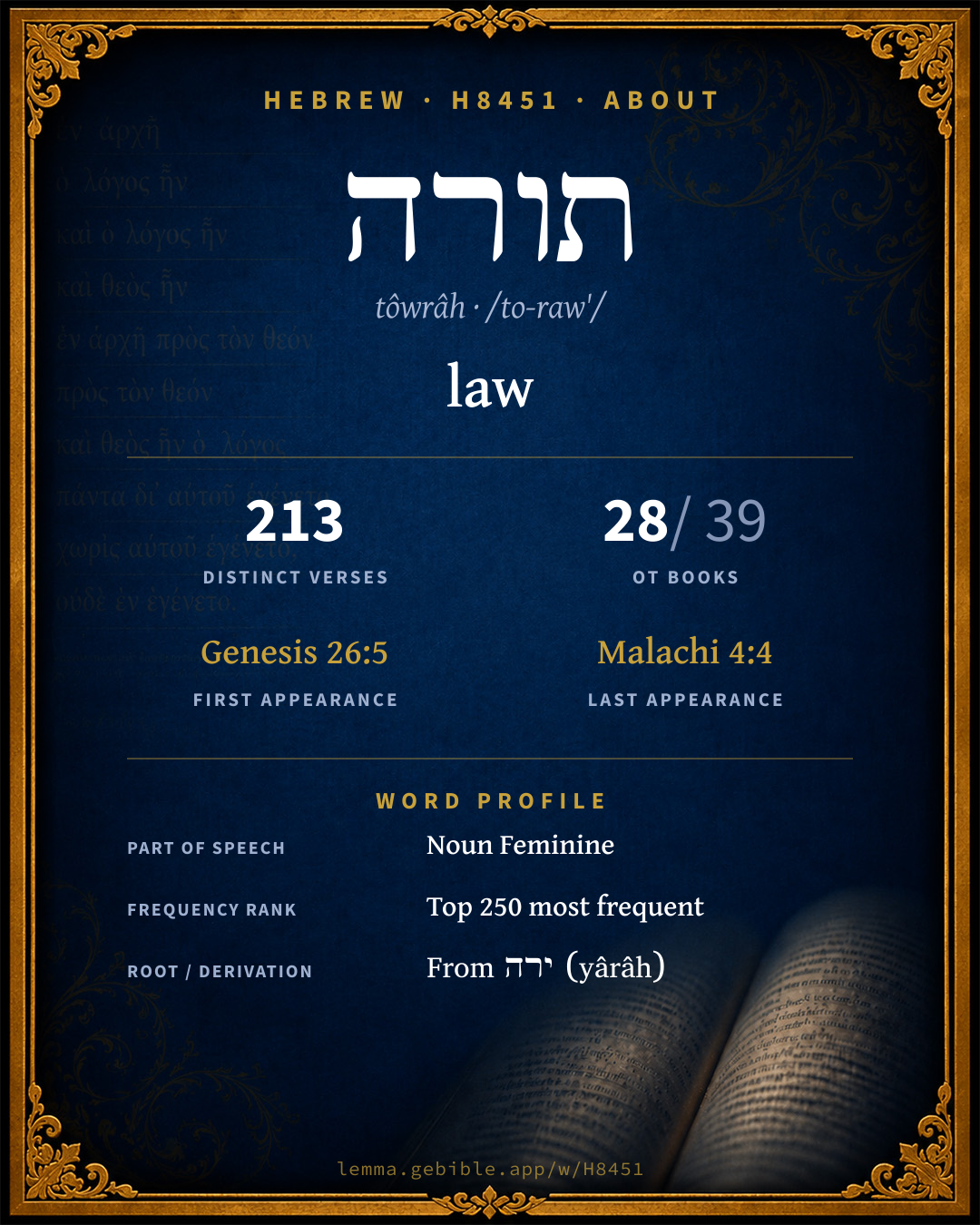
תּוֹרָה
law
also: direction, instruction fuller range ↓
Full lexicon entry — Brown-Driver-Briggs (BDB)
From Brown-Driver-Briggs (BDB)
Where this word appears
See every Absolute-state word in the Hebrew Bible →
Grammar key — what these labels mean
Part of speech
- Noun
- A naming word — a person, place, thing, or idea.
Noun type
- Common
- A common noun — a general class of person, place, or thing (“king,” “city,” “water”), not a specific name.
State
- Absolute
- The independent form of a noun, not bound to a following word.
- Construct
- A noun bound to a following noun in a possessive / “of” relationship (the construct chain).
Gender
- Feminine
- Grammatically feminine.
Number
- Singular
- One.
- Plural
- More than one (in Hebrew, generally three or more).
21 verses where H8451 appears in the Absolute state in the Book of Deuteronomy. Filtered view — show all forms. Click any verse to open its interlinear word-by-word view. Verse text shown in the World English Bible for context — . Each verse’s Hebrew form is shown with its reference; the English is not keyword-highlighted, since the data carries no word-level English alignment. Use “Compare translations” on any verse to read it across multiple English versions. This concordance covers the Hebrew Bible; Septuagint (Greek Old Testament) occurrences are not indexed here.
Deuteronomy
- Deuteronomy 1:5 הַ/תּוֹרָ֥ה ptcl def.art + n c fs Beyond the Jordan, in the land of Moab, began Moses to declare this law, saying,
- Deuteronomy 4:8 הַ/תּוֹרָ֣ה ptcl def.art + n c fs What great nation is there, that has statutes and ordinances so righteous as all this law, which I set before you this day?
- Deuteronomy 4:44 הַ/תּוֹרָ֑ה ptcl def.art + n c fs This is the law which Moses set before the children of Israel:
- Deuteronomy 17:11 הַ/תּוֹרָ֜ה ptcl def.art + n c fs according to the tenor of the law which they shall teach you, and according to the judgment which they shall tell you, you shall do; you shall not turn aside from the sentence which they shall show you, to the right hand, nor to the left.
- Deuteronomy 17:18 הַ/תּוֹרָ֤ה ptcl def.art + n c fs It shall be, when he sits on the throne of his kingdom, that he shall write him a copy of this law in a book, out of [that which is] before the priests the Levites:
- Deuteronomy 17:19 הַ/תּוֹרָ֥ה ptcl def.art + n c fs and it shall be with him, and he shall read therein all the days of his life; that he may learn to fear Yahweh his God, to keep all the words of this law and these statutes, to do them;
- Deuteronomy 27:3 הַ/תּוֹרָ֥ה ptcl def.art + n c fs and you shall write on them all the words of this law, when you are passed over; that you may go in to the land which Yahweh your God gives you, a land flowing with milk and honey, as Yahweh, the God of your fathers, has promised you.
- Deuteronomy 27:8 הַ/תּוֹרָ֥ה ptcl def.art + n c fs You shall write on the stones all the words of this law very plainly.
- Deuteronomy 27:26 הַ/תּוֹרָֽה ptcl def.art + n c fs Cursed be he who doesn't confirm the words of this law to do them. All the people shall say, Amen.
- Deuteronomy 28:58 הַ/תּוֹרָ֣ה ptcl def.art + n c fs If you will not observe to do all the words of this law that are written in this book, that you may fear this glorious and fearful name, YAHWEH YOUR GOD;
- Deuteronomy 28:61 הַ/תּוֹרָ֣ה ptcl def.art + n c fs Also every sickness, and every plague, which is not written in the book of this law, them will Yahweh bring on you, until you are destroyed.
- Deuteronomy 29:21 הַ/תּוֹרָ֖ה ptcl def.art + n c fs Yahweh will set him apart to evil out of all the tribes of Israel, according to all the curses of the covenant that is written in this book of the law.
- Deuteronomy 29:29 הַ/תּוֹרָ֥ה ptcl def.art + n c fs The secret things belong to Yahweh our God; but the things that are revealed belong to us and to our children forever, that we may do all the words of this law.
- Deuteronomy 30:10 הַ/תּוֹרָ֖ה ptcl def.art + n c fs if you shall obey the voice of Yahweh your God, to keep his commandments and his statutes which are written in this book of the law; if you turn to Yahweh your God with all your heart, and with all your soul.
- Deuteronomy 31:9 הַ/תּוֹרָ֣ה ptcl def.art + n c fs Moses wrote this law, and delivered it to the priests the sons of Levi, who bore the ark of the covenant of Yahweh, and to all the elders of Israel.
- Deuteronomy 31:11 הַ/תּוֹרָ֥ה ptcl def.art + n c fs when all Israel is come to appear before Yahweh your God in the place which he shall choose, you shall read this law before all Israel in their hearing.
- Deuteronomy 31:12 הַ/תּוֹרָ֥ה ptcl def.art + n c fs Assemble the people, the men and the women and the little ones, and your foreigner who is within your gates, that they may hear, and that they may learn, and fear Yahweh your God, and observe to do all the words of this law;
- Deuteronomy 31:24 הַ/תּוֹרָֽה ptcl def.art + n c fs It happened, when Moses had made an end of writing the words of this law in a book, until they were finished,
- Deuteronomy 31:26 הַ/תּוֹרָה֙ ptcl def.art + n c fs Take this book of the law, and put it by the side of the ark of the covenant of Yahweh your God, that it may be there for a witness against you.
- Deuteronomy 32:46 הַ/תּוֹרָ֥ה ptcl def.art + n c fs He said to them, Set your heart to all the words which I testify to you this day, which you shall command your children to observe to do, [even] all the words of this law.
- Deuteronomy 33:4 תּוֹרָ֥ה n c fs Moses commanded us a law, An inheritance for the assembly of Jacob.
About this entry
At a glance — auto-summarized from this page’s data, not written by a person. Every figure links to its source below. This summary describes the numbers; it doesn’t interpret them.
The Hebrew noun תורה centers on the idea of “law.” Alongside “law” the lexicon also lists “direction” and “instruction” — part of its full sense range. It turns up in 213 verses across 28 books, a common footprint. Its earliest occurrence is Genesis 26:5. It shares a root with ירה, יורה and מורה. For the data behind this summary, explore the sense tree and the renderings breakdown below.
Gloss history
Strong's 1890 vs modern scholarship
About this word
Strong's H8451 catalogs a Hebrew word from the Hebrew Old Testament.
These counts are not copied from any lexicon or concordance. They are computed here, from the morphology-tagged Hebrew Old Testament. What Lemma adds →
- 213
- distinct verses
- The word appears in 213 distinct verses.
- 28 / 39
- OT books
- The word appears in 28 of 39 Old Testament books.
- #213
- by frequency
- Top 250 most frequent Hebrew words (rank 213 of 8,640 Hebrew words by occurrence).
View all 213 occurrences in the concordance →
Most concentrated in
- Psalms 35 verses 16%
- Deuteronomy 22 verses 10%
- Nehemiah 21 verses 10%
By section of the Old Testament
By traditional corpus
Conventional, traditional groupings — biblical authorship is debated, so this is a traditional corpus grouping, not an authorship claim. Each share is this word’s portion of its verses in that division of the Hebrew canon. Each figure is a share of the word’s 213 distinct verses.
- Writings (Ketuvim) 96 verses · 45%
- Prophets (Nevi'im) 62 verses · 29%
- Torah (Pentateuch) 55 verses · 26%
How translations render this word
Counts come from each version’s own published word-to-Strong’s tagging or interlinear alignment — an approximate guide to how each version renders this word, not a word-level alignment the data otherwise carries. Because each total is that version’s own tagged count, the per-version totals vary from one another and need not match the appearance or distinct-verse counts above. These counts may also differ from a printed concordance because Lemma counts each distinctly tagged rendering and does not collapse phrase taggings into a single head-word total. This is a fixed set of word-tagged versions (KJV, ASV, BSB, ULT) and does not change with the reading translation you choose elsewhere. Each version’s license is shown beside its name below (and on Sources).
- King James Version: Law 160×, Is the law 19×, Laws 11×
- American Standard Version: Law 142×, Is the law 19×, Laws 8×
- Berean Standard Bible: Law 154×, Is the law 19×, Instruction 17×
- unfoldingWord Literal Text: Law 108×, Law of 46×, Teaching 15×
King James Version Public Domain
Renders H8451 across 219 tagged occurrences — most commonly:
Plus 21 renderings that appear only once — usually multi-word phrases or single function words the recovered tagging swept in, not distinct renderings.
American Standard Version Public Domain
Renders H8451 across 219 tagged occurrences — most commonly:
Plus 41 renderings that appear only once — usually multi-word phrases or single function words the recovered tagging swept in, not distinct renderings.
Berean Standard Bible Public Domain
Renders H8451 across 220 tagged occurrences — most commonly:
Plus 6 renderings that appear only once — usually multi-word phrases or single function words the recovered tagging swept in, not distinct renderings.
unfoldingWord Literal Text CC BY-SA 4.0
Renders H8451 across 231 tagged occurrences — most commonly:
Plus 14 renderings that appear only once — usually multi-word phrases or single function words the recovered tagging swept in, not distinct renderings.
10 senses and sub-senses in the full BDB
What do BDB’s symbols mean?
BDB uses these scholarly abbreviations:
| Symbol | Meaning |
|---|---|
| 𝔊 | the Septuagint (the ancient Greek translation, LXX) |
| 𝔙 | the Vulgate (the Latin translation) |
| 𝔖 | the Syriac version (the Peshitta) |
| 𝔗 | the Targum (the Aramaic translation) |
| ψ | the Psalms |
| √ | root (the underlying root or stem) |
| ‖ | parallel passage (a synonymous or contrasted parallel) |
| † | the dagger: every passage where the word occurs is cited |
The 10 senses and sub-senses the full Brown-Driver-Briggs lexicon distinguishes for this word, in lexicon order (not ranked by frequency), with BDB’s own verbatim wording and sub-sense lettering. Shown in Hebrew script with BDB’s own scholarly abbreviations. The condensed entry is in the Lexicon Entry tab. See also the Forms in the corpus table below.
- 1. instruction:
- a. human: of a mother Pr 1:8; 6:20, 23; of a father 3:1; 4:2; 7:2; of sages 13:14; 28:4(×2), 7, 9; 29:18; of a poet ψ 78:1; תּוֹרַת חֶסֶד kind instruction (of a wise wife) Pr 31:26. e.g. Proverbs 1:8
- b. divine ‖ אֲמָרִים Jb 22:22; through his servants Is 30:9 Je 8:8; ‖ אִמְרָה Is 5:24; ‖ דָּבָר Is 1:10; ‖ תְּעוּדָה 8:16, 20; ‖ חָזוֹן La 2:9; pl. תורות Dn 9:10. e.g. Job 22:22
- c. a body of prophetic (or sometimes perhaps priestly) teaching Is 42:21, 24 Je 9:12; 16:11; in the heart Is 51:7 ψ 37:31; 40:9; ‖ משׁפט Hb 1:4; ‖ משׁפטים ψ 89:31; ‖ דְּבָרִים Je 6:19; 26:4 Zc 7:12; ‖ חקים Am 2:4; ‖ חקות Je 44:10, 23; myriads of precepts Ho 8:12. e.g. Isaiah 42:21
- d. instruction in Messianic age Is 2:3 = Mi 4:4, Is 42:4; 51:4 Je 31:33. e.g. Isaiah 2:3
- e. a body of priestly direction or instruction relating to sacred things Ho 4:6 Je 2:8; 18:18 Ez 7:26 Hag 2:11 Mal 2:6, 7, 8, 9 Zp 3:4 Ez 22:26; ‖ לֹא תוֹרָה לֹא כֹּהֵן מוֹרֶה 2 Ch 15:3. e.g. Hosea 4:6
- 2. law (proposes direction): viz.
- a. of special laws, sg. of Feast of Maṣṣoth Ex 13:9 (J), sabbath 16:4 (J); of direction given by priests in partic. case Dt 17:11; of statutes of priest’s code Ex 12:49 (P), Lv 6:2, 7, 18; 7:1, 7, 11, 37; 11:46; 12:7; 13:59; 14:2, 32, 54, 57; 15:32 Nu 5:29, 30; 6:13, 21(×2); 15:16, 29; 19:2, 14; 31:21 (P); תּוֹרַת הַבָּיִת Ez 43:12(×2); בֵּין ת׳ לְמִצְוָה 2 Ch 19:10; pl. תּוֹרוֹת laws, ‖ חקים Ex 18:16, 20 (E; of decisions in civil cases given by Moses), ψ 105:45; ‖ מצות Ex 16:28 (J); ‖ מצות, חקות Gn 26:5 (J); ‖ חקים משׁפטים Lv 26:46 (H); ‖ ברית, חק Is 24:5; ‖ משׁפטים חקים, מצות Ne 9:13; the laws of the new temple Ez 43:11; 44:5, 24; those laws in which men should walk Je 32:23 (Kt). e.g. Exodus 13:9
- b. of codes of law, (1) הַתּוֹרָה as written in the code of the covenant, ‖ הַמִּצְוָה Ex 24:12 (E); ספר תּוֹרַת אלהים Jos 24:26 (E); prob. also Dt 33:4; ‖ משׁפטים v 10, ‖ בְּרִית Ho 8:1 ψ 78:10, ‖ עֵדוּת v 5; (2) the law of the Deuteronomic code, in D and Deuteronomic sections of Kings and sources of Chr., הַתּוֹרָה הַזֹּאת Dt 1:5; 4:8, 44; 17:18; 31:9, 11; דִּבְרֵי הַתּ׳ הזאת 27:26; 31:24, + כל 17:19; 27:3, 8; 28:58; 29:28; 31:12; 32:46; סֵפֶר הַתּ׳ הזאת 28:61; ספר התורה הזה 29:20; 30:10; 31:26 Jos 1:8; ספר התורה 8:34 2 K 22:8 = 2 Ch 34:15; דברי התורה Jos 8:34 2 K 23:24; so התורה אשׁר צוך משׁה Jos 1:7, similarly 22:5 2 K 17:13, 34, 37; 21:8; תּוֹרַת משׁה (ספר) Jos 8:31, 32; 23:6 1 K 2:3 2 K 14:6 = הַתּ׳ בספר מ׳ 2 Ch 25:4, 2 K 23:25; דִּבְרֵי סֵפֶר הַתּ׳ 2 K 22:11 = דברי הַתּ׳ 2 Ch 34:19; תּוֹרַת יהוה 2 K 10:31. It is probable that ת׳ in ψ 1:2(×2); 94:12 and some other parts of Chr., e.g. 1 Ch 22:12 2 Ch 6:16 (= 1 K 8:25 without ת׳), refers to Deuteronomic code. (3) other passages of Chr. may refer to code of D, but most of them certainly refer to the law of the Priests’ code. The same is true of Mal Dn and late ψψ. The phrases are: (ספר) תורת משׁה 2 Ch 23:18; 30:16 Ezr 3:2; 7:6 Ne 8:1 Mal 3:22 Dn 9:11, 13; תורת יהוה (ספר) Ezr 7:10 Ne 9:3 1 Ch 16:40 2 Ch 12:1; 17:9; 31:3, 4; 34:14; 35:26 ψ 19:8; 119:1; (ספר) תורת האלהים Ne 8:18; 10:29, 30; ספר הַתּ׳ 8:3; דִּבְרֵי הַתּ׳ v 9, 13; הַתּוֹרָה 2 Ch 14:3; 31:21; 33:8 Ezr 10:3 Ne 8:2, 7, 14; 10:35, 37; 12:44; 13:3; תּ׳ פִּיךָ ψ 119:72; תורתך Ne 9:26, 29, 34 Dn 9:11 ψ 119:18, 29, 34, 44, 51, 53, 55, 61, 70, 77, 85, 92, 97, 109, 113, 126, 136, 142, 150, 153, 163, 165, 174; תּוֹרָה (indef.) ‖ חקים, מצוות Ne 9:14. e.g. Exodus 24:12
- 3. custom, manner: תּוֹרַת הָאָדָם 2 S 7:19 the manner of man, not of God, i.e. deal with me as man with man, Thes, law for man RV, but EwGesch. iii, 180 reads דּוֹרֹת (וַתַּרְאֵנִי) hast shewed me generations of men; so We Dr.—On ת׳ v. further Dr on Dt 1:10; 24:8; 33:10 and reff. e.g. 2 Samuel 7:19
Senses from the full Brown-Driver-Briggs lexicon (Brown, Driver, Briggs; Oxford 1906 — public domain), digitized via Sefaria, supplemented by the OpenScriptures HebrewLexicon (CC BY 4.0). Full attribution on Sources.
Word origin
n.f. Dt 1:5 direction, instruction, law (poss. in first instance from casting lots, WeG i, 410; H 394 (less confidently WeSkizzen iii, 167), SS SmAT Rel. Gesch. 36 BenzArch. 408 NowArch. ii, 97, opp. by KöOffenb. ii, 347 BaudPriest. 207);—ת׳, Ex 12:49 + 88 times; cstr. תּוֹרַת Ex 13:9 + 65 times; sfs. תּוֹרָתִי ψ 78:1 + 16 times; תֹּרָו֯תְךָ Je 32:23; תֹּרָתוֹ 44:23 + 34 times sfs.; pl. תּוֹרוֹת Ne 9:13; תּוֹרֹת Is 24:5 + 2 times; sf. תּוֹרֹתַי Ez 44:24; תּוֹרֹתָ֯ו 43:11; 44:5 + 5 times sfs.;—
— Brown-Driver-Briggs (Oxford 1906, public domain), digitized via Sefaria, supplemented by the OpenScriptures HebrewLexicon (CC BY 4.0). See Sources.
Derived from ירה (yârâh) (H3384) — to throw.
Jastrow Dictionary
A second Hebrew/Aramaic lexicon for comparison, covering Aramaic and post-biblical (Talmudic, Targumic, Midrashic) usage that the biblical-Hebrew BDB does not. Matched by lemma rather than by Strong’s number, so a lemma may carry more than one Jastrow headword (shown separately below), and the entries cover usage well beyond the Bible.
תּוֹרָה
- 1. teaching, law, esp. ת׳(ה) the Law of Moses, Pentateuch; in gen. the Jewish law, Religion. Ber. 5ᵃ (ref. to Ex. XXIV, 12) ת׳ זה מקרא וכ׳ torah means the Pentateuch, ‘and the mitsvah’ means the Mishnah, ‘which I have written’ means the Phrophets and Hagiographa &c. Ib. כל העוסק בַּתּ׳ וכ׳ he that is engaged in the study of the Law &c., v. בָּדַל. Ib. 6ᵃ דינא נמי היינו ת׳ holding court is also considered a religious act, opp. שלמא בעלמא mere preservation of peace. Ib. 31ᵃ הי ת׳ והי מצוה וכ׳ where is the Law, and where the good deeds, that they may save us? Pes. 87ᵇ שקרוב לשונם ללשון ת׳ because their (the Babylonians’) language comes near the language of the Torah. Meg. 3ᵃ, a. fr. תלמוד ת׳ (abbrev. ת"ת) the study of the Law. Ned. 81ᵃ הזהרו … שמהם תצא ת׳ take heed of the children of the poor, for from them the Law goes forth; a. v. fr.—Gen. R. s. 9, a. fr. בתוֹרָתוֹ של ר׳ מאיר in R. Meir’s (annotated) copy of the Law. Y. Bicc. III, 65ᶜ bot. אין הת׳ עומדת מפני בנה the Torah does not rise before her son, i.e. he that is engaged in the study of the Law need not rise when a scholar passes. Sot. 47ᵇ הת׳ חזרה וכ׳ the Law goes around begging for students.—ת׳ שבכתב, ת׳ שבעל פה, v. כְּתָב.—ספר ת׳, v. סֵפֶר.—תּוֹרַת כהנים, v. כֹּהֵן.—Pl. תּוֹרוֹת. Sabb. 31ᵃ כמה ת׳ יש לכם how many laws have you? Sot. l. c. רבו … ונעשית תורה כשתי ת׳ differences increased in Israel, and the Law became like two laws; a. e.—2) definition, designation; character, nature. Bets. 10ᵃ דאיכא תורת כלי עליו because it bears the denomination of an utensil (v. תּוֹאַר). B. Mets. 62ᵃ בתורת פקדון אתא לידיה it came into his possession as a trust; ib. 62ᵇ בתורת זביני as a sold object. Kidd. 50ᵇ לא נחית לתורת קידושין he had not come down to any form of betrothal (had not done anything to intimate his intention of betrothal); a. fr. e.g. Exodus 24:12
A Dictionary of the Targumim, the Talmud Babli and Yerushalmi, and the Midrashic Literature (Marcus Jastrow; London, Luzac, 1903) — Public Domain. Digitized via Sefaria. Digitized via Sefaria. Full attribution on Sources.
Forms in the corpus
The 117 distinct written forms H8451 takes in the Hebrew Bible, most frequent first — each parse links to that state’s occurrences in the concordance. Hebrew forms include their vowel points and cantillation, so a single lemma takes many written forms.
The 60 most common forms are shown; 57 rarer forms follow in the full concordance.
Same root — word family
Other BDB entries built from the same root as H8451, grouped by Strong’s listed origin. These share a root / origin per the lexicon — not necessarily a shared meaning. Each links to that word’s own entry.
Derives from
Shares the same root
Proper names from this root
People and places named from this root — a name, not an additional meaning of the word.
- יורה Yôwrâh H3139 Jorah
- יורי Yôwray H3140 Jorai
- ירואל Yᵉrûwʼêl H3385 Jeruel
- יריאל Yᵉrîyʼêl H3400 Jeriel
- יריה Yᵉrîyâh H3404 Jerijah
Compare all same-root words → Showing 4 of 9 — not the complete family. 5 of the same-root words are proper names (people or places). They share a root, not necessarily a meaning.
Septuagint verse parallels
This word appears in 158 verses that also exist in the Greek Old Testament (Septuagint), out of the 213 Hebrew verses it occurs in. You can read those verses in Greek by switching the Old Testament edition to the Septuagint.
Read these verses in the Septuagint
- Genesis 26:5
- Exodus 12:49
- Leviticus 6:9
- Numbers 5:29
- Deuteronomy 1:5
- Joshua 1:7
- 1 Kings 2:3
- 2 Kings 10:31
- 1 Chronicles 16:40
- 2 Chronicles 6:16
- Ezra 3:2
- Job 22:22
This is a verse-level parallel only — the same verses exist in both the Hebrew and Greek Old Testaments. No word-level Hebrew↔Greek correspondence is claimed: the data carries no such alignment, so no Greek word is shown as this Hebrew word’s translation. Coverage is not total — the Septuagint omits the deuterocanon and renumbers the Psalms, so some Hebrew verses have no direct Greek parallel.