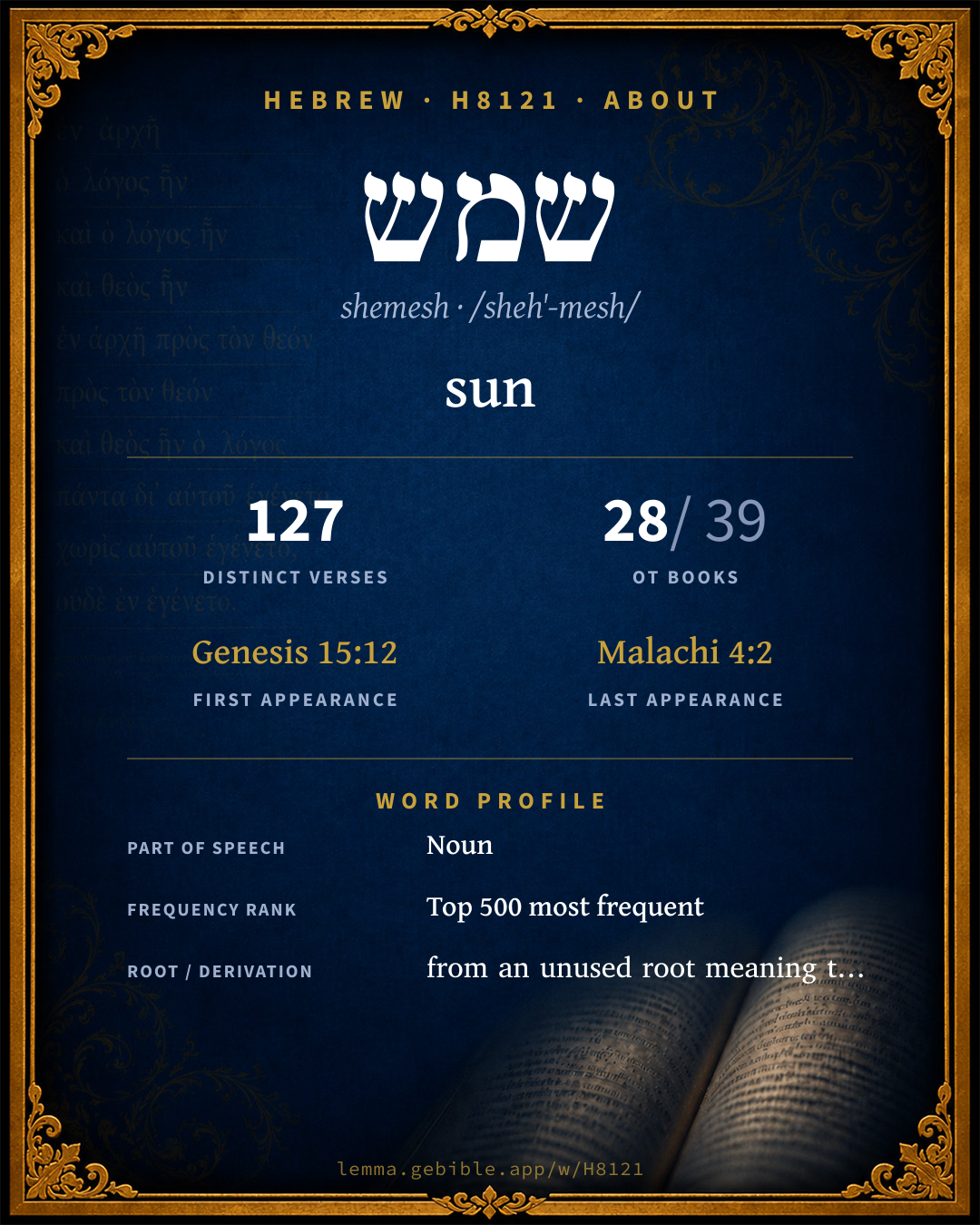
שֶׁ֫מֶשׁ
sun
‘sun’ is one of 5 main senses fuller range ↓
Full lexicon entry — Brown-Driver-Briggs (BDB)
From Brown-Driver-Briggs (BDB)
Where this word appears
Grammar key — what these labels mean
Part of speech
- Noun
- A naming word — a person, place, thing, or idea.
Noun type
- Common
- A common noun — a general class of person, place, or thing (“king,” “city,” “water”), not a specific name.
State
- Absolute
- The independent form of a noun, not bound to a following word.
- Construct
- A noun bound to a following noun in a possessive / “of” relationship (the construct chain).
Gender
- Both
- Attested as both masculine and feminine.
Number
- Singular
- One.
- Plural
- More than one (in Hebrew, generally three or more).
Every verse where H8121 appears in the Book of Ecclesiastes — 32 distinct verses. Click any verse to open its interlinear word-by-word view. Verse text shown in the World English Bible for context — . Each verse’s Hebrew form is shown with its reference; the English is not keyword-highlighted, since the data carries no word-level English alignment. Use “Compare translations” on any verse to read it across multiple English versions. This concordance covers the Hebrew Bible; Septuagint (Greek Old Testament) occurrences are not indexed here.
Ecclesiastes
- Ecclesiastes 1:3 הַ/שָּֽׁמֶשׁ ptcl def.art + n c bs What does man gain from all his labor in which he labors under the sun?
- Ecclesiastes 1:5 הַ/שֶּׁ֖מֶשׁ הַ/שָּׁ֑מֶשׁ ptcl def.art + n c bs ptcl def.art + n c bs The sun also rises, and the sun goes down, and hurries to its place where it rises.
- Ecclesiastes 1:9 הַ/שָּֽׁמֶשׁ ptcl def.art + n c bs That which has been is that which shall be; and that which has been done is that which shall be done: and there is no new thing under the sun.
- Ecclesiastes 1:14 הַ/שָּׁ֑מֶשׁ ptcl def.art + n c bs I have seen all the works that are done under the sun; and, behold, all is vanity and a chasing after wind.
- Ecclesiastes 2:11 הַ/שָּֽׁמֶשׁ ptcl def.art + n c bs Then I looked at all the works that my hands had worked, and at the labor that I had labored to do; and, behold, all was vanity and a chasing after wind, and there was no profit under the sun.
- Ecclesiastes 2:17 הַ/שָּׁ֑מֶשׁ ptcl def.art + n c bs So I hated life, because the work that is worked under the sun was grievous to me; for all is vanity and a chasing after wind.
- Ecclesiastes 2:18 הַ/שָּׁ֑מֶשׁ ptcl def.art + n c bs I hated all my labor in which I labored under the sun, seeing that I must leave it to the man who comes after me.
- Ecclesiastes 2:19 הַ/שָּׁ֑מֶשׁ ptcl def.art + n c bs Who knows whether he will be a wise man or a fool? Yet he will have rule over all of my labor in which I have labored, and in which I have shown myself wise under the sun. This also is vanity.
- Ecclesiastes 2:20 הַ/שָּֽׁמֶשׁ ptcl def.art + n c bs Therefore I began to cause my heart to despair concerning all the labor in which I had labored under the sun.
- Ecclesiastes 2:22 הַ/שָּֽׁמֶשׁ ptcl def.art + n c bs For what has a man of all his labor, and of the striving of his heart, in which he labors under the sun?
- Ecclesiastes 3:16 הַ/שָּׁ֑מֶשׁ ptcl def.art + n c bs Moreover I saw under the sun, in the place of justice, that wickedness was there; and in the place of righteousness, that wickedness was there.
- Ecclesiastes 4:1 הַ/שָּׁ֑מֶשׁ ptcl def.art + n c bs Then I returned and saw all the oppressions that are done under the sun: and, behold, the tears of those who were oppressed, and they had no comforter; and on the side of their oppressors there was power; but they had no comforter.
- Ecclesiastes 4:3 הַ/שָּֽׁמֶשׁ ptcl def.art + n c bs Yes, better than them both is him who has not yet been, who has not seen the evil work that is done under the sun.
- Ecclesiastes 4:7 הַ/שָּֽׁמֶשׁ ptcl def.art + n c bs Then I returned and saw vanity under the sun.
- Ecclesiastes 4:15 הַ/שָּׁ֑מֶשׁ ptcl def.art + n c bs I saw all the living who walk under the sun, that they were with the youth, the other, who succeeded him.
- Ecclesiastes 5:13 הַ/שָּׁ֑מֶשׁ ptcl def.art + n c bs There is a grievous evil which I have seen under the sun: wealth kept by its owner to his harm.
- Ecclesiastes 5:18 הַ/שֶּׁ֗מֶשׁ ptcl def.art + n c bs Behold, that which I have seen to be good and proper is for one to eat and to drink, and to enjoy good in all his labor, in which he labors under the sun, all the days of his life which God has given him; for this is his portion.
- Ecclesiastes 6:1 הַ/שָּׁ֑מֶשׁ ptcl def.art + n c bs There is an evil which I have seen under the sun, and it is heavy on men:
- Ecclesiastes 6:5 שֶׁ֥מֶשׁ n c bs Moreover it has not seen the sun nor known it. This has rest rather than the other.
- Ecclesiastes 6:12 הַ/שָּֽׁמֶשׁ ptcl def.art + n c bs For who knows what is good for man in life, all the days of his vain life which he spends like a shadow? For who can tell a man what will be after him under the sun?
- Ecclesiastes 7:11 הַ/שָּֽׁמֶשׁ ptcl def.art + n c bs Wisdom is as good as an inheritance. Yes, it is more excellent for those who see the sun.
- Ecclesiastes 8:9 הַ/שָּׁ֑מֶשׁ ptcl def.art + n c bs All this have I seen, and applied my mind to every work that is done under the sun. There is a time in which one man has power over another to his hurt.
- Ecclesiastes 8:15 הַ/שֶּׁ֔מֶשׁ הַ/שָּֽׁמֶשׁ ptcl def.art + n c bs ptcl def.art + n c bs Then I commended mirth, because a man has no better thing under the sun, than to eat, and to drink, and to be joyful: for that will accompany him in his labor all the days of his life which God has given him under the sun.
- Ecclesiastes 8:17 הַ/שֶּׁ֔מֶשׁ ptcl def.art + n c bs then I saw all the work of God, that man can't find out the work that is done under the sun, because however much a man labors to seek it out, yet he won't find it. Yes even though a wise man thinks he can comprehend it, he won't be able to find it.
- Ecclesiastes 9:3 הַ/שֶּׁ֔מֶשׁ ptcl def.art + n c bs This is an evil in all that is done under the sun, that there is one event to all: yes also, the heart of the sons of men is full of evil, and madness is in their heart while they live, and after that they go to the dead.
- Ecclesiastes 9:6 הַ/שָּֽׁמֶשׁ ptcl def.art + n c bs Also their love, their hatred, and their envy has perished long ago; neither have they any more a portion forever in anything that is done under the sun.
- Ecclesiastes 9:9 הַ/שֶּׁ֔מֶשׁ הַ/שָּֽׁמֶשׁ ptcl def.art + n c bs ptcl def.art + n c bs Live joyfully with the wife whom you love all the days of your life of vanity, which he has given you under the sun, all your days of vanity: for that is your portion in life, and in your labor in which you labor under the sun.
- Ecclesiastes 9:11 הַ/שֶּׁ֗מֶשׁ ptcl def.art + n c bs I returned, and saw under the sun, that the race is not to the swift, nor the battle to the strong, neither yet bread to the wise, nor yet riches to men of understanding, nor yet favor to men of skill; but time and chance happen to them all.
- Ecclesiastes 9:13 הַ/שָּׁ֑מֶשׁ ptcl def.art + n c bs I have also seen wisdom under the sun in this way, and it seemed great to me.
- Ecclesiastes 10:5 הַ/שָּׁ֑מֶשׁ ptcl def.art + n c bs There is an evil which I have seen under the sun, the sort of error which proceeds from the ruler.
- Ecclesiastes 11:7 הַ/שָּֽׁמֶשׁ ptcl def.art + n c bs Truly the light is sweet, And a pleasant thing it is for the eyes to see the sun.
- Ecclesiastes 12:2 הַ/שֶּׁ֨מֶשׁ֙ ptcl def.art + n c bs Before the sun, the light, the moon, and the stars are darkened, And the clouds return after the rain;
About this entry
At a glance — auto-summarized from this page’s data, not written by a person. Every figure links to its source below. This summary describes the numbers; it doesn’t interpret them.
שמש — transliterated shemesh — is a Hebrew noun carrying the sense “sun.” It is not a single-sense word — see its full sense range. It appears 127 verses across 28 books of the Hebrew Bible, among its common vocabulary. More than a quarter of its appearances fall in Ecclesiastes. Debuting at Genesis 15:12, it then recurs through the corpus. See the sense tree, 127-verse concordance, and the renderings breakdown below.
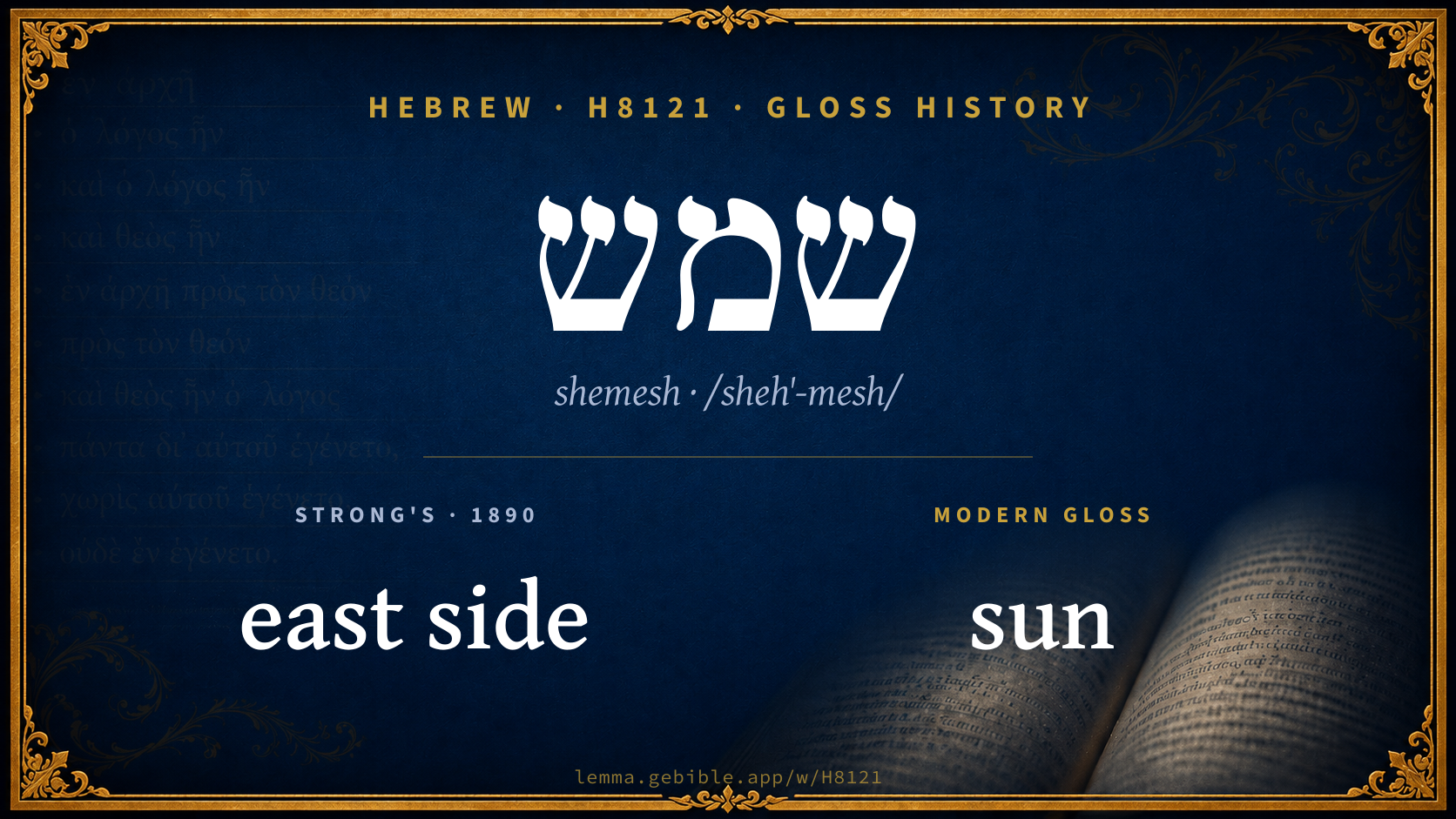
Gloss history
Strong's 1890 vs modern scholarship
About this word
Strong's H8121 catalogs a Hebrew word from the Hebrew Old Testament.
These counts are not copied from any lexicon or concordance. They are computed here, from the morphology-tagged Hebrew Old Testament. What Lemma adds →
- 127
- distinct verses
- The word appears in 127 distinct verses.
- 28 / 39
- OT books
- The word appears in 28 of 39 Old Testament books.
- #332
- by frequency
- Top 500 most frequent Hebrew words (rank 332 of 8,640 Hebrew words by occurrence).
View all 127 occurrences in the concordance →
Most concentrated in
- Ecclesiastes 32 verses 25%
- Psalms 14 verses 11%
- Joshua 12 verses 9%
By section of the Old Testament
By traditional corpus
Conventional, traditional groupings — biblical authorship is debated, so this is a traditional corpus grouping, not an authorship claim. Each share is this word’s portion of its verses in that division of the Hebrew canon. Each figure is a share of the word’s 127 distinct verses.
- Prophets (Nevi'im) 54 verses · 43%
- Writings (Ketuvim) 50 verses · 39%
- Torah (Pentateuch) 23 verses · 18%
How translations render this word
Counts come from each version’s own published word-to-Strong’s tagging or interlinear alignment — an approximate guide to how each version renders this word, not a word-level alignment the data otherwise carries. Because each total is that version’s own tagged count, the per-version totals vary from one another and need not match the appearance or distinct-verse counts above. These counts may also differ from a printed concordance because Lemma counts each distinctly tagged rendering and does not collapse phrase taggings into a single head-word total. This is a fixed set of word-tagged versions (KJV, ASV, BSB, ULT) and does not change with the reading translation you choose elsewhere. Each version’s license is shown beside its name below (and on Sources).
- King James Version: Sun 73×, Under the sun 27×, Before the sun 2×
- American Standard Version: Sun 68×, Under the sun 27×, Before the sun 3×
- Berean Standard Bible: Sun 84×, Sunset 3×, Time the sun 3×
- unfoldingWord Literal Text: Sun 129×, The 2×
King James Version Public Domain
Renders H8121 across 121 tagged occurrences — most commonly:
Plus 15 renderings that appear only once — usually multi-word phrases or single function words the recovered tagging swept in, not distinct renderings. Not rendered by a distinct English word in 13 further occurrences.
American Standard Version Public Domain
Renders H8121 across 121 tagged occurrences — most commonly:
Plus 17 renderings that appear only once — usually multi-word phrases or single function words the recovered tagging swept in, not distinct renderings.
Berean Standard Bible Public Domain
Renders H8121 across 108 tagged occurrences — most commonly:
Plus 14 renderings that appear only once — usually multi-word phrases or single function words the recovered tagging swept in, not distinct renderings. Not rendered by a distinct English word in 26 further occurrences.
unfoldingWord Literal Text CC BY-SA 4.0
Renders H8121 across 135 tagged occurrences — most commonly:
Plus 4 renderings that appear only once — usually multi-word phrases or single function words the recovered tagging swept in, not distinct renderings.
8 senses and sub-senses in the full BDB
What do BDB’s symbols mean?
BDB uses these scholarly abbreviations:
| Symbol | Meaning |
|---|---|
| 𝔊 | the Septuagint (the ancient Greek translation, LXX) |
| 𝔙 | the Vulgate (the Latin translation) |
| 𝔖 | the Syriac version (the Peshitta) |
| 𝔗 | the Targum (the Aramaic translation) |
| ψ | the Psalms |
| √ | root (the underlying root or stem) |
| ‖ | parallel passage (a synonymous or contrasted parallel) |
| † | the dagger: every passage where the word occurs is cited |
The 8 senses and sub-senses the full Brown-Driver-Briggs lexicon distinguishes for this word, in lexicon order (not ranked by frequency), with BDB’s own verbatim wording and sub-sense lettering. Shown in Hebrew script with BDB’s own scholarly abbreviations. The condensed entry is in the Lexicon Entry tab. See also the Forms in the corpus table below.
- 1. sun, Gn 37:9 (E; + moon, stars); marking time: as rising (vb. זָרַח q.v.) Ex 22:2 (E) + 8 times + Mal 3:20 (fig. שׁ׳ צְדָקָה, of reward of the faithful, with wings, i.e. rays? Now GASm; or winged sun-disc [cf. We]?); vb. יָצָא Gn 19:23 (J), Is 13:10; Ju 5:31 (sim. of splendour; v יָצָא 1 f); setting (vb. בּוֹא) Gn 15:17 (J), Am 8:9 + 19 times, + וַיְהִי הַשּׁ׳ לָבוֹא Gn 15:12 (JE), שׁ׳ יָדַע מְבוֹאוֹ ψ 104:19 (v. בּוֹא 1 i, מָבוֹא 2); as giving daylight Is 60:9; hot 1 S 11:9; Ne 7:3; Ex 16:21 (P), cf. Is 49:10; Jon 4:8 ψ 121:6; as ripening crops Dt 33:14 (poem), cf. (fig.) Jb 8:16, tanning the face Ct 1:6; standing still at Joshua’s word Jos 10:12, 13a (poem in J; ‖ יָרֵחַ), v 13b (J), cf. Hb 3:11 (+ יָרֵחַ); casting shadow (on dial), יָֽרְדָה בְמַעֲלוֹת אָחָז בַּשּׁ׳ Is 38:8, וַתָּשָׁב הַשּׁ׳ v 8; set in sky by י׳ Je 31:25 ψ 19:5; 74:16; 136:8, enduring 72:5, 17 (cf. עִם 1 g, p. 768; [פָּנֶה] II. 4 a (e), p. 817), also 89:37; personif., called to praise י׳ 148:3 (+ יָרֵחַ); to be darkened by י׳’s judgment, Ez 32:7; Jo 2:10; 3:4; 4:15 (cf. Am 8:9 supr., Mi 3:6). e.g. Genesis 37:9
- 2. of direction: מִמִּזְרַח הַשּׁ׳ Nu 21:11 (E) toward sun-rise, = East, cf. Dt 4:41, 47 + 16 times (v. מִזְרָח p. 280); מְבוֹא הַשּׁ׳ Dt 11:30 + 3 times (v. מָבוֹא 2, p. 99). e.g. Numbers 21:11
- 3. obj. of worship (usually + moon, stars, etc.) 2 K 23:5; Je 8:2; Ez 8:16; Dt 4:19; horses given to שׁ׳ 2 K 23:11, מַרְכְּבוֹת הַשּׁ׳ v 11.—Vid. also בֵּית שׁ׳ p. 112b. e.g. 2 Kings 23:5
- 4. other phr.:
- a. נֶגֶד הַשּׁ׳, i.e. openly, publicly, 2 S 12:12; Nu 25:4 (P), so לְעֵינֵי הַשּׁ׳ 2 S 12:11. e.g. 2 Samuel 12:12
- b. fig. of living, חָזָה שׁ׳ ψ 58:9, רָאָה שׁ׳ Ex 6:5; 7:11; 11:7, opp. תֶּחְשַׁךְ הַשּׁ׳ 12:2. e.g. Psalms 58:9
- c. תַּחַת הַשּׁ׳, i.e. on the earth, Ec 1:3 + 28 times Ec (cf. Gk. ὑφʼ ἡλίῳ, KueOnd. iii. 196; Eini. iii.192). e.g. Ecclesiastes 1:3
- 5. pinnacle, as glittering, shining, pl. Is 54:12 thy pinnacles, battlements (of Zion), so perhaps sg. שׁ׳ וּמָגֵן י׳ אֱלֹהִים ψ 84:12 battlement and shield is י׳ א׳ (Gr Bae Du Buhl; most sun, and so Thes De Che SS; Hup-Now hesitates). e.g. Isaiah 54:12
Senses from the full Brown-Driver-Briggs lexicon (Brown, Driver, Briggs; Oxford 1906 — public domain), digitized via Sefaria, supplemented by the OpenScriptures HebrewLexicon (CC BY 4.0). Full attribution on Sources.
Word origin
n.f. Ju 19, 14 et m. Gn 19, 23 (Albr ZAW xv (1895), 324) sun;—abs. שׁ׳ Jos 10:12 +, שָׁ֑מֶשׁ Ju 20:43 +; sf. שִׁמְשֵׁךְ Is 60:20, שִׁמְשָׁהּ Je 15:9; pl. sf. שִׁמְשֹׁתַ֫יִךְ Is 54:12;—
— Brown-Driver-Briggs (Oxford 1906, public domain), digitized via Sefaria, supplemented by the OpenScriptures HebrewLexicon (CC BY 4.0). See Sources.
Origin: from an unused root meaning to be brilliant
Jastrow Dictionary
A second Hebrew/Aramaic lexicon for comparison, covering Aramaic and post-biblical (Talmudic, Targumic, Midrashic) usage that the biblical-Hebrew BDB does not. Matched by lemma rather than by Strong’s number, so a lemma may carry more than one Jastrow headword (shown separately below), and the entries cover usage well beyond the Bible.
שָׁמַשׁ
- (Shaf. of מוש, משש)
- 1. [to handle, be busy,] to minister, officiate. Yoma VII, 5 כהן גדול מְשַׁמֵּשׁ וכ׳ the high priest officiates in eight garments, and the common priests in four. Y. ib. 44ᵇ bot. מפני מה אינו משמש וכ׳ why does he not officiate (on the Day of Atonement) dressed in gold? Lev. R. s. 21 מקדש ראשון ע"י שׁשִׁמְּשׁוּ בו וכ׳ during the first Temple, because they ministered in faithfulness, only eighteen high priests officiated in it. Yoma 47ᵃ ש׳ תחתיו officiated in his place. Ib. וכולן שמשו בכהונה וכ׳ and all of them performed the functions of high priesthood. Y. Sot. IX, 24ᵃ אלו שימשו פרנסות the former served in an administrative capacity (not merely as scholars). Tanḥ. Bo 4 חשך ואפלה שמשו … ולא עתידין לשַׁמֵּשׁ ‘darkness and mist’ served (as divine agents) in Egypt, but ‘void and waste’ never served, and never shall serve; Yalk. Is. 360. Gen. R. s. 33, end לא שמשו מזלות וכ׳ the planets did not perform their functions during all the twelve months (of the flood); שמשו אלא … ניכר they did act, only that their mark was not recognizable. Y. Yoma III, 41ᵃ top חמשה … הסגן משמש the Sagan had five functions to perform. Tam. V, 5 שלשה … מְשַׁמֶּשֶׁת it served three purposes. Midd. I, 6 ומה היו מְשַׁמְּשׁוֹת and what were they used for? R. Hash. 3ᵃ כי משמש וכ׳ ki serves for four meanings &c., v. דִּילְמָא I; a. fr.—Euphem. ש׳ מטתו, or only ש׳ to perform the marital duty; in gen. to couple (also of animals). Nidd. 17ᵃ. Ib. II, 1. Bekh. 8ᵃ; Gen. R. s. 20; a. fr.—Mikv. VIII, 4 שִׁמְּשָׁה את ביתה, v. בַּיִת.—Ned. II, 1 קונם שאיני מְשַׁמְּשָׁךְ I vow that I will not have intercourse with thee. Ib. 15ᵇ; Keth. 71ᵇ מְשַׁמַּשְׁתּוֹ she must allow him marital intercourse; a. fr.
- 2. (denom. of שַׁמָּשׁ) to attend, serve, wait upon. Ab. I, 3 המְשַׁמְּשִׁין את הרב, v. עֶבֶד. Sabb. 32ᵇ זוכה ומשמשין לו וכ׳ he will live to see himself waited upon by two thousand … servants. Kidd. 32ᵇ מצינו גדול ממנו שש׳ we find that a greater man than he waited (upon his guests); Yalk. Ex. 229; a. fr.—Esp. (of students) to be in attendance upon a scholar as a disciple. Ber. 47ᵇ אפי׳ … ולא ש׳ תלמידי וכ׳ even if one has studied the Bible and the Mishnah, but has failed to wait upon scholars, he is considered an ʿam haarets (v. אֶרֶץ). Sot. 47ᵇ שלא שִׁימְּשׁוּ כל צורכן who did not wait upon scholars sufficiently. Y. Sabb. X, 12ᶜ bot. שִׁמַּשְׁתִּי את אבא וכ׳, v. יְשִׁיבָה Ib. III, 6ᵃ (in Chald. dict.) ולא שי׳, v. סָבוֹרָא; a. fr.
- (with ב) to be handled, be used for; (of persons) to make use of, be waited upon. Snh. 48ᵇ נ׳ בהן קודש אסור להִשְׁתַּמֵּשׁ בהן חול having once been used for a sacred purpose, it is forbidden to use them for a secular purpose. B. Mets. 84ᵇ כלי שנ׳ … יִשְׁתַּמֵּשׁ בו חול shall a vessel that has been used for a sacred purpose, be used for a profane purpose (i.e. shall I marry one inferior to my first husband)? Midr. Till. to Ps. CXIX, 134 כלי שנ׳ בו מלך וכ׳ a vessel which the king has used &c., v. סָגָן. Ḥull. 60ᵇ שׁיִשְׁתַּמְּשׁוּ בכתר אחד, v. כֶּתֶר. Koh. R. to II, 5 ברוחות … מִשְׁתַּמֵשׁ וכ׳ Solomon made use of the spirits, and he sent to India &c. Ber. 52ᵇ אסור להשתמש בשמש וכ׳ you must not be waited upon by an ignorant waiter. Gen. R. s. 37; Yalk. ib. 62 שהיו מִשְׁתַּמְּשִׁין ברוה"ק (not משמשין) who made use of (acted under) holy inspiration; a. fr.
שְׁמַשׁ
- same, to minister, wait upon. Targ. Gen. XVIII, 8. Targ. I Kings I, 2; 4. Targ. I Sam. I, 3. Targ. Ex. XXVIII, 1; a. fr.—Part. pass. מְשַׁמַּשׁ. Targ. Koh. X, 6 בש׳ באצלחותא וכ׳ (not מְשַׁמֵּשׁ) enjoying happiness from above.—Ab. Zar. 10ᵇ אנטונינוס שַׁמְּשֵׁיה לרבי Antoninus waited upon (entertained) Rabbi; a. e.—Trnsf. to couple. Targ. Y. Lev. XV, 18; a. fr.
- to make use of. Ab. I, 13 ודיִשְׁתַּמַּשׁ בתגא חלף he who makes use of the crown (of the Law) goes to ruin. Meg. 16ᵃ לאו … לאִשְׁתַּמּוּשֵׁי במני וכ׳ it is unbecoming to make use of royal garments in such a condition; a. e.
שַׁמָּשׁ
- (preced.) attendant, servant, waiter. Pes. VII, 13 כשהש׳ עומד וכ׳ when the waiter (at a Passover meal of two parties) rises to serve the wine. Ber. 52ᵇ, v. שָׁמַשׁ; a. fr.—Snh. 59ᵇ חבל על ש׳ גדול וכ׳ woe for the great servant (the most useful instrument of comfort) that was lost to the world! for if the serpent had not been cursed &c.—Euphem. membrum virile. Nidd. 11ᵇ. Ib. 41ᵇ; a. fr.—Pl. שׁמָּשִׁים, שַׁמָּשִׁין. Mekh. Yithro, Baḥod., s. 10; R. Hash. 24ᵇ (ref. to Ex. XX, 23) לא תעשון כדמות שַׁמָּשַׁיי המשמשין לפני וכ׳ you shall not make an image like any of my servants (angels, Ḥayoth &c.) that are in attendance before me on high. Ib. ש׳ שבמדור העליון the servants of the higher dwelling (angels, Ḥayoth &c.); שבמדור התחתון of the lower dwelling (sun, moon &c.); a. e. e.g. Exodus 20:23
שֶׁמֶשׁ
- c. (b. h.;; v. Gen. I, 16 לממשלת וכ׳, a. Targ. Y. ib. I, 18; cmp. R. Hash. 24ᵇ, quot. in preced.) sun. Taan. 8ᵇ ש׳ בשבת וכ׳ sunshine on the Sabbath is a charity to the poor (who are cheered by it). Pes. 2ᵃ זריחת ש׳ וכ׳, v. זְרִיחָה. Mekh. Mishp., s. 13 (ref. to Ex. XXII, 2) וכי הש׳ עליו וכ׳ did the sun shine on him alone? אלא מה ש׳ שלום וכ׳ but (it means,) as the sun signifies peace to the world, so in this case, if it is sure that he has come in peace (without murderous intentions) &c. Gen. R. s. 58, beg. עד שלא ישקיע הקב"ה שִׁמְשׁוֹ וכ׳ before the Lord causes the sun of one righteous man to set, he causes the sun of another to rise. Cant. R. to I, 6 שִׁמְשָׁהּ של ע"ז, v. שָׁזַף; a. fr.—Pl. שְׁמָשׁוֹת.—בין הש׳ (abbrev. בה"ש) [between the two services, between the rulership of the day and that of the night,] at twilight. Sabb. 34ᵇ איזהו בה"ש … כל זמן שפני מזרח וכ׳ what time of the day is called ben-hash-sh’mashoth? From the time that the sun sets (and) as long as the eastern horizon is red (from the reflex); הכסיף … בה"ש when the lower horizon is pale, but the upper horizon is not, it is still ben-hash-sh’mashoth &c.; Y. Ber. I, 2ᵇ bot. Ib. בה"ש כהרף עין, v. הֶרֶף. Ab. V, 6 עשרה … בה"ש ten things were created on the Sabbath eve at twilight; a. fr. e.g. Genesis 1:16
A Dictionary of the Targumim, the Talmud Babli and Yerushalmi, and the Midrashic Literature (Marcus Jastrow; London, Luzac, 1903) — Public Domain. Digitized via Sefaria. Digitized via Sefaria. Full attribution on Sources.
Forms in the corpus
The 41 distinct written forms H8121 takes in the Hebrew Bible, most frequent first — each parse links to that state’s occurrences in the concordance. Hebrew forms include their vowel points and cantillation, so a single lemma takes many written forms.
Same root — word family
Other BDB entries built from the same root as H8121, grouped by Strong’s listed origin. These share a root / origin per the lexicon — not necessarily a shared meaning. Each links to that word’s own entry.
Derived from this word
Proper names from this root
People and places named from this root — a name, not an additional meaning of the word.
Compare all same-root words → Showing 4 of 5 — not the complete family. 2 of the same-root words are proper names (people or places). They share a root, not necessarily a meaning.
Septuagint verse parallels
This word appears in 121 verses that also exist in the Greek Old Testament (Septuagint), out of the 127 Hebrew verses it occurs in. You can read those verses in Greek by switching the Old Testament edition to the Septuagint.
Read these verses in the Septuagint
- Genesis 15:12
- Exodus 16:21
- Leviticus 22:7
- Numbers 21:11
- Deuteronomy 4:19
- Joshua 1:4
- Judges 5:31
- 1 Samuel 11:9
- 2 Samuel 2:24
- 1 Kings 22:36
- 2 Kings 3:22
- 2 Chronicles 18:34
This is a verse-level parallel only — the same verses exist in both the Hebrew and Greek Old Testaments. No word-level Hebrew↔Greek correspondence is claimed: the data carries no such alignment, so no Greek word is shown as this Hebrew word’s translation. Coverage is not total — the Septuagint omits the deuterocanon and renumbers the Psalms, so some Hebrew verses have no direct Greek parallel.