
Ecclesiastes 9:6

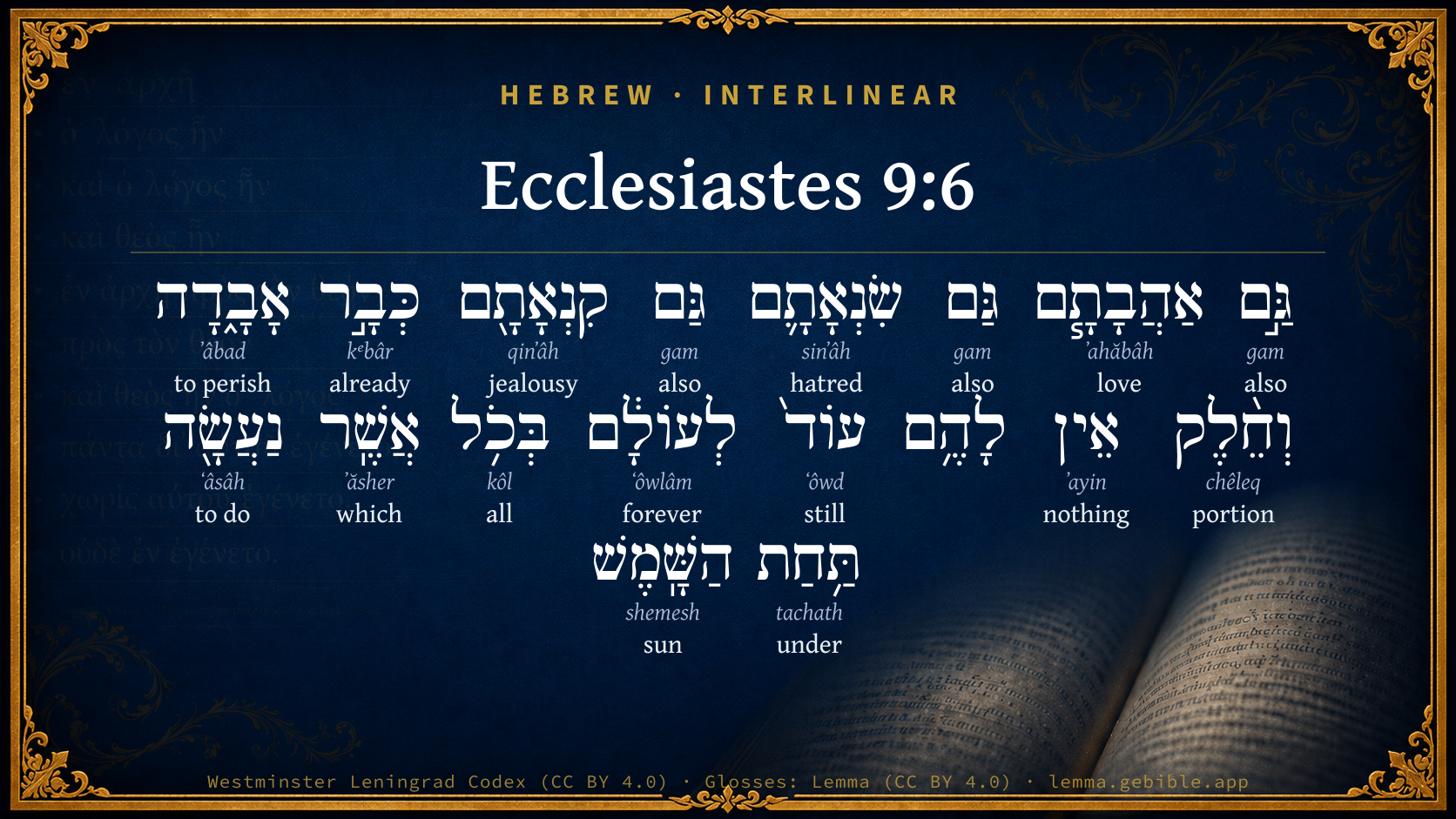
Hebrew (Westminster Leningrad Codex) Ecclesiastes 9:6 appears in the Hebrew Old Testament. The text above is from the Westminster Leningrad Codex. Each word links to its Strong’s number, a concise gloss, and parsing drawn from the Open Scriptures Hebrew Bible morphology. Click any word for its full Brown-Driver-Briggs (BDB) entry.
Download image
Cite this verse

Ecclesiastes 9:6 (World English Bible). Public Domain. Lemma interlinear Bible study tool, https://lemma.gebible.app/v/ecclesiastes/9/6.

Show BibTeX & RIS
BibTeX
RIS
English Translation
Also their love, their hatred, and their envy has perished long ago; neither have they any more a portion forever in anything that is done under the sun.
World English Bible · Public Domain
Download a study sheet

One document with this verse’s original text, its word-by-word gloss line, the meaning frame, cross-references with their text, attributed commentary, and full source and license credits — printable, and it pastes into notes with its structure intact.

This verse Autodidact and up

Study sheet (.html) Plain text (.txt)

A passage Seminary Student

Up to 50 verses in one chapter. A passage sheet keeps up to 6 commentary sources and 12 cross-references per verse, in the order this page ranks them, and says so on the sheet whenever that leaves anything out. Ask for a single verse and you get the Autodidact verse sheet above.

Everything on this page stays free to read, with no account — the sheet is a download of what is already on screen, not access to it.

Want to remove ads? Support Godless Engineer
Compare translations 3

The same verse in 3 English versions, stacked beneath the original-language interlinear above. Click any original word for its lexicon entry.

Each is an independent rendering of the whole verse — the interlinear is not word-aligned to these translations.

Highlighted words mark where these versions differ — a whole-verse word diff, not a word-by-word alignment.

  • World English Bible Public Domain
    Also their love, their hatred, and their envy has perished long ago; neither have they any more a portion forever in anything that is done under the sun.
  • King James Version Public Domain
    Also their love, and their hatred, and their envy, is now perished; neither have they any more a portion for ever in any thing that is done under the sun.
  • unfoldingWord Literal Text CC BY-SA 4.0
    Even their love, even their hate, even their jealousy—already it has perished. And there is not for them a portion any longer in perpetuity among all that is done under the sun.

unfoldingWord Literal Text — © unfoldingWord, licensed CC BY-SA 4.0. Word-aligned USFM3 via Door43 (git.door43.org/unfoldingWord/en_ult).

Versions to compare (up to 4)

3 of 4 selected

Show all 18 translations

Every available English version of this verse, each an independent rendering of the whole verse.

  • World English Bible Public Domain
    Also their love, their hatred, and their envy has perished long ago; neither have they any more a portion forever in anything that is done under the sun.
  • Berean Standard Bible Public Domain
    Their love, their hate, and their envy have already vanished, and they will never again have a share in all that is done under the sun.
  • Majority Standard Bible Public Domain
    Their love, their hate, and their envy have already vanished, and they will never again have a share in all that is done under the sun.
  • King James Version Public Domain
    Also their love, and their hatred, and their envy, is now perished; neither have they any more a portion for ever in any thing that is done under the sun.
  • American Standard Version (1901) Public Domain
    As well their love, as their hatred and their envy, is perished long ago; neither have they any more a portion for ever in anything that is done under the sun.
  • Revised Version (1885) Public Domain
    As well their love, as their hatred and their envy, is now perished; neither have they any more a portion for ever in any thing that is done under the sun.
  • Geneva Bible (1599) Public Domain
    Also their loue, and their hatred, and their enuie is now perished, and they haue no more portion for euer, in all that is done vnder the sunne.
  • Douay-Rheims (1899) Public Domain
    Their love also, and their hatred, and their envy are all perished, neither have they any part in this world, and in the work that is done under the sun.
  • Young's Literal Translation Public Domain
    Their love also, their hatred also, their envy also, hath already perished, and they have no more a portion to the age in all that hath been done under the sun.
  • Literal Standard Version CC BY-SA 4.0
    Their love also, their hatred also, their envy also, has already perished, and they have no more portion for all time in all that has been done under the sun.
  • Unlocked Literal Bible CC BY-SA 4.0
    Their love, hatred, and envy have vanished long ago. They will never have a place again in anything done under the sun.
  • unfoldingWord Literal Text CC BY-SA 4.0
    Even their love, even their hate, even their jealousy—already it has perished. And there is not for them a portion any longer in perpetuity among all that is done under the sun.
  • Darby Bible Public Domain
    Their love also, and their hatred, and their envy is already perished; neither have they any more for ever a portion in all that is done under the sun.
  • World Messianic Bible Public Domain
    Also their love, their hatred, and their envy has perished long ago; neither do they any longer have a portion forever in anything that is done under the sun.
  • Webster's Bible Public Domain
    Also their love, and their hatred, and their envy, hath now perished; neither have they any more a portion for ever in any thing that is done under the sun.
  • Free Bible Version CC BY-SA 4.0
    Their love, hate, and envy—it's all gone. They have no further part in anything that happens here on earth.
  • Bible in Basic English Public Domain
    Their love and their hate and their envy are now ended; and they have no longer a part for ever in anything which is done under the sun.
  • JPS Tanakh (1917) Public Domain
    As well their love, as their hatred and their envy, is long ago perished; neither have they any more a portion for ever in any thing that is done under the sun.

Literal Standard Version (2020), Covenant Press — licensed CC BY-SA 4.0. Text via the HelloAO Bible API (eBible.org). Unlocked Literal Bible (unfoldingWord) — licensed CC BY-SA 4.0. Text via the HelloAO Bible API (eBible.org). unfoldingWord Literal Text — © unfoldingWord, licensed CC BY-SA 4.0. Word-aligned USFM3 via Door43 (git.door43.org/unfoldingWord/en_ult). Free Bible Version, Dr. Jonathan Gallagher — licensed CC BY-SA 4.0. Text via the HelloAO Bible API (eBible.org).

Word by word

More ways to search: Search by grammar → Find every occurrence → Compare this word →

Practice this passage: Drill this verse → Learn its vocabulary →

כְּבָ֣ר
kᵉbâr
H3528
“already”
Adverb
Part of Speech
Adverb
Full BDB Definition

Origin: from H3527

TWOT: 947c

already, long ago, a great while
  1. גַּ֣ם gam H1571 “also” Particle, Accusative
  2. אַהֲבָתָ֧ם ʼahăbâh H160 “love · their” Noun, Common, Feminine, Singular, Construct + Suffix, Personal, 3rd Person, Masculine, Plural
  3. גַּם gam H1571 “also” Particle, Accusative
  4. שִׂנְאָתָ֛ם sinʼâh H8135 “hatred · their” Noun, Common, Feminine, Singular, Construct + Suffix, Personal, 3rd Person, Masculine, Plural
  5. גַּם gam H1571 “also” Particle, Accusative
  6. קִנְאָתָ֖ם qinʼâh H7068 “jealousy · their” Noun, Common, Feminine, Singular, Construct + Suffix, Personal, 3rd Person, Masculine, Plural
  7. אָבָ֑דָה ʼâbad H6 “to perish” Verb, Qal, Perfect, 3rd Person, Feminine, Singular
  8. וְחֵ֨לֶק chêleq H2506 “and · portion” Conjunction + Noun, Common, Masculine, Singular, Absolute
  9. אֵין ʼayin H369 “nothing” Particle, Negative
  10. עוֹד֙ ʻôwd H5750 “still” Adverb
  11. לְעוֹלָ֔ם ʻôwlâm H5769 “to/for · forever” Preposition + Noun, Common, Masculine, Singular, Absolute
  12. בְּכֹ֥ל kôl H3605 “in/at · all” Preposition + Noun, Common, Masculine, Singular, Absolute
  13. אֲשֶֽׁר ʼăsher H834 “which” Particle, Relative
  14. נַעֲשָׂ֖ה ʻâsâh H6213 “to do” Verb, Niphal, Perfect, 3rd Person, Masculine, Singular
  15. תַּ֥חַת tachath H8478 “under” Preposition
  16. הַשָּֽׁמֶשׁ shemesh H8121 “the · sun” Particle, Definite Article + Noun, Common, Both, Singular, Absolute

About this verse

These counts appear in no published source. They are computed here, from the morphology-tagged text and Lemma’s own curated glosses. What Lemma adds →

18
words
15
distinct lemmas
Wisdom
section

Notable vocabulary

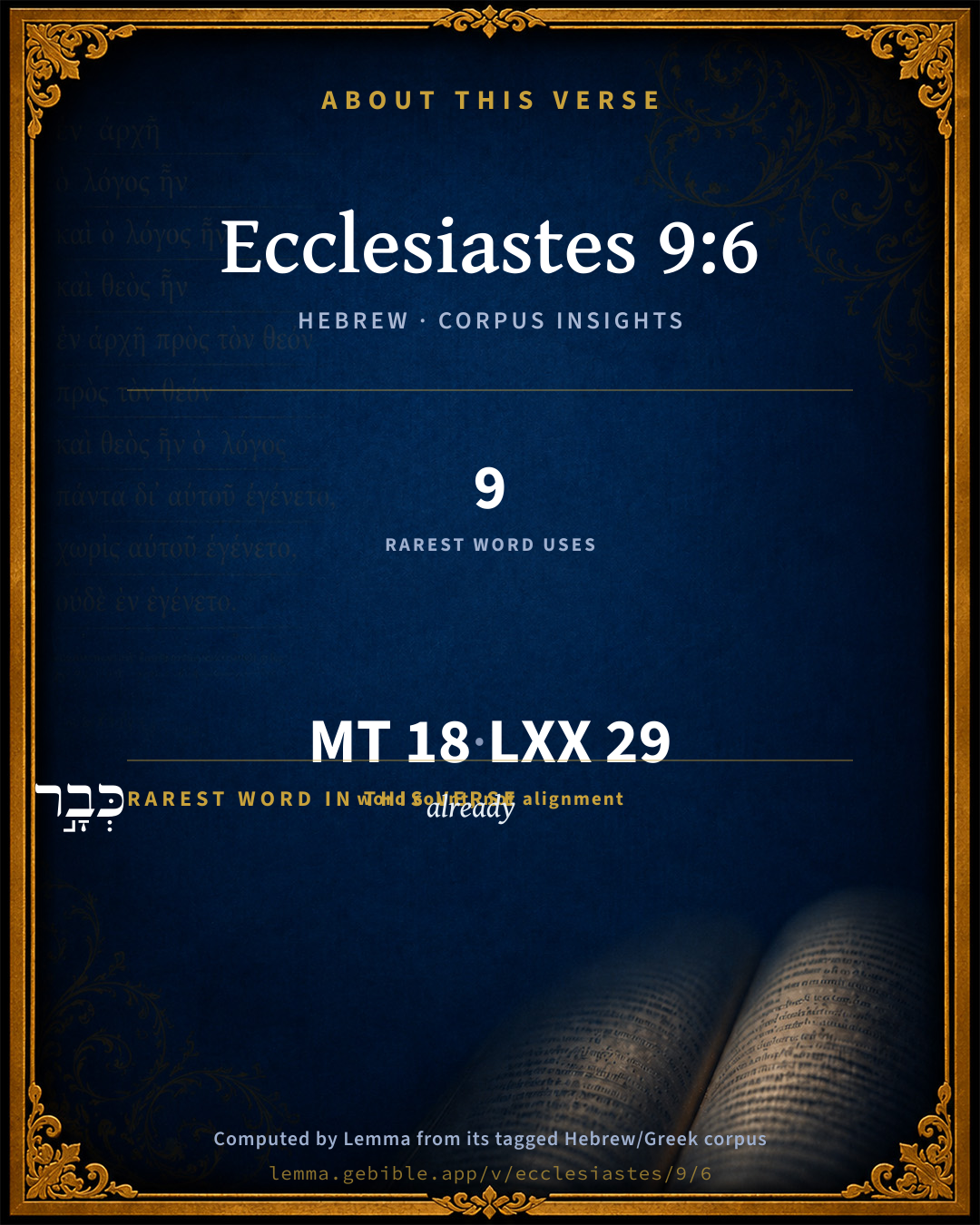
The rarest word here is כְּבָ֣ר already H3528 — appearing just 9 times in the whole Hebrew Bible.

Shared distinctive vocabulary

כְּבָ֣ר already H3528 occurs in 8 verses of the Hebrew Bible. Also found in:

Grammatical profile

  • 2 verbs
  • 7 nouns
  • 2 prepositions
  • 2 adverbs
  • 5 particles

Verb forms

  • אָבָ֑דָה Qal · Perfect
  • נַעֲשָׂ֖ה Niphal · Perfect

Repetition

A word recurs within this verse — often emphatic in Hebrew:

  • גַּ֣ם also H1571 ×3

Hebrew & Septuagint length

In English translation the verse runs 28 words from the Hebrew and 31 from the Septuagint (LXX English) — closely comparable.

A rough comparison of the two English renderings, which tokenize alike — not a word-level alignment.

Word counts can differ between the Hebrew and the Greek without any difference in meaning — e.g. the Hebrew direct-object marker אֵת has no separate Greek word, and Greek often adds the article ὁ.

In the original languages it is 18 Hebrew tokens and 29 Greek tokens — but the two are counted differently (Hebrew bundles its prefixes and suffixes into one token; the Greek is in lemma form), so that isn’t a like-for-like length.

Cross-references

7

Topical passages linked to Ecclesiastes 9:6 in the Treasury of Scripture Knowledge — connected by theme and wording, ordered by reader-vote popularity; previews shown in the World English Bible.

  • Psalms 146:3–4 Don't put your trust in princes, Each a son of man in whom there is no help.
  • Job 3:17–18 There the wicked cease from troubling; There the weary are at rest.
  • Ecclesiastes 6:12 For who knows what is good for man in life, all the days of his vain life which he spends like a shadow? For who can tell a man what will be after him under the sun?
  • Matthew 2:20 "Arise and take the young child and his mother, and go into the land of Israel, for those who sought the young child's life are dead."
  • Exodus 1:8 Now there arose a new king over Egypt, who didn't know Joseph.
  • Proverbs 10:28 The prospect of the righteous is joy, But the hope of the wicked will perish.
  • Ecclesiastes 2:18–23 I hated all my labor in which I labored under the sun, seeing that I must leave it to the man who comes after me.

Cross-references courtesy of OpenBible.info (CC BY 4.0).

Hebrew and Greek witnesses Masoretic Hebrew ↔ Greek Septuagint

The same verse in the two great witnesses to the Old Testament, shown verse-for-verse.

These are two independent witnesses, not word-aligned to each other, and the Septuagint is shown in lemma (dictionary) form.

Hebrew Ecclesiastes 9:6 Masoretic · Westminster Leningrad Codex

גַּ֣ם אַהֲבָתָ֧ם גַּם שִׂנְאָתָ֛ם גַּם קִנְאָתָ֖ם כְּבָ֣ר אָבָ֑דָה וְחֵ֨לֶק אֵין לָהֶ֥ם עוֹד֙ לְעוֹלָ֔ם בְּכֹ֥ל אֲשֶֽׁר נַעֲשָׂ֖ה תַּ֥חַת הַשָּֽׁמֶשׁ

Also their love, their hatred, and their envy has perished long ago; neither have they any more a portion forever in anything that is done under the sun.

World English Bible · Public Domain

Greek LXX Ecclesiastes 9:6 Septuagint · lemma form

καί γέ ἀγάπη αὐτός καί γέ μῖσος αὐτός καί γέ ζῆλος αὐτός ἤδη ἀποὀλλύω καί μερίς οὐ εἰμί αὐτός ἔτι εἰς αἰών ἐν πᾶς ὁ ποιέω ὑπό ὁ ἥλιος

also their love, and their hatred, and their envy, have now perished; yes, there is no portion for them any more for ever in all that is done under the sun.

LXX2012 (modern English Septuagint) · Public Domain

Hebrew: Westminster Leningrad Codex (CC BY 4.0). Greek: Septuagint (public domain); English from LXX2012 (modern English Septuagint) (Public Domain). How the Septuagint differs from the Hebrew →

Commentary

Notes on Ecclesiastes 9:6 from classic Christian and Jewish commentators (each source and its license shown beneath its notes). The classic Christian expositions comment on the surrounding passage and are grouped to its opening verse, so a note may address several verses; the Jewish commentaries on the Tanakh (Rashi and others) are per-verse, so they appear only where the commentator wrote on this verse.

Lemma curates 59 commentaries, every one of them public domain or Creative Commons licensed, each selected and text-cleaned for this edition rather than reprinted as found. About our sources →

Trapp's Complete Commentary

John Trapp

Ecc 9:6 Also their love, and their hatred, and their envy, is now perished; neither have they any more a portion for ever in any [thing] that is done under the sun.

Ver. 6. Also their love and their hatred, &c.] Here is lie upon lie. The atheist, as he had denied knowledge to the dead, so here he denies affections, as love, hatred, envy, or zeal, as Jerome renders it. But it is certain that those that are dead in Jesus do very dearly love God, and hate evil with a perfect hatred. The wicked, on the other side, continue in that other world to hate God and goodness, to love such as themselves are, to stomach the happiness of those in heaven, &c.

John Trapp, A Commentary or Exposition upon All the Books of the Old and New Testament (1647–1656) — public domain. Text from a community e-Sword module.

Jamieson, Fausset & Brown

Robert Jamieson, A. R. Fausset & David Brown

love, and . . . hatred, &c.--(referring to Ecc 9:1; see on Ecc 9:1). Not that these cease in a future world absolutely (Eze 32:27; Rev 22:11); but as the end of this verse shows, relatively to persons and things in this world. Man's love and hatred can no longer be exercised for good or evil in the same way as here; but the fruits of them remain. What he is at death he remains for ever. "Envy," too, marks the wicked as referred to, since it was therewith that they assailed the righteous (see on Ecc 9:1).

portion--Their "portion" was "in this life" (Psa 17:14), that they now "cannot have any more."

Jamieson, Fausset & Brown — Commentary Critical and Explanatory on the Whole Bible (1871) — public domain (CC PDM 1.0). Text via the HelloAO Bible API.

Adam Clarke's Commentary

Verse 6. Also their love, and their hatred] It is evident that he speaks here of the ignorance, want of power, c., of the dead, in reference only to this life. And though they have no more a portion under the sun, yet he does not intimate that they have none anywhere else. A man threatens to conquer kingdoms, &c. He dies what are his threats?

Adam Clarke's Commentary on the Bible (1810–1826) — public domain. Text from a community e-Sword/MySword module.

Ellicott's Commentary for English Readers

(6, 7) Now.—Rather, long ago.

A Bible Commentary for English Readers, edited by Charles John Ellicott (1878–1897) — public domain. Text from a community e-Sword module.

The Cambridge Bible for Schools and Colleges

gen. ed. J. J. S. Perowne

6. Also their love, and their hatred, and their envy, is now perished] The three passions are named as strongest and most vehement in their action. Even these are all hushed in the calm of the grave. There are no passions there, and the deadliest foes, rival statesmen and bitter controversialists, rest side by side together. The thought of the state of the dead stands on nearly the same level as that of the elegy of Hezekiah (Isa_38:9-20).

The Cambridge Bible for Schools and Colleges (gen. ed. J. J. S. Perowne; Cambridge University Press, 1878–1918) — public domain. Text from a community e-Sword module.

John Gill's Exposition

Also their love, and their hatred, and their envy, is now perished,.... Not that the separate spirits of the dead are without their affections, or these unexercised; the spirits of just men made perfect will love God and Christ, and angels, and good men, and all that is good, more intensely; love will continue after this life, and be in its height, and therefore said to be the greatest grace, Co1 13:13; they will hate sin, Satan, and all the enemies of Christ, and be filled with zeal for his glory; so the word (z) for envy may be rendered; see Rev 6:9; and the spirits of the wicked dead will still continue to love sin, and hate the Lord, and envy the happiness of the saints; and will rise again with the same spite and malice against them; see Eze 32:27; but this respects persons and things in this world; they no more love persons and things here, nor are loved by any; death parts the best friends, and the most endearing and loving relations, and puts an end to all their mutual friendship and affection; they hate their enemies no more, nor are hated by them; they no more envy the prosperity of others, nor are envied by others; all such kind of love and hatred, enmity and envy, active or passive, cease at death; out of the world, as the Targum adds;

neither have they any more a portion for ever in any thing that is under the sun: the worldly man's portion is only in this life, and when he dies, he carries nothing of it with him; whose ever his possessions will be at death, they are no more his, nor will he ever return to enjoy them any more; his houses, his lands, his estates, his gold and silver, and whatever of worth and value he had, he has no more lot and part in them: but the good man has a portion above the sun; God is his portion, heaven is his inheritance for ever and ever. The Targum understands it of the wicked;

"and they have no good part with the righteous in the world to come; and they have no profit of all that is done in this world under the sun.''

(z) "aemulatio ipsorum", Cocceius, Gejerus; "aelus eorum", Drusius, Amana, Rambachius.

John Gill's Exposition of the Whole Bible (1746–1763) — public domain (CC PDM 1.0). Text via the HelloAO Bible API.

Matthew Poole's English Annotations

They neither love, nor hate, nor envy any person or thing in this world, but are now altogether unconcerned in all things done under the sun.

In any thing that is done under the sun; in any worldly thing; by which limitation he sufficiently insinuates his belief of their portion in the other world.

Matthew Poole's English Annotations on the Holy Bible (1683–1685) — public domain. Text from a community e-Sword/MySword module.

Whedon's Commentary on the Bible

Daniel D. Whedon

6. Their envy — Better, their zeal. Love, hatred, and zeal are the chief movers of the human breast, but now they are for ever extinguished.

“The loftiest passions and the least

Lie sleeping side by side,

And Love hath reared its staff of rest

Hard by the grave of Pride.”

Daniel D. Whedon (gen. ed.), Commentary on the Old and New Testaments (1874–1909) — public domain. Text from a community e-Sword module.

The Pulpit Commentary

Also their love, and their hatred, and their envy, is now (long ago) perished. All the feelings which are exhibited and developed in the life of the upper world are annihilated (comp. ver. 10). Three are selected as the most potent passions, such as by their strength and activity might ideally be supposed to survive even the stroke of death. But all are now at an end. Neither have they any more a portion forever in any thing that is done under the sun. Between the dead and the living an impassable gulf exists. The view of death here given, intensely gloomy and hopeless as it appears to be, is in conformity with other passages of the Old Testament. (see Job_14:10-14; Psa_6:5 Psa_30:9; Isa_38:10-19 Ecc 17:27, 28 RAPC Bar 3:16-19) and that imperfect dispensation. Koheleth and his contemporaries were of those "who through fear of death were all their lifetime subject to bondage"; (Heb_2:15) it was Christ who brightened the dark valley, showing the blessedness of those who die in the Lord, bringing life and immortality to light through the gospel. (2Ti_1:10) Some expositors have felt the pessimistic utterances of this passage so deeply that they have endeavored to account for them by introducing an atheistic objector, or an intended opposition between flesh and spirit. But there is not a trace of any two such voices, and the suggestion is quite unnecessary. The writer, while believing in the continued existence of the soul, knows little and has little that is cheering to say about it"s condition; and what he does say is not inconsistent with a judgment to come, though he has not yet arrived at the enunciation of this great solution. The Vulgate renders the last clause, Nec habent partem in hoc saeculo et in opere quod sub sole geritur. But "forever" is the correct rendering of and Ginsburg concludes that Jerome"s translation can be traced to the Hagadistic interpretation of the verse which restricts its scope to the wicked The author of the Book of Wisdom, writing later, takes a much more hopeful view of death and the departed. (see Ecc_1:15 Ecc_2:22-24 Ecc_3:1 Ecc_6:1-8 Ecc_8:17, etc.)

The Pulpit Commentary (1880–1919), ed. H.D.M. Spence-Jones & Joseph S. Exell — public domain. Text from a community e-Sword module.

John Wesley's Explanatory Notes

Also - They neither love, nor hate, nor envy any thing in this world, but are unconcerned in what is done under the sun.

John Wesley, Explanatory Notes Upon the Whole Bible (1754–1765) — public domain. Text via the GEBible commentary corpus.

unfoldingWord translationNotes

Door43 World Missions Community

Their love, hatred, and envy

This refers to the love, hatred, and envy that the dead people showed others when they were alive.

anything done

This can be stated in active form. AT: "anything that people do" (See: Active or Passive)

under the sun

This refers to things that are done on earth. See how you translated this in Ecclesiastes 1:3. AT: "on the earth" (See: Idiom)

eat your bread with joy, and drink your wine with a happy heart

These two phrases share similar meanings and emphasize the importance of enjoying the basic activities of life. (See: Parallelism)

your bread

This refers to food in general. AT: "your food" (See: Synecdoche)

drink your wine with a happy heart

Here the word "heart" refers to the emotions. AT: "drink your wine joyfully" (See: Metonymy)

Let your clothes be always white and your head anointed with oil

Wearing white clothes and anointing one's head with oil were both signs of gladness and celebration. (See: Symbolic Action)

your head anointed with oil

This can be stated in active form. AT: "anoint your head with oil" (See: Active or Passive)

translationWords

love

envy

bread

joy

wine

God

good

works

anoint

oil

unfoldingWord translationNotes — © Distant Shores Media and the Door43 World Missions Community, licensed CC BY-SA 4.0. Source: git.door43.org/Door43/en_tn.

Rashi

Rabbi Shlomo Yitzchaki (Rashi)

Also their love that they loved folly and scorn.

as well as their hate that they hated knowledge.

as well as their provocation that they provoked the Holy One, blessed be He, with the deeds of their hands.

and they have no more share, etc. in all that is done, etc. The merit of a son or daughter did not avail those wicked men who worshipped idols, and they have no atonement after death.

Rashi on the Tanakh — English translations: “The Judaica Press complete Tanach with Rashi, translated by A. J. Rosenberg” (CC BY 4.0); “Pentateuch with Rashi's commentary by M. Rosenbaum and A.M. Silbermann, 1929-1934” (public domain); “The Metsudah Tanach series, Lakewood, N.J” (CC BY 4.0); and “The Book of Joshua, Metsudah Publications, 1997” (CC BY 4.0). Text via Sefaria.

Lesson kit

Teaching starters — assembled from the data on this page, not authored interpretation. Every prompt links to the verse data it draws on. Edit before teaching.

Ecclesiastes, in the Wisdom, opens this verse with 18 words (15 distinct Hebrew lemmas). Its most distinctive word is kᵉbâr (“already”). A historical commentator’s framing appears above. Read the whole chapter for the surrounding context.

Discussion questions

  1. How does “already” (kᵉbâr) shape what this verse is saying?
  2. How does Ecclesiastes 1:10, which shares the word «already», read alongside this verse?
  3. What does the repetition of “also” (3× in this one verse) do in this verse?
  4. The translations on this page render this verse differently — a whole-verse word diff, not a word-by-word alignment. What might account for the different wordings?
  5. «אָבָ֑דָה» is a Qal Perfect verb. How does that grammatical form shape the action described?
  6. Compare how Trapp's Complete Commentary and Jamieson, Fausset & Brown read this verse. Where do they agree or differ?

Things to notice

Reading settings

Reading text

Shown beneath each verse's original-language words.

Old Testament
Old Testament edition

Read the OT as the Masoretic Hebrew (MT) or the Greek Septuagint (LXX).

English shown for the Greek Septuagint (in the Hebrew ↔ Greek comparison).

Comparing translations? Open the Compare panel on any verse page to stack up to four side by side.