Isaiah 45:6

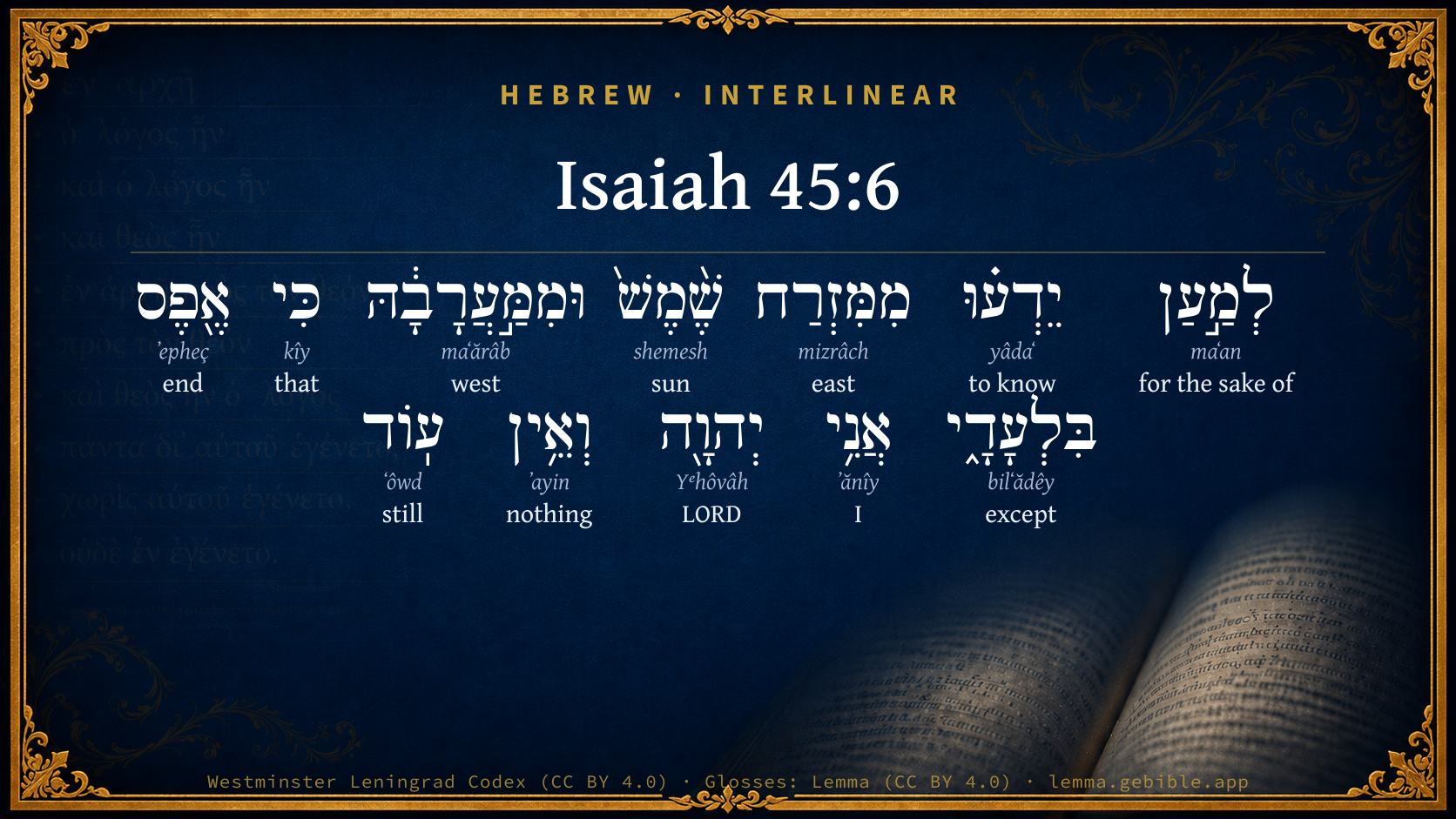
Hebrew (Westminster Leningrad Codex) Isaiah 45:6 appears in the Hebrew Old Testament. The text above is from the Westminster Leningrad Codex. Each word links to its Strong’s number, a concise gloss, and parsing drawn from the Open Scriptures Hebrew Bible morphology. Click any word for its full Brown-Driver-Briggs (BDB) entry.
Download image
Cite this verse

Isaiah 45:6 (World English Bible). Public Domain. Lemma interlinear Bible study tool, https://lemma.gebible.app/v/isaiah/45/6.

Show BibTeX & RIS
BibTeX
RIS
English Translation
that they may know from the rising of the sun, and from the west, that there is none besides me: I am Yahweh, and there is no one else.
World English Bible · Public Domain
Download a study sheet

One document with this verse’s original text, its word-by-word gloss line, the meaning frame, cross-references with their text, attributed commentary, and full source and license credits — printable, and it pastes into notes with its structure intact.

This verse Autodidact and up

Study sheet (.html) Plain text (.txt)

A passage Seminary Student

Up to 50 verses in one chapter. A passage sheet keeps up to 6 commentary sources and 12 cross-references per verse, in the order this page ranks them, and says so on the sheet whenever that leaves anything out. Ask for a single verse and you get the Autodidact verse sheet above.

Everything on this page stays free to read, with no account — the sheet is a download of what is already on screen, not access to it.

Want to remove ads? Support Godless Engineer
Compare translations 3

The same verse in 3 English versions, stacked beneath the original-language interlinear above. Click any original word for its lexicon entry.

Each is an independent rendering of the whole verse — the interlinear is not word-aligned to these translations.

Highlighted words mark where these versions differ — a whole-verse word diff, not a word-by-word alignment.

  • World English Bible Public Domain
    that they may know from the rising of the sun, and from the west, that there is none besides me: I am Yahweh, and there is no one else.
  • King James Version Public Domain
    That they may know from the rising of the sun, and from the west, that there is none beside me. I am the LORD, and there is none else.
  • unfoldingWord Literal Text CC BY-SA 4.0
    so that they may know from the rising of the sun and from its setting that none except me. I Yahweh, and there is no other.

unfoldingWord Literal Text — © unfoldingWord, licensed CC BY-SA 4.0. Word-aligned USFM3 via Door43 (git.door43.org/unfoldingWord/en_ult).

Versions to compare (up to 4)

3 of 4 selected

Show all 18 translations

Every available English version of this verse, each an independent rendering of the whole verse.

  • World English Bible Public Domain
    that they may know from the rising of the sun, and from the west, that there is none besides me: I am Yahweh, and there is no one else.
  • Berean Standard Bible Public Domain
    so that all may know, from where the sun rises to where it sets, that there is none but Me; I am the LORD, and there is no other.
  • Majority Standard Bible Public Domain
    so that all may know, from where the sun rises to where it sets, that there is none but Me; I am the LORD, and there is no other.
  • King James Version Public Domain
    That they may know from the rising of the sun, and from the west, that there is none beside me. I am the LORD, and there is none else.
  • American Standard Version (1901) Public Domain
    that they may know from the rising of the sun, and from the west, that there is none besides me: I am Jehovah, and there is none else.
  • Revised Version (1885) Public Domain
    that they may know from the rising of the sun, and from the west, that there is none beside me: I am the LORD, and there is none else.
  • Geneva Bible (1599) Public Domain
    That they may knowe from the rising of the sunne and from the West, that there is none besides me. I am the Lord, and there is none other.
  • Douay-Rheims (1899) Public Domain
    That they may know who are from the rising of the sun, and they who are from the west, that there is none besides me. I am the Lord, and there is none else:
  • Young's Literal Translation Public Domain
    So that they know from the rising of the sun, And from the west, that there is none besides Me, I `am' Jehovah, and there is none else,
  • Literal Standard Version CC BY-SA 4.0
    So that they know from the rising of the sun, || And from the west, that there is none besides Me, || I [am] YHWH, and there is none else,
  • Unlocked Literal Bible CC BY-SA 4.0
    that people may know from the rising of the sun, and from the west, that there is no god but me: I am Yahweh, and there is no other.
  • unfoldingWord Literal Text CC BY-SA 4.0
    so that they may know from the rising of the sun and from its setting that none except me. I Yahweh, and there is no other.
  • Darby Bible Public Domain
    -- that they may know from the rising of the sun, and from the going down, that there is none beside me. I [am] Jehovah, and there is none else;
  • World Messianic Bible Public Domain
    that they may know from the rising of the sun, and from the west, that there is no one besides me. I am the LORD, and there is no one else.
  • Webster's Bible Public Domain
    That they may know from the rising of the sun, and from the west, that there is none besides me. I am the LORD, and there is none else.
  • Free Bible Version CC BY-SA 4.0
    so that everyone, from the east to the west, will know that there is no God apart from me, that I am the Lord, and there is none apart from me.
  • Bible in Basic English Public Domain
    So that they may see from the east and from the west that there is no God but me: I am the Lord, and there is no other.
  • JPS Tanakh (1917) Public Domain
    That they may know from the rising of the sun, and from the west, that there is none beside Me; I am the LORD; and there is none else;

Literal Standard Version (2020), Covenant Press — licensed CC BY-SA 4.0. Text via the HelloAO Bible API (eBible.org). Unlocked Literal Bible (unfoldingWord) — licensed CC BY-SA 4.0. Text via the HelloAO Bible API (eBible.org). unfoldingWord Literal Text — © unfoldingWord, licensed CC BY-SA 4.0. Word-aligned USFM3 via Door43 (git.door43.org/unfoldingWord/en_ult). Free Bible Version, Dr. Jonathan Gallagher — licensed CC BY-SA 4.0. Text via the HelloAO Bible API (eBible.org).

Word by word

More ways to search: Search by grammar → Find every occurrence → Compare this word →

Practice this passage: Drill this verse → Learn its vocabulary →

וּמִמַּ֣עֲרָבָ֔הּ
maʻărâb
H4628
“and · from · west · her”
Conjunction + Preposition + Noun, Common, Masculine, Singular, Construct + Suffix, Personal, 3rd Person, Feminine, Singular
Part of Speech
Conjunction + Preposition + Noun
Type
Common
Gender
Masculine
Number
Singular
State
Construct
Full BDB Definition

Origin: from H6150 , in the sense of shading

TWOT: 1689b

setting place, west, westward
  1. לְמַ֣עַן maʻan H4616 “for the sake of” Preposition
  2. יֵדְע֗וּ yâdaʻ H3045 “to know” Verb, Qal, Imperfect, 3rd Person, Masculine, Plural
  3. מִמִּזְרַח mizrâch H4217 “from · east of” Preposition + Noun, Common, Masculine, Singular, Construct
  4. שֶׁ֨מֶשׁ֙ shemesh H8121 “sun” Noun, Common, Both, Singular, Absolute
  5. כִּי kîy H3588 “that” Conjunction
  6. אֶ֖פֶס ʼepheç H657 “end” Noun, Common, Masculine, Singular, Absolute
  7. בִּלְעָדָ֑י bilʻădêy H1107 “except · me” Preposition + Suffix, Personal, 1st Person, Common, Singular
  8. אֲנִ֥י ʼănîy H589 “I” Pronoun, Personal, 1st Person, Common, Singular
  9. יְהוָ֖ה Yᵉhôvâh H3068 “LORD” Noun, Proper
  10. וְאֵ֥ין ʼayin H369 “and · nothing” Conjunction + Particle, Negative
  11. עֽוֹד ʻôwd H5750 “still” Adverb

About this verse

These counts appear in no published source. They are computed here, from the morphology-tagged text and Lemma’s own curated glosses. What Lemma adds →

12
words
12
distinct lemmas
Prophets
section

Notable vocabulary

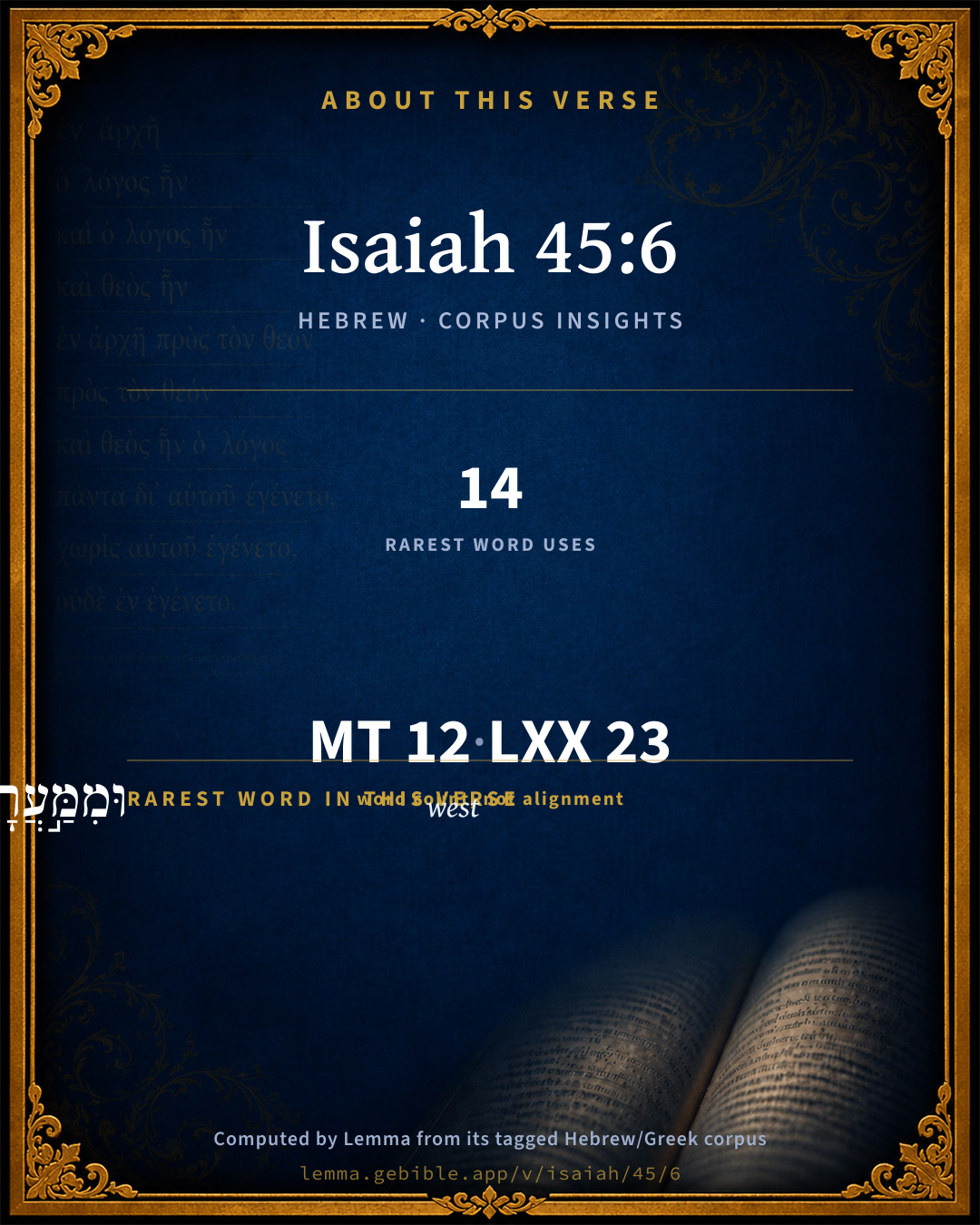
The rarest word here is וּמִמַּ֣עֲרָבָ֔הּ west H4628 — appearing just 14 times in the whole Hebrew Bible.

Shared distinctive vocabulary

וּמִמַּ֣עֲרָבָ֔הּ west H4628 occurs in 14 verses of the Hebrew Bible. Also found in:

Grammatical profile

  • 1 verb
  • 5 nouns
  • 1 pronoun
  • 2 prepositions
  • 1 conjunction
  • 1 adverb
  • 1 particle

Verb forms

  • יֵדְע֗וּ Qal · Imperfect

Hebrew & Septuagint length

In English translation the verse runs 29 words from the Hebrew and 33 from the Septuagint (LXX English) — closely comparable.

A rough comparison of the two English renderings, which tokenize alike — not a word-level alignment.

Word counts can differ between the Hebrew and the Greek without any difference in meaning — e.g. the Hebrew direct-object marker אֵת has no separate Greek word, and Greek often adds the article ὁ.

In the original languages it is 12 Hebrew tokens and 23 Greek tokens — but the two are counted differently (Hebrew bundles its prefixes and suffixes into one token; the Greek is in lemma form), so that isn’t a like-for-like length.

Cross-references

9

Topical passages linked to Isaiah 45:6 in the Treasury of Scripture Knowledge — connected by theme and wording, ordered by reader-vote popularity; previews shown in the World English Bible.

  • Isaiah 45:5 I am Yahweh, and there is none else; besides me there is no God. I will gird you, though you have not known me;
  • Malachi 1:11 For from the rising of the sun even to the going down of the same, my name is great among the nations, and in every place incense will be offered to my name, and a pure offering: for my name is great among the nations," says Yahweh of Hosts.
  • Psalms 46:10 "Be still, and know that I am God. I will be exalted among the nations. I will be exalted in the earth."
  • Isaiah 37:20 Now therefore, Yahweh our God, save us from his hand, that all the kingdoms of the earth may know that you are Yahweh, even you only.
  • Psalms 83:18 That they may know that you alone, whose name is Yahweh, Are the Most High over all the earth.
  • Ezekiel 38:23 I will magnify myself, and sanctify myself, and I will make myself known in the eyes of many nations; and they shall know that I am Yahweh.
  • 1 Samuel 17:46–47 This day will Yahweh deliver you into my hand; and I will strike you, and take your head from off you; and I will give the dead bodies of the host of the Philistines this day to the birds of the sky, and to the wild animals of the earth; that all the earth may know that there is a God in Israel,
  • Psalms 102:15–16 So the nations will fear the name of Yahweh; All the kings of the earth your glory.
  • Ezekiel 39:21 I will set my glory among the nations; and all the nations shall see my judgment that I have executed, and my hand that I have laid on them.

Cross-references courtesy of OpenBible.info (CC BY 4.0).

Hebrew and Greek witnesses Masoretic Hebrew ↔ Greek Septuagint

The same verse in the two great witnesses to the Old Testament, shown verse-for-verse.

These are two independent witnesses, not word-aligned to each other, and the Septuagint is shown in lemma (dictionary) form.

Hebrew Isaiah 45:6 Masoretic · Westminster Leningrad Codex

לְמַ֣עַן יֵדְע֗וּ מִמִּזְרַח שֶׁ֨מֶשׁ֙ וּמִמַּ֣עֲרָבָ֔הּ כִּי אֶ֖פֶס בִּלְעָדָ֑י אֲנִ֥י יְהוָ֖ה וְאֵ֥ין עֽוֹד

that they may know from the rising of the sun, and from the west, that there is none besides me: I am Yahweh, and there is no one else.

World English Bible · Public Domain

Greek LXX Isaiah 45:6 Septuagint · lemma form

ἵνα γιγνώσκω ὁ ἀπό ἀνατολή ἥλιος καί ὁ ἀπό δυσμή ὅτι οὐ εἰμί πλήν ἐγώ ἐγώ κύριος ὁ θεός καί οὐ εἰμί ἔτι

That they that come from the east and they that come from the west may know that there is no God but me. I am the Lord God, and there is none beside.

LXX2012 (modern English Septuagint) · Public Domain

Hebrew: Westminster Leningrad Codex (CC BY 4.0). Greek: Septuagint (public domain); English from LXX2012 (modern English Septuagint) (Public Domain). How the Septuagint differs from the Hebrew →

Targum (Aramaic paraphrase)

1

The Targum is the ancient Jewish Aramaic paraphrase of the Hebrew Scriptures — an interpretive translation, not the Hebrew text itself. Onkelos (literal) and Pseudo-Jonathan (expansive) render the Torah, and Jonathan the Prophets. Coverage is partial: where no permissively-licensed English translation exists for a verse, only the Aramaic is shown. This is verse-level text, not a word-by-word alignment to the Hebrew.

  1. Targum Jonathan Prophets (Joshua–Malachi)
    בְּדִיל דְיֵדְעוּן מִמַדְנַח שִׁמְשָׁא וּמִמַעַרְבָא אֲרֵי לֵית בַּר מִנִי אֲנָא יְיָ וְלֵית עוֹד:

    That they may know from the rising of the sun, and from the west; I am the Lord, and there is none else:

    Targum Jonathan — Aramaic: “Mikraot Gedolot” (public domain). English: “Sefaria Community Translation” (CC0 1.0 (public-domain dedication)); “London "Chaldee Paraphrase," 1871” (public domain). Text via Sefaria.

Commentary

Notes on Isaiah 45:6 from classic Christian and Jewish commentators (each source and its license shown beneath its notes). The classic Christian expositions comment on the surrounding passage and are grouped to its opening verse, so a note may address several verses; the Jewish commentaries on the Tanakh (Rashi and others) are per-verse, so they appear only where the commentator wrote on this verse.

Lemma curates 59 commentaries, every one of them public domain or Creative Commons licensed, each selected and text-cleaned for this edition rather than reprinted as found. About our sources →

Trapp's Complete Commentary

John Trapp

Isa 45:6 That they may know from the rising of the sun, and from the west, that [there is] none beside me. I [am] the LORD, and [there is] none else.

Ver. 6. That they may know from the rising of the sun,] i.e., All the world over, by thy proclamation. {Ezr 1:1-2}

That there is none besides me.] Quia nihilum praeter me: ego Dominus et nihil ultra, so Oecolampadius rendereth it, and saith further that it is oppido profanda sententia, a very profound sentence, teaching us that where God is not, there is nothing; for in him we are, move and live, and it is he who worketh all in all things.

John Trapp, A Commentary or Exposition upon All the Books of the Old and New Testament (1647–1656) — public domain. Text from a community e-Sword module.

The Biblical Illustrator

Joseph S. Exell

Isa_45:6-13

I am the Lord, and there is none else

The beneficent sovereignty of God

The key-thought to all the intricacies of the whole of this passage is that God is the absolute Author of all that exists and the infinite Supreme Ruler of all events; and the implied, though not expressed inference from this claim is, that He is to be absolutely trusted in the matter and manner of Israels redemption from Babylon.

In the 7 th verse, the attitude which the prophet makes the Almighty assume is most absolute. Why summon Cyrus, a heathen prince? Why not one of their own nation, a prince of their own people? The answer to this implied objection is contained in Isa_45:9-11. Woe unto him that striveth with his Maker, &c. Will Israel be more wise than God who made him and the world and rules them in His own manner? The question in the 11 th verse means, Will ye take the disposition of things out of My hands, and direct Me how I am to deal with My own chosen people? The 12 th and 13 th verses are intended to cairn the anxieties of the exiles in reference to Cyrus. He who created all things had also raised up Cyrus, whose victorious career had awakened the fears of the exiles; but Jehovah had in righteousness summoned him to the work, and this was to be the guarantee that Cyrus would build up Jerusalem again, and set the captives free, and that without redemption of money. This whole passage may have its drift and meaning summed up in a single sentence. It is an appeal of God to His people to leave the whole management of their redemption in His hands, and to let His power, wisdom, and righteousness reassure their minds under any difficulties or fears that may trouble them. (C. Short, M. A.)

The Biblical Illustrator, edited by Joseph S. Exell (c. 1880s–1900s) — public domain. Text from a community e-Sword module.

The Preacher's Complete Homiletical Commentary

Joseph S. Exell (gen. ed.)

THE FORMER OF LIGHT AND CREATOR OF DARKNESS

Isa_45:6-7. I am the Lord, and there is none else, &c.

These words occur in the remarkable prophecy of the capture of Babylon by Cyrus; a prophecy fulfilled to the letter.

What was the end proposed in bringing Cyrus to Babylon, and in giving him that empire? The usual answer is, that he might deliver the Jews out of captivity. This is true. But if we rest here, we shall see only a small part of the design of God in this providence. There was a greater end to be answered than even the deliverance of the Jews. It is stated in Isa_45:5-6. The great end of this particular dispensation was to deliver Cyrus and his people from the delusion that there are two eternal and independent Principles, symbolised by Light and Darkness; the one good, and the source of all good; the other evil, and the source of all evil; the one giving blessings to mankind, the other inflicting on them punishments and miseries. Its chief purpose was to bring the inhabitants of all the provinces of the vast Persian empire to know that Jehovah was the Lord, and that beside Him there was no other God.

How was this merciful purpose accomplished? God began in Babylon itself.

1. You recollect the story of the young Hebrews who refused to worship the idol set up there, and were cast into a furnace of fire, from which they were delivered unhurt. We should look beyond that deliverance, great an event as it was in itself, to the end which God intended by it, even to set Himself above the idols of the heathen. The Babylonian idol was put to shame in the presence of its assembled worshippers; and the monarch was led to declare publicly, by a decree, that there was no God like the God of Israel, that could deliver after that sort. All the rulers of the provinces were assembled at that festivity, and what was then done would be spread to the utmost border of Nebuchadnezzar’s dominion.

2. Later on he acknowledged, even more emphatically, that Jehovah is the King of heaven (Dan_4:34-36).

3. Then there was the capture of Babylon, in exact accordance with Isaiah’s prophecy.—With all these things Cyrus and his Persians would be acquainted; and thus they would be taught the great truth, that there is but one God, far above every power, subjecting all things to His control, and who alone ought to be worshipped. To the worshippers of Ormuzd and Ahriman God declares, in our text, that He alone forms the light and creates darkness; that He makes peace and creates evil; that there is no power beside Him; no power co-equal and eternal with Him; that good and evil are but His instruments, and continually subject to His all-controlling power.

Were there any effects of this dispensation of Providence? There were. Cyrus embraced this great truth of the existence of one supreme God, and issued a decree for the rebuilding of the temple at Jerusalem, in terms which acknowledge Jehovah to be the God of heaven and earth, who had spoken by His prophet concerning those very events (Ezr_1:1-3). In the same book we have also decrees of Darius and Artaxerxes, in which, under the appropriate and supreme title of “the God of heaven,” Jehovah is acknowledged as the supreme God. Though the religion of the Persians afterwards became corrupted, it is probable that among them some remained holding the vital truths of piety, even to the days of Christ. “The Magi” who came from the East seeking our Saviour were probably Persians, worshippers of the true God, who, having been instructed especially by the prophecies of Isaiah and Daniel, were waiting for redemption, and expecting the appearance of the Redeemer.

Besides their connection with the history of God’s gracious dealings with man in past times, the words before us contain some great principles that concern us.

I. Take this general principle, “I am the Lord, and there is none else; there is no God beside Me,” and mark a few of the consequences that result from it.

1. As there is one supreme God, whose perfections are infinite, whose glories are unshadowed, our first duty is to keep Him ever in our thoughts, to set the Lord always before us. For this reason, among others, was the Son of God manifested, that our meditations on the Divine character might be more constant and impressive, because brought more within the limits of our conception (H. E. I. 846–848).

2. As there is but one God, so there is but one government and will; and therefore we can be at no loss, when that will is made known to us, to discover the line of duty. Idolaters, acknowledging different rulers among their gods, could have no settled principles. The dominion of one god interfered with that of another. Will was opposed to will, and therefore law to law. To us there is but one God, and therefore but one law. What a foundation for morals does this furnish! and what a foundation for hope! The law comes from an all-perfect Being, and therefore changes not (Psa_119:152). It is for all men alike. It can never be transgressed with impunity. To think that it may be so transgressed is one of the most perilous of all sins (Deu_29:19-20). All its forms are forms of the one great law of love (Mat_22:37-40). And it has its one source in love: “God is love!”

II. We have the declaration, I form the light, and create darkness: I make peace and create evil.” Light is the emblem of good; darkness the emblem of evil According to the opinion of the Persians, these were eternal and independent principles; a system which afforded no hope of deliverance. But here our God declares that both are His, either by formation or permission; both are under His control, and at His disposal.

1. He is the Author of all light or good. All our blessings, spiritual and temporal, come from Him, in the overflowing of His spontaneous bounty. They place us, therefore, under the greatest obligations of gratitude and obedience to Him.

2. The text refers us to darkness or evil.

(1.) Of moral evil He is not the author, but He has permitted it. The heathens knew that it existed, and, unable to account for the fact, invented an eternal being, all evil himself, and the source whence it proceeds. Our Bibles explain this great mystery. We can conceive of two sorts of creatures; either moved by a sort of mechanical impulse, and thus doing what was right, and then what is called virtue could not have existed, and there would have been no more of holiness or virtue in a saint or angel than in the atoms which compose the material universe, moved each to its own place by the appointment of the Divine Will; or possessing will, and sufficient power to choose what is good, and yet liable to the seductions of vice. God chose to create beings of the latter kind. Virtue implies the power of preference and choice, and from the wrong use of this power in creatures whom God endowed with it, evil proceeded. The creature is directly the author of evil; but God has permitted its existence. Even this permission, terrible as it is in its direct consequences, over-ruled for good (H. E. I. 2276–2280).

(2.) As moral evil is by His permission, so natural evil is by His infliction. The miseries which have been the consequences of sin have been so by His appointment. They are all evidences that He hates sin. The various afflictions which come upon men in the course of divine providence are all according to God’s appointment, because He is determined to subject man to a state of discipline in reference to another world. And He has connected inward misery with sin, that it might be felt by us to be “an evil thing and a bitter,” that so we might be constrained to ask for deliverance. It is good for us to feel this.—Richard Watson: Works, vol. viii. pp. 478–494.

This sublime asseveration is true in the realms both of creation and Providence. It is opposed to the Oriental doctrine of two opposite creators, and may have been intended for the benefit of Cyrus, who was probably a disciple of that doctrine. It affirms the opposite doctrine of our Supreme Being. We use the text as affirming God’s supreme disposal of earthly affairs.

I. THE IMPORT OF THE STATEMENT.

It is opposed to the doctrine of two creators in its strong affirmation that whatever is done, of both kinds, is done by the one Being who speaks. And it is opposed to the doctrine that God does not interfere in human affairs; it strongly affirms the contrary, and traces all action to Him. For fuller statements of the truth in both its aspects, such passages may be consulted as Isa_11:12-14; Isa_44:24-28; Act_17:26-28; Mat_6:26-34. With such passages as these in our minds, we shall perceive that the divine activity was concerned in the creation of all things in the material universe, and is concerned in their sustentation and control. We shall perceive that He has to do with the nations of the earth, appointing their position, measuring their prosperity, and directing the circumstances that conduce to it. He separated the Jews from other nations and from the land of Egypt. He gave Nebuchadnezzar his commission in connection with their chastisement and captivity. He appointed Cyrus to be the instrument of their return. We shall perceive that each individual man is the subject of His action. The general management of the world includes the special Providential management of the individual. For the whole of life is composed of its numberless minute circumstances. Birth, infancy, the training which influences character and position, prosperity, adversity, alternate light and darkness, sickness, death, its time and manner, with the causes leading to it—all are in His supreme all-controlling hand.

II. THE SATISFACTORINESS OF THE STATEMENT.

The government of the world is in the best hands.

1. It is in the hands of one Person. Government by one supreme mind is, in itself, the best form of government. Monarchy, with unlimited power in the possession of the monarch, is the ideal government. Why is it desirable and necessary to limit the monarchs of the earth by bringing in other counsellors? Because no man is competent to the task of personal government. If one could be found possessed of wisdom that could make no mistake, equity that could do no wrong, goodness that sought only the well-being of all, and power that could give effect to all his decisions, he he would be fit to govern the world. But no such man can be found. The best is imperfect. And the supremacy might fall into the hands of folly or wickedness. Human rulers must be surrounded, therefore, with the safeguards and limitations that are found necessary in experience. But in God all qualifications meet for the centring in Him of unlimited rulership.

2. It is in the hands of One who possesses the competency to govern without being limited. For the wisdom, power, goodness, and righteousness that are requisite to the uncontrolled universal government are possessed by Him. These attributes are esentially in His nature, and their exercise essential to any action He performs. Therefore He makes no mistakes, therefore no difficulty is insuperable by Him; therefore all His methods are arranged with a view to the general good, even although they may not seem so, as storms bring benefit to the atmosphere, and therefore no injustice is done by Him to any of the creatures that are comprehended in His wide dominion.

3. It is in the hands of One who possesses the right to control human affairs (1Ch_29:11-12). He created. He preserves. Man’s sin has not destroyed God’s governmental right. It has created a necessity for darkness as well as for light. It is for Him to determine the measures of light and darkness that shall brighten or cloud the pathway of every one.

These truths are capable of important uses. Let us—

1. Acknowledge the divine supremacy. It quiets the soul in the experience of life’s alternate light and darkness. Without this, a man feels that he is like a waif on the waters, driven hither and thither without power of effective resistance. He will chafe. With it, he is like a ship under the guidance of a competent captain. Human life becomes entirely different when we are satisfied that its vicissitudes are not the result of accident, but are controlled by the supreme Intelligence.

2. Submit to the divine arrangements. The question is not speculation. It affects our interests and our feelings. Darkness may envelop us, losses may be sustained. Sorrows, some of them deep, heart-rending, long sustained, may be appointed. There may be rebellion in heart. There may be the mere submission of the heathen, which only means that we submit to our lot because resistance is useless. But there may be Christian submission. It proceeds from the heart’s submission to God Himself. It bows to the will of God because of the confidence in the character that directs the will. It is enough to say “the Lord hath done it.” It is satisfied with the voice of Jesus in the storm: “It is I.” Like the great Example, it says, “Not my will, but thine be done, O my Father.”

3. Accept the divine discipline. When the light shines upon our way, let us be glad and thankful. When the darkness gathers, let us ask, “Why should a living man complain, a man for the punishment of his sins?” “What is the sin on account of which the chastisement is sent?” Believers are chastened with a view to their improvement; to the deepening and enrichment of their spiritual life. Many have found their times of trouble times of richest spiritual fruitfulness. And sinners are visited with dark days as warnings. The sickness and sorrow that rend the heart are meant to show the uncertainty and insufficiency of earthly things, and to rend the heart from sin.—J. Rawlinson.

THE ORIGIN OF EVIL

Isa_45:6-7. I am the Lord, and there is none else. I form the light, and create darkness, &c.

This bold unqualified assertion that the Source of all light is also the Fountain of darkness, that evil as well as good is the work of God, must task and perplex every thoughtful mind. No intelligent reader can fail to be struck and impressed by the opening words of the chapter: “Thus saith the Lord to His anointed, to Cyrus.” We have to bear in mind that Cyrus was a Persian. The creed of Cyrus and the Persians, though singularly pure and noble, had one grave defect. They believed in one God indeed, and thought of Him so nobly that their symbol for Him was a circle with wings—the circle to denote the completeness, the perfection, the eternity of God; and the wings His all-pervading presence. But while they believed in one only God (Ahuramazda), the Maker of all that was good, they also, and out of reverence for One to whom they dared not attribute any wrong, believed in an anti-god (Ahriman), whom they made responsible for all that was evil. We may fairly say, that since these words were addressed to a Persian, their main purpose was achieved if they conveyed to him the thought that the universe was not governed by two rival powers, but by one Supreme Person, ever in harmony with Himself, who tolerated and controlled the evil forces of the universe no less than the good, though He did not originate them. But, softened and modified thus, the claim is tremendous; and yet it meets and satisfies the cravings both of intellect and heart as no easier, no dualistic theory does or can do. The intellect demands unity. And how can our hearts be at rest until we know and are sure that God rules over the kingdom of darkness as well as in the kingdom of light? “I am the Lord, and there is none else.” Obviously the words open up the whole question of the existence, the permission, the origination of evil. And, in considering this question, it will be well for us to determine—

I. What, and how much, of the evil that exists we can ourselves honestly attribute directly and immediately to God our Maker.

1. Much of the evil within and around us is of our own making. A large proportion of the pain, loss, and moral defeat of which we are conscious, has sprung from our own follies and faults. After making all due allowance for hereditary bias, for unhappy and unfavourable conditions, for almost irresistible conspiracies of opportunity with inclination, we are conscious of many faults and sins which we might have avoided and ought to have avoided. God forbade the sins into which we fell. His Spirit strove to hold us back from them. We would give in to them, as we now confess with penitent shame. Candour compels us to exonerate Him from all responsibility for the sufferings they have produced.

2. Much of the evil that has lowered and afflicted our lives has been of our neighbours’ making. We inherited, with much that was good, some evil bias from our fathers. We have often had to breathe an atmosphere charged with moral infections from the corrupt habits of the world around us. Our education was not good, or was not wholly good and wise. As we look back and think of all we have lost and suffered, it is probable that we attribute far more of the evils which have fallen on us to men than to God. Here already is an immense deduction. Take away all the wrongs, pains, losses, temptations, sins, which might and would have been avoided had both we and our neighbours done our best to obey the law of conscience even, and how much do we leave? Very much less than we commonly assume.

3. For much that seems evil to us is not really evil, or is not altogether evil. Cyrus and his Persians had such evils as noxious plants and animals, excessive heat and cold, famine, drought, earthquake, storms, disease, and sudden death in their minds mainly when they spoke of the works of Ahriman. But, as we know, these apparent ills are not necessarily ills at all, or they are products of causes which work for good on the whole, or they carry compensations so large that the world would be the poorer for their loss. This point admits of much illustration, e.g., storms destroy, but revivify the air; the struggle for existence among plants and animals evolves their more perfect species, &c. Much that we call evil is even designed and adapted to call our attention to the true order of human life. Those who are driven towards pessimism could hardly do better than rouse themselves to look on human life as a whole.

II. In what sense may we reverently attribute all evil to God? Here we approach a problem which the wise of all ages have pronounced insoluble; and hence it becomes us to move with diffidence, and to bear in mind that the most we can hope to attain is a working hypothesis which will commend itself to our reason, not a final solution of the mystery.

The question with us, after all, is not of what we can discover, but of what God has revealed, of how we are to explain and vindicate a claim which He Himself asserts. Science herself admits that, by a thousand different paths of investigation and thought, it is led to the conclusion that, if there be a God at all, there can be but one God. We see most of God in the highest of His works, i.e., in man, and in that which is highest in man, viz., thought, will, affection. In God we have the creative and Supreme Spirit, Maker of all things, the Fountain of all force, the Administrator of all laws, of whom we frame our highest conception when we think of Him as the Source of all that is noblest in man—as the Infinite Mind, the pure Eternal Will, the absolute Love. This being so, we ask—

1. How did evil arise? For the origin of evil we must go back to the creation of all things. There must have been a time when the Great Creative Spirit dwelt alone. In that Divine solitude the question arose whether a creation should be called into being, and of what kind it should be. What, then, is implied in the very nature of active intelligent creatures such as we are? We would not have had God surround Himself with a merely inanimate world, nor tenant that with mere automata, incapable of a spontaneous and enforced obedience. But, if free to think truly, must not active intelligences be free to think untruly? if free to love, must they not be free not to love? if free to obey, must they not be free to disobey? The very creation of beings in themselves good involves the tremendous risk of their becoming evil.

Must we not go further, and say that it involved a dead certainty, a certainty which must have been foreseen and provided for in the eternal counsels of the Almighty, that in the lapse of ages, with a vast hierarchy of creatures possessed of freewill, some among them would assert and prove their freedom by disobedience? How else could man, e.g., assure himself that he was free? This being so, how long would it be before he put his freedom to the touch? The poet Cowper says: “I could sit at ease and quiet in my chamber all day long; but the moment I knew the door was locked upon me, I should try to get out at all risks.” Free creatures, again, creatures with intelligence, will, passion, are active creatures, and there is something in the very nature of activity which blunts and weakens our sense of inferiority, dependence, accountability. The Bible affirms that what Reason might have anticipated actually took place. It tells us that both in heaven and on earth the creatures God had made did thus fall away from Him. And it moreover asserts, in accord with philosophy and science, that, by their disobedience to the laws of their being and happiness, they jarred themselves into a false and sinister relation to the material universe; that, by introducing moral evil into the creation, they exposed themselves to those physical ills from which we suffer to this day.

2. How may evil be justified? How can we reconcile it at once with God’s perfect goodness and unbounded power? On our hypothesis we reconcile it with His power by the plain and obvious argument that even Omnipotence cannot at once create freewill and not create it. If God made man free to choose evil, how can He possibly compel him to be good except by taking away his freedom of choice and action? But if we would reconcile the existence of evil with the goodness of God—and this is by far the most difficult achievement—we must take the whole theory of human life and destiny taught by the Bible, and not merely a part of it. The Bible teaches that the lines of human life and destiny are to be produced beyond the grave; that while, in large measure, men do receive the due reward of their deeds here and now, yet a more exact retribution will be meted out hereafter—a more abundant reward for all that has been good in us, a more searching punishment of what is evil; that in His compassion God came down to us, virtually saying to us, “I might much more reasonably attribute the evils from which you suffer to you than you to me. But, see, I freely take them all on Myself. I take away the sin of the world by a sacrifice so great, that you can but apprehend it afar off. I foretell a final, a complete victory over it. And, meantime, it shall have no power to hurt you if you will but put your trust in Me.”—Samuel Cox, D.D.: Genesis of Evil (two sermons), pp. 1–41.

The Preacher's Complete Homiletical Commentary (gen. ed. Joseph S. Exell; Funk & Wagnalls, c. 1892) — public domain (pre-1929). A full-Bible homiletical/sermon-outline anthology covering 65 of 66 books (2 John is absent from the source module). Text from a community e-Sword module.

Jamieson, Fausset & Brown

Robert Jamieson, A. R. Fausset & David Brown

From the rising to the setting of the sun, that is, from east to west, the whole habitable world. It is not said, "from north to south," for that would not imply the habitable world, as, "from east to west" does (Ezr 1:1, &c.). The conquest of Jerusalem by Babylon, the capital of the world, and the overthrow of Babylon and restoration of the Jews by Cyrus, who expressly acknowledged himself to be but the instrument in God's hands, were admirably suited to secure, throughout the world, the acknowledgment of Jehovah as the only true God.

Jamieson, Fausset & Brown — Commentary Critical and Explanatory on the Whole Bible (1871) — public domain (CC PDM 1.0). Text via the HelloAO Bible API.

The Cambridge Bible for Schools and Colleges

gen. ed. J. J. S. Perowne

6. The ultimate purpose of the conquest of Cyrus is the universal recognition of the truth asserted in Isa_45:5, the sole divinity of Jehovah.

from the west] Lit. from the going down thereof. (On omission of mappîq see Davidson, Grammar § 19. R. c.)

The Cambridge Bible for Schools and Colleges (gen. ed. J. J. S. Perowne; Cambridge University Press, 1878–1918) — public domain. Text from a community e-Sword module.

John Gill's Exposition

That they may know from the rising of the sun, and from the west,.... That all the inhabitants of the world, from east to west, which takes in the habitable part of the world, that from north to south not being entirely so; that all within this compass, by hearing what great things God did by Cyrus, and for his people, might know, own, and acknowledge,

that there is none besides me: I am the Lord, and there is none else; or, "besides me there is nothing" (l); all creatures are nonentities in comparison of God; and he fills up all places, and everything lives, and moves, and has its being in him; and there is no God, the Lord, the eternal Jehovah, but the one true God, Father, Son, and Spirit.

(l) "quod nihilum absque me", Forerius.

John Gill's Exposition of the Whole Bible (1746–1763) — public domain (CC PDM 1.0). Text via the HelloAO Bible API.

Albert Barnes' Notes on the Bible

That they may know from the rising of the sun, and from the west - This phrase is evidently used here to designate the whole world. Kimchi says, that the reason why the north and the south are not mentioned here is, that the earth from the east to the west is perfectly inhabitable, but not so from the north to the south. That this was accomplished, see Ezr 1:1 ff Cyrus made public proclamation that Yahweh had given him all the kingdoms of the earth, and had commanded him to rebuild the temple in Jerusalem. The purpose of all this arrangement was, to secure the acknowledgment of the truth that Yahweh was the only true God, as extensively as possible. Nothing could be better adapted to this than the actual course of events. For,

1. The conquest of Jerusalem by Nebuchadnezzar was an event which would be extensively known throughout all nations.

2. Babylon was then the magnificent capital of the pagan world, and the kingdom of which it was the center was the most mighty kingdom of the earth.

3. The fact of the conquest of Babylon, and the manner in which it was done, would be known all over that empire, and would attract universal attention. Nothing had ever occurred more remarkable; nothing more fitted to excite the wonder of mankind.

4. The hand of Yahweh was so manifest in this, and the prophecies which had been uttered were so distinctly fulfilled, that Cyrus himself acknowledged that it was of Yahweh. The existence, the name, and the truth of Yahweh became known as far as the name and exploits of Cyrus; and there was a public recognition of the true God by him who had conquered the most mighty capital of the world, and whose opinions and laws were to enter into the constitution of the Medo-Persian empire that was to succeed.

Albert Barnes' Notes on the Bible (1834–1885) — public domain. Text from a community e-Sword/MySword module.

Matthew Poole's English Annotations

That they may know; that all nations may know it by my foretelling of these things so long beforehand, and by the wonderful success that I shall give thee, and by my overruling thins heart, and counsels, and victories, to the deliverance of my people according to my promise.

Matthew Poole's English Annotations on the Holy Bible (1683–1685) — public domain. Text from a community e-Sword/MySword module.

The Pulpit Commentary

That they may know from the rising of the sun. Here we have the third motive of the Divine action respecting Cyrus. The attention of all the world from the extreme east to the extreme west, would be drawn by the wonderful occurrences. Jehovah"s hand in them would be perceived, and his sole Godhead would obtain acknowledgment. An impulse was doubtless given to monotheism by the victories of Cyrus and the favour which he showed the Jews; but it cannot be said to have been very marked. Idolatry and polytheism were to a certain extent discredited; but they maintained their ground nevertheless. It was not till the true "Anointed One" appeared the antitype of whom Cyrus was the type that the idols were "utterly abolished.

Vers. 6-8. An old perplexity.

From very ancient times, through very many generations, there has presented itself to the human mind the perplexity which arises from the antagonism of forces. We find everywhere

I OPPOSITE ASPECTS OF HUMAN LIFE. Here are light and darkness, peace and evil (ver. 7). On the one hand are signs and indications of a marvellous and minute benevolence. In the sea, in the soil, in the forests, in the air, and on the earth; in fish, in insects, in beast, in bird, and, above all, in the life and in the mind of man, are innumerable, inestimable evidences of Divine beneficence. But, on the other hand, there are drawbacks, there are shadows, there are evils, the number of which we cannot count, and the nature of which it is difficult to exaggerate. Pleasure is matched with pain; joy is followed by sorrow; hope is shadowed by fear; peace is waited upon by strife; life is swallowed up by death.

II THE PERPLEXITY THUS OCCASIONED. What is the secret of this strange contradiction? What is the explanation of it? Shall we find intellectual rest in dualism? or shall we fall back upon fate upon the blind action of unintelligent forces? or may we rise to the belief in one overruling God? Who shall read the riddle of the unintelligible world?

III THE ARGUMENT FROM THE ISSUE. Go far enough on, and we shall find that which enlightens and relieves us; we must look to "the end of the Lord". (Jam_5:11) The end of the Lord is found:

1. In righteousness. (Ver. 8.) At last, in the history of men, families, and nations, the pure and just are exalted, while the wicked are consumed and perish.

2. In salvation. (Ver. 8.) To the suffering ones comes rescue from poverty or oppression; to the sinful ones comes redemption from penalty, reinstatement in the home and kingdom of God.

IV THE SATISFYING TRUTH. After all, only one thing will decide the question God"s revealing Word. It was his declaration through the prophets, "I am the Lord;" "I the Lord have created it." It is the word, the life, the work of Jesus Christ, who reveals to us an ever-present, overruling Father of mankind. C.

The Pulpit Commentary (1880–1919), ed. H.D.M. Spence-Jones & Joseph S. Exell — public domain. Text from a community e-Sword module.

John Wesley's Explanatory Notes

That - That all nations may know it by my foretelling these things so long before, and by the wonderful success that I shall give thee, and by my over-ruling thine heart and counsels, to the deliverance of my people.

John Wesley, Explanatory Notes Upon the Whole Bible (1754–1765) — public domain. Text via the GEBible commentary corpus.

J. A. Alexander on Isaiah

Joseph Addison Alexander

“That they may know, from the rising of the sun to the west (or to his going down), that there is none without me; I am Jehovah, and there is no other.” What was said before of Cyrus in particular is now said of men in general, viz. that they must be convinced in this way that the God of Israel is the one true God.

Joseph Addison Alexander, The Prophecies of Isaiah (1846–1847; New York: Scribner, 1870–1878) — public domain. Text from a community e-Sword module.

Ibn Ezra

Rabbi Abraham ibn Ezra

That they may know, etc. I have besides given thee strength, in order that My name shall be known everywhere, that I am alone the Lord, and that there is none beside Me.

Ibn Ezra on the Tanakh — English translations: “Sefaria Community Translation” (CC0 1.0 (public-domain dedication)); “Yalkut, Sifsei Chachomim Chumash, Metsudah Publications, 2009” (CC BY 4.0); and “Commentary of Ibn Ezra on Isaiah - trans. by M. Friedlander, 1873” (public domain). Text via Sefaria.

Lesson kit

Teaching starters — assembled from the data on this page, not authored interpretation. Every prompt links to the verse data it draws on. Edit before teaching.

Isaiah, in the Prophets, opens this verse with 12 words (12 distinct Hebrew lemmas). Its most distinctive word is maʻărâb (“west”). A historical commentator’s framing appears above. Read the whole chapter for the surrounding context.

Discussion questions

  1. How does “west” (maʻărâb) shape what this verse is saying?
  2. 1 Chronicles 7:28 shares the word «west» with this verse. How do the two illuminate each other?
  3. These translations render this verse differently. What is at stake in choosing one wording over another?
  4. The verb «יֵדְע֗וּ» is Qal Imperfect. How does its form color the action?
  5. Reading how Trapp's Complete Commentary and The Biblical Illustrator read this verse, where do the two commentators agree and where do they part?

Things to notice

Reading settings

Reading text

Shown beneath each verse's original-language words.

Old Testament
Old Testament edition

Read the OT as the Masoretic Hebrew (MT) or the Greek Septuagint (LXX).

English shown for the Greek Septuagint (in the Hebrew ↔ Greek comparison).

Comparing translations? Open the Compare panel on any verse page to stack up to four side by side.