
Ecclesiastes 1:5

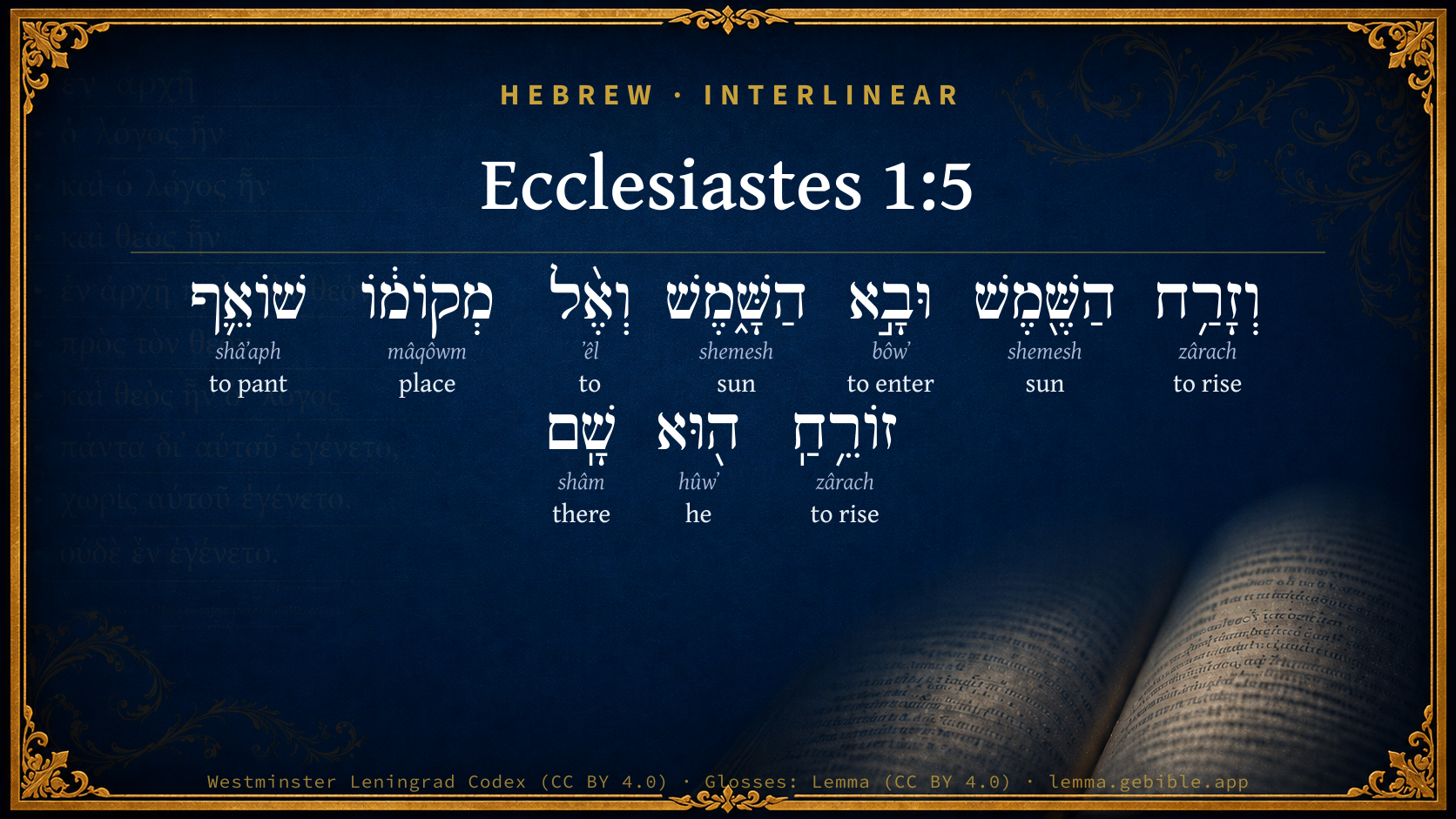
Hebrew (Westminster Leningrad Codex) Ecclesiastes 1:5 appears in the Hebrew Old Testament. The text above is from the Westminster Leningrad Codex. Each word links to its Strong’s number, a concise gloss, and parsing drawn from the Open Scriptures Hebrew Bible morphology. Click any word for its full Brown-Driver-Briggs (BDB) entry.
Download image
Cite this verse

Ecclesiastes 1:5 (World English Bible). Public Domain. Lemma interlinear Bible study tool, https://lemma.gebible.app/v/ecclesiastes/1/5.

Show BibTeX & RIS
BibTeX
RIS
English Translation
The sun also rises, and the sun goes down, and hurries to its place where it rises.
World English Bible · Public Domain
Download a study sheet

One document with this verse’s original text, its word-by-word gloss line, the meaning frame, cross-references with their text, attributed commentary, and full source and license credits — printable, and it pastes into notes with its structure intact.

This verse Autodidact and up

Study sheet (.html) Plain text (.txt)

A passage Seminary Student

Up to 50 verses in one chapter. A passage sheet keeps up to 6 commentary sources and 12 cross-references per verse, in the order this page ranks them, and says so on the sheet whenever that leaves anything out. Ask for a single verse and you get the Autodidact verse sheet above.

Everything on this page stays free to read, with no account — the sheet is a download of what is already on screen, not access to it.

Want to remove ads? Support Godless Engineer
Compare translations 3

The same verse in 3 English versions, stacked beneath the original-language interlinear above. Click any original word for its lexicon entry.

Each is an independent rendering of the whole verse — the interlinear is not word-aligned to these translations.

Highlighted words mark where these versions differ — a whole-verse word diff, not a word-by-word alignment.

  • World English Bible Public Domain
    The sun also rises, and the sun goes down, and hurries to its place where it rises.
  • King James Version Public Domain
    The sun also ariseth, and the sun goeth down, and hasteth to his place where he arose.
  • unfoldingWord Literal Text CC BY-SA 4.0
    And the sun rises and the sun sets; and to its place, panting, it is rising there.

unfoldingWord Literal Text — © unfoldingWord, licensed CC BY-SA 4.0. Word-aligned USFM3 via Door43 (git.door43.org/unfoldingWord/en_ult).

Versions to compare (up to 4)

3 of 4 selected

Show all 18 translations

Every available English version of this verse, each an independent rendering of the whole verse.

  • World English Bible Public Domain
    The sun also rises, and the sun goes down, and hurries to its place where it rises.
  • Berean Standard Bible Public Domain
    The sun rises and the sun sets; it hurries back to where it rises.
  • Majority Standard Bible Public Domain
    The sun rises and the sun sets; it hurries back to where it rises.
  • King James Version Public Domain
    The sun also ariseth, and the sun goeth down, and hasteth to his place where he arose.
  • American Standard Version (1901) Public Domain
    The sun also ariseth, and the sun goeth down, and hasteth to its place where it ariseth.
  • Revised Version (1885) Public Domain
    The sun also ariseth, and the sun goeth down, and hasteth to his place where he ariseth.
  • Geneva Bible (1599) Public Domain
    The sunne riseth, and ye sunne goeth downe, and draweth to his place, where he riseth.
  • Douay-Rheims (1899) Public Domain
    The sun riseth, and goeth down, and returneth to his place: and there rising again,
  • Young's Literal Translation Public Domain
    Also, the sun hath risen, and the sun hath gone in, and unto its place panting it is rising there.
  • Literal Standard Version CC BY-SA 4.0
    Also, the sun has risen, and the sun has gone in, and to its place panting it is rising there.
  • Unlocked Literal Bible CC BY-SA 4.0
    The sun rises, and it goes down and hurries back to the place where it rises again.
  • unfoldingWord Literal Text CC BY-SA 4.0
    And the sun rises and the sun sets; and to its place, panting, it is rising there.
  • Darby Bible Public Domain
    The sun also riseth, and the sun goeth down, and hasteth to its place where it ariseth.
  • World Messianic Bible Public Domain
    The sun also rises, and the sun goes down, and hurries to its place where it rises.
  • Webster's Bible Public Domain
    The sun also riseth, and the sun goeth down, and hasteth to his place where he arose.
  • Free Bible Version CC BY-SA 4.0
    The sun comes up, and the sun goes down, and then rushes to its place to rise again.
  • Bible in Basic English Public Domain
    The sun comes up and the sun goes down, and goes quickly back to the place where he came up.
  • JPS Tanakh (1917) Public Domain
    The sun also ariseth, and the sun goeth down, and hasteth to his place where he ariseth.

Literal Standard Version (2020), Covenant Press — licensed CC BY-SA 4.0. Text via the HelloAO Bible API (eBible.org). Unlocked Literal Bible (unfoldingWord) — licensed CC BY-SA 4.0. Text via the HelloAO Bible API (eBible.org). unfoldingWord Literal Text — © unfoldingWord, licensed CC BY-SA 4.0. Word-aligned USFM3 via Door43 (git.door43.org/unfoldingWord/en_ult). Free Bible Version, Dr. Jonathan Gallagher — licensed CC BY-SA 4.0. Text via the HelloAO Bible API (eBible.org).

Word by word

More ways to search: Search by grammar → Find every occurrence → Compare this word →

Practice this passage: Drill this verse → Learn its vocabulary →

שׁוֹאֵ֛ף
shâʼaph
H7602
“panting”
Verb, Qal, Participle Active, Masculine, Singular, Absolute
Part of Speech
Verb
Stem
Qal
Form
Participle Active
Gender
Masculine
Number
Singular
State
Absolute
Full BDB Definition

Origin: a primitive root

TWOT: 2305 , 2306

to gasp, pant, pant after, long for, breathe heavily - (Qal) - to gasp, pant after, snuff up - to gasp or pant (with desire), pant after, be eager for - to thirst for one's blood (from actions of animals) (figuratively) - to crush, trample, trample upon - (Qal) to trample upon, crush
  1. וְזָרַ֥ח zârach H2224 “and · to rise” Conjunction + Verb, Qal, Sequential Perfect, 3rd Person, Masculine, Singular
  2. הַשֶּׁ֖מֶשׁ shemesh H8121 “the · sun” Particle, Definite Article + Noun, Common, Both, Singular, Absolute
  3. וּבָ֣א bôwʼ H935 “and · to enter” Conjunction + Verb, Qal, Sequential Perfect, 3rd Person, Masculine, Singular
  4. הַשָּׁ֑מֶשׁ shemesh H8121 “the · sun” Particle, Definite Article + Noun, Common, Both, Singular, Absolute
  5. וְאֶ֨ל ʼêl H413 “and · to” Conjunction + Preposition
  6. מְקוֹמ֔וֹ mâqôwm H4725 “place · his” Noun, Common, Masculine, Singular, Construct + Suffix, Personal, 3rd Person, Masculine, Singular
  7. זוֹרֵ֥חַֽ zârach H2224 “rising” Verb, Qal, Participle Active, Masculine, Singular, Absolute
  8. ה֖וּא hûwʼ H1931 “he” Pronoun, Personal, 3rd Person, Masculine, Singular
  9. שָֽׁם shâm H8033 “there” Adverb

About this verse

These counts appear in no published source. They are computed here, from the morphology-tagged text and Lemma’s own curated glosses. What Lemma adds →

10
words
8
distinct lemmas
Wisdom
section

Notable vocabulary

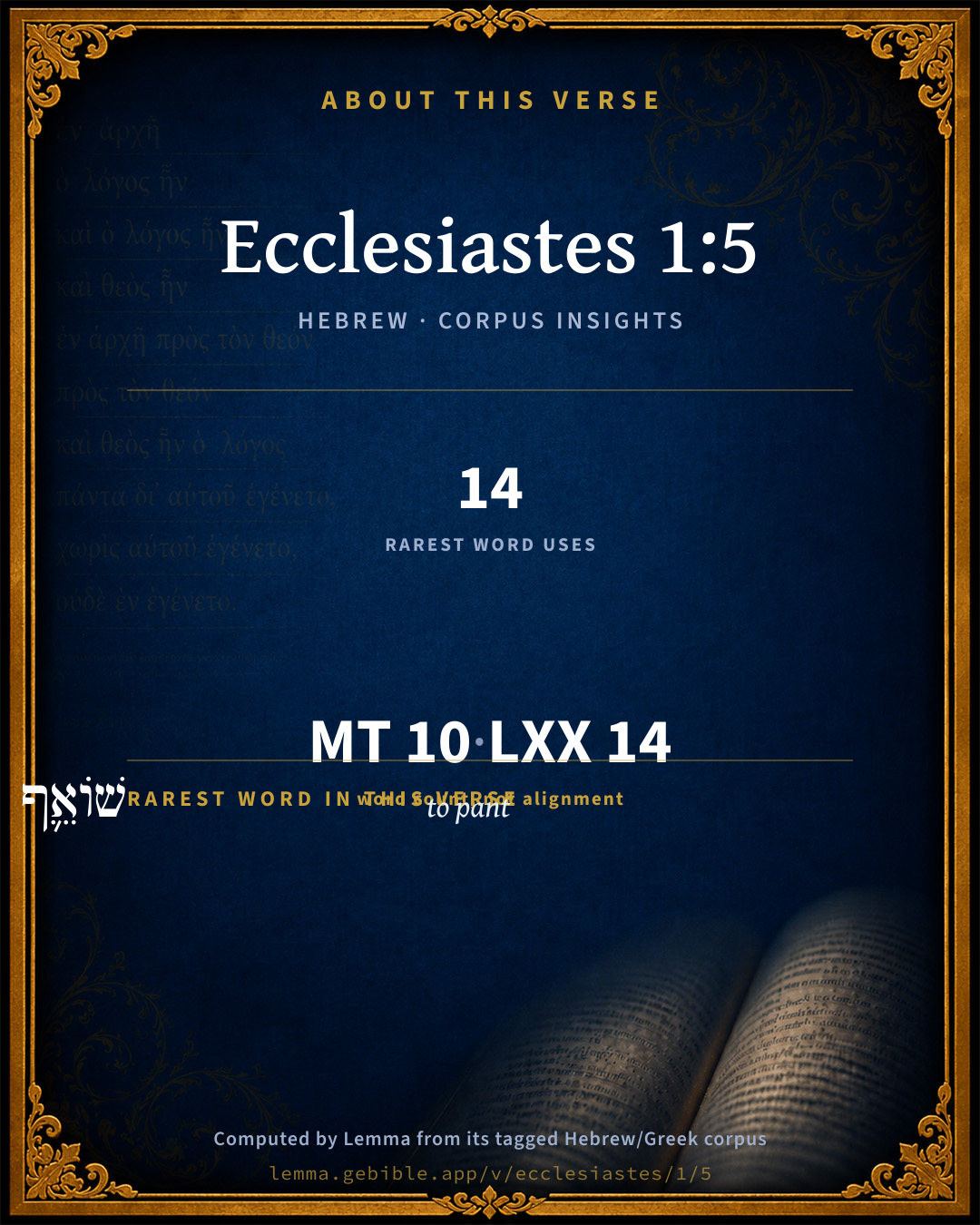
The rarest word here is שׁוֹאֵ֛ף to pant H7602 — appearing just 14 times in the whole Hebrew Bible.

Shared distinctive vocabulary

שׁוֹאֵ֛ף to pant H7602 occurs in 14 verses of the Hebrew Bible. Also found in:

Grammatical profile

  • 4 verbs
  • 3 nouns
  • 1 pronoun
  • 1 preposition
  • 1 adverb

Verb forms

  • וְזָרַ֥ח Qal · Sequential Perfect
  • וּבָ֣א Qal · Sequential Perfect
  • שׁוֹאֵ֛ף Qal · Participle Active
  • זוֹרֵ֥חַֽ Qal · Participle Active

Repetition

Words recur within this verse — often emphatic in Hebrew:

  • וְזָרַ֥ח to rise H2224 ×2
  • הַשֶּׁ֖מֶשׁ sun H8121 ×2

Hebrew & Septuagint length

In English translation the verse runs 17 words from the Hebrew and 14 from the Septuagint (LXX English) — closely comparable.

A rough comparison of the two English renderings, which tokenize alike — not a word-level alignment.

Word counts can differ between the Hebrew and the Greek without any difference in meaning — e.g. the Hebrew direct-object marker אֵת has no separate Greek word, and Greek often adds the article ὁ.

In the original languages it is 10 Hebrew tokens and 14 Greek tokens — but the two are counted differently (Hebrew bundles its prefixes and suffixes into one token; the Greek is in lemma form), so that isn’t a like-for-like length.

Cross-references

7

Topical passages linked to Ecclesiastes 1:5 in the Treasury of Scripture Knowledge — connected by theme and wording, ordered by reader-vote popularity; previews shown in the World English Bible.

  • Psalms 19:4–6 Their voice has gone out through all the earth, Their words to the end of the world. In them he has set a tent for the sun,
  • Psalms 42:1 As the deer pants for the water brooks, So my soul pants after you, God.
  • Habakkuk 3:11 The sun and moon stood still in the sky, At the light of your arrows as they went, At the shining of your glittering spear.
  • Genesis 8:22 While the earth remains, seed time and harvest, and cold and heat, and summer and winter, and day and night shall not cease."
  • Joshua 10:13–14 The sun stood still, and the moon stayed, Until the nation had avenged themselves of their enemies. Isn't this written in the book of Jashar? The sun stayed in the midst of the sky, and didn't hurry to go down about a whole day.
  • Psalms 89:36–37 His seed will endure forever, His throne like the sun before me.
  • Psalms 104:19–23 He appointed the moon for seasons. The sun knows when to set.

Cross-references courtesy of OpenBible.info (CC BY 4.0).

Hebrew and Greek witnesses Masoretic Hebrew ↔ Greek Septuagint

The same verse in the two great witnesses to the Old Testament, shown verse-for-verse.

These are two independent witnesses, not word-aligned to each other, and the Septuagint is shown in lemma (dictionary) form.

Hebrew Ecclesiastes 1:5 Masoretic · Westminster Leningrad Codex

וְזָרַ֥ח הַשֶּׁ֖מֶשׁ וּבָ֣א הַשָּׁ֑מֶשׁ וְאֶ֨ל מְקוֹמ֔וֹ שׁוֹאֵ֛ף זוֹרֵ֥חַֽ ה֖וּא שָֽׁם

The sun also rises, and the sun goes down, and hurries to its place where it rises.

World English Bible · Public Domain

Greek LXX Ecclesiastes 1:5 Septuagint · lemma form

καί ἀνατέλλω ὁ ἥλιος καί δύω ὁ ἥλιος καί εἰς ὁ τόπος αὐτός ἕλκω

And the sun arises, and the sun goes down and draws toward its place;

LXX2012 (modern English Septuagint) · Public Domain

On this verse, The Pulpit Commentary discusses the Septuagint’s reading. Read the note in Commentary ↓

Hebrew: Westminster Leningrad Codex (CC BY 4.0). Greek: Septuagint (public domain); English from LXX2012 (modern English Septuagint) (Public Domain). How the Septuagint differs from the Hebrew →

Commentary

Notes on Ecclesiastes 1:5 from classic Christian and Jewish commentators (each source and its license shown beneath its notes). The classic Christian expositions comment on the surrounding passage and are grouped to its opening verse, so a note may address several verses; the Jewish commentaries on the Tanakh (Rashi and others) are per-verse, so they appear only where the commentator wrote on this verse.

Lemma curates 59 commentaries, every one of them public domain or Creative Commons licensed, each selected and text-cleaned for this edition rather than reprinted as found. About our sources →

Trapp's Complete Commentary

John Trapp

Ecc 1:5 The sun also ariseth, and the sun goeth down, and hasteth to his place where he arose.

Ver. 5. The sun also ariseth.] That sweet and swift creature (the Persians deified it); so sweet that Eudoxus professed himself willing to be burnt up by the sun presently, so he might be admitted to come so near it as to learn the nature of it; {a} so swift that the Persians dedicated a horse to their god the sun, as the swiftest on earth to the swiftest in heaven. {b} He courseth about the world with incredible speed, and "rejoiceth as a giant to run a race." {Psa 19:5} He exceedeth the eagle’s flight more than it goes beyond the slow motion of a snail. Whether it run nearer the earth now by 9976 German miles than it did in Ptolemy’s days, as some mathematicians affirm, I know not; but that, being of a fiery nature, it should, contrary to the nature of fire (which is to fly upward), send down its beams, its heat, light, and influence, this I admire, with Chrysostom, {c} as a gracious work of God, in making this great servant of the world - as his name in Hebrew {d} signifies - so sweetly serviceable.

And hasteth to the place.] Heb., Panteth, as if tired, and even breathless, A figurative speech, like that in Dan 9:21, where the angel Gabriel is said to "fly swiftly," or with weariness of flight, to inform Daniel. For use hereof, hear the poet: -

“The sun doth set and rise,

But we contrariwise,

Sleep after one short light,

An everlasting night.” {e}

{a} Plutarch.

{b} ωσπερ το ταχιστον, τω ταχυτατω θεων. - Paus.

{c} Hom. 8 Ad. Pop. Antioch.

{d} שׁמשׁ.

{e} Soles occidere et redire possuat,

Nobiscum semel! occidit brevis lux,

Nox est perpetua una dormienda. - Catull

John Trapp, A Commentary or Exposition upon All the Books of the Old and New Testament (1647–1656) — public domain. Text from a community e-Sword module.

Joseph Benson's Commentary

Ecc 1:5-6. The sun also riseth — The sun is in perpetual motion, rising, setting, and rising again, and so constantly repeating its course in all succeeding days, and years, and ages; and the like he observes concerning the winds and rivers, Ecc 1:6-7; and the design of these similitudes seems to be, to show the vanity of all worldly things, and that man’s mind can never be satisfied with them, because there is nothing in the world but a constant repetition of the same things, which is so irksome, that the consideration thereof hath made some persons weary of their lives; and there is no new thing under the sun, as is added in the foot of the account, (Ecc 1:9,) which seems to be given us as a key to understand the meaning of the foregoing passages. And this is certain from experience, that the things of this world are so narrow, and the mind of man so vast, that there must be something new to satisfy the mind; and even delightful things, by too frequent repetition, are so far from yielding satisfaction, that they grow tedious and troublesome. The wind goeth, &c. — The wind also sometimes blows from one quarter of the world, and sometimes from another; successively returning to the same quarters in which it had formerly been.

Joseph Benson's Commentary on the Old and New Testaments (1811–1818) — public domain. Text from a community e-Sword module.

Jamieson, Fausset & Brown

Robert Jamieson, A. R. Fausset & David Brown

(Psa 19:5-6). "Panting" as the Hebrew for "hasteth"; metaphor, from a runner (Psa 19:5, "a strong man") in a "race." It applies rather to the rising sun, which seems laboriously to mount up to the meridian, than to the setting sun; the accents too favor MAURER, "And (that too, returning) to his place, where panting he riseth."

Jamieson, Fausset & Brown — Commentary Critical and Explanatory on the Whole Bible (1871) — public domain (CC PDM 1.0). Text via the HelloAO Bible API.

Adam Clarke's Commentary

Verse 5. and Eccl 1:6. These verses are confused by being falsely divided. The first clause of the sixth should be joined to the fifth verse.

"The sun also ariseth, and the sun goeth down, and hasteth to his place where he ariseth; going to the south, and circulating to the north."

Adam Clarke's Commentary on the Bible (1810–1826) — public domain. Text from a community e-Sword/MySword module.

Ellicott's Commentary for English Readers

(5) Hasteth.—Heb., panteth. The word is used of eager desire (Job_7:2; Psa_119:131).

Where he arose.—Better, there to rise again.

A Bible Commentary for English Readers, edited by Charles John Ellicott (1878–1897) — public domain. Text from a community e-Sword module.

The Cambridge Bible for Schools and Colleges

gen. ed. J. J. S. Perowne

5. The sun also ariseth] From the standpoint of modern thought the sun might seem even more than the earth to be the type of permanent existence, but with the Hebrew, who looked on it in its phenomenal aspect, it was not so, and the sun accordingly appears as presenting not a contrast, but a parallel, to human mutability and resultless labour. We are reminded of the Rabbinic legend of Abraham’s looking on the sun, and, when half tempted to adore it, repressing the temptation by watching its going down and saying “The God whom I worship must be a God that does not set.” Koran, Sur. 6. Stanley’s Jewish Church, 1. Lect. 1.

hasteth to his place where he arose] The primary meaning of the first of the two verbs is that of the panting of one who travels quickly. Here again we have to think of the belief that, between the sunset and the sunrise, the sun had a long journey to perform, as the Greeks thought, by the great Ocean river, till it returned to the point where it had risen the day before. Possibly the clouds and mists of the morning were thought of as the panting of the sun, as of “the strong man” who “runs his race” (Psa_19:5).

Parallels present themselves in Psa_19:5 (“rejoiceth as a strong man to run a race”) and yet more strikingly in Virgil, Georg. i. 250,

Nosque ubi primus equis Oriens adflavit anhelis,

Illic sera rubens accendit lumina Vesper.

“And when to us the sun with panting steeds

Hastens at dawn, far off the star of eve

There lights her glowing lamp.”

Comp. also Æn. xii. 113.

The Cambridge Bible for Schools and Colleges (gen. ed. J. J. S. Perowne; Cambridge University Press, 1878–1918) — public domain. Text from a community e-Sword module.

John Gill's Exposition

The sun also ariseth, and the sun goeth down, and hasteth to his place where he arose. The sun rises in the morning and sets at evening in our hemisphere, according to the appearance of things; and then it makes haste to go round the other hemisphere in the night: it "pants", as the word (t) signifies; the same figure is used by other writers (u); like a man out of breath with running; so this glorious body, which rejoiceth as a strong man to run his race, and whose circuit is from one end of the heavens to the other, Psa 19:5; is in haste to get to the place where he rose in the morning, and there he makes no stop, but pursues his course in the same track again. By this instance is exemplified the succession of the generations of men one after another, as the rising and setting of the sun continually follows each other; and also sets forth the restless state of things in the world, which, like the sun, are never at a stand, but always moving, and swiftly taking their course; and likewise the changeable state of man, who, like the rising sun, and when at noon day, is in flourishing circumstances, and in the height of prosperity, but as this declines and sets, so he has his declining times and days of adversity. Moreover, like the rising sun, he comes into this world and appears for a while, and then, like the setting sun, he dies; only with this difference, in which the sun has the preference to him, as the earth before had; the sun hastens and comes to its place from whence it arose, but man lies down and rises not again till the heavens be no more, and never returns to his place in this world, that knows him no more, Job 7:10. The Jews (w) say, before the sun of one righteous, man sets, the sun of another righteous man rises.

(t) "anhelus", Montanus, Tigurine version; "anhelat", Drusius, Piscator, Cocceius, Amama; "anhelaus est", Rambachius; "doth he breathe", Broughton. (u) "Placebits anhelat", Claudian. Epigrarm. "Equis oriens afflavit anhelis", Virgil. Georgic. l. 1. v. 250. Aeneid, l. 5. (w) Apud R. Joseph. Titatzak in loc. Midrash Kohelet in loc.

John Gill's Exposition of the Whole Bible (1746–1763) — public domain (CC PDM 1.0). Text via the HelloAO Bible API.

Albert Barnes' Notes on the Bible

Hasteth ... - literally, at his place panting (in his eagerness) riseth he there.

Albert Barnes' Notes on the Bible (1834–1885) — public domain. Text from a community e-Sword/MySword module.

Haydock's Catholic Bible Commentary

Place daily. Its annual motion is then mentioned. (Calmet)

George Leo Haydock (1774–1849), Haydock's Catholic Family Bible and Commentary, 1859 edition — public domain. Excludes Psalms (Douay-Rheims chapter numbering differs from Protestant) and Deuterocanonical books (Catholic canon only).

Matthew Poole's English Annotations

The sun is in perpetual motion, sometimes arising, and sometimes setting, and then arising again, and so constantly repeating its courses in all succeeding days, and years, and ages; and the like he observes concerning the winds and rivers, Ecc 1:6,7. And the design of these similitudes seems to be, either,

1. That by representing the constant changes and restless motions of these particular things he might intimate that it is so with all other earthly things; and therefore no man can expect satisfaction from them. Or,

2. That by comparing the sun, and wind, and rivers, as, Ecc 1:4, he compared the earth with man, he might show that man, considered as mortal, is in a more unhappy condition than these things, because when the earth abides, man goes; and when the sun sets, he riseth again; and so the wind and rivers return to their former place and state, but man, when once he dies, he never returns again to this life; of which comparison see Job 14:7,12. Or,

3. To show the vanity of all worldly things, and that man’s mind can never be satisfied with them, because there is nothing in the world but a constant repetition of the same things, which is so irksome a thing, that the consideration thereof hath made some persons weary of their lives; and there is no new thing under the sun, as is added in the foot of the account, Ecc 1:9, which seems to me to be given as a key to understand the meaning of the foregoing passages. And this is manifest and certain from experience, that the things of this world are so narrow, and the mind of man so vast, that there must be something new to satisfy the mind; and even delightful things, by too frequent repetition or long continuance, are so far from yielding satisfaction, that they grow tedious and troublesome.

Matthew Poole's English Annotations on the Holy Bible (1683–1685) — public domain. Text from a community e-Sword/MySword module.

Whedon's Commentary on the Bible

Daniel D. Whedon

5. The sun also ariseth — Not only giving light to man, but, unwearied, never dwindling, it shows as if even superior to him.

Hasteth — Hebrew, panteth, as if ambitious to rise “another and the same,” and —

“With new spangled eye,

Flame in the forehead of the morning sky.”

Daniel D. Whedon (gen. ed.), Commentary on the Old and New Testaments (1874–1909) — public domain. Text from a community e-Sword module.

The Pulpit Commentary

The sun also ariseth, and the sun goeth down. The sun is another instance of ever-recurring change in the face of an enduring sameness, rising and setting day-by-day, and resting never. The legendary "Life of Abram" relates how, having been hidden for some years in a cave in order to escape the search of Nimrod, when he emerged from his concealment, and for the first time beheld heaven and earth, he began to inquire who was the Creator of the wonders around him. When the sun arose and flooded the scene with its glorious light, he at once concluded that that bright orb must be the creative Deity, and offered his prayers to it all day long. But when it sank in darkness, he repented of his illusion, being persuaded that the sun could not have made the world and be itself subject to extinction (see "Abraham: his Life and Times," p. 12). And hasteth to his place where he arose; literally, and panteth (equivalent to hasteth, longeth to go) to its place arising there; i.e. the sun, sinking in the west, eagerly during the night returns to the east, duly to rise there in the morning. The "place" is the region of reappearance. The Septuagint gives, "The sun arises, and the sun sets, and draws (elkei) unto its place;" and then carries the idea into the following verse: "Arising there, it proceedeth southward," etc. The Vulgate supports the rendering; but there is no doubt that the Authorized Version gives substantially the sense of the Hebrew text as accentuated. The verb pav (shaaph), as Delitzsch shows, implies "punting," not from fatigue, but in eager pursuit of something; and all notions of panting steeds or morning exhalations are quite foreign from the conception of the passage. The notion which Koheleth desires to convey is that the sun makes no real progress; its eager punting merely brings it to the old place, there to recommence its monotonous routine. Rosenm quotes Catullus, "Carm.," 5:4-6, on which, Doering cites Lotich., "Eleg.," 3:7. 23

Ergo ubi permensus coelum sol occidit, idem Purpureo vestit lumine rursus humum; Nos, ubi decidimus, defuncti muncre vitae, Urget perpetua hmina nocte sopor.

But our passage does not contrast the revival of the sun every morning with man"s eternal sleep in death.

Vers. 5-7.

The cycles of nature.

This is not to be taken as the language of one who makes complaints of nature, wishing that the great forces of the world were ordered otherwise than they actually are. It is the language of one who observes nature, and is baffled by its mysteries; who asks what all means, and why everything is as it is. Even at that distant time it was recognized that the processes of nature are cyclic. The stars accomplish their revolutions, and the seasons return in their appointed order. There is unity in diversity, and changes succeed one another with remarkable regularity. These observations seem to have suggested to the writer of Ecclesiastes the inquiry Is man"s life and destiny in this respect similar to the order of nature? Is our human experience as cyclic as are the processes of the material universe? Is there no real advance for man? and is he destined to pass through changes which in the end will only leave him where he was?

I NATURE PRESENTS A SPECTACLE OF CONSTANT CHANGE AND RESTLESSNESS. The three examples given in these passages are such as must strike every attentive observer of this earth and the phenomena accessible to the view of its inhabitants. The sun runs his daily course through the heavens, to return on the next morning to fulfill the same circuit. The wind veers about from one quarter to another, and quits one direction only in a few hours, or a few days, or at most a few weeks, to resume it. The rivers flow on in an unceasing current, and find their way into the sea, which (as is now known) yields in evaporation its tribute to the clouds, whence the water-springs are in due time replenished. Modern science has vastly enlarged our view of similar processes throughout all of the universe which is accessible to our observation. "Nothing continueth in one stay." There is in the world nothing immovable and unchangeable. It is believed that not an atom is at rest.

II NATURE SEEMS TO EFFECT NO PROGRESS BY ALL THE CHANGES EXHIBITED. Not only is there a want, an absence, of stability, of rest; there is no apparent advance and improvement. Things move from their places only to return to them; their motion is rather in a circle than in a straight line. It was this cyclic tendency in natural processes which arrested the attention and perplexed the inquiring mind of the wise man. And modern science does not in this matter effect a radical change in our beliefs. Evolutionists teach us teat rhythm is the ultimate law of the universe. Evolution is followed by involution, or dissipation. A planet or a system evolves until it reaches its climax, and thenceforward its course is reversed, until it is resolved into the elements of which it was primevally composed. In the presence of such speculations the intellect reels, dizzy and powerless.

III REFLECTION MAY, HOWEVER, SUGGEST TO US THAT THERE IS UNITY IN DIVERSITY, STABILITY IN CHANGE; THAT THERE IS A DIVINE PURPOSE IN NATURE. If there be evidence of reason in the universe, if nature is the expression of mind, the vehicle by which the Creator-Spirit communicates with the created spirits he has fashioned in his own likeness, then there is at least the suggestion of what is deeper and more significant than the cycles of phenomena. There is rest for the intelligence in such a conviction as that of the theist, who rises above the utterances to the Being who utters forth his mind and will in the world which he has made, and which he rules by laws that are the expression of his own reason. He looks behind and above the mechanical cycles of nature, and discovers the Divine mind, into whose purposes he can only very partially penetrate, but in whose presence and control he finds repose.

IV ANALOGY POINTS OUT THAT IN AND BENEATH THE MUTABILITY OF THE HUMAN LOT AND LIFE THERE IS DIVINE PURPOSE OF INSTRUCTION AND BLESSING. If, as it seems, it occurred to the mind of the wise man that, as in nature, so in human existence, all things are cyclic and unprogressive, such an inference was not unnatural. Yet it is not a conclusion in which the reasonable mind can rest. The fuller revelation with which we have been favored enlightens us with respect to the intentions of Eternal Wisdom and Love. Our Savior has founded upon earth a kingdom which cannot be moved. And the figures which he himself has employed to set forth its progress are an assurance that it is not bounded by time or space; that it shall grow until its dimensions and beneficence exceed all human expectations, and satisfy the heart of the Divine Redeemer himself. Each faithful Christian, however feeble and however lowly, may work in his Master"s cause with the assurance that his service shall be not only acceptable, but effective. Better shall be the end than the beginning. The seed shall give rise to a tree of whose fruit all nations shall taste, and beneath whose shadow humanity itself shall find both shelter and repose. T.

The Pulpit Commentary (1880–1919), ed. H.D.M. Spence-Jones & Joseph S. Exell — public domain. Text from a community e-Sword module.

John Wesley's Explanatory Notes

The sun - The sun is in perpetual motion, rising, setting, and rising again, and so constantly repeating its course in all succeeding days, and years, and ages; and the like he observes concerning the winds and rivers, ver. 6, 7, and the design of these similitudes seem to be; to shew the vanity of all worldly things, and that man's mind can never be satisfied with them, because there is nothing in the world but a constant repetition of the same things, which is so irksome, that the consideration thereof hath made some persons weary of their lives; and there is no new thing under the sun, as is added in the foot of the account, ver. 9, which seems to be given us as a key to understand the meaning of the foregoing passages. And this is certain from experience that the things of this world are so narrow, and the mind of man so vast, that there must be something new to satisfy the mind; and even delightful things by too frequent repetition, are so far from yielding satisfaction, that they grow tedious and troublesome.

John Wesley, Explanatory Notes Upon the Whole Bible (1754–1765) — public domain. Text via the GEBible commentary corpus.

Keil & Delitzsch

C. F. Keil & F. Delitzsch

"And the sun ariseth, the sun goeth down, and it hasteth (back) to its place, there to rise again." It rises and sets again, but its setting is not a coming to rest; for from its place of resting in the west it must rise again in the morning in the east, hastening to fulfil its course. Thus Hitzig rightly, for he takes "there to rise again" as a relative clause; the words may be thus translated, but strictly taken, both participles stand on the same level; שׁואף (panting, hastening) is like בּא in Ecc 1:4, the expression of the present, and זו that of the fut. instans: ibi (rursus) oriturus; the accentuation also treats the two partic. as co-ordinate, for Tiphcha separates more than Tebir; but it is inappropriate that it gives to ואל־ם the greater disjunctive Zakef Quaton (with Kadma going before). Ewald adopts this sequence of the accents, for he explains: the sun goes down, and that to its own place, viz., hastening back to it just by its going down, where, panting, it again ascends. But that the sun goes down to the place of its ascending, is a distorted thought. If "to its place" belongs to "goeth," then it can refer only to the place of the going down, as e.g., Benjamin el-Nahawendi (Neubauer, Aus der Petersb. Bibl. p. 108) explains: "and that to its place," viz., the place of the going down appointed for it by the Creator, with reference to Psa 104:19, "the sun knoweth his going down." But the שׁם, which refers back to "its place," opposes this interpretation; and the phrase שׁו cannot mean "panting, rising," since שאף in itself does not signify to pant, but to snatch at, to long eagerly after anything, thus to strive, panting after it (cf. Job 7:2; Psa 119:131), which accords with the words "to its place," but not with the act of rising. And how unnatural to think of the rising sun, which gives the impression of renewed youth, as panting! No, the panting is said of the sun that has set, which, during the night, and thus without rest by day and night, must turn itself back again to the east (Psa 19:7), there anew to commence its daily course. Thus also Rashi, the lxx, Syr., Targ., Jerome, Venet., and Luther. Instead of שׁו, Grtz would read שׁב אף, redit (atque) etiam; but שׁו is as characteristic of the Preacher's manner of viewing the world as סובב וגו, Ecc 1:6, and ין, Ecc 1:8. Thus much regarding the sun. Many old interpreters, recently Grtz, and among translators certainly the lxx, refer also Ecc 1:6 to the sun. The Targ. paraphrases the whole verse of the state of the sun by day and night, and at the spring and autumn equinox, according to which Rashi translates הרוּח, la volont (du soleil). But along with the sun, the wind is also referred to as a third example of restless motion always renewing itself. The division of the verses is correct; Ecc 1:6 used of the sun would overload the figure, and the whole of Ecc 1:6 therefore refers to the wind.

Keil & Delitzsch — Biblical Commentary on the Old Testament (1861–1891) — public domain (CC PDM 1.0). Text via the HelloAO Bible API. (Old Testament only.)

Rashi

Rabbi Shlomo Yitzchaki (Rashi)

The sun rises, etc. A generation goes and a generation comes as the sun rises at dawn and sets at eventide, and it goes throughout the night, yearning to rise from the place whence it rose yesterday, that it will rise from there also today.

Rashi on the Tanakh — English translations: “The Judaica Press complete Tanach with Rashi, translated by A. J. Rosenberg” (CC BY 4.0); “Pentateuch with Rashi's commentary by M. Rosenbaum and A.M. Silbermann, 1929-1934” (public domain); “The Metsudah Tanach series, Lakewood, N.J” (CC BY 4.0); and “The Book of Joshua, Metsudah Publications, 1997” (CC BY 4.0). Text via Sefaria.

Lesson kit

Teaching starters — assembled from the data on this page, not authored interpretation. Every prompt links to the verse data it draws on. Edit before teaching.

Ecclesiastes, in the Wisdom, opens this verse with 10 words (8 distinct Hebrew lemmas). Its most distinctive word is shâʼaph (“to pant”). A historical commentator’s framing appears above. Read the whole chapter for the surrounding context.

Discussion questions

  1. The word shâʼaph carries the sense “to pant.” How does it shape the verse?
  2. Job 5:5 shares the word «to pant» with this verse. How do the two illuminate each other?
  3. “to rise” occurs 2× in this one verse. What is the effect of the repetition?
  4. These translations render this verse differently. What is at stake in choosing one wording over another?
  5. The verb «וְזָרַ֥ח» is Qal Sequential Perfect. How does its form color the action?
  6. Reading how Trapp's Complete Commentary and Joseph Benson's Commentary read this verse, where do the two commentators agree and where do they part?

Things to notice

Reading settings

Reading text

Shown beneath each verse's original-language words.

Old Testament
Old Testament edition

Read the OT as the Masoretic Hebrew (MT) or the Greek Septuagint (LXX).

English shown for the Greek Septuagint (in the Hebrew ↔ Greek comparison).

Comparing translations? Open the Compare panel on any verse page to stack up to four side by side.