
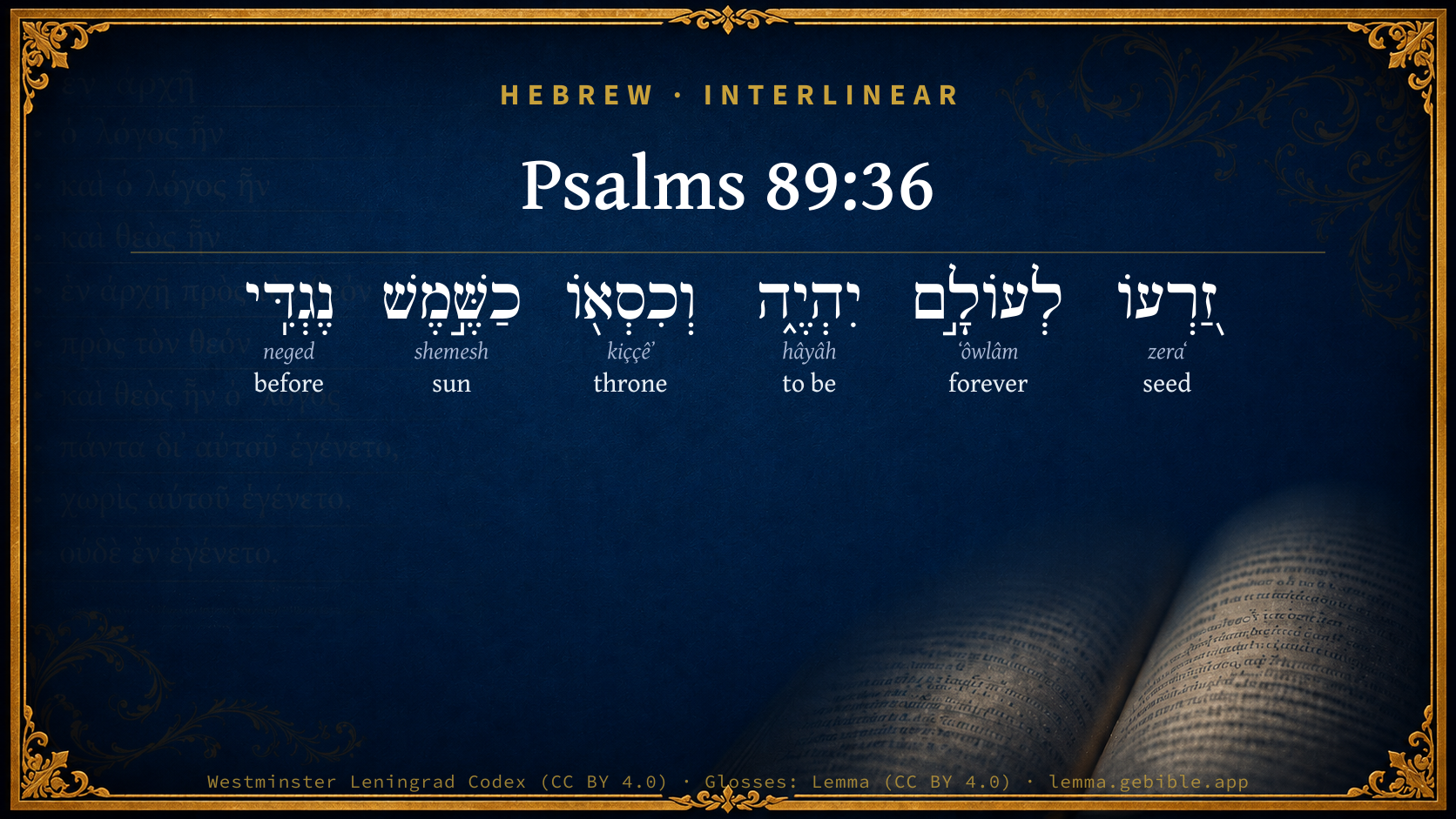
Psalms 89:36

Hebrew (Westminster Leningrad Codex) Psalms 89:36 appears in the Hebrew Old Testament. The text above is from the Westminster Leningrad Codex. Each word links to its Strong’s number, a concise gloss, and parsing drawn from the Open Scriptures Hebrew Bible morphology. Click any word for its full Brown-Driver-Briggs (BDB) entry.
Download image
Cite this verse

Psalms 89:36 (World English Bible). Public Domain. Lemma interlinear Bible study tool, https://lemma.gebible.app/v/psalms/89/36.

Show BibTeX & RIS
BibTeX
RIS
English Translation
His seed will endure forever, His throne like the sun before me.
World English Bible · Public Domain
Download a study sheet

One document with this verse’s original text, its word-by-word gloss line, the meaning frame, cross-references with their text, attributed commentary, and full source and license credits — printable, and it pastes into notes with its structure intact.

This verse Autodidact and up

Study sheet (.html) Plain text (.txt)

A passage Seminary Student

Up to 50 verses in one chapter. A passage sheet keeps up to 6 commentary sources and 12 cross-references per verse, in the order this page ranks them, and says so on the sheet whenever that leaves anything out. Ask for a single verse and you get the Autodidact verse sheet above.

Everything on this page stays free to read, with no account — the sheet is a download of what is already on screen, not access to it.

Want to remove ads? Support Godless Engineer
Compare translations 3

The same verse in 3 English versions, stacked beneath the original-language interlinear above. Click any original word for its lexicon entry.

Each is an independent rendering of the whole verse — the interlinear is not word-aligned to these translations.

Highlighted words mark where these versions differ — a whole-verse word diff, not a word-by-word alignment.

  • World English Bible Public Domain
    His seed will endure forever, His throne like the sun before me.
  • King James Version Public Domain
    His seed shall endure for ever, and his throne as the sun before me.
  • unfoldingWord Literal Text CC BY-SA 4.0
    His seed will be forever, and his throne, like the sun before me.

unfoldingWord Literal Text — © unfoldingWord, licensed CC BY-SA 4.0. Word-aligned USFM3 via Door43 (git.door43.org/unfoldingWord/en_ult).

Versions to compare (up to 4)

3 of 4 selected

Show all 18 translations

Every available English version of this verse, each an independent rendering of the whole verse.

  • World English Bible Public Domain
    His seed will endure forever, His throne like the sun before me.
  • Berean Standard Bible Public Domain
    his offspring shall endure forever, and his throne before Me like the sun,
  • Majority Standard Bible Public Domain
    his offspring shall endure forever, and his throne before Me like the sun,
  • King James Version Public Domain
    His seed shall endure for ever, and his throne as the sun before me.
  • American Standard Version (1901) Public Domain
    His seed shall endure for ever, And his throne as the sun before me.
  • Revised Version (1885) Public Domain
    His seed shall endure for ever, and his throne as the sun before me.
  • Geneva Bible (1599) Public Domain
    His seede shall endure for euer, and his throne shalbe as the sunne before me.
  • Douay-Rheims (1899) Public Domain
    Once have I sworn by my holiness: I will not lie unto David:
  • Young's Literal Translation Public Domain
    His seed is to the age, And his throne `is' as the sun before Me,
  • Literal Standard Version CC BY-SA 4.0
    His seed is for all time, || And his throne [is] as the sun before Me,
  • Unlocked Literal Bible CC BY-SA 4.0
    his descendants will continue forever and his throne as long as the sun before me.
  • unfoldingWord Literal Text CC BY-SA 4.0
    His seed will be forever, and his throne, like the sun before me.
  • Darby Bible Public Domain
    His seed shall endure for ever, and his throne as the sun before me;
  • World Messianic Bible Public Domain
    His offspring will endure forever, his throne like the sun before me.
  • Webster's Bible Public Domain
    \\89:35\\Once have I sworn by my holiness that I will not lie to David.
  • Free Bible Version CC BY-SA 4.0
    His royal line will last forever, and his dynasty will continue before me as long as the sun endures.
  • Bible in Basic English Public Domain
    His seed will not come to an end for ever; the seat of his kingdom will be like the sun before me.
  • JPS Tanakh (1917) Public Domain
    (89-37) His seed shall endure for ever, and his throne as the sun before Me.

Literal Standard Version (2020), Covenant Press — licensed CC BY-SA 4.0. Text via the HelloAO Bible API (eBible.org). Unlocked Literal Bible (unfoldingWord) — licensed CC BY-SA 4.0. Text via the HelloAO Bible API (eBible.org). unfoldingWord Literal Text — © unfoldingWord, licensed CC BY-SA 4.0. Word-aligned USFM3 via Door43 (git.door43.org/unfoldingWord/en_ult). Free Bible Version, Dr. Jonathan Gallagher — licensed CC BY-SA 4.0. Text via the HelloAO Bible API (eBible.org).

Word by word

More ways to search: Search by grammar → Find every occurrence → Compare this word →

Practice this passage: Drill this verse → Learn its vocabulary →

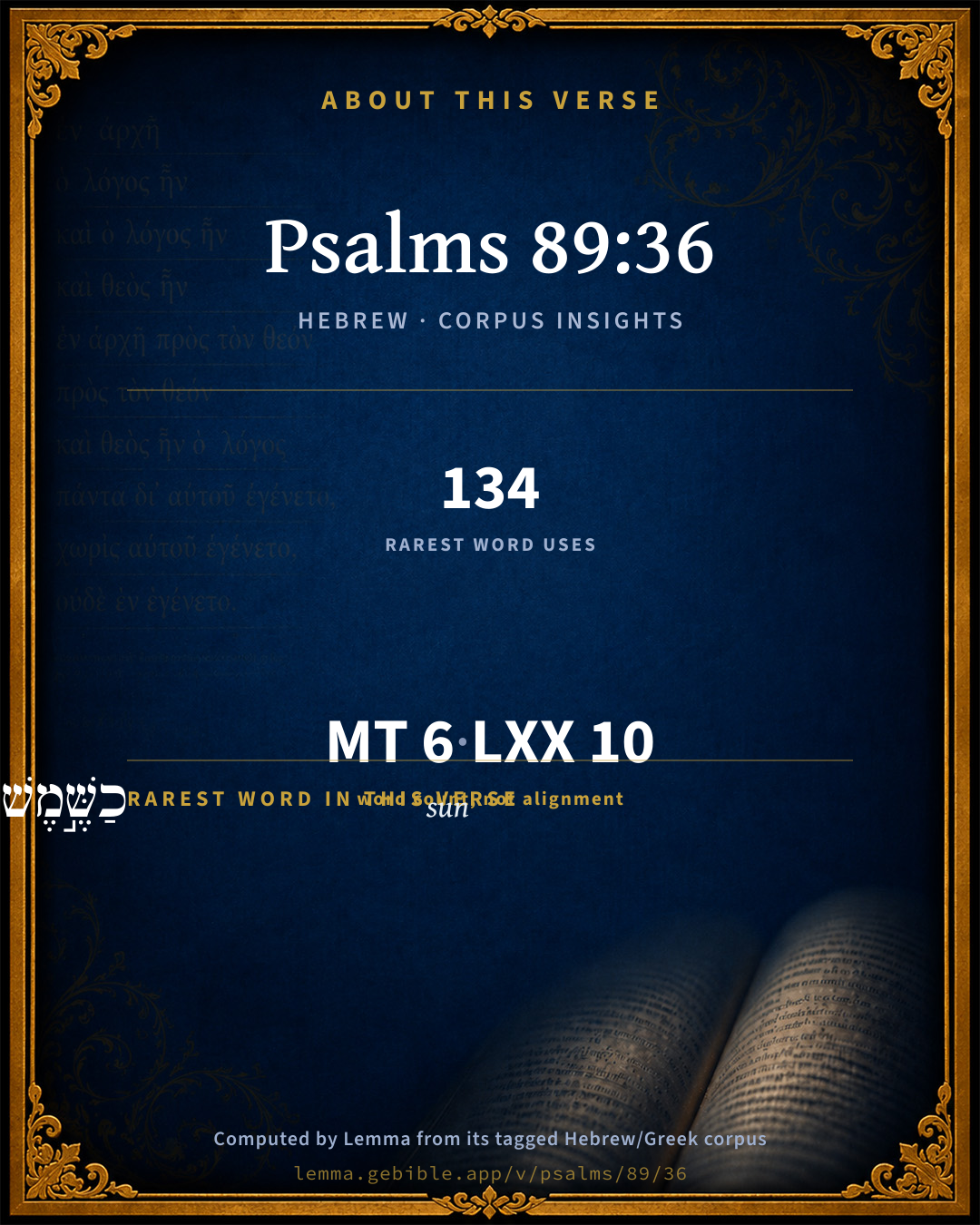
כַשֶּׁ֣מֶשׁ
shemesh
H8121
“like/as the · sun”
Preposition, Determined + Noun, Common, Both, Singular, Absolute
Part of Speech
Preposition + Noun
Type
Common
Gender
Both
Number
Singular
State
Absolute
Full BDB Definition

Origin: from an unused root meaning to be brilliant

TWOT: 2417a

sun - sun - sunrise, sun-rising, east, sun-setting, west (of direction) - sun (as object of illicit worship) - openly, publicly (in other phrases) - pinnacles, battlements, shields (as glittering or shining)
  1. זַ֭רְעוֹ zeraʻ H2233 “seed · his” Noun, Common, Masculine, Singular, Construct + Suffix, Personal, 3rd Person, Masculine, Singular
  2. לְעוֹלָ֣ם ʻôwlâm H5769 “to/for · forever” Preposition + Noun, Common, Masculine, Singular, Absolute
  3. יִהְיֶ֑ה hâyâh H1961 “to be” Verb, Qal, Imperfect, 3rd Person, Masculine, Singular
  4. וְכִסְא֖וֹ kiççêʼ H3678 “and · throne · his” Conjunction + Noun, Common, Masculine, Singular, Construct + Suffix, Personal, 3rd Person, Masculine, Singular
  5. נֶגְדִּֽי neged H5048 “before · me” Preposition + Suffix, Personal, 1st Person, Common, Singular

About this verse

These counts appear in no published source. They are computed here, from the morphology-tagged text and Lemma’s own curated glosses. What Lemma adds →

6
words
6
distinct lemmas
Wisdom
section

Grammatical profile

  • 1 verb
  • 4 nouns
  • 1 preposition

Verb forms

  • יִהְיֶ֑ה Qal · Imperfect

Hebrew & Septuagint length

In English translation the verse runs 12 words from the Hebrew and 14 from the Septuagint (LXX English) — closely comparable.

A rough comparison of the two English renderings, which tokenize alike — not a word-level alignment.

Word counts can differ between the Hebrew and the Greek without any difference in meaning — e.g. the Hebrew direct-object marker אֵת has no separate Greek word, and Greek often adds the article ὁ.

In the original languages it is 6 Hebrew tokens and 10 Greek tokens — but the two are counted differently (Hebrew bundles its prefixes and suffixes into one token; the Greek is in lemma form), so that isn’t a like-for-like length.

Cross-references

11

Topical passages linked to Psalms 89:36 in the Treasury of Scripture Knowledge — connected by theme and wording, ordered by reader-vote popularity; previews shown in the World English Bible.

  • Psalms 72:5 They shall fear you while the sun endures; And as long as the moon, throughout all generations.
  • Psalms 89:29 I will also make his seed endure forever, And his throne as the days of heaven.
  • Psalms 72:17 His name endures forever. His name continues as long as the sun. Men shall be blessed by him. All nations will call him blessed.
  • Isaiah 59:21 As for me, this is my covenant with them, says Yahweh: my Spirit who is on you, and my words which I have put in your mouth, shall not depart out of your mouth, nor out of the mouth of your seed, nor out of the mouth of your seed's seed, says Yahweh, from henceforth and forever.
  • Luke 1:33 and he will reign over the house of Jacob forever. There will be no end to his Kingdom."
  • 2 Samuel 7:16 Your house and your kingdom shall be made sure for ever before you: your throne shall be established forever.
  • Psalms 89:4 'I will establish your seed forever, And build up your throne to all generations.'" Selah.
  • Isaiah 9:7 Of the increase of his government and of peace there shall be no end, on the throne of David, and on his kingdom, to establish it, and to uphold it with justice and with righteousness from henceforth even forever. The zeal of Yahweh of Hosts will perform this.
  • Jeremiah 33:20 Thus says Yahweh: If you can break my covenant of the day, and my covenant of the night, so that there shall not be day and night in their season;
  • John 12:34 The multitude answered him, "We have heard out of the law that the Christ remains forever. How do you say, 'The Son of Man must be lifted up?' Who is this Son of Man?"
  • Isaiah 53:10 Yet it pleased Yahweh to bruise him; he has put him to grief: when you shall make his soul an offering for sin, he shall see [his] seed, he shall prolong his days, and the pleasure of Yahweh shall prosper in his hand.

Cross-references courtesy of OpenBible.info (CC BY 4.0).

Hebrew and Greek witnesses Masoretic Hebrew ↔ Greek Septuagint

The same verse in the two great witnesses to the Old Testament, shown verse-for-verse.

You’re reading Greek Psalm 88 (Hebrew Psalm 89). The Septuagint counts the superscription, so verse numbers can differ from the Hebrew — chapter-level alignment, not verse-by-verse. Numbering follows Rahlfs.

These are two independent witnesses, not word-aligned to each other, and the Septuagint is shown in lemma (dictionary) form.

Hebrew Psalms 89:36 Masoretic · Westminster Leningrad Codex

זַ֭רְעוֹ לְעוֹלָ֣ם יִהְיֶ֑ה וְכִסְא֖וֹ כַשֶּׁ֣מֶשׁ נֶגְדִּֽי

His seed will endure forever, His throne like the sun before me.

World English Bible · Public Domain

Greek LXX Greek Psalm 88:36 Septuagint · lemma form

ἅπαξ ὄμνυμι ἐν ὁ ἅγιος ἐγώ εἰ ὁ δαυίδ ψεύδομαι

His seed shall endure for ever, and his throne as the sun before me;

LXX2012 (modern English Septuagint) · Public Domain

Hebrew: Westminster Leningrad Codex (CC BY 4.0). Greek: Septuagint (public domain); English from LXX2012 (modern English Septuagint) (Public Domain). How the Septuagint differs from the Hebrew →

Commentary

Notes on Psalms 89:36 from classic Christian and Jewish commentators (each source and its license shown beneath its notes). The classic Christian expositions comment on the surrounding passage and are grouped to its opening verse, so a note may address several verses; the Jewish commentaries on the Tanakh (Rashi and others) are per-verse, so they appear only where the commentator wrote on this verse.

Lemma curates 59 commentaries, every one of them public domain or Creative Commons licensed, each selected and text-cleaned for this edition rather than reprinted as found. About our sources →

Trapp's Complete Commentary

John Trapp

Psa 89:36 His seed shall endure for ever, and his throne as the sun before me.

Ver. 36. His seed shall endure for ever] Christ "shall see his seed, he shall prolong his days; and the pleasure of the Lord shall prosper in his hands," Isa 53:10 filiabitur nomine eius, Psa 72:17. See there.

John Trapp, A Commentary or Exposition upon All the Books of the Old and New Testament (1647–1656) — public domain. Text from a community e-Sword module.

The Biblical Illustrator

Joseph S. Exell

Psa_89:36

As the sun

The sun as an emblem of God

The sun has always been an object so full of mystery and amazing quality that in a large part of history it was worshipped as a deity, and it is destined in all the remainder of history to be the greatest emblem of God.

It leaves behind it the seven wonders of the old earth and any seven wonders of the new, and makes of itself alone the one matchless object of all physical things and forms. It deals only in the great. Vast in all particulars, it easily became the early god of mankind, and very slowly and with difficulty became disengaged from the Hebrew and classic religions. At last the Christianized multitude has reached the ability to distinguish between the universe and the Maker of the universe; and, stupendous as the bounds of space may be, and sublime as their occupants may be, the modern mind says they are not God. Our sun could not be God, for there are millions of such suns. But, though as a deity our sun is dethroned, it is wonderful in its dethronement. In the spring months, when winter is being daily conquered by the arrows of heat, the mind will not easily escape the feeling that the sun is a vast expression of Divine love. Our sun has called into being a group of worlds. To him must earth, and Mars, and Jupiter, and Saturn, and their companions, give the credit of their very being as well as of their rich decoration, for the central orb is master of the whole scene. He holds all the planets in an orbit, and thus makes years and seasons possible; and thus detaining them as a mother leads her children by the hand, he makes their surfaces into gardens, and compels each globe to be a marvel of beauty. God as a pure spirit being invisible, we are constrained to feel that the universe is only God passing outward from thought into material, and that all these millions of suns with their planets around them are so many incarnations of the Love Infinite. As man came as an image of God, and as Christ came as an image, still closer, of the Father, so the countless suns are shining forth all glorious images of Him whose soul alone is invisible. Should the sun decline in warmth, all the life on our globe would cease. Should the sun increase his warmth all life of animal and plant would be burned up. What love is that which regulates this gigantic fire and makes it flame for ever as the fireside of our Fathers house? If there is such a tremendous scheme for lighting and warming worlds through uncounted ages, may there not be also vast designs of human existence and progress equal, indeed, to all those outlined in religion? If all these physical wonders are for the final happiness of souls, if planets are thus made into the blessed homes of mind, what is to be the destiny of that mind for which such sublime preparations have been made? (D. Swing.)

The Biblical Illustrator, edited by Joseph S. Exell (c. 1880s–1900s) — public domain. Text from a community e-Sword module.

Joseph Benson's Commentary

Psa 89:36-37. His throne as the sun before me — In respect of perpetual duration, as appears, both from the foregoing and following words. It shall be established as the moon — As the moon, though subject to eclipses, and frequent and manifold changes, yet doth constantly and perpetually remain in heaven, as a witness of my covenant of the night, as it is called Jer 33:20, so shall the house and kingdom of David continue for ever. And as a faithful witness in heaven — By which may be meant either, 1st, The moon last mentioned, which was to be a faithful witness to this promise of God so long as it continued in the heavens; or the rainbow, which, though in itself it be unstable and transient, and doth but seldom appear, yet in Scripture is mentioned as God’s faithful and perpetual witness, being called a token of God’s everlasting covenant, between him and every living creature for perpetual generations, Gen 9:12-16.

Joseph Benson's Commentary on the Old and New Testaments (1811–1818) — public domain. Text from a community e-Sword module.

J. A. Alexander on Psalms

Joseph Addison Alexander

37. (Psa 89:36) His seed to eternity shall be; and his throne as the sun before me. See above, on Psa 89:29, and compare Psa 45:6. Shall be, shall continue to exist. Or the whole phrase may mean, shall be eternal. As the sun, see above, on Psa 72:5; Psa 72:17. Before me, in my sight and under my protection.

Joseph Addison Alexander, The Psalms Translated and Explained (1850) — public domain. Text from a community e-Sword module.

Adam Clarke's Commentary

Verse 36. His throne as the sun] Splendid and glorious! dispensing light, heat, life, and salvation to all mankind.

Adam Clarke's Commentary on the Bible (1810–1826) — public domain. Text from a community e-Sword/MySword module.

John Calvin's Commentaries

36. His seed shall endure for ever. There now follows the promise that the right of sovereignty shall always remain with the posterity of David. These two things — his offspring and his throne, are conjoined; and by these words the everlasting duration of the kingdom is promised, so that it should never pass to those who were of a strange and different race. The sun and the moon are produced as witnesses; for although they are creatures subject to corruption, they yet possess more stability than the earth or air; the elements, as we see, being subject to continual changes. As the whole of this lower world is subject to unceasing agitation and change, there is presented to us a more steadfast state of things in the sun and moon, that the kingdom of David might not be estimated according to the common order of nature. Since, however, this royal throne was shaken in the time of Rehoboam, as we have before had occasion to remark, and afterwards broken down and overthrown, it follows that this prophecy cannot be limited to David. For although at length the outward majesty of this kingdom was put an end to without hope of being re-established, the sun ceased not to shine by day, nor the moon by night. Accordingly, until we come to Christ, God might seem to be unfaithful to his promises. But in the branch which sprung from the root of Jesse, these words were fulfilled in their fullest sense.

John Calvin's Commentaries (1540-1563) — public domain. Text from the Calvin Translation Society English edition (1840s-50s) via the Christian Classics Ethereal Library (ccel.org). Calvin's coverage is partial (roughly two-thirds of the Bible); uncommented books and verses are honest gaps, never fabricated. The 19th-century editor's footnotes and remarks are omitted so the notes are faithfully Calvin's own voice.

The Cambridge Bible for Schools and Colleges

gen. ed. J. J. S. Perowne

36. Cp. Psa_89:4; Psa_89:29; Psa_72:5; Psa_72:7; Psa_72:17.

The Cambridge Bible for Schools and Colleges (gen. ed. J. J. S. Perowne; Cambridge University Press, 1878–1918) — public domain. Text from a community e-Sword module.

John Gill's Exposition

It shall be established for ever as the moon,.... Either Christ's seed, or throne, which comes to much the same sense; for by both are meant his church and people, his kingdom and interest in the world; the moon is as perpetual as the sun, and is used as elsewhere to signify the continuance of the people, church, and interest of Christ, Psa 72:5, for though the moon has its spots, and is changeable, sometimes in the full, and sometimes in the decline, yet always is, and always continues, and ever will; and so though the people of God have their spots and imperfections, and are sometimes on the decline in the frames and dispositions of their minds, in the exercise of grace, in their spirituality, liveliness, and zeal, and in their walk and conversation in the church and world; yet they shall abide and persevere to the end; and though the church may be like the moon in the wane, be declining as to numbers, gifts, and graces, yet it shall continue and be established; it is sometimes indeed in a fluctuating state, and is not always in the same place, but is removed from one country to another; yet it always is somewhere, even though in the wilderness, and ere long will be established on the top of the mountains, and be no more a tabernacle that shall be taken down; see Psa 48:8.

and as a faithful witness in heaven: or "in the sky or cloud" (b); some understand this of the moon, others of both sun and moon; but it seems best to interpret it of something distinct from either, even of the rainbow, which though it does not always appear in the clouds, yet it has appeared at times, and does and will unto the end of the world; and be a faithful and an everlasting token and witness of the covenant of God made with all creatures, that he will no more destroy the world by a flood, Gen 9:12, and is an emblem of the covenant of grace, and of the continuance, perpetuity, and immutability of it; see Isa 54:9.

Selah. See Gill on Psa 3:2.

(b) "in aethere", Montanus, Tigurine version, Vatablus; "in superiore nube", Junius & Tremellius; "in nubibus", Gejerus.

John Gill's Exposition of the Whole Bible (1746–1763) — public domain (CC PDM 1.0). Text via the HelloAO Bible API.

Albert Barnes' Notes on the Bible

His seed shall endure forever ... - His posterity. See the notes at Psa 89:29. There, the expression is, “his throne as the days of heaven.” Here it is, “his throne as the sun before me.” The meaning is the same. It would stand through all time. Compare the notes at Psa 72:5.

Albert Barnes' Notes on the Bible (1834–1885) — public domain. Text from a community e-Sword/MySword module.

Matthew Poole's English Annotations

In respect of perpetual duration, as appears both from the foregoing words, and from the following verse.

Matthew Poole's English Annotations on the Holy Bible (1683–1685) — public domain. Text from a community e-Sword/MySword module.

The Treasury of David

Charles H. Spurgeon

Ver. 36. His seed shall endure for ever. David's line in the person of Jesus is an endless one, and the race of Jesus, as represented in successive generations of believers, shows no sign of failure. No power, human or Satanic, can break the Christian succession; as saints die others shall rise up to fill their places, so that till the last day, the day of doom, Jesus shall have a seed to serve him.

And his throne as the sun before me. In our Lord Jesus the dynasty of David remains upon the throne. Jesus has never abdicated, nor gone into banishment. He reigns, and must reign so long as the sun continues to shine upon the earth. A seed and a throne are the two great promises of the covenant, and they are as important to us as to our Lord Jesus himself; for we are the seed who must endure for ever, and we are protected and ennobled by that King whose royalties are to last for ever.

Ver. 36. His seed shall endure for ever. They shall continue for ever in three senses. First. In the succession of their race to the end of the world. It will never be cut off. "The Church is in danger!" What Church? "Upon this rock", says he, "I will build my Church; and the gates of hell shall not prevail against it." Yea, his people shall continue to increase in number and excellency. We shall leave the world better than we entered it: and so will our children; till Jerusalem shall be established, and be made a praise in the whole earth. Secondly. In their religious character to the end of their own life. If left to themselves, we could not be sure of their persevering to the end of a day or an hour. But they are kept by the power of God, through faith, unto salvation. He upholdeth them with his hand. They shall hold on their way. In all their dangers they shall be more than conquerors. Thirdly. In their glorified state, through eternal ages. The world passeth away, and the lusts thereof; but he that doeth the will of God abideth for ever. All other greatness is only for life: it is frequently less durableat death it ends. But then, the Christian's greatnessI will not say, begins; for it began the moment he prayedbut then it continues, increases, and is perfected. William Jay.

Psalms 89:37*

Charles H. Spurgeon's The Treasury of David (1869–1885) — public domain. Psalms only. Text from a community e-Sword/MySword module.

The Pulpit Commentary

His seed shall endure forever (comp. ver. 29). And his throne as the sun before me; i.e. shall endure as the sun. (comp. Psa_72:5 and 2Sa_7:13)

The Pulpit Commentary (1880–1919), ed. H.D.M. Spence-Jones & Joseph S. Exell — public domain. Text from a community e-Sword module.

Rashi

Rabbi Shlomo Yitzchaki (Rashi)

that I will not fail David Heb. אכזב, an expression of (Isa. 58:11): “whose water does not fail (יכזבו),” faliance in Old French, failure; possibly from the Latin fallera, deception.

Rashi on the Tanakh — English translations: “The Judaica Press complete Tanach with Rashi, translated by A. J. Rosenberg” (CC BY 4.0); “Pentateuch with Rashi's commentary by M. Rosenbaum and A.M. Silbermann, 1929-1934” (public domain); “The Metsudah Tanach series, Lakewood, N.J” (CC BY 4.0); and “The Book of Joshua, Metsudah Publications, 1997” (CC BY 4.0). Text via Sefaria.

Lesson kit

Teaching starters — assembled from the data on this page, not authored interpretation. Every prompt links to the verse data it draws on. Edit before teaching.

Psalms, in the Wisdom, opens this verse with 6 words (6 distinct Hebrew lemmas). Its most distinctive word is shemesh (“sun”). A historical commentator’s framing appears above. Read the whole chapter for the surrounding context.

Discussion questions

  1. The word shemesh carries the sense “sun.” How does it shape the verse?
  2. Psalms 72:5 shares this passage’s theme. How do the two illuminate each other?
  3. The translations on this page render this verse differently — a whole-verse word diff, not a word-by-word alignment. What might account for the different wordings?
  4. The verb «יִהְיֶ֑ה» is Qal Imperfect. How does its form color the action?
  5. Reading how Trapp's Complete Commentary and The Biblical Illustrator read this verse, where do the two commentators agree and where do they part?

Things to notice

Reading settings

Reading text

Shown beneath each verse's original-language words.

Old Testament
Old Testament edition

Read the OT as the Masoretic Hebrew (MT) or the Greek Septuagint (LXX).

English shown for the Greek Septuagint (in the Hebrew ↔ Greek comparison).

Comparing translations? Open the Compare panel on any verse page to stack up to four side by side.