
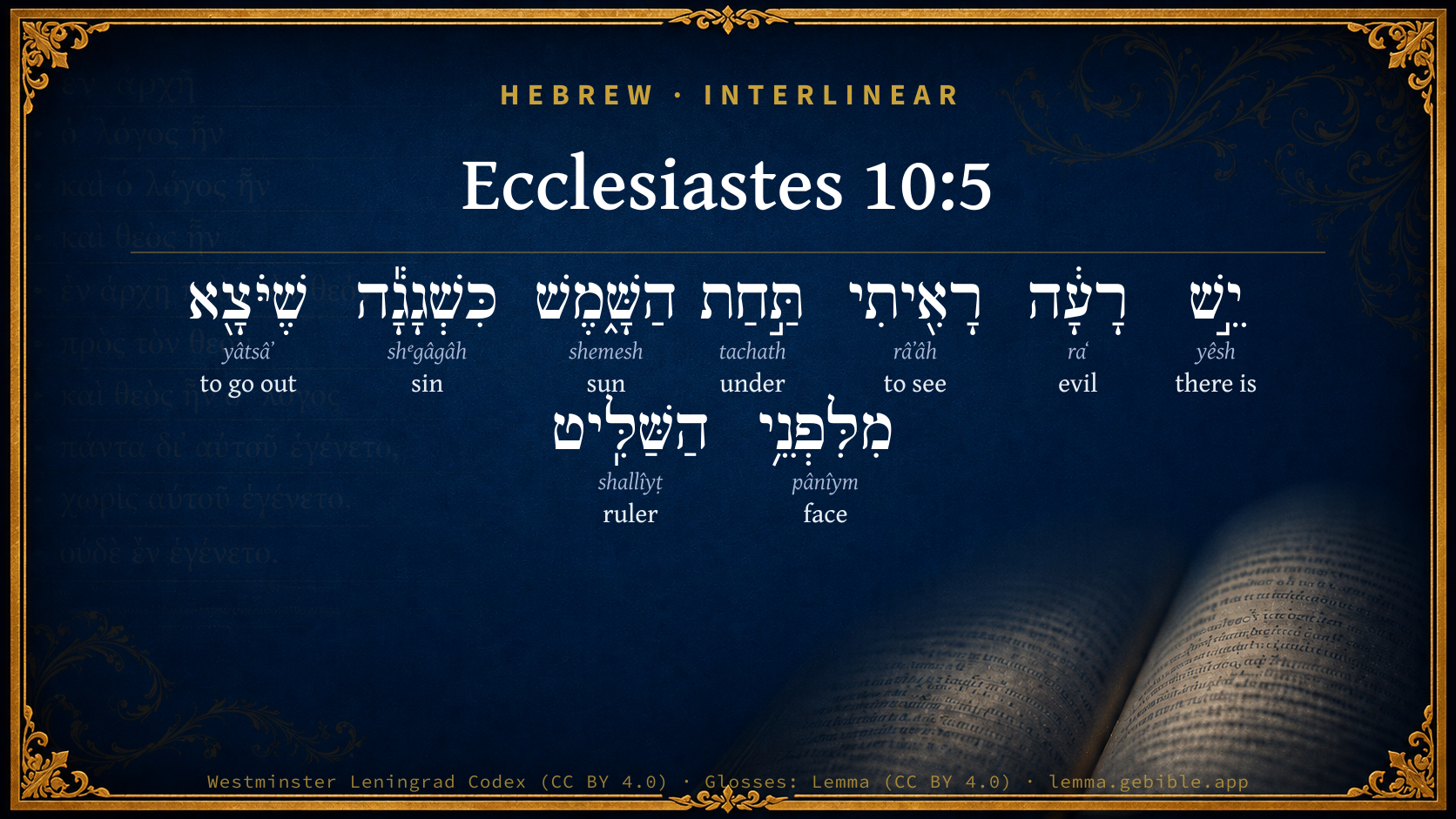
Ecclesiastes 10:5

Hebrew (Westminster Leningrad Codex) Ecclesiastes 10:5 appears in the Hebrew Old Testament. The text above is from the Westminster Leningrad Codex. Each word links to its Strong’s number, a concise gloss, and parsing drawn from the Open Scriptures Hebrew Bible morphology. Click any word for its full Brown-Driver-Briggs (BDB) entry.
Download image
Cite this verse

Ecclesiastes 10:5 (World English Bible). Public Domain. Lemma interlinear Bible study tool, https://lemma.gebible.app/v/ecclesiastes/10/5.

Show BibTeX & RIS
BibTeX
RIS
English Translation
There is an evil which I have seen under the sun, the sort of error which proceeds from the ruler.
World English Bible · Public Domain
Download a study sheet

One document with this verse’s original text, its word-by-word gloss line, the meaning frame, cross-references with their text, attributed commentary, and full source and license credits — printable, and it pastes into notes with its structure intact.

This verse Autodidact and up

Study sheet (.html) Plain text (.txt)

A passage Seminary Student

Up to 50 verses in one chapter. A passage sheet keeps up to 6 commentary sources and 12 cross-references per verse, in the order this page ranks them, and says so on the sheet whenever that leaves anything out. Ask for a single verse and you get the Autodidact verse sheet above.

Everything on this page stays free to read, with no account — the sheet is a download of what is already on screen, not access to it.

Want to remove ads? Support Godless Engineer
Compare translations 3

The same verse in 3 English versions, stacked beneath the original-language interlinear above. Click any original word for its lexicon entry.

Each is an independent rendering of the whole verse — the interlinear is not word-aligned to these translations.

Highlighted words mark where these versions differ — a whole-verse word diff, not a word-by-word alignment.

  • World English Bible Public Domain
    There is an evil which I have seen under the sun, the sort of error which proceeds from the ruler.
  • King James Version Public Domain
    There is an evil which I have seen under the sun, as an error which proceedeth from the ruler:
  • unfoldingWord Literal Text CC BY-SA 4.0
    There is a misfortune I saw under the sun, like an unintentional sin that goes out from before the face of the authority.

unfoldingWord Literal Text — © unfoldingWord, licensed CC BY-SA 4.0. Word-aligned USFM3 via Door43 (git.door43.org/unfoldingWord/en_ult).

Versions to compare (up to 4)

3 of 4 selected

Show all 18 translations

Every available English version of this verse, each an independent rendering of the whole verse.

  • World English Bible Public Domain
    There is an evil which I have seen under the sun, the sort of error which proceeds from the ruler.
  • Berean Standard Bible Public Domain
    There is an evil I have seen under the sun—an error that proceeds from the ruler:
  • Majority Standard Bible Public Domain
    There is an evil I have seen under the sun—an error that proceeds from the ruler:
  • King James Version Public Domain
    There is an evil which I have seen under the sun, as an error which proceedeth from the ruler:
  • American Standard Version (1901) Public Domain
    There is an evil which I have seen under the sun, as it were an error which proceedeth from the ruler:
  • Revised Version (1885) Public Domain
    There is an evil which I have seen under the sun, as it were an error which proceedeth from the ruler:
  • Geneva Bible (1599) Public Domain
    There is an euil that I haue seene vnder the sunne, as an errour that proceedeth from the face of him that ruleth.
  • Douay-Rheims (1899) Public Domain
    There is an evil that I have seen under the sun, as it were by an error proceeding from the face of the prince:
  • Young's Literal Translation Public Domain
    There is an evil I have seen under the sun, As an error that goeth out from the ruler,
  • Literal Standard Version CC BY-SA 4.0
    There is an evil I have seen under the sun, || As ignorance that goes out from the ruler,
  • Unlocked Literal Bible CC BY-SA 4.0
    There is an evil that I have seen under the sun, a kind of error that comes from a ruler:
  • unfoldingWord Literal Text CC BY-SA 4.0
    There is a misfortune I saw under the sun, like an unintentional sin that goes out from before the face of the authority.
  • Darby Bible Public Domain
    There is an evil that I have seen under the sun, as an error [that] proceedeth from the ruler:
  • World Messianic Bible Public Domain
    There is an evil which I have seen under the sun, the sort of error which proceeds from the ruler.
  • Webster's Bible Public Domain
    There is an evil which I have seen under the sun, as an error which proceedeth from the ruler:
  • Free Bible Version CC BY-SA 4.0
    I also realized there's another evil here on earth: rulers make a big mistake
  • Bible in Basic English Public Domain
    There is an evil which I have seen under the sun, like an error which comes by chance from a ruler:
  • JPS Tanakh (1917) Public Domain
    There is an evil which I have seen under the sun, like an error which proceedeth from a ruler:

Literal Standard Version (2020), Covenant Press — licensed CC BY-SA 4.0. Text via the HelloAO Bible API (eBible.org). Unlocked Literal Bible (unfoldingWord) — licensed CC BY-SA 4.0. Text via the HelloAO Bible API (eBible.org). unfoldingWord Literal Text — © unfoldingWord, licensed CC BY-SA 4.0. Word-aligned USFM3 via Door43 (git.door43.org/unfoldingWord/en_ult). Free Bible Version, Dr. Jonathan Gallagher — licensed CC BY-SA 4.0. Text via the HelloAO Bible API (eBible.org).

Word by word

More ways to search: Search by grammar → Find every occurrence → Compare this word →

Practice this passage: Drill this verse → Learn its vocabulary →

הַשַּׁלִּֽיט
shallîyṭ
H7989
“the · ruler”
Particle, Definite Article + Adjective, Adjective, Masculine, Singular, Absolute
Part of Speech
Particle + Adjective
Type
Adjective
Gender
Masculine
Number
Singular
State
Absolute
Full BDB Definition

Origin: from H7980

TWOT: 2396a

having mastery, domineering, master - having mastery - ruler (substantive) - domineering, imperious
  1. יֵ֣שׁ yêsh H3426 “there is” Particle, Demonstrative
  2. רָעָ֔ה raʻ H7451 “evil” Noun, Common, Feminine, Singular, Absolute
  3. רָאִ֖יתִי râʼâh H7200 “to see” Verb, Qal, Perfect, 1st Person, Common, Singular
  4. תַּ֣חַת tachath H8478 “under” Preposition
  5. הַשָּׁ֑מֶשׁ shemesh H8121 “the · sun” Particle, Definite Article + Noun, Common, Both, Singular, Absolute
  6. כִּשְׁגָגָ֕ה shᵉgâgâh H7684 “like/as · sin” Preposition + Noun, Common, Feminine, Singular, Absolute
  7. שֶׁיֹּצָ֖א yâtsâʼ H3318 “who/which · going out” Particle, Relative + Verb, Qal, Participle Active, Feminine, Singular, Absolute
  8. מִלִּפְנֵ֥י pânîym H6440 “from · to/for · face(s) of” Preposition + Preposition + Noun, Common, Both, Plural, Construct

About this verse

These counts appear in no published source. They are computed here, from the morphology-tagged text and Lemma’s own curated glosses. What Lemma adds →

9
words
9
distinct lemmas
Wisdom
section

Notable vocabulary

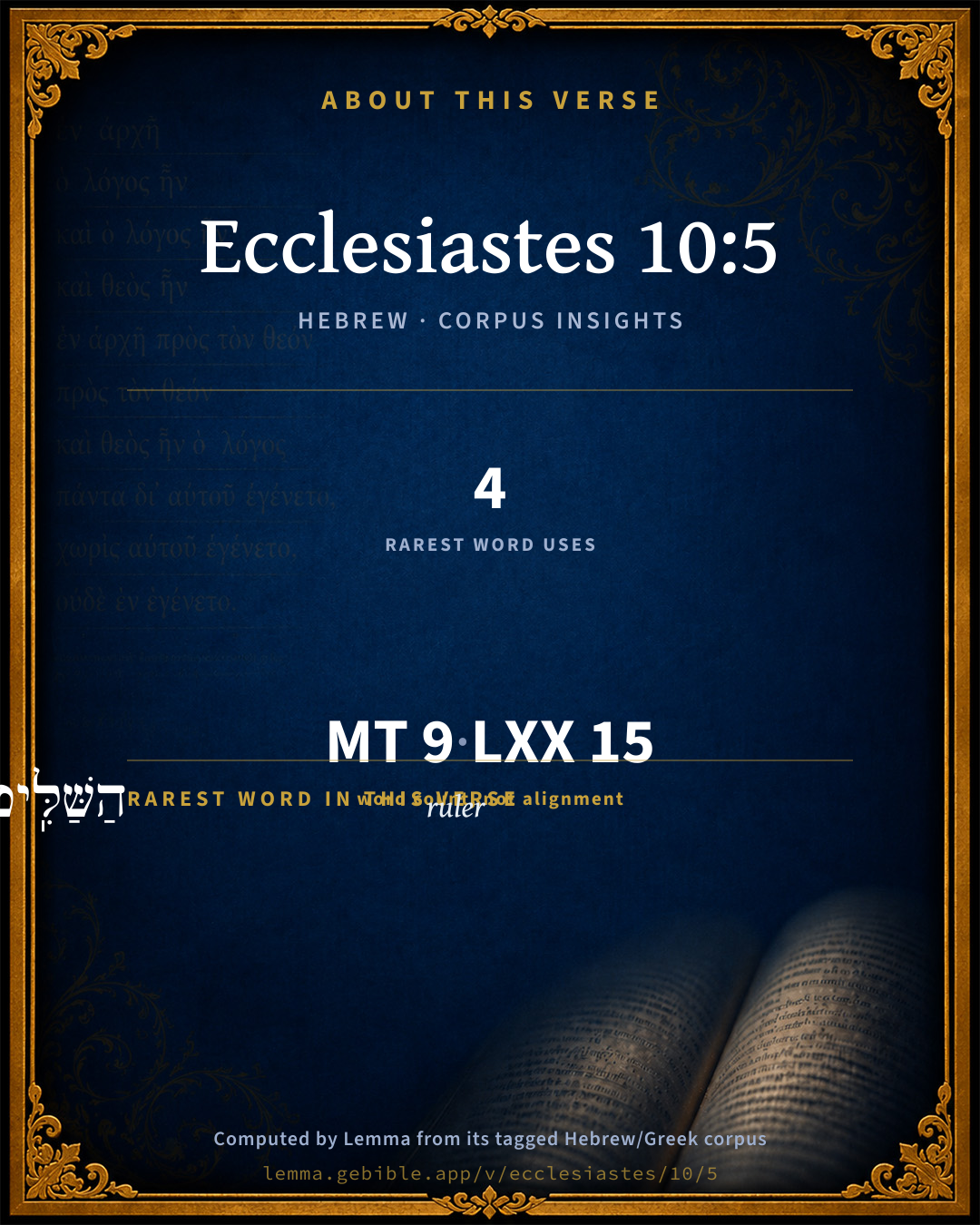
The rarest word here is הַשַּׁלִּֽיט ruler H7989 — appearing just 4 times in the whole Hebrew Bible.

Shared distinctive vocabulary

הַשַּׁלִּֽיט ruler H7989 occurs in 4 verses of the Hebrew Bible. Also found in:

Grammatical profile

  • 2 verbs
  • 4 nouns
  • 1 adjective
  • 1 preposition
  • 1 particle

Verb forms

  • רָאִ֖יתִי Qal · Perfect
  • שֶׁיֹּצָ֖א Qal · Participle Active

Hebrew & Septuagint length

In English translation the verse runs 20 words from the Hebrew and 19 from the Septuagint (LXX English) — closely comparable.

A rough comparison of the two English renderings, which tokenize alike — not a word-level alignment.

Word counts can differ between the Hebrew and the Greek without any difference in meaning — e.g. the Hebrew direct-object marker אֵת has no separate Greek word, and Greek often adds the article ὁ.

In the original languages it is 9 Hebrew tokens and 15 Greek tokens — but the two are counted differently (Hebrew bundles its prefixes and suffixes into one token; the Greek is in lemma form), so that isn’t a like-for-like length.

Cross-references

6

Topical passages linked to Ecclesiastes 10:5 in the Treasury of Scripture Knowledge — connected by theme and wording, ordered by reader-vote popularity; previews shown in the World English Bible.

  • Ecclesiastes 5:13 There is a grievous evil which I have seen under the sun: wealth kept by its owner to his harm.
  • Ecclesiastes 6:1 There is an evil which I have seen under the sun, and it is heavy on men:
  • Ecclesiastes 3:16 Moreover I saw under the sun, in the place of justice, that wickedness was there; and in the place of righteousness, that wickedness was there.
  • Ecclesiastes 4:1 Then I returned and saw all the oppressions that are done under the sun: and, behold, the tears of those who were oppressed, and they had no comforter; and on the side of their oppressors there was power; but they had no comforter.
  • Ecclesiastes 4:7 Then I returned and saw vanity under the sun.
  • Ecclesiastes 9:3 This is an evil in all that is done under the sun, that there is one event to all: yes also, the heart of the sons of men is full of evil, and madness is in their heart while they live, and after that they go to the dead.

Cross-references courtesy of OpenBible.info (CC BY 4.0).

Hebrew and Greek witnesses Masoretic Hebrew ↔ Greek Septuagint

The same verse in the two great witnesses to the Old Testament, shown verse-for-verse.

These are two independent witnesses, not word-aligned to each other, and the Septuagint is shown in lemma (dictionary) form.

Hebrew Ecclesiastes 10:5 Masoretic · Westminster Leningrad Codex

יֵ֣שׁ רָעָ֔ה רָאִ֖יתִי תַּ֣חַת הַשָּׁ֑מֶשׁ כִּשְׁגָגָ֕ה שֶׁיֹּצָ֖א מִלִּפְנֵ֥י הַשַּׁלִּֽיט

There is an evil which I have seen under the sun, the sort of error which proceeds from the ruler.

World English Bible · Public Domain

Greek LXX Ecclesiastes 10:5 Septuagint · lemma form

εἰμί πονηρία ὅς ὁράω ὑπό ὁ ἥλιος ὡς ἀκούσιος ὅς ἐκἔρχομαι ἀπό πρόσωπον ὁ ἐξουσιάζω

There is an evil which I have seen under the sun, wherein an error has proceeded from the ruler.

LXX2012 (modern English Septuagint) · Public Domain

On this verse, Trapp's Complete Commentary discusses the Septuagint’s reading. Read the note in Commentary ↓

Hebrew: Westminster Leningrad Codex (CC BY 4.0). Greek: Septuagint (public domain); English from LXX2012 (modern English Septuagint) (Public Domain). How the Septuagint differs from the Hebrew →

Commentary

Notes on Ecclesiastes 10:5 from classic Christian and Jewish commentators (each source and its license shown beneath its notes). The classic Christian expositions comment on the surrounding passage and are grouped to its opening verse, so a note may address several verses; the Jewish commentaries on the Tanakh (Rashi and others) are per-verse, so they appear only where the commentator wrote on this verse.

Lemma curates 59 commentaries, every one of them public domain or Creative Commons licensed, each selected and text-cleaned for this edition rather than reprinted as found. About our sources →

Trapp's Complete Commentary

John Trapp

Ecc 10:5 There is an evil [which] I have seen under the sun, as an error [which] proceedeth from the ruler:

Ver. 5. As an error which proceedeth from the ruler.] Or, An ignorance, as Jerome renders it; ως ακουσιον - so the Septuagint - as a thing unwillingly done. An error, an infirmity it must be called, because committed by great ones; but in true account it is a gross evil, the very pest of virtue and cause of confusion - viz., the advancement of most unworthy and incapable persons, and that for the prince’s pleasure sake, because he will seem absolute. An earl of Kildare was complained of to our Henry VIII, and when his adversary concluded his invective with, Finally, all Ireland cannot rule this earl, the king replied, Then shall this earl rule all Ireland; and so, for his jest sake, made him deputy. {a}

{a} Heyl. Geog., p. 506.

John Trapp, A Commentary or Exposition upon All the Books of the Old and New Testament (1647–1656) — public domain. Text from a community e-Sword module.

Joseph Benson's Commentary

Ecc 10:5-7. There is an evil, &c. — I have observed another great vanity and misdemeanour among men; as an error which proceedeth, &c. — Or rather, as the Hebrew may be translated, which is indeed an error proceeding from the ruler: for the following erroneous conduct must needs come from those who have power of conferring honour and authority. Folly is set in great dignity — Foolish and unworthy persons are frequently advanced by the favour or humour of princes into places of great trust and dignity, which is at once a great reproach to the prince, and a sore calamity to his people. And the rich sit in a low place — Wise and worthy men, rich in endowments of the mind, are neglected and despised, or removed from those places to which their merits had raised them. I have seen servants on horses — Men of a servile condition and disposition riding in pomp and state as princes; and princes — Men of noble birth and qualities, fit to rule a kingdom, walking as servants — In a state of poverty and degradation, despised and disregarded.

Joseph Benson's Commentary on the Old and New Testaments (1811–1818) — public domain. Text from a community e-Sword module.

The Preacher's Complete Homiletical Commentary

Joseph S. Exell (gen. ed.)

CRITICAL NOTES.—

Ecc_10:5. As an error which proceedeth from the ruler.] Not a mere error, as such, but one which is manifest by its consequences—caprices of despotism like those described in Ecc_10:6-7.

Ecc_10:6. Folly.] To be understood, in the concrete form, of mean and ignoble persons, having no title to dignity and advancement. The rich.] Men of noble birth and bearing, inheriting an honourable name and patrimony, and qualified to fill exalted positions in the state. This unnatural inversion of the orders of society was not infrequent under the despotism of Eastern monarchs.

Ecc_10:7. Servants.] Not merely in condition, but servile in character, destitute of all noble aims and purposes. Princes.] Both in regard of outward rank, and having a corresponding elevation of character and bearing. They are princely minded.

Ecc_10:8. He that diggeth a pit shall fall into it.] It was the custom, where lions and other wild animals abounded, to dig pits overlaid with branches of trees, in order to entrap them. Hence a man might unwittingly fall into a pit which he had himself digged (Psa_7:15; Psa_57:6; Pro_26:27). And whoso breaketh an hedge, a serpent shall bite him.] Serpents and other reptiles were often found hiding in old walls. Hence he who broke through them ran the risk of being bitten (Amo_5:19).

Ecc_10:9. Removeth stones … cleaveth wood, shall be endangered thereby.] As such employments required violent exertion, they were the more dangerous.

MAIN HOMILETICS OF THE PARAGRAPH.—Ecc_10:5-10

THE PROMOTION OF FOOLS

The excellencies of wisdom, and the practical uses of it, are evident to all who can feel the force of moral reasoning. Yet the wise often fail of attaining their true place in the world, or having attained it, they are thrust out, and fools set up in their stead. He who is conscious of superior gifts, and rectitude of purpose, is condemned to witness the promotion of men, contemptibly poor in mind and morals, to places of authority and power. How does this perverse disposition of things arise, and wherewith shall good men console themselves in this disappointment?

I. It arises from the Interference of Human Caprice with the Proper Tendencies of Social Forces. The setting up of folly in great dignity, and casting down the wise and noble from their seats, is here ascribed “to an error which proceedeth from the ruler.” (Ecc_10:5.) Such an unnatural inversion can only proceed from the caprice of some arbitrary authority. It is only possible through those accidents of history when folly and wickedness gain a temporary advantage. That wisdom which is made up of justice, goodness, and practical sagacity in human affairs, is a social force which has a known direction. But it may be turned aside from this direction by some disturbing causes. The fitness of things, their true tendencies and results, must be acknowledged, though they may be interrupted for a while by some disorder.

1. It is fitting that the wisest and best should rule. Such ought to have the highest social influence and power—the chiefest authority in the state. Nations can only maintain their place in the world’s history by means of their noblest and wisest men. Their natural decay sets in when these are displaced, and the sovereignty given to fools. There are conditions of national stability that must not be violated, and it is impossible to preserve the social pyramid poised upon its apex.

2. The most sacred rights of man may be held in abeyance. Wisdom and goodness ought to secure their proper results, and enjoy with dignity their quiet triumphs. But the existence of moral evil introduces a source of complication. It is a disquieting factor in our reckoning of human things. Hence, in this world, what is right does not always prevail. It is the property of evil to hold continual warfare against all order—to rebel against all just dignities—to undo the work of goodness in the world. Thus the progress of humanity towards perfection is retarded.

II. It is an Unstable Condition of Things. The wise man may be consoled when he reflects that such social disorder cannot last long. There are certain fundamental principles of national prosperity, and these cannot be long violated with impunity. Retribution comes at length, and the true order returns. There are certain chemical preparations which are said to be unstable, because they are held together by a slender bond, and the slightest force is sufficient to decompose them. In like manner, there are conditions of society brought about by the irrational caprice of wilful men; but such conditions are unstable. They are always upon the point of rupture. Providence, which permits so much, has yet reserves of force by which these evils find correction. In the disorders of human government, fools may be suddenly raised to rank and authority; but they must at length fall to their true level. They can but, as it were, snatch at greatness: they cannot retain it in their grasp. No power can give their unnatural assumption any fixity or permanence.

1. The devices which procure their promotion may be turned against themselves. (Ecc_10:8-9.) They were raised to their dignities by flattery, intrigue—by a ruthless trampling upon the rights of others. They employed dangerous weapons which may, at any moment, be snatched from their hands and used against themselves. He who breaks through the boundaries of truth and right runs the risk of arousing indignant justice. The breakers of old walls—moral, social—shall be avenged by the startled serpent’s sting.

2. Human caprice is not to be trusted. When men are not governed by great principles, but by passion and folly, they are ever unsteady. You cannot reckon upon them, for nothing can be trusted that does not rest upon the sure foundations of truth and right. The fools which the wilful monarch promotes to power may soon excite his disgust, and give place to other fools who are likely to meet with the same capricious fate.

3. They lack that fitness which alone can give dignity and efficiency to office. Wisdom imparts an intellectual and a moral fitness for every duty and trust; and without it, no man can fulfil the highest offices in the community.

(1.) He cannot maintain the dignity proper to them. Men hold in admiration those who possess wisdom and knowledge. Even the most ignorant learn to regard, with a feeling akin to adoration, those who are more knowing and wiser than they. Men may pay court to the outward splendour of the fool; they may adore the greatness which is thrust upon him, but they despise himself. The pomp and glory of outward circumstance cannot impart true dignity where the solid endowments of moral worth and wisdom are not found.

(2.) He cannot maintain the efficiency of it. (Ecc_10:10.) Physical strength, or the power of authority, may accomplish much, but wisdom is necessary for the finest and most ingenious work—for the framing of all purposes that are far-reaching, and the richest in their consequences to man. Human destiny cannot be shaped to the noblest issues by rough tools, though they be wielded with savage strength. There must be the cunning hand—the skilful device—the sharp edge. These are the gifts of wisdom to man, without which he cannot accomplish any work of enduring worth. The power of office and authority is impotent and vain where the highest faculties are blunt.

SUGGESTIVE COMMENTS ON THE VERSES

Ecc_10:5. St. Cyril observeth that in the law whereas if others did sin, God appointed a sacrifice and remedy for them, whether they sinned through ignorance or else with knowledge. In the sin of the High Priest there is not appointed any sacrifice for him if that he sinned by ignorance, “as if by no means there were to be admitted in them that do rule ignorance, or defect of that wisdom required for their position.” Besides there had need to be a great care in the ruler that shall choose others to rule and command, because it is a hard thing to discharge it. Nazianzene saith, “It is a hard thing for a man to rule, a most hard thing to instruct and teach men. It seemeth to me to be an art of arts, a science of sciences, to rule man, who is of all creatures most various and changeable” [Jermin].

It is hard for ordinary men to conceive of the full nature and strength of those temptations which beset one who is invested with absolute rule. There are positions in which it is hard for ordinary virtue to stand upright. It is no wonder, therefore, that such monarchs have erred.

The most exalted station and complete investiture of authority cannot confer infallibility.

We must not allow errors to pass unheeded because they are connected with great names.

The errors of the mightiest are the most destructive. There is an “energy of position” in things moral and social, as well as in the region of matter. When power is wrongly directed, the disaster is proportioned to its magnitude.

Ecc_10:6. There is no function belonging to rulers which they are bound to exercise with greater impartiality, prudence, and caution, than that of selecting men who are to fill the great offices of the state. These men have oftentimes the destinies of a nation in their hands.… To place, out of mere favouritism or caprice, or even from a want of sufficient care and enquiry, an unrighteous or incompetent judge in the seat of justice; an ignorant or dishonest administration in charge of the revenues of a country; a cruel or rapacious governor at the head of the province of the kingdom; an unskilful or inexperienced leader in the command of an army;—for rulers to do such things is to trifle with interests of the greatest magnitude, and to betray a trust of the most solemn and responsible kind [Buchanan].

The highest honours and dignities must sit ungainly upon those who are not prepared for them by sufficient training and capacity. In the obscurest station, folly is a disadvantage, a noticeable evil; but in the most exalted station, it becomes conspicuous and most fully exposed to the eye of ridicule.

When a fool is set in dignity, it is as when a handful of hay is set up to give light, which with smoke and smell offendeth all that are near it. When the worthy sit in a low place, it is as when a goodly candle, that on a table would give a comfortable and comely light, is put under a bushel [Jermin].

When men of true nobility of mind and character are pushed from their seats, they still adorn the lowliest place where they are constrained to sit. They suffer most who cast them down.

Ecc_10:7. No change of outward condition can alter what is essential in the character. The servile mind is not destroyed by the elevation from poverty to grandeur, nor do royal minds cease to be such when they are stripped of all outward marks of greatness.

It was far from being a very uncommon case, under the despotic government of the East; slaves of the palace being not unfrequently, from caprice, partiality, or secret selfishness, advanced to the highest ranks, to look down in haughty superciliousness on their natural and deserving superiors [Wardlaw].

Ecc_10:8. He who seeks prosperity and distinction by treacherous ways, or by breaking through the bounds of moral restraint, tempts the vengeance of Heaven.

He who frames designs for the destruction of others is working on the utmost edge of danger.

There are proper boundaries to knowledge as well as to the courses of conduct. He who by needless curiosity adventures to break through them, only prepares misery for himself—the anguish of a restless and unsatisfied mind.

When ambitious heads break through hedges to get to high places, there is a serpent lurking secretly, which bites them by the heel and either stops them from going on, or else bringeth by it some great mischief upon them. Or else the serpent that biteth these ambitious subtle workers is some other more subtle than they, by whom they are undermined in their plots. Indeed, when ambition is set upon it, no hedge, no wall is able to hold it, but it breaks through, and leaps over all. What hedges did Athaliah break, killing all the royal progeny that herself might reign? What hedges did Abimelech break, killing seventy of his brethren that himself might rule? What hedges did Absalom break that he might be king in Israel? But did not the serpent bite them all? [Jermin.]

Ecc_10:9. The man who sets himself to pull down or to alter the fabric of the constitution of a country, undertakes a work of no light or trifling difficulty, and a work always of hazard to himself, and very often of fearfully doubtful benefit to others. It is a vast deal easier to find fault than to mend; to complain of what is wrong, than to substitute what is right [Wardlaw].

Most men have penetration enough to discover the faults in things that are established, but the knowledge of the deep principles upon which they rest, and by which they are held together, is the possession of only a few. He who attempts the work of a reformer, without sufficient knowledge and prudence, is likely to meet with ill-success and to bring trouble upon himself.

There are times when the corruptions of existing things have grown so great as to demand violent measures for their reformation. But the zeal thus aroused is a dangerous weapon in the hands of frail man.

Ecc_10:10. A little skill expended in sharpening the edge, will save a great deal of strength in wielding the hatchet. But, just as the unskilful labourer who cannot handle the whetstone must belabour the tree with a blunt instrument, and after inflaming his palms and racking his sinews, achieves less result than his neighbour whose knowledge and whose knack avail instead of brute force, so the servant who does not know the right way to do his work, after all his fatigue and fluster will give less satisfaction than one who has learned the best and easiest methods; and the householder who knows nothing of the mechanic arts, or who knows not what to do when sickness or emergencies occur, must compensate by the depth of his purse, or by the strength of his arm, for the defects of his skill. A blunt axe implies heavy blows and an aching arm; coarse work with a blistered hand. But “wisdom is profitable to direct.” Intelligence is as good as strength, and a little skill will save both time and materials, money and temper [Dr. J. Hamilton].

Even in the most righteous cause, great strength and determination of character will lead a man into many evils unless he has skill and prudence to guide him.

Mere force is blind, and must be directed to proper ends and uses by those who have the power to see.

The triumphs of man over the fierceness and strength of the brute creation, and over all the difficulties which nature places in his way, are the triumphs of mind.

Wisdom gives that fine edge to effort by which many difficulties, that otherwise offer a complete resistance, are easily cleft through.

Wisdom is the director of all forces which can be brought under the control of man. Without intelligent guidance, they cannot become effective for the best ends.

The Preacher's Complete Homiletical Commentary (gen. ed. Joseph S. Exell; Funk & Wagnalls, c. 1892) — public domain (pre-1929). A full-Bible homiletical/sermon-outline anthology covering 65 of 66 books (2 John is absent from the source module). Text from a community e-Sword module.

Tyndale Open Study Notes

Tyndale Open Resources

10:5-7 The unjust and destructive delegation of authority to those incapable of using it wisely is a grave mistake. Favoritism, nepotism, extortion, and bribery can place the most reckless fools in the most powerful positions.

Tyndale Open Study Notes — © Tyndale Open Resources, licensed CC BY-SA 4.0. Text via the HelloAO Bible API.

Geneva Bible (1599)

Geneva Bible translators

Meaning, that it is an evil thing when they that are in authority, fail and do not their duty.

Geneva Bible (1599) marginal notes — public domain. Text via Bolls.life.

Jamieson, Fausset & Brown

Robert Jamieson, A. R. Fausset & David Brown

as--rather, "by reason of an error" [MAURER and HOLDEN].

Jamieson, Fausset & Brown — Commentary Critical and Explanatory on the Whole Bible (1871) — public domain (CC PDM 1.0). Text via the HelloAO Bible API.

Adam Clarke's Commentary

Verse 5. An error which proceedeth from the ruler] What this error in the ruler is, the two following verses point out: it is simply this - an injudicious distribution of offices, and raising people to places of trust and confidence, who are destitute of merit, are neither of name nor family to excite public confidence, and are without property; so that they have no stake in the country, and their only solicitude must naturally be to enrich themselves, and provide for their poor relatives. This is frequent in the governments of the world; and favouritism has often brought prosperous nations to the brink of ruin. Folly was set in dignity; the man of property, sense, and name, in a low place. Servants - menial men, rode upon horses - carried every thing with a high and proud hand; and princes, - the nobles of the people, were obliged to walk by their sides, and often from the state of things to become in effect their servants. This was often the case in this country, during the reign of Thomas a Becket, and Cardinal Woolsey. These insolent men lorded it over the whole nation; and the people and their gentry were raised or depressed according as their pride and caprice willed. And, through this kind of errors, not only a few sovereigns have had most uncomfortable and troublesome reigns, but some have even lost their lives.

Adam Clarke's Commentary on the Bible (1810–1826) — public domain. Text from a community e-Sword/MySword module.

Ellicott's Commentary for English Readers

(5) Error.—The word is the same as at Ecc_10:6.

A Bible Commentary for English Readers, edited by Charles John Ellicott (1878–1897) — public domain. Text from a community e-Sword module.

The Cambridge Bible for Schools and Colleges

gen. ed. J. J. S. Perowne

5. as an error which proceedeth from the ruler] The last word serves as a link connecting this verse with the preceding. It might be wise at times to bow to the temper of a despotic ruler, but the ruler was not always right. What the Debater had seen was to him a blot upon the government of him who allowed it. There lies below the surface the half-suppressed thought that this anomaly, stated in the next verse, was as a blot in the government of the supreme Ruler of the Universe. Technically the word was used in the Mosaic Law of the involuntary sins of ignorance (Lev_4:22; Lev_4:27; Lev_5:18). The unequal distribution of honours seemed to men as a blunder of Providence.

The Cambridge Bible for Schools and Colleges (gen. ed. J. J. S. Perowne; Cambridge University Press, 1878–1918) — public domain. Text from a community e-Sword module.

John Gill's Exposition

There is an evil which I have seen under the sun,.... Which Solomon had observed in the course of his life, practised in some kingdoms and by some princes on earth, under the sun; for there is nothing of the like kind, as after mentioned, done in heaven, above the sun;

as an error which proceedeth from the ruler; from the supreme ruler of a nation, the king of it; and it is not only as an error, or like one, a seeming one; but it is a real error, bestowing places of honour and profit on undeserving persons: which error proceeds from ignorance of the persons; or from affection to them, and from friendship cultivated with them in the younger time of life, being educated with them; or through the misrepresentation and imposition of those about him, who have ends to serve by their promotion; or through his own lusts and passions, which these men indulge him in. It may be understood of God, the supreme ruler, who suffers such things to be; and which may seem to some an error in providence, though it is not: but the other sense is best.

John Gill's Exposition of the Whole Bible (1746–1763) — public domain (CC PDM 1.0). Text via the HelloAO Bible API.

Haydock's Catholic Bible Commentary

Prince, who seems to have been guilty of any indiscretion.

George Leo Haydock (1774–1849), Haydock's Catholic Family Bible and Commentary, 1859 edition — public domain. Excludes Psalms (Douay-Rheims chapter numbering differs from Protestant) and Deuterocanonical books (Catholic canon only).

Matthew Poole's English Annotations

I have observed another great vanity and misdemeanour amongst men.

As an error which proceedeth from the ruler; so the sense is, like those errors which rulers commonly commit. Or rather, which is indeed an error proceeding from the ruler; for the following miscarriage must needs come from those who have power of conferring honour and power, &c. So the Hebrew caph is not a note of likeness, but of reality, as it is Jdg 13:23; Neh 7:2; Hos 4:4; 5:10, and oft elsewhere.

Matthew Poole's English Annotations on the Holy Bible (1683–1685) — public domain. Text from a community e-Sword/MySword module.

Whedon's Commentary on the Bible

Daniel D. Whedon

5. An evil — Koheleth speaks of this as occurring in his day and before his own eyes, (which could hardly have happened in the just reign of Solomon.) As an error, etc. — That is, such an outrage as only a despot could perpetrate; such as many a caliph, sultan, and emperor has committed.

Daniel D. Whedon (gen. ed.), Commentary on the Old and New Testaments (1874–1909) — public domain. Text from a community e-Sword module.

The Pulpit Commentary

Koheleth gives his personal experience of apparent confusion in the ordering of state affairs. There is an evil which I have seen under the sun. Power gets into the hands of an unwise man, and then errors are committed and injustice reigns. As an error which proceedeth from the ruler. The K here is cash veritatis, which denotes not comparison, but resemblance, the idealization of the individual, the harmony of the particular with the general idea. The evil which he noticed appeared to be (he does not affirm that it is) a mistake caused by the ruler; it so presented itself to his mind. The caution observed in the statement may be owing partly to the tacit feeling that such blots occasioned difficulties in the view taken of the moral government of the world. He does not intend to refer to God under the appellation "Ruler." The Septuagint renders, JWv ajkousion ejxhlqen, "As if it came involuntarily;" Vulgate, to much the same effect, Quasi per errorem egrediens. The idea here is either gnat the evil is one not produced by any intentional action of the ruler, but resulting from human imperfection, or that what appears to be a mistake is not so really. But these interpretations are unsuitable. Those who adhere to the Solomonic authorship of our book see here a prophetic intimation of the evil of Jeroboam"s rule, which evil proceeded from the sins of Solomon himself and his son Rehoboam. (So Wordsworth, Motais, etc.)

Vers. 5-7.

Social paradoxes.

The evil which the writer of Ecclesiastes here condemns is one of which the history of every nation affords many examples. Princes" favorites have too often been chosen from amongst the worthless herd who seek their own elevation and advantage by ministering to the vices of the young, profligate, and powerful. How many a reign has been marred by this mischief! How many a king has been misled, to his own and his country"s harm, by the folly of choosing companions and counselors not for wisdom, sincerity, and patriotism, but because those chosen are of congenial tastes and habits, or are flatterers and parasites!

I THE ELEVATION OF FOOLISH FAVORITES TO POWER IS INJURIOUS TO THOSE SO PROMOTED, Men who might have been respectable and useful in a lowly station are corrupted and morally debased by their elevation to posts of undeserved dignity and emolument. Their heads are turned by the giddy height to which they are raised.

II THE ELEVATION OF FOOLISH FAVORITES TO POWER IS INJURIOUS TO THE PRINCES WHOM THEY PROFESS TO SERVE. What kings and rulers need is to be told the truth. It is important that they should know the actual state and needs of the nation. And it is important that any weakness or wrong bias, natural or acquired, should be corrected. But the fools who are set in high places make it their one great rule of conduct never to utter unpalatable truth. They assume the faultlessness of their master; they paint the condition of his subjects in glowing colors, and give the ruler all the credit for national prosperity. Their insincerity and flattery are morally injurious to the prince, who by the companionship of the wise might have been morally benefited.

III THE ELEVATION OF FOOLISH FAVORITES TO POWER IS INJURIOUS TO THE COMMUNITY. The example of injustice thus presented is discouraging to the upright and depressing to the reflecting. The throne becomes unpopular, and the people generally are demoralized. The evil is no doubt greater in despotic than in constitutional states, for these latter afford fewer opportunities for rapacity and oppression. Yet nothing more injuriously affects the community generally than the spectacle of a court which prefers folly to wisdom, fashion to experience, vice to virtue, frivolity to piety. T.

The Pulpit Commentary (1880–1919), ed. H.D.M. Spence-Jones & Joseph S. Exell — public domain. Text from a community e-Sword module.

Keil & Delitzsch

C. F. Keil & F. Delitzsch

"There is an evil which I have seen under the sun, like an error which proceedeth from the ruler." The introduction by the virtual relative raithi is as at Ecc 5:12; Ecc 6:1. Knobel, Hengst., and others give to the כ of כּשׁ the meaning of "according to," or "in consequence of which," which harmonizes neither with ra'ah nor with raithi. Also Kleinert's translation: "There is a misery - I have seen it under the sun - in respect of an error which proceedeth from the ruler," is untenable; for by this translation ra'ah is made the pred. while it is the subj. to ישׁ, and kishgagah the unfolding of this subject. Hitzig also remarks: "as [wie ein] an error, instead of which we have: in respect to [um einen] an error;" for he confounds things incongruous. Hitz., however, rightly recognises, as also Kleinert, the כ as Caph veritatis, which measures the concrete with the idea. Isa 13:6, compares the individual with the general which therein comes to view, Eze 26:10; Neh 7:2; cf. Sa2 9:8. Koheleth saw an evil under the sun; something which was like an error, appeared to him altogether like an error which proceedeth from the ruler. If we could translate שׁיּ by quod exiit, then כ would be the usual Caph similitudinis; but since it must be translated by quod exit, וגו כשׁ places the observed fact under a comprehensive generality: it had the nature of an error proceeding from the ruler. If this is correct, it is so much the less to be assumed that by השׁלּיט God is to be understood (Dan 5:21), as Jerome was taught by his Hebraeus: quod putent homines in hac inaequalitate rerum illum non juste et ut aequum est judicare. It is a governor in a state that is meant, by whom an error might easily be committed, and only too frequently is committed, in the promotion of degradation of persons. But since the world, with its wonderful division of high and low, appears like as it were an error proceeding from the Most High, there certainly falls a shadow on the providence of God Himself, the Governor of the world; but yet not so immediately that the subject of discourse is an "error" of God, which would be a saying more than irreverent. יּצא = יּצה is the metaplastic form for יּצאה or יּצאת (for which at Deu 28:57 incorrectly יּצת), not an error of transcription, as Olsh. supposes; vid., to the contrary. מלּפני (Symm. ἐξ ἔμπροστηεν) with יצא is the old usus loq. There now follows a sketch of the perverted world.

Keil & Delitzsch — Biblical Commentary on the Old Testament (1861–1891) — public domain (CC PDM 1.0). Text via the HelloAO Bible API. (Old Testament only.)

unfoldingWord translationNotes

Door43 World Missions Community

under the sun

This refers to things that are done on earth. See how you translated this in Ecclesiastes 1:3. AT: "on the earth" (See: Idiom)

Fools are given leadership positions

This can be stated in active form. AT: "Rulers give positions of leadership to fools" (See: Active or Passive)

successful men are given low positions

This can be stated in active form. AT: "they give low positions to successful men" (See: Active or Passive)

low positions

This is an idiom. AT" "unimportant positions" (See: Idiom)

successful men walking like slaves on the ground

This speaks of successful men walking like slaves walk, because slaves were usually forced to walk and were not permitted to ride. (See: Simile)

translationWords

evil

servant

horse

unfoldingWord translationNotes — © Distant Shores Media and the Door43 World Missions Community, licensed CC BY-SA 4.0. Source: git.door43.org/Door43/en_tn.

Rashi

Rabbi Shlomo Yitzchaki (Rashi)

like an error that goes forth from before the ruler It is like a ruler who let an error out of his mouth unintentionally, and it cannot be retracted. So does the Holy One, blessed be He, speak, and it cannot be retracted.

Rashi on the Tanakh — English translations: “The Judaica Press complete Tanach with Rashi, translated by A. J. Rosenberg” (CC BY 4.0); “Pentateuch with Rashi's commentary by M. Rosenbaum and A.M. Silbermann, 1929-1934” (public domain); “The Metsudah Tanach series, Lakewood, N.J” (CC BY 4.0); and “The Book of Joshua, Metsudah Publications, 1997” (CC BY 4.0). Text via Sefaria.

Lesson kit

Teaching starters — assembled from the data on this page, not authored interpretation. Every prompt links to the verse data it draws on. Edit before teaching.

Ecclesiastes, in the Wisdom, opens this verse with 9 words (9 distinct Hebrew lemmas). Its most distinctive word is shallîyṭ (“ruler”). A historical commentator’s framing appears above. Read the whole chapter for the surrounding context.

Discussion questions

  1. The word shallîyṭ carries the sense “ruler.” How does it shape the verse?
  2. Genesis 42:6 shares the word «ruler» with this verse. How do the two illuminate each other?
  3. The translations on this page render this verse differently — a whole-verse word diff, not a word-by-word alignment. What might account for the different wordings?
  4. The verb «רָאִ֖יתִי» is Qal Perfect. How does its form color the action?
  5. Reading how Trapp's Complete Commentary and Joseph Benson's Commentary read this verse, where do the two commentators agree and where do they part?

Things to notice

Reading settings

Reading text

Shown beneath each verse's original-language words.

Old Testament
Old Testament edition

Read the OT as the Masoretic Hebrew (MT) or the Greek Septuagint (LXX).

English shown for the Greek Septuagint (in the Hebrew ↔ Greek comparison).

Comparing translations? Open the Compare panel on any verse page to stack up to four side by side.