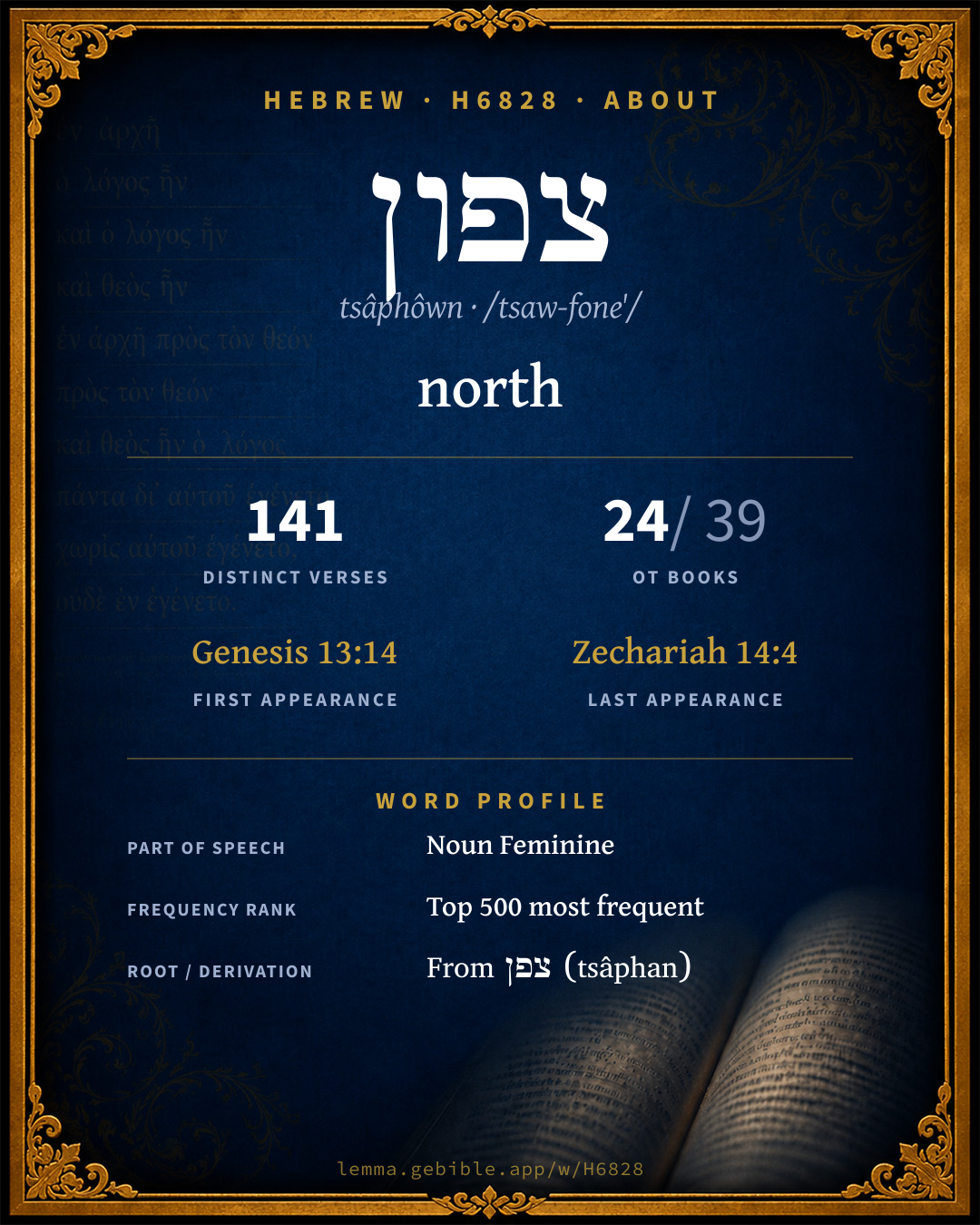
צָפוֹן
north
‘north’ is one of 3 main senses fuller range ↓
Full lexicon entry — Brown-Driver-Briggs (BDB)
From Brown-Driver-Briggs (BDB)
Where this word appears
See every Absolute-state word in the Hebrew Bible →
Grammar key — what these labels mean
Part of speech
- Noun
- A naming word — a person, place, thing, or idea.
Noun type
- Common
- A common noun — a general class of person, place, or thing (“king,” “city,” “water”), not a specific name.
State
- Absolute
- The independent form of a noun, not bound to a following word.
- Construct
- A noun bound to a following noun in a possessive / “of” relationship (the construct chain).
Gender
- Feminine
- Grammatically feminine.
Number
- Singular
- One.
Every verse where H6828 appears in the Book of Joshua — 22 distinct verses. Click any verse to open its interlinear word-by-word view. Verse text shown in the World English Bible for context — . Each verse’s Hebrew form is shown with its reference; the English is not keyword-highlighted, since the data carries no word-level English alignment. Use “Compare translations” on any verse to read it across multiple English versions. This concordance covers the Hebrew Bible; Septuagint (Greek Old Testament) occurrences are not indexed here.
Joshua
- Joshua 8:11 מִ/צְּפ֣וֹן prep + n c fs cs All the people, [even] the [men of] war who were with him, went up, and drew near, and came before the city, and encamped on the north side of Ai: now there was a valley between him and Ai.
- Joshua 8:13 מִ/צְּפ֣וֹן prep + n c fs cs So they set the people, even all the host who was on the north of the city, and their liers-in-wait who were on the west of the city; and Joshua went that night into the midst of the valley.
- Joshua 11:2 מִ/צְּפ֗וֹן prep + n c fs cs and to the kings who were on the north, in the hill-country, and in the Arabah south of Chinneroth, and in the lowland, and in the heights of Dor on the west,
- Joshua 13:3 צָפ֔וֹנָ/ה n c fs + sfx dem from the Shihor, which is before Egypt, even to the border of Ekron northward, [which] is reckoned to the Canaanites; the five lords of the Philistines; the Gazites, and the Ashdodites, the Ashkelonites, the Gittites, and the Ekronites; also the Avvim,
- Joshua 15:5 צָפ֨וֹנָ/ה֙ n c fs + sfx dem The east border was the Salt Sea, even to the end of the Jordan. The border of the north quarter was from the bay of the sea at the end of the Jordan;
- Joshua 15:6 מִ/צְּפ֖וֹן prep + n c fs cs and the border went up to Beth Hoglah, and passed along by the north of Beth Arabah; and the border went up to the stone of Bohan the son of Reuben;
- Joshua 15:7 וְ/צָפ֜וֹנָ/ה conj + n c fs + sfx dem and the border went up to Debir from the valley of Achor, and so northward, looking toward Gilgal, that is over against the ascent of Adummim, which is on the south side of the river; and the border passed along to the waters of En Shemesh, and the goings out of it were at En Rogel;
- Joshua 15:8 צָפֹֽנָ/ה n c fs + sfx dem and the border went up by the valley of the son of Hinnom to the side of the Jebusite southward (the same is Jerusalem); and the border went up to the top of the mountain that lies before the valley of Hinnom westward, which is at the uttermost part of the valley of Rephaim northward;
- Joshua 15:10 מִ/צָּפ֖וֹנָ/ה prep + n c fs + sfx dem and the border turned about from Baalah westward to Mount Seir, and passed along to the side of Mount Jearim on the north (the same is Chesalon), and went down to Beth-shemesh, and passed along by Timnah;
- Joshua 15:11 צָפוֹנָ/ה֒ n c fs + sfx dem and the border went out to the side of Ekron northward; and the border extended to Shikkeron, and passed along to Mount Baalah, and went out at Jabneel; and the goings out of the border were at the sea.
- Joshua 16:6 מִ/צָּפ֔וֹן prep + n c fs and the border went out westward at Michmethath on the north; and the border turned about eastward to Taanath Shiloh, and passed along it on the east of Janoah;
- Joshua 17:9 מִ/צְּפ֣וֹן prep + n c fs cs The border went down to the brook of Kanah, southward of the brook: these cities belonged to Ephraim among the cities of Manasseh: and the border of Manasseh was on the north side of the brook, and the goings out of it were at the sea:
- Joshua 17:10 וְ/צָפ֨וֹנָ/ה֙ מִ/צָּפ֔וֹן conj + n c fs + sfx dem prep + n c fs southward it was Ephraim's, and northward it was Manasseh's, and the sea was his border; and they reached to Asher on the north, and to Issachar on the east.
- Joshua 18:5 מִ/צָּפֽוֹן prep + n c fs They shall divide it into seven portions: Judah shall abide in his border on the south, and the house of Joseph shall abide in their border on the north.
- Joshua 18:12 צָפ֖וֹנָ/ה מִ/צָּפ֗וֹן n c fs + sfx dem prep + n c fs Their border on the north quarter was from the Jordan; and the border went up to the side of Jericho on the north, and went up through the hill-country westward; and the goings out of it were at the wilderness of Beth Aven.
- Joshua 18:16 צָפ֑וֹנָ/ה n c fs + sfx dem and the border went down to the uttermost part of the mountain that lies before the valley of the son of Hinnom, which is in the valley of Rephaim northward; and it went down to the valley of Hinnom, to the side of the Jebusite southward, and went down to En Rogel;
- Joshua 18:17 מִ/צָּפ֗וֹן prep + n c fs and it extended northward, and went out at En Shemesh, and went out to Geliloth, which is over against the ascent of Adummim; and it went down to the stone of Bohan the son of Reuben;
- Joshua 18:18 צָפ֑וֹנָ/ה n c fs + sfx dem and it passed along to the side over against the Arabah northward, and went down to the Arabah;
- Joshua 18:19 צָפוֹנָ/ה֒ צָפ֔וֹנָ/ה n c fs + sfx dem n c fs + sfx dem and the border passed along to the side of Beth Hoglah northward; and the goings out of the border were at the north bay of the Salt Sea, at the south end of the Jordan: this was the south border.
- Joshua 19:14 מִ/צְּפ֖וֹן prep + n c fs cs and the border turned about it on the north to Hannathon; and the goings out of it were at the valley of Iphtah El;
- Joshua 19:27 צָפ֛וֹנָ/ה n c fs + sfx dem and it turned toward the sunrise to Beth Dagon, and reached to Zebulun, and to the valley of Iphtah El northward to Beth Emek and Neiel; and it went out to Cabul on the left hand,
- Joshua 24:30 מִ/צְּפ֖וֹן prep + n c fs cs They buried him in the border of his inheritance in Timnathserah, which is in the hill-country of Ephraim, on the north of the mountain of Gaash.
About this entry
At a glance — auto-summarized from this page’s data, not written by a person. Every figure links to its source below. This summary describes the numbers; it doesn’t interpret them.
At its core, צפון (tsâphôwn) means “north.” Scripture first uses it in Genesis 13:14. It turns up in 141 verses across 24 books, a common footprint. The word gravitates to Ezekiel (27%), then Jeremiah and Joshua. Catalogued under 3 senses, its meaning is not single-sense. Each statement above links to its evidence; the full detail follows below.
Gloss history
Strong's 1890 vs modern scholarship
About this word
Strong's H6828 catalogs a Hebrew word from the Hebrew Old Testament.
These counts are not copied from any lexicon or concordance. They are computed here, from the morphology-tagged Hebrew Old Testament. What Lemma adds →
- 141
- distinct verses
- The word appears in 141 distinct verses.
- 24 / 39
- OT books
- The word appears in 24 of 39 Old Testament books.
- #294
- by frequency
- Top 500 most frequent Hebrew words (rank 294 of 8,640 Hebrew words by occurrence).
View all 141 occurrences in the concordance →
By section of the Old Testament
By traditional corpus
Conventional, traditional groupings — biblical authorship is debated, so this is a traditional corpus grouping, not an authorship claim. Each share is this word’s portion of its verses in that division of the Hebrew canon. Each figure is a share of the word’s 141 distinct verses.
- Prophets (Nevi'im) 103 verses · 73%
- Writings (Ketuvim) 22 verses · 16%
- Torah (Pentateuch) 16 verses · 11%
How translations render this word
Counts come from each version’s own published word-to-Strong’s tagging or interlinear alignment — an approximate guide to how each version renders this word, not a word-level alignment the data otherwise carries. Because each total is that version’s own tagged count, the per-version totals vary from one another and need not match the appearance or distinct-verse counts above. These counts may also differ from a printed concordance because Lemma counts each distinctly tagged rendering and does not collapse phrase taggings into a single head-word total. This is a fixed set of word-tagged versions (KJV, ASV, BSB, ULT) and does not change with the reading translation you choose elsewhere. Each version’s license is shown beside its name below (and on Sources).
BDB lists this Strong’s number as 2 distinct words (homographs). Each count above pools all of them and is not split by sense — see the Senses section below. A low-frequency rendering may belong to a different one of those words, not the primary meaning.
- King James Version†: North 82×, Northward 21×, Toward the north 16×
- American Standard Version†: North 82×, Northward 21×, Toward the north 15×
- Berean Standard Bible†: North 121×, Northern 12×, North side 6×
- unfoldingWord Literal Text†: North 87×, Northward 21×, Northern 7×
King James Version Public Domain
Renders H6828 across 153† tagged occurrences — most commonly:
Plus 26 renderings that appear only once — usually multi-word phrases or single function words the recovered tagging swept in, not distinct renderings.
American Standard Version Public Domain
Renders H6828 across 153† tagged occurrences — most commonly:
Plus 27 renderings that appear only once — usually multi-word phrases or single function words the recovered tagging swept in, not distinct renderings.
Berean Standard Bible Public Domain
Renders H6828 across 153† tagged occurrences — most commonly:
Plus 9 renderings that appear only once — usually multi-word phrases or single function words the recovered tagging swept in, not distinct renderings.
unfoldingWord Literal Text CC BY-SA 4.0
Renders H6828 across 146† tagged occurrences — most commonly:
Plus 22 renderings that appear only once — usually multi-word phrases or single function words the recovered tagging swept in, not distinct renderings.
Senses in BDB
The 3 senses BDB distinguishes for this word, in lexicon order (not ranked by frequency or importance). The full entry — with sub-senses — is in the Lexicon Entry tab.
- north (of direction), northward
- north
- northward
Word origin
I. n.f. Is 43:6 north (as the hidden, dark; cf. Thes LewyFremdw. 188 f.; perhaps Ph. צפל north);—abs. צ׳ Je 25:26 +, צָפֹ֫נָה northward Gn 13:14 +, oftener צָפ֫וֹנָה Je 3:12 +, also צָפ֫וֹנָה = צָפוֹן Je 1:13 + (after preps. and st. cstr.; cf. Ges§ 90 e); cstr. מִצְּפוֹן לְ Jos 8:11 +, also מִצְּפוֹן 19:14 Gi (cf. Benn; van d. H. Baer מִצָּ׳), מִצְּפ֫וֹנָה לְ Ju 21:19; (צ׳ occurs oftenest in Ez [46 times], Jos [25 times], Je [25 times], Dn [9 times]);—north (opp. S., E., W.) Gn 13:14; 28:14 (both J), Ex 27:11 (P), +; פְּאַת צ׳ north side Ex 26:20 Jos 15:5 + (v. פֵּאָה); so צֶלַע צ׳ Ex 26:35, רוּחַ הַצּ׳ Ez 42:17, cf. עַל־יֶרֶךְ הַמִּזְבֵּחַ צָפ֫וֹנָה 2 K 16:14; גְּבוּל צ׳ Nu 34:7, 9 north boundary; יַרְכְּתֵי צ׳ remote parts of north Is 14:13 (as divine abode), Ez 38:6, 15 + (v. [יַרְכָה]); שַׁעַר הַצּ׳ Ez 40:35 +, פֶּתַח צ׳ 42:2; רוּחַ צ׳ Pr 25:23 north wind, and so צ׳ alone Ct 4:16; toward the north is צָפ֫וֹנָה Jos 13:3 + (v. also supr.), and אֶל־צָפוֹן Ec 1:6, אֶל־הַצּ׳ Ez 42:1, אֶל־הַצָּפ֫וֹנָה 8:14, לַצָּפוֹן 40:23, דֶּרֶךְ הַצָּפוֹן v 20, ד׳ צָפ֫וֹנָה 8:5(×2) +, etc.; especially (in Je Ez etc.) of quarter whence invaders were to come, e.g. Assyrian Is 14:31, cf. Zp 2:13, Babylonians Je 6:1, 22; 15:12; 46:20, 24 (עַם־צ׳), 47:2, Ez 26:7, Cyrus against Bab. Is 41:25, cf. Je 50:3, 9, 41; 51:48; more vaguely, Je 1:14, 15 (מַמְלְכוֹת צ׳), 4:6; 10:22; 13:20; 25:9, 26 (מַלְכֵי הַצּ׳); of Gog’s host Ez 38:6, 15; 39:2; נְסִיכֵי צ׳ 32:30 (appar. of nearer [Aramæan?] princes); אֶרֶץ צ׳ Je 31:8 is region of Carchemish, but Zc 2:10; 6:6, 8(×2) of Babylon; מֵאֶרֶץ צ׳ (sometimes + other countries) the exiles and dispersed are to return Je 3:18; 16:15 = 23:8; 31:8, cf. Is 43:6; 49:12; מֶלֶךְ הַצּ׳ Dn 11:6, 7, 8, 11, 13, 15, 40 denotes successive Seleucidae.
II. n.pr.loc. on E. bank of Jordan, in tribe of Gad, צ׳ Jos 13:27 (Σαφαν[ων]), צָפ֫וֹנָה Ju 12:1 (βοῤῥᾶν, 𝔊L Σεφηνα); according to Talm. = mod. Amateh, N. of Jabbok, GFM BuhlGeogr. 259 (who doubts); Ṣapuna appears TelAm WklNo. 174.
— Brown-Driver-Briggs (Oxford 1906, public domain), digitized via Sefaria, supplemented by the OpenScriptures HebrewLexicon (CC BY 4.0). See Sources.
Derived from צפן (tsâphan) (H6845) — to hide.
Jastrow Dictionary
A second Hebrew/Aramaic lexicon for comparison, covering Aramaic and post-biblical (Talmudic, Targumic, Midrashic) usage that the biblical-Hebrew BDB does not. Matched by lemma rather than by Strong’s number, so a lemma may carry more than one Jastrow headword (shown separately below), and the entries cover usage well beyond the Bible.
צָפוֹן I
- (adapt. of sapo, as if fr. צוּף; v. Sm. Ant. Engl. ed.3, s. vv. Sapo a. Fullo) [foam,] soap, detergent. Nidd. 62ᵃ העביר עליו צ׳ ועבר (Ar. ספון) if he rubbed soap over the suspected blood-stain, and it disappeared. Ib. צ׳ צבע נמי מעבר but will not soap also remove red dye? B. Kam. 93ᵇ הואיל ויכול להעבירו ע"י צ׳ because he can remove it with soap. Ib. 101ᵃ במאי שקיל להו בצ׳ צ׳ וכ׳ Ms. R. (v. Rabb. D. S. a. l. note 300) wherewith shall he take the dye off? With soap? Soap will remove the dye, but will not restore the natural color. Tosef. Nidd. VIII, 11 שאילו העביר עליו צ׳ וכ׳ ed. Zuck. (Var. סָאפוֹן, סאפן) if he had rubbed soap over it at the start, it might have passed away.—Denom. הִצְפִּין to soap. Ib. הצפינן ועבר עליו ed. Zuck. (read הִצְפִּינוֹ, and strike out עליו) if he soaped the stain, and it passed away (oth. ed. סאפון ועבר, sub. העביר עליו, v. supra).
צָפוֹן II
- (b. h.) [brightness, cmp. אִסְתָּן,] north. Erub. 38ᵃ, sq. Gen. R. s. 1, beg. צְפוֹנוֹ (של רקיע) the northern portion of the sky; a. v. fr.—Denom. צְפוֹנִי; f. צְפוֹנִית. Y. Peah III, 17ᵈ חצייה צ׳ its northern half. Zeb. V, 3; a. fr.
A Dictionary of the Targumim, the Talmud Babli and Yerushalmi, and the Midrashic Literature (Marcus Jastrow; London, Luzac, 1903) — Public Domain. Digitized via Sefaria. Digitized via Sefaria. Full attribution on Sources.
Forms in the corpus
The 62 distinct written forms H6828 takes in the Hebrew Bible, most frequent first — each parse links to that state’s occurrences in the concordance. Hebrew forms include their vowel points and cantillation, so a single lemma takes many written forms.
The 60 most common forms are shown; 2 rarer forms follow in the full concordance.
Same root — word family
Other BDB entries built from the same root as H6828, grouped by Strong’s listed origin. These share a root / origin per the lexicon — not necessarily a shared meaning. Each links to that word’s own entry.
Derives from
Shares the same root
Derived from this word
Proper names from this root
People and places named from this root — a name, not an additional meaning of the word.
Compare all same-root words → Showing 4 of 7 — not the complete family. 2 of the same-root words are proper names (people or places). They share a root, not necessarily a meaning.
Septuagint verse parallels
This word appears in 133 verses that also exist in the Greek Old Testament (Septuagint), out of the 141 Hebrew verses it occurs in. You can read those verses in Greek by switching the Old Testament edition to the Septuagint.
Read these verses in the Septuagint
- Genesis 13:14
- Exodus 26:20
- Leviticus 1:11
- Numbers 2:25
- Deuteronomy 2:3
- Joshua 8:11
- Judges 2:9
- 1 Samuel 14:5
- 1 Kings 7:25
- 2 Kings 16:14
- 1 Chronicles 9:24
- 2 Chronicles 4:4
This is a verse-level parallel only — the same verses exist in both the Hebrew and Greek Old Testaments. No word-level Hebrew↔Greek correspondence is claimed: the data carries no such alignment, so no Greek word is shown as this Hebrew word’s translation. Coverage is not total — the Septuagint omits the deuterocanon and renumbers the Psalms, so some Hebrew verses have no direct Greek parallel.