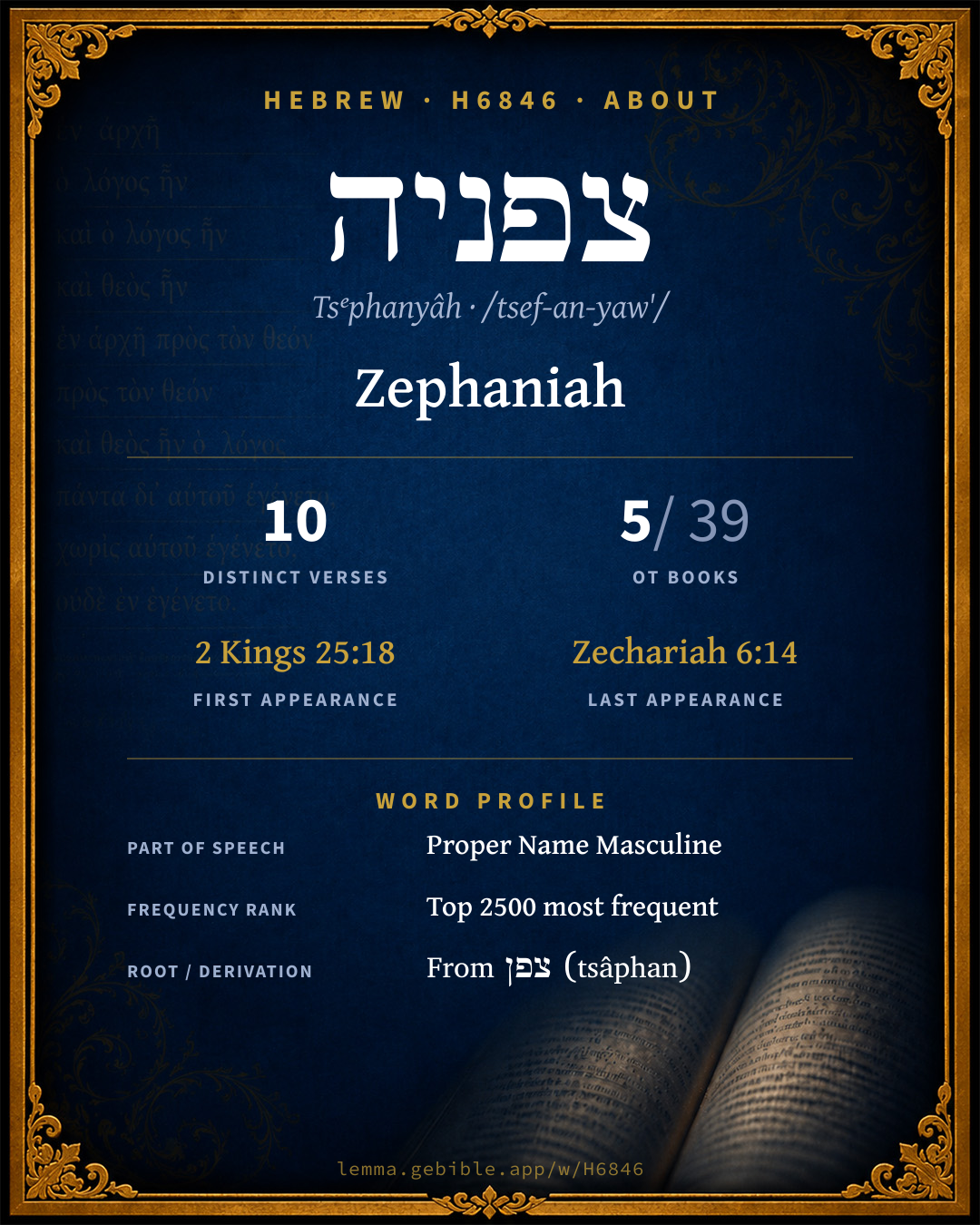
צְפַנְיָהוּ
Zephaniah
BDB lists 5 entries for ‘Zephaniah’ fuller range ↓
Full lexicon entry — Brown-Driver-Briggs (BDB)
From Brown-Driver-Briggs (BDB)
Where this word appears
Grammar key — what these labels mean
Part of speech
- Noun
- A naming word — a person, place, thing, or idea.
Noun type
- Proper
- A name of a specific person, place, or people (e.g. Abraham, Zion, Israel).
Every verse where H6846 appears — 10 distinct verses across 5 books. Click any verse to open its interlinear word-by-word view. Verse text shown in the World English Bible for context — . Each verse’s Hebrew form is shown with its reference; the English is not keyword-highlighted, since the data carries no word-level English alignment. Use “Compare translations” on any verse to read it across multiple English versions. This concordance covers the Hebrew Bible; Septuagint (Greek Old Testament) occurrences are not indexed here.
2 Kings 1 verse
1 Chronicles 1 verse
Jeremiah 5 verses
- Jeremiah 21:1 צְפַנְיָ֧ה n Proper The word which came to Jeremiah from Yahweh, when king Zedekiah sent to him Pashhur the son of Malchijah, and Zephaniah the son of Maaseiah, the priest, saying,
- Jeremiah 29:25 צְפַנְיָ֤ה n Proper Thus speaks Yahweh of Hosts, the God of Israel, saying, Because you have sent letters in your own name to all the people who are at Jerusalem, and to Zephaniah the son of Maaseiah, the priest, and to all the priests, saying,
- Jeremiah 29:29 צְפַנְיָ֥ה n Proper Zephaniah the priest read this letter in the ears of Jeremiah the prophet.
- Jeremiah 37:3 צְפַנְיָ֤הוּ n Proper Zedekiah the king sent Jehucal the son of Shelemiah, and Zephaniah the son of Maaseiah, the priest, to the prophet Jeremiah, saying, Pray now to Yahweh our God for us.
- Jeremiah 52:24 צְפַנְיָ֖ה n Proper The captain of the guard took Seraiah the chief priest, and Zephaniah the second priest, and the three keepers of the threshold:
Zephaniah 1 verse
Zechariah 2 verses
- Zechariah 6:10 צְפַנְיָ֔ה n Proper "Take of them of the captivity, even of Heldai, of Tobijah, and of Jedaiah; and come the same day, and go into the house of Josiah the son of Zephaniah, where they have come from Babylon.
- Zechariah 6:14 צְפַנְיָ֑ה n Proper The crowns shall be to Helem, and to Tobijah, and to Jedaiah, and to Hen the son of Zephaniah, for a memorial in the temple of Yahweh.
About this entry
At a glance — auto-summarized from this page’s data, not written by a person. Every figure links to its source below. This summary describes the numbers; it doesn’t interpret them.
The Hebrew name צפניה centers on the idea of “Zephaniah.” Jeremiah dominates its distribution — 5 of 10 verses. The Hebrew Bible uses it across 10 verses — uncommon. Its earliest occurrence is 2 Kings 25:18. For the data behind this summary, explore 10-verse concordance and the renderings breakdown below.
Gloss history
Strong's 1890 vs modern scholarship
About this word
Strong's H6846 catalogs a Hebrew word from the Hebrew Old Testament.
These counts are not copied from any lexicon or concordance. They are computed here, from the morphology-tagged Hebrew Old Testament. What Lemma adds →
- 10
- distinct verses
- The word appears in 10 distinct verses.
- 5 / 39
- OT books
- The word appears in 5 of 39 Old Testament books.
- #2,342
- by frequency
- Top 2500 most frequent Hebrew words (rank 2,342 of 8,640 Hebrew words by occurrence).
View all 10 occurrences in the concordance →
By section of the Old Testament
By traditional corpus
Conventional, traditional groupings — biblical authorship is debated, so this is a traditional corpus grouping, not an authorship claim. Each share is this word’s portion of its verses in that division of the Hebrew canon. Each figure is a share of the word’s 10 distinct verses.
- Prophets (Nevi'im) 9 verses · 90%
- Writings (Ketuvim) 1 verse · 10%
How translations render this word
Counts come from each version’s own published word-to-Strong’s tagging or interlinear alignment — an approximate guide to how each version renders this word, not a word-level alignment the data otherwise carries. Because each total is that version’s own tagged count, the per-version totals vary from one another and need not match the appearance or distinct-verse counts above. These counts may also differ from a printed concordance because Lemma counts each distinctly tagged rendering and does not collapse phrase taggings into a single head-word total. This is a fixed set of word-tagged versions (KJV, ASV, BSB, ULT) and does not change with the reading translation you choose elsewhere. Each version’s license is shown beside its name below (and on Sources).
- King James Version: Zephaniah 9×
- American Standard Version: Zephaniah 9×
- Berean Standard Bible: Zephaniah 10×
- unfoldingWord Literal Text: Zephaniah 6×
King James Version Public Domain
Renders H6846 across 10 tagged occurrences — most commonly:
Plus 1 rendering that appears only once — usually multi-word phrases or single function words the recovered tagging swept in, not distinct renderings.
American Standard Version Public Domain
Renders H6846 across 10 tagged occurrences — most commonly:
Plus 1 rendering that appears only once — usually multi-word phrases or single function words the recovered tagging swept in, not distinct renderings.
Berean Standard Bible Public Domain
Renders H6846 across 10 tagged occurrences — most commonly:
unfoldingWord Literal Text CC BY-SA 4.0
Renders H6846 across 6 tagged occurrences — most commonly:
Senses in the full BDB
What do BDB’s symbols mean?
BDB uses these scholarly abbreviations:
| Symbol | Meaning |
|---|---|
| 𝔊 | the Septuagint (the ancient Greek translation, LXX) |
| 𝔙 | the Vulgate (the Latin translation) |
| 𝔖 | the Syriac version (the Peshitta) |
| 𝔗 | the Targum (the Aramaic translation) |
| ψ | the Psalms |
| √ | root (the underlying root or stem) |
| ‖ | parallel passage (a synonymous or contrasted parallel) |
| † | the dagger: every passage where the word occurs is cited |
The 4 senses and sub-senses the full Brown-Driver-Briggs lexicon distinguishes for this word, in lexicon order (not ranked by frequency), with BDB’s own verbatim wording and sub-sense lettering. Shown in Hebrew script with BDB’s own scholarly abbreviations. The condensed entry is in the Lexicon Entry tab. See also the Forms in the corpus table below.
- 1. priest, -יָה Je 21:1; 22:25, 29; 52:24 = -יָהוּ 2 K 25:18 (𝔊L Σαφανιας), Je 37:3. Elsewhere -יָה: e.g. Jeremiah 21:1
- 2. the prophet Zp 1:1. e.g. Zephaniah 1:1
- 3. a Judæan Zc 6:10–14. e.g. Zechariah 6:10
- 4. ancestor of Heman 1 Ch 6:21 (Σαφανιας; = אוּרִיאֵל v 9). e.g. 1 Chronicles 6:21
Senses from the full Brown-Driver-Briggs lexicon (Brown, Driver, Briggs; Oxford 1906 — public domain), digitized via Sefaria, supplemented by the OpenScriptures HebrewLexicon (CC BY 4.0). Full attribution on Sources.
Word origin
n.pr.m. Σοφονιας (י׳ hath treasured; OHeb. צפניהו, Ph. צפנבעל);—
— Brown-Driver-Briggs (Oxford 1906, public domain), digitized via Sefaria, supplemented by the OpenScriptures HebrewLexicon (CC BY 4.0). See Sources.
Derived from צפן (tsâphan) (H6845) — to hide.
Forms in the corpus
The 10 distinct written forms H6846 takes in the Hebrew Bible, most frequent first — each parse links to that state’s occurrences in the concordance. Hebrew forms include their vowel points and cantillation, so a single lemma takes many written forms.
| Form | Parsing | Example | Uses |
|---|---|---|---|
| צְפַנְיָ֑ה | Noun, Proper | Zechariah 6:14 | 1 |
| צְפַנְיָ֔ה | Noun, Proper | Zechariah 6:10 | 1 |
| צְפַנְיָ֖ה | Noun, Proper | Jeremiah 52:24 | 1 |
| צְפַנְיָ֖הוּ | Noun, Proper | 2 Kings 25:18 | 1 |
| צְפַנְיָ֤ה | Noun, Proper | Jeremiah 29:25 | 1 |
| צְפַנְיָ֤הוּ | Noun, Proper | Jeremiah 37:3 | 1 |
| צְפַנְיָ֥ה | Noun, Proper | Jeremiah 29:29 | 1 |
| צְפַנְיָ֧ה | Noun, Proper | Jeremiah 21:1 | 1 |
| צְפַנְיָֽה | Noun, Proper | 1 Chronicles 6:36 | 1 |
| צְפַנְיָה֙ | Noun, Proper | Zephaniah 1:1 | 1 |
Same root — word family
Other BDB entries built from the same root as H6846, grouped by Strong’s listed origin. These share a root / origin per the lexicon — not necessarily a shared meaning. Each links to that word’s own entry.
Derives from
Shares the same root
Compare all same-root words → Showing 4 of 5 — not the complete family. They share a root, not necessarily a meaning.
Bible dictionary
Public-domain dictionary articles matched to this entry by name (Zephaniah). A biblical name can be shared by more than one person or place, so an article may treat several.
Easton's Bible Dictionary · M. G. Easton, 1897
Jehovah has concealed, or Jehovah of darkness. (1.) The son of Cushi, and great-grandson of Hezekiah, and the ninth in the order of the minor prophets. He prophesied in the days of Josiah, king of Judah (B.C. 641-610), and was contemporary with Jeremiah, with whom he had much in common. The book of his prophecies consists of:
(a) An introduction (1:1-6), announcing the judgment of the world, and the judgment upon Israel, because of their transgressions.
(b) The description of the judgment (1:7-18).
(c) An exhortation to seek God while there is still time (2:1-3).
(d) The announcement of judgment on the heathen (2:4-15).
(e) The hopeless misery of Jerusalem (3:1-7).
(f) The promise of salvation (3:8-20).
(2.) The son of Maaseiah, the "second priest" in the reign of Zedekiah, often mentioned in Jeremiah as having been sent from the king to inquire (Jer. 21:1) regarding the coming woes which he had denounced, and to entreat the prophet's intercession that the judgment threatened might be averted (Jer. 29:25, 26, 29; 37:3; 52:24). He, along with some other captive Jews, was put to death by the king of Babylon "at Riblah in the land of Hamath" (2 Kings 25:21).
(3.) A Kohathite ancestor of the prophet Samuel (1 Chr. 6:36).
(4.) The father of Josiah, the priest who dwelt in Jerusalem when Darius issued the decree that the temple should be rebuilt (Zech. 6:10).
Smith's Bible Dictionary · William Smith, 1863
(hidden by Jehovah).
+ The ninth in order of the twelve minor prophets. His pedigree is traced to his fourth ancestor, Hezekiah, (Zephaniah 1:1) supposed to be the celebrated king of that name. The chief characteristics of this book are the unity and harmony of the composition, the grace, energy and dignity of its style, and the rapid and effective alternations of threats and promises. The general tone of the last portion is Messianic, but without any specific reference to the person of our Lord. The date of the book is given in the inscription--viz, the reign of Josiah, from 642 to 611 B.C. It is most probable moreover, that the prophecy was delivered before the eighteenth year of Josiah. + The son of Maaseiah, (Jeremiah 21:1) and sagan or second priest in the reign of Zedekiah. (B.C. 588.) He succeeded Jehoida, (Jeremiah 29:25,26) and was probably a ruler of the temple, whose office it was, among others, to punish pretenders to the gift of prophecy. (Jeremiah 29:29) On the capture of Jerusalem he was taken and slain at Riblah. (Jeremiah 52:24,27; 2 Kings 25:18,21) + Father of Josiah, 2, (Zechariah 6:10) and of Hen, according to the reading of the received text of (Zechariah 6:14)
Hitchcock's Bible Names Dictionary · Roswell D. Hitchcock, 1869
the Lord is my secret
Classic public-domain reference works; full attribution on Sources.
Septuagint verse parallels
This word appears in 8 verses that also exist in the Greek Old Testament (Septuagint), out of the 10 Hebrew verses it occurs in. You can read those verses in Greek by switching the Old Testament edition to the Septuagint.
Read these verses in the Septuagint
This is a verse-level parallel only — the same verses exist in both the Hebrew and Greek Old Testaments. No word-level Hebrew↔Greek correspondence is claimed: the data carries no such alignment, so no Greek word is shown as this Hebrew word’s translation. Coverage is not total — the Septuagint omits the deuterocanon and renumbers the Psalms, so some Hebrew verses have no direct Greek parallel.