
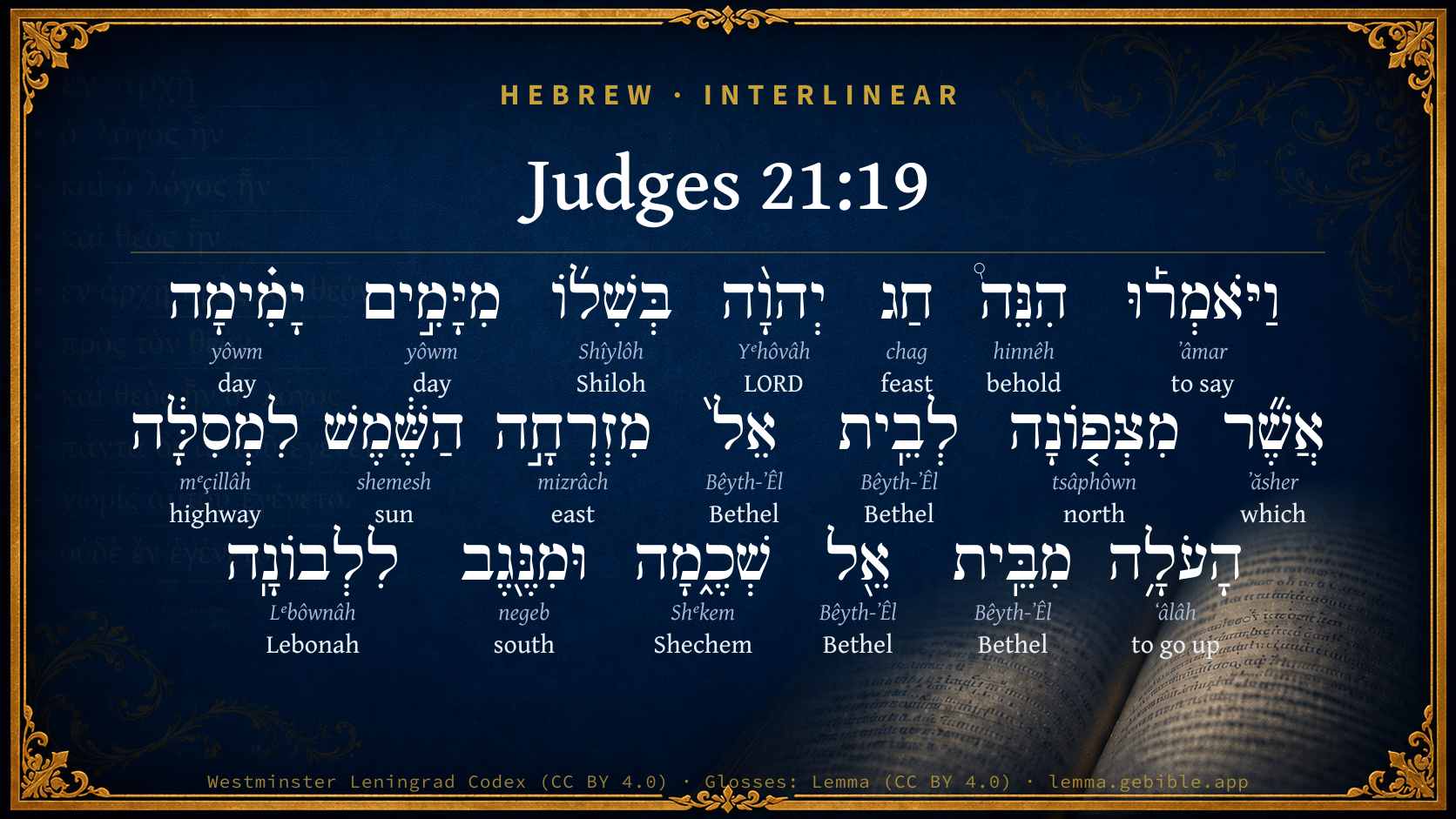
Judges 21:19

Hebrew (Westminster Leningrad Codex) Judges 21:19 appears in the Hebrew Old Testament. The text above is from the Westminster Leningrad Codex. Each word links to its Strong’s number, a concise gloss, and parsing drawn from the Open Scriptures Hebrew Bible morphology. Click any word for its full Brown-Driver-Briggs (BDB) entry.
Download image
Cite this verse

Judges 21:19 (World English Bible). Public Domain. Lemma interlinear Bible study tool, https://lemma.gebible.app/v/judges/21/19.

Show BibTeX & RIS
BibTeX
RIS
English Translation
They said, Behold, there is a feast of Yahweh from year to year in Shiloh, which is on the north of Bethel, on the east side of the highway that goes up from Bethel to Shechem, and on the south of Lebonah.
World English Bible · Public Domain
Highlights
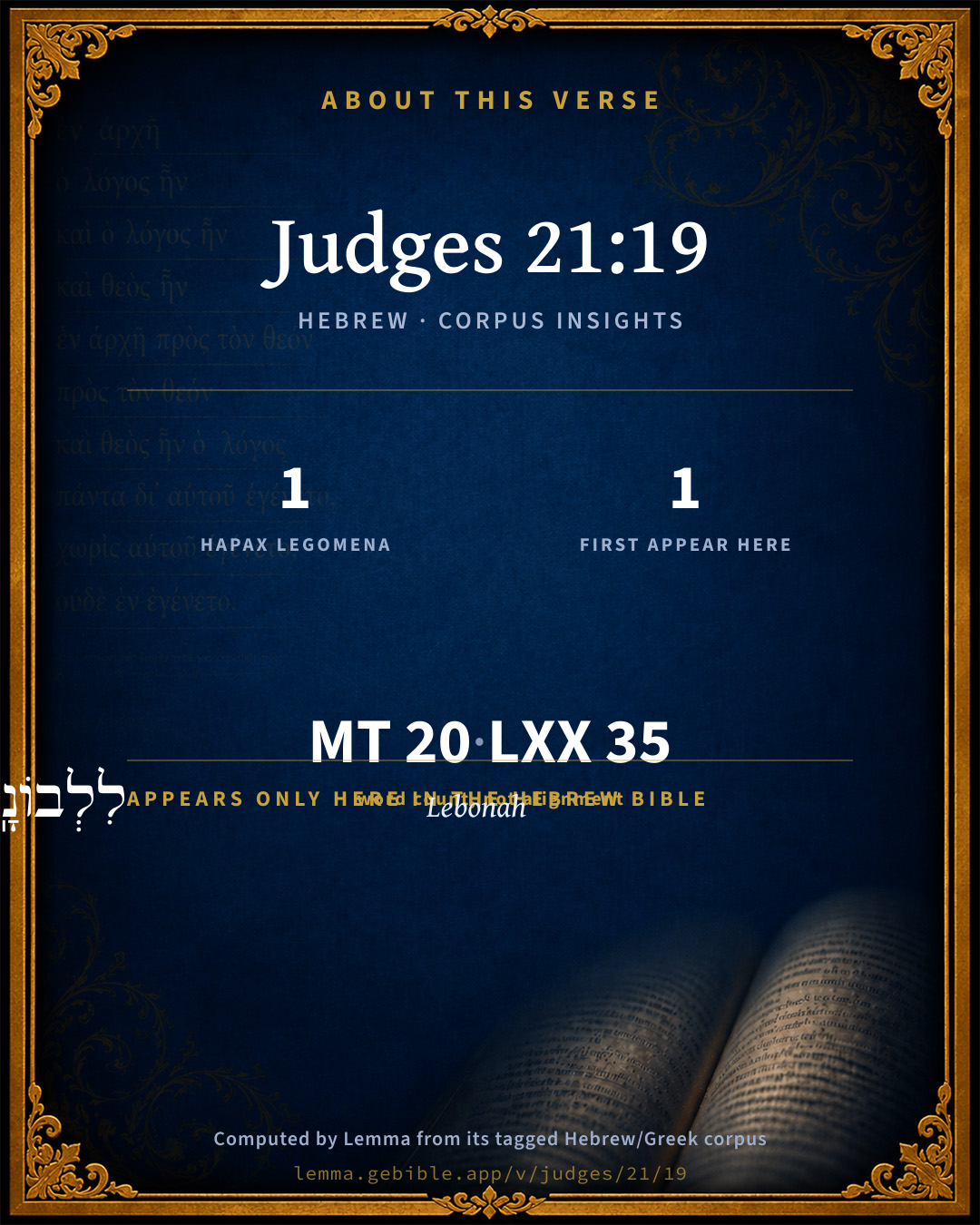
  • 1 hapax legomenon — only here in the Hebrew Bible
  • 1 first appearance in the Hebrew Bible
Full analysis ↓
Download a study sheet

One document with this verse’s original text, its word-by-word gloss line, the meaning frame, cross-references with their text, attributed commentary, and full source and license credits — printable, and it pastes into notes with its structure intact.

This verse Autodidact and up

Study sheet (.html) Plain text (.txt)

A passage Seminary Student

Up to 50 verses in one chapter. A passage sheet keeps up to 6 commentary sources and 12 cross-references per verse, in the order this page ranks them, and says so on the sheet whenever that leaves anything out. Ask for a single verse and you get the Autodidact verse sheet above.

Everything on this page stays free to read, with no account — the sheet is a download of what is already on screen, not access to it.

Want to remove ads? Support Godless Engineer
Compare translations 3

The same verse in 3 English versions, stacked beneath the original-language interlinear above. Click any original word for its lexicon entry.

Each is an independent rendering of the whole verse — the interlinear is not word-aligned to these translations.

Highlighted words mark where these versions differ — a whole-verse word diff, not a word-by-word alignment.

  • World English Bible Public Domain
    They said, Behold, there is a feast of Yahweh from year to year in Shiloh, which is on the north of Bethel, on the east side of the highway that goes up from Bethel to Shechem, and on the south of Lebonah.
  • King James Version Public Domain
    Then they said, Behold, there is a feast of the LORD in Shiloh yearly in a place which is on the north side of Bethel, on the east side of the highway that goeth up from Bethel to Shechem, and on the south of Lebonah.
  • unfoldingWord Literal Text CC BY-SA 4.0
    So they said, “Behold, a feast of Yahweh at Shiloh from days to days.” (That from the north to Bethel, from the rising of the sun to the road going up from Bethel Shechem and from the south to Lebonah.)

unfoldingWord Literal Text — © unfoldingWord, licensed CC BY-SA 4.0. Word-aligned USFM3 via Door43 (git.door43.org/unfoldingWord/en_ult).

Versions to compare (up to 4)

3 of 4 selected

Show all 18 translations

Every available English version of this verse, each an independent rendering of the whole verse.

  • World English Bible Public Domain
    They said, Behold, there is a feast of Yahweh from year to year in Shiloh, which is on the north of Bethel, on the east side of the highway that goes up from Bethel to Shechem, and on the south of Lebonah.
  • Berean Standard Bible Public Domain
    “But look,” they said, “there is a yearly feast to the LORD in Shiloh, which is north of Bethel east of the road that goes up from Bethel to Shechem, and south of Lebonah.”
  • Majority Standard Bible Public Domain
    “But look,” they said, “there is a yearly feast to the LORD in Shiloh, which is north of Bethel east of the road that goes up from Bethel to Shechem, and south of Lebonah.”
  • King James Version Public Domain
    Then they said, Behold, there is a feast of the LORD in Shiloh yearly in a place which is on the north side of Bethel, on the east side of the highway that goeth up from Bethel to Shechem, and on the south of Lebonah.
  • American Standard Version (1901) Public Domain
    And they said, Behold, there is a feast of Jehovah from year to year in Shiloh, which is on the north of Beth-el, on the east side of the highway that goeth up from Beth-el to Shechem, and on the south of Lebonah.
  • Revised Version (1885) Public Domain
    And they said, Behold, there is a feast of the LORD from year to year in Shiloh, which is on the north of Beth-el, on the east side of the highway that goeth up from Beth-el to Shechem, and on the south of Lebonah.
  • Geneva Bible (1599) Public Domain
    Therefore they said, Beholde, there is a feast of the Lord euery yere in Shiloh in a place, which is on the Northside of Beth-el, and on the Eastside of the way that goeth vp from Beth-el to Shechem, and on the South of Lebonah.
  • Douay-Rheims (1899) Public Domain
    So they took counsel, and said: Behold there is a yearly solemnity of the Lord in Silo, which is situate on the north of the city of Bethel, and on the east side of the way, that goeth from Bethel to Sichem, and on the south of the town of Lebona.
  • Young's Literal Translation Public Domain
    And they say, `Lo, a festival of Jehovah `is' in Shiloh, from time to time, which `is' on the north of Beth-El, at the rising of the sun, by the highway which is going up from Beth-El to Shechem, and on the south of Lebonah.'
  • Literal Standard Version CC BY-SA 4.0
    And they say, “Behold, a festival of YHWH [is] in Shiloh, from time to time, which [is] on the north of Beth-El, at the rising of the sun, by the highway which is going up from Beth-El to Shechem, and on the south of Lebonah.”
  • Unlocked Literal Bible CC BY-SA 4.0
    So they said, “You know there is a feast for Yahweh every year at Shiloh (which is north of Bethel, east of the road that goes up from Bethel to Shechem, and south of Lebonah).”
  • unfoldingWord Literal Text CC BY-SA 4.0
    So they said, “Behold, a feast of Yahweh at Shiloh from days to days.” (That from the north to Bethel, from the rising of the sun to the road going up from Bethel Shechem and from the south to Lebonah.)
  • Darby Bible Public Domain
    So they said, "Behold, there is the yearly feast of the LORD at Shiloh, which is north of Bethel, on the east of the highway that goes up from Bethel to Shechem, and south of Lebo'nah."
  • World Messianic Bible Public Domain
    They said, “Behold, there is a feast of the LORD from year to year in Shiloh, which is on the north of Bethel, on the east side of the highway that goes up from Bethel to Shechem, and on the south of Lebonah.”
  • Webster's Bible Public Domain
    Then they said, Behold, there is a feast of the LORD in Shiloh yearly in a place which is on the north side of Beth-el, on the east side of the highway that goeth up from Beth-el to Shechem, and on the south of Lebonah.
  • Free Bible Version CC BY-SA 4.0
    Then they said, “Look! Every year there's the Lord's festival in Shiloh. It's held north of Bethel, and east of the road that goes from Bethel to Shechem, south of Lebonah.”
  • Bible in Basic English Public Domain
    And they said, See, every year there is a feast of the Lord in Shiloh, which is to the north of Beth-el, on the east side of the highway which goes up from Beth-el to Shechem, and on the south of Lebonah.
  • JPS Tanakh (1917) Public Domain
    And they said: 'Behold, there is the feast of the LORD from year to year in Shiloh, which is on the north of Beth-el, on the east side of the highway that goeth up from Beth-el to Shechem, and on the south of Lebonah.'

Literal Standard Version (2020), Covenant Press — licensed CC BY-SA 4.0. Text via the HelloAO Bible API (eBible.org). Unlocked Literal Bible (unfoldingWord) — licensed CC BY-SA 4.0. Text via the HelloAO Bible API (eBible.org). unfoldingWord Literal Text — © unfoldingWord, licensed CC BY-SA 4.0. Word-aligned USFM3 via Door43 (git.door43.org/unfoldingWord/en_ult). Free Bible Version, Dr. Jonathan Gallagher — licensed CC BY-SA 4.0. Text via the HelloAO Bible API (eBible.org).

Word by word

More ways to search: Search by grammar → Find every occurrence → Compare this word →

Practice this passage: Drill this verse → Learn its vocabulary →

לִלְבוֹנָֽה
Lᵉbôwnâh
H3829
“to/for · Lebonah”
Preposition + Noun, Proper
Part of Speech
Preposition + Noun
Type
Proper
Full BDB Definition

Origin: the same as H3828

TWOT: None

Lebonah = "frankincense" - a town in Ephraim 3 miles (5 kilometers) west northwest of Shiloh
  1. וַיֹּאמְר֡וּ ʼâmar H559 “and · to say” Conjunction + Verb, Qal, Sequential Imperfect, 3rd Person, Masculine, Plural
  2. הִנֵּה֩ hinnêh H2009 “behold” Particle, Demonstrative
  3. חַג chag H2282 “feast of” Noun, Common, Masculine, Singular, Construct
  4. יְהוָ֨ה Yᵉhôvâh H3068 “LORD” Noun, Proper
  5. בְּשִׁל֜וֹ Shîylôh H7887 “in/at · Shiloh” Preposition + Noun, Proper
  6. מִיָּמִ֣ים yôwm H3117 “from · days” Preposition + Noun, Common, Masculine, Plural, Absolute
  7. יָמִ֗ימָה yôwm H3117 “days · toward” Noun, Common, Masculine, Plural, Absolute + Suffix, Demonstrative
  8. אֲשֶׁ֞ר ʼăsher H834 “which” Particle, Relative
  9. מִצְּפ֤וֹנָה tsâphôwn H6828 “from · north · toward” Preposition + Noun, Common, Feminine, Singular, Absolute + Suffix, Demonstrative
  10. לְבֵֽית Bêyth-ʼÊl H1008 “to/for · Bethel” Preposition + Noun, Proper
  11. אֵל֙ Bêyth-ʼÊl H1008 “Bethel” Noun, Proper
  12. מִזְרְחָ֣ה mizrâch H4217 “east · toward” Noun, Common, Masculine, Singular, Construct + Suffix, Demonstrative
  13. הַשֶּׁ֔מֶשׁ shemesh H8121 “the · sun” Particle, Definite Article + Noun, Common, Both, Singular, Absolute
  14. לִמְסִלָּ֔ה mᵉçillâh H4546 “to/for · highway” Preposition + Noun, Common, Feminine, Singular, Absolute
  15. הָעֹלָ֥ה ʻâlâh H5927 “the · going up” Particle, Definite Article + Verb, Qal, Participle Active, Feminine, Singular, Absolute
  16. מִבֵּֽית Bêyth-ʼÊl H1008 “from · Bethel” Preposition + Noun, Proper
  17. אֵ֖ל Bêyth-ʼÊl H1008 “Bethel” Noun, Proper
  18. שְׁכֶ֑מָה Shᵉkem H7927 “Shechem · toward” Noun, Proper + Suffix, Demonstrative
  19. וּמִנֶּ֖גֶב negeb H5045 “and · from · south” Conjunction + Preposition + Noun, Common, Masculine, Singular, Absolute

About this verse

These counts appear in no published source. They are computed here, from the morphology-tagged text and Lemma’s own curated glosses. What Lemma adds →

20
words
16
distinct lemmas
Historical
section

Notable vocabulary

1 hapax legomenon — a word that appears only here in the entire Hebrew Bible:

  • לִלְבוֹנָֽה Lebonah H3829

First appearance in Scripture

This word makes its first canonical appearance in the Hebrew Bible here:

  • לִלְבוֹנָֽה Lebonah H3829

Shared distinctive vocabulary

לִמְסִלָּ֔ה highway H4546 occurs in 26 verses of the Hebrew Bible. Also found in:

Grammatical profile

  • 2 verbs
  • 16 nouns
  • 2 particles

Verb forms

  • וַיֹּאמְר֡וּ Qal · Sequential Imperfect
  • הָעֹלָ֥ה Qal · Participle Active

Repetition

Words recur within this verse — often emphatic in Hebrew:

  • לְבֵֽית Bethel H1008 ×4
  • מִיָּמִ֣ים day H3117 ×2

Hebrew & Septuagint length

In English translation the verse runs 42 words from the Hebrew and 42 from the Septuagint (LXX English) — the same length.

A rough comparison of the two English renderings, which tokenize alike — not a word-level alignment.

Word counts can differ between the Hebrew and the Greek without any difference in meaning — e.g. the Hebrew direct-object marker אֵת has no separate Greek word, and Greek often adds the article ὁ.

In the original languages it is 20 Hebrew tokens and 35 Greek tokens — but the two are counted differently (Hebrew bundles its prefixes and suffixes into one token; the Greek is in lemma form), so that isn’t a like-for-like length.

Cross-references

19

Topical passages linked to Judges 21:19 in the Treasury of Scripture Knowledge — connected by theme and wording, ordered by reader-vote popularity; previews shown in the World English Bible.

  • Exodus 23:14–16 "You shall observe a feast to me three times a year.
  • Psalms 81:3 Blow the trumpet at the New Moon, At the full moon, on our feast day.
  • Leviticus 23:2 "Speak to the children of Israel, and tell them, 'The set feasts of Yahweh, which you shall proclaim to be holy convocations, even these are my set feasts.
  • Leviticus 23:4 "'These are the set feasts of Yahweh, even holy convocations, which you shall proclaim in their appointed season.
  • Leviticus 23:6 On the fifteenth day of the same month is the feast of unleavened bread to Yahweh. Seven days you shall eat unleavened bread.
  • Leviticus 23:10 "Speak to the children of Israel, and tell them, 'When you have come into the land which I give to you, and shall reap its the harvest, then you shall bring the sheaf of the first fruits of your harvest to the priest:
  • Leviticus 23:34 "Speak to the children of Israel, and say, 'On the fifteenth day of this seventh month is the feast of tents for seven days to Yahweh.
  • Numbers 10:10 Also in the day of your gladness, and in your set feasts, and in the beginnings of your months, you shall blow the trumpets over your burnt offerings, and over the sacrifices of your peace-offerings; and they shall be to you for a memorial before your God: I am Yahweh your God.
  • Numbers 28:16 In the first month, on the fourteenth day of the month, is Yahweh's Passover.
  • Numbers 28:26 Also in the day of the first fruits, when you offer a new meal-offering to Yahweh in your [feast of] weeks, you shall have a holy convocation; you shall do no servile work;
  • Numbers 29:12 On the fifteenth day of the seventh month you shall have a holy convocation; you shall do no servile work, and you shall keep a feast to Yahweh seven days:
  • Deuteronomy 16:1 Observe the month of Abib, and keep the Passover to Yahweh your God; for in the month of Abib Yahweh your God brought you forth out of Egypt by night.
  • Deuteronomy 16:10 You shall keep the feast of weeks to Yahweh your God with a tribute of a freewill-offering of your hand, which you shall give, according as Yahweh your God blesses you:
  • Deuteronomy 16:13 You shall keep the feast of tents seven days, after that you have gathered in from your threshing floor and from your winepress:
  • Joshua 18:1 The whole congregation of the children of Israel assembled themselves together at Shiloh, and set up the tent of meeting there: and the land was subdued before them.
  • Judges 18:31 So they set them up Micah's engraved image which he made, all the time that the house of God was in Shiloh.
  • 1 Samuel 1:3 This man went up out of his city from year to year to worship and to sacrifice to Yahweh of Hosts in Shiloh. The two sons of Eli, Hophni and Phinehas, priests to Yahweh, were there.
  • John 5:1 After these things, there was a feast of the Jews, and Jesus went up to Jerusalem.
  • John 7:2 Now the feast of the Jews, the Feast of Booths, was at hand.

Cross-references courtesy of OpenBible.info (CC BY 4.0).

Hebrew and Greek witnesses Masoretic Hebrew ↔ Greek Septuagint

The same verse in the two great witnesses to the Old Testament, shown verse-for-verse.

These are two independent witnesses, not word-aligned to each other, and the Septuagint is shown in lemma (dictionary) form.

Hebrew Judges 21:19 Masoretic · Westminster Leningrad Codex

וַיֹּאמְר֡וּ הִנֵּה֩ חַג יְהוָ֨ה בְּשִׁל֜וֹ מִיָּמִ֣ים יָמִ֗ימָה אֲשֶׁ֞ר מִצְּפ֤וֹנָה לְבֵֽית אֵל֙ מִזְרְחָ֣ה הַשֶּׁ֔מֶשׁ לִמְסִלָּ֔ה הָעֹלָ֥ה מִבֵּֽית אֵ֖ל שְׁכֶ֑מָה וּמִנֶּ֖גֶב לִלְבוֹנָֽה

They said, Behold, there is a feast of Yahweh from year to year in Shiloh, which is on the north of Bethel, on the east side of the highway that goes up from Bethel to Shechem, and on the south of Lebonah.

World English Bible · Public Domain

Greek LXX Judges 21:19 Septuagint · lemma form

καί εἶπον ἰδού δή ἑορτή κύριος ἐν σηλων ἀπό ἡμέρα εἰς ἡμέρα ὅς εἰμί ἀπό βορέας ὁ βαιθηλ κατά ἀνατολή ἥλιος ἐπί ὁ ὁδός ὁ ἀναβαίνω ἀπό βαιθηλ εἰς συχεμ καί ἀπό νότος ὁ λεβωνα

And they said, Behold! now there is a feast of the Lord from year to year in Selom, which is on the north of Baethel, eastward on the way that goes up from Baethel to Sychem, and from the south of Lebona.

LXX2012 (modern English Septuagint) · Public Domain

Hebrew: Westminster Leningrad Codex (CC BY 4.0). Greek: Septuagint (public domain); English from LXX2012 (modern English Septuagint) (Public Domain). How the Septuagint differs from the Hebrew →

Targum (Aramaic paraphrase)

1

The Targum is the ancient Jewish Aramaic paraphrase of the Hebrew Scriptures — an interpretive translation, not the Hebrew text itself. Onkelos (literal) and Pseudo-Jonathan (expansive) render the Torah, and Jonathan the Prophets. Coverage is partial: where no permissively-licensed English translation exists for a verse, only the Aramaic is shown. This is verse-level text, not a word-by-word alignment to the Hebrew.

  1. Targum Jonathan Prophets (Joshua–Malachi)
    וַאֲמַרוּ הָא חַגָא קֳדָם יְיָ בְּשִׁלוֹ מִזְמַן מוֹעֵד לְמוֹעֵד דִי מִצִיפּוּנָא לְבֵית אֵל מַדְּנַח שִׁמְשָׁא לְכִבְשָׁא דְסָלֵיק מִבֵּית אֵל לִשְׁכֶם וּמִדָרוֹמָא לִלְבוֹנָתָא:

    (no public-domain English translation for this verse)

    Targum Jonathan — Aramaic: “Mikraot Gedolot” (public domain). English: “Sefaria Community Translation” (CC0 1.0 (public-domain dedication)); “London "Chaldee Paraphrase," 1871” (public domain). Text via Sefaria.

Commentary

Notes on Judges 21:19 from classic Christian and Jewish commentators (each source and its license shown beneath its notes). The classic Christian expositions comment on the surrounding passage and are grouped to its opening verse, so a note may address several verses; the Jewish commentaries on the Tanakh (Rashi and others) are per-verse, so they appear only where the commentator wrote on this verse.

Lemma curates 59 commentaries, every one of them public domain or Creative Commons licensed, each selected and text-cleaned for this edition rather than reprinted as found. About our sources →

John Gill's Exposition

Then they said,.... Some of the elders that sat in council debating this matter, and considering of ways and means to assist their brethren the Benjaminites, and preserve their tribe from being lost:

behold, there is a feast of the Lord in Shiloh yearly; where the tabernacle then was, and before which the males of Israel were obliged to appear three times of the year; and this was one of them, as is clear by its being called a feast of the Lord; and therefore cannot design any civil festival or fair kept for trade and commerce. Some have thought of the feast of the passover, but it is most likely to be the feast of tabernacles, as Abarbinel takes it to be; which in Jewish writings is emphatically called "the feast"; and the time of year when that was kept was a time of great rejoicing, on account of the fruits of the earth being gathered in, and the reading of the law and especially at the tithe of drawing of water at this feast; insomuch that it is said (e) that he who never saw the rejoicing at drawing of water never saw rejoicing in his life, which was attended with piping, and dancing, and singing. It is pretty strange what Kimchi notes, that this may be either one of the above feasts, or the day of atonement, at which, he says, the daughters of Israel used to go and dance in the vineyards, according to the words of the Rabbins; when though that is reckoned among the feasts, Lev 23:1 it was properly a fast, as it is called, Act 27:9 and all tokens of festivity and joy were forbidden on it; and where these words of their Rabbins are to be met with, he says not: in a place

which is on the north side of Bethel; we rightly supply "in a place": for the intention is not to describe the situation of Shiloh, which was well known, but a place not far from it, where at this festival the daughters of Shiloh used to dance:

on the east side of the highway that goeth up from Bethel to Shechem; this place lay to the east of a public road, that led from Bethel to Shechem:

and on the south of Lebonah; which Mr. Maundrell (f) takes to be a place now called Kane Leban, which stands on the east side of a delightful vale, having a village of the same name standing opposite to it on the other side of the vale; one of these places, either that Kane or the village, is supposed to be the Lebonah mentioned Jdg 21:19 to which both the name and situation seem to agree.

(e) Misn. Succah, c. 5. sect. 1, 4. Vid. Maimon. Hilchot Lulab, c. 8. sect. 13. (f) Journey from Aleppo, p. 63.

John Gill's Exposition of the Whole Bible (1746–1763) — public domain (CC PDM 1.0). Text via the HelloAO Bible API.

Trapp's Complete Commentary

John Trapp

Jdg 21:19 Then they said, Behold, [there is] a feast of the LORD in Shiloh yearly [in a place] which [is] on the north side of Bethel, on the east side of the highway that goeth up from Bethel to Shechem, and on the south of Lebonah.

Ver. 19. Behold, there is a feast of the Lord in Shiloh.] What feast this was is much controverted; some say, the feast of tabernacles; others, the feast of blowing trumpets, the seventh of the first month. {Num 10:10; Num 29:1} Others again, that it was some singular feast kept in Shiloh only to the honour of God in way of thankfulness for choosing it to set his tabernacle there; and that, haply, upon the day that it was first set up there, from year to year. Such a feast as is yet kept in Switzerland for joy of the Reformation: or as Bugenhagius kept yearly on the day that Luther and other divines finished the translation of the Holy Scriptures into the Dutch, calling it, The feast of the translation of the Bible.

John Trapp, A Commentary or Exposition upon All the Books of the Old and New Testament (1647–1656) — public domain. Text from a community e-Sword module.

Joseph Benson's Commentary

Jdg 21:19. A feast — Probably it was the feast of tabernacles, which they celebrated with more than ordinary joy. And that feast was the only season at which the Jewish virgins were allowed to dance. But even this was not mixed dancing. No men danced with these daughters of Shiloh. Nor did the married women so forget their gravity as to join with them. However, their dancing thus in public made them an easy prey: whence Bishop Hall observes, “The ambushes of evil spirits carry away many souls from dancing to a fearful desolation.”

Joseph Benson's Commentary on the Old and New Testaments (1811–1818) — public domain. Text from a community e-Sword module.

Geneva Bible (1599)

Geneva Bible translators

He describeth the place where the maids used yearly to dance as the manner then was, and to sing Psalms and songs of God’s works among them.

Geneva Bible (1599) marginal notes — public domain. Text via Bolls.life.

Jamieson, Fausset & Brown

Robert Jamieson, A. R. Fausset & David Brown

on the east side of the highway that goeth up from Beth-el to Shechem--The exact site of the place was described evidently for the direction of the Benjamites.

Jamieson, Fausset & Brown — Commentary Critical and Explanatory on the Whole Bible (1871) — public domain (CC PDM 1.0). Text via the HelloAO Bible API.

Adam Clarke's Commentary

Verse 19. There is a feast of the Lord] What this feast was is not known: it might be either the passover, pentecost, or the feast of tabernacles, or indeed some other peculiar to this place. All the above feasts were celebrated at that time of the year when the vines were in full leaf; therefore the Benjamites might easily conceal themselves in the vineyards; and the circumstances will answer to any of those feasts.

On the east side of the highway, c.] I can see no reason for this minute description, unless it intimates that this feast was to be held this year in rather a different place to that which was usual: and, as the Benjamites had been shut up in their strong hold in Rimmon, they might not have heard of this alteration and it was necessary, in such a case, to give them the most circumstantial information, that they might succeed in their enterprise without being discovered.

Adam Clarke's Commentary on the Bible (1810–1826) — public domain. Text from a community e-Sword/MySword module.

Ellicott's Commentary for English Readers

(19) A feast of the Lord in Shiloh.—It is unlikely that the reference is to a local feast; but it is impossible to say which of the three yearly feasts is meant. The most natural would be the Feast of Tabernacles. We see from 1Sa_1:3 that even among pious families the trying custom of going up to the Tabernacle three times a year had fallen into complete abeyance.

A place which is on the north side of Beth-el . . .—This elaborate description of the site of Shiloh, a place which is so often mentioned elsewhere without any addition, is extremely curious. There can be little doubt that it is due to the marginal gloss of some Masoretic scribe, perhaps in the editing of the sacred books by Ezra. That it is a gloss seems clear, because it comes in as a parenthesis in the speech of the elders, and, of course, in their day such a description was needless. Indeed, it was spoken at Shiloh itself, and the site was well known to all Israel. But by the time that the story was committed to writing in the days of the kings, or finally edited in the days of Ezra, Shiloh had long been desolate, and probably the very site was unknown to thousands. Hence this very valuable and interesting description was added, which has alone enabled us to identify Shiloh in the modern Seilûn.

South of Lebonah.—Lebonah, now Lubban, is not mentioned elsewhere.

A Bible Commentary for English Readers, edited by Charles John Ellicott (1878–1897) — public domain. Text from a community e-Sword module.

The Cambridge Bible for Schools and Colleges

gen. ed. J. J. S. Perowne

19. there is a feast] the feast (marg.). The word rendered feast (ḥag) strictly implies a pilgrimage to a sanctuary; the three chief ḥaggim were festivals at which every male Israelite was required to appear before Jehovah (Exo_23:14-17); cf. also the Mohammedan ḥaj = the pilgrimage to Mecca. What the particular feast here was we are not told; most probably it was a vintage festival to celebrate the ingathering; for this was an occasion of special rejoicing, cf. the Canaanite feast at Shechem Jdg_9:27, and marked the end of the year (September); note that the vines were still in leaf, Jdg_21:20.

of the Lord … in Shiloh] Shiloh was a centre of Jehovah-worship at this early period, Jdg_18:31. A topographical gloss (cf. Jdg_21:12, Jdg_20:31) defines the situation in such a way as to leave no doubt that Shiloh is to be identified with the modern Seilûn, some 2 miles E.S.E. of Lubbân = Lebonah; in later times, after the exile, it was probably necessary to tell readers where the ancient sites were. Obviously this addition cannot come from the author of Jdg_21:12, where Shiloh is first mentioned. 19a may be taken as addressed to the Benjamites: 20b gives the rest of the speech.

The Cambridge Bible for Schools and Colleges (gen. ed. J. J. S. Perowne; Cambridge University Press, 1878–1918) — public domain. Text from a community e-Sword module.

Albert Barnes' Notes on the Bible

The Feast was probably the Passover, or one of the three great Jewish Feasts. In these unsettled times men went up to Shiloh (Seilun) only once a year 1Sa 1:3 instead of thrice; only the males kept the Feasts, and therefore the virgins of Shiloh would naturally be the only maidens present, and the public festival would be a likely occasion for their festive dances. It is, however, possible that some particular feast unique to Shiloh is meant, like the yearly sacrifice of David’s family in Bethlehem 1Sa 20:29.

Albert Barnes' Notes on the Bible (1834–1885) — public domain. Text from a community e-Sword/MySword module.

Haydock's Catholic Bible Commentary

Counsel, among themselves. (Haydock) --- Solemnity. It is not known which is meant, as all the three great festivals occurred during the time that the vines were covered with leaves; (ver. 20) or this feast might be one peculiar to the city of Silo, in memory of the ark being transported thither. Vatable thinks that the description here given, regards the place where the dance was to be, as all must have known the situation of the city. Silo rather lies to the west than to the east, (Calmet) if we draw a line from Bethel to Sichem, but the road might be circuitous. (Haydock) --- St. Jerome places Silo ten miles west of Sichem. --- Lebona may be Chan Lebna, four miles to the south of it. (Calmet)

George Leo Haydock (1774–1849), Haydock's Catholic Family Bible and Commentary, 1859 edition — public domain. Excludes Psalms (Douay-Rheims chapter numbering differs from Protestant) and Deuterocanonical books (Catholic canon only).

Matthew Poole's English Annotations

Yearly; on the three solemn feasts, in which they used some honest and holy recreations; among which dancing was one, Exo 15:20; 1Sa 18:6; 2Sa 6:14; and probably it was the feast of tabernacles, which they did celebrate with more than ordinary joy, Deu 16:13-15.

Which is on the north side of Beth-el, Heb. which is on the north of Beth-el. Which doth not relate to

Shiloh, which was so known a place, that it was frivolous to describe it by such circumstances, even by places much less known than itself; but to the

feast, which as to that part or exercise of the feast here especially concerned and mentioned, to wit, the dancing of the virgins, was not celebrated in Shiloh, but in a neighboring place more convenient for that purpose.

Matthew Poole's English Annotations on the Holy Bible (1683–1685) — public domain. Text from a community e-Sword/MySword module.

Whedon's Commentary on the Bible

Daniel D. Whedon

19. A feast of the Lord in Shiloh — One of the great yearly festivals, which, notwithstanding the irregularities of the age, were still observed at the seat of the tabernacle. Compare 1Sa_1:3, note. The context shows that the festival occurred about this time.

Lebonah — Identical with the modern village Lubban, about three miles northwest of Shiloh. The particular description here given of the location of Shiloh seems to have been given to the men sent to capture the dancing maidens there, and make off with them without hinderance.

Daniel D. Whedon (gen. ed.), Commentary on the Old and New Testaments (1874–1909) — public domain. Text from a community e-Sword module.

The Pulpit Commentary

There is a feast of the Lord in Shiloh yearly. Compare the exactly similar description, 1Sa_1:3, 1Sa_1:7. There is a great difference of opinion among commentators as to what feast is here meant. Hengstenberg, Keil, Delitzsch, and others think it was the passover; Bishop Patrick and others think it was the feast of tabernacles, a more joyous feast; Rosenmuller and others think it was a festival peculiar to Shiloh, after the analogy of the yearly sacrifice of the family of Jesse at Bethlehem, (1Sa_20:29) and more or less in accordance with Deu_12:10-12. It is not easy to say which view is right, but the last seems not improbable, In a place which is on the north side, etc. The words in a place are not in the Hebrew, and do not seem to be implied by the context. But the description is that of the situation of Shiloh itself, which is very exact (see "Palestine Exploration Fund," Map of West Palestine). Lebonah survives in el-Lubbun, about two miles north-west of Seilun, and to the west of the road to Shechem or Nablus. It seems strange that so particular a description of the situation of Shiloh should be given; but it may probably indicate that the writer lived after the tabernacle had been moved to Jerusalem, and Shiloh had relapsed into an obscure village. (Jud_1:20:27, note) The situation of the descriptive words in the Hebrew, with the pronoun which, separated from Shiloh by the word yearly, indicates that they are an explanation added by the narrator.

The Pulpit Commentary (1880–1919), ed. H.D.M. Spence-Jones & Joseph S. Exell — public domain. Text from a community e-Sword module.

John Wesley's Explanatory Notes

A feast - Probably it was the feast of tabernacles, which they celebrated with more than ordinary joy. And that feast was the only season, at which the Jewish virgins were allowed to dance. But even this was not mixed dancing. No men danced with these daughters of Shiloh. Nor did the married women so forget their gravity, as to join with them. However their dancing thus in public, made them an easy prey: whence Bishop Hall observes, "The ambushes of evil spirits carry away many souls from dancing to a fearful desolation."

John Wesley, Explanatory Notes Upon the Whole Bible (1754–1765) — public domain. Text via the GEBible commentary corpus.

Rashi

Rabbi Shlomo Yitzchaki (Rashi)

East [lit. "sunrise"] of the road. To the east of the road. Shiloh was north of Beis El, south of Levonah, and east of the road ascending from Beis El to Shechem.

Rashi on the Tanakh — English translations: “The Judaica Press complete Tanach with Rashi, translated by A. J. Rosenberg” (CC BY 4.0); “Pentateuch with Rashi's commentary by M. Rosenbaum and A.M. Silbermann, 1929-1934” (public domain); “The Metsudah Tanach series, Lakewood, N.J” (CC BY 4.0); and “The Book of Joshua, Metsudah Publications, 1997” (CC BY 4.0). Text via Sefaria.

Lesson kit

Teaching starters — assembled from the data on this page, not authored interpretation. Every prompt links to the verse data it draws on. Edit before teaching.

Judges, in the Historical, opens this verse with 20 words (16 distinct Hebrew lemmas). Its most distinctive word is Lᵉbôwnâh (“Lebonah”). A historical commentator’s framing appears above. Read the whole chapter for the surrounding context.

Discussion questions

  1. The word Lᵉbôwnâh carries the sense “Lebonah.” How does it shape the verse?
  2. 1 word here appears nowhere else in the Hebrew Bible. Why might the author reach for such rare wording?
  3. This is the first place “Lebonah” appears in Scripture (first appears here). What does its debut here establish?
  4. How does Numbers 20:19, which shares the word «highway», read alongside this verse?
  5. What does the repetition of “Bethel” (4× in this one verse) do in this verse?
  6. These translations render this verse differently. What is at stake in choosing one wording over another?
  7. «וַיֹּאמְר֡וּ» is a Qal Sequential Imperfect verb. How does that grammatical form shape the action described?
  8. Compare how John Gill's Exposition and Trapp's Complete Commentary read this verse. Where do they agree or differ?

Things to notice

  • 1 word in this verse appears nowhere else in the Hebrew Bible.
  • 1 word makes its first canonical appearance in Scripture here.
  • This verse counts 20 Hebrew ↔ 35 Greek words.
  • These translations choose different wording for 17 words in this verse.
  • “Bethel” occurs 4× in this single verse.

Reading settings

Reading text

Shown beneath each verse's original-language words.

Old Testament
Old Testament edition

Read the OT as the Masoretic Hebrew (MT) or the Greek Septuagint (LXX).

English shown for the Greek Septuagint (in the Hebrew ↔ Greek comparison).

Comparing translations? Open the Compare panel on any verse page to stack up to four side by side.