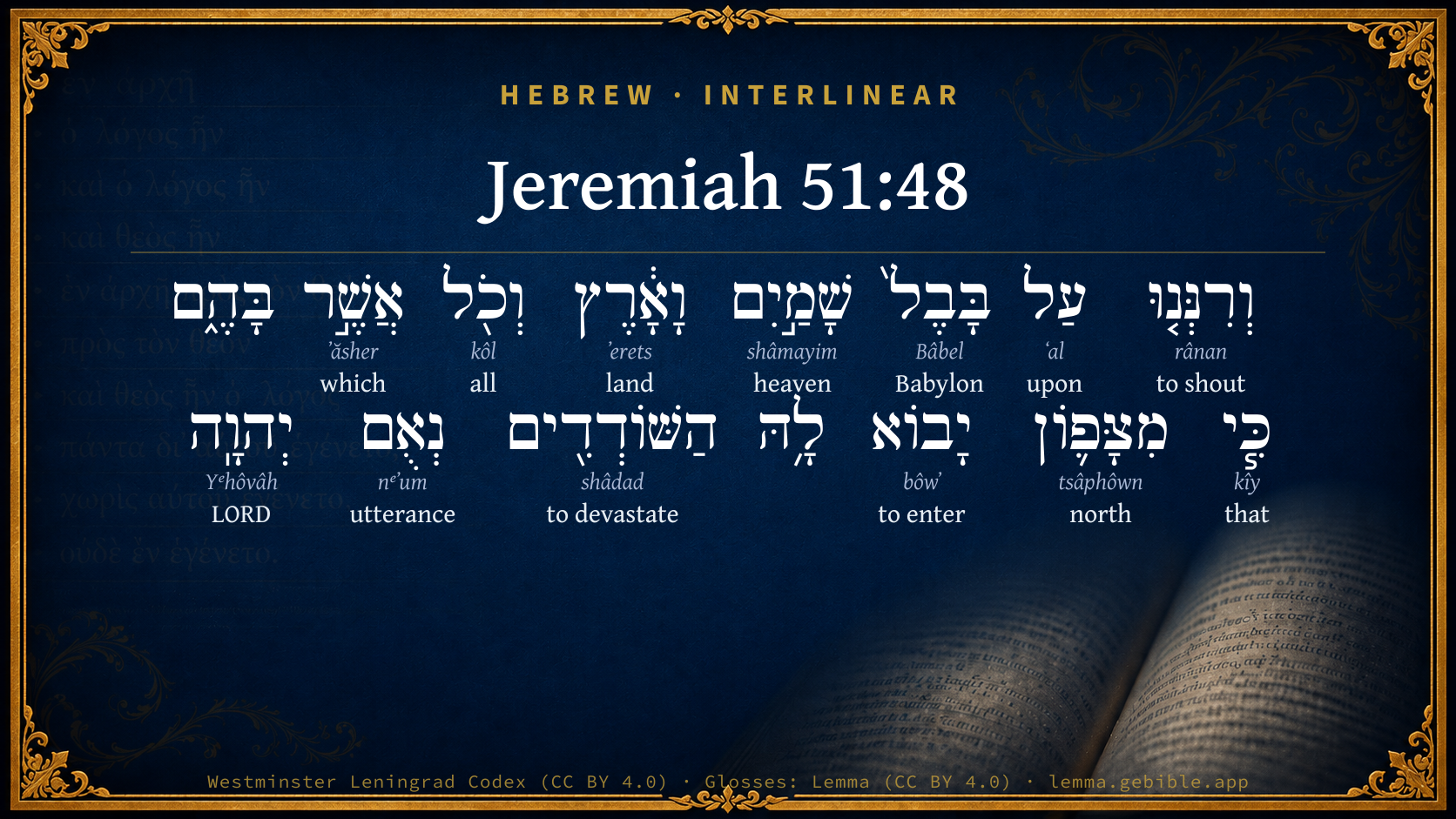
Jeremiah 51:48

Hebrew (Westminster Leningrad Codex) Jeremiah 51:48 appears in the Hebrew Old Testament. The text above is from the Westminster Leningrad Codex. Each word links to its Strong’s number, a concise gloss, and parsing drawn from the Open Scriptures Hebrew Bible morphology. Click any word for its full Brown-Driver-Briggs (BDB) entry.
Download image
Cite this verse

Jeremiah 51:48 (World English Bible). Public Domain. Lemma interlinear Bible study tool, https://lemma.gebible.app/v/jeremiah/51/48.

Show BibTeX & RIS
BibTeX
RIS
English Translation
Then the heavens and the earth, and all that is therein, shall sing for joy over Babylon; for the destroyers shall come to her from the north, says Yahweh.
World English Bible · Public Domain
Download a study sheet

One document with this verse’s original text, its word-by-word gloss line, the meaning frame, cross-references with their text, attributed commentary, and full source and license credits — printable, and it pastes into notes with its structure intact.

This verse Autodidact and up

Study sheet (.html) Plain text (.txt)

A passage Seminary Student

Up to 50 verses in one chapter. A passage sheet keeps up to 6 commentary sources and 12 cross-references per verse, in the order this page ranks them, and says so on the sheet whenever that leaves anything out. Ask for a single verse and you get the Autodidact verse sheet above.

Everything on this page stays free to read, with no account — the sheet is a download of what is already on screen, not access to it.

Want to remove ads? Support Godless Engineer
Compare translations 3

The same verse in 3 English versions, stacked beneath the original-language interlinear above. Click any original word for its lexicon entry.

Each is an independent rendering of the whole verse — the interlinear is not word-aligned to these translations.

Highlighted words mark where these versions differ — a whole-verse word diff, not a word-by-word alignment.

  • World English Bible Public Domain
    Then the heavens and the earth, and all that is therein, shall sing for joy over Babylon; for the destroyers shall come to her from the north, says Yahweh.
  • King James Version Public Domain
    Then the heaven and the earth, and all that is therein, shall sing for Babylon: for the spoilers shall come unto her from the north, saith the LORD.
  • unfoldingWord Literal Text CC BY-SA 4.0
    Then the heavens and the earth, and all that is in them will rejoice over Babylon. For destroyers will come for her from the north—this is Yahweh’s declaration.

unfoldingWord Literal Text — © unfoldingWord, licensed CC BY-SA 4.0. Word-aligned USFM3 via Door43 (git.door43.org/unfoldingWord/en_ult).

Versions to compare (up to 4)

3 of 4 selected

Show all 18 translations

Every available English version of this verse, each an independent rendering of the whole verse.

  • World English Bible Public Domain
    Then the heavens and the earth, and all that is therein, shall sing for joy over Babylon; for the destroyers shall come to her from the north, says Yahweh.
  • Berean Standard Bible Public Domain
    Then heaven and earth and all that is in them will shout for joy over Babylon because the destroyers from the north will come against her,” declares the LORD.
  • Majority Standard Bible Public Domain
    Then heaven and earth and all that is in them will shout for joy over Babylon because the destroyers from the north will come against her,” declares the LORD.
  • King James Version Public Domain
    Then the heaven and the earth, and all that is therein, shall sing for Babylon: for the spoilers shall come unto her from the north, saith the LORD.
  • American Standard Version (1901) Public Domain
    Then the heavens and the earth, and all that is therein, shall sing for joy over Babylon; for the destroyers shall come unto her from the north, saith Jehovah.
  • Revised Version (1885) Public Domain
    Then the heaven and the earth, and all that is therein, shall sing for joy over Babylon; for the spoilers shall come unto her from the north, saith the LORD.
  • Geneva Bible (1599) Public Domain
    Then the heauen and the earth, and all that is therein, shall reioyce for Babel: for the destroyers shall come vnto her from the North, saith the Lord.
  • Douay-Rheims (1899) Public Domain
    And the heavens and the earth, and all things that are in them shall give praise for Babylon: for spoilers shall come to her from the north, saith the Lord.
  • Young's Literal Translation Public Domain
    And cried aloud against Babylon Have heavens and earth, and all that `is' in them, For, from the north come to it do the spoilers, An affirmation of Jehovah.
  • Literal Standard Version CC BY-SA 4.0
    And heavens and earth and all that [is] in them || Have cried aloud against Babylon, || For the spoilers come to her from the north,” || A declaration of YHWH.
  • Unlocked Literal Bible CC BY-SA 4.0
    Then the heavens and the earth, and all that is in them will rejoice over Babylon. For destroyers will come for her from the north—this is Yahweh's declaration.
  • unfoldingWord Literal Text CC BY-SA 4.0
    Then the heavens and the earth, and all that is in them will rejoice over Babylon. For destroyers will come for her from the north—this is Yahweh’s declaration.
  • Darby Bible Public Domain
    And the heavens and the earth, and all that is therein, shall shout aloud over Babylon; for out of the north the spoilers shall come against her, saith Jehovah.
  • World Messianic Bible Public Domain
    Then the heavens and the earth, and all that is therein, will sing for joy over Babylon; for the destroyers will come to her from the north,” says the LORD.
  • Webster's Bible Public Domain
    Then the heaven and the earth, and all that is in them, shall sing for Babylon: for the spoilers shall come to her from the north, saith the LORD.
  • Free Bible Version CC BY-SA 4.0
    Then everyone in heaven and on earth will celebrate with shouts of joy at what's happened to Babylon, because the destroyers from the north will come and attack her, declares the Lord.
  • Bible in Basic English Public Domain
    And the heaven and the earth and everything in them, will make a song of joy over Babylon: for those who make her waste will come from the north, says the Lord.
  • JPS Tanakh (1917) Public Domain
    Then the heaven and the earth, and all that is therein, shall sing for joy over Babylon; for the spoilers shall come unto her from the north, saith the LORD.

Literal Standard Version (2020), Covenant Press — licensed CC BY-SA 4.0. Text via the HelloAO Bible API (eBible.org). Unlocked Literal Bible (unfoldingWord) — licensed CC BY-SA 4.0. Text via the HelloAO Bible API (eBible.org). unfoldingWord Literal Text — © unfoldingWord, licensed CC BY-SA 4.0. Word-aligned USFM3 via Door43 (git.door43.org/unfoldingWord/en_ult). Free Bible Version, Dr. Jonathan Gallagher — licensed CC BY-SA 4.0. Text via the HelloAO Bible API (eBible.org).

Word by word

More ways to search: Search by grammar → Find every occurrence → Compare this word →

Practice this passage: Drill this verse → Learn its vocabulary →

וְרִנְּנ֤וּ
rânan
H7442
“and · to shout”
Conjunction + Verb, Piel, Sequential Perfect, 3rd Person, Common, Plural
Part of Speech
Conjunction + Verb
Stem
Piel
Form
Sequential Perfect
Person
3rd Person
Gender
Common
Number
Plural
Full BDB Definition

Origin: a primitive root

TWOT: 2134 , 2179

to overcome - (Hithpolel) to be overcome - to cry out, shout for joy, give a ringing cry - (Qal) - to give a ringing cry (in joy, exaltation, distress) - to cry aloud (in summons, exhortation of wisdom) - (Piel) to give a ringing cry (in joy, exultation, praise - (Pual) ringing cry, singing out (passive) - (Hiphil) to cause to ring or sing out (for joy) - (Hithpolel) rejoicing (participle)
  1. עַל ʻal H5921 “upon” Preposition
  2. בָּבֶל֙ Bâbel H894 “Babylon” Noun, Proper
  3. שָׁמַ֣יִם shâmayim H8064 “heaven(s)” Noun, Common, Masculine, Plural, Absolute
  4. וָאָ֔רֶץ ʼerets H776 “and · land” Conjunction + Noun, Common, Both, Singular, Absolute
  5. וְכֹ֖ל kôl H3605 “and · all” Conjunction + Noun, Common, Masculine, Singular, Absolute
  6. אֲשֶׁ֣ר ʼăsher H834 “which” Particle, Relative
  7. כִּ֧י kîy H3588 “that” Conjunction
  8. מִצָּפ֛וֹן tsâphôwn H6828 “from · north” Preposition + Noun, Common, Feminine, Singular, Absolute
  9. יָבוֹא bôwʼ H935 “to enter” Verb, Qal, Imperfect, 3rd Person, Masculine, Singular
  10. הַשּׁוֹדְדִ֖ים shâdad H7703 “the · devastating” Particle, Definite Article + Verb, Qal, Participle Active, Masculine, Plural, Absolute
  11. נְאֻם nᵉʼum H5002 “utterance of” Noun, Common, Masculine, Singular, Construct
  12. יְהוָֽה Yᵉhôvâh H3068 “LORD” Noun, Proper

About this verse

These counts appear in no published source. They are computed here, from the morphology-tagged text and Lemma’s own curated glosses. What Lemma adds →

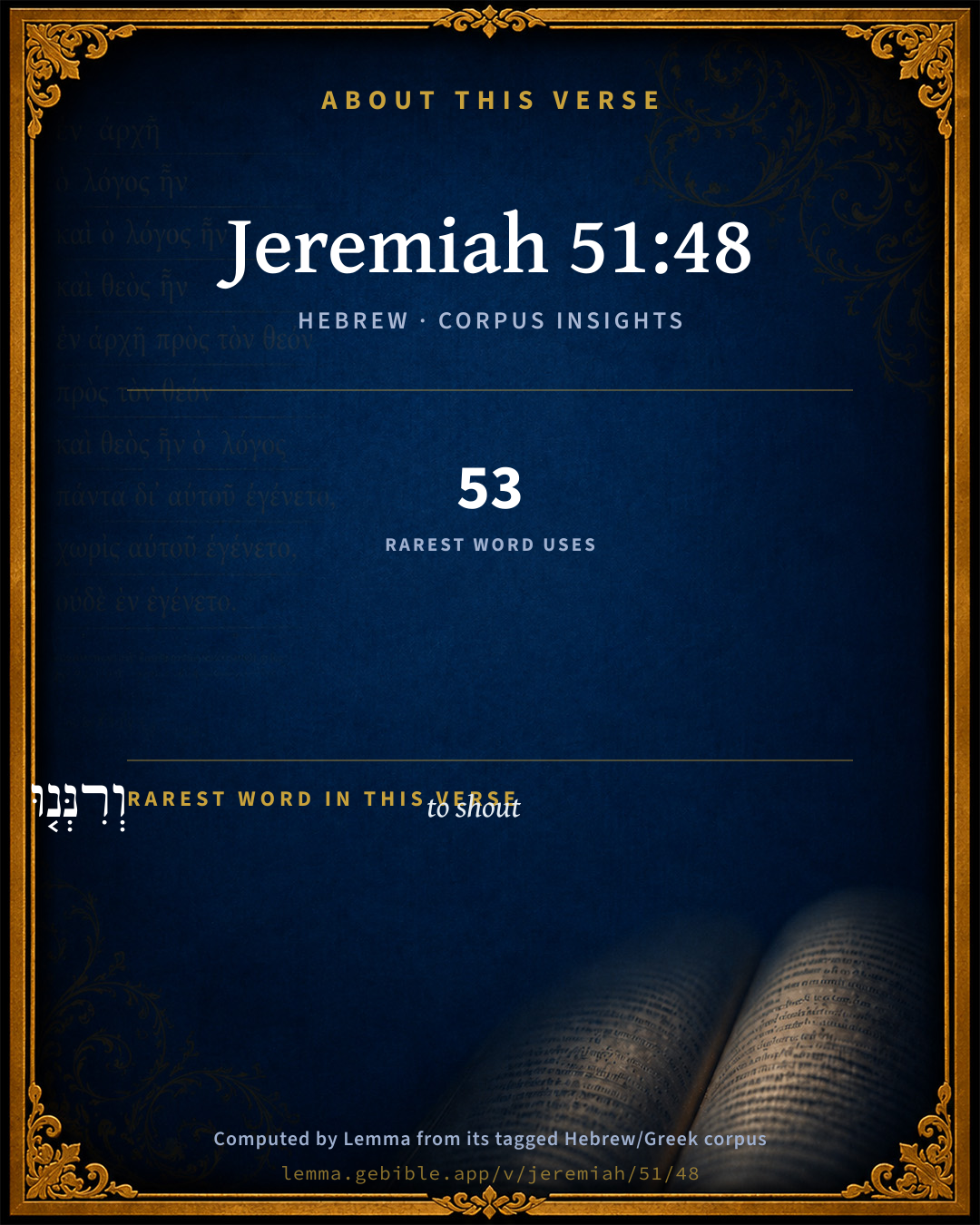
15
words
13
distinct lemmas
Prophets
section

Shared distinctive vocabulary

וְרִנְּנ֤וּ to shout H7442 occurs in 53 verses of the Hebrew Bible. Also found in:

Grammatical profile

  • 3 verbs
  • 7 nouns
  • 3 prepositions
  • 1 conjunction
  • 1 particle

Verb forms

  • וְרִנְּנ֤וּ Piel · Sequential Perfect
  • יָבוֹא Qal · Imperfect
  • הַשּׁוֹדְדִ֖ים Qal · Participle Active

Cross-references

13

Topical passages linked to Jeremiah 51:48 in the Treasury of Scripture Knowledge — connected by theme and wording, ordered by reader-vote popularity; previews shown in the World English Bible.

  • Isaiah 44:23 Sing, you heavens, for Yahweh has done it; shout, you lower parts of the earth; break forth into singing, you mountains, O forest, and every tree therein: for Yahweh has redeemed Jacob, and will glorify himself in Israel.
  • Revelation 18:20 Rejoice over her, O heaven, you saints, apostles, and prophets; for God has judged your judgment on her."
  • Jeremiah 50:3 For out of the north there comes up a nation against her, which shall make her land desolate, and none shall dwell therein: they are fled, they are gone, both man and animal.
  • Isaiah 48:20 Go you forth from Babylon, flee you from the Chaldeans; with a voice of singing declare you, tell this, utter it even to the end of the earth: say you, Yahweh has redeemed his servant Jacob.
  • Isaiah 49:13 Sing, heavens; and be joyful, earth; and break forth into singing, mountains: for Yahweh has comforted his people, and will have compassion on his afflicted.
  • Psalms 58:10–11 The righteous shall rejoice when he sees the vengeance. He shall wash his feet in the blood of the wicked;
  • Proverbs 11:10 When it goes well with the righteous, the city rejoices. When the wicked perish, there is shouting.
  • Jeremiah 50:9 For, behold, I will stir up and cause to come up against Babylon a company of great nations from the north country; and they shall set themselves in array against her; from there she shall be taken: their arrows shall be as of an expert mighty man; none shall return in vain.
  • Jeremiah 50:41 Behold, a people comes from the north; and a great nation and many kings shall be stirred up from the uttermost parts of the earth.
  • Jeremiah 51:10–11 Yahweh has brought forth our righteousness: come, and let us declare in Zion the work of Yahweh our God.
  • Revelation 15:1–4 I saw another great and marvelous sign in the sky: seven angels having the seven last plagues, for in them God's wrath is finished.
  • Revelation 16:4–7 The third poured out his bowl into the rivers and springs of water, and they became blood.
  • Revelation 19:1–7 After these things I heard something like a loud voice of a great multitude in heaven, saying, "Hallelujah! Salvation, power, and glory belong to our God:

Cross-references courtesy of OpenBible.info (CC BY 4.0).

Hebrew and Greek witnesses Masoretic Hebrew ↔ Greek Septuagint

The same verse in the two great witnesses to the Old Testament, shown verse-for-verse.

These are two independent witnesses, not word-aligned to each other, and the Septuagint is shown in lemma (dictionary) form.

Hebrew Jeremiah 51:48 Masoretic · Westminster Leningrad Codex

וְרִנְּנ֤וּ עַל בָּבֶל֙ שָׁמַ֣יִם וָאָ֔רֶץ וְכֹ֖ל אֲשֶׁ֣ר בָּהֶ֑ם כִּ֧י מִצָּפ֛וֹן יָבוֹא לָ֥הּ הַשּׁוֹדְדִ֖ים נְאֻם יְהוָֽה

Then the heavens and the earth, and all that is therein, shall sing for joy over Babylon; for the destroyers shall come to her from the north, says Yahweh.

World English Bible · Public Domain

Greek LXX Structure differs

In the Septuagint, Jeremiah is about an eighth shorter than the Hebrew and arranges its material differently — the Oracles Against the Nations (Hebrew chapters 46–51) appear in the middle of the Greek book, after 25:13. Because the chapter and verse boundaries do not line up, a verse-for-verse comparison with the Hebrew is not shown.

A verse-for-verse comparison isn’t shown here because the chapters and verses don’t line up. Switch to the LXX edition with the MT / LXX toggle above to read the Greek directly.

Hebrew: Westminster Leningrad Codex (CC BY 4.0). Greek: Septuagint (public domain); English from a public-domain English Septuagint. How the Septuagint differs from the Hebrew →

Targum (Aramaic paraphrase)

1

The Targum is the ancient Jewish Aramaic paraphrase of the Hebrew Scriptures — an interpretive translation, not the Hebrew text itself. Onkelos (literal) and Pseudo-Jonathan (expansive) render the Torah, and Jonathan the Prophets. Coverage is partial: where no permissively-licensed English translation exists for a verse, only the Aramaic is shown. This is verse-level text, not a word-by-word alignment to the Hebrew.

  1. Targum Jonathan Prophets (Joshua–Malachi)
    וִישַׁבְּחוּן עַל בָּבֶל שְׁמַיָא וְאַרְעָא וְכָל דִי בְהוֹן אֲרֵי מִצְפּוּנָא יֵיתוּן עֲלָה בָּזוֹזִין אֲמַר יְיָ:

    (no public-domain English translation for this verse)

    Targum Jonathan — Aramaic: “Mikraot Gedolot” (public domain). English: “Sefaria Community Translation” (CC0 1.0 (public-domain dedication)); “London "Chaldee Paraphrase," 1871” (public domain). Text via Sefaria.

Commentary

Notes on Jeremiah 51:48 from classic Christian and Jewish commentators (each source and its license shown beneath its notes). The classic Christian expositions comment on the surrounding passage and are grouped to its opening verse, so a note may address several verses; the Jewish commentaries on the Tanakh (Rashi and others) are per-verse, so they appear only where the commentator wrote on this verse.

Lemma curates 59 commentaries, every one of them public domain or Creative Commons licensed, each selected and text-cleaned for this edition rather than reprinted as found. About our sources →

Trapp's Complete Commentary

John Trapp

Jer 51:48 Then the heaven and the earth, and all that [is] therein, shall sing for Babylon: for the spoilers shall come unto her from the north, saith the LORD.

Ver. 48. Then the heaven and the earth, &c., shall sing.] Est hyperbolica prosopopoeia. This is an exagerated personification. There shall be, as it were, a new face set upon the world, and all the creatures shall appear to be well paid at the downfall of Babylon, under the oppressions whereof they even groaned and laboured. See what a similar general joy there will be at the ruin of Rome! {Rev 18:20}

John Trapp, A Commentary or Exposition upon All the Books of the Old and New Testament (1647–1656) — public domain. Text from a community e-Sword module.

Keil & Delitzsch

C. F. Keil & F. Delitzsch

Heaven and earth, with all that is in them (i.e., the whole world, with its animate and inanimate creatures), break out into rejoicing over the fall of Babylon (cf. Isa 44:23), for Babylon has enslaved and laid waste all the world. The second part of Jer 51:48, "for the destroyers shall come from the north," is logically connected with Jer 51:47, to which Jer 51:48 is to be taken as subordinate, in the sense, "over which heaven and earth rejoice." On Jer 51:48, cf. Jer 50:3, Jer 50:9,Jer 50:41. Both parts of Jer 51:49 are placed in mutual relation by גּם־גּם. These two particles, thus used, signify "as well as," "not only...but also," or "as...so." Ewald, Hitzig, and Graf have quite missed the meaning of both clauses, since they take חללי ישׂראל as a vocative, and render the whole thus: "Not only must Babylon fall, O ye slain ones of Israel, but slain ones of the whole earth have fallen on the side of Babylon (or through Babylon)." This view of the expression "slain ones of Israel" cannot be established, either from grammatical considerations or from a regard to the meaning of the whole. Not only is there no occasion for a direct address to the slain ones of Israel; but by such a view of the expression, the antithesis indicated by גּמרררגּם, between "the slain ones of Israel" and "the slain ones of the earth," is thereby destroyed. Viewed grammatically, "the slain ones of Israel" can only be the subject dependent on the inf. לנפּל: "the fall of the slain ones of Israel." Kimchi has long ago hit the meaning in the explanation, גּם בּבל היתה סבּת לנפּל, "as Babylon was the cause of the slain ones of Israel falling." Similarly Jerome: et quomodo fecit Babylon ut caderent occisi ex Israel. This paraphrase may be vindicated on grammatical grounds, for the inf. constr. with ל, with or without היה, is used to express that on which one is engaged, or what one is on the point of doing; cf. Gesenius, 132, 3, Rem. 1. In this meaning, לנפּל stands here without היה: "Just as Babylon was concerned in making the slain ones of Israel fall;" or better: "Just as Babylon was intent on the fall of slain ones in Israel, so also there fall because of Babylon (prop. dative, for Babylon) slain ones of all the earth;" because there are to be found, in the capital of the empire, people from all quarters of the world, who are slain when Babylon is conquered. The perf. נפלוּ is prophetic, like פּקדתּי in Jer 51:47.

Keil & Delitzsch — Biblical Commentary on the Old Testament (1861–1891) — public domain (CC PDM 1.0). Text via the HelloAO Bible API. (Old Testament only.)

Geneva Bible (1599)

Geneva Bible translators

All creatures in heaven and earth shall rejoice, and praise God for the destruction of Babylon the great enemy of his Church.

Geneva Bible (1599) marginal notes — public domain. Text via Bolls.life.

Jamieson, Fausset & Brown

Robert Jamieson, A. R. Fausset & David Brown

heaven . . . earth . . . sing for Babylon-- (Isa 14:7-13; Isa 44:23; Rev 18:20).

Jamieson, Fausset & Brown — Commentary Critical and Explanatory on the Whole Bible (1871) — public domain (CC PDM 1.0). Text via the HelloAO Bible API.

Adam Clarke's Commentary

Verse 48. The heaven and the earth - shall sing for Babylon] Its fall shall be a subject of universal rejoicing.

Adam Clarke's Commentary on the Bible (1810–1826) — public domain. Text from a community e-Sword/MySword module.

John Calvin's Commentaries

That, he might more fully convince the Jews of the truth of all that he has hitherto said of the destruction of Babylon, he declares that God would effect it, and that it would be applauded by all the elements. Shout, he says, shall heaven and earth; which is a kind of personification — for he ascribes knowledge to heaven and earth. It might, indeed, be more refinedly explained, that angels and men would shout for joy, but it would be a frigid explanation; and the Prophet removes every ambiguity, by adding, and all that is in them: he includes, no doubt, the stars, men, trees, fishes, birds, fields, stones, and rivers. And the expression is very emphatical when he says, that all created things, though without reason and understanding, would yet be full of joy, so that they would, in a manner, rejoice and sing praise. If such would be the feeling in dead creatures, when God put forth his hand against Babylon, would it be possible for that city to remain safe, which was so hated by heaven and earth, and which was accursed by birds and wild beasts, by trees, and everything void of understanding!

We hence see that the Prophet heaps together all kinds of figures and modes of speaking, in order to confirm weak minds, so that they might confidently look forward to the destruction of Babylon. He at the same time intimates that Babylon was hated by all creatures, because it had reached to the highest pitch of wickedness. He then shows the cause by the effect, as though he had said that Babylon was hated by heaven and earth, so that heaven and earth seemed as though they deemed themselves in a manner polluted by the sight of that city. As long, then, as Babylon stood, heaven and earth sighed: but, on the contrary, when God appeared as an avenger, then heaven and earth, and all things in them, would shout with joy. Could it then be that God, the judge of the world, would always connive at its sins? If heaven and earth could not endure it, and Babylon was so loathsome to all, and joy would arise from its destruction, could God possibly allow that city, filled with so many sins, and detested by heaven and earth, to escape with impunity his judgment?

We now, then, more fully understand why the Prophet says that triumph and joy would be in heaven and earth, and among all created things.

He says, because; but the particle כי, ki, may be taken for an adverb of time: then he says, when from the north shall come wasters He alludes to the Medes, for the Persians were eastward. But as the Medes were nigher, and also their monarch hr wealthier, the Prophet refers especially to the Medes when he says that evil would come from the north. For the Medes were north of Chaldea, as the Persians were eastward.

John Calvin's Commentaries (1540-1563) — public domain. Text from the Calvin Translation Society English edition (1840s-50s) via the Christian Classics Ethereal Library (ccel.org). Calvin's coverage is partial (roughly two-thirds of the Bible); uncommented books and verses are honest gaps, never fabricated. The 19th-century editor's footnotes and remarks are omitted so the notes are faithfully Calvin's own voice.

Ellicott's Commentary for English Readers

(48) Then the heaven and the earth . . .—The prophet, following in the track of Isaiah (Isa_44:23), thinks of the whole creation as rejoicing in the righteous judgment of Jehovah on the guilty city, and in the liberation of His people. They sing, as it were, their Te Deum over the fall of Babylon under the attack of the Medo-Persian armies “from the North.”

A Bible Commentary for English Readers, edited by Charles John Ellicott (1878–1897) — public domain. Text from a community e-Sword module.

The Cambridge Bible for Schools and Colleges

gen. ed. J. J. S. Perowne

48. shall sing for joy over Babylon] shall rejoice over her fall.

The Cambridge Bible for Schools and Colleges (gen. ed. J. J. S. Perowne; Cambridge University Press, 1878–1918) — public domain. Text from a community e-Sword module.

John Gill's Exposition

Ye that have escaped the sword, go away, stand not still,.... The Jews, who had escaped the sword of the Chaldeans when Jerusalem was taken, and were carried captive into Babylon, where they had remained to this time; and had also escaped the sword of the Medes and Persians, when Babylon was taken; these are bid to go away from Babylon, and go into their land, and not stay in Babylon, or linger there, as Lot in Sodom; or stop on the road, but make the best of their way to the land of Judea:

remember the Lord afar off; the worship of the Lord, as the Targum interprets it; the worship of the Lord in the sanctuary at Jerusalem, from which they were afar off at Babylon; and had been a long time, even seventy years, deprived of it, as Kimchi explains it:

and let Jerusalem come into your mind; that once famous city, the metropolis of the nation, that now lay in ruins; the temple that once stood in it, and the service of God there; that upon the remembrance of, and calling these to mind, they might be quickened and stirred up to hasten thither, and rebuild the city and temple, and restore the worship of God. It is not easy to say whose words these are, whether the words of the prophet, or of the Lord by him; or of the inhabitants of the heavens and earth, whose song may be here continued, and in it thus address the Jews.

John Gill's Exposition of the Whole Bible (1746–1763) — public domain (CC PDM 1.0). Text via the HelloAO Bible API.

Haydock's Catholic Bible Commentary

Praise, for the just punishment. (Haydock) --- The crimes were public. (Calmet)

George Leo Haydock (1774–1849), Haydock's Catholic Family Bible and Commentary, 1859 edition — public domain. Excludes Psalms (Douay-Rheims chapter numbering differs from Protestant) and Deuterocanonical books (Catholic canon only).

Matthew Poole's English Annotations

All the creatures in heaven and earth. shall rejoice at the vengeance which God shall take upon Babylon, which had been the destroyer of so many of their people. The Median soldiers are those here called spoilers from the north.

Matthew Poole's English Annotations on the Holy Bible (1683–1685) — public domain. Text from a community e-Sword/MySword module.

The Pulpit Commentary

From the north. The same statement as in Jer_50:3, Jer_50:9, Jer_50:41.

Joy over judgment.

I THE SINNER WILL WEEP AND WAIL. This is the constant declaration of the Word of God. "There shall be weeping and gnashing of teeth." Would that the sinner would look steadily on to the end, and so consider his ways!

II HUMAN NATURE, IN SYMPATHY WITH THE SINNER"S WOES, WILL SORROW. (Cf. Isa_21:10) We have need to be on our guard against this. In the present day our sympathy with the suffering leads us to forget the causes and the blessed results that come from the judgment of God. No criminal is ever condemned to die but at once there are those who strive to get his punishment remitted. It is a false sympathy and needs to be resisted.

III BUT HEAVEN AND EARTH REJOICE. Cf. the many psalms in which we are called on to rejoice because the Lord "cometh to judge the earth." The grounds of this joy are:

1. Righteousness is vindicated.

2. The oppressed are delivered.

3. Men will learn righteousness.

4. They that are judged will be brought to a better mind.

5. The kingdom of God will more speedily come. C.

The Pulpit Commentary (1880–1919), ed. H.D.M. Spence-Jones & Joseph S. Exell — public domain. Text from a community e-Sword module.

John Wesley's Explanatory Notes

Then - All the creatures in heaven and earth shall rejoice at the vengeance which God shall take upon Babylon.

John Wesley, Explanatory Notes Upon the Whole Bible (1754–1765) — public domain. Text via the GEBible commentary corpus.

Lesson kit

Teaching starters — assembled from the data on this page, not authored interpretation. Every prompt links to the verse data it draws on. Edit before teaching.

Jeremiah, in the Prophets, opens this verse with 15 words (13 distinct Hebrew lemmas). Its most distinctive word is rânan (“to shout”). A historical commentator’s framing appears above. Read the whole chapter for the surrounding context.

Discussion questions

  1. How does “to shout” (rânan) shape what this verse is saying?
  2. How does Leviticus 9:24, which shares the word «to shout», read alongside this verse?
  3. These translations render this verse differently; the difference is in the English rendering, not the original. What questions does that raise?
  4. «וְרִנְּנ֤וּ» is a Piel Sequential Perfect verb. How does that grammatical form shape the action described?
  5. Compare how Trapp's Complete Commentary and Keil & Delitzsch read this verse. Where do they agree or differ?

Things to notice

Reading settings

Reading text

Shown beneath each verse's original-language words.

Old Testament
Old Testament edition

Read the OT as the Masoretic Hebrew (MT) or the Greek Septuagint (LXX).

English shown for the Greek Septuagint (in the Hebrew ↔ Greek comparison).

Comparing translations? Open the Compare panel on any verse page to stack up to four side by side.