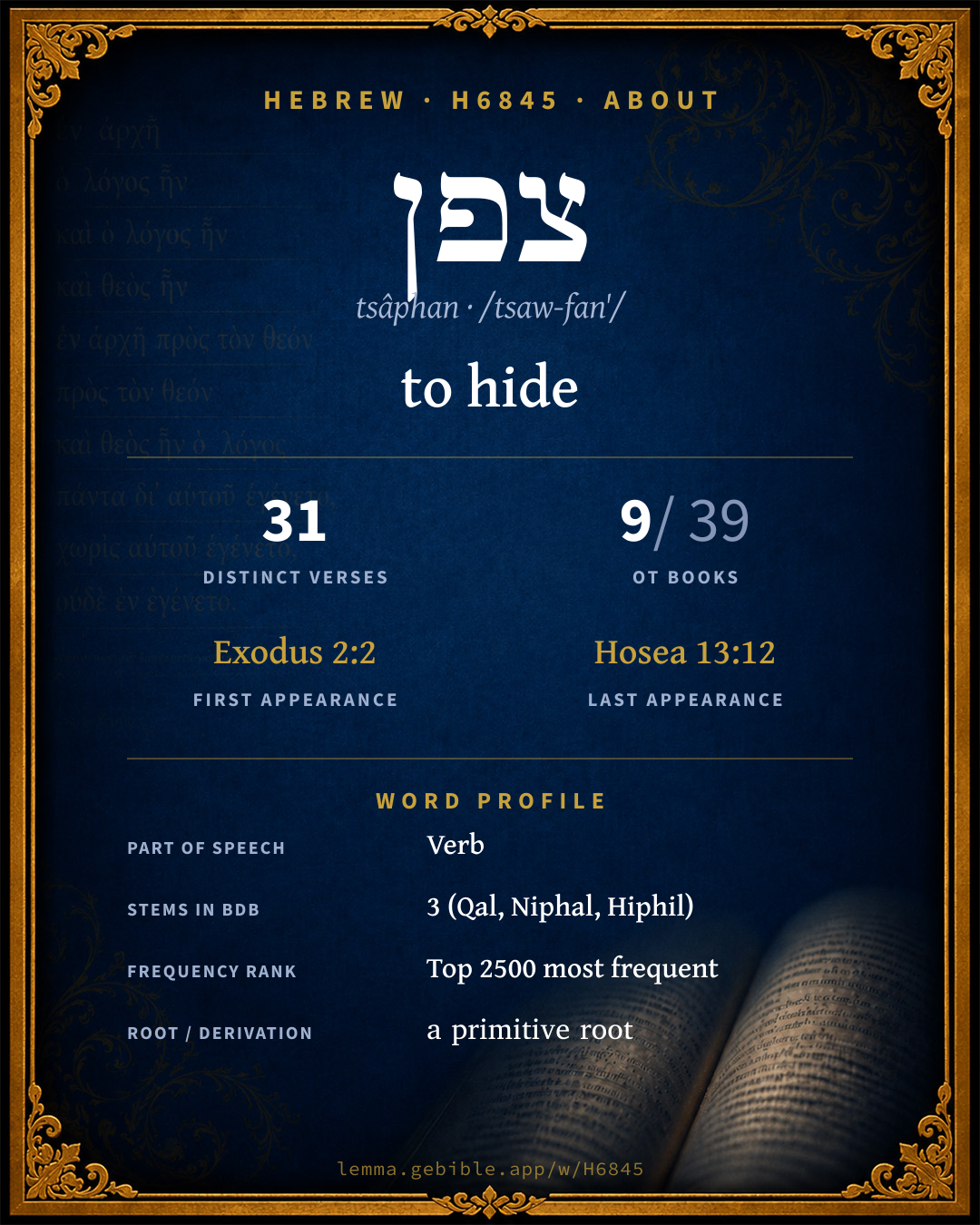
צָפַן
to hide
‘to hide’ is one of 3 main senses fuller range ↓
Full lexicon entry — Brown-Driver-Briggs (BDB)
From Brown-Driver-Briggs (BDB)
Where this word appears
See every Qal verb in the Hebrew Bible →
Grammar key — what these labels mean
Part of speech
- Verb
- An action or state-of-being word.
Stem
- Qal
- The basic, simple active stem — the plain form of the verb (“he wrote”). Here: ‘trans. hide’
- Niphal
- Usually the simple passive or reflexive of the Qal (“he was written”).
- Hiphil
- The causative active stem (“he caused / brought about”). Here: ‘hide’
Form
- Imperfect
- An incomplete, ongoing, or future action (“he will / would write”).
- Perfect
- A completed action or state — Hebrew marks aspect (completeness) more than strict tense (“he wrote”).
- Sequential Imperfect
- An imperfect with prefixed waw — the standard past-narrative form (waw-consecutive imperfect).
- Sequential Perfect
- A perfect with prefixed waw continuing a preceding imperfect or command (waw-consecutive perfect).
- Participle Passive
- A verbal adjective expressing action received (“written”).
- Infinitive Construct
- A bound verbal noun, frequently with prepositions (“to write / in writing”).
- Cohortative
- A first-person volitional form expressing wish or resolve (“let me / let us write”).
- Participle Active
- A verbal adjective expressing ongoing or characteristic action (“writing / one who writes”).
State
- Absolute
- The independent form of a noun, not bound to a following word.
- Construct
- A noun bound to a following noun in a possessive / “of” relationship (the construct chain).
Person
- 3rd Person
- The one spoken about (“he / she / it / they”).
- 1st Person
- The speaker (“I / we”).
- 2nd Person
- The one addressed (“you”).
Gender
- Masculine
- Grammatically masculine.
- Common
- Either gender — not distinguished for this form.
- Feminine
- Grammatically feminine.
Number
- Plural
- More than one (in Hebrew, generally three or more).
- Singular
- One.
Grammatical forms 19 distinct
- Verb, Qal, Imperfect, 3rd Person, Masculine, Plural 4 times (12%)
- Verb, Qal, Perfect, 1st Person, Common, Singular 3 times (9%)
- Verb, Qal, Perfect, 2nd Person, Masculine, Singular 3 times (9%)
- Verb, Qal, Imperfect, 2nd Person, Masculine, Singular 3 times (9%)
- Verb, Qal, Imperfect, 3rd Person, Masculine, Singular 3 times (9%)
- Verb, Qal, Sequential Imperfect, 3rd Person, Feminine, Singular 2 times (6%)
- Verb, Niphal, Perfect, 3rd Person, Common, Plural 2 times (6%)
- Verb, Qal, Participle Passive, Masculine, Singular, Construct 2 times (6%)
+11 more forms (12 occurrences)
Parsed forms decoded from the imported morphology (morphhb / Westminster Leningrad Codex — WLC text public domain, morphhb tagging CC BY 4.0), counted across 34 parsed occurrences — not distinct verses.
Every verse where H6845 appears — 31 distinct verses across 9 books. Click any verse to open its interlinear word-by-word view. Verse text shown in the World English Bible for context — . Each verse’s Hebrew form is shown with its reference; the English is not keyword-highlighted, since the data carries no word-level English alignment. Use “Compare translations” on any verse to read it across multiple English versions. This concordance covers the Hebrew Bible; Septuagint (Greek Old Testament) occurrences are not indexed here.
Exodus 2 verses
- Exodus 2:2 וַֽ/תִּצְפְּנֵ֖/הוּ conj + Qal wimpf 3fs + sfx pers 3ms The woman conceived, and bore a son. When she saw that he was a fine child, she hid him three months.
- Exodus 2:3 הַצְּפִינ/וֹ֒ Hiphil inf.cs + sfx pers 3ms When she could no longer hide him, she took a papyrus basket for him, and coated it with tar and with pitch. She put the child in it, and laid it in the reeds by the river's bank.
Joshua 1 verse
Job 8 verses
- Job 10:13 צָפַ֣נְתָּ Qal pf 2ms Yet you hid these things in your heart. I know that this is with you:
- Job 14:13 תַּצְפִּנֵ֗/נִי Hiphil impf 2ms + sfx pers 1cs "Oh that you would hide me in Sheol, That you would keep me secret, until your wrath is past, That you would appoint me a set time, and remember me!
- Job 15:20 נִצְפְּנ֥וּ Niphal pf 3cp The wicked man travails with pain all his days, Even the number of years that are laid up for the oppressor.
- Job 17:4 צָפַ֣נְתָּ Qal pf 2ms For you have hidden their heart from understanding, Therefore shall you not exalt them.
- Job 20:26 לִ/צְפּ֫וּנָ֥י/ו prep + Qal ptcp.pass mp cs + sfx pers 3ms All darkness is laid up for his treasures. An unfanned fire shall devour him. It shall consume that which is left in his tent.
- Job 21:19 יִצְפֹּן Qal impf 3ms You say, 'God lays up his iniquity for his children.' Let him recompense it to himself, that he may know it.
- Job 23:12 צָפַ֥נְתִּי Qal pf 1cs I haven't gone back from the commandment of his lips. I have treasured up the words of his mouth more than my necessary food.
- Job 24:1 נִצְפְּנ֣וּ Niphal pf 3cp "Why aren't times laid up by the Almighty? Why don't those who know him see his days?
Psalms 8 verses
- Psalms 10:8 יִצְפֹּֽנוּ Qal impf 3mp He lies in wait near the villages. From ambushes, he murders the innocent. His eyes are secretly set against the helpless.
- Psalms 17:14 וּֽ/צְפוּנְ/ךָ֮ conj + Qal ptcp.pass ms cs + sfx pers 2ms From men by your hand, Yahweh, From men of the world, whose portion is in this life. You fill the belly of your cherished ones. Your sons have plenty, And they store up wealth for their children.
- Psalms 27:5 יִצְפְּנֵ֨/נִי Qal impf 3ms + sfx pers 1cs For in the day of trouble he will keep me secretly in his pavilion. In the covert of his tent he will hide me. He will lift me up on a rock.
- Psalms 31:19 צָפַ֪נְתָּ Qal pf 2ms Oh how great is your goodness, Which you have laid up for those who fear you, Which you have worked for those who take refuge in you, Before the sons of men!
- Psalms 31:20 תִּצְפְּנֵ֥/ם Qal impf 2ms + sfx pers 3mp In the shelter of your presence you will hide them from the plotting of man. You will keep them secretly in a dwelling away from the strife of tongues.
- Psalms 56:6 יצפינו יִצְפּ֗וֹנוּ Hiphil impf 3mp Qal impf 3mp They conspire and lurk, Watching my steps, they are eager to take my life.
- Psalms 83:3 צְפוּנֶֽי/ךָ Qal ptcp.pass mp cs + sfx pers 2ms They conspire with cunning against your people. They plot against your cherished ones.
- Psalms 119:11 צָפַ֣נְתִּי Qal pf 1cs I have hidden your word in my heart, That I might not sin against you.
Proverbs 8 verses
- Proverbs 1:11 נִצְפְּנָ֖ה Qal coh 1cp If they say, "Come with us, Let's lay in wait for blood; Let's lurk secretly for the innocent without cause;
- Proverbs 1:18 יִ֝צְפְּנ֗וּ Qal impf 3mp But these lay wait for their own blood. They lurk secretly for their own lives.
- Proverbs 2:1 תִּצְפֹּ֥ן Qal impf 2ms My son, if you will receive my words, And store up my commandments within you;
- Proverbs 2:7 ו/צפן יִצְפֹּ֣ן conj + Qal wpf 3ms Qal impf 3ms He lays up sound wisdom for the upright. He is a shield to those who walk in integrity;
- Proverbs 7:1 תִּצְפֹּ֥ן Qal impf 2ms My son, keep my words. Lay up my commandments within you.
- Proverbs 10:14 יִצְפְּנוּ Qal impf 3mp Wise men lay up knowledge, But the mouth of the foolish is near ruin.
- Proverbs 13:22 וְ/צָפ֥וּן conj + Qal ptcp.pass ms A good man leaves an inheritance to his children's children, But the wealth of the sinner is stored for the righteous.
- Proverbs 27:16 צֹפְנֶ֥י/הָ צָֽפַן Qal ptcp.act mp cs + sfx pers 3fs Qal pf 3ms Restraining her is like restraining the wind, Or like grasping oil in his right hand.
Song of Solomon 1 verse
Jeremiah 1 verse
Ezekiel 1 verse
Hosea 1 verse
About this entry
At a glance — auto-summarized from this page’s data, not written by a person. Every figure links to its source below. This summary describes the numbers; it doesn’t interpret them.
צפן (tsâphan) is a Hebrew verb most often rendered “to hide.” It first appears in Exodus 2:2. Spanning 31 verses in 9 books, it ranks among the moderately common words of the Hebrew Bible. Job dominates its distribution — 8 of 31 verses. As a verb its force shifts by stem, across 3 stems (Qal, Niphal, and more). For the data behind this summary, explore the sense tree and the renderings breakdown below.
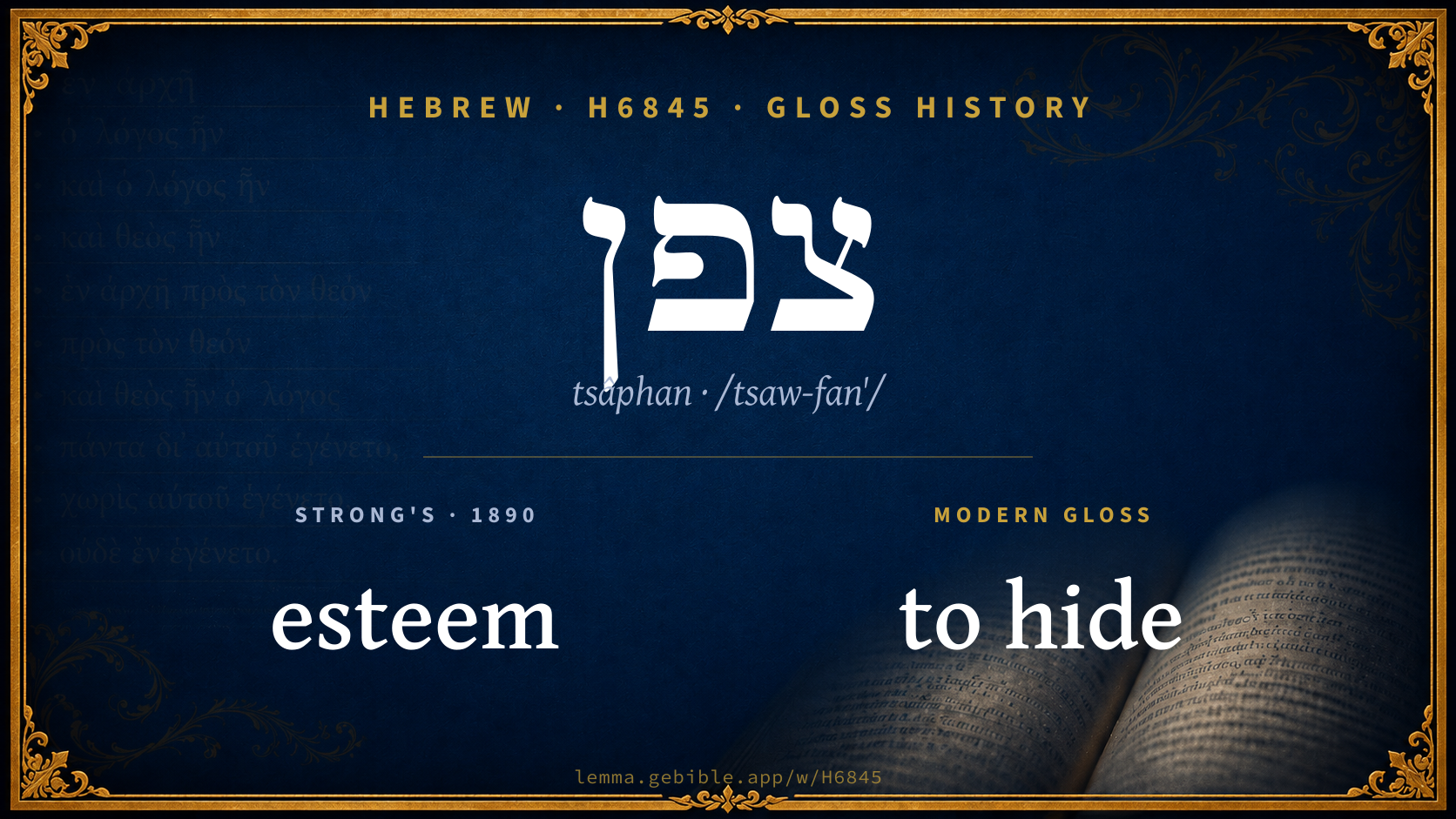
Gloss history
Strong's 1890 vs modern scholarship
About this word
Strong's H6845 catalogs a Hebrew word from the Hebrew Old Testament.
These counts are not copied from any lexicon or concordance. They are computed here, from the morphology-tagged Hebrew Old Testament. What Lemma adds →
- 31
- distinct verses
- The word appears in 31 distinct verses.
- 9 / 39
- OT books
- The word appears in 9 of 39 Old Testament books.
- #1,041
- by frequency
- Top 2500 most frequent Hebrew words (rank 1,041 of 8,640 Hebrew words by occurrence).
View all 31 occurrences in the concordance →
By section of the Old Testament
By traditional corpus
Conventional, traditional groupings — biblical authorship is debated, so this is a traditional corpus grouping, not an authorship claim. Each share is this word’s portion of its verses in that division of the Hebrew canon. Each figure is a share of the word’s 31 distinct verses.
- Writings (Ketuvim) 25 verses · 81%
- Prophets (Nevi'im) 4 verses · 13%
- Torah (Pentateuch) 2 verses · 6%
How translations render this word
Counts come from each version’s own published word-to-Strong’s tagging or interlinear alignment — an approximate guide to how each version renders this word, not a word-level alignment the data otherwise carries. Because each total is that version’s own tagged count, the per-version totals vary from one another and need not match the appearance or distinct-verse counts above. These counts may also differ from a printed concordance because Lemma counts each distinctly tagged rendering and does not collapse phrase taggings into a single head-word total. This is a fixed set of word-tagged versions (KJV, ASV, BSB, ULT) and does not change with the reading translation you choose elsewhere. Each version’s license is shown beside its name below (and on Sources).
- King James Version: Hid 2×, Hide 2×
- American Standard Version: Are laid 1×, Are privily set 1×, Child 1×
- Berean Standard Bible: Are reserved 1×, Concealed 1×, He stores up 1×
- unfoldingWord Literal Text: Is stored up 2×, Store up 2×
King James Version Public Domain
Renders H6845 across 31 tagged occurrences — most commonly:
Plus 27 renderings that appear only once — usually multi-word phrases or single function words the recovered tagging swept in, not distinct renderings. Not rendered by a distinct English word in 2 further occurrences.
American Standard Version Public Domain
Renders H6845 across 30 tagged occurrences — most commonly:
Plus other, less common renderings.
Berean Standard Bible Public Domain
Renders H6845 across 31 tagged occurrences — most commonly:
Plus other, less common renderings.
unfoldingWord Literal Text CC BY-SA 4.0
Renders H6845 across 37 tagged occurrences — most commonly:
Plus 33 renderings that appear only once — usually multi-word phrases or single function words the recovered tagging swept in, not distinct renderings.
Senses in the full BDB
Hebrew verbs can shift meaning by stem (binyan): Qal is the basic action, Niphal is often passive or reflexive, Piel often intensifies or makes it factitive, and Hiphil is typically causative. The senses below are grouped under the stem BDB assigns to each.
What do BDB’s symbols mean?
BDB uses these scholarly abbreviations:
| Symbol | Meaning |
|---|---|
| 𝔊 | the Septuagint (the ancient Greek translation, LXX) |
| 𝔙 | the Vulgate (the Latin translation) |
| 𝔖 | the Syriac version (the Peshitta) |
| 𝔗 | the Targum (the Aramaic translation) |
| ψ | the Psalms |
| √ | root (the underlying root or stem) |
| ‖ | parallel passage (a synonymous or contrasted parallel) |
| † | the dagger: every passage where the word occurs is cited |
The 5 senses and sub-senses the full Brown-Driver-Briggs lexicon distinguishes for this word, in lexicon order (not ranked by frequency), with BDB’s own verbatim wording and sub-sense lettering. Shown in Hebrew script with BDB’s own scholarly abbreviations. The condensed entry is in the Lexicon Entry tab. See also the Forms in the corpus table below.
Qal
- Pf. 3 ms. צ׳ Pr 27:16: 2 ms. צָפַנְתָּ Jb 10:13 +, etc.; Impf. יִצְפֹּן Jb 21:19 + Pr 2:7 Qr (Kt וצפן), sf. יִּצְפְּנֵנִי ψ 27:5, etc.; Pt. act. pl. sf. צֹפְנֶיהָ Pr 27:16; pass. צָפוּן Pr. 13:22 +, ψ 17:14 Kt; f. צְפוּנָה Ho 13:12, etc.;— e.g. Proverbs 27:16
- 1. trans. hide, c. acc. pers. Ex 2:2 (E), Jos 2:4 (JE), of hiding a quarrelsome woman, like hiding wind Pr 27:16(×2) (si vera l.; cf. Toy); of י׳’s hiding his servants (from evil) ψ 27:5; 31:21: = treasure up a thing, Pr 10:14, + אִתְּךָ with thyself, in thine own keeping 2:1 = 7:1, in (ב) the heart Jb 10:13 (subj. י׳; of secret purposes), ψ 119:11, cf. Jb 23:12; + ל pers. Pr 13:22; Ct 7:14, subj. י׳ Jb 21:19 reserve penalty; blessings ψ 31:20; Pr 2:7; + מִן Jb 17:4 thou [God] hast treasured up their heart away from understanding, kept it therefrom; pass., of sin Ho 13:12 (abs.; ‖ צָרוּר); read poss. צָפוּן for צָפוּ Jb 15:22 treasured up for (אֱלֵי) the sword (v. I. צפה); צָפוּן = treasured, cherished place (i.e. Jerusalem) Ez 7:22; = treasure ψ 17:14 Qr (Kt צפינך, v. צפין), Jb 20:26 (on dub. text v. Bu); pl. of י׳’s treasured ones, his saints ψ 83:4. e.g. Exodus 2:2
- 2. intrans. lie hid, lurk, abs. ψ 56:7, c. ל pers. Pr 1:11, 18 and (of eyes of wicked) ψ 10:8. e.g. Psalms 56:7
Niphal
- Pf. 3 ms. נִצְפַּן Je 16:17 be hidden from before (מִנֶּגֶד) י׳’s eyes (‖ נִסְתְּרוּ); 3 pl. נִצְפְּנוּ Jb 24:1 + מִשַּׁי stored up on the part of Shadday; stored up for (ל) one 15:20. e.g. Jeremiah 16:17
Hiphil
- hide, = Qal: Impf. 2 ms. sf. תַּצְפִּנֵנִי Jb 14:13, c. ב loc.; 3 mpl. יצפינו ψ 56:7 Kt (but Qal); Inf. cstr. sf. הַצְּפִינוֹ (Ges§ 20 h) Ex 2:3 to hide him. e.g. Job 14:13
Senses from the full Brown-Driver-Briggs lexicon (Brown, Driver, Briggs; Oxford 1906 — public domain), digitized via Sefaria, supplemented by the OpenScriptures HebrewLexicon (CC BY 4.0). Full attribution on Sources.
Word origin
vb. hide, treasure up (NH id.; TelAm. ṣapânu; set, of sun);—
— Brown-Driver-Briggs (Oxford 1906, public domain), digitized via Sefaria, supplemented by the OpenScriptures HebrewLexicon (CC BY 4.0). See Sources.
Origin: a primitive root
Jastrow Dictionary
A second Hebrew/Aramaic lexicon for comparison, covering Aramaic and post-biblical (Talmudic, Targumic, Midrashic) usage that the biblical-Hebrew BDB does not. Matched by lemma rather than by Strong’s number, so a lemma may carry more than one Jastrow headword (shown separately below), and the entries cover usage well beyond the Bible.
צָפַן
- 1. to look up to, respect, regard, v. סָפַן.
- 2. to provide, store away, reserve, guard; to hide. Deut. R. s. 7 (ref. to Prov. II, 1) אתם צוֹפְנִים … ואני צוֹפֵן וכ׳ you treasure up learning and good deeds with me in this world, and I treasure up for you good reward in the hereafter (ref. to Ps. XXXI, 20); Cant. R. to VII, 14; a. e.—Part. pass. צָפוּן; f. צְפוּנָה; pl. צְפוּנִים, צְפוּנִין; צְפוּנוֹת. Midr. Prov. to ch. II אם זכיתם להַצְפִּין תורתי … מטוב הצ׳ וכ׳ if you do well, guarding my Law (making provision for the study of the Law), I will satisfy you out of the good which is reserved for the hereafter (ref. to Ps. l. c.). Lev. R. s. 2 (ref. to צפנה וכ׳, Lev. I, 11) כנגד מעשיהם … שהם צ׳ לפניו this is typical of the deeds of Abraham …, which are stored up before him (the Lord, for the benefit of their descendants); v. צְפוּנָה. Midr. Prov. l. c. (ref. to יצפן, ib. II, 7) משעה שאדם … צ׳ לו while man is formed in his mother’s womb, (the reward for) the Law which he will study is reserved for him. Succ. 52ᵃ (play on הצפוני, Joel II, 20) זה יצר הרע שצ׳ ועומד בלבו וכ׳ that means the evil inclination that constantly lies in waiting in the heart of man. Gen. R. s. 90; Yalk. ib. 148, v. יָפַע; a. fr. e.g. Proverbs 2:1
- to be reserved, kept. Tanḥ. ed. Bub. Yithro 8 ונ׳ לשלש וכ׳ and he (Moses) was reserved for three months (for the giving of the Law in the third month, Ex. XIX, 1); Yalk. Ex. 271; ib. ונצפון (corr. acc.). e.g. Exodus 19:1
- 1. to guard, provide; to remove, hide. Midr. Prov. l. c., v. supra. Deut. R. s. 1 (play on צפנה, Deut. II, 3) הַצְפִּינוּ עצמיכם ממנו hide yourselves from him; a. e. e.g. Deuteronomy 2:3
- 2. (denom. of צָפוֹן II) to turn north. B. Bath. 25ᵇ יַצְפִּין let him turn towards the north (in prayer).
- 3. (denom. of צָפוֹן I) to brighten, cleanse with soap, v. צָפוֹן I. I.
- 4. (in enigmatic speech) to enlighten. Erub. 53ᵇ הַצְפִּינֵנוּ היכן … צפון ‘unhide’ unto us where R. … is hidden; [Rashi refers to צָפָה, with emphatic נ].
A Dictionary of the Targumim, the Talmud Babli and Yerushalmi, and the Midrashic Literature (Marcus Jastrow; London, Luzac, 1903) — Public Domain. Digitized via Sefaria. Digitized via Sefaria. Full attribution on Sources.
Forms in the corpus
The 31 distinct written forms H6845 takes in the Hebrew Bible, most frequent first — each parse links to that stem’s occurrences in the concordance. Hebrew forms include their vowel points and cantillation, so a single lemma takes many written forms.
Same root — word family
Other BDB entries built from the same root as H6845, grouped by Strong’s listed origin. These share a root / origin per the lexicon — not necessarily a shared meaning. Each links to that word’s own entry.
Derived from this word
Proper names from this root
People and places named from this root — a name, not an additional meaning of the word.
Compare all same-root words → Showing 4 of 5 — not the complete family. 1 of the same-root words is a proper name (a person or place). They share a root, not necessarily a meaning.
Septuagint verse parallels
This word appears in 27 verses that also exist in the Greek Old Testament (Septuagint), out of the 31 Hebrew verses it occurs in. You can read those verses in Greek by switching the Old Testament edition to the Septuagint.
Read these verses in the Septuagint
- Exodus 2:2
- Joshua 2:4
- Job 10:13
- Psalms 17:14
- Proverbs 1:11
- Song of Solomon 7:13
- Jeremiah 16:17
- Ezekiel 7:22
- Hosea 13:12
This is a verse-level parallel only — the same verses exist in both the Hebrew and Greek Old Testaments. No word-level Hebrew↔Greek correspondence is claimed: the data carries no such alignment, so no Greek word is shown as this Hebrew word’s translation. Coverage is not total — the Septuagint omits the deuterocanon and renumbers the Psalms, so some Hebrew verses have no direct Greek parallel.