
Ezekiel 44:4

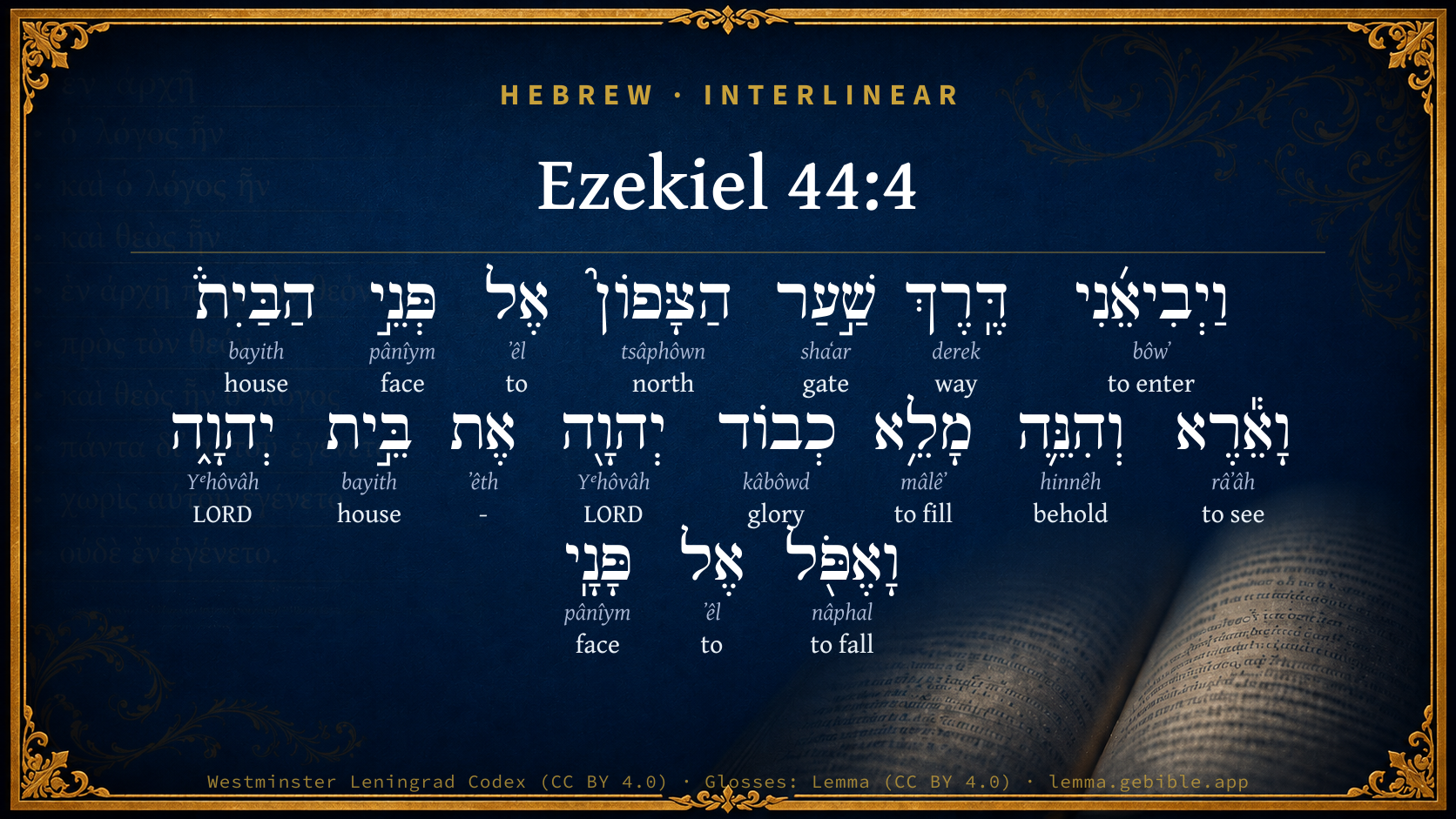
Hebrew (Westminster Leningrad Codex) Ezekiel 44:4 appears in the Hebrew Old Testament. The text above is from the Westminster Leningrad Codex. Each word links to its Strong’s number, a concise gloss, and parsing drawn from the Open Scriptures Hebrew Bible morphology. Click any word for its full Brown-Driver-Briggs (BDB) entry.
Download image
Cite this verse

Ezekiel 44:4 (World English Bible). Public Domain. Lemma interlinear Bible study tool, https://lemma.gebible.app/v/ezekiel/44/4.

Show BibTeX & RIS
BibTeX
RIS
English Translation
Then he brought me by the way of the north gate before the house; and I looked, and, behold, the glory of Yahweh filled the house of Yahweh: and I fell on my face.
World English Bible · Public Domain
Download a study sheet

One document with this verse’s original text, its word-by-word gloss line, the meaning frame, cross-references with their text, attributed commentary, and full source and license credits — printable, and it pastes into notes with its structure intact.

This verse Autodidact and up

Study sheet (.html) Plain text (.txt)

A passage Seminary Student

Up to 50 verses in one chapter. A passage sheet keeps up to 6 commentary sources and 12 cross-references per verse, in the order this page ranks them, and says so on the sheet whenever that leaves anything out. Ask for a single verse and you get the Autodidact verse sheet above.

Everything on this page stays free to read, with no account — the sheet is a download of what is already on screen, not access to it.

Want to remove ads? Support Godless Engineer
Compare translations 3

The same verse in 3 English versions, stacked beneath the original-language interlinear above. Click any original word for its lexicon entry.

Each is an independent rendering of the whole verse — the interlinear is not word-aligned to these translations.

Highlighted words mark where these versions differ — a whole-verse word diff, not a word-by-word alignment.

  • World English Bible Public Domain
    Then he brought me by the way of the north gate before the house; and I looked, and, behold, the glory of Yahweh filled the house of Yahweh: and I fell on my face.
  • King James Version Public Domain
    Then brought he me the way of the north gate before the house: and I looked, and, behold, the glory of the LORD filled the house of the LORD: and I fell upon my face.
  • unfoldingWord Literal Text CC BY-SA 4.0
    Then he brought me by way of the northern gate to the front of the temple, and I looked, and behold, the glory of Yahweh filled the house of Yahweh, and I fell to my face.

unfoldingWord Literal Text — © unfoldingWord, licensed CC BY-SA 4.0. Word-aligned USFM3 via Door43 (git.door43.org/unfoldingWord/en_ult).

Versions to compare (up to 4)

3 of 4 selected

Show all 18 translations

Every available English version of this verse, each an independent rendering of the whole verse.

  • World English Bible Public Domain
    Then he brought me by the way of the north gate before the house; and I looked, and, behold, the glory of Yahweh filled the house of Yahweh: and I fell on my face.
  • Berean Standard Bible Public Domain
    Then the man brought me to the front of the temple by way of the north gate. I looked and saw the glory of the LORD filling His temple, and I fell facedown.
  • Majority Standard Bible Public Domain
    Then the man brought me to the front of the temple by way of the north gate. I looked and saw the glory of the LORD filling His temple, and I fell facedown.
  • King James Version Public Domain
    Then brought he me the way of the north gate before the house: and I looked, and, behold, the glory of the LORD filled the house of the LORD: and I fell upon my face.
  • American Standard Version (1901) Public Domain
    Then he brought me by the way of the north gate before the house; and I looked, and, behold, the glory of Jehovah filled the house of Jehovah: and I fell upon my face.
  • Revised Version (1885) Public Domain
    Then he brought me the way of the north gate before the house; and I looked, and behold, the glory of the LORD filled the house of the LORD: and I fell upon my face.
  • Geneva Bible (1599) Public Domain
    Then brought he mee toward the North gate before the House: and when I looked, beholde, the glorie of the Lord filled the house of the Lord, and I fell vpon my face.
  • Douay-Rheims (1899) Public Domain
    And he brought me by the way of the north gate, in the sight of the house: and I saw, and behold the glory of the Lord filled the house of the Lord: and I fell on my face.
  • Young's Literal Translation Public Domain
    And he bringeth me in the way of the north gate unto the front of the house, and I look, and lo, filled hath the honour of Jehovah the house of Jehovah, and I fall on my face.
  • Literal Standard Version CC BY-SA 4.0
    And he brings me in the way of the north gate to the front of the house, and I look, and behold, the glory of YHWH has filled the house of YHWH, and I fall on my face.
  • Unlocked Literal Bible CC BY-SA 4.0
    Then he brought me by way of the northern gate to the front of the temple, and I looked, and behold, the glory of Yahweh filled the house of Yahweh, and I fell on my face.
  • unfoldingWord Literal Text CC BY-SA 4.0
    Then he brought me by way of the northern gate to the front of the temple, and I looked, and behold, the glory of Yahweh filled the house of Yahweh, and I fell to my face.
  • Darby Bible Public Domain
    And he brought me the way of the north gate before the house; and I beheld, and lo, the glory of Jehovah filled the house of Jehovah: and I fell upon my face.
  • World Messianic Bible Public Domain
    Then he brought me by the way of the north gate before the house; and I looked, and behold, the LORD’s glory filled the LORD’s house; so I fell on my face.
  • Webster's Bible Public Domain
    Then he brought me the way of the north gate before the house: and I looked, and behold, the glory of the LORD filled the house of the LORD: and I fell upon my face.
  • Free Bible Version CC BY-SA 4.0
    The man took me to the front of the Temple through the north gate. As I looked, I saw the glory of the Lord filling his Temple, and I fell with my face to the ground.
  • Bible in Basic English Public Domain
    And he took me to the north doorway in front of the house; and, looking, I saw that the house of the Lord was full of the glory of the Lord; and I went down on my face.
  • JPS Tanakh (1917) Public Domain
    Then he brought me the way of the north gate before the house; and I looked, and, behold, the glory of the LORD filled the house of the LORD; and I fell upon my face.

Literal Standard Version (2020), Covenant Press — licensed CC BY-SA 4.0. Text via the HelloAO Bible API (eBible.org). Unlocked Literal Bible (unfoldingWord) — licensed CC BY-SA 4.0. Text via the HelloAO Bible API (eBible.org). unfoldingWord Literal Text — © unfoldingWord, licensed CC BY-SA 4.0. Word-aligned USFM3 via Door43 (git.door43.org/unfoldingWord/en_ult). Free Bible Version, Dr. Jonathan Gallagher — licensed CC BY-SA 4.0. Text via the HelloAO Bible API (eBible.org).

Word by word

More ways to search: Search by grammar → Find every occurrence → Compare this word →

Practice this passage: Drill this verse → Learn its vocabulary →

הַצָּפוֹן֮
tsâphôwn
H6828
“the · north”
Particle, Definite Article + Noun, Common, Feminine, Singular, Absolute
Part of Speech
Particle + Noun
Type
Common
Gender
Feminine
Number
Singular
State
Absolute
Full BDB Definition

Origin: from H6845

TWOT: 1953b

north (of direction), northward - north - northward
  1. וַיְבִיאֵ֜נִי bôwʼ H935 “and · to enter · me” Conjunction + Verb, Hiphil, Sequential Imperfect, 3rd Person, Masculine, Singular + Suffix, Personal, 1st Person, Common, Singular
  2. דֶּֽרֶךְ derek H1870 “way of” Noun, Common, Both, Singular, Construct
  3. שַׁ֣עַר shaʻar H8179 “gate of” Noun, Common, Masculine, Singular, Construct
  4. אֶל ʼêl H413 “to” Preposition
  5. פְּנֵ֣י pânîym H6440 “face(s) of” Noun, Common, Both, Plural, Construct
  6. הַבַּיִת֒ bayith H1004 “the · house” Particle, Definite Article + Noun, Common, Masculine, Singular, Absolute
  7. וָאֵ֕רֶא râʼâh H7200 “and · to see” Conjunction + Verb, Qal, Sequential Imperfect, 1st Person, Common, Singular
  8. וְהִנֵּ֛ה hinnêh H2009 “and · behold” Conjunction + Particle, Demonstrative
  9. מָלֵ֥א mâlêʼ H4390 “to fill” Verb, Qal, Perfect, 3rd Person, Masculine, Singular
  10. כְבוֹד kâbôwd H3519 “glory of” Noun, Common, Both, Singular, Construct
  11. יְהוָ֖ה Yᵉhôvâh H3068 “LORD” Noun, Proper
  12. אֶת ʼêth H853 “-” Particle, Direct Object
  13. בֵּ֣ית bayith H1004 “house of” Noun, Common, Masculine, Singular, Construct
  14. יְהוָ֑ה Yᵉhôvâh H3068 “LORD” Noun, Proper
  15. וָאֶפֹּ֖ל nâphal H5307 “and · to fall” Conjunction + Verb, Qal, Sequential Imperfect, 1st Person, Common, Singular
  16. אֶל ʼêl H413 “to” Preposition
  17. פָּנָֽי pânîym H6440 “face(s) · my” Noun, Common, Both, Plural, Construct + Suffix, Personal, 1st Person, Common, Singular

About this verse

These counts appear in no published source. They are computed here, from the morphology-tagged text and Lemma’s own curated glosses. What Lemma adds →

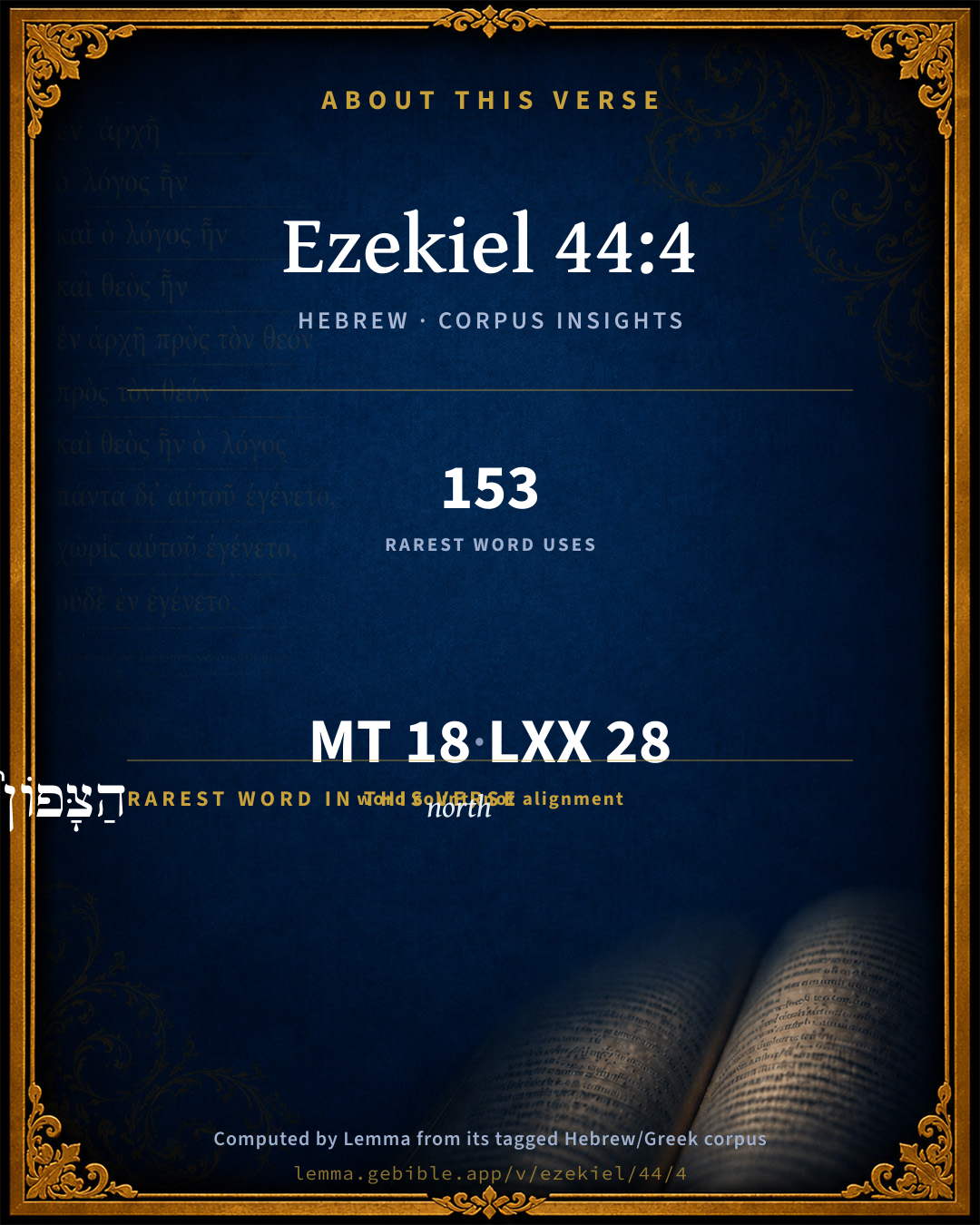
18
words
14
distinct lemmas
Prophets
section

Grammatical profile

  • 4 verbs
  • 10 nouns
  • 2 prepositions
  • 2 particles

Verb forms

  • וַיְבִיאֵ֜נִי Hiphil · Sequential Imperfect
  • וָאֵ֕רֶא Qal · Sequential Imperfect
  • מָלֵ֥א Qal · Perfect
  • וָאֶפֹּ֖ל Qal · Sequential Imperfect

Repetition

Words recur within this verse — often emphatic in Hebrew:

  • פְּנֵ֣י face H6440 ×2
  • הַבַּיִת֒ house H1004 ×2
  • יְהוָ֖ה LORD H3068 ×2
  • אֶל to H413 ×2

Hebrew & Septuagint length

In English translation the verse runs 34 words from the Hebrew and 40 from the Septuagint (LXX English) — closely comparable.

A rough comparison of the two English renderings, which tokenize alike — not a word-level alignment.

Word counts can differ between the Hebrew and the Greek without any difference in meaning — e.g. the Hebrew direct-object marker אֵת has no separate Greek word, and Greek often adds the article ὁ.

In the original languages it is 18 Hebrew tokens and 28 Greek tokens — but the two are counted differently (Hebrew bundles its prefixes and suffixes into one token; the Greek is in lemma form), so that isn’t a like-for-like length.

Cross-references

15

Topical passages linked to Ezekiel 44:4 in the Treasury of Scripture Knowledge — connected by theme and wording, ordered by reader-vote popularity; previews shown in the World English Bible.

  • Ezekiel 1:28 As the appearance of the bow that is in the cloud in the day of rain, so was the appearance of the brightness round about. This was the appearance of the likeness of the glory of Yahweh. When I saw it, I fell on my face, and I heard a voice of one that spoke.
  • Ezekiel 3:23 Then I arose, and went forth into the plain: and, behold, the glory of Yahweh stood there, as the glory which I saw by the river Chebar; and I fell on my face.
  • Revelation 1:17 When I saw him, I fell at his feet like a dead man. He laid his right hand on me, saying, "Don't be afraid. I am the first and the last,
  • Ezekiel 40:20 The gate of the outer court whose prospect is toward the north, he measured the length of it and the breadth of it.
  • Ezekiel 43:3–5 It was according to the appearance of the vision which I saw, even according to the vision that I saw when I came to destroy the city; and the visions were like the vision that I saw by the river Chebar; and I fell on my face.
  • Isaiah 6:3–4 One called to another, and said, "Holy, holy, holy, is Yahweh of Hosts! The whole earth is full of his glory!"
  • Ezekiel 40:40 On the [one] side outside, as one goes up to the entry of the gate toward the north, were two tables; and on the other side, which belonged to the porch of the gate, were two tables.
  • Haggai 2:7 and I will shake all nations. The precious things of all nations will come, and I will fill this house with glory, says Yahweh of Hosts.
  • Genesis 17:3 Abram fell on his face. God talked with him, saying,
  • Numbers 16:42–45 It happened, when the congregation was assembled against Moses and against Aaron, that they looked toward the tent of meeting: and, behold, the cloud covered it, and the glory of Yahweh appeared.
  • Psalms 89:7 A very awesome God in the council of the holy ones, To be feared above all those who are around him?
  • Ezekiel 10:4 The glory of Yahweh mounted up from the cherub, [and stood] over the threshold of the house; and the house was filled with the cloud, and the court was full of the brightness of Yahweh's glory.
  • Ezekiel 10:18–19 The glory of Yahweh went forth from over the threshold of the house, and stood over the cherubim.
  • Ezekiel 11:22–23 Then did the cherubim lift up their wings, and the wheels were beside them; and the glory of the God of Israel was over them above.
  • Malachi 3:1 "Behold, I send my messenger, and he will prepare the way before me; and the Lord, whom you seek, will suddenly come to his temple; and the messenger of the covenant, whom you desire, behold, he comes!" says Yahweh of hosts.

Cross-references courtesy of OpenBible.info (CC BY 4.0).

Hebrew and Greek witnesses Masoretic Hebrew ↔ Greek Septuagint

The same verse in the two great witnesses to the Old Testament, shown verse-for-verse.

These are two independent witnesses, not word-aligned to each other, and the Septuagint is shown in lemma (dictionary) form.

Hebrew Ezekiel 44:4 Masoretic · Westminster Leningrad Codex

וַיְבִיאֵ֜נִי דֶּֽרֶךְ שַׁ֣עַר הַצָּפוֹן֮ אֶל פְּנֵ֣י הַבַּיִת֒ וָאֵ֕רֶא וְהִנֵּ֛ה מָלֵ֥א כְבוֹד יְהוָ֖ה אֶת בֵּ֣ית יְהוָ֑ה וָאֶפֹּ֖ל אֶל פָּנָֽי

Then he brought me by the way of the north gate before the house; and I looked, and, behold, the glory of Yahweh filled the house of Yahweh: and I fell on my face.

World English Bible · Public Domain

Greek LXX Ezekiel 44:4 Septuagint · lemma form

καί εἰςἄγω ἐγώ κατά ὁ ὁδός ὁ πύλη ὁ πρός βορέας κατέναντι ὁ οἶκος καί ὁράω καί ἰδού πλήρης δόξα ὁ οἶκος κύριος καί πίπτω ἐπί πρόσωπον ἐγώ

And he brought me in by the way of the gate that looks northward, in front of the house: and I looked, and, behold, the house was full of the glory of the Lord: and I fell upon my face.

LXX2012 (modern English Septuagint) · Public Domain

On this verse, Keil & Delitzsch discusses the Septuagint’s reading. Read the note in Commentary ↓

Hebrew: Westminster Leningrad Codex (CC BY 4.0). Greek: Septuagint (public domain); English from LXX2012 (modern English Septuagint) (Public Domain). How the Septuagint differs from the Hebrew →

Targum (Aramaic paraphrase)

1

The Targum is the ancient Jewish Aramaic paraphrase of the Hebrew Scriptures — an interpretive translation, not the Hebrew text itself. Onkelos (literal) and Pseudo-Jonathan (expansive) render the Torah, and Jonathan the Prophets. Coverage is partial: where no permissively-licensed English translation exists for a verse, only the Aramaic is shown. This is verse-level text, not a word-by-word alignment to the Hebrew.

  1. Targum Jonathan Prophets (Joshua–Malachi)
    וְאָעֲלַנִי אוֹרַח תְּרַע צִפּוּנָא דִקֳדָם בֵּיתָא וַחֲזֵית וְהָא אִתְמְלֵי יְקָרָא דַייָ יַת בֵּית מַקְדְשָׁא דַייָ וְאִשְׁתַּטְחֵית עַל אַפָּי:

    (no public-domain English translation for this verse)

    Targum Jonathan — Aramaic: “Mikraot Gedolot” (public domain). English: “Sefaria Community Translation” (CC0 1.0 (public-domain dedication)); “London "Chaldee Paraphrase," 1871” (public domain). Text via Sefaria.

Commentary

Notes on Ezekiel 44:4 from classic Christian and Jewish commentators (each source and its license shown beneath its notes). The classic Christian expositions comment on the surrounding passage and are grouped to its opening verse, so a note may address several verses; the Jewish commentaries on the Tanakh (Rashi and others) are per-verse, so they appear only where the commentator wrote on this verse.

Lemma curates 59 commentaries, every one of them public domain or Creative Commons licensed, each selected and text-cleaned for this edition rather than reprinted as found. About our sources →

Matthew Henry's Commentary

This is much to the same purport with what we had in the beginning of ch. 43. As the prophet must look again upon what he had before seen, so he must be told again what he had before heard. Here, as before, he sees the house filled with the glory of the Lord, which strikes an awe upon him, so that he falls prostrate at the sight, the humblest posture of adoration and the expression of a holy awe: I fell upon my face, Eze 44:4. Note, The more we see of the glory of God the more low we shall lie in our own eyes. Now here,

I. God charges the prophet to take a very particular notice of all he saw, and all that was said to him (Eze 44:5): "Behold with thy eyes what is shown thee, particularly the entering in of the house and every going forth of it, all the inlets and all the outlets of the sanctuary;" those he must take special notice of. Note, In acquainting ourselves with divine things we must not aim so much at an abstract speculation of the things themselves as at finding the plain appointed way of converse and communion with those things, that we may go in and out and find pasture. 2. Hear with thy ears all that I say unto thee about the laws and ordinances of the house, which he was to instruct the people in. Note, Those who are appointed to be teachers have need to be very diligent careful learners, that they may neither forget any of the things they are entrusted with nor mistake concerning them.

II. He sends him upon an errand to the people, to the rebellious, even to the house of Israel, Eze 44:6. It is sad to think that the house of Israel should deserve this character from him who perfectly knew them, that a people in covenant with God should be rebellious against him. Who are his subjects if the house of Israel be rebels? But it is an instance of God's rich mercy that, though they had been rebellious, yet, being the house of Israel, he does not cast them off, but sends an ambassador to them, to invite and encourage them to return to their allegiance, which he would not have done if he had been pleased to kill them. The whole race of mankind has fallen under the character here given of the house of Israel; but our Lord Jesus, when he ascended on high, received gifts for men, yea, even for the rebellious also, that, as here, the Lord God might dwell among them, Psa 68:18.

1. He must tell them of their faults, must show them their rebellions, must show the house of Jacob their sins. Note, Those that are sent to comfort God's people must first convince them, and so prepare them for comfort. Let it suffice you of all your abominations, Eze 44:6. Note, It is time for those that have continued long in sin to reckon it long enough, and too long, and to begin to think of taking up in time, and leaving off their evil courses. "Let the time past of your lives suffice, for by this time, surely, you have surfeited upon your abominations and have become sick of them," Pe1 4:3. That which is here charged upon them is, (1.) That they had admitted those to the privileges of the sanctuary that were not entitled to them; whereas God had said, The stranger that comes nigh shall be put to death, they had not only connived at the intrusion of strangers into the sanctuary, but had themselves introduced them (Eze 44:7): You brought in strangers uncircumcised in flesh, and therefore under a legal incapacity to enter into the sanctuary, which was a breaking of the covenant of circumcision, throwing down the hedge of their peculiarity, and laying themselves in common with the rest of the world. Yet if these strangers had been devout and good, though they were not circumcised, the crime would not have been so great; but they were uncircumcised in heart too, unhumbled, unreformed, and strangers indeed to God and all goodness. When they came to offer sacrifice they brought these with them to feast with them upon the sacrifice, because they were fond of their company, and this was one of their abominations, wherewith they polluted God's sanctuary; it was giving that which was holy unto dogs, Mat 7:6. Note, The admission of those who are openly wicked and profane to special ordinances is a polluting of God's sanctuary and a great provocation to him. (2.) That they had employed those in the service of the sanctuary who were not fit for it. Though none but priests and Levites were to minister in the sanctuary, yet we may suppose that all who were priests and Levites did not immediately attend there, but chosen men of them, who were best qualified, who were most wise, serious, and conscientious, and most likely to keep the charge of the holy things carefully; but, in making this choice, they had not regard to merit and qualification for the work: "You have set keepers of my charge in my sanctuary for yourselves, such as you had some favour or affection for, such as you either had got, or hoped to get, money by, or such as would comply with your humours and would dispense with the laws of the sanctuary to please you; thus you have not kept the charge of my holy things." Note, Those who have the choice of the keepers of the holy things, if, to serve some secular selfish purpose, they choose such as are unfit and unfaithful, will justly have it laid at their door, that they have betrayed the holy things by lodging them in bad hands.

2. He must tell them their duty (Eze 44:9): "No stranger shall enter into my sanctuary till he has first submitted to the laws of it." But, lest any should think that this excluded the penitent believing Gentiles from the church, the stranger here is described to be one that is uncircumcised in heart, not in sincerity consenting to the covenant, nor putting away the filth of the flesh; whereas the believing Gentiles were circumcised with the circumcision made without hands, Col 2:11. This circumcision of the heart, in the spirit, not in the letter, was what the unbelieving Jews were strangers to and unconcerned about, while yet they were zealous to keep out of the sanctuary uncircumcised Gentiles, witness their rage against Paul when they did but suspect him to have brought Greeks into the temple, Act 21:28.

Matthew Henry's Commentary on the Whole Bible (1708–1710) — public domain (CC PDM 1.0). Text via the HelloAO Bible API.

Trapp's Complete Commentary

John Trapp

Eze 44:4 Then brought he me the way of the north gate before the house: and I looked, and, behold, the glory of the LORD filled the house of the LORD: and I fell upon my face.

Ver. 4. Then brought he me.] See on Eze 44:1.

The glory of the Lord.] See Eze 43:2; Eze 43:5.

And fell upon my face.] See Eze 43:3; Eze 1:28.

John Trapp, A Commentary or Exposition upon All the Books of the Old and New Testament (1647–1656) — public domain. Text from a community e-Sword module.

Albert Barnes' Notes on the Bible

Admonition to the ministering priests, grounded upon former neglect.

Eze 44:4

The north gate before the house - The north gate of the inner court. God expostulates with His people in the seat of their former idolatries Eze 8:3.

Eze 44:5

Mark well - The careful arrangements made had all been intended to keep the temple and its surroundings from profanation. Hence, attention to these particulars is enjoined.

Eze 44:7

Strangers - This refers especially to the sin of unauthorized and unfaithful priests ministering in the services of the temple. Compare marginal references.

Eze 44:8

Mine holy things - The altar, its sacrifices, the sacred utensils, and the like.

For yourselves - According to your own pleasure, not My ordinances Num 16:40.

Eze 44:10

The Levites as a body had remained true to the temple-service at Jerusalem 2Ch 11:13; but individuals among them deserted to Israel probably from the first (see the marginal references), as in later years some went over to the worship of the Samaritans on Mount Gerizim. These apostate Levites “shall bear their iniquities,” they shall not be restored to their former rank and privileges.

Eze 44:11

Ministers - As, according to the new system, the Levites, as a body, were to receive their portion in the “oblation” Eze 45:5; the only manner in which the Levites of Eze 44:10 could live at all, was as part of the whole body, to which they were therefore reunited, but in the lowest grade. It is remarkable that the number of Levites who returned after the captivity was very small, not exceeding 400, of whom only 74 were priests’ assistants (Ezr 2:40-42; compare Ezr 8:15-19). The gap in their number was filled up by 220 Nethinim (“given” ones), probably originally strangers and captives, who, although employed in the temple services, were held by the Jews in the lowest repute.

Eze 44:12

Lifted up mine hand - i. e., “The Lord sware” Eze 20:5, that they should bear their iniquities.

Albert Barnes' Notes on the Bible (1834–1885) — public domain. Text from a community e-Sword/MySword module.

Joseph Benson's Commentary

Eze 44:4-8. Then he brought me by the way of the north gate of the house — The east gate being shut. And, behold, the glory of the Lord filled the house of the Lord — As appeared by the light which shone through the windows, for there was no door into the sanctuary on that side. And the Lord said, Son of man, mark well, &c. — See notes on Eze 40:4; and Eze 43:2. Mark well the entering, &c., with every going forth of the sanctuary — The word laws is to be understood in this last sentence, the sense being, that the prophet should admonish the people of the laws relating to the admitting certain persons into the temple, or the courts of it, and to suffer none that were unqualified to attend upon God’s service there. This appears to be the sense from the following verses. And thou shalt say, Let it suffice you of all your abominations — Let the time past be sufficient for you to have provoked me with your abominations. In that ye have brought into my sanctuary strangers, &c. — In that ye have set up idols within the precincts of my temple, and have appointed idolatrous priests to officiate there. When ye offer my bread, the fat, and the blood — At the very time when ye were offering my sacrifices upon the altar. Or the words may imply, that they suffered heathen to offer at God’s altar, expressly contrary to the law, Lev 22:27. By bread may be understood the meat-offerings made of flour, which accompanied the other sacrifices, although every thing offered upon the altar is properly called the bread of God. The fat and blood of every sacrifice were peculiarly appropriated to God. And they have broken my covenant — Idolatry was a direct breach of that covenant into which God had entered with the Jews: upon which account it is so often represented under the metaphor of adultery. And ye have not kept the charge of my holy things — You have not observed the laws I gave you for taking care of the things relating to my house and worship, but have appointed such persons to officiate there as best suited with your own inclinations.

Joseph Benson's Commentary on the Old and New Testaments (1811–1818) — public domain. Text from a community e-Sword module.

Dummelow's Commentary on the Holy Bible

J. R. Dummelow

The Priests and the Levites

Standing at the inner northern gate Ezekiel again saw the glory of God filling the Temple and was again addressed by the divine voice (Eze_44:4-5). The Speaker first rebuked the custom which had prevailed in the old Temple, of having foreigners as servants in the sanctuary (Eze_44:6-8). He directed that in future their place should be taken by the Lévites who were not of the family of Zadok. These had formerly shared the priestly office, but for their encouragement of Israel's idolatry they were to be deprived of this privilege, and to have humbler services assigned to them (Eze_44:9-14). The Levites of the family of Zadok alone were to exercise the priesthood in future (Eze_44:15-16). No mention is made of the high priest. Various regulations follow as to the priests, clothing, marriage, public duties, defilement and purification, and sacrificial perquisites (Eze_44:17-31). This passage has an important bearing on the date of certain parts of the Pentateuch (see Intro.).

7. Strangers] In 2 Kings 11 we have an instance of foreign mercenaries ('Carites', 2Ki_11:4, RV) being employed as guards in the Temple. The Nethinim (Ezr_8:20) were apparently captives employed as Temple slaves: see Zec_14:21.

They] RM 'ye', Because of] RV 'to add unto',

10. Are gone away] RV 'went'. The reference is to the worship at the high places, abolished by Josiah (2Ki_23:8-9).

15. Zadok] made priest by Solomon when Abiathar was, deposed (1Ki_2:26-27, 1Ki_2:35).

17, 18. Cp. Exo_28:39-42; Exo_39:27-29; Lev_16:4.

19. The holy chambers] those described in Ezekiel 42 : see Eze_42:13, Eze_42:14.

20. Cp. Lev_21:5.

21. Cp. Lev_10:9.

22. Cp. Lev_21:14.

23. Cp. Lev_10:10.

24. Cp. Deu_17:8-13; Deu_19:17; Deu_21:5, where the priests are associated with secular judges.

25. Cp. Lev_21:1-3;

26. Cp. Num_19:11.

28. Cp. Num_18:20.

29. Meat offering] cp. Lev_2:3; Lev_7:9-11. Sin.. and.. trespass offering] cp. Lev_6:18; Lev_7:6-7; Num_18:9, Num_18:10. Dedicated] RV 'devoted': cp. Lev_27:28; Num_18:14.

30. The firstfruits] Cp. Exo_23:19; Exo_34:26; Num_18:13; Deu_18:4.

Oblation] RM 'heave offering': cp. Num_15:19-21; Num_18:19.

31. Cp. Exo_22:31; Lev_22:8.

J. R. Dummelow, A Commentary on the Holy Bible (Macmillan, 1909) — public domain. Text from a community e-Sword module.

Keil & Delitzsch

C. F. Keil & F. Delitzsch

The Position of Foreigners, Levites, and Priests in Relation to the Temple and the Temple Service. - The further precepts concerning the approach to the sanctuary, and the worship to be presented there, are introduced with a fresh exhortation to observe with exactness all the statutes and laws, in order that the desecration of the sanctuary which had formerly taken place might not be repeated, and are delivered to the prophet at the north gate in front of the manifestation of the glory of God (Eze 44:4-8). - Eze 44:4. And he brought me by the way of the north gate to the front of the house; and I looked, and behold the glory of Jehovah filled the house of Jehovah, and I fell down upon my face. Eze 44:5. And Jehovah said to me, Son of man, direct thy heart and see with thine eyes and hear with thine ears all that I say to thee with regard to all the statutes of the house of Jehovah and all its laws, and direct thy heart to the entering into the house through all the exits of the house, Eze 44:6. And say to the rebellious one, to the family of Israel, Thus saith the Lord Jehovah, Let it be sufficient for you, of all your abominations, O house of Israel, Eze 44:7. In that ye brought in foreigners, uncircumcised in heart and uncircumcised in flesh, to be in my sanctuary, to desecrate it, my house, when ye offered my food, fat and blood, and so they broke my covenant to all your abominations, Eze 44:8. And so ye did not keep the charge of my holy things, but made them keepers of my charge for you in my sanctuary. - From the outer gate to which Ezekiel had been taken, simply that he might be instructed concerning the entering thereby, he is once more conducted, after this has been done, by the way of the north gate to the front of the temple house, to receive the further directions there for the performance of the worship of God in the new sanctuary. The question, whether we are to understand by the north gate that of the outer or that of the inner court, cannot be answered with certainty. Hitzig has decided in favour of the latter, Kliefoth in favour of the former. The place to which he is conducted is אל־פּני הבּית, ad faciem domus, before the temple house, so that he had it before his eyes, i.e., was able to see it. As the gateway of the inner court was eight steps, about four cubits, higher than the outer court gate, this was hardly possible if he stood at or within the latter. הבּית, i.e., the temple house, could only be distinctly seen from the inner north gate. And the remark that it is more natural to think of the outer north gate, because the next thing said to the prophet has reference to the question who is to go into and out of the sanctuary, has not much force, as the instructions do not refer to the going in and out alone, but chiefly to the charge of Jehovah, i.e., to the maintenance of divine worship.

At the fresh standing-place the glory of the Lord, which filled the temple, met the sight of the prophet again, so that he fell down and worshipped once more (cf. Eze 43:3, Eze 43:5). This remark is not intended "to indicate that now, after the preliminary observations in Ezekiel 43:13-44:3, the true thorah commences" (Kliefoth), but to show the unapproachable glory and holiness of the new temple. For Eze 44:5, see Eze 40:4; Eze 43:11-12. In Eze 44:6 אל־מרי is placed at the head in a substantive form for the sake of emphasis, and בּית־ישׂראל is appended in the form of an apposition. For the fact itself, see Eze 2:8. רב־לּכם followed by מן, a sufficiency of anything, as in Exo 9:28; Kg1 12:28, is equivalent to "there is enough for you to desist from it." The תּועבות, from which they are to desist, are more precisely defined in Eze 44:6. They consisted in the fact that the Israelites admitted foreigners, heathen, uncircumcised in heart and flesh, into the sanctuary, to desecrate it during the offering of sacrifice. It is not expressly stated, indeed, that they admitted uncircumcised heathen to the offering of sacrifice, but this is implied in what is affirmed. The offering of sacrifice in the temple of Jehovah is not only permitted in the Mosaic law to foreigners living in Israel, but to some extent prescribed (Lev 17:10,Lev 17:12; Num 15:13.). It was only in the paschal meal that no 'בן was allowed to participate (Exo 12:43). To do this, he must first of all be circumcised (v. 44). Solomon accordingly prays to the Lord in his temple-prayer that He will also hearken to the prayer of the foreigner, who may come from a distant land for the Lord's name sake to worship in His house (Kg1 8:41.). The reproof in the verse before us is apparently at variance with this. Raschi would therefore understand by בּני־נכר, Israelites who had fallen into heathen idolatry. Rosenmller, on the other hand, is of opinion that the Israelites were blamed because they had accepted victimas et libamina from the heathen, and offered them in the temple, which had been prohibited in Lev 25:22. Hvernick understands by the sons of the foreigner, Levites who had become apostates from Jehovah, and were therefore placed by Ezekiel on a par with the idolatrous sons of the foreigner. And lastly, Hitzig imagines that they were foreign traders, who had been admitted within the sacred precincts as sellers of sacrificial animals, incense, and so forth. All these are alike arbitrary and erroneous. The apparent discrepancy vanishes, if we consider the more precise definition of בּני , viz., "uncircumcised in heart and flesh." Their being uncircumcised in heart is placed first, for the purpose of characterizing the foreigners as godless heathen, who ere destitute not only of the uncircumcision of their flesh, but also of that of the heart, i.e., of piety of heart, which Solomon mentions in his prayer as the motive for the coming of distant strangers to the temple. By the admission of such foreigners as these, who had no fear of God at all, into the temple during the sacrificial worship, Israel had defiled the sanctuary. את־בּיתי is in apposition to the suffix to חלּלו. The food of Jehovah (לחמי) is sacrifice, according to Lev 3:11; Lev 21:6, etc., and is therefore explained by "fat and blood." ויּפרוּ, which the lxx changed in an arbitrary manner into the second person, refers to the "foreigners," the heathen. By their treading the temple in their ungodliness they broke the covenant of the Lord with His people, who allowed this desecration of His sanctuary. אל כּל־תּועבות, in addition to all your abominations. How grievous a sin was involved in this is stated in Eze 44:8. The people of Israel, by their unrighteous admission of godless heathen into the temple, not only failed to show the proper reverence for the holy things of the Lord, but even made these heathen, so to speak, servants of God for themselves in His sanctuary. These last words are not to be understood literally, but spiritually. Allowing them to tread the temple is regarded as equivalent to appointing them to take charge of the worship in the temple. For שׁמר , see Lev 18:30; Lev 22:9, and the commentary on Lev 8:35.

The Lord would guard against such desecration of His sanctuary in the future. To this end the following precepts concerning the worship in the new temple are given. - Eze 44:9. Thus saith the Lord Jehovah, No foreigner, uncircumcised in heart and uncircumcised in flesh, shall come into my sanctuary, of all the foreigners that are in the midst of the sons of Israel; Eze 44:10. But even the Levites, who have gone away from me in the wandering of Israel, which wandered away from me after its idols, they shall bear their guilt. Eze 44:11. They shall be servants in my sanctuary, as guards at the gates of the house and serving in the house; they shall slay the burnt-offering and the slain-offering for the people, and shall stand before it to serve them. Eze 44:12. Because they served them before their idols, and became to the house of Israel a stumbling-block to guilt, therefore I have lifted my hand against them, is the saying of the Lord Jehovah, that they should bear their guilt. Eze 44:13. They shall not draw near to me to serve me as priests, and to draw near to all my holy things, to the most holy, but shall bear their disgrace and all their abominations which they have done. Eze 44:14. And so will I make them guards of the charge of the house with regard to all its service, and to all that is performed therein. Eze 44:15. But the priests of the tribe of Levi, the sons of Zadok, who have kept the charge of my sanctuary on the wandering of the sons of Israel from me, they shall draw near to me to serve me, and stand before me, offer to me fat and blood, is the saying of the Lord Jehovah. Eze 44:16. They shall come into my sanctuary, and they draw near to my table to serve me, and shall keep my charge. - In order that all desecration may be kept at a distance from the new sanctuary, foreigners uncircumcised in heart and flesh are not to be admitted into it; and even of the Levites appointed for the service of the sanctuary according to the Mosaic law, all who took part in the falling away of the people into idolatry are to be excluded from investiture with the priests' office as a punishment for their departure from the Lord, and only to be allowed to perform subordinate duties in connection with the worship of God. On the other hand, the descendants of Zadok, who kept themselves free from all straying into idolatry, are to perform the specifically priestly service at the altar and in the sanctuary, and they alone. The meaning and design of the command, to shut out the foreigners uncircumcised in heart from all access to the sanctuary, are not that the intermediate position and class of foreigners living in Israel should henceforth be abolished (Kliefoth); for this would be at variance with Eze 47:22 and Eze 47:23, according to which the foreigners (גּרים) were to receive a possession of their own in the fresh distribution of the land, which not only presupposes their continuance within the congregation of Israel, but also secures it for the time to come. The meaning is rather this: No heathen uncircumcised in heart, i.e., estranged in life from God, shall have access to the altar in the new sanctuary. The emphasis of the prohibition lies here, as in Eze 44:7, upon their being uncircumcised in heart; and the reason for the exclusion of foreigners consists not so much in the foreskin of the flesh as in the spiritual foreskin, so that not only the uncircumcised heathen, but also Israelites who were circumcised in flesh, were to keep at a distance from the sanctuary if they failed to possess circumcision of heart. The ל before כּל־בּן serves the purpose of comprehension, as in Gen 9:10; Lev 11:42, etc. (compare Ewald, ֗310a). Not only are foreigners who are estranged from God to be prevented from coming into the sanctuary, but even the Levites, who fell into idolatry at the time of the apostasy of the Israelites, are to bear their guilt, i.e., are to be punished for it by exclusion from the rights of the priesthood. This is the connection between the tenth verse and the ninth, indicated by כּי אם, which derives its meaning, truly (imo), yea even, from this connection, as in Isa 33:21. הלויּם are not the Levites here as distinguished from the priests (Aaronites), but all the descendants of Levi, including the Aaronites chosen for the priests' office, to whom what is to be said concerning the Levites chiefly applied. The division of the Levites into such as are excluded from the service and office of priests (כּהן, Eze 44:13) on account of their former straying into idolatry, and the sons of Zadok, who kept aloof from that wandering, and therefore are to be the only persons allowed to administer the priests' office for the future, shows very clearly that the threat "they shall bear their guilt" does not apply to the common Levites, but to the Levitical priests. They are to be degraded to the performance of the inferior duties in the temple and at divine worship. The guilt with which they are charged is that they forsook Jehovah when the people strayed into idolatry. Forsaking Jehovah involves both passive and active participation in idolatry (cf. Jer 2:5). This wandering of the Israelites from Jehovah took place during the whole time that the tabernacle and Solomon's temple were in existence, though at different periods and with varying force and extent.

Bearing the guilt is more minutely defined in Eze 44:11-13. The Levitical priests who have forsaken the Lord are to lose the dignity and rights of the priesthood; they are not, indeed, to be entirely deprived of the prerogative conferred upon the tribe of Levi by virtue of its election to the service of the sanctuary in the place of the first-born of the whole nation, but henceforth they are merely to be employed in the performance of the lower duties, as guards at the gates of the temple, and as servants of the people at the sacrificial worship, when they are to slaughter the animals for the people, which every one who offered sacrifice was also able to do for himself. Because they have already served the people before their idols, i.e., have helped them in their idolatry, they shall also serve the people in time to come in the worship of God, though not as priests, but simply in non-priestly occupations. The words 'המּה יעמדוּ are taken from Num 16:9, and the suffixes in לפּניהם and לשׁרתּם refer to עם. מכשׁול עון .עם ot ref, as in Eze 7:19; Eze 14:3; Eze 18:30. נשׂא יד, not to raise the arm to smite, but to lift up the hand to swear, as in Eze 20:5-6, etc. לגשׁת על כּל־קדשׁי, to draw near to all my holy things. קדשׁים are not the rooms in the sanctuary, but those portions of the sacrifices which were sacred to the Lord. They are not to touch these, i.e., neither to sprinkle blood nor to burn the portions of fat upon the altar, or perform anything connected therewith. This explanation is required by the apposition אל־קדשׁי הקּדשׁים, which (in the plural) does not mean the most holy place at the hinder part of the temple, but the most holy sacrificial gifts (cf. Eze 42:13). נשׂא , as in Eze 16:52. In Eze 44:14 it is once more stated in a comprehensive manner in what the bearing of the guilt and shame was to consist: God would make them keepers of the temple with regard to the inferior acts of service. The general expression שׁמר משׁמרת הבּית, which signifies the temple service universally, receives its restriction to the inferior acts of service from 'לכל עבדתו וגו, which is used in Num 3:26; Num 4:23, Num 4:30,Num 4:32, Num 4:39, Num 4:47, for the heavy duties performed by the Merarites and Gershonites, in distinction from the עבדה of the Kohathites, which consisted in שׁמר משׁמרת הקּדשׁ (Num 3:28) and עשׂות מלאכה (Num 4:3). The priestly service at the altar and in the sanctuary, on the other hand, was to be performed by the sons of Zadok alone, because when the people went astray they kept the charge of the sanctuary, i.e., performed the duties of the priestly office with fidelity. Zadok was the son of Ahitub, of the line of Eleazar (1 Chr. 5:34; Ch1 6:37-38), who remained faithful to King David at the rebellion of Absalom (Sa2 15:24.), and also anointed Solomon as king in opposition to Adonijah the pretender (Kg1 1:32.); whereas the high priest Abiathar, of the line of Ithamar, took part with Adonijah (Kg1 1:7, Kg1 1:25), and was deposed from his office by Solomon in consequence, so that now the high-priesthood was in the sole possession of Zadok and his descendants (Kg1 2:26-27, and Kg1 2:35). From this attitude of Zadok toward David, the prince given by the Lord to His people, it may be seen at once that he not only kept aloof from the wandering of the people, but offered a decided opposition thereto, and attended to his office in a manner that was well-pleasing to God. As he received the high-priesthood from Solomon in the place of Abiathar for this fidelity of his, so shall his descendants only be invested with the priestly office in the new temple. For the correct explanation of the words in these verses, however, we must pay particular regard to the clause, "who have kept the charge of my sanctuary." This implies, for example, that lineal descent from Zadok alone was not sufficient, but that fidelity in the service of the Lord must also be added as an indispensable requisite. In Eze 44:15 and Eze 44:16 the priestly service is described according to its principal functions at the altar of burnt-offering, and in the holy place at the altar of incense. שׁלחני is the altar of incense (see Eze 41:22).

Keil & Delitzsch — Biblical Commentary on the Old Testament (1861–1891) — public domain (CC PDM 1.0). Text via the HelloAO Bible API. (Old Testament only.)

Jamieson, Fausset & Brown

Robert Jamieson, A. R. Fausset & David Brown

Directions as to the priests. Their acts of desecration are attributed to "the house of Israel" (Eze 44:6-7), as the sins of the priesthood and of the people acted and reacted on one another; "like people, like priest" (Jer 5:31; Hos 4:9).

Jamieson, Fausset & Brown — Commentary Critical and Explanatory on the Whole Bible (1871) — public domain (CC PDM 1.0). Text via the HelloAO Bible API.

Ellicott's Commentary for English Readers

(4) The north gate.—The prophet is now carried to the north gate, and since this is described as “before the house” and was in full view of it, it must have been the gate of the inner court, the appointed place for the killing of the sacrifices, and therefore especially fitting for the announcement of the ordinances of the priests. There he saw the “glory of the Lord” filling the house, and was commanded to give the utmost attention to the laws now to be announced.

A Bible Commentary for English Readers, edited by Charles John Ellicott (1878–1897) — public domain. Text from a community e-Sword module.

The Cambridge Bible for Schools and Colleges

gen. ed. J. J. S. Perowne

4. The prophet is brought by way of the N. gate into the inner court before the house. From his position in front of the house he beholds the glory of the, Lord filling the house, and falls on his face.

The Cambridge Bible for Schools and Colleges (gen. ed. J. J. S. Perowne; Cambridge University Press, 1878–1918) — public domain. Text from a community e-Sword module.

John Gill's Exposition

Then brought he me the way of the north gate before the house,.... The north gate of the inward court, whither he was brought from the east gate, which was shut: this, and what follow, may have some respect to the churches in these our northern parts of the world, in their now declining circumstances, which are aptly represented in some following verses; but will hereafter be filled with the glory of the Lord, as follows:

and I looked, and, behold, the glory of the Lord filled the house of the Lord; as he had seen at the eastern gate, Eze 43:2,

and I fell upon my face; as he had done before, under a sense of the greatness and glory of the divine Majesty, and of his own vileness and unworthiness; see Eze 43:3.

John Gill's Exposition of the Whole Bible (1746–1763) — public domain (CC PDM 1.0). Text via the HelloAO Bible API.

Haydock's Catholic Bible Commentary

Face. This astonishment and attention (ver. 5.) intimate the mysteries of the Church, prefigured by the Jewish rites. (Worthington)

George Leo Haydock (1774–1849), Haydock's Catholic Family Bible and Commentary, 1859 edition — public domain. Excludes Psalms (Douay-Rheims chapter numbering differs from Protestant) and Deuterocanonical books (Catholic canon only).

Matthew Poole's English Annotations

Then, when he had been informed of the reason why the east gate was shut, and when he perceived he must not go out thereby.

He; the angel, or Christ in the appearance of man.

The way of the north gate; to the north gate of the inner court, whence he had a prospect of the temple, though no door to it on that side.

Behold; through the windows of the temple he did discern that brightness and lustre which filled the temple.

The glory of the Lord, & c.: see Eze 1:28; 43:2.

Matthew Poole's English Annotations on the Holy Bible (1683–1685) — public domain. Text from a community e-Sword/MySword module.

Whedon's Commentary on the Bible

Daniel D. Whedon

4-5. Again the prophet is permitted to see the glory of Jehovah filling the inner temple (Eze_43:5), and again he is informed that every detail of the temple ritual is of symbolic importance. (Compare Eze_43:10-12, and introduction to chap. 40.)

Daniel D. Whedon (gen. ed.), Commentary on the Old and New Testaments (1874–1909) — public domain. Text from a community e-Sword module.

The Pulpit Commentary

Vers. 4-16The relations of the people, Levites, and priests to the sanctuary.

From the outside of the east gate of the outer court the prophet was brought the way of the north gate, but whether of the outer or of the inner is uncertain, and set down before the house. On the ground that the prophet at his new station was in front of the temple, Hitzig, Keil, and others decide for the north gate of the inner court; whereas Kliefoth, looking to the circumstance that the first communications made to the prophet at his new post concerned "the entering in of the house," and "the going forth of the sanctuary," prefers the north gate of the outer court. But at whichever of the gates the prophet was set down he perceived a second time (comp. Eze_43:5) that the glory of the Lord filled the house of the Lord, and this, perhaps, should cast the balance in favor of the inner court entrance, from which the interior of the "house" could be more easily

Reverence.

The prophet was brought "the way of the north gate before the house," because it was thence that, on a previous occasion, he had been directed to gaze upon the provision for idolatrous worship which aroused the indignation of Jehovah. Instructions were about to be given which would be the means of preventing a repetition of the infamous defilement of God"s holy place which in times past had taken place within the temple precincts. And that a suitable impression might be made, "the glory of the Lord filled the house of the Lord." It was upon this occasion that the prophet, filled with reverence and awe, fell upon his face.

I THERE IS MISPLACED REVERENCE.

1. When men revere worldly greatness and splendor.

2. When men revere idols and deities, which are nothing but the work of their own hands and the invention of their own minds.

II THERE IS JUSTIFIABLE AND BECOMING REVERENCE. Such was that felt and manifested by Ezekiel in the presence of the glory of the Lord.

1. The nature of man is capable of true and profound reverence. There is groveling and degrading homage offered to men or to supposed supernatural powers homage not worthy to be designated reverence. But man has the capacity of honoring the noblest and the best; and this is among the sublimest capacities of his nature.

2. The attributes, the character, of God deserve such reverence. The more the Eternal is studied, as manifested in his works and in his Word, the mere will it be felt that he is the one fit Object of reverential regard and worship. The admonition of the angel addressed to the seer of the Apocalypse was just and is universally applicable, "Worship God!

III THERE IS APPROPRIATE EXPRESSION OF TRUE VENERATION AND ADORATION. A natural manifestation of reverence is that accorded in the text: "I fell upon my face." The attitude of the body and the expression of the countenance are the natural revelation of the deep feelings of awe and veneration. A more articulate expression is the language of prayer and praise, which must indeed always be inadequate, which yet may in all conceivable circumstances be employed by the Church of Christ. All attitudes and all language are vain except as the manifestation of the deep feelings of the heart. Yet it is not possible for men to have a just view of God, to feel aright towards him, without presenting some audible or visible, some manifest expression of such thought and emotion. Man is both soul and body, and the movements, the attitudes, the utterances, of the bodily nature are the expressions of what is intellectual and spiritual. Whilst worship, to be acceptable, must be in spirit and in truth, they who are in the flesh will bow in reverence or kneel in supplication, will pour forth their gratitude in song, and their faith and adoration in petition and in praise. T.

HOMILIES BY J.D. DAVIES Vers. 4-9. Church-worship vital to the soul.

As the heart is vital to the body, and sends its tide of life to every organ in the system, so the sanctuary is the central source of spiritual life to the human commonwealth. What the Church is, the home will be, the town will be, the nation will be. The guilt contracted by Israel in the temple was a fount of iniquity whence defilement spread to every part of the body politic. The sin of the sanctuary was the sin of sins. On the other hand, the sanctuary may be a well-spring of salvation. The loftiest expectations cherished here God will satisfy. "This is my rest for ever; here will I dwell." Here, "he that asks, receives." "I looked, and, behold, the glory of the Lord filled the house.

I CHURCH-WORSHIP IS SUPREMELY IMPORTANT. "Son of man, mark well, and behold with thine eyes, and hear with thine ears, all that I say unto thee concerning all the ordinances of the house." Of such moment to human interests are these laws and ordinances, that the prophet must give concentrated attention to the matter. Every faculty of soul must be engaged to learn the will of God, and to do it. There are subtle bonds of vital connection between the human soul and temple-worship, which easily escape the notice of the eye. To gain the good which God intends we must prepare the heart and mind beforehand. "Mark well the entering in of the house" High expectation of blessing should be raised. A state of mind free from selfish care should be fostered. As the photographer carefully prepares his plate to receive a faithful impression, so equally concerned should we be to prepare our hearts for high and intimate converse with God. Nor should we be unmindful how we depart from that august Presence. What care is needed to bury deep in our memory the truths we have received! What care ought there Be to retain the anointing of holy influence upon the soul!

II CHURCH-WORSHIP EMBRACES ELEMENTS VISIBLE AND INVISIBLE. To be acceptable worshippers God required that they should Be circumcised in flesh and circumcised in heart. The one was designed to be the visible symbol of the other. To circumcise the flesh would Be useless if there was not also the circumcision of the heart. The circumcision of the flesh was instructive and disciplinary was a test of obedience. To neglect this was a willful and open breach of the covenant made with Israel. In our present earthly state, outward religions forms are highly useful; but if they remain only forms done without heart or willinghood they are barren of blessing to men. As the race advances in religiousculture, simpler and fewer forms will suffice. Men will be able to rise to communion with God without the intervention of rites. In the heavenly home no temple is found, for God himself is the Temple, and the redeemed have immediate access to his presence. But for the present, visible ordinances are the best channels by which we can gain fellowship with God.

III CHURCH-WORSHIP REQUIRES PURITY OF CHARACTER. Had the God of Israel demanded internal purity as the condition of approaching him, he would have shut out the whole race of men from his house. But his high design is to create holy character among men, and every arrangement of temple-worship has purification for its end. The uncircumcised Gentiles were allowed to enter an outer court; the circumcised could have nearer approach; an inner circle was reserved for the children of Levi; and only one of all the human race was permitted to enter the holiest sanctuary the very presence-chamber of Jehovah. In this way the world was taught the value of moral purity. In proportion to holiness of character is the nearness of access to God, The pure in heart shall see him. Hence the cardinal distinction between the circumcised and the uncircumcised, which God so wisely imposed. With that man God dwells who has a humble and contrite heart. To promote moral purity is the proper design of Church-worship.

IV CHURCH-WORSHIP DEBASED IS THE FOULEST OFFENCE. It is to repel God in the act of his most gracious approach to men. It is to wound God in the tenderest part of his nature. Sacrilege has always been counted a most heinous offence. To secularize the temple is to destroy the only ladder by which we can climb to heaven. To trifle with religion is to commit spiritual suicide. On this head our Lord asks, "If the light that is in thee be darkness, how great is that darkness!" As new-fallen snow is among the most beautiful of natural objects, so tarnished snow is most offensive to the eye. If the only fount of living water be poisoned, how can the life of men Be sustained? To abuse the ordinances of the sanctuary is to starve one"s own soul, is to make religion obnoxious to our fellows, is to insult Jehovah. This is man"s crowning sin sin unto death.

V RELIGIOUS SERVICE MUST BE PERSONAL AND INDIVIDUAL. "Ye have not kept the charge of mine holy things: but ye have set keepers of my charge in my sanctuary for yourselves/" In the eyes of God it was a foul offence that the priests had delegated their work to others to persons whom Jehovah had not appointed, did not approve! It is impossible for any man to devolve his service for God upon another person. God"s service cannot be discharged by proxy. Just as no man can transfer to another his talents, or his qualities, or his position, so no man can transfer his responsibilities or his work. Already God has supreme claim to the entire service of that man to whom I may wish to transfer my task. Already he is under tribute to serve the same Master. Moreover, by abandoning my service, I abandon my reward and my joy. Delegation of service in God"s kingdom is forbidden. "Each one of us must give account of himself before God." Rightly understood, service is privilege. To serve is to reign. D.

The Pulpit Commentary (1880–1919), ed. H.D.M. Spence-Jones & Joseph S. Exell — public domain. Text from a community e-Sword module.

John Wesley's Explanatory Notes

He - Christ in the appearance of a man.

John Wesley, Explanatory Notes Upon the Whole Bible (1754–1765) — public domain. Text via the GEBible commentary corpus.

unfoldingWord translationNotes

Door43 World Missions Community

Then he

Possible meanings are 1) "Then the man" or 2) "Then Yahweh."

behold

The word "behold" here shows that Ezekiel was surprised by what he saw.

the glory of Yahweh

See how you translated this in Ezekiel 1:28.

I fell on my face

"I bowed down to the ground" or "I lay on the ground." Ezekiel did not fall by accident. He went down to the ground to show that he respected and feared Yahweh. See how you translated this in Ezekiel 1:28. (See: Idiom)

set your heart

"pay attention to" or "think about." Translate as you translated "fix your mind on" in Ezekiel 40:4. (See: Idiom)

all its regulations

"all the instructions about the house of Yahweh"

translationWords

house

glory

Son of Man

heart

declare

statute

unfoldingWord translationNotes — © Distant Shores Media and the Door43 World Missions Community, licensed CC BY-SA 4.0. Source: git.door43.org/Door43/en_tn.

Lesson kit

Teaching starters — assembled from the data on this page, not authored interpretation. Every prompt links to the verse data it draws on. Edit before teaching.

Ezekiel, in the Prophets, opens this verse with 18 words (14 distinct Hebrew lemmas). Its most distinctive word is tsâphôwn (“north”). A historical commentator’s framing appears above. Read the whole chapter for the surrounding context.

Discussion questions

  1. What does “north” (tsâphôwn) contribute to the verse as a whole?
  2. How does Ezekiel 1:28, which shares this passage’s theme, read alongside this verse?
  3. What does the repetition of “face” (2× in this one verse) do in this verse?
  4. These translations render this verse differently; the difference is in the English rendering, not the original. What questions does that raise?
  5. «וַיְבִיאֵ֜נִי» is a Hiphil Sequential Imperfect verb. How does that grammatical form shape the action described?
  6. Compare how Matthew Henry's Commentary and Trapp's Complete Commentary read this verse. Where do they agree or differ?

Things to notice

Reading settings

Reading text

Shown beneath each verse's original-language words.

Old Testament
Old Testament edition

Read the OT as the Masoretic Hebrew (MT) or the Greek Septuagint (LXX).

English shown for the Greek Septuagint (in the Hebrew ↔ Greek comparison).

Comparing translations? Open the Compare panel on any verse page to stack up to four side by side.