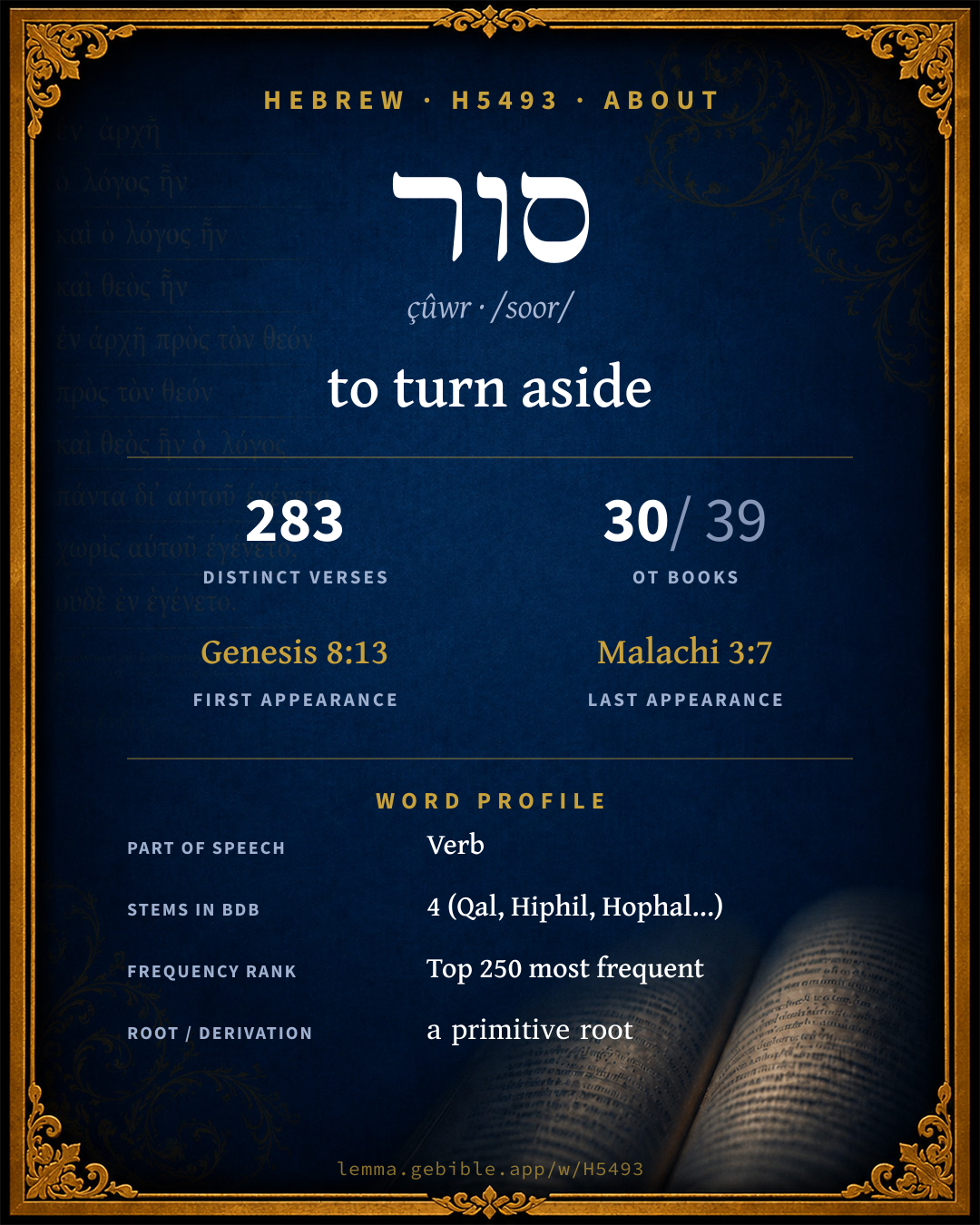
סוּר
to turn aside
‘to turn aside’ is one of 3 main senses fuller range ↓
Full lexicon entry — Brown-Driver-Briggs (BDB)
From Brown-Driver-Briggs (BDB)
Where this word appears
See every Hiphil verb in the Hebrew Bible →
Grammar key — what these labels mean
Part of speech
- Verb
- An action or state-of-being word.
Stem
- Qal
- The basic, simple active stem — the plain form of the verb (“he wrote”). Here: ‘turn aside’
- Hiphil
- The causative active stem (“he caused / brought about”). Here: ‘cause to’
- Hophal
- The passive counterpart of the Hiphil (“he was caused to…”).
- Polel
- A stem of hollow/geminate roots functioning like the Piel — intensive active.
Form
- Perfect
- A completed action or state — Hebrew marks aspect (completeness) more than strict tense (“he wrote”).
- Sequential Imperfect
- An imperfect with prefixed waw — the standard past-narrative form (waw-consecutive imperfect).
- Imperfect
- An incomplete, ongoing, or future action (“he will / would write”).
- Imperative
- A direct command (“write!”).
- Infinitive Construct
- A bound verbal noun, frequently with prepositions (“to write / in writing”).
- Sequential Perfect
- A perfect with prefixed waw continuing a preceding imperfect or command (waw-consecutive perfect).
- Participle Active
- A verbal adjective expressing ongoing or characteristic action (“writing / one who writes”).
- Jussive
- A third- or second-person volitional form expressing wish or command (“let him write”).
- Infinitive Absolute
- An unbound verbal noun, often intensifying or standing in for a finite verb.
- Cohortative
- A first-person volitional form expressing wish or resolve (“let me / let us write”).
- Participle Passive
- A verbal adjective expressing action received (“written”).
State
- Absolute
- The independent form of a noun, not bound to a following word.
- Construct
- A noun bound to a following noun in a possessive / “of” relationship (the construct chain).
Person
- 3rd Person
- The one spoken about (“he / she / it / they”).
- 2nd Person
- The one addressed (“you”).
- 1st Person
- The speaker (“I / we”).
Gender
- Masculine
- Grammatically masculine.
- Common
- Either gender — not distinguished for this form.
- Feminine
- Grammatically feminine.
Number
- Singular
- One.
- Plural
- More than one (in Hebrew, generally three or more).
9 verses where H5493 appears in the Hiphil stem in the Book of Job. Filtered view — show all forms. Click any verse to open its interlinear word-by-word view. Verse text shown in the World English Bible for context — . Each verse’s Hebrew form is shown with its reference; the English is not keyword-highlighted, since the data carries no word-level English alignment. Use “Compare translations” on any verse to read it across multiple English versions. This concordance covers the Hebrew Bible; Septuagint (Greek Old Testament) occurrences are not indexed here.
Job
- Job 9:34 יָסֵ֣ר Hiphil impf 3ms Let him take his rod away from me, Let his terror not make me afraid:
- Job 12:20 מֵסִ֣יר Hiphil ptcp.act ms He removes the speech of those who are trusted, And takes away the understanding of the elders.
- Job 12:24 מֵסִ֗יר Hiphil ptcp.act ms He takes away understanding from the chiefs of the people of the earth, And causes them to wander in a wilderness where there is no way.
- Job 19:9 וַ֝/יָּ֗סַר conj + Hiphil wimpf 3ms He has stripped me of my glory, And taken the crown from my head.
- Job 27:2 הֵסִ֣יר Hiphil pf 3ms "As God lives, who has taken away my right, The Almighty, who has made my soul bitter.
- Job 27:5 אָסִ֖יר Hiphil impf 1cs Far be it from me that I should justify you. Until I die I will not put away my integrity from me.
- Job 33:17 לְ֭/הָסִיר prep + Hiphil inf.cs That he may withdraw man from his purpose, And hide pride from man.
- Job 34:5 הֵסִ֥יר Hiphil pf 3ms For Job has said, 'I am righteous, God has taken away my right:
- Job 34:20 וְ/יָסִ֥ירוּ conj + Hiphil impf 3mp In a moment they die, even at midnight; The people are shaken and pass away, The mighty are taken away without hand.
About this entry
At a glance — auto-summarized from this page’s data, not written by a person. Every figure links to its source below. This summary describes the numbers; it doesn’t interpret them.
The Hebrew verb סור centers on the idea of “to turn aside.” Where the King James Version says “depart,” newer translations reach for “turn away” (Berean Standard Bible) and “turn aside” (unfoldingWord Literal Text); the renderings breakdown has the detail. It appears 283 verses across 30 books of the Hebrew Bible, among its common vocabulary. Debuting at Genesis 8:13, it then recurs through the corpus. Read the stem: it spans 4 stems, including Qal and Hiphil. For the data behind this summary, explore the sense tree and the renderings breakdown below.
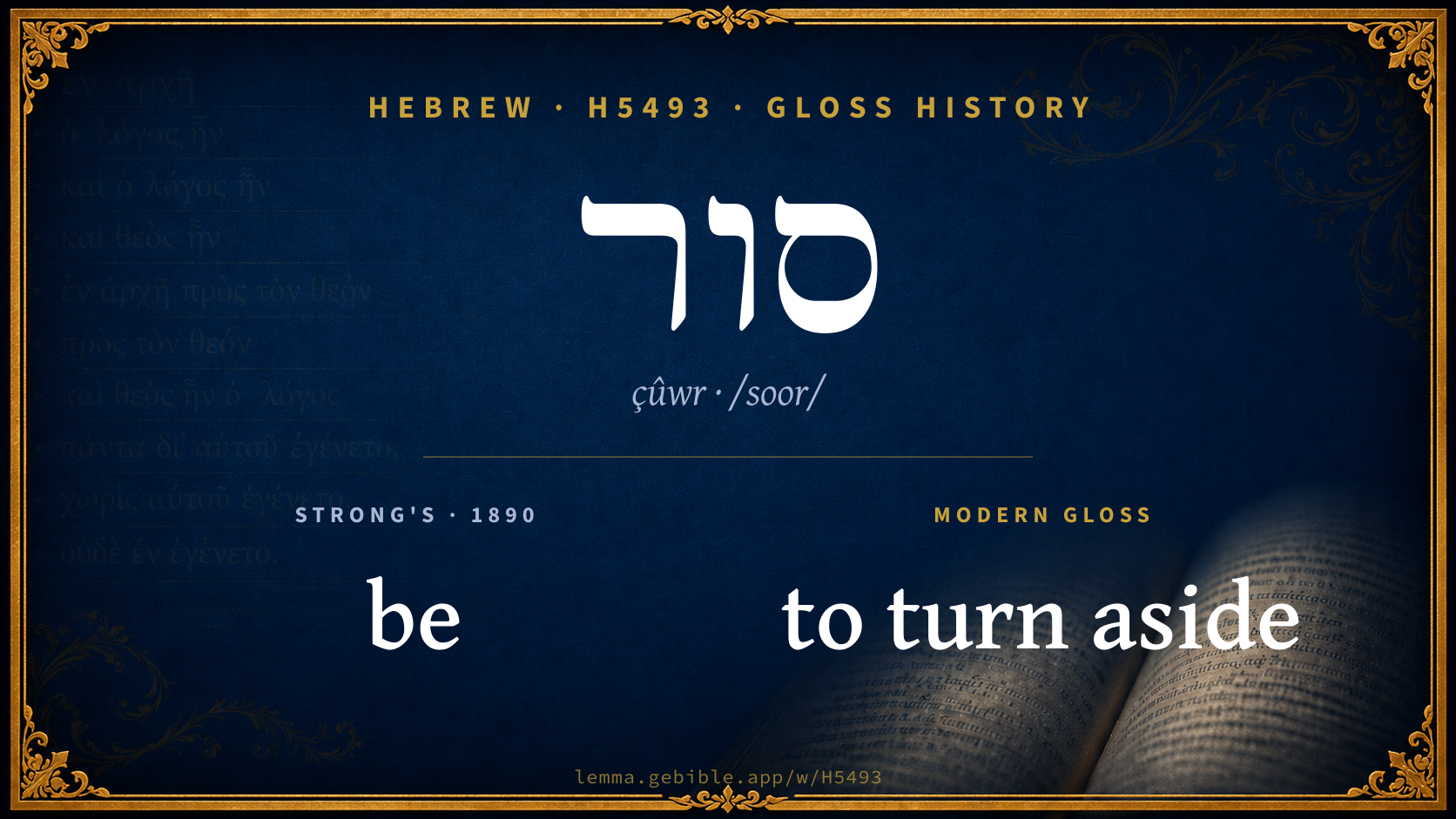
Gloss history
Strong's 1890 vs modern scholarship
About this word
Strong's H5493 catalogs a Hebrew word from the Hebrew Old Testament.
These counts are not copied from any lexicon or concordance. They are computed here, from the morphology-tagged Hebrew Old Testament. What Lemma adds →
- 283
- distinct verses
- The word appears in 283 distinct verses.
- 30 / 39
- OT books
- The word appears in 30 of 39 Old Testament books.
- #163
- by frequency
- Top 250 most frequent Hebrew words (rank 163 of 8,640 Hebrew words by occurrence).
View all 283 occurrences in the concordance →
By section of the Old Testament
By traditional corpus
Conventional, traditional groupings — biblical authorship is debated, so this is a traditional corpus grouping, not an authorship claim. Each share is this word’s portion of its verses in that division of the Hebrew canon. Each figure is a share of the word’s 283 distinct verses.
- Prophets (Nevi'im) 149 verses · 53%
- Writings (Ketuvim) 81 verses · 29%
- Torah (Pentateuch) 53 verses · 19%
How translations render this word
Counts come from each version’s own published word-to-Strong’s tagging or interlinear alignment — an approximate guide to how each version renders this word, not a word-level alignment the data otherwise carries. Because each total is that version’s own tagged count, the per-version totals vary from one another and need not match the appearance or distinct-verse counts above. These counts may also differ from a printed concordance because Lemma counts each distinctly tagged rendering and does not collapse phrase taggings into a single head-word total. This is a fixed set of word-tagged versions (KJV, ASV, BSB, ULT) and does not change with the reading translation you choose elsewhere. Each version’s license is shown beside its name below (and on Sources).
BDB lists this Strong’s number as 4 distinct words (homographs). Each count above pools all of them and is not split by sense — see the Senses section below. A low-frequency rendering may belong to a different one of those words, not the primary meaning.
- King James Version†: Depart 23×, Departed 9×, He departed 9×
- American Standard Version†: Depart 17×, Remove 9×, He departed 8×
- Berean Standard Bible†: Turn away 21×, Removed 19×, Turn aside 15×
- unfoldingWord Literal Text†: Turn aside 32×, Remove 27×, Turn away 27×
King James Version Public Domain
Renders H5493 across 308† tagged occurrences — most commonly:
Plus other, less common renderings. Plus 136 renderings that appear only once — usually multi-word phrases or single function words the recovered tagging swept in, not distinct renderings.
American Standard Version Public Domain
Renders H5493 across 306† tagged occurrences — most commonly:
Plus other, less common renderings. Plus 139 renderings that appear only once — usually multi-word phrases or single function words the recovered tagging swept in, not distinct renderings.
Berean Standard Bible Public Domain
Renders H5493 across 294† tagged occurrences — most commonly:
Plus other, less common renderings. Plus 120 renderings that appear only once — usually multi-word phrases or single function words the recovered tagging swept in, not distinct renderings. Not rendered by a distinct English word in 4 further occurrences.
unfoldingWord Literal Text CC BY-SA 4.0
Renders H5493 across 396† tagged occurrences — most commonly:
Plus other, less common renderings. Plus 89 renderings that appear only once — usually multi-word phrases or single function words the recovered tagging swept in, not distinct renderings.
11 senses and sub-senses in the full BDB
Hebrew verbs can shift meaning by stem (binyan): Qal is the basic action, Niphal is often passive or reflexive, Piel often intensifies or makes it factitive, and Hiphil is typically causative. The senses below are grouped under the stem BDB assigns to each. This entry also uses Hophal (the passive of Hiphil) and one or more reduplicated stems (the Pōlēl/Pilpēl type), which for hollow or geminate roots behave much like Piel — often intensive or iterative.
What do BDB’s symbols mean?
BDB uses these scholarly abbreviations:
| Symbol | Meaning |
|---|---|
| 𝔊 | the Septuagint (the ancient Greek translation, LXX) |
| 𝔙 | the Vulgate (the Latin translation) |
| 𝔖 | the Syriac version (the Peshitta) |
| 𝔗 | the Targum (the Aramaic translation) |
| ψ | the Psalms |
| √ | root (the underlying root or stem) |
| ‖ | parallel passage (a synonymous or contrasted parallel) |
| † | the dagger: every passage where the word occurs is cited |
The 11 senses and sub-senses the full Brown-Driver-Briggs lexicon distinguishes for this word, in lexicon order (not ranked by frequency), with BDB’s own verbatim wording and sub-sense lettering. Shown in Hebrew script with BDB’s own scholarly abbreviations. The condensed entry is in the Lexicon Entry tab. See also the Forms in the corpus table below.
סור I and (Ho 9
Qal
- Pf. 3 ms. סָר Ex 3:4 +; 3 fs. סָ֫רָה 1 S 16:14 +; 1 s. סָ֑רְתִּי ψ 119:102; 3 pl. סָרוּ Dt 9:12 +; 2 mpl. סַרְתֶּם v 16 +, etc.; Impf. 3 ms. יָסוּר Gn 49:10 +, וַיָּ֫סַר Ju 4:18 +; 3 fs. תָּסוּר 1 S 6:3 +; 1 s. cohort. אָסֻ֫רָה Ex 3:3; 3 mpl. יָסֻ֫רוּ Ex 25:15 +, etc.; Imv. ms. סוּר 2 S 2:22 +, etc.; Inf. abs. סוֹר Dn 9:5, סֹר v 11; cstr. סוּר Is 7:17 +; sf. שׂוּרִי Ho 9:12 (Ges§ 6 k Now); Pt. סָר Jb 1:1 +; f. cstr. סָרַת Pr 11:22; mpl. cstr. סָרֵי Je 6:28 (or from סרר, or שָׂר); pass. f. סוּרָה Is 49:21, c. intrans. meaning (Ges§ 50 f Köii. 1, 137), pl. sf. סוּרַי Je 17:13 Qr; and cstr. סוּרֵי 2:21;— e.g. Exodus 3:4
- 1. turn aside, out of one’s course 1 S 6:12 Dt 2:27, from following, מֵאַחֲרֵי pers. 2 S 2:21, 22, abs. v 23, from attacking, מֵעַל 2 Ch 20:10; turn in unto (for shelter, refuge, etc.), c. אֶל־, Gn 19:2, 3 (J) Ju 4:18(×3); 19:11, 12 2 K 4:11, c. לְ Ju 20:8, c. שָׁם 18:3; 19:15, שָׁ֫מָה 18:15 2 K 4:8 (+ inf.), v 10; c. הֵ֫נָּה Pr 9:4, 16 (in fig.); for purpose implied Ex 3:3 (J) Ru 4:1(×2), or expr. by inf. Ex 3:4 (J) Ju 14:8 Je 15:5 (in fig.); especially fig. turn aside from right path, from י׳, his commands, etc., usually c. מִן Ex 32:8 (J) Ju 2:17 Dt 9:12 + 7 times D, Pr 13:14 + 5 times Pr, + 10 times elsewhere, + 2 Ch 8:15 (ins. מִן); c. מֵאַחֲרֵי 1 S 12:20 + 4 times; c. מֵעַל Je 32:40 Ez 6:9; מִן + יָמִין etc. Dt 5:29; 17:11 2 K 22:2 = 2 Ch 34:2; abs. (sometimes = revolt) ψ 14:3 Je 5:23 Dt 11:16; 17:17 (subj. לֵבָב), וְסוּרַי Je 17:13 Qr (> יסורי Kt) read prob. וְסוּרֶיךָ those revolting from thee (Ew Gie); סוּרֵי הַגֶּפֶן נָכְרִיָּה Je 2:21 degenerate (shoots) of the foreign vine (fig.); סָרַת טַעַם Pr 11:22 a woman turning aside as to discretion, shewing lack of it; also from wrong path, sins (of Jerob.), etc., c. מִן 2 K 3:3; 14:24 + 7 times 2 K; c. מֵעַל 2 K 10:31; 15:18; c. מֵאַחֲרֵי 2 K 10:29; †סָר מֵרָע (pt.) Jb 1:1, 8; 2:3 also Is 59:15; סוּר מֵרָע (inf. and imv.) Jb 28:28 Pr 3:7; 13:19; 16:6, 17 ψ 34:15; 37:27. e.g. 1 Samuel 6:12
- 2. depart, usually c. מִן, of frogs Ex 8:7, flies v 25 (both J), sword 2 S 12:10; sceptre from Judah Gn 49:10 (poem in J): י׳’s hand 1 S 6:3, his kindness 2 S 7:15 (MT, but read אָסִיר 𝔊 𝔖 𝔙 ‖ 1 Ch 17:13 Th We Dr Klo Bu Kit HPS), his wrath Ez 16:42 (but del. Co Siegf Toy), depart from way = get out of the way, cease to obstruct Is 30:11, etc.; c. מִתּוֹךְ 1 S 15:6(×2); c. מֵעַל Is 7:17 Ju 16:19 Nu 12:10, etc.; of י׳ departing, מִן pers., Ho 9:12, מֵעַל Ju 16:20 1 S 28:16, מֵעִם 1 S 18:12; God, c. מִן Jb 21:14; 22:17, c. מֵעַל 1 S 28:15; רוּחַ י׳, c. מֵעִם 1 S 16:14; evil spirit, c. מֵעַל v 23; abs. depart [from Babyl.] Is 52:11(×2); = avoid contact La 4:15(×3); of wicked Jb 15:30 he shall not depart out of (מִנִּי) darkness, i.e. shall not avoid it, escape it; pt. pass. made to depart, thrust away, of Isr. under fig. of wife Is 49:21 (> act., according to BaNB § 124 c.). e.g. Exodus 8:7
- 3. of lifeless things = be removed, oppressor’s yoke, c. מֵעַל Is 14:25 cf. v 25 10:27; staves from (מִן) ark Ex 25:15; abs. iniquity Is 6:7; especially of בָּמוֹת 1 K 15:14; 22:44 2 K 12:4; 14:4; 15:4, 35 2 Ch 15:17; 20:33. e.g. Isaiah 14:25
- 4. = come to an end, Am 6:7 Is 11:13.—For סָר אֶל־ 1 S 22:14 read שַׂר עַל־ 𝔊 Th Dr Klo Bu Kit Löhr HPS; in 15:32 Th HPS del. סָר (after 𝔊 𝔙 𝔖) as dittogr.; סָר סָבְאָם Ho 4:18 v. סֹבֶא; Ho 7:14 read יָסוֹ֫רוּ for יָס֫וּרוּ (√ סרר q.v.); Je 6:28, it is uncertain whether (סוֹרְרִים) סָרֵי belongs here, revolters among the rebellious, or sub סרר, or even = שָׂרֵי princes, chiefs (cf. 1 S 22:14). e.g. Amos 6:7
Poʿlel
- Pf. 3 ms. דְּרָכַי סוֹרֵר La 3:11 he turned aside my ways (my steps). e.g. Lamentations 3:11
Hiphil
- Pf. 3 ms. הֵסִיר 2 K 18:4 +; 2 ms. וַהֲסִרֹ֫תָ consec. (Dr§ 110 (5) Obs.) 1 K 2:31; 1 s. הֲסִירֹ֫תִי 2 K 23:27 +, וַהֲסִרֹתִ֫י 1 S 17:46 +; 3 pl. הֵסִ֫ירוּ 2 Ch 30:14, etc.; Impf. 3 ms. יָסִיר Is 3:18 +, juss. יָסֵר Ex 8:4 +, וַיָּ֫סַר Gn 8:13 +; sf. וַיְסִרֵהוּ 1 S 18:13, וַיְסִרֶהָ 1 K 15:13, יְסִירֶנָּה Lv 3:4 +; 3 mpl. יָסִ֫ירוּ Is 5:23 +, etc.; Imv. ms. הָסֵר 1 K 20:24 +, הָסִיר Ez 21:31 (read הָסֵיר, הָסֵר); fs. הָסִ֫ירִי 1 S 1:14, etc.; Inf. abs. הָסֵר Gn 30:32 +; cstr. הָסִיר 2 K 6:32 +, etc.; Pt. מֵסִיר Is 3:1 + 3 times;— e.g. 2 Kings 18:4
- 1. cause to (turn aside,) depart, common word for remove, take away: c. מִן, Ex 8:4, 27; 33:23 (all J), 23:25 (E) Dt 7:15 1 S 28:3 Jos 7:13 (J) Ju 10:16 Is 3:1 ψ 18:23 (+ ‖ 2 S 22:23, read אָסִיר מִמֶּנִּי De Hup-Now HPS); shoulder from burden ψ 81:7; מֵסִיר אָזְנוֹ מִשְּׁמֹעַ Pr 28:9; + often, + Jb 33:17 (ins. מִן 𝔊 Ew Di De Hi Bu al.); c. מֵעַל, take off ring Gn 41:42 (E) Est 3:10, also 8:2 (abs.); garments Gn 38:14, 19 (J) Dt 21:13 Zc 3:4 1 S 17:39 (armour), also Ex 34:34 (P; abs.) and Ez 26:16 (Co ins. מֵעַל); take off head, מֵעַל 1 S 17:46, abs. 2 S 4:7; 16:9 2 K 6:32; c. מֵעַל also often fig. (from upon = from resting on, or burdening), plagues Ex 8:4; 10:17 (J), cf. Nu 21:7 (E), also 1 S 1:14 Am 5:23 1 K 2:31; reproach 1 S 17:26 Is 25:8; c. מֵעִם = from one’s presence 1 S 18:13, also of י׳ removing his kindness 1 Ch 16:13 + ‖ 2 S 7:15 (v. Qal 2); c. מֵעַל פָּנָיו, of י׳ removing Isr. 2 K 17:18, 23; 23:27; 24:3 Je 32:31; abs. 2 K 23:27; often abs., Gn 8:13 Noah removed the covering; remove = depose c. מִן 1 K 15:13 = 2 Ch 15:16 (v. מִן 7 b (b)), abs. 2 Ch 36:3, cf. Ju 9:29 Jb 34:20; remove בָּמוֹת, etc., 2 K 18:4, v 22 = Is 36:7 = 2 Ch 32:12, 2 K 23:19 2 Ch 30:14; 14:2, cf. 14:4; 17:5 (both c. מִן); = put away strange gods, etc., Gn 35:2 Jos 24:14, 23 (all E), 1 S 7:4, c. מִתּוֹךְ v 3 Is 58:9; once c. לְ, מֵסִיר שָׂפָה לְנֶאֱמָנִים Jb 12:20. e.g. Exodus 8:4
- 2. rarer uses are: put aside = leave undone Jos 11:15 (D); retract words Is 31:2 (of י׳); reject prayer ψ 66:20; abolish sacrifice Dn 11:31; turn one away מֵאַחֲרֵי, i.e. from following Dt 7:4; c. אֶל־ pers., remove the ark unto 2 S 6:10 = 1 Ch 13:13. e.g. Joshua 11:15
Hophal
- Pf. 3 ms. הוּסַר Lv 4:31 Dn 12:11; Impf. 3 ms. יוּסַר Lv 4:35; Pt. מוּסָר Is 17:1; pl. מוּסָרִים 1 S 21:7 (but final ם prob. dittogr. before מ We Dr Klo Kit HPS);—be taken away, removed: c. מִן Lv 4:35, מֵעַל v 31, מִלִּפְנֵי י׳ 1 S 21:7; מוּסָר מֵעִיר Is 17:1 Damascus is removed from being a city; abs. be abolished Dn 12:11 (cf. 11:31 Hiph.). e.g. Leviticus 4:31
סור II verb. properly Pt. of סור q.v.
סור III of a temple-gate
סור IV saw (‖ form of נָשַׂר
Qal
- Impf. 3 ms. וַיָּשַׂר 1 Ch 20:3 (but v. שׂים 1 a).—Ho 9:12 v. סור; Ju 9:22; Ho 8:4 v. שׂרר; 12:5 v. שׂרה. e.g. 1 Chronicles 20:3
Senses from the full Brown-Driver-Briggs lexicon (Brown, Driver, Briggs; Oxford 1906 — public domain), digitized via Sefaria, supplemented by the OpenScriptures HebrewLexicon (CC BY 4.0). Full attribution on Sources.
Word origin
I. and (Ho 9:12) [שׂוּר]300 vb. turn aside (NH Hiph. cause to turn aside, or apostatize; TelAm. sûru, n. rebel WklGloss.);—
II. adj.verb. properly Pt. of סור q.v.
III. n.pr. of a temple-gate;—שַׁעַר ס׳ 2 K 11:6 (> ‖ 2 Ch 23:5 שַׁעַר הַיְסוֹד, v. יְסוֹד), but del. ver. as gloss WeBleek’s Einl. 4:258 KmpKau Benz.
I. vb. saw (‖ form of נָשַׂר; denom. from מַשּׂוֹר?);—
— Brown-Driver-Briggs (Oxford 1906, public domain), digitized via Sefaria, supplemented by the OpenScriptures HebrewLexicon (CC BY 4.0). See Sources.
Origin: a primitive root
Jastrow Dictionary
A second Hebrew/Aramaic lexicon for comparison, covering Aramaic and post-biblical (Talmudic, Targumic, Midrashic) usage that the biblical-Hebrew BDB does not. Matched by lemma rather than by Strong’s number, so a lemma may carry more than one Jastrow headword (shown separately below), and the entries cover usage well beyond the Bible.
סוּר I
- (b. h.)
- 1. to go around; to turn; with ל to turn to, follow; with מן, מ־, to turn away; in gen. [to turn from the right path,] to go astray; to degenerate. Snh. 21ᵇ (ref. to Deut. XVII, 17) אני ארבה ולא אָסוּר I (Solomon) will take many wives and yet not go astray. Ber. 19ᵇ, a. fr. לאו דלא תָסוּר the prohibition inplied in the words, ‘thou shalt not deviate’ (from the decisions of the courts, the interpretations of the Rabbis, Deut. XVII, 11); a. fr. e.g. Deuteronomy 17:17
- 2. to pass away, cease. Num. R. s. 9 (ref. to Am. VI, 7) אותה שעה תָסוּר שמחת הסרוחים at that time shall the joy of the (corrupt) banqueters cease; a. e. e.g. Amos 6:7
- 1. to remove, take off. Num. R. s. 14 (play on סיר, Ps. LX, 10) והֵסַרְתִּי הצרעת מעליו and I removed the leprosy from him; שהסרתי אותו מן הטביעה whom I removed (saved) from drowning, v. טְבִיעָה I; Num. R. s. 12 הָסֵר הטומאה וכ׳ remove the uncleanness out of thy house; a. e. e.g. Psalms 60:10
- 2. to cause to deviate, to corrupt. Snh. II, 4 (ref. to Deut. XVII, 17) ובלבד שלא יהו מְסִירוֹת את לבו provided they (the wives) do not corrupt his heart; אפי׳ אחת ומְסִירָה וכ׳ even one wife, if she might corrupt his heart, he must not marry. Kidd. 68ᵇ (ref. to Deut. VII, 4) לרבות כל המְסִירִים this is to intimate the extension of the prohibition of intermarriage to all nations that might lead astray; Yeb. 23ᵃ; Ab. Zar. 36ᵇ המְסִירוֹת. e.g. Deuteronomy 17:17
- to be removed. Macc. 5ᵃ (ref. to סרה Deut. XIX, 16) עד שתּוּסַר גופה של עדות Ar. s. v. זמם (ed. שתסרה) until the testimony itself has been removed (an alibi has been proved). e.g. Deuteronomy 19:16
סוּר
- 1. to turn, esp. ס׳ סכינא (v. Ḥull. 17ᵇ, quot. s. v. טוּפְרָא) to turn the slaughtering knife on all sides, to examine. Erub. 63ᵃ רבינא סַר סכינא וכ׳ R. examined the slaughterer’s knife (assumed the rabbinical function of superintending the slaughtering) in Babylonia. Ḥull. 18ᵃ דלא סר וכ׳ who failed to examine his knife before an authorised scholar.
- 2. to go around, visit, superintend, esp. ס׳ ניכסיה (or ארעיה) to superintend one’s estate, examine, watch laborers &c.—Part. סָיֵיר. Ib. 105ᵃ מאן דסייר ניכסיה וכ׳ (Ar. סָאֵיר) he who goes around examining his property every day. Ib. וכ׳ אבא הוה ס׳ … ואנא לא סָיִירְנָא my father used to examine his estate twice a day, but I do it only once a day.
- same. B. Mets. 76ᵇ, sq. [read:] סַיְּירָהּ לארעיה וכ׳ (v. Rabb. D. S. a. l. note) he visited his fields &c. Gitt. 38ᵇ דמְסַיְּירֵי וכ׳ Rashi (ed. דסָיְירֵי) those who examine their property on the Sabbath; a. e.—V. סְעַר I.
סוּר II
- (b. h.) pr. n. שער הס׳ the gate of Sur, name of a Temple gate. Y. Erub. V, 22ᶜ
*סָוַר
- (cmp. צבר, v. סַוָּאר) to pile, arrange.—Part. pass. סָווּר; f. סְווּרָה; pl. סְווּרוֹת. Tosef. B. Bath. III, 6 העצים … האבנים ס׳ וכ׳ ed. Zuck. (Var. סוררות, some ed. סוירות, corr. acc.) wood or stones piled up whether for his untilled field (for building) or for his fence; v. סָדַר a. צָבַר.
סוֹר
- (= סאור, v. סִיאוּר) fermentation, froth, leaven; trnsf. (cmp. שְׂאוֹר, עִיסָה a. חָמַץ) germ, original nature, character. Snh. 92ᵇ סו̇רו̇ his haughty nature; [oth. opin.: its (the kiln’s) froth], v. מָקַק a. מָרַק. Kidd. 82ᵃ כל שעסקיו סורו רע … he who has a business which brings him in contact with women, has bad leaven in him (or else he would not have chosen such a trade). Hor. 13ᵃ מפני שסוֹרָן רע because they (the mice) are of a mischievous nature. B. Mets. 59ᵇ the Torah cautions repeatedly against ill-treating the proselyte (גֵּר), מפני שסורו רע because his original character is bad (into which ill treatment might cause him to relapse). Kidd. 17ᵇ שמא יחזור לסורו lest he (the proselyte) relapse &c., v. קִילְקוּל. Gen. R. s. 70 היה חוזר לסורו he (Aquila) might have gone back to his evil ways (to heathenism); v. סִיאוּר. Gen. R. s. 74, end (expl. למקומו, Gen. XXXII, 1) לסורו to his evil manners (sensual pleasures). Cant. R. to II, 5; a. e.—Pl. סוֹרִים degenerate, bad people. Num. R. s. 3 אפי׳ סוֹרֵיהֶן וכ׳ even the bad among them are charitable; (Midr. Till. to Ps. XCII בּוֹרִים שבהם). e.g. Genesis 32:1
A Dictionary of the Targumim, the Talmud Babli and Yerushalmi, and the Midrashic Literature (Marcus Jastrow; London, Luzac, 1903) — Public Domain. Digitized via Sefaria. Digitized via Sefaria. Full attribution on Sources.
Forms in the corpus
The 194 distinct written forms H5493 takes in the Hebrew Bible, most frequent first — each parse links to that stem’s occurrences in the concordance. Hebrew forms include their vowel points and cantillation, so a single lemma takes many written forms.
The 60 most common forms are shown; 134 rarer forms follow in the full concordance.
Same root — word family
Other BDB entries built from the same root as H5493, grouped by Strong’s listed origin. These share a root / origin per the lexicon — not necessarily a shared meaning. Each links to that word’s own entry.
Derived from this word
Proper names from this root
People and places named from this root — a name, not an additional meaning of the word.
Compare all same-root words → Showing 4 of 5 — not the complete family. 1 of the same-root words is a proper name (a person or place). They share a root, not necessarily a meaning.
Septuagint verse parallels
This word appears in 266 verses that also exist in the Greek Old Testament (Septuagint), out of the 283 Hebrew verses it occurs in. You can read those verses in Greek by switching the Old Testament edition to the Septuagint.
Read these verses in the Septuagint
- Genesis 8:13
- Exodus 3:3
- Leviticus 1:16
- Numbers 12:10
- Deuteronomy 2:27
- Joshua 1:7
- Judges 2:17
- Ruth 4:1
- 1 Samuel 1:14
- 2 Samuel 2:21
- 1 Kings 2:31
- 2 Kings 3:2
This is a verse-level parallel only — the same verses exist in both the Hebrew and Greek Old Testaments. No word-level Hebrew↔Greek correspondence is claimed: the data carries no such alignment, so no Greek word is shown as this Hebrew word’s translation. Coverage is not total — the Septuagint omits the deuterocanon and renumbers the Psalms, so some Hebrew verses have no direct Greek parallel.