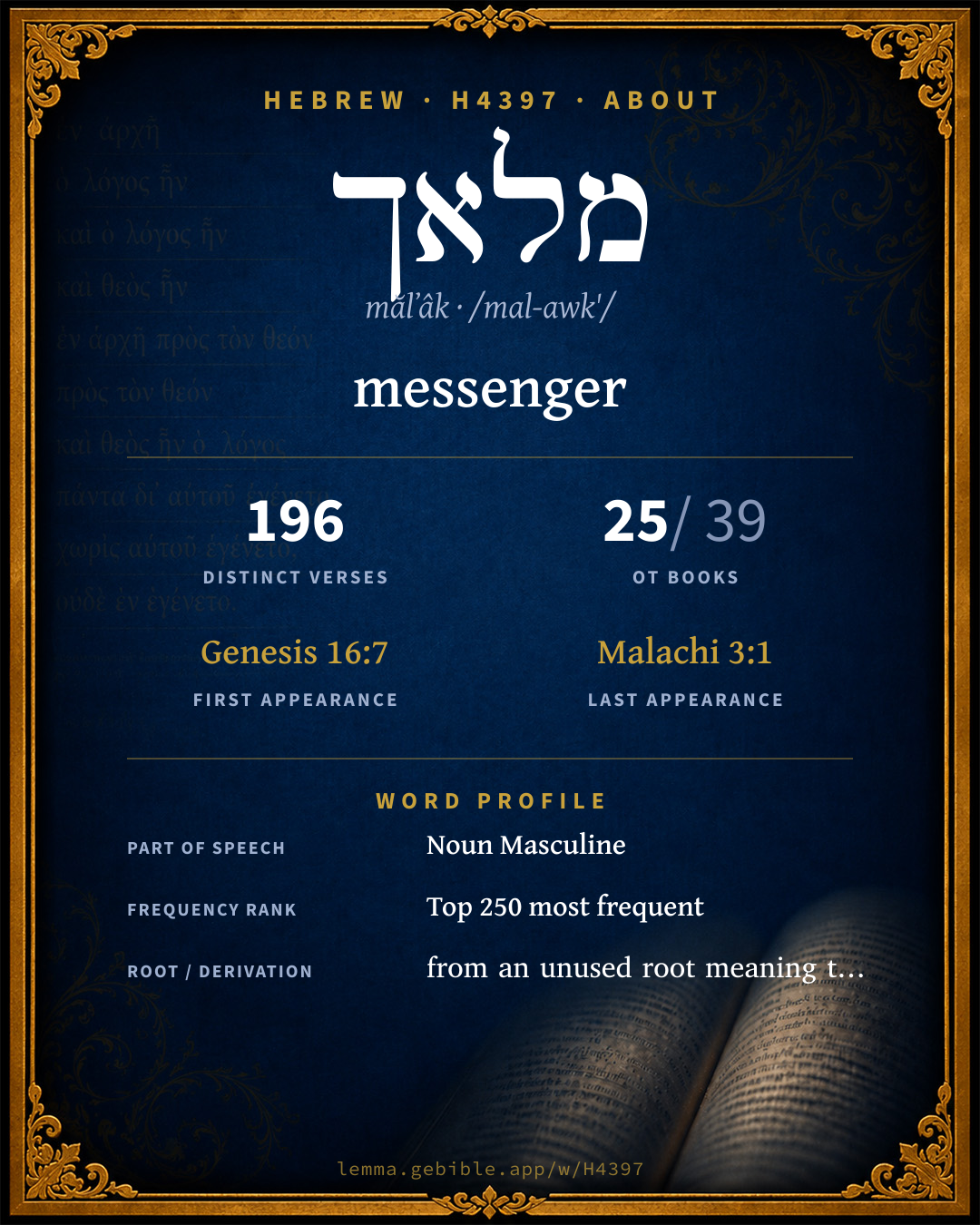
מַלְאָךְ
messenger
‘messenger’ is one of 4 main senses fuller range ↓
Full lexicon entry — Brown-Driver-Briggs (BDB)
From Brown-Driver-Briggs (BDB)
Where this word appears
See every Absolute-state word in the Hebrew Bible →
Grammar key — what these labels mean
Part of speech
- Noun
- A naming word — a person, place, thing, or idea.
Noun type
- Common
- A common noun — a general class of person, place, or thing (“king,” “city,” “water”), not a specific name.
State
- Construct
- A noun bound to a following noun in a possessive / “of” relationship (the construct chain).
- Absolute
- The independent form of a noun, not bound to a following word.
Gender
- Masculine
- Grammatically masculine.
Number
- Singular
- One.
- Plural
- More than one (in Hebrew, generally three or more).
13 verses where H4397 appears in the Absolute state in the Book of Zechariah. Filtered view — show all forms. Click any verse to open its interlinear word-by-word view. Verse text shown in the World English Bible for context — . Each verse’s Hebrew form is shown with its reference; the English is not keyword-highlighted, since the data carries no word-level English alignment. Use “Compare translations” on any verse to read it across multiple English versions. This concordance covers the Hebrew Bible; Septuagint (Greek Old Testament) occurrences are not indexed here.
Zechariah
- Zechariah 1:9 הַ/מַּלְאָךְ֙ ptcl def.art + n c ms Then I asked, 'My lord, what are these?'" The angel who talked with me said to me, "I will show you what these are."
- Zechariah 1:13 הַ/מַּלְאָ֛ךְ ptcl def.art + n c ms Yahweh answered the angel who talked with me with kind and comforting words.
- Zechariah 1:14 הַ/מַּלְאָךְ֙ ptcl def.art + n c ms So the angel who talked with me said to me, "Proclaim, saying, 'Thus says Yahweh of Hosts: "I am jealous for Jerusalem and for Zion with a great jealousy.
- Zechariah 1:19 הַ/מַּלְאָ֛ךְ ptcl def.art + n c ms I asked the angel who talked with me, "What are these?" He answered me, "These are the horns which have scattered Judah, Israel, and Jerusalem."
- Zechariah 2:3 הַ/מַּלְאָ֛ךְ וּ/מַלְאָ֣ךְ ptcl def.art + n c ms conj + n c ms Behold, the angel who talked with me went forth, and another angel went out to meet him,
- Zechariah 3:3 הַ/מַּלְאָֽךְ ptcl def.art + n c ms Now Joshua was clothed with filthy garments, and was standing before the angel.
- Zechariah 4:1 הַ/מַּלְאָ֖ךְ ptcl def.art + n c ms The angel who talked with me came again, and wakened me, as a man who is wakened out of his sleep.
- Zechariah 4:4 הַ/מַּלְאָ֛ךְ ptcl def.art + n c ms I answered and spoke to the angel who talked with me, saying, "What are these, my lord?"
- Zechariah 4:5 הַ/מַּלְאָ֞ךְ ptcl def.art + n c ms Then the angel who talked with me answered me, "Don't you know what these are?" I said, "No, my lord."
- Zechariah 5:5 הַ/מַּלְאָ֖ךְ ptcl def.art + n c ms Then the angel who talked with me came forward, and said to me, "Lift up now your eyes, and see what is this that is appearing."
- Zechariah 5:10 הַ/מַּלְאָ֖ךְ ptcl def.art + n c ms Then said I to the angel who talked with me, "Where are these carrying the ephah basket?"
- Zechariah 6:4 הַ/מַּלְאָ֖ךְ ptcl def.art + n c ms Then I asked the angel who talked with me, "What are these, my lord?"
- Zechariah 6:5 הַ/מַּלְאָ֖ךְ ptcl def.art + n c ms The angel answered me, "These are the four winds of the sky, which go forth from standing before the Lord of all the earth.
About this entry
At a glance — auto-summarized from this page’s data, not written by a person. Every figure links to its source below. This summary describes the numbers; it doesn’t interpret them.
At its core, מלאך (mălʼâk) means “messenger.” Not a single-sense word: explore its full sense range. With 196 verses in 25 books, it is a common word in the Hebrew Bible. Scripture first uses it in Genesis 16:7. Sharing its root, it stands alongside מלאך, מלאכה and מלאכות. Dig into 196-verse concordance and the renderings breakdown below.
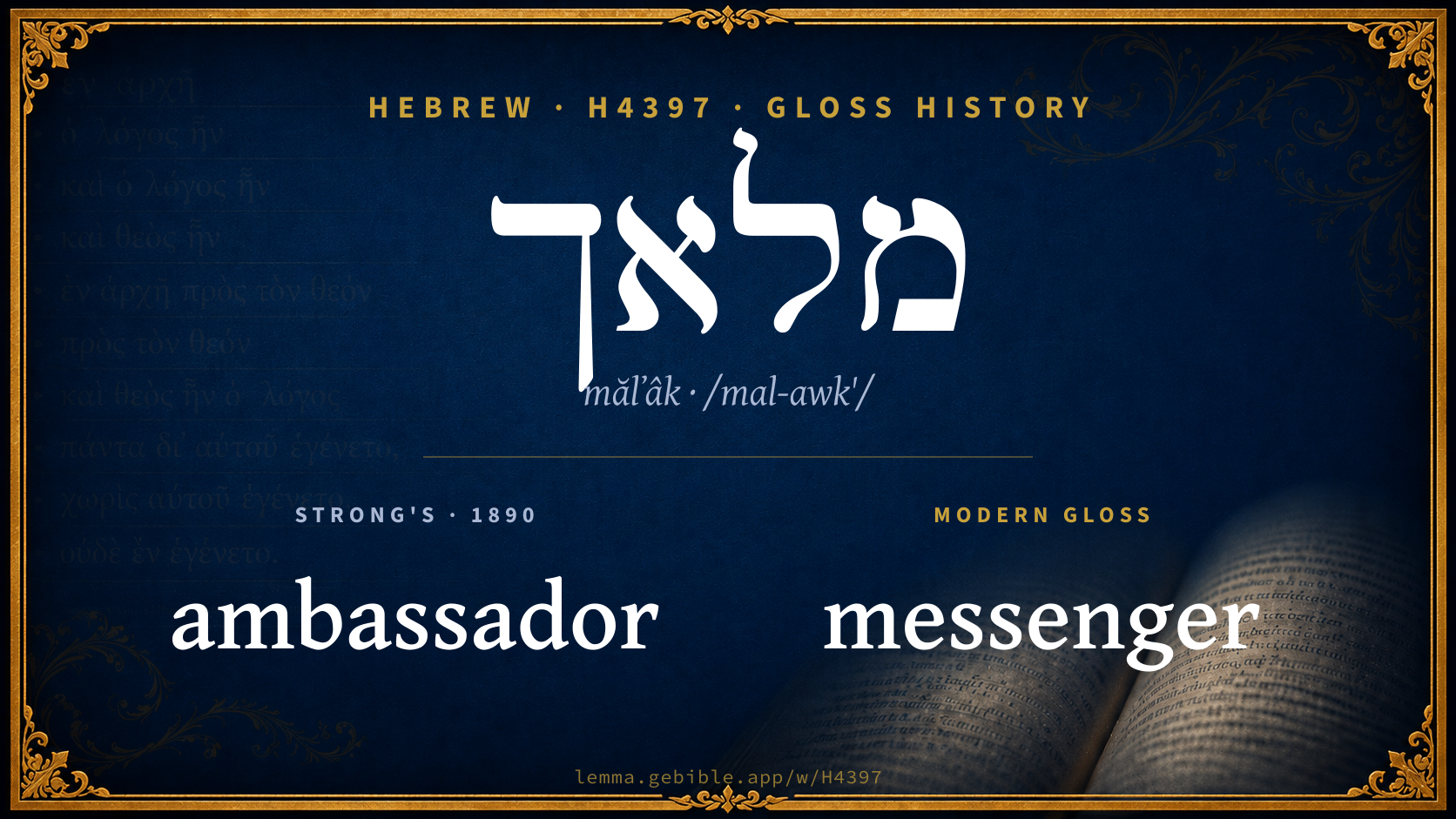
Gloss history
Strong's 1890 vs modern scholarship
About this word
Strong's H4397 catalogs a Hebrew word from the Hebrew Old Testament.
These counts are not copied from any lexicon or concordance. They are computed here, from the morphology-tagged Hebrew Old Testament. What Lemma adds →
- 196
- distinct verses
- The word appears in 196 distinct verses.
- 25 / 39
- OT books
- The word appears in 25 of 39 Old Testament books.
- #225
- by frequency
- Top 250 most frequent Hebrew words (rank 225 of 8,640 Hebrew words by occurrence).
View all 196 occurrences in the concordance →
By section of the Old Testament
By traditional corpus
Conventional, traditional groupings — biblical authorship is debated, so this is a traditional corpus grouping, not an authorship claim. Each share is this word’s portion of its verses in that division of the Hebrew canon. Each figure is a share of the word’s 196 distinct verses.
- Prophets (Nevi'im) 126 verses · 64%
- Torah (Pentateuch) 39 verses · 20%
- Writings (Ketuvim) 31 verses · 16%
How translations render this word
Counts come from each version’s own published word-to-Strong’s tagging or interlinear alignment — an approximate guide to how each version renders this word, not a word-level alignment the data otherwise carries. Because each total is that version’s own tagged count, the per-version totals vary from one another and need not match the appearance or distinct-verse counts above. These counts may also differ from a printed concordance because Lemma counts each distinctly tagged rendering and does not collapse phrase taggings into a single head-word total. This is a fixed set of word-tagged versions (KJV, ASV, BSB, ULT) and does not change with the reading translation you choose elsewhere. Each version’s license is shown beside its name below (and on Sources).
- King James Version: Angel 87×, Messengers 70×, Messenger 20×
- American Standard Version: Angel 88×, Messengers 67×, Messenger 18×
- Berean Standard Bible: Angel 92×, Messengers 65×, Messenger 21×
- unfoldingWord Literal Text: Messengers 69×, Angel of 58×, Angel 32×
King James Version Public Domain
Renders H4397 across 213 tagged occurrences — most commonly:
Plus 21 renderings that appear only once — usually multi-word phrases or single function words the recovered tagging swept in, not distinct renderings. Not rendered by a distinct English word in 1 further occurrence.
American Standard Version Public Domain
Renders H4397 across 212 tagged occurrences — most commonly:
Plus 21 renderings that appear only once — usually multi-word phrases or single function words the recovered tagging swept in, not distinct renderings.
Berean Standard Bible Public Domain
Renders H4397 across 212 tagged occurrences — most commonly:
Plus 12 renderings that appear only once — usually multi-word phrases or single function words the recovered tagging swept in, not distinct renderings. Not rendered by a distinct English word in 2 further occurrences.
unfoldingWord Literal Text CC BY-SA 4.0
Renders H4397 across 221 tagged occurrences — most commonly:
Plus other, less common renderings. Plus 10 renderings that appear only once — usually multi-word phrases or single function words the recovered tagging swept in, not distinct renderings.
8 senses and sub-senses in the full BDB
What do BDB’s symbols mean?
BDB uses these scholarly abbreviations:
| Symbol | Meaning |
|---|---|
| 𝔊 | the Septuagint (the ancient Greek translation, LXX) |
| 𝔙 | the Vulgate (the Latin translation) |
| 𝔖 | the Syriac version (the Peshitta) |
| 𝔗 | the Targum (the Aramaic translation) |
| ψ | the Psalms |
| √ | root (the underlying root or stem) |
| ‖ | parallel passage (a synonymous or contrasted parallel) |
| † | the dagger: every passage where the word occurs is cited |
The 8 senses and sub-senses the full Brown-Driver-Briggs lexicon distinguishes for this word, in lexicon order (not ranked by frequency), with BDB’s own verbatim wording and sub-sense lettering. Shown in Hebrew script with BDB’s own scholarly abbreviations. The condensed entry is in the Lexicon Entry tab. See also the Forms in the corpus table below.
- 1. messenger,
- a. one sent with a message Gn 32:4 + 8 times JE; Dt 2:26, (not in P); Ju 6:35 + 8 times; 1 S 6:21 + 51 times S K, 1 Ch 14:1; 19:2, 16 2 Ch 18:12; 35:21; Ne 6:3; Jb 1:14; Pr 13:17; 17:11; Is 14:32; 18:2; 30:4; 37:9, 14; Je 27:3; Ez 17:15; 23:16, 40; 30:9; Na 2:14; מלאכי שׁלום, messengers of peace Is 33:7. e.g. Genesis 32:4
- b. a prophet Is 42:19; 44:26; 2 Ch 36:15, 16; Hg 1:13; the herald of the advent מלאכי Mal 3:1. e.g. Isaiah 42:19
- c. priest Mal 2:7, prob. Ec. 5:5 (RV angel). e.g. Malachi 2:7
- d. ‖ מֵלִיץ Jb 33:23, a messenger from God acting as an interpreter and declaring what is right (angel of RV too specific). e.g. Job 33:23
- e. fig. מ׳ רָעִים messengers of evil ψ 78:49; מ׳ מות messengers of death Pr 16:14; ‖ רוחות winds his messengers ψ 104:4. e.g. Psalms 78:49
- 2. angel, as messenger of God, מלאכים with God in theophanies Gn 19:1, 15; 28:12; 32:2 (JE), praising him; ψ 103:20; 148:2; in his sight not without error Jb 4:18 charged with the care of the pious ψ 91:11; elsewhere sg. sent to a prophet 1 K 13:18; 19:5, 7; 2 K 1:3, 15; Zc 1:9 + 18 times in Zc 1–6; excellent, wise, powerful 1 S 29:9 2 S 14:17, 20; 19:28 Zc 12:8; encamping about the faithful ψ 34:8; chasing his enemies ψ 35:5, 6; destroying by judgment of Yahweh 2 S 24:16, 17 = 1 Ch 21:12–30; 2 K 19:35 = Is 37:36 = 2 Ch 32:21. e.g. Genesis 19:1
- 3. the theophanic angel (ה)אלהים מ׳ in the story of E: Gn 21:17; 31:11 Ex 14:19, also in Ju 6:20; 13:6, 9; מ׳ יהוה in the story of J: Gn 16:7, 9, 10, 11; 22:11, 15; Ex 3:2 Nu 22:22, 23, 24, 25, 26, 27, 31, 32, 34, 35 and in Ju 2:1, 4; 5:23; 6:11, 12, 21(×2), 22(×2); 13:3, 13, 15, 16(×2), 17, 18, 20(×2), 21; הַמַּלְאָךְ Gn 48:16 (E); מַלְאָךְ Ex 23:20 (E), 33:2; Nu 20:16 (JE), Ho 12:5; מַלְאָכִי Ex 23:23 (E), 32:34 (J); מַלְאָכוֹ Gn 24:7, 40 (J), מ׳ פניו Is 63:9 (referring to the ancient מלאך); מ׳ הברית Mal 3:1 (referring to the advent of י׳ for judgment, see Br MP 473). The theophanic angel is not mentioned in D and P. e.g. Genesis 21:17
Senses from the full Brown-Driver-Briggs lexicon (Brown, Driver, Briggs; Oxford 1906 — public domain), digitized via Sefaria, supplemented by the OpenScriptures HebrewLexicon (CC BY 4.0). Full attribution on Sources.
Word origin
n.m. messenger;—מ׳ Ex 23:20 + 48 times; cstr. מַלְאַךְ Gn 16:7 + 69 times; sfs. מַלְאָכִי Ex 23:23 + 3 times; מַלְאָכוֹ Gn 24:7, 40; pl. מַלְאָכִים Gn 32:4 + 63 times + מלאכים 2 S 11:1 Kt (מלכים); cstr. מַלְאֲכֵי Gn 28:12 + 11 times; מַלְאָכֶיךָ Nu 24:12, 2 K 19:23; מַלְאָכֵכֵה Na 2:14 error for מַלְאָכֵכִי = מַלְאָכַיְכִי Ges§ 91, (2), Anm. 2 or מַלְאָכֵךְ by dittogr. from foll. הוֹי Kö ii. 1.S 571). מַלְאָכָיו 2 Ch 36:15 + 8 times;—
— Brown-Driver-Briggs (Oxford 1906, public domain), digitized via Sefaria, supplemented by the OpenScriptures HebrewLexicon (CC BY 4.0). See Sources.
Origin: from an unused root meaning to despatch as a deputy
Jastrow Dictionary
A second Hebrew/Aramaic lexicon for comparison, covering Aramaic and post-biblical (Talmudic, Targumic, Midrashic) usage that the biblical-Hebrew BDB does not. Matched by lemma rather than by Strong’s number, so a lemma may carry more than one Jastrow headword (shown separately below), and the entries cover usage well beyond the Bible.
מַלְאָךְ
- לאך to work, messenger, esp. angel. Gen. R. s. 50 אין מ׳ אחד עושה וכ׳ one angel never performs two missions. Snh. 96ᵃ אותו מ׳ שנזדמן וכ׳ the name of the angel that came to Abraham was Night. Gen. R. s. 9 מַלְאַךְ חיים angel of life. Ib., a. fr. מ׳ המות (abbrev. מה"מ) angel of death; a. v. fr.—Pl. מַלְאָכִים. Gen. R. s. 50 ולא שני מ׳ וכ׳ nor do two angels go on one mission. Ib. נדמו לו בדמות מ׳ they appeared to him as angels. Ib. משעשו שליחותן קראן מ׳ after they have done their mission, the text calls them messengers. Y. R. Hash. I, 56ᵈ bot. אף שמות המ׳ עלו וכ׳ the names of the angels, too, came (to Palestine) with them (the exiles) from Babylonia; Gen. R. s. 48.—מַלְאֲכֵי (ה)שרת (abbrev. מה"ש, מ"ה) the ministering angels. Sabb. 55ᵇ תנא דמ"ה the teacher who said (ib. top) that the angels asked the Lord &c. Ned. 20ᵃ ד׳ דברים סחו לי מ"ה four things did the ministering angels tell me; ib. 20ᵇ מאן מ"ה רבנן ‘the ministering angels’ means teachers; מ"ה ממש ministering angels in the true sense.—Tosef. Sabb. XVII (XVIII), 3 מַלְאֲכֵי שטן messengers of hindrance, opp. to מה"ש.—Y. Shebu. VI, 37ᵃ bot., a. fr. מלאכי חבלה, v. חַבָּלָה.—Ḥag. 5ᵇ, a. fr. מלאכי (ה)שלום the angels of peace; a. v. fr.
מַלְאָךְ ²
- Targ. Y. I Ex. IV, 25; a. fr.—Pl. מַלְאָכַיָּא, מַלְאָכִין, מַלְאָכֵי. Targ. Gen. XIX, 1; a. fr.—B. Bath. 75ᵃ פליגי תרי מ׳ ברקיע וכ׳ two angels in heaven, Michael and Gabriel, differ. Ib. חזא מ׳ שרת וכ׳ he saw ministering angels sitting &c. Koh. R. to IX, 11 (ref. to Ps. LXVIII, 13) אפי׳ מלכיהון דמ׳ וכ׳ even the chiefs of the angels, Michael and Gabriel, were afraid of Moses. Taan. 24ᵇ, v. מַלָּחָא; a. fr. e.g. Psalms 68:13
A Dictionary of the Targumim, the Talmud Babli and Yerushalmi, and the Midrashic Literature (Marcus Jastrow; London, Luzac, 1903) — Public Domain. Digitized via Sefaria. Digitized via Sefaria. Full attribution on Sources.
Forms in the corpus
The 86 distinct written forms H4397 takes in the Hebrew Bible, most frequent first — each parse links to that state’s occurrences in the concordance. Hebrew forms include their vowel points and cantillation, so a single lemma takes many written forms.
The 60 most common forms are shown; 26 rarer forms follow in the full concordance.
Same root — word family
Other BDB entries built from the same root as H4397, grouped by Strong’s listed origin. These share a root / origin per the lexicon — not necessarily a shared meaning. Each links to that word’s own entry.
Derived from this word
Proper names from this root
People and places named from this root — a name, not an additional meaning of the word.
Compare all same-root words → Showing 4 of 5 — not the complete family. 1 of the same-root words is a proper name (a person or place). They share a root, not necessarily a meaning.
Septuagint verse parallels
This word appears in 193 verses that also exist in the Greek Old Testament (Septuagint), out of the 196 Hebrew verses it occurs in. You can read those verses in Greek by switching the Old Testament edition to the Septuagint.
Read these verses in the Septuagint
- Genesis 16:7
- Exodus 3:2
- Numbers 20:14
- Deuteronomy 2:26
- Joshua 6:17
- Judges 2:1
- 1 Samuel 6:21
- 2 Samuel 2:5
- 1 Kings 13:18
- 2 Kings 1:2
- 1 Chronicles 14:1
- 2 Chronicles 18:12
This is a verse-level parallel only — the same verses exist in both the Hebrew and Greek Old Testaments. No word-level Hebrew↔Greek correspondence is claimed: the data carries no such alignment, so no Greek word is shown as this Hebrew word’s translation. Coverage is not total — the Septuagint omits the deuterocanon and renumbers the Psalms, so some Hebrew verses have no direct Greek parallel.