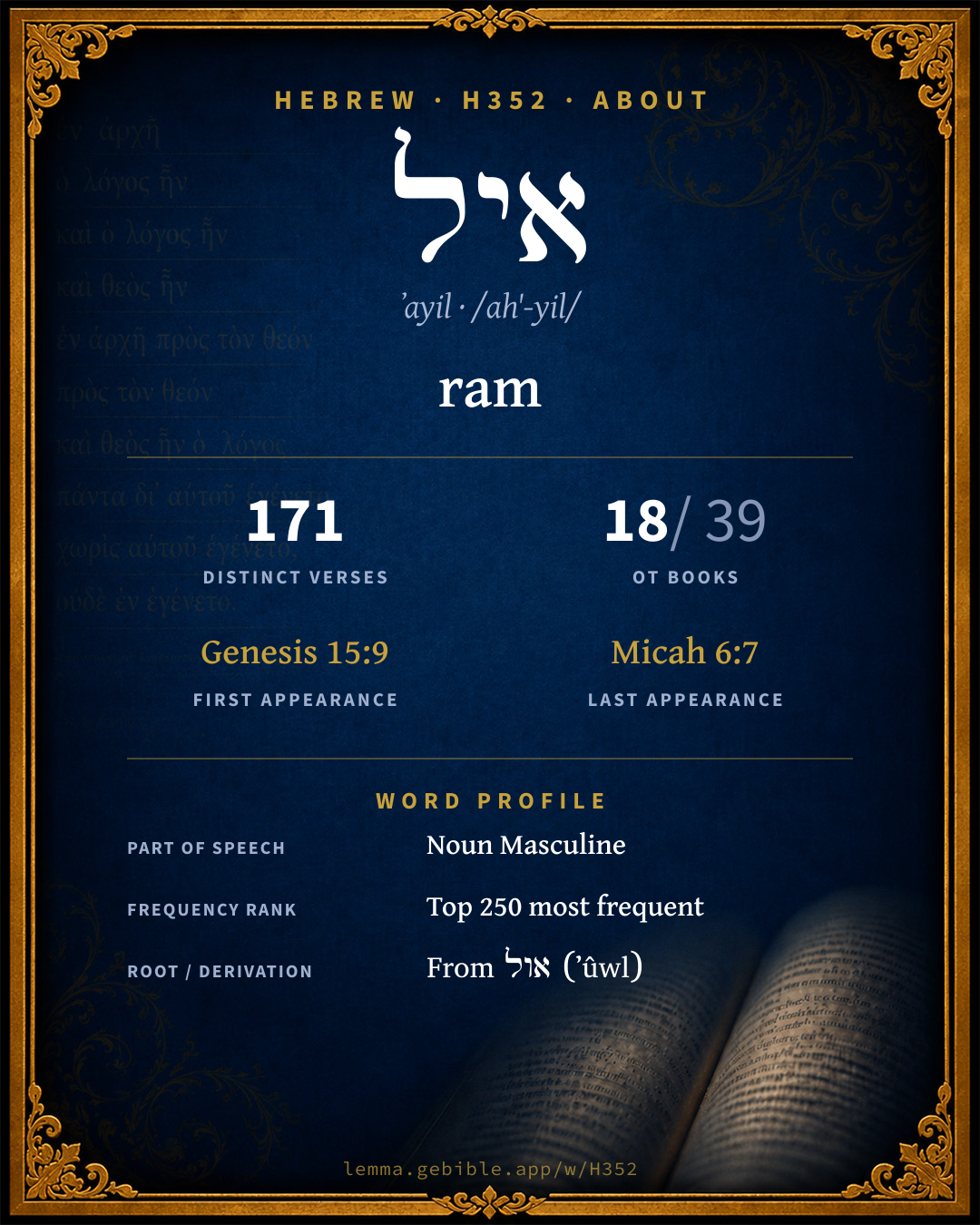
אַ֫יִל
ram
‘ram’ is one of 4 main senses fuller range ↓
Full lexicon entry — Brown-Driver-Briggs (BDB)
From Brown-Driver-Briggs (BDB)
Where this word appears
See every Absolute-state word in the Hebrew Bible →
Grammar key — what these labels mean
Part of speech
- Noun
- A naming word — a person, place, thing, or idea.
Noun type
- Common
- A common noun — a general class of person, place, or thing (“king,” “city,” “water”), not a specific name.
State
- Absolute
- The independent form of a noun, not bound to a following word.
- Construct
- A noun bound to a following noun in a possessive / “of” relationship (the construct chain).
Gender
- Masculine
- Grammatically masculine.
Number
- Plural
- More than one (in Hebrew, generally three or more).
- Singular
- One.
Every verse where H352 appears in the Book of Ezekiel — 33 distinct verses. Click any verse to open its interlinear word-by-word view. Verse text shown in the World English Bible for context — . Each verse’s Hebrew form is shown with its reference; the English is not keyword-highlighted, since the data carries no word-level English alignment. Use “Compare translations” on any verse to read it across multiple English versions. This concordance covers the Hebrew Bible; Septuagint (Greek Old Testament) occurrences are not indexed here.
Ezekiel
- Ezekiel 17:13 אֵילֵ֥י n c mp cs and he took of the seed royal, and made a covenant with him; he also brought him under an oath, and took away the mighty of the land;
- Ezekiel 27:21 וְ/אֵילִים֙ conj + n c mp Arabia, and all the princes of Kedar, they were the merchants of your hand; in lambs, and rams, and goats, in these were they your merchants.
- Ezekiel 31:11 אֵ֣יל n c ms cs I will even deliver him into the hand of the mighty one of the nations; he shall surely deal with him; I have driven him out for his wickedness.
- Ezekiel 31:14 אֵלֵי/הֶ֛ם n c mp cs + sfx pers 3mp to the end that none of all the trees by the waters exalt themselves in their stature, neither set their top among the thick boughs, nor that their mighty ones stand up on their height, [even] all who drink water: for they are all delivered to death, to the lower parts of the earth, in the midst of the children of men, with those who go down to the pit.
- Ezekiel 34:17 לָ/אֵילִ֖ים prep det + n c mp As for you, O my flock, thus says the Lord Yahweh: Behold, I judge between sheep and sheep, the rams and the male goats.
- Ezekiel 39:18 אֵילִ֨ים n c mp You shall eat the flesh of the mighty, and drink the blood of the princes of the earth, of rams, of lambs, and of goats, of bulls, all of them fatlings of Bashan.
- Ezekiel 40:9 ו/איל/ו וְ/אֵילָ֖י/ו conj + n c ms cs + sfx pers 3ms conj + n c mp cs + sfx pers 3ms Then measured he the porch of the gate, eight cubits; and the posts of it, two cubits; and the porch of the gate was toward the house.
- Ezekiel 40:10 לָ/אֵילִ֖ם prep det + n c mp The lodges of the gate eastward were three on this side, and three on that side; they three were of one measure: and the posts had one measure on this side and on that side.
- Ezekiel 40:14 אֵילִ֖ים אֵיל֙ n c mp n c ms cs He made also posts, sixty cubits; and the court [reached] to the posts, round about the gate.
- Ezekiel 40:16 אֵלֵי/הֵ֨מָה אַ֖יִל n c mp cs + sfx pers 3mp n c ms There were closed windows to the lodges, and to their posts within the gate round about, and likewise to the arches; and windows were round about inward; and on [each] post were palm trees.
- Ezekiel 40:21 ו/איל/ו וְ/אֵילָ֤י/ו conj + n c ms cs + sfx pers 3ms conj + n c mp cs + sfx pers 3ms The lodges of it were three on this side and three on that side; and the posts of it and the arches of it were after the measure of the first gate: the length of it was fifty cubits, and the breadth twenty-five cubits.
- Ezekiel 40:24 איל/ו אֵילָי/ו֙ n c ms cs + sfx pers 3ms n c mp cs + sfx pers 3ms He led me toward the south; and, behold, a gate toward the south: and he measured the posts of it and the arches of it according to these measures.
- Ezekiel 40:26 איל/ו אֵילָֽי/ו n c ms cs + sfx pers 3ms n c mp cs + sfx pers 3ms There were seven steps to go up to it, and the arches of it were before them; and it had palm trees, one on this side, and another on that side, on the posts of it.
- Ezekiel 40:29 ו/איל/ו וְ/אֵילָ֤י/ו conj + n c ms cs + sfx pers 3ms conj + n c mp cs + sfx pers 3ms and the lodges of it, and the posts of it, and the arches of it, according to these measures: and there were windows in it and in the arches of it round about; it was fifty cubits long, and twenty-five cubits broad.
- Ezekiel 40:31 איל/ו אֵילָ֑י/ו n c ms cs + sfx pers 3ms n c mp cs + sfx pers 3ms The arches of it were toward the outer court; and palm trees were on the posts of it: and the ascent to it had eight steps.
- Ezekiel 40:33 ו/אל/ו וְ/אֵלָ֤י/ו conj + n c ms cs + sfx pers 3ms conj + n c mp cs + sfx pers 3ms and the lodges of it, and the posts of it, and the arches of it, according to these measures: and there were windows therein and in the arches of it round about; it was fifty cubits long, and twenty-five cubits broad.
- Ezekiel 40:34 אל/ו אֵלָ֖י/ו n c ms cs + sfx pers 3ms n c mp cs + sfx pers 3ms The arches of it were toward the outer court; and palm trees were on the posts of it, on this side, and on that side: and the ascent to it had eight steps.
- Ezekiel 40:36 אל/ו אֵלָ֣י/ו n c ms cs + sfx pers 3ms n c mp cs + sfx pers 3ms the lodges of it, the posts of it, and the arches of it: and there were windows therein round about; the length was fifty cubits, and the breadth twenty-five cubits.
- Ezekiel 40:37 ו/איל/ו וְ/אֵילָ֗י/ו איל/ו אֵילָ֖י/ו conj + n c ms cs + sfx pers 3ms conj + n c mp cs + sfx pers 3ms n c ms cs + sfx pers 3ms n c mp cs + sfx pers 3ms The posts of it were toward the outer court; and palm trees were on the posts of it, on this side, and on that side: and the ascent to it had eight steps.
- Ezekiel 40:38 בְּ/אֵילִ֖ים prep + n c mp A chamber with the door of it was by the posts at the gates; there they washed the burnt offering.
- Ezekiel 40:48 אֵ֣ל n c ms cs Then he brought me to the porch of the house, and measured each post of the porch, five cubits on this side, and five cubits on that side: and the breadth of the gate was three cubits on this side, and three cubits on that side.
- Ezekiel 40:49 הָ֣/אֵילִ֔ים ptcl def.art + n c mp The length of the porch was twenty cubits, and the breadth eleven cubits; even by the steps by which they went up to it: and there were pillars by the posts, one on this side, and another on that side.
- Ezekiel 41:1 הָ/אֵילִ֗ים ptcl def.art + n c mp He brought me to the temple, and measured the posts, six cubits broad on the one side, and six cubits broad on the other side, which was the breadth of the tent.
- Ezekiel 41:3 אֵֽיל n c ms cs Then went he inward, and measured each post of the entrance, two cubits; and the entrance, six cubits; and the breadth of the entrance, seven cubits.
- Ezekiel 43:23 וְ/אַ֥יִל conj + n c ms When you have made an end of cleansing it, you shall offer a young bull without blemish, and a ram out of the flock without blemish.
- Ezekiel 43:25 וְ/אַ֥יִל conj + n c ms Seven days shall you prepare every day a goat for a sin-offering: they shall also prepare a young bull, and a ram out of the flock, without blemish.
- Ezekiel 45:23 אֵילִ֤ים n c mp The seven days of the feast he shall prepare a burnt offering to Yahweh, seven bulls and seven rams without blemish daily the seven days; and a male goat daily for a sin-offering.
- Ezekiel 45:24 לָ/אַ֖יִל prep det + n c ms He shall prepare a meal-offering, an ephah for a bull, and an ephah for a ram, and a hin of oil to an ephah.
- Ezekiel 46:4 וְ/אַ֥יִל conj + n c ms The burnt offering that the prince shall offer to Yahweh shall be on the Sabbath day six lambs without blemish and a ram without blemish;
- Ezekiel 46:5 לָ/אַ֔יִל prep det + n c ms and the meal-offering shall be an ephah for the ram, and the meal-offering for the lambs as he is able to give, and a hin of oil to an ephah.
- Ezekiel 46:6 וָ/אַ֖יִל conj + n c ms On the day of the new moon it shall be a young bull without blemish, and six lambs, and a ram; they shall be without blemish:
- Ezekiel 46:7 לָ/אַ֨יִל֙ prep det + n c ms and he shall prepare a meal-offering, an ephah for the bull, and an ephah for the ram, and for the lambs according as he is able, and a hin of oil to an ephah.
- Ezekiel 46:11 לָ/אַ֔יִל prep det + n c ms In the feasts and in the solemnities the meal-offering shall be an ephah for a bull, and an ephah for a ram, and for the lambs as he is able to give, and a hin of oil to an ephah.
About this entry
At a glance — auto-summarized from this page’s data, not written by a person. Every figure links to its source below. This summary describes the numbers; it doesn’t interpret them.
At its core, איל (ʼayil) means “ram.” Carrying more than one sense, it rewards its full sense range. It turns up in 171 verses across 18 books, a common footprint. The word gravitates to Numbers (38%), then Ezekiel and Exodus. Scripture first uses it in Genesis 15:9. Dig into 171-verse concordance and the renderings breakdown below.
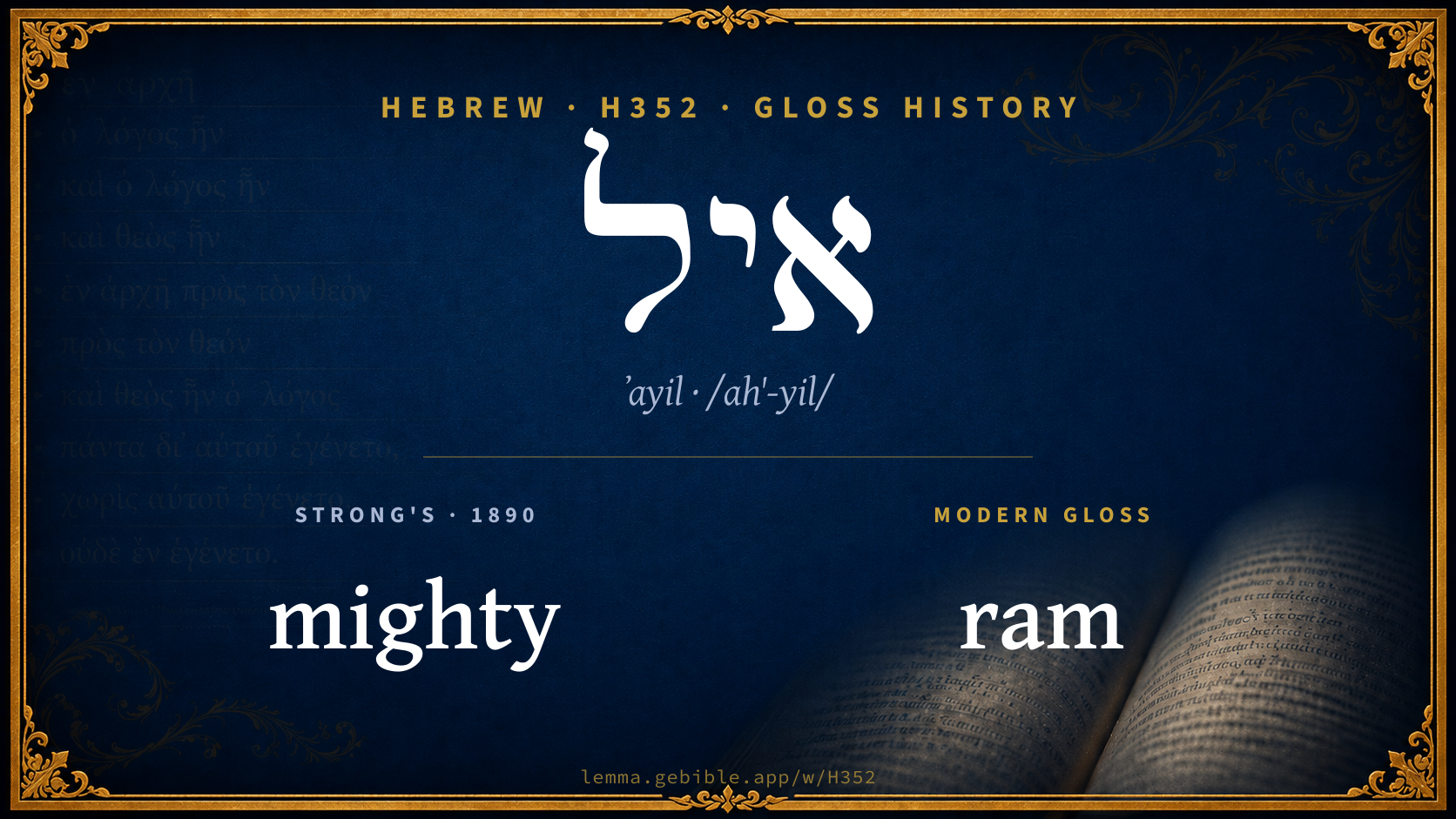
Gloss history
Strong's 1890 vs modern scholarship
About this word
Strong's H352 catalogs a Hebrew word from the Hebrew Old Testament.
These counts are not copied from any lexicon or concordance. They are computed here, from the morphology-tagged Hebrew Old Testament. What Lemma adds →
- 171
- distinct verses
- The word appears in 171 distinct verses.
- 18 / 39
- OT books
- The word appears in 18 of 39 Old Testament books.
- #240
- by frequency
- Top 250 most frequent Hebrew words (rank 240 of 8,640 Hebrew words by occurrence).
View all 171 occurrences in the concordance →
By section of the Old Testament
By traditional corpus
Conventional, traditional groupings — biblical authorship is debated, so this is a traditional corpus grouping, not an authorship claim. Each share is this word’s portion of its verses in that division of the Hebrew canon. Each figure is a share of the word’s 171 distinct verses.
- Torah (Pentateuch) 109 verses · 64%
- Prophets (Nevi'im) 44 verses · 26%
- Writings (Ketuvim) 18 verses · 11%
How translations render this word
Counts come from each version’s own published word-to-Strong’s tagging or interlinear alignment — an approximate guide to how each version renders this word, not a word-level alignment the data otherwise carries. Because each total is that version’s own tagged count, the per-version totals vary from one another and need not match the appearance or distinct-verse counts above. These counts may also differ from a printed concordance because Lemma counts each distinctly tagged rendering and does not collapse phrase taggings into a single head-word total. This is a fixed set of word-tagged versions (KJV, ASV, BSB, ULT) and does not change with the reading translation you choose elsewhere. Each version’s license is shown beside its name below (and on Sources).
BDB lists this Strong’s number as 5 distinct words (homographs). Each count above pools all of them and is not split by sense — see the Senses section below. A low-frequency rendering may belong to a different one of those words, not the primary meaning.
- King James Version†: Ram 84×, Rams 56×, Posts 8×
- American Standard Version†: Ram 80×, Rams 61×, Posts 7×
- Berean Standard Bible†: Ram 87×, Rams 58×, Side pillars 12×
- unfoldingWord Literal Text†: Ram 77×, Rams 60×, And 11×
King James Version Public Domain
Renders H352 across 185† tagged occurrences — most commonly:
Plus 14 renderings that appear only once — usually multi-word phrases or single function words the recovered tagging swept in, not distinct renderings.
American Standard Version Public Domain
Renders H352 across 185† tagged occurrences — most commonly:
Plus 23 renderings that appear only once — usually multi-word phrases or single function words the recovered tagging swept in, not distinct renderings.
Berean Standard Bible Public Domain
Renders H352 across 178† tagged occurrences — most commonly:
Plus 14 renderings that appear only once — usually multi-word phrases or single function words the recovered tagging swept in, not distinct renderings. Not rendered by a distinct English word in 5 further occurrences.
unfoldingWord Literal Text CC BY-SA 4.0
Renders H352 across 207† tagged occurrences — most commonly:
Plus 20 renderings that appear only once — usually multi-word phrases or single function words the recovered tagging swept in, not distinct renderings.
Senses in the full BDB
What do BDB’s symbols mean?
BDB uses these scholarly abbreviations:
| Symbol | Meaning |
|---|---|
| 𝔊 | the Septuagint (the ancient Greek translation, LXX) |
| 𝔙 | the Vulgate (the Latin translation) |
| 𝔖 | the Syriac version (the Peshitta) |
| 𝔗 | the Targum (the Aramaic translation) |
| ψ | the Psalms |
| √ | root (the underlying root or stem) |
| ‖ | parallel passage (a synonymous or contrasted parallel) |
| † | the dagger: every passage where the word occurs is cited |
The 3 senses and sub-senses the full Brown-Driver-Briggs lexicon distinguishes for this word, in lexicon order (not ranked by frequency), with BDB’s own verbatim wording and sub-sense lettering. Shown in Hebrew script with BDB’s own scholarly abbreviations. The condensed entry is in the Lexicon Entry tab. See also the Forms in the corpus table below.
איל I
- 1. used as food Gn 31:38 (E) Dt 32:14 (cf. ram of sacrifice, infr. e.g. Ex 29:32 cf. Lv 8:31); as yielding wool 2 K 3:4; as tribute 2 Ch 17:11; as merchandise Ez 27:21; as gift Gn 32:15 (E); in sim. of leaping, skipping ψ 114:4 (הֶהָרִים רָקְדוּ כְּא׳) v 6; in Dn.’s vision, ram with two horns symbol. kings of Media and Persia Dn 8:3, 4, 6, 7(×4), 20; fig. of rich and powerful in Isr. Ez 34:17. e.g. Genesis 31:38
- 2. slain in ceremony of ratification of covenant betw. י׳ & Abr. Gn 15:9 (J); in Abr.’s sacrif. Gn 22:13(×2) (E); Balaam’s sacrif. Nu 23:1 + 5 times Nu 23 (JE); so in ritual (P), (a) in consecration ceremony of Aaron & his sons Ex 29:1 + 15 times Ex 29 (א׳ מִלֻּאִים v 22 cf. v 26, 27, 31) Lv 8:2 + 8 times Lv 8 (א׳ הַמִּלֻּאִים v 22, 29 א׳ הָעֹלָה v 18); (b) in guilt-offering (אָשָׁם) Lv 5:15, 16, 18, 25; 19:21, 22 cf. Ezr 10:19 & א׳ הַכִּפֻּרִים Nu 5:8; (c) burnt-offering (עֹלָה) Lv 9:2 & Nu 15:6, 11 & Ez 46:4, 5, 6, 7, 11, on day of atonement Lv 16:3, 5, Pentecost 23:18; (d) peace-offering (שְׁלָמִים) Lv 9:4, 18, 19; beginning of month Nu 28:11, 12, 14 cf. 29:2, 3; passover 28:19, 20 cf. Ez 45:23, 24; day of firstfruits Nu 28:27, 28; in 7th month 29:8 + 18 times Nu 29; (e) in law of Nazarite Nu 6:14, 17, 19; (f) in consecration of altar of tabernacle Nu 7:15 + 25 times Nu 7, cf. consecr. of Ezek.’s temple-altar Ez 43:23, 25; (g) more generally 1 S 15:22; Is 1:11 Mi 6:7 Jb 42:8 ψ 66:15, also Is 34:6; 60:7; at bringing ark to Jerus. 1 Ch 15:26; other occasions 29:21; 2 Ch 13:9; 29:21, 22, 32; Ezr 8:35; cf. fig. Je 51:40; Ez 39:18. e.g. Genesis 15:9
- 3. עֹרֹת אֵילִים מְאָדָּמִים rams’ skins dyed red, of covering of tabernacle Ex 25:5; 26:14 35:7, 23; 36:19 cf. 39:34 (all P). e.g. Exodus 25:5
איל II [m.] projecting pillar or pilaster
איל III leader, chief (= ram, as leader of flock? cf. Di Ex 15
איל IV terebinth (prob. as prominent, lofty tree, v. Di Gn 12
Senses from the full Brown-Driver-Briggs lexicon (Brown, Driver, Briggs; Oxford 1906 — public domain), digitized via Sefaria, supplemented by the OpenScriptures HebrewLexicon (CC BY 4.0). Full attribution on Sources.
Word origin
I. n.m. Gn 22:13 ram (as leader of flock, NHeb. & Aramaic id., Assyrian ailu DlW, Ph. איל, = אַיִל rather than אַיָּל, cf. CISi. p. 231)—אַיִל (אָ֑יִל) Gn 15:9 +; cstr. אֵיל Ex 29:22 +; pl. אֵילִים (אֵילִם, אֵלִים) Gn 32:15 +; cstr. אֵילֵי Gn 31:38 Is 60:7.—ram,
II. n.[m.] projecting pillar or pilaster—א׳ abs. 1 K 6:31 (but v. infr.) cstr. id. Ez 40:14 (but del. Co) 16 (Co better אֵילָיו); אֵיל 41:3, אֵל 40:48; pl. אֵילִים 40:14 +; אֵילִם 40:10; sf. אילו Kt 40:9 + 7 times; אלו Kt 40:29 + 2 times Qr (in all) אֵילָיו, אֵלָיו; אֵלֵיהֵמָֿה 40:16;—pilaster or projection in wall at each side of entrance (cf. BöProben, 302; NÄ 927), in Sol.’s temple 1 K 6:31 (BöNÄ 525 reads אֵילָם), in Ezek.’s temple Ez 40:9, 10 + 14 times Ez 40.41 + 40:14a Ew Hi Co אילם cf. 𝔊B; 40:38 read אילם so Sm Co cf. 𝔊; 40:14b Co del. א׳.
III. n.m. leader, chief (= ram, as leader of flock? cf. Di Ex 15:15 Ol§ 142 f LagBN 170 & v. Ez 34:17)—cstr. אֵל Ez 31:11; pl. cstr. אֵילֵי Ex 15:15 Ez 17:13; + 2 K 24:15 Qr (Kt אולי v. אוּל); אֵלֵי Ez 32:21 (del. Co, v. 𝔊).—leader, chief א׳ מוֹאָב Ex 15:15; א׳ הָאָרֶץ Ez 17:13 2 K 24:15 Qr; א׳ גּוֹיִם Ez 31:11 (אֵלִים Jb 41:17 v. sub i. -אלה; perhaps אֵלֵיהֶם Ez 31:14 but cf. infr. iv. איל & also אֶל Note 1).
IV. n.m. terebinth (prob. as prominent, lofty tree, v. Di Gn 12:6; 14:6)—cstr. אֵיל only n.pr. אֵיל פָּארָן vid. infr.; pl. אֵילִים Is 1:29; אֵלִים Is 57:5 cstr. אֵילֵי Is 61:3; sf. אֵלֵיהֶם Ez 31:14 (> del. Co vid. 𝔙 𝔄).—terebinth (cf. אֵלָה); as marking idol-shrines Is 1:29; 57:5 (so Che Di etc. > gods); fig. of ransomed ones of Zion אֵילֵי הַצֶּדֶק; 61:3; perhaps of haughty ones Ez 31:14.
— Brown-Driver-Briggs (Oxford 1906, public domain), digitized via Sefaria, supplemented by the OpenScriptures HebrewLexicon (CC BY 4.0). See Sources.
Derived from אול (ʼûwl) (H193) — belly.
Jastrow Dictionary
A second Hebrew/Aramaic lexicon for comparison, covering Aramaic and post-biblical (Talmudic, Targumic, Midrashic) usage that the biblical-Hebrew BDB does not. Matched by lemma rather than by Strong’s number, so a lemma may carry more than one Jastrow headword (shown separately below), and the entries cover usage well beyond the Bible.
*אֱיָל
- superiority, patronage, arbitration; v. Midr. Till. to Ps. LXXXVIII, 5. Midr. Till. to Ps. CIV, 29 (ref. to Is. LVII, 19 peace, peace &c.) אילולי (אֱיָילוֹ) אֱיָלוֹ של וכ׳ but for the peace-making arbitration of the Lord &c. e.g. Isaiah 57:19
אַיִל
- 1. ram (the strong). B. Kam. 65ᵇ if one stole טלה ונעשה א׳ a lamb and it grew to be a ram. Ib. א׳ בן יומו קרוי א׳ a ram one day old is called a ram (ayil is used in a general sense, irrespective of age). R. Hash. 16ᵃ; a. fr.—[*Pl. אֵלִים. Tosef. R. Hash. III (II), 3 (Var. יעלים).]—
- *2. א׳ קמצא [perh. אַיָּל q. v.] a species of locusts. Eduy. VIII, 4; Pes. 16ᵃ; Ab. Zar. 37ᵃ אייל ed. (Ms. M. אייול), v. דְּכֵי.
אַיָּל
- prob. fr. אול = עול, cmp. Var. lect. of אַיֶּלֶת II; cmp. אלל) [the climber], hart. Ḥull. 28ᵃ; a. e.
A Dictionary of the Targumim, the Talmud Babli and Yerushalmi, and the Midrashic Literature (Marcus Jastrow; London, Luzac, 1903) — Public Domain. Digitized via Sefaria. Digitized via Sefaria. Full attribution on Sources.
Forms in the corpus
The 93 distinct written forms H352 takes in the Hebrew Bible, most frequent first — each parse links to that state’s occurrences in the concordance. Hebrew forms include their vowel points and cantillation, so a single lemma takes many written forms.
The 60 most common forms are shown; 33 rarer forms follow in the full concordance.
Same root — word family
Other BDB entries built from the same root as H352, grouped by Strong’s listed origin. These share a root / origin per the lexicon — not necessarily a shared meaning. Each links to that word’s own entry.
Derives from
Derived from this word
- איל ʼĕyâl H353 strength
- איל ʼayâl H354 stag
- אילם ʼêylâm H361 porch
- אילן ʼîylân H363 tree
- אלה ʼêlâh H424 terebinth
- אלון ʼêlôwn H436 oak
Proper names from this root
People and places named from this root — a name, not an additional meaning of the word.
- אילון ʼÊylôwn H356 Elon
- אילות ʼÊylôwth H359 Elath
- אילם ʼÊylim H362 Elim
- איל פארן ʼÊyl Pâʼrân H364 El-paran
- אל ʼêl H410 God
Compare all same-root words → Showing 4 of 13 — not the complete family. 5 of the same-root words are proper names (people or places). They share a root, not necessarily a meaning.
Septuagint verse parallels
This word appears in 168 verses that also exist in the Greek Old Testament (Septuagint), out of the 171 Hebrew verses it occurs in. You can read those verses in Greek by switching the Old Testament edition to the Septuagint.
Read these verses in the Septuagint
- Genesis 15:9
- Exodus 15:15
- Leviticus 5:15
- Numbers 5:8
- Deuteronomy 32:14
- 1 Samuel 15:22
- 1 Kings 6:31
- 2 Kings 3:4
- 1 Chronicles 15:26
- 2 Chronicles 13:9
- Ezra 8:35
- Job 42:8
This is a verse-level parallel only — the same verses exist in both the Hebrew and Greek Old Testaments. No word-level Hebrew↔Greek correspondence is claimed: the data carries no such alignment, so no Greek word is shown as this Hebrew word’s translation. Coverage is not total — the Septuagint omits the deuterocanon and renumbers the Psalms, so some Hebrew verses have no direct Greek parallel.