
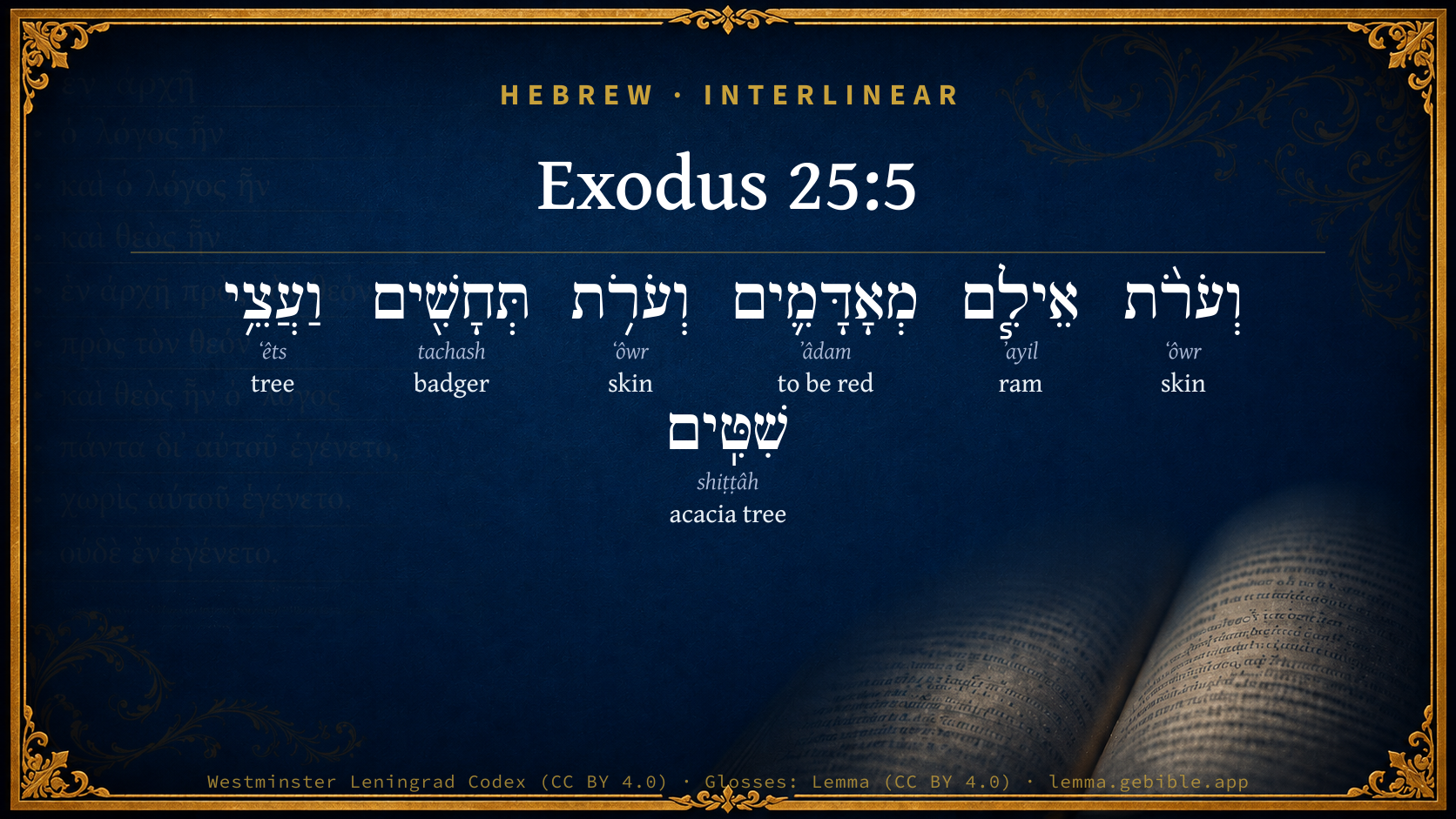
Exodus 25:5

Hebrew (Westminster Leningrad Codex) Exodus 25:5 appears in the Hebrew Old Testament. The text above is from the Westminster Leningrad Codex. Each word links to its Strong’s number, a concise gloss, and parsing drawn from the Open Scriptures Hebrew Bible morphology. Click any word for its full Brown-Driver-Briggs (BDB) entry.
Download image
Cite this verse

Exodus 25:5 (World English Bible). Public Domain. Lemma interlinear Bible study tool, https://lemma.gebible.app/v/exodus/25/5.

Show BibTeX & RIS
BibTeX
RIS
English Translation
rams' skins dyed red, sea cow hides, acacia wood,
World English Bible · Public Domain
Highlights
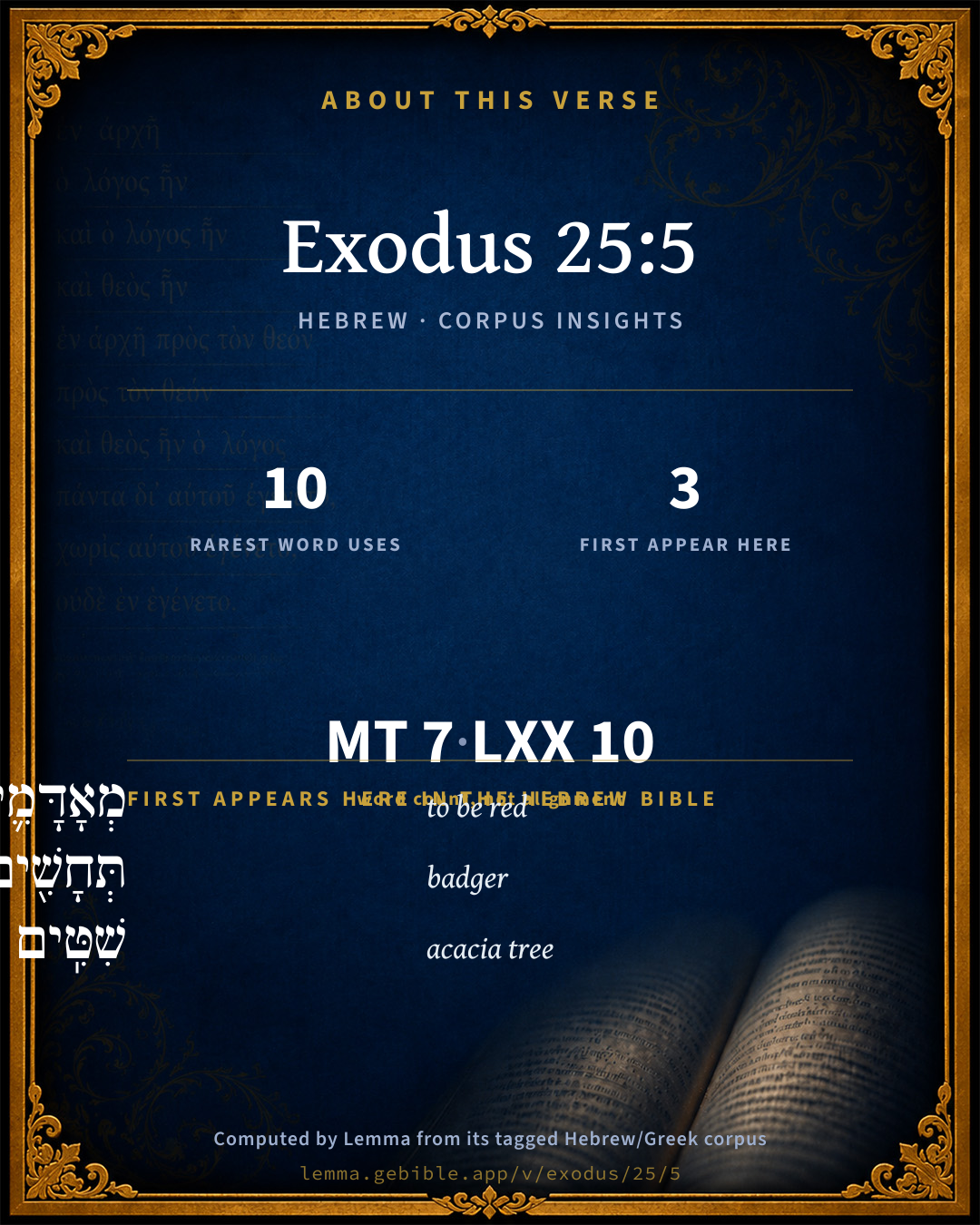
  • 3 first appearances in the Hebrew Bible
Full analysis ↓
Download a study sheet

One document with this verse’s original text, its word-by-word gloss line, the meaning frame, cross-references with their text, attributed commentary, and full source and license credits — printable, and it pastes into notes with its structure intact.

This verse Autodidact and up

Study sheet (.html) Plain text (.txt)

A passage Seminary Student

Up to 50 verses in one chapter. A passage sheet keeps up to 6 commentary sources and 12 cross-references per verse, in the order this page ranks them, and says so on the sheet whenever that leaves anything out. Ask for a single verse and you get the Autodidact verse sheet above.

Everything on this page stays free to read, with no account — the sheet is a download of what is already on screen, not access to it.

Want to remove ads? Support Godless Engineer
Compare translations 3

The same verse in 3 English versions, stacked beneath the original-language interlinear above. Click any original word for its lexicon entry.

Each is an independent rendering of the whole verse — the interlinear is not word-aligned to these translations.

Highlighted words mark where these versions differ — a whole-verse word diff, not a word-by-word alignment.

  • World English Bible Public Domain
    rams' skins dyed red, sea cow hides, acacia wood,
  • King James Version Public Domain
    And rams' skins dyed red, and badgers' skins, and shittim wood,
  • unfoldingWord Literal Text CC BY-SA 4.0
    and reddened hides of rams and hides of sea cows and wood of acacias,

unfoldingWord Literal Text — © unfoldingWord, licensed CC BY-SA 4.0. Word-aligned USFM3 via Door43 (git.door43.org/unfoldingWord/en_ult).

Versions to compare (up to 4)

3 of 4 selected

Show all 18 translations

Every available English version of this verse, each an independent rendering of the whole verse.

  • World English Bible Public Domain
    rams' skins dyed red, sea cow hides, acacia wood,
  • Berean Standard Bible Public Domain
    ram skins dyed red and fine leather; acacia wood;
  • Majority Standard Bible Public Domain
    ram skins dyed red and fine leather; acacia wood;
  • King James Version Public Domain
    And rams' skins dyed red, and badgers' skins, and shittim wood,
  • American Standard Version (1901) Public Domain
    and rams' skins dyed red, and sealskins, and acacia wood,
  • Revised Version (1885) Public Domain
    and rams’ skins dyed red, and sealskins, and acacia wood;
  • Geneva Bible (1599) Public Domain
    And rammes skinnes coloured red, and the skinnes of badgers, and the wood Shittim,
  • Douay-Rheims (1899) Public Domain
    And rams' skins dyed red, and violet skins, and setim wood:
  • Young's Literal Translation Public Domain
    and rams' skins made red, and badgers' skins, and shittim wood,
  • Literal Standard Version CC BY-SA 4.0
    and rams’ skins made red, and tachashim skins, and shittim wood,
  • Unlocked Literal Bible CC BY-SA 4.0
    ram skins dyed red and sea cow hides; acacia wood;
  • unfoldingWord Literal Text CC BY-SA 4.0
    and reddened hides of rams and hides of sea cows and wood of acacias,
  • Darby Bible Public Domain
    and rams' skins dyed red, and badgers' skins; and acacia-wood;
  • World Messianic Bible Public Domain
    rams’ skins dyed red, sea cow hides, acacia wood,
  • Webster's Bible Public Domain
    And rams' skins dyed red, and badgers' skins, and shittim wood.
  • Free Bible Version CC BY-SA 4.0
    ram skins that have been tanned, and fine leather; acacia wood;
  • Bible in Basic English Public Domain
    And sheepskins coloured red, and leather, and hard wood;
  • JPS Tanakh (1917) Public Domain
    and rams' skins dyed red, and sealskins, and acacia-wood;

Literal Standard Version (2020), Covenant Press — licensed CC BY-SA 4.0. Text via the HelloAO Bible API (eBible.org). Unlocked Literal Bible (unfoldingWord) — licensed CC BY-SA 4.0. Text via the HelloAO Bible API (eBible.org). unfoldingWord Literal Text — © unfoldingWord, licensed CC BY-SA 4.0. Word-aligned USFM3 via Door43 (git.door43.org/unfoldingWord/en_ult). Free Bible Version, Dr. Jonathan Gallagher — licensed CC BY-SA 4.0. Text via the HelloAO Bible API (eBible.org).

Word by word

More ways to search: Search by grammar → Find every occurrence → Compare this word →

Practice this passage: Drill this verse → Learn its vocabulary →

About this verse

These counts appear in no published source. They are computed here, from the morphology-tagged text and Lemma’s own curated glosses. What Lemma adds →

7
words
6
distinct lemmas
Pentateuch
section

Notable vocabulary

The rarest word here is מְאָדָּמִ֛ים to be red H119 — appearing just 10 times in the whole Hebrew Bible.

First appearance in Scripture

These words make their first canonical appearance in the Hebrew Bible here:

  • מְאָדָּמִ֛ים to be red H119
  • תְּחָשִׁ֖ים badger H8476
  • שִׁטִּֽים acacia tree H7848

Shared distinctive vocabulary

מְאָדָּמִ֛ים to be red H119 occurs in 10 verses of the Hebrew Bible. Also found in:

Grammatical profile

  • 1 verb
  • 6 nouns

Verb forms

  • מְאָדָּמִ֛ים Pual · Participle Passive

Repetition

A word recurs within this verse — often emphatic in Hebrew:

  • וְעֹרֹ֨ת skin H5785 ×2

Hebrew & Septuagint length

In English translation the verse runs 9 words from the Hebrew and 11 from the Septuagint (LXX English) — closely comparable.

A rough comparison of the two English renderings, which tokenize alike — not a word-level alignment.

Word counts can differ between the Hebrew and the Greek without any difference in meaning — e.g. the Hebrew direct-object marker אֵת has no separate Greek word, and Greek often adds the article ὁ.

In the original languages it is 7 Hebrew tokens and 10 Greek tokens — but the two are counted differently (Hebrew bundles its prefixes and suffixes into one token; the Greek is in lemma form), so that isn’t a like-for-like length.

Cross-references

4

Topical passages linked to Exodus 25:5 in the Treasury of Scripture Knowledge — connected by theme and wording, ordered by reader-vote popularity; previews shown in the World English Bible.

  • Exodus 26:14–15 You shall make a covering for the tent of rams' skins dyed red, and a covering of sea cow hides above.
  • Exodus 26:26 "You shall make bars of acacia wood: five for the boards of the one side of the tent,
  • Exodus 26:37–27:1 You shall make for the screen five pillars of acacia, and overlay them with gold: their hooks shall be of gold: and you shall cast five sockets of brass for them.
  • Exodus 36:20 He made the boards for the tent of acacia wood, standing up.

Cross-references courtesy of OpenBible.info (CC BY 4.0).

Hebrew and Greek witnesses Masoretic Hebrew ↔ Greek Septuagint

The same verse in the two great witnesses to the Old Testament, shown verse-for-verse.

These are two independent witnesses, not word-aligned to each other, and the Septuagint is shown in lemma (dictionary) form.

Hebrew Exodus 25:5 Masoretic · Westminster Leningrad Codex

וְעֹרֹ֨ת אֵילִ֧ם מְאָדָּמִ֛ים וְעֹרֹ֥ת תְּחָשִׁ֖ים וַעֲצֵ֥י שִׁטִּֽים

rams' skins dyed red, sea cow hides, acacia wood,

World English Bible · Public Domain

Greek LXX Exodus 25:5 Septuagint · lemma form

καί δέρμα κριός ἐρυθροδανόω καί δέρμα ὑακίνθινος καί ξύλον ἄσηπτος

and rams' skins dyed red, and blue skins, and incorruptible wood,

LXX2012 (modern English Septuagint) · Public Domain

On this verse, Adam Clarke's Commentary discusses the Septuagint’s reading. Read the note in Commentary ↓

Hebrew: Westminster Leningrad Codex (CC BY 4.0). Greek: Septuagint (public domain); English from LXX2012 (modern English Septuagint) (Public Domain). How the Septuagint differs from the Hebrew →

Targum (Aramaic paraphrase)

2

The Targum is the ancient Jewish Aramaic paraphrase of the Hebrew Scriptures — an interpretive translation, not the Hebrew text itself. Onkelos (literal) and Pseudo-Jonathan (expansive) render the Torah, and Jonathan the Prophets. Coverage is partial: where no permissively-licensed English translation exists for a verse, only the Aramaic is shown. This is verse-level text, not a word-by-word alignment to the Hebrew.

  1. Targum Onkelos Torah (Genesis–Deuteronomy)
    וּמַשְׁכֵי דְדִכְרֵי מְסַמְקֵי וּמַשְׁכֵי סַסְגוֹנָא וְאָעֵי שִׁטִין:

    (no public-domain English translation for this verse)

    Targum Onkelos — Aramaic: “Onkelos Genesis” (public domain); “Onkelos Exodus” (public domain); “Onkelos Leviticus” (public domain); “Onkelos Numbers” (public domain); “Onkelos Deuteronomy” (public domain). English: “Sefaria Community Translation” (CC0 1.0 (public-domain dedication)); “J.W. Etheridge. The Targums of Onkelos and Jonathan Ben Uzziel on the Pentateuch. London: Longmans, Green, 1862” (public domain). Text via Sefaria.

  2. Targum Pseudo-Jonathan Torah (Genesis–Deuteronomy)
    וּמַשְׁכֵי דְדִכְרֵי מְסַמְקֵי וּמַשְׁכֵי דְסַסְגוֹנָא וְקַיְסִין דְּשִׁיטִין

    and skins of rams dyed red, and purpled skins, and woods of sittin,

    Targum Pseudo-Jonathan — Aramaic: “Targum Jonathan on Genesis” (public domain); “Targum Jonathan on Exodus” (public domain); “Targum Jonathan on Leviticus” (public domain); “Targum Jonathan on Numbers” (public domain); “Targum Jonathan on Deuteronomy” (public domain). English: “The Targum of Jonathan ben Uzziel, trans. J. W. Etheridge, London, 1862” (public domain). Text via Sefaria.

Commentary

Notes on Exodus 25:5 from classic Christian and Jewish commentators (each source and its license shown beneath its notes). The classic Christian expositions comment on the surrounding passage and are grouped to its opening verse, so a note may address several verses; the Jewish commentaries on the Tanakh (Rashi and others) are per-verse, so they appear only where the commentator wrote on this verse.

Lemma curates 59 commentaries, every one of them public domain or Creative Commons licensed, each selected and text-cleaned for this edition rather than reprinted as found. About our sources →

Trapp's Complete Commentary

John Trapp

Exo 25:5 And rams’ skins dyed red, and badgers’ skins, and shittim wood,

Ver. 5. Shittim wood.] A kind of cedar that rotteth not.

John Trapp, A Commentary or Exposition upon All the Books of the Old and New Testament (1647–1656) — public domain. Text from a community e-Sword module.

Geneva Bible (1599)

Geneva Bible translators

Which is thought to be a kindle of Cedar, which will not rot.

Geneva Bible (1599) marginal notes — public domain. Text via Bolls.life.

Jamieson, Fausset & Brown

Robert Jamieson, A. R. Fausset & David Brown

badgers' skins--The badger was an unclean animal, and is not a native of the East--rather some kind of fish, of the leather of which sandals are made in the East. [See on Exo 39:34 and Eze 16:10.]

shittim wood--or Shittah (Isa 41:19), the acacia, a shrub which grows plentifully in the deserts of Arabia, yielding a light, strong, and beautiful wood, in long planks.

Jamieson, Fausset & Brown — Commentary Critical and Explanatory on the Whole Bible (1871) — public domain (CC PDM 1.0). Text via the HelloAO Bible API.

Adam Clarke's Commentary

Verse 5. Rams' skins dyed red] ערת אילם מאדמים oroth eylim meoddamim, literally, the skins of red rams. It is a fact attested by many respectable travellers, that in the Levant sheep are often to be met with that have red or violet-coloured fleeces. And almost all ancient writers speak of the same thing. Homer describes the rams of Polyphemus as having a violet-coloured fleece.

Αρσενες οΐες ησαν εΰτρεφεες, δασυμαλλοι,

Καλοι τε, μεγαλοι τε, ιοδνεφες ειρος εχοντες.

Odyss., lib. ix., ver. 425.

"Strong were the rams, with native purple fair,

Well fed, and largest of the fleecy care."

POPE.

Pliny, Aristotle, and others mention the same. And from facts of this kind it is very probable that the fable of the golden fleece had its origin. In the Zetland Isles I have seen sheep with variously coloured fleeces, some white, some black, some black and white, some of a very fine chocolate colour. Beholding those animals brought to my recollection those words of Virgil: -

Ipse sed in pratis Aries jam suave rubenti

Murice, jam croceo mutabit vellera luto.

Eclog. iv., ver. 43.

"No wool shall in dissembled colours shine;

But the luxurious father of the fold,

With native purple or unborrow'd gold,

Beneath his pompous fleece shall proudly sweat,

And under Tyrian robes the lamb shall bleat."

DRYDEN.

Badgers' skins] ערת תחשים oroth techashim. Few terms have afforded greater perplexity to critics and commentators than this. Bochart has exhausted the subject, and seems to have proved that no kind of animal is here intended, but a colour. None of the ancient versions acknowledge an animal of any kind except the Chaldee, which seems to think the badger is intended, and from it we have borrowed our translation of the word. The Septuagint and Vulgate have skins dyed a violet colour; the Syriac, azure; the Arabic, black; the Coptic, violet; the modern Persic, ram-skins, c. The colour contended for by Bochart is the hysginus, which is a very deep blue. So Pliny, Coccoque tinctum Tyrio tingere, ut fieret hysginum. "They dip crimson in purple to make the colour called hysginus." - Hist. Nat., lib. ix., c. 65, edit. Bipont.

Shittim wood] By some supposed to be the finest species of the cedar by others, the acacia Nilotica, a species of thorn, solid, light, and very beautiful. This acacia is known to have been plentiful in Egypt, and it abounds in Arabia Deserta, the very place in which Moses was when he built the tabernacle; and hence it is reasonable to suppose that he built it of that wood, which was every way proper for his purpose.

Adam Clarke's Commentary on the Bible (1810–1826) — public domain. Text from a community e-Sword/MySword module.

Ellicott's Commentary for English Readers

(5) Rams’ skins dyed red.—North Africa has always been celebrated for the production of the best possible leather. Herodotus describes the manufacture of his own times (Hist. iv. 189). Even at the present day, we bind our best books in morocco. Brilliant colours always were, and still are, affected by the North African races, and their “red skins” have been famous in all ages. It is probable that the Israelites had brought with them many skins of this kind out of Egypt.

Badgers’ skins.—The badger is not a native of North Africa, nor of the Arabian desert; and the translation of the Hebrew takhash by “badger” is a very improbable conjecture. In Arabic, tukhash or dukhash is the name of a marine animal resembling the seal; or, perhaps it should rather be said, is applied with some vagueness to a number of sea-animals, as seals, dugongs, dolphins, sharks, and dog-fish. The skins here spoken of are probably those of some one or more of these animals. They formed the outer covering of the Tabernacle (Exo_26:14).

Shittim wood.—That the shittah (plural, shittim) was a species of Acacia is now generally admitted.

It was certainly not the palm; and there are no trees in the Sinaitic region from which boards could be cut (see Exo_26:15) except the palm and the acacia. The Sinaitic acacia (A. Seyal) is a “gnarled and thorny tree, somewhat like a solitary hawthorn in its habit and manner of growth, but much larger” (Tristram). At present it does not, in the Sinaitic region, grow to such a size as would admit of planks, ten cubits long by one and a half wide, being cut from it; but, according to Canon Tristram (Nat. Hist. Of the Bible, p. 392), it attains such a size in Palestine, and therefore may formerly have done so in Arabia. The wood is “hard and close-grained, of an orange colour with a darker heart, well adapted for cabinetwork.”

A Bible Commentary for English Readers, edited by Charles John Ellicott (1878–1897) — public domain. Text from a community e-Sword module.

The Cambridge Bible for Schools and Colleges

gen. ed. J. J. S. Perowne

5. Skins and wood.

rams’ skins dyed red] These formed the second covering over the certains (Exo_26:14).

sealskins] Heb. ‘skins of tĕḥâshim,’ a word of uncertain meaning. In Arab. tuḥas or duḥas means a dolphin, which makes it probable that the dugong (Malay duyong, a sea-cow) is meant, an animal in general appearance not unlike a dolphin, though with a larger and blunter nose (see ill. in Toy’s Ezekiel, in SBOT., p. 124), species of which are common in the Red Sea; their thick and hard skins supply the Bedawin of the Sin. Peninsula with material for sandals (NHB. 44 f.; EB. i. 450 f.). An alternative view has been propounded lately, which may also be right, that taḥash is a loan-word from the Egypt. tḥs, ‘leather’ (Bondi, Aegyptiaca, 1 ff., with a full discussion of different views). The third or outermost covering over the curtains forming the ‘Dwelling’ (Exo_26:14, &c.), wrappings for the sacred vessels on transport (Num_4:6 ff.), and women’s sandals (Eze_16:10), are mentioned as made of taḥash skins. AV. badgers, though some such animal is advocated in the Talm., lacks philological foundation, and has no probability. It is doubtful also whether either seals or porpoises (RV. and RVm.) are sufficiently common in either the Red Sea or the Medit. to be the animals intended.

acacia] Heb. shiṭṭim [for shinṭim], shewn to be acacia, from sanṭ, the Arab. name of that tree. Several species of acacia are found in Palestine, the Sin. Peninsula, and the Arabian desert (EB. s.v. Shittah tree): the Acacia seyâl flourishes in dry wâdys, and grows freely in the Peninsula, and along the W. shore of the Dead Sea: it is a gnarled and thorny tree, some 15–25 feet in height: and its wood is hard, close-grained, and durable (cf. the rend. of LXX. ξύλα ἄσεπτα). According to Doughty (Arab. Des. ii. 678, cited in EB. l.c.), another species is used for shipbuilding on the Arabian coast of the Red Sea. The wood of the tree is mentioned only in the Pent., in connexion with the Tent of Meeting: the tree itself is mentioned also in Isa_41:19. See further NHB. 390 ff., DB. Shiṭṭah tree, the illustration above, p. 181; and the note on Joe_3:18 in the Camb. Bible.

The Cambridge Bible for Schools and Colleges (gen. ed. J. J. S. Perowne; Cambridge University Press, 1878–1918) — public domain. Text from a community e-Sword module.

John Gill's Exposition

And rams' skins died red,.... Of these were made a covering for the tent or tabernacle:

and badgers' skins, which were for the same use: the Septuagint version calls them hyacinth or blue skins; according to which, they seem to be the rams' skins died blue; and so Josephus (b) seems to have understood it; and it is much questionable whether the same creature is meant we call the badger, since that with the Israelites was an unclean creature; nor is its skin made use of for shoes, or well could be, as the skin of this creature is said to be, Eze 16:10. Jarchi says it was a kind of beast only at that time; and Aben Ezra says, it was known in those days but not now: and

shittim wood; supposed by the Jewish writers, as Kimchi (c), and Ben Melech from him, to be the best and most excellent kind of cedar: Aben Ezra conjectures, and he delivers it but as a conjecture, that there might be near Mount Sinai a forest of "shittim" trees; and while the Israelites were there they cut them down for booths, which they might carry with them when they removed from thence; for, he says, Moses did not speak of the tabernacle till after the day of atonement: and since Acacia is by much the largest and the most common tree of the deserts of Arabia, as Dr. Shaw (d) observes, he thinks there some reason to conjecture, that the "shittim wood", whereof the several utensils of the tabernacle, &c. were made, was the wood of Acacia: and long ago it was the opinion of Cordus (e) that the "shittim wood" was the Acacia of Dioscorides; and it is the same with the Senton or Santon of the Arabians, which is the Egyptian thorn that grows in the wilderness, of which Herodotus (f) says, they cut wood of two cubits out of and make ships of burden of it: this is said to grow in the parts of Egypt at a distance from the sea; in the mountains of Sinai, at the Red sea, about Suez, in the barren wilderness; which circumstances seem to determine it to be the "shittim wood" (g): some places where it might grow in plenty seem to have had their names from it, see Num 25:1.

(b) Ut supra. (Antiq. l. 3. c. 6. sect. 1.) (c) Sepher Shorash. rad. (d) Travels, p. 144. Ed. 2. (e) Apud Drus. Heb. Adag. Decur. 3. Adag. 4. (f) Euterpe, sive, l. 2. c. 96. (g) Vid. Scheuchzer. Physic. Sacr. vol. 2. p. 204.

John Gill's Exposition of the Whole Bible (1746–1763) — public domain (CC PDM 1.0). Text via the HelloAO Bible API.

Haydock's Catholic Bible Commentary

Setim-wood. The wood of a tree that grows in the wilderness, which is said to be incorruptible, (Challoner) as the Septuagint intimate. It is perhaps the Acacia, which is very black and hard. St. Jerome in Joel iii. 18, says it resembles our white thorn.

George Leo Haydock (1774–1849), Haydock's Catholic Family Bible and Commentary, 1859 edition — public domain. Excludes Psalms (Douay-Rheims chapter numbering differs from Protestant) and Deuterocanonical books (Catholic canon only).

Matthew Poole's English Annotations

A kind of wood growing in Egypt and the deserts of Arabia, very durable and precious. See Exo 35:24; Num 33:49; Isa 41:19; Joe 3:18.

Matthew Poole's English Annotations on the Holy Bible (1683–1685) — public domain. Text from a community e-Sword/MySword module.

Whedon's Commentary on the Bible

Daniel D. Whedon

5. Rams’ skins dyed red — “These skins may have been tanned and coloured like the leather now known as red morocco, which is said to have been manufactured in Libya from the remotest antiquity.” — Speaker’s Commentary. Others have explained the words as meaning simply skins of red rams.

Badgers’ skins — Besides the mention in Eze_16:10, the word תחשׁ, here translated badger, occurs only in connexion with the curtains and coverings of the tabernacle. The Sept. and Vulg. seem to understand it as the name of a colour, hyacinthine. The Targum and the Syriac translate it by the word ססגונא, which Levy explains (Chald. Worterbuch) as a red-spotted beast. Kitto’s Cyclopaedia maintains that it was probably an animal of the antelope tribe, but could not have been the badger, which is not found in Asia so far south as Palestine and Arabia. It is probably best understood of a kind of seal which is said to be found in the waters about Arabia. “The word bears a near resemblance to the Arabic tuchash, which appears to be the general name given to the seals, dugongs, and dolphins found in the Red sea, (Tristram,) and, according to some authorities, to the sharks and dog-fish. (Furst.) The substance spoken of would thus appear to have been leather formed from the skins of marine animals, which was well adapted as a protection against the weather. Pliny speaks of tents made of seal skins as proof against the stroke of lightning, (Nat. Hist., 2:56,) and one of these is said to have been used by Augustus whenever he travelled. The skins of the dolphin and dugong are cut into sandals by the modern Arabs, and this may explain Eze_16:10.” — Speaker’s Commentary.

Shittim wood — The wood of the acacia tree, a very hard and durable kind of tree which abounds in the Sinaitic peninsula.

Daniel D. Whedon (gen. ed.), Commentary on the Old and New Testaments (1874–1909) — public domain. Text from a community e-Sword module.

The Pulpit Commentary

And rams" skins dyed red. The manufacture of leather was well-known in Egypt from an early date, and the Libyan tribes of North Africa were celebrated for their skill in preparing and dyeing the material (Heb 4:189). Scarlet was one of the colours which they peculiarly affected (ibid. ). We must suppose that the skins spoken of had been brought with them by the Israelites cut of Egypt. And badgers" skins. It is generally agreed among moderns that this is a wrong translation. Badgers are found in Palestine, but not either in Egypt or in the wilderness. The Hebrew takhash is evidently the same word as the Arabic tukhash or dukhash, which is applied to marine animals only, as to seals, dolphins, dugongs, and perhaps sharks and dog-fish. "Seals" skins" would perhaps be the best translation. (Compare Plin. H. N. 2:55; Sueton. Octav Shittim wood. It is generally agreed that the Shittah (plural Shittim) was an acacia, whether the seyal (Acacia seyal) which now grows so abundantly in the Sinaitic peninsula, or the Acacia Nilotica, or the Serissa, is uncertain. The seyal wood is "hard and close-grained of an orange colour with a darker heart, well-adapted for cabinet work;" but the tree, as it exists nowadays, could certainly not furnish the planks, ten cubits long by one and a half wide, which were needed for the Tabernacle. (Exo_35:21) The Serissa might do so, but it is not now found in the wilderness. We are reduced to supposing either that the seyal grew to a larger size anciently than at present, or that the serissa was more widely spread than at the present day.

The Pulpit Commentary (1880–1919), ed. H.D.M. Spence-Jones & Joseph S. Exell — public domain. Text from a community e-Sword module.

John Wesley's Explanatory Notes

Shittim-wood - A kind of wood growing in Egypt and the deserts of Arabia, very durable and precious.

John Wesley, Explanatory Notes Upon the Whole Bible (1754–1765) — public domain. Text via the GEBible commentary corpus.

Scofield Reference Notes

C. I. Scofield

shittim wood

i.e. acacia.

The Scofield Reference Bible (1917 edition), notes by C. I. Scofield — public domain. Text from a community e-Sword module.

Rashi

Rabbi Shlomo Yitzchaki (Rashi)

מאדמים RED — they were dyed red after having been tanned.

תחשים TACHASH was a kind of wild beast. It existed only at that time (when Israel built the Tabernacle). It was multi-coloured and therefore it is translated in the Targum by ססגונה, and it is so translated because it delights (שָׂשׂ) and prides itself in its colours (גונא) (Shabbat 28; Midrash Tanchuma, Terumah 6).

ועצי שטים AND SHITTIM WOOD — But from where did they get this in the wilderness? Rabbi Tanchuma explained it thus: Our father Jacob foresaw by the gift of the Holy Spirit that Israel would once build a Tabernacle in the wilderness: he therefore brought cedars to Egypt and planted them there, and bade his children take these with them when they would leave Egypt (Midrash Tanchuma, Terumah 9; cf. Bereishit Rabbah 94 and Rashi on Exodus 26:15).

Rashi on the Tanakh — English translations: “The Judaica Press complete Tanach with Rashi, translated by A. J. Rosenberg” (CC BY 4.0); “Pentateuch with Rashi's commentary by M. Rosenbaum and A.M. Silbermann, 1929-1934” (public domain); “The Metsudah Tanach series, Lakewood, N.J” (CC BY 4.0); and “The Book of Joshua, Metsudah Publications, 1997” (CC BY 4.0). Text via Sefaria.

Lesson kit

Teaching starters — assembled from the data on this page, not authored interpretation. Every prompt links to the verse data it draws on. Edit before teaching.

Exodus, in the Pentateuch, opens this verse with 7 words (6 distinct Hebrew lemmas). Its most distinctive word is ʼâdam (“to be red”). A historical commentator’s framing appears above. Read the whole chapter for the surrounding context.

Discussion questions

  1. How does “to be red” (ʼâdam) shape what this verse is saying?
  2. 3 words here appear for the first time in Scripture. What is being introduced at this debut?
  3. Exodus 26:14 shares the word «to be red» with this verse. How do the two illuminate each other?
  4. “skin” occurs 2× in this one verse. What is the effect of the repetition?
  5. The translations on this page render this verse differently — a whole-verse word diff, not a word-by-word alignment. What might account for the different wordings?
  6. The verb «מְאָדָּמִ֛ים» is Pual Participle Passive. How does its form color the action?
  7. Reading how Trapp's Complete Commentary and Geneva Bible (1599) read this verse, where do the two commentators agree and where do they part?

Things to notice

Reading settings

Reading text

Shown beneath each verse's original-language words.

Old Testament
Old Testament edition

Read the OT as the Masoretic Hebrew (MT) or the Greek Septuagint (LXX).

English shown for the Greek Septuagint (in the Hebrew ↔ Greek comparison).

Comparing translations? Open the Compare panel on any verse page to stack up to four side by side.