Numbers 29:18

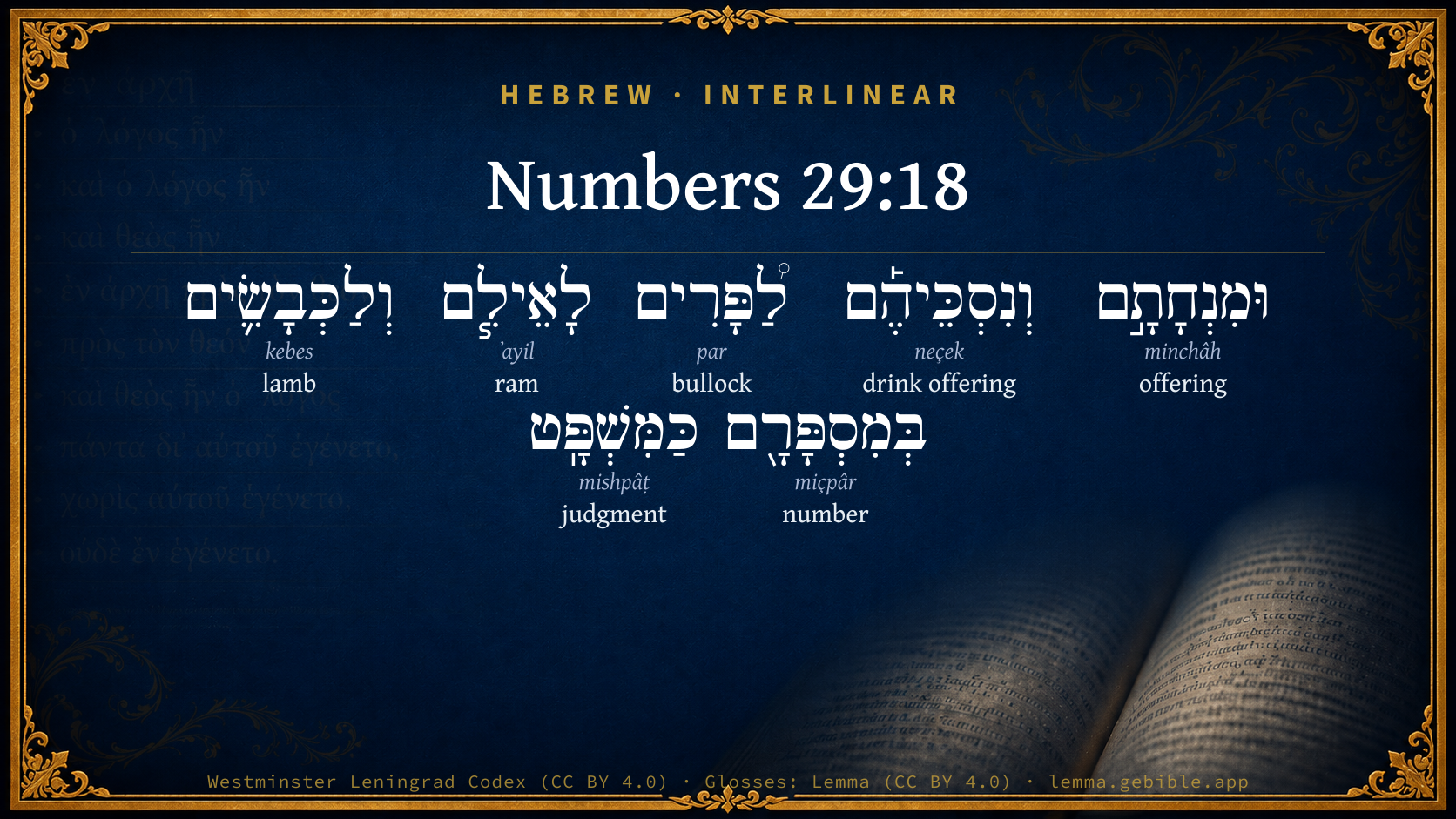
Hebrew (Westminster Leningrad Codex) Numbers 29:18 appears in the Hebrew Old Testament. The text above is from the Westminster Leningrad Codex. Each word links to its Strong’s number, a concise gloss, and parsing drawn from the Open Scriptures Hebrew Bible morphology. Click any word for its full Brown-Driver-Briggs (BDB) entry.
Download image
Cite this verse

Numbers 29:18 (World English Bible). Public Domain. Lemma interlinear Bible study tool, https://lemma.gebible.app/v/numbers/29/18.

Show BibTeX & RIS
BibTeX
RIS
English Translation
and their meal-offering and their drink-offerings for the bulls, for the rams, and for the lambs, according to their number, after the ordinance;
World English Bible · Public Domain
Download a study sheet

One document with this verse’s original text, its word-by-word gloss line, the meaning frame, cross-references with their text, attributed commentary, and full source and license credits — printable, and it pastes into notes with its structure intact.

This verse Autodidact and up

Study sheet (.html) Plain text (.txt)

A passage Seminary Student

Up to 50 verses in one chapter. A passage sheet keeps up to 6 commentary sources and 12 cross-references per verse, in the order this page ranks them, and says so on the sheet whenever that leaves anything out. Ask for a single verse and you get the Autodidact verse sheet above.

Everything on this page stays free to read, with no account — the sheet is a download of what is already on screen, not access to it.

Want to remove ads? Support Godless Engineer
Compare translations 3

The same verse in 3 English versions, stacked beneath the original-language interlinear above. Click any original word for its lexicon entry.

Each is an independent rendering of the whole verse — the interlinear is not word-aligned to these translations.

Highlighted words mark where these versions differ — a whole-verse word diff, not a word-by-word alignment.

  • World English Bible Public Domain
    and their meal-offering and their drink-offerings for the bulls, for the rams, and for the lambs, according to their number, after the ordinance;
  • King James Version Public Domain
    And their meat offering and their drink offerings for the bullocks, for the rams, and for the lambs, shall be according to their number, after the manner:
  • unfoldingWord Literal Text CC BY-SA 4.0
    and their grain offering and their drink offerings for the bulls, for the rams, and for the male lambs shall be by their number according to the ordinance.

unfoldingWord Literal Text — © unfoldingWord, licensed CC BY-SA 4.0. Word-aligned USFM3 via Door43 (git.door43.org/unfoldingWord/en_ult).

Versions to compare (up to 4)

3 of 4 selected

Show all 18 translations

Every available English version of this verse, each an independent rendering of the whole verse.

  • World English Bible Public Domain
    and their meal-offering and their drink-offerings for the bulls, for the rams, and for the lambs, according to their number, after the ordinance;
  • Berean Standard Bible Public Domain
    along with the grain and drink offerings for the bulls, rams, and lambs, according to the number prescribed.
  • Majority Standard Bible Public Domain
    along with the grain and drink offerings for the bulls, rams, and lambs, according to the number prescribed.
  • King James Version Public Domain
    And their meat offering and their drink offerings for the bullocks, for the rams, and for the lambs, shall be according to their number, after the manner:
  • American Standard Version (1901) Public Domain
    and their meal-offering and their drink-offerings for the bullocks, for the rams, and for the lambs, according to their number, after the ordinance;
  • Revised Version (1885) Public Domain
    and their meal offering and their drink offerings for the bullocks, for the rams, and for the lambs, according to their number, after the ordinance:
  • Geneva Bible (1599) Public Domain
    With their meate offring and their drinke offrings for the bullockes, for the rammes, and for the lambes according to their nomber, after the maner,
  • Douay-Rheims (1899) Public Domain
    And the sacrifices and the libations for every one, for the calves and for the rams and for the lambs you shall duly celebrate:
  • Young's Literal Translation Public Domain
    and their present, and their libations, for the bullocks, for the rams, and for the sheep, in their number, according to the ordinance;
  • Literal Standard Version CC BY-SA 4.0
    and their present and their drink-offerings for the bullocks, for the rams, and for the sheep, in their number, according to the ordinance;
  • Unlocked Literal Bible CC BY-SA 4.0
    You must make with them a grain offering and the drink offerings for the bulls, for the rams, and for the lambs, making as many offerings as were commanded.
  • unfoldingWord Literal Text CC BY-SA 4.0
    and their grain offering and their drink offerings for the bulls, for the rams, and for the male lambs shall be by their number according to the ordinance.
  • Darby Bible Public Domain
    and their oblation and their drink-offerings for the bullocks, for the rams, and for the lambs, by their number, according to the ordinance;
  • World Messianic Bible Public Domain
    and their meal offering and their drink offerings for the bulls, for the rams, and for the lambs, according to their number, after the ordinance;
  • Webster's Bible Public Domain
    And their meat-offering and their drink-offerings for the bullocks, for the rams, and for the lambs, shall be according to their number, after the manner:
  • Free Bible Version CC BY-SA 4.0
    They are to be accompanied by their grain offerings and drink offerings for the bulls, rams, and lambs, all according to the number required.
  • Bible in Basic English Public Domain
    And their meal offering and their drink offerings for the oxen and the sheep and the lambs, in relation to their number, as it is ordered:
  • JPS Tanakh (1917) Public Domain
    and their meal-offering and their drink-offerings for the bullocks, for the rams, and for the lambs, according to their number, after the ordinance;

Literal Standard Version (2020), Covenant Press — licensed CC BY-SA 4.0. Text via the HelloAO Bible API (eBible.org). Unlocked Literal Bible (unfoldingWord) — licensed CC BY-SA 4.0. Text via the HelloAO Bible API (eBible.org). unfoldingWord Literal Text — © unfoldingWord, licensed CC BY-SA 4.0. Word-aligned USFM3 via Door43 (git.door43.org/unfoldingWord/en_ult). Free Bible Version, Dr. Jonathan Gallagher — licensed CC BY-SA 4.0. Text via the HelloAO Bible API (eBible.org).

Word by word

More ways to search: Search by grammar → Find every occurrence → Compare this word →

Practice this passage: Drill this verse → Learn its vocabulary →

וְנִסְכֵּיהֶ֡ם
neçek
H5262
“and · drink offerings · their”
Conjunction + Noun, Common, Masculine, Plural, Construct + Suffix, Personal, 3rd Person, Masculine, Plural
Part of Speech
Conjunction + Noun
Type
Common
Gender
Masculine
Number
Plural
State
Construct
Full BDB Definition

Origin: from H5258

TWOT: 1375a

drink offering, libation, molten image, something poured out - drink offering - molten images
  1. וּמִנְחָתָ֣ם minchâh H4503 “and · offering · their” Conjunction + Noun, Common, Feminine, Singular, Construct + Suffix, Personal, 3rd Person, Masculine, Plural
  2. לַ֠פָּרִים par H6499 “to/for the · bullocks” Preposition, Determined + Noun, Common, Masculine, Plural, Absolute
  3. לָאֵילִ֧ם ʼayil H352 “to/for the · rams” Preposition, Determined + Noun, Common, Masculine, Plural, Absolute
  4. וְלַכְּבָשִׂ֛ים kebes H3532 “and · to/for the · lambs” Conjunction + Preposition, Determined + Noun, Common, Masculine, Plural, Absolute
  5. בְּמִסְפָּרָ֖ם miçpâr H4557 “in/at · number · their” Preposition + Noun, Common, Masculine, Singular, Construct + Suffix, Personal, 3rd Person, Masculine, Plural
  6. כַּמִּשְׁפָּֽט mishpâṭ H4941 “like/as the · judgment” Preposition, Determined + Noun, Common, Masculine, Singular, Absolute

About this verse

These counts appear in no published source. They are computed here, from the morphology-tagged text and Lemma’s own curated glosses. What Lemma adds →

7
words
7
distinct lemmas
Pentateuch
section

Grammatical profile

  • 7 nouns

Hebrew & Septuagint length

In English translation the verse runs 23 words from the Hebrew and 24 from the Septuagint (LXX English) — closely comparable.

A rough comparison of the two English renderings, which tokenize alike — not a word-level alignment.

Word counts can differ between the Hebrew and the Greek without any difference in meaning — e.g. the Hebrew direct-object marker אֵת has no separate Greek word, and Greek often adds the article ὁ.

Cross-references

6

Topical passages linked to Numbers 29:18 in the Treasury of Scripture Knowledge — connected by theme and wording, ordered by reader-vote popularity; previews shown in the World English Bible.

  • Numbers 28:7 The drink-offering of it shall be the fourth part of a hin for the one lamb: in the holy place shall you pour out a drink-offering of strong drink to Yahweh.
  • Numbers 15:4–12 then shall he who offers his offering offer to Yahweh a meal-offering of a tenth part [of an ephah] of fine flour mixed with the fourth part of a hin of oil:
  • Numbers 28:14 Their drink-offerings shall be half a hin of wine for a bull, and the third part of a hin for the ram, and the fourth part of a hin for a lamb: this is the burnt offering of every month throughout the months of the year.
  • Numbers 29:3–4 and their meal-offering, fine flour mixed with oil, three tenth parts for the bull, two tenth parts for the ram,
  • Numbers 29:6 besides the burnt offering of the new moon, and the meal-offering of it, and the continual burnt offering and the meal-offering of it, and their drink-offerings, according to their ordinance, for a sweet savor, an offering made by fire to Yahweh.
  • Numbers 29:9–10 and their meal-offering, fine flour mixed with oil, three tenth parts for the bull, two tenth parts for the one ram,

Cross-references courtesy of OpenBible.info (CC BY 4.0).

Hebrew and Greek witnesses Masoretic Hebrew ↔ Greek Septuagint

The same verse in the two great witnesses to the Old Testament, shown verse-for-verse.

These are two independent witnesses, not word-aligned to each other, and the Septuagint is shown in lemma (dictionary) form.

Hebrew Numbers 29:18 Masoretic · Westminster Leningrad Codex

וּמִנְחָתָ֣ם וְנִסְכֵּיהֶ֡ם לַ֠פָּרִים לָאֵילִ֧ם וְלַכְּבָשִׂ֛ים בְּמִסְפָּרָ֖ם כַּמִּשְׁפָּֽט

and their meal-offering and their drink-offerings for the bulls, for the rams, and for the lambs, according to their number, after the ordinance;

World English Bible · Public Domain

Greek LXX Numbers 29:18 Septuagint · lemma form

ὁ θυσία αὐτός καί ὁ σπονδή αὐτός ὁ μόσχος καί ὁ κριός καί ὁ ἀμνός κατά ἀριθμός αὐτός κατά ὁ σύγκρισις αὐτός

Their meat-offering and their drink-offering shall be for the calves and the rams and the lambs according to their number, according to their ordinance.

LXX2012 (modern English Septuagint) · Public Domain

Hebrew: Westminster Leningrad Codex (CC BY 4.0). Greek: Septuagint (public domain); English from LXX2012 (modern English Septuagint) (Public Domain). How the Septuagint differs from the Hebrew →

Targum (Aramaic paraphrase)

2

The Targum is the ancient Jewish Aramaic paraphrase of the Hebrew Scriptures — an interpretive translation, not the Hebrew text itself. Onkelos (literal) and Pseudo-Jonathan (expansive) render the Torah, and Jonathan the Prophets. Coverage is partial: where no permissively-licensed English translation exists for a verse, only the Aramaic is shown. This is verse-level text, not a word-by-word alignment to the Hebrew.

  1. Targum Onkelos Torah (Genesis–Deuteronomy)
    וּמִנְחַתְהוֹן וְנִסְכֵּיהוֹן לְתוֹרִין לְדִכְרִין וּלְאִימְרִין בְּמִנְיָנֵיהוֹן כִּדְחָזֵי

    (no public-domain English translation for this verse)

    Targum Onkelos — Aramaic: “Onkelos Genesis” (public domain); “Onkelos Exodus” (public domain); “Onkelos Leviticus” (public domain); “Onkelos Numbers” (public domain); “Onkelos Deuteronomy” (public domain). English: “Sefaria Community Translation” (CC0 1.0 (public-domain dedication)); “J.W. Etheridge. The Targums of Onkelos and Jonathan Ben Uzziel on the Pentateuch. London: Longmans, Green, 1862” (public domain). Text via Sefaria.

  2. Targum Pseudo-Jonathan Torah (Genesis–Deuteronomy)
    וּמִנְחַתְהוֹן סְמִידָא דְחִינְטַיָא וַחֲמַר נִיסוּכֵיהוֹן מַה דִי תֶהֱווֹן מְקַרְבִין עִם תּוֹרַיָא עִם דִיכְרַיָא וְאִמְרַיָא בְּמִנְיָנֵיהוֹן כְּסֵדֶר דִינָא

    And their mincha of wheat flour, and the wine of their libation which shall be offered with the bullocks, rams, and lambs, by their number according to the order of their appointment;

    Targum Pseudo-Jonathan — Aramaic: “Targum Jonathan on Genesis” (public domain); “Targum Jonathan on Exodus” (public domain); “Targum Jonathan on Leviticus” (public domain); “Targum Jonathan on Numbers” (public domain); “Targum Jonathan on Deuteronomy” (public domain). English: “The Targum of Jonathan ben Uzziel, trans. J. W. Etheridge, London, 1862” (public domain). Text via Sefaria.

Commentary

Notes on Numbers 29:18 from classic Christian and Jewish commentators (each source and its license shown beneath its notes). The classic Christian expositions comment on the surrounding passage and are grouped to its opening verse, so a note may address several verses; the Jewish commentaries on the Tanakh (Rashi and others) are per-verse, so they appear only where the commentator wrote on this verse.

Lemma curates 59 commentaries, every one of them public domain or Creative Commons licensed, each selected and text-cleaned for this edition rather than reprinted as found. About our sources →

Trapp's Complete Commentary

John Trapp

Num 29:18 And their meat offering and their drink offerings for the bullocks, for the rams, and for the lambs, [shall be] according to their number, after the manner:

Ver. 18. After the manner.] That is, in manner and form aforesaid. The manner is that which makes or mars the action; as a good suit may be marred in the making, so a good duty: there may be malum opus in bona materia. Jehu’s zeal was rewarded as an act of justice, quoad substantiam operis; and punished as an act of policy, quoad modum agendi, for the perverse end. Yea, David, for failing in a ceremony only, though with an honest heart, suffered a breach instead of a blessing. {1Ch 15:13} Idolaters also went on in their own manner as their idol priests prescribed. "The manner of Beersheba liveth"; {Amo 8:14} that is, the form of rites of the worshipping in Beersheba, as the Chaldee paraphraseth.

John Trapp, A Commentary or Exposition upon All the Books of the Old and New Testament (1647–1656) — public domain. Text from a community e-Sword module.

Jamieson, Fausset & Brown

Robert Jamieson, A. R. Fausset & David Brown

after the manner--according to the ritual order appointed by divine authority--that for meat offerings (Num 29:3-10), and drink offerings (Num 28:7, Num 28:14).

Jamieson, Fausset & Brown — Commentary Critical and Explanatory on the Whole Bible (1871) — public domain (CC PDM 1.0). Text via the HelloAO Bible API.

The Cambridge Bible for Schools and Colleges

gen. ed. J. J. S. Perowne

18. ye shall do no laborious work] The expression is found only in H (Lev_23:7-8 &c.) and in this and the following chapter. It is not only the work of slaves that is forbidden, as E.VV. might suggest, but all business or occupation that requires labour.

Num_29:1. a day of blowing of trumpets] See Num_10:10.

The Cambridge Bible for Schools and Colleges (gen. ed. J. J. S. Perowne; Cambridge University Press, 1878–1918) — public domain. Text from a community e-Sword module.

Matthew Poole's English Annotations

Of which see for meat-offerings, Num 29:3,4,9,10; and for drink-offerings, Num 28:7,14

Matthew Poole's English Annotations on the Holy Bible (1683–1685) — public domain. Text from a community e-Sword/MySword module.

Rashi

Rabbi Shlomo Yitzchaki (Rashi)

ומנחתם ונסכיהם לפרים AND THEIR MEAL OFFERING AND THEIR DRINK OFFERINGS FOR THE BULLOCKS — The bullocks offered on the Feast of Tabernacles are seventy in all, in allusion to the seventy nations of the world, and they gradually decrease in number each day, an omen to them of gradual annihilation, but during the period when the Temple existed and these sacrifices were offered they protected them against this misfortune (cf. Sukkah 55b).

ולכבשים AND FOR THE LAMBS — in allusion to the Israelites who are called ( 50:17) “scattered lambs”. — They (the lambs) are of fixed number each day (a symbol that the Israelites are fixed, imperishable), and their total is ninety-eight, serving to avert from them the ninety-eight curses which are set forth in Deuteronomy (Deuteronomy 28:15 ff.) — In the paragraph dealing with the second day of the Festival, it is said, (v. 19) ונסכיהם, and this is in reference to the two daily continual offerings (while the usual term is ונסכה corresponding to ומנחתה that precedes it), and it sometimes uses a modification of the terms usually employed in those paragraphs only in order that some teaching may be deduced from it, as our Rabbis, may their memory be for a blessing, said: in the case of the second day we have ונסכיהם, of the sixth ונסכיה, of the seventh כמשפטם (instead of the usual כמשפטה): the additional letters are מ and י and מ — so you have here מים, “water”, — a suggestion that the libation of water on Tabernacles is of Biblical origin (מן התורה) (Sifrei Bamidbar 150; Shabbat 103b).

Rashi on the Tanakh — English translations: “The Judaica Press complete Tanach with Rashi, translated by A. J. Rosenberg” (CC BY 4.0); “Pentateuch with Rashi's commentary by M. Rosenbaum and A.M. Silbermann, 1929-1934” (public domain); “The Metsudah Tanach series, Lakewood, N.J” (CC BY 4.0); and “The Book of Joshua, Metsudah Publications, 1997” (CC BY 4.0). Text via Sefaria.

Lesson kit

Teaching starters — assembled from the data on this page, not authored interpretation. Every prompt links to the verse data it draws on. Edit before teaching.

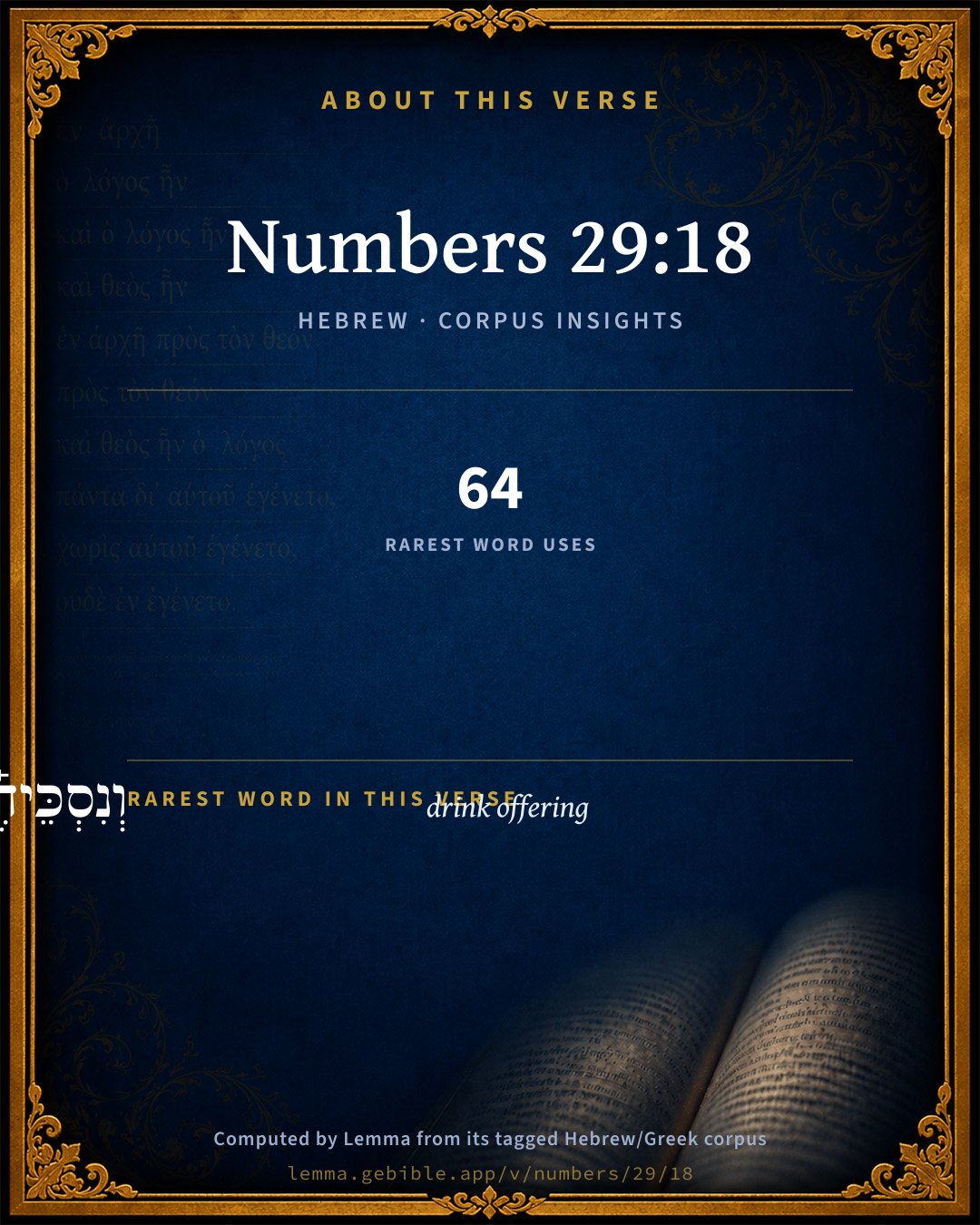
Numbers, in the Pentateuch, opens this verse with 7 words (7 distinct Hebrew lemmas). Its most distinctive word is neçek (“drink offering”). A historical commentator’s framing appears above. Read the whole chapter for the surrounding context.

Discussion questions

  1. What does “drink offering” (neçek) contribute to the verse as a whole?
  2. Numbers 28:7 shares this passage’s theme. How do the two illuminate each other?
  3. These translations render this verse differently. What is at stake in choosing one wording over another?
  4. Reading how Trapp's Complete Commentary and Jamieson, Fausset & Brown read this verse, where do the two commentators agree and where do they part?

Things to notice

Reading settings

Reading text

Shown beneath each verse's original-language words.

Old Testament
Old Testament edition

Read the OT as the Masoretic Hebrew (MT) or the Greek Septuagint (LXX).

English shown for the Greek Septuagint (in the Hebrew ↔ Greek comparison).

Comparing translations? Open the Compare panel on any verse page to stack up to four side by side.