
Ezekiel 40:14

Hebrew (Westminster Leningrad Codex) Ezekiel 40:14 appears in the Hebrew Old Testament. The text above is from the Westminster Leningrad Codex. Each word links to its Strong’s number, a concise gloss, and parsing drawn from the Open Scriptures Hebrew Bible morphology. Click any word for its full Brown-Driver-Briggs (BDB) entry.
Download image
Cite this verse

Ezekiel 40:14 (World English Bible). Public Domain. Lemma interlinear Bible study tool, https://lemma.gebible.app/v/ezekiel/40/14.

Show BibTeX & RIS
BibTeX
RIS
English Translation
He made also posts, sixty cubits; and the court [reached] to the posts, round about the gate.
World English Bible · Public Domain
Download a study sheet

One document with this verse’s original text, its word-by-word gloss line, the meaning frame, cross-references with their text, attributed commentary, and full source and license credits — printable, and it pastes into notes with its structure intact.

This verse Autodidact and up

Study sheet (.html) Plain text (.txt)

A passage Seminary Student

Up to 50 verses in one chapter. A passage sheet keeps up to 6 commentary sources and 12 cross-references per verse, in the order this page ranks them, and says so on the sheet whenever that leaves anything out. Ask for a single verse and you get the Autodidact verse sheet above.

Everything on this page stays free to read, with no account — the sheet is a download of what is already on screen, not access to it.

Want to remove ads? Support Godless Engineer
Compare translations 3

The same verse in 3 English versions, stacked beneath the original-language interlinear above. Click any original word for its lexicon entry.

Each is an independent rendering of the whole verse — the interlinear is not word-aligned to these translations.

Highlighted words mark where these versions differ — a whole-verse word diff, not a word-by-word alignment.

  • World English Bible Public Domain
    He made also posts, sixty cubits; and the court [reached] to the posts, round about the gate.
  • King James Version Public Domain
    He made also posts of threescore cubits, even unto the post of the court round about the gate.
  • unfoldingWord Literal Text CC BY-SA 4.0
    Then he measured the wall that went between the guard chambers—sixty cubits in length; he measured as far as the gate’s portico.

unfoldingWord Literal Text — © unfoldingWord, licensed CC BY-SA 4.0. Word-aligned USFM3 via Door43 (git.door43.org/unfoldingWord/en_ult).

Versions to compare (up to 4)

3 of 4 selected

Show all 18 translations

Every available English version of this verse, each an independent rendering of the whole verse.

  • World English Bible Public Domain
    He made also posts, sixty cubits; and the court [reached] to the posts, round about the gate.
  • Berean Standard Bible Public Domain
    Next he measured the gateposts to be sixty cubits high. The gateway extended around to the gatepost of the courtyard.
  • Majority Standard Bible Public Domain
    Next he measured the gateposts to be sixty cubits high. The gateway extended around to the gatepost of the courtyard.
  • King James Version Public Domain
    He made also posts of threescore cubits, even unto the post of the court round about the gate.
  • American Standard Version (1901) Public Domain
    He made also posts, threescore cubits; and the court `reached' unto the posts, round about the gate.
  • Revised Version (1885) Public Domain
    He made also posts, threescore cubits; and the court reached unto the post, the gate being round about.
  • Geneva Bible (1599) Public Domain
    He made also postes of threescore cubites, and the postes of the court, and of the gate had one measure round about.
  • Douay-Rheims (1899) Public Domain
    He made also fronts of sixty cubits: and to the front the court of the gate on every side round about.
  • Young's Literal Translation Public Domain
    And he maketh the posts of sixty cubits, even unto the post of the court, the gate all round about;
  • Literal Standard Version CC BY-SA 4.0
    And he makes the posts of sixty cubits, even to the post of the court, the gate all around;
  • Unlocked Literal Bible CC BY-SA 4.0
    Then he measured the wall that went between the guard chambers—sixty cubits in length; he measured as far as the gate's portico.
  • unfoldingWord Literal Text CC BY-SA 4.0
    Then he measured the wall that went between the guard chambers—sixty cubits in length; he measured as far as the gate’s portico.
  • Darby Bible Public Domain
    And he made posts, sixty cubits, and by the post was the court of the gate round about.
  • World Messianic Bible Public Domain
    He also made posts, sixty cubits; and the court reached to the posts, around the gate.
  • Webster's Bible Public Domain
    He made also posts of sixty cubits; even to the post of the court around the gate.
  • Free Bible Version CC BY-SA 4.0
    Then he measured the distance between the posts as sixty cubits. The gateway led all the way around to the courtyard.
  • Bible in Basic English Public Domain
    And he took the measure of the covered way, twenty cubits; and opening from the covered way of the doorway was the open square round about.
  • JPS Tanakh (1917) Public Domain
    He made also posts of threescore cubits; even unto the posts of the court in the gates round about.

Literal Standard Version (2020), Covenant Press — licensed CC BY-SA 4.0. Text via the HelloAO Bible API (eBible.org). Unlocked Literal Bible (unfoldingWord) — licensed CC BY-SA 4.0. Text via the HelloAO Bible API (eBible.org). unfoldingWord Literal Text — © unfoldingWord, licensed CC BY-SA 4.0. Word-aligned USFM3 via Door43 (git.door43.org/unfoldingWord/en_ult). Free Bible Version, Dr. Jonathan Gallagher — licensed CC BY-SA 4.0. Text via the HelloAO Bible API (eBible.org).

Word by word

More ways to search: Search by grammar → Find every occurrence → Compare this word →

Practice this passage: Drill this verse → Learn its vocabulary →

שִׁשִּׁ֣ים
shishshîym
H8346
“sixty”
Adjective, Cardinal number, Both, Plural, Absolute
Part of Speech
Adjective
Type
Cardinal number
Gender
Both
Number
Plural
State
Absolute
Full BDB Definition

Origin: multiple of H8337

TWOT: 2336c

sixty, three score
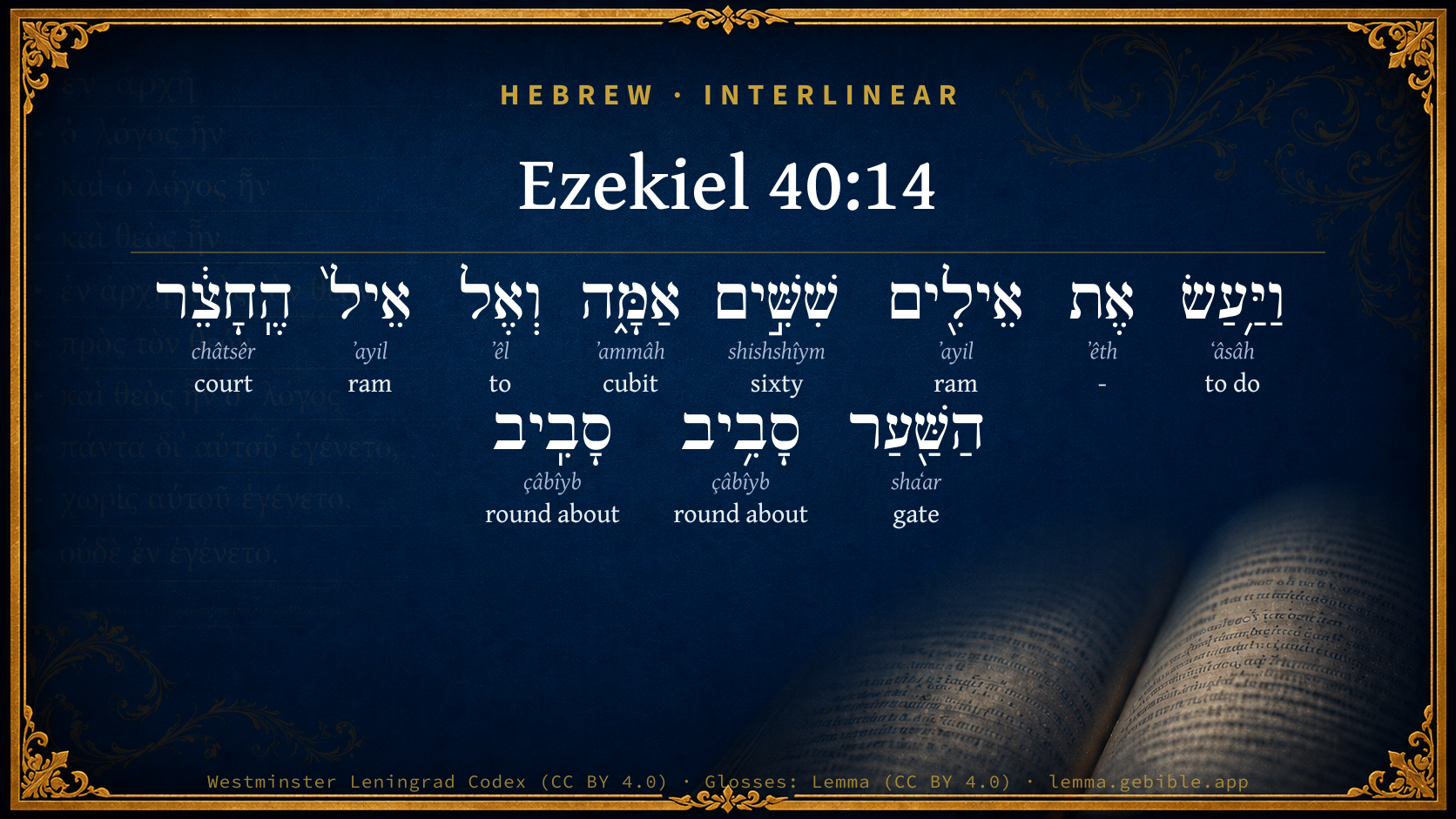
  1. וַיַּ֥עַשׂ ʻâsâh H6213 “and · to do” Conjunction + Verb, Qal, Sequential Imperfect, 3rd Person, Masculine, Singular
  2. אֶת ʼêth H853 “-” Particle, Direct Object
  3. אֵילִ֖ים ʼayil H352 “rams” Noun, Common, Masculine, Plural, Absolute
  4. אַמָּ֑ה ʼammâh H520 “cubit” Noun, Common, Feminine, Singular, Absolute
  5. וְאֶל ʼêl H413 “and · to” Conjunction + Preposition
  6. אֵיל֙ ʼayil H352 “ram of” Noun, Common, Masculine, Singular, Construct
  7. הֶֽחָצֵ֔ר châtsêr H2691 “the · court” Particle, Definite Article + Noun, Common, Both, Singular, Absolute
  8. הַשַּׁ֖עַר shaʻar H8179 “the · gate” Particle, Definite Article + Noun, Common, Masculine, Singular, Absolute
  9. סָבִ֥יב çâbîyb H5439 “round about” Noun, Common, Both, Singular, Absolute
  10. סָבִֽיב çâbîyb H5439 “round about” Noun, Common, Both, Singular, Absolute

About this verse

These counts appear in no published source. They are computed here, from the morphology-tagged text and Lemma’s own curated glosses. What Lemma adds →

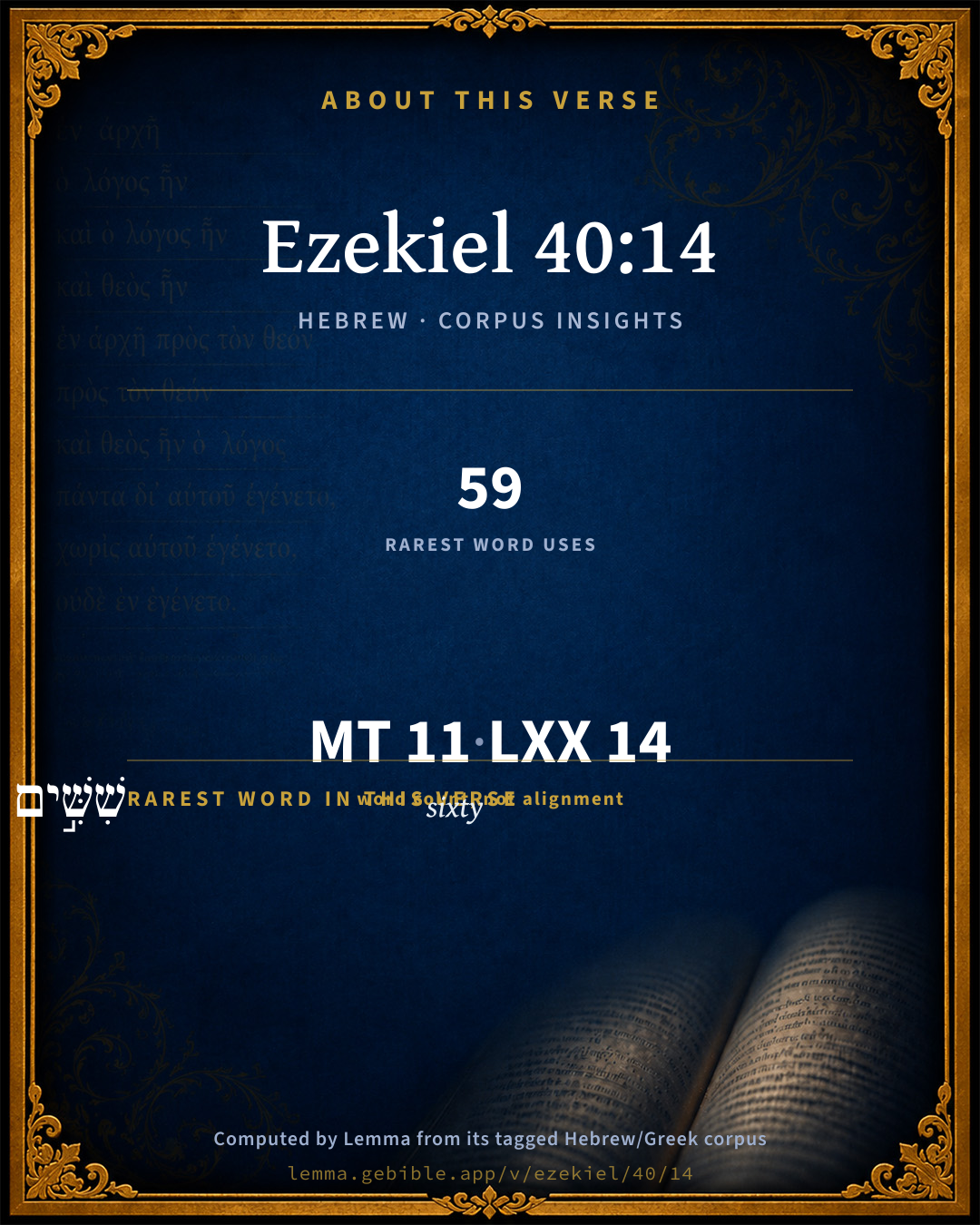
11
words
9
distinct lemmas
Prophets
section

Shared distinctive vocabulary

שִׁשִּׁ֣ים sixty H8346 occurs in 56 verses of the Hebrew Bible. Also found in:

Grammatical profile

  • 1 verb
  • 7 nouns
  • 1 adjective
  • 1 preposition
  • 1 particle

Verb forms

  • וַיַּ֥עַשׂ Qal · Sequential Imperfect

Repetition

Words recur within this verse — often emphatic in Hebrew:

  • אֵילִ֖ים ram H352 ×2
  • סָבִ֥יב round about H5439 ×2

Hebrew & Septuagint length

In English translation the verse runs 17 words from the Hebrew and 21 from the Septuagint (LXX English) — closely comparable.

A rough comparison of the two English renderings, which tokenize alike — not a word-level alignment.

Word counts can differ between the Hebrew and the Greek without any difference in meaning — e.g. the Hebrew direct-object marker אֵת has no separate Greek word, and Greek often adds the article ὁ.

In the original languages it is 11 Hebrew tokens and 14 Greek tokens — but the two are counted differently (Hebrew bundles its prefixes and suffixes into one token; the Greek is in lemma form), so that isn’t a like-for-like length.

Cross-references

8

Topical passages linked to Ezekiel 40:14 in the Treasury of Scripture Knowledge — connected by theme and wording, ordered by reader-vote popularity; previews shown in the World English Bible.

  • Exodus 27:9 "You shall make the court of the tent: for the south side southward there shall be hangings for the court of fine twined linen one hundred cubits long for one side:
  • 1 Chronicles 28:6 He said to me, Solomon your son, he shall build my house and my courts; for I have chosen him to be my son, and I will be his father.
  • Psalms 100:4 Enter into his gates with thanksgiving, Into his courts with praise. Give thanks to him, and bless his name.
  • Isaiah 62:9 but those who have garnered it shall eat it, and praise Yahweh; and those who have gathered it shall drink it in the courts of my sanctuary.
  • Ezekiel 8:7 He brought me to the door of the court; and when I looked, behold, a hole in the wall.
  • Ezekiel 42:1 Then he brought me forth into the outer court, the way toward the north: and he brought me into the chamber that was over against the separate place, and which was over against the building toward the north.
  • Exodus 35:17 the hangings of the court, its pillars, their sockets, and the screen for the gate of the court;
  • Leviticus 6:16 That which is left of it Aaron and his sons shall eat. It shall be eaten without yeast in a holy place. They shall eat it in the court of the Tent of Meeting

Cross-references courtesy of OpenBible.info (CC BY 4.0).

Hebrew and Greek witnesses Masoretic Hebrew ↔ Greek Septuagint

The same verse in the two great witnesses to the Old Testament, shown verse-for-verse.

These are two independent witnesses, not word-aligned to each other, and the Septuagint is shown in lemma (dictionary) form.

Hebrew Ezekiel 40:14 Masoretic · Westminster Leningrad Codex

וַיַּ֥עַשׂ אֶת אֵילִ֖ים שִׁשִּׁ֣ים אַמָּ֑ה וְאֶל אֵיל֙ הֶֽחָצֵ֔ר הַשַּׁ֖עַר סָבִ֥יב סָבִֽיב

He made also posts, sixty cubits; and the court [reached] to the posts, round about the gate.

World English Bible · Public Domain

Greek LXX Ezekiel 40:14 Septuagint · lemma form

καί ὁ αἴθριος ὁ αιλαμ ὁ πύλη ἑξήκοντα πῆχυς εἴκοσι θείμ ὁ πύλη κύκλος

And the open space of the porch of the gate without, was twenty cubits to the chambers round about the gate.

LXX2012 (modern English Septuagint) · Public Domain

On this verse, The Cambridge Bible for Schools and Colleges discusses the Septuagint’s reading. Read the note in Commentary ↓

Hebrew: Westminster Leningrad Codex (CC BY 4.0). Greek: Septuagint (public domain); English from LXX2012 (modern English Septuagint) (Public Domain). How the Septuagint differs from the Hebrew →

Targum (Aramaic paraphrase)

1

The Targum is the ancient Jewish Aramaic paraphrase of the Hebrew Scriptures — an interpretive translation, not the Hebrew text itself. Onkelos (literal) and Pseudo-Jonathan (expansive) render the Torah, and Jonathan the Prophets. Coverage is partial: where no permissively-licensed English translation exists for a verse, only the Aramaic is shown. This is verse-level text, not a word-by-word alignment to the Hebrew.

  1. Targum Jonathan Prophets (Joshua–Malachi)
    וַעֲבַד יַת אֵלַיָא שִׁתִּין אַמִין רוּמְהוֹן וְעַל אֵילָא דְדַרְתָּא דְתַרְעָא סְחוֹר סְחוֹר:

    (no public-domain English translation for this verse)

    Targum Jonathan — Aramaic: “Mikraot Gedolot” (public domain). English: “Sefaria Community Translation” (CC0 1.0 (public-domain dedication)); “London "Chaldee Paraphrase," 1871” (public domain). Text via Sefaria.

Commentary

Notes on Ezekiel 40:14 from classic Christian and Jewish commentators (each source and its license shown beneath its notes). The classic Christian expositions comment on the surrounding passage and are grouped to its opening verse, so a note may address several verses; the Jewish commentaries on the Tanakh (Rashi and others) are per-verse, so they appear only where the commentator wrote on this verse.

Lemma curates 59 commentaries, every one of them public domain or Creative Commons licensed, each selected and text-cleaned for this edition rather than reprinted as found. About our sources →

The Cambridge Bible for Schools and Colleges

gen. ed. J. J. S. Perowne

14. Eze_40:14 is obscure. In the first place “he made” is suspicious, everywhere else it is “he measured.” In the second place the number 60 cubits is incomprehensible. The idea that the “posts” were prolonged into pillars of such a height is altogether improbable. Besides, the “posts” are accurately distinguished from pillars, for which another word is employed (Eze_40:49). It is to be observed that the measurer first passes in from E. to W. along one side of the gateway, mentioning the different things with their dimensions of which it was composed. Having reached the porch at the inner end he returns, noting that the two sides of the gateway were in all respects alike. Then from Eze_40:11 onwards he gives measurements of the breadth of various parts of the gateway, the entrance (Eze_40:11), the contraction opposite the guardrooms (Eze_40:12), and finally the breadth of the whole gate building (v, 13). While, however, the breadth of all other parts of the gateway has been given, that of the “porch” at the inner end has not been mentioned, though its length from E. to W., Fig. 1, mn, was stated to be 8 cubits (Eze_40:8-9). It is probable, therefore, that Eze_40:14 supplies this measurement. Render: and he measured the porch, 20 cubits—reading porch (ailam), for posts (ailim), and 20 for 60, in both cases with LXX. The 20 are inside measurement, N. to S.; 22 might have been expected, for the back wall of the guardrooms was 1½ cubits, but a chamber like the porch used for assemblies and feasts (Eze_44:3) might well have a wall of 2½ cubits thick, as in point of fact the wall to the W. was two cubits (Eze_40:9).

even unto the post … gate] At any rate with present pointing: and unto (touching on) the post was the court … gate. It is probable, however, that “post” is either repetition of unto, and should be struck out, or else that it is a consequence of the false reading “posts” in first clause, and should be read “porch” as there (so in Eze_40:37). The latter is more probable: and unto (adjoining) the porch was the court, round about the gate. The omission of prep. before “gate” is difficult, but cf. acc. 1Ki_6:5, and the more remarkable case Eze_43:17. LXX. read differently, and Syr. wants the clause.

The Cambridge Bible for Schools and Colleges (gen. ed. J. J. S. Perowne; Cambridge University Press, 1878–1918) — public domain. Text from a community e-Sword module.

Trapp's Complete Commentary

John Trapp

Eze 40:14 He made also posts of threescore cubits, even unto the post of the court round about the gate.

Ver. 14. Even unto the post,] i.e., The height was the same everywhere. See these things best set forth by pictures at the end of Castalio’s and Lavater’s annotations on the text.

John Trapp, A Commentary or Exposition upon All the Books of the Old and New Testament (1647–1656) — public domain. Text from a community e-Sword module.

John Gill's Exposition

He made also posts of threescore cubits,.... Jerom thinks, that between the outward wall which surrounded this building, and the building itself, these posts or pillars were placed for ornament, which took up the space of sixty cubits; but rather these design the posts or columns of the gate, which supported the arch over it, on which were rooms or stories, and these were sixty cubits high; for of their height is this measure to be understood. So the Targum,

"and he made posts, sixty cubits was their height;''

in the Targum, in the Polyglot Bible by Montanus, it is,

"and he made sixty posts, their height a cubit:''

and to this agree Jarchi and Kimchi; these were thirty five yards high, the height of the temple ordered to be built by Cyrus, Ezr 6:3. The man that measured is said to "make" these posts, he being the builder as well as the measurer of this edifice; and might be said to make these as, by measuring, he pointed out the size and proportion of them: these posts may design the true members of Gospel churches, such who are pillars in the house of God; of which see more on Eze 40:16, compare the phrase of "making" these posts or pillars with Rev 3:12,

even unto the post of the court round about the gate; that is, there was the same measure to every post or pillar in every court, at every gate round about; at the southern and northern gates, as at this eastern one; they were all exactly of the same measure as the posts in this; so Jarchi and Kimchi interpret it.

John Gill's Exposition of the Whole Bible (1746–1763) — public domain (CC PDM 1.0). Text via the HelloAO Bible API.

Haydock's Catholic Bible Commentary

Cubits high, or else the elevation is nowhere specified. (Calmet)

George Leo Haydock (1774–1849), Haydock's Catholic Family Bible and Commentary, 1859 edition — public domain. Excludes Psalms (Douay-Rheims chapter numbering differs from Protestant) and Deuterocanonical books (Catholic canon only).

Matthew Poole's English Annotations

He made; measured, and thereby showed what kind of posts they should be.

Posts of threescore cubits: if this might be interpreted by Cyrus’s edict for building this fabric sixty cubits high, it would be a clear confirmation of the Divine mission of the prophet, and the certainty of a future performance of the good he promised in God’s name, when it appears so evident that he had so long before declared to what height the building should be raised by license from Cyrus. But more like it is that it refers to the height of this gate, built up two stories above the arch, and the posts in their height are only mentioned, but imply all the rest of the building over the east gate. These high columns or posts on the inner front of this gate were so disposed, that the last on each side was very near to the first post, or pillar of the court on either side of the gate; and so the posts, and buildings laid on those posts, joined on each side of this gate.

Matthew Poole's English Annotations on the Holy Bible (1683–1685) — public domain. Text from a community e-Sword/MySword module.

Whedon's Commentary on the Bible

Daniel D. Whedon

14. R.V. reads, “He made also posts, threescore cubits; and the court reached unto the post, the gate being round about.” Davidson and Toy, following LXX., read “porch, or vestibule” (ailam) for posts (ailim), and “twenty” for threescore.

Daniel D. Whedon (gen. ed.), Commentary on the Old and New Testaments (1874–1909) — public domain. Text from a community e-Sword module.

The Pulpit Commentary

He made also posts. In using the verb "made" the prophet either went back in thought to the time when the man who then explained the building had fashioned it (Hengstenberg); or he employed the term in the sense of constituit, i.e. fixed or estimated, "inasmuch as such a height could not be measured from the bottom to the top with the measuring-red" (Keil). The "posts," the of ver. 9, were sixty cubits high, and corresponded to the towers in modern churches. To the objection sometimes urged against what is called the "exaggerated" height of these columns, Kliefoth replies, "If it had been considered that our church towers have grown up out of gate-pillars, that one can see, not merely in Egyptian obelisks and Turkish minarets, but also in our own hollow factory chimneys, how upon a base of two cubits, square pillars of sixty cubits high can be erected, and that finally the talk is of a colossal building seen in vision, no critical difficulties would have been discovered in this statement as to height." The last clause, even unto the post of the court round about the gate, should read, and the court reached unto the post (lyia being used collectively), the gate being round about (Revised Version); or, the court round about the gate reached to the pillars (Keil); or, at the pillar the court was round about the gate (Kliefoth). The sense is, that the court lay round about the inner egress from the gate. The Authorized Version, with which Dr. Currey, in the "Speaker"s Commentary," agrees, thinks of an inner hall between the porch of the gate and the two most western guard-chambers, round the sides of which the sixty-cubit columns stood. Ewald, following the corrupt text of the LXX, translates, "And the threshold of the outer vestibule twenty cubits, the gate court abutting on the chambers round about."

The Pulpit Commentary (1880–1919), ed. H.D.M. Spence-Jones & Joseph S. Exell — public domain. Text from a community e-Sword module.

John Wesley's Explanatory Notes

He made - Measured, and thereby shewed what kind of posts they should be. Threescore cubits - Probably this refers to the height of this gate built up two stories above the arch, and the posts in their height are only mentioned, but imply all the rest of the building over the east gate. Unto the post - These high columns, on the inner front of this gate were so disposed, that the last on each side was very near the first post, or pillar of the court on either side of the gate, and so the posts and buildings laid on those posts joined on each side of this gate.

John Wesley, Explanatory Notes Upon the Whole Bible (1754–1765) — public domain. Text via the GEBible commentary corpus.

unfoldingWord translationNotes

Door43 World Missions Community

guard chambers

See how you translated this in Ezekiel 40:7.

sixty cubits

about 32 meters (See: Biblical Distance)

cubits

See how you translated these "long" cubits in Ezekiel 40:05.

portico

This was a covering in front of an entrance with columns or posts for support. See how you translated this in Ezekiel 8:16.

fifty cubits

about 27 meters

closed windows

Possible meanings are 1) "closed windows" or 2) "windows with shutters" or 3) "narrow windows."

likewise for the porches

"the porches also had closed windows all around"

each jamb

jambs are the sides of a wooden frame of a door

translationWords

palm

unfoldingWord translationNotes — © Distant Shores Media and the Door43 World Missions Community, licensed CC BY-SA 4.0. Source: git.door43.org/Door43/en_tn.

Rashi

Rabbi Shlomo Yitzchaki (Rashi)

And he made the pillars sixty cubits The height of the pillars of the posts of the hall was sixty cubits.

and [likewise] to the pillars of the court [and of] the gates all around And the same was for all the pillars that were in all the halls of the gates all around. For also in the north and in the south the gates were constructed like this gate, as is delineated in this account.

Rashi on the Tanakh — English translations: “The Judaica Press complete Tanach with Rashi, translated by A. J. Rosenberg” (CC BY 4.0); “Pentateuch with Rashi's commentary by M. Rosenbaum and A.M. Silbermann, 1929-1934” (public domain); “The Metsudah Tanach series, Lakewood, N.J” (CC BY 4.0); and “The Book of Joshua, Metsudah Publications, 1997” (CC BY 4.0). Text via Sefaria.

Lesson kit

Teaching starters — assembled from the data on this page, not authored interpretation. Every prompt links to the verse data it draws on. Edit before teaching.

Ezekiel, in the Prophets, opens this verse with 11 words (9 distinct Hebrew lemmas). Its most distinctive word is shishshîym (“sixty”). A historical commentator’s framing appears above. Read the whole chapter for the surrounding context.

Discussion questions

  1. How does “sixty” (shishshîym) shape what this verse is saying?
  2. Genesis 5:15 shares the word «sixty» with this verse. How do the two illuminate each other?
  3. “ram” occurs 2× in this one verse. What is the effect of the repetition?
  4. The translations on this page render this verse differently — a whole-verse word diff, not a word-by-word alignment. What might account for the different wordings?
  5. The verb «וַיַּ֥עַשׂ» is Qal Sequential Imperfect. How does its form color the action?
  6. Reading how The Cambridge Bible for Schools and Colleges and Trapp's Complete Commentary read this verse, where do the two commentators agree and where do they part?

Things to notice

Reading settings

Reading text

Shown beneath each verse's original-language words.

Old Testament
Old Testament edition

Read the OT as the Masoretic Hebrew (MT) or the Greek Septuagint (LXX).

English shown for the Greek Septuagint (in the Hebrew ↔ Greek comparison).

Comparing translations? Open the Compare panel on any verse page to stack up to four side by side.