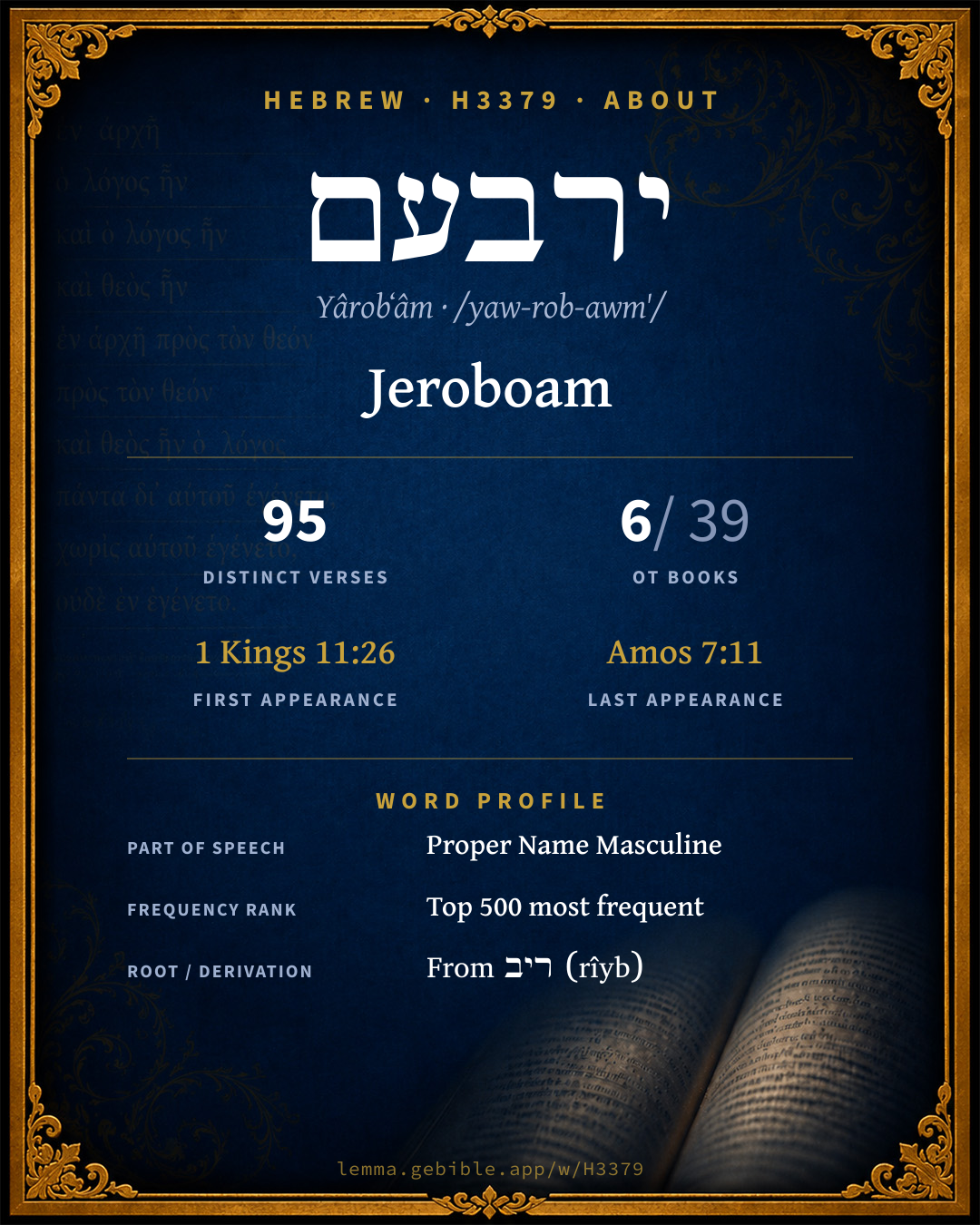
יָֽרָבְעָם
Jeroboam
BDB lists 3 entries for ‘Jeroboam’ fuller range ↓
Full lexicon entry — Brown-Driver-Briggs (BDB)
From Brown-Driver-Briggs (BDB)
Where this word appears
Grammar key — what these labels mean
Part of speech
- Noun
- A naming word — a person, place, thing, or idea.
Noun type
- Proper
- A name of a specific person, place, or people (e.g. Abraham, Zion, Israel).
Every verse where H3379 appears — 95 distinct verses across 6 books. Click any verse to open its interlinear word-by-word view. Verse text shown in the World English Bible for context — . Each verse’s Hebrew form is shown with its reference; the English is not keyword-highlighted, since the data carries no word-level English alignment. Use “Compare translations” on any verse to read it across multiple English versions. This concordance covers the Hebrew Bible; Septuagint (Greek Old Testament) occurrences are not indexed here.
1 Kings 48 verses
- 1 Kings 11:26 וְ/יָרָבְעָם֩ conj + n Proper Jeroboam the son of Nebat, an Ephraimite of Zeredah, a servant of Solomon, whose mother's name was Zeruah, a widow, he also lifted up his hand against the king.
- 1 Kings 11:28 יָרָבְעָ֖ם n Proper The man Jeroboam was a mighty man of valor; and Solomon saw the young man that he was industrious, and he gave him charge over all the labor of the house of Joseph.
- 1 Kings 11:29 וְ/יָֽרָבְעָ֖ם conj + n Proper It happened at that time, when Jeroboam went out of Jerusalem, that the prophet Ahijah the Shilonite found him in the way; now [Ahijah] had clad himself with a new garment; and they two were alone in the field.
- 1 Kings 11:31 לְ/יָֽרָבְעָ֔ם prep + n Proper He said to Jeroboam, Take ten pieces; for thus says Yahweh, the God of Israel, Behold, I will tear the kingdom out of the hand of Solomon, and will give ten tribes to you
- 1 Kings 11:40 יָרָבְעָ֑ם יָרָבְעָ֗ם n Proper n Proper Solomon sought therefore to kill Jeroboam; but Jeroboam arose, and fled into Egypt, to Shishak king of Egypt, and was in Egypt until the death of Solomon.
- 1 Kings 12:2 יָרָבְעָ֣ם יָרָבְעָ֖ם n Proper n Proper It happened, when Jeroboam the son of Nebat heard of it (for he was yet in Egypt, where he had fled from the presence of king Solomon, and Jeroboam lived in Egypt,
- 1 Kings 12:3 יָרָבְעָ֖ם n Proper and they sent and called him), that Jeroboam and all the assembly of Israel came, and spoke to Rehoboam, saying,
- 1 Kings 12:12 יָרָבְעָ֧ם n Proper So Jeroboam and all the people came to Rehoboam the third day, as the king bade, saying, Come to me again the third day.
- 1 Kings 12:15 יָרָבְעָ֖ם n Proper So the king didn't listen to the people; for it was a thing brought about of Yahweh, that he might establish his word, which Yahweh spoke by Ahijah the Shilonite to Jeroboam the son of Nebat.
- 1 Kings 12:20 יָרָבְעָ֔ם n Proper It happened, when all Israel heard that Jeroboam was returned, that they sent and called him to the congregation, and made him king over all Israel: there was none who followed the house of David, but the tribe of Judah only.
- 1 Kings 12:25 יָרָבְעָ֧ם n Proper Then Jeroboam built Shechem in the hill-country of Ephraim, and lived therein; and he went out from there, and built Penuel.
- 1 Kings 12:26 יָרָבְעָ֖ם n Proper Jeroboam said in his heart, Now will the kingdom return to the house of David:
- 1 Kings 12:32 יָרָבְעָ֣ם n Proper Jeroboam ordained a feast in the eighth month, on the fifteenth day of the month, like the feast that is in Judah, and he went up to the altar; so did he in Bethel, sacrificing to the calves that he had made: and he placed in Bethel the priests of the high places that he had made.
- 1 Kings 13:1 וְ/יָרָבְעָ֛ם conj + n Proper Behold, there came a man of God out of Judah by the word of Yahweh to Beth El: and Jeroboam was standing by the altar to burn incense.
- 1 Kings 13:4 יָרָבְעָ֧ם n Proper It happened, when the king heard the saying of the man of God, which he cried against the altar in Bethel, that Jeroboam put forth his hand from the altar, saying, Lay hold on him. His hand, which he put forth against him, dried up, so that he could not draw it back again to him.
- 1 Kings 13:33 יָרָבְעָ֖ם n Proper After this thing Jeroboam didn't return from his evil way, but made again from among all the people priests of the high places: whoever would, he consecrated him, that there might be priests of the high places.
- 1 Kings 13:34 יָרָבְעָ֑ם n Proper This thing became sin to the house of Jeroboam, even to cut it off, and to destroy it from off the surface of the earth.
- 1 Kings 14:1 יָרָבְעָֽם n Proper At that time Abijah the son of Jeroboam fell sick.
- 1 Kings 14:2 יָרָבְעָ֜ם יָרָבְעָ֑ם n Proper n Proper Jeroboam said to his wife, Please get up and disguise yourself, that you not be known to be the wife of Jeroboam; and get you to Shiloh: behold, there is Ahijah the prophet, who spoke concerning me that I should be king over this people.
- 1 Kings 14:4 יָרָבְעָ֔ם n Proper Jeroboam's wife did so, and arose, and went to Shiloh, and came to the house of Ahijah. Now Ahijah could not see; for his eyes were set by reason of his age.
- 1 Kings 14:5 יָרָבְעָ֡ם n Proper Yahweh said to Ahijah, Behold, the wife of Jeroboam comes to inquire of you concerning her son; for he is sick: thus and thus shall you tell her; for it will be, when she comes in, that she will feign herself to be another woman.
- 1 Kings 14:6 יָרָבְעָ֑ם n Proper It was so, when Ahijah heard the sound of her feet, as she came in at the door, that he said, Come in, you wife of Jeroboam; why feign you yourself to be another? for I am sent to you with heavy news.
- 1 Kings 14:7 לְ/יָרָבְעָ֗ם prep + n Proper Go, tell Jeroboam, Thus says Yahweh, the God of Israel: Because I exalted you from among the people, and made you prince over my people Israel,
- 1 Kings 14:10 יָרָבְעָ֔ם לְ/יָֽרָבְעָם֙ יָרָבְעָ֔ם n Proper prep + n Proper n Proper therefore, behold, I will bring evil on the house of Jeroboam, and will cut off from Jeroboam every man-child, him who is shut up and him who is left at large in Israel, and will utterly sweep away the house of Jeroboam, as a man sweeps away dung, until it be all gone.
- 1 Kings 14:11 לְ/יָֽרָבְעָ֤ם prep + n Proper Him who dies of Jeroboam in the city shall the dogs eat; and him who dies in the field shall the birds of the sky eat: for Yahweh has spoken it.
- 1 Kings 14:13 לְ/יָרָבְעָ֖ם יָרָבְעָֽם prep + n Proper n Proper All Israel shall mourn for him, and bury him; for he only of Jeroboam shall come to the grave, because in him there is found some good thing toward Yahweh, the God of Israel, in the house of Jeroboam.
- 1 Kings 14:14 יָרָבְעָ֖ם n Proper Moreover Yahweh will raise him up a king over Israel, who shall cut off the house of Jeroboam that day: but what? even now.
- 1 Kings 14:16 יָֽרָבְעָם֙ n Proper He will give Israel up because of the sins of Jeroboam, which he has sinned, and with which he has made Israel to sin.
- 1 Kings 14:17 יָרָבְעָ֔ם n Proper Jeroboam's wife arose, and departed, and came to Tirzah: [and] as she came to the threshold of the house, the child died.
- 1 Kings 14:19 יָֽרָבְעָ֔ם n Proper The rest of the acts of Jeroboam, how he warred, and how he reigned, behold, they are written in the book of the chronicles of the kings of Israel.
- 1 Kings 14:20 יָרָבְעָ֔ם n Proper The days which Jeroboam reigned were two and twenty years: and he slept with his fathers, and Nadab his son reigned in his place.
- 1 Kings 14:30 יָרָבְעָ֖ם n Proper There was war between Rehoboam and Jeroboam continually.
- 1 Kings 15:1 יָרָבְעָ֣ם n Proper Now in the eighteenth year of king Jeroboam the son of Nebat began Abijam to reign over Judah.
- 1 Kings 15:6 יָרָבְעָ֖ם n Proper Now there was war between Rehoboam and Jeroboam all the days of his life.
- 1 Kings 15:7 יָרָבְעָֽם n Proper The rest of the acts of Abijam, and all that he did, aren't they written in the book of the chronicles of the kings of Judah? There was war between Abijam and Jeroboam.
- 1 Kings 15:9 לְ/יָרָבְעָ֖ם prep + n Proper In the twentieth year of Jeroboam king of Israel began Asa to reign over Judah.
- 1 Kings 15:25 יָרָבְעָ֗ם n Proper Nadab the son of Jeroboam began to reign over Israel in the second year of Asa king of Judah; and he reigned over Israel two years.
- 1 Kings 15:29 יָרָבְעָ֔ם לְ/יָרָבְעָ֖ם n Proper prep + n Proper It happened that, as soon as he was king, he struck all the house of Jeroboam: he didn't leave to Jeroboam any who breathed, until he had destroyed him; according to the saying of Yahweh, which he spoke by his servant Ahijah the Shilonite;
- 1 Kings 15:30 יָרָבְעָם֙ n Proper for the sins of Jeroboam which he sinned, and with which he made Israel to sin, because of his provocation with which he provoked Yahweh, the God of Israel, to anger.
- 1 Kings 15:34 יָרָבְעָ֔ם n Proper He did that which was evil in the sight of Yahweh, and walked in the way of Jeroboam, and in his sin with which he made Israel to sin.
- 1 Kings 16:2 יָרָבְעָ֗ם n Proper Because I exalted you out of the dust, and made you prince over my people Israel, and you have walked in the way of Jeroboam, and have made my people Israel to sin, to provoke me to anger with their sins;
- 1 Kings 16:3 יָרָבְעָ֥ם n Proper behold, I will utterly sweep away Baasha and his house; and I will make your house like the house of Jeroboam the son of Nebat.
- 1 Kings 16:7 יָרָבְעָ֑ם n Proper Moreover by the prophet Jehu the son of Hanani came the word of Yahweh against Baasha, and against his house, both because of all the evil that he did in the sight of Yahweh, to provoke him to anger with the work of his hands, in being like the house of Jeroboam, and because he struck him.
- 1 Kings 16:19 יָרָבְעָ֔ם n Proper for his sins which he sinned in doing that which was evil in the sight of Yahweh, in walking in the way of Jeroboam, and in his sin which he did, to make Israel to sin.
- 1 Kings 16:26 יָרָבְעָ֣ם n Proper For he walked in all the way of Jeroboam the son of Nebat, and in his sins with which he made Israel to sin, to provoke Yahweh, the God of Israel, to anger with their vanities.
- 1 Kings 16:31 יָרָבְעָ֣ם n Proper It happened, as if it had been a light thing for him to walk in the sins of Jeroboam the son of Nebat, that he took as wife Jezebel the daughter of Ethbaal king of the Sidonians, and went and served Baal, and worshiped him.
- 1 Kings 21:22 יָרָבְעָ֣ם n Proper and I will make your house like the house of Jeroboam the son of Nebat, and like the house of Baasha the son of Ahijah for the provocation with which you have provoked me to anger, and have made Israel to sin.
- 1 Kings 22:52 יָרָבְעָ֣ם n Proper He did that which was evil in the sight of Yahweh, and walked in the way of his father, and in the way of his mother, and in the way of Jeroboam the son of Nebat, in which he made Israel to sin.
2 Kings 23 verses
- 2 Kings 3:3 יָרָבְעָ֧ם n Proper Nevertheless he cleaved to the sins of Jeroboam the son of Nebat, with which he made Israel to sin; he didn't depart from it.
- 2 Kings 9:9 יָרָבְעָ֣ם n Proper I will make the house of Ahab like the house of Jeroboam the son of Nebat, and like the house of Baasha the son of Ahijah.
- 2 Kings 10:29 יָרָבְעָ֤ם n Proper However from the sins of Jeroboam the son of Nebat, with which he made Israel to sin, Jehu didn't depart from after them, [to wit], the golden calves that were in Bethel, and that were in Dan.
- 2 Kings 10:31 יָֽרָבְעָ֔ם n Proper But Jehu took no heed to walk in the law of Yahweh, the God of Israel, with all his heart: he didn't depart from the sins of Jeroboam, with which he made Israel to sin.
- 2 Kings 13:2 יָרָבְעָ֧ם n Proper He did that which was evil in the sight of Yahweh, and followed the sins of Jeroboam the son of Nebat, with which he made Israel to sin; he didn't depart from it.
- 2 Kings 13:6 יָרָבְעָ֛ם n Proper Nevertheless they didn't depart from the sins of the house of Jeroboam, with which he made Israel to sin, but walked therein: and there remained the Asherah also in Samaria.)
- 2 Kings 13:11 יָרָבְעָ֧ם n Proper He did that which was evil in the sight of Yahweh; he didn't depart from all the sins of Jeroboam the son of Nebat, with which he made Israel to sin; but he walked therein.
- 2 Kings 13:13 וְ/יָרָבְעָ֖ם conj + n Proper Joash slept with his fathers; and Jeroboam sat on his throne: and Joash was buried in Samaria with the kings of Israel.
- 2 Kings 14:16 יָרָבְעָ֥ם n Proper Jehoash slept with his fathers, and was buried in Samaria with the kings of Israel; and Jeroboam his son reigned in his place.
- 2 Kings 14:23 יָרָבְעָ֨ם n Proper In the fifteenth year of Amaziah the son of Joash king of Judah Jeroboam the son of Joash king of Israel began to reign in Samaria, [and reigned] forty-one years.
- 2 Kings 14:24 יָרָבְעָ֣ם n Proper He did that which was evil in the sight of Yahweh: he didn't depart from all the sins of Jeroboam the son of Nebat, with which he made Israel to sin.
- 2 Kings 14:27 יָרָבְעָ֥ם n Proper Yahweh didn't say that he would blot out the name of Israel from under the sky; but he saved them by the hand of Jeroboam the son of Joash.
- 2 Kings 14:28 יָרָבְעָ֜ם n Proper Now the rest of the acts of Jeroboam, and all that he did, and his might, how he warred, and how he recovered Damascus, and Hamath, [which had belonged] to Judah, for Israel, aren't they written in the book of the chronicles of the kings of Israel?
- 2 Kings 14:29 יָֽרָבְעָם֙ n Proper Jeroboam slept with his fathers, even with the kings of Israel; and Zechariah his son reigned in his place.
- 2 Kings 15:1 לְ/יָרָבְעָ֖ם prep + n Proper In the twenty-seventh year of Jeroboam king of Israel began Azariah son of Amaziah king of Judah to reign.
- 2 Kings 15:8 יָרָבְעָ֧ם n Proper In the thirty-eighth year of Azariah king of Judah did Zechariah the son of Jeroboam reign over Israel in Samaria six months.
- 2 Kings 15:9 יָרָבְעָ֣ם n Proper He did that which was evil in the sight of Yahweh, as his fathers had done: he didn't depart from the sins of Jeroboam the son of Nebat, with which he made Israel to sin.
- 2 Kings 15:18 יָרָבְעָ֧ם n Proper He did that which was evil in the sight of Yahweh: he didn't depart all his days from the sins of Jeroboam the son of Nebat, with which he made Israel to sin.
- 2 Kings 15:24 יָרָבְעָ֣ם n Proper He did that which was evil in the sight of Yahweh: he didn't depart from the sins of Jeroboam the son of Nebat, with which he made Israel to sin.
- 2 Kings 15:28 יָרָבְעָ֣ם n Proper He did that which was evil in the sight of Yahweh: he didn't depart from the sins of Jeroboam the son of Nebat, with which he made Israel to sin.
- 2 Kings 17:21 יָרָבְעָ֣ם יָרָבְעָ֤ם n Proper n Proper For he tore Israel from the house of David; and they made Jeroboam the son of Nebat king: and Jeroboam drove Israel from following Yahweh, and made them sin a great sin.
- 2 Kings 17:22 יָרָבְעָ֖ם n Proper The children of Israel walked in all the sins of Jeroboam which he did; they didn't depart from them;
- 2 Kings 23:15 יָרָבְעָ֤ם n Proper Moreover the altar that was at Bethel, and the high place which Jeroboam the son of Nebat, who made Israel to sin, had made, even that altar and the high place he broke down; and he burned the high place and beat it to dust, and burned the Asherah.
1 Chronicles 1 verse
2 Chronicles 18 verses
- 2 Chronicles 9:29 יָרָבְעָ֖ם n Proper Now the rest of the acts of Solomon, first and last, aren't they written in the history of Nathan the prophet, and in the prophecy of Ahijah the Shilonite, and in the visions of Iddo the seer concerning Jeroboam the son of Nebat?
- 2 Chronicles 10:2 יָרָבְעָ֤ם יָרָבְעָ֖ם n Proper n Proper It happened, when Jeroboam the son of Nebat heard of it, (for he was in Egypt, where he had fled from the presence of king Solomon), that Jeroboam returned out of Egypt.
- 2 Chronicles 10:3 יָרָבְעָ֖ם n Proper They sent and called him; and Jeroboam and all Israel came, and they spoke to Rehoboam, saying,
- 2 Chronicles 10:12 יָרָבְעָ֧ם n Proper So Jeroboam and all the people came to Rehoboam the third day, as the king bade, saying, Come to me again the third day.
- 2 Chronicles 10:15 יָרָבְעָ֖ם n Proper So the king didn't listen to the people; for it was brought about of God, that Yahweh might establish his word, which he spoke by Ahijah the Shilonite to Jeroboam the son of Nebat.
- 2 Chronicles 11:4 יָרָבְעָֽם n Proper Thus says Yahweh, You shall not go up, nor fight against your brothers: return every man to his house; for this thing is of me. So they listened to the words of Yahweh, and returned from going against Jeroboam.
- 2 Chronicles 11:14 יָֽרָבְעָם֙ n Proper For the Levites left their suburbs and their possession, and came to Judah and Jerusalem: for Jeroboam and his sons cast them off, that they should not execute the priest's office to Yahweh;
- 2 Chronicles 12:15 וְ/יָרָבְעָ֖ם conj + n Proper Now the acts of Rehoboam, first and last, aren't they written in the histories of Shemaiah the prophet and of Iddo the seer, after the manner of genealogies? There were wars between Rehoboam and Jeroboam continually.
- 2 Chronicles 13:1 יָרָבְעָ֑ם n Proper In the eighteenth year of king Jeroboam began Abijah to reign over Judah.
- 2 Chronicles 13:2 יָרָבְעָֽם n Proper Three years reigned he in Jerusalem: and his mother's name was Micaiah the daughter of Uriel of Gibeah. There was war between Abijah and Jeroboam.
- 2 Chronicles 13:3 וְ/יָרָבְעָ֗ם conj + n Proper Abijah joined battle with an army of valiant men of war, even four hundred thousand chosen men: and Jeroboam set the battle in array against him with eight hundred thousand chosen men, who were mighty men of valor.
- 2 Chronicles 13:4 יָרָבְעָ֥ם n Proper Abijah stood up on Mount Zemaraim, which is in the hill-country of Ephraim, and said, Hear me, Jeroboam and all Israel:
- 2 Chronicles 13:6 יָרָבְעָ֣ם n Proper Yet Jeroboam the son of Nebat, the servant of Solomon the son of David, rose up, and rebelled against his lord.
- 2 Chronicles 13:8 יָרָבְעָ֖ם n Proper Now you think to withstand the kingdom of Yahweh in the hand of the sons of David; and you are a great multitude, and there are with you the golden calves which Jeroboam made you for gods.
- 2 Chronicles 13:13 וְ/יָֽרָבְעָ֗ם conj + n Proper But Jeroboam caused an ambush to come about behind them: so they were before Judah, and the ambush was behind them.
- 2 Chronicles 13:15 יָֽרָבְעָם֙ n Proper Then the men of Judah gave a shout: and as the men of Judah shouted, it happened, that God struck Jeroboam and all Israel before Abijah and Judah.
- 2 Chronicles 13:19 יָרָבְעָם֒ n Proper Abijah pursued after Jeroboam, and took cities from him, Bethel with the towns of it, and Jeshanah with the towns of it, and Ephron with the towns of it.
- 2 Chronicles 13:20 יָרָבְעָ֛ם n Proper Neither did Jeroboam recover strength again in the days of Abijah: and Yahweh struck him, and he died.
Hosea 1 verse
Amos 4 verses
- Amos 1:1 יָרָבְעָ֤ם n Proper The words of Amos, who was among the herdsmen of Tekoa, which he saw concerning Israel in the days of Uzziah king of Judah, and in the days of Jeroboam the son of Joash king of Israel, two years before the earthquake.
- Amos 7:9 יָרָבְעָ֖ם n Proper The high places of Isaac will be desolate, the sanctuaries of Israel will be laid waste; and I will rise against the house of Jeroboam with the sword."
- Amos 7:10 יָרָבְעָ֥ם n Proper Then Amaziah the priest of Beth El sent to Jeroboam king of Israel, saying, "Amos has conspired against you in the midst of the house of Israel. The land is not able to bear all his words.
- Amos 7:11 יָרָבְעָ֑ם n Proper For Amos says, 'Jeroboam will die by the sword, and Israel shall surely be led away captive out of his land.'"
About this entry
At a glance — auto-summarized from this page’s data, not written by a person. Every figure links to its source below. This summary describes the numbers; it doesn’t interpret them.
ירבעם (Yârobʻâm) is a Hebrew name most often rendered “Jeroboam.” 1 Kings dominates its distribution — 48 of 95 verses. The Hebrew Bible uses it across 95 verses — moderately common. Debuting at 1 Kings 11:26, it then recurs through the corpus. For the data behind this summary, explore 95-verse concordance and the renderings breakdown below.
Gloss history
Strong's 1890 vs modern scholarship
About this word
Strong's H3379 catalogs a Hebrew word from the Hebrew Old Testament.
These counts are not copied from any lexicon or concordance. They are computed here, from the morphology-tagged Hebrew Old Testament. What Lemma adds →
- 95
- distinct verses
- The word appears in 95 distinct verses.
- 6 / 39
- OT books
- The word appears in 6 of 39 Old Testament books.
- #410
- by frequency
- Top 500 most frequent Hebrew words (rank 410 of 8,640 Hebrew words by occurrence).
View all 95 occurrences in the concordance →
Most concentrated in
- 1 Kings 48 verses 51%
- 2 Kings 23 verses 24%
- 2 Chronicles 18 verses 19%
By section of the Old Testament
By traditional corpus
Conventional, traditional groupings — biblical authorship is debated, so this is a traditional corpus grouping, not an authorship claim. Each share is this word’s portion of its verses in that division of the Hebrew canon. Each figure is a share of the word’s 95 distinct verses.
- Prophets (Nevi'im) 76 verses · 80%
- Writings (Ketuvim) 19 verses · 20%
How translations render this word
Counts come from each version’s own published word-to-Strong’s tagging or interlinear alignment — an approximate guide to how each version renders this word, not a word-level alignment the data otherwise carries. Because each total is that version’s own tagged count, the per-version totals vary from one another and need not match the appearance or distinct-verse counts above. These counts may also differ from a printed concordance because Lemma counts each distinctly tagged rendering and does not collapse phrase taggings into a single head-word total. This is a fixed set of word-tagged versions (KJV, ASV, BSB, ULT) and does not change with the reading translation you choose elsewhere. Each version’s license is shown beside its name below (and on Sources).
- King James Version: Jeroboam 94×, Against jeroboam 2×, Came to pass when jeroboam 2×
- American Standard Version: Jeroboam 93×, Came to pass 2×, Him 2×
- Berean Standard Bible: Jeroboam 86×, Jeroboam’s 6×, Now jeroboam 3×
- unfoldingWord Literal Text: Jeroboam 104×
King James Version Public Domain
Renders H3379 across 104 tagged occurrences — most commonly:
Plus 4 renderings that appear only once — usually multi-word phrases or single function words the recovered tagging swept in, not distinct renderings.
American Standard Version Public Domain
Renders H3379 across 104 tagged occurrences — most commonly:
Plus 7 renderings that appear only once — usually multi-word phrases or single function words the recovered tagging swept in, not distinct renderings.
Berean Standard Bible Public Domain
Renders H3379 across 102 tagged occurrences — most commonly:
Plus 5 renderings that appear only once — usually multi-word phrases or single function words the recovered tagging swept in, not distinct renderings. Not rendered by a distinct English word in 2 further occurrences.
unfoldingWord Literal Text CC BY-SA 4.0
Renders H3379 across 104 tagged occurrences — most commonly:
Senses in the full BDB
What do BDB’s symbols mean?
BDB uses these scholarly abbreviations:
| Symbol | Meaning |
|---|---|
| 𝔊 | the Septuagint (the ancient Greek translation, LXX) |
| 𝔙 | the Vulgate (the Latin translation) |
| 𝔖 | the Syriac version (the Peshitta) |
| 𝔗 | the Targum (the Aramaic translation) |
| ψ | the Psalms |
| √ | root (the underlying root or stem) |
| ‖ | parallel passage (a synonymous or contrasted parallel) |
| † | the dagger: every passage where the word occurs is cited |
The 2 senses and sub-senses the full Brown-Driver-Briggs lexicon distinguishes for this word, in lexicon order (not ranked by frequency), with BDB’s own verbatim wording and sub-sense lettering. Shown in Hebrew script with BDB’s own scholarly abbreviations. The condensed entry is in the Lexicon Entry tab. See also the Forms in the corpus table below.
- 1. 90 (K Ch), leader of revolt of N. Isr. (10th cent.), and first king 1 K 11:26; 12:2(×2), 20, etc., ‖ 2 Ch 10:2(×2), 3, 12, etc., 1 K 13:1, 4, 33 +; (specif. יר׳ בֶּן־נְבָט 1 K 11:26 + 23 times); in later times (under Deut. infl.) as sinful and author of Isr.’s sin 1 K 15:30; 16:2, 7, 19, 26, 31 + 15 times e.g. 1 Kings 11:26
- 2. son of Jehoash of N. Isr. (8th cent.) and 13th king 2 K 13:13; 14:16, 23, 27, 28, 29; 15:1, 8; Ho 1:1; Am 1:1; 7:9, 10, 11; prob. also 1 Ch 5:17. e.g. 2 Kings 13:13
Senses from the full Brown-Driver-Briggs lexicon (Brown, Driver, Briggs; Oxford 1906 — public domain), digitized via Sefaria, supplemented by the OpenScriptures HebrewLexicon (CC BY 4.0). Full attribution on Sources.
Word origin
n.pr.m. Jeroboam, Ιεροβοαμ (prob. = יָרֹב + עַם the people increaseth Thes Kit 1 K 11:26 al.; cf. also GrayProp. N. 59; Ency. Bib. i. 139 f.; > √ ריב the people contendeth, or (the god) ʿAmm contendeth NbrStud. Bib. i. 225, cf. CheJQ. July, 1899, 559; Ency. Bib.);—
— Brown-Driver-Briggs (Oxford 1906, public domain), digitized via Sefaria, supplemented by the OpenScriptures HebrewLexicon (CC BY 4.0). See Sources.
Derived from ריב (rîyb) (H7378) — to contend.
Jastrow Dictionary
A second Hebrew/Aramaic lexicon for comparison, covering Aramaic and post-biblical (Talmudic, Targumic, Midrashic) usage that the biblical-Hebrew BDB does not. Matched by lemma rather than by Strong’s number, so a lemma may carry more than one Jastrow headword (shown separately below), and the entries cover usage well beyond the Bible.
יָרָבְעָם
- (b. h.) pr. n. m. Jeroboam,
- 1. J. ben Nebat, the first king of Israel. Ber. 35ᵇ. Snh. X, 2 (90ᵃ); a. fr.
- 2. J. ben Joash, king of Israel. Pes. 87ᵇ. Yeb. 98ᵃ
A Dictionary of the Targumim, the Talmud Babli and Yerushalmi, and the Midrashic Literature (Marcus Jastrow; London, Luzac, 1903) — Public Domain. Digitized via Sefaria. Digitized via Sefaria. Full attribution on Sources.
Forms in the corpus
The 28 distinct written forms H3379 takes in the Hebrew Bible, most frequent first — each parse links to that state’s occurrences in the concordance. Hebrew forms include their vowel points and cantillation, so a single lemma takes many written forms.
| Form | Parsing | Example | Uses |
|---|---|---|---|
| יָרָבְעָ֖ם | Noun, Proper | Amos 7:9 | 16 |
| יָרָבְעָ֣ם | Noun, Proper | 1 Kings 12:2 | 14 |
| יָרָבְעָ֔ם | Noun, Proper | 1 Kings 12:20 | 9 |
| יָרָבְעָ֧ם | Noun, Proper | 1 Kings 12:12 | 9 |
| יָרָבְעָ֑ם | Noun, Proper | Amos 7:11 | 7 |
| יָרָבְעָ֥ם | Noun, Proper | Amos 7:10 | 7 |
| יָרָבְעָ֤ם | Noun, Proper | Amos 1:1 | 5 |
| יָרָבְעָֽם | Noun, Proper | 1 Kings 14:1 | 5 |
| יָֽרָבְעָם֙ | Noun, Proper | 1 Kings 14:16 | 4 |
| לְ/יָרָבְעָ֖ם | Noun, Proper | 1 Kings 14:13 | 4 |
| יָרָבְעָ֗ם | Noun, Proper | 1 Kings 11:40 | 3 |
| וְ/יָרָבְעָ֖ם | Noun, Proper | 2 Chronicles 12:15 | 2 |
| יָֽרָבְעָ֔ם | Noun, Proper | 1 Kings 14:19 | 2 |
| יָרָבְעָ֛ם | Noun, Proper | 2 Chronicles 13:20 | 2 |
| יָרָבְעָ֜ם | Noun, Proper | 1 Kings 14:2 | 2 |
| וְ/יָֽרָבְעָ֖ם | Noun, Proper | 1 Kings 11:29 | 1 |
| וְ/יָֽרָבְעָ֗ם | Noun, Proper | 2 Chronicles 13:13 | 1 |
| וְ/יָרָבְעָ֗ם | Noun, Proper | 2 Chronicles 13:3 | 1 |
| וְ/יָרָבְעָ֛ם | Noun, Proper | 1 Kings 13:1 | 1 |
| וְ/יָרָבְעָם֩ | Noun, Proper | 1 Kings 11:26 | 1 |
| יָרָבְעָ֡ם | Noun, Proper | 1 Kings 14:5 | 1 |
| יָרָבְעָ֨ם | Noun, Proper | 2 Kings 14:23 | 1 |
| יָרָבְעָם֒ | Noun, Proper | 2 Chronicles 13:19 | 1 |
| יָרָבְעָם֙ | Noun, Proper | 1 Kings 15:30 | 1 |
| לְ/יָֽרָבְעָ֔ם | Noun, Proper | 1 Kings 11:31 | 1 |
| לְ/יָֽרָבְעָ֤ם | Noun, Proper | 1 Kings 14:11 | 1 |
| לְ/יָֽרָבְעָם֙ | Noun, Proper | 1 Kings 14:10 | 1 |
| לְ/יָרָבְעָ֗ם | Noun, Proper | 1 Kings 14:7 | 1 |
Same root — word family
Other BDB entries built from the same root as H3379, grouped by Strong’s listed origin. These share a root / origin per the lexicon — not necessarily a shared meaning. Each links to that word’s own entry.
Derives from
Shares the same root
Proper names from this root
People and places named from this root — a name, not an additional meaning of the word.
- ירב Yârêb H3377 Jareb
- ירבעל Yᵉrubbaʻal H3378 Jerubbaal
- ירבשת Yᵉrubbesheth H3380 Jerubbesheth
- מריב בעל Mᵉrîyb Baʻal H4807 Merib-baal
- ריבי Rîybay H7380 Ribai
Compare all same-root words → Showing 4 of 10 — not the complete family. 5 of the same-root words are proper names (people or places). They share a root, not necessarily a meaning.
Bible dictionary
Public-domain dictionary articles matched to this entry by name (Jeroboam). A biblical name can be shared by more than one person or place, so an article may treat several.
Easton's Bible Dictionary · M. G. Easton, 1897
Increase of the people. (1.) The son of Nebat (1 Kings 11:26-39), "an Ephrathite," the first king of the ten tribes, over whom he reigned twenty-two years (B.C. 976-945). He was the son of a widow of Zereda, and while still young was promoted by Solomon to be chief superintendent of the "burnden", i.e., of the bands of forced labourers. Influenced by the words of the prophet Ahijah, he began to form conspiracies with the view of becoming king of the ten tribes; but these having been discovered, he fled to Egypt (1 Kings 11:29-40), where he remained for a length of time under the protection of Shishak I. On the death of Solomon, the ten tribes, having revolted, sent to invite him to become their king. The conduct of Rehoboam favoured the designs of Jeroboam, and he was accordingly proclaimed "king of Israel" (1 Kings 12: 1-20). He rebuilt and fortified Shechem as the capital of his kingdom. He at once adopted means to perpetuate the division thus made between the two parts of the kingdom, and erected at Dan and Bethel, the two extremities of his kingdom, "golden calves," which he set up as symbols of Jehovah, enjoining the people not any more to go up to worship at Jerusalem, but to bring their offerings to the shrines he had erected. Thus he became distinguished as the man "who made Israel to sin." This policy was followed by all the succeeding kings of Israel.
While he was engaged in offering incense at Bethel, a prophet from Judah appeared before him with a warning message from the Lord. Attempting to arrest the prophet for his bold words of defiance, his hand was "dried up," and the altar before which he stood was rent asunder. At his urgent entreaty his "hand was restored him again" (1 Kings 13:1-6, 9; comp. 2 Kings 23:15); but the miracle made no abiding impression on him. His reign was one of constant war with the house of Judah. He died soon after his son Abijah (1 Kings 14:1-18).
(2.) Jeroboam II., the son and successor of Jehoash, and the fourteenth king of Israel, over which he ruled for forty-one years, B.C. 825-784 (2 Kings 14:23). He followed the example of the first Jeroboam in keeping up the worship of the golden calves (2 Kings 14:24). His reign was contemporary with those of Amaziah (2 Kings 14:23) and Uzziah (15:1), kings of Judah. He was victorious over the Syrians (13:4; 14:26, 27), and extended Israel to its former limits, from "the entering of Hamath to the sea of the plain" (14:25; Amos 6:14). His reign of forty-one years was the most prosperous that Israel had ever known as yet. With all this outward prosperity, however, iniquity widely prevailed in the land (Amos 2:6-8; 4:1; 6:6; Hos. 4:12-14). The prophets Hosea (1:1), Joel (3:16; Amos 1:1, 2), Amos (1:1), and Jonah (2 Kings 14:25) lived during his reign. He died, and was buried with his ancestors (14:29). He was succeeded by his son Zachariah (q.v.).
His name occurs in Scripture only in 2 Kings 13:13; 14:16, 23, 27, 28, 29; 15:1, 8; 1 Chr. 5:17; Hos. 1:1; Amos 1:1; 7:9, 10, 11. In all other passages it is Jeroboam the son of Nebat that is meant.
Smith's Bible Dictionary · William Smith, 1863
(whose people are many).
+ The first king of the divided kingdom of Israel, B.C. 975-954, was the son of an Ephraimite of the name of Nebat. He was raised by Solomon to the rank of superintendent over the taxes and labors exacted from the tribe of Ephraim. (1 Kings 11:28) he made the most of his position, and at last was perceived by Solomon to be aiming at the monarchy. He was leaving Jerusalem, when he was met by Ahijah the prophet, who gave him the assurance that, on condition of obedience to his laws, God would establish for him a kingdom and dynasty equal to that of David. (1 Kings 11:29-40) The attempts of Solomon to cut short Jeroboam's designs occasioned his flight into Egypt. There he remained until Solomon's death. After a year's longer stay in Egypt, during which Jeroboam married Ano, the elder sister of the Egyptian queen Tahpenes, he returned to Shechem, where took place the conference with Rehoboam [Rehoboam], and the final revolt which ended in the elevation of Jeroboam to the throne of the northern kingdom. Now occurred the fatal error of his policy. Fearing that the yearly pilgrimages to Jerusalem would undo all the work which he effected, he took the bold step of rending the religious unity of the nation, which was as yet unimpaired, asunder. He caused two golden figures of Mnevis, the sacred calf, to be made and set up at the two extremities of his kingdom, one at Dan and the other at Bethel. It was while dedicating the altar at Bethel that a prophet from Judah suddenly appeared, who denounced the altar, and foretold its desecration by Josiah, and violent overthrow. The king, stretching out his hand to arrest the prophet, felt it withered and paralyzed, and only at the prophet's prayer saw it restored, and acknowledged his divine mission. Jeroboam was at constant war with the house of Judah, but the only act distinctly recorded is a battle with Abijah, son of Rehoboam, in which he was defeated. The calamity was severely felt; he never recovered the blow, and soon after died, in the 22d year of his reign, (2 Chronicles 13:20) and was buried in his ancestral sepulchre. (1 Kings 14:20) + Jeroboam II., the son of Joash, the fourth of the dynasty of Jehu. (B.C. 825-784.) The most prosperous of the kings of Israel. He repelled the Syrian invaders, took their capital city Damascus, (2 Kings 14:28) and recovered the whole of the ancient dominion from Hamah to the Dead Sea. ch (2 Kings 14:25) Ammon and Moab were reconquered, and the transjordanic tribes were restored to their territory, (2 Kings 13:5; 1 Chronicles 5:17-22) but it was merely an outward restoration.
Hitchcock's Bible Names Dictionary · Roswell D. Hitchcock, 1869
he that opposes the people
Classic public-domain reference works; full attribution on Sources.
Septuagint verse parallels
This word appears in 86 verses that also exist in the Greek Old Testament (Septuagint), out of the 95 Hebrew verses it occurs in. You can read those verses in Greek by switching the Old Testament edition to the Septuagint.
Read these verses in the Septuagint
This is a verse-level parallel only — the same verses exist in both the Hebrew and Greek Old Testaments. No word-level Hebrew↔Greek correspondence is claimed: the data carries no such alignment, so no Greek word is shown as this Hebrew word’s translation. Coverage is not total — the Septuagint omits the deuterocanon and renumbers the Psalms, so some Hebrew verses have no direct Greek parallel.