
1 Kings 14:2

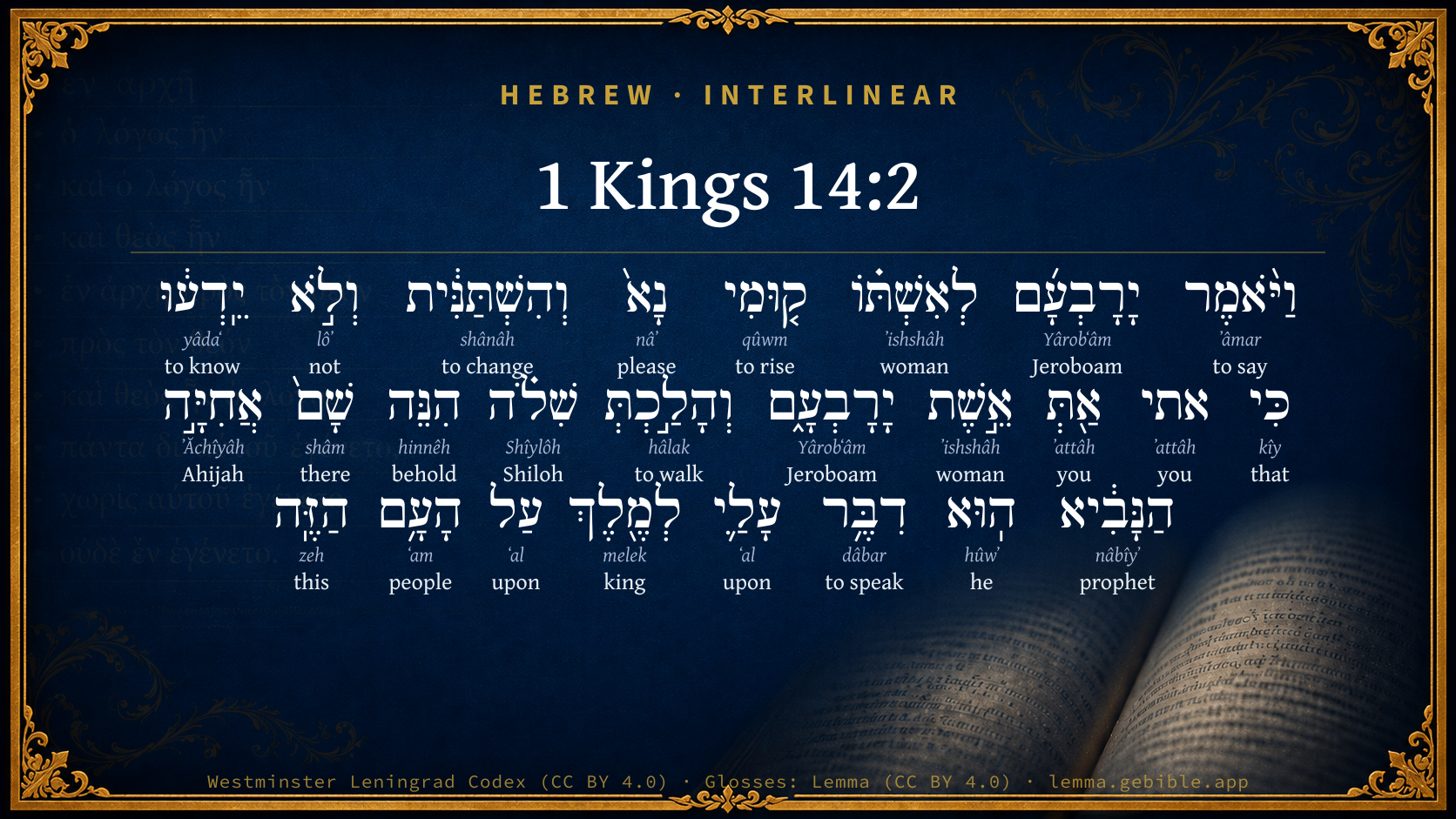
Hebrew (Westminster Leningrad Codex) 1 Kings 14:2 appears in the Hebrew Old Testament. The text above is from the Westminster Leningrad Codex. Each word links to its Strong’s number, a concise gloss, and parsing drawn from the Open Scriptures Hebrew Bible morphology. Click any word for its full Brown-Driver-Briggs (BDB) entry.
Download image
Cite this verse

1 Kings 14:2 (World English Bible). Public Domain. Lemma interlinear Bible study tool, https://lemma.gebible.app/v/1-kings/14/2.

Show BibTeX & RIS
BibTeX
RIS
English Translation
Jeroboam said to his wife, Please get up and disguise yourself, that you not be known to be the wife of Jeroboam; and get you to Shiloh: behold, there is Ahijah the prophet, who spoke concerning me that I should be king over this people.
World English Bible · Public Domain
Download a study sheet

One document with this verse’s original text, its word-by-word gloss line, the meaning frame, cross-references with their text, attributed commentary, and full source and license credits — printable, and it pastes into notes with its structure intact.

This verse Autodidact and up

Study sheet (.html) Plain text (.txt)

A passage Seminary Student

Up to 50 verses in one chapter. A passage sheet keeps up to 6 commentary sources and 12 cross-references per verse, in the order this page ranks them, and says so on the sheet whenever that leaves anything out. Ask for a single verse and you get the Autodidact verse sheet above.

Everything on this page stays free to read, with no account — the sheet is a download of what is already on screen, not access to it.

Want to remove ads? Support Godless Engineer
Compare translations 3

The same verse in 3 English versions, stacked beneath the original-language interlinear above. Click any original word for its lexicon entry.

Each is an independent rendering of the whole verse — the interlinear is not word-aligned to these translations.

Highlighted words mark where these versions differ — a whole-verse word diff, not a word-by-word alignment.

  • World English Bible Public Domain
    Jeroboam said to his wife, Please get up and disguise yourself, that you not be known to be the wife of Jeroboam; and get you to Shiloh: behold, there is Ahijah the prophet, who spoke concerning me that I should be king over this people.
  • King James Version Public Domain
    And Jeroboam said to his wife, Arise, I pray thee, and disguise thyself, that thou be not known to be the wife of Jeroboam; and get thee to Shiloh: behold, there is Ahijah the prophet, which told me that I should be king over this people.
  • unfoldingWord Literal Text CC BY-SA 4.0
    And Jeroboam said to his wife, “Arise, please, and change yourself, so they will not know that you the wife of Jeroboam. And you shall go Shiloh. Behold, Ahijah the prophet there. He, he spoke about me as king over this people.

unfoldingWord Literal Text — © unfoldingWord, licensed CC BY-SA 4.0. Word-aligned USFM3 via Door43 (git.door43.org/unfoldingWord/en_ult).

Versions to compare (up to 4)

3 of 4 selected

Show all 18 translations

Every available English version of this verse, each an independent rendering of the whole verse.

  • World English Bible Public Domain
    Jeroboam said to his wife, Please get up and disguise yourself, that you not be known to be the wife of Jeroboam; and get you to Shiloh: behold, there is Ahijah the prophet, who spoke concerning me that I should be king over this people.
  • Berean Standard Bible Public Domain
    and Jeroboam said to his wife, “Now get up, disguise yourself so they will not recognize you as my wife, and go to Shiloh. For Ahijah the prophet is there; it was he who spoke about my kingship over this people.
  • Majority Standard Bible Public Domain
    and Jeroboam said to his wife, “Now get up, disguise yourself so they will not recognize you as my wife, and go to Shiloh. For Ahijah the prophet is there; it was he who spoke about my kingship over this people.
  • King James Version Public Domain
    And Jeroboam said to his wife, Arise, I pray thee, and disguise thyself, that thou be not known to be the wife of Jeroboam; and get thee to Shiloh: behold, there is Ahijah the prophet, which told me that I should be king over this people.
  • American Standard Version (1901) Public Domain
    And Jeroboam said to his wife, Arise, I pray thee, and disguise thyself, that thou be not known to be the wife of Jeroboam; and get thee to Shiloh: behold, there is Ahijah the prophet, who spake concerning me that I should be king over this people.
  • Revised Version (1885) Public Domain
    And Jeroboam said to his wife, Arise, I pray thee, and disguise thyself, that thou be not known to be the wife of Jeroboam: and get thee to Shiloh; behold, there is Ahijah the prophet, which spake concerning me that I should be king over this people.
  • Geneva Bible (1599) Public Domain
    And Ieroboam saide vnto his wife, Vp, I pray thee, and disguise thy selfe, that they know not that thou art the wife of Ieroboam, and goe to Shiloh: for there is Ahiiah the Prophet, which tolde mee that I shoulde bee King ouer this people,
  • Douay-Rheims (1899) Public Domain
    And Jeroboam said to his wife: Arise, and change thy dress, that thou be not known to be the wife of Jeroboam, and go to Silo, where Ahias the prophet is, who told me, that I should reign over this people.
  • Young's Literal Translation Public Domain
    and Jeroboam saith to his wife, `Rise, I pray thee, and change thyself, and they know not that thou `art' wife of Jeroboam, and thou hast gone to Shiloh; lo, there `is' Ahijah the prophet; he spake unto me of `being' king over this people;
  • Literal Standard Version CC BY-SA 4.0
    and Jeroboam says to his wife, “Now rise and change yourself, and they do not know that you [are the] wife of Jeroboam, and you have gone to Shiloh; behold, Ahijah the prophet [is] there; he spoke to me of [being] king over this people;
  • Unlocked Literal Bible CC BY-SA 4.0
    Jeroboam said to his wife, “Please arise and disguise yourself, so you will not be recognized as my wife, and go to Shiloh, because Ahijah the prophet is there; he is the one who spoke about me, saying that I would become king over these people.
  • unfoldingWord Literal Text CC BY-SA 4.0
    And Jeroboam said to his wife, “Arise, please, and change yourself, so they will not know that you the wife of Jeroboam. And you shall go Shiloh. Behold, Ahijah the prophet there. He, he spoke about me as king over this people.
  • Darby Bible Public Domain
    And Jeroboam said to his wife, Arise, I pray thee, and disguise thyself, that thou be not known to be the wife of Jeroboam; and go to Shiloh: behold, there is Ahijah the prophet, who told me that [I should be] king over this people.
  • World Messianic Bible Public Domain
    Jeroboam said to his wife, “Please get up and disguise yourself, so that you won’t be recognized as Jeroboam’s wife. Go to Shiloh. Behold, Ahijah the prophet is there, who said that I would be king over this people.
  • Webster's Bible Public Domain
    And Jeroboam said to his wife, Arise, I pray thee, and disguise thyself, that thou mayest not be known to be the wife of Jeroboam; and go to Shiloh: behold, there is Ahijah the prophet, who told me that I should be king over this people.
  • Free Bible Version CC BY-SA 4.0
    So Jeroboam told his wife, “Please go and disguise yourself so nobody will know you're Jeroboam's wife. Then go to Shiloh and look for Ahijah the prophet. He was the one who told me I would become king over this people.
  • Bible in Basic English Public Domain
    And Jeroboam said to his wife, Now come, put on different clothing so that you may not seem to be the wife of Jeroboam, and go to Shiloh; see, Ahijah is there, the prophet who said I would be king over this people.
  • JPS Tanakh (1917) Public Domain
    And Jeroboam said to his wife: 'Arise, I pray thee, and disguise thyself, that thou be not known to be the wife of Jeroboam; and get thee to Shiloh; behold, there is Ahijah the prophet, who spoke concerning me that I should be king over this people.

Literal Standard Version (2020), Covenant Press — licensed CC BY-SA 4.0. Text via the HelloAO Bible API (eBible.org). Unlocked Literal Bible (unfoldingWord) — licensed CC BY-SA 4.0. Text via the HelloAO Bible API (eBible.org). unfoldingWord Literal Text — © unfoldingWord, licensed CC BY-SA 4.0. Word-aligned USFM3 via Door43 (git.door43.org/unfoldingWord/en_ult). Free Bible Version, Dr. Jonathan Gallagher — licensed CC BY-SA 4.0. Text via the HelloAO Bible API (eBible.org).

Word by word

More ways to search: Search by grammar → Find every occurrence → Compare this word →

Practice this passage: Drill this verse → Learn its vocabulary →

וְהִשְׁתַּנִּ֔ית
shânâh
H8138
“and · to change”
Conjunction + Verb, Hithpael, Perfect, 2nd Person, Feminine, Singular
Part of Speech
Conjunction + Verb
Stem
Hithpael
Form
Perfect
Person
2nd Person
Gender
Feminine
Number
Singular
Full BDB Definition

Origin: a primitive root

TWOT: 2421

to repeat, do again, change, alter - (Qal) to change - (Niphal) to be repeated - (Piel) to change, alter - (Hithpael) to disguise oneself
  1. וַיֹּ֨אמֶר ʼâmar H559 “and · to say” Conjunction + Verb, Qal, Sequential Imperfect, 3rd Person, Masculine, Singular
  2. יָרָבְעָ֜ם Yârobʻâm H3379 “Jeroboam” Noun, Proper
  3. לְאִשְׁתּ֗וֹ ʼishshâh H802 “to/for · woman · his” Preposition + Noun, Common, Feminine, Singular, Construct + Suffix, Personal, 3rd Person, Masculine, Singular
  4. ק֤וּמִי qûwm H6965 “rise” Verb, Qal, Imperative, 2nd Person, Feminine, Singular
  5. נָא֙ nâʼ H4994 “please” Particle, Exhortation
  6. וְלֹ֣א lôʼ H3808 “and · not” Conjunction + Particle, Negative
  7. יֵֽדְע֔וּ yâdaʻ H3045 “to know” Verb, Qal, Imperfect, 3rd Person, Masculine, Plural
  8. כִּי kîy H3588 “that” Conjunction
  9. אתי ʼattâh H859 “you” Pronoun, Personal, 2nd Person, Feminine, Singular
  10. אַ֖תְּ ʼattâh H859 “you” Pronoun, Personal, 2nd Person, Feminine, Singular
  11. אֵ֣שֶׁת ʼishshâh H802 “woman of” Noun, Common, Feminine, Singular, Construct
  12. יָרָבְעָ֑ם Yârobʻâm H3379 “Jeroboam” Noun, Proper
  13. וְהָלַ֣כְתְּ hâlak H1980 “and · to walk” Conjunction + Verb, Qal, Sequential Perfect, 2nd Person, Feminine, Singular
  14. שִׁלֹ֗ה Shîylôh H7887 “Shiloh” Noun, Proper
  15. הִנֵּה hinnêh H2009 “behold” Particle, Demonstrative
  16. שָׁם֙ shâm H8033 “there” Adverb
  17. אֲחִיָּ֣ה ʼĂchîyâh H281 “Ahijah” Noun, Proper
  18. הַנָּבִ֔יא nâbîyʼ H5030 “the · prophet” Particle, Definite Article + Noun, Common, Masculine, Singular, Absolute
  19. הֽוּא hûwʼ H1931 “he” Pronoun, Personal, 3rd Person, Masculine, Singular
  20. דִבֶּ֥ר dâbar H1696 “to speak” Verb, Piel, Perfect, 3rd Person, Masculine, Singular
  21. עָלַ֛י ʻal H5921 “upon · me” Preposition + Suffix, Personal, 1st Person, Common, Singular
  22. לְמֶ֖לֶךְ melek H4428 “to/for · king” Preposition + Noun, Common, Masculine, Singular, Absolute
  23. עַל ʻal H5921 “upon” Preposition
  24. הָעָ֥ם ʻam H5971 “the · people” Particle, Definite Article + Noun, Common, Masculine, Singular, Absolute
  25. הַזֶּֽה zeh H2088 “the · this” Particle, Definite Article + Pronoun, Demonstrative, Masculine, Singular

About this verse

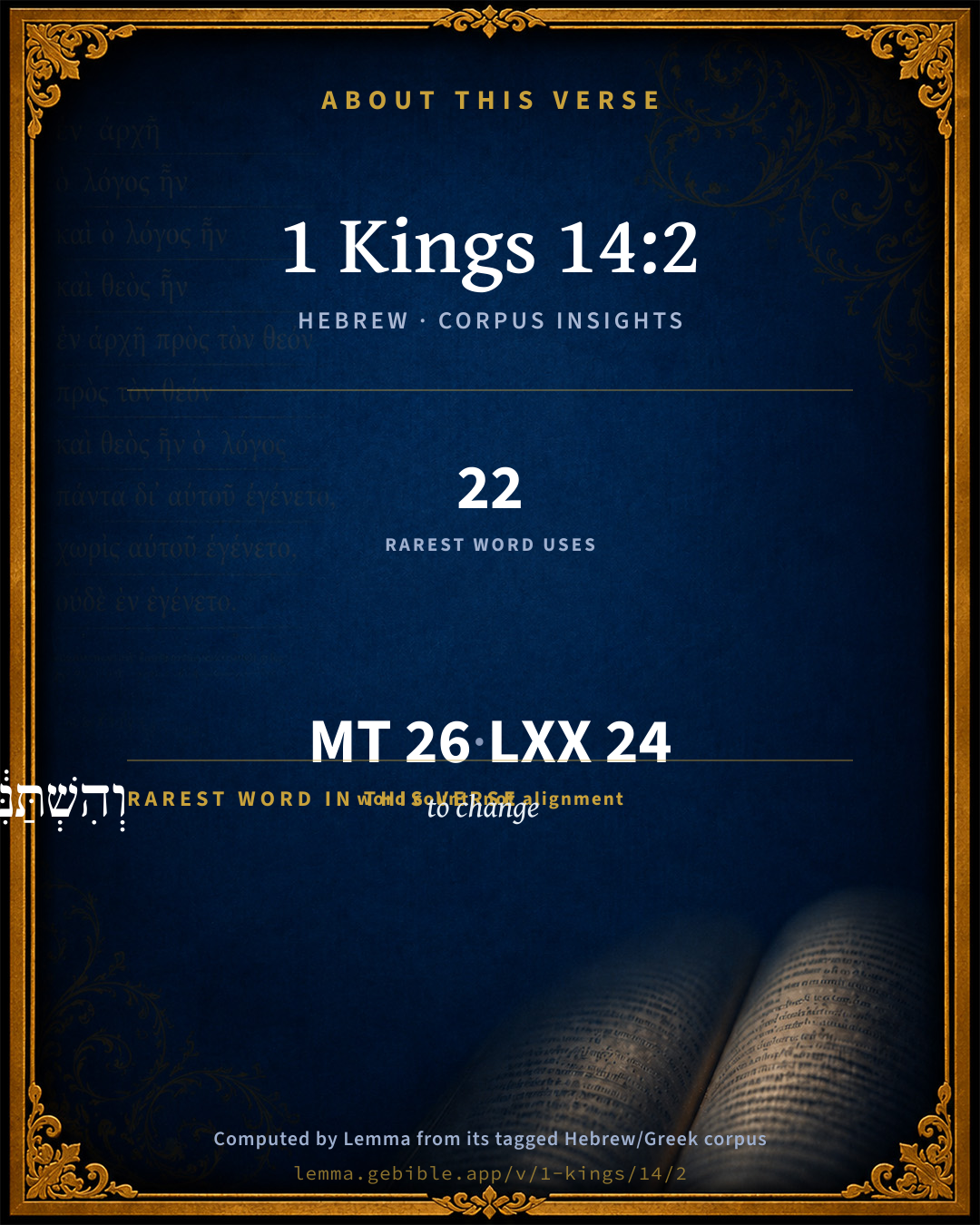
These counts appear in no published source. They are computed here, from the morphology-tagged text and Lemma’s own curated glosses. What Lemma adds →

26
words
22
distinct lemmas
Historical
section

Notable vocabulary

The rarest word here is וְהִשְׁתַּנִּ֔ית to change H8138 — appearing just 22 times in the whole Hebrew Bible.

Shared distinctive vocabulary

וְהִשְׁתַּנִּ֔ית to change H8138 occurs in 21 verses of the Hebrew Bible. Also found in:

Grammatical profile

  • 6 verbs
  • 9 nouns
  • 4 pronouns
  • 2 prepositions
  • 1 conjunction
  • 1 adverb
  • 3 particles

Verb forms

  • וַיֹּ֨אמֶר Qal · Sequential Imperfect
  • ק֤וּמִי Qal · Imperative
  • וְהִשְׁתַּנִּ֔ית Hithpael · Perfect
  • יֵֽדְע֔וּ Qal · Imperfect
  • וְהָלַ֣כְתְּ Qal · Sequential Perfect
  • דִבֶּ֥ר Piel · Perfect

Repetition

Words recur within this verse — often emphatic in Hebrew:

  • יָרָבְעָ֜ם Jeroboam H3379 ×2
  • לְאִשְׁתּ֗וֹ woman H802 ×2
  • עָלַ֛י upon H5921 ×2
  • אתי you H859 ×2

Hebrew & Septuagint length

In the original languages it is 26 Hebrew tokens and 24 Greek tokens — but the two are counted differently (Hebrew bundles its prefixes and suffixes into one token; the Greek is in lemma form), so that isn’t a like-for-like length.

Cross-references

8

Topical passages linked to 1 Kings 14:2 in the Treasury of Scripture Knowledge — connected by theme and wording, ordered by reader-vote popularity; previews shown in the World English Bible.

  • 1 Samuel 28:8 Saul disguised himself, and put on other clothing, and went, he and two men with him, and they came to the woman by night: and he said, Please divine to me by the familiar spirit, and bring me up whoever I shall name to you.
  • 2 Samuel 14:2 Joab sent to Tekoa, and fetched there a wise woman, and said to her, please act like a mourner, and put on mourning clothing, Please, and don't anoint yourself with oil, but be as a woman who has a long time mourned for the dead:
  • 1 Kings 11:29–38 It happened at that time, when Jeroboam went out of Jerusalem, that the prophet Ahijah the Shilonite found him in the way; now [Ahijah] had clad himself with a new garment; and they two were alone in the field.
  • 2 Chronicles 18:29 The king of Israel said to Jehoshaphat, I will disguise myself, and go into the battle; but put you on your robes. So the king of Israel disguised himself; and they went into the battle.
  • Joshua 18:1 The whole congregation of the children of Israel assembled themselves together at Shiloh, and set up the tent of meeting there: and the land was subdued before them.
  • 1 Kings 14:5–6 Yahweh said to Ahijah, Behold, the wife of Jeroboam comes to inquire of you concerning her son; for he is sick: thus and thus shall you tell her; for it will be, when she comes in, that she will feign herself to be another woman.
  • 1 Kings 22:30 The king of Israel said to Jehoshaphat, I will disguise myself, and go into the battle; but put you on your robes. The king of Israel disguised himself, and went into the battle.
  • Luke 12:2 But there is nothing covered up, that will not be revealed, nor hidden, that will not be known.

Cross-references courtesy of OpenBible.info (CC BY 4.0).

Hebrew and Greek witnesses Masoretic Hebrew ↔ Greek Septuagint

The same verse in the two great witnesses to the Old Testament, shown verse-for-verse.

These are two independent witnesses, not word-aligned to each other, and the Septuagint is shown in lemma (dictionary) form.

Hebrew 1 Kings 14:2 Masoretic · Westminster Leningrad Codex

וַיֹּ֨אמֶר יָרָבְעָ֜ם לְאִשְׁתּ֗וֹ ק֤וּמִי נָא֙ וְהִשְׁתַּנִּ֔ית וְלֹ֣א יֵֽדְע֔וּ כִּי אתי אַ֖תְּ אֵ֣שֶׁת יָרָבְעָ֑ם וְהָלַ֣כְתְּ שִׁלֹ֗ה הִנֵּה שָׁם֙ אֲחִיָּ֣ה הַנָּבִ֔יא הֽוּא דִבֶּ֥ר עָלַ֛י לְמֶ֖לֶךְ עַל הָעָ֥ם הַזֶּֽה

Jeroboam said to his wife, Please get up and disguise yourself, that you not be known to be the wife of Jeroboam; and get you to Shiloh: behold, there is Ahijah the prophet, who spoke concerning me that I should be king over this people.

World English Bible · Public Domain

Greek LXX 1 Kings 14:2 Septuagint · lemma form

καί ποιέω ροβοαμ ὁ πονηρός ἐνώπιον κύριος καί παραζηλόω αὐτός ἐν πᾶς ὅς ποιέω ὁ πατήρ αὐτός καί ἐν ὁ ἁμαρτία αὐτός ὅς ἁμαρτάνω

No English rendering of this Greek verse — the small residue in the structurally divergent books.

On this verse, Trapp's Complete Commentary discusses the Septuagint’s reading. Read the note in Commentary ↓

Hebrew: Westminster Leningrad Codex (CC BY 4.0). Greek: Septuagint (public domain); English from a public-domain English Septuagint. How the Septuagint differs from the Hebrew →

Targum (Aramaic paraphrase)

1

The Targum is the ancient Jewish Aramaic paraphrase of the Hebrew Scriptures — an interpretive translation, not the Hebrew text itself. Onkelos (literal) and Pseudo-Jonathan (expansive) render the Torah, and Jonathan the Prophets. Coverage is partial: where no permissively-licensed English translation exists for a verse, only the Aramaic is shown. This is verse-level text, not a word-by-word alignment to the Hebrew.

  1. Targum Jonathan Prophets (Joshua–Malachi)
    וַאֲמַר יָרָבְעָם לְאִתְּתֵיהּ קוּמִי כְעַן וְתִשְׁתַּנִין וְלָא יֵדְעוּן דְאַתְּ אִתַּת יָרָבְעָם וְתַהֲכִין לְשִׁלֹה הָא תַמָן אַחִיָה נְבִיָא הוּא מַלֵיל עֲלַי לְמֶהֱוֵי מַלְכָּא עַל עַמָא הָדֵין:

    (no public-domain English translation for this verse)

    Targum Jonathan — Aramaic: “Mikraot Gedolot” (public domain). English: “Sefaria Community Translation” (CC0 1.0 (public-domain dedication)); “London "Chaldee Paraphrase," 1871” (public domain). Text via Sefaria.

Commentary

Notes on 1 Kings 14:2 from classic Christian and Jewish commentators (each source and its license shown beneath its notes). The classic Christian expositions comment on the surrounding passage and are grouped to its opening verse, so a note may address several verses; the Jewish commentaries on the Tanakh (Rashi and others) are per-verse, so they appear only where the commentator wrote on this verse.

Lemma curates 59 commentaries, every one of them public domain or Creative Commons licensed, each selected and text-cleaned for this edition rather than reprinted as found. About our sources →

Trapp's Complete Commentary

John Trapp

1Ki 14:2 And Jeroboam said to his wife, Arise, I pray thee, and disguise thyself, that thou be not known to be the wife of Jeroboam; and get thee to Shiloh: behold, there [is] Ahijah the prophet, which told me that [I should be] king over this people.

Ver. 2. And Jeroboam said to his wife.] To her, rather than to another messenger, for secrecy’s sake; for although he knew that his son’s sickness was sent of God, yet he was loath openly to seek help of him, lest people should think the worse of his idols, as not able to relieve him; or by his example, run to God’s true prophets in their distress. Whether Jeroboam’s wife was sister to the queen of Egypt, and called by the name of Ano, as the Septuagint say, or Anna, as some others, is not very material.

Behold, there is Abijah the prophet.] Either there he dwelt, or thither he had retired himself, as irked at the king’s idolatries.

Which told me that I should be king.] Therein he told truth; and therefore also he will in this case.

John Trapp, A Commentary or Exposition upon All the Books of the Old and New Testament (1647–1656) — public domain. Text from a community e-Sword module.

Joseph Benson's Commentary

1Ki 14:2. Jeroboam said to his wife, Arise, &c. — “He most probably sent his wife to consult the prophet at Shiloh, because this was a secret not to be intrusted with any body else; a secret which, had it been divulged, might have endangered his whole government; because, if once his subjects came to understand that he himself had no confidence in the calves which he had set up, but in any matter of importance had recourse to true worshippers of God, it can hardly be conceived what an inducement this would have been for them to forsake these senseless idols, and to return to the worship of the God of Israel, whom they had imprudently forsaken. The queen then was the only person in whom he could have confidence. As a mother he knew she would be diligent in her inquiry; and as a wife faithful in her report.” — Dodd. Disguise thyself — Change thy habit and voice, and go like a private and obscure person. This caution proceeded, first, from the pride of his heart, which made him unwilling to confess his folly in worshipping such helpless idols, and to give glory to the God whom he had forsaken: secondly, from jealousy and suspicion, lest the Prophet Ahijah, (who he knew was greatly offended at him for the idolatry he had introduced,) if he knew her to be his wife, should either give her no answer, or make things worse than indeed they were.

Joseph Benson's Commentary on the Old and New Testaments (1811–1818) — public domain. Text from a community e-Sword module.

Tyndale Open Study Notes

Tyndale Open Resources

14:2 Disguise yourself: Jeroboam apparently recognized that his sin had separated him from any right to approach God’s prophet. He knew that the man who had predicted his accession to Israel’s throne could predict the child’s fate and perhaps intercede with the Lord on his behalf. • Shiloh had earlier been destroyed by the Philistines in the time of Eli (1 Sam 4). Before that, the Tabernacle resided there (Josh 18:1; 1 Sam 1:3). A small community once again inhabited the site, which remained largely undeveloped throughout the divided monarchy.

Tyndale Open Study Notes — © Tyndale Open Resources, licensed CC BY-SA 4.0. Text via the HelloAO Bible API.

Geneva Bible (1599)

Geneva Bible translators

His own conscience bare him witness, that the Prophet of God would not satisfy his affections, which was a wicked man.

Geneva Bible (1599) marginal notes — public domain. Text via Bolls.life.

Jamieson, Fausset & Brown

Robert Jamieson, A. R. Fausset & David Brown

Jeroboam said to his wife, Arise, I pray thee, and disguise thyself--His natural and intense anxiety as a parent is here seen, blended with the deep and artful policy of an apostate king. The reason of this extreme caution was an unwillingness to acknowledge that he looked for information as to the future, not to his idols, but to the true God; and a fear that this step, if publicly known, might endanger the stability of his whole political system; and a strong impression that Ahijah, who was greatly offended with him, would, if consulted openly by his queen, either insult or refuse to receive her. For these reasons he selected his wife, as, in every view, the most proper for such a secret and confidential errand, but recommended her to assume the garb and manner of a peasant woman. Strange infatuation, to suppose that the God who could reveal futurity could not penetrate a flimsy disguise!

Jamieson, Fausset & Brown — Commentary Critical and Explanatory on the Whole Bible (1871) — public domain (CC PDM 1.0). Text via the HelloAO Bible API.

Ellicott's Commentary for English Readers

(2) Shiloh, the regular habitation of Ahijah, is hardly mentioned in Scripture after the time of Eli, and the destruction which then seems to have fallen upon it, probably after the great defeat by the Philistines (Jer_7:12). It is evident that the old blind prophet still remained there, and exercised his prophetic office for the benefit of Israel, though he stood aloof from, and denounced, the new idolatry of Bethel. This idolatry is always described as pre-eminently the “sin of Jeroboam,” who by it “made Israel to sin.” Hence, while in consequence of it the royal house is condemned, the people are still regarded as God’s chosen people, to whom, even more than to the inhabitants of the kingdom of Judah, the prophets ministered, and to whom—having no longer the Temple and the consecrated royalty of David, as perpetual witnesses for God—the prophetic ministrations were of pre-eminent importance. Accordingly, the wife of Jeroboam is bidden to approach the prophet disguised as a daughter of the people.

A Bible Commentary for English Readers, edited by Charles John Ellicott (1878–1897) — public domain. Text from a community e-Sword module.

The Cambridge Bible for Schools and Colleges

gen. ed. J. J. S. Perowne

2. and disguise thyself] She was to put on such a dress that no one would recognise her for the queen. Jeroboam no doubt felt that the prophets generally were against him, and that if it were known that he was the applicant, he would receive an unfavourable answer. Josephus describes the queen as putting aside her royal robe, and assuming the dress of a private person. Otherwise she could scarcely have gone abroad on her errand. Of course she was also to conceal her identity from Ahijah, but as he was not able to see, the dress would have mattered little on his account. In the LXX. (Alex.) it is said ‘they shall not know thee’, i.e. people generally.

Ahijah] On Ahijah and Shiloh see above on 1Ki_11:29.

which told me that I should be king] R.V. ‘Which spake concerning me that I should be king’. This is somewhat nearer to the Hebrew, but the difficulty is in the word rendered ‘that I should be king’ which is a noun with a preposition לְמֶלֶךְ = ‘for a king’, where we should have expected rather the verbal form לִמְלךְ.

The Cambridge Bible for Schools and Colleges (gen. ed. J. J. S. Perowne; Cambridge University Press, 1878–1918) — public domain. Text from a community e-Sword module.

John Gill's Exposition

And take with thee ten loaves, and cracknels, and a cruse of honey, and go to him,.... It being usual to carry a present to a prophet when he was inquired of on any account, see Sa1 9:7 and this being a plain present, and of such things as the country afforded, she might be taken for a plain countrywoman, and not for such a personage as she was: the ten loaves could not be large for a woman to carry, most probably made of wheat; the cracknels, according to the Greek version in Drusius, were for the prophet's children; they very likely were spiced, or were sweetened with honey, and might be somewhat like our simnels; they seem to have their name in Hebrew from having points and pricks in them for the sake of ornament; such as Plautus (h) calls "scribilitae", because as Turnebus (i) says, they were marked and pricked, and seemed as if they were written:

he shall tell thee what shall become of the child; whether it should live or die, for that was all he wanted to know; he did not desire to know what should be done to the child for its recovery, nor to request the prophet's prayers for it.

(h) Prolog. Poenulo, ver. 43. (i) Adversar. l. 23. c. 10.

John Gill's Exposition of the Whole Bible (1746–1763) — public domain (CC PDM 1.0). Text via the HelloAO Bible API.

Albert Barnes' Notes on the Bible

Disguise thyself - Jeroboam fears that even Ahijah the Shilonite, who in some sort made him king, will scarcely give his queen a favorable answer. The king’s conscience tells him that he has not performed the conditions on which he was promised “a sure house” 1Ki 11:38.

Albert Barnes' Notes on the Bible (1834–1885) — public domain. Text from a community e-Sword/MySword module.

Haydock's Catholic Bible Commentary

Dress. As if the prophet, who could dive into futurity, could be thus imposed upon. Jeroboam was aware that he would be full of indignation at the changes which had been introduced. He might also fear, lest his wife might be exposed to danger in (Calmet) or near (Haydock) the enemy’s country, (Calmet) and the people would have been more convinced of the vanity of their idols, if they had seen that it was necessary to have recourse to a prophet of the true God. (Menochius) --- The mother might ask without the least suspicion, "Will my son recover?" --- Silo might still be attached to the service of God, in consequence of the ark residing there so long, and the presence of the revered Ahias; so that, if it formed a part of the dominions of Israel, (Tirinus) as it was in the tribe of Ephraim, though nearer Jerusalem than Sichem, (Calmet) Jeroboam might reasonably fear lest his wife should be treated with indignity. (Tirinus)

George Leo Haydock (1774–1849), Haydock's Catholic Family Bible and Commentary, 1859 edition — public domain. Excludes Psalms (Douay-Rheims chapter numbering differs from Protestant) and Deuterocanonical books (Catholic canon only).

Matthew Poole's English Annotations

Jeroboam said to his wife; partly, because he would trust none else with this secret; partly, because she might, without suspicion, inquire concerning her own child; and partly, because she would inquire most exactly and diligently, and faithfully acquaint him with the whole truth.

Disguise thyself; change thy habit and voice, and go like a private and obscure person.

That thou be not known to be the wife of Jeroboam: this caution proceeded, first, From the pride of his heart, which made him loth to confess his folly in worshipping such ignorant and helpless idols, and to give glory to the God whom he had forsaken. Secondly, From jealousy and suspicion, lest the prophet knowing this, should either give her no answer, or make it worse than indeed it was. Thirdly, From policy, lest his people should by his example be drawn to forsake the senseless calves, and to return to the God of Judah, whom they had rashly forsaken.

Matthew Poole's English Annotations on the Holy Bible (1683–1685) — public domain. Text from a community e-Sword/MySword module.

Whedon's Commentary on the Bible

Daniel D. Whedon

2. Disguise thyself — He would not have it known in Israel that his queen went on such an errand. It would show that neither his calves nor his self-made priests could help him in the time of trouble. His heart had become so infatuated and clouded by his false worship as to imagine that Jehovah’s prophet might not detect his guile. He dared not meet the old prophet, but sent his wife, for a sense of his own sins admonished him that he deserved condemnation, and would receive it if he went in person to Ahijah.

The prophet which told me that I should be king — He now remembered, when his son seemed about to die, that the prophet had spoken of his having a sure house like David, (compare 1Ki_11:38,) and he fondly clung to that hope, though he had failed in meeting its conditions.

Daniel D. Whedon (gen. ed.), Commentary on the Old and New Testaments (1874–1909) — public domain. Text from a community e-Sword module.

The Pulpit Commentary

And Jeroboam said to his wife Conscious that his proceedings would merit Ahijah"s reproof, he is afraid to go in person. And his wife if in this particular we may trust the LXX, an Egyptian princess could be more readily disguised. The commission was too delicate to beentrusted to a stranger. "None might know it but his own bosom, and she that lay in it" (Bp. Hall). Jeroboam evidently suspected that this sickness was punitive, and he would not have others think so too, Arise, I pray thee, and disguise lit., change. The word suggests that the disguise was to be effected by a change of garments. "She must put off her robes and put on a russet coat" (ib.) Possibly the queen was not unknown to the prophet (ver. 4) thyself, that thou Observe the archaic form yTia for Ta which latter the Keri would substitute, quite needlessly, here be not known Heb. and they (i.e., those whom she met, not the prophet only) shall not know that thou art, etc. to be the wife of Jeroboam; and get thee to Shiloh the modern Seilun. "There is no site in the country fixed with greater certainty than that of Shiloh". (Conder, p. 44. See. Jud_1:21:19) The identification, however, was only effected in 1838. Conder gives some interesting particulars which lead him to believe that we can identify the very site of the tabernacle. For its history, see Jos_16:5 Jos_18:1-10; Jud_1:18:31 21:19; 1Sa_4:3; Jer_41:5.Presuming that Tirzah is to be identified with Teiasir (see on ver. 17) Shiloh would be over thirty miles" distant more than a day"s journey to the queen, as the road involves some toilsome climbing: behold, there is Ahijah the prophet. (see on 1Ki_11:29) Shiloh was probably the birthplace, as well as the residence, of Ahijah. It was in the territory of Ephraim, (Jos_16:6) and at no great distance from Bethel. We can only explain Ahijah"s continued residence there, after the migration of the God-fearing Israelites to the southern kingdom, not by his great age, but by the supposition that, having been concerned in the transfer of the kingdom to Jeroboam, he felt it a duty to stay and watch his career. And the time has now come when he can be useful. His relations with Jeroboam had apparently so far been good. He had not protested, so far as we know, against the calf worship, but then God had sent another prophet to do that, which told me that I should be king Heb. he spake of me for king over this people. So that he had already proved himself a true prophet, and so far a prophet of good.

The Pulpit Commentary (1880–1919), ed. H.D.M. Spence-Jones & Joseph S. Exell — public domain. Text from a community e-Sword module.

John Wesley's Explanatory Notes

His wife - Because she might without suspicion inquire concerning her own child; and because she would inquire exactly, and diligently, and faithfully acquaint him with the truth. Disguise - Change thy habit, and voice, and go like a private and obscure person. This caution proceeded: first, from the pride of his heart, which made him loth to confess his folly in worshipping such helpless idols, and to give glory to the God whom he had forsaken. Secondly, from jealousy and suspicion, lest the prophet knowing this, should either give her no answer, or make it worse than indeed it was. Thirdly, from policy, lest his people should by his example be drawn to forsake the calves, and to return to the God of Judah.

John Wesley, Explanatory Notes Upon the Whole Bible (1754–1765) — public domain. Text via the GEBible commentary corpus.

Lesson kit

Teaching starters — assembled from the data on this page, not authored interpretation. Every prompt links to the verse data it draws on. Edit before teaching.

1 Kings, in the Historical, opens this verse with 26 words (22 distinct Hebrew lemmas). Its most distinctive word is shânâh (“to change”). A historical commentator’s framing appears above. Read the whole chapter for the surrounding context.

Discussion questions

  1. How does “to change” (shânâh) shape what this verse is saying?
  2. Genesis 41:32 shares the word «to change» with this verse. How do the two illuminate each other?
  3. “Jeroboam” occurs 2× in this one verse. What is the effect of the repetition?
  4. These translations render this verse differently; the difference is in the English rendering, not the original. What questions does that raise?
  5. The verb «וַיֹּ֨אמֶר» is Qal Sequential Imperfect. How does its form color the action?
  6. Reading how Trapp's Complete Commentary and Joseph Benson's Commentary read this verse, where do the two commentators agree and where do they part?

Things to notice

Reading settings

Reading text

Shown beneath each verse's original-language words.

Old Testament
Old Testament edition

Read the OT as the Masoretic Hebrew (MT) or the Greek Septuagint (LXX).

English shown for the Greek Septuagint (in the Hebrew ↔ Greek comparison).

Comparing translations? Open the Compare panel on any verse page to stack up to four side by side.