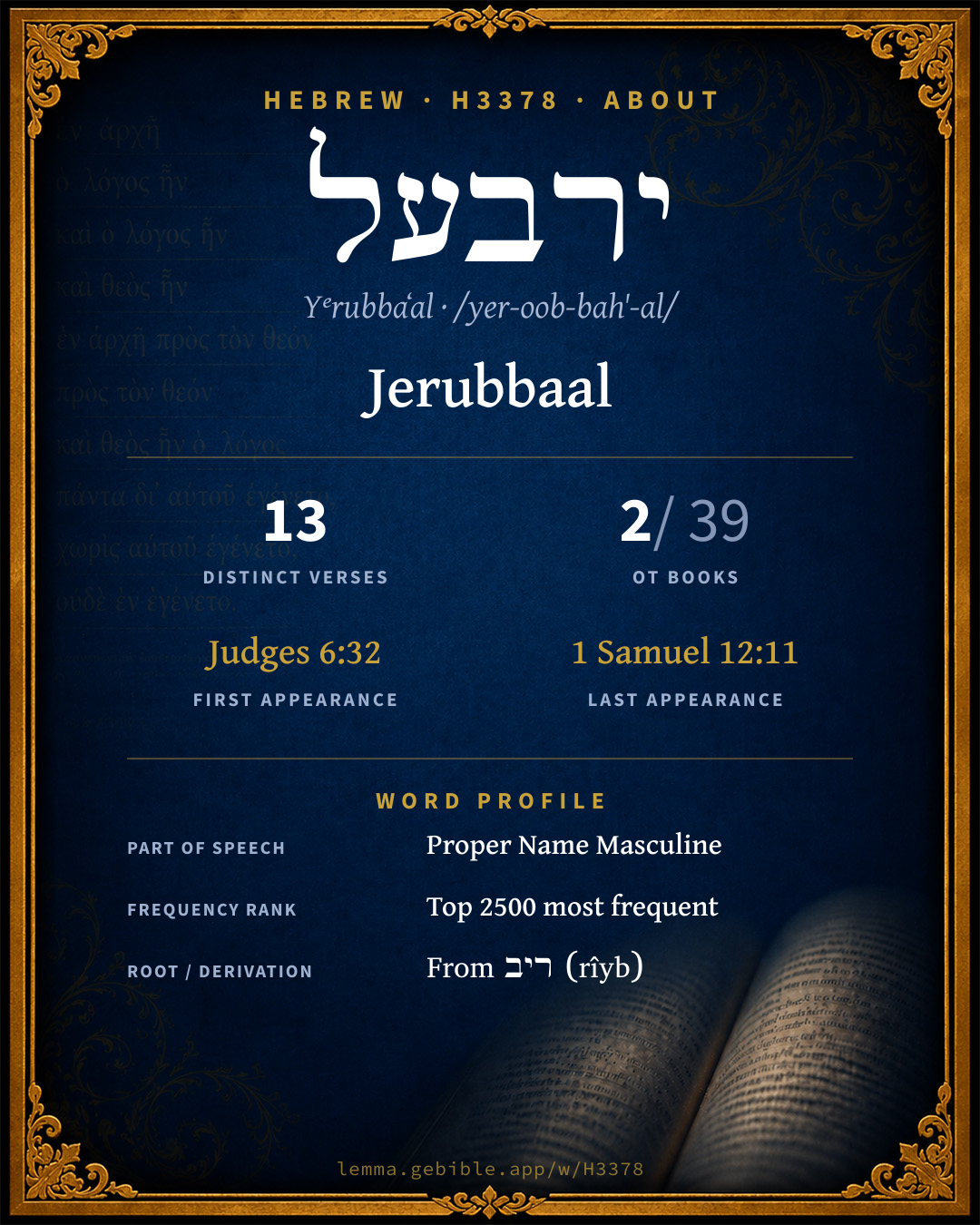
יְרֻבַּ֫עַל
Jerubbaal
BDB lists 2 entries for ‘Jerubbaal’ fuller range ↓
Full lexicon entry — Brown-Driver-Briggs (BDB)
From Brown-Driver-Briggs (BDB)
Where this word appears
Grammar key — what these labels mean
Part of speech
- Noun
- A naming word — a person, place, thing, or idea.
Noun type
- Proper
- A name of a specific person, place, or people (e.g. Abraham, Zion, Israel).
Every verse where H3378 appears — 13 distinct verses across 2 books. Click any verse to open its interlinear word-by-word view. Verse text shown in the World English Bible for context — . Each verse’s Hebrew form is shown with its reference; the English is not keyword-highlighted, since the data carries no word-level English alignment. Use “Compare translations” on any verse to read it across multiple English versions. This concordance covers the Hebrew Bible; Septuagint (Greek Old Testament) occurrences are not indexed here.
Judges 12 verses
- Judges 6:32 יְרֻבַּ֣עַל n Proper Therefore on that day he named him Jerubbaal, saying, Let Baal contend against him, because he has broken down his altar.
- Judges 7:1 יְרֻבַּ֜עַל n Proper Then Jerubbaal, who is Gideon, and all the people who were with him, rose up early, and encamped beside the spring of Harod: and the camp of Midian was on the north side of them, by the hill of Moreh, in the valley.
- Judges 8:29 יְרֻבַּ֥עַל n Proper Jerubbaal the son of Joash went and lived in his own house.
- Judges 8:35 יְרֻבַּ֖עַל n Proper neither shown they kindness to the house of Jerubbaal, [who is] Gideon, according to all the goodness which he had shown to Israel.
- Judges 9:1 יְרֻבַּ֨עַל֙ n Proper Abimelech the son of Jerubbaal went to Shechem to his mother's brothers, and spoke with them, and with all the family of the house of his mother's father, saying,
- Judges 9:2 יְרֻבַּ֔עַל n Proper Please speak in the ears of all the men of Shechem, Whether is better for you, that all the sons of Jerubbaal, who are seventy persons, rule over you, or that one rule over you? Remember also that I am your bone and your flesh.
- Judges 9:5 יְרֻבַּ֛עַל יְרֻבַּ֛עַל n Proper n Proper He went to his father's house at Ophrah, and killed his brothers the sons of Jerubbaal, being seventy persons, on one stone: but Jotham the youngest son of Jerubbaal was left; for he hid himself.
- Judges 9:16 יְרֻבַּ֣עַל n Proper Now therefore, if you have dealt truly and righteously, in that you have made Abimelech king, and if you have dealt well with Jerubbaal and his house, and have done to him according to the deserving of his hands
- Judges 9:19 יְרֻבַּ֥עַל n Proper if you then have dealt truly and righteously with Jerubbaal and with his house this day, then rejoice you in Abimelech, and let him also rejoice in you:
- Judges 9:24 יְרֻבָּ֑עַל n Proper that the violence done to the seventy sons of Jerubbaal might come, and that their blood might be laid on Abimelech their brother, who killed them, and on the men of Shechem, who strengthened his hands to kill his brothers.
- Judges 9:28 יְרֻבַּ֖עַל n Proper Gaal the son of Ebed said, Who is Abimelech, and who is Shechem, that we should serve him? Isn't he the son of Jerubbaal? and Zebul his officer? serve you the men of Hamor the father of Shechem: but why should we serve him?
- Judges 9:57 יְרֻבָּֽעַל n Proper and all the wickedness of the men of Shechem did God requite on their heads: and on them came the curse of Jotham the son of Jerubbaal.
1 Samuel 1 verse
About this entry
At a glance — auto-summarized from this page’s data, not written by a person. Every figure links to its source below. This summary describes the numbers; it doesn’t interpret them.
The Hebrew name ירבעל centers on the idea of “Jerubbaal.” The word gravitates to Judges (92%), then 1 Samuel. It appears 13 verses across 2 books of the Hebrew Bible, among its uncommon vocabulary. Debuting at Judges 6:32, it then recurs through the corpus. Dig into 13-verse concordance and the renderings breakdown below.
Gloss history
Strong's 1890 vs modern scholarship
About this word
Strong's H3378 catalogs a Hebrew word from the Hebrew Old Testament.
These counts are not copied from any lexicon or concordance. They are computed here, from the morphology-tagged Hebrew Old Testament. What Lemma adds →
- 13
- distinct verses
- The word appears in 13 distinct verses.
- 2 / 39
- OT books
- The word appears in 2 of 39 Old Testament books.
- #1,910
- by frequency
- Top 2500 most frequent Hebrew words (rank 1,910 of 8,640 Hebrew words by occurrence).
View all 13 occurrences in the concordance →
By traditional corpus
Conventional, traditional groupings — biblical authorship is debated, so this is a traditional corpus grouping, not an authorship claim. Each share is this word’s portion of its verses in that division of the Hebrew canon. Each figure is a share of the word’s 13 distinct verses.
- Prophets (Nevi'im) 13 verses · 100%
How translations render this word
Counts come from each version’s own published word-to-Strong’s tagging or interlinear alignment — an approximate guide to how each version renders this word, not a word-level alignment the data otherwise carries. Because each total is that version’s own tagged count, the per-version totals vary from one another and need not match the appearance or distinct-verse counts above. These counts may also differ from a printed concordance because Lemma counts each distinctly tagged rendering and does not collapse phrase taggings into a single head-word total. This is a fixed set of word-tagged versions (KJV, ASV, BSB, ULT) and does not change with the reading translation you choose elsewhere. Each version’s license is shown beside its name below (and on Sources).
BDB lists this Strong’s number as 2 distinct words (homographs). Each count above pools all of them and is not split by sense — see the Senses section below. A low-frequency rendering may belong to a different one of those words, not the primary meaning.
- King James Version†: Jerubbaal 14×
- American Standard Version†: Jerubbaal 12×
- Berean Standard Bible†: Jerubbaal 13×
- unfoldingWord Literal Text†: Jerubbaal 14×
King James Version Public Domain
Renders H3378 across 14† tagged occurrences — most commonly:
American Standard Version Public Domain
Renders H3378 across 14† tagged occurrences — most commonly:
Plus 2 renderings that appear only once — usually multi-word phrases or single function words the recovered tagging swept in, not distinct renderings.
Berean Standard Bible Public Domain
Renders H3378 across 14† tagged occurrences — most commonly:
Plus 1 rendering that appears only once — usually multi-word phrases or single function words the recovered tagging swept in, not distinct renderings.
unfoldingWord Literal Text CC BY-SA 4.0
Renders H3378 across 14† tagged occurrences — most commonly:
Senses in BDB
The 2 senses BDB distinguishes for this word, in lexicon order (not ranked by frequency or importance). The full entry — with sub-senses — is in the Lexicon Entry tab.
- Jerubbaal = "let Baal contend"
- name given to Gideon by his father when he destroyed the altar of Baal
Word origin
n.pr.m. name given to Gideon (according to Ju 6:32, where expl. as let Baal contend (cf. Dr 2 S 4(×2) Köii. 1, 467); Impf. ירוב not elsewhere [yet תרוב Pr 3:30 Kt, and Inf. cstr. רוב Ju 21:23 Kt], hence WeSm 31 expl. as = יְרוּבַעַל, √ ירה, cf. יְרוּאֵל, יְרִיאֵל (p. 436 b), so GFM Ju Bu Ju Now Ju);—Ju 6:32; 7:1; 8:29, 35; 9:1 + 8 times 9 (-בָּ֑עַל 9:24, 57), 1 S 12:11; = יְרֻבֶּ֫שֶׁת †2 S 11:21 (v. בֹּשֶׁת 2, sub בושׁ); Ιεροβααλ (usually; so 𝔊L 1 S 12:11 2 S 11:21, where 𝔊B Ιεροβοαμ).—יָרָבְעָם, v. רבב.
— Brown-Driver-Briggs (Oxford 1906, public domain), digitized via Sefaria, supplemented by the OpenScriptures HebrewLexicon (CC BY 4.0). See Sources.
Derived from ריב (rîyb) (H7378) — to contend.
Forms in the corpus
The 9 distinct written forms H3378 takes in the Hebrew Bible, most frequent first — each parse links to that state’s occurrences in the concordance. Hebrew forms include their vowel points and cantillation, so a single lemma takes many written forms.
| Form | Parsing | Example | Uses |
|---|---|---|---|
| יְרֻבַּ֣עַל | Noun, Proper | 1 Samuel 12:11 | 3 |
| יְרֻבַּ֖עַל | Noun, Proper | Judges 8:35 | 2 |
| יְרֻבַּ֛עַל | Noun, Proper | Judges 9:5 | 2 |
| יְרֻבַּ֥עַל | Noun, Proper | Judges 8:29 | 2 |
| יְרֻבַּ֔עַל | Noun, Proper | Judges 9:2 | 1 |
| יְרֻבַּ֜עַל | Noun, Proper | Judges 7:1 | 1 |
| יְרֻבַּ֨עַל֙ | Noun, Proper | Judges 9:1 | 1 |
| יְרֻבָּ֑עַל | Noun, Proper | Judges 9:24 | 1 |
| יְרֻבָּֽעַל | Noun, Proper | Judges 9:57 | 1 |
Same root — word family
Other BDB entries built from the same root as H3378, grouped by Strong’s listed origin. These share a root / origin per the lexicon — not necessarily a shared meaning. Each links to that word’s own entry.
Derives from
Shares the same root
Proper names from this root
People and places named from this root — a name, not an additional meaning of the word.
- ירב Yârêb H3377 Jareb
- ירבעם Yârobʻâm H3379 Jeroboam
- ירבשת Yᵉrubbesheth H3380 Jerubbesheth
- מריב בעל Mᵉrîyb Baʻal H4807 Merib-baal
- ריבי Rîybay H7380 Ribai
Compare all same-root words → Showing 4 of 10 — not the complete family. 5 of the same-root words are proper names (people or places). They share a root, not necessarily a meaning.
Bible dictionary
Public-domain dictionary articles matched to this entry by name (Jerubbaal). A biblical name can be shared by more than one person or place, so an article may treat several.
Easton's Bible Dictionary · M. G. Easton, 1897
Contender with Baal; or, let Baal plead, a surname of Gideon; a name given to him because he destroyed the altar of Baal (Judg. 6:32; 7:1; 8:29; 1 Sam. 12:11).
Hitchcock's Bible Names Dictionary · Roswell D. Hitchcock, 1869
he that defends Baal, let Baal defend his cause
Classic public-domain reference works; full attribution on Sources.
Septuagint verse parallels
This word appears in 13 verses that also exist in the Greek Old Testament (Septuagint), out of the 13 Hebrew verses it occurs in. You can read those verses in Greek by switching the Old Testament edition to the Septuagint.
Read these verses in the Septuagint
This is a verse-level parallel only — the same verses exist in both the Hebrew and Greek Old Testaments. No word-level Hebrew↔Greek correspondence is claimed: the data carries no such alignment, so no Greek word is shown as this Hebrew word’s translation. Coverage is not total — the Septuagint omits the deuterocanon and renumbers the Psalms, so some Hebrew verses have no direct Greek parallel.